>>>>>>>>
1 Distinguish between business and

5

Explain how today’s business
workforce is changing.

2 Identify and describe the factors of

6

Describe how the nature of work
itself is changing.

3 Describe the private enterprise

7

Identify the skills and attributes
managers need to lead businesses in
the 21st century.

4 Identify the six eras of business, and

8

Outline the characteristics that make
a company admired by the business
community.

not-for-profit organizations.

production.

system, including basic rights and
entrepreneurship.

explain how the relationship eraincluding alliances, technology, and
environmental concerns-influences
contemporary business.
Profit-seeking activities and enterprises provide
goods and services necessary to an economic
system.
Profit is the reward for businesspeople who take the
risk involved to offer goods and services to
customers.





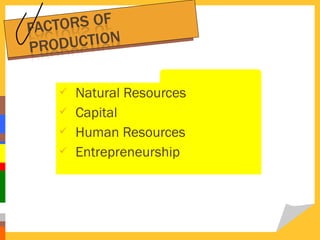
Natural Resources
Capital
Human Resources
Entrepreneurship









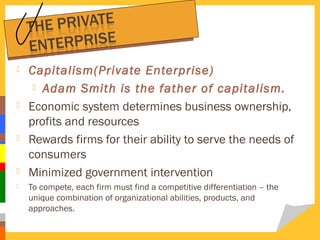
Capitalism(Private Enterprise)
 Adam Smith is the father of capitalism.
Economic system determines business ownership,
profits and resources
Rewards firms for their ability to serve the needs of
consumers
Minimized government intervention
To compete, each firm must find a competitive differentiation – the
unique combination of organizational abilities, products, and
approaches.
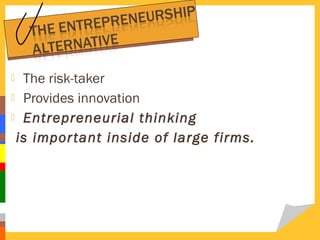
The risk-taker
 Provides innovation
 Entrepreneurial thinking
is impor tant inside of large firms.



Relationship Management



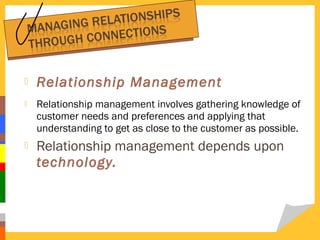
Relationship management involves gathering knowledge of
customer needs and preferences and applying that
understanding to get as close to the customer as possible.



Relationship management depends upon
technology.
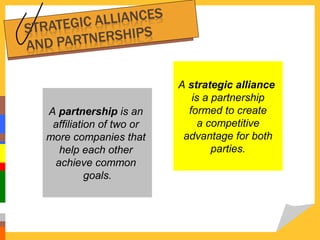
A partnership is an
affiliation of two or
more companies that
help each other
achieve common
goals.

A strategic alliance
is a partnership
formed to create
a competitive
advantage for both
parties.


Dedicated workers who can foster strong
ties with customers



Capable of high-quality production



Ability to compete in global markets



firm’s competitive differentiation


Blending individuals of dif ferent genders,
ethnic backgrounds, cultures, religions,
ages, and physical and mental abilities.



Diverse employee teams and workforces tend to perform
tasks more effectively and develop better solutions to
business problems because of their varied perspectives
and experiences. Attention to diversity issues can help
them avoid damaging legal battles.
Outsourcing is using
outside vendors to
produce goods or
fulfill services and
functions that were
previously handled
in-house or in-country.

Off-shoring is the
relocation of business
processes to lower
cost locations
overseas.
and Innovation Through Collaboration






Workers want a flexible work-life balance
that rewards them for their skills.
Part-time and temporary workers are
growing
The relationship between employees and
workers needs to be a valuable partnership
that drives innovation through collaboration.





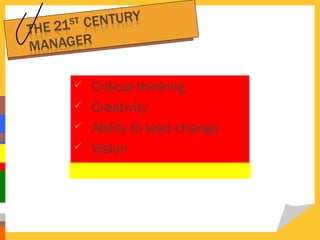
Critical-thinking
Creativity
Ability to lead change
Vision


Critical thinking is the ability to analyze
and assess information to pinpoint problems
or opportunities.



Creativity is the capacity to develop novel
solutions to perceived organizational
problems.


Guide employees and organizations through changes



Managers must be comfortable with tough decisions.



Organizational change may come internally from new company goals, emerging
employee needs, labor union demands or production problems.



External forces might include feedback from customers, developments in the
international marketplace, economic trends, and new technologies.



Changes brought on by technology, the marketplace and global competition
require leadership.


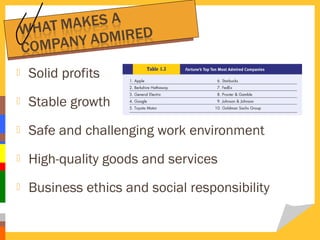
Solid profits



Stable growth



Safe and challenging work environment



High-quality goods and services



Business ethics and social responsibility

Ch01itb

  • 3.
  • 4.
    1 Distinguish betweenbusiness and 5 Explain how today’s business workforce is changing. 2 Identify and describe the factors of 6 Describe how the nature of work itself is changing. 3 Describe the private enterprise 7 Identify the skills and attributes managers need to lead businesses in the 21st century. 4 Identify the six eras of business, and 8 Outline the characteristics that make a company admired by the business community. not-for-profit organizations. production. system, including basic rights and entrepreneurship. explain how the relationship eraincluding alliances, technology, and environmental concerns-influences contemporary business.
  • 5.
    Profit-seeking activities andenterprises provide goods and services necessary to an economic system. Profit is the reward for businesspeople who take the risk involved to offer goods and services to customers.
  • 6.
  • 7.
         Capitalism(Private Enterprise)  AdamSmith is the father of capitalism. Economic system determines business ownership, profits and resources Rewards firms for their ability to serve the needs of consumers Minimized government intervention To compete, each firm must find a competitive differentiation – the unique combination of organizational abilities, products, and approaches.
  • 9.
    The risk-taker  Providesinnovation  Entrepreneurial thinking is impor tant inside of large firms. 
  • 12.
     Relationship Management  Relationship managementinvolves gathering knowledge of customer needs and preferences and applying that understanding to get as close to the customer as possible.  Relationship management depends upon technology.
  • 13.
    A partnership isan affiliation of two or more companies that help each other achieve common goals. A strategic alliance is a partnership formed to create a competitive advantage for both parties.
  • 14.
     Dedicated workers whocan foster strong ties with customers  Capable of high-quality production  Ability to compete in global markets  firm’s competitive differentiation
  • 15.
     Blending individuals ofdif ferent genders, ethnic backgrounds, cultures, religions, ages, and physical and mental abilities.  Diverse employee teams and workforces tend to perform tasks more effectively and develop better solutions to business problems because of their varied perspectives and experiences. Attention to diversity issues can help them avoid damaging legal battles.
  • 17.
    Outsourcing is using outsidevendors to produce goods or fulfill services and functions that were previously handled in-house or in-country. Off-shoring is the relocation of business processes to lower cost locations overseas.
  • 18.
    and Innovation ThroughCollaboration    Workers want a flexible work-life balance that rewards them for their skills. Part-time and temporary workers are growing The relationship between employees and workers needs to be a valuable partnership that drives innovation through collaboration.
  • 19.
  • 20.
     Critical thinking isthe ability to analyze and assess information to pinpoint problems or opportunities.  Creativity is the capacity to develop novel solutions to perceived organizational problems.
  • 21.
     Guide employees andorganizations through changes  Managers must be comfortable with tough decisions.  Organizational change may come internally from new company goals, emerging employee needs, labor union demands or production problems.  External forces might include feedback from customers, developments in the international marketplace, economic trends, and new technologies.  Changes brought on by technology, the marketplace and global competition require leadership.
  • 22.
     Solid profits  Stable growth  Safeand challenging work environment  High-quality goods and services  Business ethics and social responsibility

Editor's Notes

  • #6 Some businesses produce tangible goods while others provide services. Businesses are large enterprises like General Electric or Microsoft or the small cleaners in your neighborhood. Profits are the central focus of business because without profits, a company could not survive. Organizations like the Red Cross and the American Heart Association are not-for-profit organizations. These are businesslike establishments that have a primary objective other than returning profits to their owners. These organizations play an important role in society by placing public service above profits.
  • #7 Economic systems require certain inputs: Natural Resources, Capital, Human Resources and Entrepreneurship. Natural resources include all production inputs that are useful in their natural state. Agriculture, land, building sites, forest and mineral deposits are examples. Capital includes technology, tools, information and physical facilities. Human resources includes anyone who works for a firm. Human resources includes physical labor and intellect. Entrepreneurship is the willingness to take risks to create and operate a business.
  • #8 Adam Smith first described capitalism in his famous book, Wealth of Nations. The private enterprise minimizes government interference in economic activity. Firms are rewarded for their ability to compete and meet consumer needs. Competition regulates economic life and is a key premise of capitalism in the US. To compete, each firm must find a competitive differentiation – the unique combination of organizational abilities, products, and approaches.
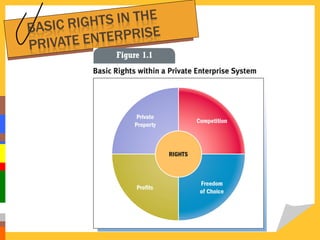
  • #9 For capitalism to work, the citizens of a private enterprise economy must have certain rights. Every participant has the right to own, use, buy, sell and bequeath property. Freedom of choice means that a private enterprise system relies on the potential for citizens to choose their own employment, purchases, and investments. Profits and competition are explicit rights of the private enterprise.
  • #10 The willingness of individuals to start a new venture drives economic growth and keeps pressure on existing companies to continue to satisfy customers. The spirit of entrepreneurship is beginning to be recognized inside all firms.
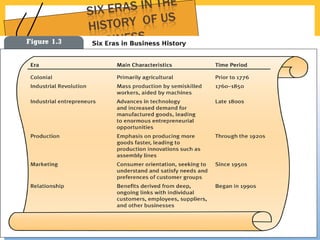
  • #12 In 400 years, the U.S. business history has gone through six distinct time periods: the colonial period, the industrial revolution, the age of industrial entrepreneurs, the production era, the marketing era, the relationship era. All of this periods are unique because they have influenced U.S business practices in different ways.
  • #13 Relationship management involves gathering knowledge of customer needs and preferences and applying that understanding to get as close to the customer as possible.
  • #14 Partnerships and strategic alliances allow organizations to take advantage of available opportunities. A way organizations build relationships to operate responsibly and incorporate issues that customers care about. Environmental concerns continue to influence consumer’s choices. Therefore, companies are researching ways to save energy and increase profits by “going green”.
  • #15 A skilled and knowledgeable workforce is an essential resource for keeping pace with the changing business world. A first-class workforce can be the foundation of a firm’s competitive differentiation, providing important advantages over competing business.
  • #16 Diverse employee teams and workforces tend to perform tasks more effectively and develop better solutions to business problems because of their varied perspectives and experiences. Attention to diversity issues can help them avoid damaging legal battles.
  • #18 The nature of work is changing. The manufacturing industry is declining while the service industry is growing. Firms must rely heavily on well-trained service workers with knowledge, technical skills, the ability to communicate and deal with people, and a talent for creative thinking. More service jobs like call centers are being outsourced.
  • #19 Workers want a flexible work-life balance that rewards them for their skills. These workers use technology and manage their own careers. The relationship between employees and workers needs to be a valuable partnership that drives innovation through collaboration.
  • #20 Today’s companies look for managers who are intelligent, highly motivated people with the ability to create and sustain a vision for the organization. The challenges in today’s marketplace require for managers to perceive the marketplace needs and what an organization must do to satisfy them. There are many challenges facing today’s managers.
  • #21 Creativity and critical thinking are imperative in today’s workplace but they must lead to action. These are essential characteristics of the 21st-century workforce. These skills are important throughout the organization.
  • #22 Changes brought on by technology, the marketplace and global competition require leadership. Organizational change may come internally from new company goals, emerging employee needs, labor union demands or production problems. External forces might include feedback from customers, developments in the international marketplace, economic trends, and new technologies.
  • #23 There are a variety of things that make a company admired. As you learn more about business, you will decide for yourself what makes a company admired.