STATE OF
THE WORLD’S
MIGRATORY
SPECIES
Convention on the Conservation of
Migratory Species of Wild Animals
ii
UNEP promotes
environmentally sound
practices globally and in its
own activities. Our distribution
policy aims to reduce UNEP’s
carbon footprint.
State of the World’s Migratory Species
Prepared for: The Secretariat of the Convention on the Conservation of
Migratory Species of Wild Animals (CMS).
Copyright: © 2024 Convention on the Conservation of Migratory Species
of Wild Animals.
Citation: UNEP-WCMC, 2024. State of the World’s Migratory Species.
UNEP-WCMC, Cambridge, United Kingdom.
Authors: Frances Davis, Andrew Szopa-Comley, Sarah Rouse, Aude
Caromel, Andy Arnell, Saloni Basrur, Nina Bhola, Holly Brooks, Giulia
Costa-Domingo, Cleo Cunningham, Katie Hunter, Matt Kaplan, Abigail
Sheppard and Kelly Malsch.
Acknowledgements: This report was made possible by the generous
financial contributions of the Governments of Australia, Switzerland, the
United Kingdom of Great Britain and Northern Ireland and the Arcadia Fund.
UNEP-WCMC would also like to express their sincere thanks to colleagues
from the CMS Secretariat for their expert input and review including Amy
Fraenkel (Executive Secretary), Marco Barbieri, Aydin Bahramlouian,
Clara Nobbe, Andrea Pauly, Melanie Virtue and Dagmar Zikova. UNEP-
WCMC also sincerely thank the Zoological Society of London (ZSL) for
their analysis of the Living Planet Index and BirdLife International for their
analysis of the Red List Index and Key Biodiversity Areas for CMS-listed
species, the results of which are contained within the report.
For their valuable contributions to the development and/or expert review
of the report the authors thank: Stuart Butchart (BirdLife International),
Gill Braulik (IMMA Secretariat), Lauren Coad (Centre for International
Forestry Research), Olivia Crowe (BirdLife International), William Darwall
(IUCN), Stefanie Deinet (ZSL), Sarah Ferriss, Stephen Garnett (Charles
Darwin University), Craig Hilton-Taylor (IUCN), Richard Jenkins (IUCN),
Aaron Laur (Center for Large Landscape Conservation), Vicky Jones
(BirdLife International), Diego Juffe-Bignoli, Louise McRae (ZSL), Giuseppe
Notarbartolo di Sciara (IMMA Secretariat), Cecelia Passadore (International
Whaling Commission), Tom Scott (BirdLife International), in addition to
colleagues from UNEP-WCMC (Heather Bingham, Laura Bonesi, Adele
Dixon, Jennifer Mark, Valerie Kapos, Aly Pavitt and Ciara Stafford).
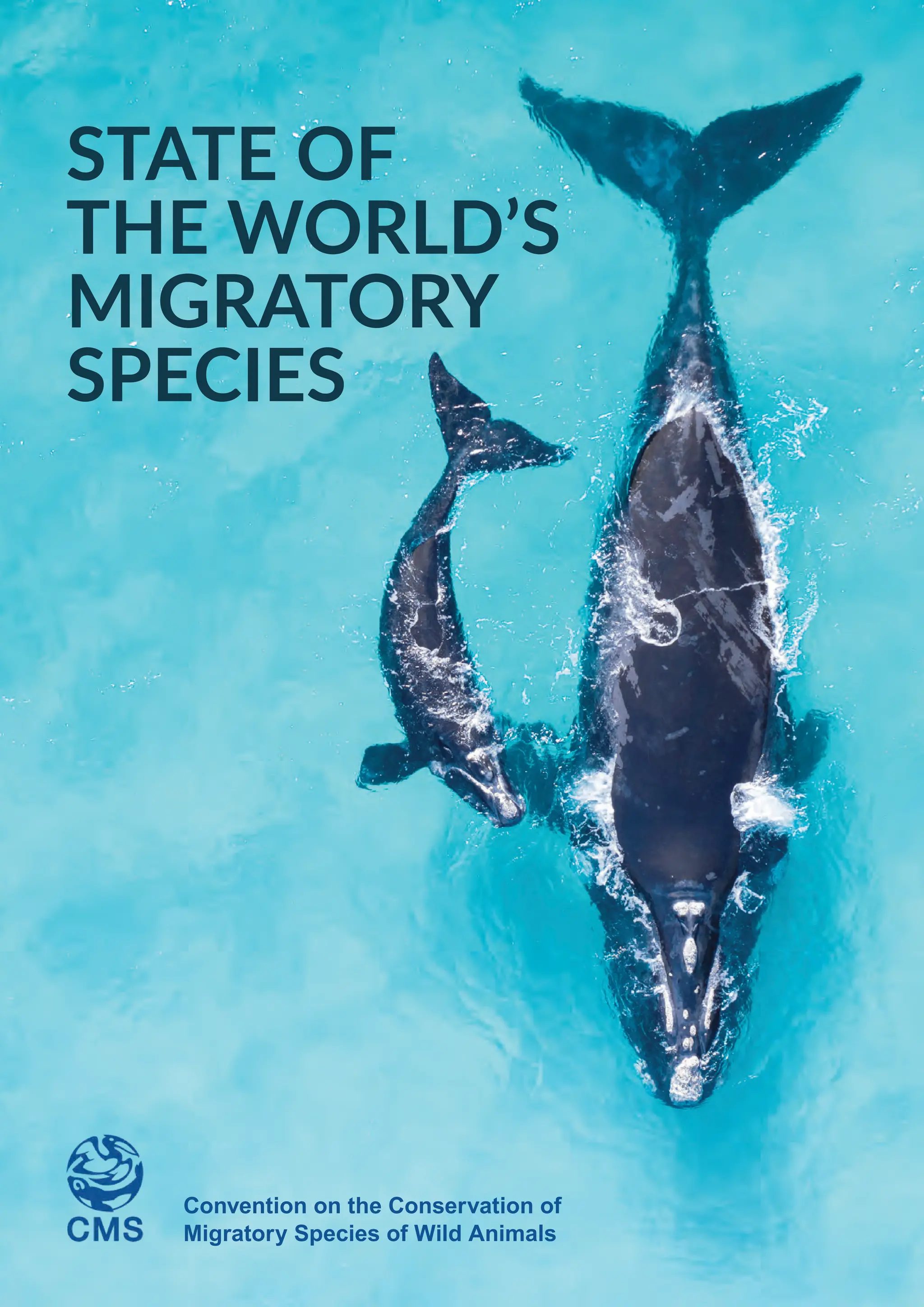
Layout: Ralph Design Ltd. Cover photo: Southern Right Whale (Eubalaena
australis). Lewis Burnett / Ocean Image Bank.
The UN Environment Programme World Conservation Monitoring Centre
(UNEP-WCMC) is a global Centre of excellence on biodiversity. The Centre
operates as a collaboration between the UN Environment Programme and
the UK-registered charity WCMC. Together we are confronting the global
crisis facing nature.
This publication may be reproduced for educational or non-profit purposes
without special permission, provided acknowledgement to the source is
made. Reuse of any figures is subject to permission from the original rights
holders. No use of this publication may be made for resale or any other
commercial purpose without permission in writing from the UN Environment
Programme. Applications for permission, with a statement of purpose and
extent of reproduction, should be sent to the Director, UNEP-WCMC,
219 Huntingdon Road, Cambridge, CB3 0DL, UK.
The contents of this report do not necessarily reflect the views or policies
of the UN Environment Programme, contributory organisations or editors.
The designations employed and the presentations of material in this report
do not imply the expression of any opinion whatsoever on the part of the
UN Environment Programme or contributory organisations, editors or
publishers concerning the legal status of any country, territory, city area or
its authorities, or concerning the delimitation of its frontiers or boundaries
or the designation of its name, frontiers or boundaries. The mention of a
commercial entity or product in this publication does not imply endorsement
by the UN Environment Programme.
UN Environment Programme World Conservation Monitoring Centre (UNEP-WCMC)
219 Huntingdon Road, Cambridge CB3 0DL, UK
Tel: +44 1223 277314
www.unep-wcmc.org
Adobe
Stock
|
#102609995
Contents
Foreword iv
Executive Summary vi
Recommendations for priority actions ix
Introduction 1
I. CMS at a glance 3
The CMS Appendices ..............................................3
The importance of migratory species.......................6
II. STATE – Conservation status 9
Conservation status of CMS-listed species............10
Beyond extinction risk: the IUCN
Green Status of Species.........................................13
Trends in the conservation status and
population abundance of migratory species...........14
Migratory species that may benefit from increased
protection or conservation action under CMS........19
III. PRESSURE – Threats to migratory species 25
Overview of the threats to migratory species.........25
Overexploitation......................................................31
Habitat loss, degradation and fragmentation..........32
Climate change.......................................................34
Pollution..................................................................35
Threats to important sites for migratory species 38
IV. RESPONSE – Actions to conserve migratory
species and their habitats 43
Implementation of legally binding
obligations under CMS...........................................43
Reducing overexploitation, including mitigating
incidental catch of non-target species....................44
Protecting and conserving key habitats
for migratory species .............................................46
Promoting ecological connectivity
by removing barriers to migration...........................48
Ecosystem restoration............................................51
Mitigating light pollution .........................................53
Conclusion 55
References 57
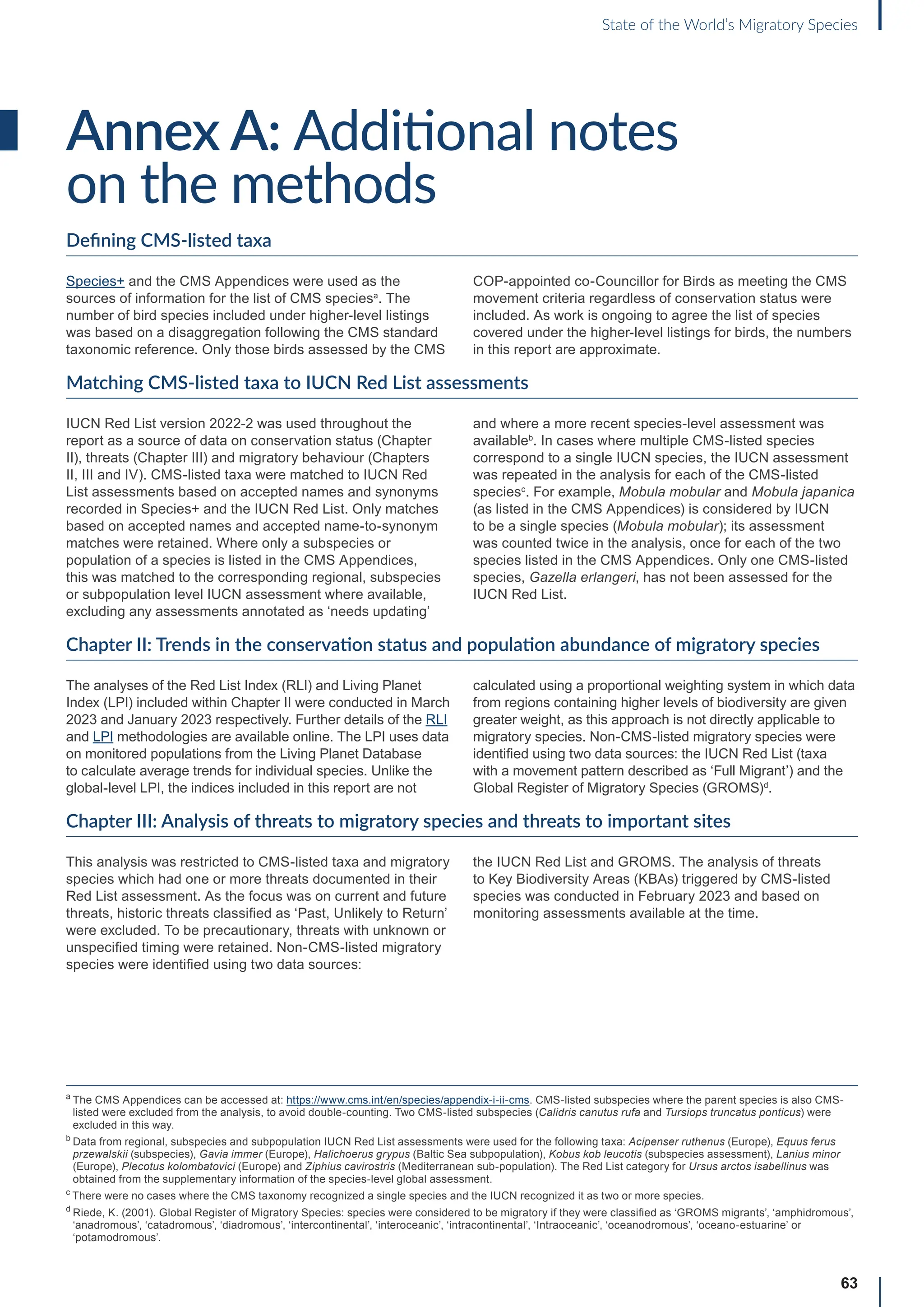
Annex A: Additional notes on the methods 63
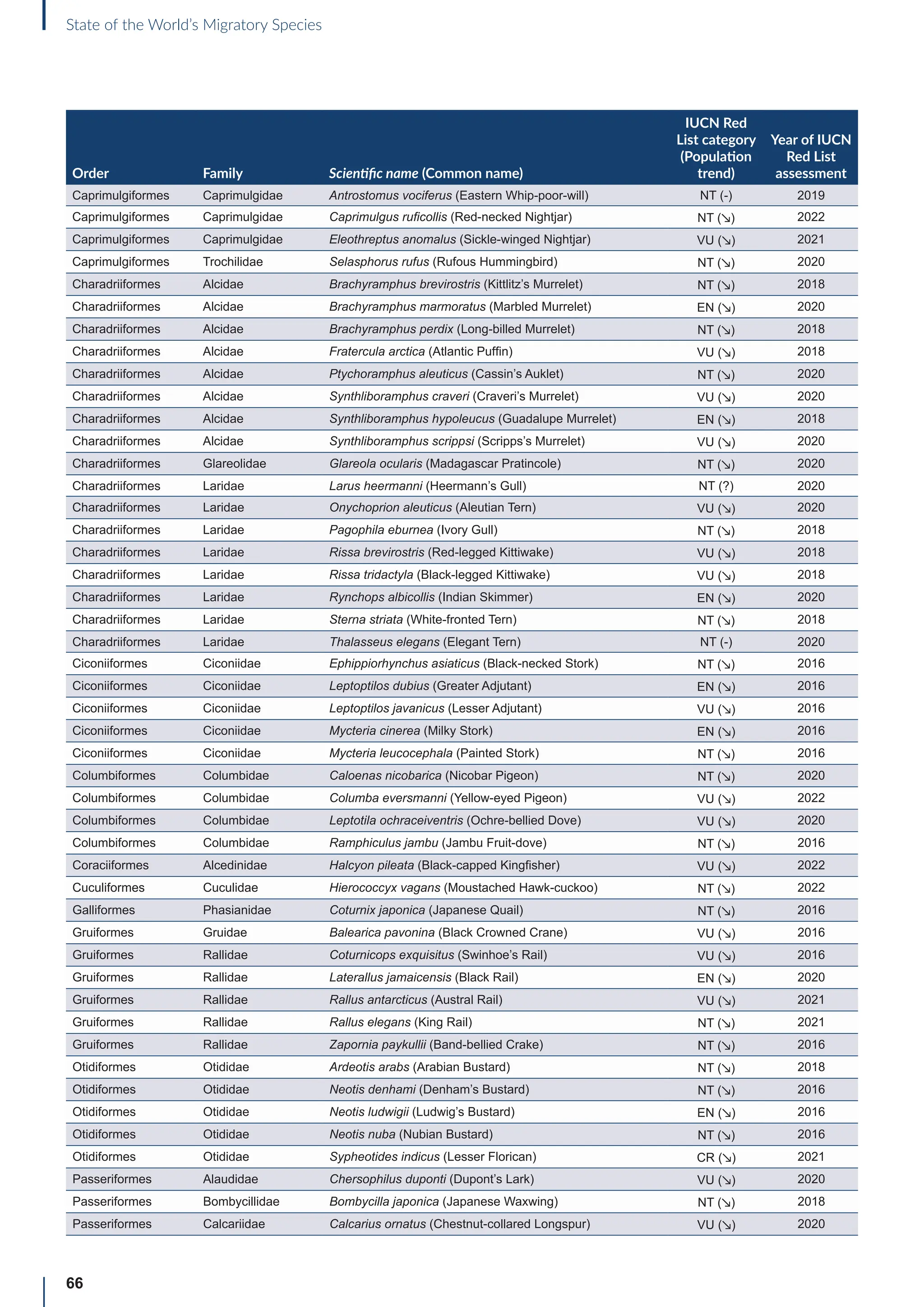
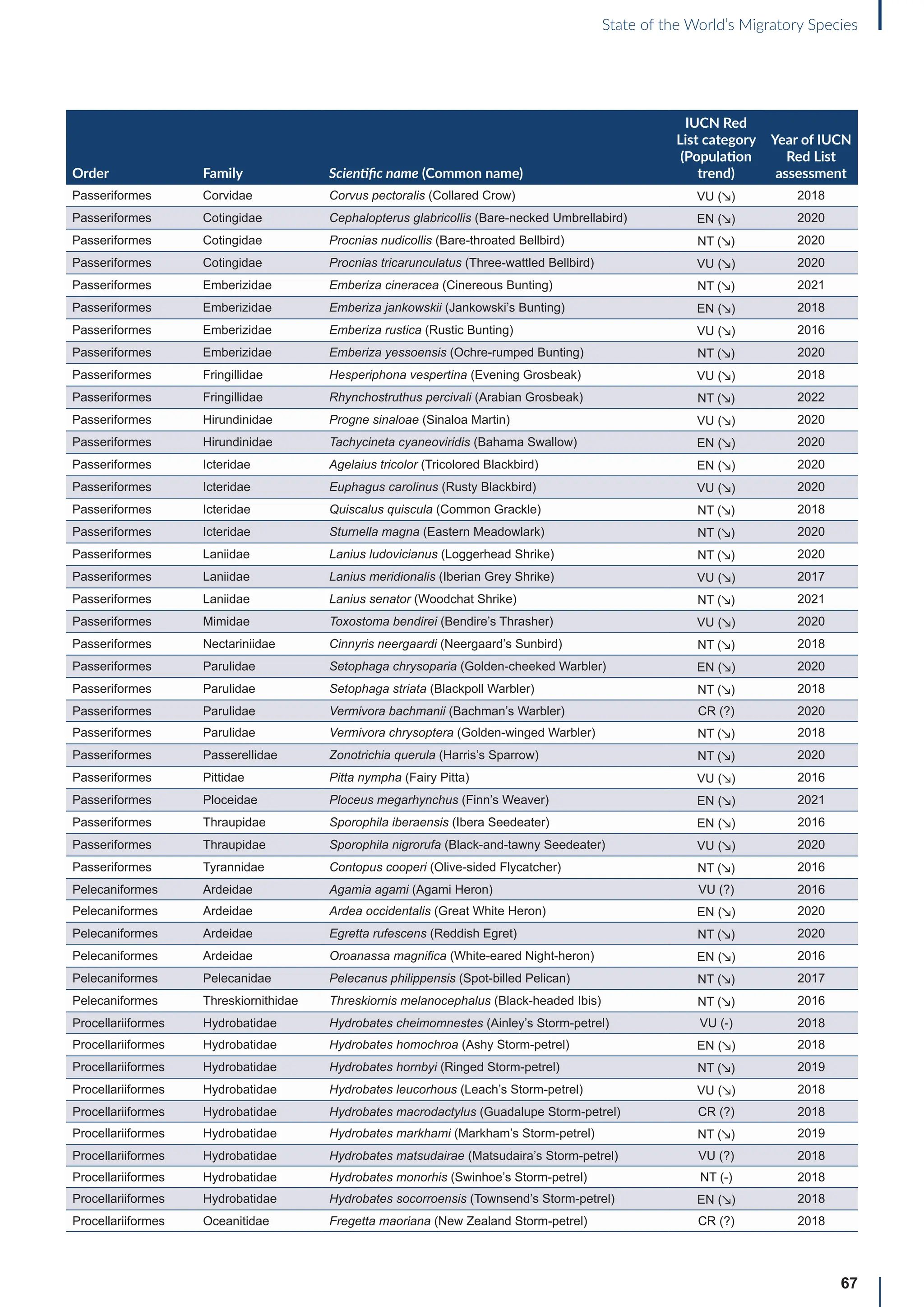
Annex B: Globally threatened or
Near Threatened migratory species not yet
listed in the CMS Appendices 65
iii
Contents
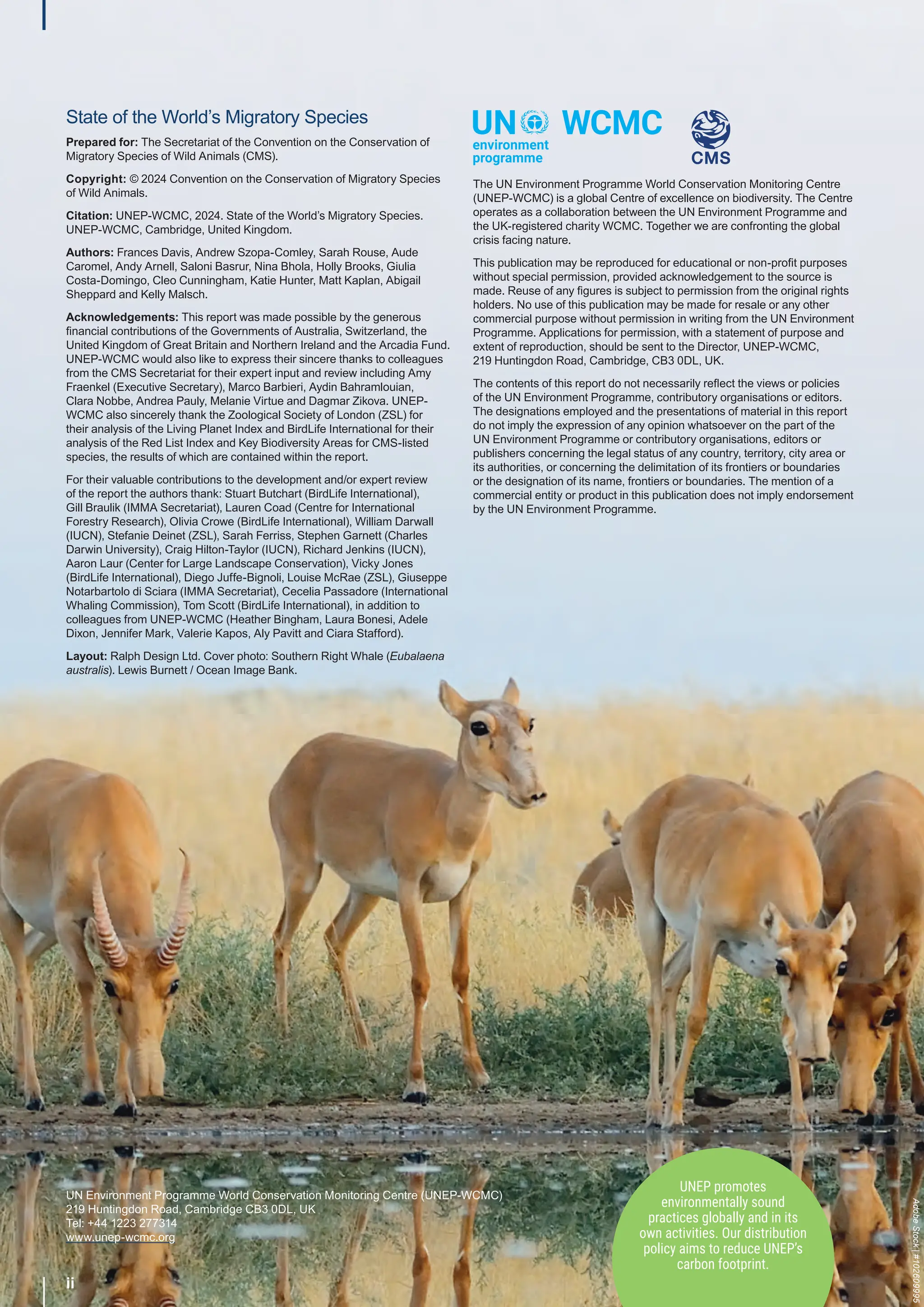
Saiga Antelope (Saiga tatarica)
iv
Foreword
Billions of animals are regularly on the move every year.
Migratory species include some of the most iconic species
on the planet such as sea turtles, whales and sharks in our
oceans, elephants, wild cats, and herds of hooved species
that cross plains and deserts, raptors, waterbirds and
songbirds that cross through the skies, and even insects
such as the monarch butterfly.
With their incredible journeys connecting different parts of
the world, migratory species provide a unique lens through
which we can understand the scale of the profound changes
affecting our world.
Migratory species rely on a variety of specific habitats at
different times in their lifecycles. They regularly travel,
sometimes thousands of miles, to reach these places. They
face enormous challenges and threats along the way, as well
at their destinations where they breed or feed. When species
cross national borders, their survival depends on the efforts
of all countries in which they are found.
The Convention on the Conservation of Migratory Species
of Wild Animals (CMS) was established in 1979 for this
very reason: international cooperation is essential for the
conservation of migratory species. It is uniquely placed to
bring countries and stakeholders together to agree on the
actions needed to ensure that these species survive and
thrive.
Effective policies and actions for migratory species require
a solid scientific grounding to understand their conservation
status, the areas they depend on, and the threats that they
face. The information presented in this ground-breaking
report, the first ever State of the World’s Migratory Species,
represents a significant milestone in efforts to synthesize and
communicate the knowledge needed to drive forward action.
The report finds that the conservation status of migratory
species overall is deteriorating. Species listed for protection
under CMS, despite positive successes, reflect this broader
trend. The conservation needs and threats to migratory
species need to be addressed with greater effectiveness,
at a broader scale, and with renewed determination. In
particular, urgent action is needed to prevent the extinction
of species that are categorised as Critically Endangered
and Endangered, which includes a substantial proportion
of all of the marine and freshwater fish species (79%) and
marine turtles (43%) that are listed under CMS. The report
also highlights nearly 400 threatened species not currently
covered by the Convention that deserve greater attention.
Among the startling results, overexploitation emerges as
the greatest threat for many migratory species, surpassing
habitat loss and fragmentation. This includes the taking of
species from the wild through intentional removal, such as
through hunting and fishing, as well as the incidental capture
of non-target species. Bycatch of non-target species in
fisheries is a leading cause of mortality of many CMS-listed
marine species.
Habitat loss, fragmentation, and barriers to migratory
movements continue to be a major threat facing migratory
species. Globally, although 49% of the sites already identified
as being important for CMS-listed species are subject to
some level of protection, many critical sites for CMS-listed
species are yet to be mapped. This information is crucial
for area-based conservation measures, and in order for
safeguards for migratory species related to investments
in infrastructure and other economic activities to be fully
met. Moreover, among the important sites for CMS-listed
species that have been identified, well over half are facing
unsustainable levels of human-caused pressure.
Other key threats to migratory species include pollution
(including light and noise pollution), climate change and
invasive species.
The good news is that the actions that are needed are clear,
and are highlighted in the recommendations of this report.
Among the most important: efforts need to be stepped up to
address unsustainable and illegal taking of migratory species
at the national level; bycatch and other incidental capture
must be massively reduced; all important sites for migratory
species need to be identified; and actions need to be taken to
protect or conserve such sites.
Actions under CMS will be crucial for achieving the global
commitments set out in the Kunming-Montreal Global
Biodiversity Framework. These include commitments to
restore and establish well-connected networks of protected
areas and other effective area-based conservation
measures, targets to halt human-induced extinctions and
to ensure that any taking of wild species is sustainable,
safe and legal, and targets to address climate change and
pollution. Delivering on these commitments in a fair and just
way will not only benefit migratory species but will also help
secure a better future for people and nature.
Producing the first ever State of the World’s Migratory
Species would not have been possible without the excellent
collaboration between UNEP-WCMC and CMS, as well as
the vital support of donors and the expertise provided by
many dedicated reviewers.
Migratory species are a shared natural treasure, and
their survival is a shared conservation responsibility that
transcends national boundaries. This landmark report will
help underpin much-needed policy actions to ensure that
migratory species continue to traverse the world’s skies,
lands, oceans, lakes and rivers.
Amy Fraenkel
CMS Executive Secretary
State of the World’s Migratory Species
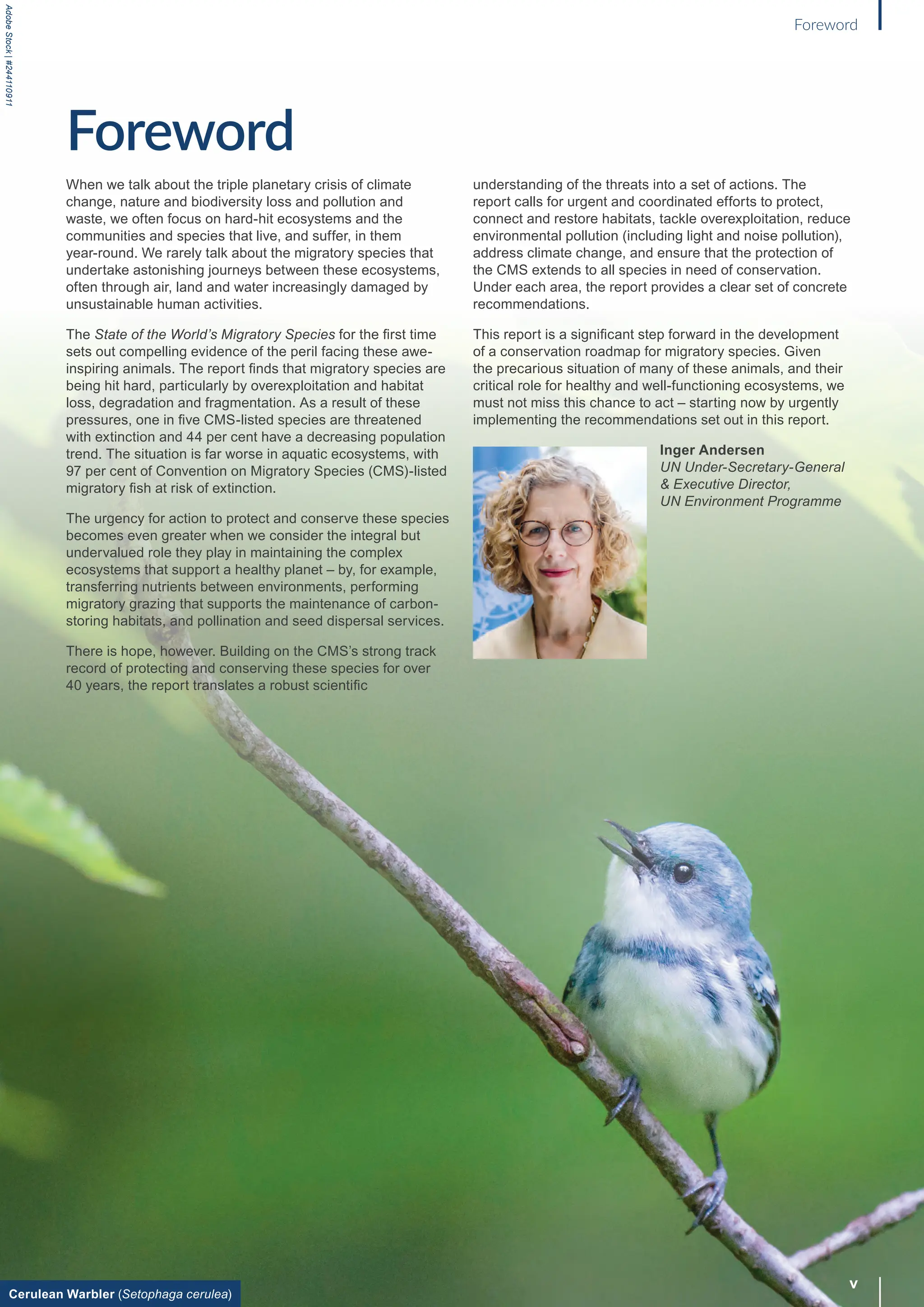
Cerulean Warbler (Setophaga cerulea)
Adobe
Stock
|
#244110911
Foreword
When we talk about the triple planetary crisis of climate
change, nature and biodiversity loss and pollution and
waste, we often focus on hard-hit ecosystems and the
communities and species that live, and suffer, in them
year-round. We rarely talk about the migratory species that
undertake astonishing journeys between these ecosystems,
often through air, land and water increasingly damaged by
unsustainable human activities.
The State of the World’s Migratory Species for the first time
sets out compelling evidence of the peril facing these awe-
inspiring animals. The report finds that migratory species are
being hit hard, particularly by overexploitation and habitat
loss, degradation and fragmentation. As a result of these
pressures, one in five CMS-listed species are threatened
with extinction and 44 per cent have a decreasing population
trend. The situation is far worse in aquatic ecosystems, with
97 per cent of Convention on Migratory Species (CMS)-listed
migratory fish at risk of extinction.
The urgency for action to protect and conserve these species
becomes even greater when we consider the integral but
undervalued role they play in maintaining the complex
ecosystems that support a healthy planet – by, for example,
transferring nutrients between environments, performing
migratory grazing that supports the maintenance of carbon-
storing habitats, and pollination and seed dispersal services.
There is hope, however. Building on the CMS’s strong track
record of protecting and conserving these species for over
40 years, the report translates a robust scientific
understanding of the threats into a set of actions. The
report calls for urgent and coordinated efforts to protect,
connect and restore habitats, tackle overexploitation, reduce
environmental pollution (including light and noise pollution),
address climate change, and ensure that the protection of
the CMS extends to all species in need of conservation.
Under each area, the report provides a clear set of concrete
recommendations.
This report is a significant step forward in the development
of a conservation roadmap for migratory species. Given
the precarious situation of many of these animals, and their
critical role for healthy and well-functioning ecosystems, we
must not miss this chance to act – starting now by urgently
implementing the recommendations set out in this report.
Inger Andersen
UN Under-Secretary-General
& Executive Director,
UN Environment Programme
v
Foreword
vi
State of the World’s Migratory Species
Executive Summary
Migratory species are found all over the world - on land, in the water and in the skies. Traversing thousands of miles,
these species rely on a diverse range of habitats for feeding, breeding and resting, and in turn, play an essential role
in the maintenance of healthy and functional ecosystems. Often their migrations take them across national borders,
and thus international cooperation is essential for their conservation and survival. The recognition of this need led
to the negotiation of the Convention on the Conservation of Migratory Species of Wild Animals (CMS), which came
into force in 1979. CMS is the global treaty that addresses the conservation and effective management of migratory
species and their habitats. The Convention aims to conserve migratory species, particularly those listed in its two
Appendices and those included in a range of CMS instruments, through international cooperation and coordinated
conservation action.
This report, the first ever State of the World’s Migratory
Species, provides a comprehensive overview and analysis of
the conservation status of migratory species. It summarizes
their current status and trends, identifies the key pressures
they face, and highlights illustrative examples of the efforts
underway to conserve and promote the recovery of these
species. It aims to improve conservation outcomes for
migratory species, by providing support for evidence-based
decision-making by CMS Parties, and more broadly, by
raising awareness of the challenges and success stories
in the conservation of migratory species. The report was
produced in response to a decision adopted at COP13 in
2020, which mandated that work be undertaken to further
develop the preliminary review of conservation status
submitted to COP13. The focus of this report is on those
species listed in the CMS Appendices; however, as other
migratory species may benefit from protection under CMS,
it also provides information on the wider group of all
migratory species.
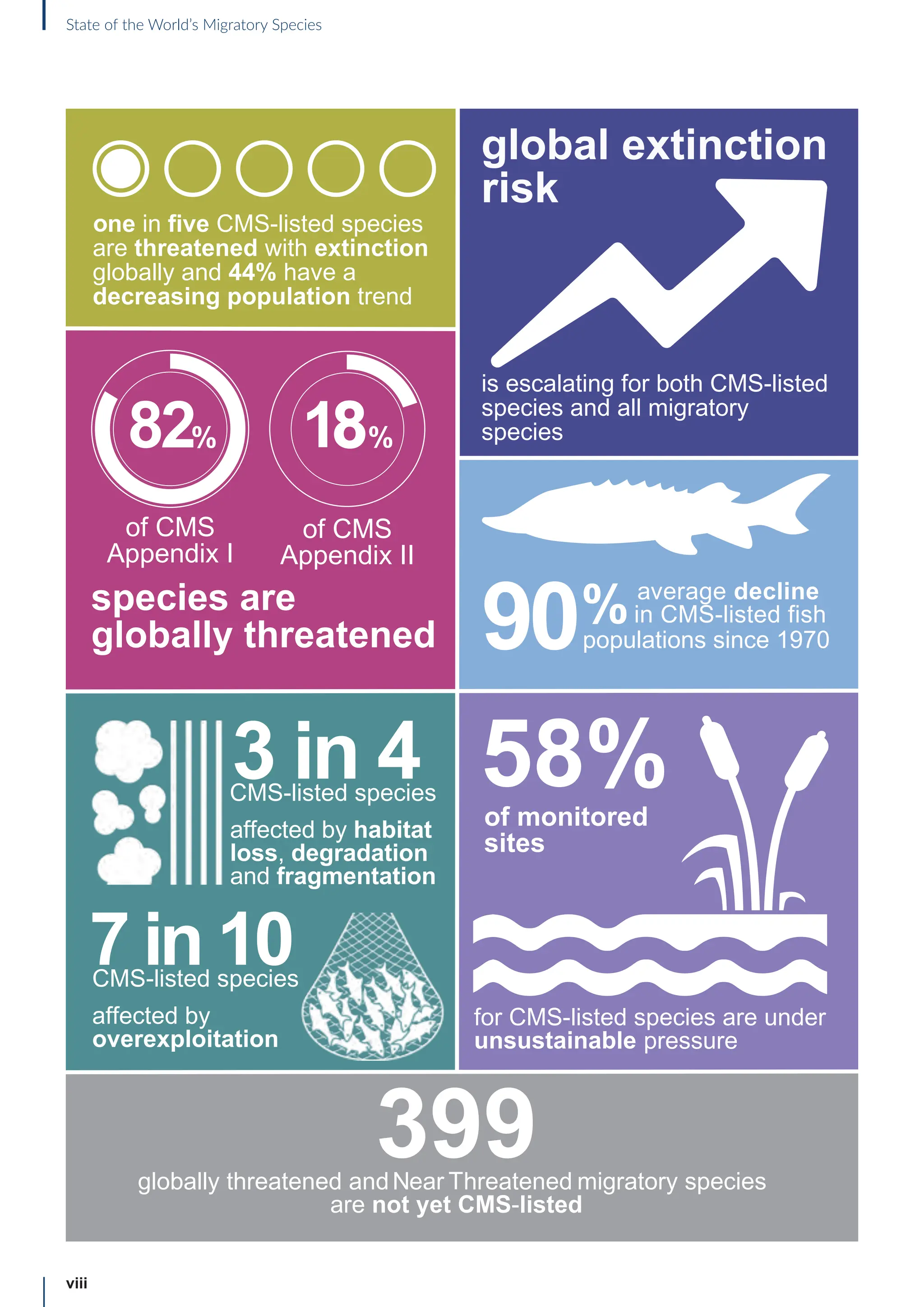
The available evidence suggests that the conservation status
of many CMS-listed species is deteriorating. One in five
CMS species are threatened with extinction and a substantial
proportion (44%) are undergoing population declines. When
considering the Appendices separately, 82% of Appendix
I species are threatened with extinction and 76% have a
declining population trend. Meanwhile, 18% of Appendix II
species are globally threatened, with almost half (42%) showing
decreasing population trends. The current situation and
trajectory of CMS-listed fish is of particular concern, with nearly
all (97%) of CMS-listed fish threatened with extinction. Indeed,
on average, there has been a steep decline in the relative

abundance of monitored fish populations over the last 50 years.
Levels of extinction risk are rising across CMS-listed species
as a whole. Between 1988 and 2020, 70 CMS species
showed a deterioration in conservation status, substantially
more than the 14 species that showed an improvement in
conservation status. Extinction risk is also escalating across
the wider group of migratory species not listed in CMS. A
novel analysis produced for this report identified 399 globally
threatened and Near Threatened migratory species (mainly
birds and fish) that are not yet listed in the CMS Appendices
that may benefit from international protection.
The deteriorating status of migratory species is being
driven by intense levels of anthropogenic pressure. Due
to their mobility, their reliance on multiple habitats, and
their dependence on connectivity between different sites,
migratory species are exposed to a diverse range of threats
caused by human activity. Most migratory species are
affected by a combination of threats, which often interact
to exacerbate one another. Habitat loss, degradation
and fragmentation (primarily driven by agriculture), and
overexploitation (hunting and fishing, both targeted and
incidental) represent the two most pervasive threats to
migratory species and their habitats according to the IUCN
Red List of Threatened SpeciesTM
. Pollution, including
pesticides, plastics, heavy metals and excess nutrients, as
well as underwater noise and light pollution, represents a
further source of pressure facing many species. The impacts
of climate change are already being felt by many migratory
species, and these impacts are expected to increase
considerably over the coming decades, not just as a direct
threat to species but also as an amplifier of other threats.
Importantly, habitat loss, degradation and fragmentation
is increasingly disrupting the ability of migratory species
to move freely along their migration routes, particularly
when large areas of continuous habitat are converted into
smaller, isolated patches that can no longer facilitate these
movements. Additionally, obstacles to migration, ranging
from physical infrastructure like roads, railways, fences
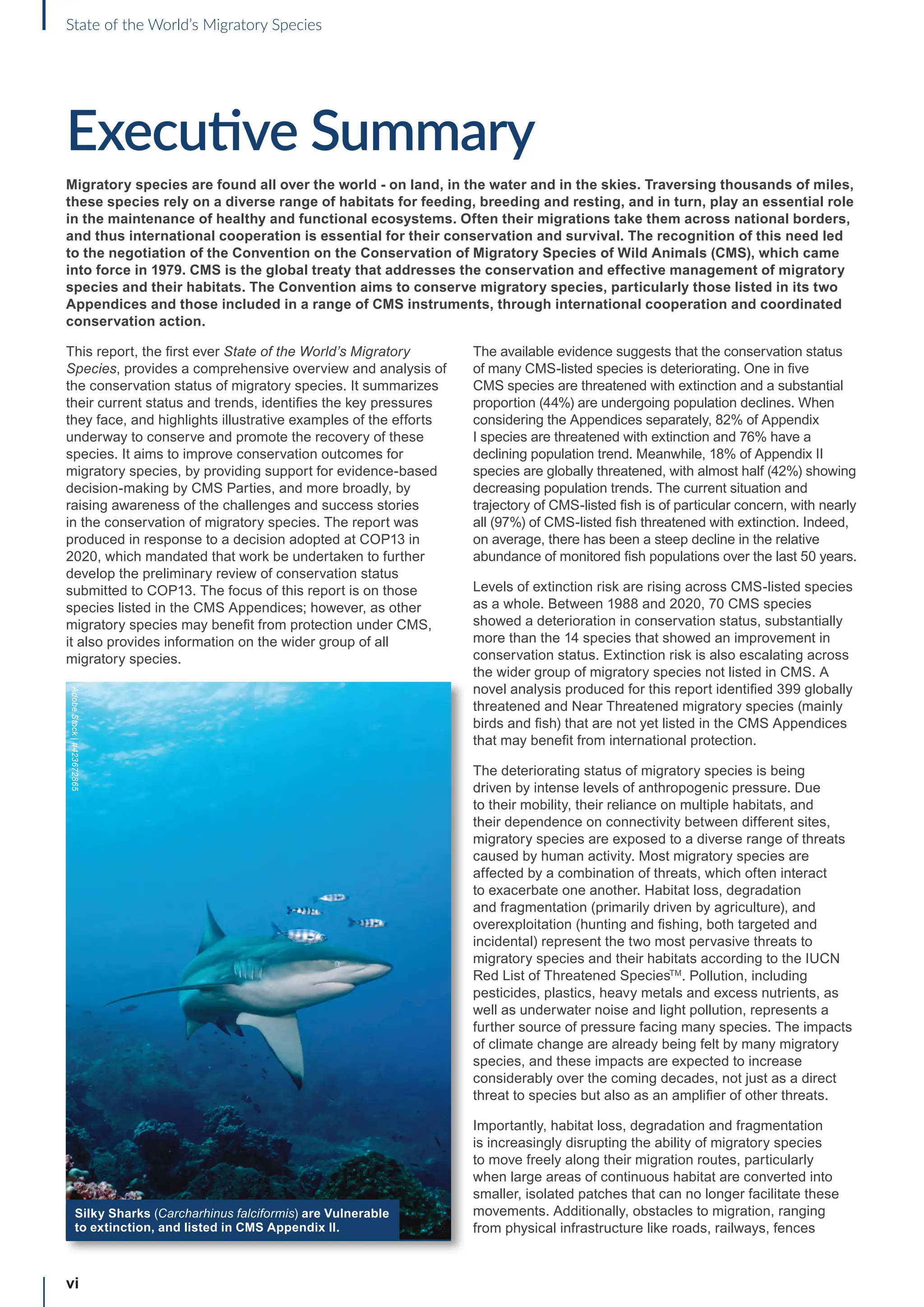
Silky Sharks (Carcharhinus falciformis) are Vulnerable
to extinction, and listed in CMS Appendix II.
Adobe
Stock
Adobe
Stock
|
#423672865
vii
Executive Summary
and dams to non-physical barriers such as disturbance
from industrial development and shipping traffic, represent
formidable barriers to migratory populations. By constraining
the movement of migratory animals, growing anthropogenic
impacts on vital migration corridors and stopover sites pose
a significant threat to the phenomenon of migration itself.
Indeed, 58% of monitored sites that are recognized to be
important for CMS-listed species are facing unsustainable
levels of anthropogenic pressure.
Given the breadth and scale of the pressures facing
migratory species, coordinated international action is
urgently needed to reverse population declines and preserve
these species and their habitats. Fortunately, although
some important data gaps remain, many of the threats
facing migratory species are well understood. Crucially, a
wealth of knowledge exists on the responses and solutions
that are required to help migratory populations recover.
Collaborative actions designed to improve the conservation
status of migratory species are already underway under
CMS, from international task forces addressing the illegal
killing of birds, to multistakeholder platforms to support the
sustainable deployment of renewable energy infrastructure
without negatively impacting migratory species. However,
to curb losses and to promote the recovery of migratory
species, these efforts need to be strengthened and scaled
up. This should include actions to expand the global network
of protected and conserved areas, particularly those areas
of importance to migratory species, in line with global
targets, while also working to improve the condition and
effective management of sites. Maintaining and enhancing
the connectivity between these sites should also be a key
priority, in part through the targeted restoration of degraded
habitats. Coordinated action is also required to combat
overexploitation, including the expansion of collaborative
international initiatives to prevent the illegal or unsustainable
taking of migratory species.
The Convention on Migratory Species provides a
global platform for international cooperation, and active
engagement across governments, communities and all
other stakeholders is critical for addressing the myriad
of challenges that migratory species face. With recently
renewed global commitments established to address the
threats to biodiversity through the Kunming-Montreal
Global Biodiversity Framework, and with the adoption of a
new strategy anticipated at CMS COP14, collective efforts
to follow through on these commitments and deliver on
ambitions for migratory species are urgently needed.
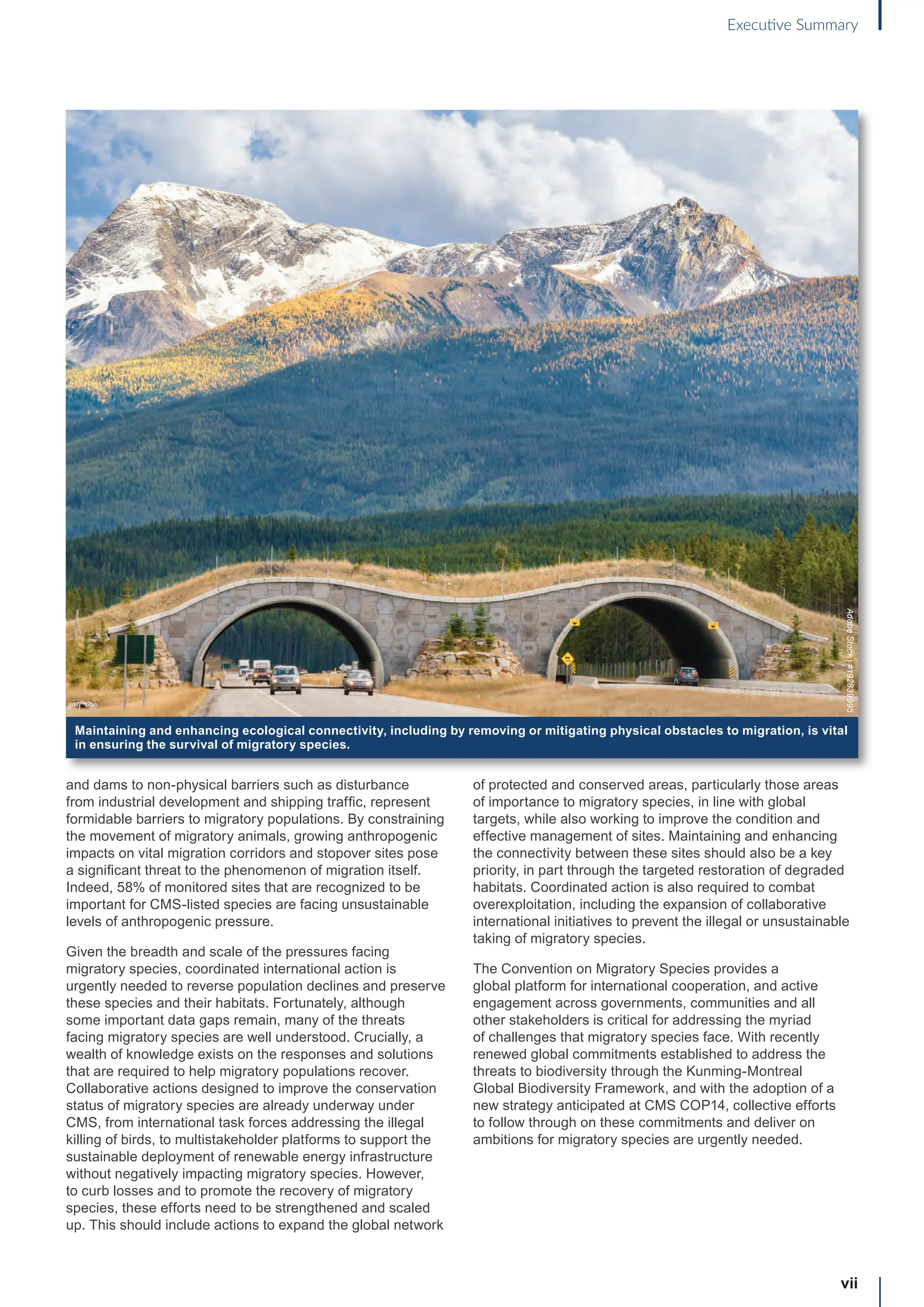
Maintaining and enhancing ecological connectivity, including by removing or mitigating physical obstacles to migration, is vital
in ensuring the survival of migratory species.
Adobe
Stock
|
#192839995
viii
State of the World’s Migratory Species
pressure
399
a
N T
global extinction
risk
8
Recommendations
for priority actions
Based on the findings of this report, the following key actions should be prioritized:
Protect, connect and restore habitats
l Identify key sites for migratory species along their
entire migratory pathways. Further work is needed to
identify critical habitats and sites for migratory species.
For example, Key Biodiversity Areas (KBAs) identify nearly
10,000 important sites for CMS-listed species, but there
are taxonomic and geographic gaps in the existing site
network, particularly for migratory terrestrial mammals,
aquatic mammals and fish, and in the Caribbean, Central
and South America and Oceania. Other priority site
identification processes relevant for specific taxonomic
groups can also support CMS efforts to identify and
protect key sites.
l Increase the coverage of KBAs and other critical
habitats by protected and conserved areas. In line
with global targets to expand the network of protected and
conserved areas to over 30% by 2030, prioritizing those
sites that are important for biodiversity is vital to ensuring
successful outcomes for nature. Currently more than half
of the area of KBA sites identified as being important
for CMS-listed species is not covered by protected or
conserved areas, indicating there are clear gaps and more
needs to be done.
l Enhance the management effectiveness of protected
and conserved areas. This includes ensuring sufficient
resources are put into the management of protected
and conserved areas to maximize the benefits for
biodiversity. Given the scale of the threats to migratory
species, improving the ecological condition of protected
and conserved areas is essential to maintain strongholds
for many species. To ensure the management needs of
migratory species are taken into account, key priorities for
migratory species should be integrated into management
plans for these areas. More broadly, it is important that
key conservation priorities for migratory species are also
integrated into National Biodiversity Strategies and Action
Plans (NBSAPs).
l Establish, support and expand regular monitoring
of important sites for migratory species, and of
populations of migratory species at these sites, following
standardized protocols. This is essential to identify the
threats taking place and their impacts on species and
ecosystems. These efforts are needed to prioritize
conservation actions, evaluate the effectiveness of
management interventions and help to pinpoint any drivers
of population change in CMS-listed species. They can
also provide indicators needed to demonstrate national
progress in achieving global and national targets.
l Follow through on ecosystem restoration
commitments, including those linked to the UN Decade
on Ecosystem Restoration and Target 2 of the Kunming-
Montreal Global Biodiversity Framework to ensure that at
least 30% of degraded terrestrial, inland water, and coastal
and marine ecosystems are under effective restoration by
2030. To support these efforts, develop and implement
national restoration plans focussed on restoring and
maintaining important habitats for migratory species.
l Prioritize ecological connectivity in the identification,
design and ongoing management of protected and
conserved areas, noting that to date, less than 10%
of protected land is connected. Connectivity should
be explicitly considered in national land, marine and
freshwater use planning, the designation of future
protected and conserved areas, and when selecting areas
for targeted restoration efforts. More broadly, maintaining
the integrity (the completeness and functionality) of the
ecosystems that migratory species form a part of should
also be a key consideration.
l Minimize the negative impacts of infrastructure
projects on flyways, swimways and migration
pathways for migratory species, with avoidance of
impacts on critical sites for migratory species as a primary
aim. Projects should be carefully planned from the outset
in accordance with the relevant Environmental Impact
Assessment and Strategic Environmental Assessment
guidelines, which should be adapted, where necessary,
to include migratory species considerations. Guidance
developed under CMS on key threats to migration and
connectivity, including on renewable energy, linear
infrastructure, light pollution and noise pollution (see
recommendations on Pollution) should be followed.
ix
Recommendations
Tackle overexploitation
l Ensure that national legislation fully and effectively
protects CMS Appendix I-listed species from take,
including by closely regulating any exceptions to the
general prohibition of take and by participating in the CMS
National Legislation Programme.
l Improve and encourage the use of tools for
monitoring and collecting standardized data on legal
take at the national level. Efforts should also be made
to improve the reliability and comprehensiveness of
reporting in order to understand the scale, intensity and
sustainability of national take.
l Fill knowledge gaps on the main drivers and scale of
illegal take of migratory species, including in regions
where this threat has not yet been assessed, to inform
the priority actions needed to tackle this issue. This
should include improved monitoring of illegal take, as well
as research to understand the effectiveness of efforts to
address it.
l Assess the cumulative impact of harvest pressure
on migratory species at the flyway and population
level and use this information to manage levels of take.
These aims could be supported by increasing efforts to
collate data on both legal and illegal take at national and
international scales.
l Strengthen and expand collaborative international
efforts to tackle illegal and unsustainable take,
focussing on the main drivers of taking and on
geographical areas identified as hotspots for illegal
killing. Such initiatives could be based on the Task Forces
established to tackle the illegal killing of migratory birds.
At the national level, multistakeholder action plans should
be developed to agree priorities and foster collaboration to
tackle this issue.
l Take action to reduce the impacts of overfishing and
incidental catch on marine migratory species. This
should include, for example, establishing catch/mortality
limits for non-target marine species, increasing observer
coverage and remote monitoring of marine capture
fisheries, and increasing international collaboration, in
particular between the CMS Secretariat and the relevant
fisheries and regulatory bodies. Support to the ratification
and implementation of the new Biodiversity Beyond
National Jurisdiction (BBNJ) Treaty will also be important
given the large numbers of ocean-going migratory
species that are found in the High Seas. Such measures
are urgently needed, considering the deteriorating
conservation status of CMS-listed fish, including sharks
and rays, and the impact of incidental catch on many
populations of seabirds, marine mammals and marine
turtles.
Reduce the damaging impacts of environmental pollution
l Promote the widespread adoption of light pollution
mitigation strategies, including those outlined in the
Light Pollution Guidelines for Wildlife endorsed by CMS
Parties, focussing in particular on brightly lit areas that
overlap with crucial habitat or migration corridors.
l Restrict the emission of underwater noise in sensitive
areas for marine species, including by making use of
the CMS Family Guidelines on Environmental Impact
Assessments for Marine Noise-generating Activities, and
through the application of quieting technologies in key
marine industries (as highlighted by a CMS report outlining
best practices for mitigating the impact of anthropogenic
noise on marine species).
l Accelerate the phase-out of toxic lead ammunition
and lead fishing weights, including by implementing
relevant recommendations outlined in the CMS Guidelines
to Prevent the Risk of Poisoning to Migratory Birds.
l Reduce the harmful effects of pesticides on migratory
species, and their food sources, by lowering usage
in or close to critical habitats and by promoting and
incentivizing nature-friendly agricultural practices.
l Tackle the issue of plastic pollution on land, at
sea and in freshwater ecosystems by eliminating
problematic and unnecessary plastics and by reducing
the unnecessary use and production of plastics through
regulations, incentives and practices (as recommended in
the CMS report “Impacts of Plastic Pollution on Freshwater
Aquatic, Terrestrial and Avian Migratory Species in the
Asia and Pacific Region”).
l Reduce the impacts of abandoned, lost and otherwise
discarded fishing gear on marine migratory species
by implementing changes to gear design and by providing
alternative disposal options. This will have benefits linked
to both reducing pollution and tackling overexploitation of
marine species.
x
State of the World’s Migratory Species
I n d u s t r i a l E f f l u e n t s
Address the root causes and cross-cutting impacts
of climate change
l Deliver on international commitments to address
climate change, including on pledges to reduce
greenhouse gas emissions and enhance the removal
of these gases from the atmosphere by maintaining
and increasing carbon stocks in vegetation and soils.
Carbon stocks should be managed in ways that align with
internationally agreed biodiversity conservation goals.
l Future-proof the network of important sites for
migratory species against the likely consequences
of climate change by ensuring that there is sufficient
connectivity between sites to facilitate dispersal and
range shifts, and that this connectivity will persist in the
face of projected climate impacts. Efforts to review the
adequacy of the current network – and to expand this
network – should fully integrate these projected impacts
to ensure resilience.
l Help migratory species adapt to a changing climate
through targeted ecosystem restoration efforts,
designed to improve habitat quality and connectivity and
reduce the impact of extreme weather events, such as
drought and thermal stress, by facilitating dispersal and
range shifts.
l Identify and implement dynamic management
measures that address changing migration pathways and
patterns resulting from climate change.
l Ensure renewable energy infrastructure expansion
is planned and developed in a way that avoids harm to
migratory species, following guidance developed by the
CMS Energy Task Force.
Ensure the CMS Appendices protect all migratory
species in need of further conservation action
l Urgently take additional action to conserve at-
risk Appendix II species: a total of 179 Appendix II
species were identified in this report as ‘very high’ or
‘high’ priorities for further action under CMS, due to their
unfavourable conservation status.
l Consider migratory species threatened with
extinction not yet listed in CMS: 399 globally threatened
and Near Threatened migratory species are not listed
in the CMS Appendices (see Annex B) but many may
benefit from listing in the Convention. Further review of
these species should be undertaken to determine whether
individual species meet all of the criteria for listing,
including in relation to the CMS definition of migration.
Once suitable candidates for listing have been identified,
consideration should be given as to how these gaps in the
Appendices can be filled.
l Prioritize research on ‘Data Deficient’ migratory
species: a disproportionate number of migratory
crustaceans, cephalopods and fish are classified as ‘Data
Deficient’ or have not been recently evaluated in the
IUCN Red List, and little is known about the conservation
status of many migratory insects. Further research into the
conservation status and threats facing these species is
needed.
xi
Recommendations
Adobe
Stock
|
#2217876507
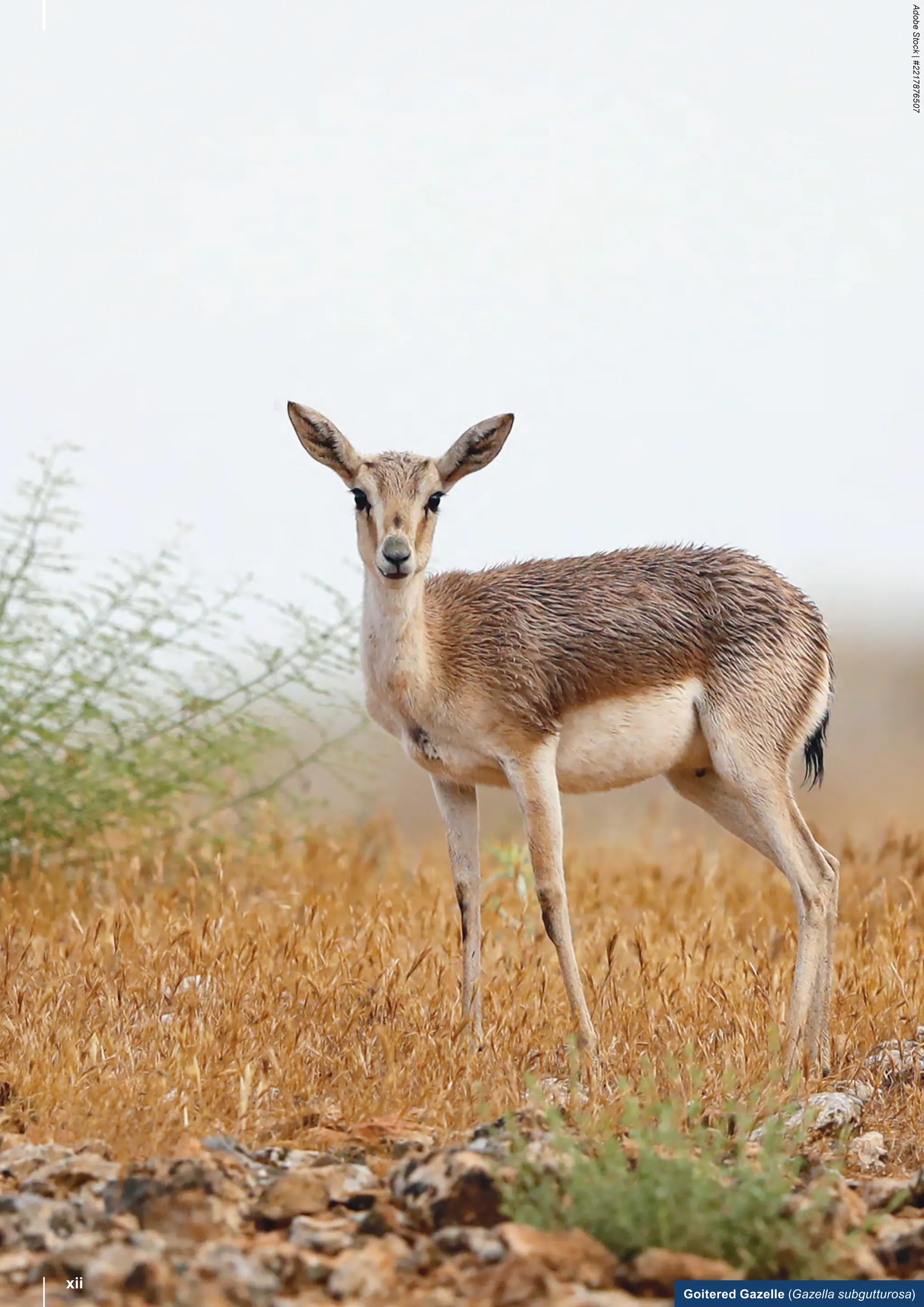
Goitered Gazelle (Gazella subgutturosa)
xii
Introduction
This report is the first ever State of the World’s Migratory
Species. It provides an overview of the conservation status
of migratory species and the pressures they face around the
globe, highlights examples of actions being taken to conserve
and promote the recovery of these species and their habitats,
and provides conclusions that help define additional actions
that should be taken.
The CMS Parties provided a clear mandate for this report.
Preparation of a review on the conservation status of species
listed in the CMS Appendices was identified as a high priority
activity to pursue within the CMS Programme of Work in
2014 at the 11th meeting of the Conference of the Parties
(COP11, Quito) and reaffirmed at the 12th meeting in 2017
(COP12, Manila). A preliminary compilation and analysis of
information on conservation status, population trends and
threats for CMS species was presented to the 13th meeting
in 2020 (COP13, Gandhinagar); given the preliminary nature
of the analysis, the COP13 document did not attempt to draw
conclusions but identified aspects that could merit further
work. In response, the Conference of the Parties adopted
Decision 13.24, which directed the Secretariat to “further
develop the preliminary review of the conservation status of
migratory species submitted to the Conference of the Parties
at its 13th meeting (COP13)”.
This report follows through on this COP13 mandate and
provides information on the status and threats to CMS-listed
species, as well as on knowledge and implementation gaps,
to help inform ongoing and future actions by CMS Parties
and the wider global community to conserve these species.
Acknowledging that the species listed in the CMS
Appendices represent just a subset, this report also provides
information on all migratory species, some of which may also
benefit from protection under the CMS Family.
Chapter I provides a brief introduction to CMS and how it
operates, and provides background on the unique nature
and importance of migratory species. Chapter II provides an
overview of the current conservation status of CMS-listed
species. It also describes long-term trends in conservation
status and population abundance of CMS-listed and all
migratory species using data from the Red List Index and
the Living Planet Index. Chapter III details the key threats
to migratory species and the impacts that these threats are
having. Chapter IV highlights illustrative examples of key
responses being implemented globally to tackle these threats
and discusses the areas that need further action. The report
also includes recommendations for consideration by the CMS
Parties and Scientific Council.
1
Introduction
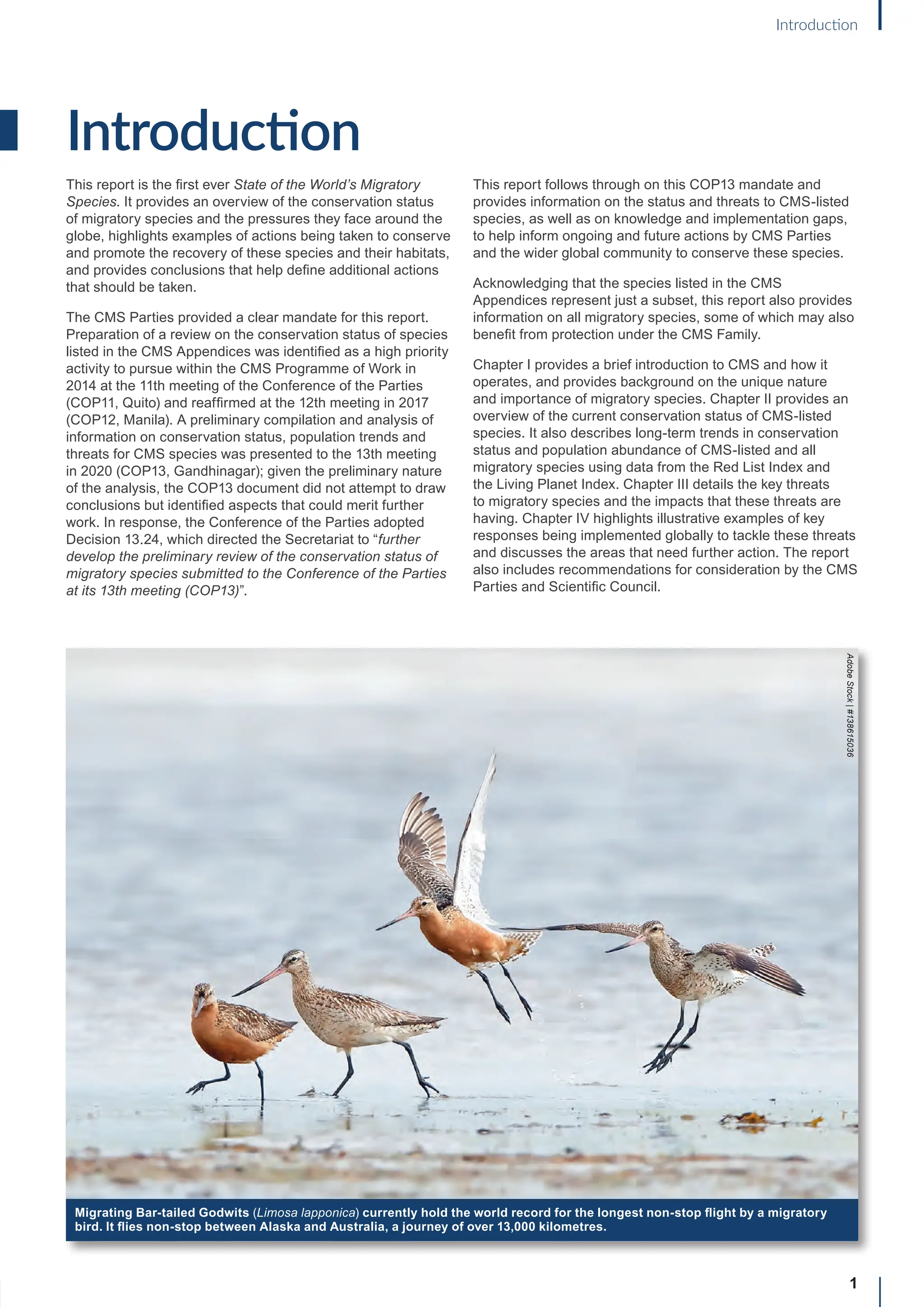
Migrating Bar-tailed Godwits (Limosa lapponica) currently hold the world record for the longest non-stop flight by a migratory
bird. It flies non-stop between Alaska and Australia, a journey of over 13,000 kilometres.
Adobe
Stock
|
#138615036
2
State of the World’s Migratory Species
Adobe
Stock
|
#295727591
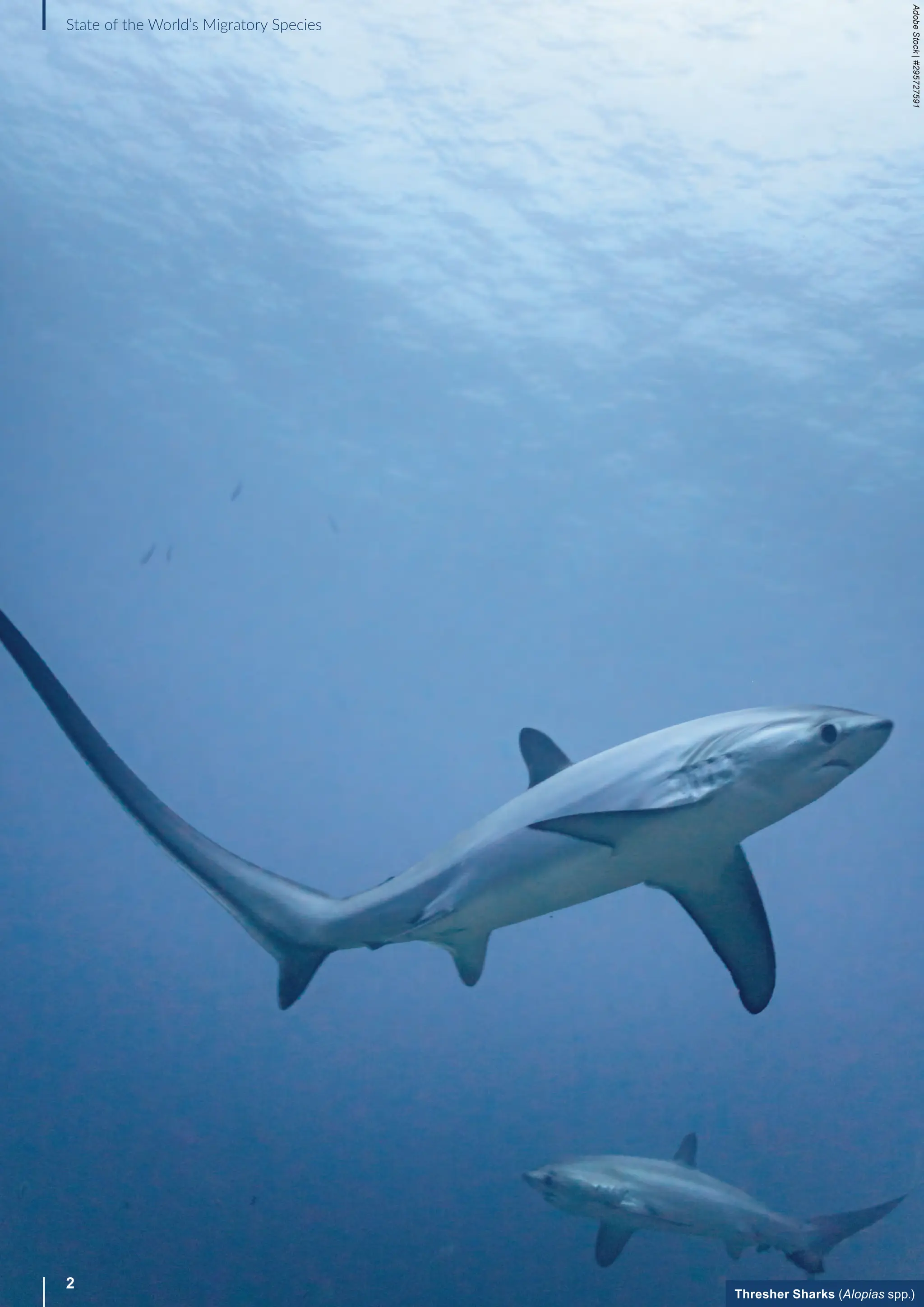
Thresher Sharks (Alopias spp.)
I. CMS at a glance
The Convention on the Conservation of Migratory Species of
Wild Animals (CMS) is the global treaty of the United Nations
that addresses the conservation and effective management
of migratory species and their habitats. The Convention
was established in recognition of the fact that conservation
of migratory species requires the cooperation of countries
across national borders, in all of the places where such
species spend any part of their life cycle. The Convention
therefore aims to conserve migratory species throughout
their range through international cooperation and coordinated
conservation measures.
The Convention has grown in scope and scale over the past
four decades since its adoption in June 1979. There are now
133 Contracting Parties to CMSa
. These Parties have made
commitments to take action, both individually and together,
to conserve migratory species and their habitats, as well as
to address factors that impede their migration. In addition to
the 133 CMS Parties, there are a further 28 countries that,
although not Party to the Convention, are Party to one or
more of the Agreements and/or are signatories to one or
more of the Memoranda of Understanding (MOU) concluded
under the umbrella of CMS.
The CMS Appendices
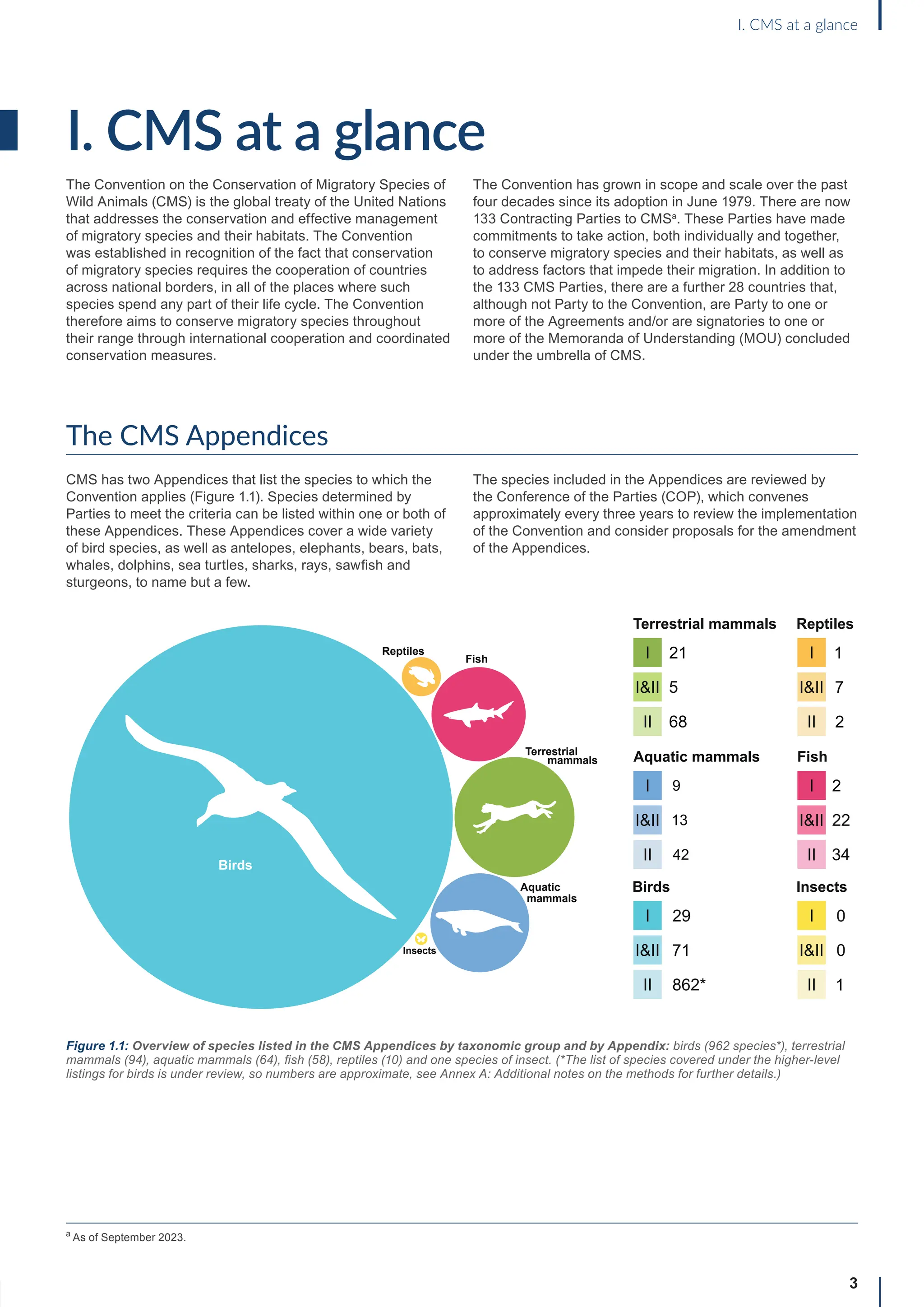
CMS has two Appendices that list the species to which the
Convention applies (Figure 1.1). Species determined by
Parties to meet the criteria can be listed within one or both of
these Appendices. These Appendices cover a wide variety
of bird species, as well as antelopes, elephants, bears, bats,
whales, dolphins, sea turtles, sharks, rays, sawfish and
sturgeons, to name but a few.
The species included in the Appendices are reviewed by
the Conference of the Parties (COP), which convenes
approximately every three years to review the implementation
of the Convention and consider proposals for the amendment
of the Appendices.
3
I. CMS at a glance
Figure 1.1: Overview of species listed in the CMS Appendices by taxonomic group and by Appendix: birds (962 species*), terrestrial
mammals (94), aquatic mammals (64), fish (58), reptiles (10) and one species of insect. (*The list of species covered under the higher-level
listings for birds is under review, so numbers are approximate, see Annex A: Additional notes on the methods for further details.)
Terrestrial
Aquatic
Birds
Reptiles
Fish
Insects
mammals
mammals
21
Terrestrial mammals
5
68
I
I&II
II
9
Aquatic mammals
13
42
I
I&II
II
29
Birds
71
862*
I
I&II
II
1
Reptiles
7
2
I
I&II
II
2
Fish
22
34
I
I&II
II
0
Insects
0
1
I
I&II
II
a
As of September 2023.
4
State of the World’s Migratory Species
Article III of the Convention establishes that Appendix I is
for listing of migratory species which are endangered. For
species included in Appendix I, CMS Parties are obliged
to prohibit the ‘taking’ of these species, with a narrow set
of exceptions. CMS Parties are additionally directed to
endeavour to conserve and restore important habitats of
Appendix I species; to prevent, remove, compensate for or
minimize the adverse effects of activities or obstacles that
seriously impede or prevent migration; and to prevent, reduce
or control factors that are endangering or are likely to further
endanger the speciesb
.
Article IV of the Convention establishes that Appendix II is
for listing of migratory species “which have an unfavourable
conservation status and which require international
agreements for their conservation and management, as
well as those species which have a conservation status
which would significantly benefit from the international
cooperation that could be achieved by an international
agreement”c
. Range States to species listed in Appendix II
are encouraged to conclude global or regional Agreements
and Memoranda of Understanding (MOUs), where these
would benefit the species, prioritizing those species with an
unfavourable conservation status. These can be tailored to
the implementation requirements of particular regions and/or
conservation needs of specific taxonomic groups. Currently,
seven legally binding Agreements and 19 international MOUs
operate under the umbrella of CMS, covering almost 600
species, a large proportion of which are also listed in the
CMS Appendices.
In addition to these Agreements and MOUs, CMS provides
for the development of other instruments or processes.
Concerted Actionsd
are priority conservation measures,
projects, or institutional arrangements undertaken to
improve the conservation status of selected Appendix I and
II species or species groupse
; 38 species were designated
for Concerted Actions for the intersessional period between
COP13 and COP14. Single or Multi-Species Action
Plans, for example, a recent Single Species Action Plan for
the Hawksbill Turtle (Eretmochelys imbricata), and Special
Species Initiatives, such as the Joint CITES-CMS African
Carnivores Initiative, offer further tools for coordinating
conservation measures.
What is a migratory species?
Migratory behaviour is found in all major taxonomic
groups of animals, including mammals, birds, reptiles,
amphibians, fish and insects. The reasons why animals
migrate are complex and can be driven by a combination
of factors, including tracking of seasonal resources and
favourable climatic conditions, and seeking optimal
breeding sites. While many animal migrations occur in a
regular and predictable pattern, some animal migrations
can happen irregularly over longer timeframes, depending
on the species and their specific ecological requirements.
Some species, such as sea turtles, undertake long
solitary migrations, while others migrate collectively in
vast numbers. Within species and populations, there
can also be variation in migratory behaviour, with some
populations or individuals that are resident in parts of the
species’ range and others that undertake long-distance
migrations.
The Convention defines a ‘migratory species’ as: “The entire population or any geographically separate part of the
population of any species or lower taxon of wild animals, a significant proportion of whose members cyclically and
predictably cross one or more national jurisdictional boundaries.”
- Article I, paragraph 1 (a)
b

Article III.4 and III.5 of the Convention.
c
Article IV.1 of the Convention
d

At COP11, Cooperative Actions, a rapid mechanism for Parties to cooperate to assist the conservation of species listed in Appendix II, and Concerted Actions,
conservation initiatives to implement the provisions of the Convention through bilateral or multilateral cooperation for a selected number of species listed in
Appendix I, were consolidated into a single process.
e
Resolution 12.28 (Rev. COP13) Concerted Actions.
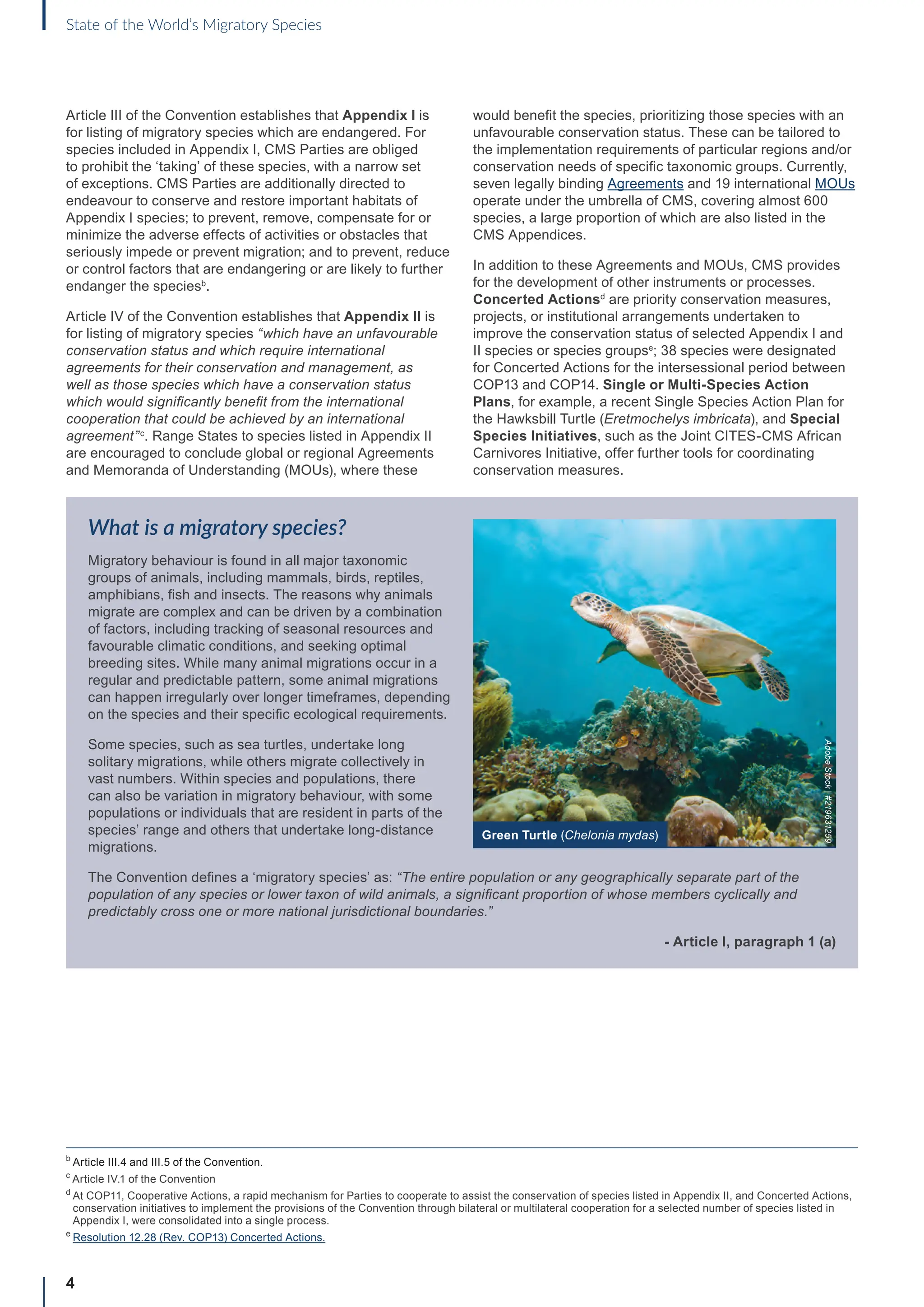
Green Turtle (Chelonia mydas)
Adobe
Stock
|
#219631259
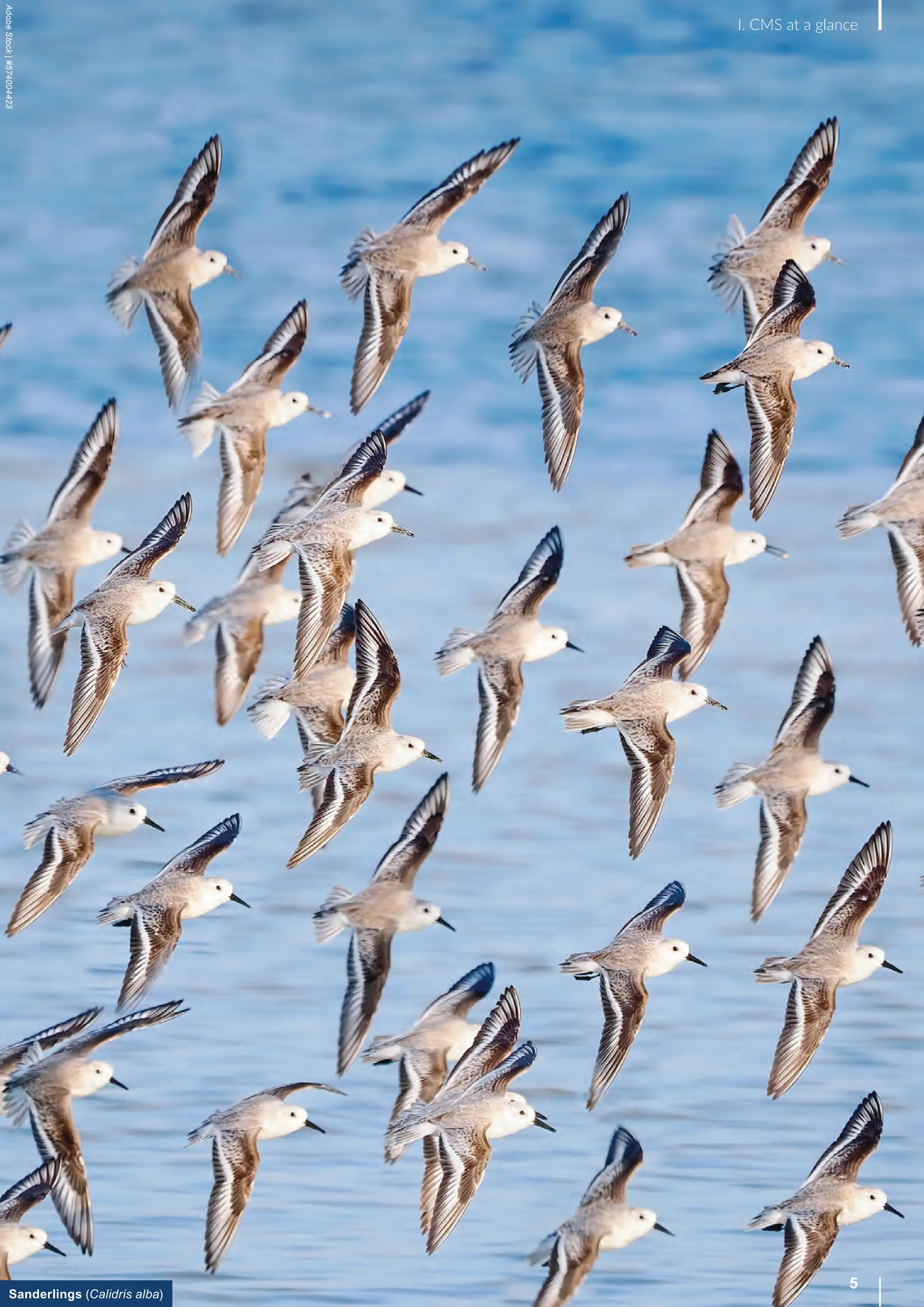
Sanderlings (Calidris alba)
5
I. CMS at a glance
Adobe
Stock
|
#574004423
6
State of the World’s Migratory Species
The importance of migratory species
Migratory animals are essential components of the
ecosystems that support all life on Earth. Globally, billions of
individual animals embark on migratory journeys each year,
connecting distant continents, countries and habitats through
their migration routes. Migratory species are of ecological,
economic and cultural importance. Within ecosystems,
migratory species perform a variety of crucial functions,
ranging from the large-scale transfer of nutrients between
environments, to the positive impacts of grazing animals on
grassland biodiversity1,2
. People around the world are reliant
on these species as sources of food, income and enjoyment.
Along their migration routes, migratory species provide vital
benefits for people, from pollination of crops to supporting
sustainable livelihoods. Migratory species are also valuable
indicators of overall environmental health: trends in the
conservation status and behaviour of migratory species can
provide an indication of the state of habitats along entire
migration routes.
Declines in the abundance of migratory species may result
in the loss of important functions and services. Conserving
migratory species can also support the continued resilience
of ecosystems in the face of a changing environment,
including by mitigating climate change impacts. Emerging
research on this theme is summarized within a recent
review of 'Climate Change and Migratory Species: a review
of impacts, conservation actions, ecosystem services and
indicators'.
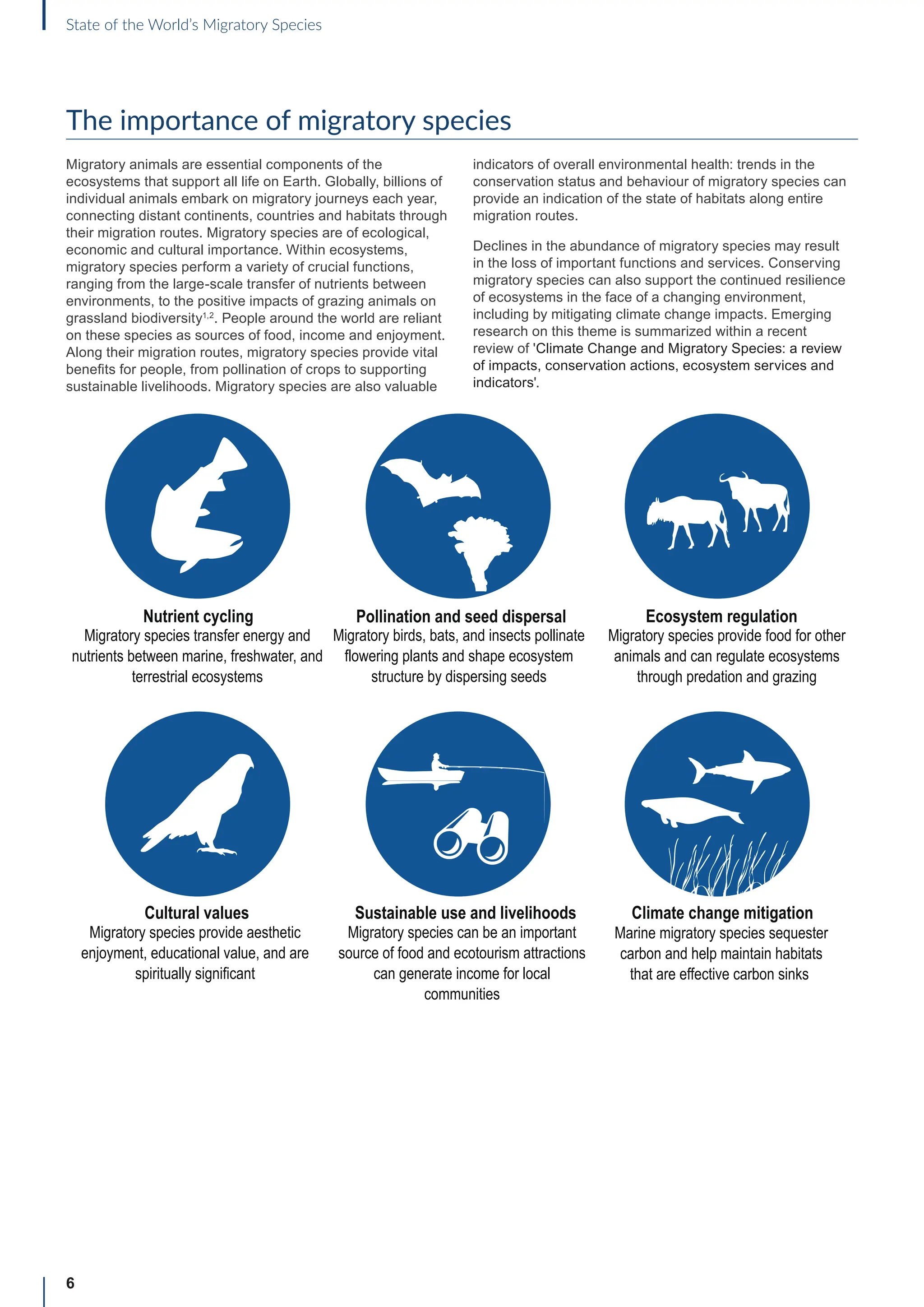
Nutrient cycling
Cultural values
Pollination and seed dispersal
Migratory birds, bats, and insects pollinate
flowering plants and shape ecosystem
structure by dispersing seeds
Migratory species transfer energy and
nutrients between marine, freshwater, and
terrestrial ecosystems
Migratory species provide aesthetic
enjoyment, educational value, and are
spiritually significant
Ecosystem regulation
Sustainable use and livelihoods
Migratory species provide food for other
animals and can regulate ecosystems
through predation and grazing
Migratory species can be an important
source of food and ecotourism attractions
can generate income for local
communities
Climate change mitigation
Marine migratory species sequester
carbon and help maintain habitats
that are effective carbon sinks
The following illustrative examples showcase the importance of migratory species
to ecosystems and society:
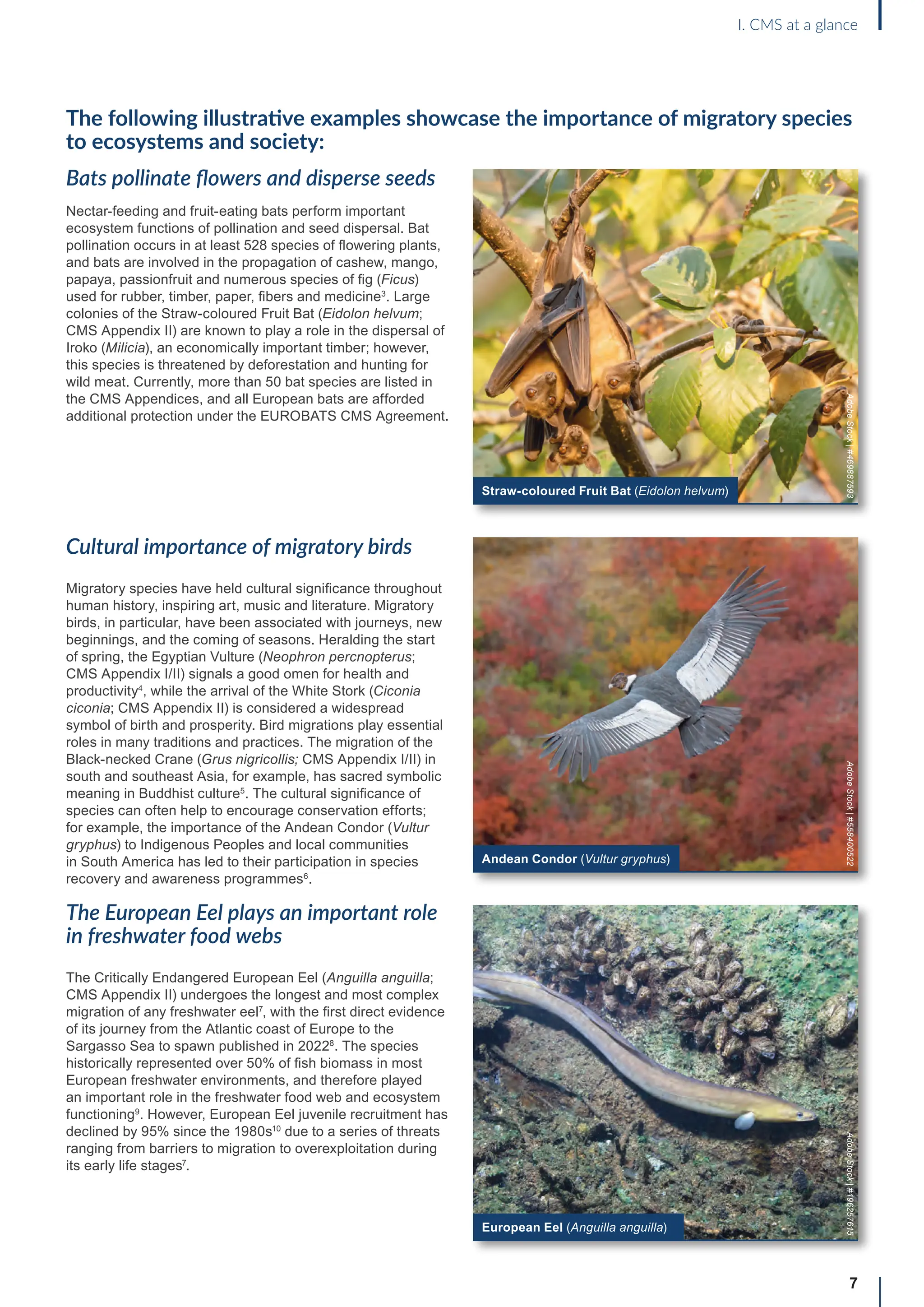
Bats pollinate flowers and disperse seeds
Nectar-feeding and fruit-eating bats perform important
ecosystem functions of pollination and seed dispersal. Bat
pollination occurs in at least 528 species of flowering plants,
and bats are involved in the propagation of cashew, mango,
papaya, passionfruit and numerous species of fig (Ficus)
used for rubber, timber, paper, fibers and medicine3
. Large
colonies of the Straw-coloured Fruit Bat (Eidolon helvum;
CMS Appendix II) are known to play a role in the dispersal of
Iroko (Milicia), an economically important timber; however,
this species is threatened by deforestation and hunting for
wild meat. Currently, more than 50 bat species are listed in
the CMS Appendices, and all European bats are afforded
additional protection under the EUROBATS CMS Agreement.
Cultural importance of migratory birds
Migratory species have held cultural significance throughout
human history, inspiring art, music and literature. Migratory
birds, in particular, have been associated with journeys, new
beginnings, and the coming of seasons. Heralding the start
of spring, the Egyptian Vulture (Neophron percnopterus;
CMS Appendix I/II) signals a good omen for health and
productivity4
, while the arrival of the White Stork (Ciconia
ciconia; CMS Appendix II) is considered a widespread
symbol of birth and prosperity. Bird migrations play essential
roles in many traditions and practices. The migration of the
Black-necked Crane (Grus nigricollis; CMS Appendix I/II) in
south and southeast Asia, for example, has sacred symbolic
meaning in Buddhist culture5
. The cultural significance of
species can often help to encourage conservation efforts;
for example, the importance of the Andean Condor (Vultur
gryphus) to Indigenous Peoples and local communities
in South America has led to their participation in species
recovery and awareness programmes6
.
The European Eel plays an important role
in freshwater food webs
The Critically Endangered European Eel (Anguilla anguilla;
CMS Appendix II) undergoes the longest and most complex
migration of any freshwater eel7
, with the first direct evidence
of its journey from the Atlantic coast of Europe to the
Sargasso Sea to spawn published in 20228
. The species
historically represented over 50% of fish biomass in most
European freshwater environments, and therefore played
an important role in the freshwater food web and ecosystem
functioning9
. However, European Eel juvenile recruitment has
declined by 95% since the 1980s10
due to a series of threats
ranging from barriers to migration to overexploitation during
its early life stages7
.
7
I. CMS at a glance
Straw-coloured Fruit Bat (Eidolon helvum)
Adobe
Stock
|
#469887593
Andean Condor (Vultur gryphus)
Adobe
Stock
|
#558400522
European Eel (Anguilla anguilla)
Adobe
Stock
|
#196257615
8
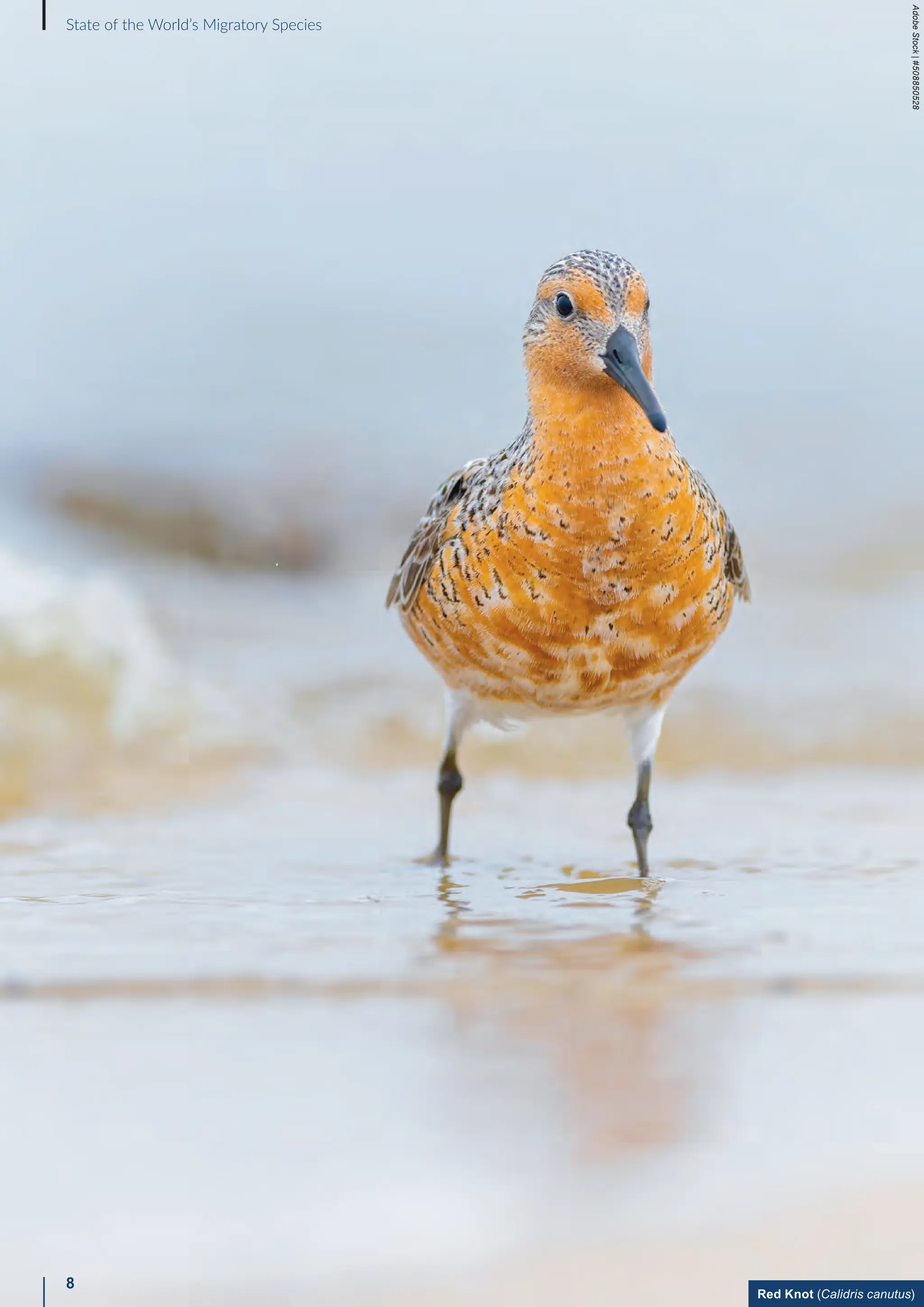
Red Knot (Calidris canutus)
State of the World’s Migratory Species
Adobe
Stock
|
#508850528
II. STATE – Conservation status
9
II. STATE - Conservation status
Conservation status and trends
l Overall, more than one in five CMS-listed species are threatened with extinction and 44% have a decreasing
population trend
◆ 82% of Appendix I species are threatened with extinction and 76% are declining
◆ 18% of Appendix II species are globally threatened; yet 42% have a decreasing population trend
l The conservation status of CMS-listed fish is of particular concern. Almost all (97%) of CMS-listed fish are
threatened with extinction and, on average, are decreasing in population abundance
l Extinction risk is rising overall across CMS-listed species: between 1988 and 2020, 70 CMS species moved to
a higher IUCN Red List threat category due to a deterioration in conservation status, while 14 species showed a
genuine improvement
Migratory species that may benefit from increased protection or conservation
action under CMS
l There are 399 globally threatened and Near Threatened migratory species (mainly birds and fish) that are not listed
in the CMS Appendices; these species deserve closer scrutiny from CMS Parties and the Scientific Council, and
may benefit from being listed in the CMS Appendices
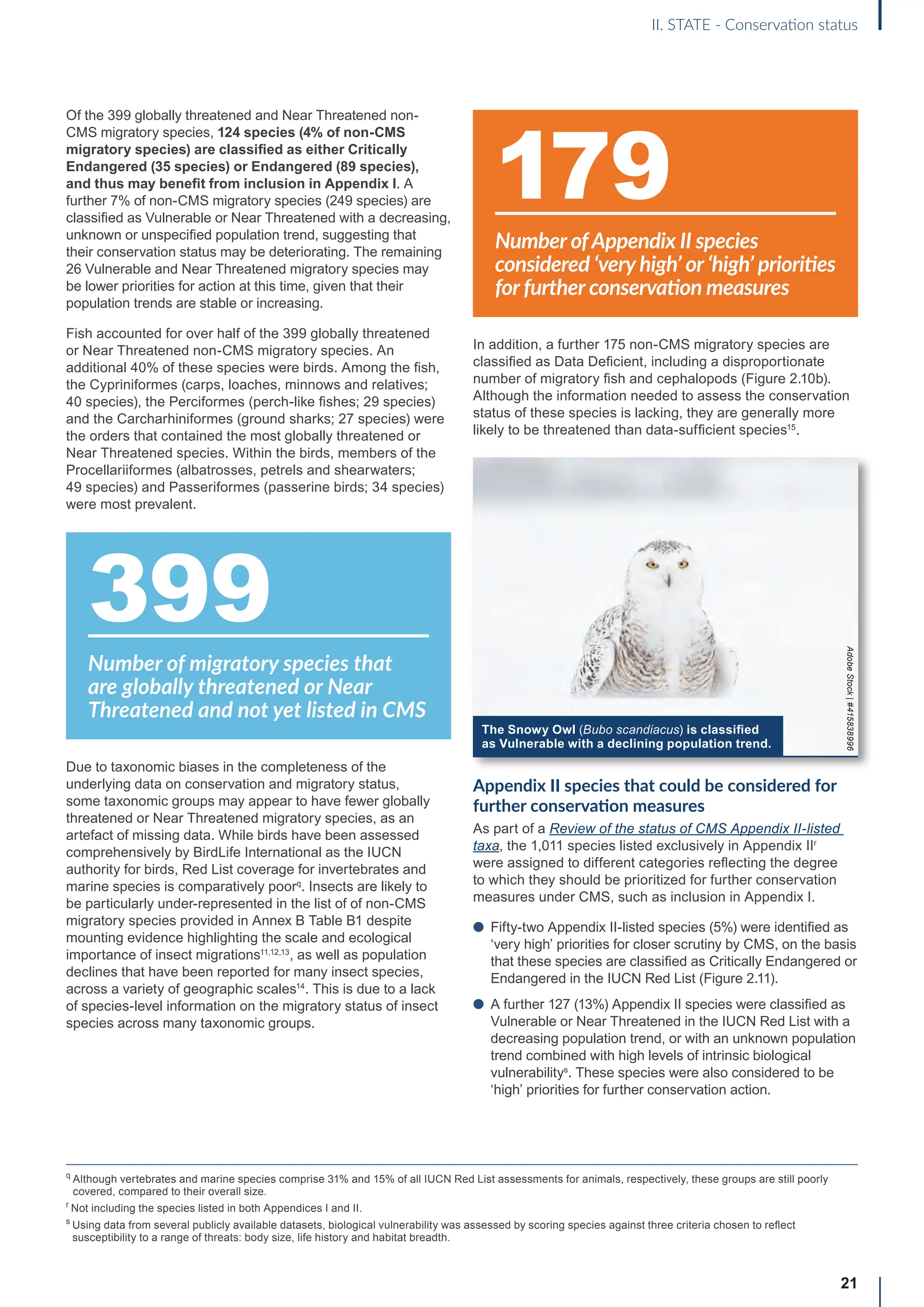
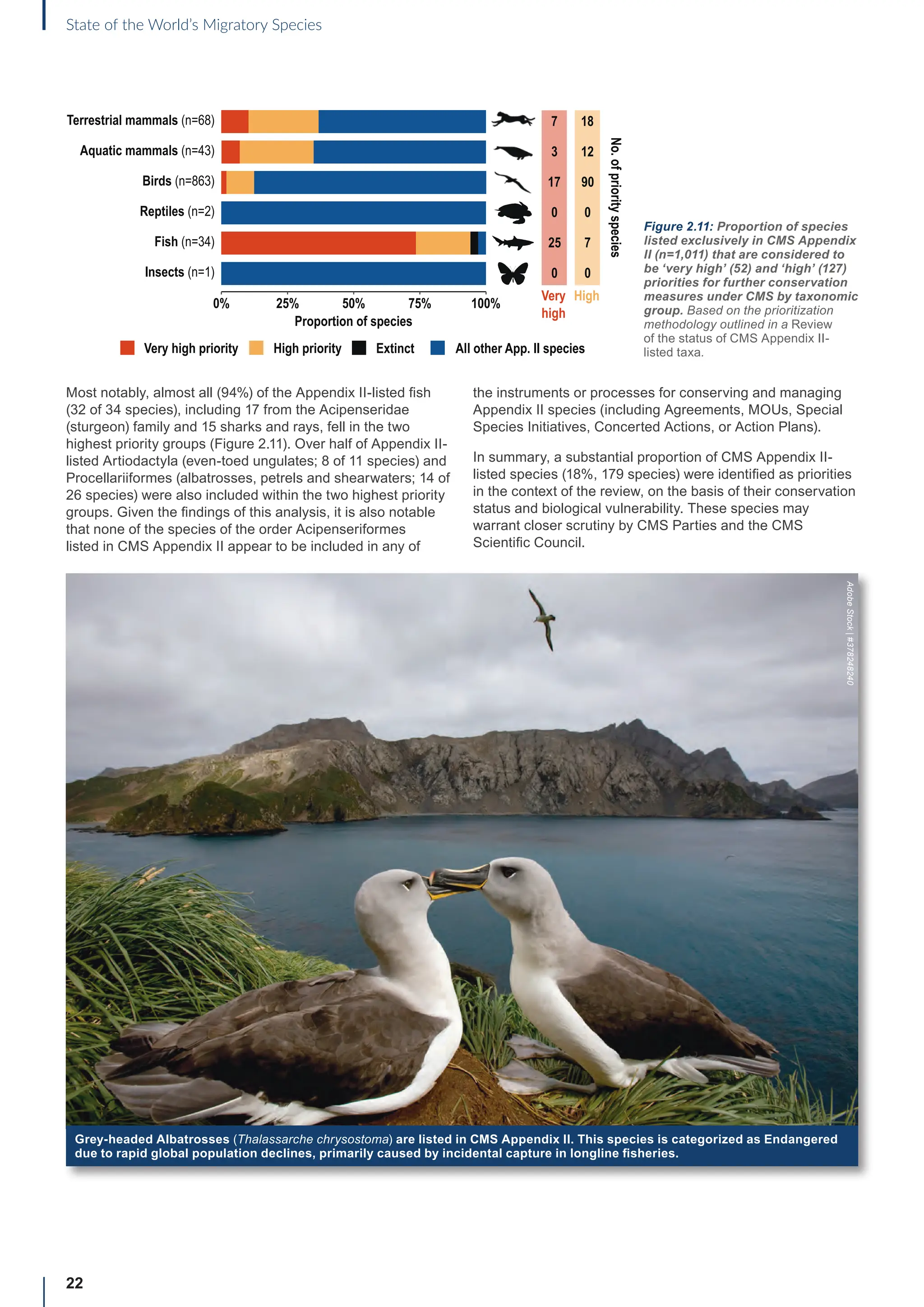
l A total of 179 species listed in Appendix II were identified as ‘very high’ (52 species, 5%) and ‘high’ (127 species,
13%) priorities for further conservation measures
The overarching mission of CMS is to “promote actions
to ensure the favourable conservation status of migratory
species and their habitats”a
. This chapter lays the
foundation for understanding the conservation status of
migratory species, which is essential to provide context
for the steps to be taken to conserve them. It provides
an overview of the conservation status of CMS-listed
species overall, by Appendix, by taxonomic group and by
region, where appropriate. It also provides insights into
the extinction risk and abundance trends of all migratory
species. The information is drawn primarily from IUCN
Red List assessments and data from the Living Planet
Index (managed by the Zoological Society of London in
collaboration with WWF), which together provide the most
comprehensive assessments of conservation status and
population abundance for species worldwide.
Dalmatian Pelicans (Pelecanus crispus)
Adobe
Stock
|
#102845544
a
CMS Strategic Plan for Migratory Species 2015-2023
10
State of the World’s Migratory Species
Conservation status of CMS-listed species
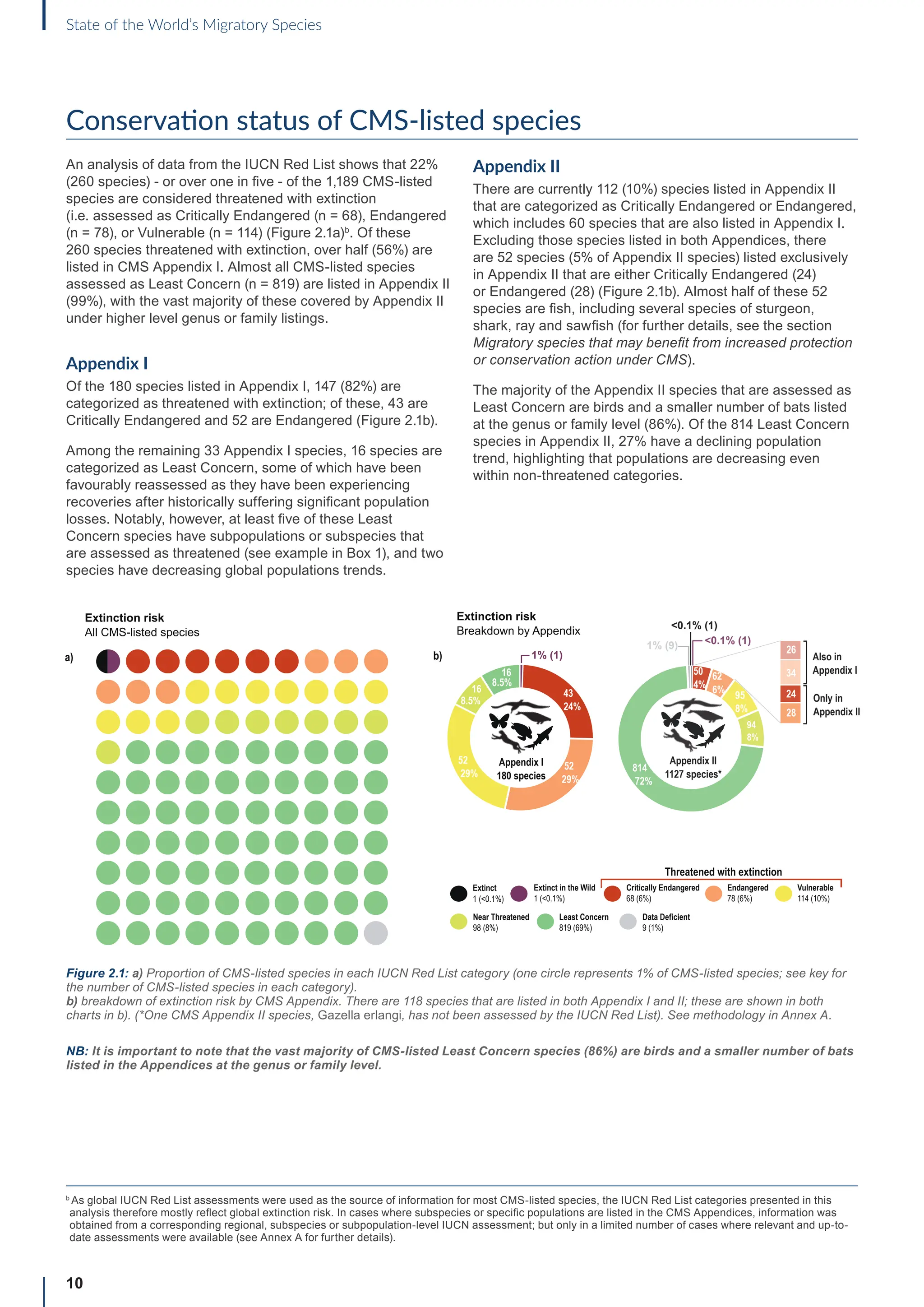
An analysis of data from the IUCN Red List shows that 22%
(260 species) - or over one in five - of the 1,189 CMS-listed
species are considered threatened with extinction
(i.e. assessed as Critically Endangered (n = 68), Endangered
(n = 78), or Vulnerable (n = 114) (Figure 2.1a)b
. Of these
260 species threatened with extinction, over half (56%) are
listed in CMS Appendix I. Almost all CMS-listed species
assessed as Least Concern (n = 819) are listed in Appendix II
(99%), with the vast majority of these covered by Appendix II
under higher level genus or family listings.
Appendix I
Of the 180 species listed in Appendix I, 147 (82%) are
categorized as threatened with extinction; of these, 43 are
Critically Endangered and 52 are Endangered (Figure 2.1b).
Among the remaining 33 Appendix I species, 16 species are
categorized as Least Concern, some of which have been
favourably reassessed as they have been experiencing
recoveries after historically suffering significant population
losses. Notably, however, at least five of these Least
Concern species have subpopulations or subspecies that
are assessed as threatened (see example in Box 1), and two
species have decreasing global populations trends.
Appendix II
There are currently 112 (10%) species listed in Appendix II
that are categorized as Critically Endangered or Endangered,
which includes 60 species that are also listed in Appendix I.
Excluding those species listed in both Appendices, there
are 52 species (5% of Appendix II species) listed exclusively
in Appendix II that are either Critically Endangered (24)
or Endangered (28) (Figure 2.1b). Almost half of these 52
species are fish, including several species of sturgeon,
shark, ray and sawfish (for further details, see the section
Migratory species that may benefit from increased protection
or conservation action under CMS).
The majority of the Appendix II species that are assessed as
Least Concern are birds and a smaller number of bats listed
at the genus or family level (86%). Of the 814 Least Concern
species in Appendix II, 27% have a declining population
trend, highlighting that populations are decreasing even
within non-threatened categories.
Figure 2.1: a) Proportion of CMS-listed species in each IUCN Red List category (one circle represents 1% of CMS-listed species; see key for
the number of CMS-listed species in each category).
b) breakdown of extinction risk by CMS Appendix. There are 118 species that are listed in both Appendix I and II; these are shown in both
charts in b). (*One CMS Appendix II species, Gazella erlangi, has not been assessed by the IUCN Red List). See methodology in Annex A.
NB: It is important to note that the vast majority of CMS-listed Least Concern species (86%) are birds and a smaller number of bats
listed in the Appendices at the genus or family level.
b
As global IUCN Red List assessments were used as the source of information for most CMS-listed species, the IUCN Red List categories presented in this
analysis therefore mostly reflect global extinction risk. In cases where subspecies or specific populations are listed in the CMS Appendices, information was
obtained from a corresponding regional, subspecies or subpopulation-level IUCN assessment; but only in a limited number of cases where relevant and up-to-
date assessments were available (see Annex A for further details).
Appendix I
180 species
Appendix II
1127 species*
814
72%
94
8%
95
8%
62
6%
50
4%
52
29%
52
29%
43
24%
16
16
1% (1)
0.1% (1)
0.1% (1)
1% (9)
34
24
Also in
Appendix I
Only in
Appendix II
34
24
28
26
Extinction risk
All CMS-listed species
Extinction risk
Breakdown by Appendix
Extinct
1 (0.1%)
Near Threatened
98 (8%)
Least Concern
819 (69%)
Extinct in the Wild
1 (0.1%)
Data Deficient
9 (1%)
Critically Endangered
68 (6%)
Endangered
78 (6%)
Vulnerable
114 (10%)
Threatened with extinction
a) b)
8.5%
8.5%
Appendix I
180 species
Appendix II
1127 species*
814
72%
94
8%
95
8%
62
6%
50
4%
52
29%
52
29%
43
24%
16
16
1% (1)
0.1% (1)
0.1% (1)
1% (9)
34
24
Also in
Appendix I
Only in
Appendix II
34
24
28
26
Extinction risk
All CMS-listed species
Extinction risk
Breakdown by Appendix
Extinct
1 (0.1%)
Near Threatened
98 (8%)
Least Concern
819 (69%)
Extinct in the Wild
1 (0.1%)
Data Deficient
9 (1%)
Critically Endangered
68 (6%)
Endangered
78 (6%)
Vulnerable
114 (10%)
Threatened with extinction
a) b)
8.5%
8.5%
Appe
180 s
Appe
1127 s
814
72%
52
29%
16
16
0.1
1% (9)
Extinction risk
All CMS-listed species
Extinction r
Breakdown
Extinct
1 (0.1%)
Near Threatened
98 (8%)
Least Concern
819 (69%)
Extinct in the Wild
1 (0.1%)
Data Deficient
9 (1%)
Critically Endangered
68 (6%)
Endangered
78 (6%)
Vulnerable
114 (10%)
Threatened with extinction
a) b)
8.5%
8.5%
Appendix I
180 species
Appendix II
1127 species*
814
72%
94
8%
95
8%
62
6%
50
4%
52
29%
52
29%
43
24%
16
16
1% (1)
0.1% (1)
0.1% (1)
1% (9)
34
24
Also in
Appendix I
Only in
Appendix II
34
24
28
26
Extinction risk
All CMS-listed species
Extinction risk
Breakdown by Appendix
Extinct
1 (0.1%)
Near Threatened
98 (8%)
Least Concern
819 (69%)
Extinct in the Wild
1 (0.1%)
Data Deficient
9 (1%)
Critically Endangered
68 (6%)
Endangered
78 (6%)
Vulnerable
114 (10%)
Threatened with extinction
a) b)
8.5%
8.5%
11
II. STATE - Conservation status
Population trends
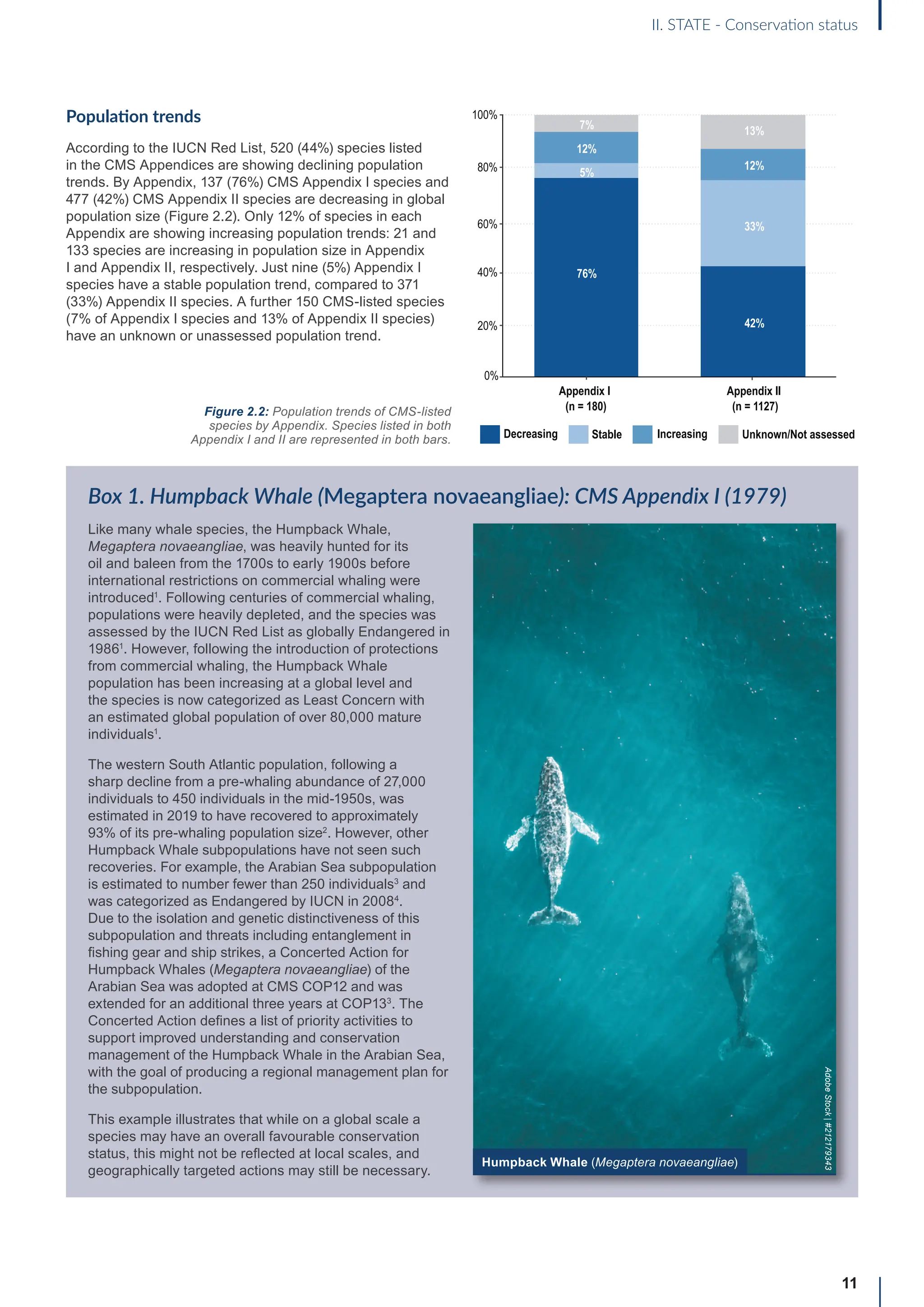
According to the IUCN Red List, 520 (44%) species listed
in the CMS Appendices are showing declining population
trends. By Appendix, 137 (76%) CMS Appendix I species and
477 (42%) CMS Appendix II species are decreasing in global
population size (Figure 2.2). Only 12% of species in each
Appendix are showing increasing population trends: 21 and
133 species are increasing in population size in Appendix
I and Appendix II, respectively. Just nine (5%) Appendix I
species have a stable population trend, compared to 371
(33%) Appendix II species. A further 150 CMS-listed species
(7% of Appendix I species and 13% of Appendix II species)
have an unknown or unassessed population trend.
Figure 2.2: Population trends of CMS-listed
species by Appendix. Species listed in both
Appendix I and II are represented in both bars.
Box 1. Humpback Whale (Megaptera novaeangliae): CMS Appendix I (1979)
Like many whale species, the Humpback Whale,
Megaptera novaeangliae, was heavily hunted for its
oil and baleen from the 1700s to early 1900s before
international restrictions on commercial whaling were
introduced1
. Following centuries of commercial whaling,
populations were heavily depleted, and the species was
assessed by the IUCN Red List as globally Endangered in
19861
. However, following the introduction of protections
from commercial whaling, the Humpback Whale
population has been increasing at a global level and
the species is now categorized as Least Concern with
an estimated global population of over 80,000 mature
individuals1
.
The western South Atlantic population, following a
sharp decline from a pre-whaling abundance of 27,000
individuals to 450 individuals in the mid-1950s, was
estimated in 2019 to have recovered to approximately
93% of its pre-whaling population size2
. However, other
Humpback Whale subpopulations have not seen such
recoveries. For example, the Arabian Sea subpopulation
is estimated to number fewer than 250 individuals3
and
was categorized as Endangered by IUCN in 20084
.
Due to the isolation and genetic distinctiveness of this
subpopulation and threats including entanglement in
fishing gear and ship strikes, a Concerted Action for
Humpback Whales (Megaptera novaeangliae) of the
Arabian Sea was adopted at CMS COP12 and was
extended for an additional three years at COP133
. The
Concerted Action defines a list of priority activities to
support improved understanding and conservation
management of the Humpback Whale in the Arabian Sea,
with the goal of producing a regional management plan for
the subpopulation.
This example illustrates that while on a global scale a
species may have an overall favourable conservation
status, this might not be reflected at local scales, and
geographically targeted actions may still be necessary.
Appendix I
(n = 180)
Appendix II
(n = 1127)
0%
20%
40%
60%
80%
100%
76%
5%
7%
42%
33%
12%
12%
13%
Decreasing Stable Increasing Unknown/Not assessed
12%
12%
Humpback Whale (Megaptera novaeangliae)
Adobe
Stock
|
#212179343
12
State of the World’s Migratory Species
Conservation status by taxonomic group
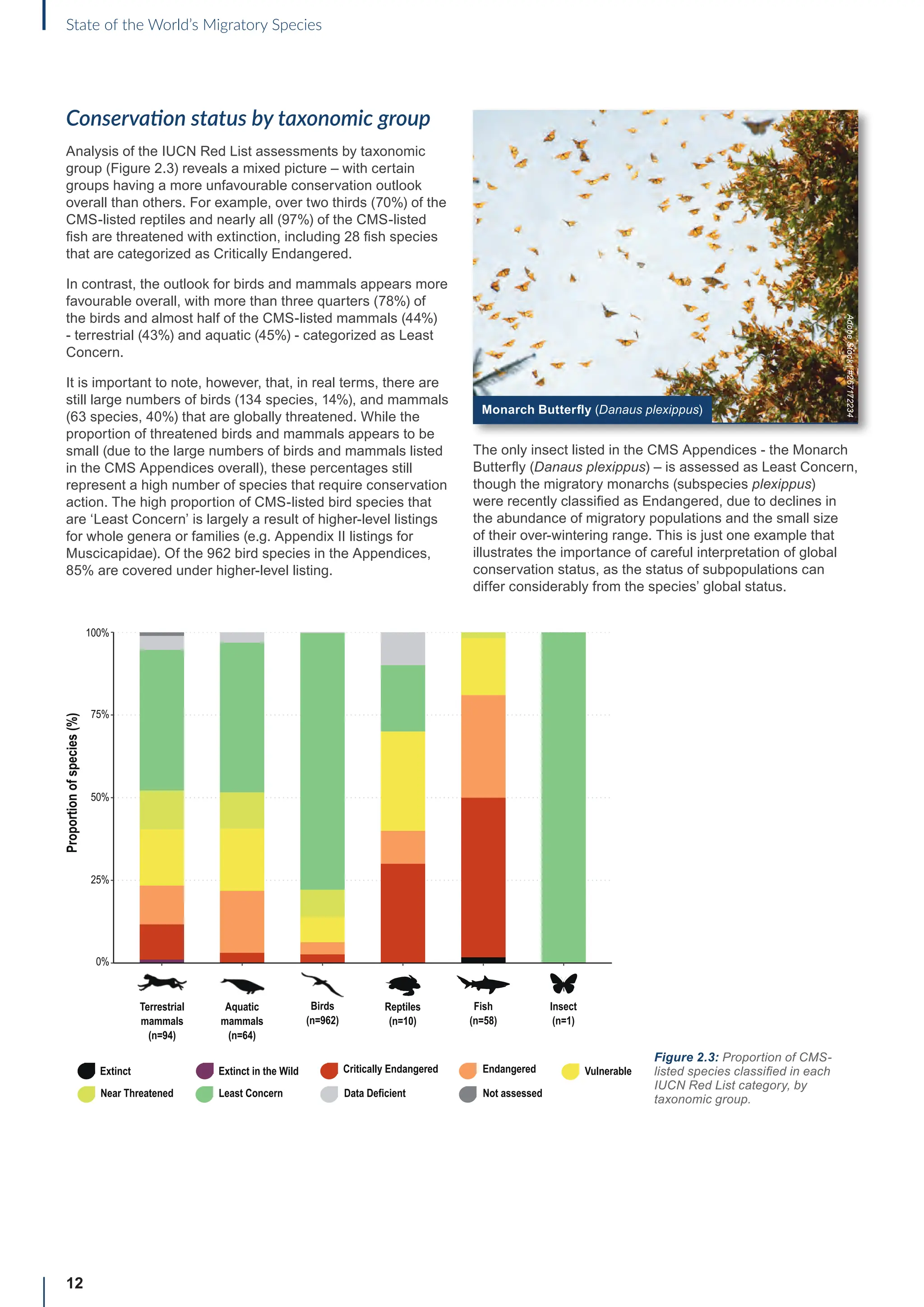
Analysis of the IUCN Red List assessments by taxonomic
group (Figure 2.3) reveals a mixed picture – with certain
groups having a more unfavourable conservation outlook
overall than others. For example, over two thirds (70%) of the
CMS-listed reptiles and nearly all (97%) of the CMS-listed
fish are threatened with extinction, including 28 fish species
that are categorized as Critically Endangered.
In contrast, the outlook for birds and mammals appears more
favourable overall, with more than three quarters (78%) of
the birds and almost half of the CMS-listed mammals (44%)
- terrestrial (43%) and aquatic (45%) - categorized as Least
Concern.
It is important to note, however, that, in real terms, there are
still large numbers of birds (134 species, 14%), and mammals
(63 species, 40%) that are globally threatened. While the
proportion of threatened birds and mammals appears to be
small (due to the large numbers of birds and mammals listed
in the CMS Appendices overall), these percentages still
represent a high number of species that require conservation
action. The high proportion of CMS-listed bird species that
are ‘Least Concern’ is largely a result of higher-level listings
for whole genera or families (e.g. Appendix II listings for
Muscicapidae). Of the 962 bird species in the Appendices,
85% are covered under higher-level listing.
The only insect listed in the CMS Appendices - the Monarch
Butterfly (Danaus plexippus) – is assessed as Least Concern,
though the migratory monarchs (subspecies plexippus)
were recently classified as Endangered, due to declines in
the abundance of migratory populations and the small size
of their over-wintering range. This is just one example that
illustrates the importance of careful interpretation of global
conservation status, as the status of subpopulations can
differ considerably from the species’ global status.
75%
100%
50%
25%
Proportion
of
species
(%)
Extinct
Birds
(n=962)
Insect
(n=1)
Aquatic
mammals
(n=64)
Reptiles
(n=10)
Fish
(n=58)
Terrestrial
mammals
(n=94)
0%
Near Threatened Least Concern
Extinct in the Wild
Data Deficient
Critically Endangered Endangered
Not assessed
Vulnerable
Figure 2.3: Proportion of CMS-
listed species classified in each
IUCN Red List category, by
taxonomic group.
Monarch Butterfly (Danaus plexippus)
Adobe
Stock
|
#267172234
13
II. STATE - Conservation status
Beyond extinction risk: the IUCN Green Status of Species
While an IUCN Red List assessment quantifies a species’
risk of extinction, a complementary tool, the IUCN Green
Status of Species, has been recently developed to present
a road map to recovery. It assesses the extent to which a
species has recovered, and quantifies the importance of
past, present, and future conservation efforts for the species,
to evaluate its potential for recovery.
The recent 2021 assessment of the Whale Shark (Rhincodon
typus), for example, indicated that while the species is
Endangered with a Species Recovery Category of ‘Largely
Depleted’ (29%)c
, the potential for future recovery of
functional populations across its historical range is high5
.
Assuming increased and sustained conservation efforts to
counter its principal threats (high levels of fishing, bycatch
in gillnet and purse seine fisheries, ship strikes and marine
pollution), it is expected that populations would stabilize
within a 10-year period6
.
The Green Status has been an optional part of Red List
assessments since 2020. To date (April 2023), six CMS-listed
species have been assessed; here, their Species Recovery
Category and recovery potentiald
are summarized:
l Saiga (Saiga tatarica) (Largely Depleted, 38%; Recovery
potential: Medium)
l Vicuña (Vicugna vicugna) (Moderately Depleted, 67%;
Recovery potential: Medium)
l Black Stork (Ciconia nigra) (Moderately Depleted, 67%;
Recovery potential: Medium)
l African Penguin (Spheniscus demersus), (Largely
Depleted, 33%; Recovery potential: Medium)
l Whale Shark (Rhincodon typus) (Largely Depleted, 29%;
Recovery potential: High)
l White Shark (Carcharodon carcharias) (Moderately
Depleted, 56%; Recovery potential: Indeterminate)
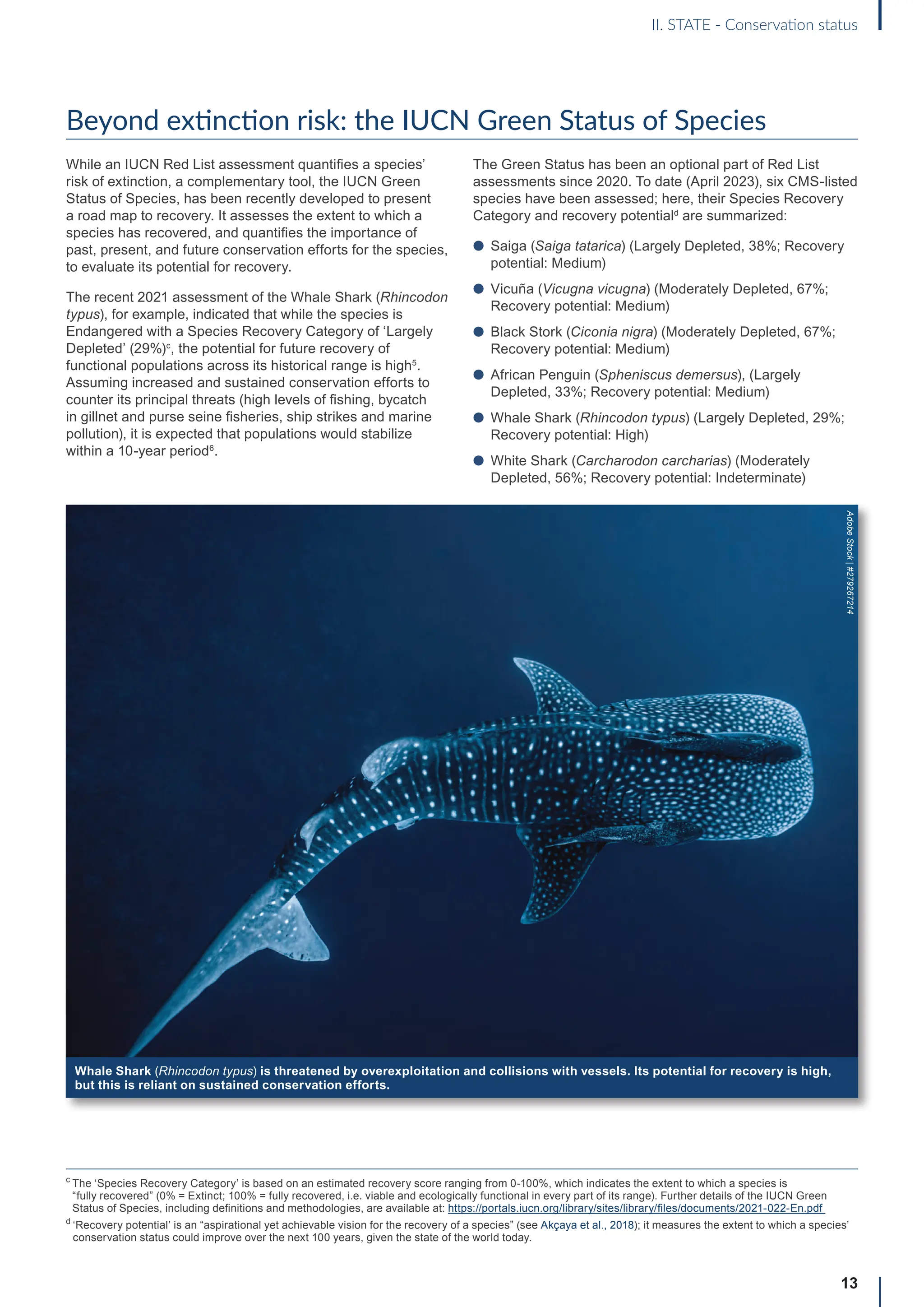
Whale Shark (Rhincodon typus) is threatened by overexploitation and collisions with vessels. Its potential for recovery is high,
but this is reliant on sustained conservation efforts.
Adobe
Stock
|
#279267214
c

The ‘Species Recovery Category’ is based on an estimated recovery score ranging from 0-100%, which indicates the extent to which a species is
“fully recovered” (0% = Extinct; 100% = fully recovered, i.e. viable and ecologically functional in every part of its range). Further details of the IUCN Green
Status of Species, including definitions and methodologies, are available at: https://portals.iucn.org/library/sites/library/files/documents/2021-022-En.pdf
d

‘Recovery potential’ is an “aspirational yet achievable vision for the recovery of a species” (see Akçaya et al., 2018); it measures the extent to which a species’
conservation status could improve over the next 100 years, given the state of the world today.
14
State of the World’s Migratory Species
Trends in the conservation status and population abundance of
migratory species
The Red List Index
The Red List Index (RLI)e
shows trends in overall extinction risk
by measuring the change in survival probability for a subset of
species; this is determined based on genuine changes in the
number of species in each extinction risk category in the IUCN
Red List (i.e. excluding any changes that result from improved
knowledge or revised taxonomy). It is important to note that the
RLI for a subset of species is calculated as an aggregate of the
survival probabilities of the species contained in that subset, and
therefore that individual species may be doing better, or worse,
than the overall resulting trend. The RLI value ranges from 1
(if all species are categorized as ‘Least Concern’) to 0 (if all
species are categorized as ‘Extinct’). A lower RLI value therefore
indicates that a group of species is closer to extinction. A steeper
downward RLI slope indicates a faster move towards extinction.
While trends can be disaggregated by region, taxonomic
group, or threat types, certain subsets of the data result in
too few species in the group with sufficient data to calculate
meaningful Indices; it was therefore only possible to obtain
disaggregates by taxonomic group for aquatic mammals,
terrestrial mammals, birds and sturgeons. The data required
to calculate the Indices for other fish groups, such as sharks
and rays, were not available, which also precluded the
calculation of the Index for fish overall. Additionally, the RLI
for mammals could only be calculated for the period 1996-
2008; as the mammals were comprehensively reassessed
by IUCN recently, the evaluation of whether any changes in
survival probability represent genuine changes in status is
still ongoing and this data could not yet be integrated into the
calculation of the index.
Globally, the extinction risk for migratory and
CMS-listed species is increasing
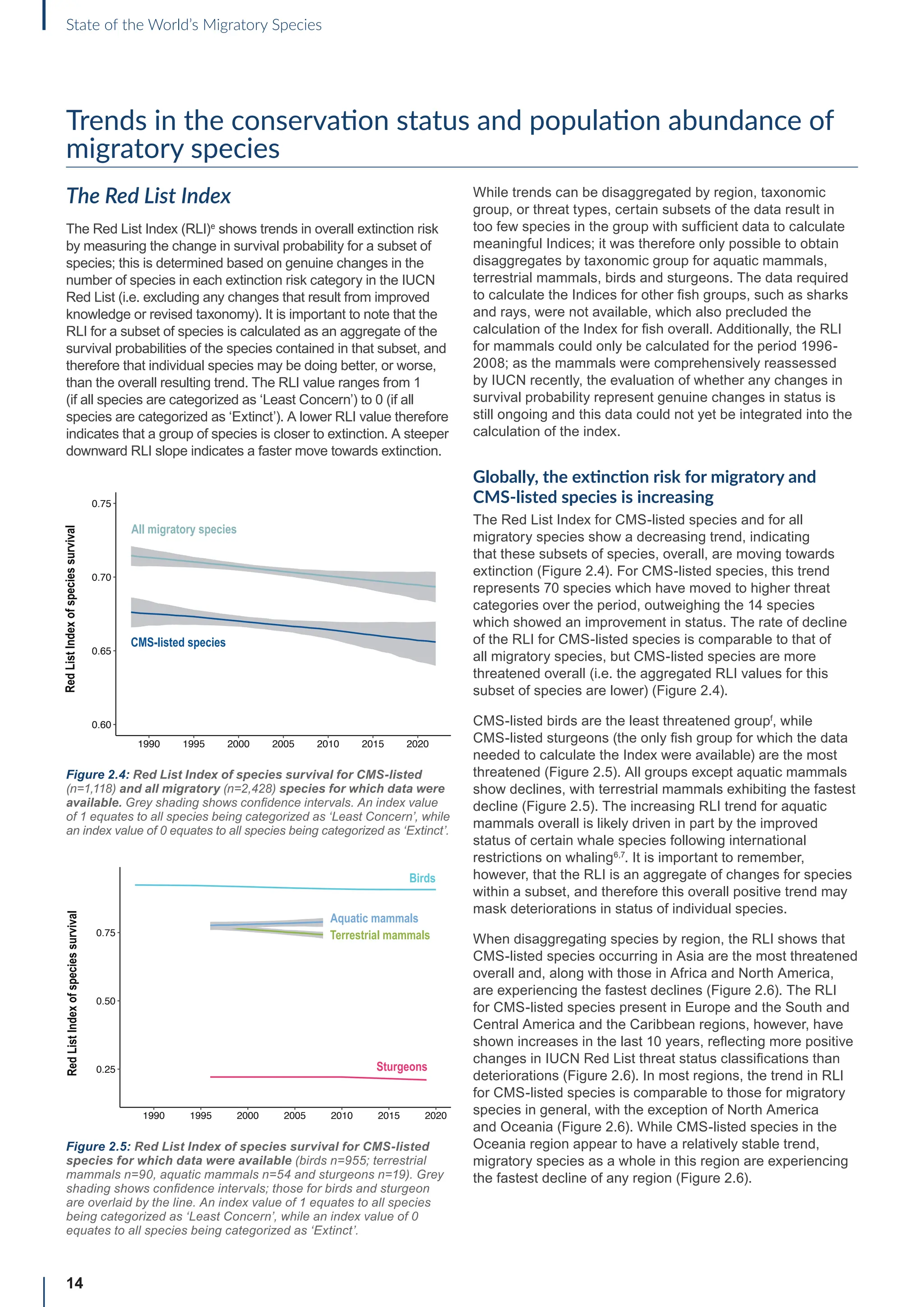
The Red List Index for CMS-listed species and for all
migratory species show a decreasing trend, indicating
that these subsets of species, overall, are moving towards
extinction (Figure 2.4). For CMS-listed species, this trend
represents 70 species which have moved to higher threat
categories over the period, outweighing the 14 species
which showed an improvement in status. The rate of decline
of the RLI for CMS-listed species is comparable to that of
all migratory species, but CMS-listed species are more
threatened overall (i.e. the aggregated RLI values for this
subset of species are lower) (Figure 2.4).
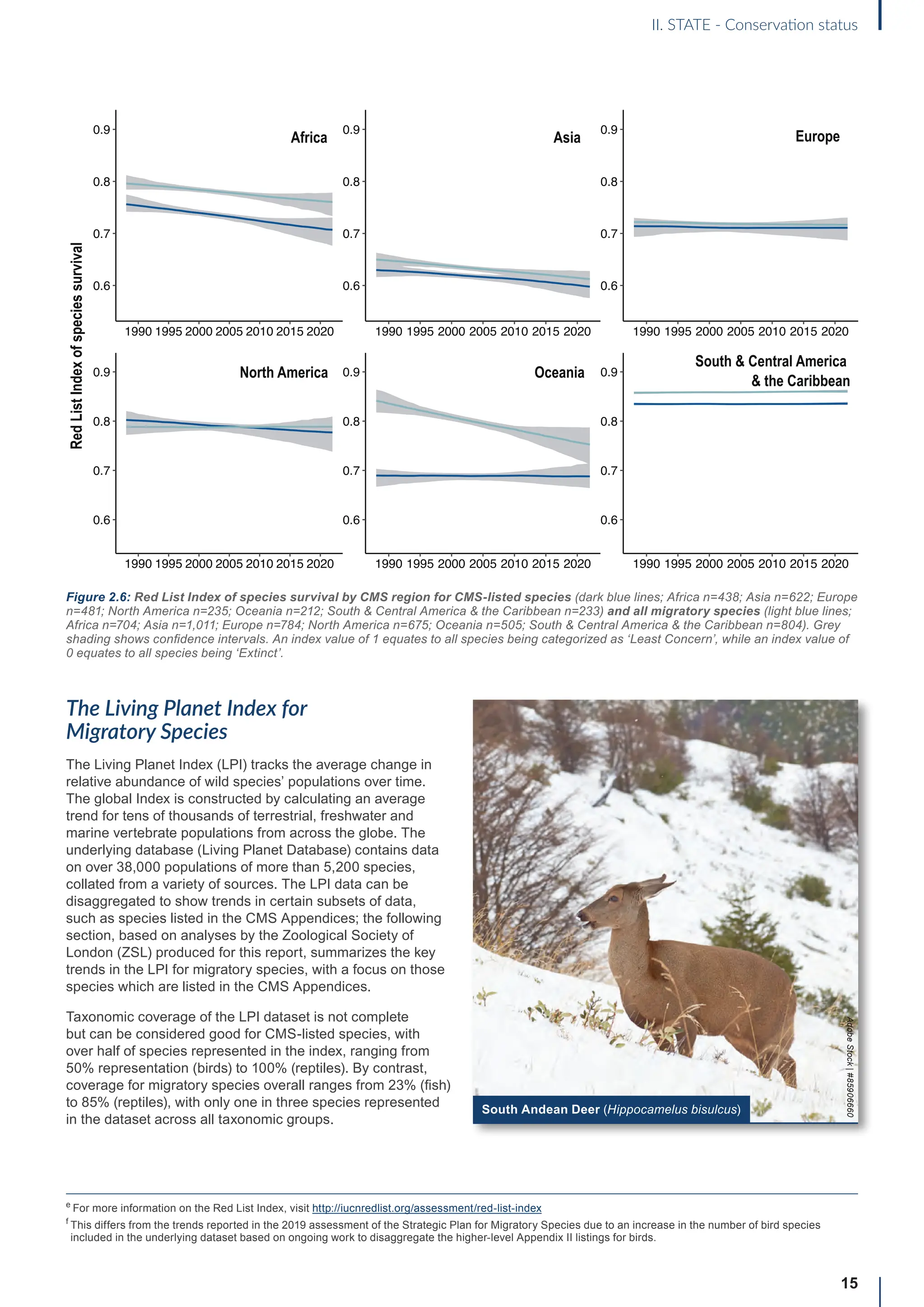
CMS-listed birds are the least threatened groupf
, while
CMS-listed sturgeons (the only fish group for which the data
needed to calculate the Index were available) are the most
threatened (Figure 2.5). All groups except aquatic mammals
show declines, with terrestrial mammals exhibiting the fastest
decline (Figure 2.5). The increasing RLI trend for aquatic
mammals overall is likely driven in part by the improved
status of certain whale species following international
restrictions on whaling6,7
. It is important to remember,
however, that the RLI is an aggregate of changes for species
within a subset, and therefore this overall positive trend may
mask deteriorations in status of individual species.
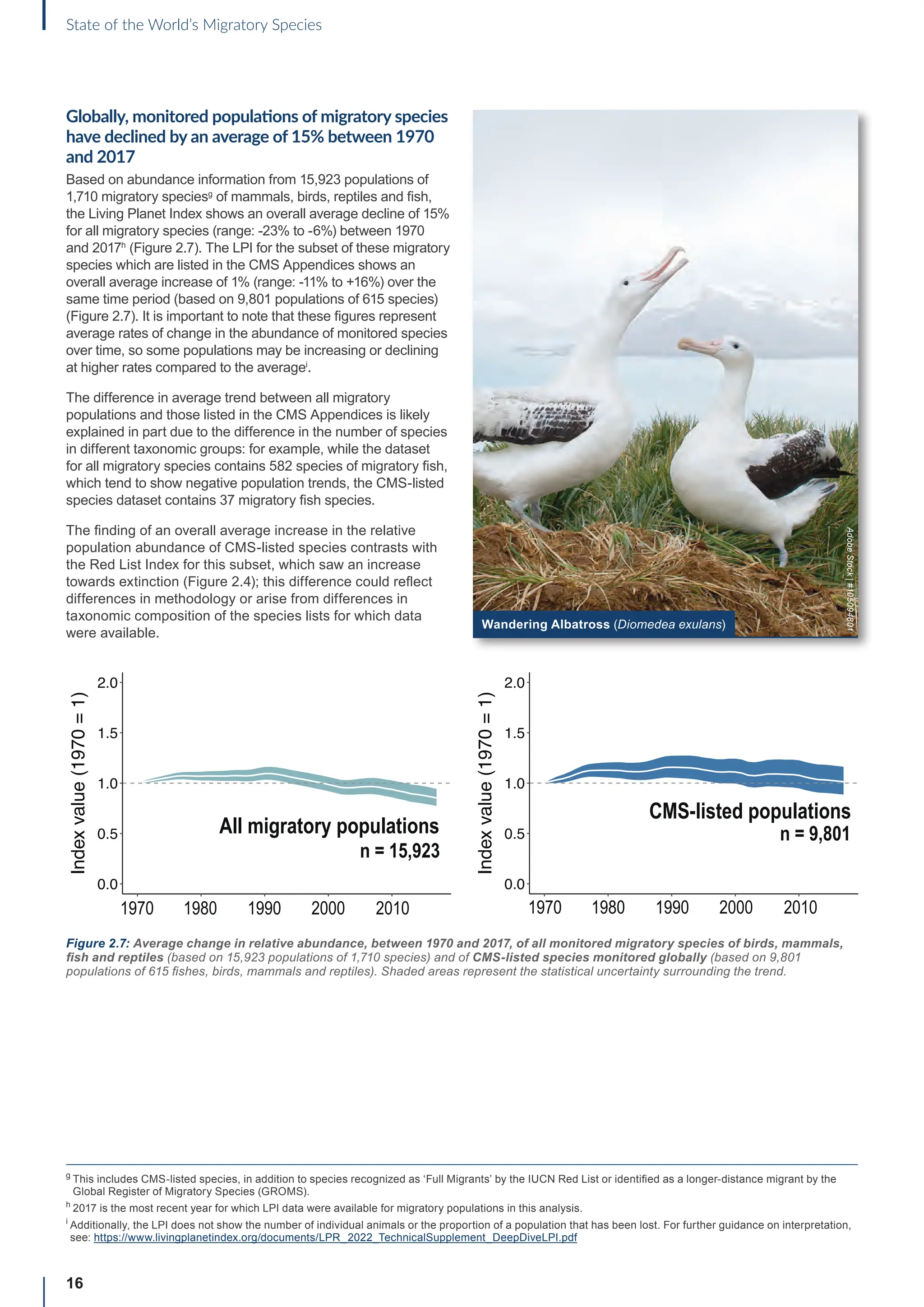
When disaggregating species by region, the RLI shows that
CMS-listed species occurring in Asia are the most threatened
overall and, along with those in Africa and North America,
are experiencing the fastest declines (Figure 2.6). The RLI
for CMS-listed species present in Europe and the South and
Central America and the Caribbean regions, however, have
shown increases in the last 10 years, reflecting more positive
changes in IUCN Red List threat status classifications than
deteriorations (Figure 2.6). In most regions, the trend in RLI
for CMS-listed species is comparable to those for migratory
species in general, with the exception of North America
and Oceania (Figure 2.6). While CMS-listed species in the
Oceania region appear to have a relatively stable trend,
migratory species as a whole in this region are experiencing
the fastest decline of any region (Figure 2.6).
Figure 2.4: Red List Index of species survival for CMS-listed
(n=1,118) and all migratory (n=2,428) species for which data were
available. Grey shading shows confidence intervals. An index value
of 1 equates to all species being categorized as ‘Least Concern’, while
an index value of 0 equates to all species being categorized as ‘Extinct’.
Figure 2.5: Red List Index of species survival for CMS-listed
species for which data were available (birds n=955; terrestrial
mammals n=90, aquatic mammals n=54 and sturgeons n=19). Grey
shading shows confidence intervals; those for birds and sturgeon
are overlaid by the line. An index value of 1 equates to all species
being categorized as ‘Least Concern’, while an index value of 0
equates to all species being categorized as ‘Extinct’.
Higher
extinction
risk
0.60
0.65
0.70
0.75
1990 1995 2000 2005 2010 2015 2020
CMS-listed species
All migratory species
Red
List
Index
of
species
survival
Lower
extinction
risk
0.25
0.50
0.75
1990 1995 2000 2005 2010 2015 2020
Birds
Aquatic mammals
Terrestrial mammals
Sturgeons
Higher
extinction
risk
Red
List
Index
of
species
survival
Lower
extinction
risk
15
II. STATE - Conservation status
Figure 2.6: Red List Index of species survival by CMS region for CMS-listed species (dark blue lines; Africa n=438; Asia n=622; Europe
n=481; North America n=235; Oceania n=212; South  Central America  the Caribbean n=233) and all migratory species (light blue lines;
Africa n=704; Asia n=1,011; Europe n=784; North America n=675; Oceania n=505; South  Central America  the Caribbean n=804). Grey
shading shows confidence intervals. An index value of 1 equates to all species being categorized as ‘Least Concern’, while an index value of
0 equates to all species being ‘Extinct’.
The Living Planet Index for
Migratory Species
The Living Planet Index (LPI) tracks the average change in
relative abundance of wild species’ populations over time.
The global Index is constructed by calculating an average
trend for tens of thousands of terrestrial, freshwater and
marine vertebrate populations from across the globe. The
underlying database (Living Planet Database) contains data
on over 38,000 populations of more than 5,200 species,
collated from a variety of sources. The LPI data can be
disaggregated to show trends in certain subsets of data,
such as species listed in the CMS Appendices; the following
section, based on analyses by the Zoological Society of
London (ZSL) produced for this report, summarizes the key
trends in the LPI for migratory species, with a focus on those
species which are listed in the CMS Appendices.
Taxonomic coverage of the LPI dataset is not complete
but can be considered good for CMS-listed species, with
over half of species represented in the index, ranging from
50% representation (birds) to 100% (reptiles). By contrast,
coverage for migratory species overall ranges from 23% (fish)
to 85% (reptiles), with only one in three species represented
in the dataset across all taxonomic groups.
0.6
0.7
0.8
0.9
1990 1995 2000 2005 2010 2015 2020
0.6
0.7
0.8
0.9
1990 1995 2000 2005 2010 2015 2020
0.6
0.7
0.8
0.9
1990 1995 2000 2005 2010 2015 2020
0.6
0.7
0.8
0.9
1990 1995 2000 2005 2010 2015 2020
0.6
0.7
0.8
0.9
1990 1995 2000 2005 2010 2015 2020
0.6
0.7
0.8
0.9
1990 1995 2000 2005 2010 2015 2020
Red
List
Index
of
species
survival
Africa Asia Europe
North America Oceania
South  Central America
 the Caribbean
e
For more information on the Red List Index, visit http://iucnredlist.org/assessment/red-list-index
f

This differs from the trends reported in the 2019 assessment of the Strategic Plan for Migratory Species due to an increase in the number of bird species
included in the underlying dataset based on ongoing work to disaggregate the higher-level Appendix II listings for birds.
South Andean Deer (Hippocamelus bisulcus)
Adobe
Stock
|
#85906660
16
State of the World’s Migratory Species
Globally, monitored populations of migratory species
have declined by an average of 15% between 1970
and 2017
Based on abundance information from 15,923 populations of
1,710 migratory speciesg
of mammals, birds, reptiles and fish,
the Living Planet Index shows an overall average decline of 15%
for all migratory species (range: -23% to -6%) between 1970
and 2017h
(Figure 2.7). The LPI for the subset of these migratory
species which are listed in the CMS Appendices shows an
overall average increase of 1% (range: -11% to +16%) over the
same time period (based on 9,801 populations of 615 species)
(Figure 2.7). It is important to note that these figures represent
average rates of change in the abundance of monitored species
over time, so some populations may be increasing or declining
at higher rates compared to the averagei
.
The difference in average trend between all migratory
populations and those listed in the CMS Appendices is likely
explained in part due to the difference in the number of species
in different taxonomic groups: for example, while the dataset
for all migratory species contains 582 species of migratory fish,
which tend to show negative population trends, the CMS-listed
species dataset contains 37 migratory fish species.
The finding of an overall average increase in the relative
population abundance of CMS-listed species contrasts with
the Red List Index for this subset, which saw an increase
towards extinction (Figure 2.4); this difference could reflect
differences in methodology or arise from differences in
taxonomic composition of the species lists for which data
were available.
g

This includes CMS-listed species, in addition to species recognized as ‘Full Migrants’ by the IUCN Red List or identified as a longer-distance migrant by the
Global Register of Migratory Species (GROMS).
h
2017 is the most recent year for which LPI data were available for migratory populations in this analysis.
i

Additionally, the LPI does not show the number of individual animals or the proportion of a population that has been lost. For further guidance on interpretation,
see: https://www.livingplanetindex.org/documents/LPR_2022_TechnicalSupplement_DeepDiveLPI.pdf
Figure 2.7: Average change in relative abundance, between 1970 and 2017, of all monitored migratory species of birds, mammals,
fish and reptiles (based on 15,923 populations of 1,710 species) and of CMS-listed species monitored globally (based on 9,801
populations of 615 fishes, birds, mammals and reptiles). Shaded areas represent the statistical uncertainty surrounding the trend.
0.0
0.5
1.0
1.5
2.0
Index
value
(1970
=
1)
All migratory populations
n = 15,923
0.0
0.5
1.0
1.5
2.0
Index
value
(1970
=
1)
CMS-listed populations
n = 9,801
1970 1980 1990 2000 2010
1970 1980 1990 2000 2010
0.0
0.5
1.0
1.5
2.0
Index
value
(1970
=
1)
All migratory populations
n = 15,923
0.0
0.5
1.0
1.5
2.0
Index
value
(1970
=
1)
CMS-listed populations
n = 9,801
1970 1980 1990 2000 2010
1970 1980 1990 2000 2010
Wandering Albatross (Diomedea exulans)
Adobe
Stock
|
#105094801
17
II. STATE - Conservation status
Birds
+11%
Index
value
(1970
=
1)
1970 1980 1990 2000 2010
2.0
1.5
1.0
0.5
0.0
Fish
-90%
1970 1980 1990 2000 2010
2.0
1.5
1.0
0.5
0.0
Index
value
(1970
=
1)
Terrestrial mammals
+14%
1970 1980 1990 2000 2010
2.5
1.5
1.0
0.5
0.0
2.0
Index
value
(1970
=
1)
Aquatic mammals +118%
1970 1980 1990 2000 2010
4.0
.3.0
2.0
1.0
0.0
5.0
Index
value
(1970
=
1)
Reptiles
+234%
1970 1980 1990 2000 2010
8.0
6.0
4.0
2.0
0.0
Index
value
(1970
=
1)
Globally, according to the LPI, average abundance
trends of most taxonomic groups of CMS-listed
species are stable or increasing since 1970
For CMS-listed species, most taxonomic groups are showing
either an average increase or a stable trend in population
abundance since 1970 (Figure 2.8). Notably, migratory fish are
the only taxonomic group showing an average decreasing trend
in population abundance, with CMS-listed fish species showing
the largest declines (-90%) (Figure 2.8).
It is important to note that trends at the broad taxonomic level
may mask population declines in specific subsets of species.
For example, although the LPI indicates that populations of
CMS-listed birds have increased by 11% on average (Figure
2.8), analyses based on other datasets provide strong
evidence for declines in the abundance of long-distance
migratory birds8,9
. Additionally, for some groups, population
declines may have mostly occurred prior to 1970; for
example, large-scale exploitation of aquatic mammals (such
as whales and dolphins) largely occurred prior to the 1970
LPI baseline6
, therefore the monitoring started when these
populations were already at a depleted state.
-90%
Average decline in CMS-listed fish
populations since 1970
Figure 2.8: Average change in relative abundance, between 1970 and 2017 of CMS-listed species by taxonomic group. From left to
right, trends are for 8,822 monitored populations of 479 bird species (+11%, range: -4% to +28%); 176 populations of 37 fish species (-90%,
range: -96% to -78%); 325 monitored populations of 50 terrestrial mammal species (+14%, range: -40% to +112%); 233 populations of 39
aquatic mammal species (+118%, range: +6% to +369%); and 245 populations of 10 reptile species (+234%, range: +64% to +582%), and
shaded areas represent the statistical uncertainty surrounding the trend. Note the different y-axis scales due to different ranges of confidence
intervals across taxonomic groups.
Global populations of the Critically Endangered
Scalloped Hammerhead (Sphyrna lewini) have
undergone steep declines.
Adobe
Stock
|
#180639191
18
State of the World’s Migratory Species
Figure 2.9: Average change in relative abundance, between 1970 and 2017, of CMS-listed species by region. Trends are for 631
populations of 161 species in Africa (-27%, range -56% to +19%); 370 populations of 126 species in Asia (-66%, range -86% to -15%); 1,627
populations of 291 species in Europe (+62%, range +30% to +103%); 420 monitored populations of 206 species in North America (+13%,
range -4% to +33%); 6,356 monitored populations of 52 species in Oceania (-37%, range -60% to 0%); 86 populations of 13 species in
Antarcticak
(6%, range -34% to +35%); and 270 populations of 74 species in South America (+90%, range -34% to +439%). Shaded areas
represent the statistical uncertainty surrounding the trend. Please note the different y-axis scales due to the large range of confidence
intervals across regions.
North America
+13%
Oceania
-37% South America +90%
Europe +62%
Asia -66%
Antarctica -6%
Africa -27%
1970 1980 1990 2000 2010
1970 1980 1990 2000 2010
1970 1980 1990 2000 2010
1970 1980 1990 2000 2010
1970 1980 1990 2000 2010 1970 1980 1990 2000 2010
1970 1980 1990 2000 2010
Index
value
(1970
=
1)
Index
value
(1970
=
1)
Index
value
(1970
=
1)
Index
value
(1970
=
1)
Index
value
(1970
=
1)
Index
value
(1970
=
1)
Index
value
(1970
=
1)
2.0
1.5
1.0
0.5
0.0
2.0
1.5
1.0
0.5
0.0
2.0
1.5
1.0
0.5
0.0
2.0
1.5
1.0
0.5
0.0
2.0
1.5
1.0
0.5
0.0
2.5
6.0
4.0
2.0
0.0
4.0
3.0
2.0
1.0
0.0
j

These are three shark species: Carcharhinus longimanus (Oceanic Whitetip), Isurus oxyrinchus (Shortfin Mako), and Lamna nasus (Porbeagle). Abundance
information is based on catch per unit effort (CPUE) data.
k
Antarctica is not a CMS region but contains populations of CMS-listed species.
Hawksbill Turtle (Eretmochelys imbricata)
Average declines of CMS-listed species are
generally observed more in the tropics
When disaggregating CMS-listed species by region, for
regions with more tropical climates – Africa, Asia and
Oceania – and Antarctica, the LPI reveals an average
decrease in abundance between 1970 and 2017, ranging
from -66% in Asia to -27% in Africa (Figure 2.9). However, in
South America, monitored populations of CMS-listed species
show an average 90% increase (range: -34% to +439%) in
abundance compared to the baseline but with the greatest
amount of variation in the underlying species trends among
the regions. While on average, CMS-listed fish are declining
(see Figure 2.8), a small number of CMS-listed fish in South
America are increasing in abundancej
, which along with
reptiles and terrestrial mammals, contribute to the positive
average trend observed for this region. While relatively
stable and increasing average trends are observed for North
America and Europe, respectively (Figure 2.9), it is important
to note that much of the habitat changes in Europe and North
America occurred prior to the 1970 baseline, meaning that
monitored populations for these regions are starting from a
more depleted state compared to other regions.
Adobe
Stock
|
#230962168
Migratory species that may benefit from increased protection or
conservation action under CMS
One function of the CMS Scientific Council is to formulate
recommendations on migratory species to be included in
Appendices I and II, and to review the current composition
of these Appendices. To support this function, this section
identifies migratory species that may benefit from being listed
in CMS, and also considers currently listed Appendix II species
that may benefit from increased protection under CMS.
Threatened migratory species that may benefit
from being listed in the CMS Appendices
The CMS Appendices include only a subset of all migratory
species. Migratory species that are endangeredl
are
eligible to be listed in Appendix I, while Appendix II includes
migratory species that have an “unfavourable conservation
statusm
and which require international agreements for their
conservation and management, as well as those which have
a conservation status which would significantly benefit from
the international cooperation that could be achieved by an
international agreement”10
. Importantly, the CMS Appendices
represent only a subset of the species which could qualify for,
and may benefit from, listing.
To determine the proportion of migratory species that are
threatened, but that are not yet listed, available data on
species’ migratory behaviour was first used to generate
a non-exhaustive list of migratory speciesn
that are not
endemic to a single countryo
. This list was then combined
with information on extinction risk and population trends from
species assessments from the IUCN Red List.
There are 4,508 species that are 1) considered to be
migratory, 2) have had a global IUCN Red List assessment
and 3) occur in multiple Range States (non-endemic species).
Of these, 3,339 (74%) are not currently listed in the CMS
Appendices (Figure 2.10a).
Among these 3,339 non-CMS speciesp
(Figure 2.10b), 277
(8%) are considered to be globally threatened and a further 122
species (4%) have been classified as Near Threatened. This
subset of 399 globally threatened and Near Threatened species
(Figure 2.10c) may be worth considering further to determine if
they meet the CMS criteria and would benefit from being listed
in the CMS Appendices (see Annex B Table B1 for a full list of
species). It is important to note these species have not been
comprehensively assessed in relation to the CMS definition of
migration, with the exception of birds, where a comprehensive
assessment has been undertaken. Further consideration is
therefore required to determine if individual species meet the
criteria for listing. It is also worth noting that there may be
some populations of globally Least Concern species that could
meet the criteria for listing in the CMS Appendices; these were
beyond the scope of this analysis.
19
II. STATE - Conservation status
l

According to the Guidelines for Assessment of Appendix I and II Listing Proposals (UNEP/CMS/Resolution 13.7/Annex 1), species classified as Extinct in
the Wild, Critically Endangered or Endangered by the IUCN Red List are eligible for listing in CMS Appendix I. Species categorized as Vulnerable and Near
Threatened by the IUCN Red List may also be eligible for listing in Appendix I, if there is substantive additional evidence for a deterioration in conservation
status, as well as information about the conservation benefits that listing in Appendix I would bring.
m

‘Unfavourable conservation status’ encompasses species classified as Extinct in the Wild, Critically Endangered, Endangered, Vulnerable or Near Threatened
by the IUCN Red List (UNEP/CMS/Resolution 13.7/Annex 1).
n

Non-avian species were considered migratory if they were listed in the CMS Appendices, or, following a precautionary approach, if there was evidence for
migratory behaviour in any of the following data sources: the IUCN Red List of Threatened Species (only species classified as ‘Full Migrants’); the Global Register
of Migratory Species; migratory sharks and rays identified by Fowler (2014). The Conservation Status of Migratory Sharks. UNEP/CMS Secretariat, Bonn,
Germany. 30 pp. The list of migratory birds that meet the CMS movement criteria was based on ongoing work by the CMS COP-appointed co-Councillor for birds.
o

As non-endemic species occur in multiple countries, they are more likely to migrate across one or more national jurisdictional boundaries, thus meeting an
important aspect of the CMS definition of a migratory species. Endemic status was determined using information on countries of occurrence obtained from
species assessments for the IUCN Red List. Only countries where the species’ presence was classified as ‘Extant’, ‘Possibly Extant’, ‘Possibly Extinct’ or
‘Presence Uncertain’ and where its origin was classified as ‘Native’, ‘Reintroduced’ or ‘Origin Uncertain’ were considered in the analysis.
p
Although not listed in the CMS Appendices, some of these species may be covered under other CMS Agreements/Memoranda of Understanding.
The Critically Endangered Nassau Grouper (Epinephelus striatus) can migrate over 200 km to reach
seasonal spawning aggregations, but populations are highly vulnerable to overfishing at these locations.
Adobe
Stock
|
#188628044
20
State of the World’s Migratory Species
Figure 2.10: Overview of migratory species that are globally threatened and Near Threatened and not yet CMS-listed, showing:
a) Number of migratory species assessed by the IUCN Red List that are listed in the CMS Appendices. b) Proportion of non-CMS migratory
species (n=3,339) that have been classified as globally threatened (Endangered, Critically Endangered or Vulnerable) or Near Threatened
and thus may potentially benefit from being listed in the CMS Appendices, by taxonomic group. c) Number of globally threatened and Near
Threatened non-CMS species (n=399), by taxonomic group.
Aquatic
mammals
Birds
Terrestrial
mammals
n=21
n=35 n=18 n=1,433
n=1,709
89%
1%
3%
3%
7%
1%
n=40
72%
4% 8%
1%
n=1
100%
17%
11%
Fish Insects
1%
3% 3%
n=80
94%
50% 50%
n=2
Cephalopods Crustaceans Horseshoe
crabs
Reptiles
29%
71%
78% 98%
10%
Number
of
species
Number
of
species
4000
3000
2000
1000
0
All migratory
species
(n=4,508)
Threatened
and Near
Threatened
migratory
species
(n=749)
9%
20%
11%
60%
a. Proportion of migratory species
that are listed in CMS
Listed in the CMS Appendices
a.
b. / c.
Key
Critically Endangered /
Endangered
Vulnerable / Near Threatened
↓ / unknown population trend
Vulnerable / Near Threatened
↑ / stable population trend
Least Concern
Data Deficient
Not listed in CMS
Birds
Terrestrial mammals
Aquatic mammals
Crustaceans
Fish
Horseshoe crabs
Reptiles
0 50 100 150 200
Number of species
b. Non-CMS migratory species
c. Threatened and Near Threatened non-CMS species
21
II. STATE - Conservation status
Of the 399 globally threatened and Near Threatened non-
CMS migratory species, 124 species (4% of non-CMS
migratory species) are classified as either Critically
Endangered (35 species) or Endangered (89 species),
and thus may benefit from inclusion in Appendix I. A
further 7% of non-CMS migratory species (249 species) are
classified as Vulnerable or Near Threatened with a decreasing,
unknown or unspecified population trend, suggesting that
their conservation status may be deteriorating. The remaining
26 Vulnerable and Near Threatened migratory species may
be lower priorities for action at this time, given that their
population trends are stable or increasing.
Fish accounted for over half of the 399 globally threatened
or Near Threatened non-CMS migratory species. An
additional 40% of these species were birds. Among the fish,
the Cypriniformes (carps, loaches, minnows and relatives;
40 species), the Perciformes (perch-like fishes; 29 species)
and the Carcharhiniformes (ground sharks; 27 species) were
the orders that contained the most globally threatened or
Near Threatened species. Within the birds, members of the
Procellariiformes (albatrosses, petrels and shearwaters;
49 species) and Passeriformes (passerine birds; 34 species)
were most prevalent.
q

Although vertebrates and marine species comprise 31% and 15% of all IUCN Red List assessments for animals, respectively, these groups are still poorly
covered, compared to their overall size.
r
Not including the species listed in both Appendices I and II.
s

Using data from several publicly available datasets, biological vulnerability was assessed by scoring species against three criteria chosen to reflect
susceptibility to a range of threats: body size, life history and habitat breadth.
179
Number ofAppendix II species
considered ‘very high’ or ‘high’ priorities
for further conservation measures
399
Number of migratory species that
are globally threatened or Near
Threatened and not yet listed in CMS
Due to taxonomic biases in the completeness of the
underlying data on conservation and migratory status,
some taxonomic groups may appear to have fewer globally
threatened or Near Threatened migratory species, as an
artefact of missing data. While birds have been assessed
comprehensively by BirdLife International as the IUCN
authority for birds, Red List coverage for invertebrates and
marine species is comparatively poorq
. Insects are likely to
be particularly under-represented in the list of of non-CMS
migratory species provided in Annex B Table B1 despite
mounting evidence highlighting the scale and ecological
importance of insect migrations11,12,13
, as well as population
declines that have been reported for many insect species,
across a variety of geographic scales14
. This is due to a lack
of species-level information on the migratory status of insect
species across many taxonomic groups.
In addition, a further 175 non-CMS migratory species are
classified as Data Deficient, including a disproportionate
number of migratory fish and cephalopods (Figure 2.10b).
Although the information needed to assess the conservation
status of these species is lacking, they are generally more
likely to be threatened than data-sufficient species15
.
Adobe
Stock
|
#415838996
Appendix II species that could be considered for
further conservation measures
As part of a Review of the status of CMS Appendix II-listed
taxa, the 1,011 species listed exclusively in Appendix IIr
were assigned to different categories reflecting the degree
to which they should be prioritized for further conservation
measures under CMS, such as inclusion in Appendix I.
l Fifty-two Appendix II-listed species (5%) were identified as
‘very high’ priorities for closer scrutiny by CMS, on the basis
that these species are classified as Critically Endangered or
Endangered in the IUCN Red List (Figure 2.11).
l A further 127 (13%) Appendix II species were classified as
Vulnerable or Near Threatened in the IUCN Red List with a
decreasing population trend, or with an unknown population
trend combined with high levels of intrinsic biological
vulnerabilitys
. These species were also considered to be
‘high’ priorities for further conservation action.
The Snowy Owl (Bubo scandiacus) is classified
as Vulnerable with a declining population trend.
22
State of the World’s Migratory Species
Most notably, almost all (94%) of the Appendix II-listed fish
(32 of 34 species), including 17 from the Acipenseridae
(sturgeon) family and 15 sharks and rays, fell in the two
highest priority groups (Figure 2.11). Over half of Appendix II-
listed Artiodactyla (even-toed ungulates; 8 of 11 species) and
Procellariiformes (albatrosses, petrels and shearwaters; 14 of
26 species) were also included within the two highest priority
groups. Given the findings of this analysis, it is also notable
that none of the species of the order Acipenseriformes
listed in CMS Appendix II appear to be included in any of
the instruments or processes for conserving and managing
Appendix II species (including Agreements, MOUs, Special
Species Initiatives, Concerted Actions, or Action Plans).
In summary, a substantial proportion of CMS Appendix II-
listed species (18%, 179 species) were identified as priorities
in the context of the review, on the basis of their conservation
status and biological vulnerability. These species may
warrant closer scrutiny by CMS Parties and the CMS
Scientific Council.
Terrestrial mammals (n=68)
Aquatic mammals (n=43)
Birds (n=863)
Reptiles (n=2)
Fish (n=34)
Insects (n=1)
Extinct
Very high priority
0% 25% 50% 75% 100%
No.
of
priority
species
High priority
Proportion of species
All other App. II species
High
Very
high
18
12
90
0
7
0
7
3
17
0
25
0
Figure 2.11: Proportion of species
listed exclusively in CMS Appendix
II (n=1,011) that are considered to
be ‘very high’ (52) and ‘high’ (127)
priorities for further conservation
measures under CMS by taxonomic
group. Based on the prioritization
methodology outlined in a Review
of the status of CMS Appendix II-
listed taxa.
Grey-headed Albatrosses (Thalassarche chrysostoma) are listed in CMS Appendix II. This species is categorized as Endangered
due to rapid global population declines, primarily caused by incidental capture in longline fisheries.
Adobe
Stock
|
#378248240
Indian Skimmers (Rynchops albicollis) are Endangered and not currently listed in the CMS Appendices.
Adobe
Stock
|
#293492971
23
II. STATE - Conservation status
Adobe
Stock
|
#240813889
24
State of the World’s Migratory Species
25
III. PRESSURE
– Threats to migratory species
Migratory species face a multitude of pressures, which are
overwhelmingly caused by human activities. Due to their
reliance on multiple geographically distinct areas, and their
dependence on connectivity between these areas, migrants
are more likely to be exposed to a diverse range of these
threats, which can impact them at different stages of their
migratory cycle1,2
. Additionally, as migratory species typically
cross international boundaries, they are often subject to
different legal frameworks and varying levels of protection
across their range.
Migratory species are increasingly being impacted by growing
human impacts on ecosystems and by climate change.
These pressures range from insurmountable anthropogenic
barriers blocking free movement (such as dams3
and fences4
)
to pollutants that interfere with navigation (such as light
pollution5
). Migratory species that travel together in groups,
congregate in large numbers within a localized area or are
channelled through narrow routes constrained by physical
features, are particularly vulnerable to threats that impact
key sites or the crucial habitat corridors connecting them.
The importance of long-lived individuals, collective memory
and social learning for successful migration in some species
may also amplify the consequences of individual losses on
populations6
.
A core goal outlined in the CMS Strategic Plan for Migratory
Species 2015-2023 is to “reduce the direct pressures
on migratory species and their habitats”a
. This chapter
provides an overview of the myriad of threats impacting both
migratory species themselves and the key sites that they
rely on. The first section summarizes the most significant
threats affecting migratory species, by combining an analysis
of threats reported in species assessments for the IUCN Red
List with additional insights from the scientific literature. The
second section outlines an approach that can be used to
identify sites that support globally significant populations of
migratory species, and provides an overview of the threats
currently facing these important sites.
Overview of the threats to migratory species
Methodology
The IUCN Red List of Threatened Species is recognized
globally as the most comprehensive source of information
on the threats that are considered to impact species’
survival. The IUCN Red List categorizes threats following
a hierarchical classification scheme, focussing on the
proximate human activities that drive negative impacts.
Threats are grouped into 11 broad categories, which are then
sub-divided further into two levels of more specific sub-
categoriesb
, providing detailed information on the drivers of
extinction risk.
III. PRESSURE - Threats to migratory species
l ‘Habitat loss, degradation and fragmentation’ and ‘overexploitation’ are the two main threats facing CMS-listed
species and migratory species as a whole.
l These two threats are the principal threats affecting both Appendix I and Appendix II-listed species.
◆	
89% of Appendix I species are impacted by ‘overexploitation’; 86% are affected by ‘habitat loss,
degradation and fragmentation’
◆	
74% of Appendix II species are affected by ‘habitat loss, degradation and fragmentation’;
68% are impacted by ‘overexploitation’
l 58% of the monitored sites recognized as being important for CMS-listed species are experiencing unsustainable
levels of human-caused pressure.
a
Goal 2 of the CMS Strategic Plan 2015-2023 (UNEP/CMS/Resolution 11.2).
b

A full list of threat categories and sub-categories with definitions is available online in Version 3.3 of the IUCN Threats Classification Scheme: www.iucnredlist.
org/resources/threat-classification-scheme.
European Turtle Doves (Streptopelia turtur) have declined due to
changes in agricultural practices and unsustainable hunting.
Adobe
Stock
|
#361266879
26
State of the World’s Migratory Species
There is no single category for ‘habitat loss, degradation and
fragmentation’ in the IUCN threat classification and a number
of categories in the classification contribute to this threatc
.
In order to understand more about the relative importance
of ‘habitat loss, degradation and fragmentation’ as a threat
to CMS-listed and all migratory species, the relevant IUCN
categories were combined into a single high-level group in
some sections of the following analysis. One further change
was made to the IUCN data: the IUCN threat category
‘biological resource use’ was amended to include only direct
impacts on animals and to exclude the indirect effects of
activities such as logging. To avoid confusion with the IUCN
definition of ‘biological resource use’, this amended category
was renamed as ‘overexploitation’ for the purposes of this
report. This definition of ‘overexploitation’ includes both
the deliberate effects of harvest and persecution and the
unintentional impacts of harvesting on non-target speciesd
.
The first section of the following analysis (‘Main threats to
CMS-listed and migratory species’) focusses on comparing
the number of CMS-listed and migratory species affected
by ‘habitat loss, degradation and fragmentation’ and
‘overexploitation’ with the remaining IUCN threat categories
(‘climate change and severe weather’, ‘invasive species,
genes and diseases’ and ‘pollution’). Subsequent sections
consider the IUCN categories and sub-categories underlying
‘habitat loss, degradation and fragmentation’.
Main threats to CMS-listed and migratory
species
The combined IUCN threat categories that relate to ‘habitat
loss, degradation and fragmentation’ represent the most
common threat affecting CMS-listed species as a whole,
closely followed by ‘overexploitation’. ‘Habitat loss,
degradation and fragmentation’ is reported to impact 481
(75%) of the 641 CMS-listed species for which one or more
threats had been identifiede
, and ‘overexploitation’ is reported
to affect 446 CMS species (70%) (Figure 3.1a).
These two threats are the principal threats reported to affect
both Appendix I and Appendix II-listed species: 158 (89%)
Appendix I species are affected by ‘overexploitation’ and
152 (86%) by ‘habitat loss, degradation and fragmentation’
(Figure 3.1b). In contrast, a higher proportion of Appendix
II species (428 species, 74%) are reportedly impacted
by ‘habitat loss, degradation and fragmentation’ than by
‘overexploitation’ (394 species, 68%).
Across the wider group of all migratory speciesf
assessed by the IUCN Red List, ‘overexploitation’ and
‘habitat loss, degradation and fragmentation’ are also
the most pervasive threats (Figure 3.1c). Both of these
threats are reported to affect 65% of the 2,300 migratory
species for which at least one threat had been documentedg
(‘overexploitation’: 1,498 species; ‘habitat loss, degradation
and fragmentation’: 1,494 species). ‘Pollution’, which
encompasses a wide range of threats arising from the
release of contaminants or energy into the environment,
also emerges as one of the most common threats facing
migratory species in general (Figure 3.1c). This threat is
reported to affect 42% of migratory species (968 species).
c

‘Agriculture and aquaculture’, ‘energy production and mining’, ‘human disturbance and intrusions’, ‘natural system modifications’, ‘residential and commercial
development’ and ‘transportation and service corridors’, in addition to the unintentional impacts on animal species of ‘gathering terrestrial plants’ and ‘logging 
wood harvesting’ (normally considered by IUCN to fall within ‘biological resource use’).
d

For the purposes of this analysis, the direct impact of overexploitation corresponds to two IUCN sub-categories of threat, normally included within ‘biological
resource use’: ‘hunting  collecting terrestrial animals’ and ‘fishing  harvesting aquatic resources’.
e

54% of the 1,189 CMS-listed species had at least one current or future threat documented in their IUCN Red List assessment. The IUCN Red List requires only
major threats to be documented for taxa assessed as Extinct, Extinct in the Wild, Critically Endangered, Endangered, Vulnerable and Near Threatened. The
absence of documented threats for Least Concern or Data Deficient taxa does not necessarily indicate that these taxa are unaffected by any threats.
f

Includes CMS-listed species, in addition to species categorized as ‘Full Migrants’ by the IUCN Red List or identified as migratory by the Global Register of
Migratory Species (GROMS).
g
49% of the 4,696 migratory species had one or more threats identified in their Red List assessments.
3 out of 4
CMS-listed species are
affected by ‘habitat loss,
degradation and fragmentation’
7 in 10
CMS-listed species are affected
by ‘overexploitation’
The destruction of intact forest ecosystems is just one
example of the habitat loss, degradation and fragmentation
that affects 3 out of 4 CMS-listed species.
Gregoire
Dubois
27
III. PRESSURE - Threats to migratory species
Habitat loss,
degradation and
fragmentation
b) CMS-listed species, by Appendix
a) CMS-listed species
Overexploitation
Climate change/
severe weather
Pollution
Invasive species,
genes and diseases
Proportion of species affected (%)
0% 25% 50% 75% 100%
158
394
251
201
269
428
152
96
88
84
c) All migratory species, including CMS species
Proportion of species affected (%)
0% 25% 50% 75% 100%
1498
1494
968
666
628
Habitat loss,
degradation and
fragmentation
Overexploitation
Climate change/
severe weather
Pollution
Invasive species,
genes and diseases
Proportion of species affected (%)
0% 25% 50% 75% 100%
298
446
481
276
237
Habitat loss,
degradation and
fragmentation
Overexploitation
Climate change/
severe weather
Pollution
Invasive species,
genes and diseases
Figure 3.1: Habitat loss, degradation and fragmentation and
overexploitation are the principal threat types affecting (a, b)
CMS-listed species and (c) all migratory species, based on the
IUCN Red List. The proportion and number of species reported as
being impacted by each overall threat type is shown for: a) CMS-
listed species (n=641), b) species listed in CMS Appendix I (dark
bars, n=177) and Appendix II (pale bars, n=580), and c) the full set
of migratory species (n=2,300). Proportions in a), b) and c) are
relative to the total number of species in each group for which data
on threats were available in IUCN Red List assessments.
28
State of the World’s Migratory Species
Key drivers of threats
The following analysis explores the main drivers of negative
impacts reported for CMS-listed and migratory species, by
disaggregating the combined group ‘habitat loss, degradation
and fragmentation’ into its component IUCN threat categories
and sub-categories. These provide more detailed information
on the human activities and processes that threaten species’
survival.
When ‘overexploitation’, ‘pollution’, ‘climate change/severe
weather’ and ‘invasive species, genes and diseases’ are
compared against the individual IUCN threat categories
that comprise ‘habitat loss, degradation and fragmentation’,
‘overexploitation’ emerges as the most common human
activity or process driving extinction risk across both
CMS-listed species and the wider group of all migratory
species (Figure 3.2). Within this category, 277 CMS-listed
species (43%) are affected by ‘hunting and collecting’ and
217 species (34%) are impacted by ‘fishing and harvesting
aquatic resources’. A full overview of the IUCN threat
categories and sub-categories reported as affecting CMS-
listed species is shown in Figure 3.3.
Overexploitation
b) CMS-listed species, by Appendix
Logging  gathering terrestrial plants *
Transportation  service corridors *
Proportion of species affected (%)
0% 25% 50% 75% 100%
Natural system modifications *
Residential  commercial development *
Invasive species, genes  diseases
Agriculture  aquaculture *
Pollution
Climate change  severe weather
Human intrusions  disturbance *
Energy production  mining *
158
394
108
96
88
84
79
78
77
68
65
42
252
251
201
269
158
185
144
141
206
123
a) CMS-listed species
Logging  gathering terrrestrial plants *
Proportion of species affected (%)
Overexploitation
Transportation  service corridors *
Agriculture  aquaculture *
Residential  commercial development *
Natural system modifications *
Invasive species, genes and diseases
Climate change  severe weather
Pollution
Human intrusions  disturbance *
Energy production  mining *
0% 25% 50% 75% 100%
446
298
292
276
237
220
211
184
171
165
139
c) All migratory species, including CMS species
Transportation  service corridors *
Proportion of species affected (%)
Overexploitation
Logging  gathering terrestrial plants *
Natural system modifications *
Energy production  mining *
Invasive species, genes  diseases
Agriculture  aquaculture *
Pollution
Climate change  severe weather
Residential  commercial development *
Human intrusions  disturbance *
0% 25% 50% 75% 100%
1498
968
838
666
632
628
434
367
350
319
240
Figure 3.2: Overview of the proximate human activities and
processes threatening (a, b) CMS-listed species and (c) all
migratory species, based on the IUCN Red List. The number of
species reported as being impacted by each threat is shown for: a)
CMS-listed species (n=641), b) species listed in CMS Appendix I
(dark bars, n=177) and Appendix II (pale bars, n=580), and c) the full
set of migratory species (n=2,300), for which data on threats were
available in IUCN Red List assessments. Asterisks (*) indicate the
IUCN threat categories which contribute to ‘habitat loss, degradation
and fragmentation’. ‘Geological events’ and ‘other threats’ affected
5% of species in both groups and are not shown.
The second and third most common threats affecting
CMS-listed species as a whole are ‘climate change/severe
weather’ (298 species) and ‘agriculture and aquaculture’
(292 species), which each affect 46% of CMS-listed species
(Figure 3.2). Within these two categories, most CMS-listed
species are reported as being affected by habitat shifts due
to climate change (203 species, 32%) and threats associated
with non-timber crop production (218 species, 34%) (Figure
3.3). Over one third of CMS-listed species are also reportedly
affected by ‘pollution’ (276 species, 43%), ‘invasive species,
genes and diseases’ (237 species, 37%) and ‘natural systems
modifications’ (220 species, 34%) (Figure 3.2).
29
III. PRESSURE - Threats to migratory species
Housing 
urban areas
184
Commercial 
industrial areas
Tourism
292
Non-timber crop
production
Livestock farming 
ranching
Wood  pulp
plantations
Aquaculture
171
Renewables
Mining 
quarrying
Oil  gas
drilling
165
Shipping
lanes
Roads 
railroads
Utility 
service lines
446
446
Hunting 
collecting
terrestrial
animals
Fishing 
harvesting
aquatic
resources
211
Recreational
activities
Other
activities
War
220
Other
Fire
Dams 
water
management/use
237
Problematic native
species/diseases
Invasive species/
diseases
Viruses
276
Agricultural 
forestry effluents
Domestic waste
water
Industrial 
military effluents
Excess energy
Solid waste
298
Droughts
Storms 
flooding
Other
Temperature
extremes
Residential 
commercial
development
Habitat
shifting
63
97 128
Agriculture
 aquaculture
Energy
production
 mining
Transportation
 service
corridors
Overexploitation
Logging, wood
harvesting 
gathering terrestrial
plants
Human
intrusions 
disturbance
Natural system
modifcations
Invasive species,
genes and diseases
Pollution
Climate change
 severe
weather
218
149
62
38
76 78
64
46
79
65
217
277
151
93
27
70
68 147
43
121
137
33
40
51
130
172
29
43
52
75
203
641
CMS-listed
species with
Red List
identified
threats
1189 CMS-listed species
139
Figure 3.3: Overview of threats to CMS-listed species. The number of CMS-listed species impacted by each category and sub-category
of threat, based on the IUCN Red List threat categories. Only CMS-listed species with one or more reported threats are included (n=641). As
individual species are often affected by multiple threat categories and sub-categories, the sum of the numbers shown in the coloured bubbles
exceeds 641. Threats associated with ‘logging, wood harvesting  gathering terrestrial plants’ refer to indirect impacts on CMS-listed species.
‘Geological events’ and ‘other threats’ affected 5% of CMS-listed species and are not shown.
Across migratory species as a whole, ‘overexploitation’,
‘pollution’ and ‘natural system modifications’ are the most
prevalent threats (Figure 3.2). All three of these threats
reportedly impact over one third of all migratory species.
‘Natural system modifications’, which is reported to affect
36% of migratory species (838 species), relates to the human
actions that convert or degrade habitat, such as fire and fire
suppression (i.e. changes in fire frequency and/or intensity
outside of the natural range of variation), or the impact of
dams and water management on ecosystems.
30
State of the World’s Migratory Species
Threats by taxonomic group
Looking across taxonomic groups, ‘overexploitation’ emerges
as the most common driver of reported impacts on CMS-
listed and migratory aquatic mammals, birds, fish and reptiles
(Figure 3.4). Terrestrial mammals are principally reported
as being affected by ‘agriculture and aquaculture’, which is
also the second most prevalent threat affecting CMS-listed
birds and migratory insects. The most pervasive threat facing
migratory insects is ‘pollution’, which covers a diverse range
of environmental contaminants and inputs, from industrial
effluents and pesticides to noise and light pollution. This
threat is also one of the most common threats reportedly
affecting migratory aquatic mammals, reptiles and fish
(‘pollution’ is also reported to impact 40% of migratory birds).
‘Climate change and severe weather’ also features among
the top three threats to migratory aquatic mammals and birds
(and also affects 43% of terrestrial mammals).
If the IUCN categories comprising ‘habitat loss, degradation
and fragmentation’ are re-combined into a single category,
this threat emerges as the primary threat facing terrestrial
mammals and birds, while ‘overexploitation’ remains the most
common threat facing aquatic mammals and fish. Migratory
reptiles are equally impacted by ‘habitat loss, degradation
and fragmentation’ and ‘overexploitation’. Similarly, migratory
insects are equally affected by ‘habitat loss, degradation and
fragmentation’ and ‘pollution’.
0% 25% 50% 75% 100% 0% 25% 50% 75% 100%
Terrestrial
mammals
Proportion of species affected (%)
All migratory species, including CMS species
2300 species with threats identified
49% of all migratory species
641 taxa with threats identified
54% of all CMS-listed taxa
CMS-listed taxa
Aquatic
mammals
Reptiles
Insects
Fish
Birds
Overexploitation (hunting  fishing)
Invasive species, genes and diseases
Threat categories
Habitat loss, degradation  fragmentation
Agriculture  aquaculture Human intrusions  disturbance
Pollution
Residential  commercial development Natural system modifications
Transportation  service corridors
Climate change  severe weather
97%
69%
Main threats in detail
The following sub-sections summarize the impacts of
the four most critical threats facing migratory species:
‘overexploitation’, ‘habitat loss, degradation and
fragmentation’, ‘climate change’ and ‘pollution’. These
four areas were selected for in-depth consideration because
they collectively affect the greatest number and broadest
range of migratory species, as revealed by the analysis
of IUCN threat data (Figure 3.1). These areas have also
been identified as priorities for further action by CMS. It is
important to note that the majority of CMS-listed species
face multiple threats, which seldom act in isolationj
. In many
cases, the impact of one threat can often exacerbate the
effects of others.
Figure 3.4: Top three threats
to CMS-listed and migratory
species by taxonomic group,
based on the IUCN Red List.
The figure includes the top three
threat categories affecting each
taxonomic group, showing the
proportion of species affected
relative to the total number in
each group (for which threat
data were available). Only
taxonomic groups containing
CMS-listed species are shown
(n=641 migratory species;
n=2,263 migratory species);
37 migratory species with
available threat data from other
taxonomic groups (primarily
cephalopods and crustaceansh
)
are not shown. No threats are
shown for CMS-listed insects,
as only one insect species is
listed in the CMS Appendices
(the Monarch Butterfly, Danaus
plexippus) and so all eight
threats affecting this species
would have equal rankingi
.
h

‘Overexploitation’ is the dominant threat affecting the vast majority (95%) of migratory cephalopods (n=21) for which threats were documented. Migratory
crustaceans (n=12) are principally impacted by ‘natural system modifications’ and ‘pollution’.
i

The Monarch Butterfly (Danaus plexippus) is affected by the following categories of threat: ‘agriculture and aquaculture’, ‘biological resource use’, ‘climate
change and severe weather’, ‘invasive species, genes and diseases’, ‘natural system modifications’, ‘pollution’, ‘residential and commercial development’ and
‘transportation and service corridors’.
j

74% of the 641 CMS-listed species with documented threats are affected by more than one of ‘climate change and severe weather’, ‘habitat loss, degradation
and fragmentation’, ‘invasive species, genes and diseases’, ‘overexploitation’ and ‘pollution’.
Overexploitation
Overexploitation of natural resources is the primary cause of
biodiversity loss in the world’s oceans and the second most
important driver of global biodiversity loss on land1
. Migratory
species across the world are harvested, taken and traded
for a variety of reasons, including consumption as food (i.e.
wild meat), transformation into products such as clothing and
handicrafts, use as pets, belief-based use and sport hunting.
Many migratory species return in large numbers to the same
sites at predictable times of year, which makes them highly
susceptible to overexploitation.
According to the IUCN Red List, ‘overexploitation’k
is one of
the main threats facing migratory species, and affects 70%
of CMS-listed species. While overexploitation of terrestrial
mammals and birds principally occurs through deliberate
harvestl
, for aquatic mammals and reptiles, the unintentional
impacts of harvesting are more common than deliberate
harvestn
(Figure 3.5). When comparing across the CMS
Appendices, overexploitation caused by deliberate harvesting
threatens almost two thirds of CMS Appendix I-listed
species2
.
Unsustainable and/or illegal taking is a
major pressure facing migratory terrestrial
mammals and birds
Unsustainable hunting and collecting affects a wide range
of terrestrial migratory species. Nearly three quarters of
all CMS-listed terrestrial mammals (70%) are targeted
by hunters, largely to supply domestic demand for wild
meat3
. Hunting is more likely to be unsustainable in regions
affected by political instability or poverty, or in areas where
infrastructure has been expanded3
. For example, wild
populations tend to be more severely depleted by harvesting
when they are close to roads and settlements4
.
Hunting for food, sport and other purposes is also a
pervasive threat to the many migratory birds that use the
East Asian-Australasian flyway5
or migrate between Africa
and Europe6
. Unsustainable hunting can result from the
failure to regulate legal harvest7
or can be driven by illegal
activity8
. While migratory birds often benefit from some legal
protection, many are subject to pressure from illegal taking.
Between 11 and 36 million birds are estimated to be illegally
killed or taken annually in the Mediterranean region8
, with a
further 1.7-4.6 million estimated to be illegally killed or taken
in the Arabian Peninsula, Iran and Iraq9
. Early indications
suggest that the scale of unsustainable and illegal take may
be even higher in Southeast Asia9
. Migratory shorebirds are
also intensively hunted in some areas of the Caribbean and
north-eastern South America11
.
Although estimates of the impacts of hunting are available
in some regions, for many species of migratory terrestrial
mammals and birds, levels of offtake are unknown3
. For
example, despite evidence that many migratory birds are
hunted unsustainably across the East Asian-Australasian
flyway9,12-13
, and that birds in general are subject to intense
hunting pressure in several countries in western and south-
eastern Africa6
, there is a lack of coordinated monitoring
of hunting impacts across these regions6,12-13
. As a result,
the cumulative impact of legal and illegal take at the
population or flyway scale cannot be assessed. This vital
information, needed to set appropriate national harvest
limits for species that can be hunted legally, is therefore
missing. For both migratory birds and terrestrial mammals,
the lack of systematically collected data on levels of taking
severely limits the ability of the international community
to fully understand the scale of this issue and to identify
which terrestrial migratory species are being harvested
unsustainably.
31
III. PRESSURE - Threats to migratory species
k

Corresponds to ‘biological resource use’, excluding sub-categories of threat that directly affect plant species and only indirectly impact animals via the loss of
habitat: 5.2 (gathering terrestrial plants) and 5.3 (logging and wood harvesting).
l

Where the species being assessed is the target of harvest. Includes the following sub-categories of threat for animals: 5.1.1 (hunting  collecting terrestrial
animals), 5.4.1 (subsistence/small scale fisheries) and 5.4.2 (large scale fisheries).
m

Where the species being assessed is not the target. Includes the following sub-categories of threat for animals: 5.1.2 (hunting  collecting terrestrial animals),
5.4.3 (incidental catch in subsistence/small scale fisheries) and 5.4.4 (incidental catch in large scale fisheries).
n

Many sharks and rays are caught incidentally and are also retained as a welcome byproduct. Although the IUCN threat classification scheme distinguishes
between intentional and unintentional harvest, in practice, it can be challenging to determine whether or not incidentally caught species are a welcome
byproduct.
Figure 3.5: Proportion of CMS-listed taxa affected by deliberate
or unintentional impacts from ‘overexploitation’ by taxonomic
group, according to the IUCN Red List. Only CMS-listed species
for which one or more threats are documented are shown (n=641;
the one insect species with threats identified is not shown). The data
shown excludes threats related to the indirect impacts of gathering
plants and logging on animal species.
Aquatic
mammals
(n=64)
Birds
(n=444)
Reptiles
(n=8)
Fish
(n=57)
Terrestrial
mammals
(n=67)
100
75
50
25
0
Proportion
of
species
affected
(%)
Threat from 'overexploitation' to CMS-listed species
Intentional use / harvest
(assessed species is the target)
Unintentional impacts /
incidental catch of non-target
species
Persecution / control Motivation unknown /
unrecorded
32
State of the World’s Migratory Species
Overfishing and incidental catch is
affecting many of the world’s marine
migratory species
Many marine migratory species listed in the CMS
Appendices, including marine mammals and some species
of sharks and rays, are acutely sensitive to pressure
from exploitation due to their inherently low reproductive
capacity. This includes mortality arising from incidental catch
where the focal species is not the target (often referred
to as ‘bycatch’). Across coastal regions of the tropics and
subtropics, the use of migratory cetaceans, crocodilians,
manatees, dugongs and marine turtles for consumption or
bait (aquatic wild meat) is widespread, despite the existence
of protective legislation14
.
Overfishing is a major threat to slow-growing sharks, rays
and chimeras. While a few species of sharks and rays are
directly targeted to supply international demand for their
meat, fins, gill plates and liver oil, the majority of the species
in this group are caught incidentally and then frequently
retained as by-product for consumption15
. Satellite tracking
has revealed extensive spatial overlap between the areas
that are used by migratory sharks and the zones exploited
by global industrial fishing fleets, suggesting that few
populations remain unaffected by large-scale fisheries16
.
Indeed, global populations of oceanic shark and ray specieso
have declined by 71% since 1970, coinciding with an 18-fold
upsurge in fishing pressure17
. For many species of sharks and
rays, pressure from large-scale industrial fisheries has also
been compounded by the expansion of small-scale fisheries
over recent decades15
. Artisanal fisheries have contributed
significantly to the threatened status of families found
primarily in shallower coastal waters, such as Sawfishes
(Pristidae) and Wedgefishes (Rhinidae)18
.
Bycatch remains one of the most significant threats to
seabirds19
. The effects are particularly serious for Albatrosses
and Petrels20
. Estimates from the early 2010s suggest
that both longline21
and gillnet fisheries22
kill hundreds
of thousands of seabirds annually, although mitigation
strategies (see Chapter IV – Reducing overexploitation,
including mitigating incidental catch of non-target species)
such as bird-scaring lines, night-setting and line-weights
have reduced bycatch levels substantially in some key
longline and trawl fisheries23
.
Habitat loss, degradation and fragmentation
Habitat loss, degradation and fragmentation is among the main
drivers of global biodiversity loss in terrestrial and freshwater
ecosystems1-3
. The Serengeti-Mara ecosystem in the United
Republic of Tanzania and Kenya is a prime example, experiencing
significant pressure from the expansion of agriculture,
settlements, roads and fences. This affects the quality and
availability of habitat for some of the world’s largest free-ranging
populations of migratory ungulates, including Blue Wildebeest
(Connochaetes taurinus) and Plains Zebra (Equus quagga)4-6
,
which support populations of CMS-listed apex predators
including Cheetah (Acinonyx jubatus), Lion (Panthera leo) and
African Wild Dog (Lycaon pictus). Similarly, the modification and
fragmentation of European rivers, through the construction of
dams and other structures, has drastically reduced the suitability
of these freshwater habitats for migrating European Eels
(Anguilla anguilla)7,8
. Habitat destruction and degradation is also a
significant driver of biodiversity loss in marine ecosystems1
, where
the loss of habitats like seagrass meadows as a result of climate
change, pollution, land reclamation and port expansion9
have
triggered population declines in species like Dugongs (Dugong
dugon) that rely on seagrass as a food source10,11
. As migratory
species must be able to move between sites, they are particularly
vulnerable to the loss of ecological connectivity that often
results from habitat destruction and degradation.
Habitat loss and degradation disrupts
connectivity
Around the world, migratory species rely on unimpeded
movement to access foraging grounds and breeding
sites12,13
. While some animals use fixed migration corridors
year after year, others vary their migratory routes and
require the preservation of undisturbed habitat across large
landscapes13
. Both fixed and variable migratory strategies
are severely impacted when habitat loss, degradation and
fragmentation restricts and disrupts these vital movements.
Globally, intensifying human impacts on natural habitats and
barriers to movement have caused significant behavioural
changes across a wide range of migratory species. For
example, a recent analysis revealed an overall decrease
in the migratory movements of many terrestrial mammal
species within areas of high human activity14
. Thus, there
is an urgent need to maintain, enhance and restore the
ecological connectivity that sustains the ability of migratory
populations to move between sites throughout entire ranges
and lifecycles15
.
o
17 out of 18 shark and ray species included in the analysis of abundance time-series are CMS-listed.
The Critically Endangered Oceanic Whitetip Shark
(Carcharhinus longimanus) is threatened by overfishing
and incidental catch.
Adobe
Stock
|
#551107776
Barriers to migratory movements
The free movement of migratory species along migration
routes on both land and in the sea is increasingly being
constrained and disrupted by a range of physical and non-
physical barriers. These can extend from infrastructure, such
as roads, railway lines, pipelines, fences, dams and shipping
traffic, to disturbance from human activities15-17
. The impact of
barriers to migration can be particularly significant when they
are constructed at critical points or bottlenecks in a migratory
journey. The loss of connectivity caused by barriers is
particularly visible in transboundary ecosystems where a lack
of international cooperation makes it challenging to preserve
intact and unfragmented habitats18
. By preventing the free
movement of migratory populations, physical border barriers
also have the potential to limit the ability of these species to
adapt to changing climatic conditions19
.
Habitat fragmentation caused by the extensive use of dams in
river systems is one of the most significant pressures facing
freshwater migratory fish20
. Only 37% of the world’s long
rivers (1,000 km) have high levels of connectivity over their
entire length, while the rest have dams and other artificial
river infrastructure21
. These barriers prevent migratory
fish from reaching their spawning grounds, alter water
flow regimes and prevent juvenile fish from dispersing22
.
The habitat fragmentation resulting from dams is currently
greatest in East Asia, Europe, the Indian sub-continent, North
America and Southern Africa. In the near future, connectivity
within tropical river systems, such as the Amazon, Mekong
and Congo basins, is predicted to come under increasing
pressure from new dams23
.
Barriers to connectivity extend beyond traditionally stationary
obstructions to movement to include any impediments that
prevent individuals of a species from completing their migratory
route. A growing area of concern within marine ecosystems is
the impact that shipping traffic is having on migratory species,
from disturbance to seabirds24,25
to lethal ship strikes of
cetaceans and Whale Sharks (Rhincodon typus)26,27
. Similarly,
on land, electrocution on power lines and collisions with, wind
turbines, tall towers and buildings impact several bird and bat
species15, 28
, while mortality through vehicle collisions affects
many species of ungulates29
. Disturbance resulting from human
activities, such as energy infrastructure and traffic, can also
function as a semi-permeable barrier to migratory ungulates.
For example, reductions in the long-range movements of
Mongolian Gazelles (Procapra gutturosa) have been linked to
increasing levels of road traffic30
. Disturbance from industrial
energy development also prevents Mule Deer (Odocoileus
hemionus) from synchronising their migration with the
emergence of spring vegetation31
, highlighting the potential of
human activities to disrupt a key movement tactic observed in
other migratory ungulates32
.
Agricultural expansion and intensification
is a key driver of ‘habitat loss, degradation
and fragmentation’
The expansion of agriculture to meet the demands of
growing human populations is a key driver of the habitat loss,
degradation and fragmentation that affects many migratory
species. Approximately 46% of the world’s terrestrial land
surface (that is habitable by humans) is agricultural land33
.
Annual global rates of cropland expansion have nearly doubled
from 5.1 million hectares per year in 2004 to 9 million hectares
per year in 201934
. The growth in agricultural land has been
particularly rapid in Africa and Southeast Asia, where 79% and
61% of the new cropland area, respectively, was converted
from natural vegetation over the past two decades33
.
Habitat loss and degradation caused by the expansion of
intensive agriculture is recognized as one of the main drivers
of large-scale declines in the populations of many insect
species35
, which, in addition to their own intrinsic value, are
a vital food source for many migratory birds, fish and bats36
.
Agricultural expansion and industrial development have also
caused the rapid loss and degradation of wetlands in the
East Asian-Australasian Flyway, which represent critical
stopover sites for migrating waterbirds, including Endangered
species such as the Far Eastern Curlew (Numenius
madagascariensis) and Great Knot (Calidris tenuirostris)37,38
.
Expanding agriculture additionally affects terrestrial migratory
mammals by blocking ungulate migration routes and
excluding these animals from parts of their seasonal ranges4
,
as well as by reducing the availability of roosting sites for
migratory bats39
.
33
III. PRESSURE - Threats to migratory species
Historically, deforestation and loss of Mountain Gorilla (Gorilla beringei beringei)
habitat in Uganda has been caused by agricultural expansion.
Adobe
Stock
|
#392818886
34
State of the World’s Migratory Species
Climate change
The impact of climate change is already being felt by many
migratory species, and the role of climate change as a direct
threat to biodiversity is expected to increase considerably in
the coming decades1
. In addition to increasing temperatures,
climate change will result in changes in precipitation, extreme
weather, sea level rise and ocean acidification, all of which
have the potential to dramatically change habitats and their
species composition2
. While some migratory species may
be able to adapt to climatic changes, many will not be able
to do so, particularly where its cascading effects could see
the degradation and loss of key habitats and the collapse of
food webs3
. Importantly, climate change may also act as an
amplifier of other threats, such as habitat loss, pollution, and
overexploitation1
.
Habitats available to many migratory
species will rapidly shrink
Warming global temperatures are expected to allow some
migratory species to expand their range polewards3,4,5
. Others
are predicted to experience a reduction or shift in range due
to a loss of resources or suitable habitat and may lose the
benefits of existing protected area networks as they track shifts
in climate6,7
. Polar species, which have limits on how far their
range can shift polewards, are of particular concern8
.
Rising sea surface temperatures and sea ice retreat are
expected to restrict the habitat range of the Narwhal
(Monodon monoceros), a species that generally avoids
sea water temperatures above 2ºC and relies on sea ice
for foraging9,10
. The small Narwhal populations present in
Mideast and Southeast Greenland are considered particularly
vulnerable to the effects of climate change. In these areas,
sharp rises in sea surface temperatures have been observed,
with a mean summer sea temperature of up to 6.3ºC
recorded, beyond the species’ known thermal preference10
.
Changing temperatures can cause
migratory species to arrive too early,
too late or not at all
The arrival of migratory species at their destination site often
aligns with the optimum abundance of resources2
. Climate
change can result in a potential mismatch between the
species’ arrival and peak abundance of resources and may
result in migrants arriving at breeding sites when conditions
are suboptimal6,11,12
. A study of population trends of 100
European migratory bird species between 1990-2000 found
that bird species with a declining population trend had not
altered the timing of their spring migration to coincide with
the earlier arrival of spring, whereas species with stable or
increasing population trends advanced their spring migration
“considerably”13
. Even if species do alter their migration
patterns, they may still be vulnerable. For example, a study
of Barnacle Geese (Branta leucopsis) found that the study
population was arriving at its Arctic breeding grounds earlier
in response to changing patterns of snowmelt14
. However,
egg laying had not kept pace with this earlier arrival, meaning
that chicks hatched after the seasonal peak in food quality
and were more likely to starve14
.
Narwhal (Monodon monoceros) pod in Lancaster Sound, Canadian Arctic. As well as being sensitive to climate change due
to their restricted Arctic range, Narwhals are highly susceptible to ocean noise.
Adobe
Stock
|
#167417601
Higher temperatures can skew sex ratios
and reduce foraging time
Climate change is predicted to pose a threat to species with
temperature-dependent sex determination, such as sea
turtles. A study of the northern Great Barrier Reef Green
Turtle (Chelonia mydas) population found that 87% of adult
turtles were female, rising to 99% in juvenile and subadult
turtles15
. The difference in sex ratio between these two
age groups was suggested to indicate an increase in the
proportion of females in recent decades, likely due to rising
sand temperatures15
. Modelling studies predict that sea turtle
populations could continue to be viable even if sex ratios
are strongly female-skewed due to the long-generation time
of sea turtles. However, considerable uncertainty remains
regarding the eventual impacts of climate change on long-
term population survival16,17
.
In other species, the direct impacts of rising temperatures
have already been demonstrated: for example, long-term
monitoring data on African Wild Dogs (Lycaon pictus) have
shown that these animals forage less in extreme heat, and
that packs exposed to elevated temperatures rear fewer pups
compared to those raising pups in cooler weather18
.
Pollution
Pollution is a key driver of recent biodiversity loss worldwide
and includes contamination of the environment with artificial
light, anthropogenic noise, plastic and chemicals1,2
. According
to the IUCN Red List, pollution is a threat to 276 CMS-listed
species (43% of those with threats documented). Pollution can
cause mortality directly, through toxic effects on individuals,
or indirectly, by reducing food availability and degrading
habitat quality. It can also adversely affect reproductive and
physiological performance1
and natural behaviours, including
migratory behaviour. Given their reliance on multiple spatially
separated habitats, migratory species may be more likely to
encounter a diverse range of pollutants.
Light pollution is a growing threat to
migratory species
A growing area of the Earth’s surface is affected by artificial
night-time lighting3
, with approximately 23% of global land
area now impacted by direct emissions from artificial light
sources4
. There is mounting evidence to suggest that artificial
night-time lighting can disrupt the migratory behaviour
of a wide range of species, by acting as an attractant
or a repellent5
. The distant sky glow of a brightly lit city
can disorient migrating animals5
. On a more local scale,
excessive artificial light can also increase the likelihood of
fatal collisions with buildings, wires and other structures5
.
Light pollution is a contributing factor to the deaths of millions
of birds annually6
. Many long-distance migrants are most
exposed to the threat of light pollution during their migration
phase, as they cross urban areas while travelling between
breeding and non-breeding locations7
. Long-term monitoring
of fatal collisions at one large building in North America,
where over 40,000 dead birds have been recovered since
1978, has shown that mortality increases when the area of
lighted windows is larger, indicating that with increased light
comes increased deaths6
.
Light pollution also affects migratory mammals, reptiles,
amphibians, fish and invertebrates, though these have
been less well studied5
. In coastal areas, artificial night-time
lighting near turtle nesting sites significantly lowers survival of
turtle hatchlings, which depend on visual brightness cues for
‘sea-finding’ behaviours8
.
35
III. PRESSURE - Threats to migratory species
African Wild Dog (Lycaon pictus)
Adobe
Stock
|
#523468436
Globally, light pollution is increasing in extent, and poses a
growing threat to migratory species.
Adobe
Stock
|
#244458582
36
State of the World’s Migratory Species
Anthropogenic noise from shipping
and sonar stresses and disorients
migratory species
Anthropogenic noise is a major stressor that impacts many
taxonomic groups, including migratory mammals, birds and
fish9
. Marine environments in particular are increasingly being
affected by noise pollution, which is predominantly caused
by activities such as commercial shipping, military sonar,
seismic exploration and offshore drilling10
and offshore wind
farms. Global noise emissions from commercial shipping, for
example, are predicted to double every 11.5 years, if current
rates of increase continue11
.
As aquatic mammals depend upon underwater sound to
navigate, communicate, find prey and avoid predators, many
of these species are significantly impacted by anthropogenic
noise11
. Sustained exposure to noise can force migrating
animals to alter their behaviour, can cause injury, or if loud
enough, can even kill12
.
Underwater noise pollution from shipping vessels disrupts
foraging behaviour in many cetaceans, including Harbour
Porpoises (Phocoena phocoena) and Killer Whales (Orcinus
orca), which spend less time feeding when noisy vessels are
present12,13
. Beaked whales (Ziphiidae) are also extremely
sensitive to high-intensity sounds, such as military sonar,
which may play a role in fatal stranding events14,15
.
Beyond the marine environment, the likely impacts of
anthropogenic noise on terrestrial migrating species that
use echolocation, such as bats, are becoming clearer. For
example, noise pollution can distract foraging bats, resulting
in them hunting less efficiently16
.
Plastic pollution is widespread in
many habitats and accumulates in the
marine environment
Plastic pollution is increasingly ubiquitous throughout the
world, from human-populated areas to remote polar habitats
and the deep sea17
. Since the beginning of the industrial
revolution, humans have produced 6.3 billion metric tonnes
of plastic waste. The majority has ultimately accumulated in
landfill or the natural environment18
. Plastic waste is typically
carried by wind and rivers to the sea. Since most plastics are
highly resistant to degradation, the world’s oceans therefore
function as a major ‘sink’ for plastic debris19
.
The range of migratory species that are impacted by plastic
pollution was highlighted in a recent CMS report20
; plastic
pollution is not only pervasive in the marine environment,
but also affects terrestrial and freshwater species such as
the Indian Elephant (Elephas maximus indicus) and the
Irrawaddy Dolphin (Orcaella brevirostris). Plastic affects
wildlife primarily through entanglement (whereby animals
become ensnared in items like bags or nets) or through the
ingestion of small plastic materials18
.
A major cause of entanglement in the marine environment is
abandoned, lost and discarded fishing gear, which leads to
‘ghost fishing’ where equipment snags animals that are then
never harvested21
. Although there is uncertainty surrounding
the quantity of fishing gear that is lost annually21
, geographic
hotspots where entanglement rates are likely to be high have
been broadly identified in ocean gyres, along coastlines, and
semi-enclosed seas, such as the eastern Mediterranean basin22
.
Ingestion of plastic debris can potentially impair an animal’s
movement and feeding, cause intestinal blockages, or affect
reproduction through the absorption of microplastics23
. While
the effects of plastic ingestion can be difficult to assess, the
inadvertent consumption of plastic debris has been shown to
represent an additional source of mortality in albatrosses21,24
.
Mass stranding of Pilot Whales (Globicephala spp.) in New Zealand.
Some stranding events have been linked to ocean noise, such as sonar.
Adobe
Stock
|
#233995756
Chemical pollution and heavy metals
can have an enduring impact on
migratory populations
Chemical pollution, the contamination of the environment with
chemicals that are not found there naturally, encompasses
a vast range of potential pollutants. These include heavy
metals, such as lead and mercury, oil, agricultural pesticides,
industrial chemicals and organic pollutants25,26
.
Poisoning from spent lead ammunition is having a significant
impact on a wide range of birds, including many migratory
raptors and waterbirds that inadvertently consume lead when
feeding27
. Approximately one million waterbirds alone are
estimated to die from acute lead poisoning annually across
Europe28
. Although it is now illegal to use lead gunshot in and
around wetlands in all 27 EU countries29
, elsewhere, the use
of lead ammunition remains a significant issue27,30
.
Marine migratory species, including cetaceans, marine
turtles and seabirds, are susceptible to the harmful effects of
oil spills. In 2010, the Deepwater Horizon oil spill in the Gulf
of Mexico is estimated to have caused the deaths of tens of
thousands of adult and juvenile marine turtles31
and hundreds
of thousands of birds (primarily seabirds)32
. The mortality
resulting from an oil spill can have an enduring impact
on wildlife populations, particularly for long-lived species
such as cetaceans33
. Aquatic mammals are prone to the
inhalation, ingestion and dermal absorption of oil, which can
compromise reproduction and survival in the long-term34
.
Agricultural and industrial activity can release significant
levels of toxic chemicals, such as persistent organic
pollutants (POPs), into the environment35
. Used in pesticides
and industrial chemicals, these pollutants are commonly
referred to as ‘forever chemicals’ as they are resistant to
environmental degradation36
. Despite increased regulation
of POPs, they continue to be detected in migratory species
such as the Common Tern (Sterna hirundo) in the Great
Lakes, United States37
.
Additionally, nutrient run-off from a wide range of sources
continues to pose a serious threat to wetland birds.
Eutrophication, the excessive growth of algae and other aquatic
plants due to an increased concentration of nutrients, leads
to deoxygenation of water systems; the resulting reduction
in habitat quality has cascading impacts on food webs. For
example, populations of five generalist duck species associated
with eutrophic water ecosystems in Finland were estimated to
have halved on average since the 1990s, likely due to over-
eutrophication and the resulting loss of feeding opportunities38
.
Finally, the widespread application of pesticides in intensive
agriculture has been recognized as a key factor in the
reported declines in the populations of many insect species39
.
These losses can result in food shortages for a wide range of
species, including the many insectivorous migratory birds40,41
.
37
III. PRESSURE - Threats to migratory species
Diving ducks, like the Vulnerable Common Pochard (Aythya ferina), as well as other waterbirds and birds of prey, are impacted
by lead poisoning from lead shot.
Adobe
Stock
|
#403833175
38
State of the World’s Migratory Species
Threats to important sites
for migratory species
In order to fully understand the pressures on migratory
species, it is important to also assess the threats to the
sites that are most critical for their survival. These sites
may include important breeding, non-breeding, feeding or
stopover sites that ensure species can make the sometimes-
arduous journeys across diverse landscapes and seascapes.
This section presents information on some of the most
important sites for CMS-listed species globally, by providing
an overview of the Key Biodiversity Areas (KBAs) that
support significant numbers of CMS-listed species, and
by highlighting terrestrial areas that may be of potential
significance for CMS species beyond the existing KBA
network. Other approaches that are being used to identify
important areas for CMS species are also summarized.
The pressures facing important sites for CMS species are
then assessed, based on the available threat data for KBAs
that have been triggered by CMS-listed species. Finally, this
section highlights the crucial data gaps that need to be filled
if all critical sites for migratory species globally are to be
identified and protected.
Key Biodiversity Areas identify
nearly 10,000 important sites for
CMS-listed species
Key Biodiversity Areas (KBAs) are “sites that contribute to
the global persistence of biodiversity” and are identified
through a set of established criteria1
, such as whether a site
supports a significant proportion of the worldwide population
of a globally threatened species. KBAs are recognized as
priorities for protection through protected area networks
(e.g. SDG indicator 15.1.2 which measures the proportion of
KBAs that are protected), and areas to avoid in development
projects (e.g. as established by International Finance
Corporation Performance Standard 6).
To date, KBAs have been most comprehensively identified
for birds, through 12,000 Important Bird and Biodiversity
Areas (IBAs)2
. However, KBAs also include Alliance for
Zero Extinction sites3
and sites covering multiple taxonomic
groups in freshwater4
, marine5
and terrestrial systems6,7
.
Of the 16,335 KBAs that have been recognized to date,
9,469 KBAs (58%) have been identified8
through having one
or more CMS-listed species at qualifying levels for at least
one KBA criterion. Overall, 95% of KBAs with CMS trigger
species have been triggered by bird species. This reflects
the fact that the overall KBA dataset is currently dominated
by IBAs, but also that 81% of CMS-listed species are bird
species (Figure 1.2). The majority of the 9,469 sites have
one (35%) or two (20%) CMS trigger species. Most KBAs
recognized to date are located in Europe, Asia and Africa
(Figure 3.7a).
Figure 3.6: Almost two thirds (61%) of CMS-listed species have
triggered at least one Key Biodiversity Area, but this varies by
taxonomic group. Shaded areas represent the percentage of
species for which at least one KBA has been triggered.
Of the 1,189 CMS-listed species, 729 species (61%) have
triggered KBAs to date. While birds are the taxonomic
group with the highest proportion of species triggering a
KBA (68%) (Figure 3.6), land birds represent the group with
both the highest number of CMS-listed species (276) and
the highest proportion not triggering a KBA. The majority of
CMS-listed terrestrial mammals, fish and aquatic mammals
have not yet been found to trigger a KBA, and there are no
KBAs for the one insect species (Monarch Butterfly, Danaus
plexippus). Additionally, of the 460 CMS-listed species that
have not yet triggered a single KBA, 70 species (15%) are
globally threatened.
0%
Terrestrial
mammals
36 spp.
38%
Aquatic
mammals
13 spp.
20%
Reptiles
6 spp.
60%
Fish
19 spp.
33%
Landbirds
310 spp.
49%
Seabirds /
waterbirds
253 spp.
89%
Seabirds
40 spp.
100%
Waterbirds
52 spp.
100%
100%
50%
Insects
1 spp.
0%
The Danube Delta in Romania is the Key Biodiversity Area with
the largest number of CMS-listed trigger species (73 species).
Adobe
Stock
|
#37955109
In addition to assessing the proportion of CMS-listed species
that have triggered at least one KBA, it is also important to
understand the extent to which important sites have been
identified throughout the migratory range of each CMS species,
as well as the ecological connectivity between those sites: each
species will depend on a number of sites as it migrates.
CMS has extensively recognized the importance of
identifying and protecting ecological networks for CMS
species throughout their ranges (for example CMS
Resolution 12.7 (Rev.COP13) on The Role of Ecological
Networks in the Conservation of Migratory Species, Pritchard
20149
and Target 10 of the strategic plan 2015-202310
);
however, an indicator is not yet established and the extent
to which all key sites have been recognized throughout the
ranges of all CMS species has not yet been assessed10
.
Nevertheless, for bird species the concept of flyways is well
established, with initiatives to identify sites of importanceq
.
39
III. PRESSURE - Threats to important sites for migratory species
p

Base layers: United Nations Geospatial, 2023. Projection: Robinson Sphere. The boundaries and names shown and the designations used on this map do not
imply official endorsement or acceptance by the United Nations.
q
The Critical Site Network Tool 2.0 has identified key sites for over 300 waterbirds across the Africa-Eurasia region; 900 sites have also been identified as part
of the East Asian Australasian Flyway network.
Figure 3.7: Maps showing a) the globalp
distribution of Key Biodiversity Areas (KBAs)8
, where KBAs that have been triggered by one or
more species listed in the CMS Appendices are shown in orange and KBAs that have been triggered by other species are shown in blue, and
b) the terrestrial areasp
of potential significance for CMS species, identified using a rarity-weighted species richness metric based on
IUCN range data refined to area of habitat (AOH) (marine areas not shown). Comparison between the two maps indicates terrestrial areas of
potential importance for CMS-listed species that are not yet covered by the KBA network.
40
State of the World’s Migratory Species
Additional areas of potential significance
for CMS-listed species
As the identification of KBAs is in progress, other sources
of data can support the identification of additional areas of
potential significance, indicating gaps in the KBA network for
CMS-listed species. Figure 3.7b presents a rarity-weighted
richness metric for terrestrial CMS-listed species based
on their IUCN Red List ranges each refined to the species’
area of habitat (AOH)11
, following a process described
by Jung et al. (2021)12
and weighting breeding and non-
breeding distributions separately13
. This metric highlights
the terrestrial areas where there are high concentrations
of range-restricted CMS-listed species. Marine areas were
not included in the analysis as marine AOH data are not yet
complete. Comparison of the two maps in Figure 3.7 reveals
broad terrestrial areas of potential high significance for CMS
species which are not yet recognized within the KBA network.
These areas are most notable in South Asia, in a band
south of the Sahel, and in pockets in Southern Africa,
Uruguay and Patagonia.
A range of other efforts are also underway to identify
important sites for CMS-listed species. In the marine
realm, Important Marine Mammal Areas (IMMAs) are being
identified through an initiative led by the IUCN SSC/WCPA
Marine Mammal Protected Areas Task Force (Figure 3.8).
Several IMMAs could meet quantitative criteria allowing their
conversion into KBAs. Work is underway to identify Important
Marine Turtle Areas (IMTAs) and Important Shark and Ray
Areas (ISRAs). There has also been significant work to
collate data on important at-sea sites for seabirds through the
BirdLife International Seabird Tracking Database and marine
IBA e-atlas. Over 3,000 marine IBAs have been identified to
date, the majority of which are already recognized as KBAs.
The Convention on Biological Diversity has also coordinated
a series of regional workshops to identify Ecologically or
Biologically Significant Areas (EBSAs). Migratory Connectivity
in the Ocean (MiCO) is also supporting the identification of
key sites through synthesis of tracking data.
Data gaps on sites of importance for terrestrial mammals
are being filled through the Global Initiative on Ungulate
Migration (GIUM), established in partnership with CMS with
the goal of creating a global atlas of migration for ungulate
species, and for understanding threats to migration. In
freshwater habitats, the Global Swimways Programme
also aims to highlight the river systems that support a high
diversity of threatened migratory fish species.
Figure 3.8: Global network of Important Marine Mammal Areas (IMMAs) totalling 209 IMMAs, 30 candidate IMMAs and 152 Areas of
Interest14
. Map provided by the IMMA Secretariat.
41
Data on threats to sites
IBA monitoring data represent the most comprehensive
dataset currently available for threats to key sites for CMS
species. IBA monitoring uses a protocol established in the
early 2000s15
in which the threats (‘pressures’) facing a site
are identified using the IUCN Threats Classification Schemer
.
A protocol for monitoring KBAs is currently in development
and closely follows the IBA monitoring scheme.
To date, threat data from IBA monitoring assessments are
available for nearly one third, or 3,096, of the KBAs triggered
by CMS-listed species, with data from 177 countries and a
global distribution that is similar to that of KBAs supporting
CMS-listed species overall. Over half (58%) of monitored
sites important for CMS species are experiencing
‘unfavourable’ or ‘very unfavourable’ levels of pressure
(Figure 3.9). This means that one or more of their trigger
species is highly impacted by threats.
Figure 3.9: Pressure assessments of KBAs that are triggered
by CMS-listed species and for which monitoring data are
available (n=3,096).
While recognizing the limitations of the data, which include
incomplete coverage of CMS-listed species and the lack of
recent threat monitorings
, the four threats most frequently
recorded at sites triggered by CMS species are ‘hunting and
collecting terrestrial animals’, ‘recreational activities’,
‘livestock farming and ranching’, and ‘non-timber crop
production’ (Figure 3.10). These threats are reportedly
having a high or very high impact at 198 (6%), 151 (5%),
133 (4%) and 191 (6%) of the 3,096 monitored sites, for the
pressures listed above respectively. Collectively, as seen with
threats to the species themselves (Figure 3.1), pressures to
sites are mainly driven by both ‘habitat loss, degradation and
fragmentation’ and ‘overexploitation’.
Other sources of threat data, particularly for birds, include
data being collated by Ramsar and presented in its Global
Wetland Outlook series16
, and through flyway assessments
such as the East Atlantic Flyway Assessment 202017
. These
data overlap with sites with IBA monitoring data presented
in Figure 3.10, but provide a more detailed regional or taxon
group assessment.
Another source of threat data is from protected area
monitoring, collated for example on World Heritage Sites
by UNESCO and the European Union for its Natura 2000
network. Remote-sensing data are also being used to identify
and monitor threats to sites in some contexts18
. Global remote
sensing datasets can also detect other relevant changes
such as changes in surface water and intertidal habitats.
Many data gaps remain on threats to
key sites
Substantial data gaps remain in relation to understanding the
threats to sites important for CMS species, as recognized
in CMS Resolution 12.7 (Rev.COP13)19
, which, among other
recommendations, urges CMS Parties to identify critical
sites and to undertake monitoring of threats. CMS Resolution
12.7 (Rev.COP13) also recognizes the crucial importance
of maintaining coherent ecological networks encompassing
core sites, migration corridors and wider landscape/seascape
in enabling the survival and the unimpeded movement of
migratory species20
.
To support this, a review of the currently-recognized
important sites (KBAs and others), together with their
connectivity, would help assess the adequacy of the current
site network, and provide a baseline for future progress
towards relevant targets under the new CMS strategy.
Site-based threat data could be supplemented by national,
regional or global analyses of remote sensing data to aid
with data gap filling, though this will require the further
development and testing of approaches.
0 200 400 600 800 1000 1200
Number of sites
Low Medium High Very high
Work and other activities
Roads and railroads
Housing and urban areas
Logging and wood harvesting
Invasive species/diseases
Dams and water management/use
Livestock farming and ranching
Recreational activities
Hunting and collecting terrestrial animals
Low Medium High Very high
Non-timber crop production
State
Pressure
0% 20% 40% 60% 80% 100%
Very unfavourable Unfavourable Favourable Very favourable
r
The IBA monitoring protocol also enables the state (condition) and response (conservation actions taken at the site) to be assessed and tracked.
s

A large proportion of the sites (47%) were last monitored more than 12 years ago. A weakest-link approach is also taken for assessing the status of sites, and this
has led in some cases to the assessor reporting only on the highest impact threat to the trigger species, rather than reporting a complete site threat assessment.
Figure 3.10: Top 10 threats to
sites supporting CMS-listed
species identified during IBA
monitoring at 3,096 sites,
based on the IUCN threat
sub-categories and an
assessment of impact.
III. PRESSURE - Threats to important sites for migratory species
42
State of the World’s Migratory Species
Adobe
Stock
|
#265409852
IV. RESPONSE
– Actions to conserve migratory
species and their habitats
As highlighted in the previous chapter, migratory species,
and their habitats and migratory routes, are facing a myriad
of threats. This chapter provides illustrative examples of
responses that the world’s governments, as well as wider
stakeholders such as civil society and the private sector,
are taking to address key threats and to conserve migratory
species and their habitats, and identifies where more work
needs to be done.
Implementation of legally binding obligations under CMS
The Convention text sets out the general principles agreed
upon by Parties for the protection and conservation of
species listed in the CMS Appendices.
For species included in Appendix I, CMS Parties are
obliged to prohibit the ‘taking’ of these species, defined as
taking, hunting, fishing, capturing, harassing or deliberate
killing, with a narrow set of exceptions to this obligation
(Article III.5); Parties should, as soon as possible, inform the
Secretariat of any exceptions made (Article III.7).
CMS Parties that are Range States of Appendix I species
are additionally directed “to endeavour to conserve and,
where feasible and appropriate, restore those habitats of the
species which are of importance in removing the species
from danger of extinction; to prevent, remove, compensate for
or minimize, as appropriate, the adverse effects of activities
or obstacles that seriously impede or prevent the migration
of the species; and to the extent feasible and appropriate, to
prevent, reduce or control factors that are endangering or are
likely to further endanger the species” (Article III.4).
CMS Parties are additionally required to “keep the Secretariat
informed in regard to which of the migratory species listed in
Appendices I and II they consider themselves to be Range
States, including provision of information on their flag vessels
engaged outside national jurisdictional limits in taking the
migratory species concerned and, where possible, future
plans in respect of such taking” (Article VI.2).
At COP12 Parties adopted Resolution 12.09 to establish a
Review Mechanism and a National Legislation Programme to
facilitate the implementation of the Convention and promote
its effectiveness. The Review Mechanism aims to ensure
compliance with Articles III.4, III.5, III.7 and VI.2 of the
Convention by reviewing specific implementation mattersa
.
The National Legislation Programme provides assistance
to Parties, if needed, in developing or improving relevant
national legislation to ensure long-term compliance with
Articles III.4 a) and b) and III.5.
In accordance with Resolution 12.9 and COP Decision 13.23,
information on Parties’ national legislation to implement Article
III.5 and III.4 a) and b) was obtained through a questionnaire.
A National Legislation Profile, comprising the findings and a
set of recommendations, has been prepared for each of the
58 Parties participating in the Programme. The preliminary
review of national legislation revealed varying levels of
implementation and differences in interpretations of key
concepts, such as the definition of ‘taking’ and the exceptions
to the take prohibition. The review also found that while most
laws cover the actions included in the definition of ‘taking’,
such as hunting, fishing, capturing and deliberate killing, in
some cases ‘harassment’ and ‘attempt’ are not expressly
prohibited. Additionally, it was revealed that domestic
legislation tends to have a broader scope when incorporating
the requirements to exceptionally allow the taking of Appendix
I species. For example, most Parties provide a general
exception for the taking of Appendix I species for scientific
purposes, but few define the circumstances in which this
exception is reasonable and appropriate.
43
IV. RESPONSE - Actions to conserve migratory species and their habitats
a

Article III paragraph 4: Parties to conserve and restore habitats of, address obstacles to migration of, and address factors endangering Appendix I species;
Article III paragraph 5: Parties to prohibit taking of Appendix I species; Article III paragraph 7: Parties to notify exceptions to Article III paragraph 5; and
Article VI paragraph 2: Parties to notify which Appendix I and II migratory species they consider themselves to be Range States and inform about flag vessels
engaged outside national jurisdictional limits in taking of migratory species concerned.
Certain Cheetah (Acinonyx jubatus)
populations are listed in CMS Appendix I.
Adobe
Stock
|
#223373756
Reducing overexploitation, including mitigating incidental catch
of non-target species
Pressure from overexploitation, including the incidental catch
of non-target species, represents one of the foremost threats
facing CMS-listed species (see Chapter II). Tackling this
complex threat is challenging, due to the diverse motivations
of harvesters, the varied rules and regulations that are
in place in different countries and environments (marine,
terrestrial, freshwater), and the many connections between
the drivers of overexploitation and the wider economy. For
example, the intentional harvest, use and trade of wildlife
occurs in many different socio-economic contexts, may be
legal or illegal depending on the region or species, and can
be driven by subsistence use, domestic demand and major
international market forces1-4
. Similarly, incidental catch of
non-target species can occur in both large- and small-scale
fisheries, with species-specific impacts that vary widely
between gear types5
. Responses to overexploitation and
incidental catch are therefore just as varied, ranging from
community awareness-raising projects to national legislation
and coordinated international action.
Tackling the illegal or unsustainable killing,
taking and trade of migratory birds
The illegal killing, taking and trade of migratory birds (IKB) is
an increasing risk to many species6
. Following the mandate
set out by CMS Resolution 11.16 (Rev. COP13) on The
Prevention of Illegal Killing, Taking and Trade of Migratory
Birds, two CMS intergovernmental task forces have been
established so far to respond to IKB, including the Inter-
governmental Task Force on Illegal Killing, Taking and Trade
of Migratory Birds in the Mediterranean Region (MIKT), while
others have been proposed and are being considered.
MIKT member countries have adopted a zero-tolerance
approach to IKB that contravenes national laws, multilateral
environmental agreements and international commitments7
.
MIKT operates in tandem with the Bern Convention Network
of Special Focal Points on IKB, using the common strategic
framework of the Rome Strategic Plan 2020-2030. Under the
framework, countries aim to halve IKB within their national
territories by 2030, compared to the 2020 baseline8
. Member
countries are encouraged to evaluate their progress through
a voluntary scoreboard assessment9
. The most recent
assessment, in 2021, concluded that current legislation
was in general “adequate to address IKB”, but highlighted
the ongoing need for heightened enforcement, including
enhanced judicial awareness in order to improve prosecution
success9
. Numerous projects at the national level also
feed into IKB solutions in the Mediterranean; for example,
in Cyprus, surveillance of known bird trapping hotspots by
BirdLife Cyprus and the RSPB working with the competent
authorities resulted in a significant decline in illegal mist
netting in these areas since 200210
.
IKB is also significant in other regions, notably the
East Asian-Australasian Flyway (EAAF) migration
route3,11,12
, where illegal trapping for consumption has
caused a population decline of 84-95% in the previously
“superabundant” Yellow-breasted Bunting (Emberiza aureola)
that is now considered Critically Endangered11
. A task force
for the region, modelled on the MIKT, and in cooperation with
the EAAF Partnership on protection of migratory waterbirds,
facilitates regional cooperation and knowledge sharing13
. A
third regional IKB task force has also been proposed for the
Arabian Peninsula, Iran and Iraq6
.
Other priority actions to tackle the unsustainable legal taking
of birds under CMS include, for example, adaptive harvest
management programmes. These can support population
recovery and sustainable use and have been established for
certain species under the Agreement on the Conservation of
African-Eurasian Waterbirds (AEWA), including for the Taiga
Bean Goose (Anser fabalis fabalis), which is declining due to
hunting pressure in Denmark, the Russian Federation, and
Sweden14
.
Advances in tracking technology16,17
, combined with the
growing availability of remotely sensed data4
, are increasingly
enabling researchers to assess the impact of threats at the
flyway scale. That said, as highlighted in Chapter II, data on
legal and illegal taking are still lacking for many bird species
in some regions. Systematically collected data on illegal
killing would help to better target on-the-ground conservation
action, including collaborative international efforts designed
to tackle illegal killing, towards the species most at risk and
the areas that are hotspots for illegal activity.
44
State of the World’s Migratory Species
Yellow-breasted Bunting (Emberiza aureola), once
widespread, has experienced substantial declines due
to illegal hunting and is now Critically Endangered.
Adobe
Stock
|
#400814092
45
IV. RESPONSE - Actions to conserve migratory species and their habitats
Mitigating incidental catch of
non-target species
Bycatchb
, referred to by CMS as the incidental catch of non-
target species in fishing gear, is a major conservation issue
affecting a wide range of aquatic taxa including mammals,
seabirds, turtles, sharks and other non-target fish species18-20
.
Tackling incidental catch of non-target species is a key
priority for CMS. In 2017, several CMS recommendations and
Resolutions were consolidated into CMS Resolution 12.22,
which calls on Parties, as a matter of urgency, to continue
and strengthen measures within fisheries under their control
to minimize the incidental catch of migratory species.
CMS Resolution 12.22 encourages Parties to implement
best practice approaches as outlined in International Plans
of Action (IPOAs) and Technical Guidelinesc
developed by
the Food and Agriculture Organization (FAO). IPOAs were
created as voluntary instruments, following the adoption
in 1995 of the (non-binding) FAO Code of Conduct for
Responsible Fisheries, to aid the implementation of bycatch
mitigation measures21
. As well as urging Parties to develop
country-level measures such as National Plans of Action,
IPOAs highlight opportunities for bycatch mitigation through
the work of Regional Fisheries Management Organizations.
Through Resolution 12.22, CMS calls on its Parties to
cooperate closely with other programmes such as the
Bycatch Mitigation Initiative (BMI) established by the
International Whaling Commission (IWC). The BMI aims to
develop, assess and promote effective measures to mitigate
incidental catch in cetaceans, with a focus on small-scale
fisheries employing gillnets, due to their wide use and non-
selective nature22,23
.
Net illumination has emerged as a promising mitigation tool
in gillnet fisheries to reduce the incidental catch of small
cetaceans24
, birds24,25
and turtles26-28
without affecting target
catch or value. Recent trials in Mexico found that attaching
green LED lights to gillnets reduces the incidental capture
of elasmobranchs, squid and finfish29
. Research suggests
that net illumination enables non-target species to avoid
entanglement by deterring them or alerting them to the
presence of nets25,26
. Since the success of such sensory
deterrents is often highly dependent on the local context
and the species involved, additional trials are needed to
determine the efficacy of this developing tool in varying light
and turbidity conditions30
, and to assess the effect of lights
on different taxa31
. Wider implementation also depends on
overcoming challenges surrounding the cost and availability
of this technology27,32
.
While emerging mitigation tools such as net illumination
represent a promising solution to the problem of incidental
catch for some species33
, there is still an urgent need to
expand collaborative international efforts designed to tackle
this threat. Given the dire conservation status of CMS-
listed fish and sharks and rays in particulard
, as well as the
inherent susceptibility of many long-lived marine mammals
and seabirds to additional mortality, further action is needed
to accelerate the effective implementation of successful
mitigation measures, and promote widespread take-up in
key fisheries.
b

The definition of bycatch used by different stakeholders can vary. This can result in inconsistencies in reporting and the implementation of mitigation strategies,
particularly for species that are commercially used, but are not directly managed as the official target of a fishery.
c

Key documents include the 1999 FAO International Plan of Action for Reducing Incidental Catch of Seabirds in Longline Fisheries (IPOA-Seabirds) and its
related Best Practices Technical Guidelines, the 1999 FAO International Plan of Action for the Conservation and Management of Sharks (IPOA-Sharks), the
2009 FAO Guidelines to Reduce Sea Turtle Mortality in Fishing Operations, and the 2011 FAO International Guidelines on Bycatch Management and Reduction
of Discards, and the 2021 FAO Guidelines to Prevent and Reduce Bycatch of Marine Mammals in Capture Fisheries.
d
27 out of 37 CMS-listed sharks and rays are categorized as Endangered or Critically Endangered.
Manta Rays (Mobula spp.) are particularly susceptible to incidental
catch by fisheries and suffer from high rates of post-release mortality.
Adobe
Stock
|
#207312399
46
State of the World’s Migratory Species
Protecting and conserving key habitats for migratory species
Protected areas and other effective area-based conservation
measures (OECMs), collectively known as protected and
conserved areas, are essential for the conservation of migratory
species. These areas, if effectively managed, provide some
of the best mechanisms to combat many of the key threats
by protecting habitat, regulating natural resource use and
preserving refuges that can provide resilience to climate change.
Migratory species can travel vast distances, meaning the
protection of their migration routes requires careful planning.
Before sites can be protected, the most important habitats
for migratory species first need to be identified: to reflect
this urgent need, the Strategic Plan for Migratory Species
2015-2023 calls for the identification of all critical habitats
and sites for migratory species (Target 10; see Chapter II).
Once these critical sites have been identified, well-placed,
well-designed, well-connected, and well-managed networks
of protected areas and OECMs can be established to prevent
the degradation of vital habitat within seasonal ranges
and migratory routes, including feeding, breeding, non-
breeding and stopover sites1
. While protected and conserved
areas have great potential to improve the conservation
status of migratory species, as of 2019, 78% of known
threatened species lack adequate protected area coverage2
.
Furthermore, an analysis of protected area coverage for
1,451 migratory birds found that just 9% are sufficiently
protected across all stages of their annual cycle, compared to
44.8% of non-migratory birds3
.
Protected areas can be designated under a variety of
management types, ranging from strict protection to the
sustainable use of some natural resources4
. OECMs
are areas governed and managed in ways that achieve
biodiversity conservation regardless of management
objectives; they represent a diverse range of management
and governance regimes, implemented by a range of actors
from the private sector to Indigenous Peoples and/or local
communities5
. OECMs can create ecological linkages
between protected areas and therefore play an important role
in building connectivity.
KBA coverage by protected and
conserved areas
Key Biodiversity Areas (KBAs)e
represent the network of
sites identified as being important for biodiversity. Globally,
nearly half (49%) of the area of KBAs triggeredf
by CMS-listed
migratory species was covered by protected and conserved
areasg
in 20226
.
Figure 4.1: Trends in protected area coverage of Key Biodiversity
Areas identified for CMS-listed species in each region. n = 1,106
KBAs in Africa, 2,100 KBAs in Asia, 4,490 KBAs in Europe, 477 KBAs
in North America, 369 KBAs in Oceania and 710 KBAs in South 
Central America and The Caribbean. Shading shows confidence
intervals. Data source: BirdLife International (2023).
Europe currently has the highest percentage of areas of KBAs
triggered by CMS-listed species that is covered by protected
and conserved areas (63%) and Asia the lowest (25%) (Figure
4.1). This means many areas already identified as being
important for migratory species are not yet fully protected or
conserved at the national or international level. For example,
the Salar De Huasco salt flats of Chile are designated as a
KBA on the basis of their importance to the Andean Flamingo
(Phoenicoparrus andinus), Puna Flamingo (Phoenicoparrus
jamesi), and Chilean Flamingo (Phoenicopterus chilensis).
While the Salar De Huasco KBA overlaps with a designated
protected area, only an estimated 7% of the KBA is covered by
the national park7
.
Increased efforts are needed to protect and conserve more
of these important sites for migratory species. Even sites
that are fully covered by protected or conserved areas, if not
appropriately managed, may not be effectively conserved
on the ground. It is also important that such areas are well-
connected, to ensure that migratory species are sufficiently
protected and conserved along their migratory routes.
CMS Region
Mean
percentage
KBA
area
covered
by
protected
areas
1980 1990 2000 2010 2020
0
25
50
75
100
Europe
Africa
South  Central America  The Caribbean
Oceania
North America
Asia
e

Key Biodiversity Areas (KBAs) are “sites that contribute to the global persistence of biodiversity” identified based on a set of 11 global criteria including
threatened, irreplaceable, and restricted biodiversity, ecological integrity, and biological processes. For example, sites may be designated due to the presence
of a significant proportion of a globally threatened species.
f

KBAs identified as having one or more CMS-listed species at qualifying levels for at least one KBA criterion.
g

The protected area coverage of KBAs identified for CMS-listed species was determined by overlapping boundary data for KBAs from the World Database of
KBAs, protected areas from the World Database on Protected Areas, and OECMs from the World Database on OECMs (September 2022 release). While this
illustrates the global protected and conserved area coverage for migratory species, it does not capture important sites for non-CMS-listed migratory species
or species that have not yet been identified as KBA triggers. Moreover, migratory species are likely reliant on many more sites beyond those currently identified.
Adobe
Stock
|
#533241191
Atlantic Forest in Guapiaçu Ecological Reserve, Brazil.
47
Additional measures, designed to ensure that wider areas of
habitat are appropriately managed, are also required for the
many migratory species that occur at low densities over a very
large geographic area during all or part of their annual cycle
(e.g. passerine birds)8
. Similar measures may be needed
for wide-ranging nomadic species, such as the Mongolian
Gazelle (Procapra gutturosa), which exhibits considerable
year-to-year variation in its movement patterns9
.
Coherent, well-connected ecological
networks are crucial for migratory species
While migratory routes can rarely be entirely protected,
ecological networks of protected areas and OECMs can be
designed to meet the habitat needs of migratory species
at the land- and seascape level10,11
. Ecologically connected
networks can facilitate the movements of migratory
species between habitat patches and geographically link
individuals and populations throughout their migratory
cycles12,13
. Connectivity between sites is therefore crucial
for the persistence of populations and species. Despite
the importance of ecological networks, connectivity has
seldom been prioritized in the identification and design of
protected area networks14,15
, and there has been no global-
scale assessment of the connectedness of current marine
and freshwater protected area networks2,15
. In the terrestrial
realm, protected and connected land was estimated to have
increased from 6.5% to just 7.7% between 2010 and 201816
,
and to 7.84% in 202017
. Promoting ecological corridors must
therefore be prioritized in the future creation and expansion
of protected and conserved areas.
Political boundaries and ecological boundaries often do
not align18,19
. Transboundary protected areas are therefore
important to facilitate migratory species’ movements across
jurisdictional borders. At the UN Climate Change Conference
COP26 in 2021, Ecuador, Costa Rica, Panama and Colombia
committed to the creation of a 500,000 km2
fishing-free
corridor. The Eastern Tropical Pacific Marine Corridor (‘CMAR’)
would be the world’s largest transboundary marine protected
area and could provide vital protection to the migratory routes
of whales, sharks, sea turtles and manta rays20
.
On land, the Kavango-Zambezi (KAZA) Transfrontier
Conservation Area in Southern Africa is one of the world’s
largest transboundary ecological networks, spanning five
countries and facilitating the migrations of CMS-listed
species, including African Elephants (Loxodonta africana),
African Wild Dogs (Lycaon pictus), and several migratory
bird species3
. In collaboration with CITES, CMS is promoting
ecological corridors for Lions, Wild Dogs and other species
through its African Carnivores Initiative21
. Elsewhere, the
Asian continent has been identified as having strong potential
for transboundary protected areas, but protected area
connectivity in this region was estimated to have decreased
between 2010 and 2018 (from 6.2% to 5.1%)16,22
. Under the
Central Asian Mammals Initiative23
, CMS is driving forwards
work to maintain connectivity in the largely intact ecosystems
of Central Asia, which are home to wide-ranging species
such as the Asiatic Wild Ass (Equus hemionus hemionus).
Effective stakeholder and rights-holder
participation is key for migratory route
protection
Migratory routes can cover large areas under diverse
governance and tenure systems, across a mosaic of protected
and unprotected lands and waters. Governance of migratory
routes therefore requires collaboration, effective and equitable
participation and consent of all relevant stakeholders
and rights-holders, including the free, prior and informed
consent of Indigenous Peoples and local communities (IPs
and LCs)24
. IPs and LCs own or govern at least a third of
the world’s terrestrial surface and play a significant role in
the conservation of migratory species and in maintaining
connectivity25
. Examples of successful community-led
conservation exist across the world and include Kawawana,
Senegal, where embedded traditional systems of governance
supporting local efforts to restore coastal habitats have seen
the return of manatees, dolphins and many migratory birds26
.
The next two sections will explore two concepts that
are integral to the design and maintenance of effective
protected area networks for migratory species: minimizing
barriers to connectivity and promoting the restoration of
degraded ecosystems.
Andean Flamingos (Phoenicoparrus andinus) feeding in the salt flats of Chile
Adobe
Stock
|
#277521009
IV. RESPONSE - Actions to conserve migratory species and their habitats
48
State of the World’s Migratory Species
Promoting ecological connectivity by removing barriers
to migration
Migratory species depend on connectivity throughout their
lifecycle. As highlighted in the preceding section, protected
and conserved areas are important aspects of promoting
ecological connectivity, but the removal of physical barriers
and infrastructure that impedes their movement is also key.
Given the range of threats posed to migratory species,
designing appropriate conservation and management
measures that promote connectivity and minimize human
disruption to movement is critical to the long-term survival of
migratory species1
.
Development projects should endeavour to preserve
ecological connectivity wherever possible. This often requires
collaboration between multiple stakeholders, including
national governments, the private sector and civil society.
Formal initiatives that bring these stakeholders together can
be beneficial in facilitating dialogue. For example, the CMS
Energy Task Force is a global forum for relevant stakeholders
to establish best practice in relation to renewable energy
expansion and migratory species. This multi-stakeholder
initiative has developed guidance and technical standards for
renewable energy projects to avoid and minimize activities
that could negatively impact migratory species.
This section focusses on measures being taken to mitigate
barriers to connectivity caused specifically by infrastructure
development. This can be achieved through targeted activities
focussed on avoidance, minimization and restoration.
Avoidance
Avoidance is the most important and most cost-effective
mechanism for reducing impacts on species2,3
. Awareness
of the potential effects of infrastructure developments prior to
project implementation can avoid severe impacts on migratory
species if acted upon. For example, a critical step prior to
the construction of new energy infrastructure is ensuring
that projects are not located in the most sensitive areas for
migratory species. To assist stakeholders involved in energy
development, the CMS Energy Task Force has compiled a
range of resources on this topic, including guidance on how
to integrate migratory species considerations into spatial
planning processes (ETF6/Doc.6). Additionally, specific
online tools have also been created to support planning for
energy developments: for example, BirdLife International, the
coordinator of the CMS Energy Task Force, has developed
the Avian Sensitivity Tool for Energy Planning (‘AVISTEP’)
(see Box 3).
Identifying alternative development sites or rerouting
planned pipelines, roads and railways can also help to avoid
negative impacts on migratory species3
. For example, in
2011, a development proposal for a road that would bisect
Serengeti National Park, “the largest remaining migratory
system on Earth”4
, was withdrawn by the United Republic of
Tanzania following widespread concern over its expected
impacts, including potential disruptions to the mass
migrations of wildebeest5
.
The realignment or removal of barriers, such as border fences, is crucial in allowing wildlife
such as African Elephants (Loxodonta africana) to move freely within transboundary protected
areas, like the Kavango-Zambezi (KAZA) Transfrontier Conservation Area.
Adobe
Stock
|
#564782245
49
Environmental Impact Assessments (EIAs) identify risks
and potential biodiversity impacts at the planning stage of a
development project6
and are applied in almost 200 countries7
.
EIAs can be complemented by Strategic Environmental
Assessments (SEAs), which consider the cumulative impacts
of several projects and tend to be applied at the sector or
country level. To understand the true potential impact on
migratory species, cumulative impacts should be modelled at
the population scale, taking into account existing and planned
development across multiple countries. SEAs are recognized
by a number of international conventions and treatiesh
, and
are expected to become more prevalent following the adoption
of the Kunming-Montreal Global Biodiversity Framework
under the Convention on Biological Diversity (Target 14i
).
SEAs are already being used in landscape planning for
large-scale infrastructure projects: for example, the inter-
governmental Mekong River Commission (MRC) of Cambodia,
Lao PDR, Thailand and Viet Nam commissioned an SEA to
assess development proposals for twelve hydropower dams
in the lower Mekong8
. The final report recommended that
decisions on the construction of the dams should be deferred
for ten years to allow time to consider alternative and less
destructive power generation systems9
. While the role of the
SEA in influencing decision-making is unclear, Cambodia
recently established a 10-year moratorium on dam-building
in the Mekong10
. However, pressure to push forward on the
construction of dams in the lower Mekong is growing8
.
Minimization
If the creation of infrastructure barriers is unavoidable, the
incorporation of biodiversity-friendly designs to prevent
or minimize their impacts on migratory species should be
considered11
. Infrastructure that is critical to the functioning
of society, such as roads, railways, and energy infrastructure,
can be modified to facilitate movements and reduce
mortality of migratory species. Based on 55 studies on the
effect of underpasses and fencing on terrestrial mammals,
Conservation Evidence determined that such interventions
are overall beneficial, with underpasses being utilized by
a range of species and most studies finding a reduction
in vehicle collisions12
. The Center for Large Landscape
Conservation collates resources for policy makers and
practitioners, including best practice manuals for conserving
ecological connectivity and implementing effective wildlife
crossings projects that are tailored to a range of species,
habitats, and socioeconomic contexts.
Nationally, through the implementation of the CMS guidelines
for reducing the impact of linear infrastructure on mammal
migratory species in Central Asia (UNEP/CMS/COP11/Doc
23.3.2), the government of Mongolia developed national
standards ensuring that wildlife-friendly measures are
considered during development projects. As part of this, the
government of Mongolia made modifications to the previously
impenetrable fence along the Trans-Mongolian Railway to
allow migratory ungulate movement. As a result, in 2020, the
first known crossing in 65 years of the CMS-listed Asiatic
Wild Ass (Equus hemionus hemionus) was observed into the
eastern steppe13
.
Restoration
If suitable habitat has been fragmented but remains viable,
restoring habitat connectivity by removing barriers may be
sufficient for migratory behaviour to return, even if migratory
movements have been disrupted for decades. Following
the removal of fences surrounding the Okavango Delta,
Botswana, Burchell’s Zebra (Equus burchelli) resumed their
historically documented migrations, despite movement out of
the Delta being prevented for over 30 years14
.
h
In addition to CMS, which has a number of Resolutions of relevance to SEAs (e.g. Resolution 7.2 (Rev.COP12)), the African-Eurasian Migratory Waterbird
Agreement (AEWA), the Convention on Biological Diversity (CBD), the Convention on Environmental Impact Assessment in a Transboundary Context (Espoo
Convention), and the Convention on Wetlands (Ramsar Convention) are a few conventions that have incorporated SEA and EIA guidelines.
i

Target 14: Ensure the full integration of biodiversity and its multiple values into policies, regulations, planning and development processes, poverty eradication
strategies, strategic environmental assessments, environmental impact assessments and, as appropriate, national accounting, within and across all levels of
government and across all sectors, in particular those with significant impacts on biodiversity, progressively aligning all relevant public and private activities,
fiscal and financial flows with the goals and targets of this framework.
Asiatic Wild Ass (Equus hemionus hemionus) observed crossing the eastern steppe in
Mongolia for the first time in 65 years following work to remove barriers to migration.
Kirk
Olson/WCS
IV. RESPONSE - Actions to conserve migratory species and their habitats
50
State of the World’s Migratory Species
Box 3. Online tools to avoid and mitigate barriers to connectivity
To conserve the long-distance movements of migratory species across multi-use landscapes, it is necessary to carry
out research and mapping of these movements in order to guide spatial and developmental planning and policies15
. The
Integrated Biodiversity Assessment Tool (IBAT) facilitates the consideration of biodiversity (including migratory species)
in planning decisions by providing access to information from three global biodiversity datasets: the World Database on
Protected Areas (WDPA), Key Biodiversity Areas (KBAs), and the IUCN Red List of Threatened Species.
Mapping long-distance migrations and corridors is now possible in ever finer detail due to advances in tracking
technology15
. The Global Initiative on Ungulate Migration (GIUM), for example, under the auspices of CMS, aims to
develop a global atlas of ungulate migrations using knowledge, data and analytical tools and catalyse new conservation
actions and policies for infrastructure development. Additionally, the Eurasian African Bird Migration Atlas, produced
in collaboration with CMS, integrates information on ringing recoveries with detailed tracking data on avian migration
patterns. These data are beginning to shed light on a range of topics relevant to the flyway-scale conservation of
migratory birds, including the degree of linkage between different parts of a species’ migratory range16
. Similar tools
and datasets have been created for marine species, such as the Migratory Connectivity in the Ocean (MiCO) system
and the Seabird Tracking Database. The Avian Sensitivity Tool for Energy Planning (AVISTEP) provides detailed spatial
assessments of avian sensitivity to steer renewable energy infrastructure planning and development.
The Global Infrastructure Impact Viewer displays the first global database of planned road and railway infrastructure
and identifies the risks and benefits it may pose to people and nature. Initiatives like Linear Infrastructure Safeguards
in Asia (LISA) and BISON Project in Europe aim to support improved planning, implementation and monitoring of
sustainable, biodiversity-friendly infrastructure through knowledge and research, as well as the recent IUCN WCPA
Technical Report ‘Addressing ecological connectivity in the development of roads, railways and canals’17
.
Aerial photo of the Woeste Hoeve wildlife overpass, the Netherlands.
Adobe
Stock
|
#469268792
Ecosystem restoration
While work must continue to protect and conserve the
remaining habitats that migratory species rely upon, there is
now also an urgent need to recover what has already been
degraded, damaged, or destroyed. Ecosystem restoration,
when planned with connectivity in mind, can reverse declines
in migratory species, allow them to migrate safely, and can
bring additional benefits - ranging from climate change
mitigation to improvements in the socioeconomic health
of communities. At the same time, migratory species can
support restoration by, in some cases, re-establishing their
unique ecological functions1
.
UN World Restoration flagship initiatives
showcase the benefits of restoration for
migratory species and for people
The global momentum to restore nature is growing with
the UN declaring 2021-2030 the Decade for Ecosystem
Restoration and governments committing to the new global
target to restore 30% of degraded ecosystems by 2030j,2,3
.
Intensifying restoration efforts in key areas provides a unique
opportunity to help migratory species recover.
Restoration encompasses a continuum of activities from
reducing ecosystem pressures to active management
interventions, with outcomes ranging from partial recovery
to full recovery of native systemsk
. Under the banner of
the UN Decade on Ecosystem Restoration, ten restoration
projects across a range of ecosystem typesl
have been
declared World Restoration Flagships, which represent
the best examples of large-scale and long-term ecosystem
restoration4
. Three of these are highlighted below.
Grasslands, shrublands, and savannahs
The Altyn Dala Conservation Initiative in Central Asia has
played a crucial role in creating a refuge for the Saiga Antelope
(Saiga tatarica), helping to bring this migratory species back
from the brink of extinction. Through a range of restorative
activities, including the revival of Kazakhstan’s steppe and
wetland habitats, and working with local communities, the
initiative is addressing overexploitation, landscape connectivity
and re-introducing native species5
. This has facilitated the
spectacular recovery of the Saiga Antelope in Kazakhstan from
50,000 individuals in 2006 to over 1.3 million individuals in 2022
and has partially restored their migrations into Uzbekistan4
.
Oceans and coasts
In the marine realm, the Abu Dhabi Marine Restoration
initiative is restoring critical coastal ecosystems for
migratory species including coral, seagrass, and mangrove
habitats4
. This will provide feeding and breeding sites for
CMS-listed species including 3,000 Dugongs (Dugong
dugon), 4,000 Green Turtles (Chelonia mydas) and several
seabird species, while also building climate resilience through
carbon sequestration in mangrove trees.
Forests
The Trinational Atlantic Forest Pact, a coalition formed by
Brazil, Argentina, and Paraguay, is a shared goal to restore
15 million hectares of the Atlantic Forest by 20506
. The
initiative brings together public and private institutions, the
scientific community and landowners. To date, the restoration
work has benefitted approximately 154 million people in the
region through increased job opportunities, improved food
and water security, and improved climate resilience. The
Atlantic Forest, which has been significantly degraded due
to centuries of logging and agricultural expansion, is home
to the Jaguar (Panthera onca), a CMS-listed species which
historically ranged throughout the Atlantic Forest. However,
most recent estimates suggest the species occupies just
2.8% of the remaining forest7
. In addition to this initiative,
the Jaguar 2030 Roadmap8
aims to strengthen the ‘Jaguar
Corridor’ from Mexico to Argentina, with the goal of securing
30 landscapes which are a conservation priority for the
Jaguar by 2030.
51
IV. RESPONSE - Actions to conserve migratory species and their habitats
Saiga Antelope (Saiga tatarica)
Dugong (Dugong dugon)
Adobe
Stock
|
#102609995
Adobe
Stock
|
#526372281
j
Target 2 of the Kunming-Montreal Global Biodiversity Framework.
k

Ecological restoration aims for the full recovery of an ecosystem to a state that closely resembles its condition in the absence of degradation.
l

The 10 UN World Restoration Flagship projects focus on a range of habitats, from forests, coastal habitats such as coral reefs and mangroves, savannahs and
grasslands, rivers, mountains, and agricultural landscapes.
52
State of the World’s Migratory Species
Restoration requires investment and
participation from all stakeholders
Several prioritization exercises have been conducted to
identify areas that may benefit from ecosystem restoration9,10,11
.
While these global-scale analyses can provide the first step
towards implementation of restoration projects at national and
subnational scales, restoration also requires consideration of
the local context12
. Furthermore, the effectiveness of these
projects depends on meaningful consultation and engagement
with local communities, including indigenous peoples, women,
and marginalized groups13
.
Successful restoration projects often hinge on community
engagement from the outset: low success rates are
frequently reported for mangrove restoration projects, with
key reasons for project failure including a lack of long-term
incentives for local communities to protect restored sites14
.
The community-led project Mikoko Pamoja in Kenya has
conserved 117 hectares of mangrove and aims to restore an
additional 0.4 hectares per year15
, and is widely considered
an effective restoration project that has delivered benefits for
the local community, the climate, and for biodiversity16
. With
mangroves being valuable nursery habitats for migratory
marine fish and key stopover sites for many migratory birds,
inclusive restoration projects such as this are of importance
for the future conservation of migratory species.
In summary, the restoration of important sites for migratory
species has great potential to revive migratory populations
and promote ecological connectivity. Specifically, ecosystem
restoration can play a vital role in halting and reversing the
range contractions that have accompanied serious declines
in the populations of many migratory species. Restoring
migratory species to their former range will depend upon
focussed efforts by CMS Parties at the national level,
including comprehensive assessments of the scale of
restoration needed to facilitate species recovery. As well as
an ambitious national approach to ecosystem restoration,
meaningful consultation and engagement with Indigenous
Peoples and local communities is critical for achieving the
success of individual restoration projects, in alignment with
Target 11 of the Strategic Plan for Migratory Species
2015-2023m
.
Community-led projects, such as Mikoko Pamoja in Gazi Bay, Kenya (pictured)
have been successful in restoring degraded mangrove ecosystems.
Rob
Barnes/GRID-Arendal
m
Target 11: Migratory species and their habitats which provide important ecosystem services are maintained at or restored to favourable conservation status,
taking into account the needs of women, indigenous and local communities, and the poor and vulnerable.
Mitigating light pollution
Light pollution, particularly artificial light at night, is a
pervasive and increasing issue globally1-3
, but one where
clear solutions exist. The availability of a range of mitigation
measures means that there are significant opportunities for
Parties to take action to combat this threat.
CMS guidelines for addressing
light pollution
Due to concerns about the impact of light pollution, in 2020,
CMS Parties adopted Resolution 13.5 on Light Pollution
Guidelines for Wildlife. This Resolution requested Parties
to “manage artificial light so that migratory species are not
disrupted within, nor displaced from, important habitat, and
are able to undertake critical behaviours such as foraging,
reproduction and migration”6
. The Resolution also endorsed
National Light Pollution Guidelines for Wildlife including
marine turtles, seabirds and migratory shorebirds (Annex to
CMS Resolution 13.5) as a useful and practical framework
for assessing and managing the impact of artificial light on
susceptible wildlife.
The Guidelines provide a wealth of information on the
theoretical, technical and practical aspects to light
management for wildlife, relevant at a range of scales, from
individual households to large-scale industrial developments.
Key recommendations include the use of Best Practice
Lighting Design (a set of principles that can be applied in
all lighting circumstances) and to conduct an Environmental
Impact Assessment for the effects of artificial light on CMS-
listed species where there is evidence for the likely impact of
light pollution on crucial behaviours or survival. Additionally,
the Guidelines include Light Mitigation Toolboxes, which
provide practical solutions for reducing the impact of artificial
light on specific taxa, including birds, bats and marine turtles.
Other measures to reduce light pollution
Light pollution-reducing measures can be very effective.
Across the world, citizen-driven campaigns, including Lights
Out programmes, which encourage the public to extinguish
outdoor lighting to protect migratory birds, are growing in
popularity and help to reduce fatal collisions7-9
.
Passerine birds are particularly vulnerable as they migrate
at night to avoid detection by predators10
. Lowering light
levels emanating from within buildings significantly reduces
collisions, particularly during key nocturnal migration events11
.
Recently developed analytical tools, such as ecological
forecasting techniques based on observations of migrating
birds derived from weather radar networks, may also offer
a way for cities to target Lights Out programmes more
strategically12
. These tools enable forecasters to predict when
nocturnal bird migration is at its peak, allowing mitigation
efforts to be rolled out when the threat is most severe12
.
Although weather radar-based monitoring of migrating birds
has mostly been applied within North America and Europe,
these techniques could feasibly be extended to other regions,
such as the East Asian-Australian Flyway13
.
In summary, a wealth of knowledge exists on the tools
and strategies needed to reduce the negative impacts of
light pollution on migratory species. CMS Parties should
make efforts to promote the widespread adoption of these
measures, concentrating on areas close to key sites used by
migratory species, or along critical migration routes.
53
IV. RESPONSE - Actions to conserve migratory species and their habitats
Green Turtle (Chelonia mydas) nesting on a beach in Costa Rica. Red LEDs are less
likely to disturb nesting turtles or disorient hatchlings making their journey to sea.
Adobe
Stock
|
#193862128
European Bee-eaters (Merops apiaster)
Adobe
Stock
|
#264355128
54
State of the World’s Migratory Species
Conclusion
State of the World’s Migratory Species provides a
comprehensive overview and analysis of the conservation
status of migratory species. It summarizes their current
status and trends, identifies the key pressures they face, and
highlights illustrative examples of efforts underway to reverse
population declines and conserve their habitats.
According to the IUCN Red List, one in five CMS-listed species
are threatened with extinction and many are undergoing
population declines. Extinction risk is rising for CMS-listed
species, with considerably more species deteriorating than
improving between 1988 and 2020. Across the wider group
of all migratory species, levels of extinction risk are also
escalating. This report further indicates there are at least 399
globally threatened or Near Threatened migratory species
that are not yet benefitting from the international protection
afforded by the Convention.
Migratory species are exposed to a diverse range of
anthropogenic pressures that are driving population declines.
Habitat loss, degradation and fragmentation (primarily driven
by agricultural expansion), and overexploitation (hunting and
fishing, both targeted and incidental), emerge as the two
most pervasive threats to CMS-listed species and migratory
species as a whole. Similarly, when analyzing threats to key
sites for migratory species, including pressures on habitats
as well as direct pressures on populations for which the sites
were designated, most are adversely affected by agriculture
and overexploitation. Climate change and pollution represent
additional key sources of pressure facing many migratory
species.
This report highlights the urgent need for action. Action
to reverse declines in migratory species populations.
Action to protect their key sites. Action to preserve the
phenomenon of migration itself. Protecting migratory species
requires international cooperation. Under CMS a wealth of
collaborative projects are already underway, examples of
which include two intergovernmental task forces to tackle
the illegal killing, taking and trade of migratory birds, as well
as multilateral initiatives to ensure the long-term survival of
migratory mammals in Central Asia and carnivores in Africa.
However, these efforts need to be strengthened and
expanded in order to halt population declines and to promote
the recovery of migratory species and their habitats. This
should include actions to identify additional key sites for
migratory species and to further understand the threats to
them; to ensure these sites are recognized internationally
and effectively protected and conserved; and that they are
well-connected and, where necessary, restored, to realize
their full ecological potential. All of which will be crucial for
helping migratory species adapt to climate change. Tackling
overexploitation also requires further action – from ensuring
that national legislation fully and effectively protects CMS
Appendix I species from taking, to improving how legal take
is monitored and reported at the national level, as well as
strengthening and expanding international efforts to tackle
illegal take.
The good news is that, although some important data
gaps remain, the main drivers of population declines and
species loss are known, and so too are the solutions. CMS
provides a global platform for international cooperation, and
active engagement across governments, communities and
all other stakeholders is critical for addressing the myriad
of challenges that migratory species face. Actions taken
under CMS will not only be crucial for migratory species,
but will also make a vital contribution towards fulfilling
global commitments outlined in the Kunming-Montreal
Global Biodiversity Framework. To effectively confront the
biodiversity crisis, the international community urgently
needs to accelerate collective efforts to conserve migratory
species and promote the recovery of their populations and
their habitats worldwide.
55
Conclusion
56
State of the World’s Migratory Species
Spinner Dolphins (Stenella longirostris)
Adobe
Stock
|
#290843695
57
References
References
I. CMS at a glance
[1] Bauer and Hoye. 2014. Migratory animals couple biodiversity and
ecosystem functioning worldwide. Science, 344(6179): 1242552.
[2] UNEP/CMS/ScC-SC6/Inf.12.4.1c
[3] Kunz et al. 2011. Ecosystem services provided by bats. Annals of the New
York Academy of Sciences, 1223(1): 1-38.
[4] Stara et al. 2016. Bound eagles, evil vultures and cuckoo horses.
Preserving the bio-cultural diversity of carrion eating birds. Human
Ecology, 44(6):751-764.
[5] Kothari et al. 2022. Of the Wheel of Life and Guardian Deities: How
Buddhism Shapes the Conservation Discourse in the Indian Trans-
Himalayas. In: Borde et al. (Eds). Religion and Nature Conservation.
Routledge, London. 29-40.
[6] Dzombak, 2022. A look inside the monumental effort to save the
Andean condor. National Geographic. Available at: https://www.
nationalgeographic.com/animals/article/a-look-inside-the-monumental-
effort-to-save-the-andean-condor.
[7] Pike et al. 2020. Anguilla anguilla. The IUCN Red List of Threatened
Species 2020: e.T60344A152845178. https://dx.doi.org/10.2305/IUCN.
UK.2020-2.RLTS.T60344A152845178.en. Accessed on 05 June 2023.
[8] Wright et al. 2022. First direct evidence of adult European eels migrating
to their breeding place in the Sargasso Sea. Scientific Reports, 12(1):
1536.
[9] Feunteun. 2002. Management and restoration of European eel population
(Anguilla anguilla): an impossible bargain. Ecological engineering, 18(5):
575-591.
[10] Sonne et al. 2021. European eel population at risk of collapse. Science,
Jun 18;372(6548):1271. PMID: 34140374.
II. State – Conservation status
[1] Cooke, J.G. 2018. Megaptera novaeangliae. The IUCN Red List
of Threatened Species 2018: e.T13006A50362794. https://dx.doi.
org/10.2305/IUCN.UK.2018-2.RLTS.T13006A50362794.en. Accessed on
17 April 2023
[2] Zerbini et al. 2019. Assessing the recovery of an Antarctic predator from
historical exploitation. Royal Society Open Science, 6(10), p.190368
[3] UNEP/CMS/Concerted Action 12.4
[4] Minton et al. 2008. Megaptera novaeangliae (Arabian Sea subpopulation).
The IUCN Red List of Threatened Species 2008: e.T132835A3464679.
https://dx.doi.org/10.2305/IUCN.UK.2008.RLTS.T132835A3464679.en.
Accessed on 17 April 2023.
[5] Pierce et al. 2021. Rhincodon typus (Green Status assessment). The
IUCN Red List of Threatened Species 2021: e.T19488A1948820221.
Accessed on 26 May 2023.
[6] Lotze et al. 2011. Recovery of marine animal populations and ecosystems.
Trends in Ecology  Evolution, 26(11), pp.595-605
[7] Thomas et al. 2016. Status of the world’s baleen whales. Marine Mammal
Science, 32(2): 682-734
[8] Rosenberg et al.2019. Decline of the North American avifauna. Science,
366(6461): 120-124.
[9] Vickery et al. 2023. The conservation of Afro-Palearctic migrants:
What are we learning and what do we need to know? Ibis. https://doi.
org/10.1111/ibi.13171.
[10] CMS. 2023. CMS Convention Text. Available at: https://www.cms.int/en/
convention-text.
[11] Hu et al. 2016. Mass seasonal bioflows of high-flying insect migrants.
Science, 354: 1584-1587.
[12] Hawkes et al. 2022. Huge spring migrations of insects from the Middle
East to Europe: quantifying the migratory assemblage and ecosystem
services. Ecography, e06288.
[13] Chowdhury et al. 2021. Migration in butterflies: a global overview.
Biological Reviews, 96: 1462-1483.
[14] Wagner et al. 2021. Insect decline in the Anthropocene: death by a
thousand cuts. Proceedings of the National Academy of Sciences of the
U.S.A, 118(2): e2023989118.
[15] Borgelt et al. 2022. More than half of data deficient species predicted to be
threatened by extinction. Communications Biology, 5: 679.
58
State of the World’s Migratory Species
III. Pressure – Threats to migratory species
Introduction
[1] Runge et al. 2014. Conserving mobile species. Frontiers in Ecology and
the Environment, 12(7): 395-402.
[2] Tobias and Pigot. 2019. Integrating behaviour and ecology into global
biodiversity conservation strategies. Philosophical Transactions of the
Royal Society B, 374(1781): 20190012.
[3] Barbarossa et al. 2020. Impacts of current and future large dams on the
geographic range connectivity of freshwater fish worldwide. Proceedings
of the National Academy of Sciences of the U.S.A, 117(7): 3648-3655.
[4] Kauffman et al. 2021. Mapping out a future for ungulate populations.
Science, 372(6542): 566-569.
[5] Burt et al. 2023. The effects of light pollution on migratory animal behavior.
Trends in Ecology  Evolution, 3096.
[6] Aikens et al. 2022. Viewing migration through a social lens. Trends in
Ecology  Evolution, 37(11), 985-996.
Overexploitation
[1] Jaureguiberry et al. 2022. The direct drivers of recent global
anthropogenic biodiversity loss. Science Advances, 8(45), eabm9982.
[2] UNEP-WCMC (2023). Review of direct use and trade for CMS Appendix I
taxa.
[3] Coad et al. 2021. Impacts of taking, trade and consumption of terrestrial
migratory species for wild meat. CMS, Bonn, Germany.
[4] Benítez-López et al. 2017. The impact of hunting on tropical mammal and
bird populations. Science, 356(6334): 180-183.
[5] Yong et al. 2021. The State of Migratory Landbirds in the East Asian
Flyway: Distributions, Threats, and Conservation Needs. Frontiers in
Ecology and Evolution, 9: 613172.
[6] Buchan et al. 2022. Spatially explicit risk mapping reveals direct
anthropogenic impacts on migratory birds. Global Ecology and
Biogeography, 31(9): 1707-1725.
[7] Lormée et al. 2020. Assessing the sustainability of harvest of the
European Turtle-dove along the European western flyway. Bird
Conservation International, 30(4): 506-521.
[8] Brochet et al. 2016. A preliminary assessment of the scope and scale of
illegal killing and taking of birds in the Mediterranean. Bird Conservation
International, 26(1): 1-28.
[9] Brochet et al. 2019. A preliminary assessment of the scope and scale of
illegal killing and taking of birds in the Arabian peninsula, Iran and Iraq.
Sandgrouse, 41: 154-175.
[10] Yong et al. 2022. The specter of empty countrysides and wetlands—
impact of hunting take on birds in Indo-Burma. Conservation Science and
Practice, 4(5): e212668.
[11] Atlantic Flyway Shorebird Initiative (AFSI). 2020. Actions for the Atlantic
Flyway Shorebird Initiative’s shorebird harvest working group 2020-2025.
Available at: https://www.shorebirdplan.org/wp-content/uploads/2020/09/
AFSI-Shorebird-Harvest-Action-Plan-2020_25-April-2020.pdf
[12] Yong et al. 2021. The state of migratory landbirds in the East Asian flyway:
distributions, threats, and conservation needs. Frontiers in Ecology and
Evolution, 9: 613172.
[13] Gallo-Cajiao et al. 2020. Extent and potential impact of hunting on migratory
shorebirds in the Asia-Pacific. Biological Conservation, 246: 108582.
[14] Ingram et al. 2022. Widespread use of migratory megafauna for aquatic wild
meat in the tropics and subtropics. Frontiers in Marine Science, 9: 837447.
[15] Dulvy et al. 2021. Overfishing drives over one-third of all sharks and rays
towards global extinction. Current Biology, 31(21): 4773-4787.
[16] Queiroz et al. 2019. Global spatial risk assessment of sharks under the
footprint of fisheries. Nature, 572(7770): 461–466.
[17] Pacoureau et al. 2021. Half a century of decline in oceanic sharks and
rays. Nature, 589(7843): 567-571.
[18] Kyne et al. 2020. The thin edge of the wedge: extremely high extinction
risk in wedgefishes and giant guitarfishes. Aquatic Conservation: Marine
and Freshwater Ecosystems, 30(7): 1337-1361.
[19] Dias et al. 2019. Threats to seabirds: a global assessment. Biological
Conservation, 237: 525-537.
[20] Croxall and Gales. 1998. An assessment of the conservation status of
albatrosses. In: Robertson, G.; Gales, R., (eds.) Albatross biology and
conservation. Chipping Norton, NSW, Surrey Beatty, pp. 46-65.
[21] Anderson et al. 2011. Global seabird bycatch in longline fisheries.
Endangered Species Research, 14: 91-106.
[22] Žydelis et al. 2013. The incidental catch of seabirds in gillnet fisheries: a
global review. Biological Conservation, 162: 76-78.
[23] Da Rocha et al. 2021. Reduction in seabird mortality in Namibian fisheries
following the introduction of bycatch regulation. Biological Conservation,
253: 108915.
Habitat loss, degradation and fragmentation
[1] IPBES. 2019. Global assessment report on biodiversity and ecosystem
services of the Intergovernmental Science-Policy Platform on Biodiversity
and Ecosystem Services. IPBES Secretariat, Bonn, Germany. 1148 pp.
[2] Jaureguiberry et al. 2022. The direct drivers of recent global
anthropogenic biodiversity loss. Science Advances, 8(45): eabm9982.
[3] WWF. 2022. Living Planet Report 2022 – Building a nature-positive
society. WWF, Gland, Switzerland. 115 pp.
[4] Holdo et al. 2011. Predicted impact of barriers to migration on the
Serengeti wildebeest population. PloS one, 6(1): e16370.
[5] Msoffe et al. 2019. Wildebeest migration in East Africa: Status, threats and
conservation measures. BioRxiv: 546747.
[6] Veldhuis et al. 2019. Cross-boundary human impacts compromise the
Serengeti-Mara ecosystem. Science, 363(6434): 1424-1428.
[7] Pike et al. 2020. Anguilla anguilla. The IUCN Red List of Threatened
Species 2020: e.T60344A152845178. https://dx.doi.org/10.2305/IUCN.
UK.2020-2.RLTS.T60344A152845178.en.
[8] Belletti et al. 2020. More than one million barriers fragment Europe’s
rivers. Nature, 588: 436-441.
[9] Grech et al. 2012. A comparison of threats, vulnerabilities and
management approaches in global seagrass bioregions. Environmental
Research Letters, 7(2): 024006.
[10] Kendrick et al. 2019. A systematic review of how multiple stressors from
an extreme event drove ecosystem-wide loss of resilience in an iconic
seagrass community. Frontiers in Marine Science, 6: 455
[11] Heng et al. 2022. Dugong feeding grounds and spatial feeding patterns in
subtidal seagrass: A case study at Sibu Archipelago, Malaysia. Estuarine,
Coastal and Shelf Science, 264: 107670.
[12] Hallworth et al. 2021. Habitat loss on the breeding grounds is a major
contributor to population declines in a long-distance migratory songbird.
Proceedings of the Royal Society B, 288(1949): 20203164.
[13] Williams et al. 2021. Habitat loss on seasonal migratory range imperils an
endangered ungulate. Ecological Solutions and Evidence, 2(1): e12039.
[14] Tucker et al. 2018. Moving in the Anthropocene: global reductions in
terrestrial mammalian movements. Science 359(6374): 466-496.
[15] Hilty et al. 2020. Guidelines for conserving connectivity through ecological
networks and corridors. Best Practice Protected Area Guidelines Series
No. 30. Gland, Switzerland: IUCN.
[16] Bauer and Hoye. 2014. Migratory animals couple biodiversity and
ecosystem functioning worldwide. Science, 344(6179): 1242552.
[17] Kavwele et al. 2022. Non‐local effects of human activity on the spatial
distribution of migratory wildlife in Serengeti National Park, Tanzania.
Ecological Solutions and Evidence, 3(3): e12159.
[18] Liu et al. 2020. Transboundary frontiers: an emerging priority for
biodiversity conservation. Trends in Ecology  Evolution, 35(8): 679-690.
[19] Titley et al. 2021. Global inequities and political borders challenge nature
conservation under climate change. Proceedings of the National Academy
of Sciences of the U.S.A, 118(7): e2011204118.
[20] Deinet et al. 2020. The Living Planet Index (LPI) for migratory freshwater
fish - Technical Report. World Fish Migration Foundation, The Netherlands.
[21] Grill et al. 2019. Mapping the world’s free-flowing rivers. Nature,
569(7755): 215-221.
[22] Gubiani et al. 2007. Persistence of fish populations in the upper Paraná River:
effects of water regulation by dams. Ecology of Freshwater Fish, 16: 161-197.
[23] Barbarossa et al. 2020. Impacts of current and future large dams on the
geographic range connectivity of freshwater fish worldwide. Proceedings
of the National Academy of Sciences of the U.S.A, 117: 3648-3655.
59
State of the World’s Migratory Species
[24] Burger et al. 2019. A novel approach for assessing effects of ship traffic
on distributions and movements of seabirds. Journal of Environmental
Management, 251: 109511.
[25] Fliessbach et al. 2019. A ship traffic disturbance vulnerability index for
Northwest European seabirds as a tool for marine spatial planning.
Frontiers in Marine Science, 6: 192.
[26] Mayaud et al. 2022. Traffic in a nursery: Ship strike risk from commercial
vessels to migrating humpback whales (Megaptera novaeangliae) in a rapidly
developing Australian urban embayment. Marine Policy, 146: 105332.
[27] Womersley et al. 2022. Global collision-risk hotspots of marine traffic
and the world’s largest fish, the whale shark. Proceedings of the National
Academy of Sciences, 119(20): e2117440119.
[28] Martin Martin, J., Garrido Lopez, J.R., Clavero Sousa, H. and Barrios,
V. (eds.) 2022. Wildlife and power lines. Guidelines for preventing and
mitigating wildlife mortality associated with electricity distribution networks.
Gland, Switzerland: IUCN. https://doi.org/10.2305/IUCN.CH.2022.10.en.
[29] Cramer et al. 2015. ‘Transportation and large herbivores’. In: van der Ree,
R., Smith, D.J., and Grilo, C. (eds.) Handbook of Road Ecology. Oxford,
UK, John Wiley and Sons Ltd. 344-353.
[30] Mendgen et al. 2023. Nomadic ungulate movements under threat:
Declining mobility of Mongolian gazelles in the Eastern Steppe. Biological
Conservation, 286: 110271.
[31] Aikens et al. 2022. Industrial energy development decouples ungulate
migration from the green wave. Nature Ecology and Evolution,
6(11):1733–1741.
[32] Kauffman et al. 2021. Causes, consequences, and conservation of
ungulate migration. Annual Review of Ecology, Evolution and Systematics,
52: 453-478.
[33] Potapov. et al. 2022. Global maps of cropland extent and change show
accelerated cropland expansion in the twenty-first century. Nature Food,
3(1): 19-28.
[34] Ritchie. 2019. Half of the world’s habitable land is used for agriculture.
Our World in Data. Available at: https://ourworldindata.org/global-land-for-
agriculture. [Accessed 06/03/2023].
[35] Wagner et al. 2021. Insect decline in the Anthropocene: death by a
thousand cuts. Proceedings of the National Academy of Sciences of the
U.S.A., 118(2): e2023989118.
[36] Vickery et al. 2023. The conservation of Afro-Palaearctic migrants: What
we are learning and what we need to know? Ibis. https://doi.org/10.1111/
ibi.13171
[37] Murray et al. 2014. Tracking the rapid loss of tidal wetlands in the Yellow
Sea. Frontiers in Ecology and the Environment, 12(5): 267-272.
[38] Studds et al. 2017. Rapid population decline in migratory shorebirds
relying on Yellow Sea tidal mudflats as stopover sites. Nature
Communications, 8(1): 14895.
[39] Frick et al. 2020. A review of the major threats and challenges to global bat
conservation. Annals of the New York Academy of Sciences, 1469(1): 5-25.
Climate change
[1] IPBES. 2019. Summary for policymakers of the global assessment
report on biodiversity and ecosystem services of the Intergovernmental
Science-Policy Platform on Biodiversity and Ecosystem Services. IPBES
Secretariat, Bonn, Germany. 56 pp.
[2] UNEP/CMS. 2006. Migratory Species and Climate Change: Impacts of a
Changing Environment on Wild Animals. UNEP/ CMS Secretariat, Bonn,
Germany. 68 pages.
[3] Tombre et al. 2019. Northward range expansion in spring‐staging barnacle
geese is a response to climate change and population growth, mediated
by individual experience. Global Change Biology, 25(11): 3680-3693
[4] CMS. 2022. Fact Sheet on Migratory Species and Climate Change. CMS
Secretariat, 2 pp.
[5] Festa et al. 2022. Bat responses to climate change: a systematic review.
Biological Reviews, 98: 19-33.
[6] Robinson et al. 2009. Travelling through a warming world: climate change
and migratory species. Endangered Species Research, 7(2): 87-99.
[7] Hoffmann et al. 2019. Predicted climate shifts within terrestrial protected
areas worldwide. Nature Communications, 10(1): 4787.
[8] Kebke et al. 2022. Climate change and cetacean health: impacts and
future directions. Philosophical Transactions of the Royal Society B,
377(1854): 20210249.
[9] CMS. 2021. Discussion paper for the Scientific Council on Decision
13.128: Climate change and migratory species (Prepared by the COP-
appointed Councillor for Climate Change). UNEP/CMS/ScC-SC5/
Doc.6.4.5. Bonn, Germany.
[10] Chambault et al. 2020. The impact of rising sea temperatures on an Arctic
top predator, the narwhal. Scientific Reports, 10(1): 1-10
[11] Mayor et al. 2017. Increasing phenological asynchrony between spring
green-up and arrival of migratory birds. Scientific Reports, 7(1): 1-10.
[12] Renner and Zohner 2018. Climate change and phenological mismatch
in trophic interactions among plants, insects, and vertebrates. Annual
Review of Ecology, Evolution, and Systematics, 49(1): 165-182.
[13] Møller et al. 2008. Populations of migratory bird species that did not show
a phenological response to climate change are declining. Proceedings of
the National Academy of Sciences, 105(42): 16195-16200.
[14] Lameris et al. 2018. Arctic geese tune migration to a warming climate but still
suffer from a phenological mismatch. Current Biology, 28(15): 2467-2473.
[15] Jensen et al. 2018. Environmental warming and feminization of one of the
largest sea turtle populations in the world. Current Biology, 28(1): 154-159.
[16] Maurer et al., 2021. Population viability of sea turtles in the context of
global warming. BioScience, 71(8): 790-804.
[17] Blechschmidt et al. 2020. Climate change and green sea turtle sex ratio—
preventing possible extinction. Genes, 11(5): 588
[18] Woodroffe,. et al. 2017. Hot dogs: High ambient temperatures impact
reproductive success in a tropical carnivore. Journal of Animal Ecology,
86(6): 1329-1338.
Pollution
[1] WWF. 2020. Living Planet Report: Bending the curve of biodiversity loss.
Almond, R. E. A., Grooten, M. and Petersen, T. (Eds.) Gland, Switzerland: WWF.
[2] Jaureguiberry et al. 2022. The direct drivers of recent global
anthropogenic biodiversity loss. Science Advances, 8(45): eabm9982.
[3] Kyba et al. 2017. Artificially lit surface of Earth at night increasing in
radiance and extent. Science Advances, 3(11): e1701528.
[4] Falchi et al. 2016. The new world atlas of artificial night sky brightness.
Science Advances 2(6): e1600377.
[5] Burt et al. 2023. The effects of light pollution on migratory animal behavior.
Trends in Ecology  Evolution, S0169534722003329.
[6] Van Doren et al. 2021. Drivers of fatal bird collisions in an urban center.
Proceedings of the National Academy of Sciences of the U.S.A, 118(24):
e2101666118.
[7] Cabrera-Cruz et al. 2018. Light pollution is greatest within passage areas
for nocturnally-migrating birds around the world. Scientific Reports, 8: 3261.
[8] Price et al. 2018. Exploring The Role of Artificial Lighting in Loggerhead
Turtle (Caretta caretta) Nest-Site Selection and Hatchling Disorientation.
Herpetological Conservation and Biology, 13(2): 415–422.
[9] Kunc, H. P. and Schmidt, R. (2019). The effects of anthropogenic noise on
animals: A meta-analysis. Biology Letters, 15: 20190649.
[10] Duarte et al. 2021. The soundscape of the Anthropocene ocean. Science,
371:(6259), eaba4658.
[11] Jalkanen et al. 2022. Underwater noise emissions from ships during
2014–2020. Environmental Pollution, 311: 119766.
[12] Williams et al. 2021. Reducing vessel noise increases foraging in
endangered killer whales. Marine Pollution Bulletin, 173: 112976.
[13] Wisniewska et al. 2018. High rates of vessel noise disrupt foraging in wild
harbour porpoises. Proc. R. Soc. B, 285, 20172314.
[14] DeRuiter et al. 2013. First direct measurements of behavioural responses
by Cuvier’s beaked whales to mid-frequency active sonar. Biology Letters,
9: 20130223.
[15] Simonis et al. 2020. Co-occurrence of beaked whale strandings and naval
sonar in the Mariana Islands, Western Pacific. Proc. R. Soc. B, 287: 20200070.
[16] Allen et al. 2021. Noise distracts foraging bats. Proc. R. Soc. B. 288:
20202689.
[17] Kühn and van Franeker. 2020. Quantitative overview of marine debris
ingested by marine megafauna. Marine Pollution Bulletin, 151, 110858.
[18] Geyer et al. 2017. Production, use, and fate of all plastics ever made.
Science Advances, 3: e1700782.
[19] Law. 2017. Plastics in the Marine Environment. Annual Review of Marine
Science, 9: 205–229.
[20] CMS. 2021. Impacts of plastic pollution on freshwater aquatic, terrestrial
and avian migratory species in the Asia and Pacific region.
[21] Gilman et al. 2021. Highest risk abandoned, lost and discarded fishing
gear. Scientific Reports, 11: 7195.
[22] Høiberg et al., 2022. Global distribution of potential impact hotspots for
marine plastic debris entanglement. Ecological Indicators, 135: 108509
[23] Wabnitz and Nichols. 2010. Editorial: Plastic Pollution: An Ocean
Emergency. Marine Turtle Newsletter, 129: 1–4.
60
State of the World’s Migratory Species
[24] Roman et al. 2020. Plastic ingestion is an underestimated cause of death
for southern hemisphere albatrosses. Conservation Letters, 14: e12785.
[25] Richard et al. 2021. Warning on nine pollutants and their effects on avian
communities. Global Ecology and Conservation, 32: e01898.
[26] International Whaling Commission. 2018. State of the Cetacean
Environment Report (SOCER) Global Compendium 2014-2018.
Cambridge, United Kingdom.
[27] Pain et al. 2019. Effects of lead ammunition on birds and other wildlife: a
review and update. Ambio: 48, 935-953.
[28] Andreotti et al. 2017. Economic assessment of wild bird mortality induced
by the use of lead gunshot in European wetlands. Science of the Total
Environment, 610-611: 1505-1513.
[29] Directorate-General for Environment. 2023. New rules banning hunting
birds with lead shot in wetlands take full effect. Available at: https://
environment.ec.europa.eu/news/new-rules-banning-hunting-birds-lead-
shot-wetlands-take-full-effect-2023-02-16_en [Accessed: 06/03/2023].
[30] Plaza et al. 2018. A review of lead contamination in South American birds:
the need for more research and policy changes. Perspectives in Ecology
and Conservation, 16(4): 201-207.
[31] Deepwater Horizon Natural Resource Damage Assessment Trustees. 2016.
Deepwater Horizon oil spill: Final Programmatic Damage Assessment and
Restoration Plan and Final Programmatic Environmental Impact Statement.
Available at: http://www.gulfspillrestoration.noaa.gov/restoration-planning/
gulf-plan
[32] Haney et al. 2014. Bird mortality from the Deepwater Horizon oil spill. II.
Carcass sampling and exposure probability in the coastal Gulf of Mexico.
Marine Ecology Progress Series, 513: 239-252.
[33] Esler et al. 2018. Timelines and mechanisms of wildlife population
recovery following the Exxon Valdez oil spill. Deep Sea Research Part II:
Topical Studies in Oceanography, 147: 36-42.
[34] Helm et al. 2014. Overview of Effects of Oil Spills on Marine Mammals. In:
Handbook of Oil Spill Science and Technology, M. Fingas (Ed.).
[35] Ashraf. 2017. Persistent organic pollutants (POPs): A global issue, a
global challenge. Environmental Science and Pollution Research, 24(5):
4223–4227.
[36] UNEP. 2023. Why do persistent organic pollutants matter? Available at:
https://www.unep.org/explore-topics/chemicals-waste/what-we-do/persistent-
organic-pollutants/why-do-persistent-organic. [Accessed: 06/03/2023].
[37] Travis et al. 2020. Evidence of continued exposure to legacy persistent
organic pollutants in threatened migratory common terns nesting in the
Great Lakes. Environment International, 144: 106065.
[38] Lehikoinen et al., 2016. Habitat‐specific population trajectories in boreal
waterbirds: Alarming trends and bioindicators for wetlands. Animal
Conservation, 19(1): 88-95.
[39] Wagner et al., 2021. Insect decline in the Anthropocene: Death by a
thousand cuts. Proceedings of the National Academy of Sciences of the
U.S.A, 118(2): e2023989118.
[40] Grames et al. 2023. The effect of insect food availability on songbird
reproductive success and chick body condition: Evidence from a
systematic review and meta-analysis. Ecology Letters, 00: 1– 16.
[41] Hallmann et al. 2014. Declines in insectivorous birds are associated with
high neonicotinoid concentrations. Nature, 511: 341-343.
Threats to important sites for migratory species
[1] IUCN. 2016. A Global Standard for the Identification of Key Biodiversity
Areas, Version 1.0. First edition. Gland, Switzerland: IUCN.
[2] Donald et al. 2019. Important Bird and Biodiversity Areas (IBAs): the
development and characteristics of a global inventory of key sites for
biodiversity. Bird Conservation International, 29: 177-198.
[3] Ricketts et al. 2005. Pinpointing and preventing imminent extinctions.
Proceedings of the National Academy of Sciences of the U.S.A., 102:
18497–18501.
[4] Holland et al. 2012. Conservation priorities for freshwater biodiversity: the
key biodiversity area approach refined and tested for continental Africa.
Biological Conservation, 148: 167-179.
[5] Edgar et al. 2008. Key Biodiversity Areas as globally significant
target sites for the conservation of marine biological diversity. Aquatic
Conservation: Marine and Freshwater Ecosystems, 18: 969–983.
[6] Eken et al. 2004. Key biodiversity areas as site conservation targets.
BioScience 54: 1110–1118.
[7] Langhammer et al. 2007. Identification and Gap Analysis of Key
Biodiversity Areas: Targets for Comprehensive Protected Area Systems.
IUCN World Commission on Protected Areas Best Practice Protected
Area Guidelines Series No. 15. Gland, Switzerland: IUCN.
[8] BirdLife International. 2023. The World Database of Key Biodiversity Areas.
Developed by the KBA Partnership: BirdLife International, International
Union for the Conservation of Nature, Amphibian Survival Alliance,
Conservation International, Critical Ecosystem Partnership Fund, Global
Environment Facility, Re:wild, NatureServe, Rainforest Trust, Royal Society
for the Protection of Birds, Wildlife Conservation Society and World Wildlife
Fund. Available at: www.keybiodiversityareas.org. [Accessed 01/09/2022].
[9] UNEP/CMS/COP11/Doc.23.4.1.2/Annex.
[10] UNEP/CMS/Resolution 11.2.
[11] Brooks et al. 2019. Measuring terrestrial area of habitat (AoH) and its
utility for the IUCN Red List. Trends in Ecology  Evolution, 34: 977-986.
[12] Jung et al. 2021. Areas of global importance for conserving terrestrial
biodiversity, carbon and water. Nature Ecology  Evolution, 5: 1-11.
[13] Hill et al. 2019. Measuring forest biodiversity status and changes globally.
Frontiers in Forests and Global Change, 2: 70.
[14] IUCN Marine Mammal Protected Areas Task Force. 2022. Final Report of the
8th IMMA Workshop: Important Marine Mammal Area Regional Workshop for
the South East Tropical and Temperate Pacific Ocean, 6-10 June 2022.
[15] Mwangi et al. 2014. Tracking trends in key sites for biodiversity: a
case study using Important Bird Areas in Kenya. Bird Conservation
International, 20: 215–230.
[16] Convention on Wetlands. 2021. Global Wetland Outlook: Special Edition
2021. Gland, Switzerland: Secretariat of the Convention on Wetlands.
[17] van Roomen et al. 2022. East Atlantic Flyway Assessment 2020. The
status of coastal waterbird populations and their sites. Wadden Sea
Flyway Initiative p/a CWSS, Wilhelmshaven, Germany, Wetlands
International, Wageningen, The Netherlands, BirdLife International,
Cambridge, United Kingdom.
[18] Beresford et al. 2020. Repeatable and standardized monitoring of threats
to Key Biodiversity Areas in Africa using Google Earth Engine. Ecological
Indicators, 109: 105763.
[19] UNEP/CMS/Resolution 12.7.
[20] UNEP/CMS/Resolution 12.7 (Rev.COP13).
IV. Response
- Actions to conserve migratory species and their habitats
Reducing overexploitation, including mitigating incidental catch of non-target species
[1] Coad et al. 2021. Impacts of taking, trade and consumption of
terrestrial migratory species for wild meat. CMS, Bonn, Germany.
[2] Ingram et al. 2021. Wild Meat Is Still on the Menu: Progress in Wild Meat
Research, Policy, and Practice from 2002 to 2020. Annual Review of
Environment and Resources, 46: 221-254.
[3] Yong et al. 2021. The state of migratory landbirds in the East Asian flyway:
Distributions, threats, and conservation needs. Frontiers in Ecology and
Evolution, 9: 1–22.
[4] Buchan et al. 2022. Spatially explicit risk mapping reveals direct
anthropogenic impacts on migratory birds. Global Ecology and
Biogeography, 31 (9): 1707–1725.
[5] Shester et al. 2011. Conservation challenges for small-scale fisheries:
Bycatch and habitat impacts of traps and gillnets. Biological Conservation,
144 (5): 1673-1681.
[6] Brochet, et al. Preliminary assessment of the scope and scale of illegal
killing and taking of birds in the Mediterranean. Bird Conservation
International 26: 1–28.
[7] UNEP/CMS. 2014. UNEP/CMS Resolution 11.16 on the Prevention
of Illegal Killing, Taking and Trade of Migratory Birds adopted by the
Conference of the Parties at its 11th Meeting (Quito, 4-9 November 2014).
[8] Directorate of Democratic Participation of the Council of Europe and CMS
Secretariat. 2019. Rome Strategic Plan 2020-2030: Eradicating illegal killing,
taking and trade in wild birds in Europe and the Mediterranean region.
61
State of the World’s Migratory Species
[9] CMS Secretariat. 2021. Updated assessment of the 2nd National
Scoreboard reporting by contracting Parties to the Bern Convention and
Members of the CMS Intergovernmental Task Force on Illegal Killing,
Taking and Trade of Migratory Birds in the Mediterranean. in Joint
Meeting of the Bern Convention Network of Special Focal Points on
Eradication of Illegal Killing, Trapping and Trade in Wild Birds and the
CMS Intergovernmental Task Force on Illegal Killing, Taking and Trade of
Migratory Birds in the Mediterranean 57.
[10] Shialis and Charalambides. 2023. Update on illegal bird trapping activity in
Cyprus. BirdLife Cyprus.
[11] Kamp et al. 2015. Global population collapse in a superabundant
migratory bird and illegal trapping in China. Conservation Biology, 29,
1684–1694.
[12] Yong et al. 2018. Challenges and opportunities for transboundary
conservation of migratory birds in the East Asian-Australasian flyway.
Conservation Biology, 32: 740–743.
[13] CMS. 2017. Intergovernmental Task Force to Address Illegal Hunting,
Taking and Trade of Migratory Birds in the East Asian-Australasian Flyway
(ITTEA).
[14] Johnson et al. 2016. Development of an adaptive harvest management
program for Taiga Bean Geese. in 1st Meeting of the AEWA European
Goose Management International Working Group 29.
[15] CMS. 2017. CMS National Legislation Programme. https://www.cms.int/
en/activities/national-legislation-programme.
[16] Marcacci et al. 2022. A roadmap integrating research, policy, and actions
to conserve Afro-Palearctic migratory landbirds at a flyway scale.
Conservation Letters, 16: e12933.
[17] Jiguet et al. 2019. Unravelling migration connectivity reveals unsustainable
hunting of the declining ortolan bunting. Science Advances, 5: eaau2642.
[18] Lewison et al. 2014. Global patterns of marine mammal, seabird, and sea
turtle bycatch reveal taxa-specific and cumulative megafauna hotspots.
Proceedings of the National Academy of Sciences of the U.S.A, 111 (14):
5271-5276
[19] Oliver et al. 2015. Global patterns in the bycatch of sharks and rays.
Marine Policy, 54: 86-97.
[20] Swimmer et al. 2020. Bycatch mitigation of protected and threatened
species in tuna purse seine and longline fisheries. Endangered Species
Research, 43: 517-542.
[21] Bache, S. 2002. Turtles, tuna and treaties: Strengthening the links
between international fisheries management and marine species
conservation. Journal of International Wildlife Law  Policy, 5: 49–64.
[22] Reeves et al. 2013. Marine mammal bycatch in gillnet and other entangling
net fisheries, 1990 to 2011. Endangered Species Research, 20, 71–97.
[23] Rousseau et al. 2019. Evolution of global marine fishing fleets and the
response of fished resources. Proceedings of the National Academy of
Sciences of the U.S.A. 116: 12238–12243.
[24] Bielli et al 2020. An illuminating idea to reduce bycatch in the Peruvian
small-scale gillnet fishery. Biological Conservation, 241: 108277.
[25] Mangel et al. 2018. Illuminating gillnets to save seabirds and the potential
for multi-taxa bycatch mitigation. Royal Society Open Science, 5: 4–7.
[26] Wang et al. 2010. Developing Visual deterrents to reduce sea turtle bycatch
in gill net fisheries. Marine Ecology Progress Series, 408: 241–250.
[27] Ortiz et al. 2016. Reducing green turtle bycatch in small-scale fisheries
using illuminated gillnets: The cost of saving a sea turtle. Marine Ecology
Progress Series, 545: 251–259.
[28] Kakai, T. M. 2019. Assessing the effectiveness of LED lights for the
reduction of sea turtle bycatch in an artisanal gillnet fishery - a case study
from the north coast of Kenya. West Indian Ocean Journal of Marine
Science, 18: 37–44.
[29] Senko et al. 2022. Net illumination reduces fisheries bycatch, maintains
catch value, and increases operational efficiency. Current Biology, 32:
911-918.e2.
[30] International Whaling Commission. 2020. Report of the Scientific
Committee. Virtual Meeting, 11-26 May 2020, 122p.
[31] IOTC Secretariat, WWF Pakistan. 2022. DRAFT REPORT: Developing
robust multi-taxa bycatch mitigation measures for gillnets/drift nets in the
Indian Ocean. In: IOTC - 18th Working Party on Ecosystems  Bycatch.
IOTC-2022-WPEB18-INF11.
[32] Gautama et al. 2022. Reducing sea turtle bycatch with net illumination
in an Indonesian small-scale coastal gillnet fishery. Frontiers in Marine
Science, 9: 1–11.
[33] Lucas et al. 2023. A systematic review of sensory deterrents for bycatch
mitigation of marine megafauna. Reviews in Fish Biology and Fisheries,
33: 1-33.
Protecting and conserving key habitats for migratory species
[1] Kauffman et al. 2021. Mapping out a future for ungulate migrations.
Science, 372(6542): 566–569.
[2] Maxwell et al. 2020. Area-based conservation in the twenty-first century.
Nature, 586(7828): 217-227.
[3] Runge et al. 2015. Protected areas and global conservation of migratory
birds. Science, 350(6265), pp.1255-1258
[4] Dudley et al. 2013. Guidelines for Applying Protected Area Management
Categories Including IUCN WCPA Best Practice Guidance on
Recognising Protected Areas and Assigning Management Categories and
Governance Types. Gland Switzerland.
[5] IUCN-WCPA Task Force on OECMs, 2019. Recognising and reporting
other effective area-based conservation measures. Gland, Switzerland:
IUCN
[6] BirdLife International. 2023. The World Database of Key Biodiversity
Areas. Developed by the KBA Partnership: BirdLife International,
International Union for the Conservation of Nature, Amphibian Survival
Alliance, Conservation International, Critical Ecosystem Partnership
Fund, Global Environment Facility, Re:wild, NatureServe, Rainforest Trust,
Royal Society for the Protection of Birds, Wildlife Conservation Society
and World Wildlife Fund. Available at www.keybiodiversityareas.org.
[Accessed September 2022].
[7] Key Biodiversity Areas Partnership. 2023. Key Biodiversity Areas
factsheet: Parque Nacional Salar de Huasco. Extracted from the World
Database of Key Biodiversity Areas. Developed by the Key Biodiversity
Areas Partnership: BirdLife International, IUCN, American Bird
Conservancy, Amphibian Survival Alliance, Conservation International,
Critical Ecosystem Partnership Fund, Global Environment Facility, Re:wild,
NatureServe, Rainforest Trust, Royal Society for the Protection of Birds,
World Wildlife Fund and Wildlife Conservation Society.
[8] Vickery et al. 2023. The conservation of Afro-Palearctic migrants: what are
we learning and what do we need to know? Ibis, https://doi.org/10.1111/
ibi.13171.
[9] Nandintsetseg et al. 2019. Challenges in the conservation of wide-ranging
nomadic species. Journal of Applied Ecology, 56(8): 1916-1926.
[10] Hilty et al. 2020. Guidelines for Conserving Connectivity through
Ecological Networks and Corridors. Groves, C. (ed.). IUCN, International
Union for Conservation of Nature.
[11] Conners et al. 2022. Mismatches in Scale between Highly Mobile Marine
Megafauna and Marine Protected Areas. Frontiers in Marine Science, 1236.
[12] Dunn, et al. 2019. The importance of migratory connectivity for global
ocean policy. Proceedings of the Royal Society B: Biological Sciences,
286(1911): 20191472.
[13] Lausche et al. 2021. Marine Connectivity Conservation‘Rules of Thumb’
for MPA and MPA Network Design. Version 1.0. IUCN WCPA Connectivity
Conservation Specialist Group’s Marine Connectivity Working Group.
[14] Balbar and Metaxas. 2019. The current application of ecological
connectivity in the design of marine protected areas. Global Ecology and
Conservation, 17, e00569
[15] Andrello et al. 2015. Extending networks of protected areas to optimize
connectivity and population growth rate. Ecography, 38(3), 273-282.
[16] Saura et al., 2019. Global trends in protected area connectivity from 2010
to 2018. Biological Conservation, 238: 108183.
[17] UNEP-WCMC and IUCN. 2021. Protected Planet Report 2020. UNEP-
WCMC and IUCN: Cambridge UK; Gland, Switzerland.
[18] García-Barón et al. 2019. Modelling the spatial abundance of a migratory
predator: A call for transboundary marine protected areas. Diversity and
Distributions, 25(3): 346–360.
[19] Allan et al. 2021. Ecological criteria for designing effective MPA networks
for large migratory pelagics: Assessing the consistency between IUCN
best practices and scholarly literature. Marine Policy, 127: 104219.
[20] UNESCO. 2023. Transboundary Marine Biosphere Reserve of the Tropical
Eastern Pacific of Colombia, Costa Rica, Ecuador and Panama. Available
at: https://www.unesco.org/en/articles/transboundary-marine-biosphere-
reserve-tropical-eastern-pacific-colombia-costa-rica-ecuador-and
[21] CMS. 2023. African Carnivores Initiative. Available at: https://www.cms.
int/en/legalinstrument/african-carnivores-initiative [Accessed 24/04/2023]
[22] Gaviria et al., 2022. Structural connectivity of Asia’s protected areas
network: identifying the potential of transboundary conservation and cost-
effective zones. ISPRS International Journal of Geo-Information, 11(7): 408.
[23] UNEP/CMS/COP13/Inf.27
[24] UNEP-WCMC and IUCN. 2021. Protected Planet Report 2020.
Cambridge (UK) and Gland (Switzerland). Available at: https://livereport.
protectedplanet.net/
[25] WWF et al. 2021. The State of Indigenous Peoples’ and Local
Communities’ Lands and Territories: A technical review of the state of
Indigenous Peoples’ and Local Communities’ lands, their contributions to
global biodiversity conservation and ecosystem services, the pressures
they face, and recommendations for actions. Gland, Switzerland.
[26] ICCA Consortium. 2021. Territories of Life: 2021 Report. ICCA
Consortium: worldwide. Available at: report.territoriesoflife.org.
62
State of the World’s Migratory Species
Promoting ecological connectivity by removing barriers to migration
[1] IPBES. 2019. Global assessment report on biodiversity and ecosystem
services of the Intergovernmental Science-Policy Platform on Biodiversity
and Ecosystem Services. (Eds.) Brondizio, Settele, Díaz, and Ngo. IPBES
Secretariat, Bonn, Germany. 1148 pp.
[2] Phalan et al. 2018. Avoiding impacts on biodiversity through strengthening
the first stage of the mitigation hierarchy. Oryx, 52(2): 316–324.
[3] Tarabon et al. 2019. Maximizing habitat connectivity in the mitigation
hierarchy. A case study on three terrestrial mammals in an urban
environment. Journal of Environmental Management, 243: 340–349.
[4] Dobson et al. 2010. Road will ruin Serengeti. Nature, 467(7313): 272-273.
[5] UNESCO. 2011. Contested Tanzania highway project will not cross
Serengeti National Park. Available at: https://whc.unesco.org/en/news/769
[6] Juffe-Bignoli et al. 2021. Mitigating the impacts of development corridors
on biodiversity: a global review. Frontiers in Ecology and Evolution, 9:
683949.
[7] Retief et al. 2016. Global megatrends and their implications for
environmental assessment practice. Environmental Impact Assessment
Review, 61: 52-60.
[8] CMS. 2021. Linear infrastructure and migratory species the role of impact
assessment and landscape approaches. Prepared by Mr. Roel Slootweg
on behalf of the CMS Secretariat. UNEP/CMS/ScC-SC5/Inf.3.
[9] ICEM. 2010. MRC Strategic Environmental Assessment (SEA) of
hydropower on the Mekong mainstream. Hanoi, Viet Nam.
[10] WWF. 2020. WWF Statement on Cambodian Government’s Decision to
Suspend Hydropower Dam Development on the Mekong River. Available
at: https://www.worldwildlife.org/press-releases/wwf-statement-on-
cambodian-government-s-decision-to-suspend-hydropower-dam-
development-on-the-mekong-river.
[11] Liu et al. 2020. Transboundary frontiers: an emerging priority for
biodiversity conservation. Trends in Ecology  Evolution, 35(8): 679–690.
[12] Littlewood et al. 2020. Terrestrial Mammal Conservation: Global Evidence
for the Effects of Interventions for terrestrial mammals excluding bats
and primates. Synopses of Conservation Evidence Series. University of
Cambridge, Cambridge, UK.
[13] WCS. 2020. After 65 years, a Desert Nomad Crosses a Railroad Track
and Makes History. Available at: https://newsroom.wcs.org/News-
Releases/articleType/ArticleView/articleId/14310/After-65-years-a-Desert-
Nomad-Crosses-a-Railroad-Track-and-Makes-History.aspx
[14] Bartlam-Brooks et al. 2011. Will reconnecting ecosystems allow long-
distance mammal migrations to resume? A case study of a zebra Equus
burchelli migration in Botswana. Oryx, 45(2): 210-216.
[15] Kauffman et al. 2021. Mapping out a future for ungulate
migrations. Science, 372(6542): 566-569.
[16] Fattorini et al. 2023. Eco-evolutionary drivers of avian migratory
connectivity. Ecology Letters, https://doi.org/10.1111/ele.14223.
[17] Ament, R., Clevenger, A. and van der Ree, R. (Eds.) 2023. Addressing
ecological connectivity in the development of roads, railways and canals.
IUCN WCPA Technical Report Series No. 5. Gland, Switzerland: IUCN.
http://www.doi.org/10.53847/IUCN.CH.2023.PATRS.5.en.
Ecosystem restoration
[1] Bauer and Hoye. 2014. Migratory Animals Couple Biodiversity and
Ecosystem Functioning Worldwide. Science. 344(6179): 1242552.
[2] UNEP and FAO. 2020. The UN Decade on Ecosystem Restoration
Strategy. Available at : https://wedocs.unep.org/bitstream/
handle/20.500.11822/31813/ERDStrat.pdf?sequence=1isAllowed=y.
[3] CBD. 2022. Kunming-Montreal Global Biodiversity Framework Draft
Decision Submitted by the President. Conference of the Parties to the
Convention on Biological Diversity Fifteenth Meeting – Part II. Montreal,
Canada, 7-19 December 2022. https://www.cbd.int/doc/c/e6d3/cd1d/
daf663719a03902a9b116c34/cop-15-l-25-en.pdf .
[4] UNEP. 2022. UN recognizes 10 pioneering initiatives that are restoring the
natural world. Available at: https://www.unep.org/news-and-stories/press-
release/un-recognizes-10-pioneering-initiatives-are-restoring-natural-
world
[5] Altyn Dala Conservation Initiative. 2023. The Initiative. Available at:
https://altyndala.org/the-initiative/
[6] Pacto pela Restauração da Mata Atlântica. 2023. Available at: https://
www.pactomataatlantica.org.br/ [In Portuguese]
[7] Paviolo et al. 2016. A biodiversity hotspot losing its top predator:
The challenge of jaguar conservation in the Atlantic Forest of South
America. Scientific Reports, 6(1): 37147.
[8] WWF. 2018. Available at: https://wwflac.awsassets.panda.org/downloads/
jaguar_2030_roadmap.pdf
[9] Strassburg et al., 2020. Global priority areas for ecosystem
restoration. Nature, 586(7831): 724-729.
[10] Brancalion et al. 2019. Global restoration opportunities in tropical
rainforest landscapes. Science advances, 5(7): p.eaav3223.
[11] Mappin et al., 2019. Restoration priorities to achieve the global protected
area target. Conservation Letters, 12(4): p.e12646
[12] Monsarrat et al., 2022. Supporting the restoration of complex ecosystems
requires long‐term and multi‐scale perspectives. Ecography, 2022(4):
p.e06354
[13] Gann et al. 2019. International principles and standards for the practice of
ecological restoration. Second edition. Restoration Ecology. 27(S1): S1–
S46.
[14] Hai, N.T., Dell, B., Phuong, V.T. and Harper, R.J., 2020. Towards a more
robust approach for the restoration of mangroves in Vietnam. Annals of
Forest Science, 77(1): 1-18.
[15] Mikoko Pamoja. 2023. Available at: https://www.mikokopamoja.org/
[16] Kairo et al. 2018. Mikoko Pamoja : A Demonstrably Effective Community-
Based Blue Carbon Project in Kenya. In: Windham-Myers, Crooks, Troxler
(eds.) A Blue Carbon Primer. CRC Press, Boca Raton.
Mitigating light pollution
[1] Burt et al. 2023. The effects of light pollution on migratory animal behavior.
Trends in Ecology  Evolution, S0169534722003329
[2] Falcón et al. 2020. Exposure to Artificial Light at Night and the
Consequences for Flora, Fauna, and Ecosystems. Frontiers in
Neuroscience, 14: 602796.
[3] Sánchez de Miguel et al. 2022. Environmental risks from artificial
nighttime lighting widespread and increasing across Europe. Science
Advances, 8(37): eabl6891.
[4] Koen et al. 2018. Emerging threat of the 21st century lightscape to global
biodiversity. Global Change Biology, 24: 2315-2325.
[5] Kyba et al. 2017. Artificially lit surface of Earth at night increasing in
radiance and extent. Science Advances, 3(11): e1701528.
[6] UNEP/CMS/Resolution 13.5.
[7] Audubon. 2023. Lights out: providing safe passage for nocturnal migrants.
Available at: https://www.audubon.org/lights-out-program
[8] Horton et al. 2019. Bright lights in the big cities: migratory birds’ exposure
to artificial light. Frontiers in Ecology and the Environment, 17(4): 209-214
[9] Loss et al. 2023. Citizen science to address the global issue of bird-
window collisions. Frontiers in Ecology and the Environment, https://doi.
org/10.1002/fee.2614
[10] Cabrera-Cruz et al. 2018. Light pollution is greatest within passage areas
for nocturnally-migrating birds around the world. Scientific Reports, 8:
3261.
[11] Van Doren et al. 2021. Drivers of fatal bird collisions in an urban center.
Proceedings of the National Academy of Sciences, 118(24): e2101666118.
[12] Horton et al. 2021. Near‐term ecological forecasting for dynamic
aeroconservation of migratory birds. Conservation Biology, 35(6): 1777-
1786.
[13] Shi et al. 2022. Prospects for monitoring bird migration along the East
Asian-Australasian Flyway using weather radar. Remote Sensing in
Ecology and Conservation, https://doi.org/10.1002/rse2.307.
63
State of the World’s Migratory Species
Annex A: Additional notes
on the methods
Defining CMS-listed taxa
Species+ and the CMS Appendices were used as the
sources of information for the list of CMS speciesa
. The
number of bird species included under higher-level listings
was based on a disaggregation following the CMS standard
taxonomic reference. Only those birds assessed by the CMS
COP-appointed co-Councillor for Birds as meeting the CMS
movement criteria regardless of conservation status were
included. As work is ongoing to agree the list of species
covered under the higher-level listings for birds, the numbers
in this report are approximate.
Matching CMS-listed taxa to IUCN Red List assessments
IUCN Red List version 2022-2 was used throughout the
report as a source of data on conservation status (Chapter
II), threats (Chapter III) and migratory behaviour (Chapters
II, III and IV). CMS-listed taxa were matched to IUCN Red
List assessments based on accepted names and synonyms
recorded in Species+ and the IUCN Red List. Only matches
based on accepted names and accepted name-to-synonym
matches were retained. Where only a subspecies or
population of a species is listed in the CMS Appendices,
this was matched to the corresponding regional, subspecies
or subpopulation level IUCN assessment where available,
excluding any assessments annotated as ‘needs updating’
and where a more recent species-level assessment was
availableb
. In cases where multiple CMS-listed species
correspond to a single IUCN species, the IUCN assessment
was repeated in the analysis for each of the CMS-listed
speciesc
. For example, Mobula mobular and Mobula japanica
(as listed in the CMS Appendices) is considered by IUCN
to be a single species (Mobula mobular); its assessment
was counted twice in the analysis, once for each of the two
species listed in the CMS Appendices. Only one CMS-listed
species, Gazella erlangeri, has not been assessed for the
IUCN Red List.
Chapter II: Trends in the conservation status and population abundance of migratory species
The analyses of the Red List Index (RLI) and Living Planet
Index (LPI) included within Chapter II were conducted in March
2023 and January 2023 respectively. Further details of the RLI
and LPI methodologies are available online. The LPI uses data
on monitored populations from the Living Planet Database
to calculate average trends for individual species. Unlike the
global-level LPI, the indices included in this report are not
calculated using a proportional weighting system in which data
from regions containing higher levels of biodiversity are given
greater weight, as this approach is not directly applicable to
migratory species. Non-CMS-listed migratory species were
identified using two data sources: the IUCN Red List (taxa
with a movement pattern described as ‘Full Migrant’) and the
Global Register of Migratory Species (GROMS)d
.
Chapter III: Analysis of threats to migratory species and threats to important sites
This analysis was restricted to CMS-listed taxa and migratory
species which had one or more threats documented in their
Red List assessment. As the focus was on current and future
threats, historic threats classified as ‘Past, Unlikely to Return’
were excluded. To be precautionary, threats with unknown or
unspecified timing were retained. Non-CMS-listed migratory
species were identified using two data sources:
the IUCN Red List and GROMS. The analysis of threats
to Key Biodiversity Areas (KBAs) triggered by CMS-listed
species was conducted in February 2023 and based on
monitoring assessments available at the time.
a

The CMS Appendices can be accessed at: https://www.cms.int/en/species/appendix-i-ii-cms. CMS-listed subspecies where the parent species is also CMS-
listed were excluded from the analysis, to avoid double-counting. Two CMS-listed subspecies (Calidris canutus rufa and Tursiops truncatus ponticus) were
excluded in this way.
b

Data from regional, subspecies and subpopulation IUCN Red List assessments were used for the following taxa: Acipenser ruthenus (Europe), Equus ferus
przewalskii (subspecies), Gavia immer (Europe), Halichoerus grypus (Baltic Sea subpopulation), Kobus kob leucotis (subspecies assessment), Lanius minor
(Europe), Plecotus kolombatovici (Europe) and Ziphius cavirostris (Mediterranean sub-population). The Red List category for Ursus arctos isabellinus was
obtained from the supplementary information of the species-level global assessment.
c
There were no cases where the CMS taxonomy recognized a single species and the IUCN recognized it as two or more species.
d

Riede, K. (2001). Global Register of Migratory Species: species were considered to be migratory if they were classified as ‘GROMS migrants’, ‘amphidromous’,
‘anadromous’, ‘catadromous’, ‘diadromous’, ‘intercontinental’, ‘interoceanic’, ‘intracontinental’, ‘Intraoceanic’, ‘oceanodromous’, ‘oceano-estuarine’ or
‘potamodromous’.
64
State of the World’s Migratory Species
Chapter III: Analysis of additional areas of potential significance for CMS-listed taxa
Terrestrial areas of potential significance for CMS-listed taxa
were identified using IUCN Red List range maps refined to
the Area of Habitat (AOH). This approach uses known habitat
preferences and elevation limits in combination with the
habitat map outlined in Jung et al. 2021e
, to delimit the AOH
available to each CMS-listed taxon within its wider range.
To produce the index of rarity-weighted richness, which
highlights terrestrial areas where range-restricted CMS-listed
taxa are concentrated, these AOH maps were then summed
together. During the summing process, smaller ranges were
given a larger weighting, based on the rationale that a given
area of habitat is typically of more significance to the survival
of a species, if there is not much habitat left to lose. Different
components of a species range were weighted separately,
following Hill et al. 2019f
.
Chapter IV: Trends in protected area coverage of Key Biodiversity Areas triggered by
CMS-listed taxa
Figure 4.1: (‘Trends in protected area coverage of Key
Biodiversity Areas identified for CMS-listed species in each
region’) shows trends in the degree to which Key Biodiversity
Areas (KBAs) triggered by CMS-listed taxa are covered
by protected areas (PAs) and other effective area-based
conservation measures (OECMs). Digital boundaries of KBAs
from the World Database of KBAs were overlayed with digital
boundaries of PAs from the World Database on Protected
Areas and World Database on OECMsg
. All data on KBAs,
PAs and OECMs were obtained from the September 2022
releases of their respective databases.
e
Jung et al. 2021. Areas of global importance for conserving terrestrial biodiversity, carbon and water. Nature Ecology  Evolution, 5: 1-11.
f
Hill et al. 2019. Measuring forest biodiversity status and changes globally. Frontiers in Forests and Global Change, 2: 70.
g
Full details of the methods are available at: https://unstats.un.org/sdgs/metadata/files/Metadata-15-01-02.pdf.
65
State of the World’s Migratory Species
Annex B: Globally threatened
or Near Threatened migratory
species not yet listed in the
CMS Appendices
Table B1: Migratorya
species that are globally threatened or Near Threatened and not yet listed in the CMS Appendices (n=399).
[IUCN Red List category: CR = Critically Endangered, EN = Endangered, VU = Vulnerable, NT = Near Threatened; population trend:
↗ = increasing, - = stable, ↘ = decreasing, ? = unknown, uns. = unspecified]. Note: This is a preliminary list and further consideration is
required to determine if individual species meet the criteria for listing, particularly in relation to the CMS definition of migration for all
groups other than birds (for which a comprehensive assessment has already been undertaken).
Order Family Scientific name (Common name)
IUCN Red
List category
(Population
trend)
Year of IUCN
Red List
assessment
Terrestrial mammals
Cetartiodactyla Bovidae Bison bison (American Bison) NT (-) 2016
Cetartiodactyla Bovidae Bison bonasus (European Bison) NT (↗) 2020
Cetartiodactyla Bovidae Capra caucasica (Western Tur) EN (↘) 2019
Cetartiodactyla Bovidae Pantholops hodgsonii (Chiru) NT (↗) 2016
Cetartiodactyla Cervidae Rangifer tarandus (Reindeer) VU (↘) 2015
Chiroptera Hipposideridae Macronycteris vittatus (Striped Leaf-nosed Bat) NT (↘) 2019
Chiroptera Phyllostomidae Choeronycteris mexicana (Mexican Long-tongued Bat) NT (?) 2018
Chiroptera Phyllostomidae Leptonycteris curasoae (Southern Long-nosed Bat) VU (↘) 2015
Chiroptera Pteropodidae Pteropus vampyrus (Large Flying-fox) EN (↘) 2021
Chiroptera Vespertilionidae Myotis lucifugus (Little Brown Bat) EN (↘) 2018
Chiroptera Vespertilionidae Myotis septentrionalis (Northern Myotis) NT (↘) 2018
Chiroptera Vespertilionidae Perimyotis subflavus (Eastern Pipistrelle) VU (↘) 2018
Perissodactyla Equidae Equus quagga (Plains Zebra) NT (↘) 2016
Perissodactyla Equidae Equus zebra (Mountain Zebra) VU (↗) 2018
Aquatic mammals
Carnivora Odobenidae Odobenus rosmarus (Walrus) VU (?) 2016
Carnivora Otariidae Callorhinus ursinus (Northern Fur Seal) VU (↘) 2015
Carnivora Otariidae Phocarctos hookeri (New Zealand Sea Lion) EN (↘) 2014
Carnivora Phocidae Cystophora cristata (Hooded Seal) VU (?) 2015
Cetartiodactyla Platanistidae Platanista minor (Indus River Dolphin) EN (↗) 2021
Birds
Bucerotiformes Bucerotidae Bycanistes cylindricus (Brown-cheeked Hornbill) VU (↘) 2018
Bucerotiformes Bucerotidae Ceratogymna elata (Yellow-casqued Hornbill) VU (↘) 2016
Caprimulgiformes Apodidae Apus acuticauda (Dark-rumped Swift) VU (-) 2016
Caprimulgiformes Apodidae Chaetura pelagica (Chimney Swift) VU (↘) 2018
Caprimulgiformes Apodidae Cypseloides niger (Black Swift) VU (↘) 2020
Caprimulgiformes Apodidae Cypseloides rothschildi (Rothschild’s Swift) NT (-) 2016
Caprimulgiformes Caprimulgidae Antrostomus carolinensis (Chuck-will’s-widow) NT (↘) 2020
a

For avian taxa, these species were assessed by the CoP-appointed co-Councillor for Birds to determine whether these species met the CMS definition of
migration; for the other taxa, the evidence for migratory behaviour was based on a range of sources (including the IUCN Red List and GROMS), but whether or
not these species meet the CMS movement criteria has not been verified.
66
State of the World’s Migratory Species
Order Family Scientific name (Common name)
IUCN Red
List category
(Population
trend)
Year of IUCN
Red List
assessment
Caprimulgiformes Caprimulgidae Antrostomus vociferus (Eastern Whip-poor-will) NT (-) 2019
Caprimulgiformes Caprimulgidae Caprimulgus ruficollis (Red-necked Nightjar) NT (↘) 2022
Caprimulgiformes Caprimulgidae Eleothreptus anomalus (Sickle-winged Nightjar) VU (↘) 2021
Caprimulgiformes Trochilidae Selasphorus rufus (Rufous Hummingbird) NT (↘) 2020
Charadriiformes Alcidae Brachyramphus brevirostris (Kittlitz’s Murrelet) NT (↘) 2018
Charadriiformes Alcidae Brachyramphus marmoratus (Marbled Murrelet) EN (↘) 2020
Charadriiformes Alcidae Brachyramphus perdix (Long-billed Murrelet) NT (↘) 2018
Charadriiformes Alcidae Fratercula arctica (Atlantic Puffin) VU (↘) 2018
Charadriiformes Alcidae Ptychoramphus aleuticus (Cassin’s Auklet) NT (↘) 2020
Charadriiformes Alcidae Synthliboramphus craveri (Craveri’s Murrelet) VU (↘) 2020
Charadriiformes Alcidae Synthliboramphus hypoleucus (Guadalupe Murrelet) EN (↘) 2018
Charadriiformes Alcidae Synthliboramphus scrippsi (Scripps’s Murrelet) VU (↘) 2020
Charadriiformes Glareolidae Glareola ocularis (Madagascar Pratincole) NT (↘) 2020
Charadriiformes Laridae Larus heermanni (Heermann’s Gull) NT (?) 2020
Charadriiformes Laridae Onychoprion aleuticus (Aleutian Tern) VU (↘) 2020
Charadriiformes Laridae Pagophila eburnea (Ivory Gull) NT (↘) 2018
Charadriiformes Laridae Rissa brevirostris (Red-legged Kittiwake) VU (↘) 2018
Charadriiformes Laridae Rissa tridactyla (Black-legged Kittiwake) VU (↘) 2018
Charadriiformes Laridae Rynchops albicollis (Indian Skimmer) EN (↘) 2020
Charadriiformes Laridae Sterna striata (White-fronted Tern) NT (↘) 2018
Charadriiformes Laridae Thalasseus elegans (Elegant Tern) NT (-) 2020
Ciconiiformes Ciconiidae Ephippiorhynchus asiaticus (Black-necked Stork) NT (↘) 2016
Ciconiiformes Ciconiidae Leptoptilos dubius (Greater Adjutant) EN (↘) 2016
Ciconiiformes Ciconiidae Leptoptilos javanicus (Lesser Adjutant) VU (↘) 2016
Ciconiiformes Ciconiidae Mycteria cinerea (Milky Stork) EN (↘) 2016
Ciconiiformes Ciconiidae Mycteria leucocephala (Painted Stork) NT (↘) 2016
Columbiformes Columbidae Caloenas nicobarica (Nicobar Pigeon) NT (↘) 2020
Columbiformes Columbidae Columba eversmanni (Yellow-eyed Pigeon) VU (↘) 2022
Columbiformes Columbidae Leptotila ochraceiventris (Ochre-bellied Dove) VU (↘) 2020
Columbiformes Columbidae Ramphiculus jambu (Jambu Fruit-dove) NT (↘) 2016
Coraciiformes Alcedinidae Halcyon pileata (Black-capped Kingfisher) VU (↘) 2022
Cuculiformes Cuculidae Hierococcyx vagans (Moustached Hawk-cuckoo) NT (↘) 2022
Galliformes Phasianidae Coturnix japonica (Japanese Quail) NT (↘) 2016
Gruiformes Gruidae Balearica pavonina (Black Crowned Crane) VU (↘) 2016
Gruiformes Rallidae Coturnicops exquisitus (Swinhoe’s Rail) VU (↘) 2016
Gruiformes Rallidae Laterallus jamaicensis (Black Rail) EN (↘) 2020
Gruiformes Rallidae Rallus antarcticus (Austral Rail) VU (↘) 2021
Gruiformes Rallidae Rallus elegans (King Rail) NT (↘) 2021
Gruiformes Rallidae Zapornia paykullii (Band-bellied Crake) NT (↘) 2016
Otidiformes Otididae Ardeotis arabs (Arabian Bustard) NT (↘) 2018
Otidiformes Otididae Neotis denhami (Denham’s Bustard) NT (↘) 2016
Otidiformes Otididae Neotis ludwigii (Ludwig’s Bustard) EN (↘) 2016
Otidiformes Otididae Neotis nuba (Nubian Bustard) NT (↘) 2016
Otidiformes Otididae Sypheotides indicus (Lesser Florican) CR (↘) 2021
Passeriformes Alaudidae Chersophilus duponti (Dupont’s Lark) VU (↘) 2020
Passeriformes Bombycillidae Bombycilla japonica (Japanese Waxwing) NT (↘) 2018
Passeriformes Calcariidae Calcarius ornatus (Chestnut-collared Longspur) VU (↘) 2020
67
State of the World’s Migratory Species
Order Family Scientific name (Common name)
IUCN Red
List category
(Population
trend)
Year of IUCN
Red List
assessment
Passeriformes Corvidae Corvus pectoralis (Collared Crow) VU (↘) 2018
Passeriformes Cotingidae Cephalopterus glabricollis (Bare-necked Umbrellabird) EN (↘) 2020
Passeriformes Cotingidae Procnias nudicollis (Bare-throated Bellbird) NT (↘) 2020
Passeriformes Cotingidae Procnias tricarunculatus (Three-wattled Bellbird) VU (↘) 2020
Passeriformes Emberizidae Emberiza cineracea (Cinereous Bunting) NT (↘) 2021
Passeriformes Emberizidae Emberiza jankowskii (Jankowski’s Bunting) EN (↘) 2018
Passeriformes Emberizidae Emberiza rustica (Rustic Bunting) VU (↘) 2016
Passeriformes Emberizidae Emberiza yessoensis (Ochre-rumped Bunting) NT (↘) 2020
Passeriformes Fringillidae Hesperiphona vespertina (Evening Grosbeak) VU (↘) 2018
Passeriformes Fringillidae Rhynchostruthus percivali (Arabian Grosbeak) NT (↘) 2022
Passeriformes Hirundinidae Progne sinaloae (Sinaloa Martin) VU (↘) 2020
Passeriformes Hirundinidae Tachycineta cyaneoviridis (Bahama Swallow) EN (↘) 2020
Passeriformes Icteridae Agelaius tricolor (Tricolored Blackbird) EN (↘) 2020
Passeriformes Icteridae Euphagus carolinus (Rusty Blackbird) VU (↘) 2020
Passeriformes Icteridae Quiscalus quiscula (Common Grackle) NT (↘) 2018
Passeriformes Icteridae Sturnella magna (Eastern Meadowlark) NT (↘) 2020
Passeriformes Laniidae Lanius ludovicianus (Loggerhead Shrike) NT (↘) 2020
Passeriformes Laniidae Lanius meridionalis (Iberian Grey Shrike) VU (↘) 2017
Passeriformes Laniidae Lanius senator (Woodchat Shrike) NT (↘) 2021
Passeriformes Mimidae Toxostoma bendirei (Bendire’s Thrasher) VU (↘) 2020
Passeriformes Nectariniidae Cinnyris neergaardi (Neergaard’s Sunbird) NT (↘) 2018
Passeriformes Parulidae Setophaga chrysoparia (Golden-cheeked Warbler) EN (↘) 2020
Passeriformes Parulidae Setophaga striata (Blackpoll Warbler) NT (↘) 2018
Passeriformes Parulidae Vermivora bachmanii (Bachman’s Warbler) CR (?) 2020
Passeriformes Parulidae Vermivora chrysoptera (Golden-winged Warbler) NT (↘) 2018
Passeriformes Passerellidae Zonotrichia querula (Harris’s Sparrow) NT (↘) 2020
Passeriformes Pittidae Pitta nympha (Fairy Pitta) VU (↘) 2016
Passeriformes Ploceidae Ploceus megarhynchus (Finn’s Weaver) EN (↘) 2021
Passeriformes Thraupidae Sporophila iberaensis (Ibera Seedeater) EN (↘) 2016
Passeriformes Thraupidae Sporophila nigrorufa (Black-and-tawny Seedeater) VU (↘) 2020
Passeriformes Tyrannidae Contopus cooperi (Olive-sided Flycatcher) NT (↘) 2016
Pelecaniformes Ardeidae Agamia agami (Agami Heron) VU (?) 2016
Pelecaniformes Ardeidae Ardea occidentalis (Great White Heron) EN (↘) 2020
Pelecaniformes Ardeidae Egretta rufescens (Reddish Egret) NT (↘) 2020
Pelecaniformes Ardeidae Oroanassa magnifica (White-eared Night-heron) EN (↘) 2016
Pelecaniformes Pelecanidae Pelecanus philippensis (Spot-billed Pelican) NT (↘) 2017
Pelecaniformes Threskiornithidae Threskiornis melanocephalus (Black-headed Ibis) NT (↘) 2016
Procellariiformes Hydrobatidae Hydrobates cheimomnestes (Ainley’s Storm-petrel) VU (-) 2018
Procellariiformes Hydrobatidae Hydrobates homochroa (Ashy Storm-petrel) EN (↘) 2018
Procellariiformes Hydrobatidae Hydrobates hornbyi (Ringed Storm-petrel) NT (↘) 2019
Procellariiformes Hydrobatidae Hydrobates leucorhous (Leach’s Storm-petrel) VU (↘) 2018
Procellariiformes Hydrobatidae Hydrobates macrodactylus (Guadalupe Storm-petrel) CR (?) 2018
Procellariiformes Hydrobatidae Hydrobates markhami (Markham’s Storm-petrel) NT (↘) 2019
Procellariiformes Hydrobatidae Hydrobates matsudairae (Matsudaira’s Storm-petrel) VU (?) 2018
Procellariiformes Hydrobatidae Hydrobates monorhis (Swinhoe’s Storm-petrel) NT (-) 2018
Procellariiformes Hydrobatidae Hydrobates socorroensis (Townsend’s Storm-petrel) EN (↘) 2018
Procellariiformes Oceanitidae Fregetta maoriana (New Zealand Storm-petrel) CR (?) 2018
68
State of the World’s Migratory Species
Order Family Scientific name (Common name)
IUCN Red
List category
(Population
trend)
Year of IUCN
Red List
assessment
Procellariiformes Oceanitidae Nesofregetta fuliginosa (Polynesian Storm-petrel) EN (↘) 2018
Procellariiformes Procellariidae Ardenna bulleri (Buller’s Shearwater) VU (-) 2018
Procellariiformes Procellariidae Ardenna carneipes (Flesh-footed Shearwater) NT (↘) 2018
Procellariiformes Procellariidae Ardenna grisea (Sooty Shearwater) NT (↘) 2019
Procellariiformes Procellariidae Bulweria fallax (Jouanin’s Petrel) NT (?) 2018
Procellariiformes Procellariidae Calonectris edwardsii (Cape Verde Shearwater) NT (↘) 2018
Procellariiformes Procellariidae Calonectris leucomelas (Streaked Shearwater) NT (↘) 2018
Procellariiformes Procellariidae Pachyptila macgillivrayi (MacGillivray’s Prion) CR (↘) 2021
Procellariiformes Procellariidae Pelecanoides whenuahouensis (Whenua Hou Diving-petrel) CR (↗) 2019
Procellariiformes Procellariidae Pseudobulweria becki (Beck’s Petrel) CR (↘) 2018
Procellariiformes Procellariidae Pseudobulweria macgillivrayi (Fiji Petrel) CR (↘) 2018
Procellariiformes Procellariidae Pseudobulweria rostrata (Tahiti Petrel) NT (↘) 2018
Procellariiformes Procellariidae Pterodroma alba (Phoenix Petrel) VU (↘) 2020
Procellariiformes Procellariidae Pterodroma arminjoniana (Trindade Petrel) VU (-) 2018
Procellariiformes Procellariidae Pterodroma axillaris (Chatham Petrel) VU (↗) 2018
Procellariiformes Procellariidae Pterodroma baraui (Barau’s Petrel) EN (↘) 2018
Procellariiformes Procellariidae Pterodroma brevipes (Collared Petrel) VU (↘) 2018
Procellariiformes Procellariidae Pterodroma caribbaea (Jamaican Petrel) CR (?) 2018
Procellariiformes Procellariidae Pterodroma cervicalis (White-necked Petrel) VU (↗) 2018
Procellariiformes Procellariidae Pterodroma cookii (Cook’s Petrel) VU (↗) 2018
Procellariiformes Procellariidae Pterodroma defilippiana (Masatierra Petrel) VU (-) 2018
Procellariiformes Procellariidae Pterodroma deserta (Desertas Petrel) VU (-) 2018
Procellariiformes Procellariidae Pterodroma externa (Juan Fernandez Petrel) VU (-) 2018
Procellariiformes Procellariidae Pterodroma feae (Cape Verde Petrel) NT (?) 2018
Procellariiformes Procellariidae Pterodroma hasitata (Black-capped Petrel) EN (↘) 2018
Procellariiformes Procellariidae Pterodroma incerta (Atlantic Petrel) EN (↘) 2019
Procellariiformes Procellariidae Pterodroma inexpectata (Mottled Petrel) NT (↘) 2018
Procellariiformes Procellariidae Pterodroma leucoptera (White-winged Petrel) VU (↘) 2018
Procellariiformes Procellariidae Pterodroma longirostris (Stejneger’s Petrel) VU (↘) 2019
Procellariiformes Procellariidae Pterodroma madeira (Zino’s Petrel) EN (−) 2018
Procellariiformes Procellariidae Pterodroma magentae (Magenta Petrel) CR (↗) 2018
Procellariiformes Procellariidae Pterodroma pycrofti (Pycroft’s Petrel) VU (↗) 2018
Procellariiformes Procellariidae Puffinus auricularis (Townsend’s Shearwater) CR (↘) 2018
Procellariiformes Procellariidae Puffinus bryani (Bryan’s Shearwater) CR (↘) 2018
Procellariiformes Procellariidae Puffinus heinrothi (Heinroth’s Shearwater) VU (-) 2018
Procellariiformes Procellariidae Puffinus huttoni (Hutton’s Shearwater) EN (−) 2019
Procellariiformes Procellariidae Puffinus newelli (Newell’s Shearwater) CR (↘) 2019
Procellariiformes Procellariidae Puffinus opisthomelas (Black-vented Shearwater) NT (-) 2021
Procellariiformes Procellariidae Puffinus yelkouan (Yelkouan Shearwater) VU (↘) 2018
Psittaciformes Psittacidae Amazona aestiva (Turquoise-fronted Amazon) NT (↘) 2019
Psittaciformes Psittacidae Amazona vinacea (Vinaceous-breasted Amazon) EN (↘) 2017
Psittaciformes Psittacidae Belocercus longicaudus (Long-tailed Parakeet) VU (↘) 2018
Psittaciformes Psittacidae Psittacara erythrogenys (Red-masked Parakeet) NT (↘) 2021
Psittaciformes Psittacidae Psittacula derbiana (Lord Derby’s Parakeet) NT (↘) 2016
Psittaciformes Psittacidae Psittacus timneh (Timneh Parrot) EN (↘) 2020
Psittaciformes Psittacidae Rhynchopsitta pachyrhyncha (Thick-billed Parrot) EN (↘) 2020
Sphenisciformes Spheniscidae Aptenodytes forsteri (Emperor Penguin) NT (↘) 2019
69
State of the World’s Migratory Species
Order Family Scientific name (Common name)
IUCN Red
List category
(Population
trend)
Year of IUCN
Red List
assessment
Sphenisciformes Spheniscidae Eudyptes chrysocome (Southern Rockhopper Penguin) VU (↘) 2020
Sphenisciformes Spheniscidae Eudyptes chrysolophus (Macaroni Penguin) VU (↘) 2020
Sphenisciformes Spheniscidae Eudyptes moseleyi (Northern Rockhopper Penguin) EN (↘) 2020
Sphenisciformes Spheniscidae Eudyptes pachyrhynchus (Fiordland Penguin) NT (↘) 2020
Strigiformes Strigidae Bubo scandiacus (Snowy Owl) VU (↘) 2021
Suliformes Phalacrocoracidae Leucocarbo bougainvilliorum (Guanay Cormorant) NT (↘) 2018
Suliformes Phalacrocoracidae Phalacrocorax capensis (Cape Cormorant) EN (↘) 2018
Suliformes Phalacrocoracidae Phalacrocorax neglectus (Bank Cormorant) EN (↘) 2018
Suliformes Sulidae Morus capensis (Cape Gannet) EN (↘) 2018
Suliformes Sulidae Papasula abbotti (Abbott’s Booby) EN (−) 2019
Reptiles
Testudines Testudines Carettochelys insculpta (Pig-nosed Turtle) EN (↘) 2017
Fish
Acipenseriformes Acipenseridae Acipenser brevirostrum (Shortnose Sturgeon) VU (-) 2016
Acipenseriformes Acipenseridae Acipenser oxyrinchus (Atlantic Sturgeon) VU (↗) 2019
Acipenseriformes Acipenseridae Acipenser transmontanus (White Sturgeon) VU (-) 2020
Albuliformes Albulidae Albula glossodonta (Shortjaw Bonefish) VU (↘) 2011
Albuliformes Albulidae Albula vulpes (Bonefish) NT (↘) 2011
Anguilliformes Anguillidae Anguilla australis (Shortfin Eel) NT (?) 2018
Anguilliformes Anguillidae Anguilla bengalensis (Indian Mottled Eel) NT (?) 2019
Anguilliformes Anguillidae Anguilla bicolor (Shortfin Eel) NT (?) 2019
Anguilliformes Anguillidae Anguilla borneensis (Indonesian Longfinned Eel) VU (?) 2018
Anguilliformes Anguillidae Anguilla japonica (Japanese Eel) EN (↘) 2018
Anguilliformes Anguillidae Anguilla luzonensis (Philippine Mottled Eel) VU (?) 2018
Anguilliformes Anguillidae Anguilla mossambica (African Longfin Eel) NT (?) 2018
Anguilliformes Anguillidae Anguilla rostrata (American Eel) EN (↘) 2013
Aulopiformes Synodontidae Harpadon nehereus (Bombay Duck Lizardfish) NT (↘) 2018
Carcharhiniformes Carcharhinidae Carcharhinus acronotus (Blacknose Shark) EN (↘) 2019
Carcharhiniformes Carcharhinidae Carcharhinus amblyrhynchoides (Graceful Shark) VU (↘) 2020
Carcharhiniformes Carcharhinidae Carcharhinus amblyrhynchos (Gray Reef Shark) EN (↘) 2020
Carcharhiniformes Carcharhinidae Carcharhinus brachyurus (Copper Shark) VU (↘) 2020
Carcharhiniformes Carcharhinidae Carcharhinus brevipinna (Spinner Shark) VU (↘) 2020
Carcharhiniformes Carcharhinidae Carcharhinus hemiodon (Pondicherry Shark) CR (?) 2020
Carcharhiniformes Carcharhinidae Carcharhinus isodon (Finetooth Shark) NT (-) 2019
Carcharhiniformes Carcharhinidae Carcharhinus leucas (Bull Shark) VU (↘) 2020
Carcharhiniformes Carcharhinidae Carcharhinus limbatus (Blacktip Shark) VU (↘) 2020
Carcharhiniformes Carcharhinidae Carcharhinus macloti (Hardnose Shark) NT (↘) 2020
Carcharhiniformes Carcharhinidae Carcharhinus melanopterus (Blacktip Reef Shark) VU (↘) 2020
Carcharhiniformes Carcharhinidae Carcharhinus plumbeus (Sandbar Shark) EN (↘) 2020
Carcharhiniformes Carcharhinidae Galeocerdo cuvier (Tiger Shark) NT (↘) 2018
Carcharhiniformes Carcharhinidae Glyphis gangeticus (Ganges Shark) CR (↘) 2021
Carcharhiniformes Carcharhinidae Isogomphodon oxyrhynchus (Daggernose Shark) CR (↘) 2019
Carcharhiniformes Carcharhinidae Lamiopsis temminckii (Broadfin Shark) EN (↘) 2020
Carcharhiniformes Carcharhinidae Negaprion acutidens (Sharptooth Lemon Shark) EN (↘) 2020
Carcharhiniformes Carcharhinidae Negaprion brevirostris (Lemon Shark) VU (↘) 2020
Carcharhiniformes Carcharhinidae Rhizoprionodon acutus (Milk Shark) VU (↘) 2020
Carcharhiniformes Carcharhinidae Scoliodon laticaudus (Spadenose Shark) NT (↘) 2020
70
State of the World’s Migratory Species
Order Family Scientific name (Common name)
IUCN Red
List category
(Population
trend)
Year of IUCN
Red List
assessment
Carcharhiniformes Sphyrnidae Eusphyra blochii (Winghead Shark) EN (↘) 2015
Carcharhiniformes Sphyrnidae Sphyrna tiburo (Bonnethead Shark) EN (↘) 2019
Carcharhiniformes Sphyrnidae Sphyrna tudes (Smalleye Hammerhead) CR (↘) 2019
Carcharhiniformes Triakidae Mustelus asterias (Starry Smoothhound) NT (↘) 2020
Carcharhiniformes Triakidae Mustelus canis (Dusky Smoothhound) NT (↘) 2019
Carcharhiniformes Triakidae Mustelus mustelus (Common Smoothhound) EN (↘) 2020
Carcharhiniformes Triakidae Mustelus schmitti (Narrownose Smoothhound) CR (↘) 2019
Characiformes Alestidae Brycinus brevis EN (?) 2019
Characiformes Alestidae Micralestes comoensis EN (?) 2019
Characiformes Bryconidae Chilobrycon deuterodon NT (?) 2020
Characiformes Serrasalmidae Myleus pacu (Pacu) NT (↘) 2021
Characiformes Serrasalmidae Myloplus planquettei (Pacu) VU (↘) 2021
Chimaeriformes Chimaeridae Chimaera monstrosa (Rabbitfish) VU (↘) 2019
Clupeiformes Clupeidae Alosa aestivalis (Blueback Herring) VU (↘) 2011
Clupeiformes Clupeidae Alosa algeriensis (North African Shad) EN (↘) 2021
Clupeiformes Clupeidae Alosa immaculata (Pontic Shad) VU (↘) 2008
Clupeiformes Clupeidae Alosa volgensis (Volga Shad) EN (?) 2008
Clupeiformes Clupeidae Clupeonella engrauliformis (Anchovy Sprat) EN (↘) 2018
Clupeiformes Clupeidae Clupeonella grimmi (Southern Caspian Sprat) EN (↘) 2017
Clupeiformes Clupeidae Sardinella lemuru (Bali Sardinella) NT (↘) 2017
Clupeiformes Clupeidae Sardinella maderensis (Madeiran Sardinella) VU (?) 2014
Clupeiformes Clupeidae Tenualosa macrura (Longtail Shad) NT (↘) 2017
Clupeiformes Clupeidae Tenualosa thibaudeaui (Mekong Herring) VU (↘) 2011
Clupeiformes Engraulidae Coilia mystus (Osbeck’s Grenadier Anchovy) EN (↘) 2017
Clupeiformes Engraulidae Coilia nasus (Japanese Grenadier Anchovy) EN (↘) 2017
Cypriniformes Cyprinidae Aaptosyax grypus (Mekong Giant Salmon Carp) CR (↘) 2011
Cypriniformes Cyprinidae Capoeta barroisi (Orontes Scraper) EN (↘) 2013
Cypriniformes Cyprinidae Catlocarpio siamensis (Giant Carp) CR (↘) 2011
Cypriniformes Cyprinidae Cirrhinus microlepis (Small Scaled Mud Carp) VU (↘) 2011
Cypriniformes Cyprinidae Cirrhinus molitorella (Mud Carp) NT (↘) 2010
Cypriniformes Cyprinidae Cyprinus carpio (Eurasian Carp) VU (?) 2008
Cypriniformes Cyprinidae Enteromius liberiensis EN (?) 2020
Cypriniformes Cyprinidae Hypsibarbus lagleri VU (↘) 2011
Cypriniformes Cyprinidae Incisilabeo behri VU (↘) 2011
Cypriniformes Cyprinidae Labeo mesops (Ntchila) CR (↘) 2018
Cypriniformes Cyprinidae Labeo nandina (Nandi labeo) NT (↘) 2010
Cypriniformes Cyprinidae Labeo pangusia (Pangusia labeo) NT (↘) 2010
Cypriniformes Cyprinidae Labeo pierrei VU (↘) 2011
Cypriniformes Cyprinidae Labeo victorianus (Ningu) CR (↘) 2015
Cypriniformes Cyprinidae Labeobarbus kimberleyensis (Largemouth Yellowfish) NT (↘) 2016
Cypriniformes Cyprinidae Labeobarbus nelspruitensis (Incomati Chiselmouth) NT (↘) 2016
Cypriniformes Cyprinidae Luciobarbus brachycephalus (Aral Barbel) VU (↘) 2008
Cypriniformes Cyprinidae Luciobarbus capito (Bulatmai Barbel) VU (↘) 2008
Cypriniformes Cyprinidae Luciobarbus esocinus (Pike Barbel) VU (↘) 2014
Cypriniformes Cyprinidae Luciobarbus longiceps (Jordan Barbel) EN (↘) 2013
Cypriniformes Cyprinidae Luciobarbus subquincunciatus (Leopard Barbel) CR (↘) 2013
Cypriniformes Cyprinidae Luciocyprinus langsoni (Shuttle-like Carp) VU (↘) 2012
71
State of the World’s Migratory Species
Order Family Scientific name (Common name)
IUCN Red
List category
(Population
trend)
Year of IUCN
Red List
assessment
Cypriniformes Cyprinidae Mekongina erythrospila (Pa Sa-ee) NT (↘) 2011
Cypriniformes Cyprinidae Naziritor chelynoides (Dark Mahseer) VU (↘) 2010
Cypriniformes Cyprinidae Neolissochilus hexagonolepis (Katli) NT (↘) 2009
Cypriniformes Cyprinidae Probarbus jullieni (Jullien’s Golden Carp) CR (↘) 2019
Cypriniformes Cyprinidae Probarbus labeamajor (Thicklipped Barb) EN (↘) 2011
Cypriniformes Cyprinidae Probarbus labeaminor (Thinlip Barb) NT (↘) 2011
Cypriniformes Cyprinidae Scaphognathops bandanensis (Bandan sharp-mouth Barb) VU (↘) 2011
Cypriniformes Cyprinidae Schizocypris brucei VU (↘) 2020
Cypriniformes Cyprinidae Schizothorax esocinus (Chirruh Snowtrout) VU (↘) 2020
Cypriniformes Cyprinidae Schizothorax plagiostomus (Snow Trout) VU (↘) 2022
Cypriniformes Cyprinidae Schizothorax richardsonii (Asla) VU (↘) 2010
Cypriniformes Cyprinidae Tor putitora EN (↘) 2018
Cypriniformes Cyprinidae Tor sinensis (Red Mahseer) VU (?) 2018
Cypriniformes Danionidae Opsaridium microlepis VU (↘) 2018
Cypriniformes Leuciscidae Alburnus sarmaticus EN (?) 2010
Cypriniformes Leuciscidae Alburnus schischkovi (Black Sea Bleak) EN (?) 2008
Cypriniformes Leuciscidae Aspiolucius esocinus (Pike Asp) EN (↘) 2020
Cypriniformes Xenocyprididae Hypophthalmichthys molitrix NT (↘) 2011
Elopiformes Megalopidae Megalops atlanticus (Tarpon) VU (↘) 2018
Gadiformes Gadidae Gadus morhua (Atlantic Cod) VU (uns.) 1996
Gadiformes Gadidae Melanogrammus aeglefinus (Haddock) VU (uns.) 1996
Gadiformes Merlucciidae Merluccius bilinearis (Silver Hake) NT (?) 2015
Gadiformes Merlucciidae Merluccius senegalensis (Senegalese Hake) EN (↘) 2012
Gobiiformes Gobiidae Awaous bustamantei VU (?) 2009
Gobiiformes Gobiidae Ctenogobius claytonii (Mexican Goby) VU (?) 2019
Gobiiformes Gobiidae Schismatogobius insignus EN (?) 2020
Hexanchiformes Hexanchidae Hexanchus griseus (Bluntnoise Sixgill Shark) NT (↘) 2019
Hexanchiformes Hexanchidae Notorynchus cepedianus (Broadnose Sevengill Shark) VU (↘) 2015
Lamniformes Odontaspididae Carcharias taurus (Sand Tiger Shark) CR (↘) 2020
Lophiiformes Lophiidae Lophius vomerinus (Cape Monk) NT (?) 2009
Myliobatiformes Aetobatidae Aetobatus flagellum (Longhead Eagle Ray) EN (↘) 2020
Myliobatiformes Aetobatidae Aetobatus narinari (Whitespotted Eagle Ray) EN (↘) 2020
Myliobatiformes Dasyatidae Bathytoshia centroura (Roughtail Stingray) VU (↘) 2019
Myliobatiformes Dasyatidae Brevitrygon imbricata (Bengal Whipray) VU (↘) 2020
Myliobatiformes Dasyatidae Fontitrygon colarensis (Colares Stingray) CR (↘) 2019
Myliobatiformes Dasyatidae Fontitrygon geijskesi (Wingfin Stingray) CR (↘) 2019
Myliobatiformes Dasyatidae Hemitrygon akajei (Red Stingray) NT (↘) 2019
Myliobatiformes Dasyatidae Hemitrygon laosensis (Mekong Stringray) EN (↘) 2021
Myliobatiformes Dasyatidae Himantura uarnak (Coach Whipray) EN (↘) 2020
Myliobatiformes Dasyatidae Pastinachus ater (Broad Cowtail Ray) VU (↘) 2020
Myliobatiformes Dasyatidae Pastinachus sephen (Cowtail Ray) NT (↘) 2017
Myliobatiformes Dasyatidae Pateobatis bleekeri (Bleeker’s Whipray) EN (↘) 2020
Myliobatiformes Dasyatidae Pateobatis fai (Pink Whipray) VU (↘) 2015
Myliobatiformes Dasyatidae Pateobatis uarnacoides (Whitenoise Whipray) EN (↘) 2020
Myliobatiformes Dasyatidae Telatrygon zugei (Pale-edge Sharpnose Ray) VU (↘) 2019
Myliobatiformes Dasyatidae Urogymnus polylepis (Giant Freshwater Whipray) EN (↘) 2021
Myliobatiformes Myliobatidae Aetomylaeus nichofii (Banded Eagle Ray) VU (↘) 2015
72
State of the World’s Migratory Species
Order Family Scientific name (Common name)
IUCN Red
List category
(Population
trend)
Year of IUCN
Red List
assessment
Myliobatiformes Myliobatidae Myliobatis freminvillei (Bullnose Eagle Ray) VU (↘) 2019
Myliobatiformes Myliobatidae Myliobatis goodei (Southern Eagle Ray) VU (↘) 2019
Myliobatiformes Rhinopteridae Rhinoptera bonasus (American Cownose Ray) VU (↘) 2019
Myliobatiformes Rhinopteridae Rhinoptera javanica (Javanese Cownose Ray) EN (↘) 2020
Myliobatiformes Rhinopteridae Rhinoptera steindachneri (Pacific Cownose Ray) NT (↘) 2019
Orectolobiformes Ginglymostomatidae Nebrius ferrugineus (Tawny Nose Shark) VU (↘) 2020
Orectolobiformes Hemiscylliidae Chiloscyllium griseum (Gray Bamboo Shark) VU (↘) 2020
Orectolobiformes Hemiscylliidae Chiloscyllium hasselti (Indonesian Bambooshark) EN (↘) 2020
Orectolobiformes Hemiscylliidae Chiloscyllium indicum (Slender Bambooshark) VU (↘) 2020
Orectolobiformes Stegostomidae Stegostoma tigrinum (Zebra Shark) EN (↘) 2015
Osteoglossiformes Notopteridae Chitala blanci (Royal Featherback) NT (?) 2011
Perciformes Carangidae Trachurus japonicus (Japanese Jack Mackerel) NT (↘) 2017
Perciformes Carangidae Trachurus trachurus (Atlantic Horse Mackerel) VU (↘) 2013
Perciformes Channidae Channa bankanensis NT (↘) 2019
Perciformes Cichlidae Oreochromis mossambicus (Mozambique Tilapia) VU (↘) 2017
Perciformes Datnioididae Datnioides undecimradiatus (Mekong Tiger Perch) VU (↘) 2011
Perciformes Epinephelidae Epinephelus aeneus (White Grouper) NT (↘) 2016
Perciformes Epinephelidae Epinephelus polyphekadion (Camouflage Grouper) VU (↘) 2016
Perciformes Epinephelidae Epinephelus striatus (Nassau Grouper) CR (↘) 2016
Perciformes Epinephelidae Hyporthodus nigritus (Warsaw Grouper) NT (?) 2016
Perciformes Epinephelidae Mycteroperca microlepis (Gag) VU (↘) 2016
Perciformes Istiophoridae Istiophorus platypterus (Sailfish) VU (↘) 2021
Perciformes Istiophoridae Makaira nigricans (Blue Marlin) VU (↘) 2021
Perciformes Labridae Bolbometopon muricatum (Green Humphead Parrotfish) VU (↘) 2007
Perciformes Osphronemidae Osphronemus exodon (Elephant Ear Gourami) VU (↘) 2007
Perciformes Pomatomidae Pomatomus saltatrix (Bluefish) VU (↘) 2014
Perciformes Sciaenidae Argyrosomus inodorus (Silver Kob) VU (↘) 2018
Perciformes Sciaenidae Argyrosomus japonicus (Dusky Meagre) EN (↘) 2018
Perciformes Sciaenidae Cynoscion acoupa (Acoupa Weakfish) VU (↘) 2019
Perciformes Sciaenidae Cynoscion regalis (Common Weakfish) EN (↘) 2019
Perciformes Sciaenidae Larimichthys crocea (Large Yellow Croaker) CR (↘) 2016
Perciformes Scombridae Scomberomorus commerson
(Narrow-banded Spanish Mackerel)
NT (↘) 2009
Perciformes Scombridae Scomberomorus munroi (Spotted Mackerel) NT (↘) 2009
Perciformes Scombridae Scomberomorus concolor (Monterey Spanish Mackerel) VU (↘) 2011
Perciformes Scombridae Thunnus maccoyii (Southern Bluefin Tuna) EN (↗) 2021
Perciformes Scombridae Thunnus obesus (Bigeye Tuna) VU (↘) 2021
Perciformes Scombridae Thunnus orientalis (Pacific Bluefin Tuna) NT (↘) 2021
Perciformes Sparidae Stenotomus chrysops (Scup) NT (↘) 2011
Perciformes Sparidae Rhabdosargus globiceps (White Stumpnose) VU (↘) 2009
Perciformes Xiphiidae Xiphias gladius (Swordfish) NT (↘) 2021
Petromyzontiformes Petromyzontidae Caspiomyzon wagneri (Caspian Lamprey) NT (?) 2008
Pleuronectiformes Paralichthyidae Paralichthys lethostigma (Southern Flounder) NT (↘) 2015
Pleuronectiformes Pleuronectidae Glyptocephalus cynoglossus (Witch Flounder) VU (↘) 2021
Pleuronectiformes Pleuronectidae Hippoglossoides platessoides (American Plaice) EN (↘) 2021
Pleuronectiformes Pleuronectidae Hippoglossus hippoglossus (Atlantic Halibut) NT (↘) 2021
Pleuronectiformes Pleuronectidae Platichthys bicoloratus (Stone Flounder) VU (↘) 2021
73
State of the World’s Migratory Species
Order Family Scientific name (Common name)
IUCN Red
List category
(Population
trend)
Year of IUCN
Red List
assessment
Pleuronectiformes Pleuronectidae Pseudopleuronectes americanus (Winter Flounder) VU (↘) 2021
Pleuronectiformes Pleuronectidae Reinhardtius hippoglossoides (Greenland Halibut) NT (↘) 2021
Rajiformes Rajidae Amblyraja radiata (Thorny Skate) VU (↘) 2019
Rajiformes Rajidae Beringraja pulchra (Mottled Skate) EN (↘) 2019
Rajiformes Rajidae Leucoraja ocellata (Winter Skate) EN (↘) 2019
Rajiformes Rajidae Malacoraja senta (Smooth Skate) VU (↗) 2019
Rajiformes Rajidae Okamejei kenojei (Spiny Skate) VU (↘) 2019
Rajiformes Rajidae Raja straeleni (Biscuit Skate) NT (↘) 2020
Rhinopristiformes Rhinidae Rhynchobatus djiddensis (Whitespotted Wedgefish) CR (↘) 2018
Rhinopristiformes Rhinobatidae Acroteriobatus annulatus (Lesser Guitarfish) VU (↘) 2019
Rhinopristiformes Rhinobatidae Pseudobatos horkelii (Brazilian Guitarfish) CR (↘) 2019
Rhinopristiformes Rhinobatidae Rhinobatos annandalei (Bengal Guitarfish) CR (↘) 2020
Rhinopristiformes Rhinobatidae Rhinobatos lionotus (Smoothback Guitarfish) CR (↘) 2019
Salmoniformes Salmonidae Coregonus lavaretus (European Whitefish) VU (?) 2008
Salmoniformes Salmonidae Coregonus maraena (Maraene) VU (↘) 2010
Salmoniformes Salmonidae Hucho hucho (Danube Salmon) EN (?) 2008
Salmoniformes Salmonidae Hucho taimen (Siberian Taimen) VU (↘) 2012
Salmoniformes Salmonidae Parahucho perryi (Sakhalin Taimen) CR (↘) 2006
Salmoniformes Salmonidae Salmo coruhensis (Anatolian Sea Trout) NT (↘) 2013
Salmoniformes Salmonidae Salmo nigripinnis (Sonaghen) VU (?) 2008
Salmoniformes Salmonidae Salmo stomachicus (Gillaroo) VU (?) 2008
Salmoniformes Salmonidae Salvelinus confluentus VU (uns.) 1996
Siluriformes Ailiidae Clupisoma naziri (Indus Garua) NT (↘) 2019
Siluriformes Ariidae Arius gagora (Gagora Catfish) NT (↘) 2009
Siluriformes Bagridae Mystus bocourti VU (↘) 2007
Siluriformes Clariidae Clarias magur (Walking Catfish) EN (↘) 2010
Siluriformes Pangasidae Pangasianodon hypophthalmus (Striped Catfish) EN (↘) 2011
Siluriformes Pangasidae Pangasius krempfi (Pa Souay Hang Leuang) EN (↘) 2011
Siluriformes Pangasidae Pangasius sanitwongsei (Giant Pangasius) EN (↘) 2007
Siluriformes Siluridae Ompok bimaculatus (Butter Catfish) NT (?) 2009
Siluriformes Siluridae Ompok pabda (Pabdah Catfish) NT (↘) 2009
Siluriformes Siluridae Wallago attu (Wallago) VU (↘) 2019
Siluriformes Sisoridae Bagarius bagarius (Goonch) VU (↘) 2022
Siluriformes Sisoridae Bagarius suchus (Crocodile Catfish) NT (?) 2011
Squaliformes Somniosidae Somniosus microcephalus (Greenland Shark) VU (↘) 2019
Squaliformes Somniosidae Somniosus pacificus (Pacific Sleeper Shark) NT (↘) 2019
Squaliformes Squalidae Squalus mitsukurii (Shortspine Spurdog) EN (↘) 2019
Syngnathiformes Syngnathidae Hippocampus kuda (Spotted Seahorse) VU (↘) 2012
Syngnathiformes Syngnathidae Microphis deocata (Deocata Pipefish) NT (?) 2016
Tetraodontiformes Molidae Mola mola (Ocean Sunfish) VU (↘) 2011
Tetraodontiformes Tetraodontidae Takifugu ocellatus (Ocellated Puffer) NT (↘) 2011
Torpediniformes Platyrhinidae Platyrhina sinensis (Chinese Fanray) EN (↘) 2019
74
State of the World’s Migratory Species
Order Family Scientific name (Common name)
IUCN Red
List category
(Population
trend)
Year of IUCN
Red List
assessment
Crustaceans
Decapoda Coenobitidae Birgus latro (Coconut Crab) VU (↘) 2018
Decapoda Palaemonidae Macrobrachium hirtimanus EN (↘) 2013
Decapoda Palaemonidae Macrobrachium occidentale NT (?) 2012
Horseshoe crabs
Xiphosura Limulidae Limulus polyphemus (American Horseshoe Crab) VU (↘) 2016
Xiphosura Limulidae Tachypleus tridentatus (Tri-spine Horseshoe Crab) EN (↘) 2018
75
State of the World’s Migratory Species
Lesser Flamingos (Phoeniconaias minor)
Adobe
Stock
|
#292288637
Adobe
Stock
|
#392964747
Arctic Tern (Sterna paradisaea)
CMS Secretariat
UN Campus
Platz der Vereinten Nationen 1
D-53113 Bonn
Germany
Tel: (+49) 228 815 24 01/02
Fax: (+49) 228 815 24 49
E-mail: cms.secretariat@cms.int
www.cms.int

UN Report: State of the Worlds Migratory Species report_E.pdf

  • 1.
    STATE OF THE WORLD’S MIGRATORY SPECIES Conventionon the Conservation of Migratory Species of Wild Animals
  • 2.
    ii UNEP promotes environmentally sound practicesglobally and in its own activities. Our distribution policy aims to reduce UNEP’s carbon footprint. State of the World’s Migratory Species Prepared for: The Secretariat of the Convention on the Conservation of Migratory Species of Wild Animals (CMS). Copyright: © 2024 Convention on the Conservation of Migratory Species of Wild Animals. Citation: UNEP-WCMC, 2024. State of the World’s Migratory Species. UNEP-WCMC, Cambridge, United Kingdom. Authors: Frances Davis, Andrew Szopa-Comley, Sarah Rouse, Aude Caromel, Andy Arnell, Saloni Basrur, Nina Bhola, Holly Brooks, Giulia Costa-Domingo, Cleo Cunningham, Katie Hunter, Matt Kaplan, Abigail Sheppard and Kelly Malsch. Acknowledgements: This report was made possible by the generous financial contributions of the Governments of Australia, Switzerland, the United Kingdom of Great Britain and Northern Ireland and the Arcadia Fund. UNEP-WCMC would also like to express their sincere thanks to colleagues from the CMS Secretariat for their expert input and review including Amy Fraenkel (Executive Secretary), Marco Barbieri, Aydin Bahramlouian, Clara Nobbe, Andrea Pauly, Melanie Virtue and Dagmar Zikova. UNEP- WCMC also sincerely thank the Zoological Society of London (ZSL) for their analysis of the Living Planet Index and BirdLife International for their analysis of the Red List Index and Key Biodiversity Areas for CMS-listed species, the results of which are contained within the report. For their valuable contributions to the development and/or expert review of the report the authors thank: Stuart Butchart (BirdLife International), Gill Braulik (IMMA Secretariat), Lauren Coad (Centre for International Forestry Research), Olivia Crowe (BirdLife International), William Darwall (IUCN), Stefanie Deinet (ZSL), Sarah Ferriss, Stephen Garnett (Charles Darwin University), Craig Hilton-Taylor (IUCN), Richard Jenkins (IUCN), Aaron Laur (Center for Large Landscape Conservation), Vicky Jones (BirdLife International), Diego Juffe-Bignoli, Louise McRae (ZSL), Giuseppe Notarbartolo di Sciara (IMMA Secretariat), Cecelia Passadore (International Whaling Commission), Tom Scott (BirdLife International), in addition to colleagues from UNEP-WCMC (Heather Bingham, Laura Bonesi, Adele Dixon, Jennifer Mark, Valerie Kapos, Aly Pavitt and Ciara Stafford). Layout: Ralph Design Ltd. Cover photo: Southern Right Whale (Eubalaena australis). Lewis Burnett / Ocean Image Bank. The UN Environment Programme World Conservation Monitoring Centre (UNEP-WCMC) is a global Centre of excellence on biodiversity. The Centre operates as a collaboration between the UN Environment Programme and the UK-registered charity WCMC. Together we are confronting the global crisis facing nature. This publication may be reproduced for educational or non-profit purposes without special permission, provided acknowledgement to the source is made. Reuse of any figures is subject to permission from the original rights holders. No use of this publication may be made for resale or any other commercial purpose without permission in writing from the UN Environment Programme. Applications for permission, with a statement of purpose and extent of reproduction, should be sent to the Director, UNEP-WCMC, 219 Huntingdon Road, Cambridge, CB3 0DL, UK. The contents of this report do not necessarily reflect the views or policies of the UN Environment Programme, contributory organisations or editors. The designations employed and the presentations of material in this report do not imply the expression of any opinion whatsoever on the part of the UN Environment Programme or contributory organisations, editors or publishers concerning the legal status of any country, territory, city area or its authorities, or concerning the delimitation of its frontiers or boundaries or the designation of its name, frontiers or boundaries. The mention of a commercial entity or product in this publication does not imply endorsement by the UN Environment Programme. UN Environment Programme World Conservation Monitoring Centre (UNEP-WCMC) 219 Huntingdon Road, Cambridge CB3 0DL, UK Tel: +44 1223 277314 www.unep-wcmc.org Adobe Stock | #102609995
  • 3.
    Contents Foreword iv Executive Summaryvi Recommendations for priority actions ix Introduction 1 I. CMS at a glance 3 The CMS Appendices ..............................................3 The importance of migratory species.......................6 II. STATE – Conservation status 9 Conservation status of CMS-listed species............10 Beyond extinction risk: the IUCN Green Status of Species.........................................13 Trends in the conservation status and population abundance of migratory species...........14 Migratory species that may benefit from increased protection or conservation action under CMS........19 III. PRESSURE – Threats to migratory species 25 Overview of the threats to migratory species.........25 Overexploitation......................................................31 Habitat loss, degradation and fragmentation..........32 Climate change.......................................................34 Pollution..................................................................35 Threats to important sites for migratory species 38 IV. RESPONSE – Actions to conserve migratory species and their habitats 43 Implementation of legally binding obligations under CMS...........................................43 Reducing overexploitation, including mitigating incidental catch of non-target species....................44 Protecting and conserving key habitats for migratory species .............................................46 Promoting ecological connectivity by removing barriers to migration...........................48 Ecosystem restoration............................................51 Mitigating light pollution .........................................53 Conclusion 55 References 57 Annex A: Additional notes on the methods 63 Annex B: Globally threatened or Near Threatened migratory species not yet listed in the CMS Appendices 65 iii Contents Saiga Antelope (Saiga tatarica)
  • 4.
    iv Foreword Billions of animalsare regularly on the move every year. Migratory species include some of the most iconic species on the planet such as sea turtles, whales and sharks in our oceans, elephants, wild cats, and herds of hooved species that cross plains and deserts, raptors, waterbirds and songbirds that cross through the skies, and even insects such as the monarch butterfly. With their incredible journeys connecting different parts of the world, migratory species provide a unique lens through which we can understand the scale of the profound changes affecting our world. Migratory species rely on a variety of specific habitats at different times in their lifecycles. They regularly travel, sometimes thousands of miles, to reach these places. They face enormous challenges and threats along the way, as well at their destinations where they breed or feed. When species cross national borders, their survival depends on the efforts of all countries in which they are found. The Convention on the Conservation of Migratory Species of Wild Animals (CMS) was established in 1979 for this very reason: international cooperation is essential for the conservation of migratory species. It is uniquely placed to bring countries and stakeholders together to agree on the actions needed to ensure that these species survive and thrive. Effective policies and actions for migratory species require a solid scientific grounding to understand their conservation status, the areas they depend on, and the threats that they face. The information presented in this ground-breaking report, the first ever State of the World’s Migratory Species, represents a significant milestone in efforts to synthesize and communicate the knowledge needed to drive forward action. The report finds that the conservation status of migratory species overall is deteriorating. Species listed for protection under CMS, despite positive successes, reflect this broader trend. The conservation needs and threats to migratory species need to be addressed with greater effectiveness, at a broader scale, and with renewed determination. In particular, urgent action is needed to prevent the extinction of species that are categorised as Critically Endangered and Endangered, which includes a substantial proportion of all of the marine and freshwater fish species (79%) and marine turtles (43%) that are listed under CMS. The report also highlights nearly 400 threatened species not currently covered by the Convention that deserve greater attention. Among the startling results, overexploitation emerges as the greatest threat for many migratory species, surpassing habitat loss and fragmentation. This includes the taking of species from the wild through intentional removal, such as through hunting and fishing, as well as the incidental capture of non-target species. Bycatch of non-target species in fisheries is a leading cause of mortality of many CMS-listed marine species. Habitat loss, fragmentation, and barriers to migratory movements continue to be a major threat facing migratory species. Globally, although 49% of the sites already identified as being important for CMS-listed species are subject to some level of protection, many critical sites for CMS-listed species are yet to be mapped. This information is crucial for area-based conservation measures, and in order for safeguards for migratory species related to investments in infrastructure and other economic activities to be fully met. Moreover, among the important sites for CMS-listed species that have been identified, well over half are facing unsustainable levels of human-caused pressure. Other key threats to migratory species include pollution (including light and noise pollution), climate change and invasive species. The good news is that the actions that are needed are clear, and are highlighted in the recommendations of this report. Among the most important: efforts need to be stepped up to address unsustainable and illegal taking of migratory species at the national level; bycatch and other incidental capture must be massively reduced; all important sites for migratory species need to be identified; and actions need to be taken to protect or conserve such sites. Actions under CMS will be crucial for achieving the global commitments set out in the Kunming-Montreal Global Biodiversity Framework. These include commitments to restore and establish well-connected networks of protected areas and other effective area-based conservation measures, targets to halt human-induced extinctions and to ensure that any taking of wild species is sustainable, safe and legal, and targets to address climate change and pollution. Delivering on these commitments in a fair and just way will not only benefit migratory species but will also help secure a better future for people and nature. Producing the first ever State of the World’s Migratory Species would not have been possible without the excellent collaboration between UNEP-WCMC and CMS, as well as the vital support of donors and the expertise provided by many dedicated reviewers. Migratory species are a shared natural treasure, and their survival is a shared conservation responsibility that transcends national boundaries. This landmark report will help underpin much-needed policy actions to ensure that migratory species continue to traverse the world’s skies, lands, oceans, lakes and rivers. Amy Fraenkel CMS Executive Secretary State of the World’s Migratory Species
  • 5.
    Cerulean Warbler (Setophagacerulea) Adobe Stock | #244110911 Foreword When we talk about the triple planetary crisis of climate change, nature and biodiversity loss and pollution and waste, we often focus on hard-hit ecosystems and the communities and species that live, and suffer, in them year-round. We rarely talk about the migratory species that undertake astonishing journeys between these ecosystems, often through air, land and water increasingly damaged by unsustainable human activities. The State of the World’s Migratory Species for the first time sets out compelling evidence of the peril facing these awe- inspiring animals. The report finds that migratory species are being hit hard, particularly by overexploitation and habitat loss, degradation and fragmentation. As a result of these pressures, one in five CMS-listed species are threatened with extinction and 44 per cent have a decreasing population trend. The situation is far worse in aquatic ecosystems, with 97 per cent of Convention on Migratory Species (CMS)-listed migratory fish at risk of extinction. The urgency for action to protect and conserve these species becomes even greater when we consider the integral but undervalued role they play in maintaining the complex ecosystems that support a healthy planet – by, for example, transferring nutrients between environments, performing migratory grazing that supports the maintenance of carbon- storing habitats, and pollination and seed dispersal services. There is hope, however. Building on the CMS’s strong track record of protecting and conserving these species for over 40 years, the report translates a robust scientific understanding of the threats into a set of actions. The report calls for urgent and coordinated efforts to protect, connect and restore habitats, tackle overexploitation, reduce environmental pollution (including light and noise pollution), address climate change, and ensure that the protection of the CMS extends to all species in need of conservation. Under each area, the report provides a clear set of concrete recommendations. This report is a significant step forward in the development of a conservation roadmap for migratory species. Given the precarious situation of many of these animals, and their critical role for healthy and well-functioning ecosystems, we must not miss this chance to act – starting now by urgently implementing the recommendations set out in this report. Inger Andersen UN Under-Secretary-General & Executive Director, UN Environment Programme v Foreword
  • 6.
    vi State of theWorld’s Migratory Species Executive Summary Migratory species are found all over the world - on land, in the water and in the skies. Traversing thousands of miles, these species rely on a diverse range of habitats for feeding, breeding and resting, and in turn, play an essential role in the maintenance of healthy and functional ecosystems. Often their migrations take them across national borders, and thus international cooperation is essential for their conservation and survival. The recognition of this need led to the negotiation of the Convention on the Conservation of Migratory Species of Wild Animals (CMS), which came into force in 1979. CMS is the global treaty that addresses the conservation and effective management of migratory species and their habitats. The Convention aims to conserve migratory species, particularly those listed in its two Appendices and those included in a range of CMS instruments, through international cooperation and coordinated conservation action. This report, the first ever State of the World’s Migratory Species, provides a comprehensive overview and analysis of the conservation status of migratory species. It summarizes their current status and trends, identifies the key pressures they face, and highlights illustrative examples of the efforts underway to conserve and promote the recovery of these species. It aims to improve conservation outcomes for migratory species, by providing support for evidence-based decision-making by CMS Parties, and more broadly, by raising awareness of the challenges and success stories in the conservation of migratory species. The report was produced in response to a decision adopted at COP13 in 2020, which mandated that work be undertaken to further develop the preliminary review of conservation status submitted to COP13. The focus of this report is on those species listed in the CMS Appendices; however, as other migratory species may benefit from protection under CMS, it also provides information on the wider group of all migratory species. The available evidence suggests that the conservation status of many CMS-listed species is deteriorating. One in five CMS species are threatened with extinction and a substantial proportion (44%) are undergoing population declines. When considering the Appendices separately, 82% of Appendix I species are threatened with extinction and 76% have a declining population trend. Meanwhile, 18% of Appendix II species are globally threatened, with almost half (42%) showing decreasing population trends. The current situation and trajectory of CMS-listed fish is of particular concern, with nearly all (97%) of CMS-listed fish threatened with extinction. Indeed, on average, there has been a steep decline in the relative abundance of monitored fish populations over the last 50 years. Levels of extinction risk are rising across CMS-listed species as a whole. Between 1988 and 2020, 70 CMS species showed a deterioration in conservation status, substantially more than the 14 species that showed an improvement in conservation status. Extinction risk is also escalating across the wider group of migratory species not listed in CMS. A novel analysis produced for this report identified 399 globally threatened and Near Threatened migratory species (mainly birds and fish) that are not yet listed in the CMS Appendices that may benefit from international protection. The deteriorating status of migratory species is being driven by intense levels of anthropogenic pressure. Due to their mobility, their reliance on multiple habitats, and their dependence on connectivity between different sites, migratory species are exposed to a diverse range of threats caused by human activity. Most migratory species are affected by a combination of threats, which often interact to exacerbate one another. Habitat loss, degradation and fragmentation (primarily driven by agriculture), and overexploitation (hunting and fishing, both targeted and incidental) represent the two most pervasive threats to migratory species and their habitats according to the IUCN Red List of Threatened SpeciesTM . Pollution, including pesticides, plastics, heavy metals and excess nutrients, as well as underwater noise and light pollution, represents a further source of pressure facing many species. The impacts of climate change are already being felt by many migratory species, and these impacts are expected to increase considerably over the coming decades, not just as a direct threat to species but also as an amplifier of other threats. Importantly, habitat loss, degradation and fragmentation is increasingly disrupting the ability of migratory species to move freely along their migration routes, particularly when large areas of continuous habitat are converted into smaller, isolated patches that can no longer facilitate these movements. Additionally, obstacles to migration, ranging from physical infrastructure like roads, railways, fences Silky Sharks (Carcharhinus falciformis) are Vulnerable to extinction, and listed in CMS Appendix II. Adobe Stock Adobe Stock | #423672865
  • 7.
    vii Executive Summary and damsto non-physical barriers such as disturbance from industrial development and shipping traffic, represent formidable barriers to migratory populations. By constraining the movement of migratory animals, growing anthropogenic impacts on vital migration corridors and stopover sites pose a significant threat to the phenomenon of migration itself. Indeed, 58% of monitored sites that are recognized to be important for CMS-listed species are facing unsustainable levels of anthropogenic pressure. Given the breadth and scale of the pressures facing migratory species, coordinated international action is urgently needed to reverse population declines and preserve these species and their habitats. Fortunately, although some important data gaps remain, many of the threats facing migratory species are well understood. Crucially, a wealth of knowledge exists on the responses and solutions that are required to help migratory populations recover. Collaborative actions designed to improve the conservation status of migratory species are already underway under CMS, from international task forces addressing the illegal killing of birds, to multistakeholder platforms to support the sustainable deployment of renewable energy infrastructure without negatively impacting migratory species. However, to curb losses and to promote the recovery of migratory species, these efforts need to be strengthened and scaled up. This should include actions to expand the global network of protected and conserved areas, particularly those areas of importance to migratory species, in line with global targets, while also working to improve the condition and effective management of sites. Maintaining and enhancing the connectivity between these sites should also be a key priority, in part through the targeted restoration of degraded habitats. Coordinated action is also required to combat overexploitation, including the expansion of collaborative international initiatives to prevent the illegal or unsustainable taking of migratory species. The Convention on Migratory Species provides a global platform for international cooperation, and active engagement across governments, communities and all other stakeholders is critical for addressing the myriad of challenges that migratory species face. With recently renewed global commitments established to address the threats to biodiversity through the Kunming-Montreal Global Biodiversity Framework, and with the adoption of a new strategy anticipated at CMS COP14, collective efforts to follow through on these commitments and deliver on ambitions for migratory species are urgently needed. Maintaining and enhancing ecological connectivity, including by removing or mitigating physical obstacles to migration, is vital in ensuring the survival of migratory species. Adobe Stock | #192839995
  • 8.
    viii State of theWorld’s Migratory Species pressure 399 a N T global extinction risk 8
  • 9.
    Recommendations for priority actions Basedon the findings of this report, the following key actions should be prioritized: Protect, connect and restore habitats l Identify key sites for migratory species along their entire migratory pathways. Further work is needed to identify critical habitats and sites for migratory species. For example, Key Biodiversity Areas (KBAs) identify nearly 10,000 important sites for CMS-listed species, but there are taxonomic and geographic gaps in the existing site network, particularly for migratory terrestrial mammals, aquatic mammals and fish, and in the Caribbean, Central and South America and Oceania. Other priority site identification processes relevant for specific taxonomic groups can also support CMS efforts to identify and protect key sites. l Increase the coverage of KBAs and other critical habitats by protected and conserved areas. In line with global targets to expand the network of protected and conserved areas to over 30% by 2030, prioritizing those sites that are important for biodiversity is vital to ensuring successful outcomes for nature. Currently more than half of the area of KBA sites identified as being important for CMS-listed species is not covered by protected or conserved areas, indicating there are clear gaps and more needs to be done. l Enhance the management effectiveness of protected and conserved areas. This includes ensuring sufficient resources are put into the management of protected and conserved areas to maximize the benefits for biodiversity. Given the scale of the threats to migratory species, improving the ecological condition of protected and conserved areas is essential to maintain strongholds for many species. To ensure the management needs of migratory species are taken into account, key priorities for migratory species should be integrated into management plans for these areas. More broadly, it is important that key conservation priorities for migratory species are also integrated into National Biodiversity Strategies and Action Plans (NBSAPs). l Establish, support and expand regular monitoring of important sites for migratory species, and of populations of migratory species at these sites, following standardized protocols. This is essential to identify the threats taking place and their impacts on species and ecosystems. These efforts are needed to prioritize conservation actions, evaluate the effectiveness of management interventions and help to pinpoint any drivers of population change in CMS-listed species. They can also provide indicators needed to demonstrate national progress in achieving global and national targets. l Follow through on ecosystem restoration commitments, including those linked to the UN Decade on Ecosystem Restoration and Target 2 of the Kunming- Montreal Global Biodiversity Framework to ensure that at least 30% of degraded terrestrial, inland water, and coastal and marine ecosystems are under effective restoration by 2030. To support these efforts, develop and implement national restoration plans focussed on restoring and maintaining important habitats for migratory species. l Prioritize ecological connectivity in the identification, design and ongoing management of protected and conserved areas, noting that to date, less than 10% of protected land is connected. Connectivity should be explicitly considered in national land, marine and freshwater use planning, the designation of future protected and conserved areas, and when selecting areas for targeted restoration efforts. More broadly, maintaining the integrity (the completeness and functionality) of the ecosystems that migratory species form a part of should also be a key consideration. l Minimize the negative impacts of infrastructure projects on flyways, swimways and migration pathways for migratory species, with avoidance of impacts on critical sites for migratory species as a primary aim. Projects should be carefully planned from the outset in accordance with the relevant Environmental Impact Assessment and Strategic Environmental Assessment guidelines, which should be adapted, where necessary, to include migratory species considerations. Guidance developed under CMS on key threats to migration and connectivity, including on renewable energy, linear infrastructure, light pollution and noise pollution (see recommendations on Pollution) should be followed. ix Recommendations
  • 10.
    Tackle overexploitation l Ensurethat national legislation fully and effectively protects CMS Appendix I-listed species from take, including by closely regulating any exceptions to the general prohibition of take and by participating in the CMS National Legislation Programme. l Improve and encourage the use of tools for monitoring and collecting standardized data on legal take at the national level. Efforts should also be made to improve the reliability and comprehensiveness of reporting in order to understand the scale, intensity and sustainability of national take. l Fill knowledge gaps on the main drivers and scale of illegal take of migratory species, including in regions where this threat has not yet been assessed, to inform the priority actions needed to tackle this issue. This should include improved monitoring of illegal take, as well as research to understand the effectiveness of efforts to address it. l Assess the cumulative impact of harvest pressure on migratory species at the flyway and population level and use this information to manage levels of take. These aims could be supported by increasing efforts to collate data on both legal and illegal take at national and international scales. l Strengthen and expand collaborative international efforts to tackle illegal and unsustainable take, focussing on the main drivers of taking and on geographical areas identified as hotspots for illegal killing. Such initiatives could be based on the Task Forces established to tackle the illegal killing of migratory birds. At the national level, multistakeholder action plans should be developed to agree priorities and foster collaboration to tackle this issue. l Take action to reduce the impacts of overfishing and incidental catch on marine migratory species. This should include, for example, establishing catch/mortality limits for non-target marine species, increasing observer coverage and remote monitoring of marine capture fisheries, and increasing international collaboration, in particular between the CMS Secretariat and the relevant fisheries and regulatory bodies. Support to the ratification and implementation of the new Biodiversity Beyond National Jurisdiction (BBNJ) Treaty will also be important given the large numbers of ocean-going migratory species that are found in the High Seas. Such measures are urgently needed, considering the deteriorating conservation status of CMS-listed fish, including sharks and rays, and the impact of incidental catch on many populations of seabirds, marine mammals and marine turtles. Reduce the damaging impacts of environmental pollution l Promote the widespread adoption of light pollution mitigation strategies, including those outlined in the Light Pollution Guidelines for Wildlife endorsed by CMS Parties, focussing in particular on brightly lit areas that overlap with crucial habitat or migration corridors. l Restrict the emission of underwater noise in sensitive areas for marine species, including by making use of the CMS Family Guidelines on Environmental Impact Assessments for Marine Noise-generating Activities, and through the application of quieting technologies in key marine industries (as highlighted by a CMS report outlining best practices for mitigating the impact of anthropogenic noise on marine species). l Accelerate the phase-out of toxic lead ammunition and lead fishing weights, including by implementing relevant recommendations outlined in the CMS Guidelines to Prevent the Risk of Poisoning to Migratory Birds. l Reduce the harmful effects of pesticides on migratory species, and their food sources, by lowering usage in or close to critical habitats and by promoting and incentivizing nature-friendly agricultural practices. l Tackle the issue of plastic pollution on land, at sea and in freshwater ecosystems by eliminating problematic and unnecessary plastics and by reducing the unnecessary use and production of plastics through regulations, incentives and practices (as recommended in the CMS report “Impacts of Plastic Pollution on Freshwater Aquatic, Terrestrial and Avian Migratory Species in the Asia and Pacific Region”). l Reduce the impacts of abandoned, lost and otherwise discarded fishing gear on marine migratory species by implementing changes to gear design and by providing alternative disposal options. This will have benefits linked to both reducing pollution and tackling overexploitation of marine species. x State of the World’s Migratory Species I n d u s t r i a l E f f l u e n t s
  • 11.
    Address the rootcauses and cross-cutting impacts of climate change l Deliver on international commitments to address climate change, including on pledges to reduce greenhouse gas emissions and enhance the removal of these gases from the atmosphere by maintaining and increasing carbon stocks in vegetation and soils. Carbon stocks should be managed in ways that align with internationally agreed biodiversity conservation goals. l Future-proof the network of important sites for migratory species against the likely consequences of climate change by ensuring that there is sufficient connectivity between sites to facilitate dispersal and range shifts, and that this connectivity will persist in the face of projected climate impacts. Efforts to review the adequacy of the current network – and to expand this network – should fully integrate these projected impacts to ensure resilience. l Help migratory species adapt to a changing climate through targeted ecosystem restoration efforts, designed to improve habitat quality and connectivity and reduce the impact of extreme weather events, such as drought and thermal stress, by facilitating dispersal and range shifts. l Identify and implement dynamic management measures that address changing migration pathways and patterns resulting from climate change. l Ensure renewable energy infrastructure expansion is planned and developed in a way that avoids harm to migratory species, following guidance developed by the CMS Energy Task Force. Ensure the CMS Appendices protect all migratory species in need of further conservation action l Urgently take additional action to conserve at- risk Appendix II species: a total of 179 Appendix II species were identified in this report as ‘very high’ or ‘high’ priorities for further action under CMS, due to their unfavourable conservation status. l Consider migratory species threatened with extinction not yet listed in CMS: 399 globally threatened and Near Threatened migratory species are not listed in the CMS Appendices (see Annex B) but many may benefit from listing in the Convention. Further review of these species should be undertaken to determine whether individual species meet all of the criteria for listing, including in relation to the CMS definition of migration. Once suitable candidates for listing have been identified, consideration should be given as to how these gaps in the Appendices can be filled. l Prioritize research on ‘Data Deficient’ migratory species: a disproportionate number of migratory crustaceans, cephalopods and fish are classified as ‘Data Deficient’ or have not been recently evaluated in the IUCN Red List, and little is known about the conservation status of many migratory insects. Further research into the conservation status and threats facing these species is needed. xi Recommendations
  • 12.
  • 13.
    Introduction This report isthe first ever State of the World’s Migratory Species. It provides an overview of the conservation status of migratory species and the pressures they face around the globe, highlights examples of actions being taken to conserve and promote the recovery of these species and their habitats, and provides conclusions that help define additional actions that should be taken. The CMS Parties provided a clear mandate for this report. Preparation of a review on the conservation status of species listed in the CMS Appendices was identified as a high priority activity to pursue within the CMS Programme of Work in 2014 at the 11th meeting of the Conference of the Parties (COP11, Quito) and reaffirmed at the 12th meeting in 2017 (COP12, Manila). A preliminary compilation and analysis of information on conservation status, population trends and threats for CMS species was presented to the 13th meeting in 2020 (COP13, Gandhinagar); given the preliminary nature of the analysis, the COP13 document did not attempt to draw conclusions but identified aspects that could merit further work. In response, the Conference of the Parties adopted Decision 13.24, which directed the Secretariat to “further develop the preliminary review of the conservation status of migratory species submitted to the Conference of the Parties at its 13th meeting (COP13)”. This report follows through on this COP13 mandate and provides information on the status and threats to CMS-listed species, as well as on knowledge and implementation gaps, to help inform ongoing and future actions by CMS Parties and the wider global community to conserve these species. Acknowledging that the species listed in the CMS Appendices represent just a subset, this report also provides information on all migratory species, some of which may also benefit from protection under the CMS Family. Chapter I provides a brief introduction to CMS and how it operates, and provides background on the unique nature and importance of migratory species. Chapter II provides an overview of the current conservation status of CMS-listed species. It also describes long-term trends in conservation status and population abundance of CMS-listed and all migratory species using data from the Red List Index and the Living Planet Index. Chapter III details the key threats to migratory species and the impacts that these threats are having. Chapter IV highlights illustrative examples of key responses being implemented globally to tackle these threats and discusses the areas that need further action. The report also includes recommendations for consideration by the CMS Parties and Scientific Council. 1 Introduction Migrating Bar-tailed Godwits (Limosa lapponica) currently hold the world record for the longest non-stop flight by a migratory bird. It flies non-stop between Alaska and Australia, a journey of over 13,000 kilometres. Adobe Stock | #138615036
  • 14.
    2 State of theWorld’s Migratory Species Adobe Stock | #295727591 Thresher Sharks (Alopias spp.)
  • 15.
    I. CMS ata glance The Convention on the Conservation of Migratory Species of Wild Animals (CMS) is the global treaty of the United Nations that addresses the conservation and effective management of migratory species and their habitats. The Convention was established in recognition of the fact that conservation of migratory species requires the cooperation of countries across national borders, in all of the places where such species spend any part of their life cycle. The Convention therefore aims to conserve migratory species throughout their range through international cooperation and coordinated conservation measures. The Convention has grown in scope and scale over the past four decades since its adoption in June 1979. There are now 133 Contracting Parties to CMSa . These Parties have made commitments to take action, both individually and together, to conserve migratory species and their habitats, as well as to address factors that impede their migration. In addition to the 133 CMS Parties, there are a further 28 countries that, although not Party to the Convention, are Party to one or more of the Agreements and/or are signatories to one or more of the Memoranda of Understanding (MOU) concluded under the umbrella of CMS. The CMS Appendices CMS has two Appendices that list the species to which the Convention applies (Figure 1.1). Species determined by Parties to meet the criteria can be listed within one or both of these Appendices. These Appendices cover a wide variety of bird species, as well as antelopes, elephants, bears, bats, whales, dolphins, sea turtles, sharks, rays, sawfish and sturgeons, to name but a few. The species included in the Appendices are reviewed by the Conference of the Parties (COP), which convenes approximately every three years to review the implementation of the Convention and consider proposals for the amendment of the Appendices. 3 I. CMS at a glance Figure 1.1: Overview of species listed in the CMS Appendices by taxonomic group and by Appendix: birds (962 species*), terrestrial mammals (94), aquatic mammals (64), fish (58), reptiles (10) and one species of insect. (*The list of species covered under the higher-level listings for birds is under review, so numbers are approximate, see Annex A: Additional notes on the methods for further details.) Terrestrial Aquatic Birds Reptiles Fish Insects mammals mammals 21 Terrestrial mammals 5 68 I I&II II 9 Aquatic mammals 13 42 I I&II II 29 Birds 71 862* I I&II II 1 Reptiles 7 2 I I&II II 2 Fish 22 34 I I&II II 0 Insects 0 1 I I&II II a As of September 2023.
  • 16.
    4 State of theWorld’s Migratory Species Article III of the Convention establishes that Appendix I is for listing of migratory species which are endangered. For species included in Appendix I, CMS Parties are obliged to prohibit the ‘taking’ of these species, with a narrow set of exceptions. CMS Parties are additionally directed to endeavour to conserve and restore important habitats of Appendix I species; to prevent, remove, compensate for or minimize the adverse effects of activities or obstacles that seriously impede or prevent migration; and to prevent, reduce or control factors that are endangering or are likely to further endanger the speciesb . Article IV of the Convention establishes that Appendix II is for listing of migratory species “which have an unfavourable conservation status and which require international agreements for their conservation and management, as well as those species which have a conservation status which would significantly benefit from the international cooperation that could be achieved by an international agreement”c . Range States to species listed in Appendix II are encouraged to conclude global or regional Agreements and Memoranda of Understanding (MOUs), where these would benefit the species, prioritizing those species with an unfavourable conservation status. These can be tailored to the implementation requirements of particular regions and/or conservation needs of specific taxonomic groups. Currently, seven legally binding Agreements and 19 international MOUs operate under the umbrella of CMS, covering almost 600 species, a large proportion of which are also listed in the CMS Appendices. In addition to these Agreements and MOUs, CMS provides for the development of other instruments or processes. Concerted Actionsd are priority conservation measures, projects, or institutional arrangements undertaken to improve the conservation status of selected Appendix I and II species or species groupse ; 38 species were designated for Concerted Actions for the intersessional period between COP13 and COP14. Single or Multi-Species Action Plans, for example, a recent Single Species Action Plan for the Hawksbill Turtle (Eretmochelys imbricata), and Special Species Initiatives, such as the Joint CITES-CMS African Carnivores Initiative, offer further tools for coordinating conservation measures. What is a migratory species? Migratory behaviour is found in all major taxonomic groups of animals, including mammals, birds, reptiles, amphibians, fish and insects. The reasons why animals migrate are complex and can be driven by a combination of factors, including tracking of seasonal resources and favourable climatic conditions, and seeking optimal breeding sites. While many animal migrations occur in a regular and predictable pattern, some animal migrations can happen irregularly over longer timeframes, depending on the species and their specific ecological requirements. Some species, such as sea turtles, undertake long solitary migrations, while others migrate collectively in vast numbers. Within species and populations, there can also be variation in migratory behaviour, with some populations or individuals that are resident in parts of the species’ range and others that undertake long-distance migrations. The Convention defines a ‘migratory species’ as: “The entire population or any geographically separate part of the population of any species or lower taxon of wild animals, a significant proportion of whose members cyclically and predictably cross one or more national jurisdictional boundaries.” - Article I, paragraph 1 (a) b Article III.4 and III.5 of the Convention. c Article IV.1 of the Convention d At COP11, Cooperative Actions, a rapid mechanism for Parties to cooperate to assist the conservation of species listed in Appendix II, and Concerted Actions, conservation initiatives to implement the provisions of the Convention through bilateral or multilateral cooperation for a selected number of species listed in Appendix I, were consolidated into a single process. e Resolution 12.28 (Rev. COP13) Concerted Actions. Green Turtle (Chelonia mydas) Adobe Stock | #219631259
  • 17.
    Sanderlings (Calidris alba) 5 I.CMS at a glance Adobe Stock | #574004423
  • 18.
    6 State of theWorld’s Migratory Species The importance of migratory species Migratory animals are essential components of the ecosystems that support all life on Earth. Globally, billions of individual animals embark on migratory journeys each year, connecting distant continents, countries and habitats through their migration routes. Migratory species are of ecological, economic and cultural importance. Within ecosystems, migratory species perform a variety of crucial functions, ranging from the large-scale transfer of nutrients between environments, to the positive impacts of grazing animals on grassland biodiversity1,2 . People around the world are reliant on these species as sources of food, income and enjoyment. Along their migration routes, migratory species provide vital benefits for people, from pollination of crops to supporting sustainable livelihoods. Migratory species are also valuable indicators of overall environmental health: trends in the conservation status and behaviour of migratory species can provide an indication of the state of habitats along entire migration routes. Declines in the abundance of migratory species may result in the loss of important functions and services. Conserving migratory species can also support the continued resilience of ecosystems in the face of a changing environment, including by mitigating climate change impacts. Emerging research on this theme is summarized within a recent review of 'Climate Change and Migratory Species: a review of impacts, conservation actions, ecosystem services and indicators'. Nutrient cycling Cultural values Pollination and seed dispersal Migratory birds, bats, and insects pollinate flowering plants and shape ecosystem structure by dispersing seeds Migratory species transfer energy and nutrients between marine, freshwater, and terrestrial ecosystems Migratory species provide aesthetic enjoyment, educational value, and are spiritually significant Ecosystem regulation Sustainable use and livelihoods Migratory species provide food for other animals and can regulate ecosystems through predation and grazing Migratory species can be an important source of food and ecotourism attractions can generate income for local communities Climate change mitigation Marine migratory species sequester carbon and help maintain habitats that are effective carbon sinks
  • 19.
    The following illustrativeexamples showcase the importance of migratory species to ecosystems and society: Bats pollinate flowers and disperse seeds Nectar-feeding and fruit-eating bats perform important ecosystem functions of pollination and seed dispersal. Bat pollination occurs in at least 528 species of flowering plants, and bats are involved in the propagation of cashew, mango, papaya, passionfruit and numerous species of fig (Ficus) used for rubber, timber, paper, fibers and medicine3 . Large colonies of the Straw-coloured Fruit Bat (Eidolon helvum; CMS Appendix II) are known to play a role in the dispersal of Iroko (Milicia), an economically important timber; however, this species is threatened by deforestation and hunting for wild meat. Currently, more than 50 bat species are listed in the CMS Appendices, and all European bats are afforded additional protection under the EUROBATS CMS Agreement. Cultural importance of migratory birds Migratory species have held cultural significance throughout human history, inspiring art, music and literature. Migratory birds, in particular, have been associated with journeys, new beginnings, and the coming of seasons. Heralding the start of spring, the Egyptian Vulture (Neophron percnopterus; CMS Appendix I/II) signals a good omen for health and productivity4 , while the arrival of the White Stork (Ciconia ciconia; CMS Appendix II) is considered a widespread symbol of birth and prosperity. Bird migrations play essential roles in many traditions and practices. The migration of the Black-necked Crane (Grus nigricollis; CMS Appendix I/II) in south and southeast Asia, for example, has sacred symbolic meaning in Buddhist culture5 . The cultural significance of species can often help to encourage conservation efforts; for example, the importance of the Andean Condor (Vultur gryphus) to Indigenous Peoples and local communities in South America has led to their participation in species recovery and awareness programmes6 . The European Eel plays an important role in freshwater food webs The Critically Endangered European Eel (Anguilla anguilla; CMS Appendix II) undergoes the longest and most complex migration of any freshwater eel7 , with the first direct evidence of its journey from the Atlantic coast of Europe to the Sargasso Sea to spawn published in 20228 . The species historically represented over 50% of fish biomass in most European freshwater environments, and therefore played an important role in the freshwater food web and ecosystem functioning9 . However, European Eel juvenile recruitment has declined by 95% since the 1980s10 due to a series of threats ranging from barriers to migration to overexploitation during its early life stages7 . 7 I. CMS at a glance Straw-coloured Fruit Bat (Eidolon helvum) Adobe Stock | #469887593 Andean Condor (Vultur gryphus) Adobe Stock | #558400522 European Eel (Anguilla anguilla) Adobe Stock | #196257615
  • 20.
    8 Red Knot (Calidriscanutus) State of the World’s Migratory Species Adobe Stock | #508850528
  • 21.
    II. STATE –Conservation status 9 II. STATE - Conservation status Conservation status and trends l Overall, more than one in five CMS-listed species are threatened with extinction and 44% have a decreasing population trend ◆ 82% of Appendix I species are threatened with extinction and 76% are declining ◆ 18% of Appendix II species are globally threatened; yet 42% have a decreasing population trend l The conservation status of CMS-listed fish is of particular concern. Almost all (97%) of CMS-listed fish are threatened with extinction and, on average, are decreasing in population abundance l Extinction risk is rising overall across CMS-listed species: between 1988 and 2020, 70 CMS species moved to a higher IUCN Red List threat category due to a deterioration in conservation status, while 14 species showed a genuine improvement Migratory species that may benefit from increased protection or conservation action under CMS l There are 399 globally threatened and Near Threatened migratory species (mainly birds and fish) that are not listed in the CMS Appendices; these species deserve closer scrutiny from CMS Parties and the Scientific Council, and may benefit from being listed in the CMS Appendices l A total of 179 species listed in Appendix II were identified as ‘very high’ (52 species, 5%) and ‘high’ (127 species, 13%) priorities for further conservation measures The overarching mission of CMS is to “promote actions to ensure the favourable conservation status of migratory species and their habitats”a . This chapter lays the foundation for understanding the conservation status of migratory species, which is essential to provide context for the steps to be taken to conserve them. It provides an overview of the conservation status of CMS-listed species overall, by Appendix, by taxonomic group and by region, where appropriate. It also provides insights into the extinction risk and abundance trends of all migratory species. The information is drawn primarily from IUCN Red List assessments and data from the Living Planet Index (managed by the Zoological Society of London in collaboration with WWF), which together provide the most comprehensive assessments of conservation status and population abundance for species worldwide. Dalmatian Pelicans (Pelecanus crispus) Adobe Stock | #102845544 a CMS Strategic Plan for Migratory Species 2015-2023
  • 22.
    10 State of theWorld’s Migratory Species Conservation status of CMS-listed species An analysis of data from the IUCN Red List shows that 22% (260 species) - or over one in five - of the 1,189 CMS-listed species are considered threatened with extinction (i.e. assessed as Critically Endangered (n = 68), Endangered (n = 78), or Vulnerable (n = 114) (Figure 2.1a)b . Of these 260 species threatened with extinction, over half (56%) are listed in CMS Appendix I. Almost all CMS-listed species assessed as Least Concern (n = 819) are listed in Appendix II (99%), with the vast majority of these covered by Appendix II under higher level genus or family listings. Appendix I Of the 180 species listed in Appendix I, 147 (82%) are categorized as threatened with extinction; of these, 43 are Critically Endangered and 52 are Endangered (Figure 2.1b). Among the remaining 33 Appendix I species, 16 species are categorized as Least Concern, some of which have been favourably reassessed as they have been experiencing recoveries after historically suffering significant population losses. Notably, however, at least five of these Least Concern species have subpopulations or subspecies that are assessed as threatened (see example in Box 1), and two species have decreasing global populations trends. Appendix II There are currently 112 (10%) species listed in Appendix II that are categorized as Critically Endangered or Endangered, which includes 60 species that are also listed in Appendix I. Excluding those species listed in both Appendices, there are 52 species (5% of Appendix II species) listed exclusively in Appendix II that are either Critically Endangered (24) or Endangered (28) (Figure 2.1b). Almost half of these 52 species are fish, including several species of sturgeon, shark, ray and sawfish (for further details, see the section Migratory species that may benefit from increased protection or conservation action under CMS). The majority of the Appendix II species that are assessed as Least Concern are birds and a smaller number of bats listed at the genus or family level (86%). Of the 814 Least Concern species in Appendix II, 27% have a declining population trend, highlighting that populations are decreasing even within non-threatened categories. Figure 2.1: a) Proportion of CMS-listed species in each IUCN Red List category (one circle represents 1% of CMS-listed species; see key for the number of CMS-listed species in each category). b) breakdown of extinction risk by CMS Appendix. There are 118 species that are listed in both Appendix I and II; these are shown in both charts in b). (*One CMS Appendix II species, Gazella erlangi, has not been assessed by the IUCN Red List). See methodology in Annex A. NB: It is important to note that the vast majority of CMS-listed Least Concern species (86%) are birds and a smaller number of bats listed in the Appendices at the genus or family level. b As global IUCN Red List assessments were used as the source of information for most CMS-listed species, the IUCN Red List categories presented in this analysis therefore mostly reflect global extinction risk. In cases where subspecies or specific populations are listed in the CMS Appendices, information was obtained from a corresponding regional, subspecies or subpopulation-level IUCN assessment; but only in a limited number of cases where relevant and up-to- date assessments were available (see Annex A for further details). Appendix I 180 species Appendix II 1127 species* 814 72% 94 8% 95 8% 62 6% 50 4% 52 29% 52 29% 43 24% 16 16 1% (1) 0.1% (1) 0.1% (1) 1% (9) 34 24 Also in Appendix I Only in Appendix II 34 24 28 26 Extinction risk All CMS-listed species Extinction risk Breakdown by Appendix Extinct 1 (0.1%) Near Threatened 98 (8%) Least Concern 819 (69%) Extinct in the Wild 1 (0.1%) Data Deficient 9 (1%) Critically Endangered 68 (6%) Endangered 78 (6%) Vulnerable 114 (10%) Threatened with extinction a) b) 8.5% 8.5% Appendix I 180 species Appendix II 1127 species* 814 72% 94 8% 95 8% 62 6% 50 4% 52 29% 52 29% 43 24% 16 16 1% (1) 0.1% (1) 0.1% (1) 1% (9) 34 24 Also in Appendix I Only in Appendix II 34 24 28 26 Extinction risk All CMS-listed species Extinction risk Breakdown by Appendix Extinct 1 (0.1%) Near Threatened 98 (8%) Least Concern 819 (69%) Extinct in the Wild 1 (0.1%) Data Deficient 9 (1%) Critically Endangered 68 (6%) Endangered 78 (6%) Vulnerable 114 (10%) Threatened with extinction a) b) 8.5% 8.5% Appe 180 s Appe 1127 s 814 72% 52 29% 16 16 0.1 1% (9) Extinction risk All CMS-listed species Extinction r Breakdown Extinct 1 (0.1%) Near Threatened 98 (8%) Least Concern 819 (69%) Extinct in the Wild 1 (0.1%) Data Deficient 9 (1%) Critically Endangered 68 (6%) Endangered 78 (6%) Vulnerable 114 (10%) Threatened with extinction a) b) 8.5% 8.5% Appendix I 180 species Appendix II 1127 species* 814 72% 94 8% 95 8% 62 6% 50 4% 52 29% 52 29% 43 24% 16 16 1% (1) 0.1% (1) 0.1% (1) 1% (9) 34 24 Also in Appendix I Only in Appendix II 34 24 28 26 Extinction risk All CMS-listed species Extinction risk Breakdown by Appendix Extinct 1 (0.1%) Near Threatened 98 (8%) Least Concern 819 (69%) Extinct in the Wild 1 (0.1%) Data Deficient 9 (1%) Critically Endangered 68 (6%) Endangered 78 (6%) Vulnerable 114 (10%) Threatened with extinction a) b) 8.5% 8.5%
  • 23.
    11 II. STATE -Conservation status Population trends According to the IUCN Red List, 520 (44%) species listed in the CMS Appendices are showing declining population trends. By Appendix, 137 (76%) CMS Appendix I species and 477 (42%) CMS Appendix II species are decreasing in global population size (Figure 2.2). Only 12% of species in each Appendix are showing increasing population trends: 21 and 133 species are increasing in population size in Appendix I and Appendix II, respectively. Just nine (5%) Appendix I species have a stable population trend, compared to 371 (33%) Appendix II species. A further 150 CMS-listed species (7% of Appendix I species and 13% of Appendix II species) have an unknown or unassessed population trend. Figure 2.2: Population trends of CMS-listed species by Appendix. Species listed in both Appendix I and II are represented in both bars. Box 1. Humpback Whale (Megaptera novaeangliae): CMS Appendix I (1979) Like many whale species, the Humpback Whale, Megaptera novaeangliae, was heavily hunted for its oil and baleen from the 1700s to early 1900s before international restrictions on commercial whaling were introduced1 . Following centuries of commercial whaling, populations were heavily depleted, and the species was assessed by the IUCN Red List as globally Endangered in 19861 . However, following the introduction of protections from commercial whaling, the Humpback Whale population has been increasing at a global level and the species is now categorized as Least Concern with an estimated global population of over 80,000 mature individuals1 . The western South Atlantic population, following a sharp decline from a pre-whaling abundance of 27,000 individuals to 450 individuals in the mid-1950s, was estimated in 2019 to have recovered to approximately 93% of its pre-whaling population size2 . However, other Humpback Whale subpopulations have not seen such recoveries. For example, the Arabian Sea subpopulation is estimated to number fewer than 250 individuals3 and was categorized as Endangered by IUCN in 20084 . Due to the isolation and genetic distinctiveness of this subpopulation and threats including entanglement in fishing gear and ship strikes, a Concerted Action for Humpback Whales (Megaptera novaeangliae) of the Arabian Sea was adopted at CMS COP12 and was extended for an additional three years at COP133 . The Concerted Action defines a list of priority activities to support improved understanding and conservation management of the Humpback Whale in the Arabian Sea, with the goal of producing a regional management plan for the subpopulation. This example illustrates that while on a global scale a species may have an overall favourable conservation status, this might not be reflected at local scales, and geographically targeted actions may still be necessary. Appendix I (n = 180) Appendix II (n = 1127) 0% 20% 40% 60% 80% 100% 76% 5% 7% 42% 33% 12% 12% 13% Decreasing Stable Increasing Unknown/Not assessed 12% 12% Humpback Whale (Megaptera novaeangliae) Adobe Stock | #212179343
  • 24.
    12 State of theWorld’s Migratory Species Conservation status by taxonomic group Analysis of the IUCN Red List assessments by taxonomic group (Figure 2.3) reveals a mixed picture – with certain groups having a more unfavourable conservation outlook overall than others. For example, over two thirds (70%) of the CMS-listed reptiles and nearly all (97%) of the CMS-listed fish are threatened with extinction, including 28 fish species that are categorized as Critically Endangered. In contrast, the outlook for birds and mammals appears more favourable overall, with more than three quarters (78%) of the birds and almost half of the CMS-listed mammals (44%) - terrestrial (43%) and aquatic (45%) - categorized as Least Concern. It is important to note, however, that, in real terms, there are still large numbers of birds (134 species, 14%), and mammals (63 species, 40%) that are globally threatened. While the proportion of threatened birds and mammals appears to be small (due to the large numbers of birds and mammals listed in the CMS Appendices overall), these percentages still represent a high number of species that require conservation action. The high proportion of CMS-listed bird species that are ‘Least Concern’ is largely a result of higher-level listings for whole genera or families (e.g. Appendix II listings for Muscicapidae). Of the 962 bird species in the Appendices, 85% are covered under higher-level listing. The only insect listed in the CMS Appendices - the Monarch Butterfly (Danaus plexippus) – is assessed as Least Concern, though the migratory monarchs (subspecies plexippus) were recently classified as Endangered, due to declines in the abundance of migratory populations and the small size of their over-wintering range. This is just one example that illustrates the importance of careful interpretation of global conservation status, as the status of subpopulations can differ considerably from the species’ global status. 75% 100% 50% 25% Proportion of species (%) Extinct Birds (n=962) Insect (n=1) Aquatic mammals (n=64) Reptiles (n=10) Fish (n=58) Terrestrial mammals (n=94) 0% Near Threatened Least Concern Extinct in the Wild Data Deficient Critically Endangered Endangered Not assessed Vulnerable Figure 2.3: Proportion of CMS- listed species classified in each IUCN Red List category, by taxonomic group. Monarch Butterfly (Danaus plexippus) Adobe Stock | #267172234
  • 25.
    13 II. STATE -Conservation status Beyond extinction risk: the IUCN Green Status of Species While an IUCN Red List assessment quantifies a species’ risk of extinction, a complementary tool, the IUCN Green Status of Species, has been recently developed to present a road map to recovery. It assesses the extent to which a species has recovered, and quantifies the importance of past, present, and future conservation efforts for the species, to evaluate its potential for recovery. The recent 2021 assessment of the Whale Shark (Rhincodon typus), for example, indicated that while the species is Endangered with a Species Recovery Category of ‘Largely Depleted’ (29%)c , the potential for future recovery of functional populations across its historical range is high5 . Assuming increased and sustained conservation efforts to counter its principal threats (high levels of fishing, bycatch in gillnet and purse seine fisheries, ship strikes and marine pollution), it is expected that populations would stabilize within a 10-year period6 . The Green Status has been an optional part of Red List assessments since 2020. To date (April 2023), six CMS-listed species have been assessed; here, their Species Recovery Category and recovery potentiald are summarized: l Saiga (Saiga tatarica) (Largely Depleted, 38%; Recovery potential: Medium) l Vicuña (Vicugna vicugna) (Moderately Depleted, 67%; Recovery potential: Medium) l Black Stork (Ciconia nigra) (Moderately Depleted, 67%; Recovery potential: Medium) l African Penguin (Spheniscus demersus), (Largely Depleted, 33%; Recovery potential: Medium) l Whale Shark (Rhincodon typus) (Largely Depleted, 29%; Recovery potential: High) l White Shark (Carcharodon carcharias) (Moderately Depleted, 56%; Recovery potential: Indeterminate) Whale Shark (Rhincodon typus) is threatened by overexploitation and collisions with vessels. Its potential for recovery is high, but this is reliant on sustained conservation efforts. Adobe Stock | #279267214 c The ‘Species Recovery Category’ is based on an estimated recovery score ranging from 0-100%, which indicates the extent to which a species is “fully recovered” (0% = Extinct; 100% = fully recovered, i.e. viable and ecologically functional in every part of its range). Further details of the IUCN Green Status of Species, including definitions and methodologies, are available at: https://portals.iucn.org/library/sites/library/files/documents/2021-022-En.pdf d ‘Recovery potential’ is an “aspirational yet achievable vision for the recovery of a species” (see Akçaya et al., 2018); it measures the extent to which a species’ conservation status could improve over the next 100 years, given the state of the world today.
  • 26.
    14 State of theWorld’s Migratory Species Trends in the conservation status and population abundance of migratory species The Red List Index The Red List Index (RLI)e shows trends in overall extinction risk by measuring the change in survival probability for a subset of species; this is determined based on genuine changes in the number of species in each extinction risk category in the IUCN Red List (i.e. excluding any changes that result from improved knowledge or revised taxonomy). It is important to note that the RLI for a subset of species is calculated as an aggregate of the survival probabilities of the species contained in that subset, and therefore that individual species may be doing better, or worse, than the overall resulting trend. The RLI value ranges from 1 (if all species are categorized as ‘Least Concern’) to 0 (if all species are categorized as ‘Extinct’). A lower RLI value therefore indicates that a group of species is closer to extinction. A steeper downward RLI slope indicates a faster move towards extinction. While trends can be disaggregated by region, taxonomic group, or threat types, certain subsets of the data result in too few species in the group with sufficient data to calculate meaningful Indices; it was therefore only possible to obtain disaggregates by taxonomic group for aquatic mammals, terrestrial mammals, birds and sturgeons. The data required to calculate the Indices for other fish groups, such as sharks and rays, were not available, which also precluded the calculation of the Index for fish overall. Additionally, the RLI for mammals could only be calculated for the period 1996- 2008; as the mammals were comprehensively reassessed by IUCN recently, the evaluation of whether any changes in survival probability represent genuine changes in status is still ongoing and this data could not yet be integrated into the calculation of the index. Globally, the extinction risk for migratory and CMS-listed species is increasing The Red List Index for CMS-listed species and for all migratory species show a decreasing trend, indicating that these subsets of species, overall, are moving towards extinction (Figure 2.4). For CMS-listed species, this trend represents 70 species which have moved to higher threat categories over the period, outweighing the 14 species which showed an improvement in status. The rate of decline of the RLI for CMS-listed species is comparable to that of all migratory species, but CMS-listed species are more threatened overall (i.e. the aggregated RLI values for this subset of species are lower) (Figure 2.4). CMS-listed birds are the least threatened groupf , while CMS-listed sturgeons (the only fish group for which the data needed to calculate the Index were available) are the most threatened (Figure 2.5). All groups except aquatic mammals show declines, with terrestrial mammals exhibiting the fastest decline (Figure 2.5). The increasing RLI trend for aquatic mammals overall is likely driven in part by the improved status of certain whale species following international restrictions on whaling6,7 . It is important to remember, however, that the RLI is an aggregate of changes for species within a subset, and therefore this overall positive trend may mask deteriorations in status of individual species. When disaggregating species by region, the RLI shows that CMS-listed species occurring in Asia are the most threatened overall and, along with those in Africa and North America, are experiencing the fastest declines (Figure 2.6). The RLI for CMS-listed species present in Europe and the South and Central America and the Caribbean regions, however, have shown increases in the last 10 years, reflecting more positive changes in IUCN Red List threat status classifications than deteriorations (Figure 2.6). In most regions, the trend in RLI for CMS-listed species is comparable to those for migratory species in general, with the exception of North America and Oceania (Figure 2.6). While CMS-listed species in the Oceania region appear to have a relatively stable trend, migratory species as a whole in this region are experiencing the fastest decline of any region (Figure 2.6). Figure 2.4: Red List Index of species survival for CMS-listed (n=1,118) and all migratory (n=2,428) species for which data were available. Grey shading shows confidence intervals. An index value of 1 equates to all species being categorized as ‘Least Concern’, while an index value of 0 equates to all species being categorized as ‘Extinct’. Figure 2.5: Red List Index of species survival for CMS-listed species for which data were available (birds n=955; terrestrial mammals n=90, aquatic mammals n=54 and sturgeons n=19). Grey shading shows confidence intervals; those for birds and sturgeon are overlaid by the line. An index value of 1 equates to all species being categorized as ‘Least Concern’, while an index value of 0 equates to all species being categorized as ‘Extinct’. Higher extinction risk 0.60 0.65 0.70 0.75 1990 1995 2000 2005 2010 2015 2020 CMS-listed species All migratory species Red List Index of species survival Lower extinction risk 0.25 0.50 0.75 1990 1995 2000 2005 2010 2015 2020 Birds Aquatic mammals Terrestrial mammals Sturgeons Higher extinction risk Red List Index of species survival Lower extinction risk
  • 27.
    15 II. STATE -Conservation status Figure 2.6: Red List Index of species survival by CMS region for CMS-listed species (dark blue lines; Africa n=438; Asia n=622; Europe n=481; North America n=235; Oceania n=212; South Central America the Caribbean n=233) and all migratory species (light blue lines; Africa n=704; Asia n=1,011; Europe n=784; North America n=675; Oceania n=505; South Central America the Caribbean n=804). Grey shading shows confidence intervals. An index value of 1 equates to all species being categorized as ‘Least Concern’, while an index value of 0 equates to all species being ‘Extinct’. The Living Planet Index for Migratory Species The Living Planet Index (LPI) tracks the average change in relative abundance of wild species’ populations over time. The global Index is constructed by calculating an average trend for tens of thousands of terrestrial, freshwater and marine vertebrate populations from across the globe. The underlying database (Living Planet Database) contains data on over 38,000 populations of more than 5,200 species, collated from a variety of sources. The LPI data can be disaggregated to show trends in certain subsets of data, such as species listed in the CMS Appendices; the following section, based on analyses by the Zoological Society of London (ZSL) produced for this report, summarizes the key trends in the LPI for migratory species, with a focus on those species which are listed in the CMS Appendices. Taxonomic coverage of the LPI dataset is not complete but can be considered good for CMS-listed species, with over half of species represented in the index, ranging from 50% representation (birds) to 100% (reptiles). By contrast, coverage for migratory species overall ranges from 23% (fish) to 85% (reptiles), with only one in three species represented in the dataset across all taxonomic groups. 0.6 0.7 0.8 0.9 1990 1995 2000 2005 2010 2015 2020 0.6 0.7 0.8 0.9 1990 1995 2000 2005 2010 2015 2020 0.6 0.7 0.8 0.9 1990 1995 2000 2005 2010 2015 2020 0.6 0.7 0.8 0.9 1990 1995 2000 2005 2010 2015 2020 0.6 0.7 0.8 0.9 1990 1995 2000 2005 2010 2015 2020 0.6 0.7 0.8 0.9 1990 1995 2000 2005 2010 2015 2020 Red List Index of species survival Africa Asia Europe North America Oceania South Central America the Caribbean e For more information on the Red List Index, visit http://iucnredlist.org/assessment/red-list-index f This differs from the trends reported in the 2019 assessment of the Strategic Plan for Migratory Species due to an increase in the number of bird species included in the underlying dataset based on ongoing work to disaggregate the higher-level Appendix II listings for birds. South Andean Deer (Hippocamelus bisulcus) Adobe Stock | #85906660
  • 28.
    16 State of theWorld’s Migratory Species Globally, monitored populations of migratory species have declined by an average of 15% between 1970 and 2017 Based on abundance information from 15,923 populations of 1,710 migratory speciesg of mammals, birds, reptiles and fish, the Living Planet Index shows an overall average decline of 15% for all migratory species (range: -23% to -6%) between 1970 and 2017h (Figure 2.7). The LPI for the subset of these migratory species which are listed in the CMS Appendices shows an overall average increase of 1% (range: -11% to +16%) over the same time period (based on 9,801 populations of 615 species) (Figure 2.7). It is important to note that these figures represent average rates of change in the abundance of monitored species over time, so some populations may be increasing or declining at higher rates compared to the averagei . The difference in average trend between all migratory populations and those listed in the CMS Appendices is likely explained in part due to the difference in the number of species in different taxonomic groups: for example, while the dataset for all migratory species contains 582 species of migratory fish, which tend to show negative population trends, the CMS-listed species dataset contains 37 migratory fish species. The finding of an overall average increase in the relative population abundance of CMS-listed species contrasts with the Red List Index for this subset, which saw an increase towards extinction (Figure 2.4); this difference could reflect differences in methodology or arise from differences in taxonomic composition of the species lists for which data were available. g This includes CMS-listed species, in addition to species recognized as ‘Full Migrants’ by the IUCN Red List or identified as a longer-distance migrant by the Global Register of Migratory Species (GROMS). h 2017 is the most recent year for which LPI data were available for migratory populations in this analysis. i Additionally, the LPI does not show the number of individual animals or the proportion of a population that has been lost. For further guidance on interpretation, see: https://www.livingplanetindex.org/documents/LPR_2022_TechnicalSupplement_DeepDiveLPI.pdf Figure 2.7: Average change in relative abundance, between 1970 and 2017, of all monitored migratory species of birds, mammals, fish and reptiles (based on 15,923 populations of 1,710 species) and of CMS-listed species monitored globally (based on 9,801 populations of 615 fishes, birds, mammals and reptiles). Shaded areas represent the statistical uncertainty surrounding the trend. 0.0 0.5 1.0 1.5 2.0 Index value (1970 = 1) All migratory populations n = 15,923 0.0 0.5 1.0 1.5 2.0 Index value (1970 = 1) CMS-listed populations n = 9,801 1970 1980 1990 2000 2010 1970 1980 1990 2000 2010 0.0 0.5 1.0 1.5 2.0 Index value (1970 = 1) All migratory populations n = 15,923 0.0 0.5 1.0 1.5 2.0 Index value (1970 = 1) CMS-listed populations n = 9,801 1970 1980 1990 2000 2010 1970 1980 1990 2000 2010 Wandering Albatross (Diomedea exulans) Adobe Stock | #105094801
  • 29.
    17 II. STATE -Conservation status Birds +11% Index value (1970 = 1) 1970 1980 1990 2000 2010 2.0 1.5 1.0 0.5 0.0 Fish -90% 1970 1980 1990 2000 2010 2.0 1.5 1.0 0.5 0.0 Index value (1970 = 1) Terrestrial mammals +14% 1970 1980 1990 2000 2010 2.5 1.5 1.0 0.5 0.0 2.0 Index value (1970 = 1) Aquatic mammals +118% 1970 1980 1990 2000 2010 4.0 .3.0 2.0 1.0 0.0 5.0 Index value (1970 = 1) Reptiles +234% 1970 1980 1990 2000 2010 8.0 6.0 4.0 2.0 0.0 Index value (1970 = 1) Globally, according to the LPI, average abundance trends of most taxonomic groups of CMS-listed species are stable or increasing since 1970 For CMS-listed species, most taxonomic groups are showing either an average increase or a stable trend in population abundance since 1970 (Figure 2.8). Notably, migratory fish are the only taxonomic group showing an average decreasing trend in population abundance, with CMS-listed fish species showing the largest declines (-90%) (Figure 2.8). It is important to note that trends at the broad taxonomic level may mask population declines in specific subsets of species. For example, although the LPI indicates that populations of CMS-listed birds have increased by 11% on average (Figure 2.8), analyses based on other datasets provide strong evidence for declines in the abundance of long-distance migratory birds8,9 . Additionally, for some groups, population declines may have mostly occurred prior to 1970; for example, large-scale exploitation of aquatic mammals (such as whales and dolphins) largely occurred prior to the 1970 LPI baseline6 , therefore the monitoring started when these populations were already at a depleted state. -90% Average decline in CMS-listed fish populations since 1970 Figure 2.8: Average change in relative abundance, between 1970 and 2017 of CMS-listed species by taxonomic group. From left to right, trends are for 8,822 monitored populations of 479 bird species (+11%, range: -4% to +28%); 176 populations of 37 fish species (-90%, range: -96% to -78%); 325 monitored populations of 50 terrestrial mammal species (+14%, range: -40% to +112%); 233 populations of 39 aquatic mammal species (+118%, range: +6% to +369%); and 245 populations of 10 reptile species (+234%, range: +64% to +582%), and shaded areas represent the statistical uncertainty surrounding the trend. Note the different y-axis scales due to different ranges of confidence intervals across taxonomic groups. Global populations of the Critically Endangered Scalloped Hammerhead (Sphyrna lewini) have undergone steep declines. Adobe Stock | #180639191
  • 30.
    18 State of theWorld’s Migratory Species Figure 2.9: Average change in relative abundance, between 1970 and 2017, of CMS-listed species by region. Trends are for 631 populations of 161 species in Africa (-27%, range -56% to +19%); 370 populations of 126 species in Asia (-66%, range -86% to -15%); 1,627 populations of 291 species in Europe (+62%, range +30% to +103%); 420 monitored populations of 206 species in North America (+13%, range -4% to +33%); 6,356 monitored populations of 52 species in Oceania (-37%, range -60% to 0%); 86 populations of 13 species in Antarcticak (6%, range -34% to +35%); and 270 populations of 74 species in South America (+90%, range -34% to +439%). Shaded areas represent the statistical uncertainty surrounding the trend. Please note the different y-axis scales due to the large range of confidence intervals across regions. North America +13% Oceania -37% South America +90% Europe +62% Asia -66% Antarctica -6% Africa -27% 1970 1980 1990 2000 2010 1970 1980 1990 2000 2010 1970 1980 1990 2000 2010 1970 1980 1990 2000 2010 1970 1980 1990 2000 2010 1970 1980 1990 2000 2010 1970 1980 1990 2000 2010 Index value (1970 = 1) Index value (1970 = 1) Index value (1970 = 1) Index value (1970 = 1) Index value (1970 = 1) Index value (1970 = 1) Index value (1970 = 1) 2.0 1.5 1.0 0.5 0.0 2.0 1.5 1.0 0.5 0.0 2.0 1.5 1.0 0.5 0.0 2.0 1.5 1.0 0.5 0.0 2.0 1.5 1.0 0.5 0.0 2.5 6.0 4.0 2.0 0.0 4.0 3.0 2.0 1.0 0.0 j These are three shark species: Carcharhinus longimanus (Oceanic Whitetip), Isurus oxyrinchus (Shortfin Mako), and Lamna nasus (Porbeagle). Abundance information is based on catch per unit effort (CPUE) data. k Antarctica is not a CMS region but contains populations of CMS-listed species. Hawksbill Turtle (Eretmochelys imbricata) Average declines of CMS-listed species are generally observed more in the tropics When disaggregating CMS-listed species by region, for regions with more tropical climates – Africa, Asia and Oceania – and Antarctica, the LPI reveals an average decrease in abundance between 1970 and 2017, ranging from -66% in Asia to -27% in Africa (Figure 2.9). However, in South America, monitored populations of CMS-listed species show an average 90% increase (range: -34% to +439%) in abundance compared to the baseline but with the greatest amount of variation in the underlying species trends among the regions. While on average, CMS-listed fish are declining (see Figure 2.8), a small number of CMS-listed fish in South America are increasing in abundancej , which along with reptiles and terrestrial mammals, contribute to the positive average trend observed for this region. While relatively stable and increasing average trends are observed for North America and Europe, respectively (Figure 2.9), it is important to note that much of the habitat changes in Europe and North America occurred prior to the 1970 baseline, meaning that monitored populations for these regions are starting from a more depleted state compared to other regions. Adobe Stock | #230962168
  • 31.
    Migratory species thatmay benefit from increased protection or conservation action under CMS One function of the CMS Scientific Council is to formulate recommendations on migratory species to be included in Appendices I and II, and to review the current composition of these Appendices. To support this function, this section identifies migratory species that may benefit from being listed in CMS, and also considers currently listed Appendix II species that may benefit from increased protection under CMS. Threatened migratory species that may benefit from being listed in the CMS Appendices The CMS Appendices include only a subset of all migratory species. Migratory species that are endangeredl are eligible to be listed in Appendix I, while Appendix II includes migratory species that have an “unfavourable conservation statusm and which require international agreements for their conservation and management, as well as those which have a conservation status which would significantly benefit from the international cooperation that could be achieved by an international agreement”10 . Importantly, the CMS Appendices represent only a subset of the species which could qualify for, and may benefit from, listing. To determine the proportion of migratory species that are threatened, but that are not yet listed, available data on species’ migratory behaviour was first used to generate a non-exhaustive list of migratory speciesn that are not endemic to a single countryo . This list was then combined with information on extinction risk and population trends from species assessments from the IUCN Red List. There are 4,508 species that are 1) considered to be migratory, 2) have had a global IUCN Red List assessment and 3) occur in multiple Range States (non-endemic species). Of these, 3,339 (74%) are not currently listed in the CMS Appendices (Figure 2.10a). Among these 3,339 non-CMS speciesp (Figure 2.10b), 277 (8%) are considered to be globally threatened and a further 122 species (4%) have been classified as Near Threatened. This subset of 399 globally threatened and Near Threatened species (Figure 2.10c) may be worth considering further to determine if they meet the CMS criteria and would benefit from being listed in the CMS Appendices (see Annex B Table B1 for a full list of species). It is important to note these species have not been comprehensively assessed in relation to the CMS definition of migration, with the exception of birds, where a comprehensive assessment has been undertaken. Further consideration is therefore required to determine if individual species meet the criteria for listing. It is also worth noting that there may be some populations of globally Least Concern species that could meet the criteria for listing in the CMS Appendices; these were beyond the scope of this analysis. 19 II. STATE - Conservation status l According to the Guidelines for Assessment of Appendix I and II Listing Proposals (UNEP/CMS/Resolution 13.7/Annex 1), species classified as Extinct in the Wild, Critically Endangered or Endangered by the IUCN Red List are eligible for listing in CMS Appendix I. Species categorized as Vulnerable and Near Threatened by the IUCN Red List may also be eligible for listing in Appendix I, if there is substantive additional evidence for a deterioration in conservation status, as well as information about the conservation benefits that listing in Appendix I would bring. m ‘Unfavourable conservation status’ encompasses species classified as Extinct in the Wild, Critically Endangered, Endangered, Vulnerable or Near Threatened by the IUCN Red List (UNEP/CMS/Resolution 13.7/Annex 1). n Non-avian species were considered migratory if they were listed in the CMS Appendices, or, following a precautionary approach, if there was evidence for migratory behaviour in any of the following data sources: the IUCN Red List of Threatened Species (only species classified as ‘Full Migrants’); the Global Register of Migratory Species; migratory sharks and rays identified by Fowler (2014). The Conservation Status of Migratory Sharks. UNEP/CMS Secretariat, Bonn, Germany. 30 pp. The list of migratory birds that meet the CMS movement criteria was based on ongoing work by the CMS COP-appointed co-Councillor for birds. o As non-endemic species occur in multiple countries, they are more likely to migrate across one or more national jurisdictional boundaries, thus meeting an important aspect of the CMS definition of a migratory species. Endemic status was determined using information on countries of occurrence obtained from species assessments for the IUCN Red List. Only countries where the species’ presence was classified as ‘Extant’, ‘Possibly Extant’, ‘Possibly Extinct’ or ‘Presence Uncertain’ and where its origin was classified as ‘Native’, ‘Reintroduced’ or ‘Origin Uncertain’ were considered in the analysis. p Although not listed in the CMS Appendices, some of these species may be covered under other CMS Agreements/Memoranda of Understanding. The Critically Endangered Nassau Grouper (Epinephelus striatus) can migrate over 200 km to reach seasonal spawning aggregations, but populations are highly vulnerable to overfishing at these locations. Adobe Stock | #188628044
  • 32.
    20 State of theWorld’s Migratory Species Figure 2.10: Overview of migratory species that are globally threatened and Near Threatened and not yet CMS-listed, showing: a) Number of migratory species assessed by the IUCN Red List that are listed in the CMS Appendices. b) Proportion of non-CMS migratory species (n=3,339) that have been classified as globally threatened (Endangered, Critically Endangered or Vulnerable) or Near Threatened and thus may potentially benefit from being listed in the CMS Appendices, by taxonomic group. c) Number of globally threatened and Near Threatened non-CMS species (n=399), by taxonomic group. Aquatic mammals Birds Terrestrial mammals n=21 n=35 n=18 n=1,433 n=1,709 89% 1% 3% 3% 7% 1% n=40 72% 4% 8% 1% n=1 100% 17% 11% Fish Insects 1% 3% 3% n=80 94% 50% 50% n=2 Cephalopods Crustaceans Horseshoe crabs Reptiles 29% 71% 78% 98% 10% Number of species Number of species 4000 3000 2000 1000 0 All migratory species (n=4,508) Threatened and Near Threatened migratory species (n=749) 9% 20% 11% 60% a. Proportion of migratory species that are listed in CMS Listed in the CMS Appendices a. b. / c. Key Critically Endangered / Endangered Vulnerable / Near Threatened ↓ / unknown population trend Vulnerable / Near Threatened ↑ / stable population trend Least Concern Data Deficient Not listed in CMS Birds Terrestrial mammals Aquatic mammals Crustaceans Fish Horseshoe crabs Reptiles 0 50 100 150 200 Number of species b. Non-CMS migratory species c. Threatened and Near Threatened non-CMS species
  • 33.
    21 II. STATE -Conservation status Of the 399 globally threatened and Near Threatened non- CMS migratory species, 124 species (4% of non-CMS migratory species) are classified as either Critically Endangered (35 species) or Endangered (89 species), and thus may benefit from inclusion in Appendix I. A further 7% of non-CMS migratory species (249 species) are classified as Vulnerable or Near Threatened with a decreasing, unknown or unspecified population trend, suggesting that their conservation status may be deteriorating. The remaining 26 Vulnerable and Near Threatened migratory species may be lower priorities for action at this time, given that their population trends are stable or increasing. Fish accounted for over half of the 399 globally threatened or Near Threatened non-CMS migratory species. An additional 40% of these species were birds. Among the fish, the Cypriniformes (carps, loaches, minnows and relatives; 40 species), the Perciformes (perch-like fishes; 29 species) and the Carcharhiniformes (ground sharks; 27 species) were the orders that contained the most globally threatened or Near Threatened species. Within the birds, members of the Procellariiformes (albatrosses, petrels and shearwaters; 49 species) and Passeriformes (passerine birds; 34 species) were most prevalent. q Although vertebrates and marine species comprise 31% and 15% of all IUCN Red List assessments for animals, respectively, these groups are still poorly covered, compared to their overall size. r Not including the species listed in both Appendices I and II. s Using data from several publicly available datasets, biological vulnerability was assessed by scoring species against three criteria chosen to reflect susceptibility to a range of threats: body size, life history and habitat breadth. 179 Number ofAppendix II species considered ‘very high’ or ‘high’ priorities for further conservation measures 399 Number of migratory species that are globally threatened or Near Threatened and not yet listed in CMS Due to taxonomic biases in the completeness of the underlying data on conservation and migratory status, some taxonomic groups may appear to have fewer globally threatened or Near Threatened migratory species, as an artefact of missing data. While birds have been assessed comprehensively by BirdLife International as the IUCN authority for birds, Red List coverage for invertebrates and marine species is comparatively poorq . Insects are likely to be particularly under-represented in the list of of non-CMS migratory species provided in Annex B Table B1 despite mounting evidence highlighting the scale and ecological importance of insect migrations11,12,13 , as well as population declines that have been reported for many insect species, across a variety of geographic scales14 . This is due to a lack of species-level information on the migratory status of insect species across many taxonomic groups. In addition, a further 175 non-CMS migratory species are classified as Data Deficient, including a disproportionate number of migratory fish and cephalopods (Figure 2.10b). Although the information needed to assess the conservation status of these species is lacking, they are generally more likely to be threatened than data-sufficient species15 . Adobe Stock | #415838996 Appendix II species that could be considered for further conservation measures As part of a Review of the status of CMS Appendix II-listed taxa, the 1,011 species listed exclusively in Appendix IIr were assigned to different categories reflecting the degree to which they should be prioritized for further conservation measures under CMS, such as inclusion in Appendix I. l Fifty-two Appendix II-listed species (5%) were identified as ‘very high’ priorities for closer scrutiny by CMS, on the basis that these species are classified as Critically Endangered or Endangered in the IUCN Red List (Figure 2.11). l A further 127 (13%) Appendix II species were classified as Vulnerable or Near Threatened in the IUCN Red List with a decreasing population trend, or with an unknown population trend combined with high levels of intrinsic biological vulnerabilitys . These species were also considered to be ‘high’ priorities for further conservation action. The Snowy Owl (Bubo scandiacus) is classified as Vulnerable with a declining population trend.
  • 34.
    22 State of theWorld’s Migratory Species Most notably, almost all (94%) of the Appendix II-listed fish (32 of 34 species), including 17 from the Acipenseridae (sturgeon) family and 15 sharks and rays, fell in the two highest priority groups (Figure 2.11). Over half of Appendix II- listed Artiodactyla (even-toed ungulates; 8 of 11 species) and Procellariiformes (albatrosses, petrels and shearwaters; 14 of 26 species) were also included within the two highest priority groups. Given the findings of this analysis, it is also notable that none of the species of the order Acipenseriformes listed in CMS Appendix II appear to be included in any of the instruments or processes for conserving and managing Appendix II species (including Agreements, MOUs, Special Species Initiatives, Concerted Actions, or Action Plans). In summary, a substantial proportion of CMS Appendix II- listed species (18%, 179 species) were identified as priorities in the context of the review, on the basis of their conservation status and biological vulnerability. These species may warrant closer scrutiny by CMS Parties and the CMS Scientific Council. Terrestrial mammals (n=68) Aquatic mammals (n=43) Birds (n=863) Reptiles (n=2) Fish (n=34) Insects (n=1) Extinct Very high priority 0% 25% 50% 75% 100% No. of priority species High priority Proportion of species All other App. II species High Very high 18 12 90 0 7 0 7 3 17 0 25 0 Figure 2.11: Proportion of species listed exclusively in CMS Appendix II (n=1,011) that are considered to be ‘very high’ (52) and ‘high’ (127) priorities for further conservation measures under CMS by taxonomic group. Based on the prioritization methodology outlined in a Review of the status of CMS Appendix II- listed taxa. Grey-headed Albatrosses (Thalassarche chrysostoma) are listed in CMS Appendix II. This species is categorized as Endangered due to rapid global population declines, primarily caused by incidental capture in longline fisheries. Adobe Stock | #378248240
  • 35.
    Indian Skimmers (Rynchopsalbicollis) are Endangered and not currently listed in the CMS Appendices. Adobe Stock | #293492971 23 II. STATE - Conservation status
  • 36.
    Adobe Stock | #240813889 24 State of theWorld’s Migratory Species
  • 37.
    25 III. PRESSURE – Threatsto migratory species Migratory species face a multitude of pressures, which are overwhelmingly caused by human activities. Due to their reliance on multiple geographically distinct areas, and their dependence on connectivity between these areas, migrants are more likely to be exposed to a diverse range of these threats, which can impact them at different stages of their migratory cycle1,2 . Additionally, as migratory species typically cross international boundaries, they are often subject to different legal frameworks and varying levels of protection across their range. Migratory species are increasingly being impacted by growing human impacts on ecosystems and by climate change. These pressures range from insurmountable anthropogenic barriers blocking free movement (such as dams3 and fences4 ) to pollutants that interfere with navigation (such as light pollution5 ). Migratory species that travel together in groups, congregate in large numbers within a localized area or are channelled through narrow routes constrained by physical features, are particularly vulnerable to threats that impact key sites or the crucial habitat corridors connecting them. The importance of long-lived individuals, collective memory and social learning for successful migration in some species may also amplify the consequences of individual losses on populations6 . A core goal outlined in the CMS Strategic Plan for Migratory Species 2015-2023 is to “reduce the direct pressures on migratory species and their habitats”a . This chapter provides an overview of the myriad of threats impacting both migratory species themselves and the key sites that they rely on. The first section summarizes the most significant threats affecting migratory species, by combining an analysis of threats reported in species assessments for the IUCN Red List with additional insights from the scientific literature. The second section outlines an approach that can be used to identify sites that support globally significant populations of migratory species, and provides an overview of the threats currently facing these important sites. Overview of the threats to migratory species Methodology The IUCN Red List of Threatened Species is recognized globally as the most comprehensive source of information on the threats that are considered to impact species’ survival. The IUCN Red List categorizes threats following a hierarchical classification scheme, focussing on the proximate human activities that drive negative impacts. Threats are grouped into 11 broad categories, which are then sub-divided further into two levels of more specific sub- categoriesb , providing detailed information on the drivers of extinction risk. III. PRESSURE - Threats to migratory species l ‘Habitat loss, degradation and fragmentation’ and ‘overexploitation’ are the two main threats facing CMS-listed species and migratory species as a whole. l These two threats are the principal threats affecting both Appendix I and Appendix II-listed species. ◆ 89% of Appendix I species are impacted by ‘overexploitation’; 86% are affected by ‘habitat loss, degradation and fragmentation’ ◆ 74% of Appendix II species are affected by ‘habitat loss, degradation and fragmentation’; 68% are impacted by ‘overexploitation’ l 58% of the monitored sites recognized as being important for CMS-listed species are experiencing unsustainable levels of human-caused pressure. a Goal 2 of the CMS Strategic Plan 2015-2023 (UNEP/CMS/Resolution 11.2). b A full list of threat categories and sub-categories with definitions is available online in Version 3.3 of the IUCN Threats Classification Scheme: www.iucnredlist. org/resources/threat-classification-scheme. European Turtle Doves (Streptopelia turtur) have declined due to changes in agricultural practices and unsustainable hunting. Adobe Stock | #361266879
  • 38.
    26 State of theWorld’s Migratory Species There is no single category for ‘habitat loss, degradation and fragmentation’ in the IUCN threat classification and a number of categories in the classification contribute to this threatc . In order to understand more about the relative importance of ‘habitat loss, degradation and fragmentation’ as a threat to CMS-listed and all migratory species, the relevant IUCN categories were combined into a single high-level group in some sections of the following analysis. One further change was made to the IUCN data: the IUCN threat category ‘biological resource use’ was amended to include only direct impacts on animals and to exclude the indirect effects of activities such as logging. To avoid confusion with the IUCN definition of ‘biological resource use’, this amended category was renamed as ‘overexploitation’ for the purposes of this report. This definition of ‘overexploitation’ includes both the deliberate effects of harvest and persecution and the unintentional impacts of harvesting on non-target speciesd . The first section of the following analysis (‘Main threats to CMS-listed and migratory species’) focusses on comparing the number of CMS-listed and migratory species affected by ‘habitat loss, degradation and fragmentation’ and ‘overexploitation’ with the remaining IUCN threat categories (‘climate change and severe weather’, ‘invasive species, genes and diseases’ and ‘pollution’). Subsequent sections consider the IUCN categories and sub-categories underlying ‘habitat loss, degradation and fragmentation’. Main threats to CMS-listed and migratory species The combined IUCN threat categories that relate to ‘habitat loss, degradation and fragmentation’ represent the most common threat affecting CMS-listed species as a whole, closely followed by ‘overexploitation’. ‘Habitat loss, degradation and fragmentation’ is reported to impact 481 (75%) of the 641 CMS-listed species for which one or more threats had been identifiede , and ‘overexploitation’ is reported to affect 446 CMS species (70%) (Figure 3.1a). These two threats are the principal threats reported to affect both Appendix I and Appendix II-listed species: 158 (89%) Appendix I species are affected by ‘overexploitation’ and 152 (86%) by ‘habitat loss, degradation and fragmentation’ (Figure 3.1b). In contrast, a higher proportion of Appendix II species (428 species, 74%) are reportedly impacted by ‘habitat loss, degradation and fragmentation’ than by ‘overexploitation’ (394 species, 68%). Across the wider group of all migratory speciesf assessed by the IUCN Red List, ‘overexploitation’ and ‘habitat loss, degradation and fragmentation’ are also the most pervasive threats (Figure 3.1c). Both of these threats are reported to affect 65% of the 2,300 migratory species for which at least one threat had been documentedg (‘overexploitation’: 1,498 species; ‘habitat loss, degradation and fragmentation’: 1,494 species). ‘Pollution’, which encompasses a wide range of threats arising from the release of contaminants or energy into the environment, also emerges as one of the most common threats facing migratory species in general (Figure 3.1c). This threat is reported to affect 42% of migratory species (968 species). c ‘Agriculture and aquaculture’, ‘energy production and mining’, ‘human disturbance and intrusions’, ‘natural system modifications’, ‘residential and commercial development’ and ‘transportation and service corridors’, in addition to the unintentional impacts on animal species of ‘gathering terrestrial plants’ and ‘logging wood harvesting’ (normally considered by IUCN to fall within ‘biological resource use’). d For the purposes of this analysis, the direct impact of overexploitation corresponds to two IUCN sub-categories of threat, normally included within ‘biological resource use’: ‘hunting collecting terrestrial animals’ and ‘fishing harvesting aquatic resources’. e 54% of the 1,189 CMS-listed species had at least one current or future threat documented in their IUCN Red List assessment. The IUCN Red List requires only major threats to be documented for taxa assessed as Extinct, Extinct in the Wild, Critically Endangered, Endangered, Vulnerable and Near Threatened. The absence of documented threats for Least Concern or Data Deficient taxa does not necessarily indicate that these taxa are unaffected by any threats. f Includes CMS-listed species, in addition to species categorized as ‘Full Migrants’ by the IUCN Red List or identified as migratory by the Global Register of Migratory Species (GROMS). g 49% of the 4,696 migratory species had one or more threats identified in their Red List assessments. 3 out of 4 CMS-listed species are affected by ‘habitat loss, degradation and fragmentation’ 7 in 10 CMS-listed species are affected by ‘overexploitation’ The destruction of intact forest ecosystems is just one example of the habitat loss, degradation and fragmentation that affects 3 out of 4 CMS-listed species. Gregoire Dubois
  • 39.
    27 III. PRESSURE -Threats to migratory species Habitat loss, degradation and fragmentation b) CMS-listed species, by Appendix a) CMS-listed species Overexploitation Climate change/ severe weather Pollution Invasive species, genes and diseases Proportion of species affected (%) 0% 25% 50% 75% 100% 158 394 251 201 269 428 152 96 88 84 c) All migratory species, including CMS species Proportion of species affected (%) 0% 25% 50% 75% 100% 1498 1494 968 666 628 Habitat loss, degradation and fragmentation Overexploitation Climate change/ severe weather Pollution Invasive species, genes and diseases Proportion of species affected (%) 0% 25% 50% 75% 100% 298 446 481 276 237 Habitat loss, degradation and fragmentation Overexploitation Climate change/ severe weather Pollution Invasive species, genes and diseases Figure 3.1: Habitat loss, degradation and fragmentation and overexploitation are the principal threat types affecting (a, b) CMS-listed species and (c) all migratory species, based on the IUCN Red List. The proportion and number of species reported as being impacted by each overall threat type is shown for: a) CMS- listed species (n=641), b) species listed in CMS Appendix I (dark bars, n=177) and Appendix II (pale bars, n=580), and c) the full set of migratory species (n=2,300). Proportions in a), b) and c) are relative to the total number of species in each group for which data on threats were available in IUCN Red List assessments.
  • 40.
    28 State of theWorld’s Migratory Species Key drivers of threats The following analysis explores the main drivers of negative impacts reported for CMS-listed and migratory species, by disaggregating the combined group ‘habitat loss, degradation and fragmentation’ into its component IUCN threat categories and sub-categories. These provide more detailed information on the human activities and processes that threaten species’ survival. When ‘overexploitation’, ‘pollution’, ‘climate change/severe weather’ and ‘invasive species, genes and diseases’ are compared against the individual IUCN threat categories that comprise ‘habitat loss, degradation and fragmentation’, ‘overexploitation’ emerges as the most common human activity or process driving extinction risk across both CMS-listed species and the wider group of all migratory species (Figure 3.2). Within this category, 277 CMS-listed species (43%) are affected by ‘hunting and collecting’ and 217 species (34%) are impacted by ‘fishing and harvesting aquatic resources’. A full overview of the IUCN threat categories and sub-categories reported as affecting CMS- listed species is shown in Figure 3.3. Overexploitation b) CMS-listed species, by Appendix Logging gathering terrestrial plants * Transportation service corridors * Proportion of species affected (%) 0% 25% 50% 75% 100% Natural system modifications * Residential commercial development * Invasive species, genes diseases Agriculture aquaculture * Pollution Climate change severe weather Human intrusions disturbance * Energy production mining * 158 394 108 96 88 84 79 78 77 68 65 42 252 251 201 269 158 185 144 141 206 123 a) CMS-listed species Logging gathering terrrestrial plants * Proportion of species affected (%) Overexploitation Transportation service corridors * Agriculture aquaculture * Residential commercial development * Natural system modifications * Invasive species, genes and diseases Climate change severe weather Pollution Human intrusions disturbance * Energy production mining * 0% 25% 50% 75% 100% 446 298 292 276 237 220 211 184 171 165 139 c) All migratory species, including CMS species Transportation service corridors * Proportion of species affected (%) Overexploitation Logging gathering terrestrial plants * Natural system modifications * Energy production mining * Invasive species, genes diseases Agriculture aquaculture * Pollution Climate change severe weather Residential commercial development * Human intrusions disturbance * 0% 25% 50% 75% 100% 1498 968 838 666 632 628 434 367 350 319 240 Figure 3.2: Overview of the proximate human activities and processes threatening (a, b) CMS-listed species and (c) all migratory species, based on the IUCN Red List. The number of species reported as being impacted by each threat is shown for: a) CMS-listed species (n=641), b) species listed in CMS Appendix I (dark bars, n=177) and Appendix II (pale bars, n=580), and c) the full set of migratory species (n=2,300), for which data on threats were available in IUCN Red List assessments. Asterisks (*) indicate the IUCN threat categories which contribute to ‘habitat loss, degradation and fragmentation’. ‘Geological events’ and ‘other threats’ affected 5% of species in both groups and are not shown.
  • 41.
    The second andthird most common threats affecting CMS-listed species as a whole are ‘climate change/severe weather’ (298 species) and ‘agriculture and aquaculture’ (292 species), which each affect 46% of CMS-listed species (Figure 3.2). Within these two categories, most CMS-listed species are reported as being affected by habitat shifts due to climate change (203 species, 32%) and threats associated with non-timber crop production (218 species, 34%) (Figure 3.3). Over one third of CMS-listed species are also reportedly affected by ‘pollution’ (276 species, 43%), ‘invasive species, genes and diseases’ (237 species, 37%) and ‘natural systems modifications’ (220 species, 34%) (Figure 3.2). 29 III. PRESSURE - Threats to migratory species Housing urban areas 184 Commercial industrial areas Tourism 292 Non-timber crop production Livestock farming ranching Wood pulp plantations Aquaculture 171 Renewables Mining quarrying Oil gas drilling 165 Shipping lanes Roads railroads Utility service lines 446 446 Hunting collecting terrestrial animals Fishing harvesting aquatic resources 211 Recreational activities Other activities War 220 Other Fire Dams water management/use 237 Problematic native species/diseases Invasive species/ diseases Viruses 276 Agricultural forestry effluents Domestic waste water Industrial military effluents Excess energy Solid waste 298 Droughts Storms flooding Other Temperature extremes Residential commercial development Habitat shifting 63 97 128 Agriculture aquaculture Energy production mining Transportation service corridors Overexploitation Logging, wood harvesting gathering terrestrial plants Human intrusions disturbance Natural system modifcations Invasive species, genes and diseases Pollution Climate change severe weather 218 149 62 38 76 78 64 46 79 65 217 277 151 93 27 70 68 147 43 121 137 33 40 51 130 172 29 43 52 75 203 641 CMS-listed species with Red List identified threats 1189 CMS-listed species 139 Figure 3.3: Overview of threats to CMS-listed species. The number of CMS-listed species impacted by each category and sub-category of threat, based on the IUCN Red List threat categories. Only CMS-listed species with one or more reported threats are included (n=641). As individual species are often affected by multiple threat categories and sub-categories, the sum of the numbers shown in the coloured bubbles exceeds 641. Threats associated with ‘logging, wood harvesting gathering terrestrial plants’ refer to indirect impacts on CMS-listed species. ‘Geological events’ and ‘other threats’ affected 5% of CMS-listed species and are not shown. Across migratory species as a whole, ‘overexploitation’, ‘pollution’ and ‘natural system modifications’ are the most prevalent threats (Figure 3.2). All three of these threats reportedly impact over one third of all migratory species. ‘Natural system modifications’, which is reported to affect 36% of migratory species (838 species), relates to the human actions that convert or degrade habitat, such as fire and fire suppression (i.e. changes in fire frequency and/or intensity outside of the natural range of variation), or the impact of dams and water management on ecosystems.
  • 42.
    30 State of theWorld’s Migratory Species Threats by taxonomic group Looking across taxonomic groups, ‘overexploitation’ emerges as the most common driver of reported impacts on CMS- listed and migratory aquatic mammals, birds, fish and reptiles (Figure 3.4). Terrestrial mammals are principally reported as being affected by ‘agriculture and aquaculture’, which is also the second most prevalent threat affecting CMS-listed birds and migratory insects. The most pervasive threat facing migratory insects is ‘pollution’, which covers a diverse range of environmental contaminants and inputs, from industrial effluents and pesticides to noise and light pollution. This threat is also one of the most common threats reportedly affecting migratory aquatic mammals, reptiles and fish (‘pollution’ is also reported to impact 40% of migratory birds). ‘Climate change and severe weather’ also features among the top three threats to migratory aquatic mammals and birds (and also affects 43% of terrestrial mammals). If the IUCN categories comprising ‘habitat loss, degradation and fragmentation’ are re-combined into a single category, this threat emerges as the primary threat facing terrestrial mammals and birds, while ‘overexploitation’ remains the most common threat facing aquatic mammals and fish. Migratory reptiles are equally impacted by ‘habitat loss, degradation and fragmentation’ and ‘overexploitation’. Similarly, migratory insects are equally affected by ‘habitat loss, degradation and fragmentation’ and ‘pollution’. 0% 25% 50% 75% 100% 0% 25% 50% 75% 100% Terrestrial mammals Proportion of species affected (%) All migratory species, including CMS species 2300 species with threats identified 49% of all migratory species 641 taxa with threats identified 54% of all CMS-listed taxa CMS-listed taxa Aquatic mammals Reptiles Insects Fish Birds Overexploitation (hunting fishing) Invasive species, genes and diseases Threat categories Habitat loss, degradation fragmentation Agriculture aquaculture Human intrusions disturbance Pollution Residential commercial development Natural system modifications Transportation service corridors Climate change severe weather 97% 69% Main threats in detail The following sub-sections summarize the impacts of the four most critical threats facing migratory species: ‘overexploitation’, ‘habitat loss, degradation and fragmentation’, ‘climate change’ and ‘pollution’. These four areas were selected for in-depth consideration because they collectively affect the greatest number and broadest range of migratory species, as revealed by the analysis of IUCN threat data (Figure 3.1). These areas have also been identified as priorities for further action by CMS. It is important to note that the majority of CMS-listed species face multiple threats, which seldom act in isolationj . In many cases, the impact of one threat can often exacerbate the effects of others. Figure 3.4: Top three threats to CMS-listed and migratory species by taxonomic group, based on the IUCN Red List. The figure includes the top three threat categories affecting each taxonomic group, showing the proportion of species affected relative to the total number in each group (for which threat data were available). Only taxonomic groups containing CMS-listed species are shown (n=641 migratory species; n=2,263 migratory species); 37 migratory species with available threat data from other taxonomic groups (primarily cephalopods and crustaceansh ) are not shown. No threats are shown for CMS-listed insects, as only one insect species is listed in the CMS Appendices (the Monarch Butterfly, Danaus plexippus) and so all eight threats affecting this species would have equal rankingi . h ‘Overexploitation’ is the dominant threat affecting the vast majority (95%) of migratory cephalopods (n=21) for which threats were documented. Migratory crustaceans (n=12) are principally impacted by ‘natural system modifications’ and ‘pollution’. i The Monarch Butterfly (Danaus plexippus) is affected by the following categories of threat: ‘agriculture and aquaculture’, ‘biological resource use’, ‘climate change and severe weather’, ‘invasive species, genes and diseases’, ‘natural system modifications’, ‘pollution’, ‘residential and commercial development’ and ‘transportation and service corridors’. j 74% of the 641 CMS-listed species with documented threats are affected by more than one of ‘climate change and severe weather’, ‘habitat loss, degradation and fragmentation’, ‘invasive species, genes and diseases’, ‘overexploitation’ and ‘pollution’.
  • 43.
    Overexploitation Overexploitation of naturalresources is the primary cause of biodiversity loss in the world’s oceans and the second most important driver of global biodiversity loss on land1 . Migratory species across the world are harvested, taken and traded for a variety of reasons, including consumption as food (i.e. wild meat), transformation into products such as clothing and handicrafts, use as pets, belief-based use and sport hunting. Many migratory species return in large numbers to the same sites at predictable times of year, which makes them highly susceptible to overexploitation. According to the IUCN Red List, ‘overexploitation’k is one of the main threats facing migratory species, and affects 70% of CMS-listed species. While overexploitation of terrestrial mammals and birds principally occurs through deliberate harvestl , for aquatic mammals and reptiles, the unintentional impacts of harvesting are more common than deliberate harvestn (Figure 3.5). When comparing across the CMS Appendices, overexploitation caused by deliberate harvesting threatens almost two thirds of CMS Appendix I-listed species2 . Unsustainable and/or illegal taking is a major pressure facing migratory terrestrial mammals and birds Unsustainable hunting and collecting affects a wide range of terrestrial migratory species. Nearly three quarters of all CMS-listed terrestrial mammals (70%) are targeted by hunters, largely to supply domestic demand for wild meat3 . Hunting is more likely to be unsustainable in regions affected by political instability or poverty, or in areas where infrastructure has been expanded3 . For example, wild populations tend to be more severely depleted by harvesting when they are close to roads and settlements4 . Hunting for food, sport and other purposes is also a pervasive threat to the many migratory birds that use the East Asian-Australasian flyway5 or migrate between Africa and Europe6 . Unsustainable hunting can result from the failure to regulate legal harvest7 or can be driven by illegal activity8 . While migratory birds often benefit from some legal protection, many are subject to pressure from illegal taking. Between 11 and 36 million birds are estimated to be illegally killed or taken annually in the Mediterranean region8 , with a further 1.7-4.6 million estimated to be illegally killed or taken in the Arabian Peninsula, Iran and Iraq9 . Early indications suggest that the scale of unsustainable and illegal take may be even higher in Southeast Asia9 . Migratory shorebirds are also intensively hunted in some areas of the Caribbean and north-eastern South America11 . Although estimates of the impacts of hunting are available in some regions, for many species of migratory terrestrial mammals and birds, levels of offtake are unknown3 . For example, despite evidence that many migratory birds are hunted unsustainably across the East Asian-Australasian flyway9,12-13 , and that birds in general are subject to intense hunting pressure in several countries in western and south- eastern Africa6 , there is a lack of coordinated monitoring of hunting impacts across these regions6,12-13 . As a result, the cumulative impact of legal and illegal take at the population or flyway scale cannot be assessed. This vital information, needed to set appropriate national harvest limits for species that can be hunted legally, is therefore missing. For both migratory birds and terrestrial mammals, the lack of systematically collected data on levels of taking severely limits the ability of the international community to fully understand the scale of this issue and to identify which terrestrial migratory species are being harvested unsustainably. 31 III. PRESSURE - Threats to migratory species k Corresponds to ‘biological resource use’, excluding sub-categories of threat that directly affect plant species and only indirectly impact animals via the loss of habitat: 5.2 (gathering terrestrial plants) and 5.3 (logging and wood harvesting). l Where the species being assessed is the target of harvest. Includes the following sub-categories of threat for animals: 5.1.1 (hunting collecting terrestrial animals), 5.4.1 (subsistence/small scale fisheries) and 5.4.2 (large scale fisheries). m Where the species being assessed is not the target. Includes the following sub-categories of threat for animals: 5.1.2 (hunting collecting terrestrial animals), 5.4.3 (incidental catch in subsistence/small scale fisheries) and 5.4.4 (incidental catch in large scale fisheries). n Many sharks and rays are caught incidentally and are also retained as a welcome byproduct. Although the IUCN threat classification scheme distinguishes between intentional and unintentional harvest, in practice, it can be challenging to determine whether or not incidentally caught species are a welcome byproduct. Figure 3.5: Proportion of CMS-listed taxa affected by deliberate or unintentional impacts from ‘overexploitation’ by taxonomic group, according to the IUCN Red List. Only CMS-listed species for which one or more threats are documented are shown (n=641; the one insect species with threats identified is not shown). The data shown excludes threats related to the indirect impacts of gathering plants and logging on animal species. Aquatic mammals (n=64) Birds (n=444) Reptiles (n=8) Fish (n=57) Terrestrial mammals (n=67) 100 75 50 25 0 Proportion of species affected (%) Threat from 'overexploitation' to CMS-listed species Intentional use / harvest (assessed species is the target) Unintentional impacts / incidental catch of non-target species Persecution / control Motivation unknown / unrecorded
  • 44.
    32 State of theWorld’s Migratory Species Overfishing and incidental catch is affecting many of the world’s marine migratory species Many marine migratory species listed in the CMS Appendices, including marine mammals and some species of sharks and rays, are acutely sensitive to pressure from exploitation due to their inherently low reproductive capacity. This includes mortality arising from incidental catch where the focal species is not the target (often referred to as ‘bycatch’). Across coastal regions of the tropics and subtropics, the use of migratory cetaceans, crocodilians, manatees, dugongs and marine turtles for consumption or bait (aquatic wild meat) is widespread, despite the existence of protective legislation14 . Overfishing is a major threat to slow-growing sharks, rays and chimeras. While a few species of sharks and rays are directly targeted to supply international demand for their meat, fins, gill plates and liver oil, the majority of the species in this group are caught incidentally and then frequently retained as by-product for consumption15 . Satellite tracking has revealed extensive spatial overlap between the areas that are used by migratory sharks and the zones exploited by global industrial fishing fleets, suggesting that few populations remain unaffected by large-scale fisheries16 . Indeed, global populations of oceanic shark and ray specieso have declined by 71% since 1970, coinciding with an 18-fold upsurge in fishing pressure17 . For many species of sharks and rays, pressure from large-scale industrial fisheries has also been compounded by the expansion of small-scale fisheries over recent decades15 . Artisanal fisheries have contributed significantly to the threatened status of families found primarily in shallower coastal waters, such as Sawfishes (Pristidae) and Wedgefishes (Rhinidae)18 . Bycatch remains one of the most significant threats to seabirds19 . The effects are particularly serious for Albatrosses and Petrels20 . Estimates from the early 2010s suggest that both longline21 and gillnet fisheries22 kill hundreds of thousands of seabirds annually, although mitigation strategies (see Chapter IV – Reducing overexploitation, including mitigating incidental catch of non-target species) such as bird-scaring lines, night-setting and line-weights have reduced bycatch levels substantially in some key longline and trawl fisheries23 . Habitat loss, degradation and fragmentation Habitat loss, degradation and fragmentation is among the main drivers of global biodiversity loss in terrestrial and freshwater ecosystems1-3 . The Serengeti-Mara ecosystem in the United Republic of Tanzania and Kenya is a prime example, experiencing significant pressure from the expansion of agriculture, settlements, roads and fences. This affects the quality and availability of habitat for some of the world’s largest free-ranging populations of migratory ungulates, including Blue Wildebeest (Connochaetes taurinus) and Plains Zebra (Equus quagga)4-6 , which support populations of CMS-listed apex predators including Cheetah (Acinonyx jubatus), Lion (Panthera leo) and African Wild Dog (Lycaon pictus). Similarly, the modification and fragmentation of European rivers, through the construction of dams and other structures, has drastically reduced the suitability of these freshwater habitats for migrating European Eels (Anguilla anguilla)7,8 . Habitat destruction and degradation is also a significant driver of biodiversity loss in marine ecosystems1 , where the loss of habitats like seagrass meadows as a result of climate change, pollution, land reclamation and port expansion9 have triggered population declines in species like Dugongs (Dugong dugon) that rely on seagrass as a food source10,11 . As migratory species must be able to move between sites, they are particularly vulnerable to the loss of ecological connectivity that often results from habitat destruction and degradation. Habitat loss and degradation disrupts connectivity Around the world, migratory species rely on unimpeded movement to access foraging grounds and breeding sites12,13 . While some animals use fixed migration corridors year after year, others vary their migratory routes and require the preservation of undisturbed habitat across large landscapes13 . Both fixed and variable migratory strategies are severely impacted when habitat loss, degradation and fragmentation restricts and disrupts these vital movements. Globally, intensifying human impacts on natural habitats and barriers to movement have caused significant behavioural changes across a wide range of migratory species. For example, a recent analysis revealed an overall decrease in the migratory movements of many terrestrial mammal species within areas of high human activity14 . Thus, there is an urgent need to maintain, enhance and restore the ecological connectivity that sustains the ability of migratory populations to move between sites throughout entire ranges and lifecycles15 . o 17 out of 18 shark and ray species included in the analysis of abundance time-series are CMS-listed. The Critically Endangered Oceanic Whitetip Shark (Carcharhinus longimanus) is threatened by overfishing and incidental catch. Adobe Stock | #551107776
  • 45.
    Barriers to migratorymovements The free movement of migratory species along migration routes on both land and in the sea is increasingly being constrained and disrupted by a range of physical and non- physical barriers. These can extend from infrastructure, such as roads, railway lines, pipelines, fences, dams and shipping traffic, to disturbance from human activities15-17 . The impact of barriers to migration can be particularly significant when they are constructed at critical points or bottlenecks in a migratory journey. The loss of connectivity caused by barriers is particularly visible in transboundary ecosystems where a lack of international cooperation makes it challenging to preserve intact and unfragmented habitats18 . By preventing the free movement of migratory populations, physical border barriers also have the potential to limit the ability of these species to adapt to changing climatic conditions19 . Habitat fragmentation caused by the extensive use of dams in river systems is one of the most significant pressures facing freshwater migratory fish20 . Only 37% of the world’s long rivers (1,000 km) have high levels of connectivity over their entire length, while the rest have dams and other artificial river infrastructure21 . These barriers prevent migratory fish from reaching their spawning grounds, alter water flow regimes and prevent juvenile fish from dispersing22 . The habitat fragmentation resulting from dams is currently greatest in East Asia, Europe, the Indian sub-continent, North America and Southern Africa. In the near future, connectivity within tropical river systems, such as the Amazon, Mekong and Congo basins, is predicted to come under increasing pressure from new dams23 . Barriers to connectivity extend beyond traditionally stationary obstructions to movement to include any impediments that prevent individuals of a species from completing their migratory route. A growing area of concern within marine ecosystems is the impact that shipping traffic is having on migratory species, from disturbance to seabirds24,25 to lethal ship strikes of cetaceans and Whale Sharks (Rhincodon typus)26,27 . Similarly, on land, electrocution on power lines and collisions with, wind turbines, tall towers and buildings impact several bird and bat species15, 28 , while mortality through vehicle collisions affects many species of ungulates29 . Disturbance resulting from human activities, such as energy infrastructure and traffic, can also function as a semi-permeable barrier to migratory ungulates. For example, reductions in the long-range movements of Mongolian Gazelles (Procapra gutturosa) have been linked to increasing levels of road traffic30 . Disturbance from industrial energy development also prevents Mule Deer (Odocoileus hemionus) from synchronising their migration with the emergence of spring vegetation31 , highlighting the potential of human activities to disrupt a key movement tactic observed in other migratory ungulates32 . Agricultural expansion and intensification is a key driver of ‘habitat loss, degradation and fragmentation’ The expansion of agriculture to meet the demands of growing human populations is a key driver of the habitat loss, degradation and fragmentation that affects many migratory species. Approximately 46% of the world’s terrestrial land surface (that is habitable by humans) is agricultural land33 . Annual global rates of cropland expansion have nearly doubled from 5.1 million hectares per year in 2004 to 9 million hectares per year in 201934 . The growth in agricultural land has been particularly rapid in Africa and Southeast Asia, where 79% and 61% of the new cropland area, respectively, was converted from natural vegetation over the past two decades33 . Habitat loss and degradation caused by the expansion of intensive agriculture is recognized as one of the main drivers of large-scale declines in the populations of many insect species35 , which, in addition to their own intrinsic value, are a vital food source for many migratory birds, fish and bats36 . Agricultural expansion and industrial development have also caused the rapid loss and degradation of wetlands in the East Asian-Australasian Flyway, which represent critical stopover sites for migrating waterbirds, including Endangered species such as the Far Eastern Curlew (Numenius madagascariensis) and Great Knot (Calidris tenuirostris)37,38 . Expanding agriculture additionally affects terrestrial migratory mammals by blocking ungulate migration routes and excluding these animals from parts of their seasonal ranges4 , as well as by reducing the availability of roosting sites for migratory bats39 . 33 III. PRESSURE - Threats to migratory species Historically, deforestation and loss of Mountain Gorilla (Gorilla beringei beringei) habitat in Uganda has been caused by agricultural expansion. Adobe Stock | #392818886
  • 46.
    34 State of theWorld’s Migratory Species Climate change The impact of climate change is already being felt by many migratory species, and the role of climate change as a direct threat to biodiversity is expected to increase considerably in the coming decades1 . In addition to increasing temperatures, climate change will result in changes in precipitation, extreme weather, sea level rise and ocean acidification, all of which have the potential to dramatically change habitats and their species composition2 . While some migratory species may be able to adapt to climatic changes, many will not be able to do so, particularly where its cascading effects could see the degradation and loss of key habitats and the collapse of food webs3 . Importantly, climate change may also act as an amplifier of other threats, such as habitat loss, pollution, and overexploitation1 . Habitats available to many migratory species will rapidly shrink Warming global temperatures are expected to allow some migratory species to expand their range polewards3,4,5 . Others are predicted to experience a reduction or shift in range due to a loss of resources or suitable habitat and may lose the benefits of existing protected area networks as they track shifts in climate6,7 . Polar species, which have limits on how far their range can shift polewards, are of particular concern8 . Rising sea surface temperatures and sea ice retreat are expected to restrict the habitat range of the Narwhal (Monodon monoceros), a species that generally avoids sea water temperatures above 2ºC and relies on sea ice for foraging9,10 . The small Narwhal populations present in Mideast and Southeast Greenland are considered particularly vulnerable to the effects of climate change. In these areas, sharp rises in sea surface temperatures have been observed, with a mean summer sea temperature of up to 6.3ºC recorded, beyond the species’ known thermal preference10 . Changing temperatures can cause migratory species to arrive too early, too late or not at all The arrival of migratory species at their destination site often aligns with the optimum abundance of resources2 . Climate change can result in a potential mismatch between the species’ arrival and peak abundance of resources and may result in migrants arriving at breeding sites when conditions are suboptimal6,11,12 . A study of population trends of 100 European migratory bird species between 1990-2000 found that bird species with a declining population trend had not altered the timing of their spring migration to coincide with the earlier arrival of spring, whereas species with stable or increasing population trends advanced their spring migration “considerably”13 . Even if species do alter their migration patterns, they may still be vulnerable. For example, a study of Barnacle Geese (Branta leucopsis) found that the study population was arriving at its Arctic breeding grounds earlier in response to changing patterns of snowmelt14 . However, egg laying had not kept pace with this earlier arrival, meaning that chicks hatched after the seasonal peak in food quality and were more likely to starve14 . Narwhal (Monodon monoceros) pod in Lancaster Sound, Canadian Arctic. As well as being sensitive to climate change due to their restricted Arctic range, Narwhals are highly susceptible to ocean noise. Adobe Stock | #167417601
  • 47.
    Higher temperatures canskew sex ratios and reduce foraging time Climate change is predicted to pose a threat to species with temperature-dependent sex determination, such as sea turtles. A study of the northern Great Barrier Reef Green Turtle (Chelonia mydas) population found that 87% of adult turtles were female, rising to 99% in juvenile and subadult turtles15 . The difference in sex ratio between these two age groups was suggested to indicate an increase in the proportion of females in recent decades, likely due to rising sand temperatures15 . Modelling studies predict that sea turtle populations could continue to be viable even if sex ratios are strongly female-skewed due to the long-generation time of sea turtles. However, considerable uncertainty remains regarding the eventual impacts of climate change on long- term population survival16,17 . In other species, the direct impacts of rising temperatures have already been demonstrated: for example, long-term monitoring data on African Wild Dogs (Lycaon pictus) have shown that these animals forage less in extreme heat, and that packs exposed to elevated temperatures rear fewer pups compared to those raising pups in cooler weather18 . Pollution Pollution is a key driver of recent biodiversity loss worldwide and includes contamination of the environment with artificial light, anthropogenic noise, plastic and chemicals1,2 . According to the IUCN Red List, pollution is a threat to 276 CMS-listed species (43% of those with threats documented). Pollution can cause mortality directly, through toxic effects on individuals, or indirectly, by reducing food availability and degrading habitat quality. It can also adversely affect reproductive and physiological performance1 and natural behaviours, including migratory behaviour. Given their reliance on multiple spatially separated habitats, migratory species may be more likely to encounter a diverse range of pollutants. Light pollution is a growing threat to migratory species A growing area of the Earth’s surface is affected by artificial night-time lighting3 , with approximately 23% of global land area now impacted by direct emissions from artificial light sources4 . There is mounting evidence to suggest that artificial night-time lighting can disrupt the migratory behaviour of a wide range of species, by acting as an attractant or a repellent5 . The distant sky glow of a brightly lit city can disorient migrating animals5 . On a more local scale, excessive artificial light can also increase the likelihood of fatal collisions with buildings, wires and other structures5 . Light pollution is a contributing factor to the deaths of millions of birds annually6 . Many long-distance migrants are most exposed to the threat of light pollution during their migration phase, as they cross urban areas while travelling between breeding and non-breeding locations7 . Long-term monitoring of fatal collisions at one large building in North America, where over 40,000 dead birds have been recovered since 1978, has shown that mortality increases when the area of lighted windows is larger, indicating that with increased light comes increased deaths6 . Light pollution also affects migratory mammals, reptiles, amphibians, fish and invertebrates, though these have been less well studied5 . In coastal areas, artificial night-time lighting near turtle nesting sites significantly lowers survival of turtle hatchlings, which depend on visual brightness cues for ‘sea-finding’ behaviours8 . 35 III. PRESSURE - Threats to migratory species African Wild Dog (Lycaon pictus) Adobe Stock | #523468436 Globally, light pollution is increasing in extent, and poses a growing threat to migratory species. Adobe Stock | #244458582
  • 48.
    36 State of theWorld’s Migratory Species Anthropogenic noise from shipping and sonar stresses and disorients migratory species Anthropogenic noise is a major stressor that impacts many taxonomic groups, including migratory mammals, birds and fish9 . Marine environments in particular are increasingly being affected by noise pollution, which is predominantly caused by activities such as commercial shipping, military sonar, seismic exploration and offshore drilling10 and offshore wind farms. Global noise emissions from commercial shipping, for example, are predicted to double every 11.5 years, if current rates of increase continue11 . As aquatic mammals depend upon underwater sound to navigate, communicate, find prey and avoid predators, many of these species are significantly impacted by anthropogenic noise11 . Sustained exposure to noise can force migrating animals to alter their behaviour, can cause injury, or if loud enough, can even kill12 . Underwater noise pollution from shipping vessels disrupts foraging behaviour in many cetaceans, including Harbour Porpoises (Phocoena phocoena) and Killer Whales (Orcinus orca), which spend less time feeding when noisy vessels are present12,13 . Beaked whales (Ziphiidae) are also extremely sensitive to high-intensity sounds, such as military sonar, which may play a role in fatal stranding events14,15 . Beyond the marine environment, the likely impacts of anthropogenic noise on terrestrial migrating species that use echolocation, such as bats, are becoming clearer. For example, noise pollution can distract foraging bats, resulting in them hunting less efficiently16 . Plastic pollution is widespread in many habitats and accumulates in the marine environment Plastic pollution is increasingly ubiquitous throughout the world, from human-populated areas to remote polar habitats and the deep sea17 . Since the beginning of the industrial revolution, humans have produced 6.3 billion metric tonnes of plastic waste. The majority has ultimately accumulated in landfill or the natural environment18 . Plastic waste is typically carried by wind and rivers to the sea. Since most plastics are highly resistant to degradation, the world’s oceans therefore function as a major ‘sink’ for plastic debris19 . The range of migratory species that are impacted by plastic pollution was highlighted in a recent CMS report20 ; plastic pollution is not only pervasive in the marine environment, but also affects terrestrial and freshwater species such as the Indian Elephant (Elephas maximus indicus) and the Irrawaddy Dolphin (Orcaella brevirostris). Plastic affects wildlife primarily through entanglement (whereby animals become ensnared in items like bags or nets) or through the ingestion of small plastic materials18 . A major cause of entanglement in the marine environment is abandoned, lost and discarded fishing gear, which leads to ‘ghost fishing’ where equipment snags animals that are then never harvested21 . Although there is uncertainty surrounding the quantity of fishing gear that is lost annually21 , geographic hotspots where entanglement rates are likely to be high have been broadly identified in ocean gyres, along coastlines, and semi-enclosed seas, such as the eastern Mediterranean basin22 . Ingestion of plastic debris can potentially impair an animal’s movement and feeding, cause intestinal blockages, or affect reproduction through the absorption of microplastics23 . While the effects of plastic ingestion can be difficult to assess, the inadvertent consumption of plastic debris has been shown to represent an additional source of mortality in albatrosses21,24 . Mass stranding of Pilot Whales (Globicephala spp.) in New Zealand. Some stranding events have been linked to ocean noise, such as sonar. Adobe Stock | #233995756
  • 49.
    Chemical pollution andheavy metals can have an enduring impact on migratory populations Chemical pollution, the contamination of the environment with chemicals that are not found there naturally, encompasses a vast range of potential pollutants. These include heavy metals, such as lead and mercury, oil, agricultural pesticides, industrial chemicals and organic pollutants25,26 . Poisoning from spent lead ammunition is having a significant impact on a wide range of birds, including many migratory raptors and waterbirds that inadvertently consume lead when feeding27 . Approximately one million waterbirds alone are estimated to die from acute lead poisoning annually across Europe28 . Although it is now illegal to use lead gunshot in and around wetlands in all 27 EU countries29 , elsewhere, the use of lead ammunition remains a significant issue27,30 . Marine migratory species, including cetaceans, marine turtles and seabirds, are susceptible to the harmful effects of oil spills. In 2010, the Deepwater Horizon oil spill in the Gulf of Mexico is estimated to have caused the deaths of tens of thousands of adult and juvenile marine turtles31 and hundreds of thousands of birds (primarily seabirds)32 . The mortality resulting from an oil spill can have an enduring impact on wildlife populations, particularly for long-lived species such as cetaceans33 . Aquatic mammals are prone to the inhalation, ingestion and dermal absorption of oil, which can compromise reproduction and survival in the long-term34 . Agricultural and industrial activity can release significant levels of toxic chemicals, such as persistent organic pollutants (POPs), into the environment35 . Used in pesticides and industrial chemicals, these pollutants are commonly referred to as ‘forever chemicals’ as they are resistant to environmental degradation36 . Despite increased regulation of POPs, they continue to be detected in migratory species such as the Common Tern (Sterna hirundo) in the Great Lakes, United States37 . Additionally, nutrient run-off from a wide range of sources continues to pose a serious threat to wetland birds. Eutrophication, the excessive growth of algae and other aquatic plants due to an increased concentration of nutrients, leads to deoxygenation of water systems; the resulting reduction in habitat quality has cascading impacts on food webs. For example, populations of five generalist duck species associated with eutrophic water ecosystems in Finland were estimated to have halved on average since the 1990s, likely due to over- eutrophication and the resulting loss of feeding opportunities38 . Finally, the widespread application of pesticides in intensive agriculture has been recognized as a key factor in the reported declines in the populations of many insect species39 . These losses can result in food shortages for a wide range of species, including the many insectivorous migratory birds40,41 . 37 III. PRESSURE - Threats to migratory species Diving ducks, like the Vulnerable Common Pochard (Aythya ferina), as well as other waterbirds and birds of prey, are impacted by lead poisoning from lead shot. Adobe Stock | #403833175
  • 50.
    38 State of theWorld’s Migratory Species Threats to important sites for migratory species In order to fully understand the pressures on migratory species, it is important to also assess the threats to the sites that are most critical for their survival. These sites may include important breeding, non-breeding, feeding or stopover sites that ensure species can make the sometimes- arduous journeys across diverse landscapes and seascapes. This section presents information on some of the most important sites for CMS-listed species globally, by providing an overview of the Key Biodiversity Areas (KBAs) that support significant numbers of CMS-listed species, and by highlighting terrestrial areas that may be of potential significance for CMS species beyond the existing KBA network. Other approaches that are being used to identify important areas for CMS species are also summarized. The pressures facing important sites for CMS species are then assessed, based on the available threat data for KBAs that have been triggered by CMS-listed species. Finally, this section highlights the crucial data gaps that need to be filled if all critical sites for migratory species globally are to be identified and protected. Key Biodiversity Areas identify nearly 10,000 important sites for CMS-listed species Key Biodiversity Areas (KBAs) are “sites that contribute to the global persistence of biodiversity” and are identified through a set of established criteria1 , such as whether a site supports a significant proportion of the worldwide population of a globally threatened species. KBAs are recognized as priorities for protection through protected area networks (e.g. SDG indicator 15.1.2 which measures the proportion of KBAs that are protected), and areas to avoid in development projects (e.g. as established by International Finance Corporation Performance Standard 6). To date, KBAs have been most comprehensively identified for birds, through 12,000 Important Bird and Biodiversity Areas (IBAs)2 . However, KBAs also include Alliance for Zero Extinction sites3 and sites covering multiple taxonomic groups in freshwater4 , marine5 and terrestrial systems6,7 . Of the 16,335 KBAs that have been recognized to date, 9,469 KBAs (58%) have been identified8 through having one or more CMS-listed species at qualifying levels for at least one KBA criterion. Overall, 95% of KBAs with CMS trigger species have been triggered by bird species. This reflects the fact that the overall KBA dataset is currently dominated by IBAs, but also that 81% of CMS-listed species are bird species (Figure 1.2). The majority of the 9,469 sites have one (35%) or two (20%) CMS trigger species. Most KBAs recognized to date are located in Europe, Asia and Africa (Figure 3.7a). Figure 3.6: Almost two thirds (61%) of CMS-listed species have triggered at least one Key Biodiversity Area, but this varies by taxonomic group. Shaded areas represent the percentage of species for which at least one KBA has been triggered. Of the 1,189 CMS-listed species, 729 species (61%) have triggered KBAs to date. While birds are the taxonomic group with the highest proportion of species triggering a KBA (68%) (Figure 3.6), land birds represent the group with both the highest number of CMS-listed species (276) and the highest proportion not triggering a KBA. The majority of CMS-listed terrestrial mammals, fish and aquatic mammals have not yet been found to trigger a KBA, and there are no KBAs for the one insect species (Monarch Butterfly, Danaus plexippus). Additionally, of the 460 CMS-listed species that have not yet triggered a single KBA, 70 species (15%) are globally threatened. 0% Terrestrial mammals 36 spp. 38% Aquatic mammals 13 spp. 20% Reptiles 6 spp. 60% Fish 19 spp. 33% Landbirds 310 spp. 49% Seabirds / waterbirds 253 spp. 89% Seabirds 40 spp. 100% Waterbirds 52 spp. 100% 100% 50% Insects 1 spp. 0% The Danube Delta in Romania is the Key Biodiversity Area with the largest number of CMS-listed trigger species (73 species). Adobe Stock | #37955109
  • 51.
    In addition toassessing the proportion of CMS-listed species that have triggered at least one KBA, it is also important to understand the extent to which important sites have been identified throughout the migratory range of each CMS species, as well as the ecological connectivity between those sites: each species will depend on a number of sites as it migrates. CMS has extensively recognized the importance of identifying and protecting ecological networks for CMS species throughout their ranges (for example CMS Resolution 12.7 (Rev.COP13) on The Role of Ecological Networks in the Conservation of Migratory Species, Pritchard 20149 and Target 10 of the strategic plan 2015-202310 ); however, an indicator is not yet established and the extent to which all key sites have been recognized throughout the ranges of all CMS species has not yet been assessed10 . Nevertheless, for bird species the concept of flyways is well established, with initiatives to identify sites of importanceq . 39 III. PRESSURE - Threats to important sites for migratory species p Base layers: United Nations Geospatial, 2023. Projection: Robinson Sphere. The boundaries and names shown and the designations used on this map do not imply official endorsement or acceptance by the United Nations. q The Critical Site Network Tool 2.0 has identified key sites for over 300 waterbirds across the Africa-Eurasia region; 900 sites have also been identified as part of the East Asian Australasian Flyway network. Figure 3.7: Maps showing a) the globalp distribution of Key Biodiversity Areas (KBAs)8 , where KBAs that have been triggered by one or more species listed in the CMS Appendices are shown in orange and KBAs that have been triggered by other species are shown in blue, and b) the terrestrial areasp of potential significance for CMS species, identified using a rarity-weighted species richness metric based on IUCN range data refined to area of habitat (AOH) (marine areas not shown). Comparison between the two maps indicates terrestrial areas of potential importance for CMS-listed species that are not yet covered by the KBA network.
  • 52.
    40 State of theWorld’s Migratory Species Additional areas of potential significance for CMS-listed species As the identification of KBAs is in progress, other sources of data can support the identification of additional areas of potential significance, indicating gaps in the KBA network for CMS-listed species. Figure 3.7b presents a rarity-weighted richness metric for terrestrial CMS-listed species based on their IUCN Red List ranges each refined to the species’ area of habitat (AOH)11 , following a process described by Jung et al. (2021)12 and weighting breeding and non- breeding distributions separately13 . This metric highlights the terrestrial areas where there are high concentrations of range-restricted CMS-listed species. Marine areas were not included in the analysis as marine AOH data are not yet complete. Comparison of the two maps in Figure 3.7 reveals broad terrestrial areas of potential high significance for CMS species which are not yet recognized within the KBA network. These areas are most notable in South Asia, in a band south of the Sahel, and in pockets in Southern Africa, Uruguay and Patagonia. A range of other efforts are also underway to identify important sites for CMS-listed species. In the marine realm, Important Marine Mammal Areas (IMMAs) are being identified through an initiative led by the IUCN SSC/WCPA Marine Mammal Protected Areas Task Force (Figure 3.8). Several IMMAs could meet quantitative criteria allowing their conversion into KBAs. Work is underway to identify Important Marine Turtle Areas (IMTAs) and Important Shark and Ray Areas (ISRAs). There has also been significant work to collate data on important at-sea sites for seabirds through the BirdLife International Seabird Tracking Database and marine IBA e-atlas. Over 3,000 marine IBAs have been identified to date, the majority of which are already recognized as KBAs. The Convention on Biological Diversity has also coordinated a series of regional workshops to identify Ecologically or Biologically Significant Areas (EBSAs). Migratory Connectivity in the Ocean (MiCO) is also supporting the identification of key sites through synthesis of tracking data. Data gaps on sites of importance for terrestrial mammals are being filled through the Global Initiative on Ungulate Migration (GIUM), established in partnership with CMS with the goal of creating a global atlas of migration for ungulate species, and for understanding threats to migration. In freshwater habitats, the Global Swimways Programme also aims to highlight the river systems that support a high diversity of threatened migratory fish species. Figure 3.8: Global network of Important Marine Mammal Areas (IMMAs) totalling 209 IMMAs, 30 candidate IMMAs and 152 Areas of Interest14 . Map provided by the IMMA Secretariat.
  • 53.
    41 Data on threatsto sites IBA monitoring data represent the most comprehensive dataset currently available for threats to key sites for CMS species. IBA monitoring uses a protocol established in the early 2000s15 in which the threats (‘pressures’) facing a site are identified using the IUCN Threats Classification Schemer . A protocol for monitoring KBAs is currently in development and closely follows the IBA monitoring scheme. To date, threat data from IBA monitoring assessments are available for nearly one third, or 3,096, of the KBAs triggered by CMS-listed species, with data from 177 countries and a global distribution that is similar to that of KBAs supporting CMS-listed species overall. Over half (58%) of monitored sites important for CMS species are experiencing ‘unfavourable’ or ‘very unfavourable’ levels of pressure (Figure 3.9). This means that one or more of their trigger species is highly impacted by threats. Figure 3.9: Pressure assessments of KBAs that are triggered by CMS-listed species and for which monitoring data are available (n=3,096). While recognizing the limitations of the data, which include incomplete coverage of CMS-listed species and the lack of recent threat monitorings , the four threats most frequently recorded at sites triggered by CMS species are ‘hunting and collecting terrestrial animals’, ‘recreational activities’, ‘livestock farming and ranching’, and ‘non-timber crop production’ (Figure 3.10). These threats are reportedly having a high or very high impact at 198 (6%), 151 (5%), 133 (4%) and 191 (6%) of the 3,096 monitored sites, for the pressures listed above respectively. Collectively, as seen with threats to the species themselves (Figure 3.1), pressures to sites are mainly driven by both ‘habitat loss, degradation and fragmentation’ and ‘overexploitation’. Other sources of threat data, particularly for birds, include data being collated by Ramsar and presented in its Global Wetland Outlook series16 , and through flyway assessments such as the East Atlantic Flyway Assessment 202017 . These data overlap with sites with IBA monitoring data presented in Figure 3.10, but provide a more detailed regional or taxon group assessment. Another source of threat data is from protected area monitoring, collated for example on World Heritage Sites by UNESCO and the European Union for its Natura 2000 network. Remote-sensing data are also being used to identify and monitor threats to sites in some contexts18 . Global remote sensing datasets can also detect other relevant changes such as changes in surface water and intertidal habitats. Many data gaps remain on threats to key sites Substantial data gaps remain in relation to understanding the threats to sites important for CMS species, as recognized in CMS Resolution 12.7 (Rev.COP13)19 , which, among other recommendations, urges CMS Parties to identify critical sites and to undertake monitoring of threats. CMS Resolution 12.7 (Rev.COP13) also recognizes the crucial importance of maintaining coherent ecological networks encompassing core sites, migration corridors and wider landscape/seascape in enabling the survival and the unimpeded movement of migratory species20 . To support this, a review of the currently-recognized important sites (KBAs and others), together with their connectivity, would help assess the adequacy of the current site network, and provide a baseline for future progress towards relevant targets under the new CMS strategy. Site-based threat data could be supplemented by national, regional or global analyses of remote sensing data to aid with data gap filling, though this will require the further development and testing of approaches. 0 200 400 600 800 1000 1200 Number of sites Low Medium High Very high Work and other activities Roads and railroads Housing and urban areas Logging and wood harvesting Invasive species/diseases Dams and water management/use Livestock farming and ranching Recreational activities Hunting and collecting terrestrial animals Low Medium High Very high Non-timber crop production State Pressure 0% 20% 40% 60% 80% 100% Very unfavourable Unfavourable Favourable Very favourable r The IBA monitoring protocol also enables the state (condition) and response (conservation actions taken at the site) to be assessed and tracked. s A large proportion of the sites (47%) were last monitored more than 12 years ago. A weakest-link approach is also taken for assessing the status of sites, and this has led in some cases to the assessor reporting only on the highest impact threat to the trigger species, rather than reporting a complete site threat assessment. Figure 3.10: Top 10 threats to sites supporting CMS-listed species identified during IBA monitoring at 3,096 sites, based on the IUCN threat sub-categories and an assessment of impact. III. PRESSURE - Threats to important sites for migratory species
  • 54.
    42 State of theWorld’s Migratory Species Adobe Stock | #265409852
  • 55.
    IV. RESPONSE – Actionsto conserve migratory species and their habitats As highlighted in the previous chapter, migratory species, and their habitats and migratory routes, are facing a myriad of threats. This chapter provides illustrative examples of responses that the world’s governments, as well as wider stakeholders such as civil society and the private sector, are taking to address key threats and to conserve migratory species and their habitats, and identifies where more work needs to be done. Implementation of legally binding obligations under CMS The Convention text sets out the general principles agreed upon by Parties for the protection and conservation of species listed in the CMS Appendices. For species included in Appendix I, CMS Parties are obliged to prohibit the ‘taking’ of these species, defined as taking, hunting, fishing, capturing, harassing or deliberate killing, with a narrow set of exceptions to this obligation (Article III.5); Parties should, as soon as possible, inform the Secretariat of any exceptions made (Article III.7). CMS Parties that are Range States of Appendix I species are additionally directed “to endeavour to conserve and, where feasible and appropriate, restore those habitats of the species which are of importance in removing the species from danger of extinction; to prevent, remove, compensate for or minimize, as appropriate, the adverse effects of activities or obstacles that seriously impede or prevent the migration of the species; and to the extent feasible and appropriate, to prevent, reduce or control factors that are endangering or are likely to further endanger the species” (Article III.4). CMS Parties are additionally required to “keep the Secretariat informed in regard to which of the migratory species listed in Appendices I and II they consider themselves to be Range States, including provision of information on their flag vessels engaged outside national jurisdictional limits in taking the migratory species concerned and, where possible, future plans in respect of such taking” (Article VI.2). At COP12 Parties adopted Resolution 12.09 to establish a Review Mechanism and a National Legislation Programme to facilitate the implementation of the Convention and promote its effectiveness. The Review Mechanism aims to ensure compliance with Articles III.4, III.5, III.7 and VI.2 of the Convention by reviewing specific implementation mattersa . The National Legislation Programme provides assistance to Parties, if needed, in developing or improving relevant national legislation to ensure long-term compliance with Articles III.4 a) and b) and III.5. In accordance with Resolution 12.9 and COP Decision 13.23, information on Parties’ national legislation to implement Article III.5 and III.4 a) and b) was obtained through a questionnaire. A National Legislation Profile, comprising the findings and a set of recommendations, has been prepared for each of the 58 Parties participating in the Programme. The preliminary review of national legislation revealed varying levels of implementation and differences in interpretations of key concepts, such as the definition of ‘taking’ and the exceptions to the take prohibition. The review also found that while most laws cover the actions included in the definition of ‘taking’, such as hunting, fishing, capturing and deliberate killing, in some cases ‘harassment’ and ‘attempt’ are not expressly prohibited. Additionally, it was revealed that domestic legislation tends to have a broader scope when incorporating the requirements to exceptionally allow the taking of Appendix I species. For example, most Parties provide a general exception for the taking of Appendix I species for scientific purposes, but few define the circumstances in which this exception is reasonable and appropriate. 43 IV. RESPONSE - Actions to conserve migratory species and their habitats a Article III paragraph 4: Parties to conserve and restore habitats of, address obstacles to migration of, and address factors endangering Appendix I species; Article III paragraph 5: Parties to prohibit taking of Appendix I species; Article III paragraph 7: Parties to notify exceptions to Article III paragraph 5; and Article VI paragraph 2: Parties to notify which Appendix I and II migratory species they consider themselves to be Range States and inform about flag vessels engaged outside national jurisdictional limits in taking of migratory species concerned. Certain Cheetah (Acinonyx jubatus) populations are listed in CMS Appendix I. Adobe Stock | #223373756
  • 56.
    Reducing overexploitation, includingmitigating incidental catch of non-target species Pressure from overexploitation, including the incidental catch of non-target species, represents one of the foremost threats facing CMS-listed species (see Chapter II). Tackling this complex threat is challenging, due to the diverse motivations of harvesters, the varied rules and regulations that are in place in different countries and environments (marine, terrestrial, freshwater), and the many connections between the drivers of overexploitation and the wider economy. For example, the intentional harvest, use and trade of wildlife occurs in many different socio-economic contexts, may be legal or illegal depending on the region or species, and can be driven by subsistence use, domestic demand and major international market forces1-4 . Similarly, incidental catch of non-target species can occur in both large- and small-scale fisheries, with species-specific impacts that vary widely between gear types5 . Responses to overexploitation and incidental catch are therefore just as varied, ranging from community awareness-raising projects to national legislation and coordinated international action. Tackling the illegal or unsustainable killing, taking and trade of migratory birds The illegal killing, taking and trade of migratory birds (IKB) is an increasing risk to many species6 . Following the mandate set out by CMS Resolution 11.16 (Rev. COP13) on The Prevention of Illegal Killing, Taking and Trade of Migratory Birds, two CMS intergovernmental task forces have been established so far to respond to IKB, including the Inter- governmental Task Force on Illegal Killing, Taking and Trade of Migratory Birds in the Mediterranean Region (MIKT), while others have been proposed and are being considered. MIKT member countries have adopted a zero-tolerance approach to IKB that contravenes national laws, multilateral environmental agreements and international commitments7 . MIKT operates in tandem with the Bern Convention Network of Special Focal Points on IKB, using the common strategic framework of the Rome Strategic Plan 2020-2030. Under the framework, countries aim to halve IKB within their national territories by 2030, compared to the 2020 baseline8 . Member countries are encouraged to evaluate their progress through a voluntary scoreboard assessment9 . The most recent assessment, in 2021, concluded that current legislation was in general “adequate to address IKB”, but highlighted the ongoing need for heightened enforcement, including enhanced judicial awareness in order to improve prosecution success9 . Numerous projects at the national level also feed into IKB solutions in the Mediterranean; for example, in Cyprus, surveillance of known bird trapping hotspots by BirdLife Cyprus and the RSPB working with the competent authorities resulted in a significant decline in illegal mist netting in these areas since 200210 . IKB is also significant in other regions, notably the East Asian-Australasian Flyway (EAAF) migration route3,11,12 , where illegal trapping for consumption has caused a population decline of 84-95% in the previously “superabundant” Yellow-breasted Bunting (Emberiza aureola) that is now considered Critically Endangered11 . A task force for the region, modelled on the MIKT, and in cooperation with the EAAF Partnership on protection of migratory waterbirds, facilitates regional cooperation and knowledge sharing13 . A third regional IKB task force has also been proposed for the Arabian Peninsula, Iran and Iraq6 . Other priority actions to tackle the unsustainable legal taking of birds under CMS include, for example, adaptive harvest management programmes. These can support population recovery and sustainable use and have been established for certain species under the Agreement on the Conservation of African-Eurasian Waterbirds (AEWA), including for the Taiga Bean Goose (Anser fabalis fabalis), which is declining due to hunting pressure in Denmark, the Russian Federation, and Sweden14 . Advances in tracking technology16,17 , combined with the growing availability of remotely sensed data4 , are increasingly enabling researchers to assess the impact of threats at the flyway scale. That said, as highlighted in Chapter II, data on legal and illegal taking are still lacking for many bird species in some regions. Systematically collected data on illegal killing would help to better target on-the-ground conservation action, including collaborative international efforts designed to tackle illegal killing, towards the species most at risk and the areas that are hotspots for illegal activity. 44 State of the World’s Migratory Species Yellow-breasted Bunting (Emberiza aureola), once widespread, has experienced substantial declines due to illegal hunting and is now Critically Endangered. Adobe Stock | #400814092
  • 57.
    45 IV. RESPONSE -Actions to conserve migratory species and their habitats Mitigating incidental catch of non-target species Bycatchb , referred to by CMS as the incidental catch of non- target species in fishing gear, is a major conservation issue affecting a wide range of aquatic taxa including mammals, seabirds, turtles, sharks and other non-target fish species18-20 . Tackling incidental catch of non-target species is a key priority for CMS. In 2017, several CMS recommendations and Resolutions were consolidated into CMS Resolution 12.22, which calls on Parties, as a matter of urgency, to continue and strengthen measures within fisheries under their control to minimize the incidental catch of migratory species. CMS Resolution 12.22 encourages Parties to implement best practice approaches as outlined in International Plans of Action (IPOAs) and Technical Guidelinesc developed by the Food and Agriculture Organization (FAO). IPOAs were created as voluntary instruments, following the adoption in 1995 of the (non-binding) FAO Code of Conduct for Responsible Fisheries, to aid the implementation of bycatch mitigation measures21 . As well as urging Parties to develop country-level measures such as National Plans of Action, IPOAs highlight opportunities for bycatch mitigation through the work of Regional Fisheries Management Organizations. Through Resolution 12.22, CMS calls on its Parties to cooperate closely with other programmes such as the Bycatch Mitigation Initiative (BMI) established by the International Whaling Commission (IWC). The BMI aims to develop, assess and promote effective measures to mitigate incidental catch in cetaceans, with a focus on small-scale fisheries employing gillnets, due to their wide use and non- selective nature22,23 . Net illumination has emerged as a promising mitigation tool in gillnet fisheries to reduce the incidental catch of small cetaceans24 , birds24,25 and turtles26-28 without affecting target catch or value. Recent trials in Mexico found that attaching green LED lights to gillnets reduces the incidental capture of elasmobranchs, squid and finfish29 . Research suggests that net illumination enables non-target species to avoid entanglement by deterring them or alerting them to the presence of nets25,26 . Since the success of such sensory deterrents is often highly dependent on the local context and the species involved, additional trials are needed to determine the efficacy of this developing tool in varying light and turbidity conditions30 , and to assess the effect of lights on different taxa31 . Wider implementation also depends on overcoming challenges surrounding the cost and availability of this technology27,32 . While emerging mitigation tools such as net illumination represent a promising solution to the problem of incidental catch for some species33 , there is still an urgent need to expand collaborative international efforts designed to tackle this threat. Given the dire conservation status of CMS- listed fish and sharks and rays in particulard , as well as the inherent susceptibility of many long-lived marine mammals and seabirds to additional mortality, further action is needed to accelerate the effective implementation of successful mitigation measures, and promote widespread take-up in key fisheries. b The definition of bycatch used by different stakeholders can vary. This can result in inconsistencies in reporting and the implementation of mitigation strategies, particularly for species that are commercially used, but are not directly managed as the official target of a fishery. c Key documents include the 1999 FAO International Plan of Action for Reducing Incidental Catch of Seabirds in Longline Fisheries (IPOA-Seabirds) and its related Best Practices Technical Guidelines, the 1999 FAO International Plan of Action for the Conservation and Management of Sharks (IPOA-Sharks), the 2009 FAO Guidelines to Reduce Sea Turtle Mortality in Fishing Operations, and the 2011 FAO International Guidelines on Bycatch Management and Reduction of Discards, and the 2021 FAO Guidelines to Prevent and Reduce Bycatch of Marine Mammals in Capture Fisheries. d 27 out of 37 CMS-listed sharks and rays are categorized as Endangered or Critically Endangered. Manta Rays (Mobula spp.) are particularly susceptible to incidental catch by fisheries and suffer from high rates of post-release mortality. Adobe Stock | #207312399
  • 58.
    46 State of theWorld’s Migratory Species Protecting and conserving key habitats for migratory species Protected areas and other effective area-based conservation measures (OECMs), collectively known as protected and conserved areas, are essential for the conservation of migratory species. These areas, if effectively managed, provide some of the best mechanisms to combat many of the key threats by protecting habitat, regulating natural resource use and preserving refuges that can provide resilience to climate change. Migratory species can travel vast distances, meaning the protection of their migration routes requires careful planning. Before sites can be protected, the most important habitats for migratory species first need to be identified: to reflect this urgent need, the Strategic Plan for Migratory Species 2015-2023 calls for the identification of all critical habitats and sites for migratory species (Target 10; see Chapter II). Once these critical sites have been identified, well-placed, well-designed, well-connected, and well-managed networks of protected areas and OECMs can be established to prevent the degradation of vital habitat within seasonal ranges and migratory routes, including feeding, breeding, non- breeding and stopover sites1 . While protected and conserved areas have great potential to improve the conservation status of migratory species, as of 2019, 78% of known threatened species lack adequate protected area coverage2 . Furthermore, an analysis of protected area coverage for 1,451 migratory birds found that just 9% are sufficiently protected across all stages of their annual cycle, compared to 44.8% of non-migratory birds3 . Protected areas can be designated under a variety of management types, ranging from strict protection to the sustainable use of some natural resources4 . OECMs are areas governed and managed in ways that achieve biodiversity conservation regardless of management objectives; they represent a diverse range of management and governance regimes, implemented by a range of actors from the private sector to Indigenous Peoples and/or local communities5 . OECMs can create ecological linkages between protected areas and therefore play an important role in building connectivity. KBA coverage by protected and conserved areas Key Biodiversity Areas (KBAs)e represent the network of sites identified as being important for biodiversity. Globally, nearly half (49%) of the area of KBAs triggeredf by CMS-listed migratory species was covered by protected and conserved areasg in 20226 . Figure 4.1: Trends in protected area coverage of Key Biodiversity Areas identified for CMS-listed species in each region. n = 1,106 KBAs in Africa, 2,100 KBAs in Asia, 4,490 KBAs in Europe, 477 KBAs in North America, 369 KBAs in Oceania and 710 KBAs in South Central America and The Caribbean. Shading shows confidence intervals. Data source: BirdLife International (2023). Europe currently has the highest percentage of areas of KBAs triggered by CMS-listed species that is covered by protected and conserved areas (63%) and Asia the lowest (25%) (Figure 4.1). This means many areas already identified as being important for migratory species are not yet fully protected or conserved at the national or international level. For example, the Salar De Huasco salt flats of Chile are designated as a KBA on the basis of their importance to the Andean Flamingo (Phoenicoparrus andinus), Puna Flamingo (Phoenicoparrus jamesi), and Chilean Flamingo (Phoenicopterus chilensis). While the Salar De Huasco KBA overlaps with a designated protected area, only an estimated 7% of the KBA is covered by the national park7 . Increased efforts are needed to protect and conserve more of these important sites for migratory species. Even sites that are fully covered by protected or conserved areas, if not appropriately managed, may not be effectively conserved on the ground. It is also important that such areas are well- connected, to ensure that migratory species are sufficiently protected and conserved along their migratory routes. CMS Region Mean percentage KBA area covered by protected areas 1980 1990 2000 2010 2020 0 25 50 75 100 Europe Africa South Central America The Caribbean Oceania North America Asia e Key Biodiversity Areas (KBAs) are “sites that contribute to the global persistence of biodiversity” identified based on a set of 11 global criteria including threatened, irreplaceable, and restricted biodiversity, ecological integrity, and biological processes. For example, sites may be designated due to the presence of a significant proportion of a globally threatened species. f KBAs identified as having one or more CMS-listed species at qualifying levels for at least one KBA criterion. g The protected area coverage of KBAs identified for CMS-listed species was determined by overlapping boundary data for KBAs from the World Database of KBAs, protected areas from the World Database on Protected Areas, and OECMs from the World Database on OECMs (September 2022 release). While this illustrates the global protected and conserved area coverage for migratory species, it does not capture important sites for non-CMS-listed migratory species or species that have not yet been identified as KBA triggers. Moreover, migratory species are likely reliant on many more sites beyond those currently identified. Adobe Stock | #533241191 Atlantic Forest in Guapiaçu Ecological Reserve, Brazil.
  • 59.
    47 Additional measures, designedto ensure that wider areas of habitat are appropriately managed, are also required for the many migratory species that occur at low densities over a very large geographic area during all or part of their annual cycle (e.g. passerine birds)8 . Similar measures may be needed for wide-ranging nomadic species, such as the Mongolian Gazelle (Procapra gutturosa), which exhibits considerable year-to-year variation in its movement patterns9 . Coherent, well-connected ecological networks are crucial for migratory species While migratory routes can rarely be entirely protected, ecological networks of protected areas and OECMs can be designed to meet the habitat needs of migratory species at the land- and seascape level10,11 . Ecologically connected networks can facilitate the movements of migratory species between habitat patches and geographically link individuals and populations throughout their migratory cycles12,13 . Connectivity between sites is therefore crucial for the persistence of populations and species. Despite the importance of ecological networks, connectivity has seldom been prioritized in the identification and design of protected area networks14,15 , and there has been no global- scale assessment of the connectedness of current marine and freshwater protected area networks2,15 . In the terrestrial realm, protected and connected land was estimated to have increased from 6.5% to just 7.7% between 2010 and 201816 , and to 7.84% in 202017 . Promoting ecological corridors must therefore be prioritized in the future creation and expansion of protected and conserved areas. Political boundaries and ecological boundaries often do not align18,19 . Transboundary protected areas are therefore important to facilitate migratory species’ movements across jurisdictional borders. At the UN Climate Change Conference COP26 in 2021, Ecuador, Costa Rica, Panama and Colombia committed to the creation of a 500,000 km2 fishing-free corridor. The Eastern Tropical Pacific Marine Corridor (‘CMAR’) would be the world’s largest transboundary marine protected area and could provide vital protection to the migratory routes of whales, sharks, sea turtles and manta rays20 . On land, the Kavango-Zambezi (KAZA) Transfrontier Conservation Area in Southern Africa is one of the world’s largest transboundary ecological networks, spanning five countries and facilitating the migrations of CMS-listed species, including African Elephants (Loxodonta africana), African Wild Dogs (Lycaon pictus), and several migratory bird species3 . In collaboration with CITES, CMS is promoting ecological corridors for Lions, Wild Dogs and other species through its African Carnivores Initiative21 . Elsewhere, the Asian continent has been identified as having strong potential for transboundary protected areas, but protected area connectivity in this region was estimated to have decreased between 2010 and 2018 (from 6.2% to 5.1%)16,22 . Under the Central Asian Mammals Initiative23 , CMS is driving forwards work to maintain connectivity in the largely intact ecosystems of Central Asia, which are home to wide-ranging species such as the Asiatic Wild Ass (Equus hemionus hemionus). Effective stakeholder and rights-holder participation is key for migratory route protection Migratory routes can cover large areas under diverse governance and tenure systems, across a mosaic of protected and unprotected lands and waters. Governance of migratory routes therefore requires collaboration, effective and equitable participation and consent of all relevant stakeholders and rights-holders, including the free, prior and informed consent of Indigenous Peoples and local communities (IPs and LCs)24 . IPs and LCs own or govern at least a third of the world’s terrestrial surface and play a significant role in the conservation of migratory species and in maintaining connectivity25 . Examples of successful community-led conservation exist across the world and include Kawawana, Senegal, where embedded traditional systems of governance supporting local efforts to restore coastal habitats have seen the return of manatees, dolphins and many migratory birds26 . The next two sections will explore two concepts that are integral to the design and maintenance of effective protected area networks for migratory species: minimizing barriers to connectivity and promoting the restoration of degraded ecosystems. Andean Flamingos (Phoenicoparrus andinus) feeding in the salt flats of Chile Adobe Stock | #277521009 IV. RESPONSE - Actions to conserve migratory species and their habitats
  • 60.
    48 State of theWorld’s Migratory Species Promoting ecological connectivity by removing barriers to migration Migratory species depend on connectivity throughout their lifecycle. As highlighted in the preceding section, protected and conserved areas are important aspects of promoting ecological connectivity, but the removal of physical barriers and infrastructure that impedes their movement is also key. Given the range of threats posed to migratory species, designing appropriate conservation and management measures that promote connectivity and minimize human disruption to movement is critical to the long-term survival of migratory species1 . Development projects should endeavour to preserve ecological connectivity wherever possible. This often requires collaboration between multiple stakeholders, including national governments, the private sector and civil society. Formal initiatives that bring these stakeholders together can be beneficial in facilitating dialogue. For example, the CMS Energy Task Force is a global forum for relevant stakeholders to establish best practice in relation to renewable energy expansion and migratory species. This multi-stakeholder initiative has developed guidance and technical standards for renewable energy projects to avoid and minimize activities that could negatively impact migratory species. This section focusses on measures being taken to mitigate barriers to connectivity caused specifically by infrastructure development. This can be achieved through targeted activities focussed on avoidance, minimization and restoration. Avoidance Avoidance is the most important and most cost-effective mechanism for reducing impacts on species2,3 . Awareness of the potential effects of infrastructure developments prior to project implementation can avoid severe impacts on migratory species if acted upon. For example, a critical step prior to the construction of new energy infrastructure is ensuring that projects are not located in the most sensitive areas for migratory species. To assist stakeholders involved in energy development, the CMS Energy Task Force has compiled a range of resources on this topic, including guidance on how to integrate migratory species considerations into spatial planning processes (ETF6/Doc.6). Additionally, specific online tools have also been created to support planning for energy developments: for example, BirdLife International, the coordinator of the CMS Energy Task Force, has developed the Avian Sensitivity Tool for Energy Planning (‘AVISTEP’) (see Box 3). Identifying alternative development sites or rerouting planned pipelines, roads and railways can also help to avoid negative impacts on migratory species3 . For example, in 2011, a development proposal for a road that would bisect Serengeti National Park, “the largest remaining migratory system on Earth”4 , was withdrawn by the United Republic of Tanzania following widespread concern over its expected impacts, including potential disruptions to the mass migrations of wildebeest5 . The realignment or removal of barriers, such as border fences, is crucial in allowing wildlife such as African Elephants (Loxodonta africana) to move freely within transboundary protected areas, like the Kavango-Zambezi (KAZA) Transfrontier Conservation Area. Adobe Stock | #564782245
  • 61.
    49 Environmental Impact Assessments(EIAs) identify risks and potential biodiversity impacts at the planning stage of a development project6 and are applied in almost 200 countries7 . EIAs can be complemented by Strategic Environmental Assessments (SEAs), which consider the cumulative impacts of several projects and tend to be applied at the sector or country level. To understand the true potential impact on migratory species, cumulative impacts should be modelled at the population scale, taking into account existing and planned development across multiple countries. SEAs are recognized by a number of international conventions and treatiesh , and are expected to become more prevalent following the adoption of the Kunming-Montreal Global Biodiversity Framework under the Convention on Biological Diversity (Target 14i ). SEAs are already being used in landscape planning for large-scale infrastructure projects: for example, the inter- governmental Mekong River Commission (MRC) of Cambodia, Lao PDR, Thailand and Viet Nam commissioned an SEA to assess development proposals for twelve hydropower dams in the lower Mekong8 . The final report recommended that decisions on the construction of the dams should be deferred for ten years to allow time to consider alternative and less destructive power generation systems9 . While the role of the SEA in influencing decision-making is unclear, Cambodia recently established a 10-year moratorium on dam-building in the Mekong10 . However, pressure to push forward on the construction of dams in the lower Mekong is growing8 . Minimization If the creation of infrastructure barriers is unavoidable, the incorporation of biodiversity-friendly designs to prevent or minimize their impacts on migratory species should be considered11 . Infrastructure that is critical to the functioning of society, such as roads, railways, and energy infrastructure, can be modified to facilitate movements and reduce mortality of migratory species. Based on 55 studies on the effect of underpasses and fencing on terrestrial mammals, Conservation Evidence determined that such interventions are overall beneficial, with underpasses being utilized by a range of species and most studies finding a reduction in vehicle collisions12 . The Center for Large Landscape Conservation collates resources for policy makers and practitioners, including best practice manuals for conserving ecological connectivity and implementing effective wildlife crossings projects that are tailored to a range of species, habitats, and socioeconomic contexts. Nationally, through the implementation of the CMS guidelines for reducing the impact of linear infrastructure on mammal migratory species in Central Asia (UNEP/CMS/COP11/Doc 23.3.2), the government of Mongolia developed national standards ensuring that wildlife-friendly measures are considered during development projects. As part of this, the government of Mongolia made modifications to the previously impenetrable fence along the Trans-Mongolian Railway to allow migratory ungulate movement. As a result, in 2020, the first known crossing in 65 years of the CMS-listed Asiatic Wild Ass (Equus hemionus hemionus) was observed into the eastern steppe13 . Restoration If suitable habitat has been fragmented but remains viable, restoring habitat connectivity by removing barriers may be sufficient for migratory behaviour to return, even if migratory movements have been disrupted for decades. Following the removal of fences surrounding the Okavango Delta, Botswana, Burchell’s Zebra (Equus burchelli) resumed their historically documented migrations, despite movement out of the Delta being prevented for over 30 years14 . h In addition to CMS, which has a number of Resolutions of relevance to SEAs (e.g. Resolution 7.2 (Rev.COP12)), the African-Eurasian Migratory Waterbird Agreement (AEWA), the Convention on Biological Diversity (CBD), the Convention on Environmental Impact Assessment in a Transboundary Context (Espoo Convention), and the Convention on Wetlands (Ramsar Convention) are a few conventions that have incorporated SEA and EIA guidelines. i Target 14: Ensure the full integration of biodiversity and its multiple values into policies, regulations, planning and development processes, poverty eradication strategies, strategic environmental assessments, environmental impact assessments and, as appropriate, national accounting, within and across all levels of government and across all sectors, in particular those with significant impacts on biodiversity, progressively aligning all relevant public and private activities, fiscal and financial flows with the goals and targets of this framework. Asiatic Wild Ass (Equus hemionus hemionus) observed crossing the eastern steppe in Mongolia for the first time in 65 years following work to remove barriers to migration. Kirk Olson/WCS IV. RESPONSE - Actions to conserve migratory species and their habitats
  • 62.
    50 State of theWorld’s Migratory Species Box 3. Online tools to avoid and mitigate barriers to connectivity To conserve the long-distance movements of migratory species across multi-use landscapes, it is necessary to carry out research and mapping of these movements in order to guide spatial and developmental planning and policies15 . The Integrated Biodiversity Assessment Tool (IBAT) facilitates the consideration of biodiversity (including migratory species) in planning decisions by providing access to information from three global biodiversity datasets: the World Database on Protected Areas (WDPA), Key Biodiversity Areas (KBAs), and the IUCN Red List of Threatened Species. Mapping long-distance migrations and corridors is now possible in ever finer detail due to advances in tracking technology15 . The Global Initiative on Ungulate Migration (GIUM), for example, under the auspices of CMS, aims to develop a global atlas of ungulate migrations using knowledge, data and analytical tools and catalyse new conservation actions and policies for infrastructure development. Additionally, the Eurasian African Bird Migration Atlas, produced in collaboration with CMS, integrates information on ringing recoveries with detailed tracking data on avian migration patterns. These data are beginning to shed light on a range of topics relevant to the flyway-scale conservation of migratory birds, including the degree of linkage between different parts of a species’ migratory range16 . Similar tools and datasets have been created for marine species, such as the Migratory Connectivity in the Ocean (MiCO) system and the Seabird Tracking Database. The Avian Sensitivity Tool for Energy Planning (AVISTEP) provides detailed spatial assessments of avian sensitivity to steer renewable energy infrastructure planning and development. The Global Infrastructure Impact Viewer displays the first global database of planned road and railway infrastructure and identifies the risks and benefits it may pose to people and nature. Initiatives like Linear Infrastructure Safeguards in Asia (LISA) and BISON Project in Europe aim to support improved planning, implementation and monitoring of sustainable, biodiversity-friendly infrastructure through knowledge and research, as well as the recent IUCN WCPA Technical Report ‘Addressing ecological connectivity in the development of roads, railways and canals’17 . Aerial photo of the Woeste Hoeve wildlife overpass, the Netherlands. Adobe Stock | #469268792
  • 63.
    Ecosystem restoration While workmust continue to protect and conserve the remaining habitats that migratory species rely upon, there is now also an urgent need to recover what has already been degraded, damaged, or destroyed. Ecosystem restoration, when planned with connectivity in mind, can reverse declines in migratory species, allow them to migrate safely, and can bring additional benefits - ranging from climate change mitigation to improvements in the socioeconomic health of communities. At the same time, migratory species can support restoration by, in some cases, re-establishing their unique ecological functions1 . UN World Restoration flagship initiatives showcase the benefits of restoration for migratory species and for people The global momentum to restore nature is growing with the UN declaring 2021-2030 the Decade for Ecosystem Restoration and governments committing to the new global target to restore 30% of degraded ecosystems by 2030j,2,3 . Intensifying restoration efforts in key areas provides a unique opportunity to help migratory species recover. Restoration encompasses a continuum of activities from reducing ecosystem pressures to active management interventions, with outcomes ranging from partial recovery to full recovery of native systemsk . Under the banner of the UN Decade on Ecosystem Restoration, ten restoration projects across a range of ecosystem typesl have been declared World Restoration Flagships, which represent the best examples of large-scale and long-term ecosystem restoration4 . Three of these are highlighted below. Grasslands, shrublands, and savannahs The Altyn Dala Conservation Initiative in Central Asia has played a crucial role in creating a refuge for the Saiga Antelope (Saiga tatarica), helping to bring this migratory species back from the brink of extinction. Through a range of restorative activities, including the revival of Kazakhstan’s steppe and wetland habitats, and working with local communities, the initiative is addressing overexploitation, landscape connectivity and re-introducing native species5 . This has facilitated the spectacular recovery of the Saiga Antelope in Kazakhstan from 50,000 individuals in 2006 to over 1.3 million individuals in 2022 and has partially restored their migrations into Uzbekistan4 . Oceans and coasts In the marine realm, the Abu Dhabi Marine Restoration initiative is restoring critical coastal ecosystems for migratory species including coral, seagrass, and mangrove habitats4 . This will provide feeding and breeding sites for CMS-listed species including 3,000 Dugongs (Dugong dugon), 4,000 Green Turtles (Chelonia mydas) and several seabird species, while also building climate resilience through carbon sequestration in mangrove trees. Forests The Trinational Atlantic Forest Pact, a coalition formed by Brazil, Argentina, and Paraguay, is a shared goal to restore 15 million hectares of the Atlantic Forest by 20506 . The initiative brings together public and private institutions, the scientific community and landowners. To date, the restoration work has benefitted approximately 154 million people in the region through increased job opportunities, improved food and water security, and improved climate resilience. The Atlantic Forest, which has been significantly degraded due to centuries of logging and agricultural expansion, is home to the Jaguar (Panthera onca), a CMS-listed species which historically ranged throughout the Atlantic Forest. However, most recent estimates suggest the species occupies just 2.8% of the remaining forest7 . In addition to this initiative, the Jaguar 2030 Roadmap8 aims to strengthen the ‘Jaguar Corridor’ from Mexico to Argentina, with the goal of securing 30 landscapes which are a conservation priority for the Jaguar by 2030. 51 IV. RESPONSE - Actions to conserve migratory species and their habitats Saiga Antelope (Saiga tatarica) Dugong (Dugong dugon) Adobe Stock | #102609995 Adobe Stock | #526372281 j Target 2 of the Kunming-Montreal Global Biodiversity Framework. k Ecological restoration aims for the full recovery of an ecosystem to a state that closely resembles its condition in the absence of degradation. l The 10 UN World Restoration Flagship projects focus on a range of habitats, from forests, coastal habitats such as coral reefs and mangroves, savannahs and grasslands, rivers, mountains, and agricultural landscapes.
  • 64.
    52 State of theWorld’s Migratory Species Restoration requires investment and participation from all stakeholders Several prioritization exercises have been conducted to identify areas that may benefit from ecosystem restoration9,10,11 . While these global-scale analyses can provide the first step towards implementation of restoration projects at national and subnational scales, restoration also requires consideration of the local context12 . Furthermore, the effectiveness of these projects depends on meaningful consultation and engagement with local communities, including indigenous peoples, women, and marginalized groups13 . Successful restoration projects often hinge on community engagement from the outset: low success rates are frequently reported for mangrove restoration projects, with key reasons for project failure including a lack of long-term incentives for local communities to protect restored sites14 . The community-led project Mikoko Pamoja in Kenya has conserved 117 hectares of mangrove and aims to restore an additional 0.4 hectares per year15 , and is widely considered an effective restoration project that has delivered benefits for the local community, the climate, and for biodiversity16 . With mangroves being valuable nursery habitats for migratory marine fish and key stopover sites for many migratory birds, inclusive restoration projects such as this are of importance for the future conservation of migratory species. In summary, the restoration of important sites for migratory species has great potential to revive migratory populations and promote ecological connectivity. Specifically, ecosystem restoration can play a vital role in halting and reversing the range contractions that have accompanied serious declines in the populations of many migratory species. Restoring migratory species to their former range will depend upon focussed efforts by CMS Parties at the national level, including comprehensive assessments of the scale of restoration needed to facilitate species recovery. As well as an ambitious national approach to ecosystem restoration, meaningful consultation and engagement with Indigenous Peoples and local communities is critical for achieving the success of individual restoration projects, in alignment with Target 11 of the Strategic Plan for Migratory Species 2015-2023m . Community-led projects, such as Mikoko Pamoja in Gazi Bay, Kenya (pictured) have been successful in restoring degraded mangrove ecosystems. Rob Barnes/GRID-Arendal m Target 11: Migratory species and their habitats which provide important ecosystem services are maintained at or restored to favourable conservation status, taking into account the needs of women, indigenous and local communities, and the poor and vulnerable.
  • 65.
    Mitigating light pollution Lightpollution, particularly artificial light at night, is a pervasive and increasing issue globally1-3 , but one where clear solutions exist. The availability of a range of mitigation measures means that there are significant opportunities for Parties to take action to combat this threat. CMS guidelines for addressing light pollution Due to concerns about the impact of light pollution, in 2020, CMS Parties adopted Resolution 13.5 on Light Pollution Guidelines for Wildlife. This Resolution requested Parties to “manage artificial light so that migratory species are not disrupted within, nor displaced from, important habitat, and are able to undertake critical behaviours such as foraging, reproduction and migration”6 . The Resolution also endorsed National Light Pollution Guidelines for Wildlife including marine turtles, seabirds and migratory shorebirds (Annex to CMS Resolution 13.5) as a useful and practical framework for assessing and managing the impact of artificial light on susceptible wildlife. The Guidelines provide a wealth of information on the theoretical, technical and practical aspects to light management for wildlife, relevant at a range of scales, from individual households to large-scale industrial developments. Key recommendations include the use of Best Practice Lighting Design (a set of principles that can be applied in all lighting circumstances) and to conduct an Environmental Impact Assessment for the effects of artificial light on CMS- listed species where there is evidence for the likely impact of light pollution on crucial behaviours or survival. Additionally, the Guidelines include Light Mitigation Toolboxes, which provide practical solutions for reducing the impact of artificial light on specific taxa, including birds, bats and marine turtles. Other measures to reduce light pollution Light pollution-reducing measures can be very effective. Across the world, citizen-driven campaigns, including Lights Out programmes, which encourage the public to extinguish outdoor lighting to protect migratory birds, are growing in popularity and help to reduce fatal collisions7-9 . Passerine birds are particularly vulnerable as they migrate at night to avoid detection by predators10 . Lowering light levels emanating from within buildings significantly reduces collisions, particularly during key nocturnal migration events11 . Recently developed analytical tools, such as ecological forecasting techniques based on observations of migrating birds derived from weather radar networks, may also offer a way for cities to target Lights Out programmes more strategically12 . These tools enable forecasters to predict when nocturnal bird migration is at its peak, allowing mitigation efforts to be rolled out when the threat is most severe12 . Although weather radar-based monitoring of migrating birds has mostly been applied within North America and Europe, these techniques could feasibly be extended to other regions, such as the East Asian-Australian Flyway13 . In summary, a wealth of knowledge exists on the tools and strategies needed to reduce the negative impacts of light pollution on migratory species. CMS Parties should make efforts to promote the widespread adoption of these measures, concentrating on areas close to key sites used by migratory species, or along critical migration routes. 53 IV. RESPONSE - Actions to conserve migratory species and their habitats Green Turtle (Chelonia mydas) nesting on a beach in Costa Rica. Red LEDs are less likely to disturb nesting turtles or disorient hatchlings making their journey to sea. Adobe Stock | #193862128
  • 66.
    European Bee-eaters (Meropsapiaster) Adobe Stock | #264355128 54 State of the World’s Migratory Species
  • 67.
    Conclusion State of theWorld’s Migratory Species provides a comprehensive overview and analysis of the conservation status of migratory species. It summarizes their current status and trends, identifies the key pressures they face, and highlights illustrative examples of efforts underway to reverse population declines and conserve their habitats. According to the IUCN Red List, one in five CMS-listed species are threatened with extinction and many are undergoing population declines. Extinction risk is rising for CMS-listed species, with considerably more species deteriorating than improving between 1988 and 2020. Across the wider group of all migratory species, levels of extinction risk are also escalating. This report further indicates there are at least 399 globally threatened or Near Threatened migratory species that are not yet benefitting from the international protection afforded by the Convention. Migratory species are exposed to a diverse range of anthropogenic pressures that are driving population declines. Habitat loss, degradation and fragmentation (primarily driven by agricultural expansion), and overexploitation (hunting and fishing, both targeted and incidental), emerge as the two most pervasive threats to CMS-listed species and migratory species as a whole. Similarly, when analyzing threats to key sites for migratory species, including pressures on habitats as well as direct pressures on populations for which the sites were designated, most are adversely affected by agriculture and overexploitation. Climate change and pollution represent additional key sources of pressure facing many migratory species. This report highlights the urgent need for action. Action to reverse declines in migratory species populations. Action to protect their key sites. Action to preserve the phenomenon of migration itself. Protecting migratory species requires international cooperation. Under CMS a wealth of collaborative projects are already underway, examples of which include two intergovernmental task forces to tackle the illegal killing, taking and trade of migratory birds, as well as multilateral initiatives to ensure the long-term survival of migratory mammals in Central Asia and carnivores in Africa. However, these efforts need to be strengthened and expanded in order to halt population declines and to promote the recovery of migratory species and their habitats. This should include actions to identify additional key sites for migratory species and to further understand the threats to them; to ensure these sites are recognized internationally and effectively protected and conserved; and that they are well-connected and, where necessary, restored, to realize their full ecological potential. All of which will be crucial for helping migratory species adapt to climate change. Tackling overexploitation also requires further action – from ensuring that national legislation fully and effectively protects CMS Appendix I species from taking, to improving how legal take is monitored and reported at the national level, as well as strengthening and expanding international efforts to tackle illegal take. The good news is that, although some important data gaps remain, the main drivers of population declines and species loss are known, and so too are the solutions. CMS provides a global platform for international cooperation, and active engagement across governments, communities and all other stakeholders is critical for addressing the myriad of challenges that migratory species face. Actions taken under CMS will not only be crucial for migratory species, but will also make a vital contribution towards fulfilling global commitments outlined in the Kunming-Montreal Global Biodiversity Framework. To effectively confront the biodiversity crisis, the international community urgently needs to accelerate collective efforts to conserve migratory species and promote the recovery of their populations and their habitats worldwide. 55 Conclusion
  • 68.
    56 State of theWorld’s Migratory Species Spinner Dolphins (Stenella longirostris) Adobe Stock | #290843695
  • 69.
    57 References References I. CMS ata glance [1] Bauer and Hoye. 2014. Migratory animals couple biodiversity and ecosystem functioning worldwide. Science, 344(6179): 1242552. [2] UNEP/CMS/ScC-SC6/Inf.12.4.1c [3] Kunz et al. 2011. Ecosystem services provided by bats. Annals of the New York Academy of Sciences, 1223(1): 1-38. [4] Stara et al. 2016. Bound eagles, evil vultures and cuckoo horses. Preserving the bio-cultural diversity of carrion eating birds. Human Ecology, 44(6):751-764. [5] Kothari et al. 2022. Of the Wheel of Life and Guardian Deities: How Buddhism Shapes the Conservation Discourse in the Indian Trans- Himalayas. In: Borde et al. (Eds). Religion and Nature Conservation. Routledge, London. 29-40. [6] Dzombak, 2022. A look inside the monumental effort to save the Andean condor. National Geographic. Available at: https://www. nationalgeographic.com/animals/article/a-look-inside-the-monumental- effort-to-save-the-andean-condor. [7] Pike et al. 2020. Anguilla anguilla. The IUCN Red List of Threatened Species 2020: e.T60344A152845178. https://dx.doi.org/10.2305/IUCN. UK.2020-2.RLTS.T60344A152845178.en. Accessed on 05 June 2023. [8] Wright et al. 2022. First direct evidence of adult European eels migrating to their breeding place in the Sargasso Sea. Scientific Reports, 12(1): 1536. [9] Feunteun. 2002. Management and restoration of European eel population (Anguilla anguilla): an impossible bargain. Ecological engineering, 18(5): 575-591. [10] Sonne et al. 2021. European eel population at risk of collapse. Science, Jun 18;372(6548):1271. PMID: 34140374. II. State – Conservation status [1] Cooke, J.G. 2018. Megaptera novaeangliae. The IUCN Red List of Threatened Species 2018: e.T13006A50362794. https://dx.doi. org/10.2305/IUCN.UK.2018-2.RLTS.T13006A50362794.en. Accessed on 17 April 2023 [2] Zerbini et al. 2019. Assessing the recovery of an Antarctic predator from historical exploitation. Royal Society Open Science, 6(10), p.190368 [3] UNEP/CMS/Concerted Action 12.4 [4] Minton et al. 2008. Megaptera novaeangliae (Arabian Sea subpopulation). The IUCN Red List of Threatened Species 2008: e.T132835A3464679. https://dx.doi.org/10.2305/IUCN.UK.2008.RLTS.T132835A3464679.en. Accessed on 17 April 2023. [5] Pierce et al. 2021. Rhincodon typus (Green Status assessment). The IUCN Red List of Threatened Species 2021: e.T19488A1948820221. Accessed on 26 May 2023. [6] Lotze et al. 2011. Recovery of marine animal populations and ecosystems. Trends in Ecology Evolution, 26(11), pp.595-605 [7] Thomas et al. 2016. Status of the world’s baleen whales. Marine Mammal Science, 32(2): 682-734 [8] Rosenberg et al.2019. Decline of the North American avifauna. Science, 366(6461): 120-124. [9] Vickery et al. 2023. The conservation of Afro-Palearctic migrants: What are we learning and what do we need to know? Ibis. https://doi. org/10.1111/ibi.13171. [10] CMS. 2023. CMS Convention Text. Available at: https://www.cms.int/en/ convention-text. [11] Hu et al. 2016. Mass seasonal bioflows of high-flying insect migrants. Science, 354: 1584-1587. [12] Hawkes et al. 2022. Huge spring migrations of insects from the Middle East to Europe: quantifying the migratory assemblage and ecosystem services. Ecography, e06288. [13] Chowdhury et al. 2021. Migration in butterflies: a global overview. Biological Reviews, 96: 1462-1483. [14] Wagner et al. 2021. Insect decline in the Anthropocene: death by a thousand cuts. Proceedings of the National Academy of Sciences of the U.S.A, 118(2): e2023989118. [15] Borgelt et al. 2022. More than half of data deficient species predicted to be threatened by extinction. Communications Biology, 5: 679.
  • 70.
    58 State of theWorld’s Migratory Species III. Pressure – Threats to migratory species Introduction [1] Runge et al. 2014. Conserving mobile species. Frontiers in Ecology and the Environment, 12(7): 395-402. [2] Tobias and Pigot. 2019. Integrating behaviour and ecology into global biodiversity conservation strategies. Philosophical Transactions of the Royal Society B, 374(1781): 20190012. [3] Barbarossa et al. 2020. Impacts of current and future large dams on the geographic range connectivity of freshwater fish worldwide. Proceedings of the National Academy of Sciences of the U.S.A, 117(7): 3648-3655. [4] Kauffman et al. 2021. Mapping out a future for ungulate populations. Science, 372(6542): 566-569. [5] Burt et al. 2023. The effects of light pollution on migratory animal behavior. Trends in Ecology Evolution, 3096. [6] Aikens et al. 2022. Viewing migration through a social lens. Trends in Ecology Evolution, 37(11), 985-996. Overexploitation [1] Jaureguiberry et al. 2022. The direct drivers of recent global anthropogenic biodiversity loss. Science Advances, 8(45), eabm9982. [2] UNEP-WCMC (2023). Review of direct use and trade for CMS Appendix I taxa. [3] Coad et al. 2021. Impacts of taking, trade and consumption of terrestrial migratory species for wild meat. CMS, Bonn, Germany. [4] Benítez-López et al. 2017. The impact of hunting on tropical mammal and bird populations. Science, 356(6334): 180-183. [5] Yong et al. 2021. The State of Migratory Landbirds in the East Asian Flyway: Distributions, Threats, and Conservation Needs. Frontiers in Ecology and Evolution, 9: 613172. [6] Buchan et al. 2022. Spatially explicit risk mapping reveals direct anthropogenic impacts on migratory birds. Global Ecology and Biogeography, 31(9): 1707-1725. [7] Lormée et al. 2020. Assessing the sustainability of harvest of the European Turtle-dove along the European western flyway. Bird Conservation International, 30(4): 506-521. [8] Brochet et al. 2016. A preliminary assessment of the scope and scale of illegal killing and taking of birds in the Mediterranean. Bird Conservation International, 26(1): 1-28. [9] Brochet et al. 2019. A preliminary assessment of the scope and scale of illegal killing and taking of birds in the Arabian peninsula, Iran and Iraq. Sandgrouse, 41: 154-175. [10] Yong et al. 2022. The specter of empty countrysides and wetlands— impact of hunting take on birds in Indo-Burma. Conservation Science and Practice, 4(5): e212668. [11] Atlantic Flyway Shorebird Initiative (AFSI). 2020. Actions for the Atlantic Flyway Shorebird Initiative’s shorebird harvest working group 2020-2025. Available at: https://www.shorebirdplan.org/wp-content/uploads/2020/09/ AFSI-Shorebird-Harvest-Action-Plan-2020_25-April-2020.pdf [12] Yong et al. 2021. The state of migratory landbirds in the East Asian flyway: distributions, threats, and conservation needs. Frontiers in Ecology and Evolution, 9: 613172. [13] Gallo-Cajiao et al. 2020. Extent and potential impact of hunting on migratory shorebirds in the Asia-Pacific. Biological Conservation, 246: 108582. [14] Ingram et al. 2022. Widespread use of migratory megafauna for aquatic wild meat in the tropics and subtropics. Frontiers in Marine Science, 9: 837447. [15] Dulvy et al. 2021. Overfishing drives over one-third of all sharks and rays towards global extinction. Current Biology, 31(21): 4773-4787. [16] Queiroz et al. 2019. Global spatial risk assessment of sharks under the footprint of fisheries. Nature, 572(7770): 461–466. [17] Pacoureau et al. 2021. Half a century of decline in oceanic sharks and rays. Nature, 589(7843): 567-571. [18] Kyne et al. 2020. The thin edge of the wedge: extremely high extinction risk in wedgefishes and giant guitarfishes. Aquatic Conservation: Marine and Freshwater Ecosystems, 30(7): 1337-1361. [19] Dias et al. 2019. Threats to seabirds: a global assessment. Biological Conservation, 237: 525-537. [20] Croxall and Gales. 1998. An assessment of the conservation status of albatrosses. In: Robertson, G.; Gales, R., (eds.) Albatross biology and conservation. Chipping Norton, NSW, Surrey Beatty, pp. 46-65. [21] Anderson et al. 2011. Global seabird bycatch in longline fisheries. Endangered Species Research, 14: 91-106. [22] Žydelis et al. 2013. The incidental catch of seabirds in gillnet fisheries: a global review. Biological Conservation, 162: 76-78. [23] Da Rocha et al. 2021. Reduction in seabird mortality in Namibian fisheries following the introduction of bycatch regulation. Biological Conservation, 253: 108915. Habitat loss, degradation and fragmentation [1] IPBES. 2019. Global assessment report on biodiversity and ecosystem services of the Intergovernmental Science-Policy Platform on Biodiversity and Ecosystem Services. IPBES Secretariat, Bonn, Germany. 1148 pp. [2] Jaureguiberry et al. 2022. The direct drivers of recent global anthropogenic biodiversity loss. Science Advances, 8(45): eabm9982. [3] WWF. 2022. Living Planet Report 2022 – Building a nature-positive society. WWF, Gland, Switzerland. 115 pp. [4] Holdo et al. 2011. Predicted impact of barriers to migration on the Serengeti wildebeest population. PloS one, 6(1): e16370. [5] Msoffe et al. 2019. Wildebeest migration in East Africa: Status, threats and conservation measures. BioRxiv: 546747. [6] Veldhuis et al. 2019. Cross-boundary human impacts compromise the Serengeti-Mara ecosystem. Science, 363(6434): 1424-1428. [7] Pike et al. 2020. Anguilla anguilla. The IUCN Red List of Threatened Species 2020: e.T60344A152845178. https://dx.doi.org/10.2305/IUCN. UK.2020-2.RLTS.T60344A152845178.en. [8] Belletti et al. 2020. More than one million barriers fragment Europe’s rivers. Nature, 588: 436-441. [9] Grech et al. 2012. A comparison of threats, vulnerabilities and management approaches in global seagrass bioregions. Environmental Research Letters, 7(2): 024006. [10] Kendrick et al. 2019. A systematic review of how multiple stressors from an extreme event drove ecosystem-wide loss of resilience in an iconic seagrass community. Frontiers in Marine Science, 6: 455 [11] Heng et al. 2022. Dugong feeding grounds and spatial feeding patterns in subtidal seagrass: A case study at Sibu Archipelago, Malaysia. Estuarine, Coastal and Shelf Science, 264: 107670. [12] Hallworth et al. 2021. Habitat loss on the breeding grounds is a major contributor to population declines in a long-distance migratory songbird. Proceedings of the Royal Society B, 288(1949): 20203164. [13] Williams et al. 2021. Habitat loss on seasonal migratory range imperils an endangered ungulate. Ecological Solutions and Evidence, 2(1): e12039. [14] Tucker et al. 2018. Moving in the Anthropocene: global reductions in terrestrial mammalian movements. Science 359(6374): 466-496. [15] Hilty et al. 2020. Guidelines for conserving connectivity through ecological networks and corridors. Best Practice Protected Area Guidelines Series No. 30. Gland, Switzerland: IUCN. [16] Bauer and Hoye. 2014. Migratory animals couple biodiversity and ecosystem functioning worldwide. Science, 344(6179): 1242552. [17] Kavwele et al. 2022. Non‐local effects of human activity on the spatial distribution of migratory wildlife in Serengeti National Park, Tanzania. Ecological Solutions and Evidence, 3(3): e12159. [18] Liu et al. 2020. Transboundary frontiers: an emerging priority for biodiversity conservation. Trends in Ecology Evolution, 35(8): 679-690. [19] Titley et al. 2021. Global inequities and political borders challenge nature conservation under climate change. Proceedings of the National Academy of Sciences of the U.S.A, 118(7): e2011204118. [20] Deinet et al. 2020. The Living Planet Index (LPI) for migratory freshwater fish - Technical Report. World Fish Migration Foundation, The Netherlands. [21] Grill et al. 2019. Mapping the world’s free-flowing rivers. Nature, 569(7755): 215-221. [22] Gubiani et al. 2007. Persistence of fish populations in the upper Paraná River: effects of water regulation by dams. Ecology of Freshwater Fish, 16: 161-197. [23] Barbarossa et al. 2020. Impacts of current and future large dams on the geographic range connectivity of freshwater fish worldwide. Proceedings of the National Academy of Sciences of the U.S.A, 117: 3648-3655.
  • 71.
    59 State of theWorld’s Migratory Species [24] Burger et al. 2019. A novel approach for assessing effects of ship traffic on distributions and movements of seabirds. Journal of Environmental Management, 251: 109511. [25] Fliessbach et al. 2019. A ship traffic disturbance vulnerability index for Northwest European seabirds as a tool for marine spatial planning. Frontiers in Marine Science, 6: 192. [26] Mayaud et al. 2022. Traffic in a nursery: Ship strike risk from commercial vessels to migrating humpback whales (Megaptera novaeangliae) in a rapidly developing Australian urban embayment. Marine Policy, 146: 105332. [27] Womersley et al. 2022. Global collision-risk hotspots of marine traffic and the world’s largest fish, the whale shark. Proceedings of the National Academy of Sciences, 119(20): e2117440119. [28] Martin Martin, J., Garrido Lopez, J.R., Clavero Sousa, H. and Barrios, V. (eds.) 2022. Wildlife and power lines. Guidelines for preventing and mitigating wildlife mortality associated with electricity distribution networks. Gland, Switzerland: IUCN. https://doi.org/10.2305/IUCN.CH.2022.10.en. [29] Cramer et al. 2015. ‘Transportation and large herbivores’. In: van der Ree, R., Smith, D.J., and Grilo, C. (eds.) Handbook of Road Ecology. Oxford, UK, John Wiley and Sons Ltd. 344-353. [30] Mendgen et al. 2023. Nomadic ungulate movements under threat: Declining mobility of Mongolian gazelles in the Eastern Steppe. Biological Conservation, 286: 110271. [31] Aikens et al. 2022. Industrial energy development decouples ungulate migration from the green wave. Nature Ecology and Evolution, 6(11):1733–1741. [32] Kauffman et al. 2021. Causes, consequences, and conservation of ungulate migration. Annual Review of Ecology, Evolution and Systematics, 52: 453-478. [33] Potapov. et al. 2022. Global maps of cropland extent and change show accelerated cropland expansion in the twenty-first century. Nature Food, 3(1): 19-28. [34] Ritchie. 2019. Half of the world’s habitable land is used for agriculture. Our World in Data. Available at: https://ourworldindata.org/global-land-for- agriculture. [Accessed 06/03/2023]. [35] Wagner et al. 2021. Insect decline in the Anthropocene: death by a thousand cuts. Proceedings of the National Academy of Sciences of the U.S.A., 118(2): e2023989118. [36] Vickery et al. 2023. The conservation of Afro-Palaearctic migrants: What we are learning and what we need to know? Ibis. https://doi.org/10.1111/ ibi.13171 [37] Murray et al. 2014. Tracking the rapid loss of tidal wetlands in the Yellow Sea. Frontiers in Ecology and the Environment, 12(5): 267-272. [38] Studds et al. 2017. Rapid population decline in migratory shorebirds relying on Yellow Sea tidal mudflats as stopover sites. Nature Communications, 8(1): 14895. [39] Frick et al. 2020. A review of the major threats and challenges to global bat conservation. Annals of the New York Academy of Sciences, 1469(1): 5-25. Climate change [1] IPBES. 2019. Summary for policymakers of the global assessment report on biodiversity and ecosystem services of the Intergovernmental Science-Policy Platform on Biodiversity and Ecosystem Services. IPBES Secretariat, Bonn, Germany. 56 pp. [2] UNEP/CMS. 2006. Migratory Species and Climate Change: Impacts of a Changing Environment on Wild Animals. UNEP/ CMS Secretariat, Bonn, Germany. 68 pages. [3] Tombre et al. 2019. Northward range expansion in spring‐staging barnacle geese is a response to climate change and population growth, mediated by individual experience. Global Change Biology, 25(11): 3680-3693 [4] CMS. 2022. Fact Sheet on Migratory Species and Climate Change. CMS Secretariat, 2 pp. [5] Festa et al. 2022. Bat responses to climate change: a systematic review. Biological Reviews, 98: 19-33. [6] Robinson et al. 2009. Travelling through a warming world: climate change and migratory species. Endangered Species Research, 7(2): 87-99. [7] Hoffmann et al. 2019. Predicted climate shifts within terrestrial protected areas worldwide. Nature Communications, 10(1): 4787. [8] Kebke et al. 2022. Climate change and cetacean health: impacts and future directions. Philosophical Transactions of the Royal Society B, 377(1854): 20210249. [9] CMS. 2021. Discussion paper for the Scientific Council on Decision 13.128: Climate change and migratory species (Prepared by the COP- appointed Councillor for Climate Change). UNEP/CMS/ScC-SC5/ Doc.6.4.5. Bonn, Germany. [10] Chambault et al. 2020. The impact of rising sea temperatures on an Arctic top predator, the narwhal. Scientific Reports, 10(1): 1-10 [11] Mayor et al. 2017. Increasing phenological asynchrony between spring green-up and arrival of migratory birds. Scientific Reports, 7(1): 1-10. [12] Renner and Zohner 2018. Climate change and phenological mismatch in trophic interactions among plants, insects, and vertebrates. Annual Review of Ecology, Evolution, and Systematics, 49(1): 165-182. [13] Møller et al. 2008. Populations of migratory bird species that did not show a phenological response to climate change are declining. Proceedings of the National Academy of Sciences, 105(42): 16195-16200. [14] Lameris et al. 2018. Arctic geese tune migration to a warming climate but still suffer from a phenological mismatch. Current Biology, 28(15): 2467-2473. [15] Jensen et al. 2018. Environmental warming and feminization of one of the largest sea turtle populations in the world. Current Biology, 28(1): 154-159. [16] Maurer et al., 2021. Population viability of sea turtles in the context of global warming. BioScience, 71(8): 790-804. [17] Blechschmidt et al. 2020. Climate change and green sea turtle sex ratio— preventing possible extinction. Genes, 11(5): 588 [18] Woodroffe,. et al. 2017. Hot dogs: High ambient temperatures impact reproductive success in a tropical carnivore. Journal of Animal Ecology, 86(6): 1329-1338. Pollution [1] WWF. 2020. Living Planet Report: Bending the curve of biodiversity loss. Almond, R. E. A., Grooten, M. and Petersen, T. (Eds.) Gland, Switzerland: WWF. [2] Jaureguiberry et al. 2022. The direct drivers of recent global anthropogenic biodiversity loss. Science Advances, 8(45): eabm9982. [3] Kyba et al. 2017. Artificially lit surface of Earth at night increasing in radiance and extent. Science Advances, 3(11): e1701528. [4] Falchi et al. 2016. The new world atlas of artificial night sky brightness. Science Advances 2(6): e1600377. [5] Burt et al. 2023. The effects of light pollution on migratory animal behavior. Trends in Ecology Evolution, S0169534722003329. [6] Van Doren et al. 2021. Drivers of fatal bird collisions in an urban center. Proceedings of the National Academy of Sciences of the U.S.A, 118(24): e2101666118. [7] Cabrera-Cruz et al. 2018. Light pollution is greatest within passage areas for nocturnally-migrating birds around the world. Scientific Reports, 8: 3261. [8] Price et al. 2018. Exploring The Role of Artificial Lighting in Loggerhead Turtle (Caretta caretta) Nest-Site Selection and Hatchling Disorientation. Herpetological Conservation and Biology, 13(2): 415–422. [9] Kunc, H. P. and Schmidt, R. (2019). The effects of anthropogenic noise on animals: A meta-analysis. Biology Letters, 15: 20190649. [10] Duarte et al. 2021. The soundscape of the Anthropocene ocean. Science, 371:(6259), eaba4658. [11] Jalkanen et al. 2022. Underwater noise emissions from ships during 2014–2020. Environmental Pollution, 311: 119766. [12] Williams et al. 2021. Reducing vessel noise increases foraging in endangered killer whales. Marine Pollution Bulletin, 173: 112976. [13] Wisniewska et al. 2018. High rates of vessel noise disrupt foraging in wild harbour porpoises. Proc. R. Soc. B, 285, 20172314. [14] DeRuiter et al. 2013. First direct measurements of behavioural responses by Cuvier’s beaked whales to mid-frequency active sonar. Biology Letters, 9: 20130223. [15] Simonis et al. 2020. Co-occurrence of beaked whale strandings and naval sonar in the Mariana Islands, Western Pacific. Proc. R. Soc. B, 287: 20200070. [16] Allen et al. 2021. Noise distracts foraging bats. Proc. R. Soc. B. 288: 20202689. [17] Kühn and van Franeker. 2020. Quantitative overview of marine debris ingested by marine megafauna. Marine Pollution Bulletin, 151, 110858. [18] Geyer et al. 2017. Production, use, and fate of all plastics ever made. Science Advances, 3: e1700782. [19] Law. 2017. Plastics in the Marine Environment. Annual Review of Marine Science, 9: 205–229. [20] CMS. 2021. Impacts of plastic pollution on freshwater aquatic, terrestrial and avian migratory species in the Asia and Pacific region. [21] Gilman et al. 2021. Highest risk abandoned, lost and discarded fishing gear. Scientific Reports, 11: 7195. [22] Høiberg et al., 2022. Global distribution of potential impact hotspots for marine plastic debris entanglement. Ecological Indicators, 135: 108509 [23] Wabnitz and Nichols. 2010. Editorial: Plastic Pollution: An Ocean Emergency. Marine Turtle Newsletter, 129: 1–4.
  • 72.
    60 State of theWorld’s Migratory Species [24] Roman et al. 2020. Plastic ingestion is an underestimated cause of death for southern hemisphere albatrosses. Conservation Letters, 14: e12785. [25] Richard et al. 2021. Warning on nine pollutants and their effects on avian communities. Global Ecology and Conservation, 32: e01898. [26] International Whaling Commission. 2018. State of the Cetacean Environment Report (SOCER) Global Compendium 2014-2018. Cambridge, United Kingdom. [27] Pain et al. 2019. Effects of lead ammunition on birds and other wildlife: a review and update. Ambio: 48, 935-953. [28] Andreotti et al. 2017. Economic assessment of wild bird mortality induced by the use of lead gunshot in European wetlands. Science of the Total Environment, 610-611: 1505-1513. [29] Directorate-General for Environment. 2023. New rules banning hunting birds with lead shot in wetlands take full effect. Available at: https:// environment.ec.europa.eu/news/new-rules-banning-hunting-birds-lead- shot-wetlands-take-full-effect-2023-02-16_en [Accessed: 06/03/2023]. [30] Plaza et al. 2018. A review of lead contamination in South American birds: the need for more research and policy changes. Perspectives in Ecology and Conservation, 16(4): 201-207. [31] Deepwater Horizon Natural Resource Damage Assessment Trustees. 2016. Deepwater Horizon oil spill: Final Programmatic Damage Assessment and Restoration Plan and Final Programmatic Environmental Impact Statement. Available at: http://www.gulfspillrestoration.noaa.gov/restoration-planning/ gulf-plan [32] Haney et al. 2014. Bird mortality from the Deepwater Horizon oil spill. II. Carcass sampling and exposure probability in the coastal Gulf of Mexico. Marine Ecology Progress Series, 513: 239-252. [33] Esler et al. 2018. Timelines and mechanisms of wildlife population recovery following the Exxon Valdez oil spill. Deep Sea Research Part II: Topical Studies in Oceanography, 147: 36-42. [34] Helm et al. 2014. Overview of Effects of Oil Spills on Marine Mammals. In: Handbook of Oil Spill Science and Technology, M. Fingas (Ed.). [35] Ashraf. 2017. Persistent organic pollutants (POPs): A global issue, a global challenge. Environmental Science and Pollution Research, 24(5): 4223–4227. [36] UNEP. 2023. Why do persistent organic pollutants matter? Available at: https://www.unep.org/explore-topics/chemicals-waste/what-we-do/persistent- organic-pollutants/why-do-persistent-organic. [Accessed: 06/03/2023]. [37] Travis et al. 2020. Evidence of continued exposure to legacy persistent organic pollutants in threatened migratory common terns nesting in the Great Lakes. Environment International, 144: 106065. [38] Lehikoinen et al., 2016. Habitat‐specific population trajectories in boreal waterbirds: Alarming trends and bioindicators for wetlands. Animal Conservation, 19(1): 88-95. [39] Wagner et al., 2021. Insect decline in the Anthropocene: Death by a thousand cuts. Proceedings of the National Academy of Sciences of the U.S.A, 118(2): e2023989118. [40] Grames et al. 2023. The effect of insect food availability on songbird reproductive success and chick body condition: Evidence from a systematic review and meta-analysis. Ecology Letters, 00: 1– 16. [41] Hallmann et al. 2014. Declines in insectivorous birds are associated with high neonicotinoid concentrations. Nature, 511: 341-343. Threats to important sites for migratory species [1] IUCN. 2016. A Global Standard for the Identification of Key Biodiversity Areas, Version 1.0. First edition. Gland, Switzerland: IUCN. [2] Donald et al. 2019. Important Bird and Biodiversity Areas (IBAs): the development and characteristics of a global inventory of key sites for biodiversity. Bird Conservation International, 29: 177-198. [3] Ricketts et al. 2005. Pinpointing and preventing imminent extinctions. Proceedings of the National Academy of Sciences of the U.S.A., 102: 18497–18501. [4] Holland et al. 2012. Conservation priorities for freshwater biodiversity: the key biodiversity area approach refined and tested for continental Africa. Biological Conservation, 148: 167-179. [5] Edgar et al. 2008. Key Biodiversity Areas as globally significant target sites for the conservation of marine biological diversity. Aquatic Conservation: Marine and Freshwater Ecosystems, 18: 969–983. [6] Eken et al. 2004. Key biodiversity areas as site conservation targets. BioScience 54: 1110–1118. [7] Langhammer et al. 2007. Identification and Gap Analysis of Key Biodiversity Areas: Targets for Comprehensive Protected Area Systems. IUCN World Commission on Protected Areas Best Practice Protected Area Guidelines Series No. 15. Gland, Switzerland: IUCN. [8] BirdLife International. 2023. The World Database of Key Biodiversity Areas. Developed by the KBA Partnership: BirdLife International, International Union for the Conservation of Nature, Amphibian Survival Alliance, Conservation International, Critical Ecosystem Partnership Fund, Global Environment Facility, Re:wild, NatureServe, Rainforest Trust, Royal Society for the Protection of Birds, Wildlife Conservation Society and World Wildlife Fund. Available at: www.keybiodiversityareas.org. [Accessed 01/09/2022]. [9] UNEP/CMS/COP11/Doc.23.4.1.2/Annex. [10] UNEP/CMS/Resolution 11.2. [11] Brooks et al. 2019. Measuring terrestrial area of habitat (AoH) and its utility for the IUCN Red List. Trends in Ecology Evolution, 34: 977-986. [12] Jung et al. 2021. Areas of global importance for conserving terrestrial biodiversity, carbon and water. Nature Ecology Evolution, 5: 1-11. [13] Hill et al. 2019. Measuring forest biodiversity status and changes globally. Frontiers in Forests and Global Change, 2: 70. [14] IUCN Marine Mammal Protected Areas Task Force. 2022. Final Report of the 8th IMMA Workshop: Important Marine Mammal Area Regional Workshop for the South East Tropical and Temperate Pacific Ocean, 6-10 June 2022. [15] Mwangi et al. 2014. Tracking trends in key sites for biodiversity: a case study using Important Bird Areas in Kenya. Bird Conservation International, 20: 215–230. [16] Convention on Wetlands. 2021. Global Wetland Outlook: Special Edition 2021. Gland, Switzerland: Secretariat of the Convention on Wetlands. [17] van Roomen et al. 2022. East Atlantic Flyway Assessment 2020. The status of coastal waterbird populations and their sites. Wadden Sea Flyway Initiative p/a CWSS, Wilhelmshaven, Germany, Wetlands International, Wageningen, The Netherlands, BirdLife International, Cambridge, United Kingdom. [18] Beresford et al. 2020. Repeatable and standardized monitoring of threats to Key Biodiversity Areas in Africa using Google Earth Engine. Ecological Indicators, 109: 105763. [19] UNEP/CMS/Resolution 12.7. [20] UNEP/CMS/Resolution 12.7 (Rev.COP13). IV. Response - Actions to conserve migratory species and their habitats Reducing overexploitation, including mitigating incidental catch of non-target species [1] Coad et al. 2021. Impacts of taking, trade and consumption of terrestrial migratory species for wild meat. CMS, Bonn, Germany. [2] Ingram et al. 2021. Wild Meat Is Still on the Menu: Progress in Wild Meat Research, Policy, and Practice from 2002 to 2020. Annual Review of Environment and Resources, 46: 221-254. [3] Yong et al. 2021. The state of migratory landbirds in the East Asian flyway: Distributions, threats, and conservation needs. Frontiers in Ecology and Evolution, 9: 1–22. [4] Buchan et al. 2022. Spatially explicit risk mapping reveals direct anthropogenic impacts on migratory birds. Global Ecology and Biogeography, 31 (9): 1707–1725. [5] Shester et al. 2011. Conservation challenges for small-scale fisheries: Bycatch and habitat impacts of traps and gillnets. Biological Conservation, 144 (5): 1673-1681. [6] Brochet, et al. Preliminary assessment of the scope and scale of illegal killing and taking of birds in the Mediterranean. Bird Conservation International 26: 1–28. [7] UNEP/CMS. 2014. UNEP/CMS Resolution 11.16 on the Prevention of Illegal Killing, Taking and Trade of Migratory Birds adopted by the Conference of the Parties at its 11th Meeting (Quito, 4-9 November 2014). [8] Directorate of Democratic Participation of the Council of Europe and CMS Secretariat. 2019. Rome Strategic Plan 2020-2030: Eradicating illegal killing, taking and trade in wild birds in Europe and the Mediterranean region.
  • 73.
    61 State of theWorld’s Migratory Species [9] CMS Secretariat. 2021. Updated assessment of the 2nd National Scoreboard reporting by contracting Parties to the Bern Convention and Members of the CMS Intergovernmental Task Force on Illegal Killing, Taking and Trade of Migratory Birds in the Mediterranean. in Joint Meeting of the Bern Convention Network of Special Focal Points on Eradication of Illegal Killing, Trapping and Trade in Wild Birds and the CMS Intergovernmental Task Force on Illegal Killing, Taking and Trade of Migratory Birds in the Mediterranean 57. [10] Shialis and Charalambides. 2023. Update on illegal bird trapping activity in Cyprus. BirdLife Cyprus. [11] Kamp et al. 2015. Global population collapse in a superabundant migratory bird and illegal trapping in China. Conservation Biology, 29, 1684–1694. [12] Yong et al. 2018. Challenges and opportunities for transboundary conservation of migratory birds in the East Asian-Australasian flyway. Conservation Biology, 32: 740–743. [13] CMS. 2017. Intergovernmental Task Force to Address Illegal Hunting, Taking and Trade of Migratory Birds in the East Asian-Australasian Flyway (ITTEA). [14] Johnson et al. 2016. Development of an adaptive harvest management program for Taiga Bean Geese. in 1st Meeting of the AEWA European Goose Management International Working Group 29. [15] CMS. 2017. CMS National Legislation Programme. https://www.cms.int/ en/activities/national-legislation-programme. [16] Marcacci et al. 2022. A roadmap integrating research, policy, and actions to conserve Afro-Palearctic migratory landbirds at a flyway scale. Conservation Letters, 16: e12933. [17] Jiguet et al. 2019. Unravelling migration connectivity reveals unsustainable hunting of the declining ortolan bunting. Science Advances, 5: eaau2642. [18] Lewison et al. 2014. Global patterns of marine mammal, seabird, and sea turtle bycatch reveal taxa-specific and cumulative megafauna hotspots. Proceedings of the National Academy of Sciences of the U.S.A, 111 (14): 5271-5276 [19] Oliver et al. 2015. Global patterns in the bycatch of sharks and rays. Marine Policy, 54: 86-97. [20] Swimmer et al. 2020. Bycatch mitigation of protected and threatened species in tuna purse seine and longline fisheries. Endangered Species Research, 43: 517-542. [21] Bache, S. 2002. Turtles, tuna and treaties: Strengthening the links between international fisheries management and marine species conservation. Journal of International Wildlife Law Policy, 5: 49–64. [22] Reeves et al. 2013. Marine mammal bycatch in gillnet and other entangling net fisheries, 1990 to 2011. Endangered Species Research, 20, 71–97. [23] Rousseau et al. 2019. Evolution of global marine fishing fleets and the response of fished resources. Proceedings of the National Academy of Sciences of the U.S.A. 116: 12238–12243. [24] Bielli et al 2020. An illuminating idea to reduce bycatch in the Peruvian small-scale gillnet fishery. Biological Conservation, 241: 108277. [25] Mangel et al. 2018. Illuminating gillnets to save seabirds and the potential for multi-taxa bycatch mitigation. Royal Society Open Science, 5: 4–7. [26] Wang et al. 2010. Developing Visual deterrents to reduce sea turtle bycatch in gill net fisheries. Marine Ecology Progress Series, 408: 241–250. [27] Ortiz et al. 2016. Reducing green turtle bycatch in small-scale fisheries using illuminated gillnets: The cost of saving a sea turtle. Marine Ecology Progress Series, 545: 251–259. [28] Kakai, T. M. 2019. Assessing the effectiveness of LED lights for the reduction of sea turtle bycatch in an artisanal gillnet fishery - a case study from the north coast of Kenya. West Indian Ocean Journal of Marine Science, 18: 37–44. [29] Senko et al. 2022. Net illumination reduces fisheries bycatch, maintains catch value, and increases operational efficiency. Current Biology, 32: 911-918.e2. [30] International Whaling Commission. 2020. Report of the Scientific Committee. Virtual Meeting, 11-26 May 2020, 122p. [31] IOTC Secretariat, WWF Pakistan. 2022. DRAFT REPORT: Developing robust multi-taxa bycatch mitigation measures for gillnets/drift nets in the Indian Ocean. In: IOTC - 18th Working Party on Ecosystems Bycatch. IOTC-2022-WPEB18-INF11. [32] Gautama et al. 2022. Reducing sea turtle bycatch with net illumination in an Indonesian small-scale coastal gillnet fishery. Frontiers in Marine Science, 9: 1–11. [33] Lucas et al. 2023. A systematic review of sensory deterrents for bycatch mitigation of marine megafauna. Reviews in Fish Biology and Fisheries, 33: 1-33. Protecting and conserving key habitats for migratory species [1] Kauffman et al. 2021. Mapping out a future for ungulate migrations. Science, 372(6542): 566–569. [2] Maxwell et al. 2020. Area-based conservation in the twenty-first century. Nature, 586(7828): 217-227. [3] Runge et al. 2015. Protected areas and global conservation of migratory birds. Science, 350(6265), pp.1255-1258 [4] Dudley et al. 2013. Guidelines for Applying Protected Area Management Categories Including IUCN WCPA Best Practice Guidance on Recognising Protected Areas and Assigning Management Categories and Governance Types. Gland Switzerland. [5] IUCN-WCPA Task Force on OECMs, 2019. Recognising and reporting other effective area-based conservation measures. Gland, Switzerland: IUCN [6] BirdLife International. 2023. The World Database of Key Biodiversity Areas. Developed by the KBA Partnership: BirdLife International, International Union for the Conservation of Nature, Amphibian Survival Alliance, Conservation International, Critical Ecosystem Partnership Fund, Global Environment Facility, Re:wild, NatureServe, Rainforest Trust, Royal Society for the Protection of Birds, Wildlife Conservation Society and World Wildlife Fund. Available at www.keybiodiversityareas.org. [Accessed September 2022]. [7] Key Biodiversity Areas Partnership. 2023. Key Biodiversity Areas factsheet: Parque Nacional Salar de Huasco. Extracted from the World Database of Key Biodiversity Areas. Developed by the Key Biodiversity Areas Partnership: BirdLife International, IUCN, American Bird Conservancy, Amphibian Survival Alliance, Conservation International, Critical Ecosystem Partnership Fund, Global Environment Facility, Re:wild, NatureServe, Rainforest Trust, Royal Society for the Protection of Birds, World Wildlife Fund and Wildlife Conservation Society. [8] Vickery et al. 2023. The conservation of Afro-Palearctic migrants: what are we learning and what do we need to know? Ibis, https://doi.org/10.1111/ ibi.13171. [9] Nandintsetseg et al. 2019. Challenges in the conservation of wide-ranging nomadic species. Journal of Applied Ecology, 56(8): 1916-1926. [10] Hilty et al. 2020. Guidelines for Conserving Connectivity through Ecological Networks and Corridors. Groves, C. (ed.). IUCN, International Union for Conservation of Nature. [11] Conners et al. 2022. Mismatches in Scale between Highly Mobile Marine Megafauna and Marine Protected Areas. Frontiers in Marine Science, 1236. [12] Dunn, et al. 2019. The importance of migratory connectivity for global ocean policy. Proceedings of the Royal Society B: Biological Sciences, 286(1911): 20191472. [13] Lausche et al. 2021. Marine Connectivity Conservation‘Rules of Thumb’ for MPA and MPA Network Design. Version 1.0. IUCN WCPA Connectivity Conservation Specialist Group’s Marine Connectivity Working Group. [14] Balbar and Metaxas. 2019. The current application of ecological connectivity in the design of marine protected areas. Global Ecology and Conservation, 17, e00569 [15] Andrello et al. 2015. Extending networks of protected areas to optimize connectivity and population growth rate. Ecography, 38(3), 273-282. [16] Saura et al., 2019. Global trends in protected area connectivity from 2010 to 2018. Biological Conservation, 238: 108183. [17] UNEP-WCMC and IUCN. 2021. Protected Planet Report 2020. UNEP- WCMC and IUCN: Cambridge UK; Gland, Switzerland. [18] García-Barón et al. 2019. Modelling the spatial abundance of a migratory predator: A call for transboundary marine protected areas. Diversity and Distributions, 25(3): 346–360. [19] Allan et al. 2021. Ecological criteria for designing effective MPA networks for large migratory pelagics: Assessing the consistency between IUCN best practices and scholarly literature. Marine Policy, 127: 104219. [20] UNESCO. 2023. Transboundary Marine Biosphere Reserve of the Tropical Eastern Pacific of Colombia, Costa Rica, Ecuador and Panama. Available at: https://www.unesco.org/en/articles/transboundary-marine-biosphere- reserve-tropical-eastern-pacific-colombia-costa-rica-ecuador-and [21] CMS. 2023. African Carnivores Initiative. Available at: https://www.cms. int/en/legalinstrument/african-carnivores-initiative [Accessed 24/04/2023] [22] Gaviria et al., 2022. Structural connectivity of Asia’s protected areas network: identifying the potential of transboundary conservation and cost- effective zones. ISPRS International Journal of Geo-Information, 11(7): 408. [23] UNEP/CMS/COP13/Inf.27 [24] UNEP-WCMC and IUCN. 2021. Protected Planet Report 2020. Cambridge (UK) and Gland (Switzerland). Available at: https://livereport. protectedplanet.net/ [25] WWF et al. 2021. The State of Indigenous Peoples’ and Local Communities’ Lands and Territories: A technical review of the state of Indigenous Peoples’ and Local Communities’ lands, their contributions to global biodiversity conservation and ecosystem services, the pressures they face, and recommendations for actions. Gland, Switzerland. [26] ICCA Consortium. 2021. Territories of Life: 2021 Report. ICCA Consortium: worldwide. Available at: report.territoriesoflife.org.
  • 74.
    62 State of theWorld’s Migratory Species Promoting ecological connectivity by removing barriers to migration [1] IPBES. 2019. Global assessment report on biodiversity and ecosystem services of the Intergovernmental Science-Policy Platform on Biodiversity and Ecosystem Services. (Eds.) Brondizio, Settele, Díaz, and Ngo. IPBES Secretariat, Bonn, Germany. 1148 pp. [2] Phalan et al. 2018. Avoiding impacts on biodiversity through strengthening the first stage of the mitigation hierarchy. Oryx, 52(2): 316–324. [3] Tarabon et al. 2019. Maximizing habitat connectivity in the mitigation hierarchy. A case study on three terrestrial mammals in an urban environment. Journal of Environmental Management, 243: 340–349. [4] Dobson et al. 2010. Road will ruin Serengeti. Nature, 467(7313): 272-273. [5] UNESCO. 2011. Contested Tanzania highway project will not cross Serengeti National Park. Available at: https://whc.unesco.org/en/news/769 [6] Juffe-Bignoli et al. 2021. Mitigating the impacts of development corridors on biodiversity: a global review. Frontiers in Ecology and Evolution, 9: 683949. [7] Retief et al. 2016. Global megatrends and their implications for environmental assessment practice. Environmental Impact Assessment Review, 61: 52-60. [8] CMS. 2021. Linear infrastructure and migratory species the role of impact assessment and landscape approaches. Prepared by Mr. Roel Slootweg on behalf of the CMS Secretariat. UNEP/CMS/ScC-SC5/Inf.3. [9] ICEM. 2010. MRC Strategic Environmental Assessment (SEA) of hydropower on the Mekong mainstream. Hanoi, Viet Nam. [10] WWF. 2020. WWF Statement on Cambodian Government’s Decision to Suspend Hydropower Dam Development on the Mekong River. Available at: https://www.worldwildlife.org/press-releases/wwf-statement-on- cambodian-government-s-decision-to-suspend-hydropower-dam- development-on-the-mekong-river. [11] Liu et al. 2020. Transboundary frontiers: an emerging priority for biodiversity conservation. Trends in Ecology Evolution, 35(8): 679–690. [12] Littlewood et al. 2020. Terrestrial Mammal Conservation: Global Evidence for the Effects of Interventions for terrestrial mammals excluding bats and primates. Synopses of Conservation Evidence Series. University of Cambridge, Cambridge, UK. [13] WCS. 2020. After 65 years, a Desert Nomad Crosses a Railroad Track and Makes History. Available at: https://newsroom.wcs.org/News- Releases/articleType/ArticleView/articleId/14310/After-65-years-a-Desert- Nomad-Crosses-a-Railroad-Track-and-Makes-History.aspx [14] Bartlam-Brooks et al. 2011. Will reconnecting ecosystems allow long- distance mammal migrations to resume? A case study of a zebra Equus burchelli migration in Botswana. Oryx, 45(2): 210-216. [15] Kauffman et al. 2021. Mapping out a future for ungulate migrations. Science, 372(6542): 566-569. [16] Fattorini et al. 2023. Eco-evolutionary drivers of avian migratory connectivity. Ecology Letters, https://doi.org/10.1111/ele.14223. [17] Ament, R., Clevenger, A. and van der Ree, R. (Eds.) 2023. Addressing ecological connectivity in the development of roads, railways and canals. IUCN WCPA Technical Report Series No. 5. Gland, Switzerland: IUCN. http://www.doi.org/10.53847/IUCN.CH.2023.PATRS.5.en. Ecosystem restoration [1] Bauer and Hoye. 2014. Migratory Animals Couple Biodiversity and Ecosystem Functioning Worldwide. Science. 344(6179): 1242552. [2] UNEP and FAO. 2020. The UN Decade on Ecosystem Restoration Strategy. Available at : https://wedocs.unep.org/bitstream/ handle/20.500.11822/31813/ERDStrat.pdf?sequence=1isAllowed=y. [3] CBD. 2022. Kunming-Montreal Global Biodiversity Framework Draft Decision Submitted by the President. Conference of the Parties to the Convention on Biological Diversity Fifteenth Meeting – Part II. Montreal, Canada, 7-19 December 2022. https://www.cbd.int/doc/c/e6d3/cd1d/ daf663719a03902a9b116c34/cop-15-l-25-en.pdf . [4] UNEP. 2022. UN recognizes 10 pioneering initiatives that are restoring the natural world. Available at: https://www.unep.org/news-and-stories/press- release/un-recognizes-10-pioneering-initiatives-are-restoring-natural- world [5] Altyn Dala Conservation Initiative. 2023. The Initiative. Available at: https://altyndala.org/the-initiative/ [6] Pacto pela Restauração da Mata Atlântica. 2023. Available at: https:// www.pactomataatlantica.org.br/ [In Portuguese] [7] Paviolo et al. 2016. A biodiversity hotspot losing its top predator: The challenge of jaguar conservation in the Atlantic Forest of South America. Scientific Reports, 6(1): 37147. [8] WWF. 2018. Available at: https://wwflac.awsassets.panda.org/downloads/ jaguar_2030_roadmap.pdf [9] Strassburg et al., 2020. Global priority areas for ecosystem restoration. Nature, 586(7831): 724-729. [10] Brancalion et al. 2019. Global restoration opportunities in tropical rainforest landscapes. Science advances, 5(7): p.eaav3223. [11] Mappin et al., 2019. Restoration priorities to achieve the global protected area target. Conservation Letters, 12(4): p.e12646 [12] Monsarrat et al., 2022. Supporting the restoration of complex ecosystems requires long‐term and multi‐scale perspectives. Ecography, 2022(4): p.e06354 [13] Gann et al. 2019. International principles and standards for the practice of ecological restoration. Second edition. Restoration Ecology. 27(S1): S1– S46. [14] Hai, N.T., Dell, B., Phuong, V.T. and Harper, R.J., 2020. Towards a more robust approach for the restoration of mangroves in Vietnam. Annals of Forest Science, 77(1): 1-18. [15] Mikoko Pamoja. 2023. Available at: https://www.mikokopamoja.org/ [16] Kairo et al. 2018. Mikoko Pamoja : A Demonstrably Effective Community- Based Blue Carbon Project in Kenya. In: Windham-Myers, Crooks, Troxler (eds.) A Blue Carbon Primer. CRC Press, Boca Raton. Mitigating light pollution [1] Burt et al. 2023. The effects of light pollution on migratory animal behavior. Trends in Ecology Evolution, S0169534722003329 [2] Falcón et al. 2020. Exposure to Artificial Light at Night and the Consequences for Flora, Fauna, and Ecosystems. Frontiers in Neuroscience, 14: 602796. [3] Sánchez de Miguel et al. 2022. Environmental risks from artificial nighttime lighting widespread and increasing across Europe. Science Advances, 8(37): eabl6891. [4] Koen et al. 2018. Emerging threat of the 21st century lightscape to global biodiversity. Global Change Biology, 24: 2315-2325. [5] Kyba et al. 2017. Artificially lit surface of Earth at night increasing in radiance and extent. Science Advances, 3(11): e1701528. [6] UNEP/CMS/Resolution 13.5. [7] Audubon. 2023. Lights out: providing safe passage for nocturnal migrants. Available at: https://www.audubon.org/lights-out-program [8] Horton et al. 2019. Bright lights in the big cities: migratory birds’ exposure to artificial light. Frontiers in Ecology and the Environment, 17(4): 209-214 [9] Loss et al. 2023. Citizen science to address the global issue of bird- window collisions. Frontiers in Ecology and the Environment, https://doi. org/10.1002/fee.2614 [10] Cabrera-Cruz et al. 2018. Light pollution is greatest within passage areas for nocturnally-migrating birds around the world. Scientific Reports, 8: 3261. [11] Van Doren et al. 2021. Drivers of fatal bird collisions in an urban center. Proceedings of the National Academy of Sciences, 118(24): e2101666118. [12] Horton et al. 2021. Near‐term ecological forecasting for dynamic aeroconservation of migratory birds. Conservation Biology, 35(6): 1777- 1786. [13] Shi et al. 2022. Prospects for monitoring bird migration along the East Asian-Australasian Flyway using weather radar. Remote Sensing in Ecology and Conservation, https://doi.org/10.1002/rse2.307.
  • 75.
    63 State of theWorld’s Migratory Species Annex A: Additional notes on the methods Defining CMS-listed taxa Species+ and the CMS Appendices were used as the sources of information for the list of CMS speciesa . The number of bird species included under higher-level listings was based on a disaggregation following the CMS standard taxonomic reference. Only those birds assessed by the CMS COP-appointed co-Councillor for Birds as meeting the CMS movement criteria regardless of conservation status were included. As work is ongoing to agree the list of species covered under the higher-level listings for birds, the numbers in this report are approximate. Matching CMS-listed taxa to IUCN Red List assessments IUCN Red List version 2022-2 was used throughout the report as a source of data on conservation status (Chapter II), threats (Chapter III) and migratory behaviour (Chapters II, III and IV). CMS-listed taxa were matched to IUCN Red List assessments based on accepted names and synonyms recorded in Species+ and the IUCN Red List. Only matches based on accepted names and accepted name-to-synonym matches were retained. Where only a subspecies or population of a species is listed in the CMS Appendices, this was matched to the corresponding regional, subspecies or subpopulation level IUCN assessment where available, excluding any assessments annotated as ‘needs updating’ and where a more recent species-level assessment was availableb . In cases where multiple CMS-listed species correspond to a single IUCN species, the IUCN assessment was repeated in the analysis for each of the CMS-listed speciesc . For example, Mobula mobular and Mobula japanica (as listed in the CMS Appendices) is considered by IUCN to be a single species (Mobula mobular); its assessment was counted twice in the analysis, once for each of the two species listed in the CMS Appendices. Only one CMS-listed species, Gazella erlangeri, has not been assessed for the IUCN Red List. Chapter II: Trends in the conservation status and population abundance of migratory species The analyses of the Red List Index (RLI) and Living Planet Index (LPI) included within Chapter II were conducted in March 2023 and January 2023 respectively. Further details of the RLI and LPI methodologies are available online. The LPI uses data on monitored populations from the Living Planet Database to calculate average trends for individual species. Unlike the global-level LPI, the indices included in this report are not calculated using a proportional weighting system in which data from regions containing higher levels of biodiversity are given greater weight, as this approach is not directly applicable to migratory species. Non-CMS-listed migratory species were identified using two data sources: the IUCN Red List (taxa with a movement pattern described as ‘Full Migrant’) and the Global Register of Migratory Species (GROMS)d . Chapter III: Analysis of threats to migratory species and threats to important sites This analysis was restricted to CMS-listed taxa and migratory species which had one or more threats documented in their Red List assessment. As the focus was on current and future threats, historic threats classified as ‘Past, Unlikely to Return’ were excluded. To be precautionary, threats with unknown or unspecified timing were retained. Non-CMS-listed migratory species were identified using two data sources: the IUCN Red List and GROMS. The analysis of threats to Key Biodiversity Areas (KBAs) triggered by CMS-listed species was conducted in February 2023 and based on monitoring assessments available at the time. a The CMS Appendices can be accessed at: https://www.cms.int/en/species/appendix-i-ii-cms. CMS-listed subspecies where the parent species is also CMS- listed were excluded from the analysis, to avoid double-counting. Two CMS-listed subspecies (Calidris canutus rufa and Tursiops truncatus ponticus) were excluded in this way. b Data from regional, subspecies and subpopulation IUCN Red List assessments were used for the following taxa: Acipenser ruthenus (Europe), Equus ferus przewalskii (subspecies), Gavia immer (Europe), Halichoerus grypus (Baltic Sea subpopulation), Kobus kob leucotis (subspecies assessment), Lanius minor (Europe), Plecotus kolombatovici (Europe) and Ziphius cavirostris (Mediterranean sub-population). The Red List category for Ursus arctos isabellinus was obtained from the supplementary information of the species-level global assessment. c There were no cases where the CMS taxonomy recognized a single species and the IUCN recognized it as two or more species. d Riede, K. (2001). Global Register of Migratory Species: species were considered to be migratory if they were classified as ‘GROMS migrants’, ‘amphidromous’, ‘anadromous’, ‘catadromous’, ‘diadromous’, ‘intercontinental’, ‘interoceanic’, ‘intracontinental’, ‘Intraoceanic’, ‘oceanodromous’, ‘oceano-estuarine’ or ‘potamodromous’.
  • 76.
    64 State of theWorld’s Migratory Species Chapter III: Analysis of additional areas of potential significance for CMS-listed taxa Terrestrial areas of potential significance for CMS-listed taxa were identified using IUCN Red List range maps refined to the Area of Habitat (AOH). This approach uses known habitat preferences and elevation limits in combination with the habitat map outlined in Jung et al. 2021e , to delimit the AOH available to each CMS-listed taxon within its wider range. To produce the index of rarity-weighted richness, which highlights terrestrial areas where range-restricted CMS-listed taxa are concentrated, these AOH maps were then summed together. During the summing process, smaller ranges were given a larger weighting, based on the rationale that a given area of habitat is typically of more significance to the survival of a species, if there is not much habitat left to lose. Different components of a species range were weighted separately, following Hill et al. 2019f . Chapter IV: Trends in protected area coverage of Key Biodiversity Areas triggered by CMS-listed taxa Figure 4.1: (‘Trends in protected area coverage of Key Biodiversity Areas identified for CMS-listed species in each region’) shows trends in the degree to which Key Biodiversity Areas (KBAs) triggered by CMS-listed taxa are covered by protected areas (PAs) and other effective area-based conservation measures (OECMs). Digital boundaries of KBAs from the World Database of KBAs were overlayed with digital boundaries of PAs from the World Database on Protected Areas and World Database on OECMsg . All data on KBAs, PAs and OECMs were obtained from the September 2022 releases of their respective databases. e Jung et al. 2021. Areas of global importance for conserving terrestrial biodiversity, carbon and water. Nature Ecology Evolution, 5: 1-11. f Hill et al. 2019. Measuring forest biodiversity status and changes globally. Frontiers in Forests and Global Change, 2: 70. g Full details of the methods are available at: https://unstats.un.org/sdgs/metadata/files/Metadata-15-01-02.pdf.
  • 77.
    65 State of theWorld’s Migratory Species Annex B: Globally threatened or Near Threatened migratory species not yet listed in the CMS Appendices Table B1: Migratorya species that are globally threatened or Near Threatened and not yet listed in the CMS Appendices (n=399). [IUCN Red List category: CR = Critically Endangered, EN = Endangered, VU = Vulnerable, NT = Near Threatened; population trend: ↗ = increasing, - = stable, ↘ = decreasing, ? = unknown, uns. = unspecified]. Note: This is a preliminary list and further consideration is required to determine if individual species meet the criteria for listing, particularly in relation to the CMS definition of migration for all groups other than birds (for which a comprehensive assessment has already been undertaken). Order Family Scientific name (Common name) IUCN Red List category (Population trend) Year of IUCN Red List assessment Terrestrial mammals Cetartiodactyla Bovidae Bison bison (American Bison) NT (-) 2016 Cetartiodactyla Bovidae Bison bonasus (European Bison) NT (↗) 2020 Cetartiodactyla Bovidae Capra caucasica (Western Tur) EN (↘) 2019 Cetartiodactyla Bovidae Pantholops hodgsonii (Chiru) NT (↗) 2016 Cetartiodactyla Cervidae Rangifer tarandus (Reindeer) VU (↘) 2015 Chiroptera Hipposideridae Macronycteris vittatus (Striped Leaf-nosed Bat) NT (↘) 2019 Chiroptera Phyllostomidae Choeronycteris mexicana (Mexican Long-tongued Bat) NT (?) 2018 Chiroptera Phyllostomidae Leptonycteris curasoae (Southern Long-nosed Bat) VU (↘) 2015 Chiroptera Pteropodidae Pteropus vampyrus (Large Flying-fox) EN (↘) 2021 Chiroptera Vespertilionidae Myotis lucifugus (Little Brown Bat) EN (↘) 2018 Chiroptera Vespertilionidae Myotis septentrionalis (Northern Myotis) NT (↘) 2018 Chiroptera Vespertilionidae Perimyotis subflavus (Eastern Pipistrelle) VU (↘) 2018 Perissodactyla Equidae Equus quagga (Plains Zebra) NT (↘) 2016 Perissodactyla Equidae Equus zebra (Mountain Zebra) VU (↗) 2018 Aquatic mammals Carnivora Odobenidae Odobenus rosmarus (Walrus) VU (?) 2016 Carnivora Otariidae Callorhinus ursinus (Northern Fur Seal) VU (↘) 2015 Carnivora Otariidae Phocarctos hookeri (New Zealand Sea Lion) EN (↘) 2014 Carnivora Phocidae Cystophora cristata (Hooded Seal) VU (?) 2015 Cetartiodactyla Platanistidae Platanista minor (Indus River Dolphin) EN (↗) 2021 Birds Bucerotiformes Bucerotidae Bycanistes cylindricus (Brown-cheeked Hornbill) VU (↘) 2018 Bucerotiformes Bucerotidae Ceratogymna elata (Yellow-casqued Hornbill) VU (↘) 2016 Caprimulgiformes Apodidae Apus acuticauda (Dark-rumped Swift) VU (-) 2016 Caprimulgiformes Apodidae Chaetura pelagica (Chimney Swift) VU (↘) 2018 Caprimulgiformes Apodidae Cypseloides niger (Black Swift) VU (↘) 2020 Caprimulgiformes Apodidae Cypseloides rothschildi (Rothschild’s Swift) NT (-) 2016 Caprimulgiformes Caprimulgidae Antrostomus carolinensis (Chuck-will’s-widow) NT (↘) 2020 a For avian taxa, these species were assessed by the CoP-appointed co-Councillor for Birds to determine whether these species met the CMS definition of migration; for the other taxa, the evidence for migratory behaviour was based on a range of sources (including the IUCN Red List and GROMS), but whether or not these species meet the CMS movement criteria has not been verified.
  • 78.
    66 State of theWorld’s Migratory Species Order Family Scientific name (Common name) IUCN Red List category (Population trend) Year of IUCN Red List assessment Caprimulgiformes Caprimulgidae Antrostomus vociferus (Eastern Whip-poor-will) NT (-) 2019 Caprimulgiformes Caprimulgidae Caprimulgus ruficollis (Red-necked Nightjar) NT (↘) 2022 Caprimulgiformes Caprimulgidae Eleothreptus anomalus (Sickle-winged Nightjar) VU (↘) 2021 Caprimulgiformes Trochilidae Selasphorus rufus (Rufous Hummingbird) NT (↘) 2020 Charadriiformes Alcidae Brachyramphus brevirostris (Kittlitz’s Murrelet) NT (↘) 2018 Charadriiformes Alcidae Brachyramphus marmoratus (Marbled Murrelet) EN (↘) 2020 Charadriiformes Alcidae Brachyramphus perdix (Long-billed Murrelet) NT (↘) 2018 Charadriiformes Alcidae Fratercula arctica (Atlantic Puffin) VU (↘) 2018 Charadriiformes Alcidae Ptychoramphus aleuticus (Cassin’s Auklet) NT (↘) 2020 Charadriiformes Alcidae Synthliboramphus craveri (Craveri’s Murrelet) VU (↘) 2020 Charadriiformes Alcidae Synthliboramphus hypoleucus (Guadalupe Murrelet) EN (↘) 2018 Charadriiformes Alcidae Synthliboramphus scrippsi (Scripps’s Murrelet) VU (↘) 2020 Charadriiformes Glareolidae Glareola ocularis (Madagascar Pratincole) NT (↘) 2020 Charadriiformes Laridae Larus heermanni (Heermann’s Gull) NT (?) 2020 Charadriiformes Laridae Onychoprion aleuticus (Aleutian Tern) VU (↘) 2020 Charadriiformes Laridae Pagophila eburnea (Ivory Gull) NT (↘) 2018 Charadriiformes Laridae Rissa brevirostris (Red-legged Kittiwake) VU (↘) 2018 Charadriiformes Laridae Rissa tridactyla (Black-legged Kittiwake) VU (↘) 2018 Charadriiformes Laridae Rynchops albicollis (Indian Skimmer) EN (↘) 2020 Charadriiformes Laridae Sterna striata (White-fronted Tern) NT (↘) 2018 Charadriiformes Laridae Thalasseus elegans (Elegant Tern) NT (-) 2020 Ciconiiformes Ciconiidae Ephippiorhynchus asiaticus (Black-necked Stork) NT (↘) 2016 Ciconiiformes Ciconiidae Leptoptilos dubius (Greater Adjutant) EN (↘) 2016 Ciconiiformes Ciconiidae Leptoptilos javanicus (Lesser Adjutant) VU (↘) 2016 Ciconiiformes Ciconiidae Mycteria cinerea (Milky Stork) EN (↘) 2016 Ciconiiformes Ciconiidae Mycteria leucocephala (Painted Stork) NT (↘) 2016 Columbiformes Columbidae Caloenas nicobarica (Nicobar Pigeon) NT (↘) 2020 Columbiformes Columbidae Columba eversmanni (Yellow-eyed Pigeon) VU (↘) 2022 Columbiformes Columbidae Leptotila ochraceiventris (Ochre-bellied Dove) VU (↘) 2020 Columbiformes Columbidae Ramphiculus jambu (Jambu Fruit-dove) NT (↘) 2016 Coraciiformes Alcedinidae Halcyon pileata (Black-capped Kingfisher) VU (↘) 2022 Cuculiformes Cuculidae Hierococcyx vagans (Moustached Hawk-cuckoo) NT (↘) 2022 Galliformes Phasianidae Coturnix japonica (Japanese Quail) NT (↘) 2016 Gruiformes Gruidae Balearica pavonina (Black Crowned Crane) VU (↘) 2016 Gruiformes Rallidae Coturnicops exquisitus (Swinhoe’s Rail) VU (↘) 2016 Gruiformes Rallidae Laterallus jamaicensis (Black Rail) EN (↘) 2020 Gruiformes Rallidae Rallus antarcticus (Austral Rail) VU (↘) 2021 Gruiformes Rallidae Rallus elegans (King Rail) NT (↘) 2021 Gruiformes Rallidae Zapornia paykullii (Band-bellied Crake) NT (↘) 2016 Otidiformes Otididae Ardeotis arabs (Arabian Bustard) NT (↘) 2018 Otidiformes Otididae Neotis denhami (Denham’s Bustard) NT (↘) 2016 Otidiformes Otididae Neotis ludwigii (Ludwig’s Bustard) EN (↘) 2016 Otidiformes Otididae Neotis nuba (Nubian Bustard) NT (↘) 2016 Otidiformes Otididae Sypheotides indicus (Lesser Florican) CR (↘) 2021 Passeriformes Alaudidae Chersophilus duponti (Dupont’s Lark) VU (↘) 2020 Passeriformes Bombycillidae Bombycilla japonica (Japanese Waxwing) NT (↘) 2018 Passeriformes Calcariidae Calcarius ornatus (Chestnut-collared Longspur) VU (↘) 2020
  • 79.
    67 State of theWorld’s Migratory Species Order Family Scientific name (Common name) IUCN Red List category (Population trend) Year of IUCN Red List assessment Passeriformes Corvidae Corvus pectoralis (Collared Crow) VU (↘) 2018 Passeriformes Cotingidae Cephalopterus glabricollis (Bare-necked Umbrellabird) EN (↘) 2020 Passeriformes Cotingidae Procnias nudicollis (Bare-throated Bellbird) NT (↘) 2020 Passeriformes Cotingidae Procnias tricarunculatus (Three-wattled Bellbird) VU (↘) 2020 Passeriformes Emberizidae Emberiza cineracea (Cinereous Bunting) NT (↘) 2021 Passeriformes Emberizidae Emberiza jankowskii (Jankowski’s Bunting) EN (↘) 2018 Passeriformes Emberizidae Emberiza rustica (Rustic Bunting) VU (↘) 2016 Passeriformes Emberizidae Emberiza yessoensis (Ochre-rumped Bunting) NT (↘) 2020 Passeriformes Fringillidae Hesperiphona vespertina (Evening Grosbeak) VU (↘) 2018 Passeriformes Fringillidae Rhynchostruthus percivali (Arabian Grosbeak) NT (↘) 2022 Passeriformes Hirundinidae Progne sinaloae (Sinaloa Martin) VU (↘) 2020 Passeriformes Hirundinidae Tachycineta cyaneoviridis (Bahama Swallow) EN (↘) 2020 Passeriformes Icteridae Agelaius tricolor (Tricolored Blackbird) EN (↘) 2020 Passeriformes Icteridae Euphagus carolinus (Rusty Blackbird) VU (↘) 2020 Passeriformes Icteridae Quiscalus quiscula (Common Grackle) NT (↘) 2018 Passeriformes Icteridae Sturnella magna (Eastern Meadowlark) NT (↘) 2020 Passeriformes Laniidae Lanius ludovicianus (Loggerhead Shrike) NT (↘) 2020 Passeriformes Laniidae Lanius meridionalis (Iberian Grey Shrike) VU (↘) 2017 Passeriformes Laniidae Lanius senator (Woodchat Shrike) NT (↘) 2021 Passeriformes Mimidae Toxostoma bendirei (Bendire’s Thrasher) VU (↘) 2020 Passeriformes Nectariniidae Cinnyris neergaardi (Neergaard’s Sunbird) NT (↘) 2018 Passeriformes Parulidae Setophaga chrysoparia (Golden-cheeked Warbler) EN (↘) 2020 Passeriformes Parulidae Setophaga striata (Blackpoll Warbler) NT (↘) 2018 Passeriformes Parulidae Vermivora bachmanii (Bachman’s Warbler) CR (?) 2020 Passeriformes Parulidae Vermivora chrysoptera (Golden-winged Warbler) NT (↘) 2018 Passeriformes Passerellidae Zonotrichia querula (Harris’s Sparrow) NT (↘) 2020 Passeriformes Pittidae Pitta nympha (Fairy Pitta) VU (↘) 2016 Passeriformes Ploceidae Ploceus megarhynchus (Finn’s Weaver) EN (↘) 2021 Passeriformes Thraupidae Sporophila iberaensis (Ibera Seedeater) EN (↘) 2016 Passeriformes Thraupidae Sporophila nigrorufa (Black-and-tawny Seedeater) VU (↘) 2020 Passeriformes Tyrannidae Contopus cooperi (Olive-sided Flycatcher) NT (↘) 2016 Pelecaniformes Ardeidae Agamia agami (Agami Heron) VU (?) 2016 Pelecaniformes Ardeidae Ardea occidentalis (Great White Heron) EN (↘) 2020 Pelecaniformes Ardeidae Egretta rufescens (Reddish Egret) NT (↘) 2020 Pelecaniformes Ardeidae Oroanassa magnifica (White-eared Night-heron) EN (↘) 2016 Pelecaniformes Pelecanidae Pelecanus philippensis (Spot-billed Pelican) NT (↘) 2017 Pelecaniformes Threskiornithidae Threskiornis melanocephalus (Black-headed Ibis) NT (↘) 2016 Procellariiformes Hydrobatidae Hydrobates cheimomnestes (Ainley’s Storm-petrel) VU (-) 2018 Procellariiformes Hydrobatidae Hydrobates homochroa (Ashy Storm-petrel) EN (↘) 2018 Procellariiformes Hydrobatidae Hydrobates hornbyi (Ringed Storm-petrel) NT (↘) 2019 Procellariiformes Hydrobatidae Hydrobates leucorhous (Leach’s Storm-petrel) VU (↘) 2018 Procellariiformes Hydrobatidae Hydrobates macrodactylus (Guadalupe Storm-petrel) CR (?) 2018 Procellariiformes Hydrobatidae Hydrobates markhami (Markham’s Storm-petrel) NT (↘) 2019 Procellariiformes Hydrobatidae Hydrobates matsudairae (Matsudaira’s Storm-petrel) VU (?) 2018 Procellariiformes Hydrobatidae Hydrobates monorhis (Swinhoe’s Storm-petrel) NT (-) 2018 Procellariiformes Hydrobatidae Hydrobates socorroensis (Townsend’s Storm-petrel) EN (↘) 2018 Procellariiformes Oceanitidae Fregetta maoriana (New Zealand Storm-petrel) CR (?) 2018
  • 80.
    68 State of theWorld’s Migratory Species Order Family Scientific name (Common name) IUCN Red List category (Population trend) Year of IUCN Red List assessment Procellariiformes Oceanitidae Nesofregetta fuliginosa (Polynesian Storm-petrel) EN (↘) 2018 Procellariiformes Procellariidae Ardenna bulleri (Buller’s Shearwater) VU (-) 2018 Procellariiformes Procellariidae Ardenna carneipes (Flesh-footed Shearwater) NT (↘) 2018 Procellariiformes Procellariidae Ardenna grisea (Sooty Shearwater) NT (↘) 2019 Procellariiformes Procellariidae Bulweria fallax (Jouanin’s Petrel) NT (?) 2018 Procellariiformes Procellariidae Calonectris edwardsii (Cape Verde Shearwater) NT (↘) 2018 Procellariiformes Procellariidae Calonectris leucomelas (Streaked Shearwater) NT (↘) 2018 Procellariiformes Procellariidae Pachyptila macgillivrayi (MacGillivray’s Prion) CR (↘) 2021 Procellariiformes Procellariidae Pelecanoides whenuahouensis (Whenua Hou Diving-petrel) CR (↗) 2019 Procellariiformes Procellariidae Pseudobulweria becki (Beck’s Petrel) CR (↘) 2018 Procellariiformes Procellariidae Pseudobulweria macgillivrayi (Fiji Petrel) CR (↘) 2018 Procellariiformes Procellariidae Pseudobulweria rostrata (Tahiti Petrel) NT (↘) 2018 Procellariiformes Procellariidae Pterodroma alba (Phoenix Petrel) VU (↘) 2020 Procellariiformes Procellariidae Pterodroma arminjoniana (Trindade Petrel) VU (-) 2018 Procellariiformes Procellariidae Pterodroma axillaris (Chatham Petrel) VU (↗) 2018 Procellariiformes Procellariidae Pterodroma baraui (Barau’s Petrel) EN (↘) 2018 Procellariiformes Procellariidae Pterodroma brevipes (Collared Petrel) VU (↘) 2018 Procellariiformes Procellariidae Pterodroma caribbaea (Jamaican Petrel) CR (?) 2018 Procellariiformes Procellariidae Pterodroma cervicalis (White-necked Petrel) VU (↗) 2018 Procellariiformes Procellariidae Pterodroma cookii (Cook’s Petrel) VU (↗) 2018 Procellariiformes Procellariidae Pterodroma defilippiana (Masatierra Petrel) VU (-) 2018 Procellariiformes Procellariidae Pterodroma deserta (Desertas Petrel) VU (-) 2018 Procellariiformes Procellariidae Pterodroma externa (Juan Fernandez Petrel) VU (-) 2018 Procellariiformes Procellariidae Pterodroma feae (Cape Verde Petrel) NT (?) 2018 Procellariiformes Procellariidae Pterodroma hasitata (Black-capped Petrel) EN (↘) 2018 Procellariiformes Procellariidae Pterodroma incerta (Atlantic Petrel) EN (↘) 2019 Procellariiformes Procellariidae Pterodroma inexpectata (Mottled Petrel) NT (↘) 2018 Procellariiformes Procellariidae Pterodroma leucoptera (White-winged Petrel) VU (↘) 2018 Procellariiformes Procellariidae Pterodroma longirostris (Stejneger’s Petrel) VU (↘) 2019 Procellariiformes Procellariidae Pterodroma madeira (Zino’s Petrel) EN (−) 2018 Procellariiformes Procellariidae Pterodroma magentae (Magenta Petrel) CR (↗) 2018 Procellariiformes Procellariidae Pterodroma pycrofti (Pycroft’s Petrel) VU (↗) 2018 Procellariiformes Procellariidae Puffinus auricularis (Townsend’s Shearwater) CR (↘) 2018 Procellariiformes Procellariidae Puffinus bryani (Bryan’s Shearwater) CR (↘) 2018 Procellariiformes Procellariidae Puffinus heinrothi (Heinroth’s Shearwater) VU (-) 2018 Procellariiformes Procellariidae Puffinus huttoni (Hutton’s Shearwater) EN (−) 2019 Procellariiformes Procellariidae Puffinus newelli (Newell’s Shearwater) CR (↘) 2019 Procellariiformes Procellariidae Puffinus opisthomelas (Black-vented Shearwater) NT (-) 2021 Procellariiformes Procellariidae Puffinus yelkouan (Yelkouan Shearwater) VU (↘) 2018 Psittaciformes Psittacidae Amazona aestiva (Turquoise-fronted Amazon) NT (↘) 2019 Psittaciformes Psittacidae Amazona vinacea (Vinaceous-breasted Amazon) EN (↘) 2017 Psittaciformes Psittacidae Belocercus longicaudus (Long-tailed Parakeet) VU (↘) 2018 Psittaciformes Psittacidae Psittacara erythrogenys (Red-masked Parakeet) NT (↘) 2021 Psittaciformes Psittacidae Psittacula derbiana (Lord Derby’s Parakeet) NT (↘) 2016 Psittaciformes Psittacidae Psittacus timneh (Timneh Parrot) EN (↘) 2020 Psittaciformes Psittacidae Rhynchopsitta pachyrhyncha (Thick-billed Parrot) EN (↘) 2020 Sphenisciformes Spheniscidae Aptenodytes forsteri (Emperor Penguin) NT (↘) 2019
  • 81.
    69 State of theWorld’s Migratory Species Order Family Scientific name (Common name) IUCN Red List category (Population trend) Year of IUCN Red List assessment Sphenisciformes Spheniscidae Eudyptes chrysocome (Southern Rockhopper Penguin) VU (↘) 2020 Sphenisciformes Spheniscidae Eudyptes chrysolophus (Macaroni Penguin) VU (↘) 2020 Sphenisciformes Spheniscidae Eudyptes moseleyi (Northern Rockhopper Penguin) EN (↘) 2020 Sphenisciformes Spheniscidae Eudyptes pachyrhynchus (Fiordland Penguin) NT (↘) 2020 Strigiformes Strigidae Bubo scandiacus (Snowy Owl) VU (↘) 2021 Suliformes Phalacrocoracidae Leucocarbo bougainvilliorum (Guanay Cormorant) NT (↘) 2018 Suliformes Phalacrocoracidae Phalacrocorax capensis (Cape Cormorant) EN (↘) 2018 Suliformes Phalacrocoracidae Phalacrocorax neglectus (Bank Cormorant) EN (↘) 2018 Suliformes Sulidae Morus capensis (Cape Gannet) EN (↘) 2018 Suliformes Sulidae Papasula abbotti (Abbott’s Booby) EN (−) 2019 Reptiles Testudines Testudines Carettochelys insculpta (Pig-nosed Turtle) EN (↘) 2017 Fish Acipenseriformes Acipenseridae Acipenser brevirostrum (Shortnose Sturgeon) VU (-) 2016 Acipenseriformes Acipenseridae Acipenser oxyrinchus (Atlantic Sturgeon) VU (↗) 2019 Acipenseriformes Acipenseridae Acipenser transmontanus (White Sturgeon) VU (-) 2020 Albuliformes Albulidae Albula glossodonta (Shortjaw Bonefish) VU (↘) 2011 Albuliformes Albulidae Albula vulpes (Bonefish) NT (↘) 2011 Anguilliformes Anguillidae Anguilla australis (Shortfin Eel) NT (?) 2018 Anguilliformes Anguillidae Anguilla bengalensis (Indian Mottled Eel) NT (?) 2019 Anguilliformes Anguillidae Anguilla bicolor (Shortfin Eel) NT (?) 2019 Anguilliformes Anguillidae Anguilla borneensis (Indonesian Longfinned Eel) VU (?) 2018 Anguilliformes Anguillidae Anguilla japonica (Japanese Eel) EN (↘) 2018 Anguilliformes Anguillidae Anguilla luzonensis (Philippine Mottled Eel) VU (?) 2018 Anguilliformes Anguillidae Anguilla mossambica (African Longfin Eel) NT (?) 2018 Anguilliformes Anguillidae Anguilla rostrata (American Eel) EN (↘) 2013 Aulopiformes Synodontidae Harpadon nehereus (Bombay Duck Lizardfish) NT (↘) 2018 Carcharhiniformes Carcharhinidae Carcharhinus acronotus (Blacknose Shark) EN (↘) 2019 Carcharhiniformes Carcharhinidae Carcharhinus amblyrhynchoides (Graceful Shark) VU (↘) 2020 Carcharhiniformes Carcharhinidae Carcharhinus amblyrhynchos (Gray Reef Shark) EN (↘) 2020 Carcharhiniformes Carcharhinidae Carcharhinus brachyurus (Copper Shark) VU (↘) 2020 Carcharhiniformes Carcharhinidae Carcharhinus brevipinna (Spinner Shark) VU (↘) 2020 Carcharhiniformes Carcharhinidae Carcharhinus hemiodon (Pondicherry Shark) CR (?) 2020 Carcharhiniformes Carcharhinidae Carcharhinus isodon (Finetooth Shark) NT (-) 2019 Carcharhiniformes Carcharhinidae Carcharhinus leucas (Bull Shark) VU (↘) 2020 Carcharhiniformes Carcharhinidae Carcharhinus limbatus (Blacktip Shark) VU (↘) 2020 Carcharhiniformes Carcharhinidae Carcharhinus macloti (Hardnose Shark) NT (↘) 2020 Carcharhiniformes Carcharhinidae Carcharhinus melanopterus (Blacktip Reef Shark) VU (↘) 2020 Carcharhiniformes Carcharhinidae Carcharhinus plumbeus (Sandbar Shark) EN (↘) 2020 Carcharhiniformes Carcharhinidae Galeocerdo cuvier (Tiger Shark) NT (↘) 2018 Carcharhiniformes Carcharhinidae Glyphis gangeticus (Ganges Shark) CR (↘) 2021 Carcharhiniformes Carcharhinidae Isogomphodon oxyrhynchus (Daggernose Shark) CR (↘) 2019 Carcharhiniformes Carcharhinidae Lamiopsis temminckii (Broadfin Shark) EN (↘) 2020 Carcharhiniformes Carcharhinidae Negaprion acutidens (Sharptooth Lemon Shark) EN (↘) 2020 Carcharhiniformes Carcharhinidae Negaprion brevirostris (Lemon Shark) VU (↘) 2020 Carcharhiniformes Carcharhinidae Rhizoprionodon acutus (Milk Shark) VU (↘) 2020 Carcharhiniformes Carcharhinidae Scoliodon laticaudus (Spadenose Shark) NT (↘) 2020
  • 82.
    70 State of theWorld’s Migratory Species Order Family Scientific name (Common name) IUCN Red List category (Population trend) Year of IUCN Red List assessment Carcharhiniformes Sphyrnidae Eusphyra blochii (Winghead Shark) EN (↘) 2015 Carcharhiniformes Sphyrnidae Sphyrna tiburo (Bonnethead Shark) EN (↘) 2019 Carcharhiniformes Sphyrnidae Sphyrna tudes (Smalleye Hammerhead) CR (↘) 2019 Carcharhiniformes Triakidae Mustelus asterias (Starry Smoothhound) NT (↘) 2020 Carcharhiniformes Triakidae Mustelus canis (Dusky Smoothhound) NT (↘) 2019 Carcharhiniformes Triakidae Mustelus mustelus (Common Smoothhound) EN (↘) 2020 Carcharhiniformes Triakidae Mustelus schmitti (Narrownose Smoothhound) CR (↘) 2019 Characiformes Alestidae Brycinus brevis EN (?) 2019 Characiformes Alestidae Micralestes comoensis EN (?) 2019 Characiformes Bryconidae Chilobrycon deuterodon NT (?) 2020 Characiformes Serrasalmidae Myleus pacu (Pacu) NT (↘) 2021 Characiformes Serrasalmidae Myloplus planquettei (Pacu) VU (↘) 2021 Chimaeriformes Chimaeridae Chimaera monstrosa (Rabbitfish) VU (↘) 2019 Clupeiformes Clupeidae Alosa aestivalis (Blueback Herring) VU (↘) 2011 Clupeiformes Clupeidae Alosa algeriensis (North African Shad) EN (↘) 2021 Clupeiformes Clupeidae Alosa immaculata (Pontic Shad) VU (↘) 2008 Clupeiformes Clupeidae Alosa volgensis (Volga Shad) EN (?) 2008 Clupeiformes Clupeidae Clupeonella engrauliformis (Anchovy Sprat) EN (↘) 2018 Clupeiformes Clupeidae Clupeonella grimmi (Southern Caspian Sprat) EN (↘) 2017 Clupeiformes Clupeidae Sardinella lemuru (Bali Sardinella) NT (↘) 2017 Clupeiformes Clupeidae Sardinella maderensis (Madeiran Sardinella) VU (?) 2014 Clupeiformes Clupeidae Tenualosa macrura (Longtail Shad) NT (↘) 2017 Clupeiformes Clupeidae Tenualosa thibaudeaui (Mekong Herring) VU (↘) 2011 Clupeiformes Engraulidae Coilia mystus (Osbeck’s Grenadier Anchovy) EN (↘) 2017 Clupeiformes Engraulidae Coilia nasus (Japanese Grenadier Anchovy) EN (↘) 2017 Cypriniformes Cyprinidae Aaptosyax grypus (Mekong Giant Salmon Carp) CR (↘) 2011 Cypriniformes Cyprinidae Capoeta barroisi (Orontes Scraper) EN (↘) 2013 Cypriniformes Cyprinidae Catlocarpio siamensis (Giant Carp) CR (↘) 2011 Cypriniformes Cyprinidae Cirrhinus microlepis (Small Scaled Mud Carp) VU (↘) 2011 Cypriniformes Cyprinidae Cirrhinus molitorella (Mud Carp) NT (↘) 2010 Cypriniformes Cyprinidae Cyprinus carpio (Eurasian Carp) VU (?) 2008 Cypriniformes Cyprinidae Enteromius liberiensis EN (?) 2020 Cypriniformes Cyprinidae Hypsibarbus lagleri VU (↘) 2011 Cypriniformes Cyprinidae Incisilabeo behri VU (↘) 2011 Cypriniformes Cyprinidae Labeo mesops (Ntchila) CR (↘) 2018 Cypriniformes Cyprinidae Labeo nandina (Nandi labeo) NT (↘) 2010 Cypriniformes Cyprinidae Labeo pangusia (Pangusia labeo) NT (↘) 2010 Cypriniformes Cyprinidae Labeo pierrei VU (↘) 2011 Cypriniformes Cyprinidae Labeo victorianus (Ningu) CR (↘) 2015 Cypriniformes Cyprinidae Labeobarbus kimberleyensis (Largemouth Yellowfish) NT (↘) 2016 Cypriniformes Cyprinidae Labeobarbus nelspruitensis (Incomati Chiselmouth) NT (↘) 2016 Cypriniformes Cyprinidae Luciobarbus brachycephalus (Aral Barbel) VU (↘) 2008 Cypriniformes Cyprinidae Luciobarbus capito (Bulatmai Barbel) VU (↘) 2008 Cypriniformes Cyprinidae Luciobarbus esocinus (Pike Barbel) VU (↘) 2014 Cypriniformes Cyprinidae Luciobarbus longiceps (Jordan Barbel) EN (↘) 2013 Cypriniformes Cyprinidae Luciobarbus subquincunciatus (Leopard Barbel) CR (↘) 2013 Cypriniformes Cyprinidae Luciocyprinus langsoni (Shuttle-like Carp) VU (↘) 2012
  • 83.
    71 State of theWorld’s Migratory Species Order Family Scientific name (Common name) IUCN Red List category (Population trend) Year of IUCN Red List assessment Cypriniformes Cyprinidae Mekongina erythrospila (Pa Sa-ee) NT (↘) 2011 Cypriniformes Cyprinidae Naziritor chelynoides (Dark Mahseer) VU (↘) 2010 Cypriniformes Cyprinidae Neolissochilus hexagonolepis (Katli) NT (↘) 2009 Cypriniformes Cyprinidae Probarbus jullieni (Jullien’s Golden Carp) CR (↘) 2019 Cypriniformes Cyprinidae Probarbus labeamajor (Thicklipped Barb) EN (↘) 2011 Cypriniformes Cyprinidae Probarbus labeaminor (Thinlip Barb) NT (↘) 2011 Cypriniformes Cyprinidae Scaphognathops bandanensis (Bandan sharp-mouth Barb) VU (↘) 2011 Cypriniformes Cyprinidae Schizocypris brucei VU (↘) 2020 Cypriniformes Cyprinidae Schizothorax esocinus (Chirruh Snowtrout) VU (↘) 2020 Cypriniformes Cyprinidae Schizothorax plagiostomus (Snow Trout) VU (↘) 2022 Cypriniformes Cyprinidae Schizothorax richardsonii (Asla) VU (↘) 2010 Cypriniformes Cyprinidae Tor putitora EN (↘) 2018 Cypriniformes Cyprinidae Tor sinensis (Red Mahseer) VU (?) 2018 Cypriniformes Danionidae Opsaridium microlepis VU (↘) 2018 Cypriniformes Leuciscidae Alburnus sarmaticus EN (?) 2010 Cypriniformes Leuciscidae Alburnus schischkovi (Black Sea Bleak) EN (?) 2008 Cypriniformes Leuciscidae Aspiolucius esocinus (Pike Asp) EN (↘) 2020 Cypriniformes Xenocyprididae Hypophthalmichthys molitrix NT (↘) 2011 Elopiformes Megalopidae Megalops atlanticus (Tarpon) VU (↘) 2018 Gadiformes Gadidae Gadus morhua (Atlantic Cod) VU (uns.) 1996 Gadiformes Gadidae Melanogrammus aeglefinus (Haddock) VU (uns.) 1996 Gadiformes Merlucciidae Merluccius bilinearis (Silver Hake) NT (?) 2015 Gadiformes Merlucciidae Merluccius senegalensis (Senegalese Hake) EN (↘) 2012 Gobiiformes Gobiidae Awaous bustamantei VU (?) 2009 Gobiiformes Gobiidae Ctenogobius claytonii (Mexican Goby) VU (?) 2019 Gobiiformes Gobiidae Schismatogobius insignus EN (?) 2020 Hexanchiformes Hexanchidae Hexanchus griseus (Bluntnoise Sixgill Shark) NT (↘) 2019 Hexanchiformes Hexanchidae Notorynchus cepedianus (Broadnose Sevengill Shark) VU (↘) 2015 Lamniformes Odontaspididae Carcharias taurus (Sand Tiger Shark) CR (↘) 2020 Lophiiformes Lophiidae Lophius vomerinus (Cape Monk) NT (?) 2009 Myliobatiformes Aetobatidae Aetobatus flagellum (Longhead Eagle Ray) EN (↘) 2020 Myliobatiformes Aetobatidae Aetobatus narinari (Whitespotted Eagle Ray) EN (↘) 2020 Myliobatiformes Dasyatidae Bathytoshia centroura (Roughtail Stingray) VU (↘) 2019 Myliobatiformes Dasyatidae Brevitrygon imbricata (Bengal Whipray) VU (↘) 2020 Myliobatiformes Dasyatidae Fontitrygon colarensis (Colares Stingray) CR (↘) 2019 Myliobatiformes Dasyatidae Fontitrygon geijskesi (Wingfin Stingray) CR (↘) 2019 Myliobatiformes Dasyatidae Hemitrygon akajei (Red Stingray) NT (↘) 2019 Myliobatiformes Dasyatidae Hemitrygon laosensis (Mekong Stringray) EN (↘) 2021 Myliobatiformes Dasyatidae Himantura uarnak (Coach Whipray) EN (↘) 2020 Myliobatiformes Dasyatidae Pastinachus ater (Broad Cowtail Ray) VU (↘) 2020 Myliobatiformes Dasyatidae Pastinachus sephen (Cowtail Ray) NT (↘) 2017 Myliobatiformes Dasyatidae Pateobatis bleekeri (Bleeker’s Whipray) EN (↘) 2020 Myliobatiformes Dasyatidae Pateobatis fai (Pink Whipray) VU (↘) 2015 Myliobatiformes Dasyatidae Pateobatis uarnacoides (Whitenoise Whipray) EN (↘) 2020 Myliobatiformes Dasyatidae Telatrygon zugei (Pale-edge Sharpnose Ray) VU (↘) 2019 Myliobatiformes Dasyatidae Urogymnus polylepis (Giant Freshwater Whipray) EN (↘) 2021 Myliobatiformes Myliobatidae Aetomylaeus nichofii (Banded Eagle Ray) VU (↘) 2015
  • 84.
    72 State of theWorld’s Migratory Species Order Family Scientific name (Common name) IUCN Red List category (Population trend) Year of IUCN Red List assessment Myliobatiformes Myliobatidae Myliobatis freminvillei (Bullnose Eagle Ray) VU (↘) 2019 Myliobatiformes Myliobatidae Myliobatis goodei (Southern Eagle Ray) VU (↘) 2019 Myliobatiformes Rhinopteridae Rhinoptera bonasus (American Cownose Ray) VU (↘) 2019 Myliobatiformes Rhinopteridae Rhinoptera javanica (Javanese Cownose Ray) EN (↘) 2020 Myliobatiformes Rhinopteridae Rhinoptera steindachneri (Pacific Cownose Ray) NT (↘) 2019 Orectolobiformes Ginglymostomatidae Nebrius ferrugineus (Tawny Nose Shark) VU (↘) 2020 Orectolobiformes Hemiscylliidae Chiloscyllium griseum (Gray Bamboo Shark) VU (↘) 2020 Orectolobiformes Hemiscylliidae Chiloscyllium hasselti (Indonesian Bambooshark) EN (↘) 2020 Orectolobiformes Hemiscylliidae Chiloscyllium indicum (Slender Bambooshark) VU (↘) 2020 Orectolobiformes Stegostomidae Stegostoma tigrinum (Zebra Shark) EN (↘) 2015 Osteoglossiformes Notopteridae Chitala blanci (Royal Featherback) NT (?) 2011 Perciformes Carangidae Trachurus japonicus (Japanese Jack Mackerel) NT (↘) 2017 Perciformes Carangidae Trachurus trachurus (Atlantic Horse Mackerel) VU (↘) 2013 Perciformes Channidae Channa bankanensis NT (↘) 2019 Perciformes Cichlidae Oreochromis mossambicus (Mozambique Tilapia) VU (↘) 2017 Perciformes Datnioididae Datnioides undecimradiatus (Mekong Tiger Perch) VU (↘) 2011 Perciformes Epinephelidae Epinephelus aeneus (White Grouper) NT (↘) 2016 Perciformes Epinephelidae Epinephelus polyphekadion (Camouflage Grouper) VU (↘) 2016 Perciformes Epinephelidae Epinephelus striatus (Nassau Grouper) CR (↘) 2016 Perciformes Epinephelidae Hyporthodus nigritus (Warsaw Grouper) NT (?) 2016 Perciformes Epinephelidae Mycteroperca microlepis (Gag) VU (↘) 2016 Perciformes Istiophoridae Istiophorus platypterus (Sailfish) VU (↘) 2021 Perciformes Istiophoridae Makaira nigricans (Blue Marlin) VU (↘) 2021 Perciformes Labridae Bolbometopon muricatum (Green Humphead Parrotfish) VU (↘) 2007 Perciformes Osphronemidae Osphronemus exodon (Elephant Ear Gourami) VU (↘) 2007 Perciformes Pomatomidae Pomatomus saltatrix (Bluefish) VU (↘) 2014 Perciformes Sciaenidae Argyrosomus inodorus (Silver Kob) VU (↘) 2018 Perciformes Sciaenidae Argyrosomus japonicus (Dusky Meagre) EN (↘) 2018 Perciformes Sciaenidae Cynoscion acoupa (Acoupa Weakfish) VU (↘) 2019 Perciformes Sciaenidae Cynoscion regalis (Common Weakfish) EN (↘) 2019 Perciformes Sciaenidae Larimichthys crocea (Large Yellow Croaker) CR (↘) 2016 Perciformes Scombridae Scomberomorus commerson (Narrow-banded Spanish Mackerel) NT (↘) 2009 Perciformes Scombridae Scomberomorus munroi (Spotted Mackerel) NT (↘) 2009 Perciformes Scombridae Scomberomorus concolor (Monterey Spanish Mackerel) VU (↘) 2011 Perciformes Scombridae Thunnus maccoyii (Southern Bluefin Tuna) EN (↗) 2021 Perciformes Scombridae Thunnus obesus (Bigeye Tuna) VU (↘) 2021 Perciformes Scombridae Thunnus orientalis (Pacific Bluefin Tuna) NT (↘) 2021 Perciformes Sparidae Stenotomus chrysops (Scup) NT (↘) 2011 Perciformes Sparidae Rhabdosargus globiceps (White Stumpnose) VU (↘) 2009 Perciformes Xiphiidae Xiphias gladius (Swordfish) NT (↘) 2021 Petromyzontiformes Petromyzontidae Caspiomyzon wagneri (Caspian Lamprey) NT (?) 2008 Pleuronectiformes Paralichthyidae Paralichthys lethostigma (Southern Flounder) NT (↘) 2015 Pleuronectiformes Pleuronectidae Glyptocephalus cynoglossus (Witch Flounder) VU (↘) 2021 Pleuronectiformes Pleuronectidae Hippoglossoides platessoides (American Plaice) EN (↘) 2021 Pleuronectiformes Pleuronectidae Hippoglossus hippoglossus (Atlantic Halibut) NT (↘) 2021 Pleuronectiformes Pleuronectidae Platichthys bicoloratus (Stone Flounder) VU (↘) 2021
  • 85.
    73 State of theWorld’s Migratory Species Order Family Scientific name (Common name) IUCN Red List category (Population trend) Year of IUCN Red List assessment Pleuronectiformes Pleuronectidae Pseudopleuronectes americanus (Winter Flounder) VU (↘) 2021 Pleuronectiformes Pleuronectidae Reinhardtius hippoglossoides (Greenland Halibut) NT (↘) 2021 Rajiformes Rajidae Amblyraja radiata (Thorny Skate) VU (↘) 2019 Rajiformes Rajidae Beringraja pulchra (Mottled Skate) EN (↘) 2019 Rajiformes Rajidae Leucoraja ocellata (Winter Skate) EN (↘) 2019 Rajiformes Rajidae Malacoraja senta (Smooth Skate) VU (↗) 2019 Rajiformes Rajidae Okamejei kenojei (Spiny Skate) VU (↘) 2019 Rajiformes Rajidae Raja straeleni (Biscuit Skate) NT (↘) 2020 Rhinopristiformes Rhinidae Rhynchobatus djiddensis (Whitespotted Wedgefish) CR (↘) 2018 Rhinopristiformes Rhinobatidae Acroteriobatus annulatus (Lesser Guitarfish) VU (↘) 2019 Rhinopristiformes Rhinobatidae Pseudobatos horkelii (Brazilian Guitarfish) CR (↘) 2019 Rhinopristiformes Rhinobatidae Rhinobatos annandalei (Bengal Guitarfish) CR (↘) 2020 Rhinopristiformes Rhinobatidae Rhinobatos lionotus (Smoothback Guitarfish) CR (↘) 2019 Salmoniformes Salmonidae Coregonus lavaretus (European Whitefish) VU (?) 2008 Salmoniformes Salmonidae Coregonus maraena (Maraene) VU (↘) 2010 Salmoniformes Salmonidae Hucho hucho (Danube Salmon) EN (?) 2008 Salmoniformes Salmonidae Hucho taimen (Siberian Taimen) VU (↘) 2012 Salmoniformes Salmonidae Parahucho perryi (Sakhalin Taimen) CR (↘) 2006 Salmoniformes Salmonidae Salmo coruhensis (Anatolian Sea Trout) NT (↘) 2013 Salmoniformes Salmonidae Salmo nigripinnis (Sonaghen) VU (?) 2008 Salmoniformes Salmonidae Salmo stomachicus (Gillaroo) VU (?) 2008 Salmoniformes Salmonidae Salvelinus confluentus VU (uns.) 1996 Siluriformes Ailiidae Clupisoma naziri (Indus Garua) NT (↘) 2019 Siluriformes Ariidae Arius gagora (Gagora Catfish) NT (↘) 2009 Siluriformes Bagridae Mystus bocourti VU (↘) 2007 Siluriformes Clariidae Clarias magur (Walking Catfish) EN (↘) 2010 Siluriformes Pangasidae Pangasianodon hypophthalmus (Striped Catfish) EN (↘) 2011 Siluriformes Pangasidae Pangasius krempfi (Pa Souay Hang Leuang) EN (↘) 2011 Siluriformes Pangasidae Pangasius sanitwongsei (Giant Pangasius) EN (↘) 2007 Siluriformes Siluridae Ompok bimaculatus (Butter Catfish) NT (?) 2009 Siluriformes Siluridae Ompok pabda (Pabdah Catfish) NT (↘) 2009 Siluriformes Siluridae Wallago attu (Wallago) VU (↘) 2019 Siluriformes Sisoridae Bagarius bagarius (Goonch) VU (↘) 2022 Siluriformes Sisoridae Bagarius suchus (Crocodile Catfish) NT (?) 2011 Squaliformes Somniosidae Somniosus microcephalus (Greenland Shark) VU (↘) 2019 Squaliformes Somniosidae Somniosus pacificus (Pacific Sleeper Shark) NT (↘) 2019 Squaliformes Squalidae Squalus mitsukurii (Shortspine Spurdog) EN (↘) 2019 Syngnathiformes Syngnathidae Hippocampus kuda (Spotted Seahorse) VU (↘) 2012 Syngnathiformes Syngnathidae Microphis deocata (Deocata Pipefish) NT (?) 2016 Tetraodontiformes Molidae Mola mola (Ocean Sunfish) VU (↘) 2011 Tetraodontiformes Tetraodontidae Takifugu ocellatus (Ocellated Puffer) NT (↘) 2011 Torpediniformes Platyrhinidae Platyrhina sinensis (Chinese Fanray) EN (↘) 2019
  • 86.
    74 State of theWorld’s Migratory Species Order Family Scientific name (Common name) IUCN Red List category (Population trend) Year of IUCN Red List assessment Crustaceans Decapoda Coenobitidae Birgus latro (Coconut Crab) VU (↘) 2018 Decapoda Palaemonidae Macrobrachium hirtimanus EN (↘) 2013 Decapoda Palaemonidae Macrobrachium occidentale NT (?) 2012 Horseshoe crabs Xiphosura Limulidae Limulus polyphemus (American Horseshoe Crab) VU (↘) 2016 Xiphosura Limulidae Tachypleus tridentatus (Tri-spine Horseshoe Crab) EN (↘) 2018
  • 87.
    75 State of theWorld’s Migratory Species Lesser Flamingos (Phoeniconaias minor) Adobe Stock | #292288637
  • 88.
    Adobe Stock | #392964747 Arctic Tern (Sternaparadisaea) CMS Secretariat UN Campus Platz der Vereinten Nationen 1 D-53113 Bonn Germany Tel: (+49) 228 815 24 01/02 Fax: (+49) 228 815 24 49 E-mail: cms.secretariat@cms.int www.cms.int