Efficiency analysis of
transboundary conservation
strategies for migratory species.
Klaus Riede
Zoologisches Forschungsinstitut &
Museum Alexander Koenig (ZFMK)
Adenauerallee 150-164
53113 Bonn, Germany
Millions of Animals on the
Move!
• 5 billion passerine birds migrate to wintering grounds in
tropical Africa
• Marine mammals (whales, dolphins, seals) migrate to
marine zones of high productivity for feeding
• nearly 2,000 fish species migrate within oceans or
between fresh- and saltwater (oceanodromous or diadromous)
• the Monarch butterfly is a famous insect migrant
Definitions:
• Migration: “the act of moving from one spatial unit to another“ (Baker
1978, p. 23)
• Political definition: the entire population or any geographically separate
part of the population of any
species or lower taxon of wild animals, a significant proportion of whose
members cyclically and predictably cross one or more national
jurisdictional boundaries“ (CMS 1979, Article 1)
• ‘true migration’ : “seasonal movement with return to starting point – the
traveller needs a return ticket”(Dingle 1996)
• GROMS: true migration > 100 km (excl. local migrants)
CMS
Global Register of Migratory
Species
Geo-database for Migratory Species:
• 4,344 vertebrate species
• 5,600 references
• 1,300 GIS maps
83 whales and dolphins 39 seals and sirenia
131 bats
45 terrestrial mammals
298
migratory
mammals
2,203 migratory birds
Travellers without Passport
10 reptiles (incl 7 sea turtles)
Chelonia mydas
Green Sea Turtle
1,926 migratory fishes
1,795 Actinopterygii 93 Elasmobranchii
Ganges shark Glyphis gangeticus
19 Petromyzontidae
Geo-Database on CD-ROM
http://www.groms.de
Ciconia ciconia - White stork
Satellite telemetry data 1991-2003
Migratory species -
connecting ecosystems and disciplines
• Elevated diversity of migrants in temperate zones
• Migrants will be lost if conservation is limited to Hot Spots
GIS-Analysis:
Global Distribution of Migrants
Number of migratory species in several (890)
ecoregions of the world
Total:
846 migratory species
Multilateral Agreements affecting
Migrants
• Benelux Convention on the Hunting and Protection of Birds. Brussels, 1970
• Agreement for the Establishment of a Commission for Controlling the
Desert Locust in North-West Africa. Rome, 1970
• Convention on Wetlands of International Importance especially as Waterfowl
Habitat. Ramsar (Iran), 1970
• Convention on International Trade in Endangered Species of Wild Fauna and
Flora. Washington, 1973 (CITES)
•Agreement on Conservation of Polar Bears. Oslo, 1973
•Convention on Conservation of Nature in the South Pacific. Apia, 1976
•Convention on the Conservation of Migratory Species of Wild Animals.
Bonn, 1979 (CMS)
Multilateral Agreements especially for
Migrants
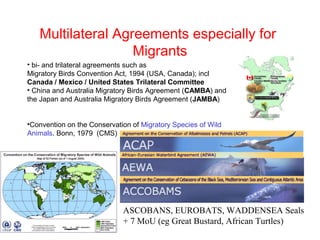
• bi- and trilateral agreements such as
Migratory Birds Convention Act, 1994 (USA, Canada); incl
Canada / Mexico / United States Trilateral Committee
• China and Australia Migratory Birds Agreement (CAMBA) and
the Japan and Australia Migratory Birds Agreement (JAMBA)
•Convention on the Conservation of Migratory Species of Wild
Animals. Bonn, 1979 (CMS)
ASCOBANS, EUROBATS, WADDENSEA Seals
+ 7 MoU (eg Great Bustard, African Turtles)
How do we measure efficiency of species
conservation?
Catch data: Hunting, Whaling and Fishery
http://www.erin.utoronto.ca/~w3env100y/env/ENV100/hum/cod.htm
From:
The Collapse of the Canadian Cod Fishery , WebCT Courses at University of Toronto
Canadian Cod (Gadus morhua, North Atlantic pop)s Fishery
Red List: VU; CMS: NL
Measuring Efficiency using Red List Data
• Global data (population totals per subspecies (mammals) or species (birds):
International Red List: http://www.redlist.org
•Extinct migrants: total of 8 spp
Passenger Pigeon (Ectopistes migratorius),
digitised by GROMS, after Grzimek B (1980) From: Natureworks: Extinct North American Species
http://www.nhptv.org/natureworks/nwep16a.htm
International Red List Criteria
EX
EW
CR
EN
VU
DD
NE
threatened
Red-Listed Migrants: Summary
Latein Englisch CMS RL2
K
N 2K N 2005
Balaena mysticetus Bowhead whale App I CR 54 1 LR, 1 EN (44 CR)
Camelus bactrianus Bactrian camel App I EN 100 2 CR, 1 VU (90 EN)
Vanellus gregarius Sociable plover App I & II VU 221 2 CR, 2 DD, 12 EN
Saiga tatarica Saiga App II pop LR 166 1 CR, 2 EN, 7 VU (56 LR)
Cervus elaphus Barbary stag App I pop DD 96 (93 DD)
Examples: Critically Endangered in
2005
Year 2000: 647 Red Listed 2000
Year 2005: 683 Red Listed (at least),
but 114 require case-by-case comparisons
(taxonomic inconsistencies, assessment of subspecies)
Migratory Catfish (Pangasiidae) in the Mekong River
CMS: App. I
CITES: I
Red List: CR
Pangasius gigas (Pangasianodon gigas)
Courtesy: Zeb Hogan
Exploitation of formerly abundant migratory
species:
Tragedy of the Commons
Courtesy: Zeb Hogan
Thanks to: ...all members of the GROMS Team, particularly
Eva Gerstner (GIS and Programming)
Birgit Gerkmann (White Stork satellite data)
Bedru Sherefa-Muzein (Data Entry)
Houssein Yamout (GIS consultancy)
all picture providers (as mentioned)
DIVERSITAS (Travel Grant to Klaus Riede)
The GROMS is hosted by the Museum Koenig, under the auspices of the CMS Secretariat,
and with funds from the German Ministry of the Environment

Riede efficiency

  • 1.
    Efficiency analysis of transboundaryconservation strategies for migratory species. Klaus Riede Zoologisches Forschungsinstitut & Museum Alexander Koenig (ZFMK) Adenauerallee 150-164 53113 Bonn, Germany
  • 2.
    Millions of Animalson the Move! • 5 billion passerine birds migrate to wintering grounds in tropical Africa • Marine mammals (whales, dolphins, seals) migrate to marine zones of high productivity for feeding • nearly 2,000 fish species migrate within oceans or between fresh- and saltwater (oceanodromous or diadromous) • the Monarch butterfly is a famous insect migrant
  • 3.
    Definitions: • Migration: “theact of moving from one spatial unit to another“ (Baker 1978, p. 23) • Political definition: the entire population or any geographically separate part of the population of any species or lower taxon of wild animals, a significant proportion of whose members cyclically and predictably cross one or more national jurisdictional boundaries“ (CMS 1979, Article 1) • ‘true migration’ : “seasonal movement with return to starting point – the traveller needs a return ticket”(Dingle 1996) • GROMS: true migration > 100 km (excl. local migrants) CMS
  • 4.
    Global Register ofMigratory Species Geo-database for Migratory Species: • 4,344 vertebrate species • 5,600 references • 1,300 GIS maps 83 whales and dolphins 39 seals and sirenia 131 bats 45 terrestrial mammals 298 migratory mammals
  • 5.
  • 6.
    10 reptiles (incl7 sea turtles) Chelonia mydas Green Sea Turtle
  • 7.
    1,926 migratory fishes 1,795Actinopterygii 93 Elasmobranchii Ganges shark Glyphis gangeticus 19 Petromyzontidae
  • 8.
  • 9.
    Ciconia ciconia -White stork Satellite telemetry data 1991-2003 Migratory species - connecting ecosystems and disciplines
  • 10.
    • Elevated diversityof migrants in temperate zones • Migrants will be lost if conservation is limited to Hot Spots GIS-Analysis: Global Distribution of Migrants
  • 11.
    Number of migratoryspecies in several (890) ecoregions of the world Total: 846 migratory species
  • 12.
    Multilateral Agreements affecting Migrants •Benelux Convention on the Hunting and Protection of Birds. Brussels, 1970 • Agreement for the Establishment of a Commission for Controlling the Desert Locust in North-West Africa. Rome, 1970 • Convention on Wetlands of International Importance especially as Waterfowl Habitat. Ramsar (Iran), 1970 • Convention on International Trade in Endangered Species of Wild Fauna and Flora. Washington, 1973 (CITES) •Agreement on Conservation of Polar Bears. Oslo, 1973 •Convention on Conservation of Nature in the South Pacific. Apia, 1976 •Convention on the Conservation of Migratory Species of Wild Animals. Bonn, 1979 (CMS)
  • 13.
    Multilateral Agreements especiallyfor Migrants • bi- and trilateral agreements such as Migratory Birds Convention Act, 1994 (USA, Canada); incl Canada / Mexico / United States Trilateral Committee • China and Australia Migratory Birds Agreement (CAMBA) and the Japan and Australia Migratory Birds Agreement (JAMBA) •Convention on the Conservation of Migratory Species of Wild Animals. Bonn, 1979 (CMS) ASCOBANS, EUROBATS, WADDENSEA Seals + 7 MoU (eg Great Bustard, African Turtles)
  • 14.
    How do wemeasure efficiency of species conservation? Catch data: Hunting, Whaling and Fishery http://www.erin.utoronto.ca/~w3env100y/env/ENV100/hum/cod.htm From: The Collapse of the Canadian Cod Fishery , WebCT Courses at University of Toronto Canadian Cod (Gadus morhua, North Atlantic pop)s Fishery Red List: VU; CMS: NL
  • 15.
    Measuring Efficiency usingRed List Data • Global data (population totals per subspecies (mammals) or species (birds): International Red List: http://www.redlist.org •Extinct migrants: total of 8 spp Passenger Pigeon (Ectopistes migratorius), digitised by GROMS, after Grzimek B (1980) From: Natureworks: Extinct North American Species http://www.nhptv.org/natureworks/nwep16a.htm
  • 16.
    International Red ListCriteria EX EW CR EN VU DD NE threatened
  • 17.
    Red-Listed Migrants: Summary LateinEnglisch CMS RL2 K N 2K N 2005 Balaena mysticetus Bowhead whale App I CR 54 1 LR, 1 EN (44 CR) Camelus bactrianus Bactrian camel App I EN 100 2 CR, 1 VU (90 EN) Vanellus gregarius Sociable plover App I & II VU 221 2 CR, 2 DD, 12 EN Saiga tatarica Saiga App II pop LR 166 1 CR, 2 EN, 7 VU (56 LR) Cervus elaphus Barbary stag App I pop DD 96 (93 DD) Examples: Critically Endangered in 2005 Year 2000: 647 Red Listed 2000 Year 2005: 683 Red Listed (at least), but 114 require case-by-case comparisons (taxonomic inconsistencies, assessment of subspecies)
  • 18.
    Migratory Catfish (Pangasiidae)in the Mekong River CMS: App. I CITES: I Red List: CR Pangasius gigas (Pangasianodon gigas) Courtesy: Zeb Hogan
  • 19.
    Exploitation of formerlyabundant migratory species: Tragedy of the Commons Courtesy: Zeb Hogan
  • 20.
    Thanks to: ...allmembers of the GROMS Team, particularly Eva Gerstner (GIS and Programming) Birgit Gerkmann (White Stork satellite data) Bedru Sherefa-Muzein (Data Entry) Houssein Yamout (GIS consultancy) all picture providers (as mentioned) DIVERSITAS (Travel Grant to Klaus Riede) The GROMS is hosted by the Museum Koenig, under the auspices of the CMS Secretariat, and with funds from the German Ministry of the Environment