Bones
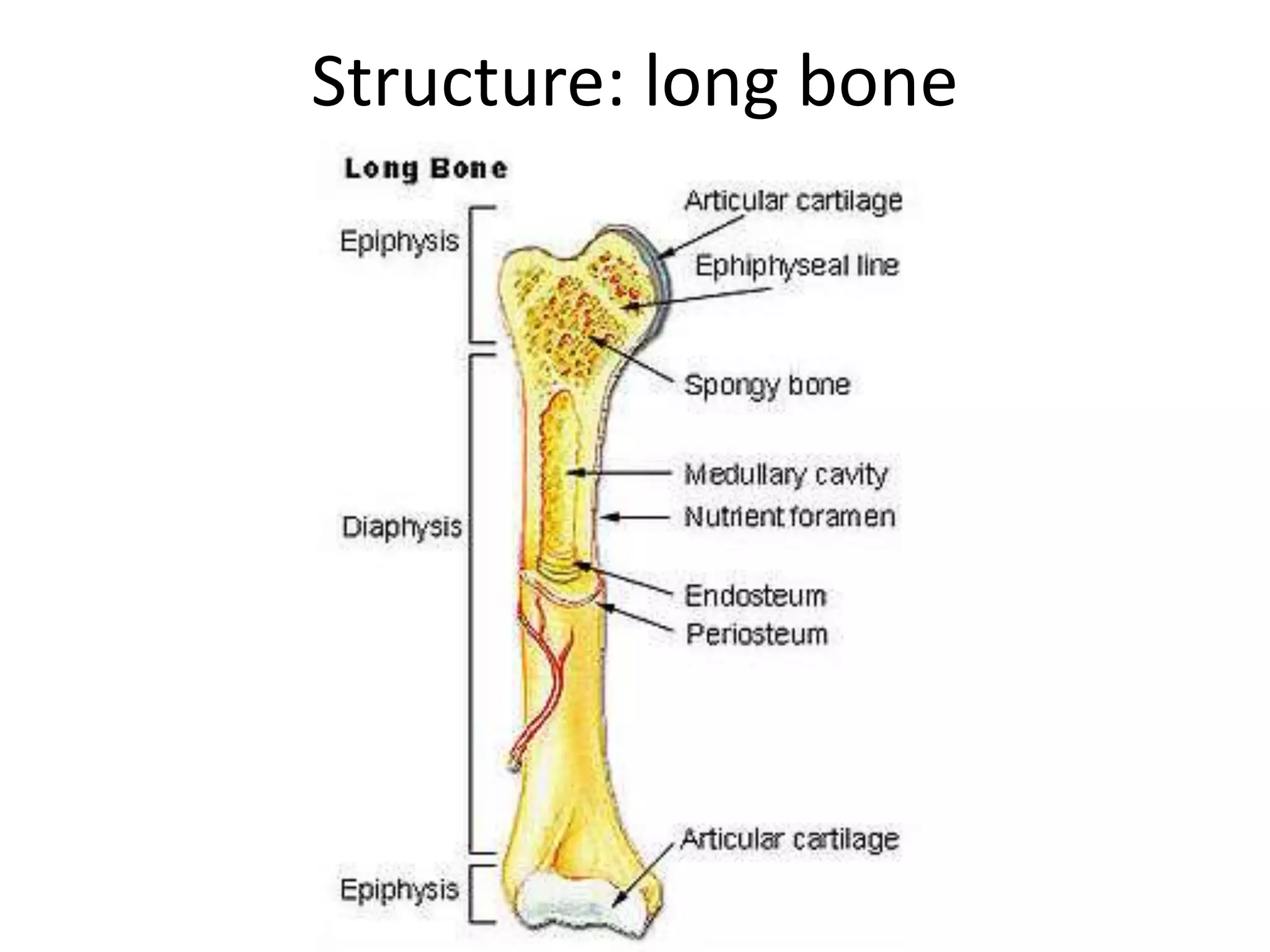
Structure: long bone
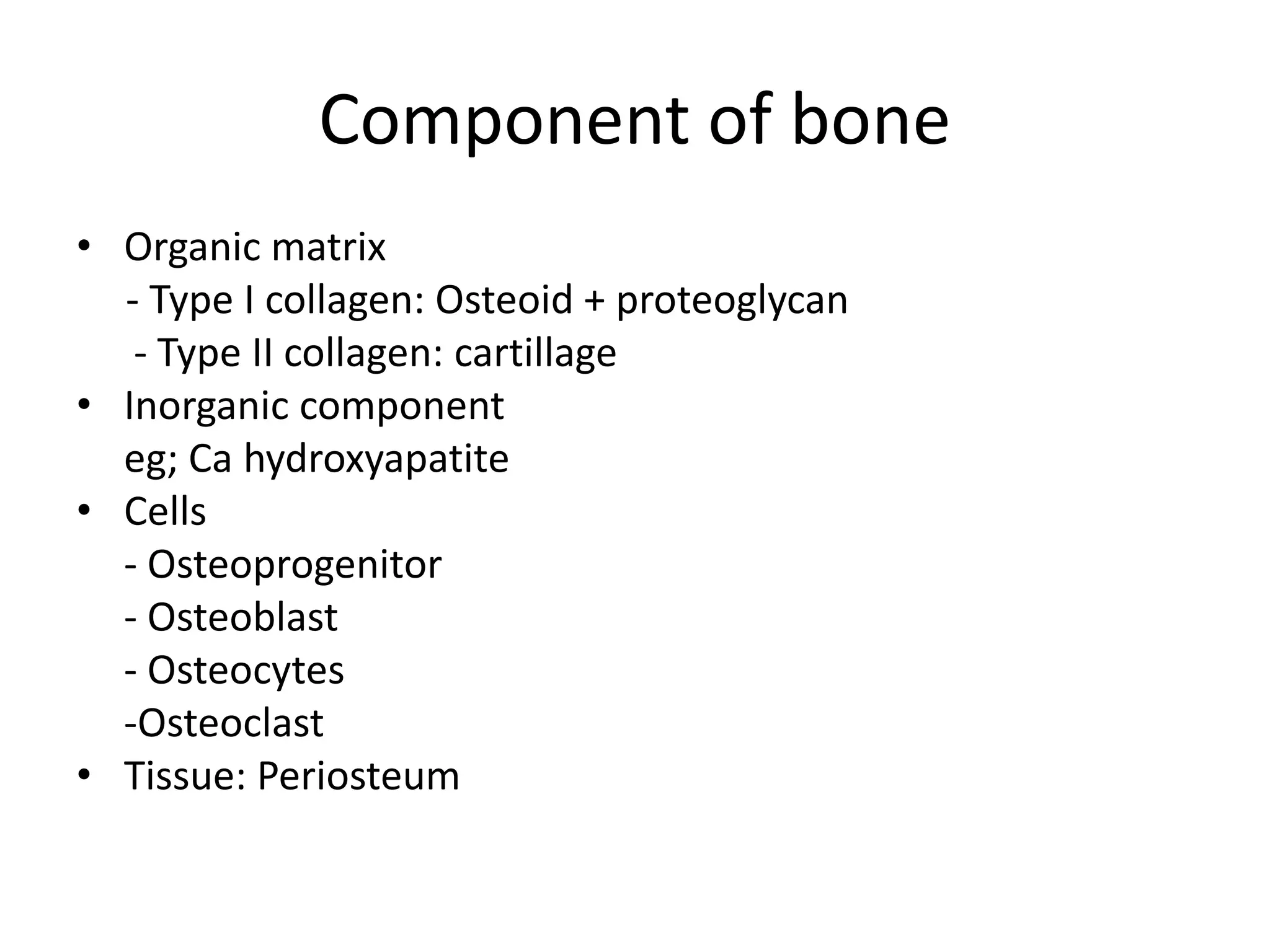
Component of bone
• Organic matrix
- Type I collagen: Osteoid + proteoglycan
- Type II collagen: cartillage
• Inorganic component
eg; Ca hydroxyapatite
• Cells
- Osteoprogenitor
- Osteoblast
- Osteocytes
-Osteoclast
• Tissue: Periosteum
Bone formation
• Production of Osteoid
• Mineralization of osteiod
• Remodelling by resoption & reformation
Osteoblast  (Production)
Osteoid  (Mineralization)
Woven bone  (Remodelling)
Lamellar bone.
Ossification
• Endochondrial Ossification –frm cartillage
• Membranous / Periosteal Ossification – frm
connective tissue
Quiz: Fn of bone???
Involvement of:
PTH Vit D Calcitonin
Bone Abnormalities
1. Cogenital
2. Metabolic bone Dx
3. Inflammation
4. Malignancies
5. Trauma/ Fractures
1. Congenital
• Achondroplasia
• Osteogenesis Imperfecta
• Osteopetrosis
2. Metabolic Bone Dx
• Osteoporosis
• Osteomalacia, Rickets
• Paget’s Dx (of bone!!)/ Oteitis deformans
• Renal Bone Dx/ Renal osteodystrophy
• Hyperparathyroidism
3. Inflammation
• Osteomyelitis
(osteon, meaning bone, myelo- meaning
marrow, and -itis meaning inflammation)
4. Malignancies
Bone tumors
Primary
Bone Forming
Tumors
Cartillage
Producing
Tumors
Others
Ewing’s Sarcoma
Myeloma
Solitary
plasmacytoma
Multiple
Myeloma
Osteoclastoma
(Giant cell
tumors)
Secondary
Malignancies
Bone Forming
Tumors
Benign
Osteoma
Osteoid
Osteoma
Ostoeblastoma
Malignant Osteosarcoma
Malignancies
Cartillage
Producing
Tumors
Benign
Osteochondroma
(En)chondroma
Malignant Chondrosarcoma
Malignancies
• Malignant  Primary (what it produce)
 Secondary (metastasis)
*most common bone tumours in children and
young adult Primary Bone Tumours
* most common bone tumours in older adult
Myeloma and Mets from other site (brest,
prostate, lung, kidney)
5. Trauma/ Fractures
• Comminuted
• Displaced
• Spiral
• Complicated
• Depressed
• Stress fracture
• Pathologic fracture (tumours, osteoporosis,
osteomalacia, Paget’s, cogenital)
Healing of bone
Haematoma Granulation
Procallus
formation (soft
tissue)
OssificationRemodelling

Bones pathology

Editor's Notes

  • #4 osteoid is the unmineralized, organic portion of the bone matrix that forms prior to the maturation of bone tissue. Osteoblasts begin the process of forming bone tissue by secreting the osteoid as several specific proteins An osteocyte, a star-shaped cell, is the most abundant[citation needed] cell found in compact bone. Cells contain a nucleus and a thin ring of cytoplasm. When osteoblasts become trapped in the matrix they secrete, they become osteocytes. Up to fifty percent of bone is made up of a modified form of the inorganic mineral hydroxylapatite (known as bone mineral).[
  • #7 Ossification (or osteogenesis) is the process of laying down new bone material by cells