BONE BIOLOGY and PHYSIOLOGY
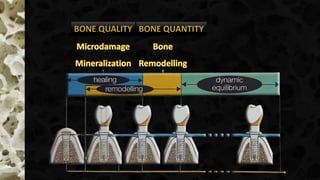
Why do we wait for 6 months and 3 months to load
implants in maxilla and mandible respectively?
Does waiting for more than the prescribed period improve
osseointegration?
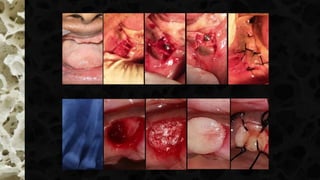
What is better? Augmenting the site and placing implants
later or doing both at the same visit?
How different is immediate loading different from delayed
loading as far as bone health is concerned?
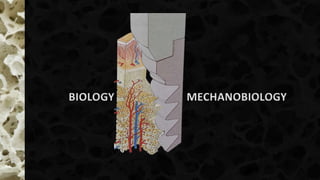
BIOLOGY MECHANOBIOLOGY
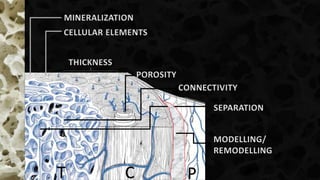
T C P
THICKNESS
POROSITY
CONNECTIVITY
SEPARATION
MINERALIZATION
CELLULAR ELEMENTS
MODELLING/
REMODELLING
C.H. Turner: Determinants of skeletal fragility and quality. J Musculoskel Neuron Interact 2002; 2(6):527-52
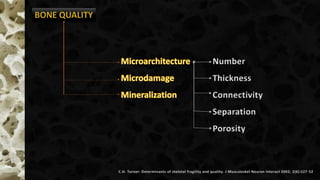
Number
Thickness
Connectivity
Separation
Porosity
C.H. Turner: Determinants of skeletal fragility and quality. J Musculoskel Neuron Interact 2002; 2(6):527-52
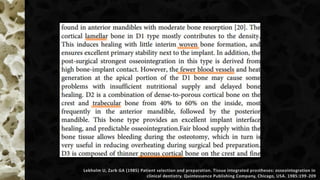
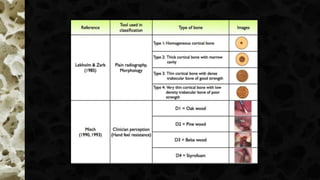
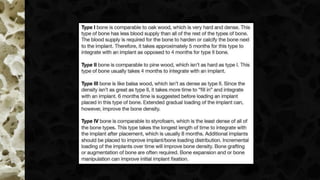
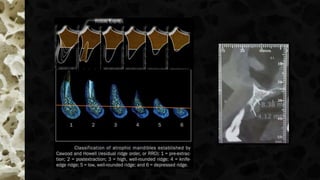
Lekholm U, Zarb GA (1985) Patient selection and preparation. Tissue integrated prostheses: osseointegration in
clinical dentistry. Quintessence Publishing Company, Chicago, USA. 1985:199-209
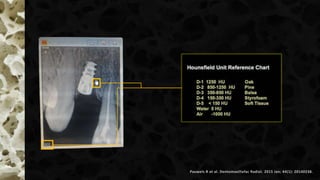
Pauwels R et al. Dentomaxillofac Radiol. 2015 Jan; 44(1): 20140238.
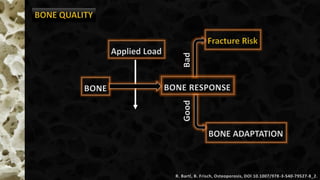
R. Bartl, B. Frisch, Osteoporosis, DOI 10.1007/978-3-540-79527-8_2.
Bad
BONE
Good
BONE RESPONSE
1N
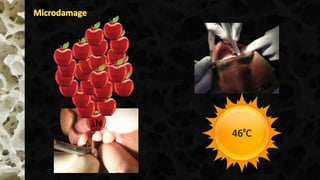
46ºC
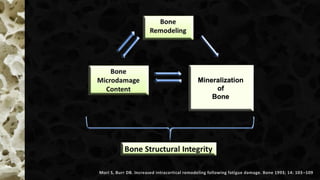
Mori S, Burr DB. Increased intracortical remodeling following fatigue damage. Bone 1993; 14: 103–109
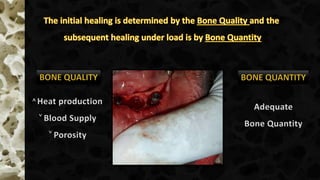
ᴧ Heat production
˅ Blood Supply
˅ Porosity
Adequate
Bone Quantity
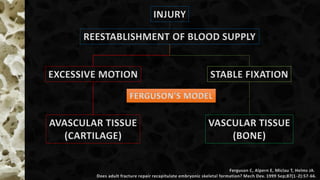
INJURY
REESTABLISHMENT OF BLOOD SUPPLY
EXCESSIVE MOTION STABLE FIXATION
AVASCULAR TISSUE
(CARTILAGE)
VASCULAR TISSUE
(BONE)
FERGUSON’S MODEL
Ferguson C, Alpern E, Miclau T, Helms JA.
Does adult fracture repair recapitulate embryonic skeletal formation? Mech Dev. 1999 Sep;87(1-2):57-66.
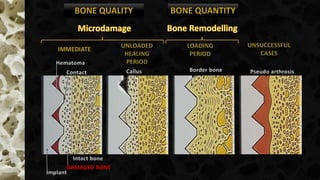
Contact
Hematoma
DAMAGED BONE
Intact bone
Implant
Callus Border bone Pseudo arthrosis
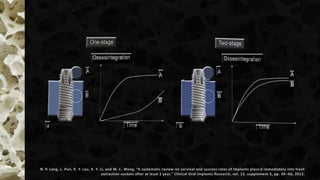
N. P. Lang, L. Pun, K. Y. Lau, K. Y. Li, and M. C. Wong, “A systematic review on survival and success rates of implants place d immediately into fresh
extraction sockets after at least 1 year,” Clinical Oral Implants Research, vol. 23, supplement 5, pp. 39 –66, 2012.
MECHANOSTAT THEORY
MECHANOSTATTHEORY
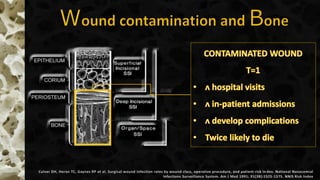
Culver DH, Horan TC, Gaynes RP et al. Surgical wound infection rates by wound class, operative procedure, and patient risk in dex. National Nosocomial
Infections Surveillance System. Am J Med 1991; 91(3B):152S-157S. NNIS Risk Index
Bone in implantology- condensed

Bone in implantology- condensed

  • 1.
    BONE BIOLOGY andPHYSIOLOGY
  • 2.
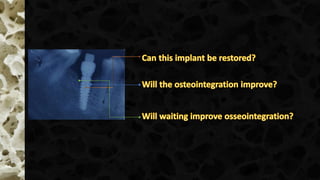
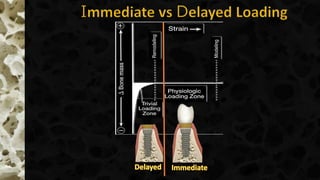
    Why do wewait for 6 months and 3 months to load implants in maxilla and mandible respectively? Does waiting for more than the prescribed period improve osseointegration? What is better? Augmenting the site and placing implants later or doing both at the same visit? How different is immediate loading different from delayed loading as far as bone health is concerned?
  • 3.
  • 4.
  • 5.
    C.H. Turner: Determinantsof skeletal fragility and quality. J Musculoskel Neuron Interact 2002; 2(6):527-52
  • 6.
    Number Thickness Connectivity Separation Porosity C.H. Turner: Determinantsof skeletal fragility and quality. J Musculoskel Neuron Interact 2002; 2(6):527-52
  • 7.
    Lekholm U, ZarbGA (1985) Patient selection and preparation. Tissue integrated prostheses: osseointegration in clinical dentistry. Quintessence Publishing Company, Chicago, USA. 1985:199-209
  • 10.
    Pauwels R etal. Dentomaxillofac Radiol. 2015 Jan; 44(1): 20140238.
  • 11.
    R. Bartl, B.Frisch, Osteoporosis, DOI 10.1007/978-3-540-79527-8_2. Bad BONE Good BONE RESPONSE
  • 12.
  • 15.
    Mori S, BurrDB. Increased intracortical remodeling following fatigue damage. Bone 1993; 14: 103–109
  • 18.
    ᴧ Heat production ˅Blood Supply ˅ Porosity Adequate Bone Quantity
  • 20.
    INJURY REESTABLISHMENT OF BLOODSUPPLY EXCESSIVE MOTION STABLE FIXATION AVASCULAR TISSUE (CARTILAGE) VASCULAR TISSUE (BONE) FERGUSON’S MODEL Ferguson C, Alpern E, Miclau T, Helms JA. Does adult fracture repair recapitulate embryonic skeletal formation? Mech Dev. 1999 Sep;87(1-2):57-66.
  • 23.
  • 24.
    N. P. Lang,L. Pun, K. Y. Lau, K. Y. Li, and M. C. Wong, “A systematic review on survival and success rates of implants place d immediately into fresh extraction sockets after at least 1 year,” Clinical Oral Implants Research, vol. 23, supplement 5, pp. 39 –66, 2012.
  • 27.
  • 28.
  • 31.
    Culver DH, HoranTC, Gaynes RP et al. Surgical wound infection rates by wound class, operative procedure, and patient risk in dex. National Nosocomial Infections Surveillance System. Am J Med 1991; 91(3B):152S-157S. NNIS Risk Index

Editor's Notes

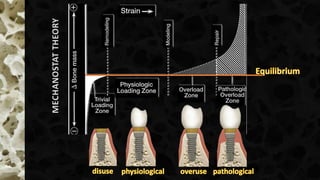
  • #4 Mechanobiology is an emerging field of science at the interface of biology and engineering that focuses on how physical forces and changes in the mechanical properties of cells and tissues contribute to development, cell differentiation, physiology, and disease.[1] A major challenge in the field is understanding mechanotransduction—the molecular mechanisms by which cells sense and respond to mechanical signals.
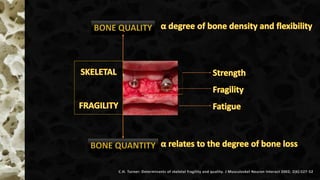
  • #6 all the factors that determine how well the skeleton can resist fracturing: Bone quality
  • #12 Bone Quality is considered an amalgamation of many factors such as mass, structure, and material properties. Assessing these three factors, architectural, biochemical, and material, that define Bone Quality is important for determining bone strength and fracture risk. Currently, only 2 of 3 factors are heavily researched (architectural and biochemical), leaving Material Properties as the missing key component to understanding Bone Quality. When discussing Bone Quality and these three factors, both the mineral and organic components of bone must be considered. The relationship between the mineral and organic facets of bone reveals information to better define the tissue-level quality of bone. From the two components of bone, mineral and organic, the organic component of bone contributes largely to the material factor of Bone Quality.
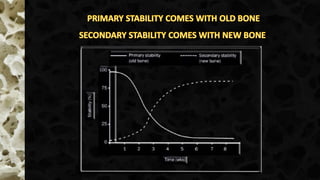
  • #20 Factors influencing primary stability: Implant geometry. Bone density and quality. Surgical protocol (osteotomy preparation) including the skill of the surgeon. Primary stability (mechanical stability) and secondary stability (biologic stability after bone remodeling) of the implant in the bone. With conventional surfaces, implants are exposed to a higher risk of failure due to an overall stability dip between weeks two to four.
  • #28 The Mechanostat is a model describing bone growth and bone loss. It was promoted by Harold Frost and described extensively in the Utah Paradigm of Skeletal Physiology[1][2][3][4][5] in the 1960s. The Mechanostat is a refinement of Wolff's law described by Julius Wolff (1836–1902). Typical examples of the influence of maximum forces and the resulting elastic deformations on bone growth or bone loss are extended flights of astronauts and cosmonauts as well as patient with paraplegia due to an accident. For example, a patient in a wheel chair who is using his arms but due to his paraplegia not his legs will suffer massive muscle and bone loss only in his legs due to the lack of usage of the legs. However the muscles and bones of the arms which are used every day will stay the same or might even be increased depending on the usage.
  • #29 Disuse, Physiologic, Hypertrophic and Pathologic….
  • #32 Clean wounds The wound is considered to be clean when the operative procedure does not enter into a normally colonized viscus or lumen of the body. SSI rates in this class of procedures are less than 2%, depending upon clinical variables, and often originate from contaminants in the OR environment, from the surgical team or most commonly from skin. ! Clean-contaminated wounds Asite is considered to be clean-contaminated when the operative procedure enters into a colonized viscus or cavity of the body, but under elective and controlled circumstances. SSI rates in this class of procedures range from 4% to 10%. ! Contaminated wounds When gross contamination is present but no infection is obvious, a surgical site is considered to be contaminated. As with clean-contaminated procedures, the contaminants are bacteria that are introduced by soilage of the surgical field. SSI rates in this class of procedures can exceed 20%. ! Dirty wounds If active infection is already present in the surgical site, it is considered to be a dirty wound. Pathogens of the active infection as well as unusual pathogens will likely be encountered. SSI rates in this class of procedures can exceed 40%. ASA Scores. And OT time.