Bone cement
DR. NAVEEN BAGILUMANE
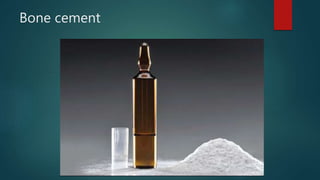
Bone cement
Bone Cement
 In reality, “Bone Cement” is a misnomer .Word cement is used to
describe a substance that bonds two things together, But bone
cement acts as a space-filler that creates a tight space which holds the
implant against the bone.
 Originally developed for Dental applications.
 Using in orthopaedics for more than 40 years.
 Gold standard in the field of joint replacement surgery.
 Neither Osteoinductive, nor Osteoconductive and does no remodeling
of bone.
History trace back to…..
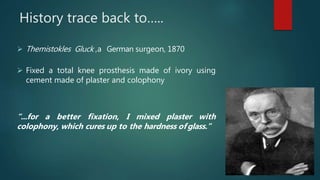
 Themistokles Gluck ,a German surgeon, 1870
 Fixed a total knee prosthesis made of ivory using
cement made of plaster and colophony
“...for a better fixation, I mixed plaster with
colophony, which cures up to the hardness ofglass.”
History trace back to…..
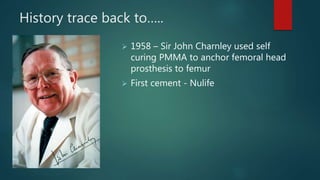
 1958 – Sir John Charnley used self
curing PMMA to anchor femoral head
prosthesis to femur
 First cement - Nulife
What is bone cement?
 Self curing organic or inorganic formulations which may or
may not contain antibiotics used to fill up a cavity or to create
a mechanical fixation of prosthesis to living bone.
 Chemical name - PMMA
Interest in orthopaedics
 Joint Replacement Surgery
 Spinal Compression Fractures
 Chronic Osteomyelitis
 Tumours
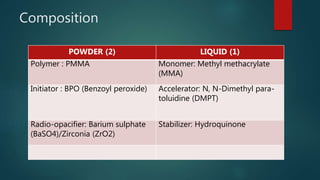
Composition
POWDER (2) LIQUID (1)
Polymer : PMMA Monomer: Methyl methacrylate
(MMA)
Initiator : BPO (Benzoyl peroxide) Accelerator: N, N-Dimethyl para-
toluidine (DMPT)
Radio-opacifier: Barium sulphate
(BaSO4)/Zirconia (ZrO2)
Stabilizer: Hydroquinone
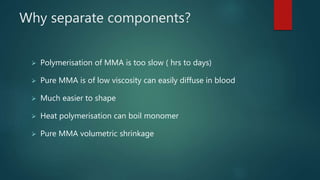
Why separate components?
 Polymerisation of MMA is too slow ( hrs to days)
 Pure MMA is of low viscosity can easily diffuse in blood
 Much easier to shape
 Heat polymerisation can boil monomer
 Pure MMA volumetric shrinkage
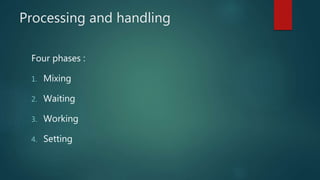
Processing and handling
Four phases :
1. Mixing
2. Waiting
3. Working
4. Setting
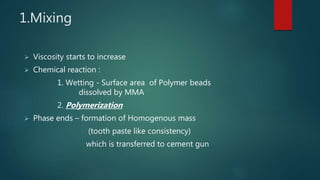
1.Mixing
 Viscosity starts to increase
 Chemical reaction :
1. Wetting - Surface area of Polymer beads
dissolved by MMA
2. Polymerization
 Phase ends – formation of Homogenous mass
(tooth paste like consistency)
which is transferred to cement gun
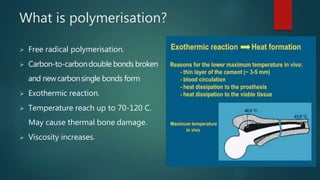
What is polymerisation?
 Free radical polymerisation.
 Carbon-to-carbondouble bonds broken
and newcarbonsingle bonds form
 Exothermic reaction.
 Temperature reach up to 70-120 C.
May cause thermal bone damage.
 Viscosity increases.
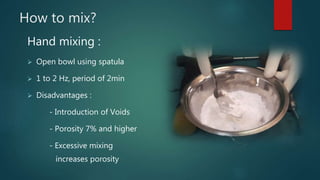
How to mix?
Hand mixing :
 Open bowl using spatula
 1 to 2 Hz, period of 2min
 Disadvantages :
- Introduction of Voids
- Porosity 7% and higher
- Excessive mixing
increases porosity
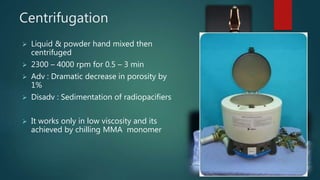
Centrifugation
 Liquid & powder hand mixed then
centrifuged
 2300 – 4000 rpm for 0.5 – 3 min
 Adv : Dramatic decrease in porosity by
1%
 Disadv : Sedimentation of radiopacifiers
 It works only in low viscosity and its
achieved by chilling MMA monomer
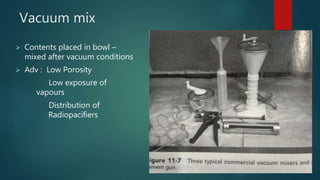
Vacuum mix
 Contents placed in bowl –
mixed after vacuum conditions
 Adv : Low Porosity
Low exposure of
vapours
Distribution of
Radiopacifiers
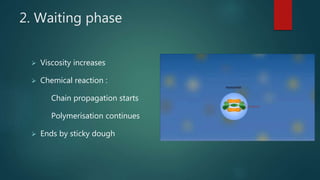
2. Waiting phase
 Viscosity increases
 Chemical reaction :
Chain propagation starts
Polymerisation continues
 Ends by sticky dough
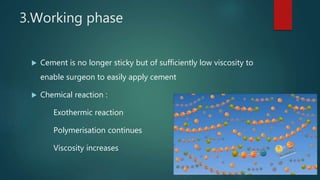
3.Working phase
 Cement is no longer sticky but of sufficiently low viscosity to
enable surgeon to easily apply cement
 Chemical reaction :
Exothermic reaction
Polymerisation continues
Viscosity increases
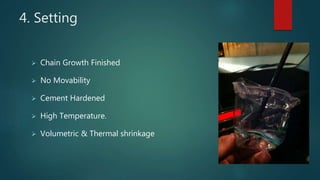
4. Setting
 Chain Growth Finished
 No Movability
 Cement Hardened
 High Temperature.
 Volumetric & Thermal shrinkage
Functions of Bone cement
 Allows secure fixation of implant and bone
 Mechanical interlock and space filling
 Load transferring
 Maintenance/restoration of bone stock
 Release of antibiotics
How to deliver cement?
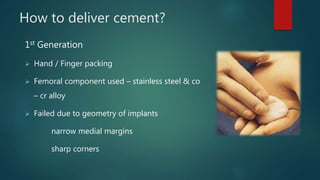
1st Generation
 Hand / Finger packing
 Femoral component used – stainless steel & co
– cr alloy
 Failed due to geometry of implants
narrow medial margins
sharp corners
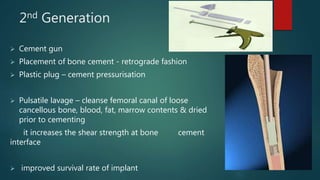
2nd Generation
 Cement gun
 Placement of bone cement - retrograde fashion
 Plastic plug – cement pressurisation
 Pulsatile lavage – cleanse femoral canal of loose
cancellous bone, blood, fat, marrow contents & dried
prior to cementing
it increases the shear strength at bone cement
interface
 improved survival rate of implant
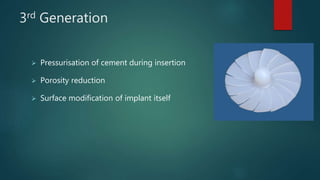
3rd Generation
 Pressurisation of cement during insertion
 Porosity reduction
 Surface modification of implant itself
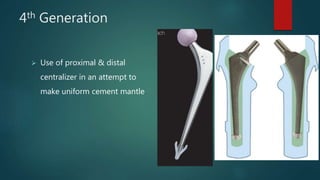
4th Generation
 Use of proximal & distal
centralizer in an attempt to
make uniform cement mantle
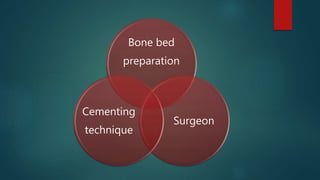
Bone bed
preparation
Surgeon
Cementing
technique
Antibiotics Loaded Bone cement
Ideal antibiotic properties :
 Preparation must be thermally stable
 Antibiotic properties not affected by heat
 Must be water soluble for diffusion into tissues
 Bactericidal
 Gradual elution over an appropriate time period
 Minimal local inflammatory response
Contd..
 Have action against common pathogens like S.aureus, S.
epidermidis ,coliforms and anaerobes.
 Must not significantly compromise mechanical integrity
 Must be available as a powder.
 Must have a low incidence of allergy.
Which antibiotics to use?
 Gentamycin (most common) andtobramycin are commonly
used
 Vancomycin (ultrafine powder) is used as lyophilised
vancomycin. It greatly reduces fatigue strength.
 Ciprofloxacin may inhibit soft tissuehealing
 Penicillins and cephalosporins exhibits stability and good
elution properties. But are avoideddue to their potential
allerginicity.
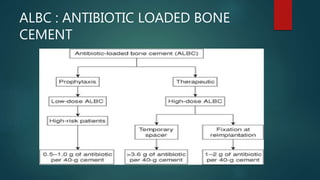
ALBC : ANTIBIOTIC LOADED BONE
CEMENT
How to asses radiologically?
 Barrack’s Cement mantle grading
 Gruen zones
Barrack’s femoral component
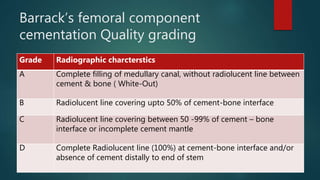
cementation Quality grading
Grade Radiographic charcterstics
A Complete filling of medullary canal, without radiolucent line between
cement & bone ( White-Out)
B Radiolucent line covering upto 50% of cement-bone interface
C Radiolucent line covering between 50 -99% of cement – bone
interface or incomplete cement mantle
D Complete Radiolucent line (100%) at cement-bone interface and/or
absence of cement distally to end of stem
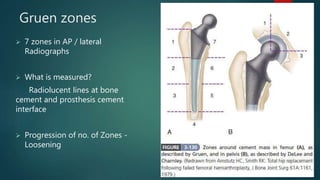
Gruen zones
 7 zones in AP / lateral
Radiographs
 What is measured?
Radiolucent lines at bone
cement and prosthesis cement
interface
 Progression of no. of Zones -
Loosening
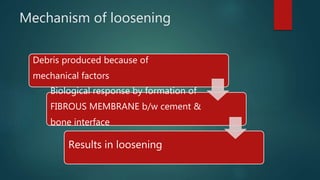
Mechanism of loosening
Debris produced because of
mechanical factors
Biological response by formation of
FIBROUS MEMBRANE b/w cement &
bone interface
Results in loosening
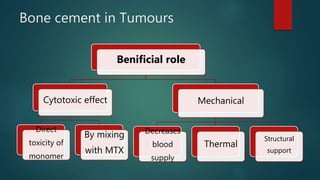
Bone cement in Tumours
Benificial role
Cytotoxic effect
Direct
toxicity of
monomer
By mixing
with MTX
Mechanical
Decreases
blood
supply
Thermal
Structural
support
Contraindications
 Pregnancy
 Active infection
 Hypersensitivity (d/t histamine release n Complement
activation C3a/C5a)
 Metabolic disorder
Bone Cement Implantation
Syndrome – (BCIS)
 HYPOXIA, HYPOTENSION or both and/or unexpected LOSS
OF CONSCIOUSNESS
 occurring around the time of cementation, prosthesis
insertion, reduction of the joint or, occasionally, tourniquet
deflation in a patient undergoing cemented bone surgery.
Clinical picture varies..
 Hypoxia
 Hypotension
 Cardiac arrhythmias
 increased Pulmonary Vascular Resistance (PVR)
 Cardiac arrest
Classification
• Grade 1: moderate hypoxia (SpO2-94%) or hypotension [fall
in systolic blood pressure (SBP) 20%].
• Grade 2: severe hypoxia (SpO2-88%) or hypotension (fall in
SBP 40%) or unexpected loss of consciousness.
• Grade 3: cardiovascular collapse requiring CPR.
Etiology of BCIS
1. Absorption of monomer into circulation
2. Embolization
3. Histamine release & Hypersensitivity
4. Complement activation
5. Multimodal

Bone cement

  • 1.
  • 2.
  • 3.
    Bone Cement  Inreality, “Bone Cement” is a misnomer .Word cement is used to describe a substance that bonds two things together, But bone cement acts as a space-filler that creates a tight space which holds the implant against the bone.  Originally developed for Dental applications.  Using in orthopaedics for more than 40 years.  Gold standard in the field of joint replacement surgery.  Neither Osteoinductive, nor Osteoconductive and does no remodeling of bone.
  • 4.
    History trace backto…..  Themistokles Gluck ,a German surgeon, 1870  Fixed a total knee prosthesis made of ivory using cement made of plaster and colophony “...for a better fixation, I mixed plaster with colophony, which cures up to the hardness ofglass.”
  • 5.
    History trace backto…..  1958 – Sir John Charnley used self curing PMMA to anchor femoral head prosthesis to femur  First cement - Nulife
  • 6.
    What is bonecement?  Self curing organic or inorganic formulations which may or may not contain antibiotics used to fill up a cavity or to create a mechanical fixation of prosthesis to living bone.  Chemical name - PMMA
  • 7.
    Interest in orthopaedics Joint Replacement Surgery  Spinal Compression Fractures  Chronic Osteomyelitis  Tumours
  • 8.
    Composition POWDER (2) LIQUID(1) Polymer : PMMA Monomer: Methyl methacrylate (MMA) Initiator : BPO (Benzoyl peroxide) Accelerator: N, N-Dimethyl para- toluidine (DMPT) Radio-opacifier: Barium sulphate (BaSO4)/Zirconia (ZrO2) Stabilizer: Hydroquinone
  • 9.
    Why separate components? Polymerisation of MMA is too slow ( hrs to days)  Pure MMA is of low viscosity can easily diffuse in blood  Much easier to shape  Heat polymerisation can boil monomer  Pure MMA volumetric shrinkage
  • 10.
    Processing and handling Fourphases : 1. Mixing 2. Waiting 3. Working 4. Setting
  • 11.
    1.Mixing  Viscosity startsto increase  Chemical reaction : 1. Wetting - Surface area of Polymer beads dissolved by MMA 2. Polymerization  Phase ends – formation of Homogenous mass (tooth paste like consistency) which is transferred to cement gun
  • 12.
    What is polymerisation? Free radical polymerisation.  Carbon-to-carbondouble bonds broken and newcarbonsingle bonds form  Exothermic reaction.  Temperature reach up to 70-120 C. May cause thermal bone damage.  Viscosity increases.
  • 13.
    How to mix? Handmixing :  Open bowl using spatula  1 to 2 Hz, period of 2min  Disadvantages : - Introduction of Voids - Porosity 7% and higher - Excessive mixing increases porosity
  • 14.
    Centrifugation  Liquid &powder hand mixed then centrifuged  2300 – 4000 rpm for 0.5 – 3 min  Adv : Dramatic decrease in porosity by 1%  Disadv : Sedimentation of radiopacifiers  It works only in low viscosity and its achieved by chilling MMA monomer
  • 15.
    Vacuum mix  Contentsplaced in bowl – mixed after vacuum conditions  Adv : Low Porosity Low exposure of vapours Distribution of Radiopacifiers
  • 16.
    2. Waiting phase Viscosity increases  Chemical reaction : Chain propagation starts Polymerisation continues  Ends by sticky dough
  • 17.
    3.Working phase  Cementis no longer sticky but of sufficiently low viscosity to enable surgeon to easily apply cement  Chemical reaction : Exothermic reaction Polymerisation continues Viscosity increases
  • 18.
    4. Setting  ChainGrowth Finished  No Movability  Cement Hardened  High Temperature.  Volumetric & Thermal shrinkage
  • 19.
    Functions of Bonecement  Allows secure fixation of implant and bone  Mechanical interlock and space filling  Load transferring  Maintenance/restoration of bone stock  Release of antibiotics
  • 20.
    How to delivercement? 1st Generation  Hand / Finger packing  Femoral component used – stainless steel & co – cr alloy  Failed due to geometry of implants narrow medial margins sharp corners
  • 21.
    2nd Generation  Cementgun  Placement of bone cement - retrograde fashion  Plastic plug – cement pressurisation  Pulsatile lavage – cleanse femoral canal of loose cancellous bone, blood, fat, marrow contents & dried prior to cementing it increases the shear strength at bone cement interface  improved survival rate of implant
  • 22.
    3rd Generation  Pressurisationof cement during insertion  Porosity reduction  Surface modification of implant itself
  • 23.
    4th Generation  Useof proximal & distal centralizer in an attempt to make uniform cement mantle
  • 24.
  • 25.
    Antibiotics Loaded Bonecement Ideal antibiotic properties :  Preparation must be thermally stable  Antibiotic properties not affected by heat  Must be water soluble for diffusion into tissues  Bactericidal  Gradual elution over an appropriate time period  Minimal local inflammatory response
  • 26.
    Contd..  Have actionagainst common pathogens like S.aureus, S. epidermidis ,coliforms and anaerobes.  Must not significantly compromise mechanical integrity  Must be available as a powder.  Must have a low incidence of allergy.
  • 27.
    Which antibiotics touse?  Gentamycin (most common) andtobramycin are commonly used  Vancomycin (ultrafine powder) is used as lyophilised vancomycin. It greatly reduces fatigue strength.  Ciprofloxacin may inhibit soft tissuehealing  Penicillins and cephalosporins exhibits stability and good elution properties. But are avoideddue to their potential allerginicity.
  • 28.
    ALBC : ANTIBIOTICLOADED BONE CEMENT
  • 29.
    How to assesradiologically?  Barrack’s Cement mantle grading  Gruen zones
  • 30.
    Barrack’s femoral component cementationQuality grading Grade Radiographic charcterstics A Complete filling of medullary canal, without radiolucent line between cement & bone ( White-Out) B Radiolucent line covering upto 50% of cement-bone interface C Radiolucent line covering between 50 -99% of cement – bone interface or incomplete cement mantle D Complete Radiolucent line (100%) at cement-bone interface and/or absence of cement distally to end of stem
  • 31.
    Gruen zones  7zones in AP / lateral Radiographs  What is measured? Radiolucent lines at bone cement and prosthesis cement interface  Progression of no. of Zones - Loosening
  • 32.
    Mechanism of loosening Debrisproduced because of mechanical factors Biological response by formation of FIBROUS MEMBRANE b/w cement & bone interface Results in loosening
  • 33.
    Bone cement inTumours Benificial role Cytotoxic effect Direct toxicity of monomer By mixing with MTX Mechanical Decreases blood supply Thermal Structural support
  • 34.
    Contraindications  Pregnancy  Activeinfection  Hypersensitivity (d/t histamine release n Complement activation C3a/C5a)  Metabolic disorder
  • 35.
    Bone Cement Implantation Syndrome– (BCIS)  HYPOXIA, HYPOTENSION or both and/or unexpected LOSS OF CONSCIOUSNESS  occurring around the time of cementation, prosthesis insertion, reduction of the joint or, occasionally, tourniquet deflation in a patient undergoing cemented bone surgery.
  • 36.
    Clinical picture varies.. Hypoxia  Hypotension  Cardiac arrhythmias  increased Pulmonary Vascular Resistance (PVR)  Cardiac arrest
  • 37.
    Classification • Grade 1:moderate hypoxia (SpO2-94%) or hypotension [fall in systolic blood pressure (SBP) 20%]. • Grade 2: severe hypoxia (SpO2-88%) or hypotension (fall in SBP 40%) or unexpected loss of consciousness. • Grade 3: cardiovascular collapse requiring CPR.
  • 38.
    Etiology of BCIS 1.Absorption of monomer into circulation 2. Embolization 3. Histamine release & Hypersensitivity 4. Complement activation 5. Multimodal