NAAC – IQAC - AQAR
(For Affiliated Colleges)
Revised as per Revised Accreditation
Framework in November, 2017
Dr.C.PARAMASIVAN.,Ph.D.
Assistant Professor of Commerce
Periyar E.V.R.College (Autonomous )
Tiruchirappalli -23, Tamil Nadu
Composition of the IQAC
1.Chairperson: Head of the Institution
2.Teachers to represent all level (3 to 8)
3. One member from the Management
4. Few Senior administrative officers
5. One nominee each from local society, Students
and Alumni
6.One nominee each from Employers
/Industrialists/Stakeholders
7.One of the senior teachers as the
coordinator/Director of the IQAC
Parts of AQAR
Part – A
Details of the Institution
IQAC Composition and Activities
Part – B
Criterion – I: Curricular Aspects – 100 marks
Criterion – II: Teaching, Learning and Evaluation- 350 marks
Criterion – III: Research, Innovations and Extension-120 marks
Criterion – IV: Infrastructure and Learning Resources – 100 marks
Criterion – V: Student Support and Progression – 130 marks
Criterion – VI: Governance, Leadership and Management – 100
marks
Criterion – VII: Institutional Values and Best Practices – 100 marks
Part – A
1. Details of the Institution
• Name and address
• Institutional status
• Accreditation Details
• Date of Establishment of IQAC
• Internal Quality Assurance System
2. IQAC Activities
• Regular meeting of Internal Quality Assurance Cell
(IQAC); timely submission of Annual Quality
Assurance Report (AQAR) to NAAC; Feedback from
all stakeholders collected, analysed and used for
improvements
• Academic Administrative Audit (AAA) conducted
and its follow up action
• Participation in NIRF
• ISO Certification
• NBA etc.
• Any other Quality Audit
Part-B
CRITERION I – CURRICULAR ASPECTS
1. Curriculum Planning and Implementation
• Write up about well planned curriculum delivery
and documentation - in 500 words
2. Academic Flexibility
• New programmes/courses introduced during the
Academic year
3. Curriculum Enrichment
• Value-added courses/Field Projects / Internships
under taken
4. Feedback System
• structured feedback – students, Teachers, parents ,
Alumni
CRITERION II -TEACHING-LEARNING AND
EVALUATION
1. Student Enrolment and Profile
• Demand Ratio during the year
• Student - Full time teacher ratio
2. Teaching - Learning Process
Percentage of teachers using ICT
Students mentoring system
3. Teacher Profile and Quality
Number of full time teachers appointed during the
year
Honours and recognitions received by teachers
4. Evaluation Process and Reforms
• Number of days from the date of semester-end/
year- end examination
• Reforms initiated on Continuous Internal
Evaluation(CIE) system
• Academic calendar prepared and adhered for
conduct of Examination
5. Student Performance and Learning Outcomes
Program outcomes, program specific outcomes and
course outcomes
Pass percentage of students
6. Student Satisfaction Survey
Student Satisfaction Survey (SSS) on overall
institutional performance
Criterion – III
1. Research
2. Innovations
3. Extension
4. Collaborations
Resource Mobilization for Research
• Research funds sanctioned and received from various
agencies, industry and other organisations
• Research Publications and Awards
• Ph. Ds awarded during the year
• Books and Chapters in edited Volumes / Books
published, and papers in National/International
Conference Proceedings per Teacher during the year
• Bibliometrics of the publications
• h-index of the Institutional Publications during the
year
• Faculty participation in Seminars/Conferences and
Symposia during the year
Innovation Ecosystem
• Workshops/Seminars Conducted on Intellectual
Property Rights (IPR) and Industry-Academia
Innovative practices during the year
• Awards for Innovation won by
Institution/Teachers/Research scholars /Students
during the year
• No. of Incubation centre created, start-ups
incubated on campus during the year
3. Extension Activities
• Number of extension and outreach programmes
conducted in collaboration with industry, community
and Non- Government Organisations through
• NSS
• NCC
• Red cross
• Youth Red Cross (YRC)
• Exnora
• Consumer Club
• Legal Literacy Club
• Leo Club
• Rotract Club
4. Collaborations
• Collaborative activities for research, faculty
exchange, student exchange
• Linkages with institutions/industries for
internship, on-the-job training, project work,
sharing of research facilities
• MoUs signed with institutions of national,
international importance, other universities,
industries, corporate houses etc.
MoUs signed
• Organisation
• Date of MoU signed
• Purpose and Activities
• Number of students/teachers participated
under MoUs
CRITERION IV – INFRASTRUCTURE
AND LEARNING RESOURCES
1. Physical Facilities
• Budget allocation for infrastructure
• Details of infrastructure facilities
2. Library as a Learning Resource
Library Services- Automation/ Digitalisation / infilibnet
3. IT Infrastructure
Technology Upgradation
Bandwidth available of internet connection
Facility for e-content
-content developed by teachers-e-Pathshala/SWAYAM – MOOCs
4. Maintenance of Campus Infrastructure
Expenditure incurred on maintenance of physical facilities
Procedures and policies for maintaining and utilization
CRITERION V - STUDENT SUPPORT
AND PROGRESSION
1. Student Support
• Scholarships and Financial Support
• capability enhancement and development schemes
such as Soft skill development, Remedial coaching,
Language lab, Bridge courses, Yoga, Meditation,
Personal Counselling and Mentoring etc.,
• guidance for competitive examinations and career
counselling offered by the institution during the year
• Institutional mechanism for transparency, timely
redressal of student grievances, Prevention of sexual
harassment and ragging cases during the year
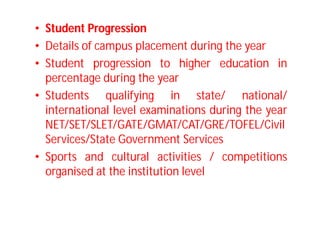
• Student Progression
• Details of campus placement during the year
• Student progression to higher education in
percentage during the year
• Students qualifying in state/ national/
international level examinations during the year
NET/SET/SLET/GATE/GMAT/CAT/GRE/TOFEL/Civil
Services/State Government Services
• Sports and cultural activities / competitions
organised at the institution level
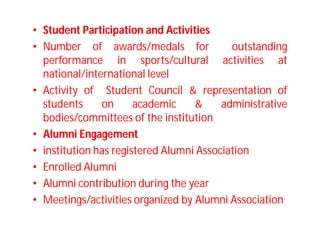
• Student Participation and Activities
• Number of awards/medals for outstanding
performance in sports/cultural activities at
national/international level
• Activity of Student Council & representation of
students on academic & administrative
bodies/committees of the institution
• Alumni Engagement
• institution has registered Alumni Association
• Enrolled Alumni
• Alumni contribution during the year
• Meetings/activities organized by Alumni Association
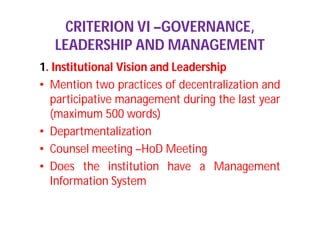
CRITERION VI –GOVERNANCE,
LEADERSHIP AND MANAGEMENT
1. Institutional Vision and Leadership
• Mention two practices of decentralization and
participative management during the last year
(maximum 500 words)
• Departmentalization
• Counsel meeting –HoD Meeting
• Does the institution have a Management
Information System
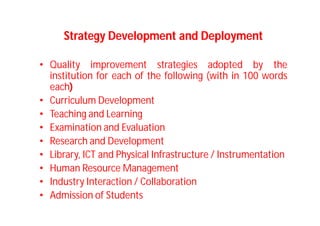
Strategy Development and Deployment
• Quality improvement strategies adopted by the
institution for each of the following (with in 100 words
each)
• Curriculum Development
• Teaching and Learning
• Examination and Evaluation
• Research and Development
• Library, ICT and Physical Infrastructure / Instrumentation
• Human Resource Management
• Industry Interaction / Collaboration
• Admission of Students
3. Implementation of e-governance in areas of
operations
• Planning and Development
• Administration
• Finance and Accounts
• Student Admission and Support
• Examination
Faculty Empowerment Strategies
• financial support to attend conferences / workshops and
towards membership fee of professional bodies during the
year
• Number of professional development / administrative
training programmes organized by the College for
teaching and non teaching staff during the year
• No. of teachers attending professional development
programmes, viz., Orientation Programme, Refresher
Course, Short Term Course, Faculty Development
Programmes during the year
• Faculty and Staff recruitment
• Welfare schemes for- Teaching, Non teaching & Students
Financial Management and Resource
Mobilization
• Institution conducts internal and external
financial audits regularly
• Funds / Grants received from
management, non-government bodies,
individuals, philanthropies during the year
• Total corpus fund generated
Internal Quality Assurance System
• Academic and Administrative Audit (AAA)
• Activities and support from the Parent –
Teacher Association- (at least 3)
• Development programmes for support
staff (at least 3)
• Post Accreditation initiative(s) (at least 3)
Other Accreditation/certification
Yes or No in Other Accreditation/certification
ISO Certification
• Submission of Data for AISHE portal
• Participation in NIRF
• NBA or any other quality audit
• ATALA ( Atal Ranking of Institutions on
Innovation Achievements ( related to ED)-
Closes 15-11-2018.
CRITERION VII – INSTITUTIONAL
VALUES AND BEST PRACTICES
• Institutional Values and Social Responsibilities
Number of gender equity promotion programmes
organized
Environmental Consciousness and
Sustainability/Alternate Energy initiatives
Differently abled friendliness
Human Values and Professional Ethics
Activities conducted for promotion of universal
Values and Ethics
Initiatives taken by the institution to make the
campus eco-friendly
Best Practices
• Describe at least two institutional best
practices
• Upload details of two best practices
successfully implemented by the
institution as per NAAC format in your
institution website, provide the link
Institutional Distinctiveness
• Uniqueness of the institution
• Provide the details of the performance of the
institution in one area distinctive to its vision,
priority and thrust Provide the web link of the
institution in not more than 500 words
• Future Plans of action for next academic year
(500 words)

Bon secrus college 31 10-18

  • 1.
    NAAC – IQAC- AQAR (For Affiliated Colleges) Revised as per Revised Accreditation Framework in November, 2017 Dr.C.PARAMASIVAN.,Ph.D. Assistant Professor of Commerce Periyar E.V.R.College (Autonomous ) Tiruchirappalli -23, Tamil Nadu
  • 2.
    Composition of theIQAC 1.Chairperson: Head of the Institution 2.Teachers to represent all level (3 to 8) 3. One member from the Management 4. Few Senior administrative officers 5. One nominee each from local society, Students and Alumni 6.One nominee each from Employers /Industrialists/Stakeholders 7.One of the senior teachers as the coordinator/Director of the IQAC
  • 3.
    Parts of AQAR Part– A Details of the Institution IQAC Composition and Activities Part – B Criterion – I: Curricular Aspects – 100 marks Criterion – II: Teaching, Learning and Evaluation- 350 marks Criterion – III: Research, Innovations and Extension-120 marks Criterion – IV: Infrastructure and Learning Resources – 100 marks Criterion – V: Student Support and Progression – 130 marks Criterion – VI: Governance, Leadership and Management – 100 marks Criterion – VII: Institutional Values and Best Practices – 100 marks
  • 4.
    Part – A 1.Details of the Institution • Name and address • Institutional status • Accreditation Details • Date of Establishment of IQAC • Internal Quality Assurance System
  • 5.
    2. IQAC Activities •Regular meeting of Internal Quality Assurance Cell (IQAC); timely submission of Annual Quality Assurance Report (AQAR) to NAAC; Feedback from all stakeholders collected, analysed and used for improvements • Academic Administrative Audit (AAA) conducted and its follow up action • Participation in NIRF • ISO Certification • NBA etc. • Any other Quality Audit
  • 6.
    Part-B CRITERION I –CURRICULAR ASPECTS 1. Curriculum Planning and Implementation • Write up about well planned curriculum delivery and documentation - in 500 words 2. Academic Flexibility • New programmes/courses introduced during the Academic year 3. Curriculum Enrichment • Value-added courses/Field Projects / Internships under taken 4. Feedback System • structured feedback – students, Teachers, parents , Alumni
  • 7.
    CRITERION II -TEACHING-LEARNINGAND EVALUATION 1. Student Enrolment and Profile • Demand Ratio during the year • Student - Full time teacher ratio 2. Teaching - Learning Process Percentage of teachers using ICT Students mentoring system 3. Teacher Profile and Quality Number of full time teachers appointed during the year Honours and recognitions received by teachers
  • 8.
    4. Evaluation Processand Reforms • Number of days from the date of semester-end/ year- end examination • Reforms initiated on Continuous Internal Evaluation(CIE) system • Academic calendar prepared and adhered for conduct of Examination 5. Student Performance and Learning Outcomes Program outcomes, program specific outcomes and course outcomes Pass percentage of students 6. Student Satisfaction Survey Student Satisfaction Survey (SSS) on overall institutional performance
  • 9.
    Criterion – III 1.Research 2. Innovations 3. Extension 4. Collaborations
  • 10.
    Resource Mobilization forResearch • Research funds sanctioned and received from various agencies, industry and other organisations • Research Publications and Awards • Ph. Ds awarded during the year • Books and Chapters in edited Volumes / Books published, and papers in National/International Conference Proceedings per Teacher during the year • Bibliometrics of the publications • h-index of the Institutional Publications during the year • Faculty participation in Seminars/Conferences and Symposia during the year
  • 11.
    Innovation Ecosystem • Workshops/SeminarsConducted on Intellectual Property Rights (IPR) and Industry-Academia Innovative practices during the year • Awards for Innovation won by Institution/Teachers/Research scholars /Students during the year • No. of Incubation centre created, start-ups incubated on campus during the year
  • 12.
    3. Extension Activities •Number of extension and outreach programmes conducted in collaboration with industry, community and Non- Government Organisations through • NSS • NCC • Red cross • Youth Red Cross (YRC) • Exnora • Consumer Club • Legal Literacy Club • Leo Club • Rotract Club
  • 13.
    4. Collaborations • Collaborativeactivities for research, faculty exchange, student exchange • Linkages with institutions/industries for internship, on-the-job training, project work, sharing of research facilities • MoUs signed with institutions of national, international importance, other universities, industries, corporate houses etc.
  • 14.
    MoUs signed • Organisation •Date of MoU signed • Purpose and Activities • Number of students/teachers participated under MoUs
  • 15.
    CRITERION IV –INFRASTRUCTURE AND LEARNING RESOURCES 1. Physical Facilities • Budget allocation for infrastructure • Details of infrastructure facilities 2. Library as a Learning Resource Library Services- Automation/ Digitalisation / infilibnet 3. IT Infrastructure Technology Upgradation Bandwidth available of internet connection Facility for e-content -content developed by teachers-e-Pathshala/SWAYAM – MOOCs 4. Maintenance of Campus Infrastructure Expenditure incurred on maintenance of physical facilities Procedures and policies for maintaining and utilization
  • 16.
    CRITERION V -STUDENT SUPPORT AND PROGRESSION 1. Student Support • Scholarships and Financial Support • capability enhancement and development schemes such as Soft skill development, Remedial coaching, Language lab, Bridge courses, Yoga, Meditation, Personal Counselling and Mentoring etc., • guidance for competitive examinations and career counselling offered by the institution during the year • Institutional mechanism for transparency, timely redressal of student grievances, Prevention of sexual harassment and ragging cases during the year
  • 17.
    • Student Progression •Details of campus placement during the year • Student progression to higher education in percentage during the year • Students qualifying in state/ national/ international level examinations during the year NET/SET/SLET/GATE/GMAT/CAT/GRE/TOFEL/Civil Services/State Government Services • Sports and cultural activities / competitions organised at the institution level
  • 18.
    • Student Participationand Activities • Number of awards/medals for outstanding performance in sports/cultural activities at national/international level • Activity of Student Council & representation of students on academic & administrative bodies/committees of the institution • Alumni Engagement • institution has registered Alumni Association • Enrolled Alumni • Alumni contribution during the year • Meetings/activities organized by Alumni Association
  • 19.
    CRITERION VI –GOVERNANCE, LEADERSHIPAND MANAGEMENT 1. Institutional Vision and Leadership • Mention two practices of decentralization and participative management during the last year (maximum 500 words) • Departmentalization • Counsel meeting –HoD Meeting • Does the institution have a Management Information System
  • 20.
    Strategy Development andDeployment • Quality improvement strategies adopted by the institution for each of the following (with in 100 words each) • Curriculum Development • Teaching and Learning • Examination and Evaluation • Research and Development • Library, ICT and Physical Infrastructure / Instrumentation • Human Resource Management • Industry Interaction / Collaboration • Admission of Students
  • 21.
    3. Implementation ofe-governance in areas of operations • Planning and Development • Administration • Finance and Accounts • Student Admission and Support • Examination
  • 22.
    Faculty Empowerment Strategies •financial support to attend conferences / workshops and towards membership fee of professional bodies during the year • Number of professional development / administrative training programmes organized by the College for teaching and non teaching staff during the year • No. of teachers attending professional development programmes, viz., Orientation Programme, Refresher Course, Short Term Course, Faculty Development Programmes during the year • Faculty and Staff recruitment • Welfare schemes for- Teaching, Non teaching & Students
  • 23.
    Financial Management andResource Mobilization • Institution conducts internal and external financial audits regularly • Funds / Grants received from management, non-government bodies, individuals, philanthropies during the year • Total corpus fund generated
  • 24.
    Internal Quality AssuranceSystem • Academic and Administrative Audit (AAA) • Activities and support from the Parent – Teacher Association- (at least 3) • Development programmes for support staff (at least 3) • Post Accreditation initiative(s) (at least 3)
  • 25.
    Other Accreditation/certification Yes orNo in Other Accreditation/certification ISO Certification • Submission of Data for AISHE portal • Participation in NIRF • NBA or any other quality audit • ATALA ( Atal Ranking of Institutions on Innovation Achievements ( related to ED)- Closes 15-11-2018.
  • 26.
    CRITERION VII –INSTITUTIONAL VALUES AND BEST PRACTICES • Institutional Values and Social Responsibilities Number of gender equity promotion programmes organized Environmental Consciousness and Sustainability/Alternate Energy initiatives Differently abled friendliness Human Values and Professional Ethics Activities conducted for promotion of universal Values and Ethics Initiatives taken by the institution to make the campus eco-friendly
  • 27.
    Best Practices • Describeat least two institutional best practices • Upload details of two best practices successfully implemented by the institution as per NAAC format in your institution website, provide the link
  • 28.
    Institutional Distinctiveness • Uniquenessof the institution • Provide the details of the performance of the institution in one area distinctive to its vision, priority and thrust Provide the web link of the institution in not more than 500 words • Future Plans of action for next academic year (500 words)