Presentation On
Criterion: VI
BY:- MR. JUNAID KHAN (M.E)
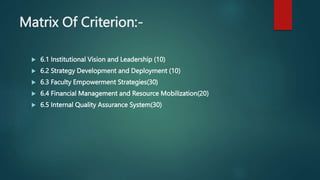
Matrix Of Criterion:-
 6.1 Institutional Vision and Leadership (10)
 6.2 Strategy Development and Deployment (10)
 6.3 Faculty Empowerment Strategies(30)
 6.4 Financial Management and Resource Mobilization(20)
 6.5 Internal Quality Assurance System(30)
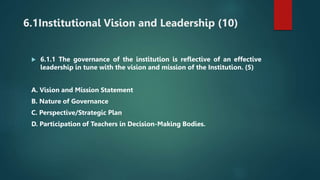
6.1Institutional Vision and Leadership (10)
 6.1.1 The governance of the institution is reflective of an effective
leadership in tune with the vision and mission of the Institution. (5)
A. Vision and Mission Statement
B. Nature of Governance
C. Perspective/Strategic Plan
D. Participation of Teachers in Decision-Making Bodies.
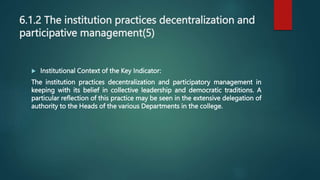
6.1.2 The institution practices decentralization and
participative management(5)
 Institutional Context of the Key Indicator:
The institution practices decentralization and participatory management in
keeping with its belief in collective leadership and democratic traditions. A
particular reflection of this practice may be seen in the extensive delegation of
authority to the Heads of the various Departments in the college.
6.2 Strategy Development and Deployment (10)
 6.2.1 Perspective/Strategic plan and deployment documents are available
in the institution.(2)
 Institutional Context of the Key Indicator: The plan to apply for
governmental as well as non-governmental grants for the development of
the institution has been one of the most important planks of the Strategic
Plan. The mobilization of financial resources, as one knows is of crucial
significance for the growth of an institution.
 Aspects of activity successfully implemented: In fulfillment of this clause in
the Strategic Plan the institution applied for and received the grants during
the last 5-year cycle.
 Strategic Plan: The institution has a Strategic Plan in place to help it
develop in a systematic, well-thought-out and phased manner.
6.2.2 Organizational structure of the Institution
including governing body, administrative setup,
and functions of various bodies, service rules,
procedures, recruitment, promotional policies as
well as grievance redressal mechanism(2)
 Governing Body
 College Development Cell (CDC)
 Director and Principal
 Service rules and procedures
 Recruitment Policies
 Promotional Policies
6.2.3 Implementation of e-governance in areas of
operation(4)
1. Planning and Development
2. Administration
3.Finance and Accounts
4. Student Admission and Support
5. Examination
6.2.4 Effectiveness of various
bodies/cells/committees is evident through minutes
of meetings and implementation of their
resolutions(2)
 Various bodies in the college :
1. Internal Quality Assurance Cell (IQAC)
2. Examination Committee
3. College Office Section
4.Grievance Redressal Committee
5.Anti Ragging Committee
6.Internal Complaints Committee (ICC)
7.Minority Cell (MC)
8.Other Backward Class Cell (OBCC)
9.Committee for SC/ST
10.Women Development Cell
6.3 Faculty Empowerment Strategies(30)
 6.3.1 The institution has effective welfare measures for teaching and non-teaching staff(9)
 List of welfare measures for the teaching staff
 Duty Leave for attending Seminars, Conferences and Workshops.
 Employee’s Provident fund.
 Maternity Leave.
 Medical Health Care Centre Facility.
 Eco-Friendly campus.
 Pure Drinking R.O. Water
 Winter & Summer Vacation.
 Loan facility
 Transport facility for teaching staff.
 Xerox Facility for staff
 Wi-Fi Campus for Faculty
 Early going and late coming facility to the staff.
6.3.2 Average percentage of teachers provided with
financial support to attend conferences/workshops
and towards membership fee of professional
bodies during the last five years(6)
 6.3.2.1 Number of teachers provided with financial support to attend
conferences / workshops and towards membership fee of professional bodies
year-wise during the last five years.
2017-18 2018-19 2019-20 2020-21 2021-22
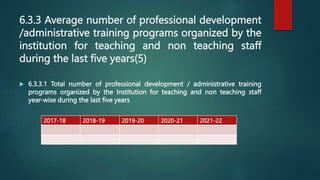
6.3.3 Average number of professional development
/administrative training programs organized by the
institution for teaching and non teaching staff
during the last five years(5)
 6.3.3.1 Total number of professional development / administrative training
programs organized by the Institution for teaching and non teaching staff
year-wise during the last five years
2017-18 2018-19 2019-20 2020-21 2021-22
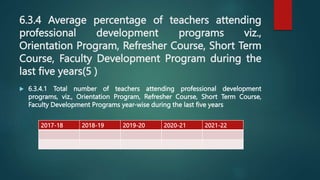
6.3.4 Average percentage of teachers attending
professional development programs viz.,
Orientation Program, Refresher Course, Short Term
Course, Faculty Development Program during the
last five years(5 )
 6.3.4.1 Total number of teachers attending professional development
programs, viz., Orientation Program, Refresher Course, Short Term Course,
Faculty Development Programs year-wise during the last five years
2017-18 2018-19 2019-20 2020-21 2021-22
6.3.5 Institution has Performance Appraisal System
for teaching and non-teaching staff(5)
 Performance appraisal of teaching staff
 Performance appraisal of Non-Teaching Staff
6.4 Financial Management and Resource
Mobilization(20)
 6.4.1 Institution conducts internal and external financial audits regularly(4)
 6.4.2 Funds / Grants received from non-government bodies, individuals,
Philanthropists during the last five years (not covered in Criterion III) (INR
in Lakhs)(8)
 6.4.3 Institutional strategies for mobilisation of funds and the optimal
utilisation of resources(8)
6.5 Internal Quality Assurance System(30)
 6.5.1 Internal Quality Assurance Cell (IQAC) has contributed significantly for
institutionalizing the quality assurance strategies and processes(8)
 Curriculum and syllabus
 Feedback system
 Felicitation of students
 Accreditation Internal & External promotion
 Reports for UGC / AICTE Expert Committee Visit
 Preparation of report for EoA.
 Strengthen the teaching learning process.
 Academic audit of Department.
6.5.2 The institution reviews its teaching learning
process, structures & methodologies of operations
and learning outcomes at periodic intervals
through IQAC set up as per norms(8)
 Review of Teaching-Learning Process and its Outcomes
 Methodologies
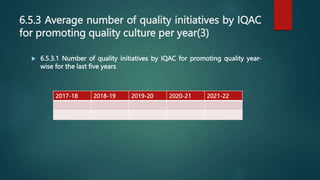
6.5.3 Average number of quality initiatives by IQAC
for promoting quality culture per year(3)
 6.5.3.1 Number of quality initiatives by IQAC for promoting quality year-
wise for the last five years
2017-18 2018-19 2019-20 2020-21 2021-22
6.5.4 Quality assurance initiatives of the institution
include(6)
 1.Regular meeting of Internal Quality Assurance Cell (IQAC); timely
submission of Annual Quality Assurance Report (AQAR) to NAAC;
Feedback collected, analysed and used for improvements
 2.Academic Administrative Audit (AAA) and initiation of follow up action
 3.Participation in NIRF
 4.ISO Certification
 5.NBA or any other quality audit
6.5.5 Incremental improvements made during the
preceding five years (in case of first cycle) Post
accreditation quality initiatives (second and
subsequent cycles)(5)
 1. Academics/Teaching Learning
 2. Research and development
 3. Recognition for the institute
 4. Infrastructure and Learning Resources
Thank You

Presentation On Institute Acreditation.pptx

  • 1.
  • 2.
    Matrix Of Criterion:- 6.1 Institutional Vision and Leadership (10)  6.2 Strategy Development and Deployment (10)  6.3 Faculty Empowerment Strategies(30)  6.4 Financial Management and Resource Mobilization(20)  6.5 Internal Quality Assurance System(30)
  • 3.
    6.1Institutional Vision andLeadership (10)  6.1.1 The governance of the institution is reflective of an effective leadership in tune with the vision and mission of the Institution. (5) A. Vision and Mission Statement B. Nature of Governance C. Perspective/Strategic Plan D. Participation of Teachers in Decision-Making Bodies.
  • 4.
    6.1.2 The institutionpractices decentralization and participative management(5)  Institutional Context of the Key Indicator: The institution practices decentralization and participatory management in keeping with its belief in collective leadership and democratic traditions. A particular reflection of this practice may be seen in the extensive delegation of authority to the Heads of the various Departments in the college.
  • 5.
    6.2 Strategy Developmentand Deployment (10)  6.2.1 Perspective/Strategic plan and deployment documents are available in the institution.(2)  Institutional Context of the Key Indicator: The plan to apply for governmental as well as non-governmental grants for the development of the institution has been one of the most important planks of the Strategic Plan. The mobilization of financial resources, as one knows is of crucial significance for the growth of an institution.  Aspects of activity successfully implemented: In fulfillment of this clause in the Strategic Plan the institution applied for and received the grants during the last 5-year cycle.
  • 6.
     Strategic Plan:The institution has a Strategic Plan in place to help it develop in a systematic, well-thought-out and phased manner.
  • 7.
    6.2.2 Organizational structureof the Institution including governing body, administrative setup, and functions of various bodies, service rules, procedures, recruitment, promotional policies as well as grievance redressal mechanism(2)  Governing Body  College Development Cell (CDC)  Director and Principal  Service rules and procedures  Recruitment Policies  Promotional Policies
  • 8.
    6.2.3 Implementation ofe-governance in areas of operation(4) 1. Planning and Development 2. Administration 3.Finance and Accounts 4. Student Admission and Support 5. Examination
  • 9.
    6.2.4 Effectiveness ofvarious bodies/cells/committees is evident through minutes of meetings and implementation of their resolutions(2)  Various bodies in the college : 1. Internal Quality Assurance Cell (IQAC) 2. Examination Committee 3. College Office Section 4.Grievance Redressal Committee 5.Anti Ragging Committee 6.Internal Complaints Committee (ICC) 7.Minority Cell (MC) 8.Other Backward Class Cell (OBCC) 9.Committee for SC/ST 10.Women Development Cell
  • 10.
    6.3 Faculty EmpowermentStrategies(30)  6.3.1 The institution has effective welfare measures for teaching and non-teaching staff(9)  List of welfare measures for the teaching staff  Duty Leave for attending Seminars, Conferences and Workshops.  Employee’s Provident fund.  Maternity Leave.  Medical Health Care Centre Facility.  Eco-Friendly campus.  Pure Drinking R.O. Water  Winter & Summer Vacation.  Loan facility  Transport facility for teaching staff.  Xerox Facility for staff  Wi-Fi Campus for Faculty  Early going and late coming facility to the staff.
  • 11.
    6.3.2 Average percentageof teachers provided with financial support to attend conferences/workshops and towards membership fee of professional bodies during the last five years(6)  6.3.2.1 Number of teachers provided with financial support to attend conferences / workshops and towards membership fee of professional bodies year-wise during the last five years. 2017-18 2018-19 2019-20 2020-21 2021-22
  • 12.
    6.3.3 Average numberof professional development /administrative training programs organized by the institution for teaching and non teaching staff during the last five years(5)  6.3.3.1 Total number of professional development / administrative training programs organized by the Institution for teaching and non teaching staff year-wise during the last five years 2017-18 2018-19 2019-20 2020-21 2021-22
  • 13.
    6.3.4 Average percentageof teachers attending professional development programs viz., Orientation Program, Refresher Course, Short Term Course, Faculty Development Program during the last five years(5 )  6.3.4.1 Total number of teachers attending professional development programs, viz., Orientation Program, Refresher Course, Short Term Course, Faculty Development Programs year-wise during the last five years 2017-18 2018-19 2019-20 2020-21 2021-22
  • 14.
    6.3.5 Institution hasPerformance Appraisal System for teaching and non-teaching staff(5)  Performance appraisal of teaching staff  Performance appraisal of Non-Teaching Staff
  • 15.
    6.4 Financial Managementand Resource Mobilization(20)  6.4.1 Institution conducts internal and external financial audits regularly(4)  6.4.2 Funds / Grants received from non-government bodies, individuals, Philanthropists during the last five years (not covered in Criterion III) (INR in Lakhs)(8)  6.4.3 Institutional strategies for mobilisation of funds and the optimal utilisation of resources(8)
  • 16.
    6.5 Internal QualityAssurance System(30)  6.5.1 Internal Quality Assurance Cell (IQAC) has contributed significantly for institutionalizing the quality assurance strategies and processes(8)  Curriculum and syllabus  Feedback system  Felicitation of students  Accreditation Internal & External promotion  Reports for UGC / AICTE Expert Committee Visit  Preparation of report for EoA.  Strengthen the teaching learning process.  Academic audit of Department.
  • 17.
    6.5.2 The institutionreviews its teaching learning process, structures & methodologies of operations and learning outcomes at periodic intervals through IQAC set up as per norms(8)  Review of Teaching-Learning Process and its Outcomes  Methodologies
  • 18.
    6.5.3 Average numberof quality initiatives by IQAC for promoting quality culture per year(3)  6.5.3.1 Number of quality initiatives by IQAC for promoting quality year- wise for the last five years 2017-18 2018-19 2019-20 2020-21 2021-22
  • 19.
    6.5.4 Quality assuranceinitiatives of the institution include(6)  1.Regular meeting of Internal Quality Assurance Cell (IQAC); timely submission of Annual Quality Assurance Report (AQAR) to NAAC; Feedback collected, analysed and used for improvements  2.Academic Administrative Audit (AAA) and initiation of follow up action  3.Participation in NIRF  4.ISO Certification  5.NBA or any other quality audit
  • 20.
    6.5.5 Incremental improvementsmade during the preceding five years (in case of first cycle) Post accreditation quality initiatives (second and subsequent cycles)(5)  1. Academics/Teaching Learning  2. Research and development  3. Recognition for the institute  4. Infrastructure and Learning Resources
  • 21.