Kakatiya University
NAAC-2022 (4th Cycle)
Preparatory Meeting
February 2, 2022
N A A C (ACCREDITATION)
( 4th cycle, 2022)
(2017-18,2018-19,2019-20,2020-21,2021-22)
KAKATIYA UNIVERSITY
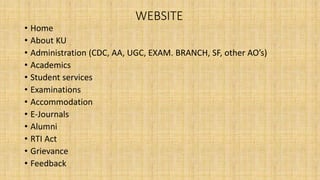
WEBSITE
• Home
• About KU
• Administration (CDC, AA, UGC, EXAM. BRANCH, SF, other AO’s)
• Academics
• Student services
• Examinations
• Accommodation
• E-Journals
• Alumni
• RTI Act
• Grievance
• Feedback
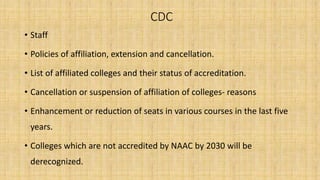
CDC
• Staff
• Policies of affiliation, extension and cancellation.
• List of affiliated colleges and their status of accreditation.
• Cancellation or suspension of affiliation of colleges- reasons
• Enhancement or reduction of seats in various courses in the last five
years.
• Colleges which are not accredited by NAAC by 2030 will be
derecognized.
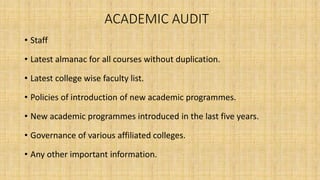
ACADEMIC AUDIT
• Staff
• Latest almanac for all courses without duplication.
• Latest college wise faculty list.
• Policies of introduction of new academic programmes.
• New academic programmes introduced in the last five years.
• Governance of various affiliated colleges.
• Any other important information.
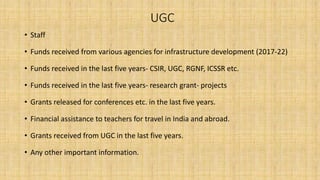
UGC
• Staff
• Funds received from various agencies for infrastructure development (2017-22)
• Funds received in the last five years- CSIR, UGC, RGNF, ICSSR etc.
• Funds received in the last five years- research grant- projects
• Grants released for conferences etc. in the last five years.
• Financial assistance to teachers for travel in India and abroad.
• Grants received from UGC in the last five years.
• Any other important information.
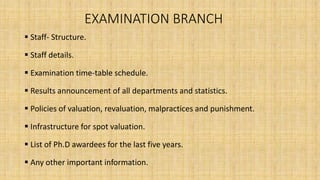
EXAMINATION BRANCH
 Staff- Structure.
 Staff details.
 Examination time-table schedule.
 Results announcement of all departments and statistics.
 Policies of valuation, revaluation, malpractices and punishment.
 Infrastructure for spot valuation.
 List of Ph.D awardees for the last five years.
 Any other important information.
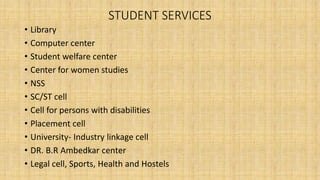
STUDENT SERVICES
• Library
• Computer center
• Student welfare center
• Center for women studies
• NSS
• SC/ST cell
• Cell for persons with disabilities
• Placement cell
• University- Industry linkage cell
• DR. B.R Ambedkar center
• Legal cell, Sports, Health and Hostels
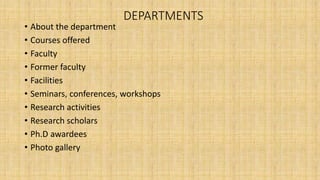
DEPARTMENTS
• About the department
• Courses offered
• Faculty
• Former faculty
• Facilities
• Seminars, conferences, workshops
• Research activities
• Research scholars
• Ph.D awardees
• Photo gallery
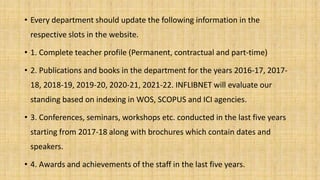
• Every department should update the following information in the
respective slots in the website.
• 1. Complete teacher profile (Permanent, contractual and part-time)
• 2. Publications and books in the department for the years 2016-17, 2017-
18, 2018-19, 2019-20, 2020-21, 2021-22. INFLIBNET will evaluate our
standing based on indexing in WOS, SCOPUS and ICI agencies.
• 3. Conferences, seminars, workshops etc. conducted in the last five years
starting from 2017-18 along with brochures which contain dates and
speakers.
• 4. Awards and achievements of the staff in the last five years.
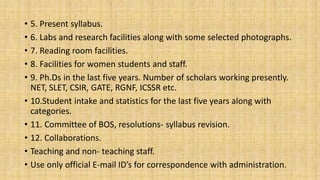
• 5. Present syllabus.
• 6. Labs and research facilities along with some selected photographs.
• 7. Reading room facilities.
• 8. Facilities for women students and staff.
• 9. Ph.Ds in the last five years. Number of scholars working presently.
NET, SLET, CSIR, GATE, RGNF, ICSSR etc.
• 10.Student intake and statistics for the last five years along with
categories.
• 11. Committee of BOS, resolutions- syllabus revision.
• 12. Collaborations.
• Teaching and non- teaching staff.
• Use only official E-mail ID’s for correspondence with administration.
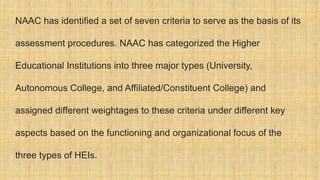
NAAC has identified a set of seven criteria to serve as the basis of its
assessment procedures. NAAC has categorized the Higher
Educational Institutions into three major types (University,
Autonomous College, and Affiliated/Constituent College) and
assigned different weightages to these criteria under different key
aspects based on the functioning and organizational focus of the
three types of HEIs.
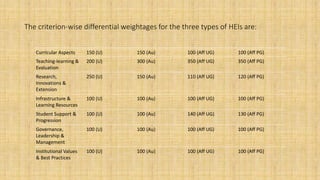
The criterion-wise differential weightages for the three types of HEIs are:
Curricular Aspects 150 (U) 150 (Au) 100 (Aff UG) 100 (Aff PG)
Teaching-learning &
Evaluation
200 (U) 300 (Au) 350 (Aff UG) 350 (Aff PG)
Research,
Innovations &
Extension
250 (U) 150 (Au) 110 (Aff UG) 120 (Aff PG)
Infrastructure &
Learning Resources
100 (U) 100 (Au) 100 (Aff UG) 100 (Aff PG)
Student Support &
Progression
100 (U) 100 (Au) 140 (Aff UG) 130 (Aff PG)
Governance,
Leadership &
Management
100 (U) 100 (Au) 100 (Aff UG) 100 (Aff PG)
Institutional Values
& Best Practices
100 (U) 100 (Au) 100 (Aff UG) 100 (Aff PG)
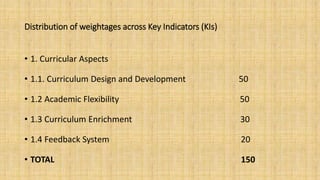
Distribution of weightages across Key Indicators (KIs)
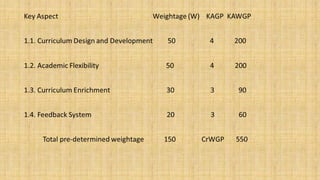
• 1. Curricular Aspects
• 1.1. Curriculum Design and Development 50
• 1.2 Academic Flexibility 50
• 1.3 Curriculum Enrichment 30
• 1.4 Feedback System 20
• TOTAL 150
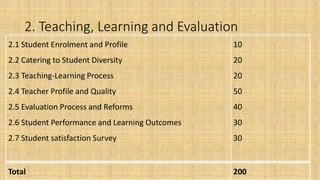
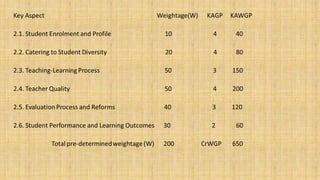
2. Teaching, Learning and Evaluation
2.1 Student Enrolment and Profile
2.2 Catering to Student Diversity
2.3 Teaching-Learning Process
2.4 Teacher Profile and Quality
2.5 Evaluation Process and Reforms
2.6 Student Performance and Learning Outcomes
2.7 Student satisfaction Survey
10
20
20
50
40
30
30
Total 200
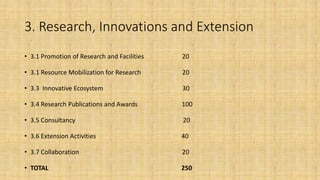
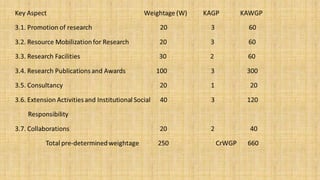
3. Research, Innovations and Extension
• 3.1 Promotion of Research and Facilities 20
• 3.1 Resource Mobilization for Research 20
• 3.3 Innovative Ecosystem 30
• 3.4 Research Publications and Awards 100
• 3.5 Consultancy 20
• 3.6 Extension Activities 40
• 3.7 Collaboration 20
• TOTAL 250
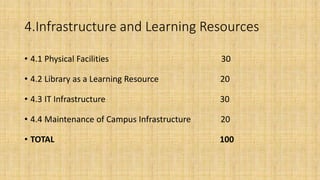
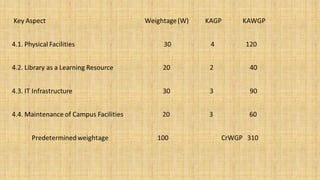
4.Infrastructure and Learning Resources
• 4.1 Physical Facilities 30
• 4.2 Library as a Learning Resource 20
• 4.3 IT Infrastructure 30
• 4.4 Maintenance of Campus Infrastructure 20
• TOTAL 100
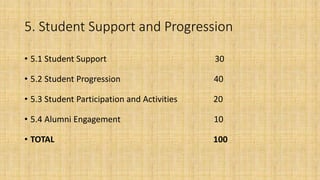
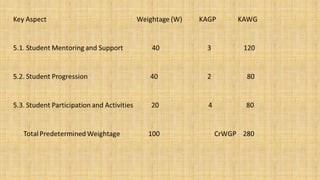
5. Student Support and Progression
• 5.1 Student Support 30
• 5.2 Student Progression 40
• 5.3 Student Participation and Activities 20
• 5.4 Alumni Engagement 10
• TOTAL 100
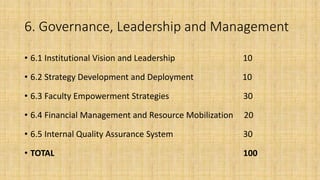
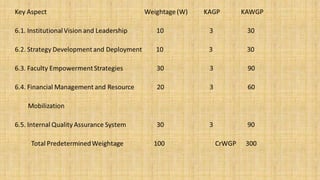
6. Governance, Leadership and Management
• 6.1 Institutional Vision and Leadership 10
• 6.2 Strategy Development and Deployment 10
• 6.3 Faculty Empowerment Strategies 30
• 6.4 Financial Management and Resource Mobilization 20
• 6.5 Internal Quality Assurance System 30
• TOTAL 100
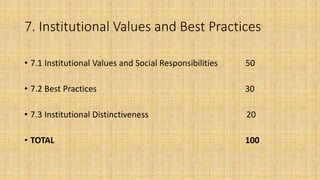
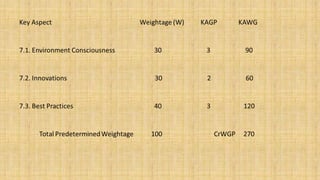
7. Institutional Values and Best Practices
• 7.1 Institutional Values and Social Responsibilities 50
• 7.2 Best Practices 30
• 7.3 Institutional Distinctiveness 20
• TOTAL 100
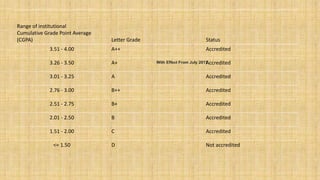
Range of institutional
Cumulative Grade Point Average
(CGPA) Letter Grade Status
3.51 - 4.00 A++ Accredited
3.26 - 3.50 A+ Accredited
3.01 - 3.25 A Accredited
2.76 - 3.00 B++ Accredited
2.51 - 2.75 B+ Accredited
2.01 - 2.50 B Accredited
1.51 - 2.00 C Accredited
<= 1.50 D Not accredited
With Effect From July 2017
THANK YOU

NAAC 4TH CYCLE final.pptx

  • 1.
    Kakatiya University NAAC-2022 (4thCycle) Preparatory Meeting February 2, 2022
  • 2.
    N A AC (ACCREDITATION) ( 4th cycle, 2022) (2017-18,2018-19,2019-20,2020-21,2021-22) KAKATIYA UNIVERSITY
  • 3.
    WEBSITE • Home • AboutKU • Administration (CDC, AA, UGC, EXAM. BRANCH, SF, other AO’s) • Academics • Student services • Examinations • Accommodation • E-Journals • Alumni • RTI Act • Grievance • Feedback
  • 4.
    CDC • Staff • Policiesof affiliation, extension and cancellation. • List of affiliated colleges and their status of accreditation. • Cancellation or suspension of affiliation of colleges- reasons • Enhancement or reduction of seats in various courses in the last five years. • Colleges which are not accredited by NAAC by 2030 will be derecognized.
  • 5.
    ACADEMIC AUDIT • Staff •Latest almanac for all courses without duplication. • Latest college wise faculty list. • Policies of introduction of new academic programmes. • New academic programmes introduced in the last five years. • Governance of various affiliated colleges. • Any other important information.
  • 6.
    UGC • Staff • Fundsreceived from various agencies for infrastructure development (2017-22) • Funds received in the last five years- CSIR, UGC, RGNF, ICSSR etc. • Funds received in the last five years- research grant- projects • Grants released for conferences etc. in the last five years. • Financial assistance to teachers for travel in India and abroad. • Grants received from UGC in the last five years. • Any other important information.
  • 7.
    EXAMINATION BRANCH  Staff-Structure.  Staff details.  Examination time-table schedule.  Results announcement of all departments and statistics.  Policies of valuation, revaluation, malpractices and punishment.  Infrastructure for spot valuation.  List of Ph.D awardees for the last five years.  Any other important information.
  • 8.
    STUDENT SERVICES • Library •Computer center • Student welfare center • Center for women studies • NSS • SC/ST cell • Cell for persons with disabilities • Placement cell • University- Industry linkage cell • DR. B.R Ambedkar center • Legal cell, Sports, Health and Hostels
  • 9.
    DEPARTMENTS • About thedepartment • Courses offered • Faculty • Former faculty • Facilities • Seminars, conferences, workshops • Research activities • Research scholars • Ph.D awardees • Photo gallery
  • 10.
    • Every departmentshould update the following information in the respective slots in the website. • 1. Complete teacher profile (Permanent, contractual and part-time) • 2. Publications and books in the department for the years 2016-17, 2017- 18, 2018-19, 2019-20, 2020-21, 2021-22. INFLIBNET will evaluate our standing based on indexing in WOS, SCOPUS and ICI agencies. • 3. Conferences, seminars, workshops etc. conducted in the last five years starting from 2017-18 along with brochures which contain dates and speakers. • 4. Awards and achievements of the staff in the last five years.
  • 11.
    • 5. Presentsyllabus. • 6. Labs and research facilities along with some selected photographs. • 7. Reading room facilities. • 8. Facilities for women students and staff. • 9. Ph.Ds in the last five years. Number of scholars working presently. NET, SLET, CSIR, GATE, RGNF, ICSSR etc. • 10.Student intake and statistics for the last five years along with categories. • 11. Committee of BOS, resolutions- syllabus revision. • 12. Collaborations. • Teaching and non- teaching staff. • Use only official E-mail ID’s for correspondence with administration.
  • 12.
    NAAC has identifieda set of seven criteria to serve as the basis of its assessment procedures. NAAC has categorized the Higher Educational Institutions into three major types (University, Autonomous College, and Affiliated/Constituent College) and assigned different weightages to these criteria under different key aspects based on the functioning and organizational focus of the three types of HEIs.
  • 13.
    The criterion-wise differentialweightages for the three types of HEIs are: Curricular Aspects 150 (U) 150 (Au) 100 (Aff UG) 100 (Aff PG) Teaching-learning & Evaluation 200 (U) 300 (Au) 350 (Aff UG) 350 (Aff PG) Research, Innovations & Extension 250 (U) 150 (Au) 110 (Aff UG) 120 (Aff PG) Infrastructure & Learning Resources 100 (U) 100 (Au) 100 (Aff UG) 100 (Aff PG) Student Support & Progression 100 (U) 100 (Au) 140 (Aff UG) 130 (Aff PG) Governance, Leadership & Management 100 (U) 100 (Au) 100 (Aff UG) 100 (Aff PG) Institutional Values & Best Practices 100 (U) 100 (Au) 100 (Aff UG) 100 (Aff PG)
  • 14.
    Distribution of weightagesacross Key Indicators (KIs) • 1. Curricular Aspects • 1.1. Curriculum Design and Development 50 • 1.2 Academic Flexibility 50 • 1.3 Curriculum Enrichment 30 • 1.4 Feedback System 20 • TOTAL 150
  • 15.
    2. Teaching, Learningand Evaluation 2.1 Student Enrolment and Profile 2.2 Catering to Student Diversity 2.3 Teaching-Learning Process 2.4 Teacher Profile and Quality 2.5 Evaluation Process and Reforms 2.6 Student Performance and Learning Outcomes 2.7 Student satisfaction Survey 10 20 20 50 40 30 30 Total 200
  • 16.
    3. Research, Innovationsand Extension • 3.1 Promotion of Research and Facilities 20 • 3.1 Resource Mobilization for Research 20 • 3.3 Innovative Ecosystem 30 • 3.4 Research Publications and Awards 100 • 3.5 Consultancy 20 • 3.6 Extension Activities 40 • 3.7 Collaboration 20 • TOTAL 250
  • 17.
    4.Infrastructure and LearningResources • 4.1 Physical Facilities 30 • 4.2 Library as a Learning Resource 20 • 4.3 IT Infrastructure 30 • 4.4 Maintenance of Campus Infrastructure 20 • TOTAL 100
  • 18.
    5. Student Supportand Progression • 5.1 Student Support 30 • 5.2 Student Progression 40 • 5.3 Student Participation and Activities 20 • 5.4 Alumni Engagement 10 • TOTAL 100
  • 19.
    6. Governance, Leadershipand Management • 6.1 Institutional Vision and Leadership 10 • 6.2 Strategy Development and Deployment 10 • 6.3 Faculty Empowerment Strategies 30 • 6.4 Financial Management and Resource Mobilization 20 • 6.5 Internal Quality Assurance System 30 • TOTAL 100
  • 20.
    7. Institutional Valuesand Best Practices • 7.1 Institutional Values and Social Responsibilities 50 • 7.2 Best Practices 30 • 7.3 Institutional Distinctiveness 20 • TOTAL 100
  • 29.
    Range of institutional CumulativeGrade Point Average (CGPA) Letter Grade Status 3.51 - 4.00 A++ Accredited 3.26 - 3.50 A+ Accredited 3.01 - 3.25 A Accredited 2.76 - 3.00 B++ Accredited 2.51 - 2.75 B+ Accredited 2.01 - 2.50 B Accredited 1.51 - 2.00 C Accredited <= 1.50 D Not accredited With Effect From July 2017
  • 30.