A presentation on
NATIONAL ASSESSMENT AND
ACCREDITATION COUNCIL
(NAAC)
Why Accreditation
Why Accreditation
 Education plays a vital role in the development of any
Education plays a vital role in the development of any
nation. Therefore, there is a premium on both quantity
(increased access) and quality (relevance and excellence of
academic programmes offered) of higher education.
 Like in any other domain, the method to improve quality
Like in any other domain, the method to improve quality
remains the same. Finding and recognizing new needs
and satisfying them with products and services of
international standards.
 The NAAC has been set up to help all participating
institutions assess their performance vis-à-vis set
parameters. A rating agency for academic excellence
across India, and the country's first such effort.
Benefits of Accreditation
 Helps the institution to know its strengths, weaknesses and
Helps the institution to know its strengths, weaknesses and
opportunities through an informed review process.
 To identify internal areas of planning and resource allocation.
To identify internal areas of planning and resource allocation.
 Out come provides funding agencies objective data for
Out come provides funding agencies objective data for
performance funding. Initiates institutions into innovative and
modern methods of pedagogy.
 Gives institutions a new sense of direction and identity.
Gives institutions a new sense of direction and identity.
 Provides society with reliable information on quality of education
Provides society with reliable information on quality of education
offered.
offered.
 Employers have access to information on the quality of education
Employers have access to information on the quality of education
offered to potential recruitees.
 Promotes intra and inter-institutional interactions.
Promotes intra and inter-institutional interactions.
Important stages in A&A of HEIs are:
On-line submission of Letter of Intent (LoI) and/or
application for Institutional Eligibility for Quality Assessment
(IEQA)
All HEIs fulfilling the eligibility criteria for undergoing
A&A are expected to submit a LoI online to NAAC. On
scrutiny of the LoI and confirming the fulfillment of the
eligibility criteria by NAAC:
Affiliated and Constituent colleges need to submit the
application for IEQA status on-line. These institutions
become eligible for submission of the SSR only after
qualifying / acquiring the IEQA status.
Self-Study Report (SSR)
Structure of the SSR to be submitted to NAAC:
A. Preface or cover letter from the Head of the Institution
B. Executive Summary- The SWOC analysis of the institution
C. Profile of the Institution
D. Criteria-wise analytical report –The institution should provide consolidated
response for each of the Key Aspects. It is not expected to respond question
wise. The questions are only pointers and the responses should provide a holistic
view describing institutional inputs, processes and outcomes covering the Key
Aspect.
E. Inputs from each of the Department in the format provided. However in smaller
colleges where there are no specific departments in vogue, the college may use the
proforma and provide programme wise details.
NAAC Criteria- 7
NAAC Criteria- 7
Student Support & Progression
Infrastructure & Learning Resources
Research, Consultancy & Extension
Teaching-Learning & Evaluation
Curricular Aspects
Governance & Leadership
Innovative Practices
1. Curriculum Planning and Implementation
2. Academic flexibility
3. Curriculum Enrichment
4. Feedback System
Criterion I : Curricular Aspects
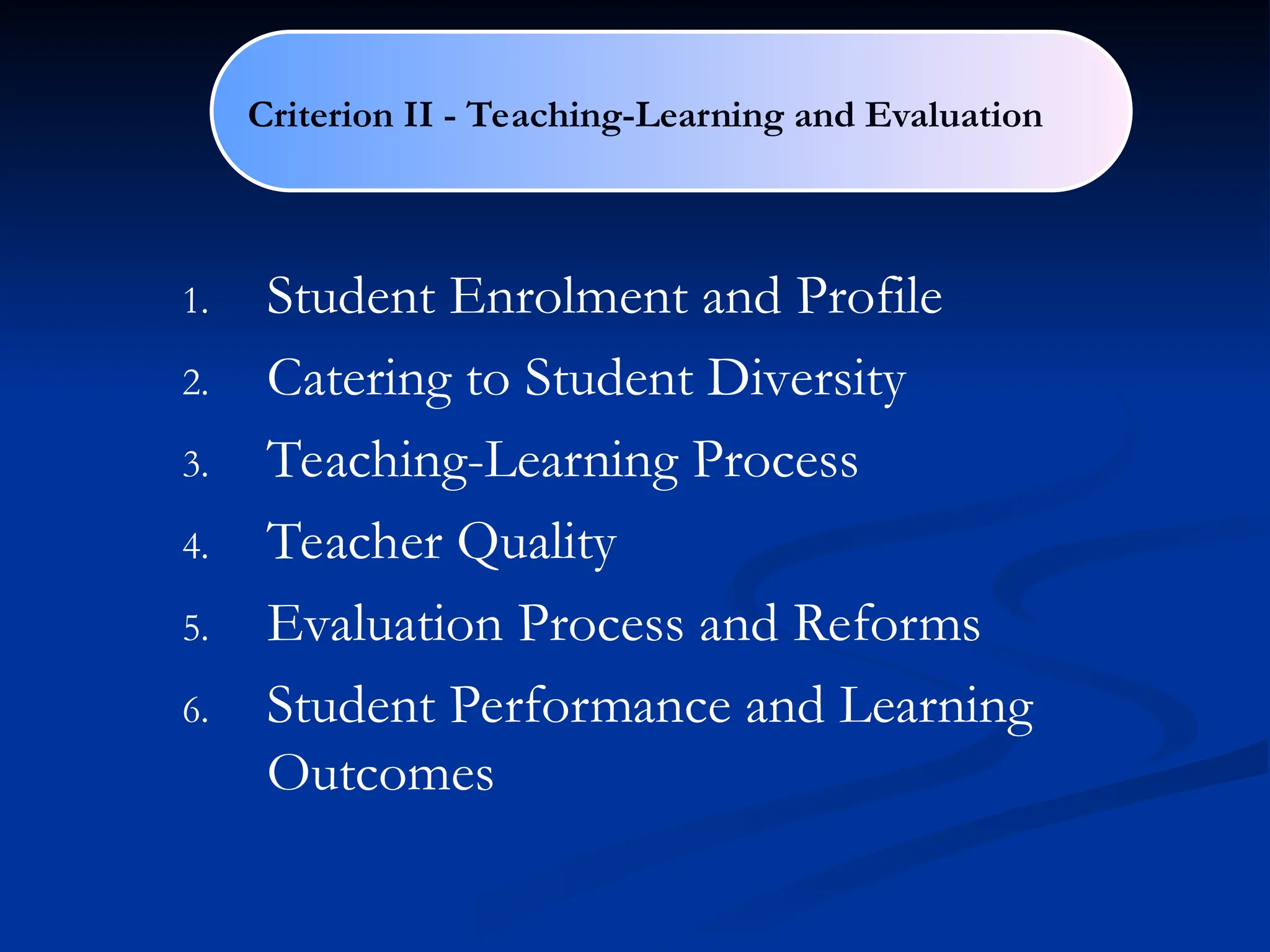
1. Student Enrolment and Profile
2. Catering to Student Diversity
3. Teaching-Learning Process
4. Teacher Quality
5. Evaluation Process and Reforms
6. Student Performance and Learning
Outcomes
Criterion II - Teaching-Learning and Evaluation
1. Promotion of Research
2. Resource Mobilization for Research
3. Research Facilities
4. Research Publications and Awards
5. Consultancy
6. Extension Activities and Institutional Social
Responsibility
7. Collaborations
Criterion III - Research, Consultancy and Extension
1. Physical Facilities
2. Library as a Learning Resource
3. IT Infrastructure
4. Maintenance of Campus Facilities
Criterion IV - Infrastructure and Learning Resources
1. Student Mentoring and Support
2. Student Progression
3. Student Participation and Activities
Criterion V - Student Support and Progression
1. Institutional Vision and Leadership
2. Strategy Development and Deployment
3. Faculty Empowerment Strategies
4. Financial Management and Resource
Mobilization
5. Internal Quality Assurance System (IQAS)
Criterion VI - Governance, Leadership and Management
1. Environment Consciousness
2. Innovations
3. Best Practices
Criterion VII - Innovations and Best Practices
A few guidelines on Institutional Preparation
 Vision and Mission statements of the college to be displayed
Vision and Mission statements of the college to be displayed.
.
 Creation of websites for all the colleges/departments.
Creation of websites for all the colleges/departments.
The websites may contain the following information:
 Goals and objectives
Goals and objectives
 Program options
Program options
 Eligibility criteria
Eligibility criteria
 Admission policy and process
Admission policy and process
 Academic calendar
Academic calendar
 Examination and other assessment schedules and procedures
Examination and other assessment schedules and procedures
 Infrastructure facilities available for teaching, learning, sports,
Infrastructure facilities available for teaching, learning, sports,
residence, research and recreation
 Scholarships given by the state and institution
Scholarships given by the state and institution
 Fee structure etc.
Fee structure etc.
 Alumni association
Alumni association
 Data banks to consist of all academic activities of teachers
Data banks to consist of all academic activities of teachers
 Event registers to maintain all the activities of the
Event registers to maintain all the activities of the
Departments/Colleges
 Hand books containing information about faculty, courses,
Hand books containing information about faculty, courses,
almanac, research and other facilities available in the
Departments/Colleges.
 Provide internet facility to all departments in the
Provide internet facility to all departments in the
colleges and provide access to all students, teachers
and other staff members.
 Constitute a college level Research Advisory Committee
Constitute a college level Research Advisory Committee
to encourage and guide teacher applying for research
projects and monitor research work done.
 Provide Assistance to teachers for filing patents.
Provide Assistance to teachers for filing patents.
 Creation of student councils, appointment of teacher
Creation of student councils, appointment of teacher
counselors and a lady counselor for all
Departments/Colleges.
 Creation of placement and guidance cells in all
Creation of placement and guidance cells in all
departments/colleges.
 Organizing seminars in all colleges for students
through students councils to get feedback from the
students regarding the academic activities of the
departments & colleges and any other students
problems
 Suggestions to be invited for enhancement of quality.
 Provision of basic facilities like telephone, safe
drinking water, toilet facilities in all
departments/colleges.
 Introduction of teacher-ward system in the
Introduction of teacher-ward system in the
departments/colleges.
 Undertaking of community activities –each college to
Undertaking of community activities –each college to
adopt 2 or 3 villages under NSS activity.
 Creation of academic audit units in all colleges.
Creation of academic audit units in all colleges.
 Collection and analysis of feedback for students and
Collection and analysis of feedback for students and
employees.
employees.
 Arranging parent teacher meets.
Arranging parent teacher meets.
 Undertaking programmes for soft skills and
Undertaking programmes for soft skills and
personality development
Lets work now
Thank you

NAAC Accreditation process and benefits for institutions

  • 1.
    A presentation on NATIONALASSESSMENT AND ACCREDITATION COUNCIL (NAAC)
  • 2.
    Why Accreditation Why Accreditation Education plays a vital role in the development of any Education plays a vital role in the development of any nation. Therefore, there is a premium on both quantity nation. Therefore, there is a premium on both quantity (increased access) and quality (relevance and excellence of (increased access) and quality (relevance and excellence of academic programmes offered) of higher education. academic programmes offered) of higher education.  Like in any other domain, the method to improve quality Like in any other domain, the method to improve quality remains the same. Finding and recognizing new needs remains the same. Finding and recognizing new needs and satisfying them with products and services of and satisfying them with products and services of international standards. international standards.  The NAAC has been set up to help all participating institutions assess their performance vis-à-vis set parameters. A rating agency for academic excellence across India, and the country's first such effort.
  • 3.
    Benefits of Accreditation Benefitsof Accreditation  Helps the institution to know its strengths, weaknesses and Helps the institution to know its strengths, weaknesses and opportunities through an informed review process. opportunities through an informed review process.  To identify internal areas of planning and resource allocation. To identify internal areas of planning and resource allocation.  Out come provides funding agencies objective data for Out come provides funding agencies objective data for performance funding. Initiates institutions into innovative and performance funding. Initiates institutions into innovative and modern methods of pedagogy. modern methods of pedagogy.  Gives institutions a new sense of direction and identity. Gives institutions a new sense of direction and identity.  Provides society with reliable information on quality of education Provides society with reliable information on quality of education offered. offered.  Employers have access to information on the quality of education Employers have access to information on the quality of education offered to potential recruitees. offered to potential recruitees.  Promotes intra and inter-institutional interactions. Promotes intra and inter-institutional interactions.
  • 4.
    Important stages inA&A of HEIs are: On-line submission of Letter of Intent (LoI) and/or application for Institutional Eligibility for Quality Assessment (IEQA) All HEIs fulfilling the eligibility criteria for undergoing A&A are expected to submit a LoI online to NAAC. On scrutiny of the LoI and confirming the fulfillment of the eligibility criteria by NAAC: Affiliated and Constituent colleges need to submit the application for IEQA status on-line. These institutions become eligible for submission of the SSR only after qualifying / acquiring the IEQA status.
  • 5.
    Self-Study Report (SSR) Structureof the SSR to be submitted to NAAC: A. Preface or cover letter from the Head of the Institution B. Executive Summary- The SWOC analysis of the institution C. Profile of the Institution D. Criteria-wise analytical report –The institution should provide consolidated response for each of the Key Aspects. It is not expected to respond question wise. The questions are only pointers and the responses should provide a holistic view describing institutional inputs, processes and outcomes covering the Key Aspect. E. Inputs from each of the Department in the format provided. However in smaller colleges where there are no specific departments in vogue, the college may use the proforma and provide programme wise details.
  • 6.
    NAAC Criteria- 7 NAACCriteria- 7 Student Support & Progression Infrastructure & Learning Resources Research, Consultancy & Extension Teaching-Learning & Evaluation Curricular Aspects Governance & Leadership Innovative Practices
  • 7.
    1. Curriculum Planningand Implementation 2. Academic flexibility 3. Curriculum Enrichment 4. Feedback System Criterion I : Curricular Aspects
  • 8.
    1. Student Enrolmentand Profile 2. Catering to Student Diversity 3. Teaching-Learning Process 4. Teacher Quality 5. Evaluation Process and Reforms 6. Student Performance and Learning Outcomes Criterion II - Teaching-Learning and Evaluation
  • 9.
    1. Promotion ofResearch 2. Resource Mobilization for Research 3. Research Facilities 4. Research Publications and Awards 5. Consultancy 6. Extension Activities and Institutional Social Responsibility 7. Collaborations Criterion III - Research, Consultancy and Extension
  • 10.
    1. Physical Facilities 2.Library as a Learning Resource 3. IT Infrastructure 4. Maintenance of Campus Facilities Criterion IV - Infrastructure and Learning Resources
  • 11.
    1. Student Mentoringand Support 2. Student Progression 3. Student Participation and Activities Criterion V - Student Support and Progression
  • 12.
    1. Institutional Visionand Leadership 2. Strategy Development and Deployment 3. Faculty Empowerment Strategies 4. Financial Management and Resource Mobilization 5. Internal Quality Assurance System (IQAS) Criterion VI - Governance, Leadership and Management
  • 13.
    1. Environment Consciousness 2.Innovations 3. Best Practices Criterion VII - Innovations and Best Practices
  • 14.
    A few guidelineson Institutional Preparation A few guidelines on Institutional Preparation  Vision and Mission statements of the college to be displayed Vision and Mission statements of the college to be displayed. .  Creation of websites for all the colleges/departments. Creation of websites for all the colleges/departments. The websites may contain the following information: The websites may contain the following information:  Goals and objectives Goals and objectives  Program options Program options  Eligibility criteria Eligibility criteria  Admission policy and process Admission policy and process  Academic calendar Academic calendar  Examination and other assessment schedules and procedures Examination and other assessment schedules and procedures  Infrastructure facilities available for teaching, learning, sports, Infrastructure facilities available for teaching, learning, sports, residence, research and recreation residence, research and recreation  Scholarships given by the state and institution Scholarships given by the state and institution  Fee structure etc. Fee structure etc.
  • 15.
     Alumni association Alumniassociation  Data banks to consist of all academic activities of teachers Data banks to consist of all academic activities of teachers  Event registers to maintain all the activities of the Event registers to maintain all the activities of the Departments/Colleges Departments/Colleges  Hand books containing information about faculty, courses, Hand books containing information about faculty, courses, almanac, research and other facilities available in the almanac, research and other facilities available in the Departments/Colleges. Departments/Colleges.
  • 16.
     Provide internetfacility to all departments in the Provide internet facility to all departments in the colleges and provide access to all students, teachers colleges and provide access to all students, teachers and other staff members. and other staff members.  Constitute a college level Research Advisory Committee Constitute a college level Research Advisory Committee to encourage and guide teacher applying for research to encourage and guide teacher applying for research projects and monitor research work done. projects and monitor research work done.  Provide Assistance to teachers for filing patents. Provide Assistance to teachers for filing patents.  Creation of student councils, appointment of teacher Creation of student councils, appointment of teacher counselors and a lady counselor for all counselors and a lady counselor for all Departments/Colleges. Departments/Colleges.  Creation of placement and guidance cells in all Creation of placement and guidance cells in all departments/colleges. departments/colleges.
  • 17.
     Organizing seminarsin all colleges for students through students councils to get feedback from the students regarding the academic activities of the departments & colleges and any other students problems  Suggestions to be invited for enhancement of quality.  Provision of basic facilities like telephone, safe drinking water, toilet facilities in all departments/colleges.  Introduction of teacher-ward system in the Introduction of teacher-ward system in the departments/colleges. departments/colleges.  Undertaking of community activities –each college to Undertaking of community activities –each college to adopt 2 or 3 villages under NSS activity. adopt 2 or 3 villages under NSS activity.
  • 18.
     Creation ofacademic audit units in all colleges. Creation of academic audit units in all colleges.  Collection and analysis of feedback for students and Collection and analysis of feedback for students and employees. employees.  Arranging parent teacher meets. Arranging parent teacher meets.  Undertaking programmes for soft skills and Undertaking programmes for soft skills and personality development personality development
  • 19.