THAO LE THANH TESOL4-37 HOU 
A Necessity to Incorporate Body Language into Language Teaching and Learning 
Page 1 
I. INTRODUCTION 
Under the globalization and technology era, English has gradually governed all aspects of 
life. In addition, English has been sharply and rapidly spreading all over the country and 
learning English has becoming a compulsory need ever since. Schools try to integrate 
English in connection with students’ future careers and needs. Centers have also grown as 
mushrooms in order to meet the current big demands. However, with such great help, 
students are expected to gain success and confidence in communication with foreigners, 
they still have problems in dealing with English. Recently, teaching English have a lot of 
positive changes, there is a main focus on language forms rather than its functions. Not 
many teachers are aware of the functions of body language and admit their potential 
towards an effective communication. In fact, being advanced in English communication 
skill is everybody’s hope since it helps them much in their future career and enhance 
rapports among people. Communication is a central aspect of everyday life. Exchanging 
information is reflected in numerous ways, not only with words, but also with their body 
language. The matter is not only “what to say” but also “how to say it”. 
As a result of the mini-project I have just done, I surprisingly discovered that one of the 
factors affecting to student’s English performance is the use of nonverbal 
communication, especially body language. Many ideas state that Vietnamese people have 
a little concept of using body language. Therefore, a lot of them find it difficult to 
communicate with others and to express what they really want to convey. 
Knowing what and how to say to whom and listening to body language are important and 
necessary for effective communication. As a matter of facts, teacher should take great 
consideration on this issue in order to have an appropriate way in communication and 
teaching. 
In fact, communication is beyond what is so-called “words”. Albert Mehrabian is noted 
for finding a 7% (verbal)-38% (vocal)-55% (facial) rule (see figure 1). Therefore, non-verbal 
communication in general and body language in particular play an important role 
in exchanging ideas. We need to go beyond what is so-called grammaticality and words. 
In classrooms, teachers much more try to impart their knowledge but pay less attention to 
how to use such knowledge in appropriate ways. Some teachers find it weird to
THAO LE THANH TESOL4-37 HOU 
A Necessity to Incorporate Body Language into Language Teaching and Learning 
demonstrate body language in turn-taking conversations. Failing to use body language in 
natural conversation model, students feel uncomfortable and unnatural in communicating 
in the real life. They don’t know how to demonstrate their thought as well as ideas with 
appropriate gestures, facial expressions, etc. Consequently, it is a need to incorporate 
body language in teaching and learning so as to have successful communication skills. 
Body language 
Figure1: 7-38-55 rule 
II. DEFINITION OF BODY LANGUAGE 
“Body language is the process of communicating what you are feeling or thinking by 
the way you place and move your body rather than by words.” (Oxford Advanced 
Learner’s Dictionary 7th) Body language is the language of relationship. It helps 
process our communication smoothly through appropriate interpretation. Besides the 
minority of local body language, we have the majority of universal one. Why don’t 
we take advantage of this to be more successful in our communication? Regardless to 
the different languages and cultures, we can use our limitations of words with 
significant non-verbal cues, particularly body language to convey what we really 
want to express and guess what the opposites want to impart to us. With the great 
help of body language, communication appears easier to seek for good interactions 
among people. Tammy S. Gregersen gives a broader definition about nonverbal 
communication “all of the messages other than words that people exchange.” (cited in 
DeVito and Hecht, 1990) We consciously and unconsciously imply what we’re 
thinking and what we want to express through non-verbal cues. In other words, we 
continuously use non-verbal signals with or without our notice in real conversation. 
Page 2 
(55%) 
Tone of voice 
(38%) 
Spoken words 
(7%)
THAO LE THANH TESOL4-37 HOU 
A Necessity to Incorporate Body Language into Language Teaching and Learning 
They affect to the comprehensiveness and success of what we want to exchange with 
our interlocutors. 
III. THE IMPORTANCE OF BODY LANGUAGE IN TEACHING AND LEARNING 
Kevin Hogan (2010) states that “nonverbal communication is between 60 to 75% of 
the impact of a message”. Therefore, in order to be more successful and attractive in 
the way we interact and communicate with people in different situations and fields, 
the power of body language should be paid more attention than it used to. 
According to Albert Mehrabian with his 7-38-55 rule, he implies the great impact of 
non-verbal cues, especially body language over communication. (1994) stated that 
“body language does more than just convey particular meanings. We may use our 
bodies to make contact with the other person when we speak” Obviously, using body 
language can enhance communication. It is also considered as an aid to break the 
barrier of cultures. Although the expressions may be different from culture to culture, 
“the expression of strong, basic emotions appears to be universal across culture” 
(Kerry O’Sullivan, 1994) In order to help students feel comfortable in communication 
when they really have one, it’s necessary to incorporate body language in language 
teaching and learning. Teachers should help them improve their language not just by 
providing them “what to say” but importantly demonstrating “how to say it 
effectively” so as to develop students’ communicative quality. 
You are constantly sending messages about your true thoughts and feelings whether 
you are using words or not. Our body is always giving off signals. Our body language 
never stops. Therefore, how to use it appropriately or how to interpret it in a correct 
way is our concern, especially in communication and our teaching. According to 
Vansight (2009), body language plays five roles on communication. 
 Repetition: they can repeat the message the person is making verbally. 
 Contradiction: they can contradict a message the individual is trying to 
Page 3 
convey.
THAO LE THANH TESOL4-37 HOU 
A Necessity to Incorporate Body Language into Language Teaching and Learning 
 Substitution: They can substitute for a verbal message. For example, s 
person’s eyes can often convey a far more vivid message than words. 
 Complementing: they may add to or complement a verbal message. A boss 
who pats a person on the back in addition to giving praise can increase the 
impact of the message. 
 Accenting: they may accent or underline a verbal message. Pounding a table, 
for example, can underline the message. 
IV. IMPLICATIONS FOR TEACHING AND LEARNING 
Are you wondering that whether someone likes you or not, even before they say a 
word? 
Do you want to know your students’ thoughts and feelings by reading their body 
language? 
Would you like to know whether your students are with you or somewhere else? 
If these questions are your concern, you’ll know how important understanding body 
language in our teaching and our students’ learning. 
1. Facial Expression 
According to Ying-Li Tian, Takeo Kanade, and Jeffrey F. Cohn, “facial 
expressions are the facial changes in response to a person’s internal emotional 
states, intentions, or social communications”. One of the most straightforward 
signals that has a great contribution in communication is facial expression. In 
conversation, we tend to pay more attention to the face than the rest of the body 
(Cynthia Gallois & Victor Callan, 1997) For example, when people surprise, they 
usually raise their eyebrows, open their eyes and mouths widely, or to show their 
contempt, they tend to lower their brows, narrow their eyes and close their mouth, 
etc. Tingfan Wu, Nicholas J. Butko, Paul Ruvulo, Marian S. Bartlett, Javier R. 
Movellan (2009) state that “the human face is a very complex system, with more 
than 44 muscles whose activation can be combined in non-trivial ways to produce 
thousands of different facial expressions” They also gave some demonstrations of 
different facial expressions with their different meanings. 
Page 4
THAO LE THANH TESOL4-37 HOU 
A Necessity to Incorporate Body Language into Language Teaching and Learning 
Figure 2: Emotion-specified facial expression. 1, disgust; 2, fear; 3, joy; 4, 
surprise; 5, sadness; 6, anger. 
Learning to digest different facial combinations can help to foster true 
communication and determine what they really need. In addition, Patrick J. Byrne 
provides the information that the priority purposes of facial expression “are 
primarily related to (1) communication and (2) identification” and emphasizes 
that “communication between human beings depends heavily on facial 
expression. This includes the spontaneous expression of emotion, as well as the 
ability to read the intent of the speaker.” Tammy S. Gregersen “the face is rich in 
communicative potential. It is the primary site for communication of emotional 
states, it reflects interpersonal attitudes; it provides nonverbal feedback on the 
comments of others; and some scholars say it is the primary source of information 
next to human speech. For these reasons, and because of the face’s visibility, we 
pay a great deal of attention to the messages we receive from the faces of others.” 
(cited in Knapp and Hall, 2006, p. 260) Therefore, don’t hesitate to show your 
happy feelings when your students are excellent in their answers and their works. 
A broad smile may be helpful and don’t try to hide your emotions when it’s 
necessary to show out. When words are not really effective to stop students’ 
gossips, a silent moment with expressions of anger and sadness is effective than 
ever. 
Facial expression is more than just the motion of eyes, lips, nose, chin, eyebrows 
and various other muscles of the face. It is worth a thousand words. In fact, we 
non-stop express our feelings and emotions through our face without notice every 
day. As teachers, we have to know how and when to demonstrate our anger, 
happiness, surprise etc. 
Page 5
THAO LE THANH TESOL4-37 HOU 
A Necessity to Incorporate Body Language into Language Teaching and Learning 
In teaching, with the great need of communicative competence, teachers should 
take advantage of conversation models which usually give out natural situations 
students may encounter in their real life. As usual, students are able to show their 
feelings by using body language but in their native language. They find it difficult 
to give that out in target language not only because they are shy to show it out but 
also because they don’t know the ways to do it. Thus, as teachers, we have to help 
our students to use the language and touch its souls. Teachers can motivate them 
to develop their body language use by setting models. In conversations, teachers 
should be initial ones to act as actors, showing from anger to happiness 
accordingly to the conversation, and even are clowns if necessary. Then, guide 
and give students chance to demonstrate their emotions in conversations. 
Page 6 
2. Eye Contact 
As we know, “eye” is the “window of one’s heart. By looking at someone’s face, 
we can know whether he doubts, how he loves or hates something, how far he 
catches up the conversation, how much he can understand what we mean, etc. 
Eyes can tell us everything. “Eye contact is a non-verbal ability to communicate, 
and it often equals to our ability to verbally express a thought.” (Jan Castagnaro, 
2007) However, teachers seem to be less aware of their body language, 
especially eye-contact. Many researchers have proved that more than two thirds 
of our communication is nonverbal. Others said that only seven percent of our 
message is sent through words. Eye contact is the most obvious way in 
communication. It shows that we are interested in what is going on or not, 
showing your respect to the interlocutors or not. When you fail to make eye 
contact, you give the impression that the other person is of no importance. Thus, 
you find yourself fail in communication with others. Maintain eye contact about 
60% of the time in order to look interested, but not aggressive. How long the 
conversation last will be determined by the way we look the interlocutor. 
Therefore, let your partner discover your friendliness and openness from your 
smiling eyes. Eye contact doesn’t mean staring or gazing at others, but how 
much we can keep track of the opposite.
THAO LE THANH TESOL4-37 HOU 
A Necessity to Incorporate Body Language into Language Teaching and Learning 
In teaching, in order to make a feeling of fair and comfortable atmospheres, 
teachers should balance their looks from the back to the front, from side to side. 
Teachers shouldn’t pay attention to much on those who are active, and just put 
aside the passive ones. Importantly, teacher’s eyesight looks must be caring and 
kind enough. That creates safe feelings among students. 
Figure 3: caring eyesight 
Beside class management function, the eyesight is very important to keep the 
conversation going on. Students will find it useful when they know how to use 
the eye contact appropriately from teachers. Looking into someone’s eyes, we 
can partly interpret what he is thinking or how he is feeling, and we 
simultaneously send messages to others about how we are feeling as well. In 
fact, there are some distinctive differences between eye contact and gazing. We 
try to keep eye contact, not gazing at someone. The ideal length of eye contact is 
about three seconds; longer eye contact can make other uncomfortable. 
Therefore, it’s important to distinguish the differences in order to use it 
successfully. Eye contact in combination with smiling can give the best effect 
towards communicative success. Teacher should show them how to do by doing 
not just saying. However, everything related to culture is universal and culture-specific 
as well. Culture is something really broad, we cannot teach them all. It’s 
a need that teacher should keep learning to upgrade their knowledge about body 
language, then give what they know to students. 
Page 7
THAO LE THANH TESOL4-37 HOU 
A Necessity to Incorporate Body Language into Language Teaching and Learning 
Page 8 
3. Gestures 
Gesture has 3 senses: motion of hands or body to emphasize or help to express a 
thought or feeling; the use of movements (especially of the hands) to 
communicate familiar or prearranged signals; something done as an indication of 
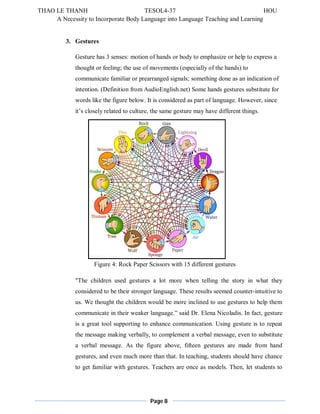
intention. (Definition from AudioEnglish.net) Some hands gestures substitute for 
words like the figure below. It is considered as part of language. However, since 
it’s closely related to culture, the same gesture may have different things. 
Figure 4: Rock Paper Scissors with 15 different gestures 
"The children used gestures a lot more when telling the story in what they 
considered to be their stronger language. These results seemed counter-intuitive to 
us. We thought the children would be more inclined to use gestures to help them 
communicate in their weaker language.” said Dr. Elena Nicoladis. In fact, gesture 
is a great tool supporting to enhance communication. Using gesture is to repeat 
the message making verbally, to complement a verbal message, even to substitute 
a verbal message. As the figure above, fifteen gestures are made from hand 
gestures, and even much more than that. In teaching, students should have chance 
to get familiar with gestures. Teachers are once as models. Then, let students to
THAO LE THANH TESOL4-37 HOU 
A Necessity to Incorporate Body Language into Language Teaching and Learning 
practice using their gesture to express their ideas and thoughts. He added more “If 
you're in a situation where it's important to get the language out and you're having 
difficulty, it may help to start making gestures." (ScienceDaily, 2005). Obviously, 
hand gestures are related closely to the meanings. So they are powerful tools for 
the speakers to convey their ideas and thoughts. Using the right hand gestures to 
the right intention helps listeners feel easy to grasp the ideas and thoughts form 
the opposite and make the speakers’ performance more interesting and vivid. 
They also have some contribution in convey the meaning with saying any words, 
in case the speakers find it difficult to express their thoughts in words. Through 
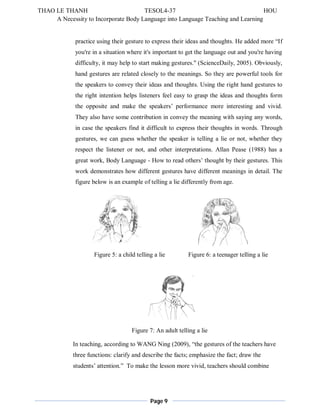
gestures, we can guess whether the speaker is telling a lie or not, whether they 
respect the listener or not, and other interpretations. Allan Pease (1988) has a 
great work, Body Language - How to read others’ thought by their gestures. This 
work demonstrates how different gestures have different meanings in detail. The 
figure below is an example of telling a lie differently from age. 
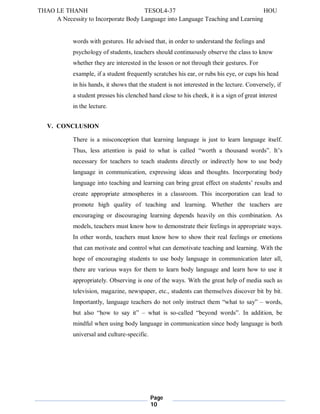
Figure 5: a child telling a lie Figure 6: a teenager telling a lie 
Figure 7: An adult telling a lie 
In teaching, according to WANG Ning (2009), “the gestures of the teachers have 
three functions: clarify and describe the facts; emphasize the fact; draw the 
students’ attention.” To make the lesson more vivid, teachers should combine 
Page 9
THAO LE THANH TESOL4-37 HOU 
A Necessity to Incorporate Body Language into Language Teaching and Learning 
words with gestures. He advised that, in order to understand the feelings and 
psychology of students, teachers should continuously observe the class to know 
whether they are interested in the lesson or not through their gestures. For 
example, if a student frequently scratches his ear, or rubs his eye, or cups his head 
in his hands, it shows that the student is not interested in the lecture. Conversely, if 
a student presses his clenched hand close to his cheek, it is a sign of great interest 
in the lecture. 
Page 
10 
V. CONCLUSION 
There is a misconception that learning language is just to learn language itself. 
Thus, less attention is paid to what is called “worth a thousand words”. It’s 
necessary for teachers to teach students directly or indirectly how to use body 
language in communication, expressing ideas and thoughts. Incorporating body 
language into teaching and learning can bring great effect on students’ results and 
create appropriate atmospheres in a classroom. This incorporation can lead to 
promote high quality of teaching and learning. Whether the teachers are 
encouraging or discouraging learning depends heavily on this combination. As 
models, teachers must know how to demonstrate their feelings in appropriate ways. 
In other words, teachers must know how to show their real feelings or emotions 
that can motivate and control what can demotivate teaching and learning. With the 
hope of encouraging students to use body language in communication later all, 
there are various ways for them to learn body language and learn how to use it 
appropriately. Observing is one of the ways. With the great help of media such as 
television, magazine, newspaper, etc., students can themselves discover bit by bit. 
Importantly, language teachers do not only instruct them “what to say” – words, 
but also “how to say it” – what is so-called “beyond words”. In addition, be 
mindful when using body language in communication since body language is both 
universal and culture-specific.

Body language

  • 1.
    THAO LE THANHTESOL4-37 HOU A Necessity to Incorporate Body Language into Language Teaching and Learning Page 1 I. INTRODUCTION Under the globalization and technology era, English has gradually governed all aspects of life. In addition, English has been sharply and rapidly spreading all over the country and learning English has becoming a compulsory need ever since. Schools try to integrate English in connection with students’ future careers and needs. Centers have also grown as mushrooms in order to meet the current big demands. However, with such great help, students are expected to gain success and confidence in communication with foreigners, they still have problems in dealing with English. Recently, teaching English have a lot of positive changes, there is a main focus on language forms rather than its functions. Not many teachers are aware of the functions of body language and admit their potential towards an effective communication. In fact, being advanced in English communication skill is everybody’s hope since it helps them much in their future career and enhance rapports among people. Communication is a central aspect of everyday life. Exchanging information is reflected in numerous ways, not only with words, but also with their body language. The matter is not only “what to say” but also “how to say it”. As a result of the mini-project I have just done, I surprisingly discovered that one of the factors affecting to student’s English performance is the use of nonverbal communication, especially body language. Many ideas state that Vietnamese people have a little concept of using body language. Therefore, a lot of them find it difficult to communicate with others and to express what they really want to convey. Knowing what and how to say to whom and listening to body language are important and necessary for effective communication. As a matter of facts, teacher should take great consideration on this issue in order to have an appropriate way in communication and teaching. In fact, communication is beyond what is so-called “words”. Albert Mehrabian is noted for finding a 7% (verbal)-38% (vocal)-55% (facial) rule (see figure 1). Therefore, non-verbal communication in general and body language in particular play an important role in exchanging ideas. We need to go beyond what is so-called grammaticality and words. In classrooms, teachers much more try to impart their knowledge but pay less attention to how to use such knowledge in appropriate ways. Some teachers find it weird to
  • 2.
    THAO LE THANHTESOL4-37 HOU A Necessity to Incorporate Body Language into Language Teaching and Learning demonstrate body language in turn-taking conversations. Failing to use body language in natural conversation model, students feel uncomfortable and unnatural in communicating in the real life. They don’t know how to demonstrate their thought as well as ideas with appropriate gestures, facial expressions, etc. Consequently, it is a need to incorporate body language in teaching and learning so as to have successful communication skills. Body language Figure1: 7-38-55 rule II. DEFINITION OF BODY LANGUAGE “Body language is the process of communicating what you are feeling or thinking by the way you place and move your body rather than by words.” (Oxford Advanced Learner’s Dictionary 7th) Body language is the language of relationship. It helps process our communication smoothly through appropriate interpretation. Besides the minority of local body language, we have the majority of universal one. Why don’t we take advantage of this to be more successful in our communication? Regardless to the different languages and cultures, we can use our limitations of words with significant non-verbal cues, particularly body language to convey what we really want to express and guess what the opposites want to impart to us. With the great help of body language, communication appears easier to seek for good interactions among people. Tammy S. Gregersen gives a broader definition about nonverbal communication “all of the messages other than words that people exchange.” (cited in DeVito and Hecht, 1990) We consciously and unconsciously imply what we’re thinking and what we want to express through non-verbal cues. In other words, we continuously use non-verbal signals with or without our notice in real conversation. Page 2 (55%) Tone of voice (38%) Spoken words (7%)
  • 3.
    THAO LE THANHTESOL4-37 HOU A Necessity to Incorporate Body Language into Language Teaching and Learning They affect to the comprehensiveness and success of what we want to exchange with our interlocutors. III. THE IMPORTANCE OF BODY LANGUAGE IN TEACHING AND LEARNING Kevin Hogan (2010) states that “nonverbal communication is between 60 to 75% of the impact of a message”. Therefore, in order to be more successful and attractive in the way we interact and communicate with people in different situations and fields, the power of body language should be paid more attention than it used to. According to Albert Mehrabian with his 7-38-55 rule, he implies the great impact of non-verbal cues, especially body language over communication. (1994) stated that “body language does more than just convey particular meanings. We may use our bodies to make contact with the other person when we speak” Obviously, using body language can enhance communication. It is also considered as an aid to break the barrier of cultures. Although the expressions may be different from culture to culture, “the expression of strong, basic emotions appears to be universal across culture” (Kerry O’Sullivan, 1994) In order to help students feel comfortable in communication when they really have one, it’s necessary to incorporate body language in language teaching and learning. Teachers should help them improve their language not just by providing them “what to say” but importantly demonstrating “how to say it effectively” so as to develop students’ communicative quality. You are constantly sending messages about your true thoughts and feelings whether you are using words or not. Our body is always giving off signals. Our body language never stops. Therefore, how to use it appropriately or how to interpret it in a correct way is our concern, especially in communication and our teaching. According to Vansight (2009), body language plays five roles on communication.  Repetition: they can repeat the message the person is making verbally.  Contradiction: they can contradict a message the individual is trying to Page 3 convey.
  • 4.
    THAO LE THANHTESOL4-37 HOU A Necessity to Incorporate Body Language into Language Teaching and Learning  Substitution: They can substitute for a verbal message. For example, s person’s eyes can often convey a far more vivid message than words.  Complementing: they may add to or complement a verbal message. A boss who pats a person on the back in addition to giving praise can increase the impact of the message.  Accenting: they may accent or underline a verbal message. Pounding a table, for example, can underline the message. IV. IMPLICATIONS FOR TEACHING AND LEARNING Are you wondering that whether someone likes you or not, even before they say a word? Do you want to know your students’ thoughts and feelings by reading their body language? Would you like to know whether your students are with you or somewhere else? If these questions are your concern, you’ll know how important understanding body language in our teaching and our students’ learning. 1. Facial Expression According to Ying-Li Tian, Takeo Kanade, and Jeffrey F. Cohn, “facial expressions are the facial changes in response to a person’s internal emotional states, intentions, or social communications”. One of the most straightforward signals that has a great contribution in communication is facial expression. In conversation, we tend to pay more attention to the face than the rest of the body (Cynthia Gallois & Victor Callan, 1997) For example, when people surprise, they usually raise their eyebrows, open their eyes and mouths widely, or to show their contempt, they tend to lower their brows, narrow their eyes and close their mouth, etc. Tingfan Wu, Nicholas J. Butko, Paul Ruvulo, Marian S. Bartlett, Javier R. Movellan (2009) state that “the human face is a very complex system, with more than 44 muscles whose activation can be combined in non-trivial ways to produce thousands of different facial expressions” They also gave some demonstrations of different facial expressions with their different meanings. Page 4
  • 5.
    THAO LE THANHTESOL4-37 HOU A Necessity to Incorporate Body Language into Language Teaching and Learning Figure 2: Emotion-specified facial expression. 1, disgust; 2, fear; 3, joy; 4, surprise; 5, sadness; 6, anger. Learning to digest different facial combinations can help to foster true communication and determine what they really need. In addition, Patrick J. Byrne provides the information that the priority purposes of facial expression “are primarily related to (1) communication and (2) identification” and emphasizes that “communication between human beings depends heavily on facial expression. This includes the spontaneous expression of emotion, as well as the ability to read the intent of the speaker.” Tammy S. Gregersen “the face is rich in communicative potential. It is the primary site for communication of emotional states, it reflects interpersonal attitudes; it provides nonverbal feedback on the comments of others; and some scholars say it is the primary source of information next to human speech. For these reasons, and because of the face’s visibility, we pay a great deal of attention to the messages we receive from the faces of others.” (cited in Knapp and Hall, 2006, p. 260) Therefore, don’t hesitate to show your happy feelings when your students are excellent in their answers and their works. A broad smile may be helpful and don’t try to hide your emotions when it’s necessary to show out. When words are not really effective to stop students’ gossips, a silent moment with expressions of anger and sadness is effective than ever. Facial expression is more than just the motion of eyes, lips, nose, chin, eyebrows and various other muscles of the face. It is worth a thousand words. In fact, we non-stop express our feelings and emotions through our face without notice every day. As teachers, we have to know how and when to demonstrate our anger, happiness, surprise etc. Page 5
  • 6.
    THAO LE THANHTESOL4-37 HOU A Necessity to Incorporate Body Language into Language Teaching and Learning In teaching, with the great need of communicative competence, teachers should take advantage of conversation models which usually give out natural situations students may encounter in their real life. As usual, students are able to show their feelings by using body language but in their native language. They find it difficult to give that out in target language not only because they are shy to show it out but also because they don’t know the ways to do it. Thus, as teachers, we have to help our students to use the language and touch its souls. Teachers can motivate them to develop their body language use by setting models. In conversations, teachers should be initial ones to act as actors, showing from anger to happiness accordingly to the conversation, and even are clowns if necessary. Then, guide and give students chance to demonstrate their emotions in conversations. Page 6 2. Eye Contact As we know, “eye” is the “window of one’s heart. By looking at someone’s face, we can know whether he doubts, how he loves or hates something, how far he catches up the conversation, how much he can understand what we mean, etc. Eyes can tell us everything. “Eye contact is a non-verbal ability to communicate, and it often equals to our ability to verbally express a thought.” (Jan Castagnaro, 2007) However, teachers seem to be less aware of their body language, especially eye-contact. Many researchers have proved that more than two thirds of our communication is nonverbal. Others said that only seven percent of our message is sent through words. Eye contact is the most obvious way in communication. It shows that we are interested in what is going on or not, showing your respect to the interlocutors or not. When you fail to make eye contact, you give the impression that the other person is of no importance. Thus, you find yourself fail in communication with others. Maintain eye contact about 60% of the time in order to look interested, but not aggressive. How long the conversation last will be determined by the way we look the interlocutor. Therefore, let your partner discover your friendliness and openness from your smiling eyes. Eye contact doesn’t mean staring or gazing at others, but how much we can keep track of the opposite.
  • 7.
    THAO LE THANHTESOL4-37 HOU A Necessity to Incorporate Body Language into Language Teaching and Learning In teaching, in order to make a feeling of fair and comfortable atmospheres, teachers should balance their looks from the back to the front, from side to side. Teachers shouldn’t pay attention to much on those who are active, and just put aside the passive ones. Importantly, teacher’s eyesight looks must be caring and kind enough. That creates safe feelings among students. Figure 3: caring eyesight Beside class management function, the eyesight is very important to keep the conversation going on. Students will find it useful when they know how to use the eye contact appropriately from teachers. Looking into someone’s eyes, we can partly interpret what he is thinking or how he is feeling, and we simultaneously send messages to others about how we are feeling as well. In fact, there are some distinctive differences between eye contact and gazing. We try to keep eye contact, not gazing at someone. The ideal length of eye contact is about three seconds; longer eye contact can make other uncomfortable. Therefore, it’s important to distinguish the differences in order to use it successfully. Eye contact in combination with smiling can give the best effect towards communicative success. Teacher should show them how to do by doing not just saying. However, everything related to culture is universal and culture-specific as well. Culture is something really broad, we cannot teach them all. It’s a need that teacher should keep learning to upgrade their knowledge about body language, then give what they know to students. Page 7
  • 8.
    THAO LE THANHTESOL4-37 HOU A Necessity to Incorporate Body Language into Language Teaching and Learning Page 8 3. Gestures Gesture has 3 senses: motion of hands or body to emphasize or help to express a thought or feeling; the use of movements (especially of the hands) to communicate familiar or prearranged signals; something done as an indication of intention. (Definition from AudioEnglish.net) Some hands gestures substitute for words like the figure below. It is considered as part of language. However, since it’s closely related to culture, the same gesture may have different things. Figure 4: Rock Paper Scissors with 15 different gestures "The children used gestures a lot more when telling the story in what they considered to be their stronger language. These results seemed counter-intuitive to us. We thought the children would be more inclined to use gestures to help them communicate in their weaker language.” said Dr. Elena Nicoladis. In fact, gesture is a great tool supporting to enhance communication. Using gesture is to repeat the message making verbally, to complement a verbal message, even to substitute a verbal message. As the figure above, fifteen gestures are made from hand gestures, and even much more than that. In teaching, students should have chance to get familiar with gestures. Teachers are once as models. Then, let students to
  • 9.
    THAO LE THANHTESOL4-37 HOU A Necessity to Incorporate Body Language into Language Teaching and Learning practice using their gesture to express their ideas and thoughts. He added more “If you're in a situation where it's important to get the language out and you're having difficulty, it may help to start making gestures." (ScienceDaily, 2005). Obviously, hand gestures are related closely to the meanings. So they are powerful tools for the speakers to convey their ideas and thoughts. Using the right hand gestures to the right intention helps listeners feel easy to grasp the ideas and thoughts form the opposite and make the speakers’ performance more interesting and vivid. They also have some contribution in convey the meaning with saying any words, in case the speakers find it difficult to express their thoughts in words. Through gestures, we can guess whether the speaker is telling a lie or not, whether they respect the listener or not, and other interpretations. Allan Pease (1988) has a great work, Body Language - How to read others’ thought by their gestures. This work demonstrates how different gestures have different meanings in detail. The figure below is an example of telling a lie differently from age. Figure 5: a child telling a lie Figure 6: a teenager telling a lie Figure 7: An adult telling a lie In teaching, according to WANG Ning (2009), “the gestures of the teachers have three functions: clarify and describe the facts; emphasize the fact; draw the students’ attention.” To make the lesson more vivid, teachers should combine Page 9
  • 10.
    THAO LE THANHTESOL4-37 HOU A Necessity to Incorporate Body Language into Language Teaching and Learning words with gestures. He advised that, in order to understand the feelings and psychology of students, teachers should continuously observe the class to know whether they are interested in the lesson or not through their gestures. For example, if a student frequently scratches his ear, or rubs his eye, or cups his head in his hands, it shows that the student is not interested in the lecture. Conversely, if a student presses his clenched hand close to his cheek, it is a sign of great interest in the lecture. Page 10 V. CONCLUSION There is a misconception that learning language is just to learn language itself. Thus, less attention is paid to what is called “worth a thousand words”. It’s necessary for teachers to teach students directly or indirectly how to use body language in communication, expressing ideas and thoughts. Incorporating body language into teaching and learning can bring great effect on students’ results and create appropriate atmospheres in a classroom. This incorporation can lead to promote high quality of teaching and learning. Whether the teachers are encouraging or discouraging learning depends heavily on this combination. As models, teachers must know how to demonstrate their feelings in appropriate ways. In other words, teachers must know how to show their real feelings or emotions that can motivate and control what can demotivate teaching and learning. With the hope of encouraging students to use body language in communication later all, there are various ways for them to learn body language and learn how to use it appropriately. Observing is one of the ways. With the great help of media such as television, magazine, newspaper, etc., students can themselves discover bit by bit. Importantly, language teachers do not only instruct them “what to say” – words, but also “how to say it” – what is so-called “beyond words”. In addition, be mindful when using body language in communication since body language is both universal and culture-specific.