Submitted By: Jelena Todorov Kalezic
RCMT IT Europe
Soft Skills
Content
▣ What are Soft skills?
▣ Importance of Soft Skill
▣ Important Soft Skills?
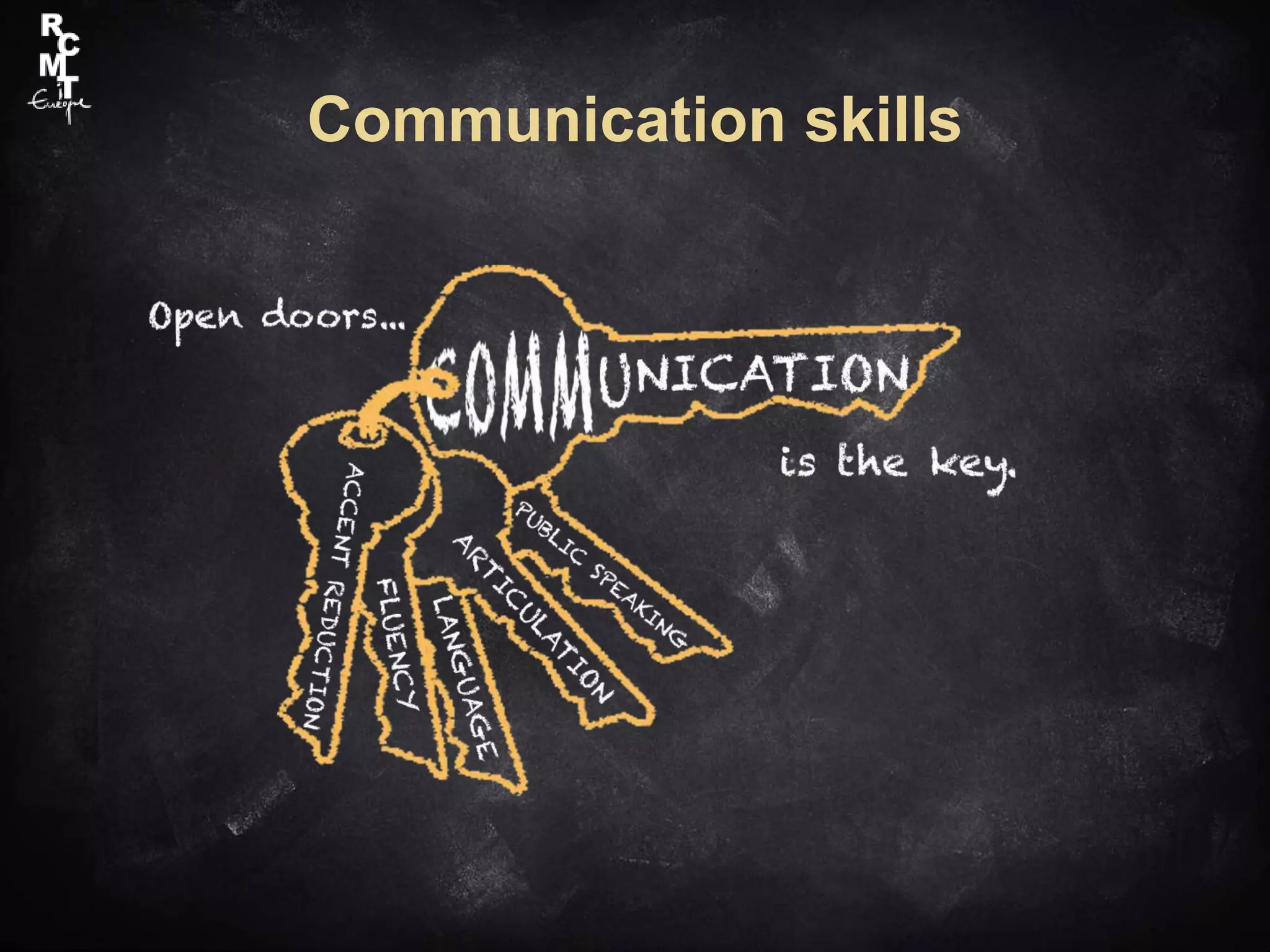
Communication skills
Body language
Making Decisions
Self Motivation
Leadership Skills
Team-Working Skills
Creativity and Problem Solving Skills
Time Management
Proactivity
Conflict management
Communication with the clients
▣ Conclusion
What are Soft skills?
▣ Soft skills is a synonym for "people skills." The
term describes those personal attributes that indicate
a high level of emotional intelligence.
▣ Unlike hard skills, which describe a person's
technical skill set and ability to perform specific
tasks, soft skills are broadly applicable across job
titles and industries.
▣ It's often said that hard skills will get you an
interview but you need soft skills to get -- and keep
-- the job.
Soft Skills
Importance of Soft Skill
▣ Soft skill are very important
o To handle interpersonal relations
o To take appropriate decisions
o To communicate effectively
o To have good impression and impact to gain
professional development
What are the Most Important Soft
Skills?
▣ Communication skills
▣ Body language
▣ Making Decisions
▣ Self Motivation
▣ Leadership Skills
▣ Team-Working Skills
▣ Creativity and Problem Solving Skills
▣ Time Management and ability to work under
Pressure
▣ Proactivity
▣ Conflict management
Communication skills
▣ Communication skills are always top of the
‘essential skills’ list.
▣ People with strong communication skills can build
relationships (from the initial building rapport
through to a longer-term relationship), listen well,
and vary their communication to suit the
circumstances.
Communication skills
Body language
▣ Face is the index of the mind and it clearly displays
the person's interest
▣ Body language presents to the audience what we
feel & think about the particular matter
▣ Ex: Nodding one’s head
▣ Body language (e.g, arms crossed, standing, sitting,
relaxed)
▣ Emotion of the sender & receiver (e.g, speaking
clearly, enthusiastic)
Body language
Making Decisions
▣ Valued by employers for many reasons, being able
to make decisions is key to getting on in life.
▣ Sometimes the actual decision doesn’t even matter;
what matters is that you have made one and moved
on.
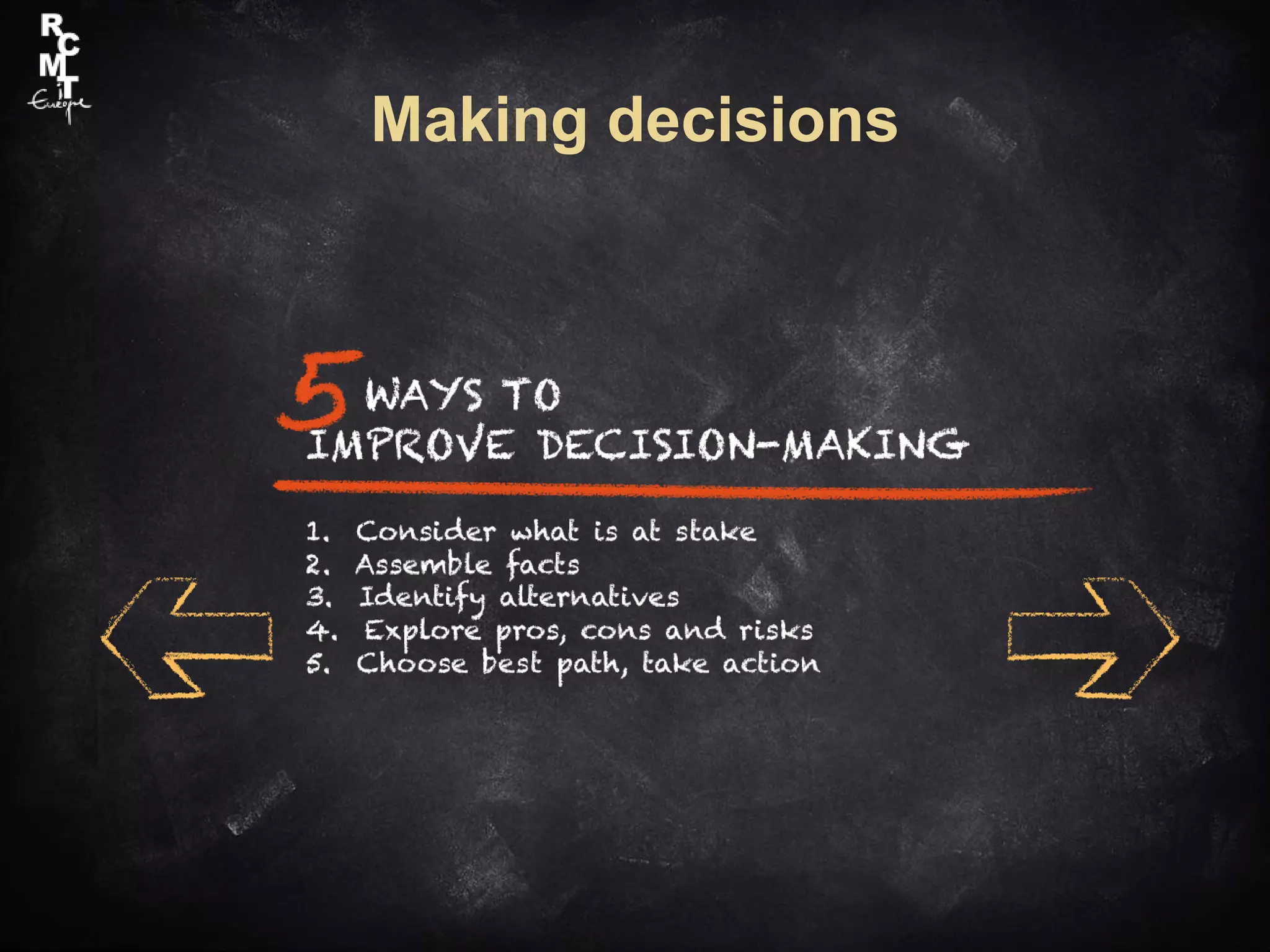
Making decisions
Self Motivation
▣ People who are self-motivated get on by themselves.
▣ They don’t need close supervision and they are
good to work with because they are generally
positive about life and can be counted upon to keep
going.
▣ It also helps to work on your personal resilience
and adaptability to change.
Self Motivation
Leadership
▣ Leadership is a soft skill you can show even if
you’re not directly managing others.
▣ Leadership can be thought of as a collection of
various other soft skills, such as a general positive
attitude and outlook, the ability to communicate
effectively, and an aptitude for both self-motivating
and motivating others.
Leadership
Team-Work
▣ Like leadership, good teamwork involves a
combination of other soft skills.
▣ Working in a team towards a common goal requires
the intuition and interpersonal acumen to know
when to be a leader, and when to be a listener.
▣ Good team players are perceptive, as well as
receptive to the needs and responsibilities of others.
Team - work
Creativity and Problem-solving
▣ Creativity and problem-solving skills are highly
valued because they are hard to develop.
▣ There are many people who believe that creative
thinkers are born, not made, and there are certainly
some people who find these skills much easier.
▣ But, like other skills, you can develop them if you
work to do so.
Creativity and Problem-solving
Time Management and Ability to
work under pressure
▣ Many would say that these two skills, which often
go hand-in-hand, are more an attitude than a skill.
▣ However they can also be developed and honed,
which is why we include them as skills.
▣ Highly valued by employers, they are also very
useful for organising a family or a team, and for
making sure that the job gets done.
Time management and ability to
work under pressure
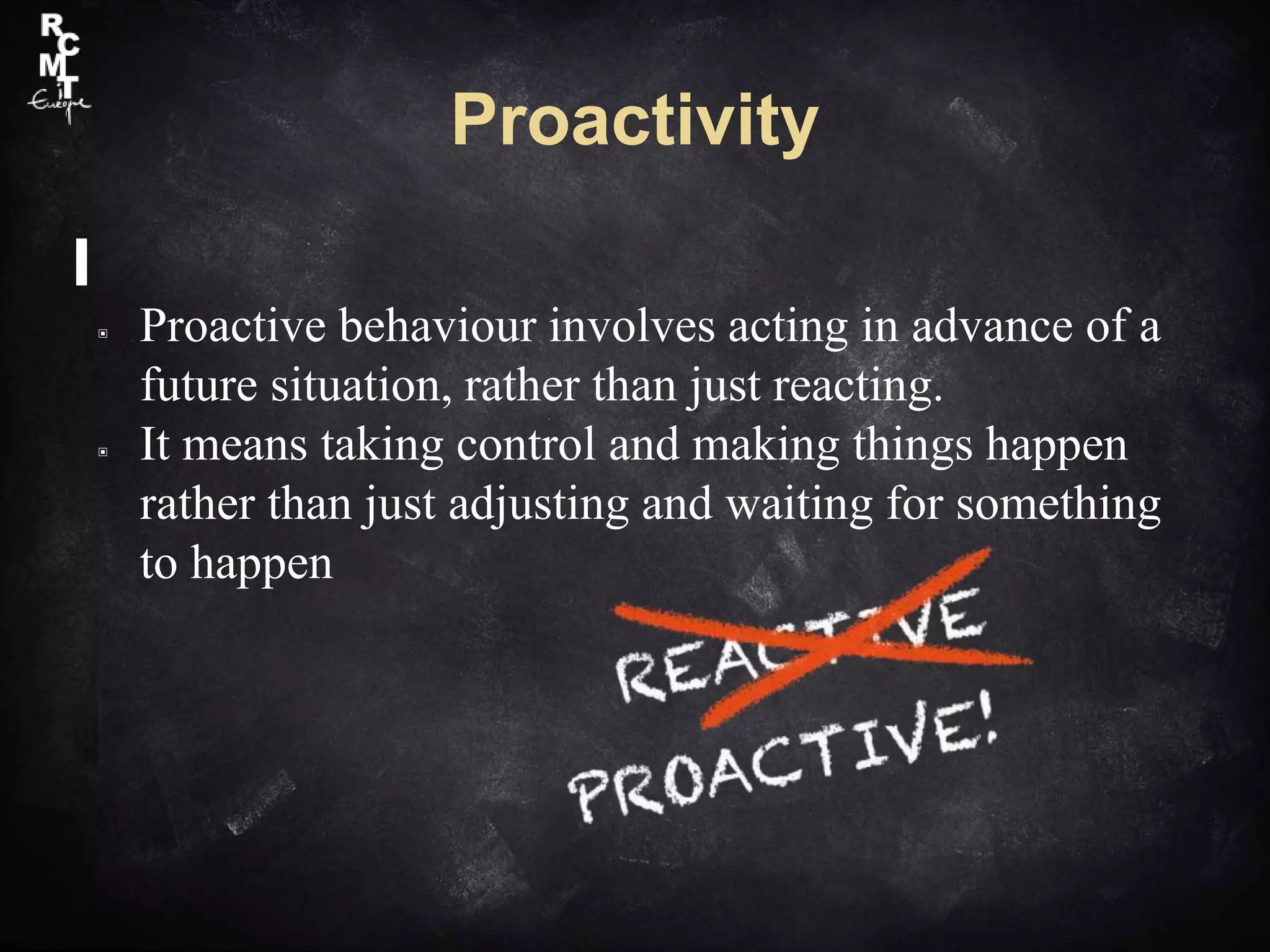
Proactivity
▣ Proactive behaviour involves acting in advance of a
future situation, rather than just reacting.
▣ It means taking control and making things happen
rather than just adjusting and waiting for something
to happen
Conflict management
▣ Conflict is inevitable and unavoidable part of our
everyday professional and personal lives
▣ Conflict management: Opportunity to improve
situations and strengthen relationships
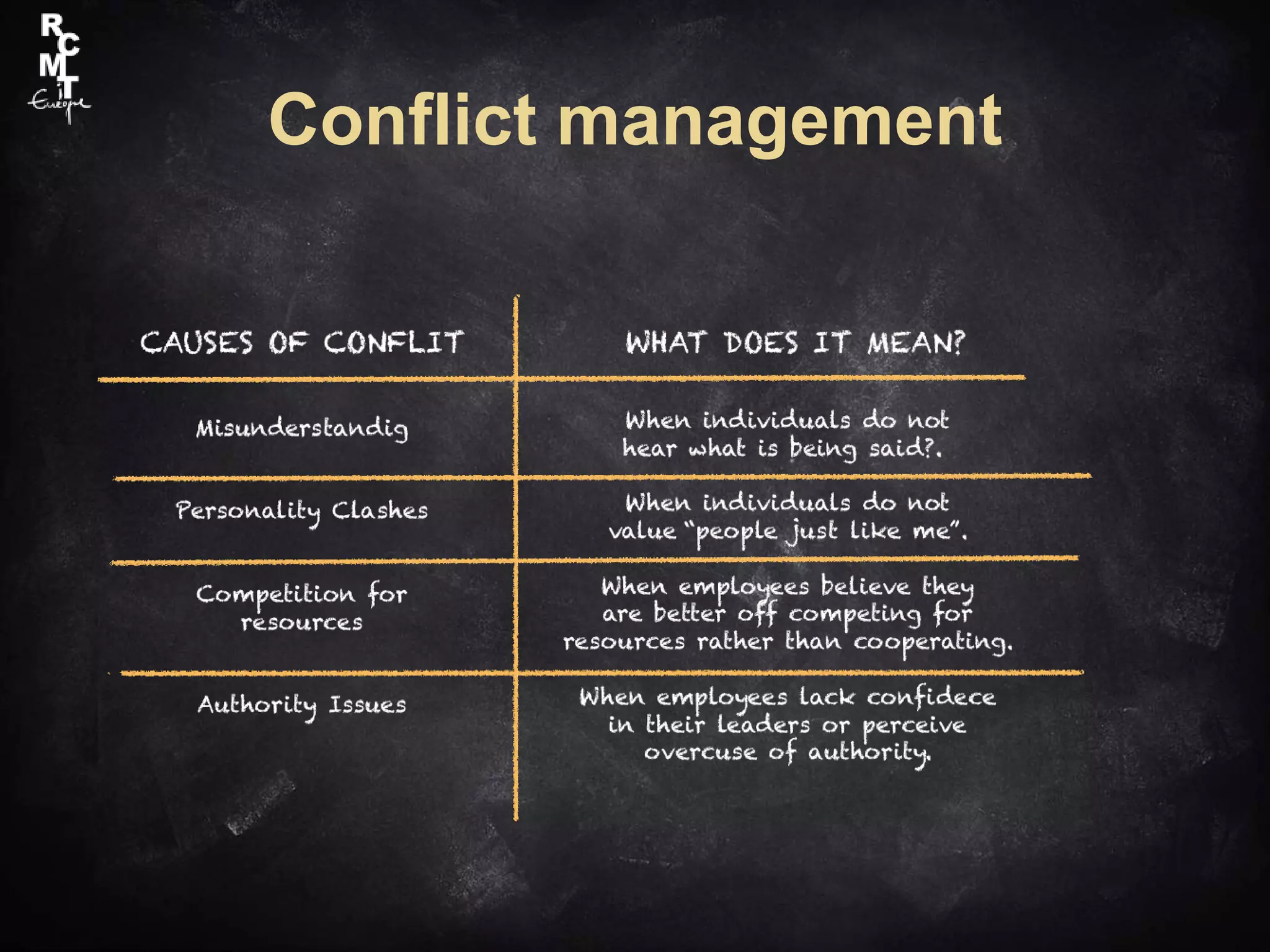
Causes of conflict:
▣ Misunderstanding
▣ Personality clashes
▣ Competition for resources
▣ Authority issues
▣ Lack of cooperation
▣ Low performance
▣ Value or goal differences
Conflict management
Conflict management
Conflict management
Functional vs dysfunctional
Conflicts are dysfunctional
▣ Conflict is indication that situation is threatening,
devastating, or on a point of breaking
▣ Conflicts are unproductive and dysfunctional
▣ Conflict is inevitable
Conflict Management
Conflicts are functional:
▣ All conflicts are not unproductive
▣ Conflicts can be useful, constructive, and positive
▣ Conflict can promote innovation, creativity, and
development of new ideas, which make
organisational growth possible
▣ If it is handled well, however, conflict can be
productive - leading to deeper understanding, mutual
respect and closeness.
Conflict management
▣ Problem has to be solved mutually, find the solution
which is acceptable to both parties
▣ Communicate
▣ Think about ways in which your communication had
set a more trustful tone or offensive tone
▣ Self-awareness a prerequisite for effective
communication relations, and managing conflict as
well as for developing empathy for others
Managing Workplace conflict
▣ Build good relationships before conflict occurs
▣ Do not let small problems escalate; deal with them as
they arise
▣ Respect differences
▣ Listen to others’ perspectives on the conflict
situation
▣ Acknowledge feelings before focusing on facts
▣ Focus on solving problems, not changing people
▣ If you can’t resolve the problem, turn to someone
who can help
▣ Remember to adapt your style to the situation and
persons involved
Conflict management steps for
positive resolution
When the following conditions are in place, the
likelihood of a positive resolution increases:
▣ Commitment to find a resolution that is mutually
beneficial
▣ Trust
▣ Frame of mind that there is more than one way to
look at the issues
▣ Belief that the solution exists
▣ Commitment to stay in the communication process.
Conflict management
Communication with the clients
Interacting with clients - Remain professional
1. Remain professional at all times. That includes the
way you speak, the things you say, and the way you
carry yourself in front of your client.
▣ Don’t be overly casual. Remember that you’re
dealing with the client, not a friend, so don’t use
curse words, tell inappropriate jokes or use text
speak or emojis with a client
▣ Always double check your grammar and spelling. A
glaring error can be embarrassing and may look
unprofessional
Communication with the clients
Interacting with clients - Remain professional
▣ Say polite and appropriate things like ‘It’s great to
hear/see you! How was your weekend?’
▣ Avoid polarizing and inappropriate topics like
politics, religion, social issues, and romantic
endeavors.
Communication with the clients
Interacting with clients - Be proactive
2. Be proactive. Always be the one to initiate
correspondence, especially when something new
comes up that your client will want to know about
▣ Have an opinion on the things you inform your client
of, and be bold and firm in your opinion.
▣ Check your sources before contacting your client
Communication with the clients
Interacting with clients - Respect your client’s time
3. You should contact your client on daily basis, but
you should not take up too much of their time
▣ Don’t call clients for idle chit chat. Keep your
contact as professional as possible unless your client
reaches out to you socially.
Communication with the clients
Interacting with clients - Client’s opinion
4. Ask your client for their thoughts and opinions of the
information you’ve relayed to determine whether
your views coincide.
▣ Acknowledge and respect the client’s opinion even if
you disagree, say something like ‘Yes, I can see your
point.’
▣ Avoid telling the client he/she is wrong as it will
make them defensive. Instead, ask questions like
‘Have you considered____?’ or ‘What
if____happens?’
Communication with the clients
Interacting with clients - Body language
5. Pay attention to body language
▣ Take note of both yours client’s body language and
your own.
▣ Leaning back can be seen as arrogant, while leaning
forward is seen as aggressive.
▣ Crossed arms across the chest can indicate feeling
defensive or resistant
▣ Fidgeting is a sign of nervousness or irritation
Communication with the clients
Interacting with clients - Your tone
6. Be aware of your tone and demeanor. Be aware of
the tone you are using and what that might convey to
the client so that you can correct your tone or
expressions as needed.
▣ Make sure your tone matches your facial expression
▣ Check also that your tone matches the words you’re
saying. If your words are conveying agreement but
your tone conveys frustration, your client will pick
up on this.
▣ Be sure to smile when you talk, especially over the
phone. Doing so helps tone sound optimistic and
open
A healthy client relationship
How to develop communication
skills
1. Aim to be understood - stay on topic, be specific
when communicating
2. Make eye contact - keep eyes focused on
conversation partner
3. Monitor your body language - leaning forward
slightly
4. Practice speaking - this will make speaking come
more easily
5. Develop your writing skills - the more you write the
easier it will become
6. Practice active listening - let speaking partners finish
saying what they are saying
Conclusion
▣ An increase in service industry emphasizes the need
for soft skills.
▣ Soft skills are used in personal and professional life.
▣ Development of soft skills improves the quality of
life
References
▣ www.google.com
▣ www.wikipedia.com
▣ www.studymafia.org
Thanks

Soft skills

  • 1.
    Submitted By: JelenaTodorov Kalezic RCMT IT Europe Soft Skills
  • 2.
    Content ▣ What areSoft skills? ▣ Importance of Soft Skill ▣ Important Soft Skills? Communication skills Body language Making Decisions Self Motivation Leadership Skills Team-Working Skills Creativity and Problem Solving Skills Time Management Proactivity Conflict management Communication with the clients ▣ Conclusion
  • 3.
    What are Softskills? ▣ Soft skills is a synonym for "people skills." The term describes those personal attributes that indicate a high level of emotional intelligence. ▣ Unlike hard skills, which describe a person's technical skill set and ability to perform specific tasks, soft skills are broadly applicable across job titles and industries. ▣ It's often said that hard skills will get you an interview but you need soft skills to get -- and keep -- the job.
  • 4.
  • 5.
    Importance of SoftSkill ▣ Soft skill are very important o To handle interpersonal relations o To take appropriate decisions o To communicate effectively o To have good impression and impact to gain professional development
  • 6.
    What are theMost Important Soft Skills? ▣ Communication skills ▣ Body language ▣ Making Decisions ▣ Self Motivation ▣ Leadership Skills ▣ Team-Working Skills ▣ Creativity and Problem Solving Skills ▣ Time Management and ability to work under Pressure ▣ Proactivity ▣ Conflict management
  • 7.
    Communication skills ▣ Communicationskills are always top of the ‘essential skills’ list. ▣ People with strong communication skills can build relationships (from the initial building rapport through to a longer-term relationship), listen well, and vary their communication to suit the circumstances.
  • 8.
  • 9.
    Body language ▣ Faceis the index of the mind and it clearly displays the person's interest ▣ Body language presents to the audience what we feel & think about the particular matter ▣ Ex: Nodding one’s head ▣ Body language (e.g, arms crossed, standing, sitting, relaxed) ▣ Emotion of the sender & receiver (e.g, speaking clearly, enthusiastic)
  • 10.
  • 11.
    Making Decisions ▣ Valuedby employers for many reasons, being able to make decisions is key to getting on in life. ▣ Sometimes the actual decision doesn’t even matter; what matters is that you have made one and moved on.
  • 12.
  • 13.
    Self Motivation ▣ Peoplewho are self-motivated get on by themselves. ▣ They don’t need close supervision and they are good to work with because they are generally positive about life and can be counted upon to keep going. ▣ It also helps to work on your personal resilience and adaptability to change.
  • 14.
  • 15.
    Leadership ▣ Leadership isa soft skill you can show even if you’re not directly managing others. ▣ Leadership can be thought of as a collection of various other soft skills, such as a general positive attitude and outlook, the ability to communicate effectively, and an aptitude for both self-motivating and motivating others.
  • 16.
  • 17.
    Team-Work ▣ Like leadership,good teamwork involves a combination of other soft skills. ▣ Working in a team towards a common goal requires the intuition and interpersonal acumen to know when to be a leader, and when to be a listener. ▣ Good team players are perceptive, as well as receptive to the needs and responsibilities of others.
  • 18.
  • 19.
    Creativity and Problem-solving ▣Creativity and problem-solving skills are highly valued because they are hard to develop. ▣ There are many people who believe that creative thinkers are born, not made, and there are certainly some people who find these skills much easier. ▣ But, like other skills, you can develop them if you work to do so.
  • 20.
  • 21.
    Time Management andAbility to work under pressure ▣ Many would say that these two skills, which often go hand-in-hand, are more an attitude than a skill. ▣ However they can also be developed and honed, which is why we include them as skills. ▣ Highly valued by employers, they are also very useful for organising a family or a team, and for making sure that the job gets done.
  • 22.
    Time management andability to work under pressure
  • 23.
    Proactivity ▣ Proactive behaviourinvolves acting in advance of a future situation, rather than just reacting. ▣ It means taking control and making things happen rather than just adjusting and waiting for something to happen
  • 24.
    Conflict management ▣ Conflictis inevitable and unavoidable part of our everyday professional and personal lives ▣ Conflict management: Opportunity to improve situations and strengthen relationships Causes of conflict: ▣ Misunderstanding ▣ Personality clashes ▣ Competition for resources ▣ Authority issues ▣ Lack of cooperation ▣ Low performance ▣ Value or goal differences
  • 25.
  • 26.
  • 27.
    Conflict management Functional vsdysfunctional Conflicts are dysfunctional ▣ Conflict is indication that situation is threatening, devastating, or on a point of breaking ▣ Conflicts are unproductive and dysfunctional ▣ Conflict is inevitable
  • 28.
    Conflict Management Conflicts arefunctional: ▣ All conflicts are not unproductive ▣ Conflicts can be useful, constructive, and positive ▣ Conflict can promote innovation, creativity, and development of new ideas, which make organisational growth possible ▣ If it is handled well, however, conflict can be productive - leading to deeper understanding, mutual respect and closeness.
  • 29.
    Conflict management ▣ Problemhas to be solved mutually, find the solution which is acceptable to both parties ▣ Communicate ▣ Think about ways in which your communication had set a more trustful tone or offensive tone ▣ Self-awareness a prerequisite for effective communication relations, and managing conflict as well as for developing empathy for others
  • 30.
    Managing Workplace conflict ▣Build good relationships before conflict occurs ▣ Do not let small problems escalate; deal with them as they arise ▣ Respect differences ▣ Listen to others’ perspectives on the conflict situation ▣ Acknowledge feelings before focusing on facts ▣ Focus on solving problems, not changing people ▣ If you can’t resolve the problem, turn to someone who can help ▣ Remember to adapt your style to the situation and persons involved
  • 31.
    Conflict management stepsfor positive resolution When the following conditions are in place, the likelihood of a positive resolution increases: ▣ Commitment to find a resolution that is mutually beneficial ▣ Trust ▣ Frame of mind that there is more than one way to look at the issues ▣ Belief that the solution exists ▣ Commitment to stay in the communication process.
  • 32.
  • 33.
    Communication with theclients Interacting with clients - Remain professional 1. Remain professional at all times. That includes the way you speak, the things you say, and the way you carry yourself in front of your client. ▣ Don’t be overly casual. Remember that you’re dealing with the client, not a friend, so don’t use curse words, tell inappropriate jokes or use text speak or emojis with a client ▣ Always double check your grammar and spelling. A glaring error can be embarrassing and may look unprofessional
  • 34.
    Communication with theclients Interacting with clients - Remain professional ▣ Say polite and appropriate things like ‘It’s great to hear/see you! How was your weekend?’ ▣ Avoid polarizing and inappropriate topics like politics, religion, social issues, and romantic endeavors.
  • 35.
    Communication with theclients Interacting with clients - Be proactive 2. Be proactive. Always be the one to initiate correspondence, especially when something new comes up that your client will want to know about ▣ Have an opinion on the things you inform your client of, and be bold and firm in your opinion. ▣ Check your sources before contacting your client
  • 36.
    Communication with theclients Interacting with clients - Respect your client’s time 3. You should contact your client on daily basis, but you should not take up too much of their time ▣ Don’t call clients for idle chit chat. Keep your contact as professional as possible unless your client reaches out to you socially.
  • 37.
    Communication with theclients Interacting with clients - Client’s opinion 4. Ask your client for their thoughts and opinions of the information you’ve relayed to determine whether your views coincide. ▣ Acknowledge and respect the client’s opinion even if you disagree, say something like ‘Yes, I can see your point.’ ▣ Avoid telling the client he/she is wrong as it will make them defensive. Instead, ask questions like ‘Have you considered____?’ or ‘What if____happens?’
  • 38.
    Communication with theclients Interacting with clients - Body language 5. Pay attention to body language ▣ Take note of both yours client’s body language and your own. ▣ Leaning back can be seen as arrogant, while leaning forward is seen as aggressive. ▣ Crossed arms across the chest can indicate feeling defensive or resistant ▣ Fidgeting is a sign of nervousness or irritation
  • 39.
    Communication with theclients Interacting with clients - Your tone 6. Be aware of your tone and demeanor. Be aware of the tone you are using and what that might convey to the client so that you can correct your tone or expressions as needed. ▣ Make sure your tone matches your facial expression ▣ Check also that your tone matches the words you’re saying. If your words are conveying agreement but your tone conveys frustration, your client will pick up on this. ▣ Be sure to smile when you talk, especially over the phone. Doing so helps tone sound optimistic and open
  • 40.
    A healthy clientrelationship
  • 41.
    How to developcommunication skills 1. Aim to be understood - stay on topic, be specific when communicating 2. Make eye contact - keep eyes focused on conversation partner 3. Monitor your body language - leaning forward slightly 4. Practice speaking - this will make speaking come more easily 5. Develop your writing skills - the more you write the easier it will become 6. Practice active listening - let speaking partners finish saying what they are saying
  • 42.
    Conclusion ▣ An increasein service industry emphasizes the need for soft skills. ▣ Soft skills are used in personal and professional life. ▣ Development of soft skills improves the quality of life
  • 43.
  • 44.