1
Functions of water in the body
• Transporting nutrients to cells and wastes from cells
• Transporting hormones, enzymes, blood cells
• Facilitating metabolism and cellular chemical functioning
• Acting as a solvent for electrolytes and nonelectrolytes
• Helping maintain normal body temperature
• Facilitating digestion and promoting elimination
• Acting as a tissue lubricant
2
3
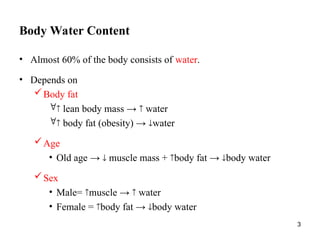
Body Water Content
• Almost 60% of the body consists of water.
• Depends on
Body fat
 lean body mass →  water
 body fat (obesity) → water
Age
• Old age →  muscle mass + body fat → body water
Sex
• Male= muscle →  water
• Female = body fat → body water
4
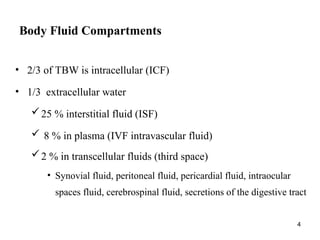
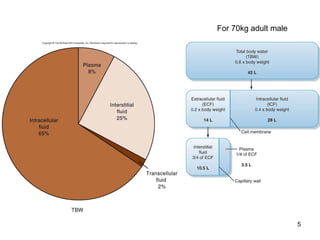
Body Fluid Compartments
• 2/3 of TBW is intracellular (ICF)
• 1/3 extracellular water
25 % interstitial fluid (ISF)
 8 % in plasma (IVF intravascular fluid)
2 % in transcellular fluids (third space)
• Synovial fluid, peritoneal fluid, pericardial fluid, intraocular
spaces fluid, cerebrospinal fluid, secretions of the digestive tract
5
For 70kg adult male
6
• Fluid compartments are separated by membranes that are
freely permeable to water.
• Movement of fluids due to:
Hydrostatic pressure
Osmotic pressure
 Hydrostatic pressure is the "pushing" force on water due to
the presence of more fluid in one region than another.
 Osmotic pressure is the "pulling" force on water due to the
presence of solutes in solution.
• Plasma-colloid osmotic (oncotic) pressure
Refers to the magnitude of the osmotic pressure exerted by
large molecules in solution.
Plasma proteins are of particular significance.
Normally ~ 26–28 mmHg.
Water Homeostasis
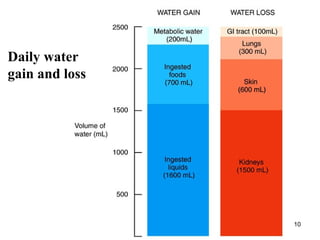
Daily intake of water:
• Water is added to the body by:
Ingested in the form of liquids or water in the food.
Synthesized in the body as a result of oxidation of
carbohydrates .
• Is highly variable among individuals depending on climate,
habits, and level of physical activity.
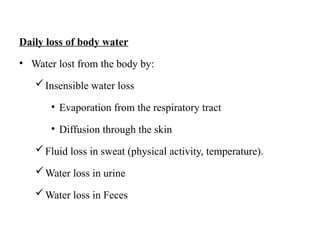
Daily loss of body water
• Water lost from the body by:
Insensible water loss
• Evaporation from the respiratory tract
• Diffusion through the skin
Fluid loss in sweat (physical activity, temperature).
Water loss in urine
Water loss in Feces
10
Daily water
gain and loss
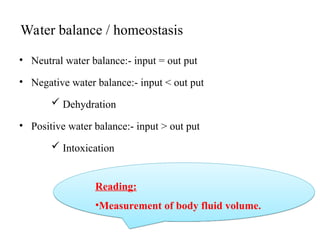
• Neutral water balance:- input = out put
• Negative water balance:- input < out put
 Dehydration
• Positive water balance:- input > out put
 Intoxication
Reading:
•Measurement of body fluid volume.
Water balance / homeostasis
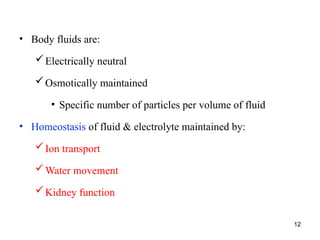
• Body fluids are:
Electrically neutral
Osmotically maintained
• Specific number of particles per volume of fluid
• Homeostasis of fluid & electrolyte maintained by:
Ion transport
Water movement
Kidney function
12
Composition of Body Fluids
• Body fluids contain
Electrolytes – charged ions
Non electrolytes – glucose
Colloid – protein
NB: Ionic composition of plasma and interstitial fluid is similar
(but higher concentration of protein in the plasma).
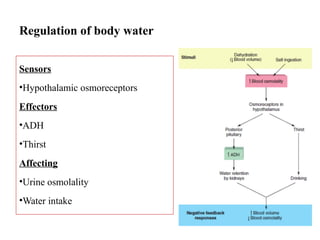
Regulation of body water
Sensors
•Hypothalamic osmoreceptors
Effectors
•ADH
•Thirst
Affecting
•Urine osmolality
•Water intake
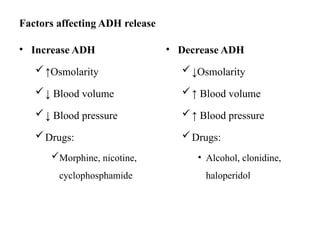
Factors affecting ADH release
• Increase ADH
↑Osmolarity
↓ Blood volume
↓ Blood pressure
Drugs:
Morphine, nicotine,
cyclophosphamide
• Decrease ADH
↓Osmolarity
↑ Blood volume
↑ Blood pressure
Drugs:
• Alcohol, clonidine,
haloperidol
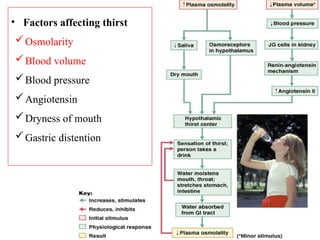
• Factors affecting thirst
Osmolarity
Blood volume
Blood pressure
Angiotensin
Dryness of mouth
Gastric distention
Fluid and electrolyte movement
• Osmosis – Fluid passes from areas of low solute concentration
to areas of high solute concentration
• Diffusion – tendency of solutes to move freely from areas of
high concentration to low concentration (down hill)
• Active Transport – requires energy to move through a cell
membrane from area of lesser concentration to one of greater
concentration
• Filtration – passage of fluid through a permeable membrane.
movement is from high to low pressure
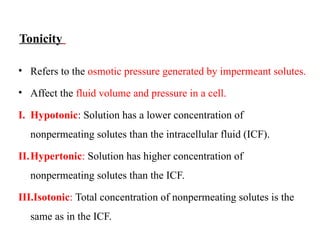
Tonicity
• Refers to the osmotic pressure generated by impermeant solutes.
• Affect the fluid volume and pressure in a cell.
I. Hypotonic: Solution has a lower concentration of
nonpermeating solutes than the intracellular fluid (ICF).
II.Hypertonic: Solution has higher concentration of
nonpermeating solutes than the ICF.
III.Isotonic: Total concentration of nonpermeating solutes is the
same as in the ICF.
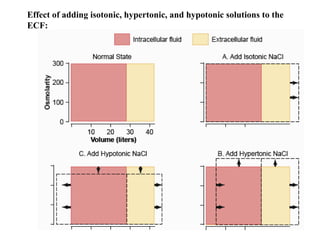
Effect of adding isotonic, hypertonic, and hypotonic solutions to the
ECF:
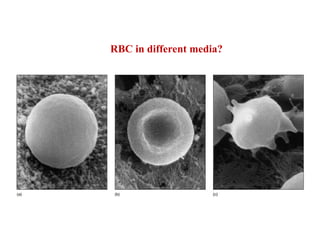
RBC in different media?
Edema
21
• Edema is the accumulation of fluid within the interstitial spaces.
• Causes
 Increased hydrostatic pressure
 Lowered plasma osmotic pressure
 Increased capillary membrane permeability
 Lymphatic channel obstruction
• Hydrostatic pressure increases due to:
 Venous obstruction:
Thrombophlebitis (inflammation of veins)
Hepatic obstruction
Tight clothing on extremities
Prolonged standing
 Salt or water retention
Congestive heart failure
Renal failure
22
23
• Decreased plasma osmotic pressure:
 ↓ Plasma albumin (liver disease or protein
malnutrition)
• Plasma proteins lost in :
 Glomerular diseases of kidney
 Hemorrhage, burns, open wounds and
cirrhosis of liver
24
• Increased capillary permeability:
Inflammation
Immune responses
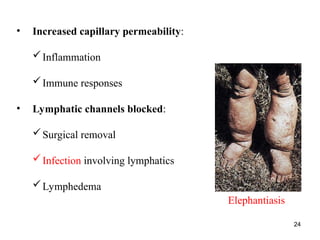
• Lymphatic channels blocked:
Surgical removal
Infection involving lymphatics
Lymphedema
Elephantiasis
25
• Fluid accumulation: complications
 Increases distance for diffusion may impair blood flow
• Slower healing
• Increased risk of infection
• Pressure sores over bony prominences
 Edema of specific organs can be life threatening (larynx,
brain, lung)
 Water is trapped, unavailable for metabolic processes. Can
result in dehydration and shock.
 Psychological effect
26
Electrolyte balance
• Na +
(Sodium)
90 % of total ECF cations
 ECF conc 135 -145 mEq / L
Pairs with Cl-
, HCO3
-
to neutralize charge
Low in ICF
Most important ion in regulating water balance
Important in nerve and muscle function
27
Regulation of Sodium
• Renal tubule reabsorption affected by hormones:
Aldosterone: increase Na+
reabsorption.
Angiotensin II: increases Na+
& HCO3-
reabsorption.
ANP: increase Na+
excretion.
28
Sodium imbalances
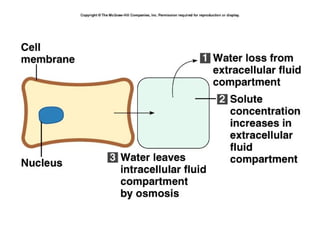
• Hypernatremia (high levels of sodium)
Plasma Na+ > 145 mEq / L
Due to ↑ Na + or ↓ water
Water moves from ICF → ECF
Cells dehydrate
29
30
• Causes of hypernatremia:
Hypertonic IV solution.
Oversecretion of aldosterone
Loss of pure water
• Long term sweating with chronic fever
• Respiratory infection → water vapor loss
• Diabetes – polyuria
Insufficient intake of water (hypodipsia)
31
Hyponatremia
• Overall decrease in Na+ in ECF
Plasma Na+ < 135 mEq / L
• Two types: depletional and dilutional
• Depletional Hyponatremia (Na+ loss):
Diuretics, chronic vomiting
Chronic diarrhea
Decreased aldosterone
Decreased Na+ intake
32
• Dilutional Hyponatremia:
Renal dysfunction with ↑intake of hypotonic fluids
Excessive sweating→ increased thirst → intake of
excessive amounts of pure water
Syndrome of Inappropriate ADH (SIADH)
• Impaired renal excretion of water
Hyperglycemia – attracts water
33
Potassium
• Major intracellular cation
• ICF conc. = 140-150 mEq/ L
• Functions
Regulates cellular enzyme activity and water content
Transmission of nerve and muscle impulses
Metabolism of proteins and carbohydrates
Regulation of acid-base balance by cellular exchange with H+
34
Potassium imbalances
Hypokalemia
•Serum K+
< 3.5 mEq /L
•Causes:-
Decreased intake of K+
Increased K+
loss
• Chronic diuretics
• Acid/base imbalance
• Trauma and stress
• Increased aldosterone
35
Hyperkalemia
• Serum K+ > 5.5 mEq / L
• Causes:-
 Renal disease
Massive cellular trauma
Insulin deficiency
Addison’s disease
Potassium sparing diuretics
Decreased blood pH
Calcium
• Calcium distribution
99% is found in the bones
0.7% located in ECF
0.1%-0.3% in side the cells
• Extracellular calcium exists in three forms
Potein bound (40%)
Complexed with citate, phosphate, sulfate (10%)
Ionized (50%)
Functions of Calcium:
•Neuronal excitability
•Muscle contractions
•Releases of hormones, enzymes and neurotransmitters.
•Blood clotting
•Bone formation
•Second messengers.
38
Regulation of calcium:
•Parathyroid hormone
↑Blood Ca++
by stimulating osteoclasts
↑GI absorption and renal retention
•Calcitonin from the thyroid gland
Promotes bone formation
↑Renal excretion
39
Calcium imbalances
Hypercalcemia
•Results from:
Hyperparathyroidism
Hypothyroid states
Renal disease
Excessive intake of vitamin D
Hypercalcemia of malignancy
• Tumor products promote bone breakdown
• Tumor growth in bone causing Ca++
release
40
Hypercalcemia
• Usually also see hypophosphatemia
• Effects:
– Many nonspecific – fatigue, weakness, lethargy
– Increases formation of kidney stones and pancreatic stones
– Muscle cramps
– Bradycardia, cardiac arrest
– Pain
– GI activity also common
• Nausea, abdominal cramps
• Diarrhea / constipation
– Metastatic calcification
41
Hypocalcemia
• Caused by:
Renal failure
Lack of vitamin D
Suppression of parathyroid function
Hypersecretion of calcitonin
Malabsorption
Hypocalcemia
• Diagnosis:
– Chvostek’s sign
– Trousseau’s sign
• Treatment
– IV calcium for acute
– Oral calcium and vitamin-D for chronic
42

04. Fluid and Electrolyte-2.ppt so important

  • 1.
  • 2.
    Functions of waterin the body • Transporting nutrients to cells and wastes from cells • Transporting hormones, enzymes, blood cells • Facilitating metabolism and cellular chemical functioning • Acting as a solvent for electrolytes and nonelectrolytes • Helping maintain normal body temperature • Facilitating digestion and promoting elimination • Acting as a tissue lubricant 2
  • 3.
    3 Body Water Content •Almost 60% of the body consists of water. • Depends on Body fat  lean body mass →  water  body fat (obesity) → water Age • Old age →  muscle mass + body fat → body water Sex • Male= muscle →  water • Female = body fat → body water
  • 4.
    4 Body Fluid Compartments •2/3 of TBW is intracellular (ICF) • 1/3 extracellular water 25 % interstitial fluid (ISF)  8 % in plasma (IVF intravascular fluid) 2 % in transcellular fluids (third space) • Synovial fluid, peritoneal fluid, pericardial fluid, intraocular spaces fluid, cerebrospinal fluid, secretions of the digestive tract
  • 5.
  • 6.
    6 • Fluid compartmentsare separated by membranes that are freely permeable to water. • Movement of fluids due to: Hydrostatic pressure Osmotic pressure  Hydrostatic pressure is the "pushing" force on water due to the presence of more fluid in one region than another.  Osmotic pressure is the "pulling" force on water due to the presence of solutes in solution.
  • 7.
    • Plasma-colloid osmotic(oncotic) pressure Refers to the magnitude of the osmotic pressure exerted by large molecules in solution. Plasma proteins are of particular significance. Normally ~ 26–28 mmHg.
  • 8.
    Water Homeostasis Daily intakeof water: • Water is added to the body by: Ingested in the form of liquids or water in the food. Synthesized in the body as a result of oxidation of carbohydrates . • Is highly variable among individuals depending on climate, habits, and level of physical activity.
  • 9.
    Daily loss ofbody water • Water lost from the body by: Insensible water loss • Evaporation from the respiratory tract • Diffusion through the skin Fluid loss in sweat (physical activity, temperature). Water loss in urine Water loss in Feces
  • 10.
  • 11.
    • Neutral waterbalance:- input = out put • Negative water balance:- input < out put  Dehydration • Positive water balance:- input > out put  Intoxication Reading: •Measurement of body fluid volume. Water balance / homeostasis
  • 12.
    • Body fluidsare: Electrically neutral Osmotically maintained • Specific number of particles per volume of fluid • Homeostasis of fluid & electrolyte maintained by: Ion transport Water movement Kidney function 12
  • 13.
    Composition of BodyFluids • Body fluids contain Electrolytes – charged ions Non electrolytes – glucose Colloid – protein NB: Ionic composition of plasma and interstitial fluid is similar (but higher concentration of protein in the plasma).
  • 14.
    Regulation of bodywater Sensors •Hypothalamic osmoreceptors Effectors •ADH •Thirst Affecting •Urine osmolality •Water intake
  • 15.
    Factors affecting ADHrelease • Increase ADH ↑Osmolarity ↓ Blood volume ↓ Blood pressure Drugs: Morphine, nicotine, cyclophosphamide • Decrease ADH ↓Osmolarity ↑ Blood volume ↑ Blood pressure Drugs: • Alcohol, clonidine, haloperidol
  • 16.
    • Factors affectingthirst Osmolarity Blood volume Blood pressure Angiotensin Dryness of mouth Gastric distention
  • 17.
    Fluid and electrolytemovement • Osmosis – Fluid passes from areas of low solute concentration to areas of high solute concentration • Diffusion – tendency of solutes to move freely from areas of high concentration to low concentration (down hill) • Active Transport – requires energy to move through a cell membrane from area of lesser concentration to one of greater concentration • Filtration – passage of fluid through a permeable membrane. movement is from high to low pressure
  • 18.
    Tonicity • Refers tothe osmotic pressure generated by impermeant solutes. • Affect the fluid volume and pressure in a cell. I. Hypotonic: Solution has a lower concentration of nonpermeating solutes than the intracellular fluid (ICF). II.Hypertonic: Solution has higher concentration of nonpermeating solutes than the ICF. III.Isotonic: Total concentration of nonpermeating solutes is the same as in the ICF.
  • 19.
    Effect of addingisotonic, hypertonic, and hypotonic solutions to the ECF:
  • 20.
  • 21.
    Edema 21 • Edema isthe accumulation of fluid within the interstitial spaces. • Causes  Increased hydrostatic pressure  Lowered plasma osmotic pressure  Increased capillary membrane permeability  Lymphatic channel obstruction
  • 22.
    • Hydrostatic pressureincreases due to:  Venous obstruction: Thrombophlebitis (inflammation of veins) Hepatic obstruction Tight clothing on extremities Prolonged standing  Salt or water retention Congestive heart failure Renal failure 22
  • 23.
    23 • Decreased plasmaosmotic pressure:  ↓ Plasma albumin (liver disease or protein malnutrition) • Plasma proteins lost in :  Glomerular diseases of kidney  Hemorrhage, burns, open wounds and cirrhosis of liver
  • 24.
    24 • Increased capillarypermeability: Inflammation Immune responses • Lymphatic channels blocked: Surgical removal Infection involving lymphatics Lymphedema Elephantiasis
  • 25.
    25 • Fluid accumulation:complications  Increases distance for diffusion may impair blood flow • Slower healing • Increased risk of infection • Pressure sores over bony prominences  Edema of specific organs can be life threatening (larynx, brain, lung)  Water is trapped, unavailable for metabolic processes. Can result in dehydration and shock.  Psychological effect
  • 26.
    26 Electrolyte balance • Na+ (Sodium) 90 % of total ECF cations  ECF conc 135 -145 mEq / L Pairs with Cl- , HCO3 - to neutralize charge Low in ICF Most important ion in regulating water balance Important in nerve and muscle function
  • 27.
    27 Regulation of Sodium •Renal tubule reabsorption affected by hormones: Aldosterone: increase Na+ reabsorption. Angiotensin II: increases Na+ & HCO3- reabsorption. ANP: increase Na+ excretion.
  • 28.
    28 Sodium imbalances • Hypernatremia(high levels of sodium) Plasma Na+ > 145 mEq / L Due to ↑ Na + or ↓ water Water moves from ICF → ECF Cells dehydrate
  • 29.
  • 30.
    30 • Causes ofhypernatremia: Hypertonic IV solution. Oversecretion of aldosterone Loss of pure water • Long term sweating with chronic fever • Respiratory infection → water vapor loss • Diabetes – polyuria Insufficient intake of water (hypodipsia)
  • 31.
    31 Hyponatremia • Overall decreasein Na+ in ECF Plasma Na+ < 135 mEq / L • Two types: depletional and dilutional • Depletional Hyponatremia (Na+ loss): Diuretics, chronic vomiting Chronic diarrhea Decreased aldosterone Decreased Na+ intake
  • 32.
    32 • Dilutional Hyponatremia: Renaldysfunction with ↑intake of hypotonic fluids Excessive sweating→ increased thirst → intake of excessive amounts of pure water Syndrome of Inappropriate ADH (SIADH) • Impaired renal excretion of water Hyperglycemia – attracts water
  • 33.
    33 Potassium • Major intracellularcation • ICF conc. = 140-150 mEq/ L • Functions Regulates cellular enzyme activity and water content Transmission of nerve and muscle impulses Metabolism of proteins and carbohydrates Regulation of acid-base balance by cellular exchange with H+
  • 34.
    34 Potassium imbalances Hypokalemia •Serum K+ <3.5 mEq /L •Causes:- Decreased intake of K+ Increased K+ loss • Chronic diuretics • Acid/base imbalance • Trauma and stress • Increased aldosterone
  • 35.
    35 Hyperkalemia • Serum K+> 5.5 mEq / L • Causes:-  Renal disease Massive cellular trauma Insulin deficiency Addison’s disease Potassium sparing diuretics Decreased blood pH
  • 36.
    Calcium • Calcium distribution 99%is found in the bones 0.7% located in ECF 0.1%-0.3% in side the cells • Extracellular calcium exists in three forms Potein bound (40%) Complexed with citate, phosphate, sulfate (10%) Ionized (50%)
  • 37.
    Functions of Calcium: •Neuronalexcitability •Muscle contractions •Releases of hormones, enzymes and neurotransmitters. •Blood clotting •Bone formation •Second messengers.
  • 38.
    38 Regulation of calcium: •Parathyroidhormone ↑Blood Ca++ by stimulating osteoclasts ↑GI absorption and renal retention •Calcitonin from the thyroid gland Promotes bone formation ↑Renal excretion
  • 39.
    39 Calcium imbalances Hypercalcemia •Results from: Hyperparathyroidism Hypothyroidstates Renal disease Excessive intake of vitamin D Hypercalcemia of malignancy • Tumor products promote bone breakdown • Tumor growth in bone causing Ca++ release
  • 40.
    40 Hypercalcemia • Usually alsosee hypophosphatemia • Effects: – Many nonspecific – fatigue, weakness, lethargy – Increases formation of kidney stones and pancreatic stones – Muscle cramps – Bradycardia, cardiac arrest – Pain – GI activity also common • Nausea, abdominal cramps • Diarrhea / constipation – Metastatic calcification
  • 41.
    41 Hypocalcemia • Caused by: Renalfailure Lack of vitamin D Suppression of parathyroid function Hypersecretion of calcitonin Malabsorption
  • 42.
    Hypocalcemia • Diagnosis: – Chvostek’ssign – Trousseau’s sign • Treatment – IV calcium for acute – Oral calcium and vitamin-D for chronic 42