BODY FLUID COMPARTMENTS &
COMPOSITION
Prof. BL Mtinangi MD, MSc PhD
Department of Physiology
Kampala International University (T)
Dar es Salaam
Homeostasis and Body Fluids
 Maintaining the volume and composition of body fluids are
important
 Body fluids are defined as dilute, watery solutions
containing dissolved chemicals inside or outside of the
cell
 Intracellular Fluid (ICF)
Fluid within cells
 Extracellular Fluid (ECF)
Fluid outside cells
Interstitial fluid is ECF between cells and tissues
BODY FLUID COMPARTMENTS
 Total body water (TBW) = 42L in a70kg
male
 Body water content depends on age and sex
 TBW has two major compartments;
ECF (14L) and ICF (28L).
 ECF = 14L (1/3 of TBW)
 Subdivided into ISF and Intravascular fluid
(Plasma)
 Interstitial = 10L Interstitial fluid (ISF)
 Intravascular = 3.5L Intravascular fluid (IVF)
 Tran cellular = < 0.5L
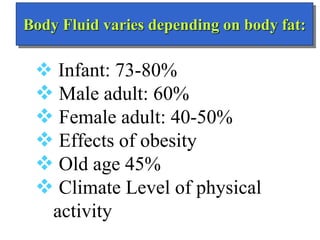
Body Fluid varies depending on body fat:
 Infant: 73-80%
 Male adult: 60%
 Female adult: 40-50%
 Effects of obesity
 Old age 45%
 Climate Level of physical
activity
BODY FLUID COMPARTMENTS (%)
BODY FLUID COMPARTMENTS
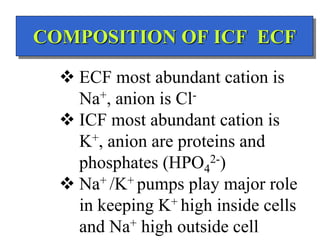
COMPOSITION OF ICF ECF
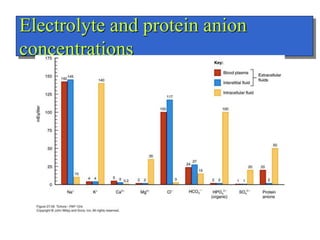
 ECF most abundant cation is
Na+, anion is Cl-
 ICF most abundant cation is
K+, anion are proteins and
phosphates (HPO4
2-)
 Na+ /K+ pumps play major role
in keeping K+ high inside cells
and Na+ high outside cell
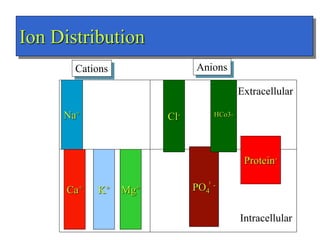
Ion Distribution
Na+
K+
Cl-
PO4
-
Protein-
Cations Anions
Extracellular
Intracellular
Ca+ Mg+
HCo3-
3
Electrolyte and protein anion
concentrations
Sodium - Na+
 Most abundant ion in ECF
 90% of extracellular cations
 Plays pivotal role in fluid and electrolyte
balance because it account for almost half of
the osmolarity of ECF
 Level in blood controlled by
 Aldosternone – increases renal reabsorption
 ADH – if sodium too low, ADH release stops
 Atrial natriuretic peptide – increases renal
excretion
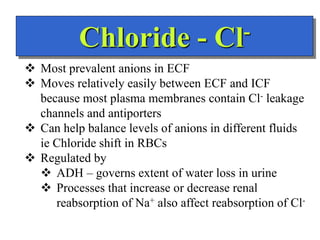
Chloride - Cl-
 Most prevalent anions in ECF
 Moves relatively easily between ECF and ICF
because most plasma membranes contain Cl- leakage
channels and antiporters
 Can help balance levels of anions in different fluids
ie Chloride shift in RBCs
 Regulated by
 ADH – governs extent of water loss in urine
 Processes that increase or decrease renal
reabsorption of Na+ also affect reabsorption of Cl-
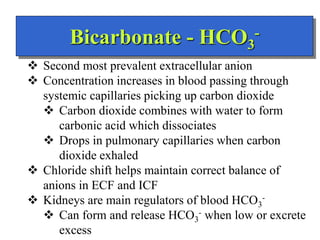
Bicarbonate - HCO3
-
 Second most prevalent extracellular anion
 Concentration increases in blood passing through
systemic capillaries picking up carbon dioxide
 Carbon dioxide combines with water to form
carbonic acid which dissociates
 Drops in pulmonary capillaries when carbon
dioxide exhaled
 Chloride shift helps maintain correct balance of
anions in ECF and ICF
 Kidneys are main regulators of blood HCO3
-
 Can form and release HCO3
- when low or excrete
excess
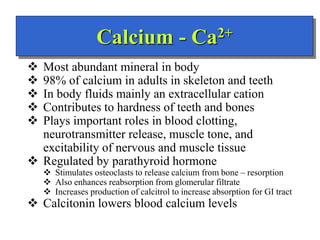
Calcium - Ca2+
 Most abundant mineral in body
 98% of calcium in adults in skeleton and teeth
 In body fluids mainly an extracellular cation
 Contributes to hardness of teeth and bones
 Plays important roles in blood clotting,
neurotransmitter release, muscle tone, and
excitability of nervous and muscle tissue
 Regulated by parathyroid hormone
 Stimulates osteoclasts to release calcium from bone – resorption
 Also enhances reabsorption from glomerular filtrate
 Increases production of calcitrol to increase absorption for GI tract
 Calcitonin lowers blood calcium levels
Phosphate
 About 85% in adults present as calcium phosphate salts in
bone and teeth
 Remaining 15% ionized – H2PO4
-, HPO4
2-, and PO4
3- are
important intracellular anions
 HPO4
2- important buffer of H+ in body fluids and urine
 Same hormones governing calcium homeostasis also
regulate HPO4
2- in blood
 Parathyroid hormone – stimulates resorption of
bone by osteoclasts releasing calcium and
phosphate but inhibits reabsorption of
phosphate ions in kidneys
 Calcitrol promotes absorption of phosphates and
calcium from GI tract
Magnesium
 In adults, about 54% of total body magnesium
is part of bone as magnesium salts
 Remaining 46% as Mg2+ in ICF (45%) or ECF
(1%)
 Second most common intracellular cation
 Cofactor for certain enzymes and sodium-
potassium pump
 Essential for normal neuromuscular activity,
synaptic transmission, and myocardial function
 Secretion of parathyroid hormone depends on
2+
Potassium - K+
 Most abundant cations in ICF
 Key role in establishing resting membrane
potential in neurons and muscle fibers
 Also helps maintain normal ICF fluid
volume
 Helps regulate pH of body fluids when
exchanged for H+
 Controlled by aldosterone – stimulates
principal cells in renal collecting ducts to
secrete excess K+
Alterations in Water Movement
 Edema
 Fluid accumulation in interstitial
spaces
 Due to any condition that leads to:
 Net movement of fluid out of
capillaries into interstitial tissues
Potassium
 Major intracellular cation
 Needed for nerve, cardiac,
skeletal function
 Excess excreted by kidneys
 Imbalance can cause sudden
death
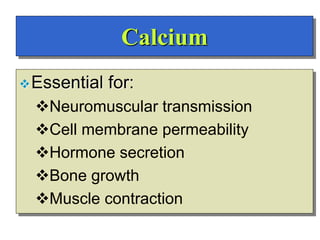
Calcium
Essential for:
Neuromuscular transmission
Cell membrane permeability
Hormone secretion
Bone growth
Muscle contraction
Magnesium
 Activates enzymes
 50% in bone
 Excreted by kidneys
 CNS effect similar to calcium
ACID BASE BALANCE
Regulation of Acid-Base
 Regulation of [H+]
 Dependent upon:
Respiration
Kidneys
Chemical Buffers
 Precise regulation necessary for peak
enzyme activity
pH Effects on Enzyme Activity
pH
Enzyme
Activity
 activity
Peak Activity
 activity
Acid Base
 Acids release H+
example: HCl -> H+ + Cl-
 Bases absorb H+
example: HCO3
- + H+ -> H2CO3
pH is logarithmic
 pH = log 1/[H+]
 = - log [H+]
 = - log 0.00000004 Eq/L
 pH = 7.4
 Think of pH as ‘power of [H+]
Buffers Resist pH Changes
 Weak acid & conjugate base
pair
 H2CO3  HCO3
-
+ H+
 Conjugate Acid  conjugate
base + acid
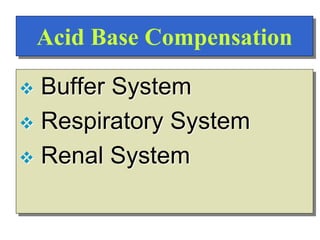
Acid Base Compensation
 Buffer System
 Respiratory System
 Renal System
Buffer System
 Immediate Buffer System
 CO2 + H20  H2CO3  H+ +
HCO3
-
 Excessive CO2  acidosis
 Excessive HCO3
-
 alkalosis
Simplified:
CO2  H+
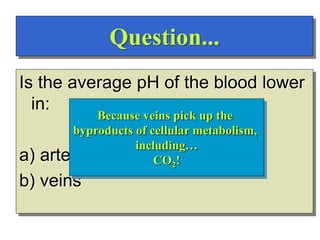
Question...
Is the average pH of the blood lower
in:
a) arteries
b) veins
Veins!
Why?
Because veins pick up the
byproducts of cellular metabolism,
including…
CO2!
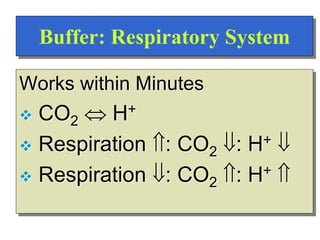
Buffer: Respiratory System
Works within Minutes
 CO2  H+
 Respiration : CO2 : H+ 
 Respiration : CO2 : H+ 
Renal System
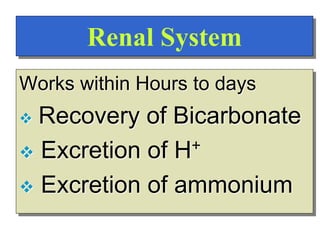
Works within Hours to days
 Recovery of Bicarbonate
 Excretion of H+
 Excretion of ammonium
Disorders of Buffers
 Respiratory Acidosis
 Respiratory Alkalosis
 Metabolic Acidosis
 Metabolic Alkalosis
Respiratory Acidosis
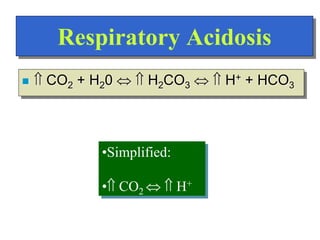
  CO2 + H20   H2CO3   H+ + HCO3
•Simplified:
• CO2   H+
Respiratory Alkalosis
  CO2 + H20   H2CO3   H+ + HCO3
• Simplified:
• CO2   H+
Metabolic Acidosis
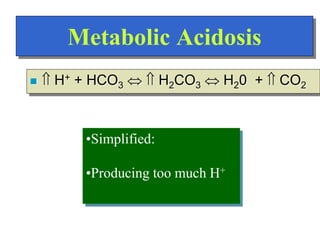
  H+ + HCO3   H2CO3  H20 +  CO2
•Simplified:
•Producing too much H+
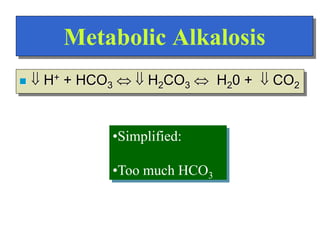
Metabolic Alkalosis
  H+ + HCO3   H2CO3  H20 +  CO2
•Simplified:
•Too much HCO3
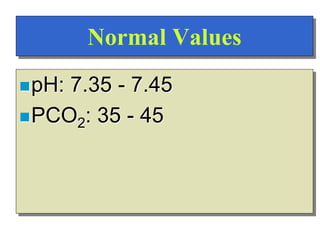
Normal Values
pH: 7.35 - 7.45
PCO2: 35 - 45
Abnormal Values
pH PCO2
Respiratory Acidosis  
Respiratory Alkalosis  
Metabolic Acidosis  Normal
 if compensating
Metabolic Alkalosis  Normal
 if compensating
Thank you

Body fluid compartment.ppt

  • 1.
    BODY FLUID COMPARTMENTS& COMPOSITION Prof. BL Mtinangi MD, MSc PhD Department of Physiology Kampala International University (T) Dar es Salaam
  • 2.
    Homeostasis and BodyFluids  Maintaining the volume and composition of body fluids are important  Body fluids are defined as dilute, watery solutions containing dissolved chemicals inside or outside of the cell  Intracellular Fluid (ICF) Fluid within cells  Extracellular Fluid (ECF) Fluid outside cells Interstitial fluid is ECF between cells and tissues
  • 3.
    BODY FLUID COMPARTMENTS Total body water (TBW) = 42L in a70kg male  Body water content depends on age and sex  TBW has two major compartments; ECF (14L) and ICF (28L).  ECF = 14L (1/3 of TBW)  Subdivided into ISF and Intravascular fluid (Plasma)  Interstitial = 10L Interstitial fluid (ISF)  Intravascular = 3.5L Intravascular fluid (IVF)  Tran cellular = < 0.5L
  • 4.
    Body Fluid variesdepending on body fat:  Infant: 73-80%  Male adult: 60%  Female adult: 40-50%  Effects of obesity  Old age 45%  Climate Level of physical activity
  • 5.
  • 6.
  • 7.
    COMPOSITION OF ICFECF  ECF most abundant cation is Na+, anion is Cl-  ICF most abundant cation is K+, anion are proteins and phosphates (HPO4 2-)  Na+ /K+ pumps play major role in keeping K+ high inside cells and Na+ high outside cell
  • 8.
  • 9.
    Electrolyte and proteinanion concentrations
  • 10.
    Sodium - Na+ Most abundant ion in ECF  90% of extracellular cations  Plays pivotal role in fluid and electrolyte balance because it account for almost half of the osmolarity of ECF  Level in blood controlled by  Aldosternone – increases renal reabsorption  ADH – if sodium too low, ADH release stops  Atrial natriuretic peptide – increases renal excretion
  • 11.
    Chloride - Cl- Most prevalent anions in ECF  Moves relatively easily between ECF and ICF because most plasma membranes contain Cl- leakage channels and antiporters  Can help balance levels of anions in different fluids ie Chloride shift in RBCs  Regulated by  ADH – governs extent of water loss in urine  Processes that increase or decrease renal reabsorption of Na+ also affect reabsorption of Cl-
  • 12.
    Bicarbonate - HCO3 - Second most prevalent extracellular anion  Concentration increases in blood passing through systemic capillaries picking up carbon dioxide  Carbon dioxide combines with water to form carbonic acid which dissociates  Drops in pulmonary capillaries when carbon dioxide exhaled  Chloride shift helps maintain correct balance of anions in ECF and ICF  Kidneys are main regulators of blood HCO3 -  Can form and release HCO3 - when low or excrete excess
  • 13.
    Calcium - Ca2+ Most abundant mineral in body  98% of calcium in adults in skeleton and teeth  In body fluids mainly an extracellular cation  Contributes to hardness of teeth and bones  Plays important roles in blood clotting, neurotransmitter release, muscle tone, and excitability of nervous and muscle tissue  Regulated by parathyroid hormone  Stimulates osteoclasts to release calcium from bone – resorption  Also enhances reabsorption from glomerular filtrate  Increases production of calcitrol to increase absorption for GI tract  Calcitonin lowers blood calcium levels
  • 14.
    Phosphate  About 85%in adults present as calcium phosphate salts in bone and teeth  Remaining 15% ionized – H2PO4 -, HPO4 2-, and PO4 3- are important intracellular anions  HPO4 2- important buffer of H+ in body fluids and urine  Same hormones governing calcium homeostasis also regulate HPO4 2- in blood  Parathyroid hormone – stimulates resorption of bone by osteoclasts releasing calcium and phosphate but inhibits reabsorption of phosphate ions in kidneys  Calcitrol promotes absorption of phosphates and calcium from GI tract
  • 15.
    Magnesium  In adults,about 54% of total body magnesium is part of bone as magnesium salts  Remaining 46% as Mg2+ in ICF (45%) or ECF (1%)  Second most common intracellular cation  Cofactor for certain enzymes and sodium- potassium pump  Essential for normal neuromuscular activity, synaptic transmission, and myocardial function  Secretion of parathyroid hormone depends on 2+
  • 16.
    Potassium - K+ Most abundant cations in ICF  Key role in establishing resting membrane potential in neurons and muscle fibers  Also helps maintain normal ICF fluid volume  Helps regulate pH of body fluids when exchanged for H+  Controlled by aldosterone – stimulates principal cells in renal collecting ducts to secrete excess K+
  • 17.
    Alterations in WaterMovement  Edema  Fluid accumulation in interstitial spaces  Due to any condition that leads to:  Net movement of fluid out of capillaries into interstitial tissues
  • 18.
    Potassium  Major intracellularcation  Needed for nerve, cardiac, skeletal function  Excess excreted by kidneys  Imbalance can cause sudden death
  • 19.
    Calcium Essential for: Neuromuscular transmission Cellmembrane permeability Hormone secretion Bone growth Muscle contraction
  • 20.
    Magnesium  Activates enzymes 50% in bone  Excreted by kidneys  CNS effect similar to calcium
  • 21.
  • 22.
    Regulation of Acid-Base Regulation of [H+]  Dependent upon: Respiration Kidneys Chemical Buffers  Precise regulation necessary for peak enzyme activity
  • 23.
    pH Effects onEnzyme Activity pH Enzyme Activity  activity Peak Activity  activity
  • 24.
    Acid Base  Acidsrelease H+ example: HCl -> H+ + Cl-  Bases absorb H+ example: HCO3 - + H+ -> H2CO3
  • 25.
    pH is logarithmic pH = log 1/[H+]  = - log [H+]  = - log 0.00000004 Eq/L  pH = 7.4  Think of pH as ‘power of [H+]
  • 26.
    Buffers Resist pHChanges  Weak acid & conjugate base pair  H2CO3  HCO3 - + H+  Conjugate Acid  conjugate base + acid
  • 27.
    Acid Base Compensation Buffer System  Respiratory System  Renal System
  • 28.
    Buffer System  ImmediateBuffer System  CO2 + H20  H2CO3  H+ + HCO3 -  Excessive CO2  acidosis  Excessive HCO3 -  alkalosis Simplified: CO2  H+
  • 29.
    Question... Is the averagepH of the blood lower in: a) arteries b) veins Veins! Why? Because veins pick up the byproducts of cellular metabolism, including… CO2!
  • 30.
    Buffer: Respiratory System Workswithin Minutes  CO2  H+  Respiration : CO2 : H+   Respiration : CO2 : H+ 
  • 31.
    Renal System Works withinHours to days  Recovery of Bicarbonate  Excretion of H+  Excretion of ammonium
  • 32.
    Disorders of Buffers Respiratory Acidosis  Respiratory Alkalosis  Metabolic Acidosis  Metabolic Alkalosis
  • 33.
    Respiratory Acidosis  CO2 + H20   H2CO3   H+ + HCO3 •Simplified: • CO2   H+
  • 34.
    Respiratory Alkalosis  CO2 + H20   H2CO3   H+ + HCO3 • Simplified: • CO2   H+
  • 35.
    Metabolic Acidosis  H+ + HCO3   H2CO3  H20 +  CO2 •Simplified: •Producing too much H+
  • 36.
    Metabolic Alkalosis  H+ + HCO3   H2CO3  H20 +  CO2 •Simplified: •Too much HCO3
  • 37.
    Normal Values pH: 7.35- 7.45 PCO2: 35 - 45
  • 38.
    Abnormal Values pH PCO2 RespiratoryAcidosis   Respiratory Alkalosis   Metabolic Acidosis  Normal  if compensating Metabolic Alkalosis  Normal  if compensating
  • 39.