Body 
Constitution Theory 
Project Group 1 16 Dec 2014
1.Definition of Body Constitution 
Theory 
2.Characteristics of Body 
Constitution Theory and relationship 
with 
human health 
3. Health preservation example 
based on Body Constitution Theory
Definition of Body 
Constitution Theory
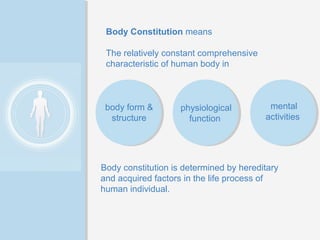
Body Constitution means 
The relatively constant comprehensive 
characteristic of human body in 
body form & 
structure 
physiological 
function 
mental 
activities 
Body constitution is determined by hereditary 
and acquired factors in the life process of 
human individual.
The Body Constitution Theory 
−refers to a classification of human individuals into different body 
types. 
−present constitutions as 
• the differences in reaction and adaptation to stimuli from 
the outside; 
• the internal important factor causing disease; 
−provide the assessment of risk for disease and guidance on 
treatment measures.
Characteristics of Body 
Constitution Theory and 
human health
Physiological Foundation of 
Constitution 
−The human organs such as viscera, meridians, body 
and orifices, and the basic substances such as essence, 
qi, blood and body fluid maintain the normal life 
activities, and are the physiological foundations for the 
development of constitution. 
−Constitution is determined by the strength and 
abundance of these organs and substances as well as 
their coordination. 
−Kidney and Spleen have more obvious effect on 
determining constitution. 
−Constitution can change over time
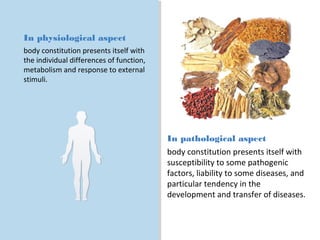
In pathological aspect 
body constitution presents itself with 
susceptibility to some pathogenic 
factors, liability to some diseases, and 
particular tendency in the 
development and transfer of diseases. 
In physiological aspect 
body constitution presents itself with 
the individual differences of function, 
metabolism and response to external 
stimuli.
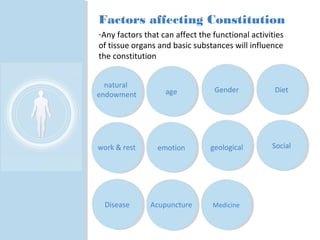
Factors affecting Constitution 
-Any factors that can affect the functional activities 
of tissue organs and basic substances will influence 
the constitution 
natural 
endowment aaggee GGeennddeerr 
Diet 
Diet work & rest eemmoottioionn geological 
SSoocciaiall 
DDisiseeaassee Acupuncture MMeeddicicininee
Traditional Classifications 
According to Five Elements 
(5 types) 
According to the variety of 
Yin Yang (5 types)
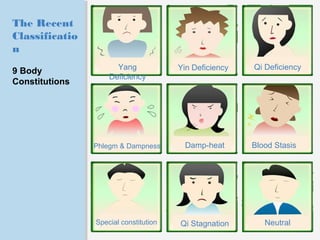
The Recent 
Classificatio 
n 
9 Body 
Constitutions 
Yang Qi Deficiency 
Deficiency 
Neutral 
Yin Deficiency 
Phlegm & Dampness Damp-heat Blood Stasis 
Special constitution Qi Stagnation
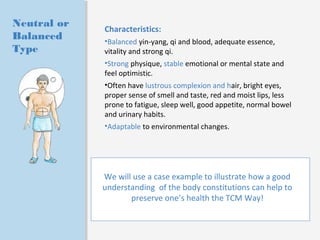
Neutral or 
Balanced 
Type 
Characteristics: 
•Balanced yin-yang, qi and blood, adequate essence, 
vitality and strong qi. 
•Strong physique, stable emotional or mental state and 
feel optimistic. 
•Often have lustrous complexion and hair, bright eyes, 
proper sense of smell and taste, red and moist lips, less 
prone to fatigue, sleep well, good appetite, normal bowel 
and urinary habits. 
•Adaptable to environmental changes. 
We will use a case example to illustrate how a good 
understanding of the body constitutions can help to 
preserve one’s health the TCM Way!
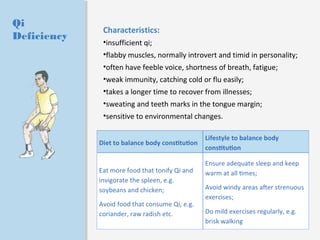
Qi 
Deficiency 
Characteristics: 
•insufficient qi; 
•flabby muscles, normally introvert and timid in personality; 
•often have feeble voice, shortness of breath, fatigue; 
•weak immunity, catching cold or flu easily; 
•takes a longer time to recover from illnesses; 
•sweating and teeth marks in the tongue margin; 
•sensitive to environmental changes.
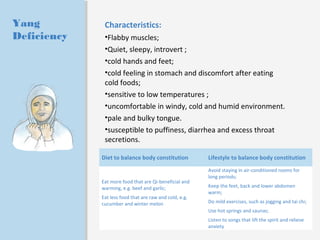
Yang 
Deficiency 
Characteristics: 
•Flabby muscles; 
•Quiet, sleepy, introvert ; 
•cold hands and feet; 
•cold feeling in stomach and discomfort after eating 
cold foods; 
•sensitive to low temperatures ; 
•uncomfortable in windy, cold and humid environment. 
•pale and bulky tongue. 
•susceptible to puffiness, diarrhea and excess throat 
secretions. 
Diet to balance body constitution Lifestyle to balance body constitution 
Eat more food that are Qi-beneficial and 
warming, e.g. beef and garlic; 
Eat less food that are raw and cold, e.g. 
cucumber and winter melon 
Avoid staying in air-conditioned rooms for 
long periods; 
Keep the feet, back and lower abdomen 
warm; 
Do mild exercises, such as jogging and tai chi; 
Use hot springs and saunas; 
Listen to songs that lift the spirit and relieve 
anxiety
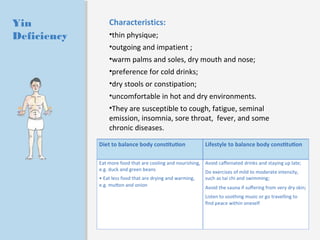
Yin 
Deficiency 
Characteristics: 
•thin physique; 
•outgoing and impatient ; 
•warm palms and soles, dry mouth and nose; 
•preference for cold drinks; 
•dry stools or constipation; 
•uncomfortable in hot and dry environments. 
•They are susceptible to cough, fatigue, seminal 
emission, insomnia, sore throat, fever, and some 
chronic diseases.
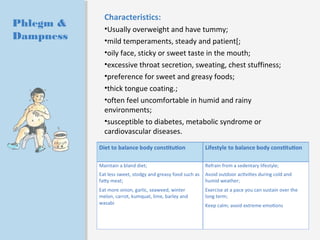
Phlegm & 
Dampness 
Characteristics: 
•Usually overweight and have tummy; 
•mild temperaments, steady and patient[; 
•oily face, sticky or sweet taste in the mouth; 
•excessive throat secretion, sweating, chest stuffiness; 
•preference for sweet and greasy foods; 
•thick tongue coating.; 
•often feel uncomfortable in humid and rainy 
environments; 
•susceptible to diabetes, metabolic syndrome or 
cardiovascular diseases.
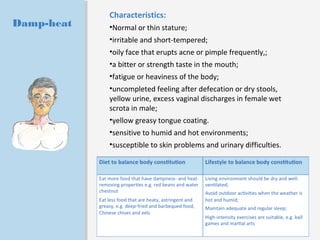
Damp-heat 
Characteristics: 
•Normal or thin stature; 
•irritable and short-tempered; 
•oily face that erupts acne or pimple frequently,; 
•a bitter or strength taste in the mouth; 
•fatigue or heaviness of the body; 
•uncompleted feeling after defecation or dry stools, 
yellow urine, excess vaginal discharges in female wet 
scrota in male; 
•yellow greasy tongue coating. 
•sensitive to humid and hot environments; 
•susceptible to skin problems and urinary difficulties.
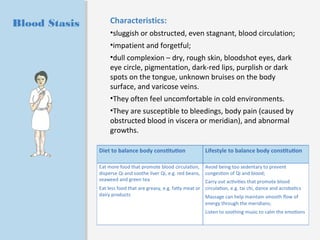
Blood Stasis Characteristics: 
•sluggish or obstructed, even stagnant, blood circulation; 
•impatient and forgetful; 
•dull complexion – dry, rough skin, bloodshot eyes, dark 
eye circle, pigmentation, dark-red lips, purplish or dark 
spots on the tongue, unknown bruises on the body 
surface, and varicose veins. 
•They often feel uncomfortable in cold environments. 
•They are susceptible to bleedings, body pain (caused by 
obstructed blood in viscera or meridian), and abnormal 
growths.
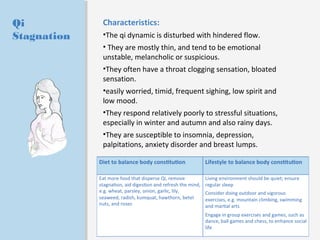
Qi 
Stagnation 
Characteristics: 
•The qi dynamic is disturbed with hindered flow. 
• They are mostly thin, and tend to be emotional 
unstable, melancholic or suspicious. 
•They often have a throat clogging sensation, bloated 
sensation. 
•easily worried, timid, frequent sighing, low spirit and 
low mood. 
•They respond relatively poorly to stressful situations, 
especially in winter and autumn and also rainy days. 
•They are susceptible to insomnia, depression, 
palpitations, anxiety disorder and breast lumps.
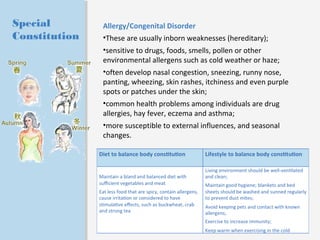
Special 
Constitution 
Allergy/Congenital Disorder 
•These are usually inborn weaknesses (hereditary); 
•sensitive to drugs, foods, smells, pollen or other 
environmental allergens such as cold weather or haze; 
•often develop nasal congestion, sneezing, runny nose, 
panting, wheezing, skin rashes, itchiness and even purple 
spots or patches under the skin; 
•common health problems among individuals are drug 
allergies, hay fever, eczema and asthma; 
•more susceptible to external influences, and seasonal 
changes.
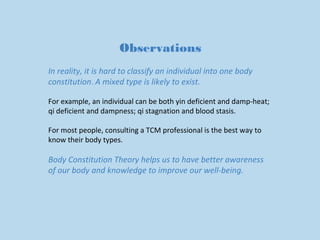
Observations 
In reality, it is hard to classify an individual into one body 
constitution. A mixed type is likely to exist. 
For example, an individual can be both yin deficient and damp-heat; 
qi deficient and dampness; qi stagnation and blood stasis. 
For most people, consulting a TCM professional is the best way to 
know their body types. 
Body Constitution Theory helps us to have better awareness 
of our body and knowledge to improve our well-being.
Health preservation 
example based on Body 
Constitution Theory
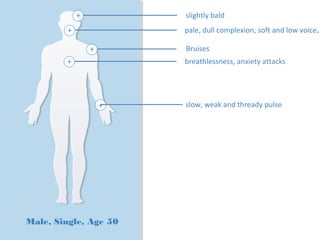
Michael went to see a TCM doctor. 
Dr Quek noted that: 
•he has a pale, dull complexion, accompanied by 
a soft and low voice. 
•He looked slightly bald, and presented an 
anxious and worried face. 
•Bruises were also noticed on his left arm (not due 
to injuries). 
•His pulse was slow, weak and thready. 
On further questioning, Michael revealed that: 
his parents had history of breathlessness and 
anxiety attacks. 
He has been very weak since younger days, but 
now the attacks are more frequent and severe. 
he likes oily, spicy and fried foodstuff, which he 
must take at least once every meals. He dislikes 
vegetables and fruits. 
he was very stressed at work (worked in the 
present job for 5 years). 
Case Study 
Male, Single, Age 50
+ 
+ pale, dull complexion, soft and low voice. 
+ Bruises 
Male, Single, Age 50 
slightly bald 
+ breathlessness, anxiety attacks 
+ slow, weak and thready pulse
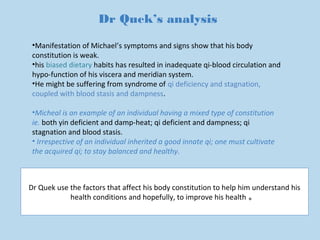
Dr Quek’s analysis 
•Manifestation of Michael’s symptoms and signs show that his body 
constitution is weak. 
•his biased dietary habits has resulted in inadequate qi-blood circulation and 
hypo-function of his viscera and meridian system. 
•He might be suffering from syndrome of qi deficiency and stagnation, 
coupled with blood stasis and dampness. 
•Micheal is an example of an individual having a mixed type of constitution 
ie. both yin deficient and damp-heat; qi deficient and dampness; qi 
stagnation and blood stasis. 
• Irrespective of an individual inherited a good innate qi; one must cultivate 
the acquired qi; to stay balanced and healthy. 
Dr Quek use the factors that affect his body constitution to help him understand his 
health conditions and hopefully, to improve his health 。
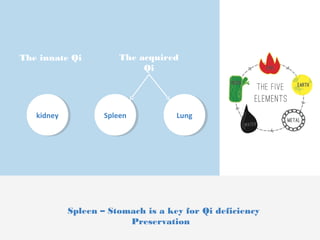
The innate Qi 
The acquired 
Qi 
kkididnneeyy SSppleleeenn LLuunngg 
Spleen – Stomach is a key for Qi deficiency 
Preservation
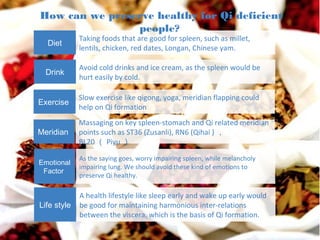
How can we preserve healthy for Qi deficient 
people? 
Diet Taking foods that are good for spleen, such as millet, 
lentils, chicken, red dates, Longan, Chinese yam. 
Drink Avoid cold drinks and ice cream, as the spleen would be 
hurt easily by cold. 
Exercise Slow exercise like qigong, yoga, meridian flapping could 
Life style 
help on Qi formation 
A health lifestyle like sleep early and wake up early would 
be good for maintaining harmonious inter-relations 
between the viscera, which is the basis of Qi formation. 
Meridian 
Massaging on key spleen-stomach and Qi related meridian 
points such as ST36 (Zusanli), RN6 (Qihai ) , 
BL20(Piyu) 
Emotional 
Factor 
As the saying goes, worry impairing spleen, while melancholy 
impairing lung. We should avoid these kind of emotions to 
preserve Qi healthy.
QQuueessttiioonnss?? 
conditions and hopefully, to improve his health 。 
Team 1 
TCM Assistant Course 
Andrew Jane Joanne Johnson Joyce Sandy Wendy

Body consitutions in TCM

  • 1.
    Body Constitution Theory Project Group 1 16 Dec 2014
  • 2.
    1.Definition of BodyConstitution Theory 2.Characteristics of Body Constitution Theory and relationship with human health 3. Health preservation example based on Body Constitution Theory
  • 3.
    Definition of Body Constitution Theory
  • 4.
    Body Constitution means The relatively constant comprehensive characteristic of human body in body form & structure physiological function mental activities Body constitution is determined by hereditary and acquired factors in the life process of human individual.
  • 5.
    The Body ConstitutionTheory −refers to a classification of human individuals into different body types. −present constitutions as • the differences in reaction and adaptation to stimuli from the outside; • the internal important factor causing disease; −provide the assessment of risk for disease and guidance on treatment measures.
  • 6.
    Characteristics of Body Constitution Theory and human health
  • 7.
    Physiological Foundation of Constitution −The human organs such as viscera, meridians, body and orifices, and the basic substances such as essence, qi, blood and body fluid maintain the normal life activities, and are the physiological foundations for the development of constitution. −Constitution is determined by the strength and abundance of these organs and substances as well as their coordination. −Kidney and Spleen have more obvious effect on determining constitution. −Constitution can change over time
  • 8.
    In pathological aspect body constitution presents itself with susceptibility to some pathogenic factors, liability to some diseases, and particular tendency in the development and transfer of diseases. In physiological aspect body constitution presents itself with the individual differences of function, metabolism and response to external stimuli.
  • 9.
    Factors affecting Constitution -Any factors that can affect the functional activities of tissue organs and basic substances will influence the constitution natural endowment aaggee GGeennddeerr Diet Diet work & rest eemmoottioionn geological SSoocciaiall DDisiseeaassee Acupuncture MMeeddicicininee
  • 10.
    Traditional Classifications Accordingto Five Elements (5 types) According to the variety of Yin Yang (5 types)
  • 11.
    The Recent Classificatio n 9 Body Constitutions Yang Qi Deficiency Deficiency Neutral Yin Deficiency Phlegm & Dampness Damp-heat Blood Stasis Special constitution Qi Stagnation
  • 12.
    Neutral or Balanced Type Characteristics: •Balanced yin-yang, qi and blood, adequate essence, vitality and strong qi. •Strong physique, stable emotional or mental state and feel optimistic. •Often have lustrous complexion and hair, bright eyes, proper sense of smell and taste, red and moist lips, less prone to fatigue, sleep well, good appetite, normal bowel and urinary habits. •Adaptable to environmental changes. We will use a case example to illustrate how a good understanding of the body constitutions can help to preserve one’s health the TCM Way!
  • 13.
    Qi Deficiency Characteristics: •insufficient qi; •flabby muscles, normally introvert and timid in personality; •often have feeble voice, shortness of breath, fatigue; •weak immunity, catching cold or flu easily; •takes a longer time to recover from illnesses; •sweating and teeth marks in the tongue margin; •sensitive to environmental changes.
  • 14.
    Yang Deficiency Characteristics: •Flabby muscles; •Quiet, sleepy, introvert ; •cold hands and feet; •cold feeling in stomach and discomfort after eating cold foods; •sensitive to low temperatures ; •uncomfortable in windy, cold and humid environment. •pale and bulky tongue. •susceptible to puffiness, diarrhea and excess throat secretions. Diet to balance body constitution Lifestyle to balance body constitution Eat more food that are Qi-beneficial and warming, e.g. beef and garlic; Eat less food that are raw and cold, e.g. cucumber and winter melon Avoid staying in air-conditioned rooms for long periods; Keep the feet, back and lower abdomen warm; Do mild exercises, such as jogging and tai chi; Use hot springs and saunas; Listen to songs that lift the spirit and relieve anxiety
  • 15.
    Yin Deficiency Characteristics: •thin physique; •outgoing and impatient ; •warm palms and soles, dry mouth and nose; •preference for cold drinks; •dry stools or constipation; •uncomfortable in hot and dry environments. •They are susceptible to cough, fatigue, seminal emission, insomnia, sore throat, fever, and some chronic diseases.
  • 16.
    Phlegm & Dampness Characteristics: •Usually overweight and have tummy; •mild temperaments, steady and patient[; •oily face, sticky or sweet taste in the mouth; •excessive throat secretion, sweating, chest stuffiness; •preference for sweet and greasy foods; •thick tongue coating.; •often feel uncomfortable in humid and rainy environments; •susceptible to diabetes, metabolic syndrome or cardiovascular diseases.
  • 17.
    Damp-heat Characteristics: •Normalor thin stature; •irritable and short-tempered; •oily face that erupts acne or pimple frequently,; •a bitter or strength taste in the mouth; •fatigue or heaviness of the body; •uncompleted feeling after defecation or dry stools, yellow urine, excess vaginal discharges in female wet scrota in male; •yellow greasy tongue coating. •sensitive to humid and hot environments; •susceptible to skin problems and urinary difficulties.
  • 18.
    Blood Stasis Characteristics: •sluggish or obstructed, even stagnant, blood circulation; •impatient and forgetful; •dull complexion – dry, rough skin, bloodshot eyes, dark eye circle, pigmentation, dark-red lips, purplish or dark spots on the tongue, unknown bruises on the body surface, and varicose veins. •They often feel uncomfortable in cold environments. •They are susceptible to bleedings, body pain (caused by obstructed blood in viscera or meridian), and abnormal growths.
  • 19.
    Qi Stagnation Characteristics: •The qi dynamic is disturbed with hindered flow. • They are mostly thin, and tend to be emotional unstable, melancholic or suspicious. •They often have a throat clogging sensation, bloated sensation. •easily worried, timid, frequent sighing, low spirit and low mood. •They respond relatively poorly to stressful situations, especially in winter and autumn and also rainy days. •They are susceptible to insomnia, depression, palpitations, anxiety disorder and breast lumps.
  • 20.
    Special Constitution Allergy/CongenitalDisorder •These are usually inborn weaknesses (hereditary); •sensitive to drugs, foods, smells, pollen or other environmental allergens such as cold weather or haze; •often develop nasal congestion, sneezing, runny nose, panting, wheezing, skin rashes, itchiness and even purple spots or patches under the skin; •common health problems among individuals are drug allergies, hay fever, eczema and asthma; •more susceptible to external influences, and seasonal changes.
  • 21.
    Observations In reality,it is hard to classify an individual into one body constitution. A mixed type is likely to exist. For example, an individual can be both yin deficient and damp-heat; qi deficient and dampness; qi stagnation and blood stasis. For most people, consulting a TCM professional is the best way to know their body types. Body Constitution Theory helps us to have better awareness of our body and knowledge to improve our well-being.
  • 22.
    Health preservation examplebased on Body Constitution Theory
  • 23.
    Michael went tosee a TCM doctor. Dr Quek noted that: •he has a pale, dull complexion, accompanied by a soft and low voice. •He looked slightly bald, and presented an anxious and worried face. •Bruises were also noticed on his left arm (not due to injuries). •His pulse was slow, weak and thready. On further questioning, Michael revealed that: his parents had history of breathlessness and anxiety attacks. He has been very weak since younger days, but now the attacks are more frequent and severe. he likes oily, spicy and fried foodstuff, which he must take at least once every meals. He dislikes vegetables and fruits. he was very stressed at work (worked in the present job for 5 years). Case Study Male, Single, Age 50
  • 24.
    + + pale,dull complexion, soft and low voice. + Bruises Male, Single, Age 50 slightly bald + breathlessness, anxiety attacks + slow, weak and thready pulse
  • 25.
    Dr Quek’s analysis •Manifestation of Michael’s symptoms and signs show that his body constitution is weak. •his biased dietary habits has resulted in inadequate qi-blood circulation and hypo-function of his viscera and meridian system. •He might be suffering from syndrome of qi deficiency and stagnation, coupled with blood stasis and dampness. •Micheal is an example of an individual having a mixed type of constitution ie. both yin deficient and damp-heat; qi deficient and dampness; qi stagnation and blood stasis. • Irrespective of an individual inherited a good innate qi; one must cultivate the acquired qi; to stay balanced and healthy. Dr Quek use the factors that affect his body constitution to help him understand his health conditions and hopefully, to improve his health 。
  • 26.
    The innate Qi The acquired Qi kkididnneeyy SSppleleeenn LLuunngg Spleen – Stomach is a key for Qi deficiency Preservation
  • 27.
    How can wepreserve healthy for Qi deficient people? Diet Taking foods that are good for spleen, such as millet, lentils, chicken, red dates, Longan, Chinese yam. Drink Avoid cold drinks and ice cream, as the spleen would be hurt easily by cold. Exercise Slow exercise like qigong, yoga, meridian flapping could Life style help on Qi formation A health lifestyle like sleep early and wake up early would be good for maintaining harmonious inter-relations between the viscera, which is the basis of Qi formation. Meridian Massaging on key spleen-stomach and Qi related meridian points such as ST36 (Zusanli), RN6 (Qihai ) , BL20(Piyu) Emotional Factor As the saying goes, worry impairing spleen, while melancholy impairing lung. We should avoid these kind of emotions to preserve Qi healthy.
  • 28.
    QQuueessttiioonnss?? conditions andhopefully, to improve his health 。 Team 1 TCM Assistant Course Andrew Jane Joanne Johnson Joyce Sandy Wendy