IRIDOLOGY
AN OVERVIEW
SUBMITTED BY
DR. Y. ROSY AYDA
SECOND BATCH, M.D
(NATUROPATHY)
GYNMC
OUTLINE
• DEFINITION
• HISTORY
• DIVISIONS / COLOUR OF IRIS / INTERPRETATION OF IRIS SIGNS
• Primary theory of iridology
• Research papers / forthcoming research / books / institutions of iridology
DEFINITION
Iridology is the art and science of analyzing the colour and structure of the
iris of the eye to gain valuable health information. It is very important to
mention that the information from the iris can be obtained quickly,
painlessly and inexpensively
REF: Bernard Jensen. Visions of Health: Understanding Iridology.
HISTORY
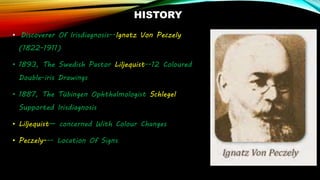
• Discoverer Of Irisdiagnosis--Ignatz Von Peczely
(1822-1911)
• 1893, The Swedish Pastor Liljequist--12 Coloured
Double-iris Drawings
• 1887, The Tübingen Ophthalmologist Schlegel
Supported Irisdiagnosis
• Liljequist— concerned With Colour Changes
• Peczely--- Location Of Signs
DIVISIONS OF THE IRIS
• The iris is divided radially and circularly
• Radial division: in hours, minutes, degrees
• Circular division: from the pupil to the outer border of the iris the area is divided
by concentric rings (zones)
• Peczely--Three zones - a stomach, an intestine and an outer zone
• Frau Pastor Madaus—Introduced Scheme of Division i.e., three major and six minor
zones
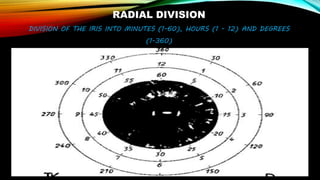
RADIAL DIVISION
DIVISION OF THE IRIS INTO MINUTES (1-60), HOURS (1 - 12) AND DEGREES
(1-360)
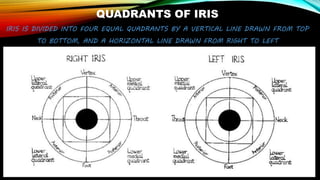
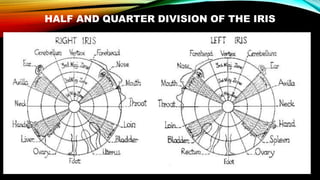
QUADRANTS OF IRIS
IRIS IS DIVIDED INTO FOUR EQUAL QUADRANTS BY A VERTICAL LINE DRAWN FROM TOP
TO BOTTOM, AND A HORIZONTAL LINE DRAWN FROM RIGHT TO LEFT
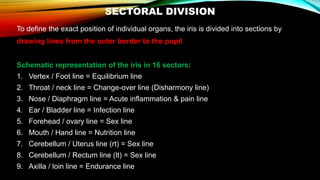
SECTORAL DIVISION
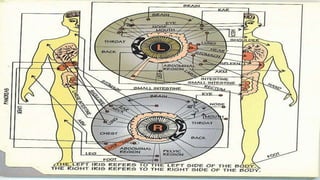
To define the exact position of individual organs, the iris is divided into sections by
drawing lines from the outer border to the pupil
Schematic representation of the iris in 16 sectors:
1. Vertex / Foot line = Equilibrium line
2. Throat / neck line = Change-over line (Disharmony line)
3. Nose / Diaphragm line = Acute inflammation & pain line
4. Ear / Bladder line = Infection line
5. Forehead / ovary line = Sex line
6. Mouth / Hand line = Nutrition line
7. Cerebellum / Uterus line (rt) = Sex line
8. Cerebellum / Rectum line (lt) = Sex line
9. Axilla / loin line = Endurance line
HALF AND QUARTER DIVISION OF THE IRIS
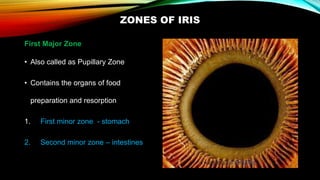
ZONES OF IRIS
First Major Zone
• Also called as Pupillary Zone
• Contains the organs of food
preparation and resorption
1. First minor zone - stomach
2. Second minor zone – intestines
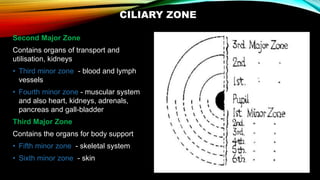
CILIARY ZONE
Second Major Zone
Contains organs of transport and
utilisation, kidneys
• Third minor zone - blood and lymph
vessels
• Fourth minor zone - muscular system
and also heart, kidneys, adrenals,
pancreas and gall-bladder
Third Major Zone
Contains the organs for body support
• Fifth minor zone - skeletal system
• Sixth minor zone - skin
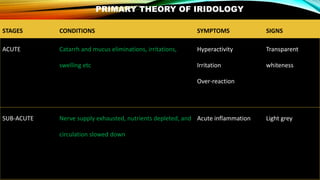
PRIMARY THEORY OF IRIDOLOGY
STAGES CONDITIONS SYMPTOMS SIGNS
ACUTE Catarrh and mucus eliminations, irritations,
swelling etc
Hyperactivity
Irritation
Over-reaction
Transparent
whiteness
SUB-ACUTE Nerve supply exhausted, nutrients depleted, and
circulation slowed down
Acute inflammation Light grey
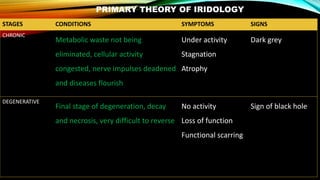
PRIMARY THEORY OF IRIDOLOGY
STAGES CONDITIONS SYMPTOMS SIGNS
CHRONIC
Metabolic waste not being
eliminated, cellular activity
congested, nerve impulses deadened
and diseases flourish
Under activity
Stagnation
Atrophy
Dark grey
DEGENERATIVE
Final stage of degeneration, decay
and necrosis, very difficult to reverse
No activity
Loss of function
Functional scarring
Sign of black hole
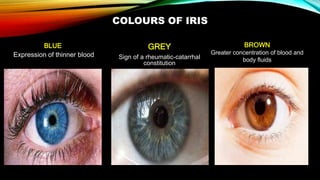
COLOURS OF IRIS
BLUE
Expression of thinner blood
GREY
Sign of a rheumatic-catarrhal
constitution
BROWN
Greater concentration of blood and
body fluids
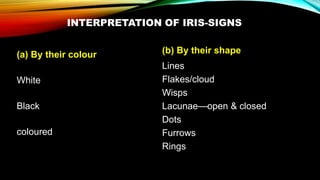
INTERPRETATION OF IRIS-SIGNS
(a) By their colour
White
Black
coloured
(b) By their shape
Lines
Flakes/cloud
Wisps
Lacunae—open & closed
Dots
Furrows
Rings
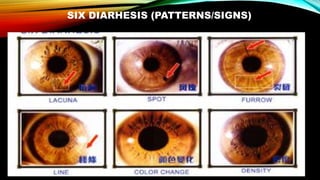
SIX DIARHESIS (PATTERNS/SIGNS)
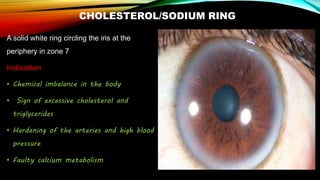
CHOLESTEROL/SODIUM RING
A solid white ring circling the iris at the
periphery in zone 7
Indication
• Chemical imbalance in the body
• Sign of excessive cholesterol and
triglycerides
• Hardening of the arteries and high blood
pressure
• Faulty calcium metabolism
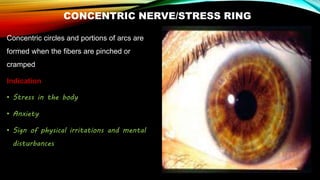
CONCENTRIC NERVE/STRESS RING
Concentric circles and portions of arcs are
formed when the fibers are pinched or
cramped
Indication
• Stress in the body
• Anxiety
• Sign of physical irritations and mental
disturbances
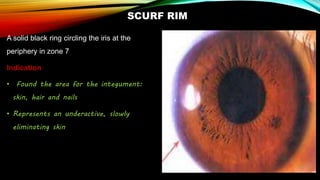
SCURF RIM
A solid black ring circling the iris at the
periphery in zone 7
Indication
• Found the area for the integument:
skin, hair and nails
• Represents an underactive, slowly
eliminating skin
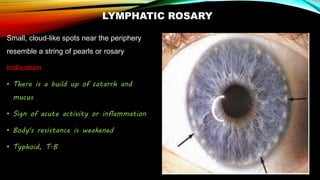
LYMPHATIC ROSARY
Small, cloud-like spots near the periphery
resemble a string of pearls or rosary
Indication
• There is a build up of catarrh and
mucus
• Sign of acute activity or inflammation
• Body's resistance is weakened
• Typhoid, T.B
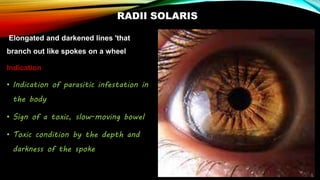
RADII SOLARIS
Elongated and darkened lines 'that
branch out like spokes on a wheel
Indication
• Indication of parasitic infestation in
the body
• Sign of a toxic, slow-moving bowel
• Toxic condition by the depth and
darkness of the spoke
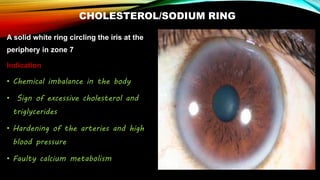
CHOLESTEROL/SODIUM RING
A solid white ring circling the iris at the
periphery in zone 7
Indication
• Chemical imbalance in the body
• Sign of excessive cholesterol and
triglycerides
• Hardening of the arteries and high
blood pressure
• Faulty calcium metabolism
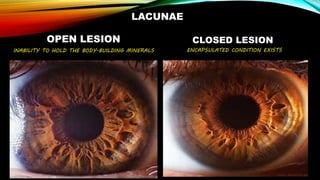
LACUNAE
OPEN LESION
INABILITY TO HOLD THE BODY-BUILDING MINERALS
CLOSED LESION
ENCAPSULATED CONDITION EXISTS
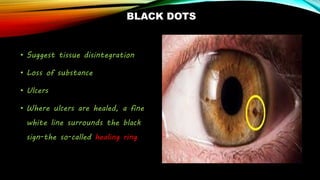
BLACK DOTS
• Suggest tissue disintegration
• Loss of substance
• Ulcers
• Where ulcers are healed, a fine
white line surrounds the black
sign-the so-called healing ring
RESEARCH PAPERS
• Psoriasis and Iridology by John Andrews
• Iridology in the 21st Century BY Dr Gael Riverz
• An Iridological Investigation in 50 Confirmed Cases for Possible Correlations
Between Candida albicans Overgrowth, Candidiasis and Structural Markings by John
Andrews
• The Spleen In Iridology: New Research in Immunology by John Andrews
• Detecting Cholesterol Presence with Iris Recognition Algorithm by Ridza Azri
Ramlee, Khairul Azha and Ranjit Singh Sarban Singh Universiti Teknikal Malaysia
Melaka (UTeM), Malaysia
• The validity and reliability of iridology in the diagnosis of previous acute
appendicitis as evidenced by appendectomy by L Frank, JT Ferreira and J Pellow
FORTHCOMING RESEARCH
The following research are under review by John Andrews Publications
• Hypoglycaemia & Iridology - 1500 Cases
• Progesterone Profiles in Modern Iridology
• Osteopenic Risk Factors in Iris Profiles
• Polycystic Ovary Syndrome & Iridology
• Pituitary gland study in Iridology
• Thyroid identification in Iridology
• The Iris & Tonsillitis – 103 cases
REF: http://www.johnandrewsiridology.net/research.htm
BOOKS ON IRIDOLOGY
1. Endocrinology & Iridology By John Andrews Published 2006
2. Emotional Approaches in Iridology By John Andrews Published 2005
3. Immunology & Iridology By John Andrews Published 2003
4. Iris & Pupillary Signs, 3rd Edition - Modern Iridology By John Andrews
Published May 2008, 3rd Edition
5. Iridology: The Diagnosis from the Eye by Henry Edward Lahn
INSTITUTIONS OF IRIDOLOGY
• Holistic Iridology (www.holisticiridology.com)
• Institute of Holistic Nutrition (www.instituteofholisticnutrition.com)
• School of Natural Healing (www.snh.cc)
• Guild of Naturopathic Iridologists International (www.gni-
international.org)
• Hellenic Medical Association of Iridology (www.iridology.gr)
• World Congress of Iridology (www.iridodiagnosis.eu)
• Brazilian Medical Iridology Association
• ICSI- International Congress of Scientific Iridology
MUCH IS STILL TO BE DONE, AND MANY
PAGES HAVE YET TO BE ADDED TO THE
HISTORY OF IRIS DIAGNOSIS……………
THANK YOU

Iridology overview

  • 1.
    IRIDOLOGY AN OVERVIEW SUBMITTED BY DR.Y. ROSY AYDA SECOND BATCH, M.D (NATUROPATHY) GYNMC
  • 2.
    OUTLINE • DEFINITION • HISTORY •DIVISIONS / COLOUR OF IRIS / INTERPRETATION OF IRIS SIGNS • Primary theory of iridology • Research papers / forthcoming research / books / institutions of iridology
  • 3.
    DEFINITION Iridology is theart and science of analyzing the colour and structure of the iris of the eye to gain valuable health information. It is very important to mention that the information from the iris can be obtained quickly, painlessly and inexpensively REF: Bernard Jensen. Visions of Health: Understanding Iridology.
  • 4.
    HISTORY • Discoverer OfIrisdiagnosis--Ignatz Von Peczely (1822-1911) • 1893, The Swedish Pastor Liljequist--12 Coloured Double-iris Drawings • 1887, The Tübingen Ophthalmologist Schlegel Supported Irisdiagnosis • Liljequist— concerned With Colour Changes • Peczely--- Location Of Signs
  • 5.
    DIVISIONS OF THEIRIS • The iris is divided radially and circularly • Radial division: in hours, minutes, degrees • Circular division: from the pupil to the outer border of the iris the area is divided by concentric rings (zones) • Peczely--Three zones - a stomach, an intestine and an outer zone • Frau Pastor Madaus—Introduced Scheme of Division i.e., three major and six minor zones
  • 6.
    RADIAL DIVISION DIVISION OFTHE IRIS INTO MINUTES (1-60), HOURS (1 - 12) AND DEGREES (1-360)
  • 7.
    QUADRANTS OF IRIS IRISIS DIVIDED INTO FOUR EQUAL QUADRANTS BY A VERTICAL LINE DRAWN FROM TOP TO BOTTOM, AND A HORIZONTAL LINE DRAWN FROM RIGHT TO LEFT
  • 8.
    SECTORAL DIVISION To definethe exact position of individual organs, the iris is divided into sections by drawing lines from the outer border to the pupil Schematic representation of the iris in 16 sectors: 1. Vertex / Foot line = Equilibrium line 2. Throat / neck line = Change-over line (Disharmony line) 3. Nose / Diaphragm line = Acute inflammation & pain line 4. Ear / Bladder line = Infection line 5. Forehead / ovary line = Sex line 6. Mouth / Hand line = Nutrition line 7. Cerebellum / Uterus line (rt) = Sex line 8. Cerebellum / Rectum line (lt) = Sex line 9. Axilla / loin line = Endurance line
  • 9.
    HALF AND QUARTERDIVISION OF THE IRIS
  • 10.
    ZONES OF IRIS FirstMajor Zone • Also called as Pupillary Zone • Contains the organs of food preparation and resorption 1. First minor zone - stomach 2. Second minor zone – intestines
  • 11.
    CILIARY ZONE Second MajorZone Contains organs of transport and utilisation, kidneys • Third minor zone - blood and lymph vessels • Fourth minor zone - muscular system and also heart, kidneys, adrenals, pancreas and gall-bladder Third Major Zone Contains the organs for body support • Fifth minor zone - skeletal system • Sixth minor zone - skin
  • 13.
    PRIMARY THEORY OFIRIDOLOGY STAGES CONDITIONS SYMPTOMS SIGNS ACUTE Catarrh and mucus eliminations, irritations, swelling etc Hyperactivity Irritation Over-reaction Transparent whiteness SUB-ACUTE Nerve supply exhausted, nutrients depleted, and circulation slowed down Acute inflammation Light grey
  • 14.
    PRIMARY THEORY OFIRIDOLOGY STAGES CONDITIONS SYMPTOMS SIGNS CHRONIC Metabolic waste not being eliminated, cellular activity congested, nerve impulses deadened and diseases flourish Under activity Stagnation Atrophy Dark grey DEGENERATIVE Final stage of degeneration, decay and necrosis, very difficult to reverse No activity Loss of function Functional scarring Sign of black hole
  • 15.
    COLOURS OF IRIS BLUE Expressionof thinner blood GREY Sign of a rheumatic-catarrhal constitution BROWN Greater concentration of blood and body fluids
  • 16.
    INTERPRETATION OF IRIS-SIGNS (a)By their colour White Black coloured (b) By their shape Lines Flakes/cloud Wisps Lacunae—open & closed Dots Furrows Rings
  • 17.
  • 18.
    CHOLESTEROL/SODIUM RING A solidwhite ring circling the iris at the periphery in zone 7 Indication • Chemical imbalance in the body • Sign of excessive cholesterol and triglycerides • Hardening of the arteries and high blood pressure • Faulty calcium metabolism
  • 19.
    CONCENTRIC NERVE/STRESS RING Concentriccircles and portions of arcs are formed when the fibers are pinched or cramped Indication • Stress in the body • Anxiety • Sign of physical irritations and mental disturbances
  • 20.
    SCURF RIM A solidblack ring circling the iris at the periphery in zone 7 Indication • Found the area for the integument: skin, hair and nails • Represents an underactive, slowly eliminating skin
  • 21.
    LYMPHATIC ROSARY Small, cloud-likespots near the periphery resemble a string of pearls or rosary Indication • There is a build up of catarrh and mucus • Sign of acute activity or inflammation • Body's resistance is weakened • Typhoid, T.B
  • 22.
    RADII SOLARIS Elongated anddarkened lines 'that branch out like spokes on a wheel Indication • Indication of parasitic infestation in the body • Sign of a toxic, slow-moving bowel • Toxic condition by the depth and darkness of the spoke
  • 23.
    CHOLESTEROL/SODIUM RING A solidwhite ring circling the iris at the periphery in zone 7 Indication • Chemical imbalance in the body • Sign of excessive cholesterol and triglycerides • Hardening of the arteries and high blood pressure • Faulty calcium metabolism
  • 24.
    LACUNAE OPEN LESION INABILITY TOHOLD THE BODY-BUILDING MINERALS CLOSED LESION ENCAPSULATED CONDITION EXISTS
  • 25.
    BLACK DOTS • Suggesttissue disintegration • Loss of substance • Ulcers • Where ulcers are healed, a fine white line surrounds the black sign-the so-called healing ring
  • 26.
    RESEARCH PAPERS • Psoriasisand Iridology by John Andrews • Iridology in the 21st Century BY Dr Gael Riverz • An Iridological Investigation in 50 Confirmed Cases for Possible Correlations Between Candida albicans Overgrowth, Candidiasis and Structural Markings by John Andrews • The Spleen In Iridology: New Research in Immunology by John Andrews • Detecting Cholesterol Presence with Iris Recognition Algorithm by Ridza Azri Ramlee, Khairul Azha and Ranjit Singh Sarban Singh Universiti Teknikal Malaysia Melaka (UTeM), Malaysia • The validity and reliability of iridology in the diagnosis of previous acute appendicitis as evidenced by appendectomy by L Frank, JT Ferreira and J Pellow
  • 27.
    FORTHCOMING RESEARCH The followingresearch are under review by John Andrews Publications • Hypoglycaemia & Iridology - 1500 Cases • Progesterone Profiles in Modern Iridology • Osteopenic Risk Factors in Iris Profiles • Polycystic Ovary Syndrome & Iridology • Pituitary gland study in Iridology • Thyroid identification in Iridology • The Iris & Tonsillitis – 103 cases REF: http://www.johnandrewsiridology.net/research.htm
  • 28.
    BOOKS ON IRIDOLOGY 1.Endocrinology & Iridology By John Andrews Published 2006 2. Emotional Approaches in Iridology By John Andrews Published 2005 3. Immunology & Iridology By John Andrews Published 2003 4. Iris & Pupillary Signs, 3rd Edition - Modern Iridology By John Andrews Published May 2008, 3rd Edition 5. Iridology: The Diagnosis from the Eye by Henry Edward Lahn
  • 29.
    INSTITUTIONS OF IRIDOLOGY •Holistic Iridology (www.holisticiridology.com) • Institute of Holistic Nutrition (www.instituteofholisticnutrition.com) • School of Natural Healing (www.snh.cc) • Guild of Naturopathic Iridologists International (www.gni- international.org) • Hellenic Medical Association of Iridology (www.iridology.gr) • World Congress of Iridology (www.iridodiagnosis.eu) • Brazilian Medical Iridology Association • ICSI- International Congress of Scientific Iridology
  • 30.
    MUCH IS STILLTO BE DONE, AND MANY PAGES HAVE YET TO BE ADDED TO THE HISTORY OF IRIS DIAGNOSIS…………… THANK YOU