Bio-Medical Waste
Management
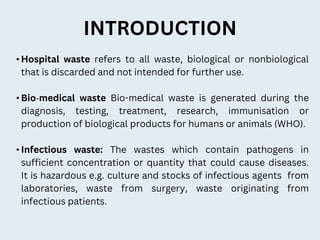
INTRODUCTION
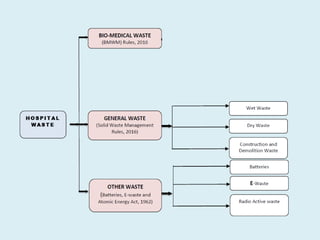
• Hospital waste refers to all waste, biological or nonbiological
that is discarded and not intended for further use.
• Bio‐medical waste Bio-medical waste is generated during the
diagnosis, testing, treatment, research, immunisation or
production of biological products for humans or animals (WHO).
• Infectious waste: The wastes which contain pathogens in
sufficient concentration or quantity that could cause diseases.
It is hazardous e.g. culture and stocks of infectious agents from
laboratories, waste from surgery, waste originating from
infectious patients.
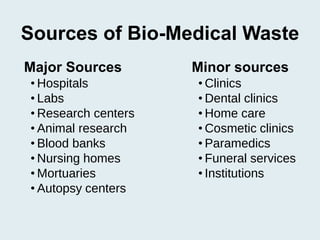
Sources of Bio-Medical Waste
Major Sources
• Hospitals
• Labs
• Research centers
• Animal research
• Blood banks
• Nursing homes
• Mortuaries
• Autopsy centers
Minor sources
• Clinics
• Dental clinics
• Home care
• Cosmetic clinics
• Paramedics
• Funeral services
• Institutions
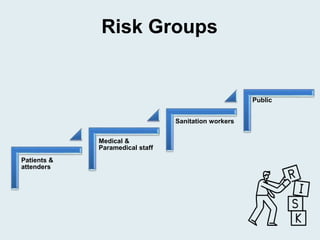
Risk Groups
Patients &
attenders
Public
Medical &
Paramedical staff
Sanitation workers
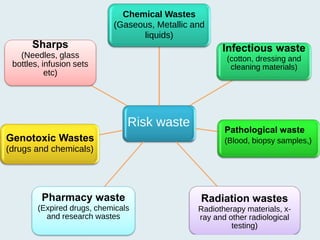
Risk waste
Chemical Wastes
(Gaseous, Metallic and
liquids)
Infectious waste
(cotton, dressing and
cleaning materials)
Pathological waste
(Blood, biopsy samples,)
Radiation wastes
Radiotherapy materials, x-
ray and other radiological
testing)
Pharmacy waste
(Expired drugs, chemicals
and research wastes
Genotoxic Wastes
(drugs and chemicals)
Sharps
(Needles, glass
bottles, infusion sets
etc)
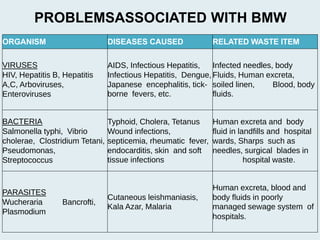
PROBLEMSASSOCIATED WITH BMW
ORGANISM DISEASES CAUSED RELATED WASTE ITEM
VIRUSES
HIV, Hepatitis B, Hepatitis
A,C, Arboviruses,
Enteroviruses
AIDS, Infectious Hepatitis,
Infectious Hepatitis, Dengue,
Japanese encephalitis, tick-
borne fevers, etc.
Infected needles, body
Fluids, Human excreta,
soiled linen, Blood, body
fluids.
BACTERIA
Salmonella typhi, Vibrio
cholerae, Clostridium Tetani,
Pseudomonas,
Streptococcus
Typhoid, Cholera, Tetanus
Wound infections,
septicemia, rheumatic fever,
endocarditis, skin and soft
tissue infections
Human excreta and body
fluid in landfills and hospital
wards, Sharps such as
needles, surgical blades in
hospital waste.
PARASITES
Wucheraria Bancrofti,
Plasmodium
Cutaneous leishmaniasis,
Kala Azar, Malaria
Human excreta, blood and
body fluids in poorly
managed sewage system of
hospitals.
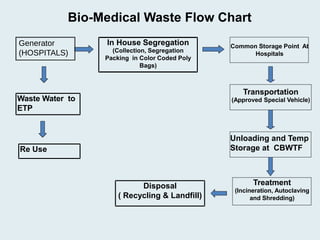
Bio-Medical Waste Flow Chart
In House Segregation
(Collection, Segregation
Packing in Color Coded Poly
Bags)
Re Use
Generator
(HOSPITALS)
Waste Water to
ETP
Common Storage Point At
Hospitals
Transportation
(Approved Special Vehicle)
Unloading and Temp
Storage at CBWTF
Treatment
(Incineration, Autoclaving
and Shredding)
Disposal
( Recycling & Landfill)
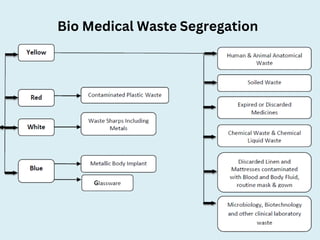
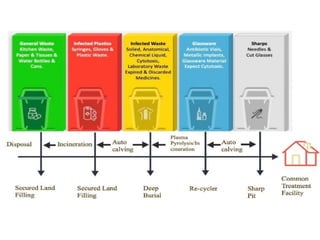
Bio Medical Waste Segregation
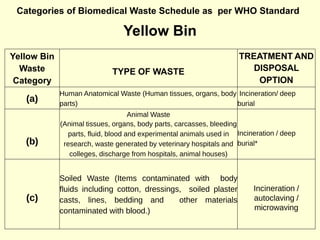
Yellow Bin
Waste
Category
TYPE OF WASTE
TREATMENT AND
DISPOSAL
OPTION
(a)
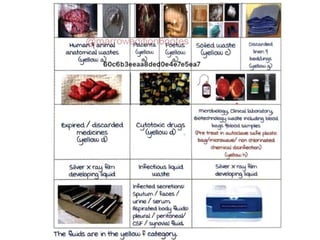
Human Anatomical Waste (Human tissues, organs, body
parts)
Incineration/ deep
burial
(b)
Animal Waste
(Animal tissues, organs, body parts, carcasses, bleeding
parts, fluid, blood and experimental animals used in
research, waste generated by veterinary hospitals and
colleges, discharge from hospitals, animal houses)
Incineration / deep
burial*
(c)
Soiled Waste (Items contaminated with body
fluids including cotton, dressings, soiled plaster
casts, lines, bedding and other materials
contaminated with blood.)
Incineration /
autoclaving /
microwaving
Categories of Biomedical Waste Schedule as per WHO Standard
Yellow Bin
Yellow Bin
Waste
Category
TYPE OF WASTE
TREATMENT AND
DISPOSAL OPTION
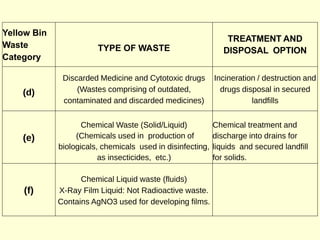
(d)
Discarded Medicine and Cytotoxic drugs
(Wastes comprising of outdated,
contaminated and discarded medicines)
Incineration / destruction and
drugs disposal in secured
landfills
(e)
Chemical Waste (Solid/Liquid)
(Chemicals used in production of
biologicals, chemicals used in disinfecting,
as insecticides, etc.)
Chemical treatment and
discharge into drains for
liquids and secured landfill
for solids.
(f)
Chemical Liquid waste (fluids)
X-Ray Film Liquid: Not Radioactive waste.
Contains AgNO3 used for developing films.
Yellow Bin
Waste
Category
TYPE OF WASTE
TREATMENT AND
DISPOSAL OPTION
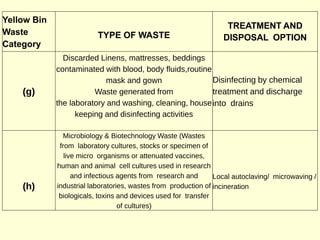
(g)
Discarded Linens, mattresses, beddings
contaminated with blood, body fluids,routine
mask and gown
Waste generated from
the laboratory and washing, cleaning, house
keeping and disinfecting activities
Disinfecting by chemical
treatment and discharge
into drains
(h)
Microbiology & Biotechnology Waste (Wastes
from laboratory cultures, stocks or specimen of
live micro organisms or attenuated vaccines,
human and animal cell cultures used in research
and infectious agents from research and
industrial laboratories, wastes from production of
biologicals, toxins and devices used for transfer
of cultures)
Local autoclaving/ microwaving /
incineration
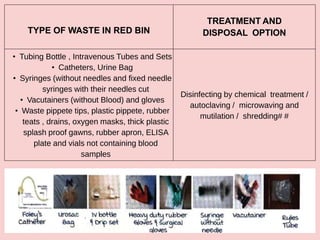
TYPE OF WASTE IN RED BIN
TREATMENT AND
DISPOSAL OPTION
• Tubing Bottle , Intravenous Tubes and Sets
• Catheters, Urine Bag
• Syringes (without needles and fixed needle
syringes with their needles cut
• Vacutainers (without Blood) and gloves
• Waste pippete tips, plastic pippete, rubber
teats , drains, oxygen masks, thick plastic
splash proof gawns, rubber apron, ELISA
plate and vials not containing blood
samples
Disinfecting by chemical treatment /
autoclaving / microwaving and
mutilation / shredding# #
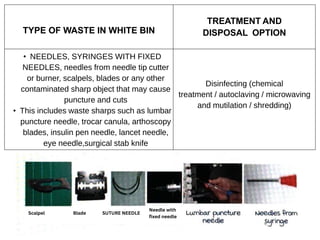
TYPE OF WASTE IN WHITE BIN
TREATMENT AND
DISPOSAL OPTION
• NEEDLES, SYRINGES WITH FIXED
NEEDLES, needles from needle tip cutter
or burner, scalpels, blades or any other
contaminated sharp object that may cause
puncture and cuts
• This includes waste sharps such as lumbar
puncture needle, trocar canula, arthoscopy
blades, insulin pen needle, lancet needle,
eye needle,surgical stab knife
Disinfecting (chemical
treatment / autoclaving / microwaving
and mutilation / shredding)
Scalpel Blade SUTURE NEEDLE
Needle with
fixed needle
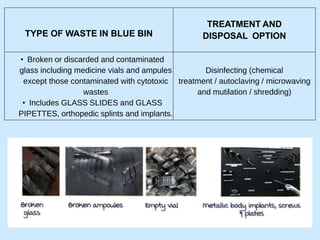
TYPE OF WASTE IN BLUE BIN
TREATMENT AND
DISPOSAL OPTION
• Broken or discarded and contaminated
glass including medicine vials and ampules
except those contaminated with cytotoxic
wastes
• Includes GLASS SLIDES and GLASS
PIPETTES, orthopedic splints and implants.
Disinfecting (chemical
treatment / autoclaving / microwaving
and mutilation / shredding)
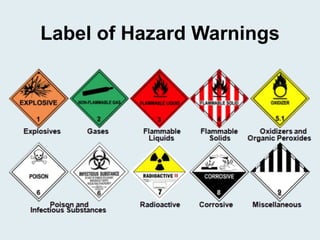
Label of Hazard Warnings
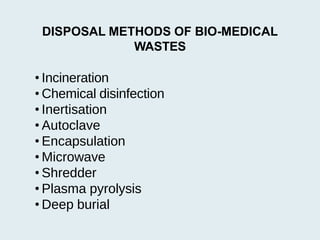
DISPOSAL METHODS OF BIO-MEDICAL
WASTES
• Incineration
• Chemical disinfection
• Inertisation
• Autoclave
• Encapsulation
• Microwave
• Shredder
• Plasma pyrolysis
• Deep burial
DISPOSAL OF BIOMEDICAL WASTE
• Deep burial: – Category 1 and 2 only – In cities having less
than 5 lakh population & rural area.
• Autoclave and microwave treatment – Standards for the
autoclaving and microwaving are also mentioned in the
Biomedical waste (Management and Handling) Rules 1998. –
All equipment installed/shared should meet these
specifications. – Category 3, 4, 6 and 7 can be treated by
these techniques.
• Shredding: – The plastic (I.V. bottles, I.V. sets, syringes,
catheters etc.), sharps (needles, blades, glass etc) should be
shredded but only after chemical
treatment/microwaving/autoclaving. – Needle destroyers can
be used for disposal of needles directly without chemical
treatment.
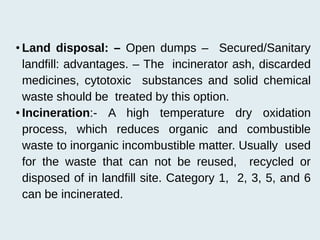
• Land disposal: – Open dumps – Secured/Sanitary
landfill: advantages. – The incinerator ash, discarded
medicines, cytotoxic substances and solid chemical
waste should be treated by this option.
• Incineration:- A high temperature dry oxidation
process, which reduces organic and combustible
waste to inorganic incombustible matter. Usually used
for the waste that can not be reused, recycled or
disposed of in landfill site. Category 1, 2, 3, 5, and 6
can be incinerated.
Safety measures
• All the generators of biomedical waste should
adopt universal precautions and appropriate safety
measures while handling the bio‐medical waste.
• It should be ensured that:
⚬ drivers, collectors and other handlers are aware of the
nature and risk of the waste.
⚬ written instructions provided regarding the procedures
to be adopted in the event of spillage/ accidents.
⚬ protective gears provided and instructions
regarding their uses are given.
⚬ workers are protected by vaccination against tetanus
and hepatitis B.
Staff safety
• Proper training
• Personal protective clothing
and equipment
• Immunization
• Post-exposure prophylaxis
• Medical surveillance
• Personal hygiene
THANK YOU

BIOMEDICAL WASTE MANAGEMENT.pptx

  • 1.
  • 2.
    INTRODUCTION • Hospital wasterefers to all waste, biological or nonbiological that is discarded and not intended for further use. • Bio‐medical waste Bio-medical waste is generated during the diagnosis, testing, treatment, research, immunisation or production of biological products for humans or animals (WHO). • Infectious waste: The wastes which contain pathogens in sufficient concentration or quantity that could cause diseases. It is hazardous e.g. culture and stocks of infectious agents from laboratories, waste from surgery, waste originating from infectious patients.
  • 4.
    Sources of Bio-MedicalWaste Major Sources • Hospitals • Labs • Research centers • Animal research • Blood banks • Nursing homes • Mortuaries • Autopsy centers Minor sources • Clinics • Dental clinics • Home care • Cosmetic clinics • Paramedics • Funeral services • Institutions
  • 5.
    Risk Groups Patients & attenders Public Medical& Paramedical staff Sanitation workers
  • 6.
    Risk waste Chemical Wastes (Gaseous,Metallic and liquids) Infectious waste (cotton, dressing and cleaning materials) Pathological waste (Blood, biopsy samples,) Radiation wastes Radiotherapy materials, x- ray and other radiological testing) Pharmacy waste (Expired drugs, chemicals and research wastes Genotoxic Wastes (drugs and chemicals) Sharps (Needles, glass bottles, infusion sets etc)
  • 7.
    PROBLEMSASSOCIATED WITH BMW ORGANISMDISEASES CAUSED RELATED WASTE ITEM VIRUSES HIV, Hepatitis B, Hepatitis A,C, Arboviruses, Enteroviruses AIDS, Infectious Hepatitis, Infectious Hepatitis, Dengue, Japanese encephalitis, tick- borne fevers, etc. Infected needles, body Fluids, Human excreta, soiled linen, Blood, body fluids. BACTERIA Salmonella typhi, Vibrio cholerae, Clostridium Tetani, Pseudomonas, Streptococcus Typhoid, Cholera, Tetanus Wound infections, septicemia, rheumatic fever, endocarditis, skin and soft tissue infections Human excreta and body fluid in landfills and hospital wards, Sharps such as needles, surgical blades in hospital waste. PARASITES Wucheraria Bancrofti, Plasmodium Cutaneous leishmaniasis, Kala Azar, Malaria Human excreta, blood and body fluids in poorly managed sewage system of hospitals.
  • 8.
    Bio-Medical Waste FlowChart In House Segregation (Collection, Segregation Packing in Color Coded Poly Bags) Re Use Generator (HOSPITALS) Waste Water to ETP Common Storage Point At Hospitals Transportation (Approved Special Vehicle) Unloading and Temp Storage at CBWTF Treatment (Incineration, Autoclaving and Shredding) Disposal ( Recycling & Landfill)
  • 9.
    Bio Medical WasteSegregation
  • 10.
    Yellow Bin Waste Category TYPE OFWASTE TREATMENT AND DISPOSAL OPTION (a) Human Anatomical Waste (Human tissues, organs, body parts) Incineration/ deep burial (b) Animal Waste (Animal tissues, organs, body parts, carcasses, bleeding parts, fluid, blood and experimental animals used in research, waste generated by veterinary hospitals and colleges, discharge from hospitals, animal houses) Incineration / deep burial* (c) Soiled Waste (Items contaminated with body fluids including cotton, dressings, soiled plaster casts, lines, bedding and other materials contaminated with blood.) Incineration / autoclaving / microwaving Categories of Biomedical Waste Schedule as per WHO Standard Yellow Bin
  • 11.
    Yellow Bin Waste Category TYPE OFWASTE TREATMENT AND DISPOSAL OPTION (d) Discarded Medicine and Cytotoxic drugs (Wastes comprising of outdated, contaminated and discarded medicines) Incineration / destruction and drugs disposal in secured landfills (e) Chemical Waste (Solid/Liquid) (Chemicals used in production of biologicals, chemicals used in disinfecting, as insecticides, etc.) Chemical treatment and discharge into drains for liquids and secured landfill for solids. (f) Chemical Liquid waste (fluids) X-Ray Film Liquid: Not Radioactive waste. Contains AgNO3 used for developing films.
  • 12.
    Yellow Bin Waste Category TYPE OFWASTE TREATMENT AND DISPOSAL OPTION (g) Discarded Linens, mattresses, beddings contaminated with blood, body fluids,routine mask and gown Waste generated from the laboratory and washing, cleaning, house keeping and disinfecting activities Disinfecting by chemical treatment and discharge into drains (h) Microbiology & Biotechnology Waste (Wastes from laboratory cultures, stocks or specimen of live micro organisms or attenuated vaccines, human and animal cell cultures used in research and infectious agents from research and industrial laboratories, wastes from production of biologicals, toxins and devices used for transfer of cultures) Local autoclaving/ microwaving / incineration
  • 14.
    TYPE OF WASTEIN RED BIN TREATMENT AND DISPOSAL OPTION • Tubing Bottle , Intravenous Tubes and Sets • Catheters, Urine Bag • Syringes (without needles and fixed needle syringes with their needles cut • Vacutainers (without Blood) and gloves • Waste pippete tips, plastic pippete, rubber teats , drains, oxygen masks, thick plastic splash proof gawns, rubber apron, ELISA plate and vials not containing blood samples Disinfecting by chemical treatment / autoclaving / microwaving and mutilation / shredding# #
  • 15.
    TYPE OF WASTEIN WHITE BIN TREATMENT AND DISPOSAL OPTION • NEEDLES, SYRINGES WITH FIXED NEEDLES, needles from needle tip cutter or burner, scalpels, blades or any other contaminated sharp object that may cause puncture and cuts • This includes waste sharps such as lumbar puncture needle, trocar canula, arthoscopy blades, insulin pen needle, lancet needle, eye needle,surgical stab knife Disinfecting (chemical treatment / autoclaving / microwaving and mutilation / shredding) Scalpel Blade SUTURE NEEDLE Needle with fixed needle
  • 16.
    TYPE OF WASTEIN BLUE BIN TREATMENT AND DISPOSAL OPTION • Broken or discarded and contaminated glass including medicine vials and ampules except those contaminated with cytotoxic wastes • Includes GLASS SLIDES and GLASS PIPETTES, orthopedic splints and implants. Disinfecting (chemical treatment / autoclaving / microwaving and mutilation / shredding)
  • 18.
  • 19.
    DISPOSAL METHODS OFBIO-MEDICAL WASTES • Incineration • Chemical disinfection • Inertisation • Autoclave • Encapsulation • Microwave • Shredder • Plasma pyrolysis • Deep burial
  • 20.
    DISPOSAL OF BIOMEDICALWASTE • Deep burial: – Category 1 and 2 only – In cities having less than 5 lakh population & rural area. • Autoclave and microwave treatment – Standards for the autoclaving and microwaving are also mentioned in the Biomedical waste (Management and Handling) Rules 1998. – All equipment installed/shared should meet these specifications. – Category 3, 4, 6 and 7 can be treated by these techniques. • Shredding: – The plastic (I.V. bottles, I.V. sets, syringes, catheters etc.), sharps (needles, blades, glass etc) should be shredded but only after chemical treatment/microwaving/autoclaving. – Needle destroyers can be used for disposal of needles directly without chemical treatment.
  • 21.
    • Land disposal:– Open dumps – Secured/Sanitary landfill: advantages. – The incinerator ash, discarded medicines, cytotoxic substances and solid chemical waste should be treated by this option. • Incineration:- A high temperature dry oxidation process, which reduces organic and combustible waste to inorganic incombustible matter. Usually used for the waste that can not be reused, recycled or disposed of in landfill site. Category 1, 2, 3, 5, and 6 can be incinerated.
  • 22.
    Safety measures • Allthe generators of biomedical waste should adopt universal precautions and appropriate safety measures while handling the bio‐medical waste. • It should be ensured that: ⚬ drivers, collectors and other handlers are aware of the nature and risk of the waste. ⚬ written instructions provided regarding the procedures to be adopted in the event of spillage/ accidents. ⚬ protective gears provided and instructions regarding their uses are given. ⚬ workers are protected by vaccination against tetanus and hepatitis B.
  • 23.
    Staff safety • Propertraining • Personal protective clothing and equipment • Immunization • Post-exposure prophylaxis • Medical surveillance • Personal hygiene
  • 24.