BME 307
Fundamentals of Ultrasound
Imaging
Medical Ultrasound
Medical ultrasound falls into two distinct categories:
1. Diagnostic
2. Therapeutic
Diagnostic Ultrasound
 Diagnostic ultrasound is a non-invasive diagnostic technique
used to image inside the body.
 Ultrasound probes, called transducers, produce sound waves
that have frequencies above the threshold of human hearing
(above 20KHz). Still, most transducers in current use operate at
much higher frequencies (in the megahertz (MHz) range).
 Most diagnostic ultrasound probes are placed on the skin.
However, to optimize image quality, probes may be placed inside
the body.
 In addition, ultrasound is sometimes used during surgery by
placing a sterile probe into the area being operated on.
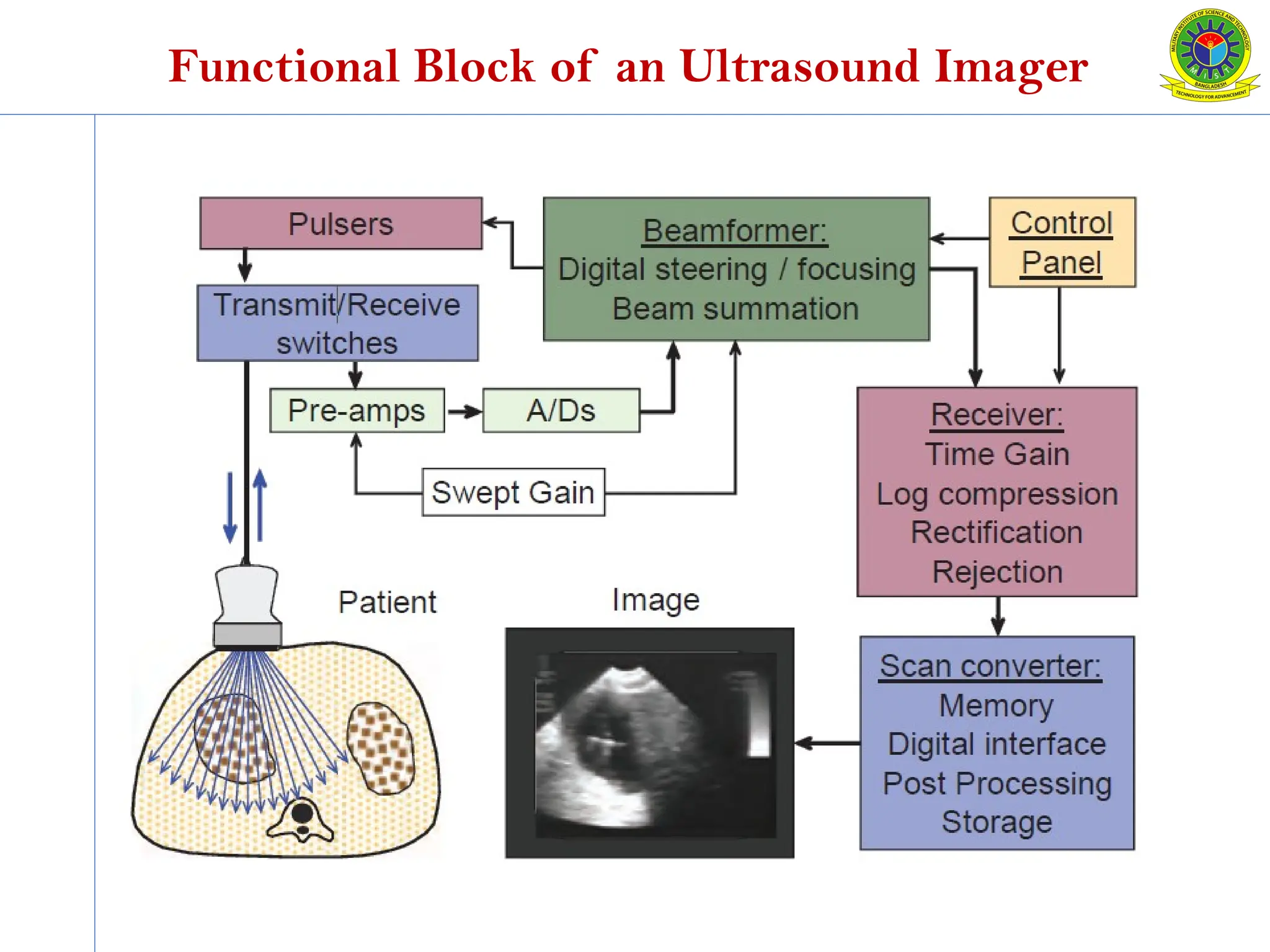
Functional Block of an Ultrasound Imager
Ultrasound Imager
How to Read Ultrasound Images
Sound Characteristics
Interactions of Ultrasound with Matter
Ultrasound interactions are determined by the acoustic
properties of matter. As ultrasound energy propagates through
a medium, interactions include
 Reflection,
 Refraction,
 Scattering, and
 Absorption.
Interactions of Ultrasound with Matter
Ultrasound Transducers
A single-element ultrasound transducer assembly is comprised of the
piezoelectric ceramic, the backing block, acoustic absorber, tuning
coil and metal shield, transducer housing, coaxial cable and voltage
source, and the ceramic to tissue matching layer.
Piezoelectric Element
Transducers
 In general, three different transducers are used : sector, linear and
convex.
 The sector transducer emits sound waves in a fan-shaped beam.
The transducer head is small and the beam close to the transducer
is narrow. The beam travels away from the transducer, it widens,
imaging more of the deeper structures. This transducer is used in
particular in neonatal skull ultrasound. The small transducer head
can see the brain parenchyma through the unfused skull sutures.
 The linear transducer emits parallel sound waves, achieving high
resolution of surface structures (including skin lesions).
 The convex transducer emits parallel sound waves from a convex
surface. Sound waves are emitted in a fan-shaped beam as in the
large convex transducer, only there is more space between the
sound waves close to the transducer. This is the transducer
commonly used in abdominal ultrasound.
Transducers
Frequency
 In addition to transducer shape, frequency also
impacts image quality.
 Frequencies between 2.5 and 7.5 MHz are used for
diagnostic ultrasound.
 High frequency enables a higher image resolution,
but depth is reduced (= lower penetration depth).
 Low frequency reduces resolution, but increases
penetration depth.
Various Planes
 A transducer is used to perform transversal and sagittal
assessments. By moving the transducer over the skin, a
parallel series of ultrasound images is obtained, allowing
systematic assessment of each part of the body.
 Another technique is to tip the transducer. The transducer
is held in place but is rotated ninety degrees; only the
sound beam changes direction.
 In this way structures can be evaluated in two directions.
For instance, in the craniocaudal direction (= transversal
plane) and left-right direction (= sagittal plane). [Figure in Next
Slide]
Important: Location and direction of the transducer on the
patient's skin determine anterior/posterior and left/right
on the imaged obtained.
Various Planes
Fig. 1 Fig. 2
Various Planes
 As a general rule, in the transversal plane (Fig. 1):
 The top of the ultrasound image is the anterior side and
the bottom is the posterior side.
 Left on the image is actually right and vice versa. The
body is seen from below.
 As a general rule, in the sagittal plane (Fig. 2):
 The top of the ultrasound image is the anterior side and
the bottom is the posterior side.
 Right on the image is towards the feet (= caudal) and left
is towards the head (= cranial).
Reflection/deflection/absorption/scatter
 When sound waves move on the boundary surface between two
media with different densities, part of the beam is reflected to the
transducer. This phenomenon is called reflection.
 The remainder of the beam continues on into the tissue, but
under a different angle. This is called deflection.
 As sound waves penetrate the tissue, part of the energy is
converted into heat. This energy loss is called absorption.
 Finally, part of the sound waves are lost in scatter. This takes place
when sound waves move through inhomogeneous tissue or in a
'hard’ boundary surface (= large density difference between two
media).
 Part of the sound waves are reflected in random directions, a
small part of which towards the transducer.
Summary on Reflection/deflection/absorption/scatter
Thank You

BME-Ultrasound imaging-medical imaging in BME

  • 1.
    BME 307 Fundamentals ofUltrasound Imaging
  • 2.
    Medical Ultrasound Medical ultrasoundfalls into two distinct categories: 1. Diagnostic 2. Therapeutic
  • 3.
    Diagnostic Ultrasound  Diagnosticultrasound is a non-invasive diagnostic technique used to image inside the body.  Ultrasound probes, called transducers, produce sound waves that have frequencies above the threshold of human hearing (above 20KHz). Still, most transducers in current use operate at much higher frequencies (in the megahertz (MHz) range).  Most diagnostic ultrasound probes are placed on the skin. However, to optimize image quality, probes may be placed inside the body.  In addition, ultrasound is sometimes used during surgery by placing a sterile probe into the area being operated on.
  • 4.
    Functional Block ofan Ultrasound Imager
  • 5.
  • 6.
    How to ReadUltrasound Images
  • 7.
    How to ReadUltrasound Images
  • 8.
  • 9.
  • 10.
  • 11.
  • 12.
    Interactions of Ultrasoundwith Matter Ultrasound interactions are determined by the acoustic properties of matter. As ultrasound energy propagates through a medium, interactions include  Reflection,  Refraction,  Scattering, and  Absorption.
  • 13.
  • 14.
  • 15.
    Ultrasound Transducers A single-elementultrasound transducer assembly is comprised of the piezoelectric ceramic, the backing block, acoustic absorber, tuning coil and metal shield, transducer housing, coaxial cable and voltage source, and the ceramic to tissue matching layer.
  • 16.
  • 17.
    Transducers  In general,three different transducers are used : sector, linear and convex.  The sector transducer emits sound waves in a fan-shaped beam. The transducer head is small and the beam close to the transducer is narrow. The beam travels away from the transducer, it widens, imaging more of the deeper structures. This transducer is used in particular in neonatal skull ultrasound. The small transducer head can see the brain parenchyma through the unfused skull sutures.  The linear transducer emits parallel sound waves, achieving high resolution of surface structures (including skin lesions).  The convex transducer emits parallel sound waves from a convex surface. Sound waves are emitted in a fan-shaped beam as in the large convex transducer, only there is more space between the sound waves close to the transducer. This is the transducer commonly used in abdominal ultrasound.
  • 18.
  • 19.
    Frequency  In additionto transducer shape, frequency also impacts image quality.  Frequencies between 2.5 and 7.5 MHz are used for diagnostic ultrasound.  High frequency enables a higher image resolution, but depth is reduced (= lower penetration depth).  Low frequency reduces resolution, but increases penetration depth.
  • 20.
    Various Planes  Atransducer is used to perform transversal and sagittal assessments. By moving the transducer over the skin, a parallel series of ultrasound images is obtained, allowing systematic assessment of each part of the body.  Another technique is to tip the transducer. The transducer is held in place but is rotated ninety degrees; only the sound beam changes direction.  In this way structures can be evaluated in two directions. For instance, in the craniocaudal direction (= transversal plane) and left-right direction (= sagittal plane). [Figure in Next Slide] Important: Location and direction of the transducer on the patient's skin determine anterior/posterior and left/right on the imaged obtained.
  • 21.
  • 22.
    Various Planes  Asa general rule, in the transversal plane (Fig. 1):  The top of the ultrasound image is the anterior side and the bottom is the posterior side.  Left on the image is actually right and vice versa. The body is seen from below.  As a general rule, in the sagittal plane (Fig. 2):  The top of the ultrasound image is the anterior side and the bottom is the posterior side.  Right on the image is towards the feet (= caudal) and left is towards the head (= cranial).
  • 23.
    Reflection/deflection/absorption/scatter  When soundwaves move on the boundary surface between two media with different densities, part of the beam is reflected to the transducer. This phenomenon is called reflection.  The remainder of the beam continues on into the tissue, but under a different angle. This is called deflection.  As sound waves penetrate the tissue, part of the energy is converted into heat. This energy loss is called absorption.  Finally, part of the sound waves are lost in scatter. This takes place when sound waves move through inhomogeneous tissue or in a 'hard’ boundary surface (= large density difference between two media).  Part of the sound waves are reflected in random directions, a small part of which towards the transducer.
  • 24.
  • 25.