BLUETOOTH
By
P.Vanjipriya
Assistant professor
KIT-Kalaignar Karunanidhi Institute of
Technology
1
BLUETOOTH
 Universal radio interface for ad-hoc wireless
connectivity
 Interconnecting computer and peripherals,
handheld devices, PDAs, cell phones –
replacement of IrDA
 Bluetooth devices operate at 2.4GHz, low power
consumption.
 in the globally available, license-free, ISM band
(from 2400-2480 MHZ)and they use FH-CDMA
technique because of its inherent interference
rejection capability.
 The Bluetooth radio technology usually uses 79
different channels and can be used at a range of
up to 30 feet.
2
 10 meters With more power, this range can be increased to up top
100 meters.
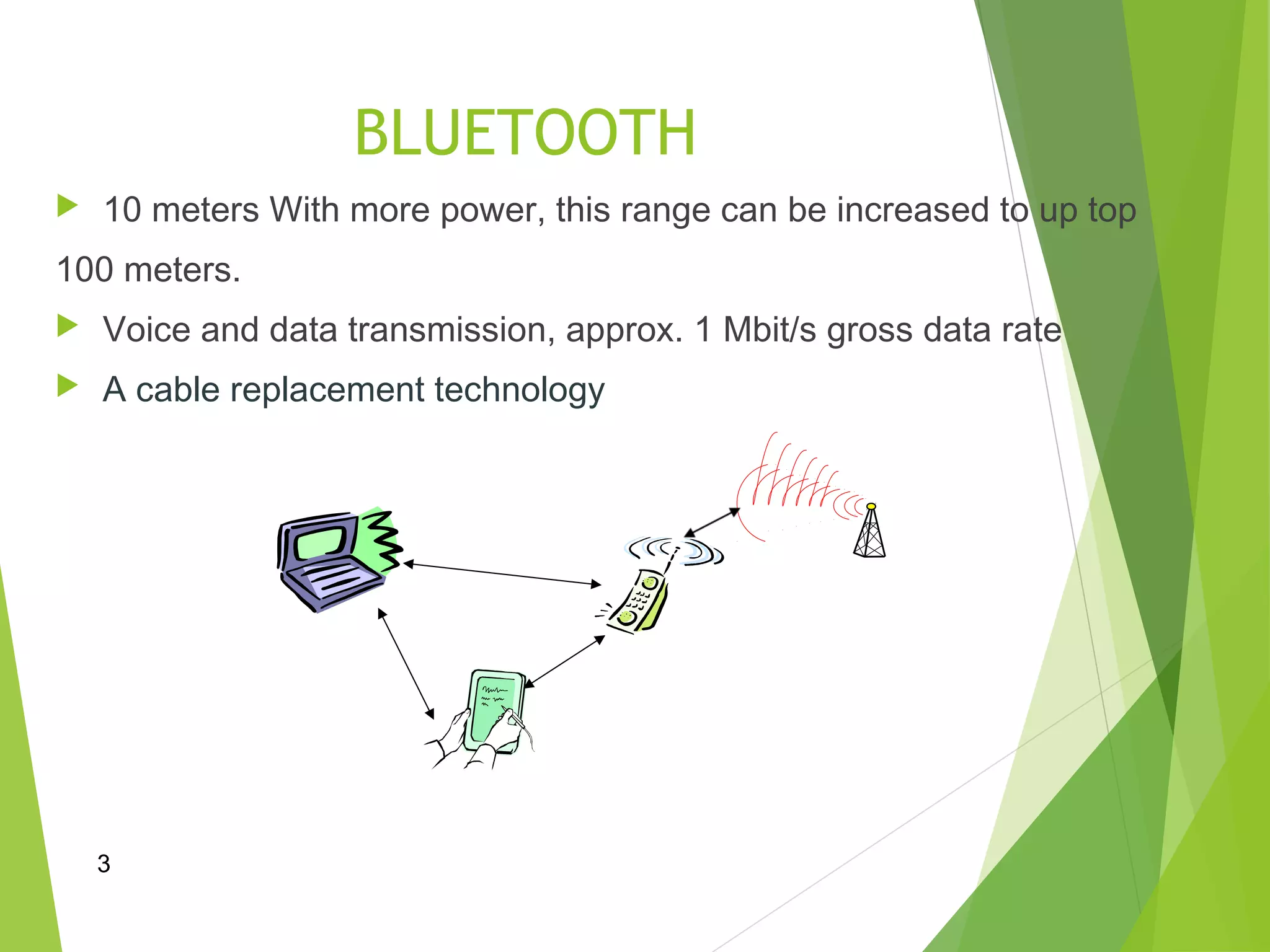
 Voice and data transmission, approx. 1 Mbit/s gross data rate
 A cable replacement technology
3
BLUETOOTH
4
APPLICATIONS AREAS
 Data, audio, graphics, video
 Data and voice access points, Cable replacement, Ad
hoc networking
Personal Ad-Personal Ad-
hoc Networkshoc Networks
Landline
Data/VoiceData/Voice
AccessAccess
PointsPoints
5
Bluetooth Histroy
 Harald Blaatand “Bluetooth” II
 King of Denmark 940-981
 Son of Gorm the Old (King of Denmark) and Thyra
Danebod (daughter of King Ethelred of England)
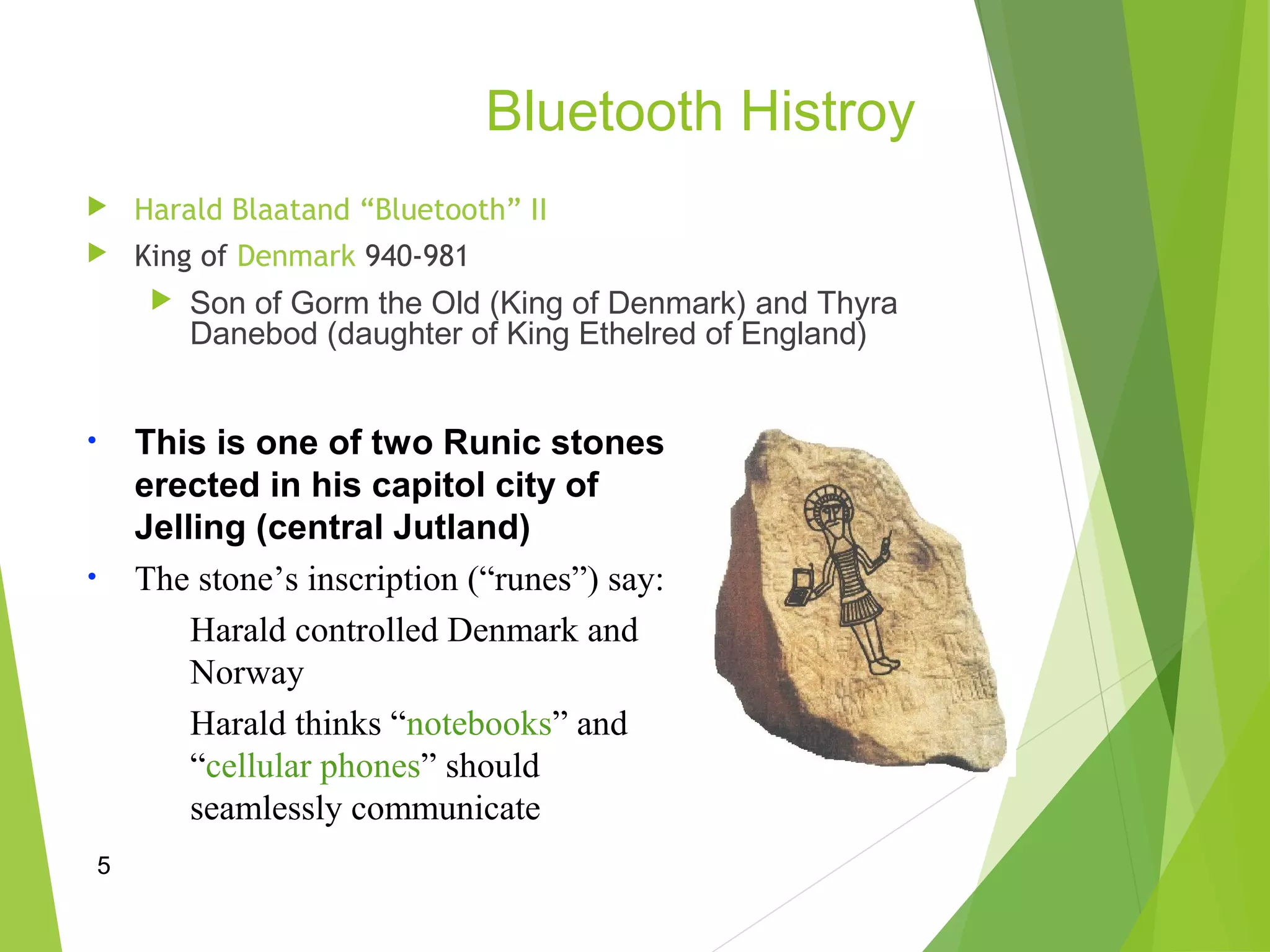
• This is one of two Runic stones
erected in his capitol city of
Jelling (central Jutland)
• The stone’s inscription (“runes”) say:
Harald controlled Denmark and
Norway
Harald thinks “notebooks” and
“cellular phones” should
seamlessly communicate
Bluetooth
 Advantages
 Bluetooth: interoperable
 IrDA: line of sight needed, point-to-point
 WLAN: higher power consumption
 Disadvantages
 Bluetooth: only up to 1 Mbps
 IrDA: much cheaper, faster (up to 16 Mbps)
 WLAN: faster (up to 11 Mbps)
6
7
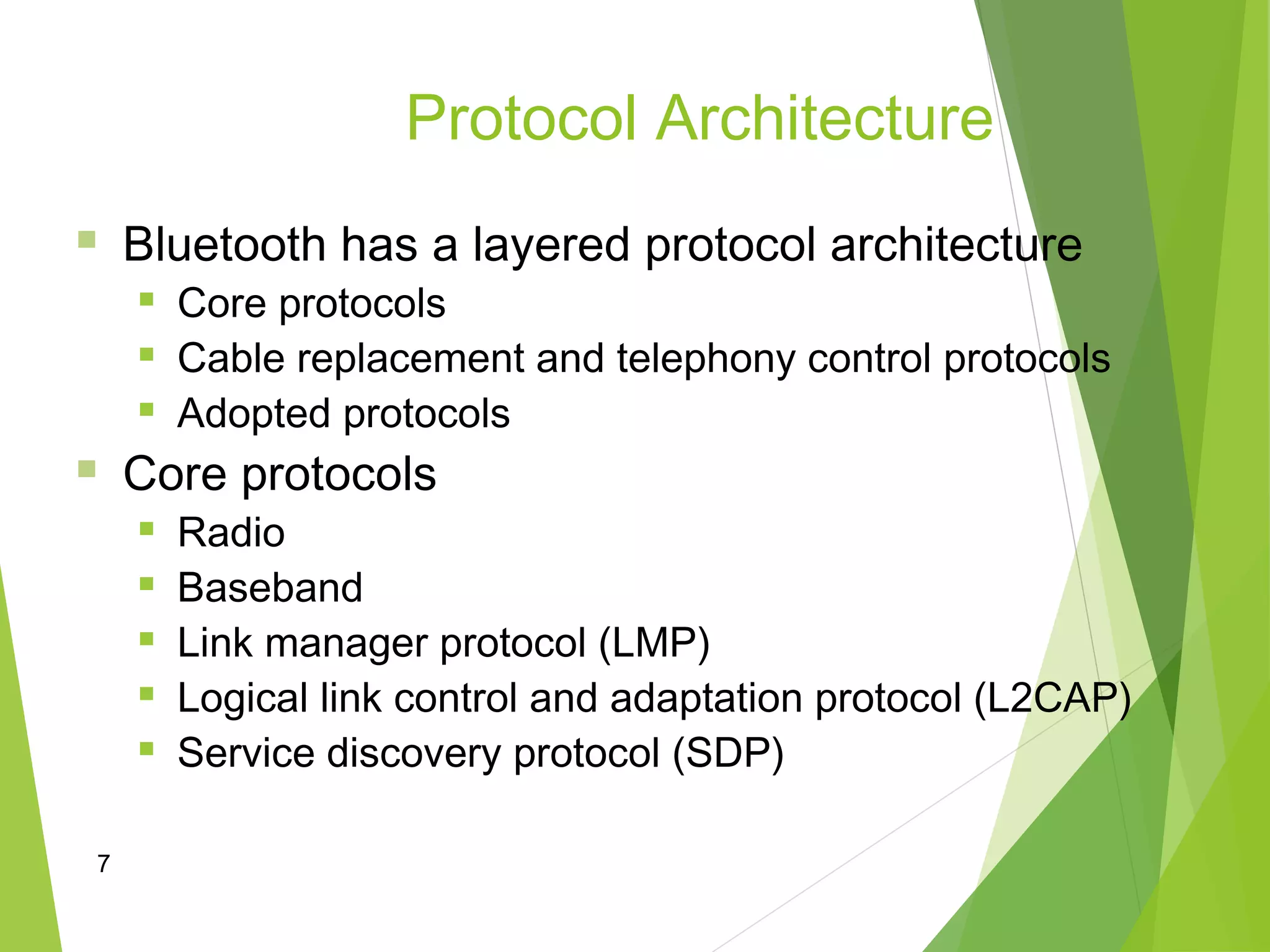
Protocol Architecture
 Bluetooth has a layered protocol architecture
 Core protocols
 Cable replacement and telephony control protocols
 Adopted protocols
 Core protocols
 Radio
 Baseband
 Link manager protocol (LMP)
 Logical link control and adaptation protocol (L2CAP)
 Service discovery protocol (SDP)
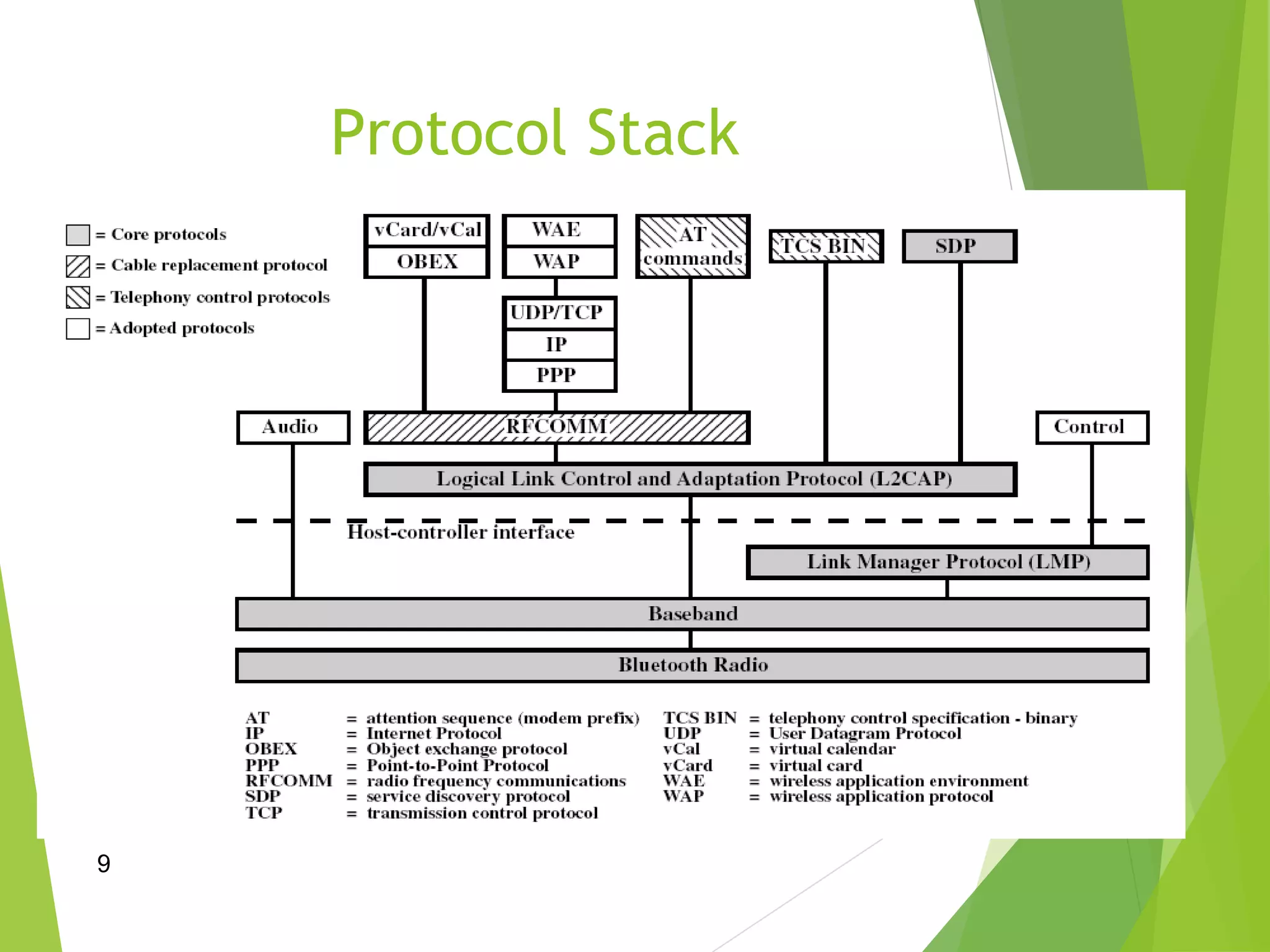
Protocol Architecture
 Cable replacement protocol
 RFCOMM
 Telephony control protocol
 Telephony control specification – binary (TCS BIN)
 Adopted protocols
 PPP
 TCP/UDP/IP
 OBEX
 WAE/WAP
8
Protocol Stack
9
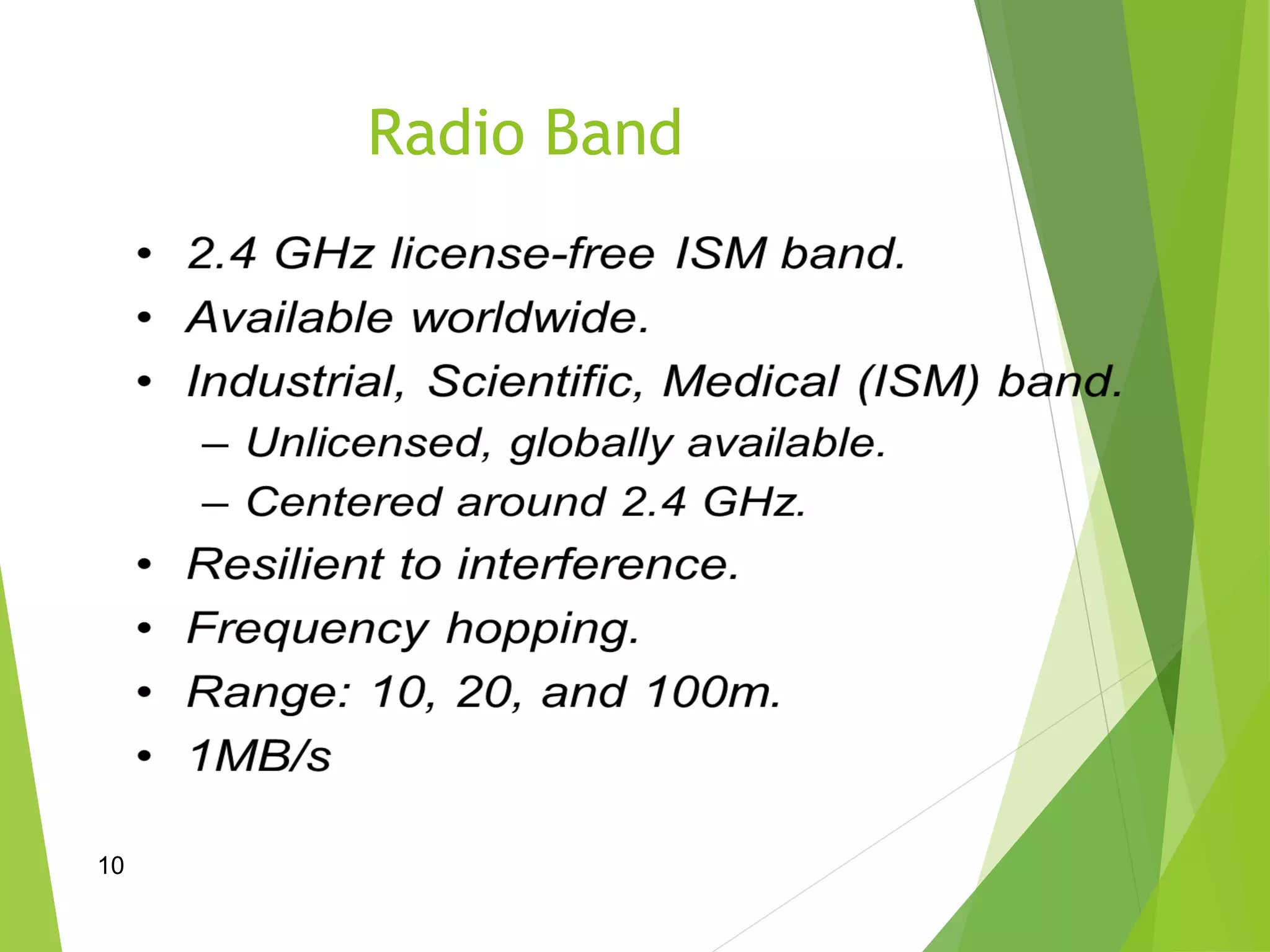
Radio Band
10
Baseband
11
 the physical layer of the Bluetooth that provides
• Error correction
• Flow control
• Hopping sequence
• Security
 hopping through 79 channels
 data is divided in packets
 access code: e.g. timing synchronization
 header: e.g. packet numbering, flow control, slave address
 payload: voice, data or both
Baseband cont…
12
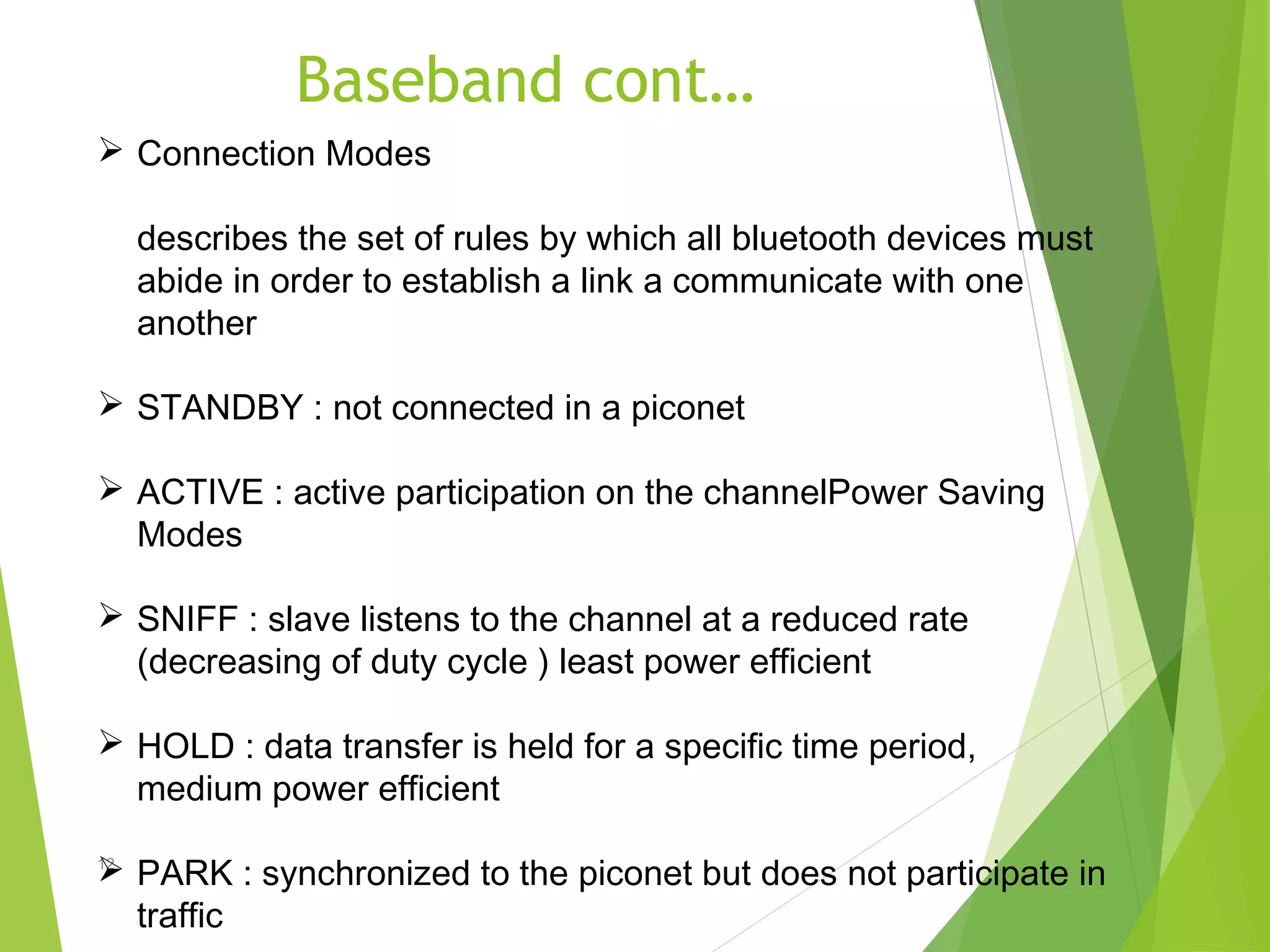
 Connection Modes
describes the set of rules by which all bluetooth devices must
abide in order to establish a link a communicate with one
another
 STANDBY : not connected in a piconet
 ACTIVE : active participation on the channelPower Saving
Modes
 SNIFF : slave listens to the channel at a reduced rate
(decreasing of duty cycle ) least power efficient
 HOLD : data transfer is held for a specific time period,
medium power efficient
 PARK : synchronized to the piconet but does not participate in
traffic
HCI (Host Controller Interface)
provides a command interface to baseband controller and link
manager
also to hardware status, control and event register
Bluetooth defined Host Controller Transport Layers:
UART (HCI over serial interface)
RS232(HCI over serial interface)
USB(HCI over USB interface e.g. USB dongle)
13
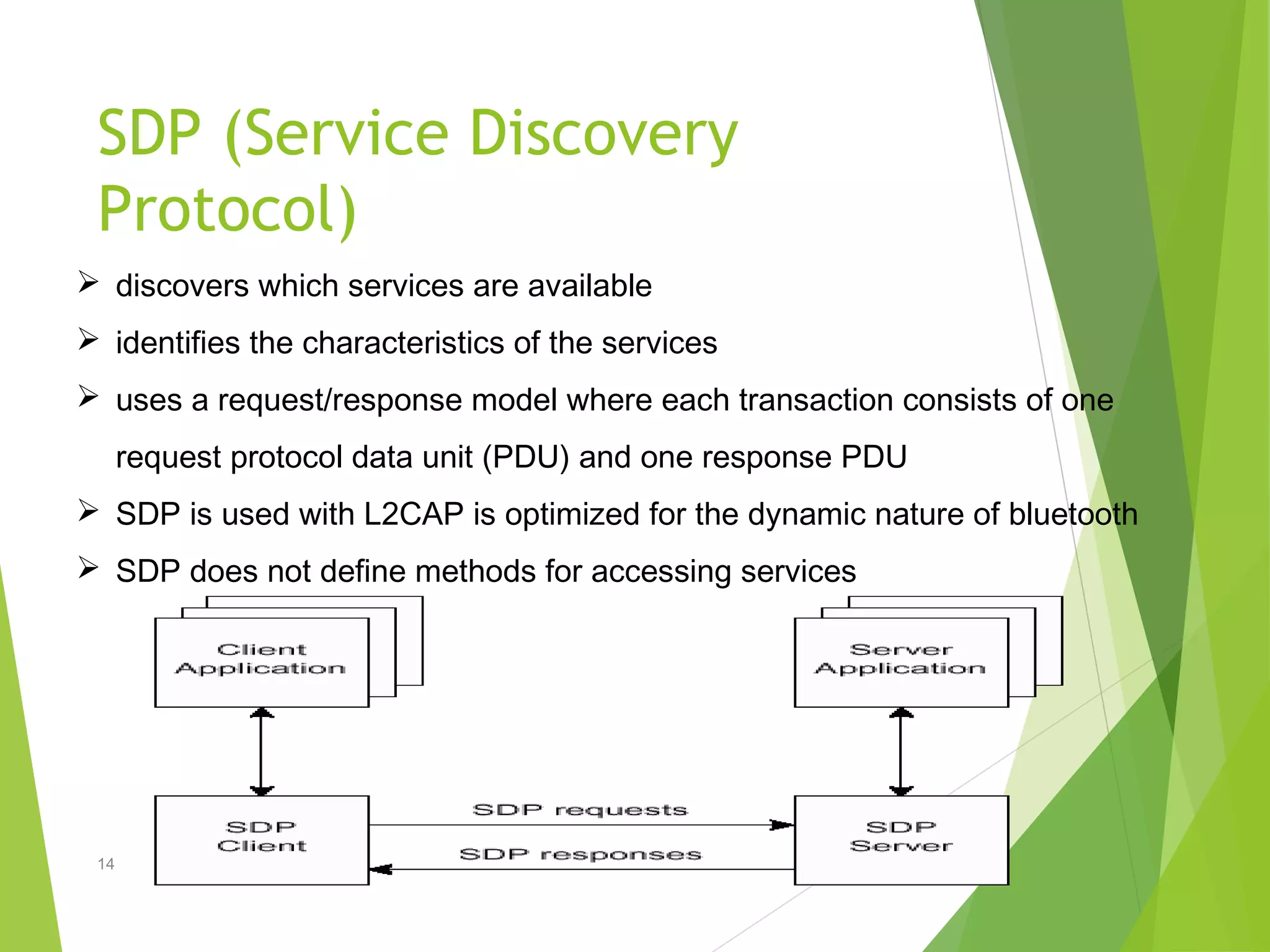
SDP (Service Discovery
Protocol)
14
 discovers which services are available
 identifies the characteristics of the services
 uses a request/response model where each transaction consists of one
request protocol data unit (PDU) and one response PDU
 SDP is used with L2CAP is optimized for the dynamic nature of bluetooth
 SDP does not define methods for accessing services
 Audio
interfaces directly with the baseband. Each voice
connection is over a 64Kbps SCO link.
The voice coding scheme is the Continuous Variable
Slope Delta (CVSD
Link Manager Protocol
link setup and control, authentication and encryption
Host Controller Interface: provides a uniform method of
access to the baseband, control registers etc through
USB, PCI, or UART
Logical Link Control and Adaptation Layer
higher protocols multiplexing, packet
segmentation/reassembly, QoS
Telephony Control Specification
defines the call control signaling for the establishment of
speech and data calls between Bluetooth devices
RFCOMM
provides emulation of serial links (RS232). Upto 60
connections15
Usage Models
16
 File transfer
 Internet bridge
 LAN access
 Synchronization
 Three-in-one phone
 Headset
17
Wireless Network Configurations
 a: piconet with a single slave
 b: piconet with a multi slave
 c: scatternet
18
Ad-hoc-networking
The Bluetooth network topology
19
Piconet
Basic unit of Bluetooth networking
Master and one to seven slave devices
Master determines channel and phase
• All devices in a piconet hop together
–Master gives slaves its clock and device ID
• Non-piconet devices are in standby
• Master can connect to 7 simultaneous or 200+ active
slaves per piconet
• Each piconet has maximum capacity (1 MSps)
• Unique hopping pattern/ID
MS
S
SP
P
SB
SB
20
Scatternets
 Scatternet
 Device in one piconet may exist as master or
slave in another piconet
 Allows many devices to share same area
 Makes efficient use of bandwidth
 Not implemented in COTS equipment
M
M
SS
S
S
P
sb
sb
P
P
Connection Establishment States
21
22
Frequency Hopping (FH)
 Resists interference and multipath effects
 Provides a form of multiple access among co-located devices in different
piconets
 Total bandwidth divided into 1 MHz channels
 FH occurs by jumping from one channel to another in pseudorandom sequence
 Hopping sequence shared across entire piconet
Piconet access:
 Bluetooth devices use time division duplex (TDD)
 Access technique is TDMA
 FH-TDD-TDMA
23
Frequency Hopping
frame uses a single hop frequency for its duration
Multislot Frames
24
Transmit Power
 The power steps shall form a monotonic sequence, with a maximum
step size of 8 dB and a minimum step size of 2 dB.
 A class 1 equipment with a maximum transmit power of +20 dBm must
be able to control its transmit power down to 4 dBm or less.
25
Baseband protocol
 Standby
 Waiting to join a piconet
 Inquire
 Ask about available radios
 Page
 Connect to a specific radio
 Connected
 Actively on a piconet (master or slave)
 Park/Hold
 Low-power connected states
26
Inquiry Page
Connected
AMA
Transmit
data
AMA
HOLD
AMA
PARK
PMA
T =2mstpcl
Low-power
states
Active
states
Standby
Connecting
states
Unconnected:
Standby
Detach
T =2mstpcl
T =0.6stpcl
T =2stpcl
releases
AMA address
Baseband link types
27
 Polling-based (TDD) frame transmissions
 1 slot: 0.625msec (max 1600 slots/sec)
 master/slave slots (even-/odd-numbered slots)
 polling: master always “polls” slaves
 Synchronous connection-oriented (SCO) link
 “circuit-switched”

periodic single-slot frame assignment
 symmetric 64Kbps full-duplex
 Asynchronous connection-less (ACL) link
 Frame switching
 asymmetric bandwidth

variable frame size (1-5 slots)
 max. 721 kbps (57.6 kbps return channel)
 108.8 - 432.6 kbps (symmetric)
0 1 2 3 4 5 6 7 8 9 10 11 12 13 14 15 16 17 18 19 20 21 22
SCO
ACL
master
slave
Bluetooth Frame Fields
 Access code
 used for timing synchronization, offset compensation,
paging, and inquiry
 Header
 used to identify frame type and carry protocol control
information
 Payload
 contains user voice or data and payload header, if present
28
Bluetooth Frame Structure
29
ACCESS CODE - based on identity and system clock of Master
Provides means for synchronization; Unique for channel;
Used by all frames on the channel
Frame
Future Usage
 Home Automation
 Home Entertainment/Games
 Electronic Commerce/M-Commerce
 Industrial Control
 Surveillance
 Access Control
 Location Based Services
 Current Trials: Shopping Malls, Train Stations
30

Bluetooth 1

  • 1.
  • 2.
    BLUETOOTH  Universal radiointerface for ad-hoc wireless connectivity  Interconnecting computer and peripherals, handheld devices, PDAs, cell phones – replacement of IrDA  Bluetooth devices operate at 2.4GHz, low power consumption.  in the globally available, license-free, ISM band (from 2400-2480 MHZ)and they use FH-CDMA technique because of its inherent interference rejection capability.  The Bluetooth radio technology usually uses 79 different channels and can be used at a range of up to 30 feet. 2
  • 3.
     10 metersWith more power, this range can be increased to up top 100 meters.  Voice and data transmission, approx. 1 Mbit/s gross data rate  A cable replacement technology 3 BLUETOOTH
  • 4.
    4 APPLICATIONS AREAS  Data,audio, graphics, video  Data and voice access points, Cable replacement, Ad hoc networking Personal Ad-Personal Ad- hoc Networkshoc Networks Landline Data/VoiceData/Voice AccessAccess PointsPoints
  • 5.
    5 Bluetooth Histroy  HaraldBlaatand “Bluetooth” II  King of Denmark 940-981  Son of Gorm the Old (King of Denmark) and Thyra Danebod (daughter of King Ethelred of England) • This is one of two Runic stones erected in his capitol city of Jelling (central Jutland) • The stone’s inscription (“runes”) say: Harald controlled Denmark and Norway Harald thinks “notebooks” and “cellular phones” should seamlessly communicate
  • 6.
    Bluetooth  Advantages  Bluetooth:interoperable  IrDA: line of sight needed, point-to-point  WLAN: higher power consumption  Disadvantages  Bluetooth: only up to 1 Mbps  IrDA: much cheaper, faster (up to 16 Mbps)  WLAN: faster (up to 11 Mbps) 6
  • 7.
    7 Protocol Architecture  Bluetoothhas a layered protocol architecture  Core protocols  Cable replacement and telephony control protocols  Adopted protocols  Core protocols  Radio  Baseband  Link manager protocol (LMP)  Logical link control and adaptation protocol (L2CAP)  Service discovery protocol (SDP)
  • 8.
    Protocol Architecture  Cablereplacement protocol  RFCOMM  Telephony control protocol  Telephony control specification – binary (TCS BIN)  Adopted protocols  PPP  TCP/UDP/IP  OBEX  WAE/WAP 8
  • 9.
  • 10.
  • 11.
    Baseband 11  the physicallayer of the Bluetooth that provides • Error correction • Flow control • Hopping sequence • Security  hopping through 79 channels  data is divided in packets  access code: e.g. timing synchronization  header: e.g. packet numbering, flow control, slave address  payload: voice, data or both
  • 12.
    Baseband cont… 12  ConnectionModes describes the set of rules by which all bluetooth devices must abide in order to establish a link a communicate with one another  STANDBY : not connected in a piconet  ACTIVE : active participation on the channelPower Saving Modes  SNIFF : slave listens to the channel at a reduced rate (decreasing of duty cycle ) least power efficient  HOLD : data transfer is held for a specific time period, medium power efficient  PARK : synchronized to the piconet but does not participate in traffic
  • 13.
    HCI (Host ControllerInterface) provides a command interface to baseband controller and link manager also to hardware status, control and event register Bluetooth defined Host Controller Transport Layers: UART (HCI over serial interface) RS232(HCI over serial interface) USB(HCI over USB interface e.g. USB dongle) 13
  • 14.
    SDP (Service Discovery Protocol) 14 discovers which services are available  identifies the characteristics of the services  uses a request/response model where each transaction consists of one request protocol data unit (PDU) and one response PDU  SDP is used with L2CAP is optimized for the dynamic nature of bluetooth  SDP does not define methods for accessing services
  • 15.
     Audio interfaces directlywith the baseband. Each voice connection is over a 64Kbps SCO link. The voice coding scheme is the Continuous Variable Slope Delta (CVSD Link Manager Protocol link setup and control, authentication and encryption Host Controller Interface: provides a uniform method of access to the baseband, control registers etc through USB, PCI, or UART Logical Link Control and Adaptation Layer higher protocols multiplexing, packet segmentation/reassembly, QoS Telephony Control Specification defines the call control signaling for the establishment of speech and data calls between Bluetooth devices RFCOMM provides emulation of serial links (RS232). Upto 60 connections15
  • 16.
    Usage Models 16  Filetransfer  Internet bridge  LAN access  Synchronization  Three-in-one phone  Headset
  • 17.
  • 18.
     a: piconetwith a single slave  b: piconet with a multi slave  c: scatternet 18 Ad-hoc-networking
  • 19.
    The Bluetooth networktopology 19 Piconet Basic unit of Bluetooth networking Master and one to seven slave devices Master determines channel and phase • All devices in a piconet hop together –Master gives slaves its clock and device ID • Non-piconet devices are in standby • Master can connect to 7 simultaneous or 200+ active slaves per piconet • Each piconet has maximum capacity (1 MSps) • Unique hopping pattern/ID MS S SP P SB SB
  • 20.
    20 Scatternets  Scatternet  Devicein one piconet may exist as master or slave in another piconet  Allows many devices to share same area  Makes efficient use of bandwidth  Not implemented in COTS equipment M M SS S S P sb sb P P
  • 21.
  • 22.
    22 Frequency Hopping (FH) Resists interference and multipath effects  Provides a form of multiple access among co-located devices in different piconets  Total bandwidth divided into 1 MHz channels  FH occurs by jumping from one channel to another in pseudorandom sequence  Hopping sequence shared across entire piconet Piconet access:  Bluetooth devices use time division duplex (TDD)  Access technique is TDMA  FH-TDD-TDMA
  • 23.
    23 Frequency Hopping frame usesa single hop frequency for its duration
  • 24.
  • 25.
    Transmit Power  Thepower steps shall form a monotonic sequence, with a maximum step size of 8 dB and a minimum step size of 2 dB.  A class 1 equipment with a maximum transmit power of +20 dBm must be able to control its transmit power down to 4 dBm or less. 25
  • 26.
    Baseband protocol  Standby Waiting to join a piconet  Inquire  Ask about available radios  Page  Connect to a specific radio  Connected  Actively on a piconet (master or slave)  Park/Hold  Low-power connected states 26 Inquiry Page Connected AMA Transmit data AMA HOLD AMA PARK PMA T =2mstpcl Low-power states Active states Standby Connecting states Unconnected: Standby Detach T =2mstpcl T =0.6stpcl T =2stpcl releases AMA address
  • 27.
    Baseband link types 27 Polling-based (TDD) frame transmissions  1 slot: 0.625msec (max 1600 slots/sec)  master/slave slots (even-/odd-numbered slots)  polling: master always “polls” slaves  Synchronous connection-oriented (SCO) link  “circuit-switched”  periodic single-slot frame assignment  symmetric 64Kbps full-duplex  Asynchronous connection-less (ACL) link  Frame switching  asymmetric bandwidth  variable frame size (1-5 slots)  max. 721 kbps (57.6 kbps return channel)  108.8 - 432.6 kbps (symmetric) 0 1 2 3 4 5 6 7 8 9 10 11 12 13 14 15 16 17 18 19 20 21 22 SCO ACL master slave
  • 28.
    Bluetooth Frame Fields Access code  used for timing synchronization, offset compensation, paging, and inquiry  Header  used to identify frame type and carry protocol control information  Payload  contains user voice or data and payload header, if present 28
  • 29.
    Bluetooth Frame Structure 29 ACCESSCODE - based on identity and system clock of Master Provides means for synchronization; Unique for channel; Used by all frames on the channel Frame
  • 30.
    Future Usage  HomeAutomation  Home Entertainment/Games  Electronic Commerce/M-Commerce  Industrial Control  Surveillance  Access Control  Location Based Services  Current Trials: Shopping Malls, Train Stations 30