HISTORY
   The Blue Brain Project is an attempt to create a synthetic brain by reverse-
    engineering the Mammalian brain(Human or any living entity’s brain)
    down to the molecular level.

   The aim of the project, founded in May 2005 by the Brain and Mind
    Institute of Switzerland is to study the brain's architectural and functional
    principles. The project is headed by the Institute's director, Henry Markram.

   Using a Blue Gene supercomputer running Michael Hines's NEURON
    software, the simulation does not consist simply of an artificial neural
    network, but involves a biologically realistic model of neurons. It is hoped
    that it will eventually shed light on the nature of consciousness.
    There are a number of sub-projects, including the Cajal Blue Brain,
    coordinated by the Supercomputing and Visualization Center of Madrid
    (CeSViMa), and others run by universities and independent laboratories.


PEOPLE BEHIND BLUE BRAIN PROJECT :

   Project Director : Prof Henry markram
1.   Neocortical column modelling

    The initial goal of the project, completed in December 2006,
     was the simulation of a rat neocortical column, which can be
     considered the smallest functional unit of the neocortex. Such
     a column is about 2 mm tall, has a diameter of 0.5 mm and
     contains about 60,000 neurons in humans.
2. Whole brain simulation

A longer term goal is to build a detailed, functional simulation of the
physiological processes in the human brain

 "It is not impossible to build a human brain and we can do it in 10
years," Henry Markram, director of the Blue Brain Project said in 2009
at the TED conference in Oxford.

 In a BBC World Service interview he said: "If we build it correctly it
should speak and have an intelligence and behave very much as a
human does."
NECESSITY
   Human brain is the most valuable creation of God.
    The man is called intelligent because of the brain.
    The brain translates the information delivered by
    the impulses , which then enables the person to
    react.

   But we loss the knowledge of a brain when the body
    is destroyed after the death of man. That
    knowledge might have been used for the
    development of the human society.

   That’s why the Blue brain is created so that we can
    save the memory of a mammalian brain in a super
    computer.
INTRODUCTION
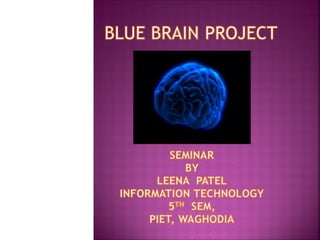
   The Blue Brain Project is an attempt to create a synthetic
    brain by reverse-engineering the mammalian brain down to
    the molecular level in order to understand brain function
    through detailed simulations.

   Simply modeling of Mammalian Brain


   Is it really possible to model a human brain?
   “YES", The IBM is now developing a virtual brain known as
    the BLUE BRAIN.
   IBM’s Blue Gene supercomputer allows a quantum leap in
    the level of detail at which the brain can be modelled.
   It would be the worlds first virtual brain.
   In 2020, we will be able to scan ourselves into the
    computers.
       On 1 July 2005, the Brain Mind Institute (BMI) and IBM
    (International Business Machines) launched the Blue Brain
    Project Using the enormous computing power of IBM’s
    prototype Blue Gene/L supercomputer.

   The aims of this ambitious initiative are to simulate the brains
    of mammals with a high level of biological accuracy and,
    ultimately, to study the steps involved in the emergence of
    biological intelligence.
Hardware and Software
Requirements for modelling
        the Brain
   Memory with a very large storing capacity.

   Processor with a very high processing power.

   A very wide network.

   A program to convert the electric impulses from the brain to input
    signal, which is to be received by the computer and vice versa.

   very powerful Nanobots to act as the interface between the natural
    brain and the computer.


    Finally   it is a      SUPERCOMPUTER
Modelling

   Neurons receive inputs from thousands of other neurons, and
    has branches of highly complex dendritic trees and require
    tens of thousands of compartments to accurately represent
    them.

   Therefore a massive increase in computational power is
    required to make this quantum leap — an increase that is
    provided by IBM’s Blue Gene supercomputer.

   Using a Blue Gene supercomputer running Michael Hines's
    NEURON software, the simulation does not consist simply of an
    artificial neural network, but involves a biologically realistic
    model of neurons.
    Molecular, morphological and electrical properties of the
    different neurons and their synaptic pathways are
    quantitated by Infrared differential interference
    microscopy in brain slices and the use of multi-neuron
    patch-clamping

   Over the past 10 years, the laboratory has prepared for
    this reconstruction by developing the multi-neuron patch-
    clamp approach, recording from thousands of neocortical
    neurons and their synaptic connections, and developing
    quantitative approaches to allow a complete numerical
    breakdown of
    the elementary building blocks of the NCC.
2013     February - decision expected on Human Brain
         Project funding of €1 billion over 10 years
         from the EU
         Simulations using NEURON software ported to
         the Blue Gene/Q system in Jülich
2014     Cellular-level simulation of the entire rat
         brain neocortex, ~100 mesocircuits
         NEURON simulation software ported to the
         DEEP Cluster-Booster prototype system in
         Jülich
2020       Exascale simulations start on the DEEP
        
           Cluster-Booster production system in Jülich
2023     Cellular-level simulation of the entire human
         brain, equivalent to 1,000x the size of the rat
         brain
   Intelligence of a person is not lost even after his
    death.

   Things can be remembered easily without much
    effort.

   Allowing deaf to hear via nerve simulation.

   Making decisions without the presence of the
    person.
   We become dependent upon the computer.

   Others may use technical knowledge against
    us.

   Another fear is found today with respect to
    human cloning.
• We will be
  able to turn
  ourselves
  into
  computers.
References :
 Nature reviews : Neuroscience


 http://bluebrain.epfl.ch/
Blue brain

Blue brain

  • 2.
  • 3.
    The Blue Brain Project is an attempt to create a synthetic brain by reverse- engineering the Mammalian brain(Human or any living entity’s brain) down to the molecular level.  The aim of the project, founded in May 2005 by the Brain and Mind Institute of Switzerland is to study the brain's architectural and functional principles. The project is headed by the Institute's director, Henry Markram.  Using a Blue Gene supercomputer running Michael Hines's NEURON software, the simulation does not consist simply of an artificial neural network, but involves a biologically realistic model of neurons. It is hoped that it will eventually shed light on the nature of consciousness.
  • 4.
    There are a number of sub-projects, including the Cajal Blue Brain, coordinated by the Supercomputing and Visualization Center of Madrid (CeSViMa), and others run by universities and independent laboratories. PEOPLE BEHIND BLUE BRAIN PROJECT :  Project Director : Prof Henry markram
  • 5.
    1. Neocortical column modelling  The initial goal of the project, completed in December 2006, was the simulation of a rat neocortical column, which can be considered the smallest functional unit of the neocortex. Such a column is about 2 mm tall, has a diameter of 0.5 mm and contains about 60,000 neurons in humans.
  • 6.
    2. Whole brainsimulation A longer term goal is to build a detailed, functional simulation of the physiological processes in the human brain  "It is not impossible to build a human brain and we can do it in 10 years," Henry Markram, director of the Blue Brain Project said in 2009 at the TED conference in Oxford.  In a BBC World Service interview he said: "If we build it correctly it should speak and have an intelligence and behave very much as a human does."
  • 7.
  • 8.
    Human brain is the most valuable creation of God. The man is called intelligent because of the brain. The brain translates the information delivered by the impulses , which then enables the person to react.  But we loss the knowledge of a brain when the body is destroyed after the death of man. That knowledge might have been used for the development of the human society.  That’s why the Blue brain is created so that we can save the memory of a mammalian brain in a super computer.
  • 9.
  • 10.
    The Blue Brain Project is an attempt to create a synthetic brain by reverse-engineering the mammalian brain down to the molecular level in order to understand brain function through detailed simulations.  Simply modeling of Mammalian Brain  Is it really possible to model a human brain?
  • 11.
    “YES", The IBM is now developing a virtual brain known as the BLUE BRAIN.  IBM’s Blue Gene supercomputer allows a quantum leap in the level of detail at which the brain can be modelled.  It would be the worlds first virtual brain.  In 2020, we will be able to scan ourselves into the computers.
  • 12.
    On 1 July 2005, the Brain Mind Institute (BMI) and IBM (International Business Machines) launched the Blue Brain Project Using the enormous computing power of IBM’s prototype Blue Gene/L supercomputer.  The aims of this ambitious initiative are to simulate the brains of mammals with a high level of biological accuracy and, ultimately, to study the steps involved in the emergence of biological intelligence.
  • 14.
    Hardware and Software Requirementsfor modelling the Brain
  • 15.
    Memory with a very large storing capacity.  Processor with a very high processing power.  A very wide network.  A program to convert the electric impulses from the brain to input signal, which is to be received by the computer and vice versa.  very powerful Nanobots to act as the interface between the natural brain and the computer. Finally it is a SUPERCOMPUTER
  • 16.
    Modelling  Neurons receive inputs from thousands of other neurons, and has branches of highly complex dendritic trees and require tens of thousands of compartments to accurately represent them.  Therefore a massive increase in computational power is required to make this quantum leap — an increase that is provided by IBM’s Blue Gene supercomputer.  Using a Blue Gene supercomputer running Michael Hines's NEURON software, the simulation does not consist simply of an artificial neural network, but involves a biologically realistic model of neurons.
  • 17.
    Molecular, morphological and electrical properties of the different neurons and their synaptic pathways are quantitated by Infrared differential interference microscopy in brain slices and the use of multi-neuron patch-clamping  Over the past 10 years, the laboratory has prepared for this reconstruction by developing the multi-neuron patch- clamp approach, recording from thousands of neocortical neurons and their synaptic connections, and developing quantitative approaches to allow a complete numerical breakdown of the elementary building blocks of the NCC.
  • 18.
    2013 February - decision expected on Human Brain Project funding of €1 billion over 10 years   from the EU Simulations using NEURON software ported to the Blue Gene/Q system in Jülich 2014 Cellular-level simulation of the entire rat brain neocortex, ~100 mesocircuits   NEURON simulation software ported to the DEEP Cluster-Booster prototype system in Jülich 2020 Exascale simulations start on the DEEP   Cluster-Booster production system in Jülich 2023 Cellular-level simulation of the entire human   brain, equivalent to 1,000x the size of the rat brain
  • 19.
    Intelligence of a person is not lost even after his death.  Things can be remembered easily without much effort.  Allowing deaf to hear via nerve simulation.  Making decisions without the presence of the person.
  • 20.
    We become dependent upon the computer.  Others may use technical knowledge against us.  Another fear is found today with respect to human cloning.
  • 21.
    • We willbe able to turn ourselves into computers.
  • 22.
    References :  Naturereviews : Neuroscience  http://bluebrain.epfl.ch/