BLOOD PRESSURE
MEASUREMENT
Diseases Attributable to Hypertension
© Continuing Medical Implementation
…...bridging the care gap
Hypertension
Heart failure
Stroke
Coronary heart disease
Myocardial infarction
Left ventricular
hypertrophy
Aortic aneurysm
Retinopathy
Peripheral vascular disease
Hypertensive
encephalopathy
Chronic kidney failure
Cerebral hemorrhage
Adapted from: Arch Intern Med 1996; 156:1926-1935.
All
Vascular
WHAT IS BLOOD PRESSURE?
Blood pressure (BP) is a measure of the
force that the circulating blood exerts
against the arterial wall.
SYSTOLIC PRESSURE
• Systolic pressure is the maximum
pressure exerted by the blood against the
arterial walls.
• It results when the ventricles contract (
systole )
DIASTOLIC PRESSURE
• Diastolic Pressure is the lowest
pressure in the artery.
• It result when the ventricles are
relaxed (diastole )
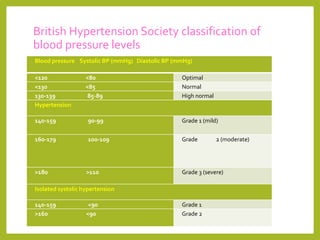
British Hypertension Society classification of
blood pressure levels
Blood pressure Systolic BP (mmHg) Diastolic BP (mmHg)
<120 <80 Optimal
<130 <85 Normal
130-139 85-89 High normal
Hypertension
140-159 90-99 Grade 1 (mild)
160-179 100-109 Grade 2 (moderate)
>180 >110 Grade 3 (severe)
Isolated systolic hypertension
140-159 <90 Grade 1
>160 <90 Grade 2
•BP is measured in mmHg and recorded as systolic
pressure/diastolic pressure, together with where, and
how, the reading was taken, e.g. BP: 146/92 mmHg,
right arm, supine.
•BP is an important guide to cardiovascular risk and
provides vital information on the haemodynamic
condition of acutely ill or injured patients. BP constantly
varies and rises with stress, excitement and
environment.
Blood Pressure measurement
•Office BP measurement:
Two readings, 5 minutes apart, sitting.
•Ambulatory BP monitoring:
For white coat hypertension.
•Self-measurement of BP:
Information on response to therapy, may improve
adherence to therapy.
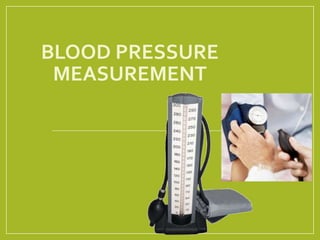
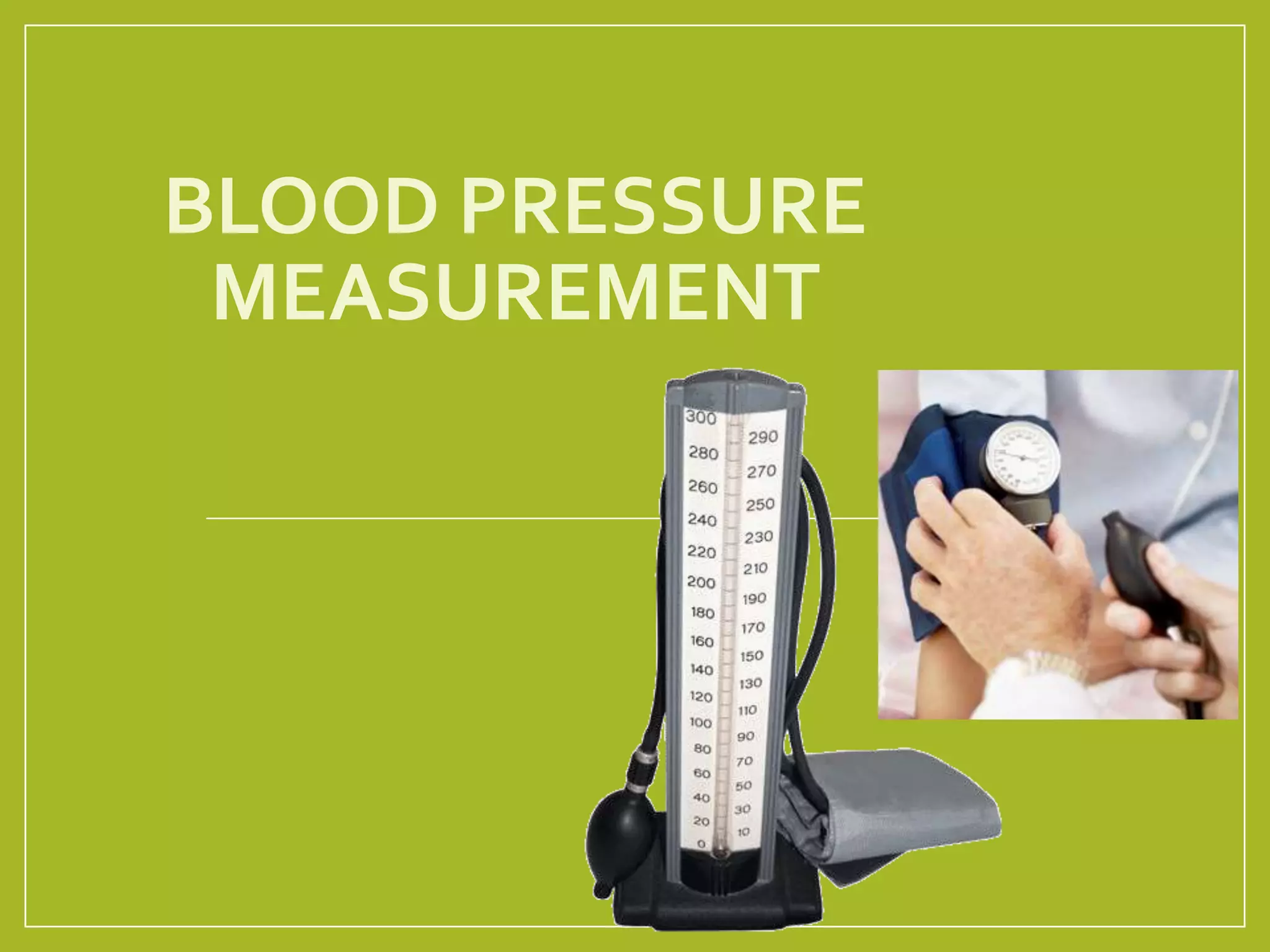
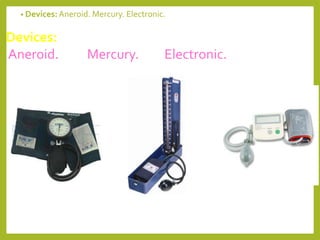
• Devices:Aneroid. Mercury. Electronic.
Devices:
Aneroid. Mercury. Electronic.
Time of measurement
• Use multiple readings at different times
during the waking hours of the patient.
• For patient taking antihypertensive
medications monitoring of blood pressure
should be done before taking the scheduled
dose.
Patient position
• BP should be measured in sitting position.
Patient should sit for 5 minutes before
measuring BP.
• In elderly, supine and standing position can
be used to detect postural hypotension.
Selecting the most accurate blood pressure cuff
• The length of the bladder should
be at least 80% of the
circumference of the upper arm.
• The width of the bladder should be
approximately 40% of the
circumference of the upper arm.
Where to listen for blood pressure sounds
From www.images.md
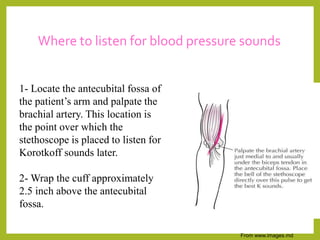
1- Locate the antecubital fossa of
the patient’s arm and palpate the
brachial artery. This location is
the point over which the
stethoscope is placed to listen for
Korotkoff sounds later.
2- Wrap the cuff approximately
2.5 inch above the antecubital
fossa.
Determining the palpated systolic pressure and
the maximum inflation level
From www.images.md
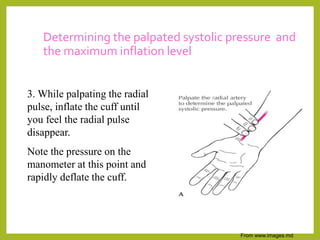
3. While palpating the radial
pulse, inflate the cuff until
you feel the radial pulse
disappear.
Note the pressure on the
manometer at this point and
rapidly deflate the cuff.
Measurement of BP
4- Place the stethoscope lightly over the brachial
artery and inflate the cuff to a pressure 30 mm Hg
greater than estimated systolic pressure.
5- Deflate the cuff slowly at a rate of 2 mm Hg per
heartbeat.
6- Systolic pressure equal the pulse first heard by
auscultation
7- Deflate the cuff until the sounds become
muffled and then disappear.The disappearance
of sound estimate the diastolic pressure.
8- Record the blood pressure reading in even
numbers. Note patient’s position, cuff size, and
arm used for measurement.
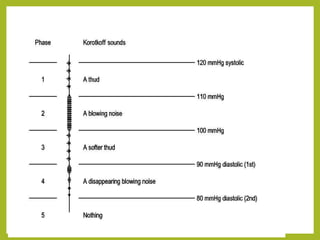
Korotkoff sounds
These noises are produced from under the distal half of the BP
cuff between systole and diastole because the artery collapses
completely and reopens with each heartbeat. As the artery wall
rapidly opens it causes a snapping or tapping sound (like the sail of
a boat snapping in the wind).As the cuff pressure falls below the
diastolic pressure, the sound disappears as the vessel wall no
longer collapses but gently expands with each beat.The first
appearance of the sound (phase 1) indicates systole.As the
pressure is reduced, the sounds muffle (phase 4) and then
disappear (phase 5). Inter-observer agreement is better for phase
5 and this is recorded as diastolic BP. Occasionally muffled sounds
persist (phase 4) and do not disappear; in this case, record phase 4
as the diastolic pressure.
© Continuing Medical Implementation
…...bridging the care gap
3
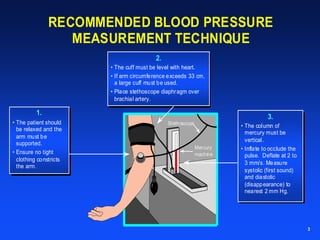
RECOMMENDED BLOOD PRESSURE
MEASUREMENT TECHNIQUE
2.
• The cuff must be level with heart.
• If arm circumference exceeds 33 cm,
a large cuff must be used.
• Place stethoscope diaphragm over
brachial artery.
2.
2.
•
• The cuff must be level with heart.
The cuff must be level with heart.
•
• If arm circumference exceeds 33 cm,
If arm circumference exceeds 33 cm,
a large cuff must be used.
•
• Place stethoscope diaphragm over
Place stethoscope diaphragm over
brachial artery.
brachial artery.
1.
• The patient should
be relaxed and the
arm must be
supported.
• Ensure no tight
clothing constricts
the arm.
1.
1.
•
• The patient should
The patient should
be relaxed and the
be relaxed and the
arm must be
arm must be
supported.
supported.
•
• Ensure no tight
Ensure no tight
clothing constricts
clothing constricts
the arm.
the arm.
3.
• The column of
mercury must be
vertical.
• Inflate to occlude the
pulse. Deflate at 2 to
3 mm/s. Measure
systolic (first sound)
and diastolic
(disappearance) to
nearest 2 mm Hg.
3.
3.
•
• The column of
The column of
mercury must be
mercury must be
vertical.
vertical.
•
• Inflate to occlude the
Inflate to occlude the
pulse. Deflate at 2 to
3 mm/s. Measure
3 mm/s. Measure
systolic (first sound)
and diastolic
and diastolic
(disappearance) to
(disappearance) to
nearest 2 mm Hg.
nearest 2 mm Hg.
Stethoscope
Stethoscope
Mercury
Mercury
machine
machine
Common problems in BP
measurement
• BP different in each arm: A difference >10 mmHg suggests peripheral
vascular disease and raises the possibility of renal artery stenosis as the
cause of hypertension. Record the highest pressure and treat this
• Wrong cuff size: A cuff of 12.5 × 23 cm is suitable for only 60% of
Europeans.The bladder should encircle between 80% and 100% of the
arm. In obese patients with large arms a normal-sized cuff will over-
estimate BP and the error is greater when the centre of the cuff is not
over the brachial artery.Therefore for obese patients a larger cuff must
be used. Using too large a cuff produces only a small under-estimation
of BP (2-3 mm in systolic BP)
• Auscultatory gap: Up to 20% of elderly hypertensive patients
have phase 1 Korotkoff sounds which begin at systolic pressure
but then disappear for varying lengths of time, reappearing before
diastolic pressure. If the first appearance of the sound is missed,
the systolic pressure will be recorded at a falsely low level. Avoid
this by palpating the systolic pressure first
• Excess pressure of stethoscope: Excess pressure can artificially
lower the diastolic reading by 10 mmHg.The systolic pressure is
not usually affected
• Patient's arm at the wrong level: The patient's elbow should be
level with his heart. Hydrostatic pressure effects mean that if the
arm is 7 cm higher, both systole and diastole pressures will be 5
mmHg lower. If the arm is 7 cm lower than the heart, they will be
about 6 mm higher
• Postural change: When a healthy person stands, the pulse
increases by about 11 bpm and stabilizes after 1 min.The BP
stabilizes after 1-2 min. Check the BP after a patient has been
standing for 2 min; a drop of ≥20 mmHg on standing is postural
hypotension
• Abnormal pulse pressure: The pulse pressure is the difference
between the systolic and diastolic pressures. A pulse pressure of
≥80 mmHg suggests aortic regurgitation, while a low pulse
pressure may occur in aortic stenosis.
thank you

BLOOD PRESSURE MEASUREMENT.pdf

  • 1.
  • 2.
    Diseases Attributable toHypertension © Continuing Medical Implementation …...bridging the care gap Hypertension Heart failure Stroke Coronary heart disease Myocardial infarction Left ventricular hypertrophy Aortic aneurysm Retinopathy Peripheral vascular disease Hypertensive encephalopathy Chronic kidney failure Cerebral hemorrhage Adapted from: Arch Intern Med 1996; 156:1926-1935. All Vascular
  • 3.
    WHAT IS BLOODPRESSURE? Blood pressure (BP) is a measure of the force that the circulating blood exerts against the arterial wall.
  • 4.
    SYSTOLIC PRESSURE • Systolicpressure is the maximum pressure exerted by the blood against the arterial walls. • It results when the ventricles contract ( systole )
  • 5.
    DIASTOLIC PRESSURE • DiastolicPressure is the lowest pressure in the artery. • It result when the ventricles are relaxed (diastole )
  • 6.
    British Hypertension Societyclassification of blood pressure levels Blood pressure Systolic BP (mmHg) Diastolic BP (mmHg) <120 <80 Optimal <130 <85 Normal 130-139 85-89 High normal Hypertension 140-159 90-99 Grade 1 (mild) 160-179 100-109 Grade 2 (moderate) >180 >110 Grade 3 (severe) Isolated systolic hypertension 140-159 <90 Grade 1 >160 <90 Grade 2
  • 7.
    •BP is measuredin mmHg and recorded as systolic pressure/diastolic pressure, together with where, and how, the reading was taken, e.g. BP: 146/92 mmHg, right arm, supine. •BP is an important guide to cardiovascular risk and provides vital information on the haemodynamic condition of acutely ill or injured patients. BP constantly varies and rises with stress, excitement and environment.
  • 8.
    Blood Pressure measurement •OfficeBP measurement: Two readings, 5 minutes apart, sitting. •Ambulatory BP monitoring: For white coat hypertension. •Self-measurement of BP: Information on response to therapy, may improve adherence to therapy.
  • 9.
    • Devices:Aneroid. Mercury.Electronic. Devices: Aneroid. Mercury. Electronic.
  • 10.
    Time of measurement •Use multiple readings at different times during the waking hours of the patient. • For patient taking antihypertensive medications monitoring of blood pressure should be done before taking the scheduled dose.
  • 11.
    Patient position • BPshould be measured in sitting position. Patient should sit for 5 minutes before measuring BP. • In elderly, supine and standing position can be used to detect postural hypotension.
  • 12.
    Selecting the mostaccurate blood pressure cuff • The length of the bladder should be at least 80% of the circumference of the upper arm. • The width of the bladder should be approximately 40% of the circumference of the upper arm.
  • 13.
    Where to listenfor blood pressure sounds From www.images.md 1- Locate the antecubital fossa of the patient’s arm and palpate the brachial artery. This location is the point over which the stethoscope is placed to listen for Korotkoff sounds later. 2- Wrap the cuff approximately 2.5 inch above the antecubital fossa.
  • 14.
    Determining the palpatedsystolic pressure and the maximum inflation level From www.images.md 3. While palpating the radial pulse, inflate the cuff until you feel the radial pulse disappear. Note the pressure on the manometer at this point and rapidly deflate the cuff.
  • 15.
    Measurement of BP 4-Place the stethoscope lightly over the brachial artery and inflate the cuff to a pressure 30 mm Hg greater than estimated systolic pressure. 5- Deflate the cuff slowly at a rate of 2 mm Hg per heartbeat. 6- Systolic pressure equal the pulse first heard by auscultation
  • 16.
    7- Deflate thecuff until the sounds become muffled and then disappear.The disappearance of sound estimate the diastolic pressure. 8- Record the blood pressure reading in even numbers. Note patient’s position, cuff size, and arm used for measurement.
  • 17.
    Korotkoff sounds These noisesare produced from under the distal half of the BP cuff between systole and diastole because the artery collapses completely and reopens with each heartbeat. As the artery wall rapidly opens it causes a snapping or tapping sound (like the sail of a boat snapping in the wind).As the cuff pressure falls below the diastolic pressure, the sound disappears as the vessel wall no longer collapses but gently expands with each beat.The first appearance of the sound (phase 1) indicates systole.As the pressure is reduced, the sounds muffle (phase 4) and then disappear (phase 5). Inter-observer agreement is better for phase 5 and this is recorded as diastolic BP. Occasionally muffled sounds persist (phase 4) and do not disappear; in this case, record phase 4 as the diastolic pressure.
  • 19.
    © Continuing MedicalImplementation …...bridging the care gap 3 RECOMMENDED BLOOD PRESSURE RECOMMENDED BLOOD PRESSURE MEASUREMENT TECHNIQUE MEASUREMENT TECHNIQUE 2. • The cuff must be level with heart. • If arm circumference exceeds 33 cm, a large cuff must be used. • Place stethoscope diaphragm over brachial artery. 2. 2. • • The cuff must be level with heart. The cuff must be level with heart. • • If arm circumference exceeds 33 cm, If arm circumference exceeds 33 cm, a large cuff must be used. a large cuff must be used. • • Place stethoscope diaphragm over Place stethoscope diaphragm over brachial artery. brachial artery. 1. • The patient should be relaxed and the arm must be supported. • Ensure no tight clothing constricts the arm. 1. 1. • • The patient should The patient should be relaxed and the be relaxed and the arm must be arm must be supported. supported. • • Ensure no tight Ensure no tight clothing constricts clothing constricts the arm. the arm. 3. • The column of mercury must be vertical. • Inflate to occlude the pulse. Deflate at 2 to 3 mm/s. Measure systolic (first sound) and diastolic (disappearance) to nearest 2 mm Hg. 3. 3. • • The column of The column of mercury must be mercury must be vertical. vertical. • • Inflate to occlude the Inflate to occlude the pulse. Deflate at 2 to pulse. Deflate at 2 to 3 mm/s. Measure 3 mm/s. Measure systolic (first sound) systolic (first sound) and diastolic and diastolic (disappearance) to (disappearance) to nearest 2 mm Hg. nearest 2 mm Hg. Stethoscope Stethoscope Mercury Mercury machine machine
  • 20.
    Common problems inBP measurement • BP different in each arm: A difference >10 mmHg suggests peripheral vascular disease and raises the possibility of renal artery stenosis as the cause of hypertension. Record the highest pressure and treat this • Wrong cuff size: A cuff of 12.5 × 23 cm is suitable for only 60% of Europeans.The bladder should encircle between 80% and 100% of the arm. In obese patients with large arms a normal-sized cuff will over- estimate BP and the error is greater when the centre of the cuff is not over the brachial artery.Therefore for obese patients a larger cuff must be used. Using too large a cuff produces only a small under-estimation of BP (2-3 mm in systolic BP)
  • 21.
    • Auscultatory gap:Up to 20% of elderly hypertensive patients have phase 1 Korotkoff sounds which begin at systolic pressure but then disappear for varying lengths of time, reappearing before diastolic pressure. If the first appearance of the sound is missed, the systolic pressure will be recorded at a falsely low level. Avoid this by palpating the systolic pressure first • Excess pressure of stethoscope: Excess pressure can artificially lower the diastolic reading by 10 mmHg.The systolic pressure is not usually affected • Patient's arm at the wrong level: The patient's elbow should be level with his heart. Hydrostatic pressure effects mean that if the arm is 7 cm higher, both systole and diastole pressures will be 5 mmHg lower. If the arm is 7 cm lower than the heart, they will be about 6 mm higher
  • 22.
    • Postural change:When a healthy person stands, the pulse increases by about 11 bpm and stabilizes after 1 min.The BP stabilizes after 1-2 min. Check the BP after a patient has been standing for 2 min; a drop of ≥20 mmHg on standing is postural hypotension • Abnormal pulse pressure: The pulse pressure is the difference between the systolic and diastolic pressures. A pulse pressure of ≥80 mmHg suggests aortic regurgitation, while a low pulse pressure may occur in aortic stenosis.
  • 23.