The Blood
Shalini Sehgal
Deptt Of Home Science
Mata Sahib Kaur Girls College
Talwandi sabo
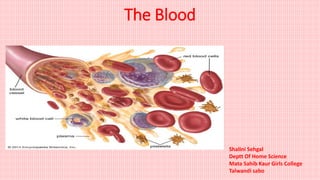
Blood
Plasma
(55%)
Cells(45%)
Platelets
White
Blood
Cells
Red Blood
Cells
Plasma
Plasma Contains:
 90% of water
Salts… keep the blood alkaline chiefly chlorides ,phosphates,carbonates of Na , K and
Ca.
Proteins (albumin, globulin, and fibrinogen)
Antibodies mainly globulins
Hormones
Nutrients like fatty acids ,glucose and amino acids
Oxygen in soluble form
Waste Products like Urea and Carbon Dioxide
Blood Clotting substances like fibrinogen, prothrombin, heparin
Enzymes.
Blood Cells
The blood cells are of three types :
 Red Blood cells
 White Blood cells
 Platelets
Red Blood Cells
 These are also known as “Erythrocytes”.
 The life span of RBS is 120 days.
 They are formed in bone marrow. Production of RBC requires VitB12.
 They are of Biconcave disc shaped.
 No nucleus present in thesecells.
 Volume: 5-5.5 ml/mm3.
 The function of RBC is to carry oxygen and collect carbon dioxide through the use of
hemoglobin(iron) .
 Hemoglobin level in
 Male: 14-18g/100cc
 Female: 12-16g/100cc
White BloodCells
• These are also known as “Leucocytes”
• The life span of WBC is 3-4days.
• Volume: 7000-10,000ml/mm3
• Main function of WBC is to fight bacterial infections by
engulfing and killing the bacteria and to digest the dead
tissues.
• They are of irregular shape
• Protoplasm and nucleus is present in these cells
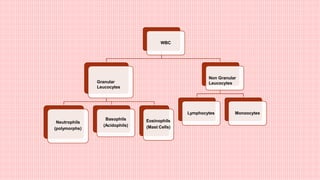
Types of WBC
These are of two types
Granular Leucocytes(They have granules in their
cytoplasm.)
Non Granular Leucocytes(They do not have granules
in their cytoplasm)
WBC
Granular
Leucocytes
Neutrophils
(polymorphs)
Basophils
(Acidophils)
Eosinophils
(Mast Cells)
Non Granular
Leucocytes
Lymphocytes Monoocytes
Platelets
These are also known as “Thrombocytes”
The life span of platelets are 3-7 days.
Number : 2,50,000 per cubic mm of blood
Formed in special cells of bone marrow
They are of irregular shape
Nucleus is present in these cells.
The function of platelets is to help in formation o
fblood clots.
Breaks down, when bleeding occurs due to injury and
release an enzyme thromboplastin,which initiates blood
clotting.
Blood and its composition

Blood and its composition

  • 1.
    The Blood Shalini Sehgal DepttOf Home Science Mata Sahib Kaur Girls College Talwandi sabo
  • 2.
  • 3.
    Plasma Plasma Contains:  90%of water Salts… keep the blood alkaline chiefly chlorides ,phosphates,carbonates of Na , K and Ca. Proteins (albumin, globulin, and fibrinogen) Antibodies mainly globulins Hormones Nutrients like fatty acids ,glucose and amino acids Oxygen in soluble form Waste Products like Urea and Carbon Dioxide Blood Clotting substances like fibrinogen, prothrombin, heparin Enzymes.
  • 4.
    Blood Cells The bloodcells are of three types :  Red Blood cells  White Blood cells  Platelets
  • 5.
    Red Blood Cells These are also known as “Erythrocytes”.  The life span of RBS is 120 days.  They are formed in bone marrow. Production of RBC requires VitB12.  They are of Biconcave disc shaped.  No nucleus present in thesecells.  Volume: 5-5.5 ml/mm3.  The function of RBC is to carry oxygen and collect carbon dioxide through the use of hemoglobin(iron) .  Hemoglobin level in  Male: 14-18g/100cc  Female: 12-16g/100cc
  • 6.
    White BloodCells • Theseare also known as “Leucocytes” • The life span of WBC is 3-4days. • Volume: 7000-10,000ml/mm3 • Main function of WBC is to fight bacterial infections by engulfing and killing the bacteria and to digest the dead tissues. • They are of irregular shape • Protoplasm and nucleus is present in these cells
  • 7.
    Types of WBC Theseare of two types Granular Leucocytes(They have granules in their cytoplasm.) Non Granular Leucocytes(They do not have granules in their cytoplasm)
  • 8.
  • 9.
    Platelets These are alsoknown as “Thrombocytes” The life span of platelets are 3-7 days. Number : 2,50,000 per cubic mm of blood Formed in special cells of bone marrow They are of irregular shape Nucleus is present in these cells. The function of platelets is to help in formation o fblood clots. Breaks down, when bleeding occurs due to injury and release an enzyme thromboplastin,which initiates blood clotting.