VALUES AND IMPORTANCE OF BLOOD DONATION
By
AJAL.A.J
WHAT IS SO WONDERFUL ABOUT
BLOOD?
Blood as a Scarce Resource
in the World
 75 million units of blood are donated each year75 million units of blood are donated each year
 500,000 women who die from complication of500,000 women who die from complication of
pregnancy each yearpregnancy each year
 150,000 die because of lack of blood.150,000 die because of lack of blood.
 80% of the worldwide population has access to80% of the worldwide population has access to
only 20% of safe blood.only 20% of safe blood.
 Only 16% of blood supply is donated by voluntary/Only 16% of blood supply is donated by voluntary/
non-remunerated blood donors in the worldnon-remunerated blood donors in the world
because of only family/replacement do in most ofbecause of only family/replacement do in most of
developing countries.developing countries. WHO Information Sheets, 2005
What is Blood?
• Specialized cells suspended in plasma
• Constantly circulating throughout body
• Carries oxygen and nourishment to cells and
removes waste products
• Supports body’s immune system and
capacity to heal itself
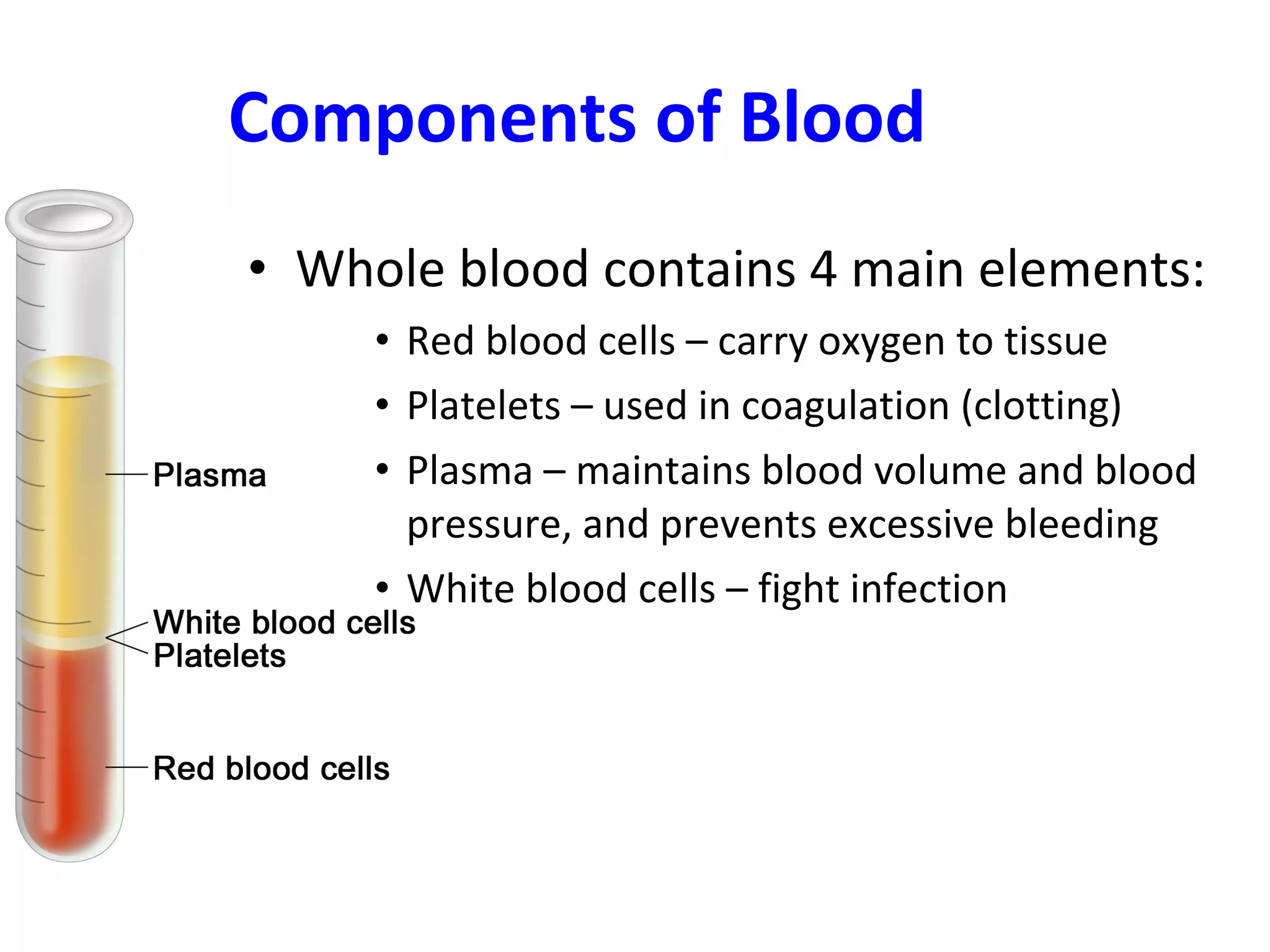
Components of Blood
• Whole blood contains 4 main elements:
• Red blood cells – carry oxygen to tissue
• Platelets – used in coagulation (clotting)
• Plasma – maintains blood volume and blood
pressure, and prevents excessive bleeding
• White blood cells – fight infection
Blood vessel
Plasma
RBCWBC Platelets
Blood
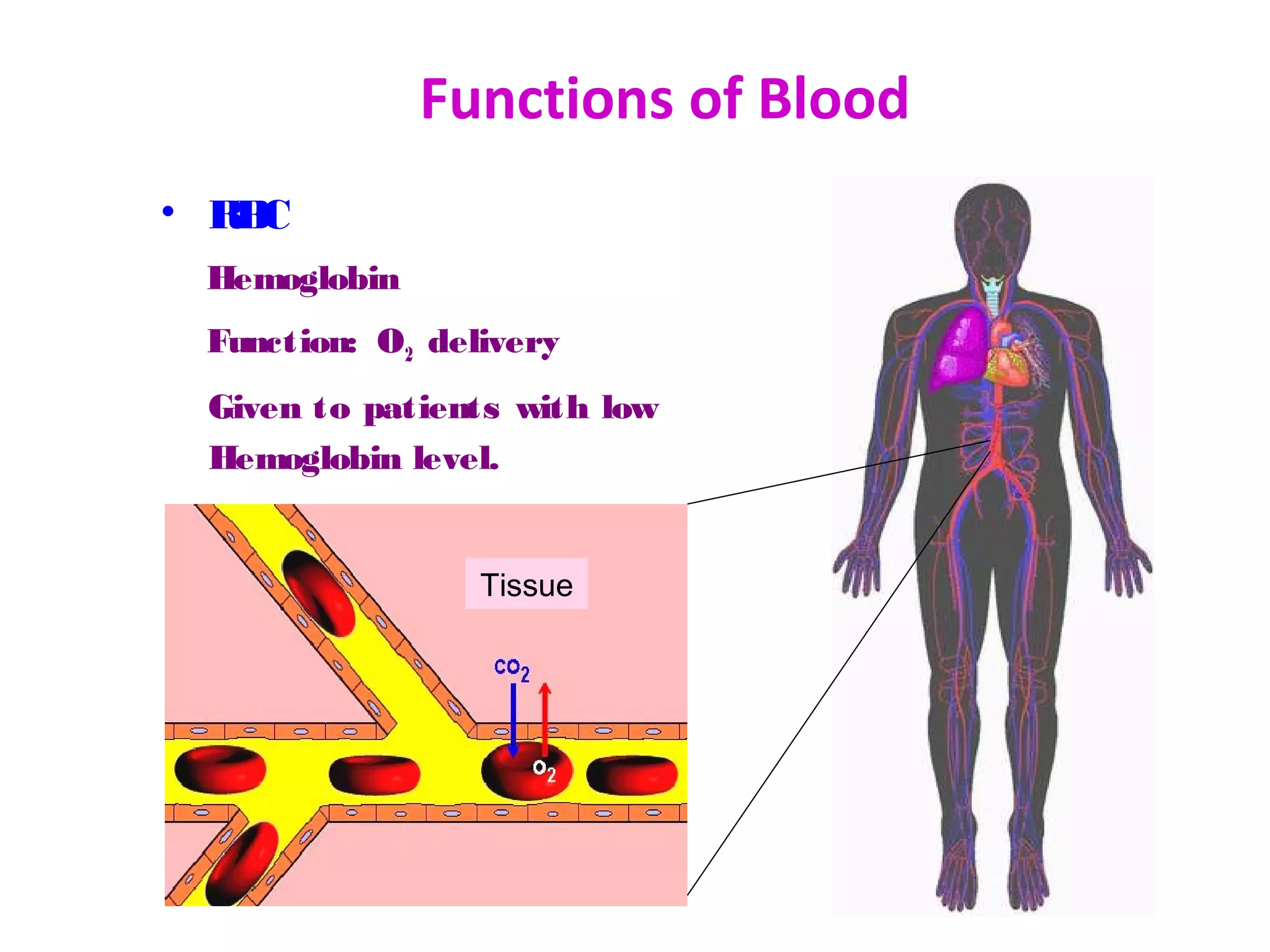
Functions of Blood
• RBC
Hemoglobin
Function: O2 delivery
Given to patients with low
Hemoglobin level.
Tissue
BLOOD
• Blood flows everywhere through
the human body.
• We cannot live without it.
• The heart pumps blood to all our
body cells, supplying them with
oxygen and food.
• Blood also carries proteins and
cell fragments called platelets
that let blood clot where there
has been an injury.
RED BLOOD CELLS
• Red blood cells carry oxygen to body
tissues and remove carbon dioxide.
• They are red because they contain a
protein called hemoglobin that is red
in color.
• Red blood cells are round and
thinner in the middle, like a balloon
that is partly filled with water. This
lets them squeeze through tiny
blood vessels without breaking.
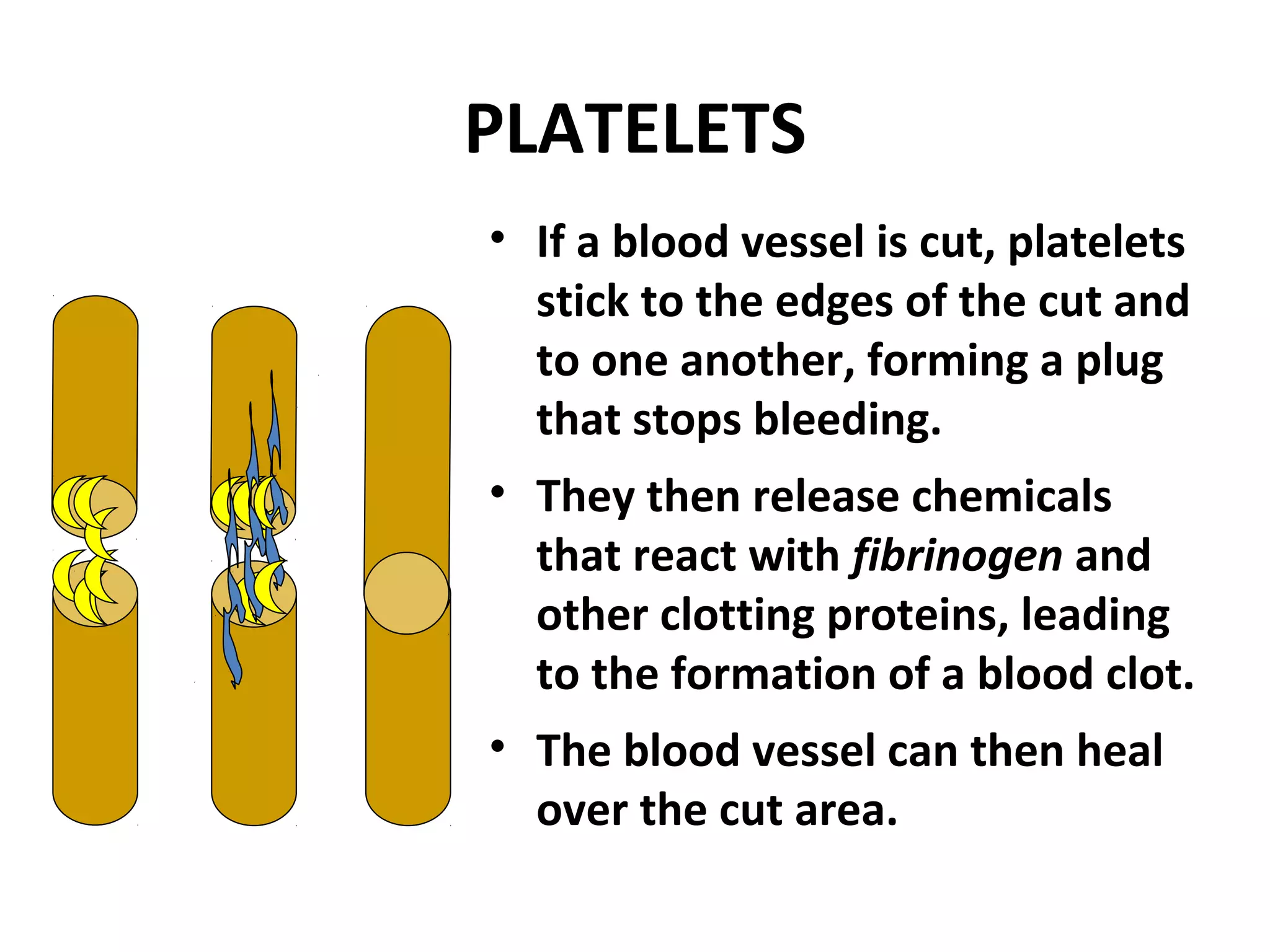
PLATELETS
• If a blood vessel is cut, platelets
stick to the edges of the cut and
to one another, forming a plug
that stops bleeding.
• They then release chemicals
that react with fibrinogen and
other clotting proteins, leading
to the formation of a blood clot.
• The blood vessel can then heal
over the cut area.
Functions of Blood
– WBCs -------- defense
– RBCs -------- carry oxygen
– Platelets -------- stop bleeding
PLASMA
• Plasma is the liquid part of
your blood in which red
cells and platelets float.
• Plasma is mostly water,
but the proteins it
contains are necessary for
life.
• Some of of these proteins
are clotting proteins.
Plasma helps to carry …
nutrients
clotting factors
proteins
What is Blood Composed
of?
• CELLS
Red cells
White cells
Platelets
• FLUID
Plasma
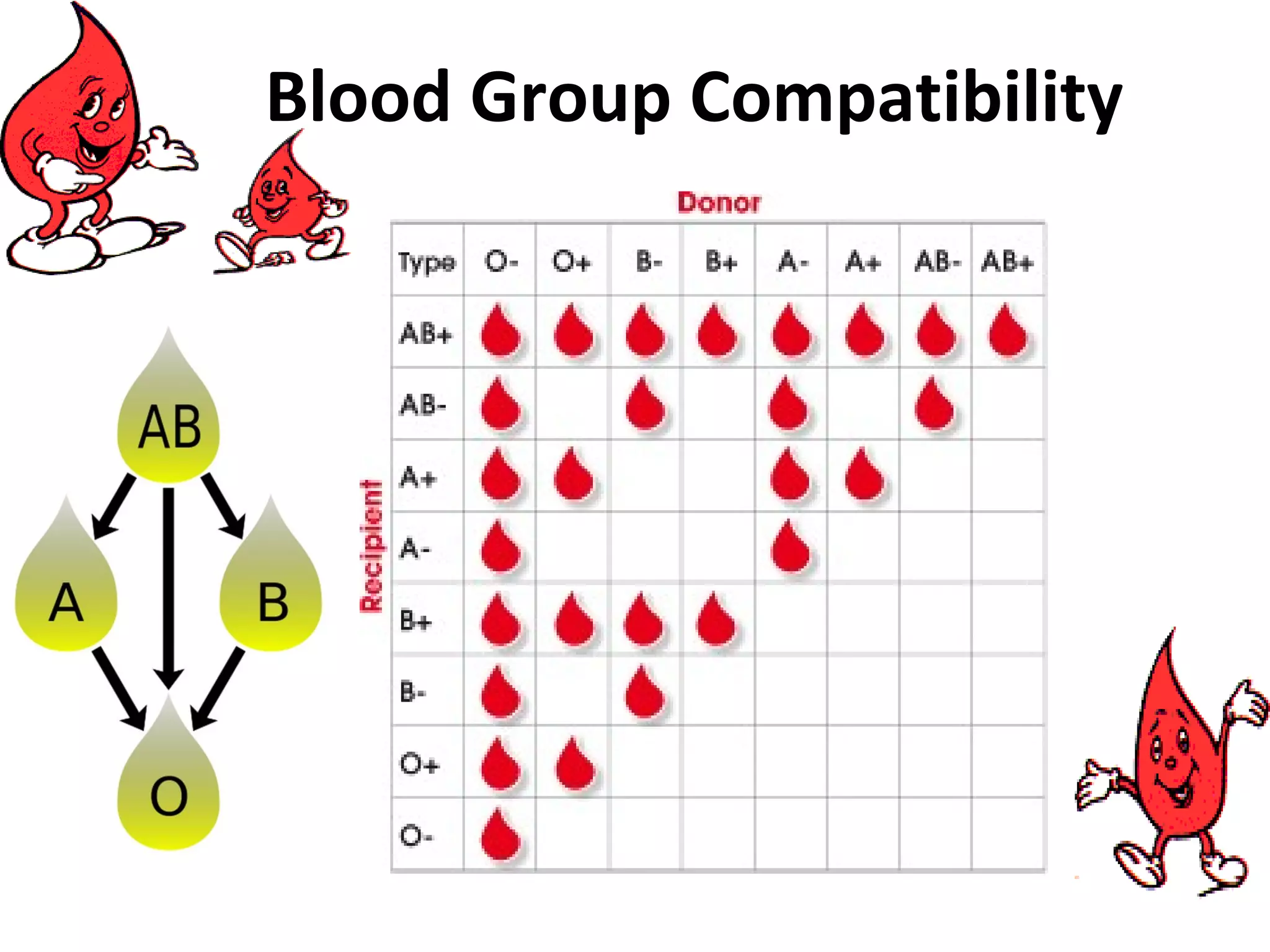
Blood Group Compatibility
 Blood group
Determined by the presence
of different proteins on the
red cell membrane.
 A antigen- group A
 B antigen- group B
 A and B antigen- group AB
 None – group O
Group A Group B
Group AB Group O
Blood Group
Blood Types
• O- is the universal blood donor
• AB is the universal blood recipient
• O and A blood groups are always in high
demand but all are needed
• There is no ‘best’ blood type
Fact sheet
 A person has 5 - 6 litres of blood in their
body.
 A person can donate blood every 90 days
(3 months).
 Body recovers the Blood very quickly:
 Blood plasma volume– within 24 - 48 hours
 Red Blood Cells – in about 3 weeks
 Platelets & White Blood Cells – within minutes
BLOOD FACT
• A kidney transplant patient, on
average, will need one to two units
of red blood cells to get through
surgery.
• A heart transplant patient, on
average, will need four to six units of
red blood cells.
BLOOD FACT
• A liver transplant patient,
on average, will need six
to 10 units of red blood
cells, 20 units of plasma
and 10 units of platelets.
BLOOD FACT
• A newborn open-heart surgery, on
average, will need one to four units
of red blood cells, one to two units of
plasma, and one to four units of
platelets.
What is a blood bank?
National Blood Donor Month
January is National Blood Donor Month and according to the American Red Cross
VOLUNTARY
BLOOD DONORS
ALTRUISTIC
 4.5 million Indians lives are saved
by blood transfusions each year
Blood is always needed for,
 accident victims
 cancer patients
 blood disorder patients
 surgery patients
 Pre-mature, pre term babies
 and many others…….
Indication of blood donationIndication of blood donation
Safety ConcernsSafety Concerns
• Safety of Blood Donor & Blood Recipient
(patient) because “Safe Blood” gives life, “Unsafe
blood” gives infections
• To ensure “Blood SafetyBlood Safety”,
– Strict “Donor ScreeningDonor Screening” at the Camp
– “TestingTesting” of collected blood to WHO specified
standards
– Strict “cross-matchingcross-matching” of blood samples to ensure
safe transfusion to patient
Procedure for Voluntary Blood DonationProcedure for Voluntary Blood Donation
Pre-Donation:Pre-Donation:
1. Donor Screening
2. Donor Eligibility criteria
3. Donor Consent Form
4. Medical examination
Blood Donation:Blood Donation:
5. Blood donation procedure
Post donationPost donation
6. Rest, advice & refreshment
7. Donor Certificate, Donor ID card
Donor Eligibility Criteria
• Who can donate?
• Age: 18 - 60 years
• Weight : > 45 kgs
• Hemoglobin level: >12 gms/dl for men
and 12.5 gms/dl for women
• In good health
Wt > 45 KgWt > 45 Kg
Who CANNOT donate?
Life long 1 year 6 Months
х Abnormal bleeding disorder
х Heart, Kidney, Liver
Disorder
х Thyroid disorder
х Epilepsy, Mental disorders
х Tuberculosis, Leprosy,
х Asthma
х Cancer
х Insulin dependent diabetics
х Uncontrolled High BP
o Surgery
o Typhoid
o Dog bite
o Unexplained
weight loss
o Continuous
low grade fever
o Tattooing or body
piercing
o Dental extraction
o Root canal
treatment
o Malaria
o Vaccination
Female donors cannot donate blood……
• During pregnancy
• After delivery for one year
• When lactating
• During menstrual period and for 7 days there
after
Male donors cannot donate blood……
• If consumed Alcohol in the previous 24 hours
Blood Donation Procedure
Remember!
The Donor Must ….
• have had good rest / sleep
• have had light meal
• be mentally prepared
Post Donation AdvicePost Donation Advice
• Drink lots of fluids for next 24 hours
• Avoid smoking for one hour & alcohol till after a meal
• Don’t use elevator to go up immediately after donation as it will make
blood rush to your feet & make you dizzy!
• Avoid highly strenuous exercises & games for a day
• If you feel dizzy, lie down & put your feet up. You will be alright in 10-20
mins.
• Remove band-aid after 4 hours. If it bleeds, apply pressure & reapply
band-aid. If bruised and painful, apply cold-pack 4 to 5 times for 5 mins
each. The bruise is due to blood seeping into the surrounding tissue. It will
take a few days to get reabsorbed.
•
What It Takes To Give III:
• You should be in good health and feel well
• You should have had something to eat and
had adequate sleep
• You must also meet hemoglobin (iron)
requirements (test done at clinic)
• At the time of donation, you will be asked a
number of questions to determine your
eligibility
What It Takes To Give IV:
If you have You must wait before
donating
Had dental treatment
(extractions, fillings, cleaning,
restoration)
For cleaning or filling: until the day
after treatment
For extraction, root canal or dental
surgery: 72 hours provided there is
full recovery
A cold, flu or sore throat Full recovery
Had ear or body piercing
or tattooing
6 months
Uses of Blood
• Platelets – cancer patients, hemophiliacs,
etc.
• Red cells – anemia patients, cancer
patients, trauma patients etc.
• Plasma – serious burns, shock, cancer,
bone marrow therapy, etc.
How Much Blood Is Needed…
• Fractured hip/Joint replacement – 2 to 5
units
• Auto accident/Gunshot wound – up to 50
units
• Cancer treatment – up to 8 units per week
• Bleeding ulcer – 3 to 30 units
• Brain surgery – 4 to 10 units
• Cardiovascular surgery – 2 to 25 units
• Liver transplant – up to 100 units
The Donation Process
• Photo identification is presented to the
receptionist.
• First time donors will be given a “First Time
Donor” sticker to inform nurses to be more
attentive.
• Iron levels are checked when there is an
available nurse.
• A series of questions are provided on the
back of the donor’s information printout to
check eligibility.
The Donation Process II
• The donor must read the information presented about
testing for diseases, HIV symptoms, etc.
• A nurse takes the donor into a private room where more
questions are asked about the donor to further check
eligibility.
• Temperature and blood pressure are measured in the
room.
• Lastly, a ‘Yes, use my blood,’ or ‘No, don’t use my blood’
sticker is available for donors to put on their information
sheet in private, without the nurse present.
What can YOU do?
• Make Blood Donation a HABIT
• Donate regularly – every 3 months to
commemorate special days like birthdays,
anniversaries ….
• Motivate others to donate
• Refer your friends and relatives
Today
Save a life!
Today
Save a life!
Benefits to Donor of blood donation
Health benefits:
Regular donation (2-3 times a year….)
– Lowers cholesterol
– Lowers lipid levels
– Decreases incidence of heart attacks, strokes
Donor is also eligible to receive one FREE unit of
blood if needed for
– Self
– Spouse/ Child/ Parents, and
– Even friends
Benefits
Health + Money
Tests on:
hemoglobin level
blood pressure
body weight
hepatitis B
hepatitis C
Syphilis
HIV/AIDS
Blood Donation Camp-What
you should know
Blood Donation Camp-
Requirements from your side
• Suitable date, venue and number of donors expected
• Well lit, well ventilated, spacious area for registration and
medical check up, bleeding and refreshment
• Sufficient cots (or Tables) bleeding tables with chairs to each
bed
• Waste boxes under each bed
• Tables and chairs for registration, medical check up and extra
chairs for waiting donors
• Clean drinking water with disposable cups in camp area and
refreshment are
• Volunteers to help with registration and refreshments
References
1. American Red Cross http://www.redcrossblood.org/learn-about-blood/blood-facts-and-
statistics
2. Chandramita Bora, Advantages of Donating Blood, 10.12.2011,
http://www.buzzle.com/articles/advantages-of-donating-blood.html
3. Blood types: Distribution stats,interesting facts,2011
http://bloodbanker.com/plasma/centers/category/blood-donation-terms/
4. A Free Pound of Dunkin Donuts Coffee For a Pint of Blood
Thursday, January 6, 2011, by Paula Forbes; http://eater.com/tags/blood-donation
5. A pint of ice cream for a pint of blood
Sunday, July 24, 2011 http://www.youtube.com/watch?v=zYQCAAuCVTo
6 .Lack of blood donations proves costly for N.J. hospitals, January 07, 2009
http://www.nj.com/news/index.ssf/2009/01/lack_of_blood_donations_proves.html
Give Blood and Save lives !!

Blood and donation facts

  • 1.
    VALUES AND IMPORTANCEOF BLOOD DONATION By AJAL.A.J
  • 2.
    WHAT IS SOWONDERFUL ABOUT BLOOD?
  • 3.
    Blood as aScarce Resource in the World  75 million units of blood are donated each year75 million units of blood are donated each year  500,000 women who die from complication of500,000 women who die from complication of pregnancy each yearpregnancy each year  150,000 die because of lack of blood.150,000 die because of lack of blood.  80% of the worldwide population has access to80% of the worldwide population has access to only 20% of safe blood.only 20% of safe blood.  Only 16% of blood supply is donated by voluntary/Only 16% of blood supply is donated by voluntary/ non-remunerated blood donors in the worldnon-remunerated blood donors in the world because of only family/replacement do in most ofbecause of only family/replacement do in most of developing countries.developing countries. WHO Information Sheets, 2005
  • 4.
    What is Blood? •Specialized cells suspended in plasma • Constantly circulating throughout body • Carries oxygen and nourishment to cells and removes waste products • Supports body’s immune system and capacity to heal itself
  • 5.
    Components of Blood •Whole blood contains 4 main elements: • Red blood cells – carry oxygen to tissue • Platelets – used in coagulation (clotting) • Plasma – maintains blood volume and blood pressure, and prevents excessive bleeding • White blood cells – fight infection
  • 6.
  • 7.
    Functions of Blood •RBC Hemoglobin Function: O2 delivery Given to patients with low Hemoglobin level. Tissue
  • 8.
    BLOOD • Blood flowseverywhere through the human body. • We cannot live without it. • The heart pumps blood to all our body cells, supplying them with oxygen and food. • Blood also carries proteins and cell fragments called platelets that let blood clot where there has been an injury.
  • 9.
    RED BLOOD CELLS •Red blood cells carry oxygen to body tissues and remove carbon dioxide. • They are red because they contain a protein called hemoglobin that is red in color. • Red blood cells are round and thinner in the middle, like a balloon that is partly filled with water. This lets them squeeze through tiny blood vessels without breaking.
  • 10.
    PLATELETS • If ablood vessel is cut, platelets stick to the edges of the cut and to one another, forming a plug that stops bleeding. • They then release chemicals that react with fibrinogen and other clotting proteins, leading to the formation of a blood clot. • The blood vessel can then heal over the cut area.
  • 11.
    Functions of Blood –WBCs -------- defense – RBCs -------- carry oxygen – Platelets -------- stop bleeding
  • 12.
    PLASMA • Plasma isthe liquid part of your blood in which red cells and platelets float. • Plasma is mostly water, but the proteins it contains are necessary for life. • Some of of these proteins are clotting proteins. Plasma helps to carry … nutrients clotting factors proteins
  • 13.
    What is BloodComposed of? • CELLS Red cells White cells Platelets • FLUID Plasma
  • 14.
  • 15.
     Blood group Determinedby the presence of different proteins on the red cell membrane.  A antigen- group A  B antigen- group B  A and B antigen- group AB  None – group O Group A Group B Group AB Group O Blood Group
  • 16.
    Blood Types • O-is the universal blood donor • AB is the universal blood recipient • O and A blood groups are always in high demand but all are needed • There is no ‘best’ blood type
  • 17.
    Fact sheet  Aperson has 5 - 6 litres of blood in their body.  A person can donate blood every 90 days (3 months).  Body recovers the Blood very quickly:  Blood plasma volume– within 24 - 48 hours  Red Blood Cells – in about 3 weeks  Platelets & White Blood Cells – within minutes
  • 18.
    BLOOD FACT • Akidney transplant patient, on average, will need one to two units of red blood cells to get through surgery. • A heart transplant patient, on average, will need four to six units of red blood cells.
  • 19.
    BLOOD FACT • Aliver transplant patient, on average, will need six to 10 units of red blood cells, 20 units of plasma and 10 units of platelets.
  • 20.
    BLOOD FACT • Anewborn open-heart surgery, on average, will need one to four units of red blood cells, one to two units of plasma, and one to four units of platelets.
  • 21.
    What is ablood bank?
  • 22.
    National Blood DonorMonth January is National Blood Donor Month and according to the American Red Cross
  • 23.
  • 24.
     4.5 millionIndians lives are saved by blood transfusions each year Blood is always needed for,  accident victims  cancer patients  blood disorder patients  surgery patients  Pre-mature, pre term babies  and many others……. Indication of blood donationIndication of blood donation
  • 25.
    Safety ConcernsSafety Concerns •Safety of Blood Donor & Blood Recipient (patient) because “Safe Blood” gives life, “Unsafe blood” gives infections • To ensure “Blood SafetyBlood Safety”, – Strict “Donor ScreeningDonor Screening” at the Camp – “TestingTesting” of collected blood to WHO specified standards – Strict “cross-matchingcross-matching” of blood samples to ensure safe transfusion to patient
  • 26.
    Procedure for VoluntaryBlood DonationProcedure for Voluntary Blood Donation Pre-Donation:Pre-Donation: 1. Donor Screening 2. Donor Eligibility criteria 3. Donor Consent Form 4. Medical examination Blood Donation:Blood Donation: 5. Blood donation procedure Post donationPost donation 6. Rest, advice & refreshment 7. Donor Certificate, Donor ID card
  • 27.
    Donor Eligibility Criteria •Who can donate? • Age: 18 - 60 years • Weight : > 45 kgs • Hemoglobin level: >12 gms/dl for men and 12.5 gms/dl for women • In good health Wt > 45 KgWt > 45 Kg
  • 28.
    Who CANNOT donate? Lifelong 1 year 6 Months х Abnormal bleeding disorder х Heart, Kidney, Liver Disorder х Thyroid disorder х Epilepsy, Mental disorders х Tuberculosis, Leprosy, х Asthma х Cancer х Insulin dependent diabetics х Uncontrolled High BP o Surgery o Typhoid o Dog bite o Unexplained weight loss o Continuous low grade fever o Tattooing or body piercing o Dental extraction o Root canal treatment o Malaria o Vaccination
  • 29.
    Female donors cannotdonate blood…… • During pregnancy • After delivery for one year • When lactating • During menstrual period and for 7 days there after Male donors cannot donate blood…… • If consumed Alcohol in the previous 24 hours
  • 30.
    Blood Donation Procedure Remember! TheDonor Must …. • have had good rest / sleep • have had light meal • be mentally prepared
  • 31.
    Post Donation AdvicePostDonation Advice • Drink lots of fluids for next 24 hours • Avoid smoking for one hour & alcohol till after a meal • Don’t use elevator to go up immediately after donation as it will make blood rush to your feet & make you dizzy! • Avoid highly strenuous exercises & games for a day • If you feel dizzy, lie down & put your feet up. You will be alright in 10-20 mins. • Remove band-aid after 4 hours. If it bleeds, apply pressure & reapply band-aid. If bruised and painful, apply cold-pack 4 to 5 times for 5 mins each. The bruise is due to blood seeping into the surrounding tissue. It will take a few days to get reabsorbed. •
  • 32.
    What It TakesTo Give III: • You should be in good health and feel well • You should have had something to eat and had adequate sleep • You must also meet hemoglobin (iron) requirements (test done at clinic) • At the time of donation, you will be asked a number of questions to determine your eligibility
  • 33.
    What It TakesTo Give IV: If you have You must wait before donating Had dental treatment (extractions, fillings, cleaning, restoration) For cleaning or filling: until the day after treatment For extraction, root canal or dental surgery: 72 hours provided there is full recovery A cold, flu or sore throat Full recovery Had ear or body piercing or tattooing 6 months
  • 34.
    Uses of Blood •Platelets – cancer patients, hemophiliacs, etc. • Red cells – anemia patients, cancer patients, trauma patients etc. • Plasma – serious burns, shock, cancer, bone marrow therapy, etc.
  • 35.
    How Much BloodIs Needed… • Fractured hip/Joint replacement – 2 to 5 units • Auto accident/Gunshot wound – up to 50 units • Cancer treatment – up to 8 units per week • Bleeding ulcer – 3 to 30 units • Brain surgery – 4 to 10 units • Cardiovascular surgery – 2 to 25 units • Liver transplant – up to 100 units
  • 36.
    The Donation Process •Photo identification is presented to the receptionist. • First time donors will be given a “First Time Donor” sticker to inform nurses to be more attentive. • Iron levels are checked when there is an available nurse. • A series of questions are provided on the back of the donor’s information printout to check eligibility.
  • 37.
    The Donation ProcessII • The donor must read the information presented about testing for diseases, HIV symptoms, etc. • A nurse takes the donor into a private room where more questions are asked about the donor to further check eligibility. • Temperature and blood pressure are measured in the room. • Lastly, a ‘Yes, use my blood,’ or ‘No, don’t use my blood’ sticker is available for donors to put on their information sheet in private, without the nurse present.
  • 38.
    What can YOUdo? • Make Blood Donation a HABIT • Donate regularly – every 3 months to commemorate special days like birthdays, anniversaries …. • Motivate others to donate • Refer your friends and relatives Today Save a life! Today Save a life!
  • 39.
    Benefits to Donorof blood donation Health benefits: Regular donation (2-3 times a year….) – Lowers cholesterol – Lowers lipid levels – Decreases incidence of heart attacks, strokes Donor is also eligible to receive one FREE unit of blood if needed for – Self – Spouse/ Child/ Parents, and – Even friends
  • 40.
    Benefits Health + Money Testson: hemoglobin level blood pressure body weight hepatitis B hepatitis C Syphilis HIV/AIDS
  • 41.
  • 42.
    Blood Donation Camp- Requirementsfrom your side • Suitable date, venue and number of donors expected • Well lit, well ventilated, spacious area for registration and medical check up, bleeding and refreshment • Sufficient cots (or Tables) bleeding tables with chairs to each bed • Waste boxes under each bed • Tables and chairs for registration, medical check up and extra chairs for waiting donors • Clean drinking water with disposable cups in camp area and refreshment are • Volunteers to help with registration and refreshments
  • 43.
    References 1. American RedCross http://www.redcrossblood.org/learn-about-blood/blood-facts-and- statistics 2. Chandramita Bora, Advantages of Donating Blood, 10.12.2011, http://www.buzzle.com/articles/advantages-of-donating-blood.html 3. Blood types: Distribution stats,interesting facts,2011 http://bloodbanker.com/plasma/centers/category/blood-donation-terms/ 4. A Free Pound of Dunkin Donuts Coffee For a Pint of Blood Thursday, January 6, 2011, by Paula Forbes; http://eater.com/tags/blood-donation 5. A pint of ice cream for a pint of blood Sunday, July 24, 2011 http://www.youtube.com/watch?v=zYQCAAuCVTo 6 .Lack of blood donations proves costly for N.J. hospitals, January 07, 2009 http://www.nj.com/news/index.ssf/2009/01/lack_of_blood_donations_proves.html
  • 44.
    Give Blood andSave lives !!

Editor's Notes

  • #34 The purpose of these restrictions is to make sure that you are absolutely healthy enough to donate so that you suffer minimal side-effects. CBS wants to ensure the best possible experience for all of its donors so that they will return after a positive experience. We do not want to risk the donor’s health, so precautions are taken to the best of our abilities.
  • #38 **The actual ‘needle in arm’ time is about 5 minutes.