Blood Donationm
BLOOD Facts
 Blood flows everywhere
through the human body.
 We cannot live without it.
 The heart pumps blood to all
our body cells, supplying them
with oxygen and food.
 Blood also carries proteins and
cell fragments called platelets
that let blood clot where there
has been an injury.
Did You Know?
 450ml of blood can save as many as three lives.
 Every two seconds, someone in India needs blood.
 One out of every three of us will need blood in our
life time.
 Even with all of today’s technology, there is no
substitute for blood.
Someone has to give blood
in order for someone to receive blood.
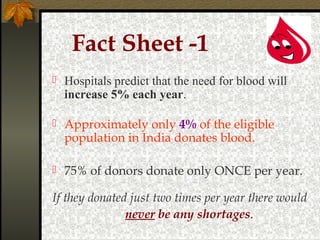
Fact Sheet -1
 Hospitals predict that the need for blood will
increase 5% each year.
 Approximately only 4% of the eligible
population in India donates blood.
 75% of donors donate only ONCE per year.
If they donated just two times per year there would
never be any shortages.
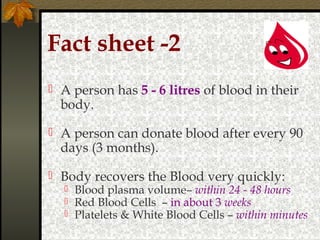
Fact sheet -2
 A person has 5 - 6 litres of blood in their
body.
 A person can donate blood after every 90
days (3 months).
 Body recovers the Blood very quickly:
 Blood plasma volume– within 24 - 48 hours
 Red Blood Cells – in about 3 weeks
 Platelets & White Blood Cells – within minutes
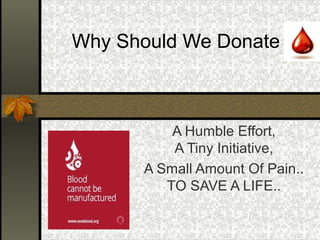
A Humble Effort,
A Tiny Initiative,
A Small Amount Of Pain..
TO SAVE A LIFE..
Why Should We Donate
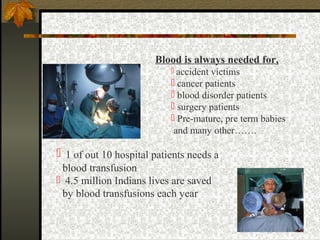
 1 of out 10 hospital patients needs a
blood transfusion
 4.5 million Indians lives are saved
by blood transfusions each year
Blood is always needed for,
 accident victims
 cancer patients
 blood disorder patients
 surgery patients
 Pre-mature, pre term babies
and many other…….
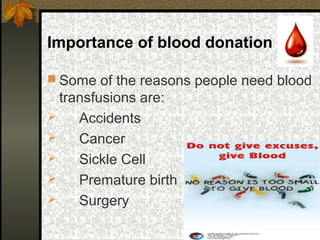
Importance of blood donation
 Some of the reasons people need blood
transfusions are:
 Accidents
 Cancer
 Sickle Cell
 Premature birth
 Surgery
Importance of blood donation
 Almost all serious health issues use blood donated by people
like you and me to save lives.
Blood that is donated last a little more than 40 days. Then it
must be disposed of. That means we need to constantly
replenish the blood so it is there when someone needs it.
 Your blood could save a baby, a child, a mother, a father, a
grandfather or a grandmother.
 One cannot make blood, it is a gift we all have inside of us to
give to those who are injured, sick, or in need. Those are the
best reasons to donate blood.
 Not everyone can save a life. But you have an opportunity
to. Don't waste it.
Who can donate the blood?
 Donor should be between 18-65 years of age with a weight of
45 kg or above with pulse rate, body temperature and blood
pressure should be normal.
 Both men and women can donate.
 There are only few conditions in which donors are permanently
excluded. The donor with history of epilepsy, psychotic
disorders, abnormal bleeding tendencies, severe asthma,
cardiovascular disorders, malignancy are permanently unfit for
blood donation.
Who can donate the blood?
 Donors suffering from disease like hepatitis, malaria, measles,
mumps, and syphilis may donate blood after full recovery with 3-
6 months gap. Also people who have undergone surgery, blood
transfusion may safely donate blood after 6-12.
Benefits of Blood Donation
 Tests on:
 hemoglobin level
 blood pressure
 body weight
 hepatitis B
 hepatitis C
 Syphilis
 HIV
Benefits of Blood Donation

Health
Heart Diseases
New Blood
Primary Concern
 Safety of Blood Donor & Blood Recipient
(patient) because “Safe Blood” gives life,
“Unsafe blood” gives infections
 To ensure “Blood Safety”,
 Strict “Donor Screening”
 “Testing” of collected blood to NACO
specified standards
 Strict “cross-matching” of blood samples to
ensure safe transfusion to patient
Information
• It is quick and safe.
• It doesn’t hurt.
• It saves 3 to 4 lives.
• Blood is taken ONLY from Voluntary Donors
• Using sterile, disposable blood bags &
instruments
• Donated Blood is tested and separated into
components benefiting 3-4 patients
• It is safe to donate after every 3 months
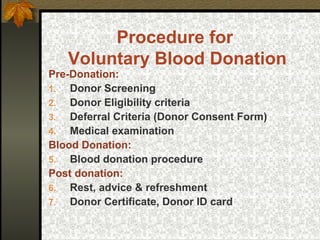
Procedure for
Voluntary Blood Donation
Pre-Donation:
1. Donor Screening
2. Donor Eligibility criteria
3. Deferral Criteria (Donor Consent Form)
4. Medical examination
Blood Donation:
5. Blood donation procedure
Post donation:
6. Rest, advice & refreshment
7. Donor Certificate, Donor ID card
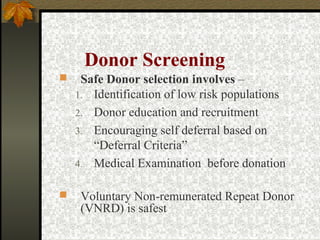
 Safe Donor selection involves –
1. Identification of low risk populations
2. Donor education and recruitment
3. Encouraging self deferral based on
“Deferral Criteria”
4. Medical Examination before donation
 Voluntary Non-remunerated Repeat Donor
(VNRD) is safest
Donor Screening
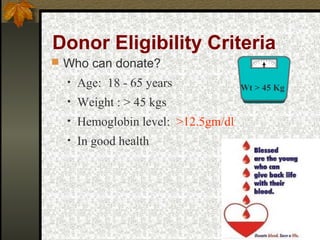
Donor Eligibility Criteria
 Who can donate?
• Age: 18 - 65 years
• Weight : > 45 kgs
• Hemoglobin level: >12.5gm/dl
• In good health
Wt > 45 Kg
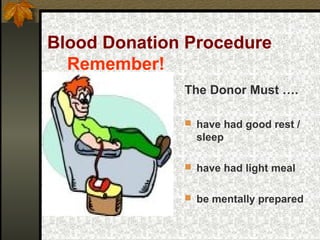
Blood Donation Procedure
Remember!
The Donor Must ….
 have had good rest /
sleep
 have had light meal
 be mentally prepared
Blood Donation Procedure
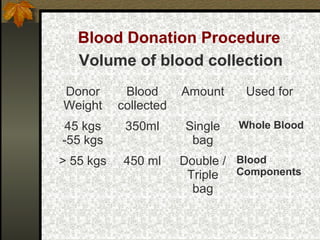
Volume of blood collection
Donor
Weight
Blood
collected
Amount Used for
45 kgs
-55 kgs
350ml Single
bag
Whole Blood
> 55 kgs 450 ml Double /
Triple
bag
Blood
Components
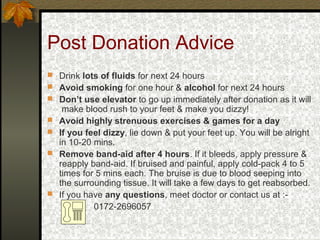
Post Donation Advice
 Drink lots of fluids for next 24 hours
 Avoid smoking for one hour & alcohol for next 24 hours
 Don’t use elevator to go up immediately after donation as it will
make blood rush to your feet & make you dizzy!
 Avoid highly strenuous exercises & games for a day
 If you feel dizzy, lie down & put your feet up. You will be alright
in 10-20 mins.
 Remove band-aid after 4 hours. If it bleeds, apply pressure &
reapply band-aid. If bruised and painful, apply cold-pack 4 to 5
times for 5 mins each. The bruise is due to blood seeping into
the surrounding tissue. It will take a few days to get reabsorbed.
 If you have any questions, meet doctor or contact us at :-
0172-2696057
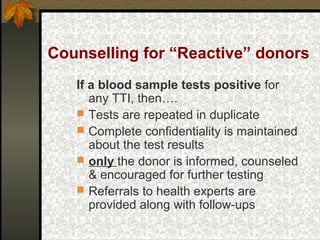
Counselling for “Reactive” donors
If a blood sample tests positive for
any TTI, then….
 Tests are repeated in duplicate
 Complete confidentiality is maintained
about the test results
 only the donor is informed, counseled
& encouraged for further testing
 Referrals to health experts are
provided along with follow-ups
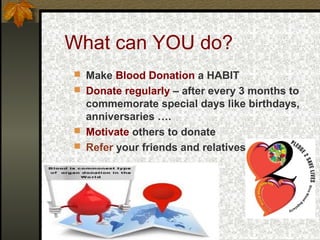
What can YOU do?
 Make Blood Donation a HABIT
 Donate regularly – after every 3 months to
commemorate special days like birthdays,
anniversaries ….
 Motivate others to donate
 Refer your friends and relatives
Thank You…
Thank You…

Blood donation

  • 1.
  • 2.
    BLOOD Facts  Bloodflows everywhere through the human body.  We cannot live without it.  The heart pumps blood to all our body cells, supplying them with oxygen and food.  Blood also carries proteins and cell fragments called platelets that let blood clot where there has been an injury.
  • 3.
    Did You Know? 450ml of blood can save as many as three lives.  Every two seconds, someone in India needs blood.  One out of every three of us will need blood in our life time.  Even with all of today’s technology, there is no substitute for blood. Someone has to give blood in order for someone to receive blood.
  • 4.
    Fact Sheet -1 Hospitals predict that the need for blood will increase 5% each year.  Approximately only 4% of the eligible population in India donates blood.  75% of donors donate only ONCE per year. If they donated just two times per year there would never be any shortages.
  • 5.
    Fact sheet -2 A person has 5 - 6 litres of blood in their body.  A person can donate blood after every 90 days (3 months).  Body recovers the Blood very quickly:  Blood plasma volume– within 24 - 48 hours  Red Blood Cells – in about 3 weeks  Platelets & White Blood Cells – within minutes
  • 6.
    A Humble Effort, ATiny Initiative, A Small Amount Of Pain.. TO SAVE A LIFE.. Why Should We Donate
  • 7.
     1 ofout 10 hospital patients needs a blood transfusion  4.5 million Indians lives are saved by blood transfusions each year Blood is always needed for,  accident victims  cancer patients  blood disorder patients  surgery patients  Pre-mature, pre term babies and many other…….
  • 8.
    Importance of blooddonation  Some of the reasons people need blood transfusions are:  Accidents  Cancer  Sickle Cell  Premature birth  Surgery
  • 9.
    Importance of blooddonation  Almost all serious health issues use blood donated by people like you and me to save lives. Blood that is donated last a little more than 40 days. Then it must be disposed of. That means we need to constantly replenish the blood so it is there when someone needs it.  Your blood could save a baby, a child, a mother, a father, a grandfather or a grandmother.  One cannot make blood, it is a gift we all have inside of us to give to those who are injured, sick, or in need. Those are the best reasons to donate blood.  Not everyone can save a life. But you have an opportunity to. Don't waste it.
  • 10.
    Who can donatethe blood?  Donor should be between 18-65 years of age with a weight of 45 kg or above with pulse rate, body temperature and blood pressure should be normal.  Both men and women can donate.  There are only few conditions in which donors are permanently excluded. The donor with history of epilepsy, psychotic disorders, abnormal bleeding tendencies, severe asthma, cardiovascular disorders, malignancy are permanently unfit for blood donation.
  • 11.
    Who can donatethe blood?  Donors suffering from disease like hepatitis, malaria, measles, mumps, and syphilis may donate blood after full recovery with 3- 6 months gap. Also people who have undergone surgery, blood transfusion may safely donate blood after 6-12.
  • 12.
    Benefits of BloodDonation  Tests on:  hemoglobin level  blood pressure  body weight  hepatitis B  hepatitis C  Syphilis  HIV
  • 13.
    Benefits of BloodDonation  Health Heart Diseases New Blood
  • 14.
    Primary Concern  Safetyof Blood Donor & Blood Recipient (patient) because “Safe Blood” gives life, “Unsafe blood” gives infections  To ensure “Blood Safety”,  Strict “Donor Screening”  “Testing” of collected blood to NACO specified standards  Strict “cross-matching” of blood samples to ensure safe transfusion to patient
  • 15.
    Information • It isquick and safe. • It doesn’t hurt. • It saves 3 to 4 lives. • Blood is taken ONLY from Voluntary Donors • Using sterile, disposable blood bags & instruments • Donated Blood is tested and separated into components benefiting 3-4 patients • It is safe to donate after every 3 months
  • 16.
    Procedure for Voluntary BloodDonation Pre-Donation: 1. Donor Screening 2. Donor Eligibility criteria 3. Deferral Criteria (Donor Consent Form) 4. Medical examination Blood Donation: 5. Blood donation procedure Post donation: 6. Rest, advice & refreshment 7. Donor Certificate, Donor ID card
  • 17.
     Safe Donorselection involves – 1. Identification of low risk populations 2. Donor education and recruitment 3. Encouraging self deferral based on “Deferral Criteria” 4. Medical Examination before donation  Voluntary Non-remunerated Repeat Donor (VNRD) is safest Donor Screening
  • 18.
    Donor Eligibility Criteria Who can donate? • Age: 18 - 65 years • Weight : > 45 kgs • Hemoglobin level: >12.5gm/dl • In good health Wt > 45 Kg
  • 19.
    Blood Donation Procedure Remember! TheDonor Must ….  have had good rest / sleep  have had light meal  be mentally prepared
  • 20.
    Blood Donation Procedure Volumeof blood collection Donor Weight Blood collected Amount Used for 45 kgs -55 kgs 350ml Single bag Whole Blood > 55 kgs 450 ml Double / Triple bag Blood Components
  • 21.
    Post Donation Advice Drink lots of fluids for next 24 hours  Avoid smoking for one hour & alcohol for next 24 hours  Don’t use elevator to go up immediately after donation as it will make blood rush to your feet & make you dizzy!  Avoid highly strenuous exercises & games for a day  If you feel dizzy, lie down & put your feet up. You will be alright in 10-20 mins.  Remove band-aid after 4 hours. If it bleeds, apply pressure & reapply band-aid. If bruised and painful, apply cold-pack 4 to 5 times for 5 mins each. The bruise is due to blood seeping into the surrounding tissue. It will take a few days to get reabsorbed.  If you have any questions, meet doctor or contact us at :- 0172-2696057
  • 22.
    Counselling for “Reactive”donors If a blood sample tests positive for any TTI, then….  Tests are repeated in duplicate  Complete confidentiality is maintained about the test results  only the donor is informed, counseled & encouraged for further testing  Referrals to health experts are provided along with follow-ups
  • 23.
    What can YOUdo?  Make Blood Donation a HABIT  Donate regularly – after every 3 months to commemorate special days like birthdays, anniversaries ….  Motivate others to donate  Refer your friends and relatives
  • 25.

Editor's Notes

  • #25 Http://lifeseva.org