Benefits & Need
for Blood Donation
DR. CHIRANJIT NOATIA
Medical Officer
Blood Bank, District Hospital Gomati
Contents in Brief
• Blood What is it? Science & Philosophy & Law .
• Users/Who need it ?
• Demand / How much is the need ?
• Supply / How much available for use ?
• Eligibility for Blood Donation .
• Eligible donor base .
• Benefits of Blood Donation
• Need of Blood Donation
• One Amazing Story of Selfless Blood Donation !
Blood What is it? Science & Philosophy & Law
• Science: One of the main transport system of the body, which
delivers nutrients & oxygen to different cells and transports
metabolic waste products from cells.
• Philosophy : Vital life force which separate living beings from
non living things, a connection that binds societies together.
• Law/Medicine : A ―drug‖ which is to be manufactured as per
standards for to be used safely in patients.
Users / Who need it (Blood) ?
• For cancer patients
• For those undergoing surgery
• For complications of pregnancy
• To treat accident and burns victims & shock
• To provide clotting factors for people with bleeding
disorders, including haemophilia
Demand / How much is the need of Blood ?
• Projected Blood requirement in our State, based on WHO
norm of 1% of Population = 36,710
• In India the 12 Million Units (1 Crore 20 Lac)
• In Our Gomati District approx 4,500 unit.
Supply / How much available for use ?
• Last 5 years collection in our state stands at 27,000 to
28,000 in average . Never crossed 30,000. That is only
about 75% of total demand we are able to meet.
• In India on avg. 9 M units are collected against 12 M units
demand . (75% again)
• In our district same reflects. 3000-3500 units we are
getting against projected demand of 4500-5000 units.
• So, there is HUGE shortfall of 25% against demand.
Eligibility for Blood Donation
• Overall health- The donor must be fit and healthy, & should not be
suffering from transmittable diseases.
• Age and weight- The donor must be 18–65 years old and should weigh
a minimum of 45 kg.
• Pulse rate- Between 50 and 100 without irregularities.
• Haemoglobin level- A minimum of 12.5 g/dL.
• Blood Pressure- Diastolic: 60-90 mm Hg, Systolic: 100–140 mm Hg.
• Body temperature- Should be normal, not exceeding 37.5 °C.
• The time period between successive blood donations should be more
than 3 months.
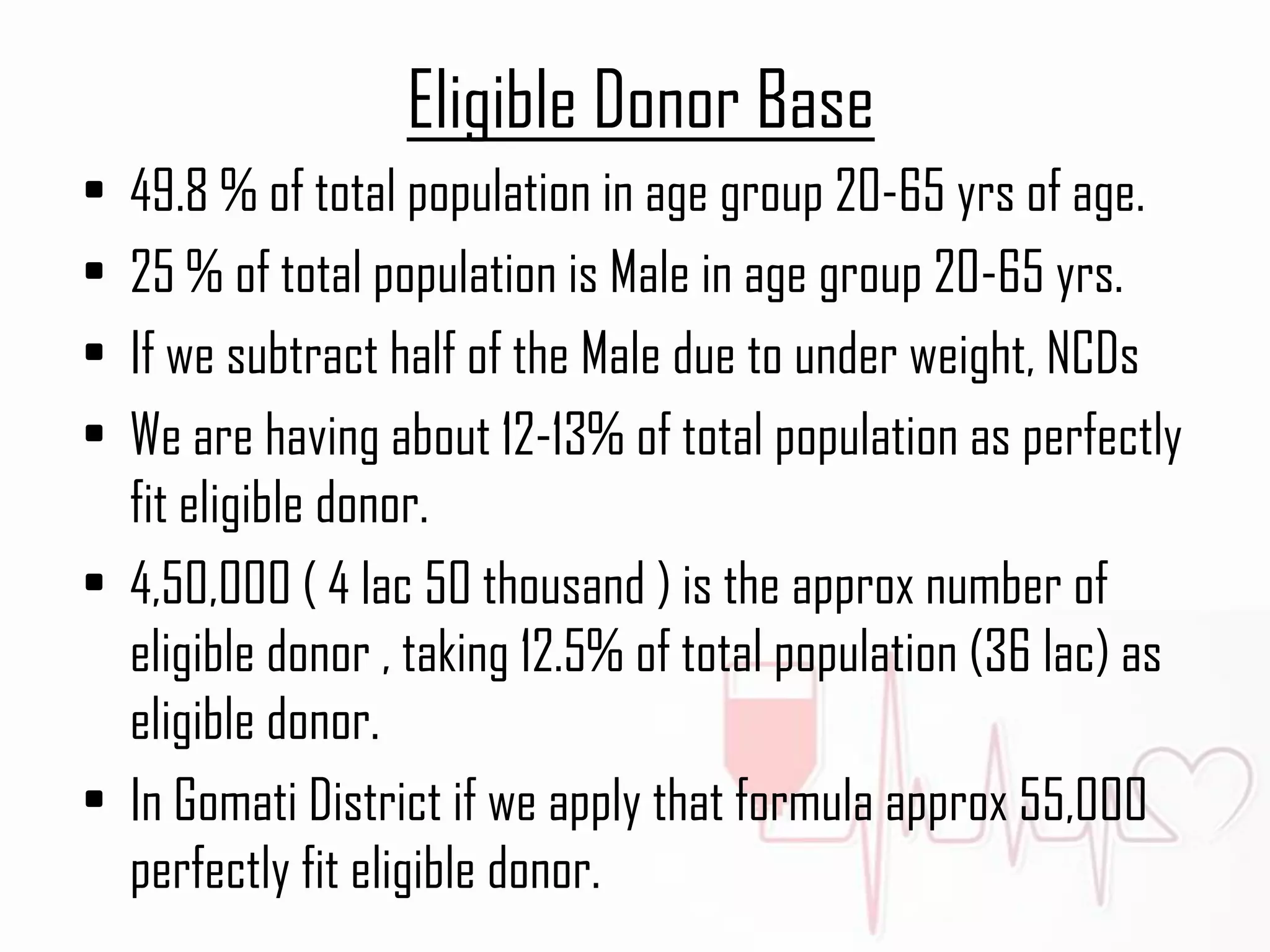
Eligible Donor Base
• 49.8 % of total population in age group 20-65 yrs of age.
• 25 % of total population is Male in age group 20-65 yrs.
• If we subtract half of the Male due to under weight, NCDs
• We are having about 12-13% of total population as perfectly
fit eligible donor.
• 4,50,000 ( 4 lac 50 thousand ) is the approx number of
eligible donor , taking 12.5% of total population (36 lac) as
eligible donor.
• In Gomati District if we apply that formula approx 55,000
perfectly fit eligible donor.
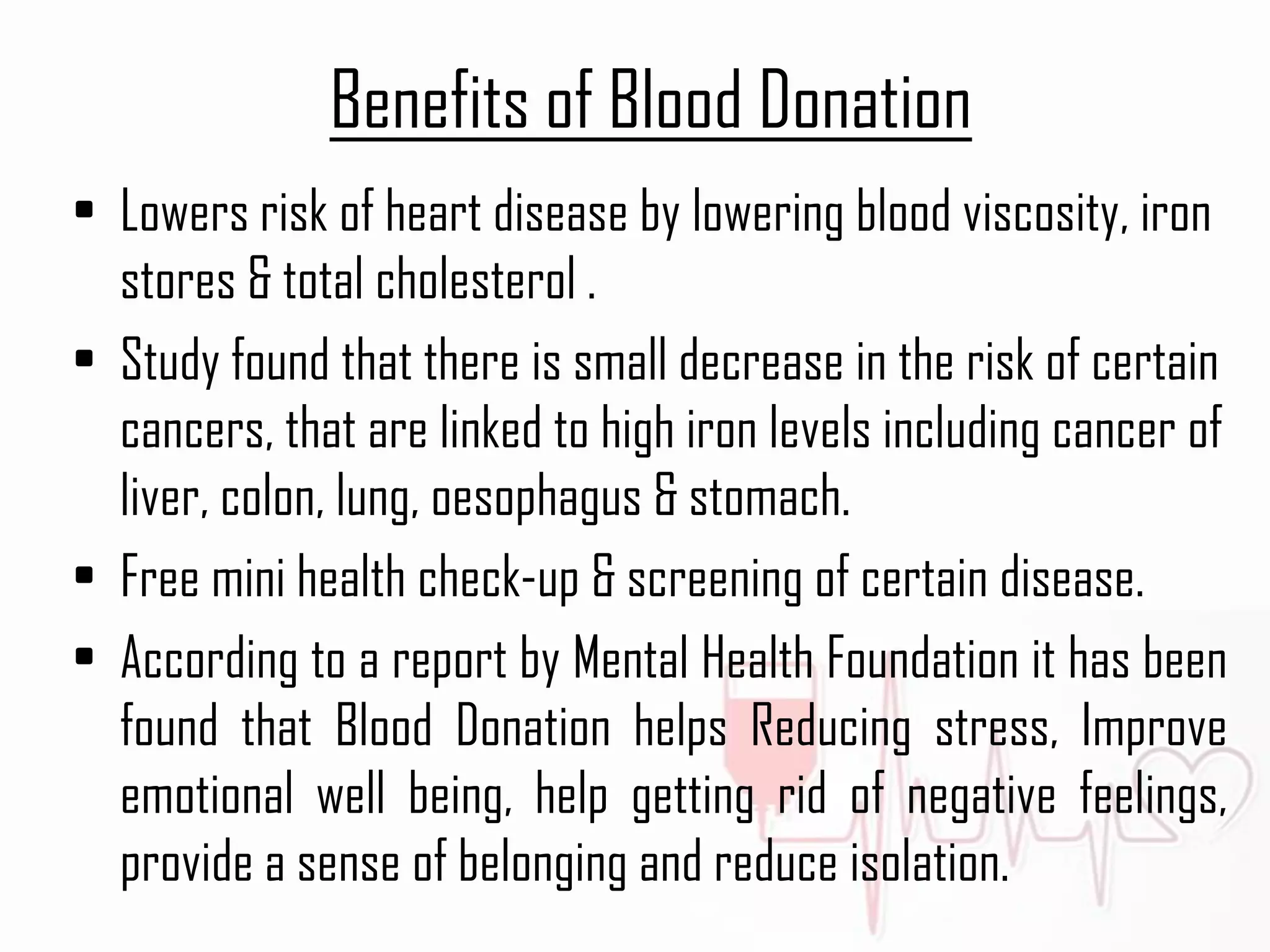
Benefits of Blood Donation
• Lowers risk of heart disease by lowering blood viscosity, iron
stores & total cholesterol .
• Study found that there is small decrease in the risk of certain
cancers, that are linked to high iron levels including cancer of
liver, colon, lung, oesophagus & stomach.
• Free mini health check-up & screening of certain disease.
• According to a report by Mental Health Foundation it has been
found that Blood Donation helps Reducing stress, Improve
emotional well being, help getting rid of negative feelings,
provide a sense of belonging and reduce isolation.
Need of Blood Donation
• The most precious gift that anyone can give to another
person — the gift of Life.
• It isn't every day you can do something to save someone's
life - but that's exactly what you do every time you donate
blood. Blood is a priceless gift - a lifesaver.
• Blood can't be manufactured and it can't be replaced by
animal blood.
• As a person belonging in the society all of us TOGETHER
should help each other to overcome HUGE shortfall of Blood.
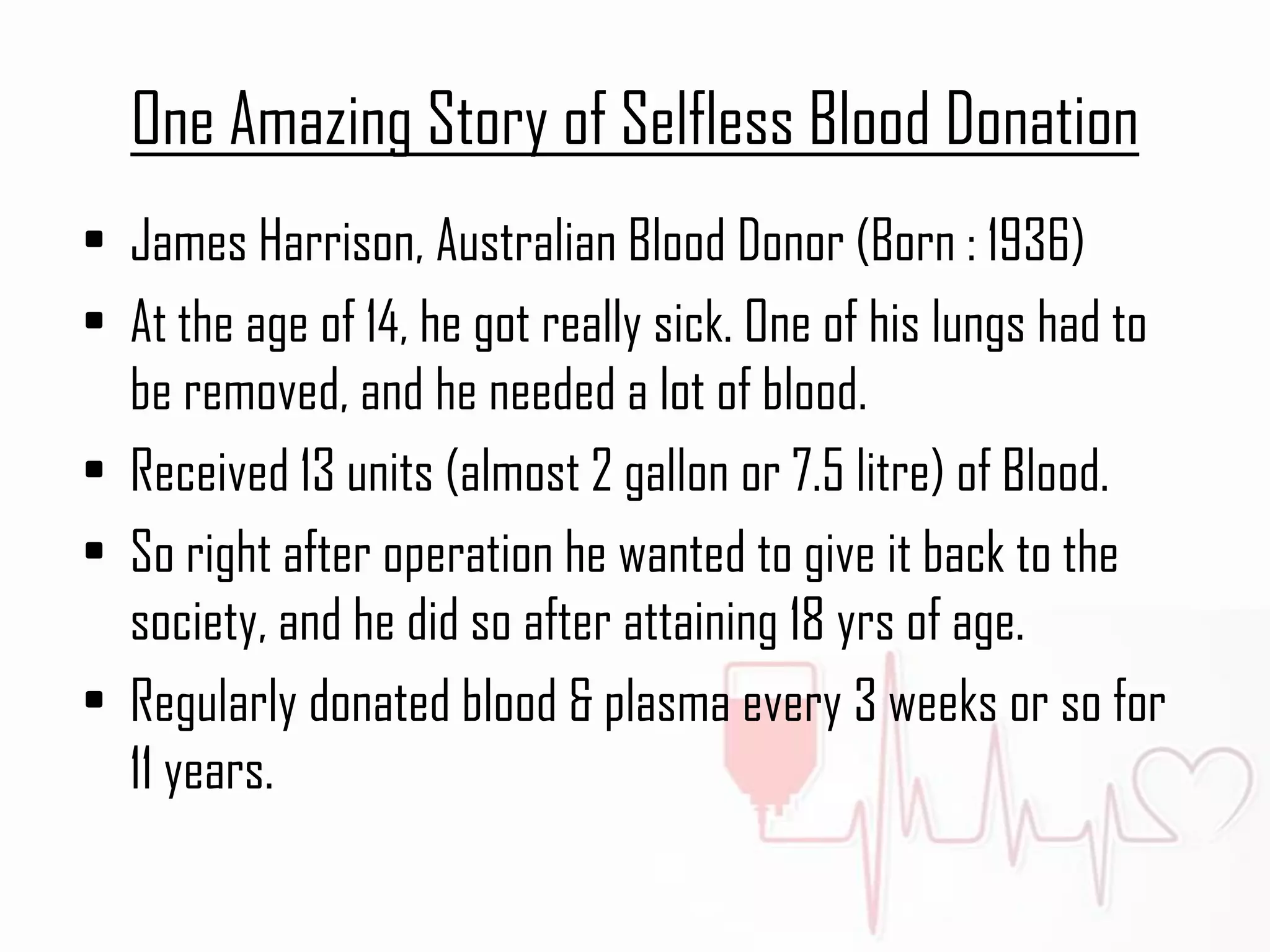
One Amazing Story of Selfless Blood Donation
• James Harrison, Australian Blood Donor (Born : 1936)
• At the age of 14, he got really sick. One of his lungs had to
be removed, and he needed a lot of blood.
• Received 13 units (almost 2 gallon or 7.5 litre) of Blood.
• So right after operation he wanted to give it back to the
society, and he did so after attaining 18 yrs of age.
• Regularly donated blood & plasma every 3 weeks or so for
11 years.
Story continuation ......
• Meanwhile, doctors were struggling with cases of a potentially
fatal condition called Rh incompatibility, also known as Rhesus
isoimmunisation or Rh disease. It occurs when a pregnant woman
has an Rh-negative blood type but the fetus she's carrying is Rh-
positive. In some pregnant women, Rh disease causes their
antibodies to attack the fetus's red blood cells.
• In Harrison's blood, Scientists found a rare antibody known as Rh
(D) immune globulin or anti-D.
• Doctors believe Harrison has anti-D because of the blood he
received at age 14. And so Harrison became the first anti-D donor
in Australia, and every batch of Anti-D that has been made in
Australia came from his blood.
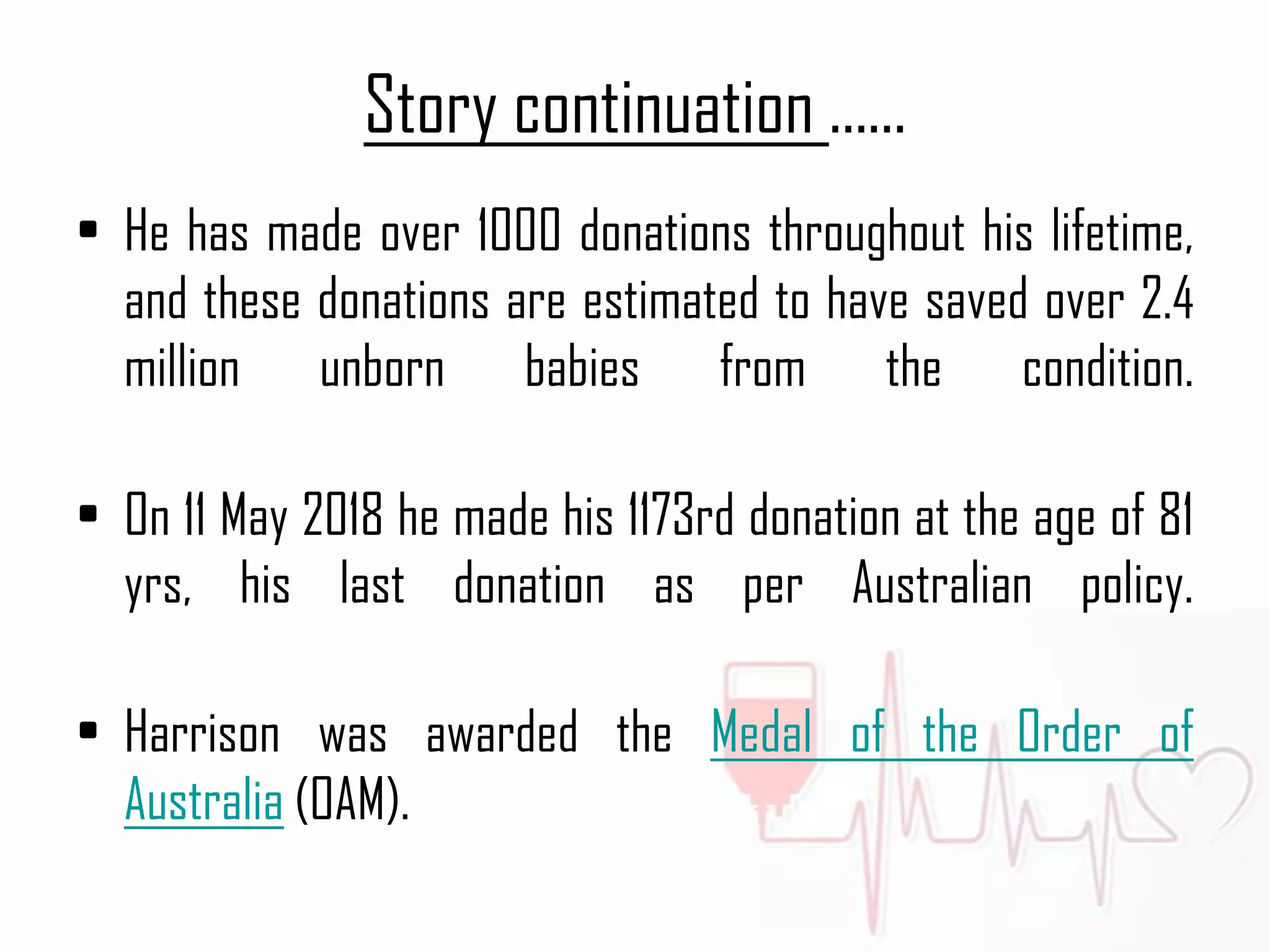
Story continuation ......
• He has made over 1000 donations throughout his lifetime,
and these donations are estimated to have saved over 2.4
million unborn babies from the condition.
• On 11 May 2018 he made his 1173rd donation at the age of 81
yrs, his last donation as per Australian policy.
• Harrison was awarded the Medal of the Order of
Australia (OAM).
• World Blood Donor Day 14th June (B’day of K. Landsteiner)
• Blood connects us all (2016)
• Don't wait until disaster strikes. What can you do? Give blood.
Give now. Give often (2017)
• Be there for someone else. Give blood. Share life. (2018)

Blood donation

  • 1.
    Benefits & Need forBlood Donation DR. CHIRANJIT NOATIA Medical Officer Blood Bank, District Hospital Gomati
  • 2.
    Contents in Brief •Blood What is it? Science & Philosophy & Law . • Users/Who need it ? • Demand / How much is the need ? • Supply / How much available for use ? • Eligibility for Blood Donation . • Eligible donor base . • Benefits of Blood Donation • Need of Blood Donation • One Amazing Story of Selfless Blood Donation !
  • 3.
    Blood What isit? Science & Philosophy & Law • Science: One of the main transport system of the body, which delivers nutrients & oxygen to different cells and transports metabolic waste products from cells. • Philosophy : Vital life force which separate living beings from non living things, a connection that binds societies together. • Law/Medicine : A ―drug‖ which is to be manufactured as per standards for to be used safely in patients.
  • 4.
    Users / Whoneed it (Blood) ? • For cancer patients • For those undergoing surgery • For complications of pregnancy • To treat accident and burns victims & shock • To provide clotting factors for people with bleeding disorders, including haemophilia
  • 5.
    Demand / Howmuch is the need of Blood ? • Projected Blood requirement in our State, based on WHO norm of 1% of Population = 36,710 • In India the 12 Million Units (1 Crore 20 Lac) • In Our Gomati District approx 4,500 unit.
  • 6.
    Supply / Howmuch available for use ? • Last 5 years collection in our state stands at 27,000 to 28,000 in average . Never crossed 30,000. That is only about 75% of total demand we are able to meet. • In India on avg. 9 M units are collected against 12 M units demand . (75% again) • In our district same reflects. 3000-3500 units we are getting against projected demand of 4500-5000 units. • So, there is HUGE shortfall of 25% against demand.
  • 7.
    Eligibility for BloodDonation • Overall health- The donor must be fit and healthy, & should not be suffering from transmittable diseases. • Age and weight- The donor must be 18–65 years old and should weigh a minimum of 45 kg. • Pulse rate- Between 50 and 100 without irregularities. • Haemoglobin level- A minimum of 12.5 g/dL. • Blood Pressure- Diastolic: 60-90 mm Hg, Systolic: 100–140 mm Hg. • Body temperature- Should be normal, not exceeding 37.5 °C. • The time period between successive blood donations should be more than 3 months.
  • 8.
    Eligible Donor Base •49.8 % of total population in age group 20-65 yrs of age. • 25 % of total population is Male in age group 20-65 yrs. • If we subtract half of the Male due to under weight, NCDs • We are having about 12-13% of total population as perfectly fit eligible donor. • 4,50,000 ( 4 lac 50 thousand ) is the approx number of eligible donor , taking 12.5% of total population (36 lac) as eligible donor. • In Gomati District if we apply that formula approx 55,000 perfectly fit eligible donor.
  • 9.
    Benefits of BloodDonation • Lowers risk of heart disease by lowering blood viscosity, iron stores & total cholesterol . • Study found that there is small decrease in the risk of certain cancers, that are linked to high iron levels including cancer of liver, colon, lung, oesophagus & stomach. • Free mini health check-up & screening of certain disease. • According to a report by Mental Health Foundation it has been found that Blood Donation helps Reducing stress, Improve emotional well being, help getting rid of negative feelings, provide a sense of belonging and reduce isolation.
  • 10.
    Need of BloodDonation • The most precious gift that anyone can give to another person — the gift of Life. • It isn't every day you can do something to save someone's life - but that's exactly what you do every time you donate blood. Blood is a priceless gift - a lifesaver. • Blood can't be manufactured and it can't be replaced by animal blood. • As a person belonging in the society all of us TOGETHER should help each other to overcome HUGE shortfall of Blood.
  • 11.
    One Amazing Storyof Selfless Blood Donation • James Harrison, Australian Blood Donor (Born : 1936) • At the age of 14, he got really sick. One of his lungs had to be removed, and he needed a lot of blood. • Received 13 units (almost 2 gallon or 7.5 litre) of Blood. • So right after operation he wanted to give it back to the society, and he did so after attaining 18 yrs of age. • Regularly donated blood & plasma every 3 weeks or so for 11 years.
  • 12.
    Story continuation ...... •Meanwhile, doctors were struggling with cases of a potentially fatal condition called Rh incompatibility, also known as Rhesus isoimmunisation or Rh disease. It occurs when a pregnant woman has an Rh-negative blood type but the fetus she's carrying is Rh- positive. In some pregnant women, Rh disease causes their antibodies to attack the fetus's red blood cells. • In Harrison's blood, Scientists found a rare antibody known as Rh (D) immune globulin or anti-D. • Doctors believe Harrison has anti-D because of the blood he received at age 14. And so Harrison became the first anti-D donor in Australia, and every batch of Anti-D that has been made in Australia came from his blood.
  • 13.
    Story continuation ...... •He has made over 1000 donations throughout his lifetime, and these donations are estimated to have saved over 2.4 million unborn babies from the condition. • On 11 May 2018 he made his 1173rd donation at the age of 81 yrs, his last donation as per Australian policy. • Harrison was awarded the Medal of the Order of Australia (OAM).
  • 14.
    • World BloodDonor Day 14th June (B’day of K. Landsteiner) • Blood connects us all (2016) • Don't wait until disaster strikes. What can you do? Give blood. Give now. Give often (2017) • Be there for someone else. Give blood. Share life. (2018)