With HUGE thanks to
Drummond Reed of Evernym for
the DID Primer slides!
Biometric Identity
Assertion
Via
Sovrin Blockchain
John R. Callahan
CTO Veridium
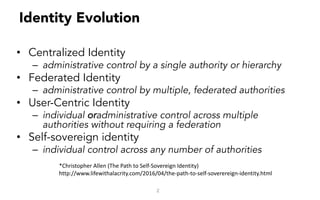
Identity Evolution
• Centralized Identity
– administrative control by a single authority or hierarchy
• Federated Identity
– administrative control by multiple, federated authorities
• User-Centric Identity
– individual oradministrative control across multiple
authorities without requiring a federation
• Self-sovereign identity
– individual control across any number of authorities
2
*Christopher	Allen	(The	Path	to	Self-Sovereign	Identity)
http://www.lifewithalacrity.com/2016/04/the-path-to-self-soverereign-identity.html
Self-sovereign identity is…
3
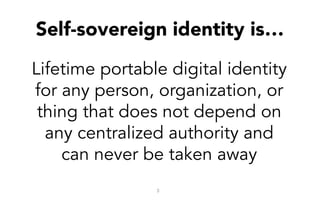
Lifetime portable digital identity
for any person, organization, or
thing that does not depend on
any centralized authority and
can never be taken away
4
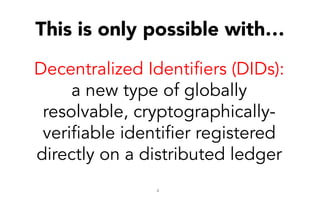
Decentralized Identifiers (DIDs):
a new type of globally
resolvable, cryptographically-
verifiable identifier registered
directly on a distributed ledger
This is only possible with…
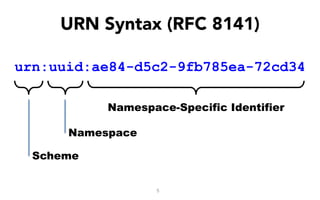
URN Syntax (RFC 8141)
5
urn:uuid:ae84-d5c2-9fb785ea-72cd34
Namespace
Scheme
Namespace-Specific Identifier
6
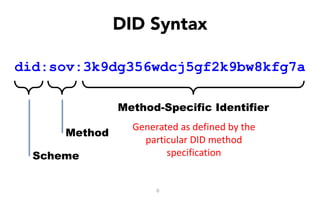
did:sov:3k9dg356wdcj5gf2k9bw8kfg7a
Method
Scheme
Method-Specific Identifier
DID Syntax
Generated	as	defined	by	the	
particular	DID	method	
specification
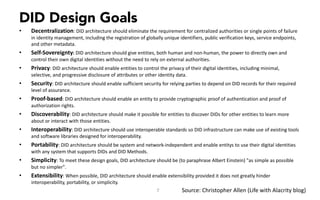
DID Design Goals
• Decentralization:	DID	architecture	should	eliminate	the	requirement	for	centralized	authorities	or	single	points	of	failure	
in	identity	management,	including	the	registration	of	globally	unique	identifiers,	public	verification	keys,	service	endpoints,	
and	other	metadata.
• Self-Sovereignty:	DID	architecture	should	give	entities,	both	human	and	non-human,	the	power	to	directly	own	and	
control	their	own	digital	identities	without	the	need	to	rely	on	external	authorities.
• Privacy:	DID	architecture	should	enable	entities	to	control	the	privacy	of	their	digital	identities,	including	minimal,	
selective,	and	progressive	disclosure	of	attributes	or	other	identity	data.
• Security:	DID	architecture	should	enable	sufficient	security	for	relying	parties	to	depend	on	DID	records	for	their	required	
level	of	assurance.
• Proof-based:	DID	architecture	should	enable	an	entity	to	provide	cryptographic	proof	of	authentication	and	proof	of	
authorization	rights.
• Discoverability:	DID	architecture	should	make	it	possible	for	entities	to	discover	DIDs	for	other	entities	to	learn	more	
about	or	interact	with	those	entities.
• Interoperability:	DID	architecture	should	use	interoperable	standards	so	DID	infrastructure	can	make	use	of	existing	tools	
and	software	libraries	designed	for	interoperability.
• Portability:	DID	architecture	should	be	system	and	network-independent	and	enable	entitys to	use	their	digital	identities	
with	any	system	that	supports	DIDs	and	DID	Methods.
• Simplicity:	To	meet	these	design	goals,	DID	architecture	should	be	(to	paraphrase	Albert	Einstein)	"as	simple	as	possible	
but	no	simpler".
• Extensibility:	When	possible,	DID	architecture	should	enable	extensibility	provided	it	does	not	greatly	hinder	
interoperability,	portability,	or	simplicity.
7 Source:	Christopher	Allen	(Life	with	Alacrity	blog)
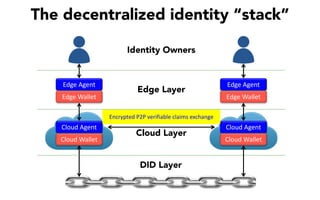
DID Layer
The decentralized identity “stack”
Cloud Layer
Cloud	Wallet Cloud	Wallet
Cloud	Agent Cloud	Agent
Identity Owners
Edge Layer
Edge	Wallet Edge	Wallet
Edge	Agent Edge	Agent
Encrypted	P2P	verifiable	claims	exchange
9
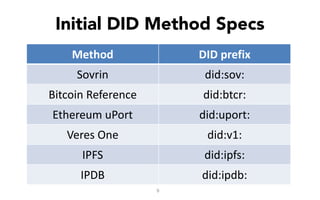
Method DID	prefix
Sovrin did:sov:
Bitcoin Reference did:btcr:
Ethereum uPort did:uport:
Veres One did:v1:
IPFS did:ipfs:
IPDB did:ipdb:
Initial DID Method Specs
10
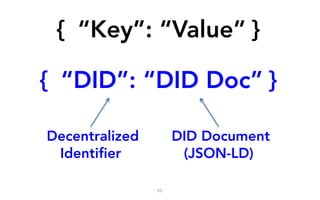
{ “Key”: “Value” }
{ “DID”: “DID Doc” }
DID Document
(JSON-LD)
Decentralized
Identifier
11
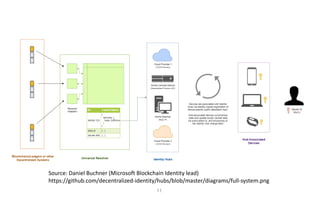
Source:	Daniel	Buchner	(Microsoft	Blockchain Identity	lead)
https://github.com/decentralized-identity/hubs/blob/master/diagrams/full-system.png
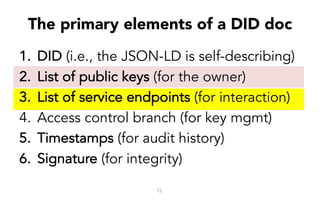
1. DID (i.e., the JSON-LD is self-describing)
2. List of public keys (for the owner)
3. List of service endpoints (for interaction)
4. Access control branch (for key mgmt)
5. Timestamps (for audit history)
6. Signature (for integrity)
12
The primary elements of a DID doc
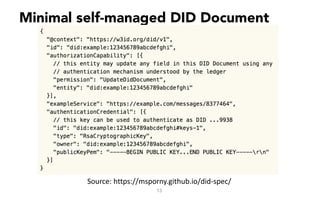
Minimal self-managed DID Document
13
Source:	https://msporny.github.io/did-spec/
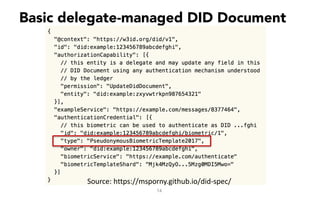
Basic delegate-managed DID Document
14
Source:	https://msporny.github.io/did-spec/
IEEE	2410
Biometric	Open	Protocol	Standard	(BOPS)
(2017	version)
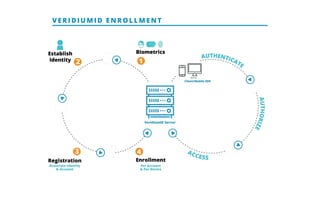
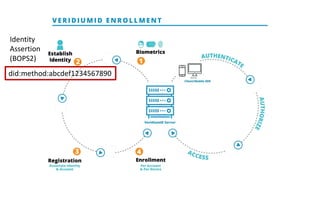
VE RI DI U MI D E NRO L L ME NT
did:method:abcdef1234567890
Identity
Assertion
(BOPS2)
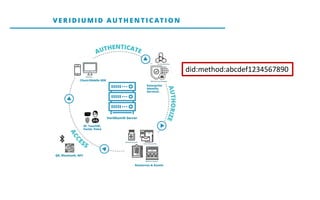
VE RI DI U MI D AU T H E NT I C AT I O N
did:method:abcdef1234567890
19
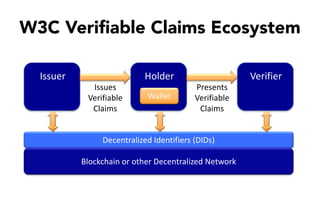
The new format for interoper-
able digital credentials being
defined by the W3C Verifiable
Claims Working Group
Verifiable claims are…
Holder
Wallet
Issuer Verifier
Issues	
Verifiable	
Claims
Presents
Verifiable	
Claims
Decentralized	Identifiers	(DIDs)
Blockchain	or	other	Decentralized	Network
W3C Verifiable Claims Ecosystem
21
22
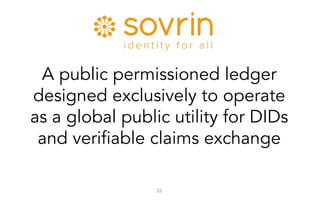
A public permissioned ledger
designed exclusively to operate
as a global public utility for DIDs
and verifiable claims exchange
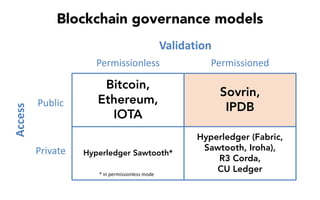
Bitcoin,
Ethereum,
IOTA
Permissionless Permissioned
Public
Private
Validation
Access
Hyperledger Sawtooth*
Sovrin,
IPDB
Hyperledger (Fabric,
Sawtooth, Iroha),
R3 Corda,
CU Ledger
Blockchain governance models
*	in	permissionless mode
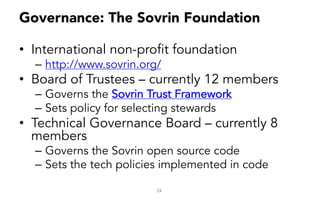
Governance: The Sovrin Foundation
• International non-profit foundation
– http://www.sovrin.org/
• Board of Trustees – currently 12 members
– Governs the Sovrin Trust Framework
– Sets policy for selecting stewards
• Technical Governance Board – currently 8
members
– Governs the Sovrin open source code
– Sets the tech policies implemented in code
24
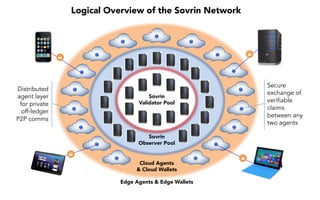
Sovrin
Validator Pool
Sovrin
Observer Pool
Edge Agents & Edge Wallets
Cloud Agents
& Cloud Wallets
Logical Overview of the Sovrin Network
Distributed
agent layer
for private
off-ledger
P2P comms
Secure
exchange of
verifiable
claims
between any
two agents
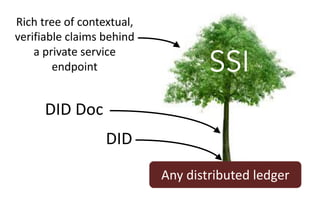
DID
DID	Doc
Rich	tree	of	contextual,	
verifiable	claims	behind	
a	private	service	
endpoint
Any	distributed	ledger
SSI
27
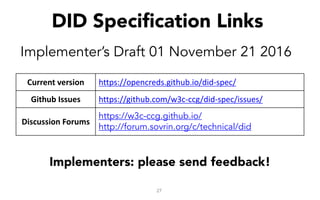
DID Specification Links
Implementer’s Draft 01 November 21 2016
Implementers: please send feedback!
Current	version https://opencreds.github.io/did-spec/
Github Issues https://github.com/w3c-ccg/did-spec/issues/
Discussion Forums
https://w3c-ccg.github.io/
http://forum.sovrin.org/c/technical/did
• W3C Verifiable Claims Working Group
– https://www.w3.org/2017/vc/charter.html
• Sovrin White Papers
– https://sovrin.org/library/
• Sovrin Trust Framework
– https://sovrin.org/trust-framework/
28
Other Links
29
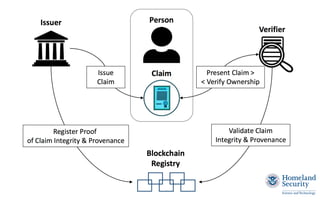
Work	on	the	DID	specification	has	been	funded	in	part	
by	a	Small	Business	Innovation	Research	(SBIR)	grant	
from	the	U.S.	Department	of	Homeland	Security	
Science	and	Technology	Directorate.
The	content	of	this	specification	does	not	necessarily	
reflect	the	position	or	the	policy	of	the	U.S.	Government	
and	no	official	endorsement	should	be	inferred.
Thank You
https://www.csoonline.com/author/John-Callahan/
© 2017 Veridium IP Ltd. All Rights Reserved

Blockchain-based Solutions for Identity & Access Management