Blockchain
1
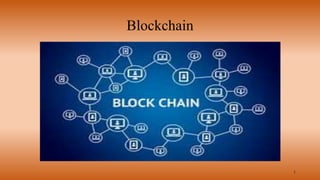
What is Blockchain?
 A distributed ledger that operates on consensus
 Parties involved have access to ledger, no single entity controls it
 Each transaction is put in a block
 Each party validates the block
 Once validated, added to a chain. No changes can be made after
creation
 After transactions are complete, all parties get a copy of transaction
(Wadhwa & Bobkoff, 2016).
2
Possible uses for Blockchain
• Banking
• Markets
• Healthcare
• Smart Contracts
• Property Records
(Wadhwa & Bobkoff, 2016).
3
How Blockchain works
• Controls information
• Avoids duplication
(Crowe, 2016).
• Provides ability to record and track events
• No one party can change transactions without consent from others
• Transparency reduces fraud and errors
• Parties must contact each other to view policy, payment data, and
status
(Mearian, 2017).
4
Benefits of Blockchain
• Disintermediation & trustless exchange
• Empowers users
• High quality data
• Process integrity
• Transparency and immutability
• Faster transactions
• Lower transaction costs
(Deloitte, 2017).
5
Challenges of Blockchain
• Nascent technology
• Uncertain regulatory status
• Large energy consumption
• Control, security, and privacy
• Integration concerns
• Cultural adaptation
• Cost
(Deloitte, 2017).
6
Fog Computing
7
What is Fog Computing and How It Works?
• System level horizontal architecture
• Distributes computing resources and services
(OpenFog, n.d.)
• Keeps data closer to ‘ground’, at local user points
(Marr, 2016)
• Fog extends cloud closer to device producing data
• Analyze data at lower level reduces latency
• Sensitive data stays in network
(CISCO, 2015)
8
Advantages of Fog Computing
• Distributes computing closer to end user
• Real time processing
• Bridges Internet of Things (IoT) with current internet infrastructure
(Chang, Zhang, & Shi, 2017)
• Low latency, less network bandwidth
• Reduced costs
• Real-time analytics
(OpenFog, n.d.)
• Business agility
• Security
(CISCO, 2015)
9
Challenges of Fog Computing
• Security and privacy
• Programming
• Architecture
• Support
• Network
• Resource management
(OpenFog, n.d.)
10
Conclusion
Blockchain could be a beneficial and reliable source of
implementing a transparent and secure platform to allow decision
makers across the chain to make better decisions, thereby reducing costs
and errors.
Fog computing could assist in preparing information nearer to
where it is created and required. It appears to reduce the need to
continually venture to the cloud, thereby potentially decreasing cost of
bandwidth from network traffic and protecting data by keeping it closer
to end user.
11
References
Chen, S., Zhang, T., & Shi, W. (2017). Fog computing. IEEE Internet Computing, 21(2). Retrieved
July 19, 2017 from http://ieeexplore.ieee.org/document/7867739/.
CISCO. (2015). Fog computing and the internet of things: extend the cloud to where things are
[White Paper]. CISCO. Retrieved July 19, 2017 from
http://www.cisco.com/c/dam/en_us/solutions/trends/iot/docs/computing-overview.pdf.
Crowe, P. (2016). There is a 'game changer' technology on Wall Street and people keep confusing it
with bitcoin. Business Insider. Retrieved July 18, 2017 from
http://www.businessinsider.com/what-is-blockchain-2016-3/#blockchains-are-ledgers-like-excel-
spreadsheets-but-they-accept-inputs-from-lots-of-different-parties-the-ledger-can-only-be-
changed-when-there-is-a-consensus-among-the-group-that-makes-them-more-secure-and-it-
means-theres-no-need-for-a-central-authority-to-approve-transactions-1.
Deloitte. (2017). Blockchain technology: 9 benefits & 7 challenges. Deloitte. Retrieved July 18, 2017
from https://www2.deloitte.com/nl/nl/pages/innovatie/artikelen/blockchain-technology-9-benefits-
and-7-challenges.html.
12
References
Marr, B. (2016). What is fog computing? And why it matters in our big data and IoT world. Forbes.
Retrieved July 19, 2017 from https://www.forbes.com/sites/bernardmarr/2016/10/14/what-is-fog-
computing-and-why-it-matters-in-our-big-data-and-iot-world/#3a2d048964ef.
Mearian, L. (2017). 4 ways blockchain is the new business collaboration tool. COMPUTERWORLD.
Retrieved July 18, 2017 from http://www.computerworld.com/article/3197695/emerging-
technology/4-ways-blockchain-is-the-new-business-collaboration-tool.html.
OpenFog. (n.d.) Definition of fog computing. OpenFog. Retrieved July 19, 2017 from
https://www.openfogconsortium.org/resources/.
Tyle, S. & Kaushal, M. (2015). The Blockchain: What It Is and Why It Matters. Brookings. Retrieved
July 18, 2017 from https://www.brookings.edu/blog/techtank/2015/01/13/the-blockchain-what-it-
is-and-why-it-matters/.
Wadhwa, T. & Bobkoff, D. (2016). Blockchain could soon power stock markets, music sales, and
even prevent child labor — here's how it works. Business Insider. Retrieved July 18, 2017 from
http://www.businessinsider.com/what-is-blockchain-2016-10.
13

Blockchain

  • 1.
  • 2.
    What is Blockchain? A distributed ledger that operates on consensus  Parties involved have access to ledger, no single entity controls it  Each transaction is put in a block  Each party validates the block  Once validated, added to a chain. No changes can be made after creation  After transactions are complete, all parties get a copy of transaction (Wadhwa & Bobkoff, 2016). 2
  • 3.
    Possible uses forBlockchain • Banking • Markets • Healthcare • Smart Contracts • Property Records (Wadhwa & Bobkoff, 2016). 3
  • 4.
    How Blockchain works •Controls information • Avoids duplication (Crowe, 2016). • Provides ability to record and track events • No one party can change transactions without consent from others • Transparency reduces fraud and errors • Parties must contact each other to view policy, payment data, and status (Mearian, 2017). 4
  • 5.
    Benefits of Blockchain •Disintermediation & trustless exchange • Empowers users • High quality data • Process integrity • Transparency and immutability • Faster transactions • Lower transaction costs (Deloitte, 2017). 5
  • 6.
    Challenges of Blockchain •Nascent technology • Uncertain regulatory status • Large energy consumption • Control, security, and privacy • Integration concerns • Cultural adaptation • Cost (Deloitte, 2017). 6
  • 7.
  • 8.
    What is FogComputing and How It Works? • System level horizontal architecture • Distributes computing resources and services (OpenFog, n.d.) • Keeps data closer to ‘ground’, at local user points (Marr, 2016) • Fog extends cloud closer to device producing data • Analyze data at lower level reduces latency • Sensitive data stays in network (CISCO, 2015) 8
  • 9.
    Advantages of FogComputing • Distributes computing closer to end user • Real time processing • Bridges Internet of Things (IoT) with current internet infrastructure (Chang, Zhang, & Shi, 2017) • Low latency, less network bandwidth • Reduced costs • Real-time analytics (OpenFog, n.d.) • Business agility • Security (CISCO, 2015) 9
  • 10.
    Challenges of FogComputing • Security and privacy • Programming • Architecture • Support • Network • Resource management (OpenFog, n.d.) 10
  • 11.
    Conclusion Blockchain could bea beneficial and reliable source of implementing a transparent and secure platform to allow decision makers across the chain to make better decisions, thereby reducing costs and errors. Fog computing could assist in preparing information nearer to where it is created and required. It appears to reduce the need to continually venture to the cloud, thereby potentially decreasing cost of bandwidth from network traffic and protecting data by keeping it closer to end user. 11
  • 12.
    References Chen, S., Zhang,T., & Shi, W. (2017). Fog computing. IEEE Internet Computing, 21(2). Retrieved July 19, 2017 from http://ieeexplore.ieee.org/document/7867739/. CISCO. (2015). Fog computing and the internet of things: extend the cloud to where things are [White Paper]. CISCO. Retrieved July 19, 2017 from http://www.cisco.com/c/dam/en_us/solutions/trends/iot/docs/computing-overview.pdf. Crowe, P. (2016). There is a 'game changer' technology on Wall Street and people keep confusing it with bitcoin. Business Insider. Retrieved July 18, 2017 from http://www.businessinsider.com/what-is-blockchain-2016-3/#blockchains-are-ledgers-like-excel- spreadsheets-but-they-accept-inputs-from-lots-of-different-parties-the-ledger-can-only-be- changed-when-there-is-a-consensus-among-the-group-that-makes-them-more-secure-and-it- means-theres-no-need-for-a-central-authority-to-approve-transactions-1. Deloitte. (2017). Blockchain technology: 9 benefits & 7 challenges. Deloitte. Retrieved July 18, 2017 from https://www2.deloitte.com/nl/nl/pages/innovatie/artikelen/blockchain-technology-9-benefits- and-7-challenges.html. 12
  • 13.
    References Marr, B. (2016).What is fog computing? And why it matters in our big data and IoT world. Forbes. Retrieved July 19, 2017 from https://www.forbes.com/sites/bernardmarr/2016/10/14/what-is-fog- computing-and-why-it-matters-in-our-big-data-and-iot-world/#3a2d048964ef. Mearian, L. (2017). 4 ways blockchain is the new business collaboration tool. COMPUTERWORLD. Retrieved July 18, 2017 from http://www.computerworld.com/article/3197695/emerging- technology/4-ways-blockchain-is-the-new-business-collaboration-tool.html. OpenFog. (n.d.) Definition of fog computing. OpenFog. Retrieved July 19, 2017 from https://www.openfogconsortium.org/resources/. Tyle, S. & Kaushal, M. (2015). The Blockchain: What It Is and Why It Matters. Brookings. Retrieved July 18, 2017 from https://www.brookings.edu/blog/techtank/2015/01/13/the-blockchain-what-it- is-and-why-it-matters/. Wadhwa, T. & Bobkoff, D. (2016). Blockchain could soon power stock markets, music sales, and even prevent child labor — here's how it works. Business Insider. Retrieved July 18, 2017 from http://www.businessinsider.com/what-is-blockchain-2016-10. 13

Editor's Notes

  • #2 Image retrieved from internet search https://www.bing.com/images/search?q=blockchain+images&id=7C64436541B19A4116A2FF95AFE6F1122DE84458&FORM=IQFRBA
  • #6 Parties can make an exchange without the oversight or intermediation of a third party Users are in control Data is complete, consistent, timely, accurate, available No central point of failure No need for third party, transactions executed by protocol Changes to blockchains are public, cannot be changed Reduces clutter & complications of multiple ledgers Reduces transaction time, processed 24/7 Decrease costs for exchanging assets, reduce transaction fees
  • #7 Resolving multiple challenges Modern currency regulated by governments, issue with adoption by pre-existing financial institutions 400+ thousand trillion solutions per second, utilizes increased amount of computer power Cyber security concerns need addressing prior to general public trust Significant changes to existing systems, must strategize transition Shift to decentralize network, requires buy-in of users/operators High initial capital costs
  • #8 Image retrieved from internet search https://www.bing.com/images/search?view=detailV2&ccid=W%2Bw2EHT8&id=4FF7777FC1E82D27E8B2E62F41D25389F89719A6&thid=OIP.W-w2EHT8jvOxQgkCd6ZJ8gEsDh&q=fog+computing+images&simid=608053536920305868&selectedindex=16&qpvt=fog+computing+images&mode=overlay&first=1
  • #10 Local subject matter Quick scaling Geographic distribution Sensor network Diversity