Overview of Blockchain
Consensus Mechanisms
Cork Blockchain, 2018-08-14
Johannes Ahlmann,
johannes@fluquid.com
Image: https://cdn-images-1.medium.com/max/1600/1*DpVNUugFmEhGhblHmXxbVA.jpeg
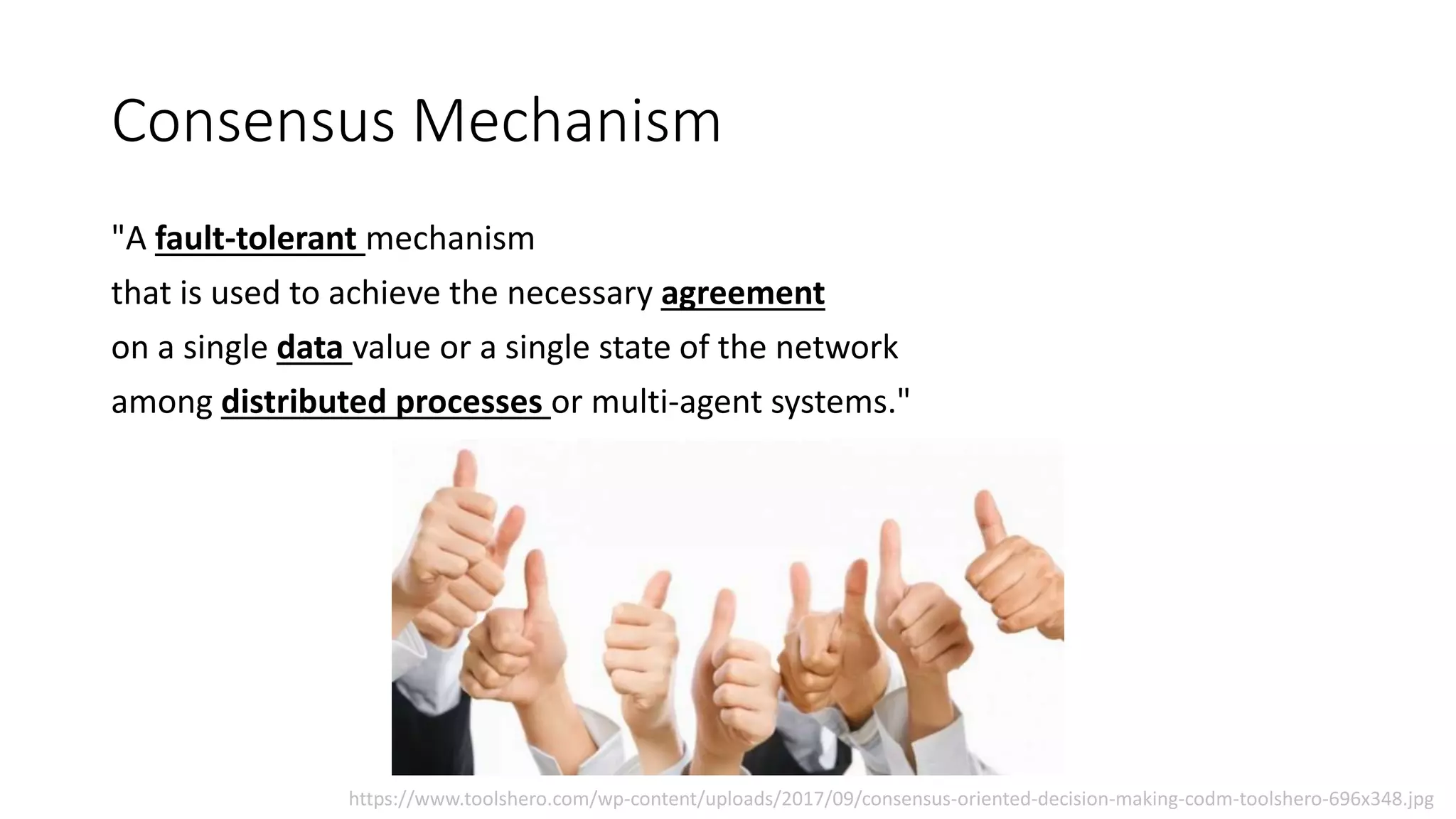
Consensus Mechanism
"A fault-tolerant mechanism
that is used to achieve the necessary agreement
on a single data value or a single state of the network
among distributed processes or multi-agent systems."
https://www.toolshero.com/wp-content/uploads/2017/09/consensus-oriented-decision-making-codm-toolshero-696x348.jpg
Byzantine Fault Tolerance
• "Crash Fault Tolerance" (CFT) aims to guarantee the functioning of a distributed
system in the presence of machines crashing or disconnecting and reconnecting
at random
• "Byzantine Fault Tolerance" (BFT) aims to guarantee the ability of a group of
nodes to achieve consensus in the presence of malicious actors who are trying to
subvert the consensus process in their favour, or prevent consensus from being
achieved.
• BFT is a much harder goal than CFT, and hasn't been solved mathematically at
scale; BFT generally makes use of cryptographic signatures, etc.
• Approximations of BFT exist, but they all come with significant constraints and
limitations attached
(i.e. Practical BFT achieve consensus in the presence of up to 1/3 malicious actors
and <20 total nodes)
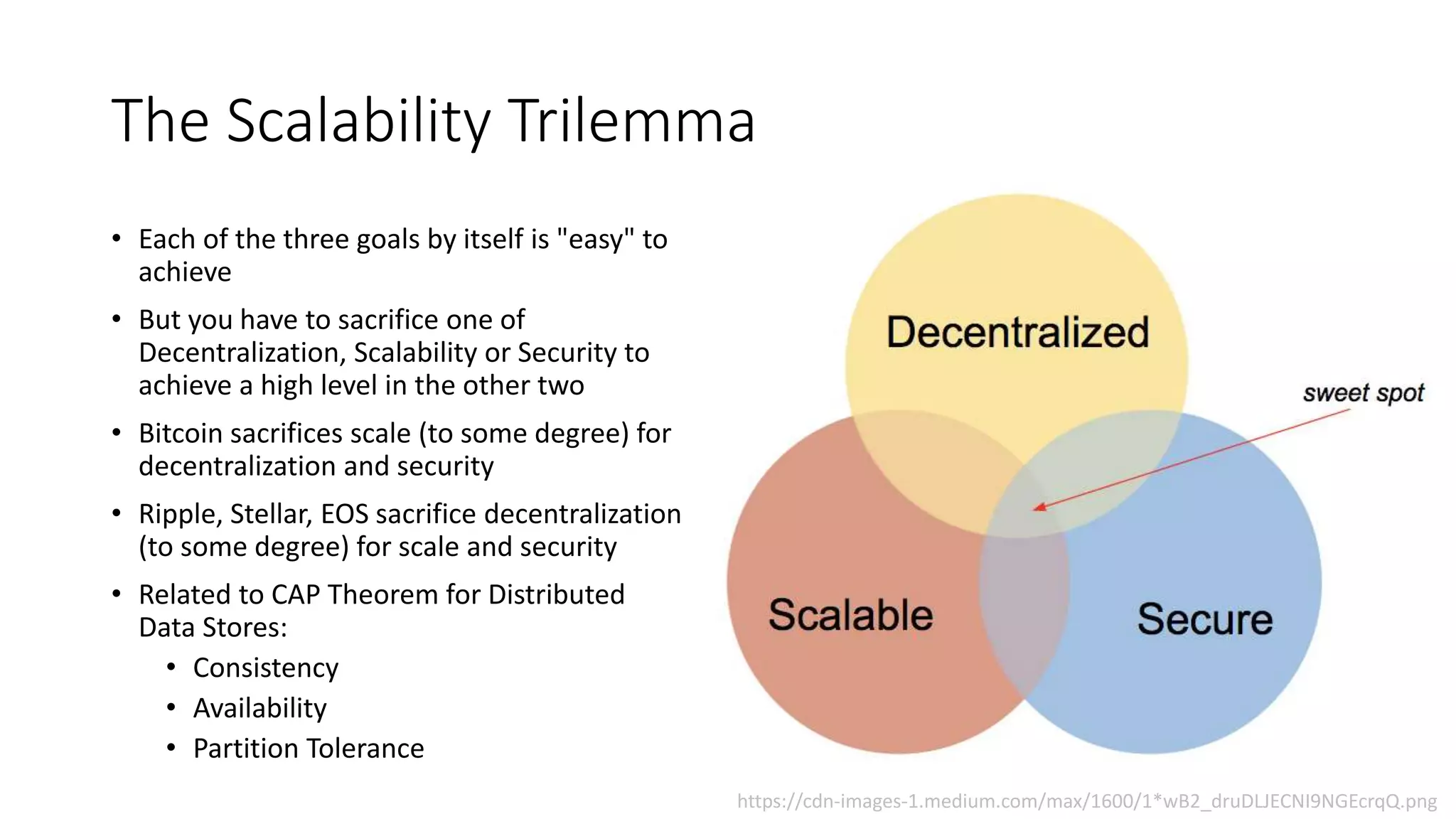
The Scalability Trilemma
• Each of the three goals by itself is "easy" to
achieve
• But you have to sacrifice one of
Decentralization, Scalability or Security to
achieve a high level in the other two
• Bitcoin sacrifices scale (to some degree) for
decentralization and security
• Ripple, Stellar, EOS sacrifice decentralization
(to some degree) for scale and security
• Related to CAP Theorem for Distributed
Data Stores:
• Consistency
• Availability
• Partition Tolerance
https://cdn-images-1.medium.com/max/1600/1*wB2_druDLJECNI9NGEcrqQ.png
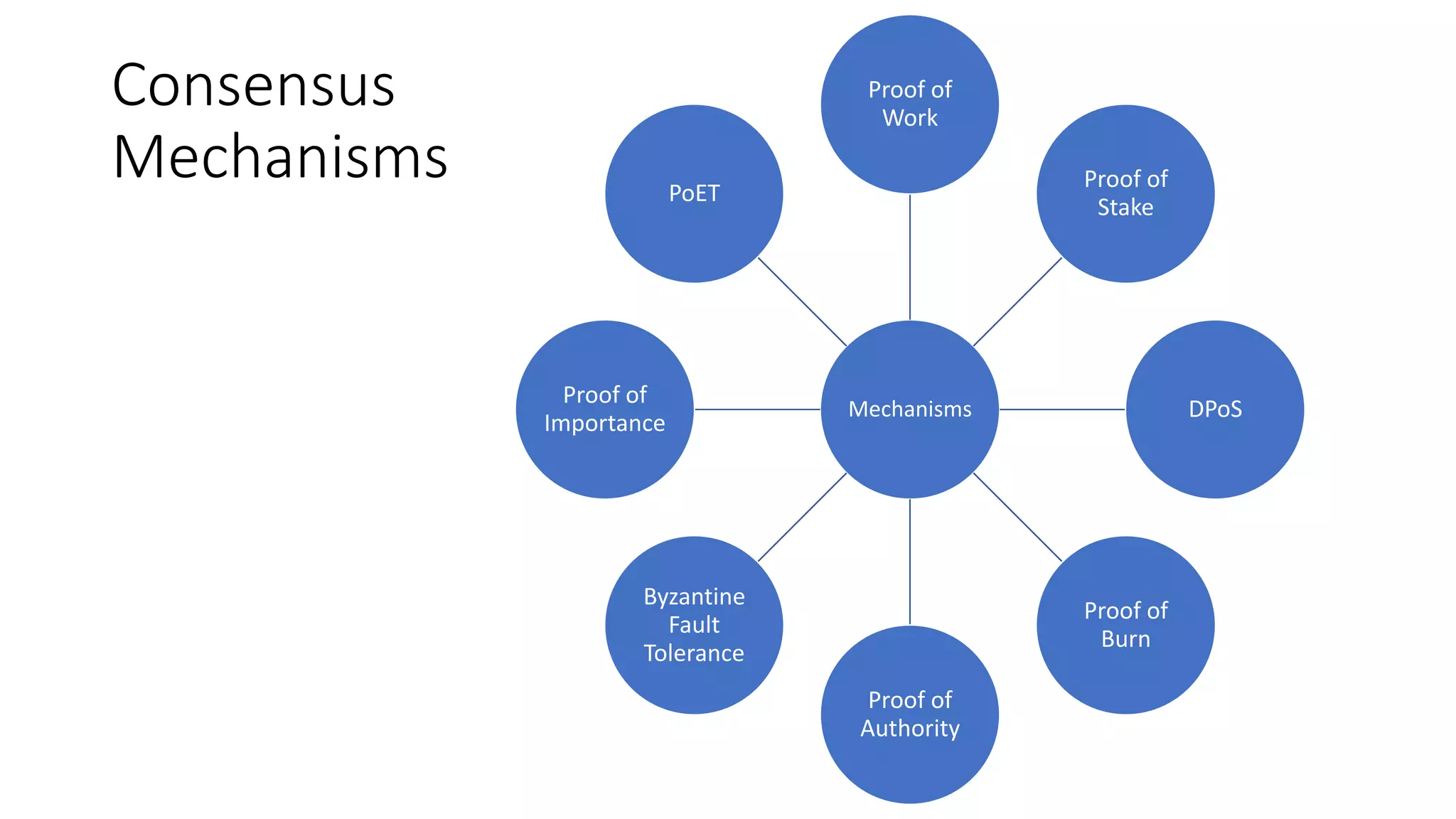
Consensus
Mechanisms
Mechanisms
Proof of
Work
Proof of
Stake
DPoS
Proof of
Burn
Proof of
Authority
Byzantine
Fault
Tolerance
Proof of
Importance
PoET
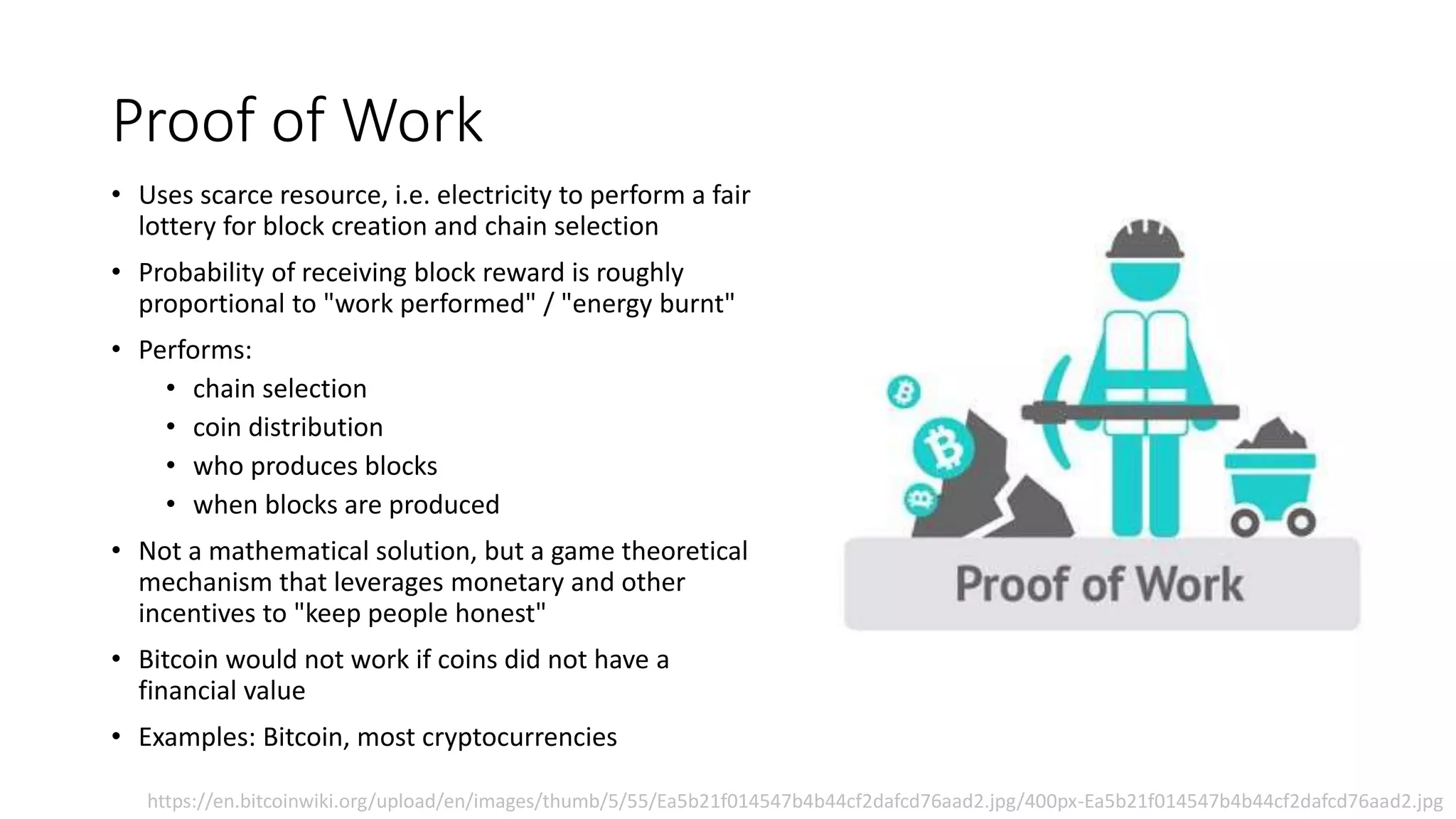
Proof of Work
• Uses scarce resource, i.e. electricity to perform a fair
lottery for block creation and chain selection
• Probability of receiving block reward is roughly
proportional to "work performed" / "energy burnt"
• Performs:
• chain selection
• coin distribution
• who produces blocks
• when blocks are produced
• Not a mathematical solution, but a game theoretical
mechanism that leverages monetary and other
incentives to "keep people honest"
• Bitcoin would not work if coins did not have a
financial value
• Examples: Bitcoin, most cryptocurrencies
https://en.bitcoinwiki.org/upload/en/images/thumb/5/55/Ea5b21f014547b4b44cf2dafcd76aad2.jpg/400px-Ea5b21f014547b4b44cf2dafcd76aad2.jpg
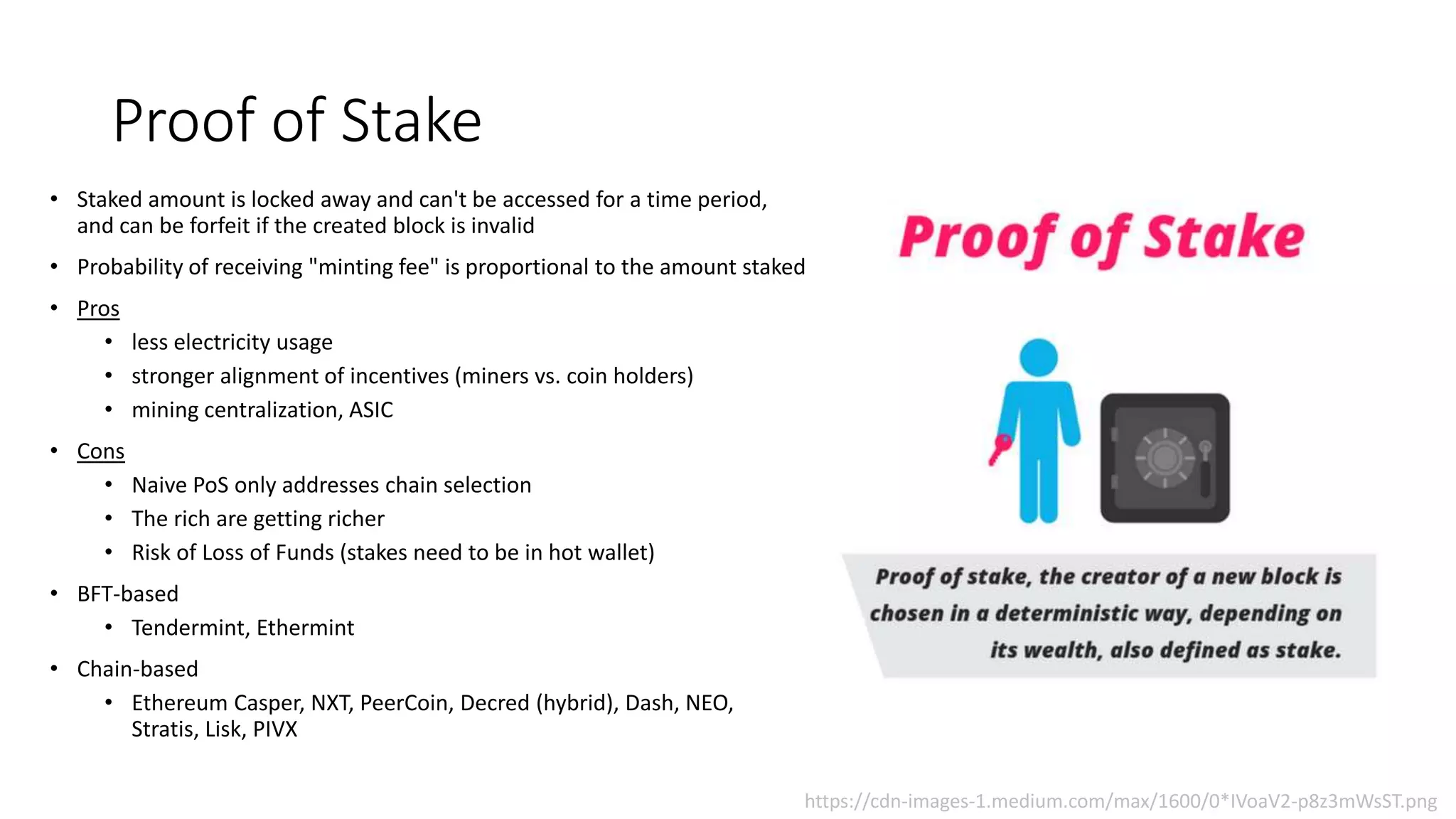
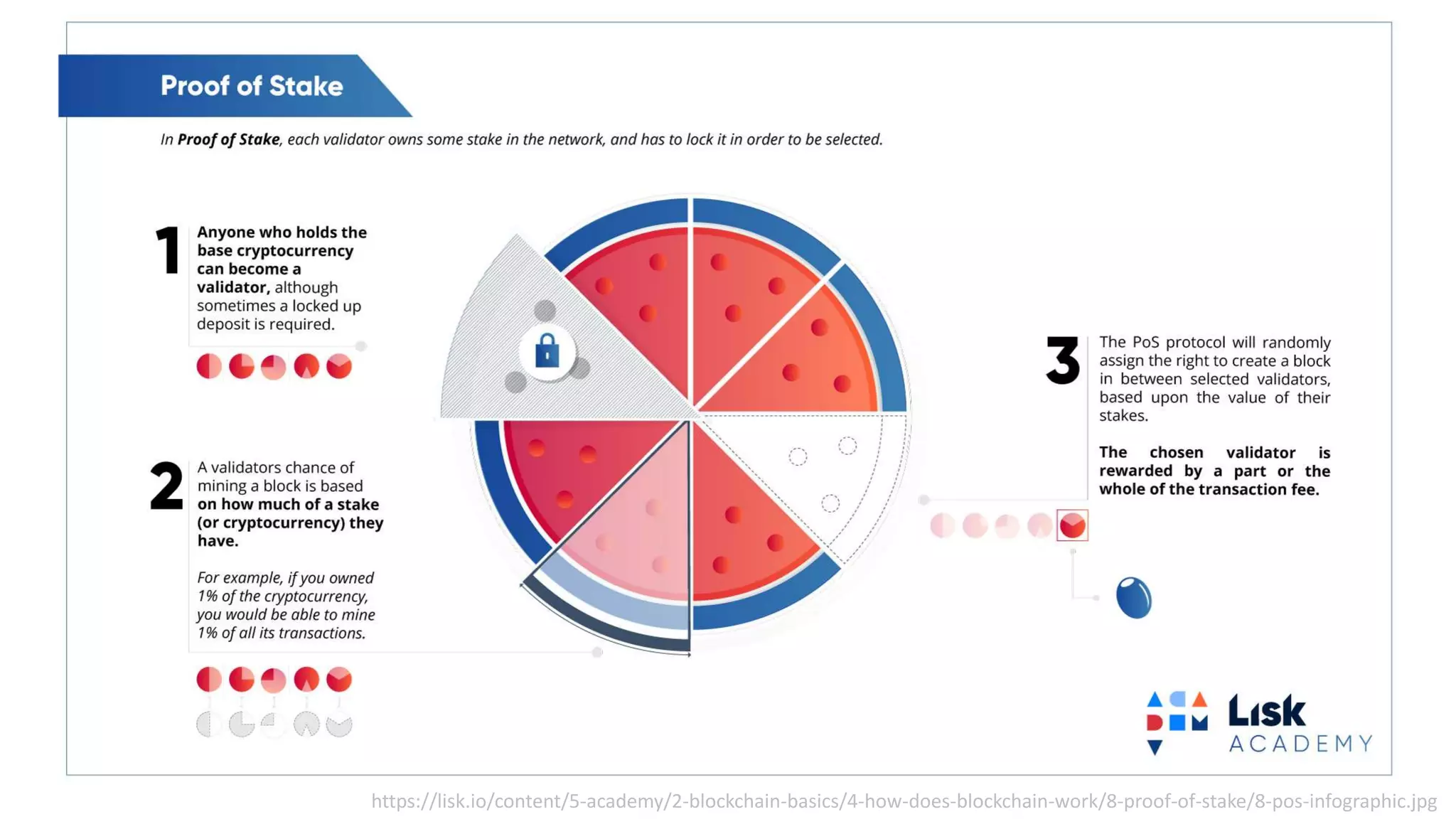
Proof of Stake
• Staked amount is locked away and can't be accessed for a time period,
and can be forfeit if the created block is invalid
• Probability of receiving "minting fee" is proportional to the amount staked
• Pros
• less electricity usage
• stronger alignment of incentives (miners vs. coin holders)
• mining centralization, ASIC
• Cons
• Naive PoS only addresses chain selection
• The rich are getting richer
• Risk of Loss of Funds (stakes need to be in hot wallet)
• BFT-based
• Tendermint, Ethermint
• Chain-based
• Ethereum Casper, NXT, PeerCoin, Decred (hybrid), Dash, NEO,
Stratis, Lisk, PIVX
https://cdn-images-1.medium.com/max/1600/0*IVoaV2-p8z3mWsST.png
https://lisk.io/content/5-academy/2-blockchain-basics/4-how-does-blockchain-work/8-proof-of-stake/8-pos-infographic.jpg
Delegated Proof of Stake
• Nodes vote for Witnesses (top 100 are paid, top 20
earn a regular salary), nodes can withdraw their vote in
case of improper conduct by a Witness
• Relies upon a group of delegates to validate blocks on
behalf of all nodes in the network
• Pros: Scalable, energy efficient, cheap transactions.
• Cons: Partially centralized
• Examples: Bitshares, EOS, Steemit
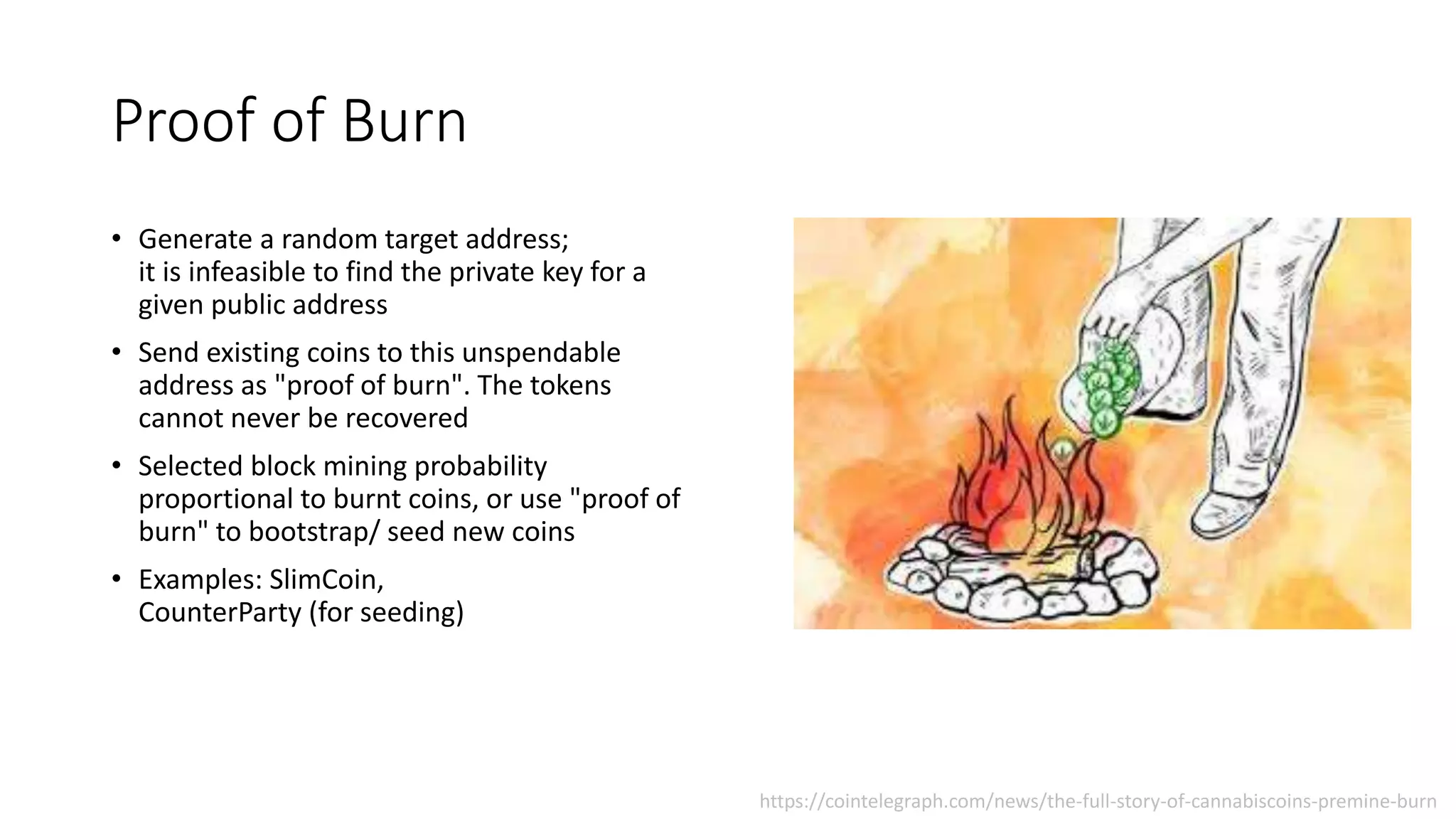
Proof of Burn
• Generate a random target address;
it is infeasible to find the private key for a
given public address
• Send existing coins to this unspendable
address as "proof of burn". The tokens
cannot never be recovered
• Selected block mining probability
proportional to burnt coins, or use "proof of
burn" to bootstrap/ seed new coins
• Examples: SlimCoin,
CounterParty (for seeding)
https://cointelegraph.com/news/the-full-story-of-cannabiscoins-premine-burn
Proof of Elapsed Time (PoET)
• Nodes need to be identifiable and accepted
into the network (permissioned blockchain)
• Uses Trusted Hardware for "fair lottery". Every
node generates a random number for how
long it has to wait, and the random number
utilitizes Trusted Computing hardware.
• Requires "Intel Software Guard Extensions
(SGX)" on node CPUs
• Examples: Hyperledger Sawtooth
https://www.hyperledger.org/wp-content/uploads/2018/01/Hyperledger_Sawtooth_Logo_Color.png
http://www.stickpng.com/assets/images/58568d224f6ae202fedf2720.png
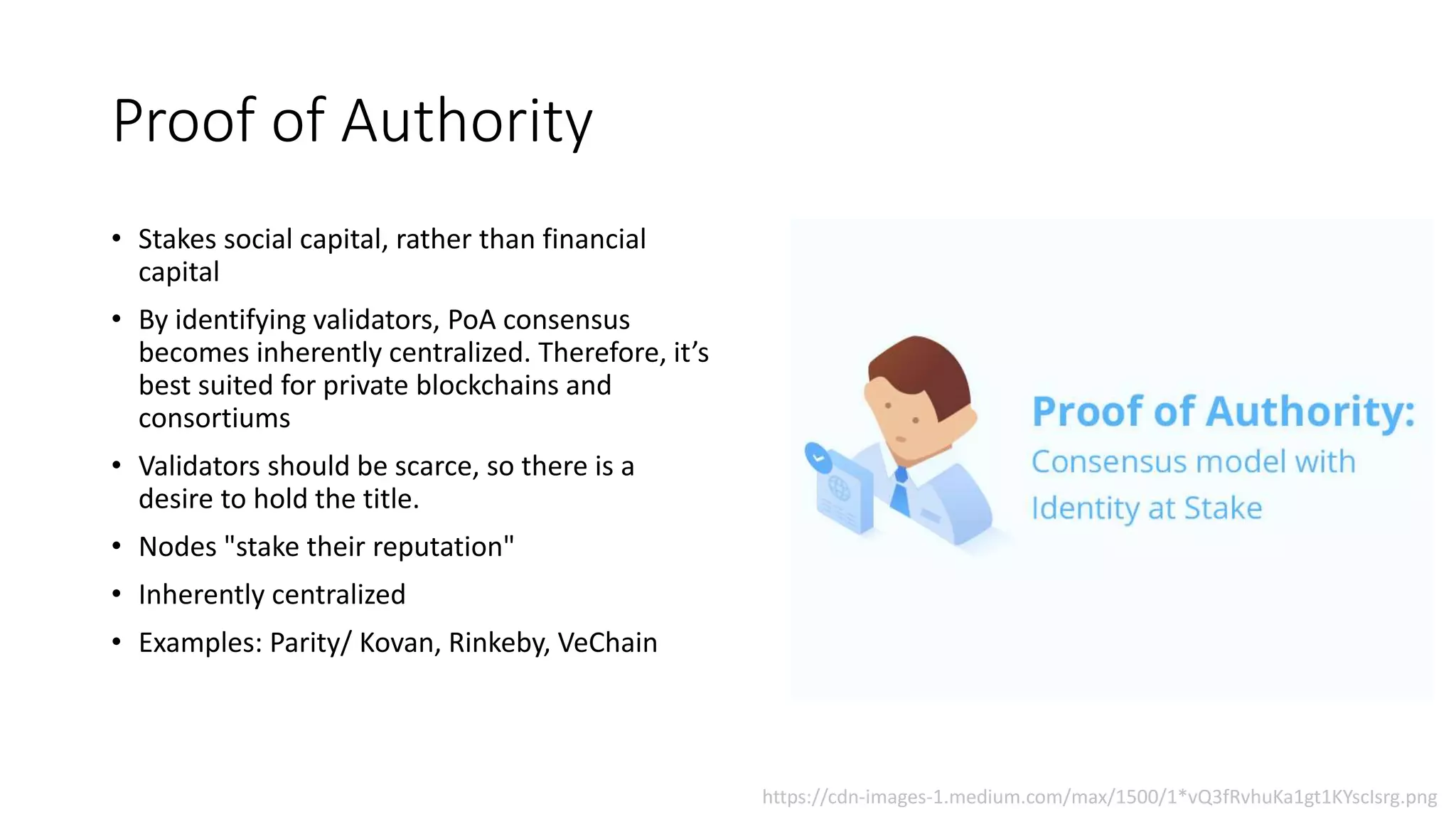
Proof of Authority
• Stakes social capital, rather than financial
capital
• By identifying validators, PoA consensus
becomes inherently centralized. Therefore, it’s
best suited for private blockchains and
consortiums
• Validators should be scarce, so there is a
desire to hold the title.
• Nodes "stake their reputation"
• Inherently centralized
• Examples: Parity/ Kovan, Rinkeby, VeChain
https://cdn-images-1.medium.com/max/1500/1*vQ3fRvhuKa1gt1KYscIsrg.png
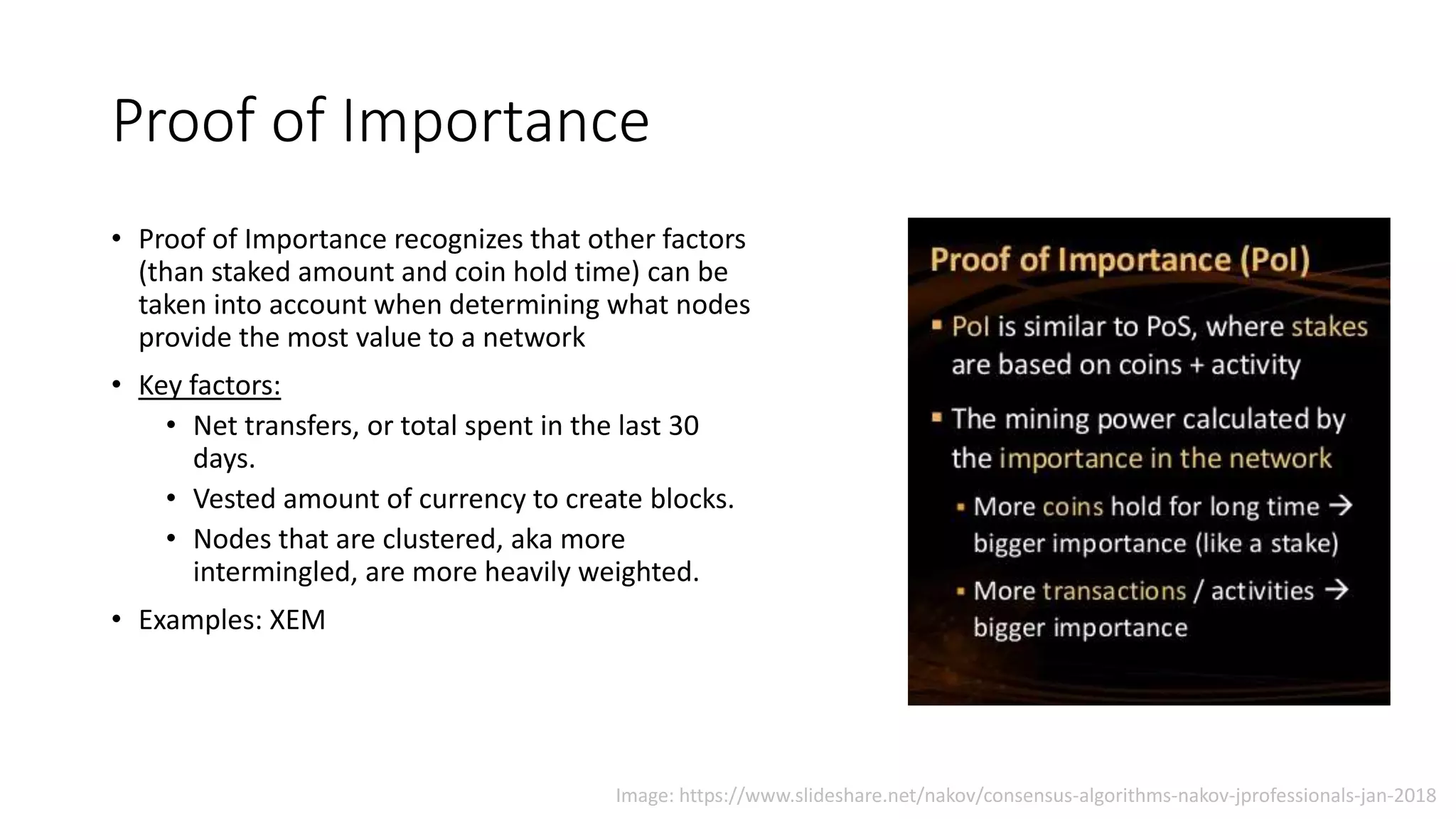
Proof of Importance
• Proof of Importance recognizes that other factors
(than staked amount and coin hold time) can be
taken into account when determining what nodes
provide the most value to a network
• Key factors:
• Net transfers, or total spent in the last 30
days.
• Vested amount of currency to create blocks.
• Nodes that are clustered, aka more
intermingled, are more heavily weighted.
• Examples: XEM
Image: https://www.slideshare.net/nakov/consensus-algorithms-nakov-jprofessionals-jan-2018
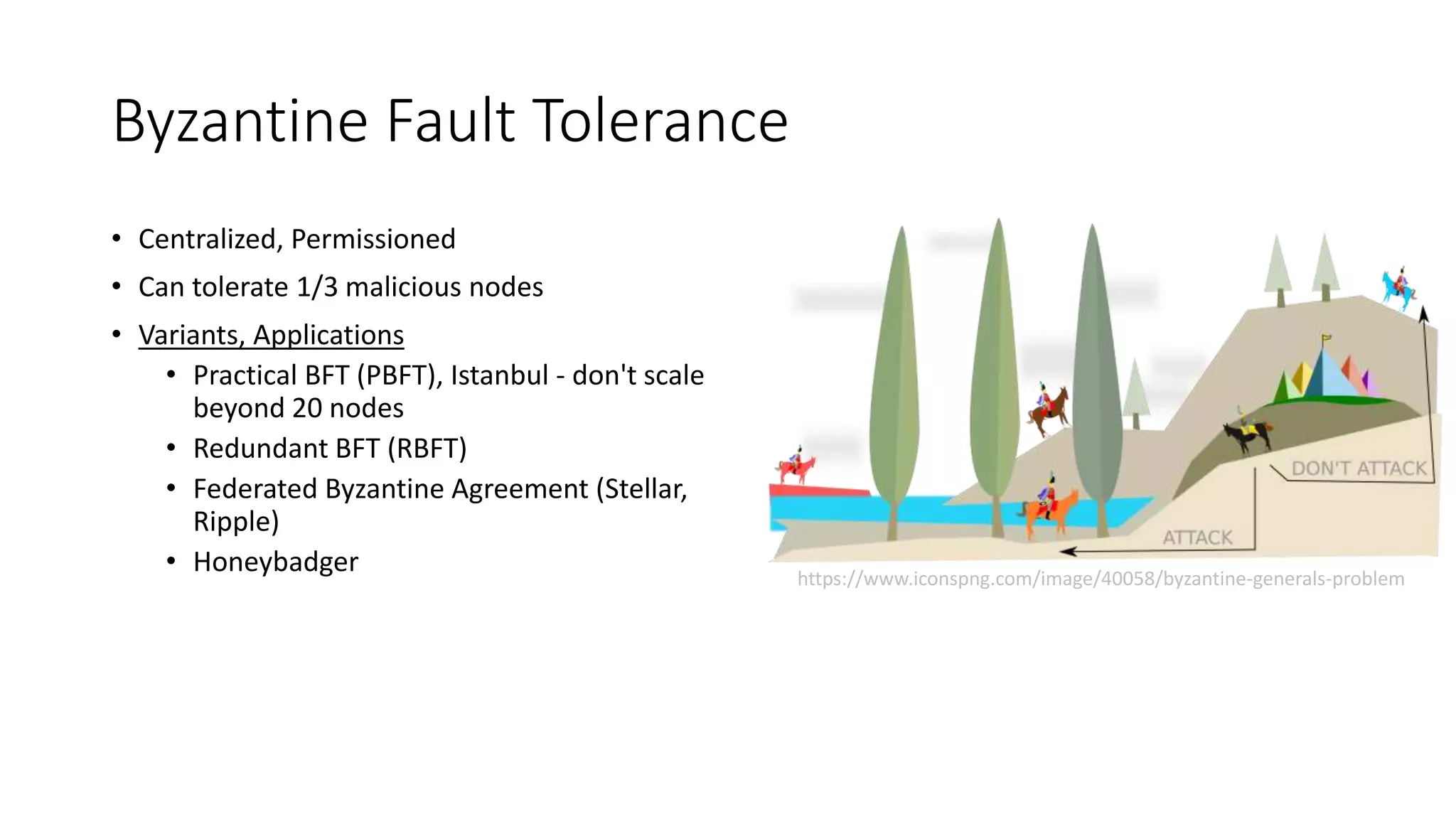
Byzantine Fault Tolerance
• Centralized, Permissioned
• Can tolerate 1/3 malicious nodes
• Variants, Applications
• Practical BFT (PBFT), Istanbul - don't scale
beyond 20 nodes
• Redundant BFT (RBFT)
• Federated Byzantine Agreement (Stellar,
Ripple)
• Honeybadger https://www.iconspng.com/image/40058/byzantine-generals-problem
Attacks on Proof of Stake
• Nothing at Stake
• Staker can stake on all candidate chains; and will be seen as having staked on whichever chain ultimate
"wins"
• This can in principle be detected, but changing stakes is necessary for convergence.
Explicit multiple staking rounds addresses this to some degree
• Stake does not add to the convergence of the system;
In contrast for PoW energy is a real-world finite resource
• Long Range Attack
• Attacker could buy a key to an address that is now empty but had a large token balance in the past,
and generate alternative history from that point
• Solution: checkpointing
Problem: checkpointing introduces centralization/"ask a friend" security model
Thank You!
Resources
• https://medium.com/the-daily-bit/9-types-of-consensus-mechanisms-that-you-didnt-know-
about-49ec365179da
• https://cointelegraph.com/news/why-blockchain-needs-proof-of-authority-instead-of-proof-of-
stake
• https://blog.cosmos.network/consensus-compare-casper-vs-tendermint-6df154ad56ae
• https://blog.bitmex.com/complete-guide-to-proof-of-stake-ethereums-latest-proposal-vitalik-
buterin-interview/

Overview of Blockchain Consensus Mechanisms

  • 1.
    Overview of Blockchain ConsensusMechanisms Cork Blockchain, 2018-08-14 Johannes Ahlmann, johannes@fluquid.com Image: https://cdn-images-1.medium.com/max/1600/1*DpVNUugFmEhGhblHmXxbVA.jpeg
  • 2.
    Consensus Mechanism "A fault-tolerantmechanism that is used to achieve the necessary agreement on a single data value or a single state of the network among distributed processes or multi-agent systems." https://www.toolshero.com/wp-content/uploads/2017/09/consensus-oriented-decision-making-codm-toolshero-696x348.jpg
  • 3.
    Byzantine Fault Tolerance •"Crash Fault Tolerance" (CFT) aims to guarantee the functioning of a distributed system in the presence of machines crashing or disconnecting and reconnecting at random • "Byzantine Fault Tolerance" (BFT) aims to guarantee the ability of a group of nodes to achieve consensus in the presence of malicious actors who are trying to subvert the consensus process in their favour, or prevent consensus from being achieved. • BFT is a much harder goal than CFT, and hasn't been solved mathematically at scale; BFT generally makes use of cryptographic signatures, etc. • Approximations of BFT exist, but they all come with significant constraints and limitations attached (i.e. Practical BFT achieve consensus in the presence of up to 1/3 malicious actors and <20 total nodes)
  • 4.
    The Scalability Trilemma •Each of the three goals by itself is "easy" to achieve • But you have to sacrifice one of Decentralization, Scalability or Security to achieve a high level in the other two • Bitcoin sacrifices scale (to some degree) for decentralization and security • Ripple, Stellar, EOS sacrifice decentralization (to some degree) for scale and security • Related to CAP Theorem for Distributed Data Stores: • Consistency • Availability • Partition Tolerance https://cdn-images-1.medium.com/max/1600/1*wB2_druDLJECNI9NGEcrqQ.png
  • 5.
    Consensus Mechanisms Mechanisms Proof of Work Proof of Stake DPoS Proofof Burn Proof of Authority Byzantine Fault Tolerance Proof of Importance PoET
  • 6.
    Proof of Work •Uses scarce resource, i.e. electricity to perform a fair lottery for block creation and chain selection • Probability of receiving block reward is roughly proportional to "work performed" / "energy burnt" • Performs: • chain selection • coin distribution • who produces blocks • when blocks are produced • Not a mathematical solution, but a game theoretical mechanism that leverages monetary and other incentives to "keep people honest" • Bitcoin would not work if coins did not have a financial value • Examples: Bitcoin, most cryptocurrencies https://en.bitcoinwiki.org/upload/en/images/thumb/5/55/Ea5b21f014547b4b44cf2dafcd76aad2.jpg/400px-Ea5b21f014547b4b44cf2dafcd76aad2.jpg
  • 7.
    Proof of Stake •Staked amount is locked away and can't be accessed for a time period, and can be forfeit if the created block is invalid • Probability of receiving "minting fee" is proportional to the amount staked • Pros • less electricity usage • stronger alignment of incentives (miners vs. coin holders) • mining centralization, ASIC • Cons • Naive PoS only addresses chain selection • The rich are getting richer • Risk of Loss of Funds (stakes need to be in hot wallet) • BFT-based • Tendermint, Ethermint • Chain-based • Ethereum Casper, NXT, PeerCoin, Decred (hybrid), Dash, NEO, Stratis, Lisk, PIVX https://cdn-images-1.medium.com/max/1600/0*IVoaV2-p8z3mWsST.png
  • 8.
  • 9.
    Delegated Proof ofStake • Nodes vote for Witnesses (top 100 are paid, top 20 earn a regular salary), nodes can withdraw their vote in case of improper conduct by a Witness • Relies upon a group of delegates to validate blocks on behalf of all nodes in the network • Pros: Scalable, energy efficient, cheap transactions. • Cons: Partially centralized • Examples: Bitshares, EOS, Steemit
  • 10.
    Proof of Burn •Generate a random target address; it is infeasible to find the private key for a given public address • Send existing coins to this unspendable address as "proof of burn". The tokens cannot never be recovered • Selected block mining probability proportional to burnt coins, or use "proof of burn" to bootstrap/ seed new coins • Examples: SlimCoin, CounterParty (for seeding) https://cointelegraph.com/news/the-full-story-of-cannabiscoins-premine-burn
  • 11.
    Proof of ElapsedTime (PoET) • Nodes need to be identifiable and accepted into the network (permissioned blockchain) • Uses Trusted Hardware for "fair lottery". Every node generates a random number for how long it has to wait, and the random number utilitizes Trusted Computing hardware. • Requires "Intel Software Guard Extensions (SGX)" on node CPUs • Examples: Hyperledger Sawtooth https://www.hyperledger.org/wp-content/uploads/2018/01/Hyperledger_Sawtooth_Logo_Color.png http://www.stickpng.com/assets/images/58568d224f6ae202fedf2720.png
  • 12.
    Proof of Authority •Stakes social capital, rather than financial capital • By identifying validators, PoA consensus becomes inherently centralized. Therefore, it’s best suited for private blockchains and consortiums • Validators should be scarce, so there is a desire to hold the title. • Nodes "stake their reputation" • Inherently centralized • Examples: Parity/ Kovan, Rinkeby, VeChain https://cdn-images-1.medium.com/max/1500/1*vQ3fRvhuKa1gt1KYscIsrg.png
  • 13.
    Proof of Importance •Proof of Importance recognizes that other factors (than staked amount and coin hold time) can be taken into account when determining what nodes provide the most value to a network • Key factors: • Net transfers, or total spent in the last 30 days. • Vested amount of currency to create blocks. • Nodes that are clustered, aka more intermingled, are more heavily weighted. • Examples: XEM Image: https://www.slideshare.net/nakov/consensus-algorithms-nakov-jprofessionals-jan-2018
  • 14.
    Byzantine Fault Tolerance •Centralized, Permissioned • Can tolerate 1/3 malicious nodes • Variants, Applications • Practical BFT (PBFT), Istanbul - don't scale beyond 20 nodes • Redundant BFT (RBFT) • Federated Byzantine Agreement (Stellar, Ripple) • Honeybadger https://www.iconspng.com/image/40058/byzantine-generals-problem
  • 15.
    Attacks on Proofof Stake • Nothing at Stake • Staker can stake on all candidate chains; and will be seen as having staked on whichever chain ultimate "wins" • This can in principle be detected, but changing stakes is necessary for convergence. Explicit multiple staking rounds addresses this to some degree • Stake does not add to the convergence of the system; In contrast for PoW energy is a real-world finite resource • Long Range Attack • Attacker could buy a key to an address that is now empty but had a large token balance in the past, and generate alternative history from that point • Solution: checkpointing Problem: checkpointing introduces centralization/"ask a friend" security model
  • 16.
  • 17.
    Resources • https://medium.com/the-daily-bit/9-types-of-consensus-mechanisms-that-you-didnt-know- about-49ec365179da • https://cointelegraph.com/news/why-blockchain-needs-proof-of-authority-instead-of-proof-of- stake •https://blog.cosmos.network/consensus-compare-casper-vs-tendermint-6df154ad56ae • https://blog.bitmex.com/complete-guide-to-proof-of-stake-ethereums-latest-proposal-vitalik- buterin-interview/