Consensus Mechanisms In Blockchain
• In a blockchain, consensus allows protocol layer nodes to
independently agree on the ledger’s state.
• These mechanisms update the chain’s state and preserve its
operational integrity, enabling decentralization without
chaos.
• All blockchains must maintain accurate records to function
correctly.
• Unlike banks, blockchains don’t have any central authority to
keep all the records.
• By contrast, all pears are equal in a decentralized network.
• Different blocks are broadcast simultaneously, and the
network has to decide which chain to follow.
• A mechanism that determines which chain to follow is called
consensus.
•
1. Proof Of Work
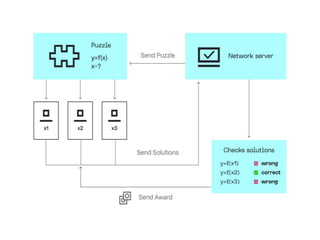
• Proof of Work is one of the earliest consensus
algorithms, which works based on game theory.
• Many popular blockchains adopted it, including
Bitcoin, Litecoin, and Dogecoin.
• There are high-level computational tasks that
miners have to do in discovering new blocks,
called mining.
• Let’s break it down… Any miner who solves the
computational problem first through repeated hashing
can announce it to the network.
• The other nodes in the network can accept its validity
or contest it when necessary.
• This is where consensus comes into play. Blockchains
adopt various hash functions for their Proof of Work.
• For instance, Bitcoin uses SHA-256. Besides facilitating
the algorithm’s operation, mining also contributes to
the security of PoW protocols.
• It makes attacks difficult because the attacker must
expend a large cost, which can be quite unprofitable
on their part.
• A consensus mechanism is what keeps decentralized
networks secure.
• Nodes must agree on the current state before updating the
blockchain.
• This automated process prevents errors and secures the
network against threats such as double-spending or Sybil
attacks, where malicious actors manipulate the network with
fake nodes.
• Distributed consensus is entirely automated, and it is
executed as programmed.
• This way, users trust the technology, rather than a third party,
for the integrity of a blockchain.
• As a result, the consensus mechanism’s logic and
implementation must be flawless.
• Bitcoin, the first mainstream blockchain, adopted the Proof
of Work consensus mechanism in 2009.

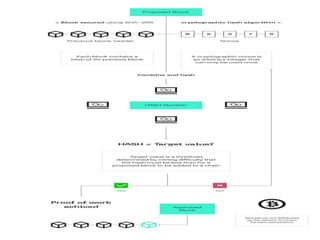
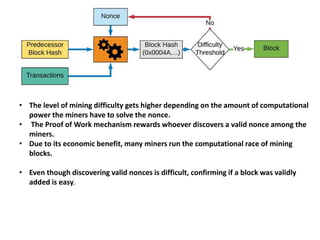
• The level of mining difficulty gets higher depending on the amount of computational
power the miners have to solve the nonce.
• The Proof of Work mechanism rewards whoever discovers a valid nonce among the
miners.
• Due to its economic benefit, many miners run the computational race of mining
blocks.
• Even though discovering valid nonces is difficult, confirming if a block was validly
added is easy.
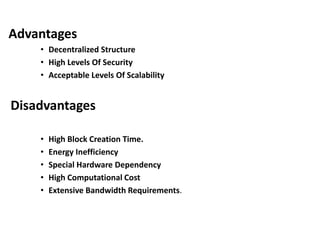
Advantages
• Decentralized Structure
• High Levels Of Security
• Acceptable Levels Of Scalability
Disadvantages
• High Block Creation Time.
• Energy Inefficiency
• Special Hardware Dependency
• High Computational Cost
• Extensive Bandwidth Requirements.
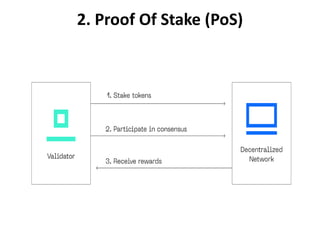
2. Proof Of Stake (PoS)
• Proof of Stake is a consensus algorithm where validators lock up
some specified amount of native assets to secure the blockchain.
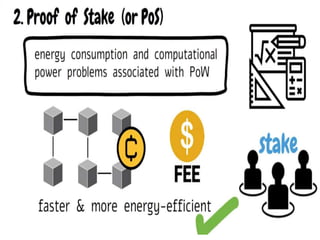
• It was developed as a better option for PoW.
• In 2022, Ethereum dropped PoW for PoS because it is more
energy-efficient and decentralized.
• Other prominent blockchains, such as Tezos and Cardano, also
incorporated PoS into their protocols.
• In DeFi, staking means locking up assets to get rewards over
time.
• The PoS mechanism demands validators to lock up their native
assets in a smart contract.
• Therefore, protocols utilizing the PoS mechanism must ensure
their smart contracts are secure.
• Each validator can create and propagate new blocks.
• At the same time, they are responsible for ascertaining the
validity of any new blocks their peer broadcasts.
• They stand a chance to lose their locked assets if they act
dishonestly.
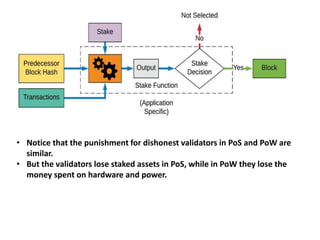
• Notice that the punishment for dishonest validators in PoS and PoW are
similar.
• But the validators lose staked assets in PoS, while in PoW they lose the
money spent on hardware and power.
Advantages
• Fast Block Creation Time.
• High Throughput.
• Energy Efficiency.
• Scalability (But Less Than Pow).
• Independence To The Special Hardware.
Disadvantages
• Suffering From Centralization.
• Lower Cost Of Misbehaving In Blockchain Networks
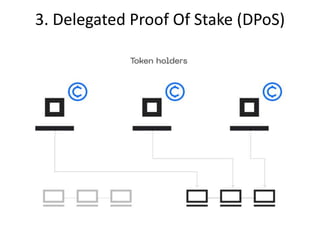
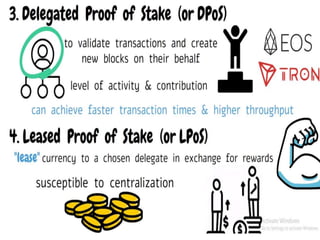
3. Delegated Proof Of Stake (DPoS)
• Daniel Larimer adapted the PoS mechanism to
design the DPoS model in 2014.
• Popular blockchains such as Cosmos and Tron
use a variation of PoS called DPoS.
• Not all who lock some specified amounts of
native assets can become validators.
• Instead, some selected delegates—better called
“witnesses”—perform the decision-making on
behalf of the others.
• The stakers have the power to elect the witnesses
to represent them.
• In case of misconduct, the stakers can also vote
to technically “impeach” them.
• The DPoS has a democratic outlook and design.
Advantages
• Scalability.
• Energy-Efficiency.
• Low-Cost Transactions.
Disadvantages
• Semi-centralization.
• Highly Susceptible to 51% Attack
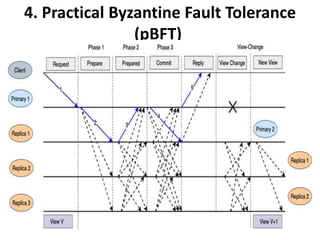
4. Practical Byzantine Fault Tolerance
(pBFT)
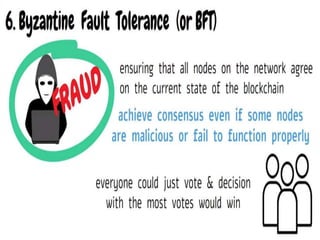
• The Byzantine Generals Problem describes the complexity
of reaching an agreement if there are disloyal generals.
• The pBFT consensus mechanism is a secure model that can
withstand dishonest validators.
• It reaches a consensus when there is ⅔ agreement from
the honest nodes.
• Hyperledger, Fabric, and other prominent blockchains are
utilizing this mechanism.
• However, the security of pBFT will be breached if the
dishonest nodes are more than ⅓ of all the nodes in the
network.
• The nodes in pBFT are divided into primary and secondary
nodes.
• The primary nodes are the leader nodes, while the
secondary nodes are the backup nodes.
• The primary nodes are changed at every consensus round.
Advantages
• Energy Efficiency.
• High Throughput.
Disadvantages
• Not Scalable.
• Susceptible To Sybil Attack.
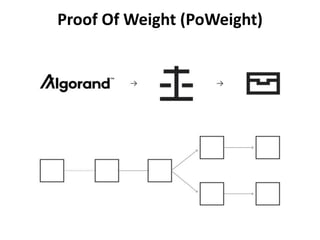
Proof Of Weight (PoWeight)
• Six MIT researchers, led by Yossi Gilad, developed a
consensus for the Algorand blockchain.
• Their prime motivation is discovering an algorithm model
that solves the Byzantine Generals’ Problem.
• They discovered a consensus algorithm based on weight
fraction and christened it Proof of Weight.
• Each user in this mechanism exists in weights, and how
much they have in their accounts determines their weight.
• The algorithm picks committee members randomly among
the users based on their weight.
• This randomness checkmates the possibility of having one or
many dishonest users.
• Honest users must have up to ⅔ of the total money in the
network. Otherwise, dishonest nodes can take over.
• Although the design of PoWeights might look similar to PoS,
each is different.
• The users only have to have tokens in PoWeights and do not
need to lock or stake them.
Advantages
• Great customization and Scalability
• Quick Transaction Confirmation.
• Energy Efficiency.
• Disadvantages
• No Incentive.
• Semi-centralization.
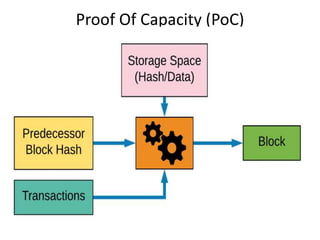
Proof Of Capacity (PoC)
• Another popular name for Proof of Capacity is Proof of
Space.
• Stefan Dziembowski and Sebastian Faust formally
introduced it in 2015.
• Burstcoin was the first project to utilize this algorithm.
• Miners need to prove that they have the storage capacity to
mine crypto.
• The most recommended storage device in the instant case
is a hard disk.
• The miner needs to get ready before the mining kicks off.
• They get ready by plotting nonces.
• A miner can only create as many nonces as they have space
for.
• The network frequently broadcasts puzzles.
• Any miner who has the closest hash in their nonce wins the
puzzle.
Advantages
• No Special Hardware.
• More Decentralized.
Disadvantages
• Susceptible To Grinding Attack. A grinding attack
happens when a miner can trick the algorithm to make
them a miner. In the case of PoC, a miner can
manipulate the chain to always request the hashes in
its nonces. Thereby mining more than the rest and
getting more rewards.
• Space Privilege Applies. Since miners often get a hard
disk with unusually large space. As a result, they can
plot more nonces and solve more puzzles. This is unfair
to those with hard disks of relatively moderate space.
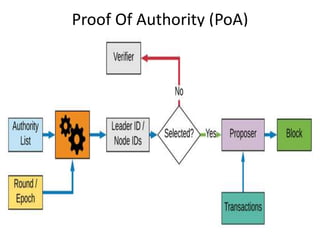
Proof Of Authority (PoA)
• There must be thorough due diligence on the miners for a
blockchain to be ultimately secure.
• Some consensus mechanisms skip this process and fall into
the hands of dishonest miners.
• Proof of Authority, a consensus mechanism in which
validators stake their identity, fixes this loophole in its
design.
• Firstly, the real-life identity of each validator is ascertained
within a PoA consensus model.
• The network managers will check how trustworthy the
prospective validator is.
• This also makes it easy to track any validator in case of foul
play.
• Secondly, each validator must stake a certain amount of
assets as a sign of commitment.
• Basically, PoA validators stake their reputation and their
coins.
• Advantages
– Transactional Speed.
– Tighter Security.
– Uses Less Energy.
Disadvantages
– Not Decentralized.
– Breaks Anonymity.
Proof of Importance (PoI)
• NEM blockchain introduced the Proof of Importance
consensus algorithm to improve the Proof of Stake
mechanism.
• First, the Proof of Stake mechanism makes validators lock up
their assets and not transact with them.
• Secondly, it only rates validators based on their stakings.
• Proof of Importance goes beyond that. The algorithm rates a
node based on 3 variables:
• How much is in an account?
• How often does the account transact with others within the
protocol?
• What is the volume of each transaction?
• These 3 questions form how the importance of an account
or node will be.
• The Proof of Importance mechanism encourages network
participants to hold assets and transact with them.
Advantages
• Sybil Resistant. A Sybil attack occurs when a dishonest validator
controls multiple dishonest nodes to manipulate the blockchain. By
default, the scoring system in PoI makes it extremely costly for anyone
to run fake nodes.
• Prevents Hoarding. Validators in a PoS blockchain have to lock their
assets. Thereby hoarding those assets out of circulation. Proof of
Importance works better because it encourages a free flow of assets.
• Rewards General Participation. PoI is beyond staking assets. It
ensures that each miner is actively involved in the network’s activities,
especially in terms of transactional frequency and volume.
Disadvantages
• Favors The Rich. Those who trade higher volumes more frequently are
accorded more importance. This can be unfair to other network
participants who do not have much funds.
• Little Incentives. Validators do not mine blocks with much power. As a
result, they are not incentivized as much as the validators in a PoS.
This low incentive can be a bad deal for those who run node as a
business.
different consensus protocols in blockchian.pptx

different consensus protocols in blockchian.pptx

  • 1.
  • 3.
    • In ablockchain, consensus allows protocol layer nodes to independently agree on the ledger’s state. • These mechanisms update the chain’s state and preserve its operational integrity, enabling decentralization without chaos. • All blockchains must maintain accurate records to function correctly. • Unlike banks, blockchains don’t have any central authority to keep all the records. • By contrast, all pears are equal in a decentralized network. • Different blocks are broadcast simultaneously, and the network has to decide which chain to follow. • A mechanism that determines which chain to follow is called consensus. •
  • 4.
    1. Proof OfWork • Proof of Work is one of the earliest consensus algorithms, which works based on game theory. • Many popular blockchains adopted it, including Bitcoin, Litecoin, and Dogecoin. • There are high-level computational tasks that miners have to do in discovering new blocks, called mining.
  • 7.
    • Let’s breakit down… Any miner who solves the computational problem first through repeated hashing can announce it to the network. • The other nodes in the network can accept its validity or contest it when necessary. • This is where consensus comes into play. Blockchains adopt various hash functions for their Proof of Work. • For instance, Bitcoin uses SHA-256. Besides facilitating the algorithm’s operation, mining also contributes to the security of PoW protocols. • It makes attacks difficult because the attacker must expend a large cost, which can be quite unprofitable on their part.
  • 8.
    • A consensusmechanism is what keeps decentralized networks secure. • Nodes must agree on the current state before updating the blockchain. • This automated process prevents errors and secures the network against threats such as double-spending or Sybil attacks, where malicious actors manipulate the network with fake nodes. • Distributed consensus is entirely automated, and it is executed as programmed. • This way, users trust the technology, rather than a third party, for the integrity of a blockchain. • As a result, the consensus mechanism’s logic and implementation must be flawless. • Bitcoin, the first mainstream blockchain, adopted the Proof of Work consensus mechanism in 2009.
  • 9.
    • The levelof mining difficulty gets higher depending on the amount of computational power the miners have to solve the nonce. • The Proof of Work mechanism rewards whoever discovers a valid nonce among the miners. • Due to its economic benefit, many miners run the computational race of mining blocks. • Even though discovering valid nonces is difficult, confirming if a block was validly added is easy.
  • 11.
    Advantages • Decentralized Structure •High Levels Of Security • Acceptable Levels Of Scalability Disadvantages • High Block Creation Time. • Energy Inefficiency • Special Hardware Dependency • High Computational Cost • Extensive Bandwidth Requirements.
  • 12.
    2. Proof OfStake (PoS)
  • 14.
    • Proof ofStake is a consensus algorithm where validators lock up some specified amount of native assets to secure the blockchain. • It was developed as a better option for PoW. • In 2022, Ethereum dropped PoW for PoS because it is more energy-efficient and decentralized. • Other prominent blockchains, such as Tezos and Cardano, also incorporated PoS into their protocols. • In DeFi, staking means locking up assets to get rewards over time. • The PoS mechanism demands validators to lock up their native assets in a smart contract. • Therefore, protocols utilizing the PoS mechanism must ensure their smart contracts are secure. • Each validator can create and propagate new blocks. • At the same time, they are responsible for ascertaining the validity of any new blocks their peer broadcasts. • They stand a chance to lose their locked assets if they act dishonestly.
  • 15.
    • Notice thatthe punishment for dishonest validators in PoS and PoW are similar. • But the validators lose staked assets in PoS, while in PoW they lose the money spent on hardware and power.
  • 16.
    Advantages • Fast BlockCreation Time. • High Throughput. • Energy Efficiency. • Scalability (But Less Than Pow). • Independence To The Special Hardware. Disadvantages • Suffering From Centralization. • Lower Cost Of Misbehaving In Blockchain Networks
  • 17.
    3. Delegated ProofOf Stake (DPoS)
  • 18.
    • Daniel Larimeradapted the PoS mechanism to design the DPoS model in 2014. • Popular blockchains such as Cosmos and Tron use a variation of PoS called DPoS. • Not all who lock some specified amounts of native assets can become validators. • Instead, some selected delegates—better called “witnesses”—perform the decision-making on behalf of the others. • The stakers have the power to elect the witnesses to represent them. • In case of misconduct, the stakers can also vote to technically “impeach” them. • The DPoS has a democratic outlook and design.
  • 19.
    Advantages • Scalability. • Energy-Efficiency. •Low-Cost Transactions. Disadvantages • Semi-centralization. • Highly Susceptible to 51% Attack
  • 21.
    4. Practical ByzantineFault Tolerance (pBFT)
  • 22.
    • The ByzantineGenerals Problem describes the complexity of reaching an agreement if there are disloyal generals. • The pBFT consensus mechanism is a secure model that can withstand dishonest validators. • It reaches a consensus when there is ⅔ agreement from the honest nodes. • Hyperledger, Fabric, and other prominent blockchains are utilizing this mechanism. • However, the security of pBFT will be breached if the dishonest nodes are more than ⅓ of all the nodes in the network. • The nodes in pBFT are divided into primary and secondary nodes. • The primary nodes are the leader nodes, while the secondary nodes are the backup nodes. • The primary nodes are changed at every consensus round.
  • 24.
    Advantages • Energy Efficiency. •High Throughput. Disadvantages • Not Scalable. • Susceptible To Sybil Attack.
  • 25.
    Proof Of Weight(PoWeight)
  • 26.
    • Six MITresearchers, led by Yossi Gilad, developed a consensus for the Algorand blockchain. • Their prime motivation is discovering an algorithm model that solves the Byzantine Generals’ Problem. • They discovered a consensus algorithm based on weight fraction and christened it Proof of Weight. • Each user in this mechanism exists in weights, and how much they have in their accounts determines their weight. • The algorithm picks committee members randomly among the users based on their weight. • This randomness checkmates the possibility of having one or many dishonest users. • Honest users must have up to ⅔ of the total money in the network. Otherwise, dishonest nodes can take over. • Although the design of PoWeights might look similar to PoS, each is different. • The users only have to have tokens in PoWeights and do not need to lock or stake them.
  • 27.
    Advantages • Great customizationand Scalability • Quick Transaction Confirmation. • Energy Efficiency. • Disadvantages • No Incentive. • Semi-centralization.
  • 28.
  • 29.
    • Another popularname for Proof of Capacity is Proof of Space. • Stefan Dziembowski and Sebastian Faust formally introduced it in 2015. • Burstcoin was the first project to utilize this algorithm. • Miners need to prove that they have the storage capacity to mine crypto. • The most recommended storage device in the instant case is a hard disk. • The miner needs to get ready before the mining kicks off. • They get ready by plotting nonces. • A miner can only create as many nonces as they have space for. • The network frequently broadcasts puzzles. • Any miner who has the closest hash in their nonce wins the puzzle.
  • 30.
    Advantages • No SpecialHardware. • More Decentralized. Disadvantages • Susceptible To Grinding Attack. A grinding attack happens when a miner can trick the algorithm to make them a miner. In the case of PoC, a miner can manipulate the chain to always request the hashes in its nonces. Thereby mining more than the rest and getting more rewards. • Space Privilege Applies. Since miners often get a hard disk with unusually large space. As a result, they can plot more nonces and solve more puzzles. This is unfair to those with hard disks of relatively moderate space.
  • 31.
  • 32.
    • There mustbe thorough due diligence on the miners for a blockchain to be ultimately secure. • Some consensus mechanisms skip this process and fall into the hands of dishonest miners. • Proof of Authority, a consensus mechanism in which validators stake their identity, fixes this loophole in its design. • Firstly, the real-life identity of each validator is ascertained within a PoA consensus model. • The network managers will check how trustworthy the prospective validator is. • This also makes it easy to track any validator in case of foul play. • Secondly, each validator must stake a certain amount of assets as a sign of commitment. • Basically, PoA validators stake their reputation and their coins.
  • 33.
    • Advantages – TransactionalSpeed. – Tighter Security. – Uses Less Energy. Disadvantages – Not Decentralized. – Breaks Anonymity.
  • 35.
  • 36.
    • NEM blockchainintroduced the Proof of Importance consensus algorithm to improve the Proof of Stake mechanism. • First, the Proof of Stake mechanism makes validators lock up their assets and not transact with them. • Secondly, it only rates validators based on their stakings. • Proof of Importance goes beyond that. The algorithm rates a node based on 3 variables: • How much is in an account? • How often does the account transact with others within the protocol? • What is the volume of each transaction? • These 3 questions form how the importance of an account or node will be. • The Proof of Importance mechanism encourages network participants to hold assets and transact with them.
  • 37.
    Advantages • Sybil Resistant.A Sybil attack occurs when a dishonest validator controls multiple dishonest nodes to manipulate the blockchain. By default, the scoring system in PoI makes it extremely costly for anyone to run fake nodes. • Prevents Hoarding. Validators in a PoS blockchain have to lock their assets. Thereby hoarding those assets out of circulation. Proof of Importance works better because it encourages a free flow of assets. • Rewards General Participation. PoI is beyond staking assets. It ensures that each miner is actively involved in the network’s activities, especially in terms of transactional frequency and volume. Disadvantages • Favors The Rich. Those who trade higher volumes more frequently are accorded more importance. This can be unfair to other network participants who do not have much funds. • Little Incentives. Validators do not mine blocks with much power. As a result, they are not incentivized as much as the validators in a PoS. This low incentive can be a bad deal for those who run node as a business.