BLOCKCHAIN REFERENCE
Compilation of Concepts for Enterprise Architects
PROTOCOLS
PROTOCOLS IN PERSPECTIVE
➤ Bitcoin
➤ Ethereum
➤ Hyperledger
➤ IPFS
➤ Ripple
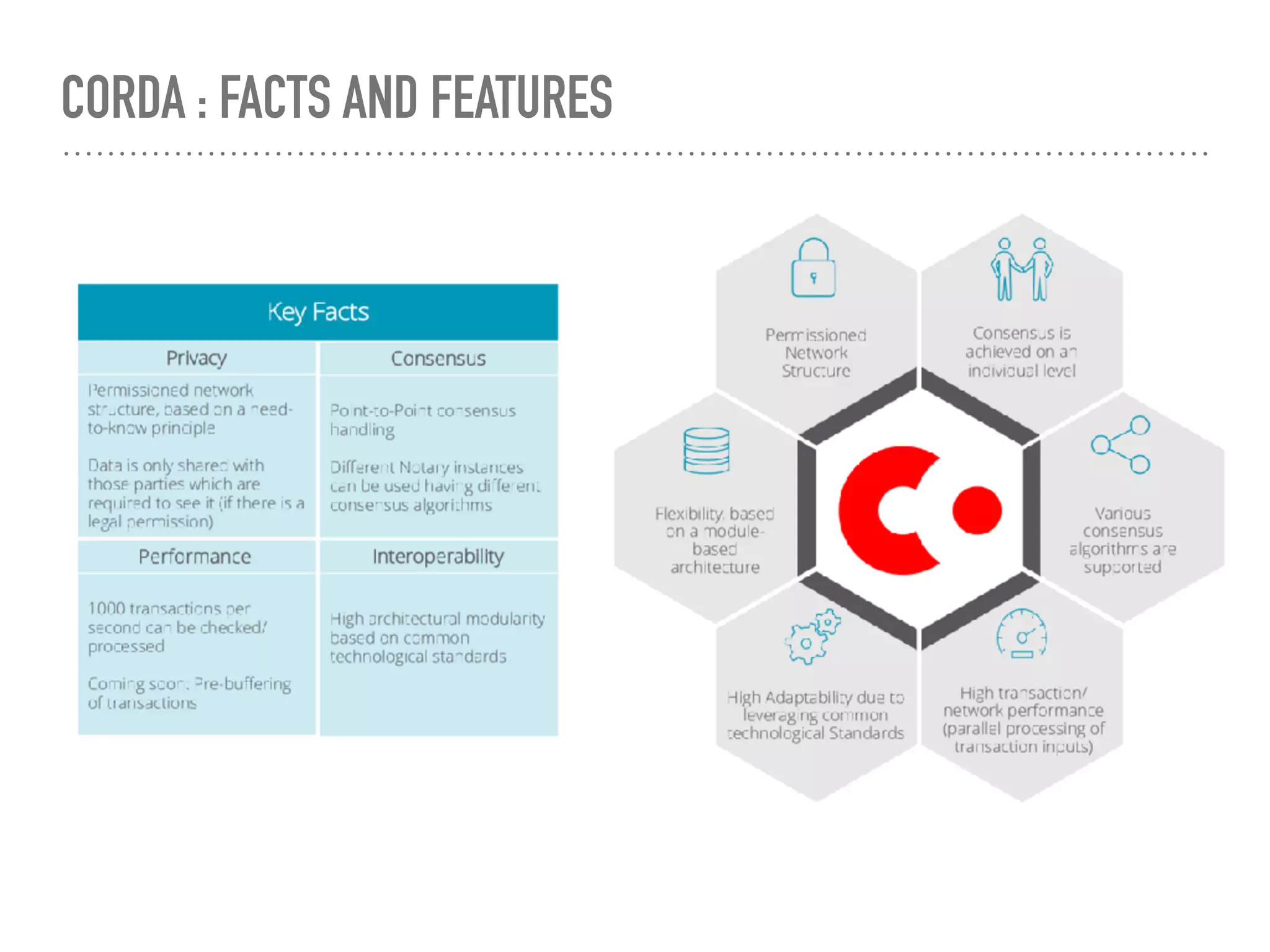
➤ R3 Corda
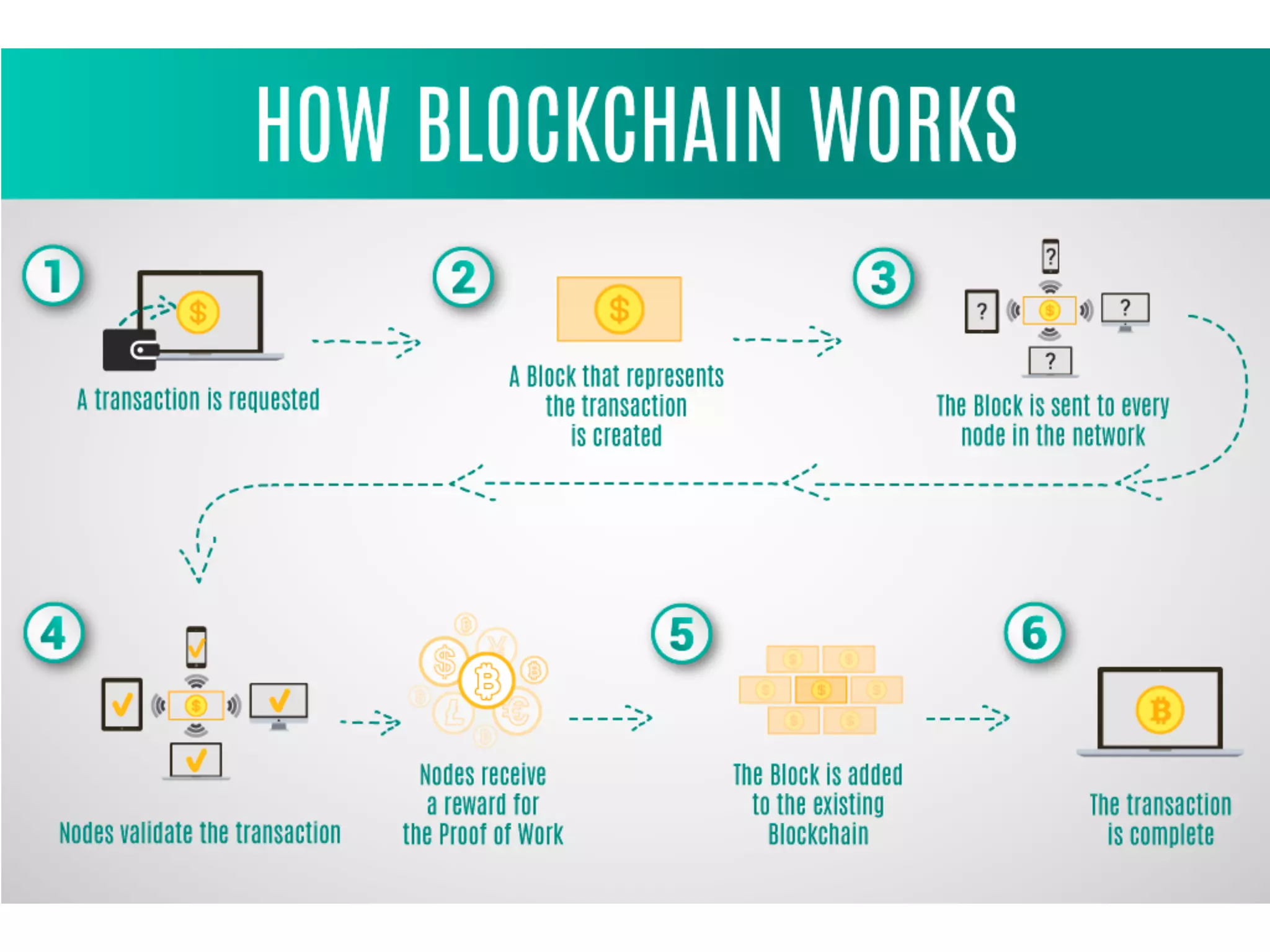
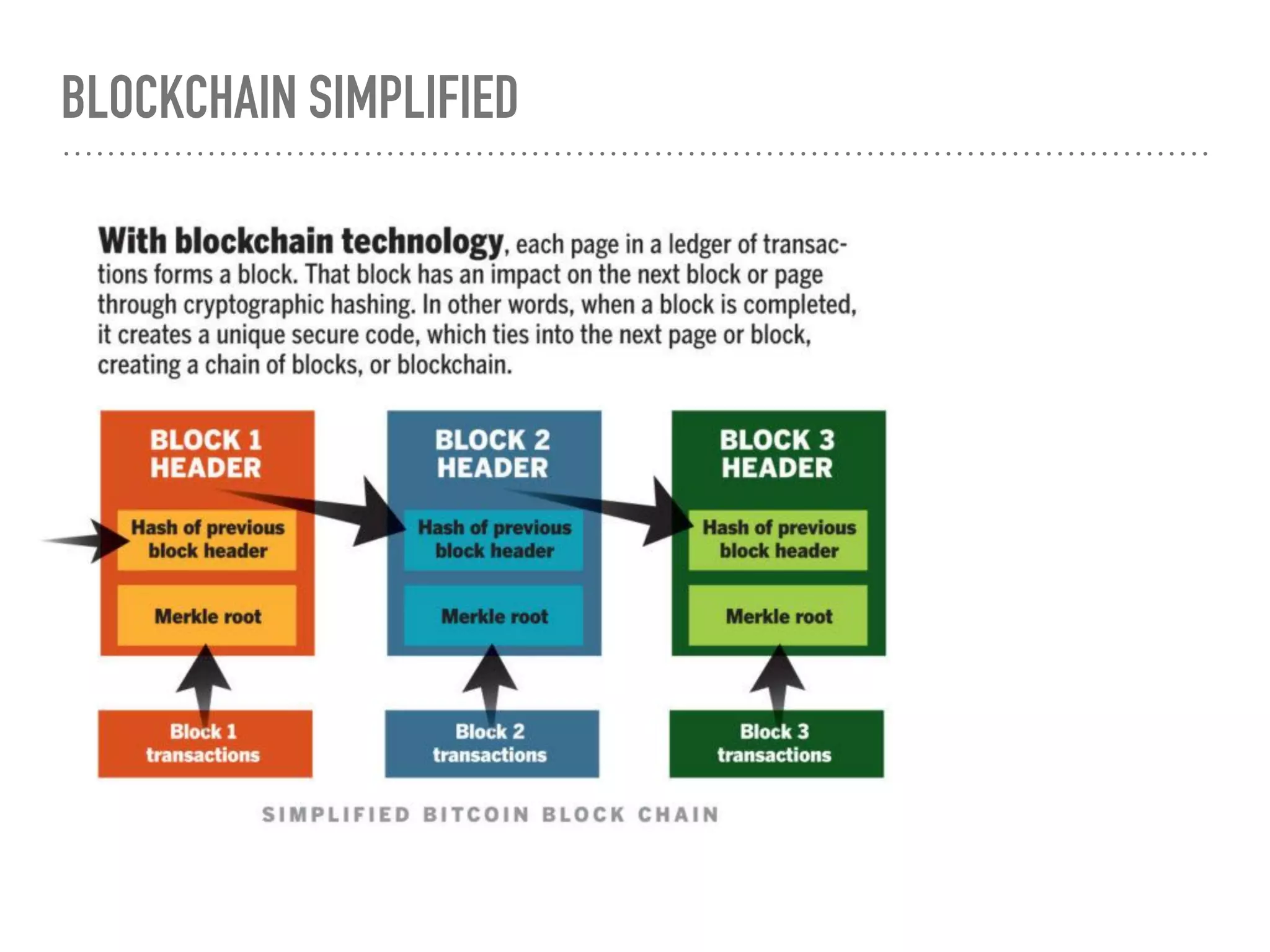
BLOCKCHAIN SIMPLIFIED
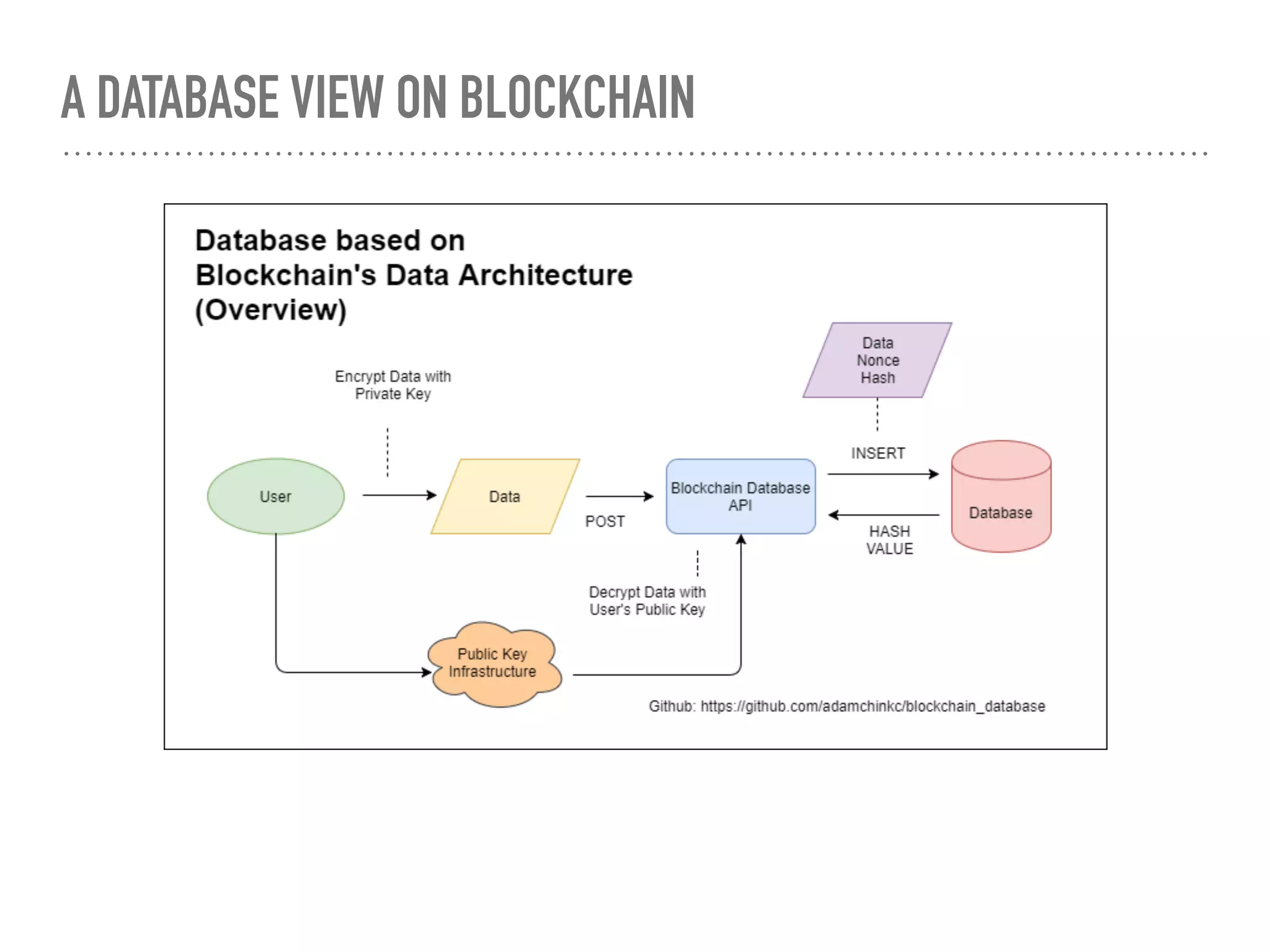
A DATABASE VIEW ON BLOCKCHAIN
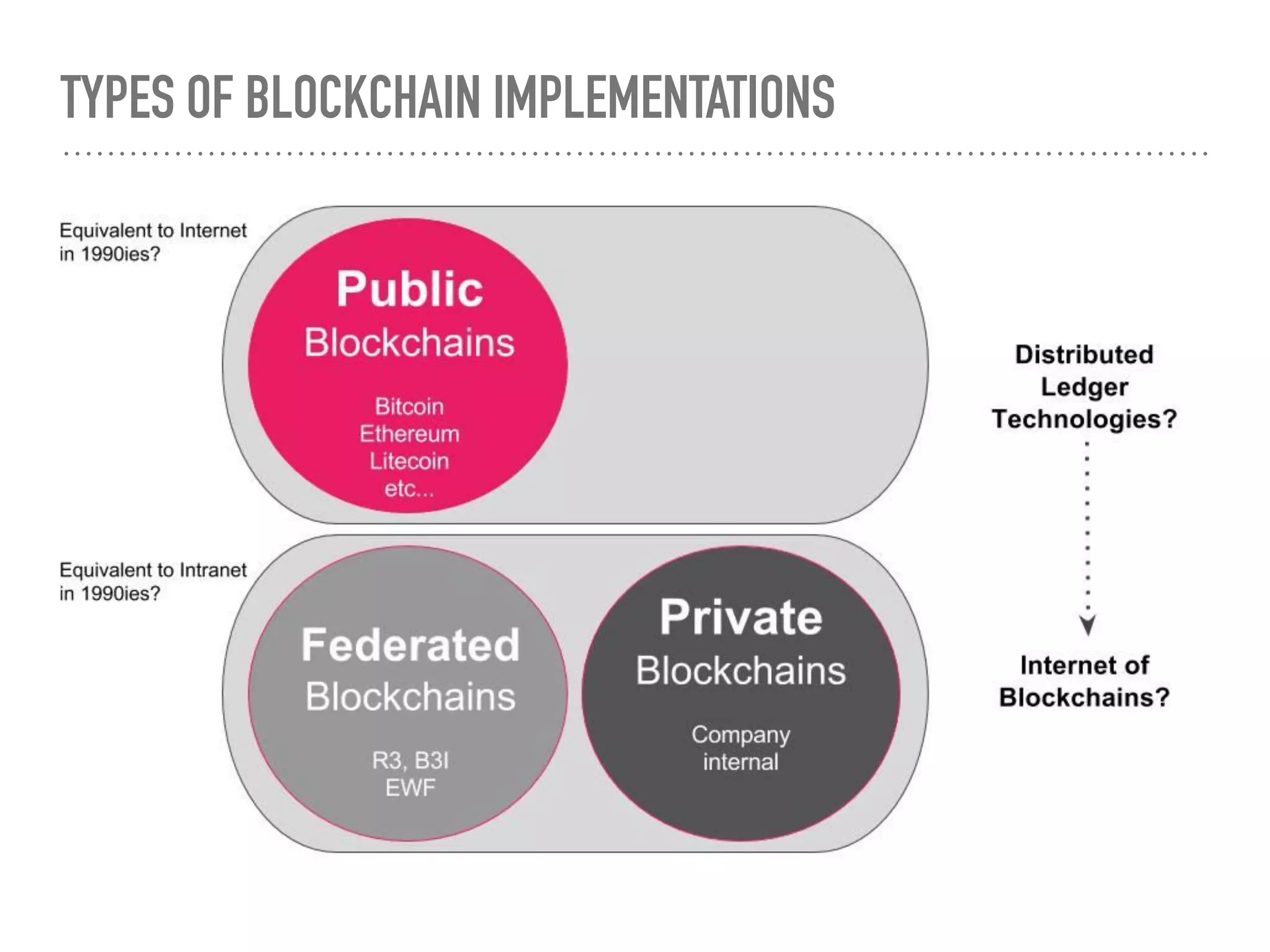
TYPES OF BLOCKCHAIN IMPLEMENTATIONS
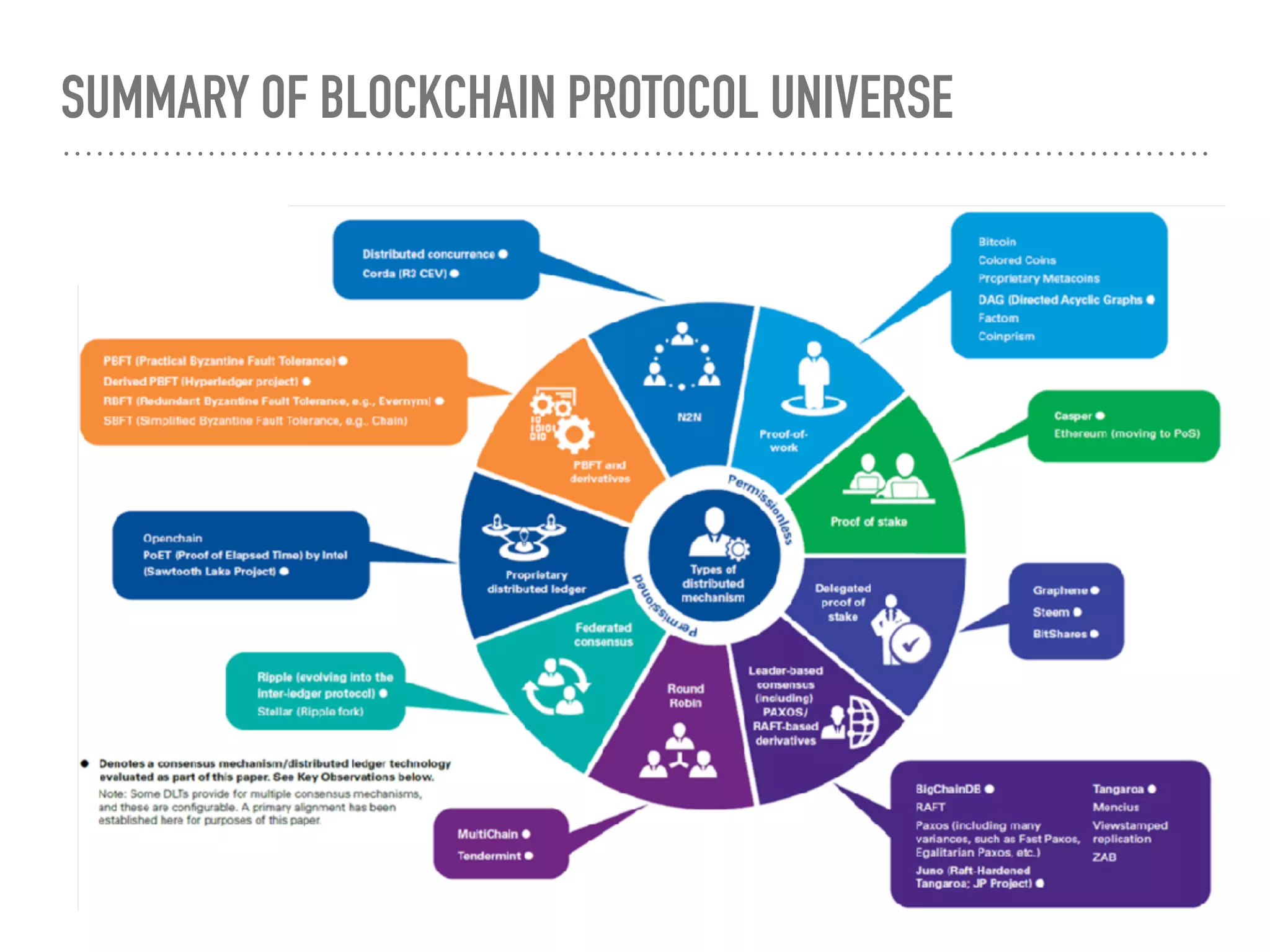
SUMMARY OF BLOCKCHAIN PROTOCOL UNIVERSE
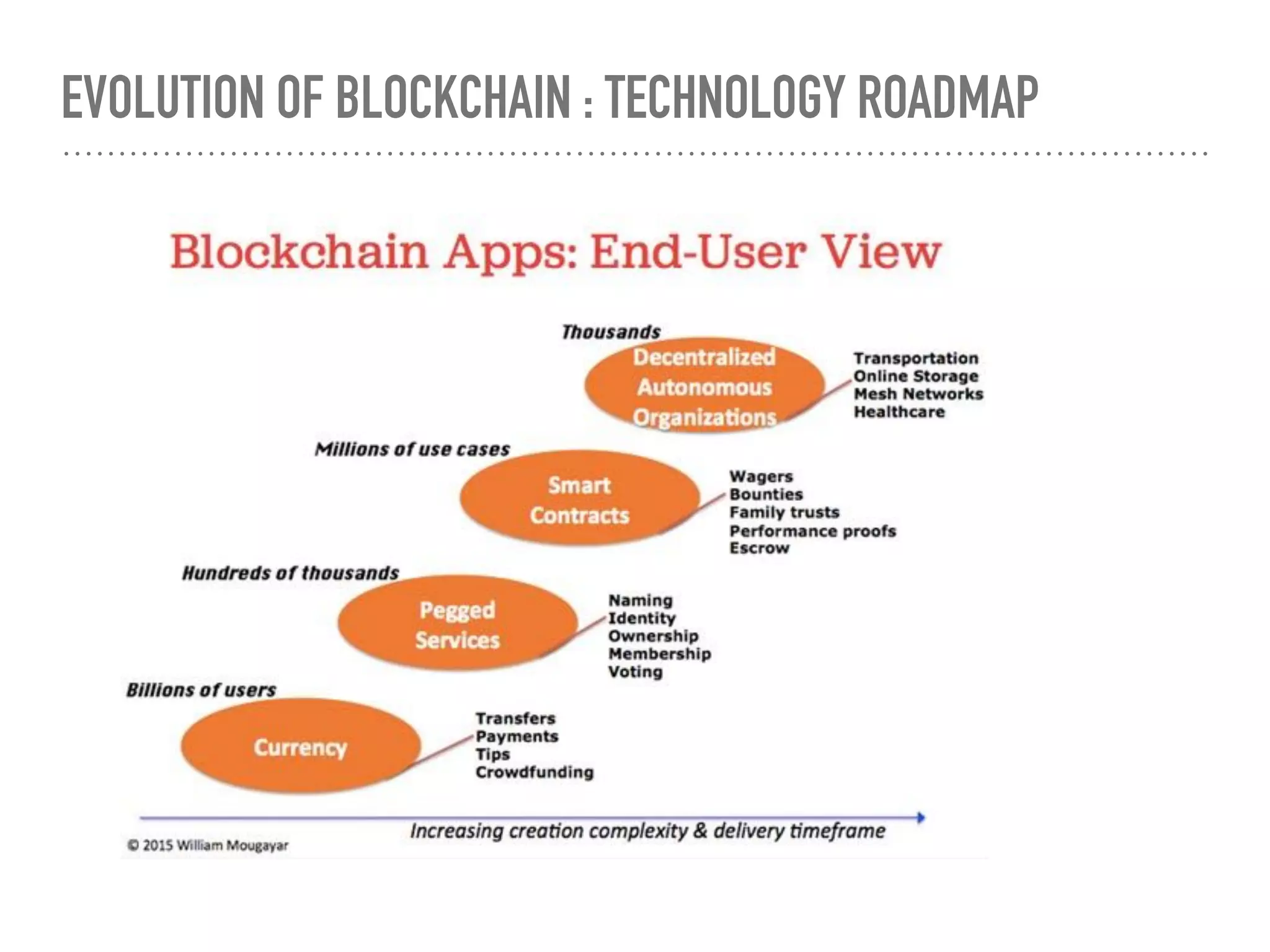
EVOLUTION OF BLOCKCHAIN : TECHNOLOGY ROADMAP
BITCOIN
• Enables transaction directly with no need of trusted third party
• Enables the non-reversible transactions
• Decreases credit cost in minor casual transactions
• Decreases transaction fees
• Prevents double-spending
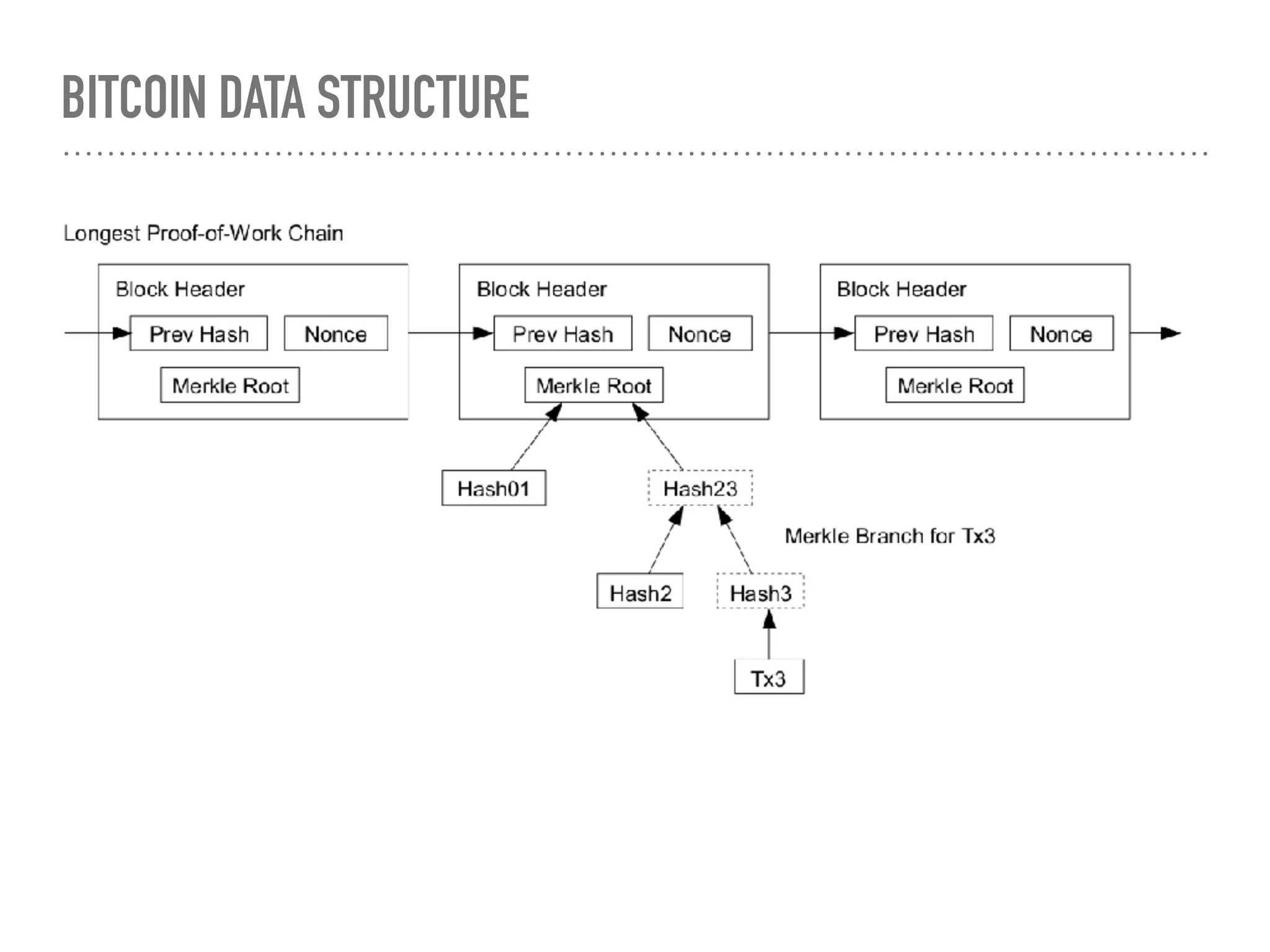
BITCOIN DATA STRUCTURE
ETHEREUM
➤ Ethereum is a public, open-source and block chain oriented
distributed computing protocol that features smart contracts
(scripting) functionality.
➤ The protocol has provided a decentralised virtual machine called
the Ethereum Virtual Machine (EVM), which carried out Turning-
complete scripts by using a global network of public nodes and
the token called ether, also referred to as gas.
➤ Gas is used for preventing the spam on networks and allocating
the resources in proportion to the incentive provided by the
request.
➤ Ethereum is also used as a protocol for decentralised applications,
smart contracts and decentralised autonomous organisations
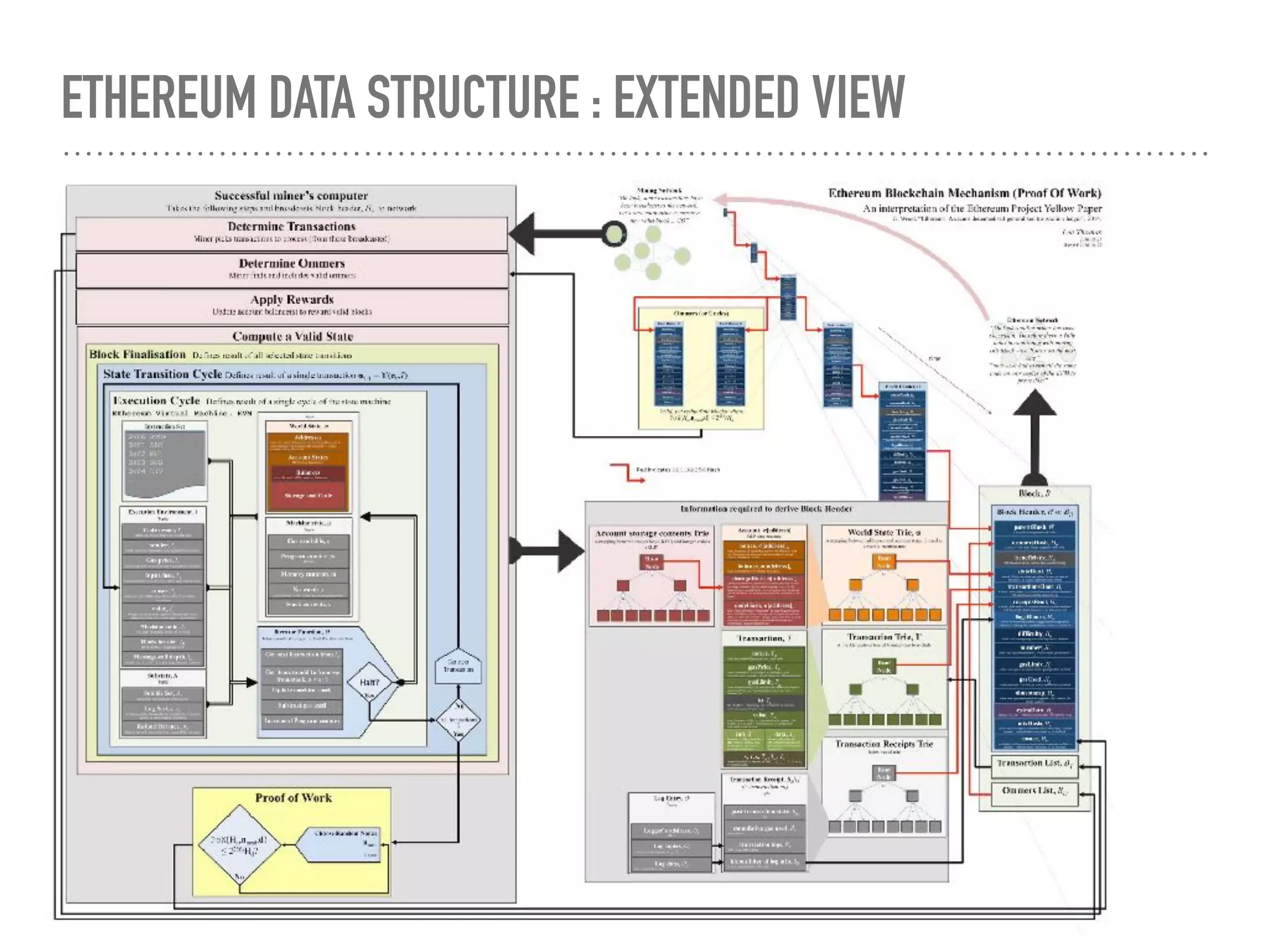
ETHEREUM DATA STRUCTURE : EXTENDED VIEW
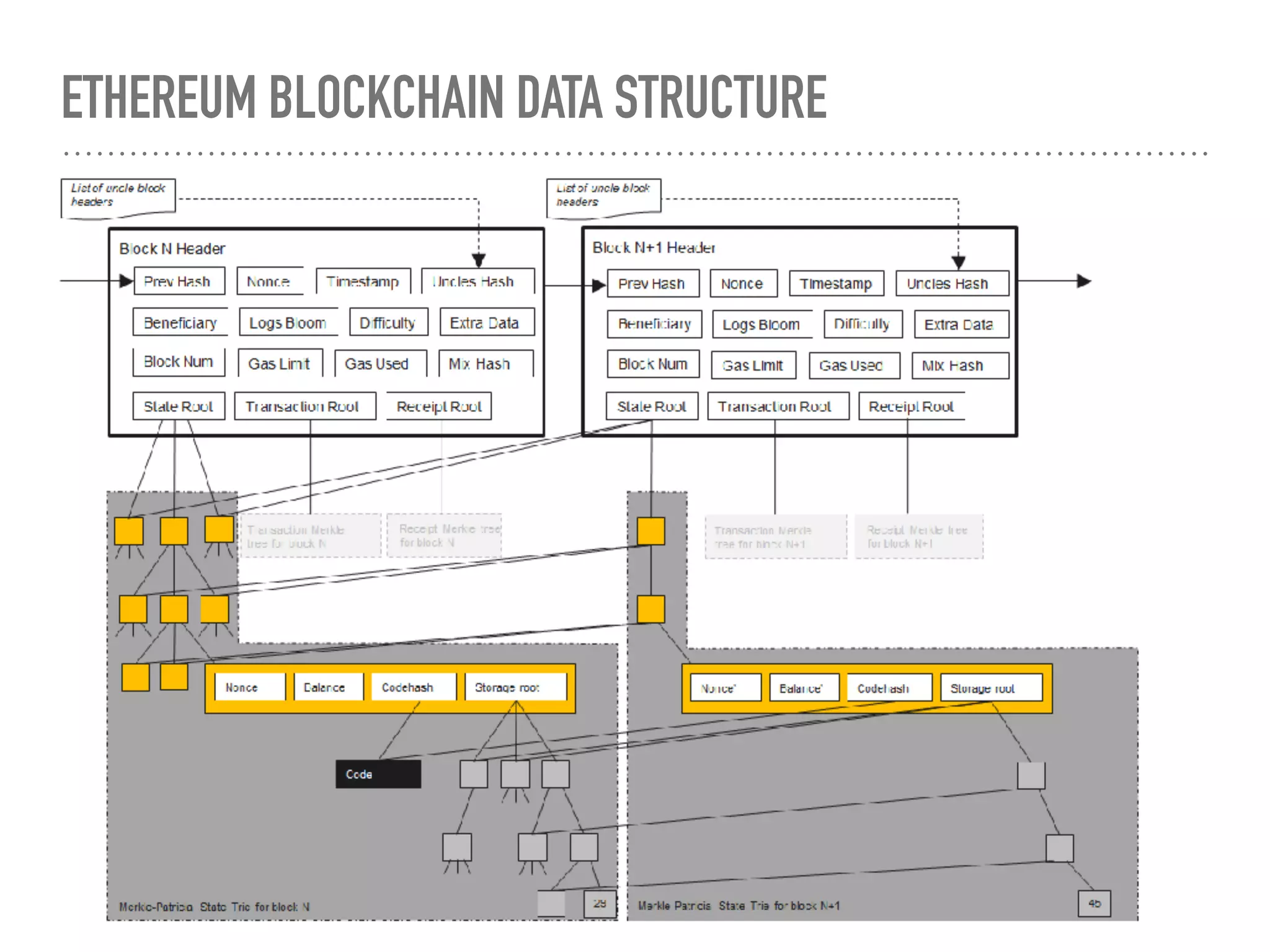
ETHEREUM BLOCKCHAIN DATA STRUCTURE
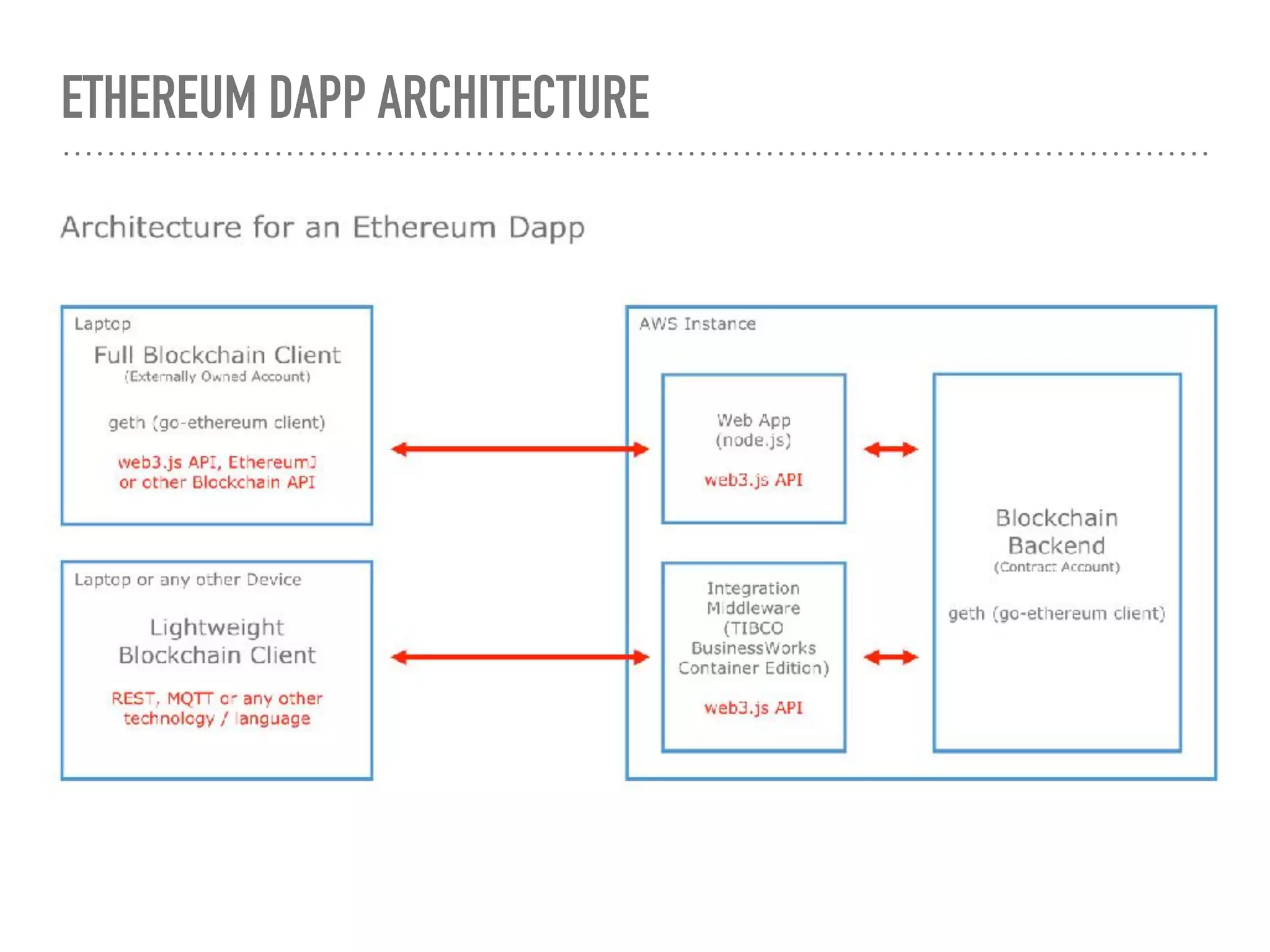
ETHEREUM DAPP ARCHITECTURE
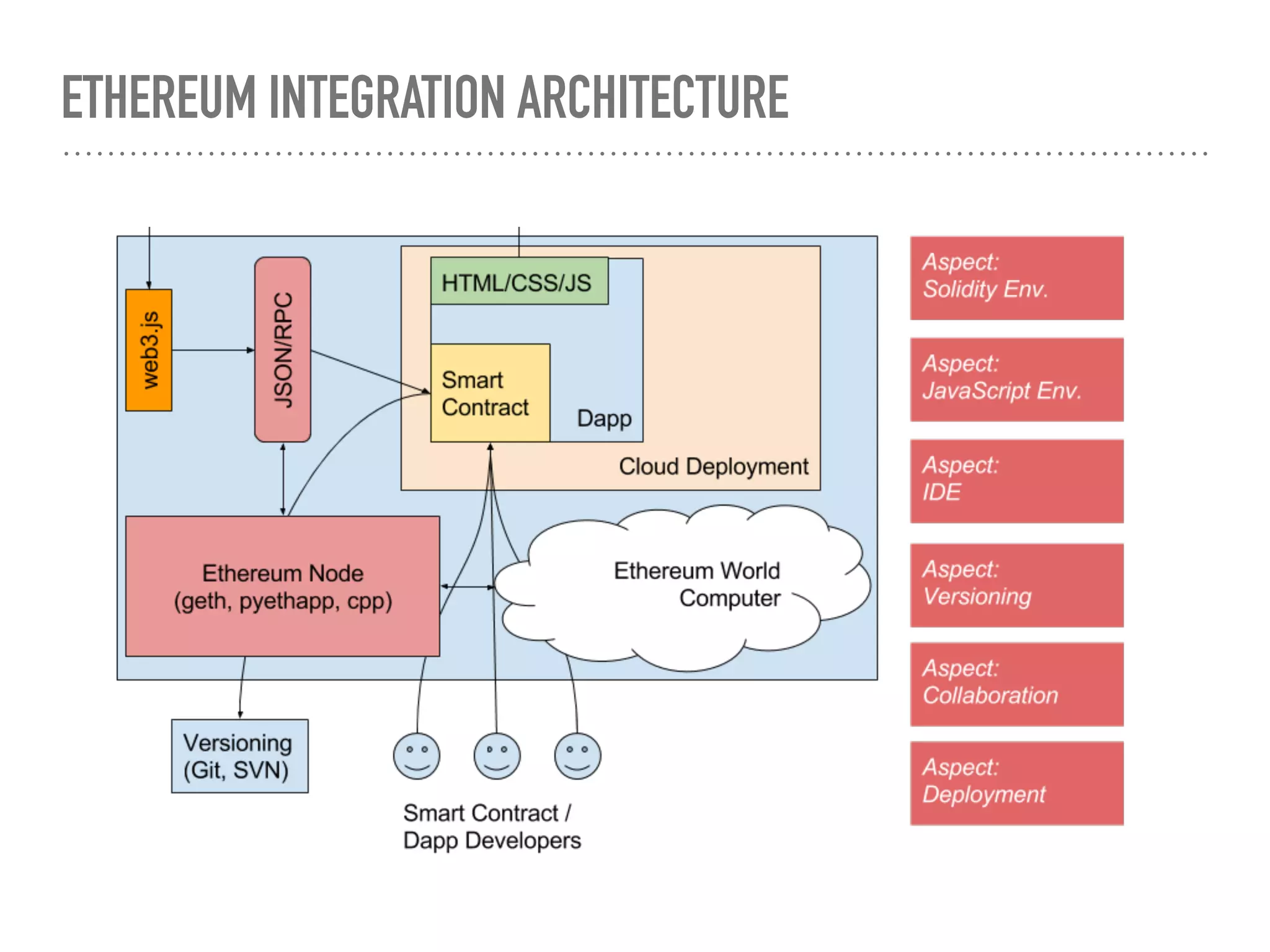
ETHEREUM INTEGRATION ARCHITECTURE
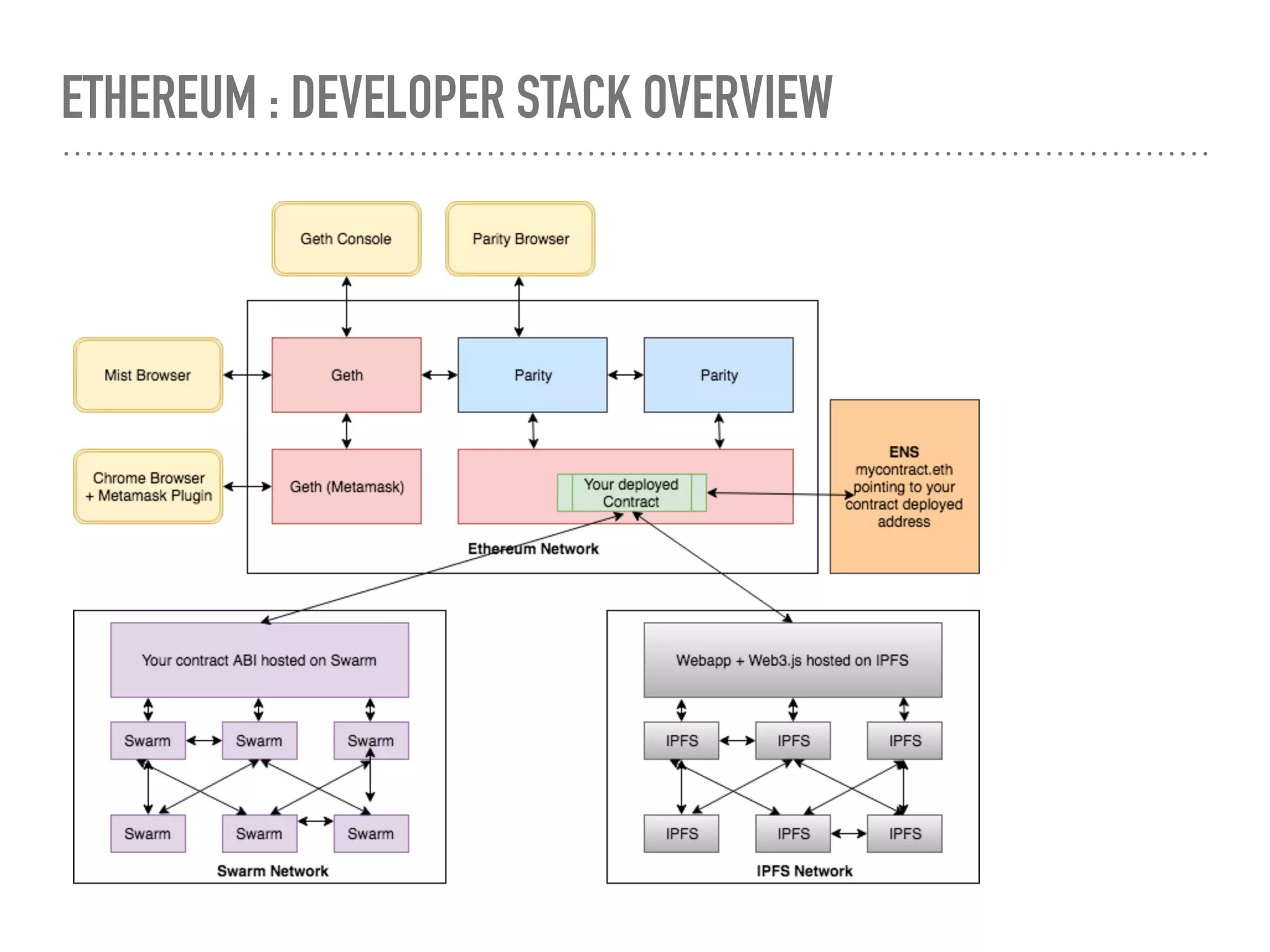
ETHEREUM : DEVELOPER STACK OVERVIEW
HYPERLEDGER FABRIC
➤ Hyperledger is the open source blockchain platform, began in
2015 by the Linux Foundation, in an effort to support the
blockchain-based distributed ledgers.
➤ The protocol focuses ledgers developed to support
international business transactions, catering leading financial,
technological and supply chain businesses, with the objective
of improving a lot of performance and reliability aspects.
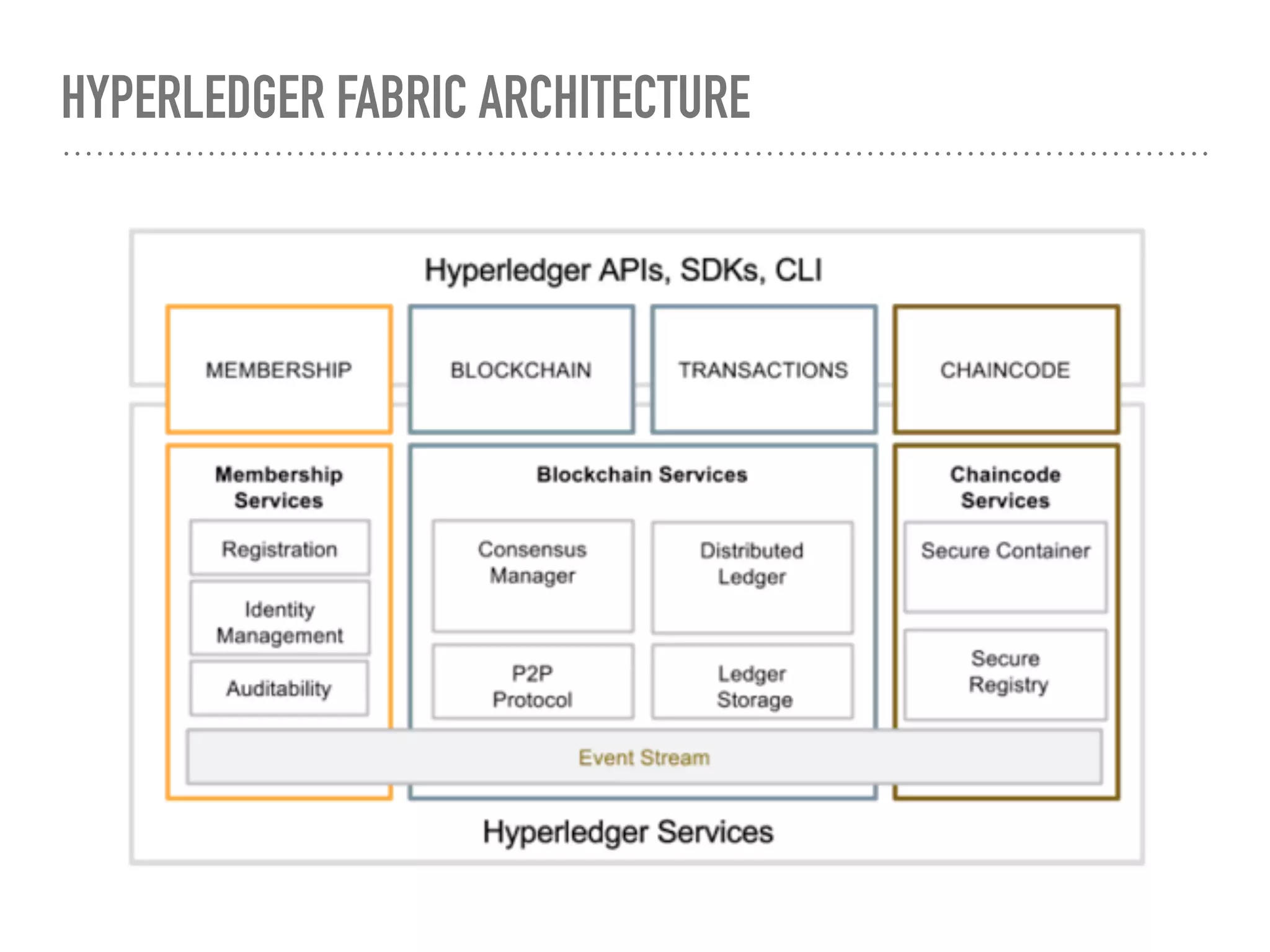
HYPERLEDGER FABRIC ARCHITECTURE
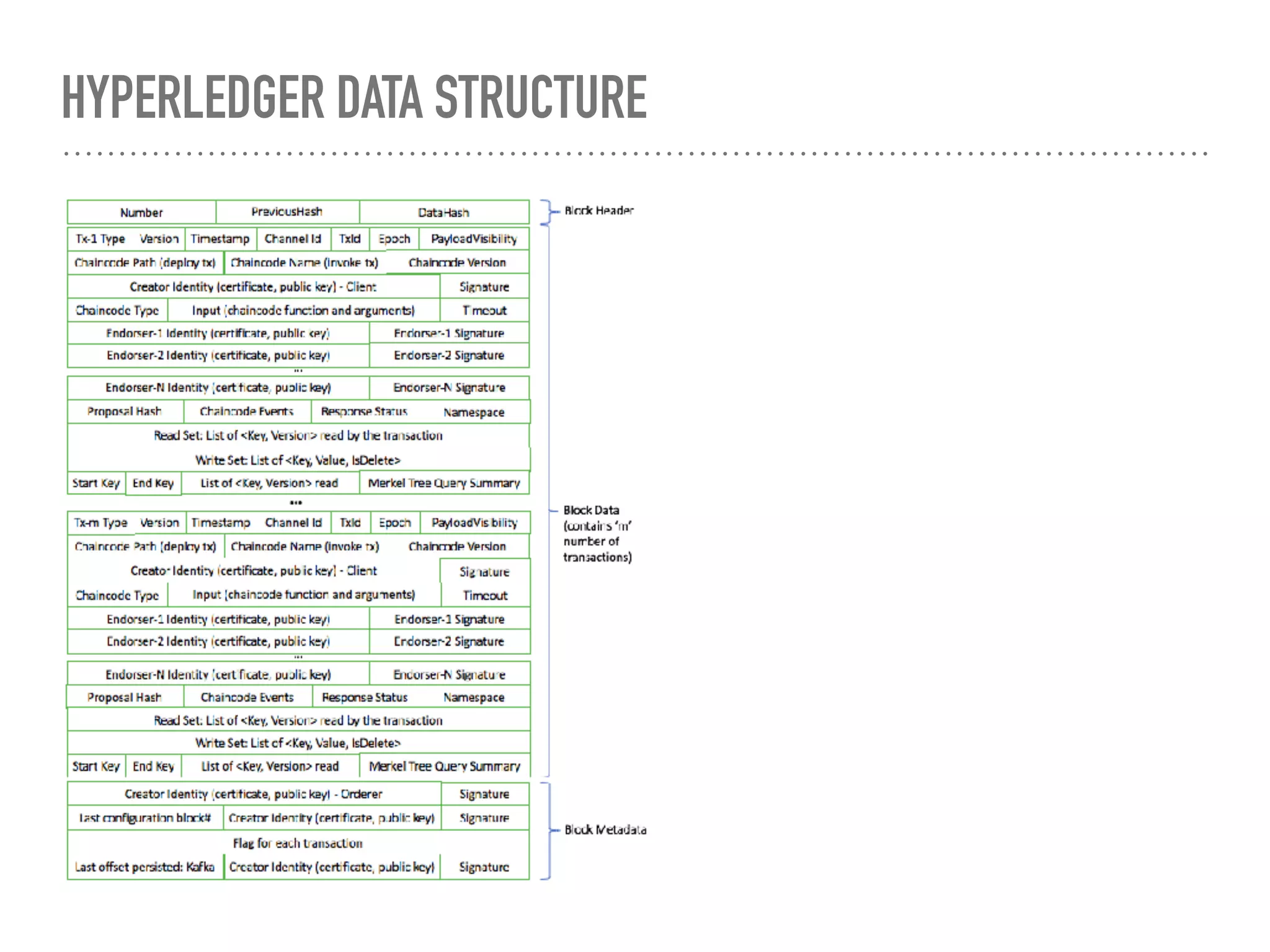
HYPERLEDGER DATA STRUCTURE
HYPERLEDGER INTEGRATION ARCHITECTURE
IPFS OVERVIEW
➤ IPFS is a peer-to-peer distributed file system that seeks to connect all
computing devices with the same system of files.
➤ In some ways, IPFS is similar to the World Wide Web, but IPFS could be seen
as a single BitTorrent swarm, exchanging objects within one Git repository.
➤ IPFS provides a high-throughput, content-addressed block storage model,
with content-addressed hyperlinks.This forms a generalised Merkle directed
acyclic graph (DAG).
➤ IPFS combines a distributed hash table, an incentivised block exchange, and
a self-certifying namespace.
➤ IPFS has no single point of failure, and nodes do not need to trust each other
not to tamper with data in transit.
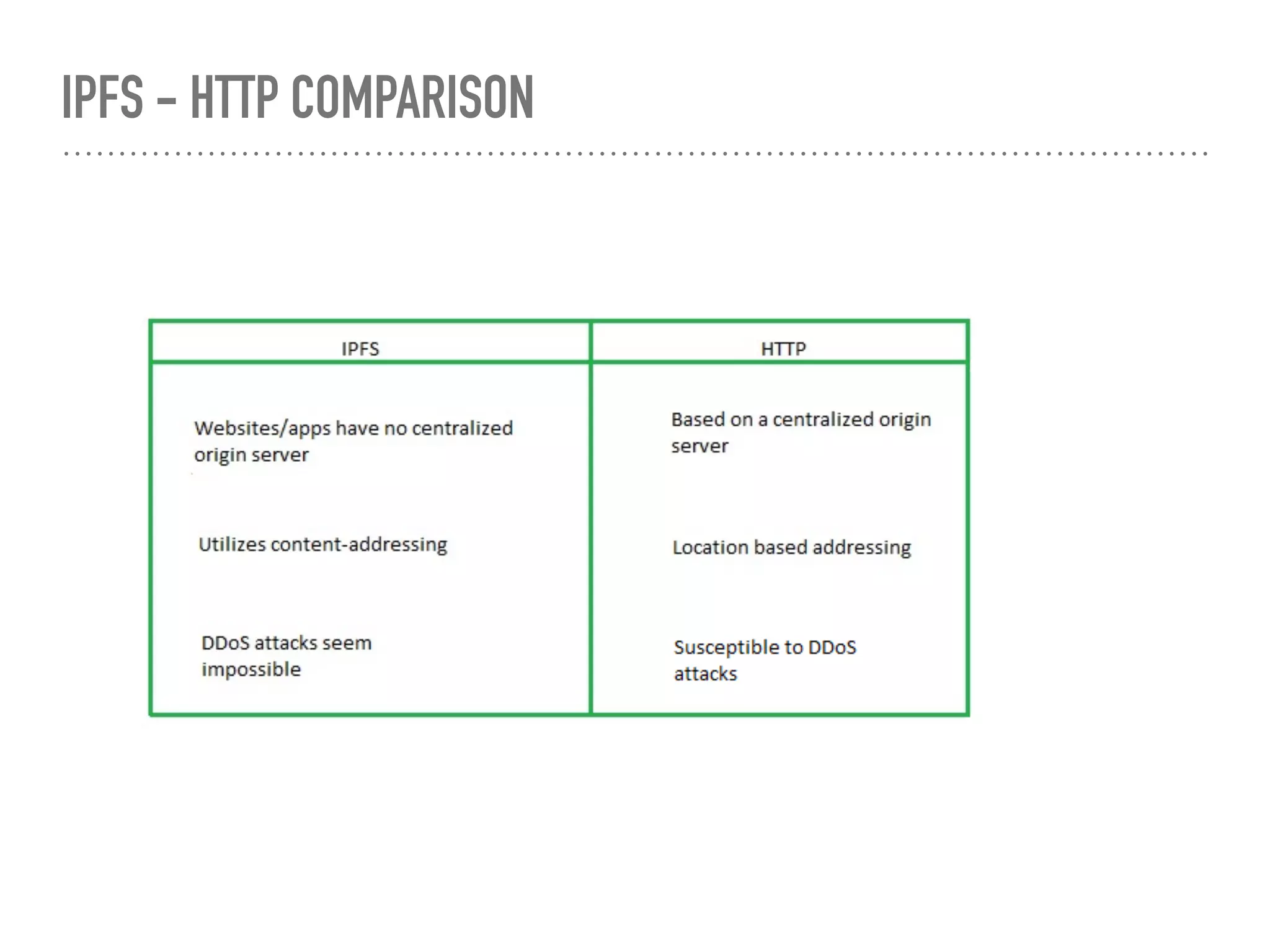
➤ Distributed Content Delivery saves bandwidth and prevents DDoS attacks,
which HTTP struggles with.
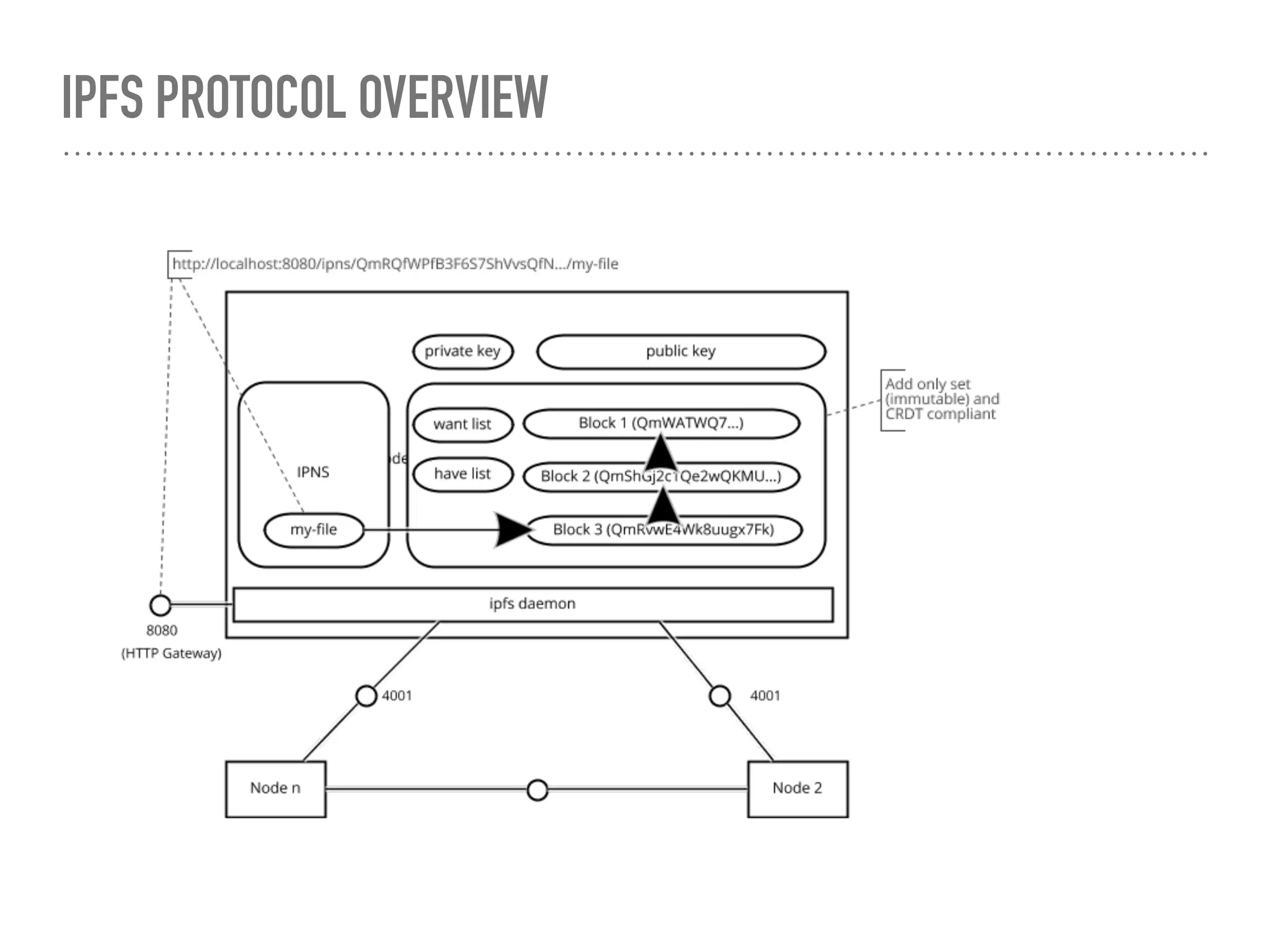
IPFS PROTOCOL OVERVIEW
IPFS - HTTP COMPARISON
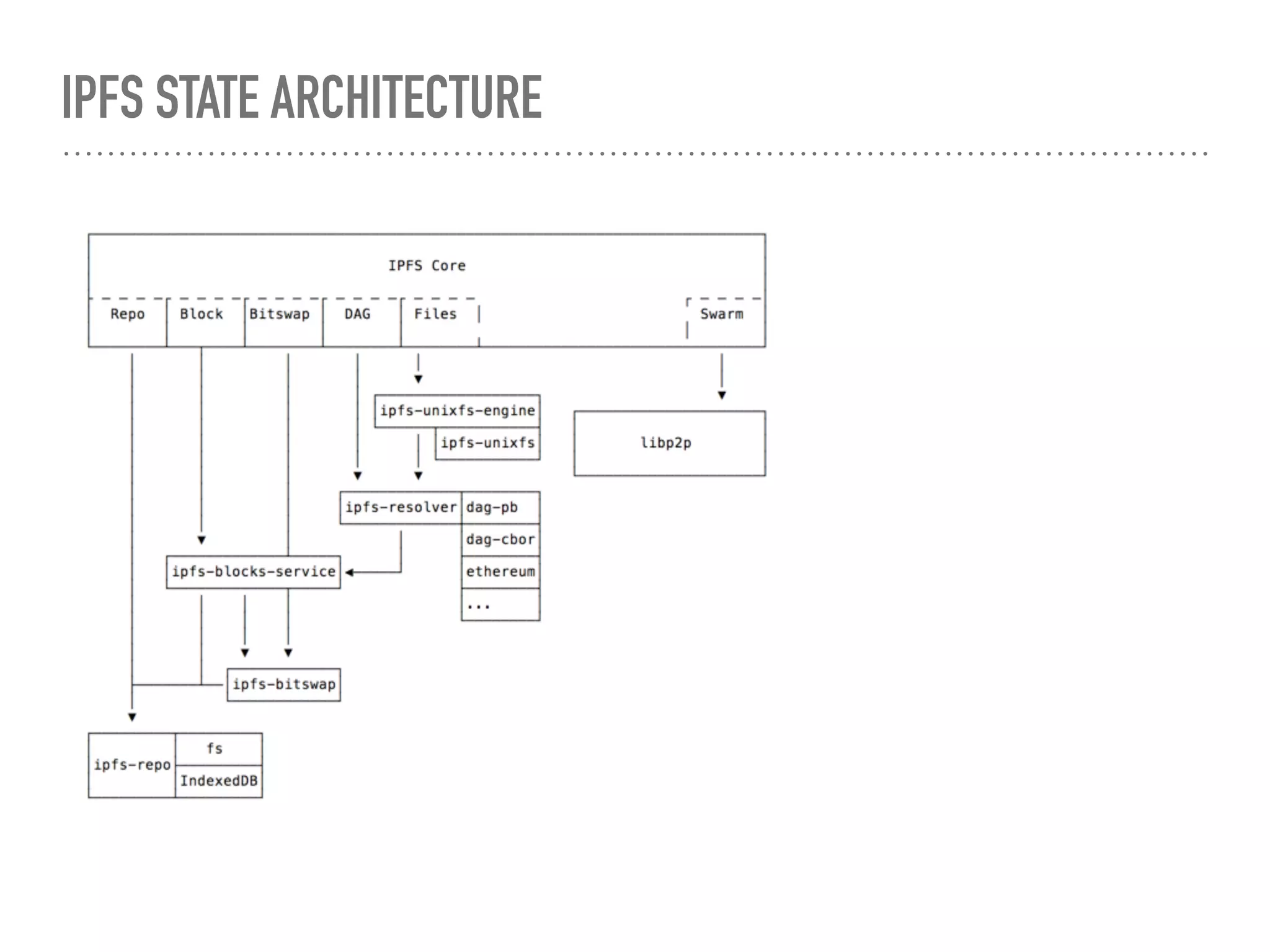
IPFS STATE ARCHITECTURE
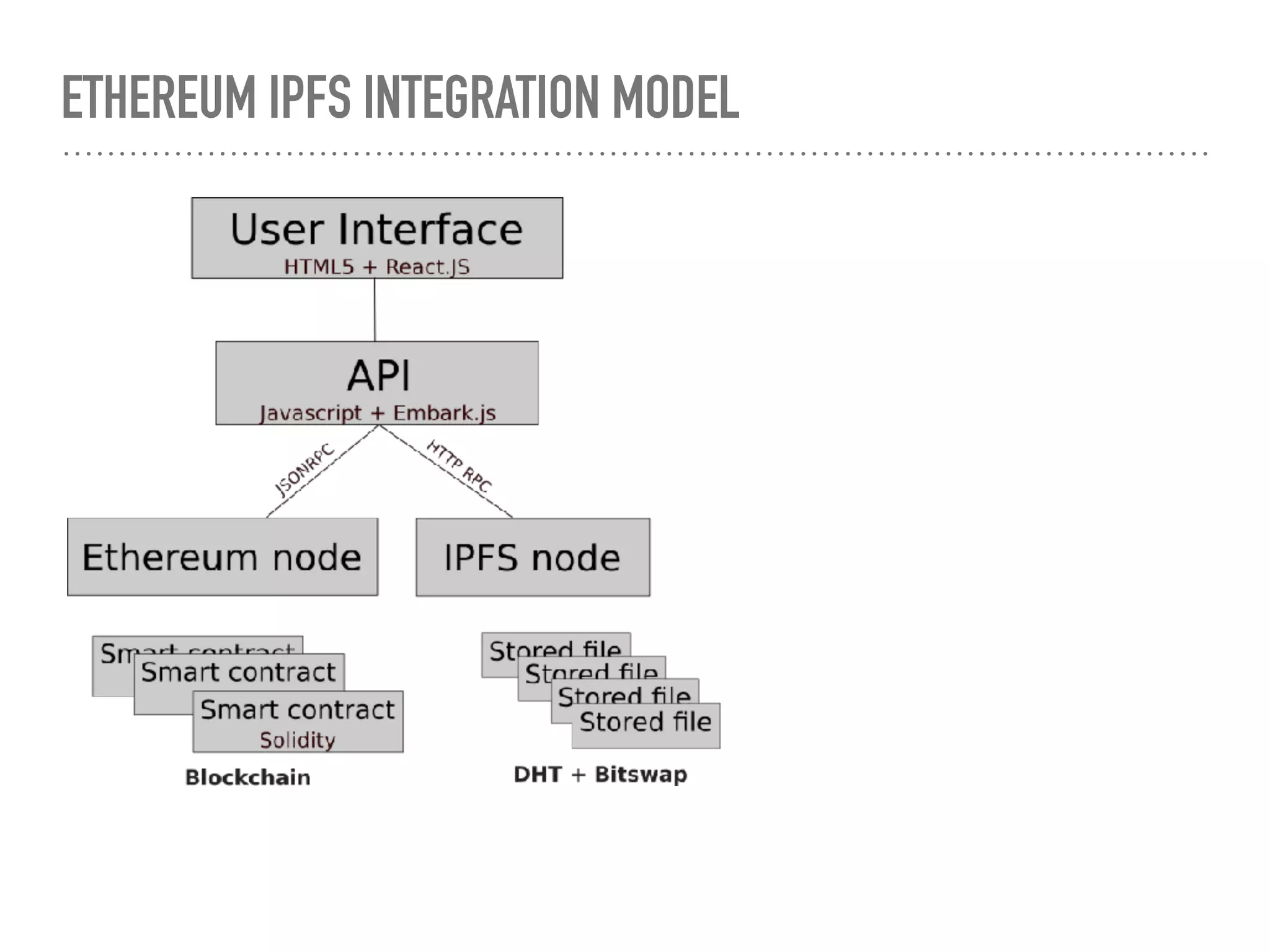
ETHEREUM IPFS INTEGRATION MODEL
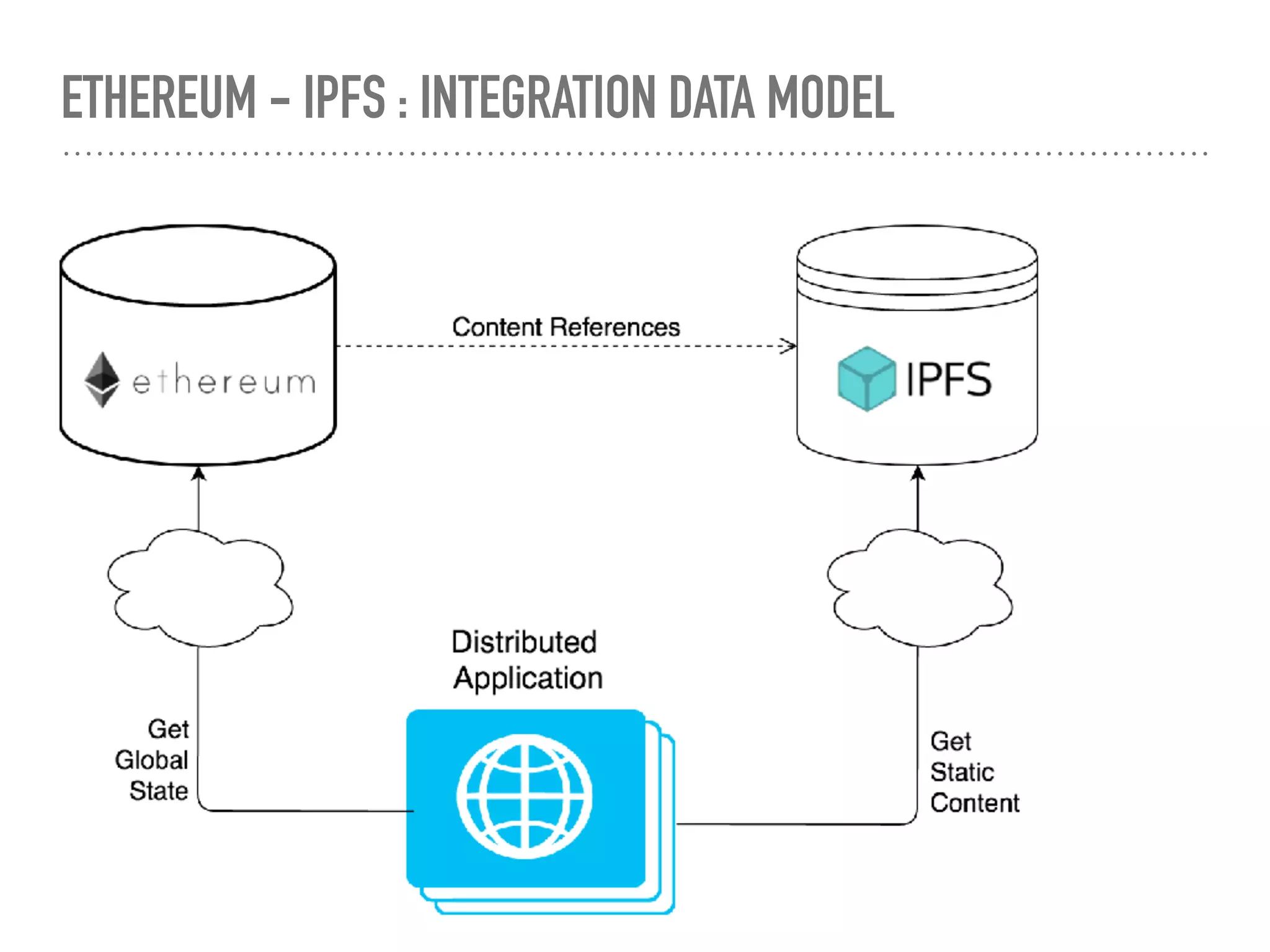
ETHEREUM - IPFS : INTEGRATION DATA MODEL
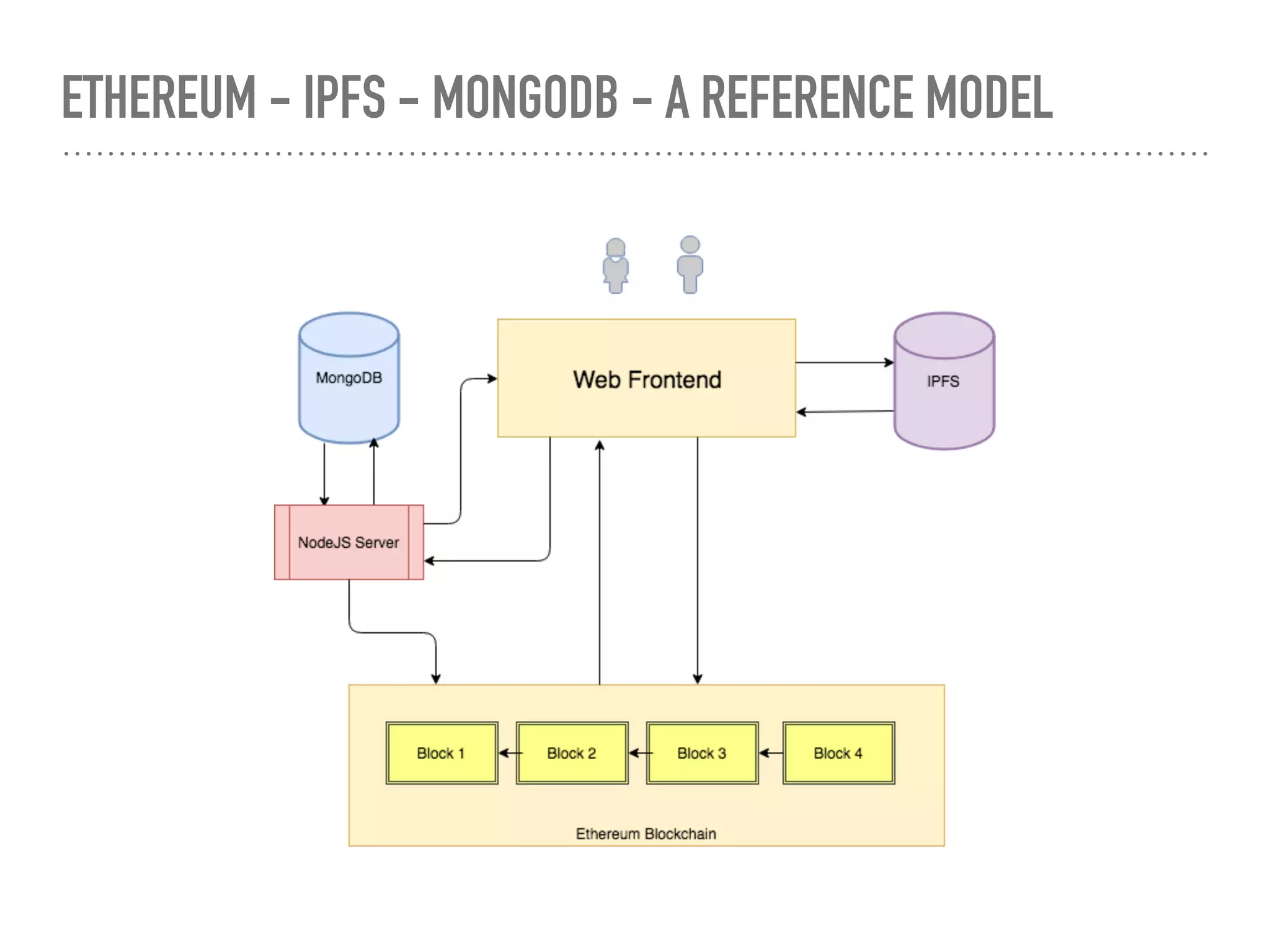
ETHEREUM - IPFS - MONGODB - A REFERENCE MODEL
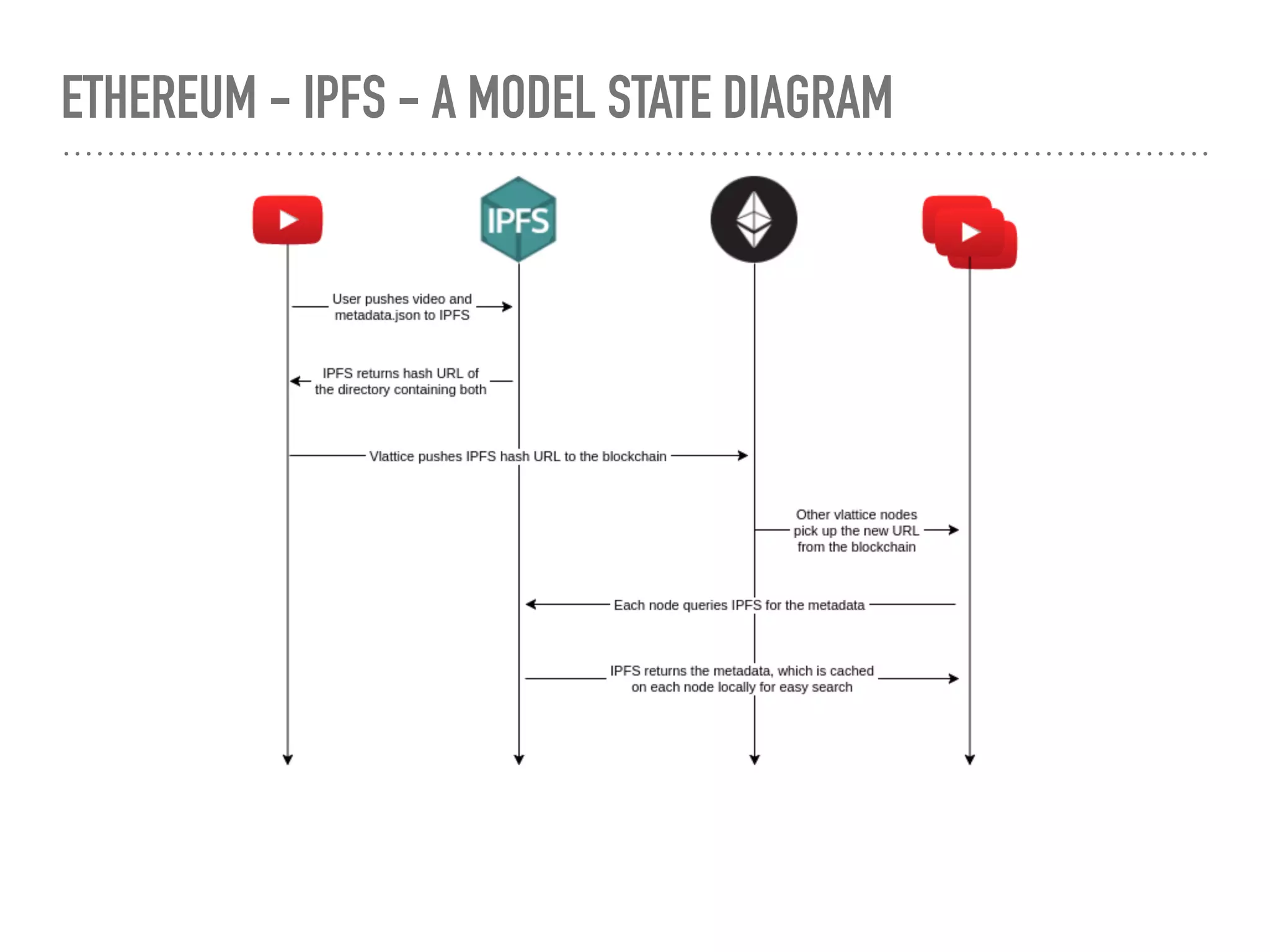
ETHEREUM - IPFS - A MODEL STATE DIAGRAM
RIPPLE CONSENSUS NETWORK
➤ The Ripple Transaction Protocol (RTXP), issued in 2012, has
been developed upon an open-source distributed consensus
ledger, Internet protocol, and native currency termed as XRP
(ripples).
➤ Ripple enables instant, safe and almost free global financial
transactions of any scale without any chargeback. The
protocol is embraced being able to support tokens presenting
cryptocurrency, fiat currency, commodity and any other value
unit like mobile minutes, frequent flier miles etc.
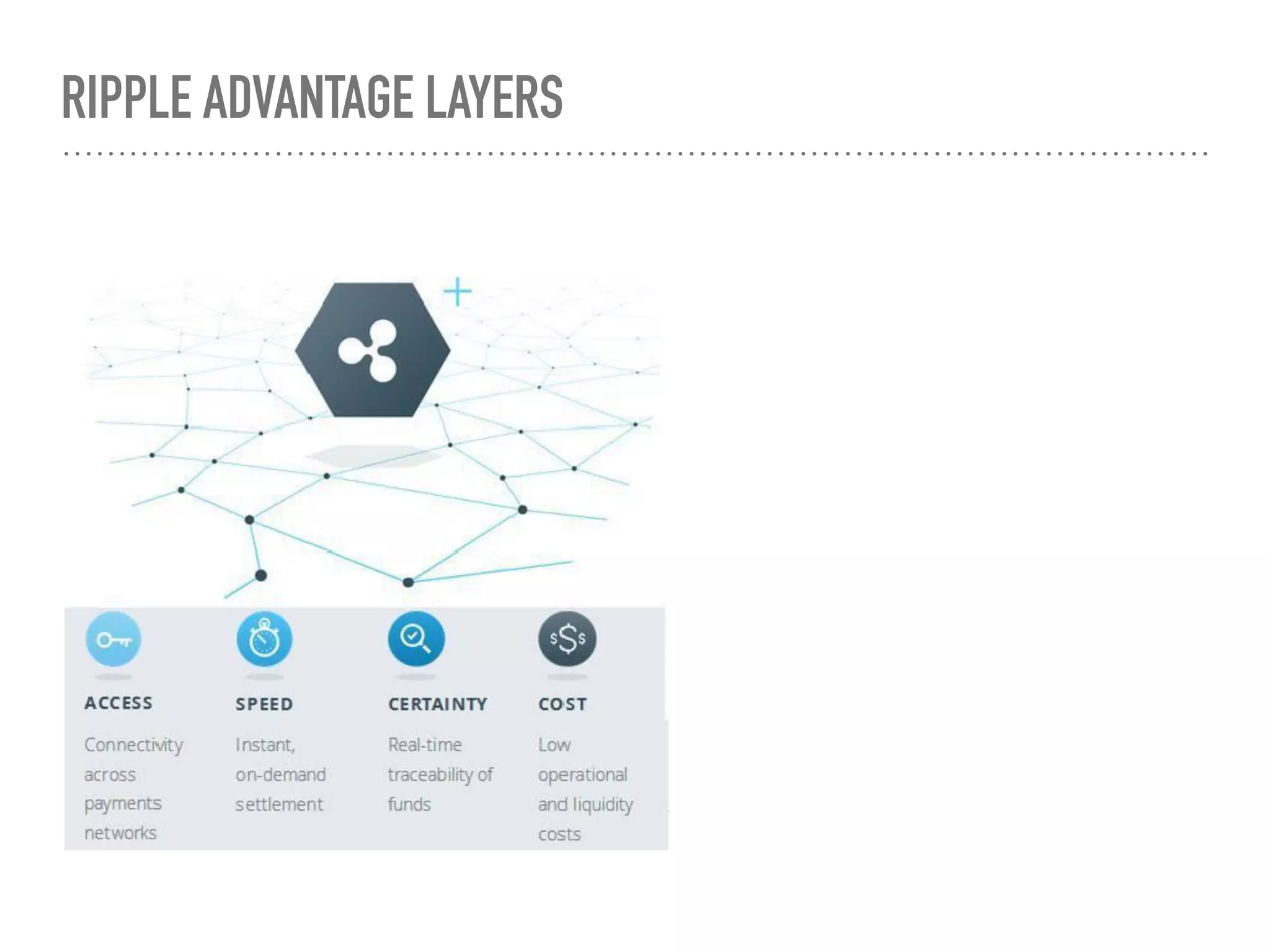
RIPPLE ADVANTAGE LAYERS
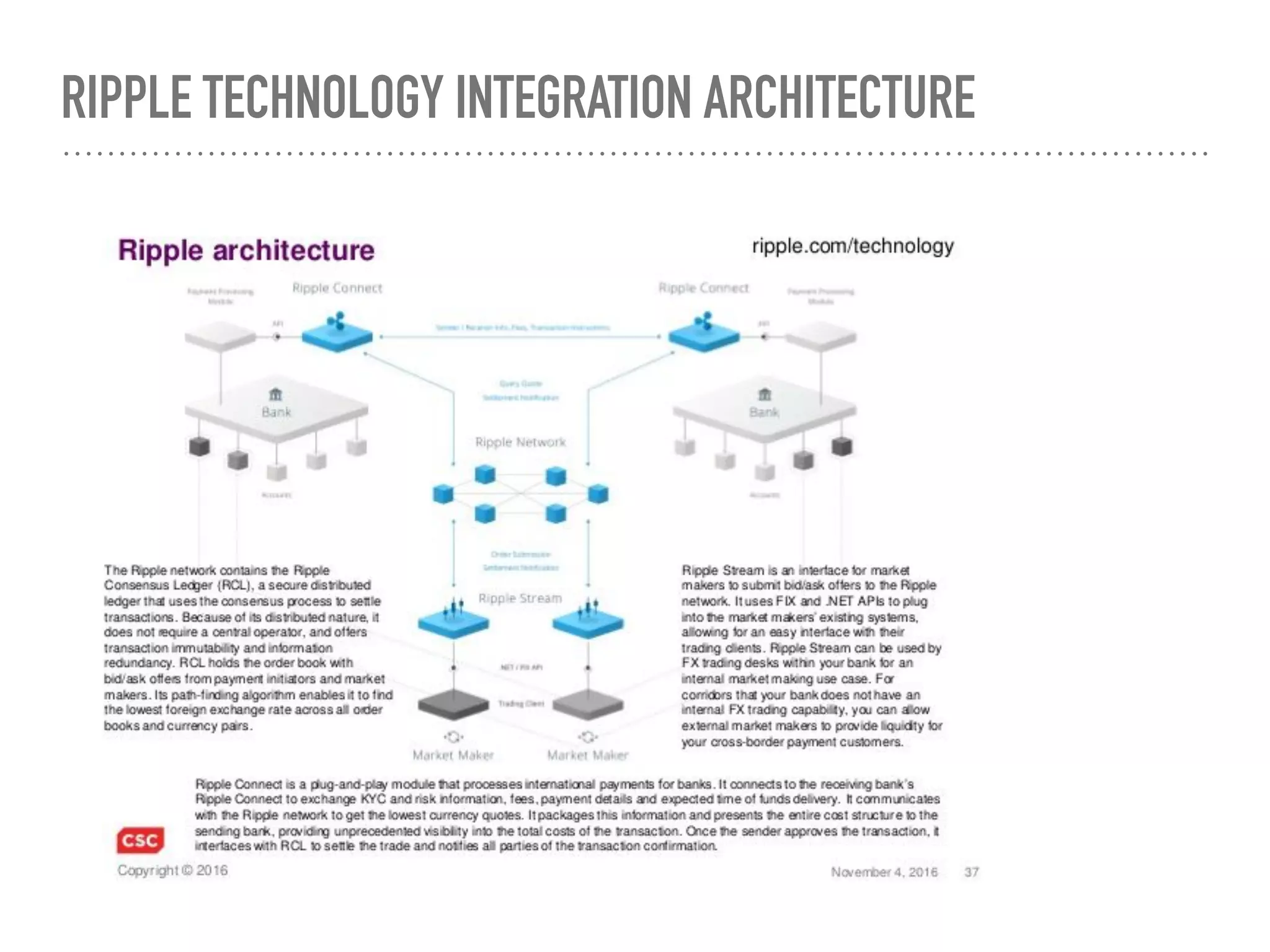
RIPPLE TECHNOLOGY INTEGRATION ARCHITECTURE
R3 CORDA
➤ Corda by the Company R3 is the distributed ledger protocol
that has been developed from the ground up for recording,
supervising and synchronising the financial agreements
among regulated financial institutions.
➤ It is, by great deal, stimulated by, and captures the advantages
of blockchain systems, with no design choices that turn
blockchains unsuitable for a lot of banking scenarios.
➤ Notary Nodes can run several consensus algorithms . Smart
Contracts cane written in Kotlin and are legally bounded
CORDA : FACTS AND FEATURES
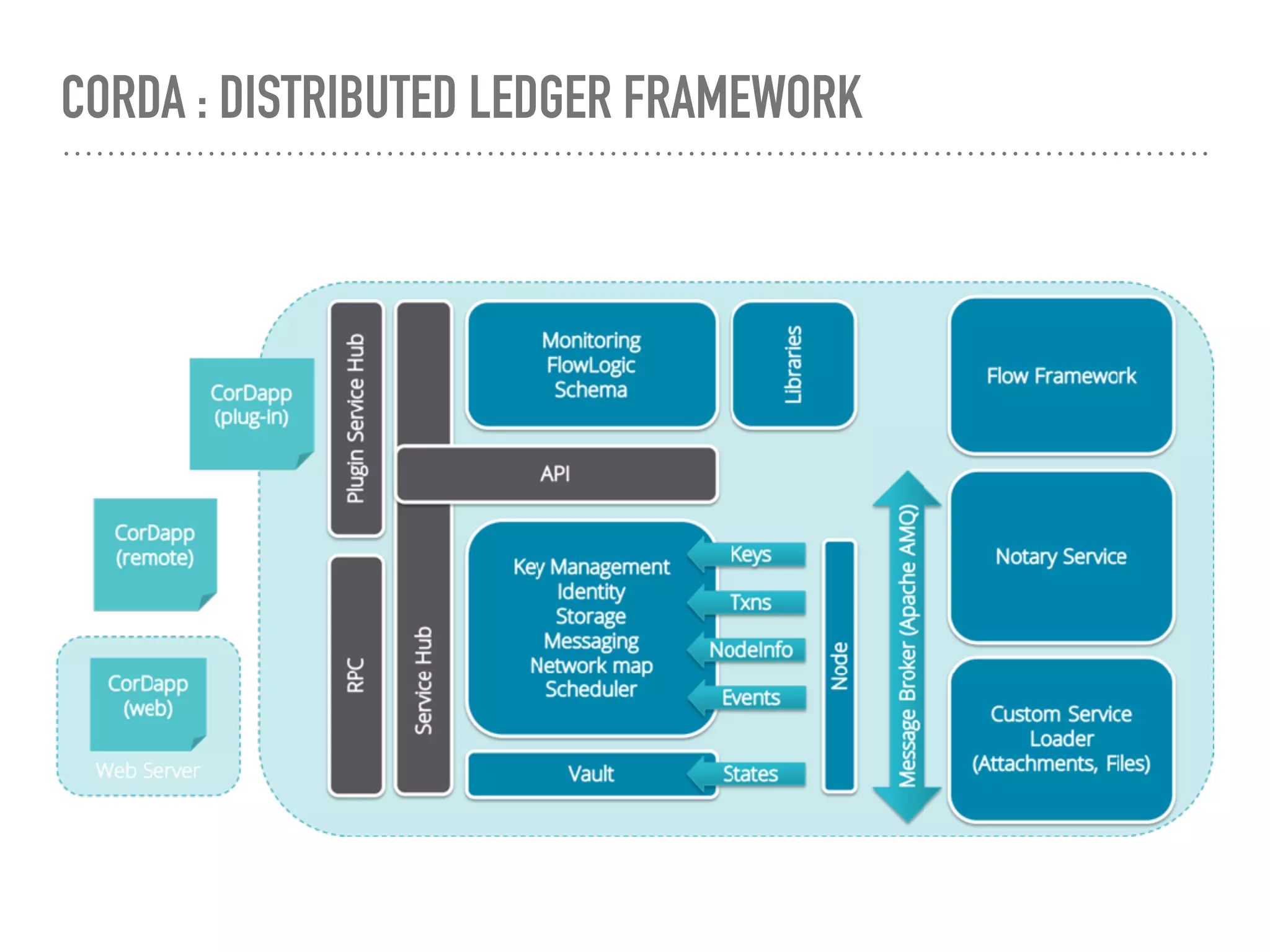
CORDA : DISTRIBUTED LEDGER FRAMEWORK
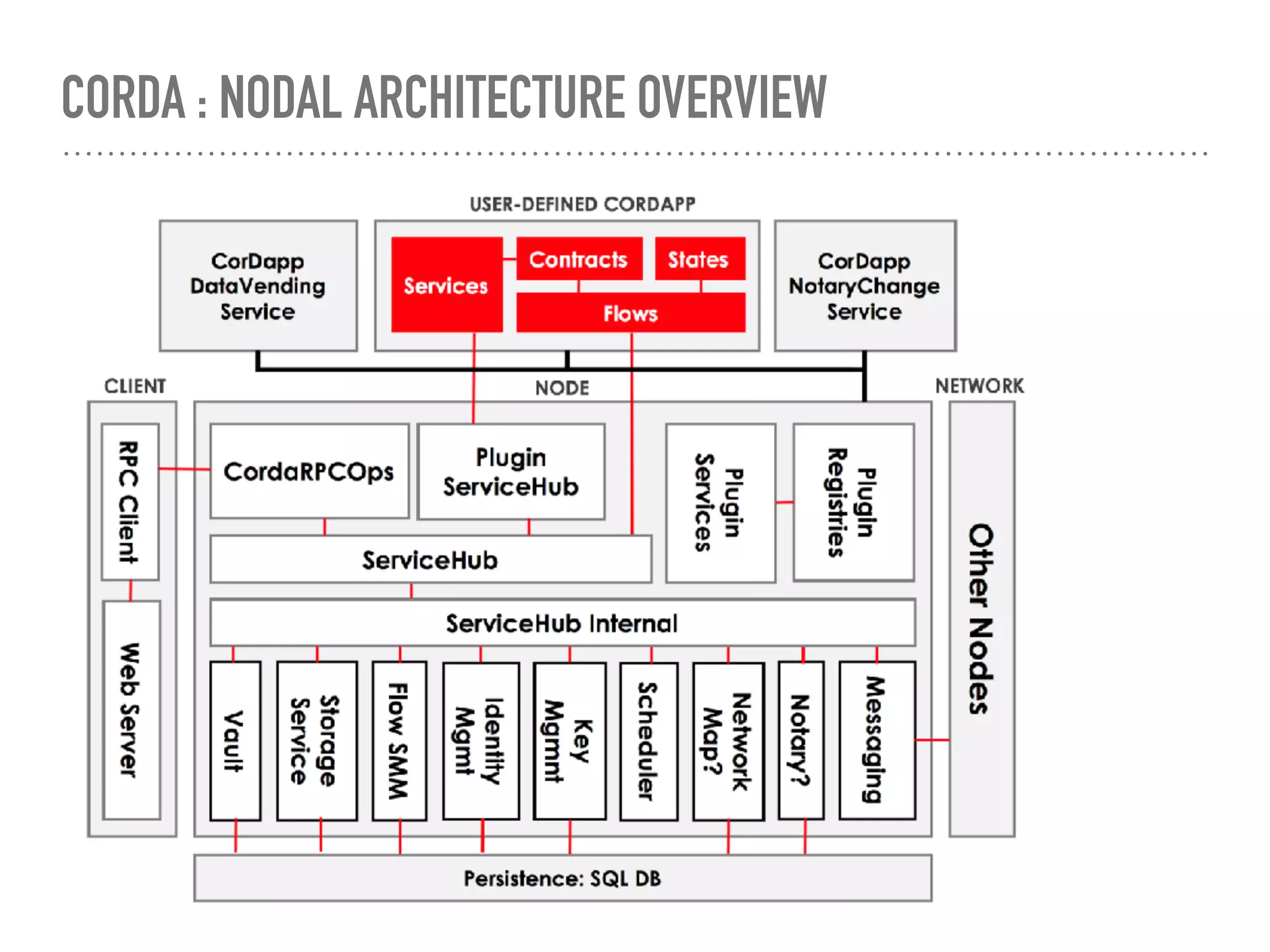
CORDA : NODAL ARCHITECTURE OVERVIEW
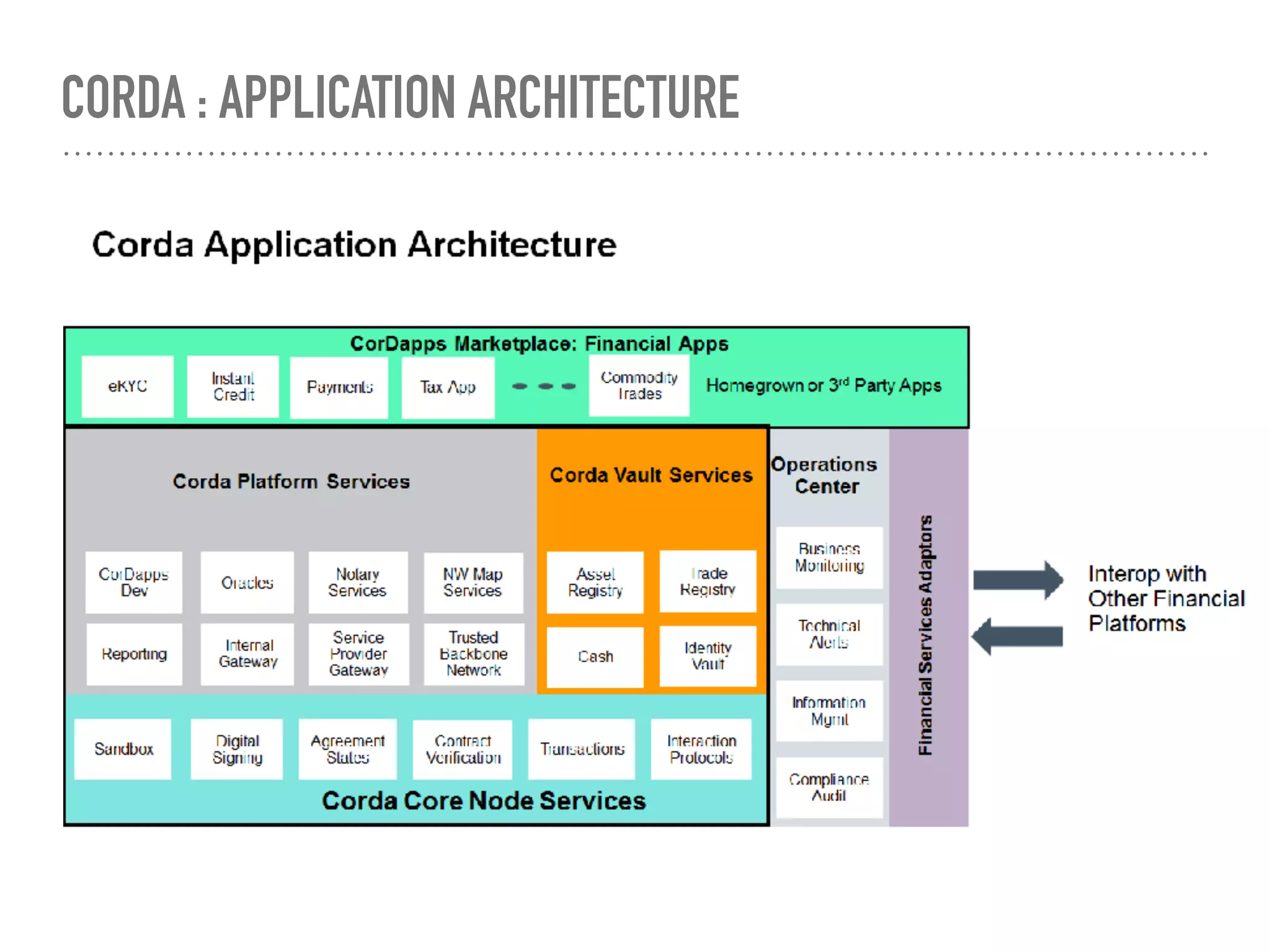
CORDA : APPLICATION ARCHITECTURE
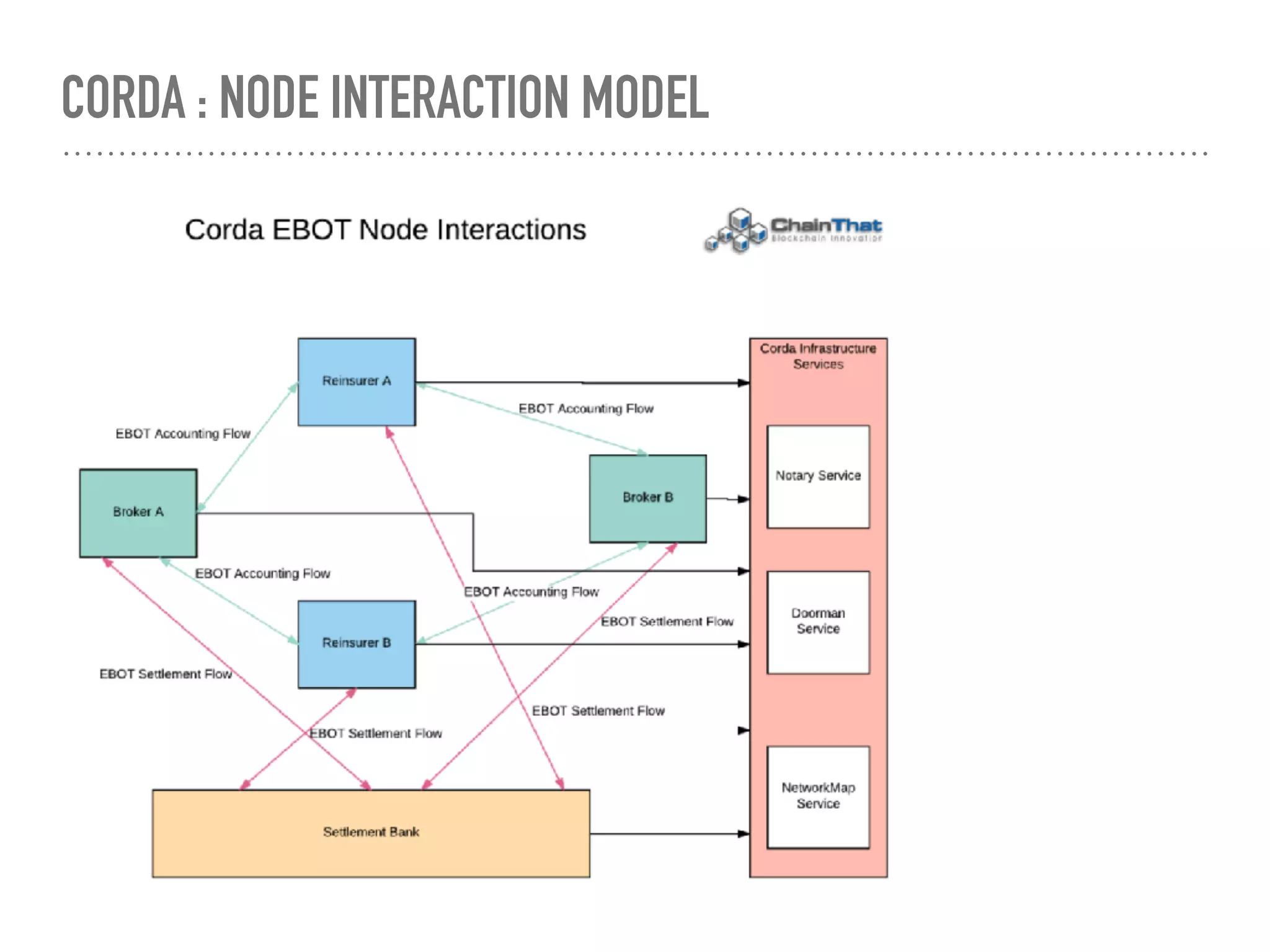
CORDA : NODE INTERACTION MODEL
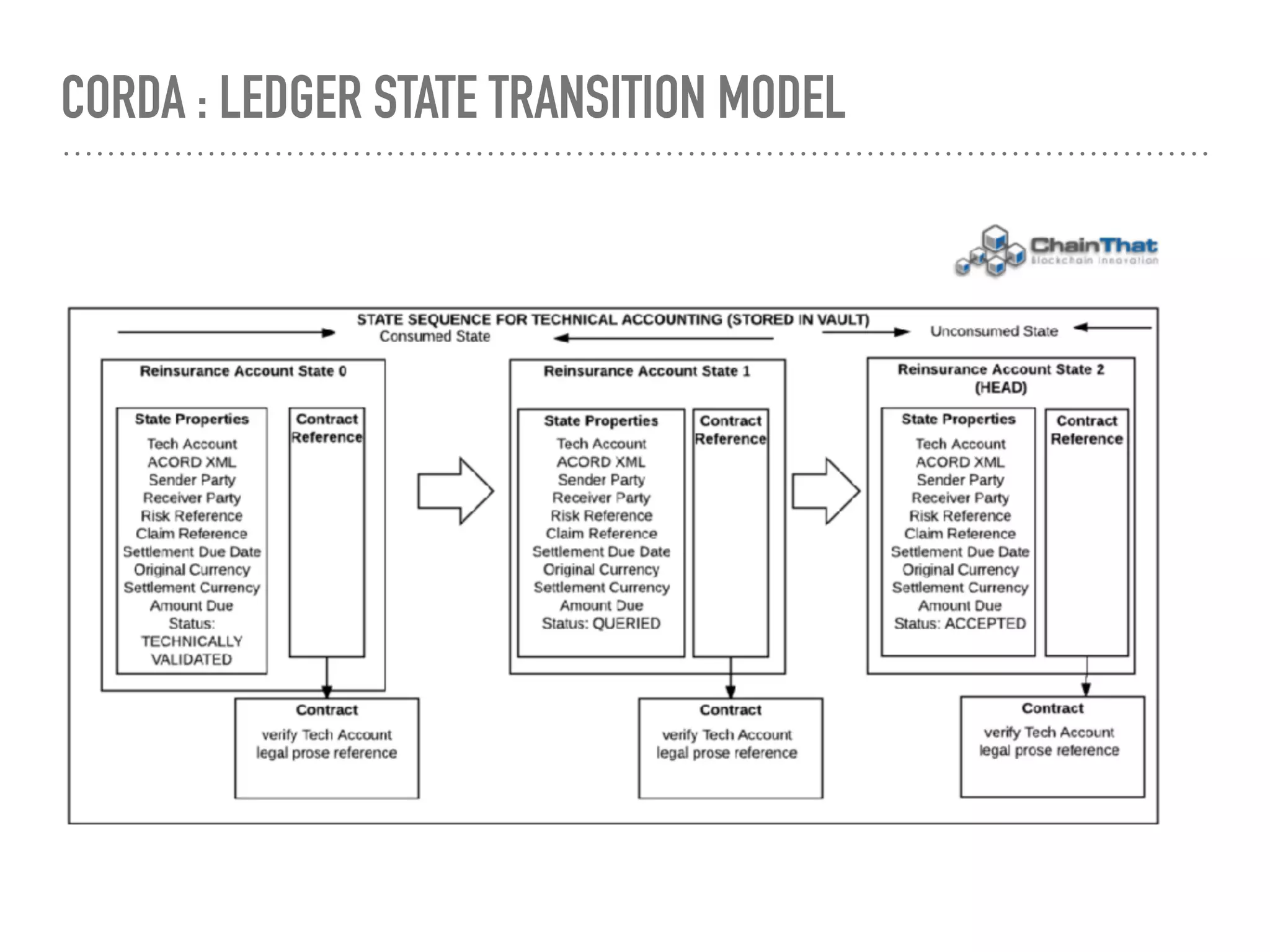
CORDA : LEDGER STATE TRANSITION MODEL
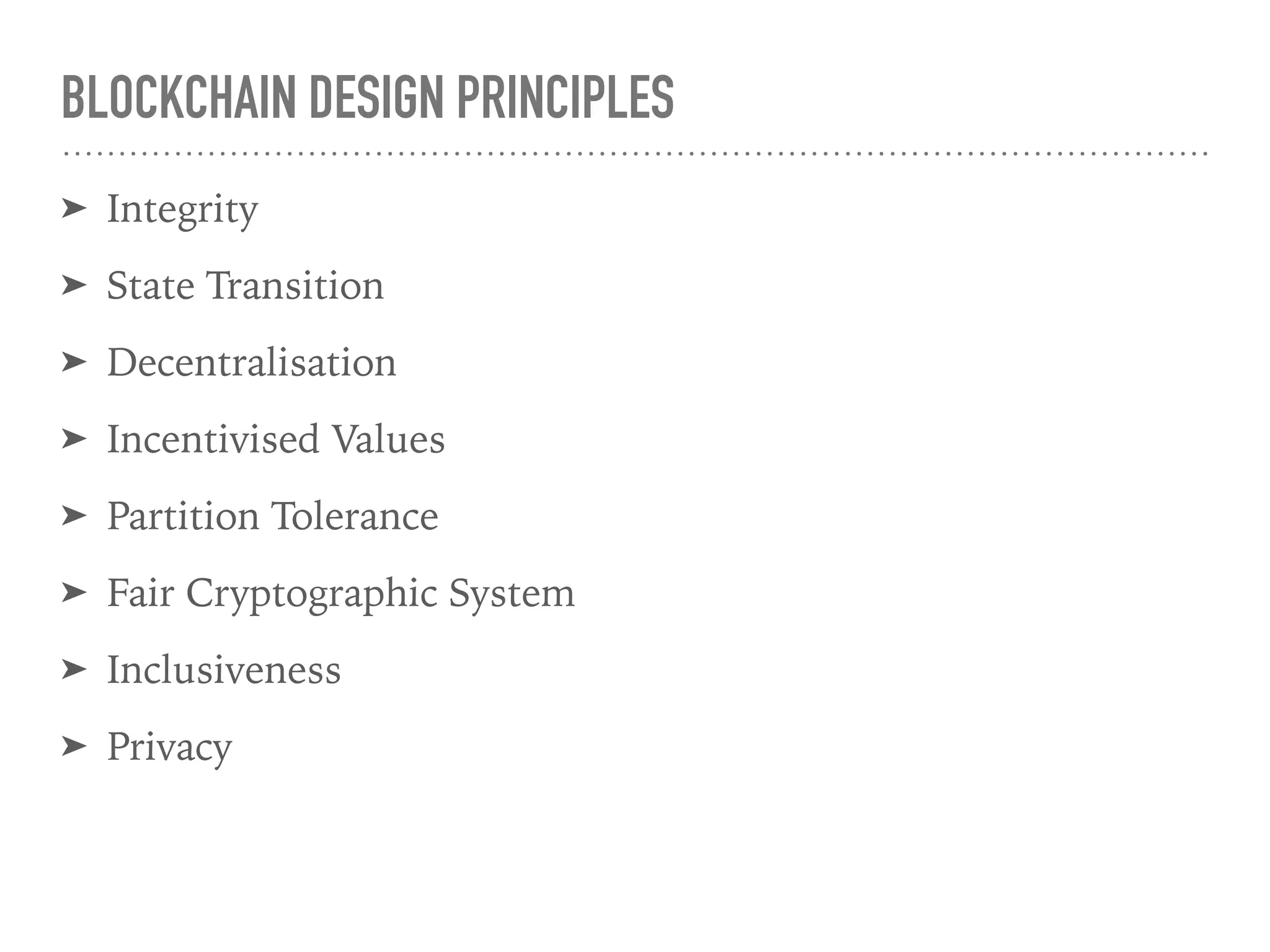
BLOCKCHAIN DESIGN PRINCIPLES
➤ Integrity
➤ State Transition
➤ Decentralisation
➤ Incentivised Values
➤ Partition Tolerance
➤ Fair Cryptographic System
➤ Inclusiveness
➤ Privacy
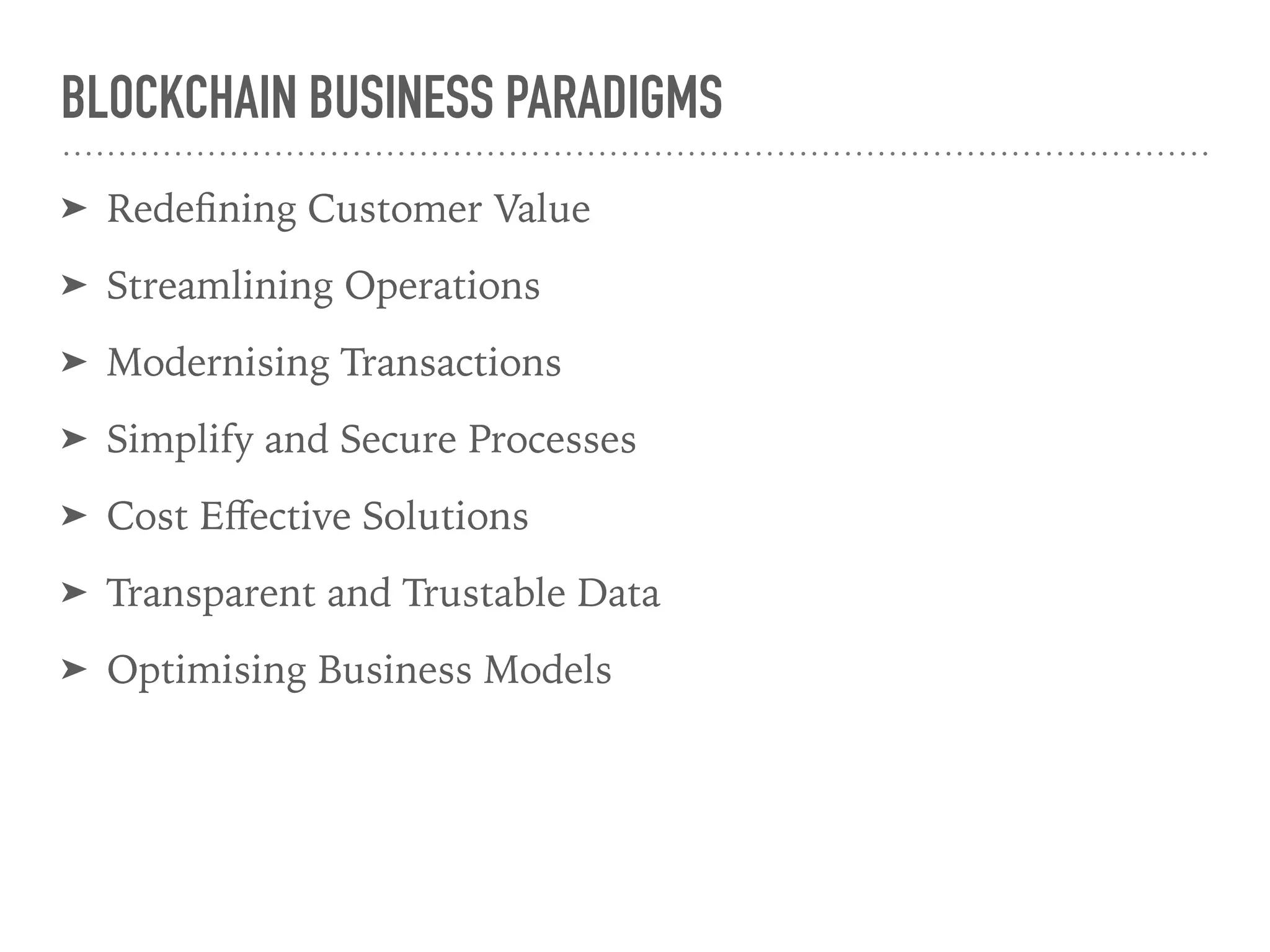
BLOCKCHAIN BUSINESS PARADIGMS
➤ Redefining Customer Value
➤ Streamlining Operations
➤ Modernising Transactions
➤ Simplify and Secure Processes
➤ Cost Effective Solutions
➤ Transparent and Trustable Data
➤ Optimising Business Models
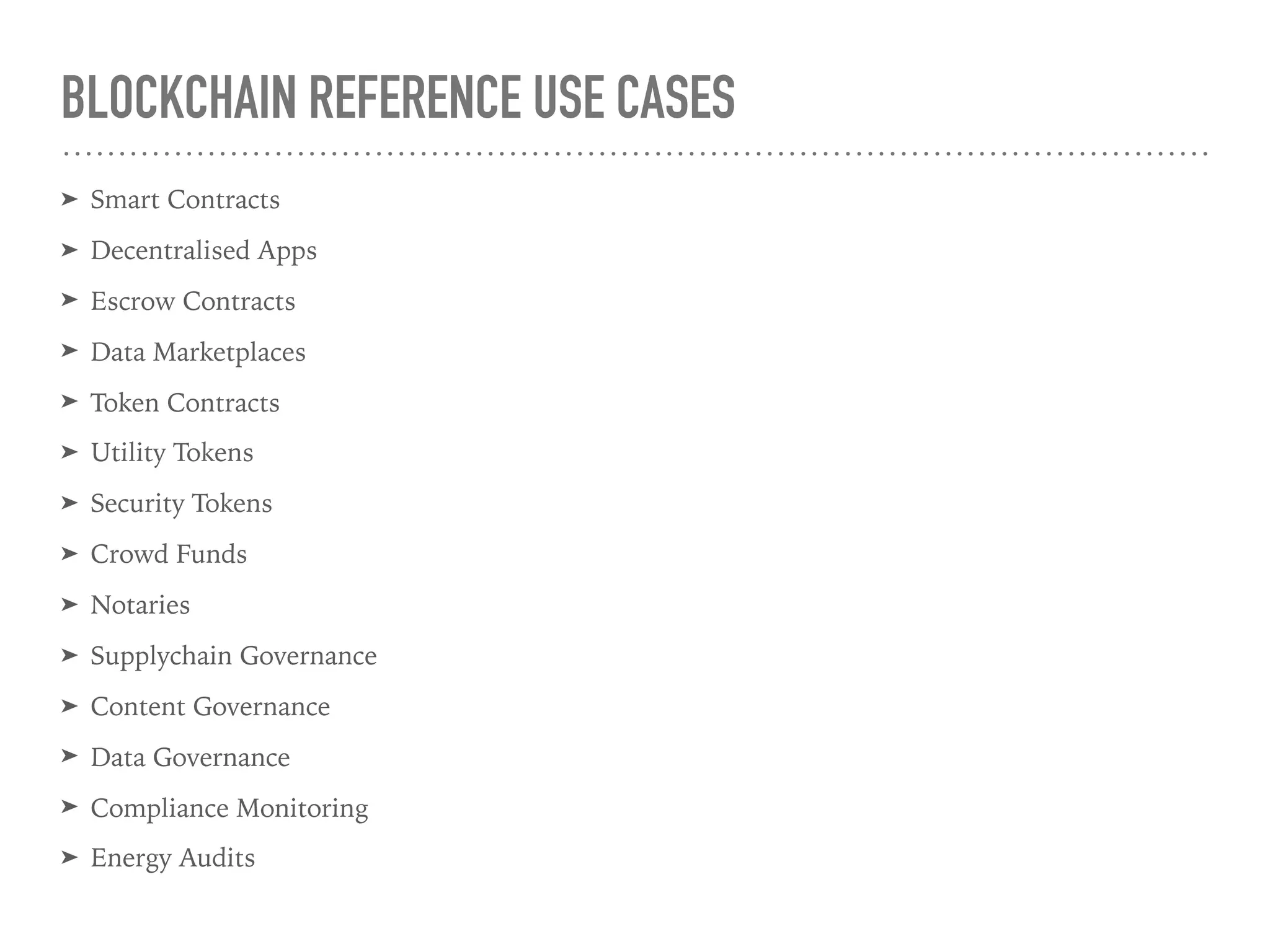
BLOCKCHAIN REFERENCE USE CASES
➤ Smart Contracts
➤ Decentralised Apps
➤ Escrow Contracts
➤ Data Marketplaces
➤ Token Contracts
➤ Utility Tokens
➤ Security Tokens
➤ Crowd Funds
➤ Notaries
➤ Supplychain Governance
➤ Content Governance
➤ Data Governance
➤ Compliance Monitoring
➤ Energy Audits

Blockchain Essentials for Enterprise Architects

  • 1.
    BLOCKCHAIN REFERENCE Compilation ofConcepts for Enterprise Architects
  • 2.
  • 3.
    PROTOCOLS IN PERSPECTIVE ➤Bitcoin ➤ Ethereum ➤ Hyperledger ➤ IPFS ➤ Ripple ➤ R3 Corda
  • 5.
  • 6.
    A DATABASE VIEWON BLOCKCHAIN
  • 7.
    TYPES OF BLOCKCHAINIMPLEMENTATIONS
  • 8.
    SUMMARY OF BLOCKCHAINPROTOCOL UNIVERSE
  • 9.
    EVOLUTION OF BLOCKCHAIN: TECHNOLOGY ROADMAP
  • 10.
    BITCOIN • Enables transactiondirectly with no need of trusted third party • Enables the non-reversible transactions • Decreases credit cost in minor casual transactions • Decreases transaction fees • Prevents double-spending
  • 11.
  • 12.
    ETHEREUM ➤ Ethereum isa public, open-source and block chain oriented distributed computing protocol that features smart contracts (scripting) functionality. ➤ The protocol has provided a decentralised virtual machine called the Ethereum Virtual Machine (EVM), which carried out Turning- complete scripts by using a global network of public nodes and the token called ether, also referred to as gas. ➤ Gas is used for preventing the spam on networks and allocating the resources in proportion to the incentive provided by the request. ➤ Ethereum is also used as a protocol for decentralised applications, smart contracts and decentralised autonomous organisations
  • 13.
    ETHEREUM DATA STRUCTURE: EXTENDED VIEW
  • 14.
  • 15.
  • 16.
  • 17.
    ETHEREUM : DEVELOPERSTACK OVERVIEW
  • 18.
    HYPERLEDGER FABRIC ➤ Hyperledgeris the open source blockchain platform, began in 2015 by the Linux Foundation, in an effort to support the blockchain-based distributed ledgers. ➤ The protocol focuses ledgers developed to support international business transactions, catering leading financial, technological and supply chain businesses, with the objective of improving a lot of performance and reliability aspects.
  • 19.
  • 20.
  • 21.
  • 22.
    IPFS OVERVIEW ➤ IPFSis a peer-to-peer distributed file system that seeks to connect all computing devices with the same system of files. ➤ In some ways, IPFS is similar to the World Wide Web, but IPFS could be seen as a single BitTorrent swarm, exchanging objects within one Git repository. ➤ IPFS provides a high-throughput, content-addressed block storage model, with content-addressed hyperlinks.This forms a generalised Merkle directed acyclic graph (DAG). ➤ IPFS combines a distributed hash table, an incentivised block exchange, and a self-certifying namespace. ➤ IPFS has no single point of failure, and nodes do not need to trust each other not to tamper with data in transit. ➤ Distributed Content Delivery saves bandwidth and prevents DDoS attacks, which HTTP struggles with.
  • 23.
  • 24.
    IPFS - HTTPCOMPARISON
  • 25.
  • 26.
  • 27.
    ETHEREUM - IPFS: INTEGRATION DATA MODEL
  • 28.
    ETHEREUM - IPFS- MONGODB - A REFERENCE MODEL
  • 29.
    ETHEREUM - IPFS- A MODEL STATE DIAGRAM
  • 30.
    RIPPLE CONSENSUS NETWORK ➤The Ripple Transaction Protocol (RTXP), issued in 2012, has been developed upon an open-source distributed consensus ledger, Internet protocol, and native currency termed as XRP (ripples). ➤ Ripple enables instant, safe and almost free global financial transactions of any scale without any chargeback. The protocol is embraced being able to support tokens presenting cryptocurrency, fiat currency, commodity and any other value unit like mobile minutes, frequent flier miles etc.
  • 31.
  • 32.
  • 33.
    R3 CORDA ➤ Cordaby the Company R3 is the distributed ledger protocol that has been developed from the ground up for recording, supervising and synchronising the financial agreements among regulated financial institutions. ➤ It is, by great deal, stimulated by, and captures the advantages of blockchain systems, with no design choices that turn blockchains unsuitable for a lot of banking scenarios. ➤ Notary Nodes can run several consensus algorithms . Smart Contracts cane written in Kotlin and are legally bounded
  • 34.
    CORDA : FACTSAND FEATURES
  • 35.
    CORDA : DISTRIBUTEDLEDGER FRAMEWORK
  • 36.
    CORDA : NODALARCHITECTURE OVERVIEW
  • 37.
    CORDA : APPLICATIONARCHITECTURE
  • 38.
    CORDA : NODEINTERACTION MODEL
  • 39.
    CORDA : LEDGERSTATE TRANSITION MODEL
  • 40.
    BLOCKCHAIN DESIGN PRINCIPLES ➤Integrity ➤ State Transition ➤ Decentralisation ➤ Incentivised Values ➤ Partition Tolerance ➤ Fair Cryptographic System ➤ Inclusiveness ➤ Privacy
  • 41.
    BLOCKCHAIN BUSINESS PARADIGMS ➤Redefining Customer Value ➤ Streamlining Operations ➤ Modernising Transactions ➤ Simplify and Secure Processes ➤ Cost Effective Solutions ➤ Transparent and Trustable Data ➤ Optimising Business Models
  • 42.
    BLOCKCHAIN REFERENCE USECASES ➤ Smart Contracts ➤ Decentralised Apps ➤ Escrow Contracts ➤ Data Marketplaces ➤ Token Contracts ➤ Utility Tokens ➤ Security Tokens ➤ Crowd Funds ➤ Notaries ➤ Supplychain Governance ➤ Content Governance ➤ Data Governance ➤ Compliance Monitoring ➤ Energy Audits