Blockchain FinTech
Land Registry and Property Ownership
Bahaa Farouk, MBA, TOGAF, ITIL, AWS, Blockchain
Lead Architect
1
Agenda
• Land Registry and Property Ownership Problem
• Does it worth the investment?
• Blockchain solution, land registry and property ownership
Land Registry & Property
Ownership Problem
“Humanity is acquiring all the right technology for all the wrong reasons.”
–R. Buckminster Fuller
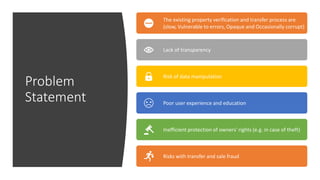
Problem
Statement
The existing property verification and transfer process are
(slow, Vulnerable to errors, Opaque and Occasionally corrupt)
Lack of transparency
Risk of data manipulation
Poor user experience and education
Inefficient protection of owners' rights (e.g. in case of theft)
Risks with transfer and sale fraud
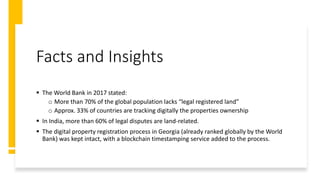
Facts and Insights
 The World Bank in 2017 stated:
o More than 70% of the global population lacks “legal registered land”
o Approx. 33% of countries are tracking digitally the properties ownership
 In India, more than 60% of legal disputes are land-related.
 The digital property registration process in Georgia (already ranked globally by the World
Bank) was kept intact, with a blockchain timestamping service added to the process.
Does it worth the
investment?
“Technology is a word that describes something that doesn’t work yet.”
– Douglas Adams
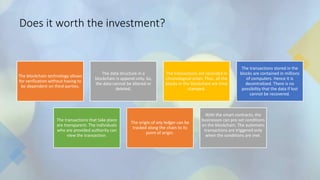
Does it worth the investment?
The blockchain technology allows
for verification without having to
be dependent on third-parties.
The data structure in a
blockchain is append-only. So,
the data cannot be altered or
deleted.
The transactions are recorded in
chronological order. Thus, all the
blocks in the blockchain are time
stamped.
The transactions stored in the
blocks are contained in millions
of computers. Hence it is
decentralized. There is no
possibility that the data if lost
cannot be recovered.
The transactions that take place
are transparent. The individuals
who are provided authority can
view the transaction.
The origin of any ledger can be
tracked along the chain to its
point of origin.
With the smart contracts, the
businesses can pre-set conditions
on the blockchain. The automatic
transactions are triggered only
when the conditions are met.
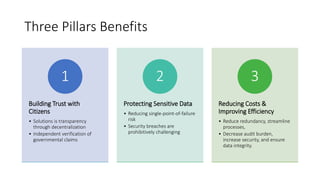
Three Pillars Benefits
Building Trust with
Citizens
• Solutions is transparency
through decentralization
• Independent verification of
governmental claims
1
Protecting Sensitive Data
• Reducing single-point-of-failure
risk
• Security breaches are
prohibitively challenging
2
Reducing Costs &
Improving Efficiency
• Reduce redundancy, streamline
processes,
• Decrease audit burden,
increase security, and ensure
data integrity.
3
Blockchain Solution “This is why I loved technology:
if you used it right, it could give
you power and privacy.”
–Cory Doctorow
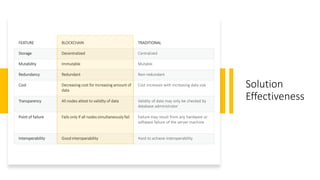
Solution
Effectiveness
FEATURE BLOCKCHAIN TRADITIONAL
Storage Decentralized Centralized
Mutability Immutable Mutable
Redundancy Redundant Non-redundant
Cost Decreasing cost for increasing amount of
data
Cost increases with increasing data size
Transparency All nodes attest to validity of data Validity of data may only be checked by
database administrator
Point of failure Fails only if all nodes simultaneously fail Failure may result from any hardware or
software failure of the server machine
Interoperability Good interoperability Hard to achieve interoperability
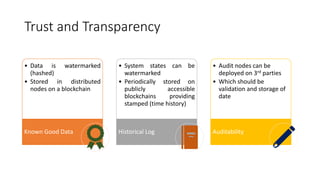
Trust and Transparency
• Data is watermarked
(hashed)
• Stored in distributed
nodes on a blockchain
Known Good Data
• System states can be
watermarked
• Periodically stored on
publicly accessible
blockchains providing
stamped (time history)
Historical Log
• Audit nodes can be
deployed on 3rd parties
• Which should be
validation and storage of
date
Auditability
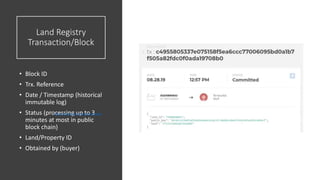
Land Registry
Transaction/Block
• Block ID
• Trx. Reference
• Date / Timestamp (historical
immutable log)
• Status (processing up to 3
minutes at most in public
block chain)
• Land/Property ID
• Obtained by (buyer)
https://exonum.com/story-georgia
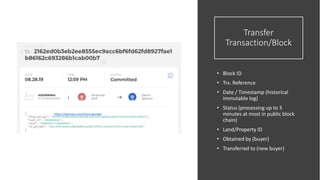
Transfer
Transaction/Block
• Block ID
• Trx. Reference
• Date / Timestamp (historical
immutable log)
• Status (processing up to 3
minutes at most in public block
chain)
• Land/Property ID
• Obtained by (buyer)
• Transferred to (new buyer)
https://exonum.com/story-georgia
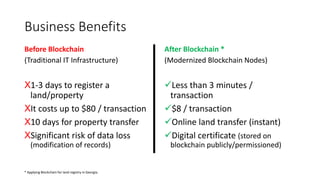
Business Benefits
Before Blockchain
(Traditional IT Infrastructure)
X1-3 days to register a
land/property
XIt costs up to $80 / transaction
X10 days for property transfer
XSignificant risk of data loss
(modification of records)
After Blockchain *
(Modernized Blockchain Nodes)
Less than 3 minutes /
transaction
$8 / transaction
Online land transfer (instant)
Digital certificate (stored on
blockchain publicly/permissioned)
* Applying Blockchain for land registry in Georgia.
Thank You

Blockchain FinTech App | Land Registry

  • 1.
    Blockchain FinTech Land Registryand Property Ownership Bahaa Farouk, MBA, TOGAF, ITIL, AWS, Blockchain Lead Architect 1
  • 2.
    Agenda • Land Registryand Property Ownership Problem • Does it worth the investment? • Blockchain solution, land registry and property ownership
  • 3.
    Land Registry &Property Ownership Problem “Humanity is acquiring all the right technology for all the wrong reasons.” –R. Buckminster Fuller
  • 4.
    Problem Statement The existing propertyverification and transfer process are (slow, Vulnerable to errors, Opaque and Occasionally corrupt) Lack of transparency Risk of data manipulation Poor user experience and education Inefficient protection of owners' rights (e.g. in case of theft) Risks with transfer and sale fraud
  • 5.
    Facts and Insights The World Bank in 2017 stated: o More than 70% of the global population lacks “legal registered land” o Approx. 33% of countries are tracking digitally the properties ownership  In India, more than 60% of legal disputes are land-related.  The digital property registration process in Georgia (already ranked globally by the World Bank) was kept intact, with a blockchain timestamping service added to the process.
  • 6.
    Does it worththe investment? “Technology is a word that describes something that doesn’t work yet.” – Douglas Adams
  • 7.
    Does it worththe investment? The blockchain technology allows for verification without having to be dependent on third-parties. The data structure in a blockchain is append-only. So, the data cannot be altered or deleted. The transactions are recorded in chronological order. Thus, all the blocks in the blockchain are time stamped. The transactions stored in the blocks are contained in millions of computers. Hence it is decentralized. There is no possibility that the data if lost cannot be recovered. The transactions that take place are transparent. The individuals who are provided authority can view the transaction. The origin of any ledger can be tracked along the chain to its point of origin. With the smart contracts, the businesses can pre-set conditions on the blockchain. The automatic transactions are triggered only when the conditions are met.
  • 8.
    Three Pillars Benefits BuildingTrust with Citizens • Solutions is transparency through decentralization • Independent verification of governmental claims 1 Protecting Sensitive Data • Reducing single-point-of-failure risk • Security breaches are prohibitively challenging 2 Reducing Costs & Improving Efficiency • Reduce redundancy, streamline processes, • Decrease audit burden, increase security, and ensure data integrity. 3
  • 9.
    Blockchain Solution “Thisis why I loved technology: if you used it right, it could give you power and privacy.” –Cory Doctorow
  • 10.
    Solution Effectiveness FEATURE BLOCKCHAIN TRADITIONAL StorageDecentralized Centralized Mutability Immutable Mutable Redundancy Redundant Non-redundant Cost Decreasing cost for increasing amount of data Cost increases with increasing data size Transparency All nodes attest to validity of data Validity of data may only be checked by database administrator Point of failure Fails only if all nodes simultaneously fail Failure may result from any hardware or software failure of the server machine Interoperability Good interoperability Hard to achieve interoperability
  • 11.
    Trust and Transparency •Data is watermarked (hashed) • Stored in distributed nodes on a blockchain Known Good Data • System states can be watermarked • Periodically stored on publicly accessible blockchains providing stamped (time history) Historical Log • Audit nodes can be deployed on 3rd parties • Which should be validation and storage of date Auditability
  • 12.
    Land Registry Transaction/Block • BlockID • Trx. Reference • Date / Timestamp (historical immutable log) • Status (processing up to 3 minutes at most in public block chain) • Land/Property ID • Obtained by (buyer) https://exonum.com/story-georgia
  • 13.
    Transfer Transaction/Block • Block ID •Trx. Reference • Date / Timestamp (historical immutable log) • Status (processing up to 3 minutes at most in public block chain) • Land/Property ID • Obtained by (buyer) • Transferred to (new buyer) https://exonum.com/story-georgia
  • 14.
    Business Benefits Before Blockchain (TraditionalIT Infrastructure) X1-3 days to register a land/property XIt costs up to $80 / transaction X10 days for property transfer XSignificant risk of data loss (modification of records) After Blockchain * (Modernized Blockchain Nodes) Less than 3 minutes / transaction $8 / transaction Online land transfer (instant) Digital certificate (stored on blockchain publicly/permissioned) * Applying Blockchain for land registry in Georgia.
  • 15.