Blockchain for the
Enterprise
Iemke Kooijman
Martijn Hulshof
25-11-2017
Experis Ciber and emerging technologies
Blockchain
Research questions:
• What is blockchain: capabilities, strengths and limitations
• What does the blockchain field look like (public/private blockchain): Key players
• What scenarios legitimate blockchain technology?
How:
• Tech first approach, application driven
• Multidisciplinary teams
• Agile development
Aim:
• Build knowledge and share expertise
• Identify valuable use cases for business
Goals & Agenda
Session goal:
Introduce core capabilities of blockchain technology and application in an enterprise context
Agenda:
Part 1:
• What is blockchain?
• SAP & Blockchain
• Use case
Part 2:
• Hyperledger Fabric overview
• Sample transaction flow
• POC demonstration
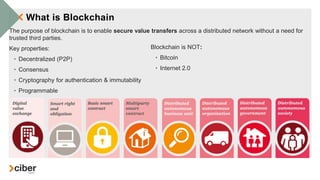
What is Blockchain
The purpose of blockchain is to enable secure value transfers across a distributed network without a need for
trusted third parties.
Key properties:
• Decentralized (P2P)
• Consensus
• Cryptography for authentication & immutability
• Programmable
Blockchain is NOT:
• Bitcoin
• Internet 2.0
Gartner Hype Cycle - 2017
What is blockchain – Public deployment
1200+ Cryptocurrencies, $250.000.000.000 Market cap
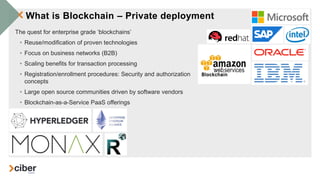
What is Blockchain – Private deployment
The quest for enterprise grade ‘blockchains’
• Reuse/modification of proven technologies
• Focus on business networks (B2B)
• Scaling benefits for transaction processing
• Registration/enrollment procedures: Security and authorization
concepts
• Large open source communities driven by software vendors
• Blockchain-as-a-Service PaaS offerings
SAP & Blockchain
Q1 2017: SAP Ariba partners with Everledger to include
‘blockchain capabilities’ in Ariba’s cloud products;
- ‘[…] to align with SAP corporate strategy on blockchain’
TrueRec: Record verifiable proof of Open SAP certificates on
‘public’ Ethereum blockchain using CF app
Part of SAP Cloud Platform Leonardo Innovation portfolio:
• Blockchain as a Service (alpha) – Co-innovation program
for early access through SAP Jam
• Integration services for IoT, ML and S/4 HANA.
Proof of concept with Ripple DLT for SAP Payment Engine
via SCP CF to efficiently process cross-border payments.
Platinum member Hyperledger consortium and founding
member of Blockchain Research Institute
Typical use case: Supply Chain Management
Conclusion - Part 1
Making the case for blockchain
• Blockchain is bleeding edge technology, still high on the ‘hype cycle’
• There is an increasing business interest into the capabilities of blockchain for driving
standardization and process integration in business networks
• Blockchain fits to the digital transformation paradigm; technological means to
redesign business models and processes
Part 2 – Hyperledger Fabric
Introduction
• Fabric initially developed in-house by IBM
• Code base contributed to Hyperledger foundation, which is hosted by The Linux Foundation
since January 2016. Mission statement (excerpt):
‘Create an enterprise grade, open source distributed ledger framework and code base, upon
which users can build and run robust, industry-specific applications, platforms and hardware
systems to support business transactions.’
‘Create an open source, technical community to benefit the ecosystem of HLP solution providers
and users, focused on blockchain and shared ledger use cases that will work across a variety of
industry solutions’
• Next to Fabric, Hyperledger also hosts other blockchain projects like Sawtooth and Burrow
Hyperledger Fabric - Basic Architecture
Hyperledger Fabric – Sample transaction flow
• Scenario:
- 2 organizations: Org A, Org B
- 2 Peer nodes
- A user from Org A wants to submit a
Purchase Order transaction
• Client A submits a proposal to write to the
ledger via a signed ‘propose message’ to
Endorsing Peers A and B.
Source: http://hyperledger-
fabric.readthedocs.io/en/latest/txflow.html
Hyperledger Fabric – Sample transaction flow
• The Endorsing Peers (Peer A, Peer B) verify
- If transaction proposal is well formed
- If transaction has not been submitted before
- If the signature is valid
- Client authorization (write operation)
Inputs are ‘processed’ against current state and a signed
response value (read/write set) is send back as a
‘response message’.
• The client inspects and compares the results
Hyperledger Fabric – Sample transaction flow
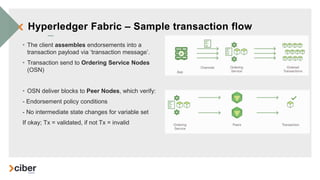
• The client assembles endorsements into a
transaction payload via ‘transaction message’.
• Transaction send to Ordering Service Nodes
(OSN)
• OSN deliver blocks to Peer Nodes, which verify:
- Endorsement policy conditions
- No intermediate state changes for variable set
If okay; Tx = validated, if not Tx = invalid
Hyperledger Fabric – Sample transaction flow
• Peer nodes append block with tx’s to their chain.
- Immutable via hash chain
• Valid transactions update (write) the current state
database
• Peer emits event to client after commit;
- ‘Transaction is added’ and
- Is ‘validated’ or ‘invalidated’
• Org A now purchased the radices and the
transaction is immutably stored in the ledger
Hyperledger Fabric – POC
Perishables SCM
• Objectives:
- Accurately track perishable products accross globalized end-to-end supply chain
- Use smart contract to process payments depending on contractually agreed shipping
conditions
• Participants: Grower, Quality official, Customs office, Shipper, Importer, Supermarket, Consumer
• Notes:
- IBM Bluemix (Cloud) BaaS trial used: including a CA, 1 peer node, 1 ordering node, client
- Hyperledger composer - Playground
Hyperledger Fabric – POC
Demo

Blockchain for the Enterprise

  • 1.
    Blockchain for the Enterprise IemkeKooijman Martijn Hulshof 25-11-2017
  • 4.
    Experis Ciber andemerging technologies Blockchain Research questions: • What is blockchain: capabilities, strengths and limitations • What does the blockchain field look like (public/private blockchain): Key players • What scenarios legitimate blockchain technology? How: • Tech first approach, application driven • Multidisciplinary teams • Agile development Aim: • Build knowledge and share expertise • Identify valuable use cases for business
  • 5.
    Goals & Agenda Sessiongoal: Introduce core capabilities of blockchain technology and application in an enterprise context Agenda: Part 1: • What is blockchain? • SAP & Blockchain • Use case Part 2: • Hyperledger Fabric overview • Sample transaction flow • POC demonstration
  • 6.
    What is Blockchain Thepurpose of blockchain is to enable secure value transfers across a distributed network without a need for trusted third parties. Key properties: • Decentralized (P2P) • Consensus • Cryptography for authentication & immutability • Programmable Blockchain is NOT: • Bitcoin • Internet 2.0
  • 7.
  • 8.
    What is blockchain– Public deployment 1200+ Cryptocurrencies, $250.000.000.000 Market cap
  • 9.
    What is Blockchain– Private deployment The quest for enterprise grade ‘blockchains’ • Reuse/modification of proven technologies • Focus on business networks (B2B) • Scaling benefits for transaction processing • Registration/enrollment procedures: Security and authorization concepts • Large open source communities driven by software vendors • Blockchain-as-a-Service PaaS offerings
  • 10.
    SAP & Blockchain Q12017: SAP Ariba partners with Everledger to include ‘blockchain capabilities’ in Ariba’s cloud products; - ‘[…] to align with SAP corporate strategy on blockchain’ TrueRec: Record verifiable proof of Open SAP certificates on ‘public’ Ethereum blockchain using CF app Part of SAP Cloud Platform Leonardo Innovation portfolio: • Blockchain as a Service (alpha) – Co-innovation program for early access through SAP Jam • Integration services for IoT, ML and S/4 HANA. Proof of concept with Ripple DLT for SAP Payment Engine via SCP CF to efficiently process cross-border payments. Platinum member Hyperledger consortium and founding member of Blockchain Research Institute
  • 12.
    Typical use case:Supply Chain Management
  • 13.
    Typical use case:Supply Chain Management
  • 14.
    Conclusion - Part1 Making the case for blockchain • Blockchain is bleeding edge technology, still high on the ‘hype cycle’ • There is an increasing business interest into the capabilities of blockchain for driving standardization and process integration in business networks • Blockchain fits to the digital transformation paradigm; technological means to redesign business models and processes
  • 15.
    Part 2 –Hyperledger Fabric Introduction • Fabric initially developed in-house by IBM • Code base contributed to Hyperledger foundation, which is hosted by The Linux Foundation since January 2016. Mission statement (excerpt): ‘Create an enterprise grade, open source distributed ledger framework and code base, upon which users can build and run robust, industry-specific applications, platforms and hardware systems to support business transactions.’ ‘Create an open source, technical community to benefit the ecosystem of HLP solution providers and users, focused on blockchain and shared ledger use cases that will work across a variety of industry solutions’ • Next to Fabric, Hyperledger also hosts other blockchain projects like Sawtooth and Burrow
  • 16.
    Hyperledger Fabric -Basic Architecture
  • 18.
    Hyperledger Fabric –Sample transaction flow • Scenario: - 2 organizations: Org A, Org B - 2 Peer nodes - A user from Org A wants to submit a Purchase Order transaction • Client A submits a proposal to write to the ledger via a signed ‘propose message’ to Endorsing Peers A and B. Source: http://hyperledger- fabric.readthedocs.io/en/latest/txflow.html
  • 19.
    Hyperledger Fabric –Sample transaction flow • The Endorsing Peers (Peer A, Peer B) verify - If transaction proposal is well formed - If transaction has not been submitted before - If the signature is valid - Client authorization (write operation) Inputs are ‘processed’ against current state and a signed response value (read/write set) is send back as a ‘response message’. • The client inspects and compares the results
  • 20.
    Hyperledger Fabric –Sample transaction flow • The client assembles endorsements into a transaction payload via ‘transaction message’. • Transaction send to Ordering Service Nodes (OSN) • OSN deliver blocks to Peer Nodes, which verify: - Endorsement policy conditions - No intermediate state changes for variable set If okay; Tx = validated, if not Tx = invalid
  • 21.
    Hyperledger Fabric –Sample transaction flow • Peer nodes append block with tx’s to their chain. - Immutable via hash chain • Valid transactions update (write) the current state database • Peer emits event to client after commit; - ‘Transaction is added’ and - Is ‘validated’ or ‘invalidated’ • Org A now purchased the radices and the transaction is immutably stored in the ledger
  • 22.
    Hyperledger Fabric –POC Perishables SCM • Objectives: - Accurately track perishable products accross globalized end-to-end supply chain - Use smart contract to process payments depending on contractually agreed shipping conditions • Participants: Grower, Quality official, Customs office, Shipper, Importer, Supermarket, Consumer • Notes: - IBM Bluemix (Cloud) BaaS trial used: including a CA, 1 peer node, 1 ordering node, client - Hyperledger composer - Playground
  • 23.