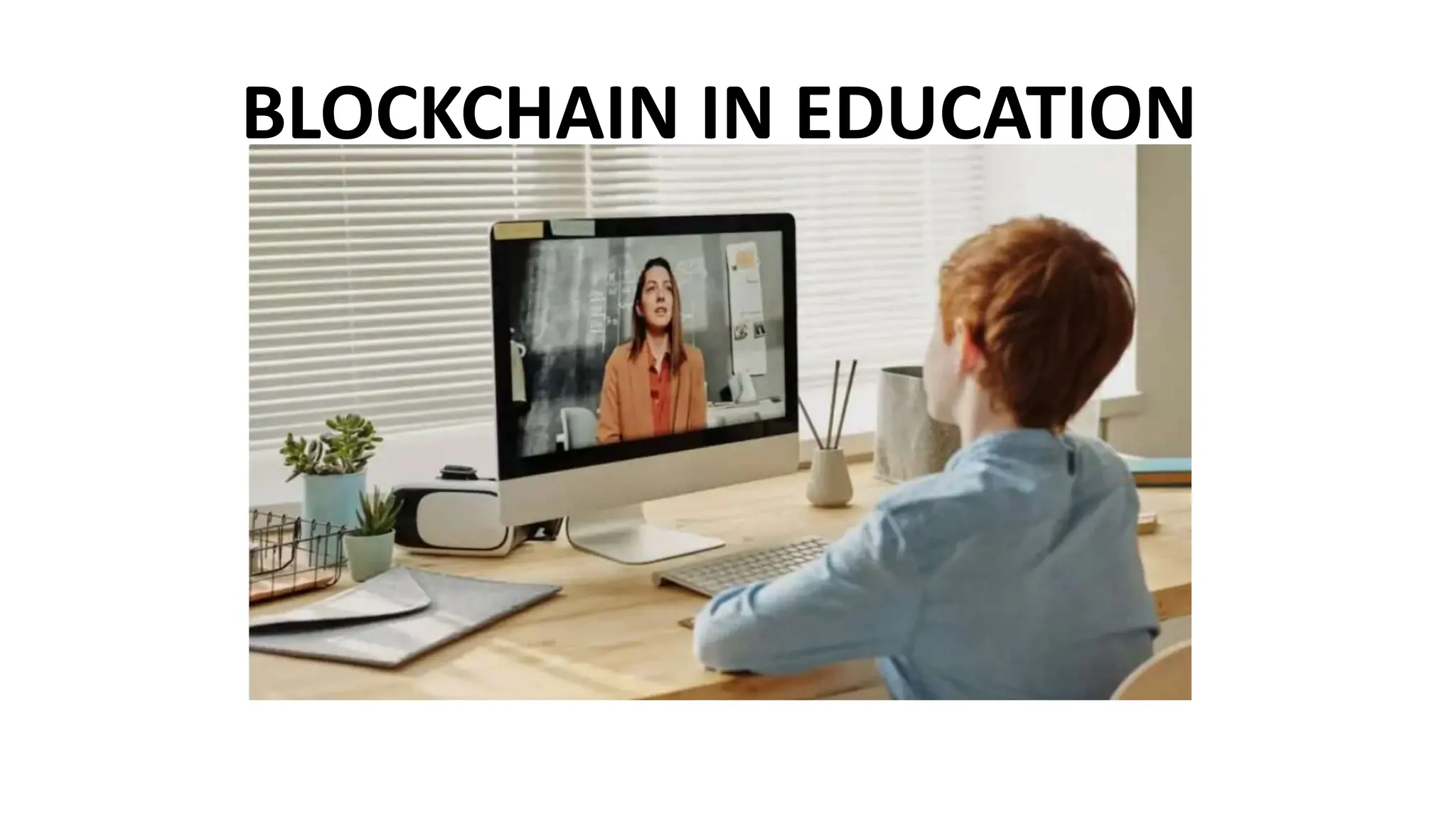
BLOCKCHAIN IN EDUCATION
• In today's rapidly evolving digital landscape, the education sector is increasingly turning to innovative
technologies to address longstanding challenges.
• At its core, blockchain is a decentralized and immutable ledger that records transactions across a network of
computers. As per Fortune Business Insights, the global blockchain technology market size was valued at
USD 11.14 billion in 2022 and is projected to grow at a CAGR of 59.9% to reach USD 469.49 billion by 2030.
• If we talk specifically about the education sector, as per Business Research Insights, the global blockchain
market size in education in 2021 was USD 118.7 million and is expected to grow at a CAGR of 43.94% to
reach USD 3.05 billion by 2030.
• Pandemic COVID-10 was undoubtedly a wake-up call for the education sector. It paved the path
of new technologies to overcome challenges limited access to quality education, resource
shortages and administrative burdens. It has transformed the traditional learning systems. Lately,
the convergence of AI, Blockchain and IoT has created high-tech teaching and learning platforms.
• Blockchain technology is also expected to change the way academic data is handled and how teachers
interact with students. The collaboration and management of academic records between students and
teachers can be substantially changed by blockchain.
• Blockchain technology is offering robust solutions to data privacy as well as cybersecurity threats.
It provides a secure and immutable way to verify academic credentials. It is enhancing data
security by offering decentralized and tamper-proof records. It is highly crucial for protecting
sensitive information and preventing cyberattacks.
• Accessing credentials and academic records and the validation of transcripts were done by
following a vague process in the traditional educational model that was posing challenges in its
expansion and growth. These issues could be easily solved by blockchain-based software.
• The main advantages blockchain brings are decentralized storage, the immutability of stored
information, traceability, and transparency. The improvements that blockchain technology is making
to education could provide opportunities for people from all backgrounds and nations.
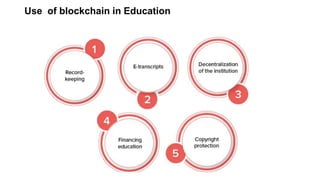
Use of blockchain in Education
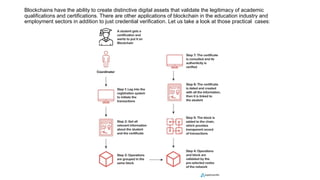
Blockchains have the ability to create distinctive digital assets that validate the legitimacy of academic
qualifications and certifications. There are other applications of blockchain in the education industry and
employment sectors in addition to just credential verification. Let us take a look at those practical cases:
• Blockchain technology holds the promise of long-overdue changes to record-keeping practices,
which have traditionally been primarily unreliable.
• A diverse set of educational documents, like diplomas, certificates, or credentials, that presently
require validators can be verified and kept on file automatically by blockchain. Once the predefined
parameters are satisfied, smart contracts powered by blockchain can handle all the work with
instant, self-triggered approval of documents.
• It enables students and learners to quickly access their records and securely share them with
prospective employers. Additionally, it lessens the strain on employers because they no longer need
to do laborious background checks to authenticate the applicant’s accomplishments. The good thing
about it is that it stays intact regardless of external problems.
• E-transcripts
• Along with the simplicity of verification comes the amazing potential of E-transcripts. Producing
transcripts is the academic institution’s most time-consuming and labor-intensive task all over the
world.
• To ensure correctness, each entry in a transcript needs to be manually checked. It requires case-
by-case inspection and a mountain of paper records from high school to university. Even in 2022,
the majority of schools still send and receive transcripts using old techniques like mail.
• These processes might be readily made more efficient by distributed ledger technology and related
solutions, which would also help reduce the number of fraudulent claims for unearned academic
credits.
• Blockchains can undoubtedly work wonders for schools by enabling tamper-resistant storage of
sensitive data, such as a student’s independent grades. Not only does it benefit educational
institutions, but it also makes the vetting process simpler for recruiters and staffing firms. It also
results in significant time and financial savings.
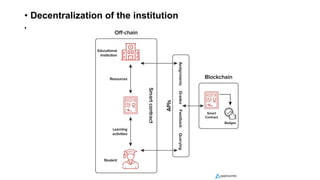
• Decentralization of the institution
•
• Due to its vast potential, blockchain can create a new business model and serve as an entire
infrastructure for universities rather than just a tool.
• By using smart contracts to support and automate agreements and payments between students
and teachers, the platform introduces online courses. As a result, students enjoy affordable tuition
and dependable service.
• On the other hand, automation has allowed educators to liberate themselves from various
administrative responsibilities, secure faculty and student data from hacks with the help of
blockchain cryptography, and cut administrative costs by doing away with middlemen.
• Financing Education
• In academic institutions, financial accounting plays a crucial role, and blockchain technology can be
used in education in previously unheard-of ways. Blockchain technology can be used to manage
teacher wages and student scholarships, creating a transparent and equitable system for funding
grants and projects.
Challenges of adopting blockchain technology in education
• Security issues
• Blockchain is known to be one of the most secure technologies. However, it is not impervious.
Finance and education are two entirely different sectors; the security parameters also should be
according to the specific sectors. The flexibility and vulnerability of blockchain currency might not fit
into the security parameters of blockchain for edtech.
• The student’s education credentials and reports are sensitive and should be stored in a manner that
is in sync with state and federal data protection laws. Thus, it is important for institutions to be extra
careful of the information and the way it is stored. Additional security measures like providing
permissions and more robust data encryption should be implemented for better security.
• Scalability concerns
• The scope of student data and certification is ever-growing. Education institutions find it challenging
to scale up the capabilities of blockchain with ever-growing needs. The simple logic is as the data
increases, more blocks are added, which tends to slow down transactions on the blockchain
platform. Additionally, peer to peer verification process makes the transaction process lengthier.
• Low adoption rate
• The benefit of blockchain is currently limited to a smaller group of students; majorly graduates, who
can store their achievements and accolades in it. For organizations to use this feature of blockchain
in education to ease their hiring process will need to adopt blockchain technology. The businesses
will have to make additional investments for the same that might not be feasible or even beneficial
for some organizations. This apprehension of additional costs might lead to low adoption rates.

Blockchain is also considered a type of database, but it differs substantially from conventional databases

  • 1.
  • 2.
    • In today'srapidly evolving digital landscape, the education sector is increasingly turning to innovative technologies to address longstanding challenges. • At its core, blockchain is a decentralized and immutable ledger that records transactions across a network of computers. As per Fortune Business Insights, the global blockchain technology market size was valued at USD 11.14 billion in 2022 and is projected to grow at a CAGR of 59.9% to reach USD 469.49 billion by 2030. • If we talk specifically about the education sector, as per Business Research Insights, the global blockchain market size in education in 2021 was USD 118.7 million and is expected to grow at a CAGR of 43.94% to reach USD 3.05 billion by 2030.
  • 3.
    • Pandemic COVID-10was undoubtedly a wake-up call for the education sector. It paved the path of new technologies to overcome challenges limited access to quality education, resource shortages and administrative burdens. It has transformed the traditional learning systems. Lately, the convergence of AI, Blockchain and IoT has created high-tech teaching and learning platforms. • Blockchain technology is also expected to change the way academic data is handled and how teachers interact with students. The collaboration and management of academic records between students and teachers can be substantially changed by blockchain. • Blockchain technology is offering robust solutions to data privacy as well as cybersecurity threats. It provides a secure and immutable way to verify academic credentials. It is enhancing data security by offering decentralized and tamper-proof records. It is highly crucial for protecting sensitive information and preventing cyberattacks.
  • 4.
    • Accessing credentialsand academic records and the validation of transcripts were done by following a vague process in the traditional educational model that was posing challenges in its expansion and growth. These issues could be easily solved by blockchain-based software. • The main advantages blockchain brings are decentralized storage, the immutability of stored information, traceability, and transparency. The improvements that blockchain technology is making to education could provide opportunities for people from all backgrounds and nations.
  • 5.
    Use of blockchainin Education
  • 6.
    Blockchains have theability to create distinctive digital assets that validate the legitimacy of academic qualifications and certifications. There are other applications of blockchain in the education industry and employment sectors in addition to just credential verification. Let us take a look at those practical cases:
  • 7.
    • Blockchain technologyholds the promise of long-overdue changes to record-keeping practices, which have traditionally been primarily unreliable. • A diverse set of educational documents, like diplomas, certificates, or credentials, that presently require validators can be verified and kept on file automatically by blockchain. Once the predefined parameters are satisfied, smart contracts powered by blockchain can handle all the work with instant, self-triggered approval of documents. • It enables students and learners to quickly access their records and securely share them with prospective employers. Additionally, it lessens the strain on employers because they no longer need to do laborious background checks to authenticate the applicant’s accomplishments. The good thing about it is that it stays intact regardless of external problems.
  • 8.
    • E-transcripts • Alongwith the simplicity of verification comes the amazing potential of E-transcripts. Producing transcripts is the academic institution’s most time-consuming and labor-intensive task all over the world. • To ensure correctness, each entry in a transcript needs to be manually checked. It requires case- by-case inspection and a mountain of paper records from high school to university. Even in 2022, the majority of schools still send and receive transcripts using old techniques like mail. • These processes might be readily made more efficient by distributed ledger technology and related solutions, which would also help reduce the number of fraudulent claims for unearned academic credits. • Blockchains can undoubtedly work wonders for schools by enabling tamper-resistant storage of sensitive data, such as a student’s independent grades. Not only does it benefit educational institutions, but it also makes the vetting process simpler for recruiters and staffing firms. It also results in significant time and financial savings.
  • 9.
    • Decentralization ofthe institution •
  • 10.
    • Due toits vast potential, blockchain can create a new business model and serve as an entire infrastructure for universities rather than just a tool. • By using smart contracts to support and automate agreements and payments between students and teachers, the platform introduces online courses. As a result, students enjoy affordable tuition and dependable service. • On the other hand, automation has allowed educators to liberate themselves from various administrative responsibilities, secure faculty and student data from hacks with the help of blockchain cryptography, and cut administrative costs by doing away with middlemen.
  • 11.
    • Financing Education •In academic institutions, financial accounting plays a crucial role, and blockchain technology can be used in education in previously unheard-of ways. Blockchain technology can be used to manage teacher wages and student scholarships, creating a transparent and equitable system for funding grants and projects.
  • 12.
    Challenges of adoptingblockchain technology in education • Security issues • Blockchain is known to be one of the most secure technologies. However, it is not impervious. Finance and education are two entirely different sectors; the security parameters also should be according to the specific sectors. The flexibility and vulnerability of blockchain currency might not fit into the security parameters of blockchain for edtech. • The student’s education credentials and reports are sensitive and should be stored in a manner that is in sync with state and federal data protection laws. Thus, it is important for institutions to be extra careful of the information and the way it is stored. Additional security measures like providing permissions and more robust data encryption should be implemented for better security.
  • 13.
    • Scalability concerns •The scope of student data and certification is ever-growing. Education institutions find it challenging to scale up the capabilities of blockchain with ever-growing needs. The simple logic is as the data increases, more blocks are added, which tends to slow down transactions on the blockchain platform. Additionally, peer to peer verification process makes the transaction process lengthier. • Low adoption rate • The benefit of blockchain is currently limited to a smaller group of students; majorly graduates, who can store their achievements and accolades in it. For organizations to use this feature of blockchain in education to ease their hiring process will need to adopt blockchain technology. The businesses will have to make additional investments for the same that might not be feasible or even beneficial for some organizations. This apprehension of additional costs might lead to low adoption rates.