THE INTEGRAL &
FRACTIONAL QUANTUM
HALL EFFECT
SUDIPTO DAS
15PH40041
Presented by
IIT Kharagpur
Outline
Classical to quantum hall effect
2 Dimensional Electron gas (2DEG) in B-field
Integral Quantum Hall Effect
Fractional Quantum Hall Effect
Composite Fermion
Application
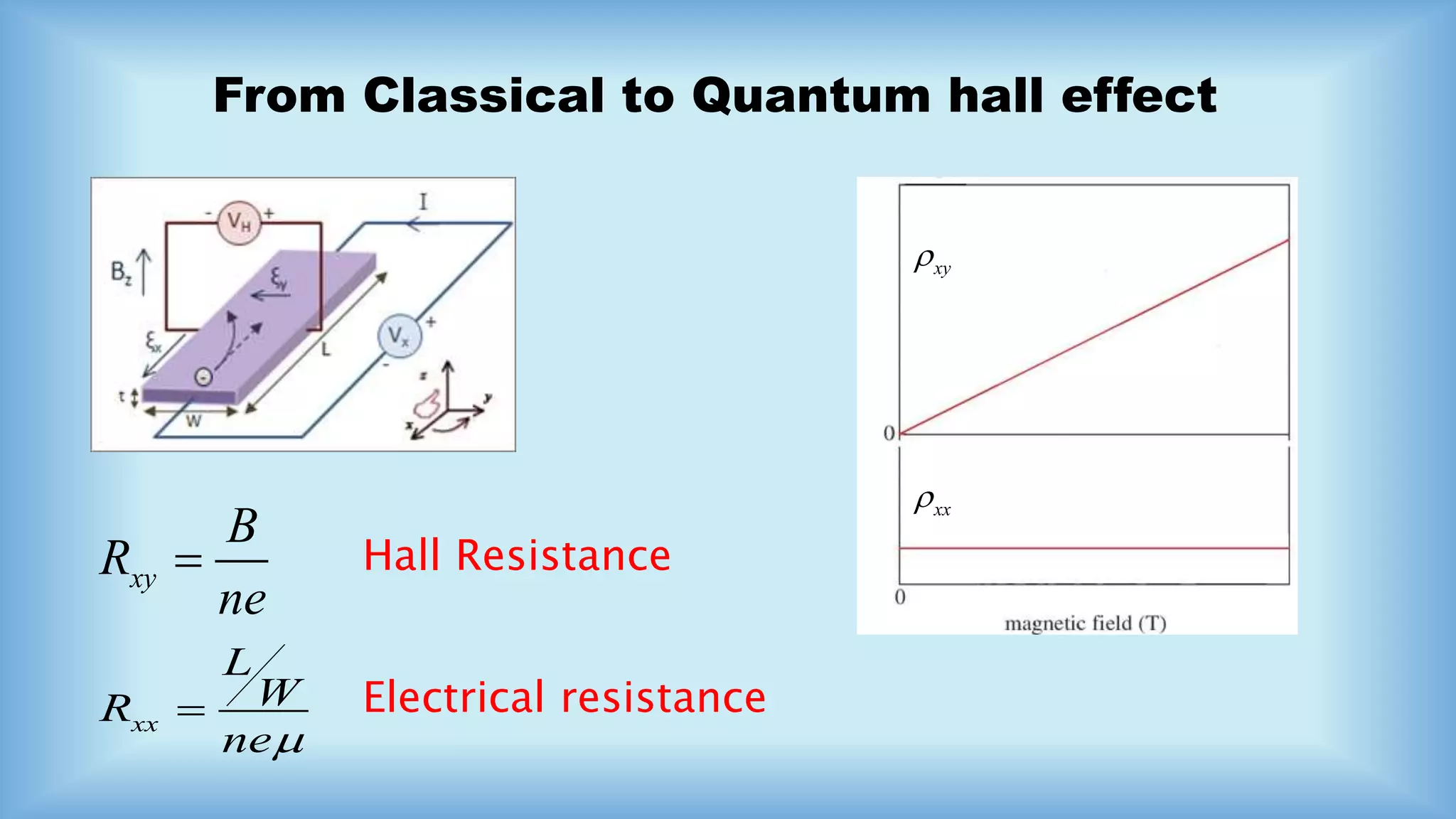
From Classical to Quantum hall effect
xx
L
WR
ne

xy
B
R
ne

Electrical resistance
Hall Resistance
xy
xx
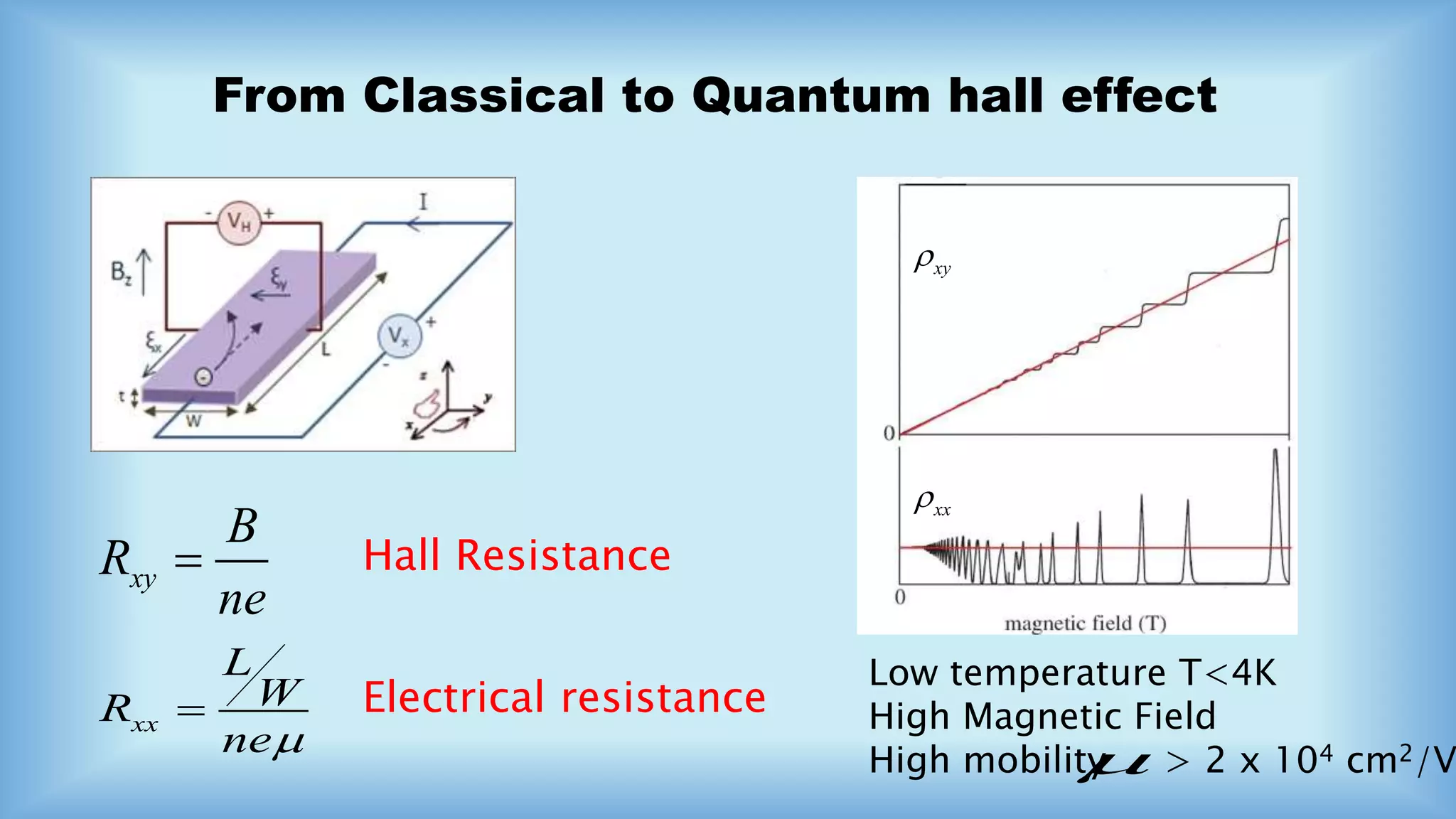
Low temperature T<4K
High Magnetic Field
High mobility > 2 x 104 cm2/V
From Classical to Quantum hall effect
xy
xx
xx
L
WR
ne

xy
B
R
ne

Electrical resistance
Hall Resistance
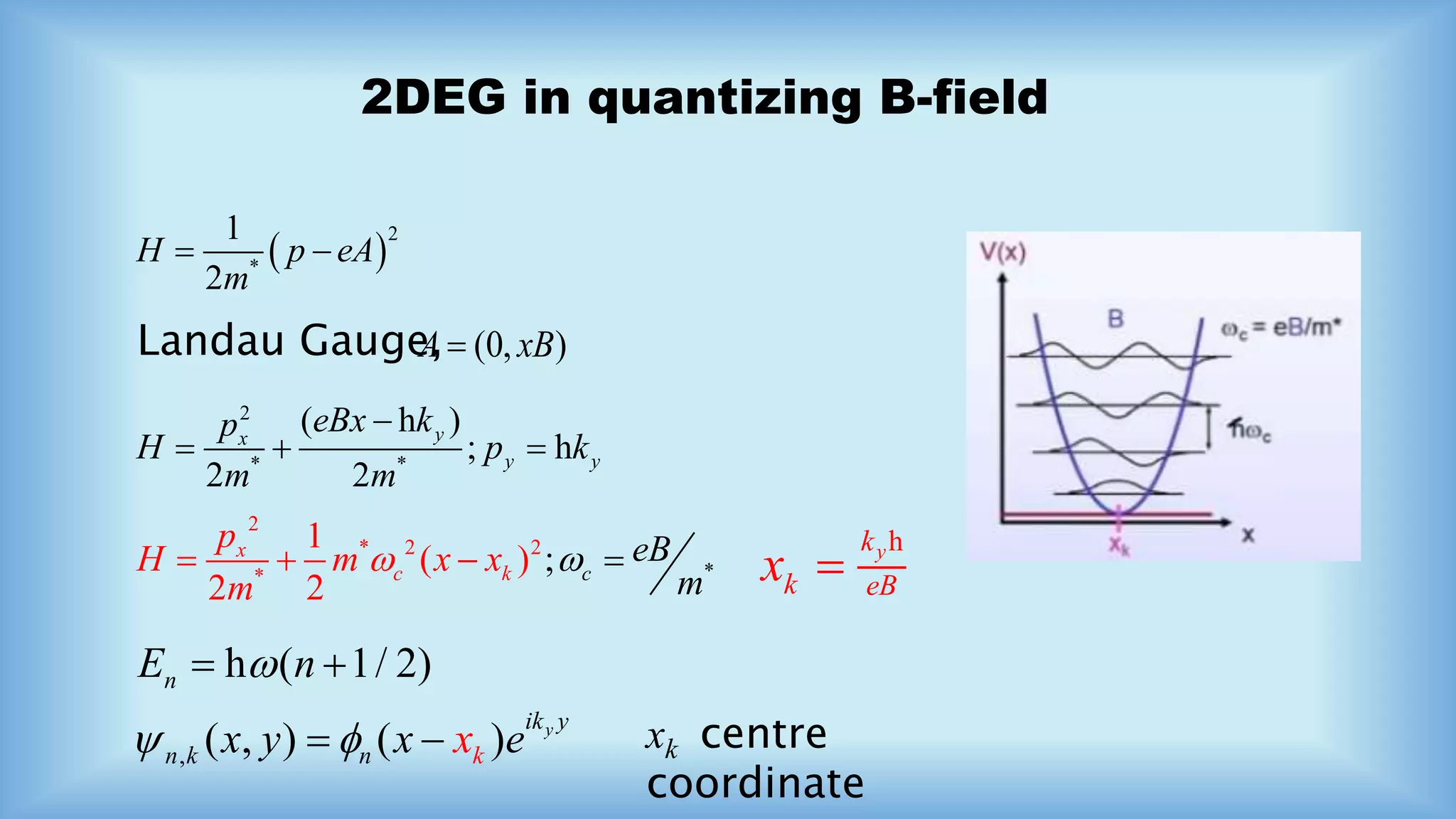
2DEG in quantizing B-field
 
2
*
1
2
H p eA
m
 
Landau Gauge, (0, )A xB
2
* *
( )
;
2 2
yx
y y
eBx kp
H p k
m m

  
h
h
2
* 2 2
* *
1
( )
2 2
;k c
x
c
p
H m x Bx
m
e
m
    yk
k eBx 
h
,
( 1/ 2)
( , ) ( ) y
n
ik y
n k n k
E n
x y xx e

 
 
 
h
xk centre
coordinate
xq= xk + (h/eBL)
Thus flux between neighbouring states, ɸ0 = B.{ (xq-
xk)L } = h/e Dirac flux
quanta
Degeneracy of States
Integral Quantum Hall Effect
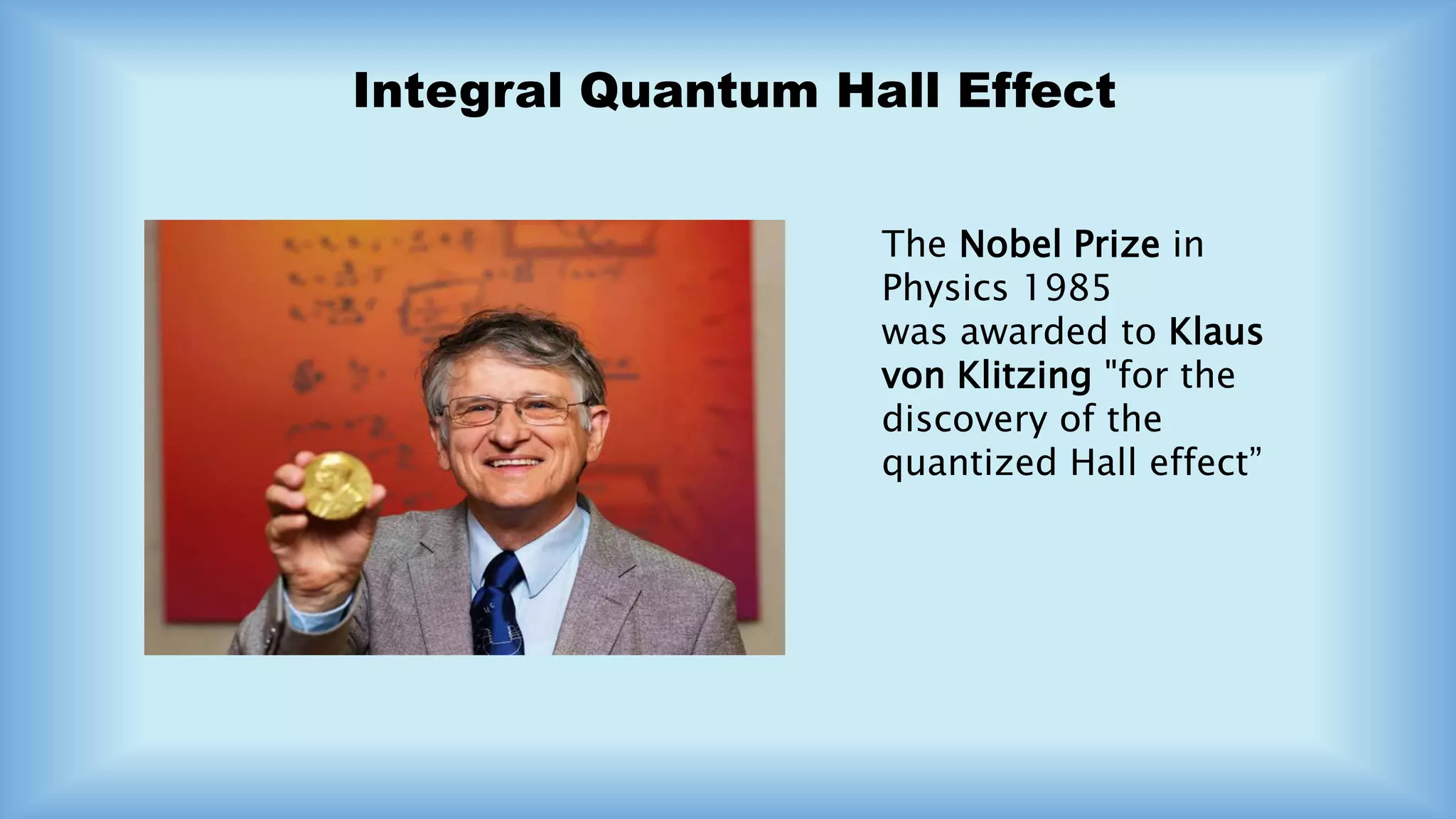
The Nobel Prize in
Physics 1985
was awarded to Klaus
von Klitzing "for the
discovery of the
quantized Hall effect”
Integral Quantum Hall Effect
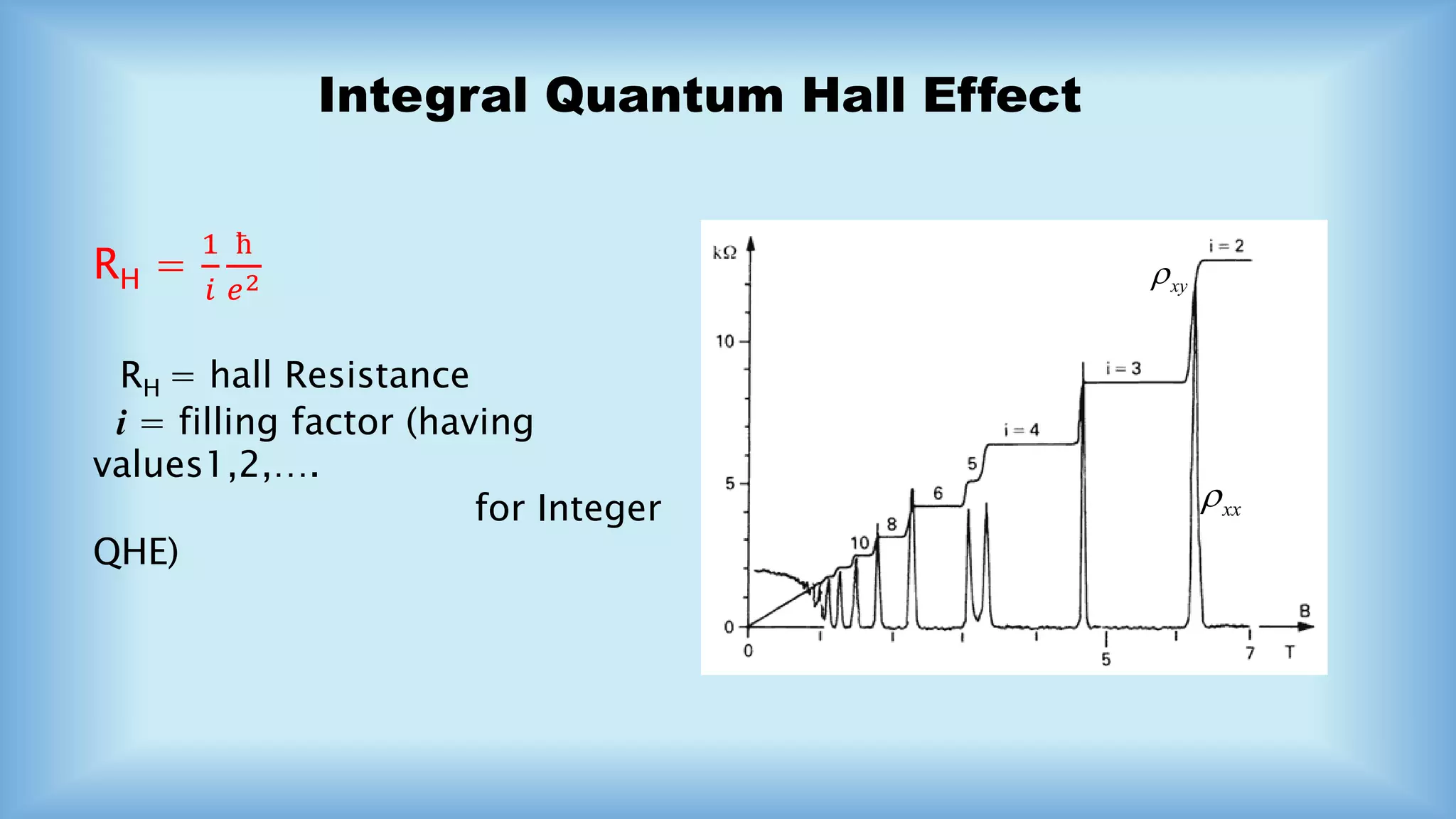
RH =
1
𝑖
ћ
𝑒2
RH = hall Resistance
i = filling factor (having
values1,2,….
for Integer
QHE)
xy
xx
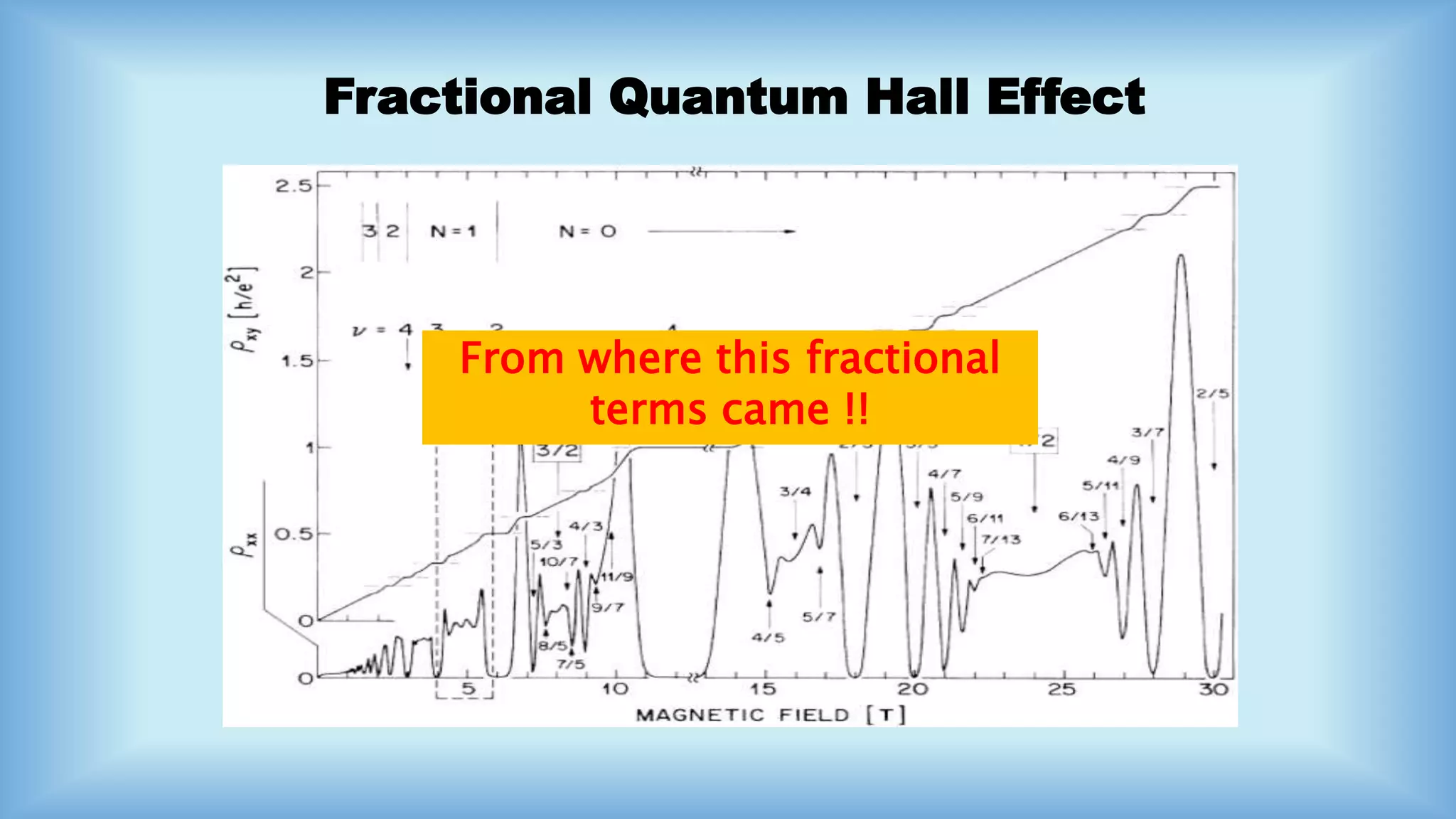
Fractional Quantum Hall Effect
From where this fractional
terms came !!
Electrons in B-field
 Flux quantum:
ɸ0 = BA = Bπr2 =
h/e
Degeneracy:
nɸ = B/ɸ0 = eB/h
Filling factor:
v = ne/ nɸ
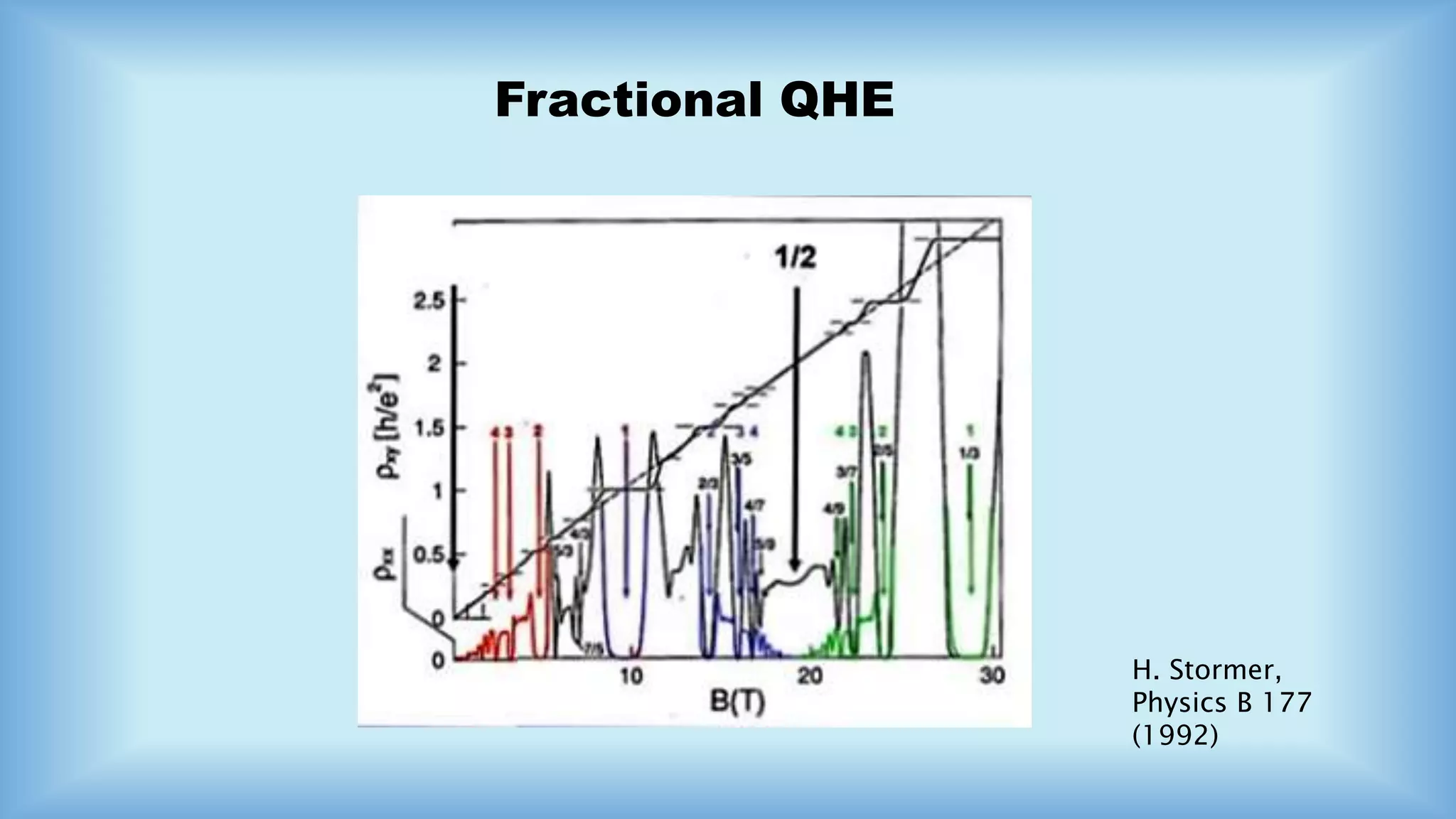
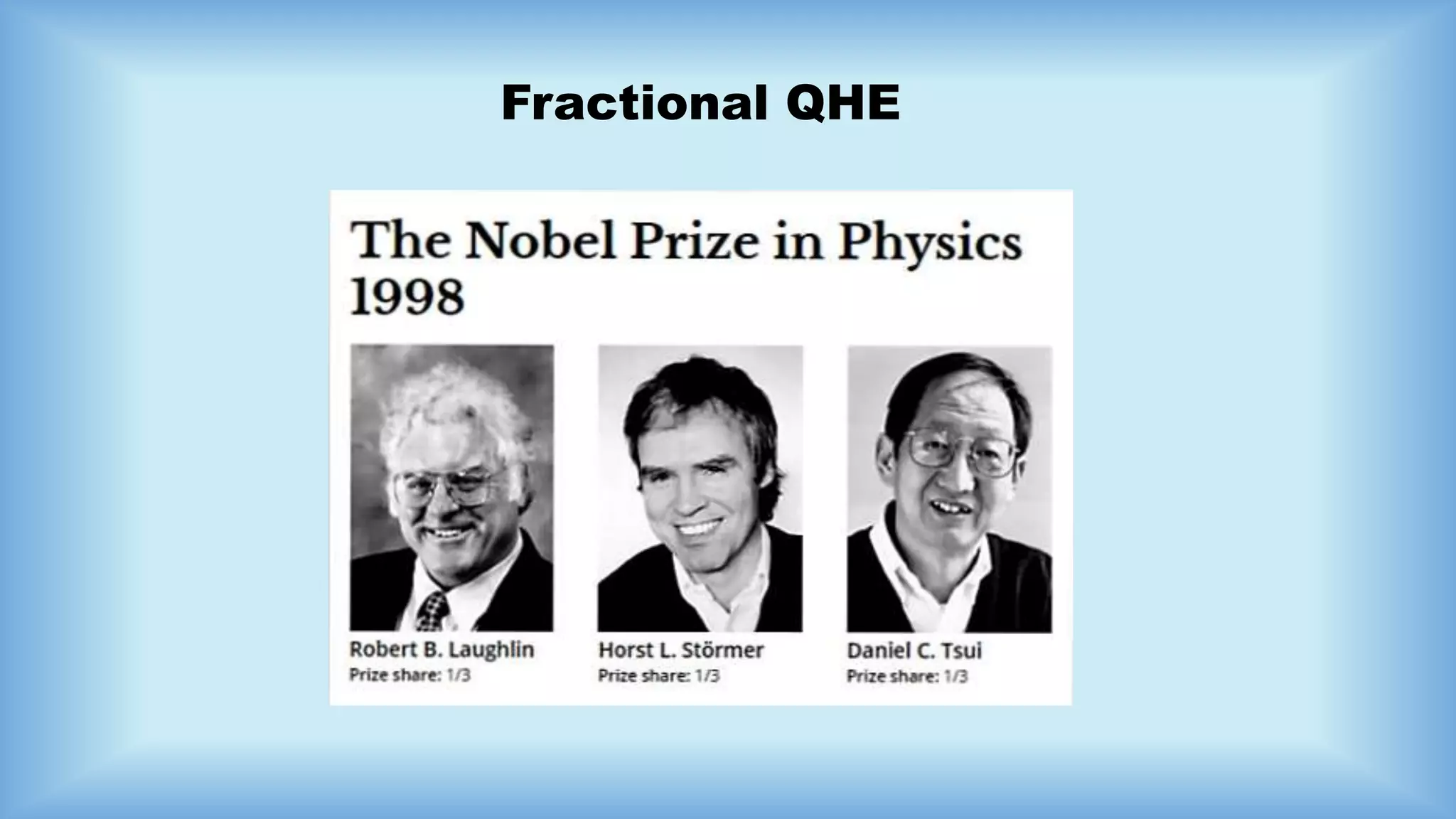
Fractional QHE
H. Stormer,
Physics B 177
(1992)
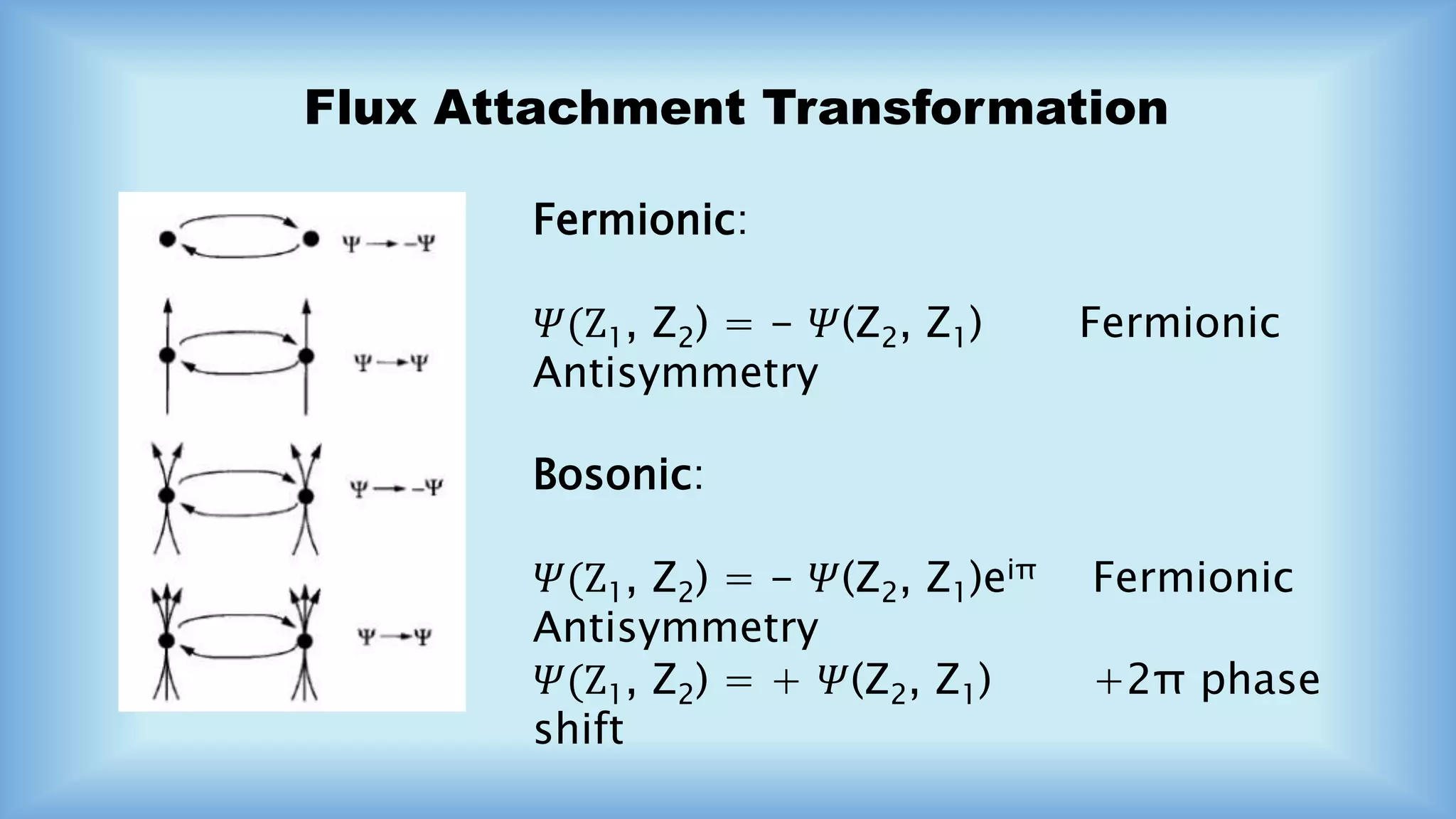
Flux Attachment Transformation
Fermionic:
𝛹(Z1, Z2) = - 𝛹(Z2, Z1) Fermionic
Antisymmetry
Bosonic:
𝛹(Z1, Z2) = - 𝛹(Z2, Z1)eiπ Fermionic
Antisymmetry
𝛹(Z1, Z2) = + 𝛹(Z2, Z1) +2π phase
shift
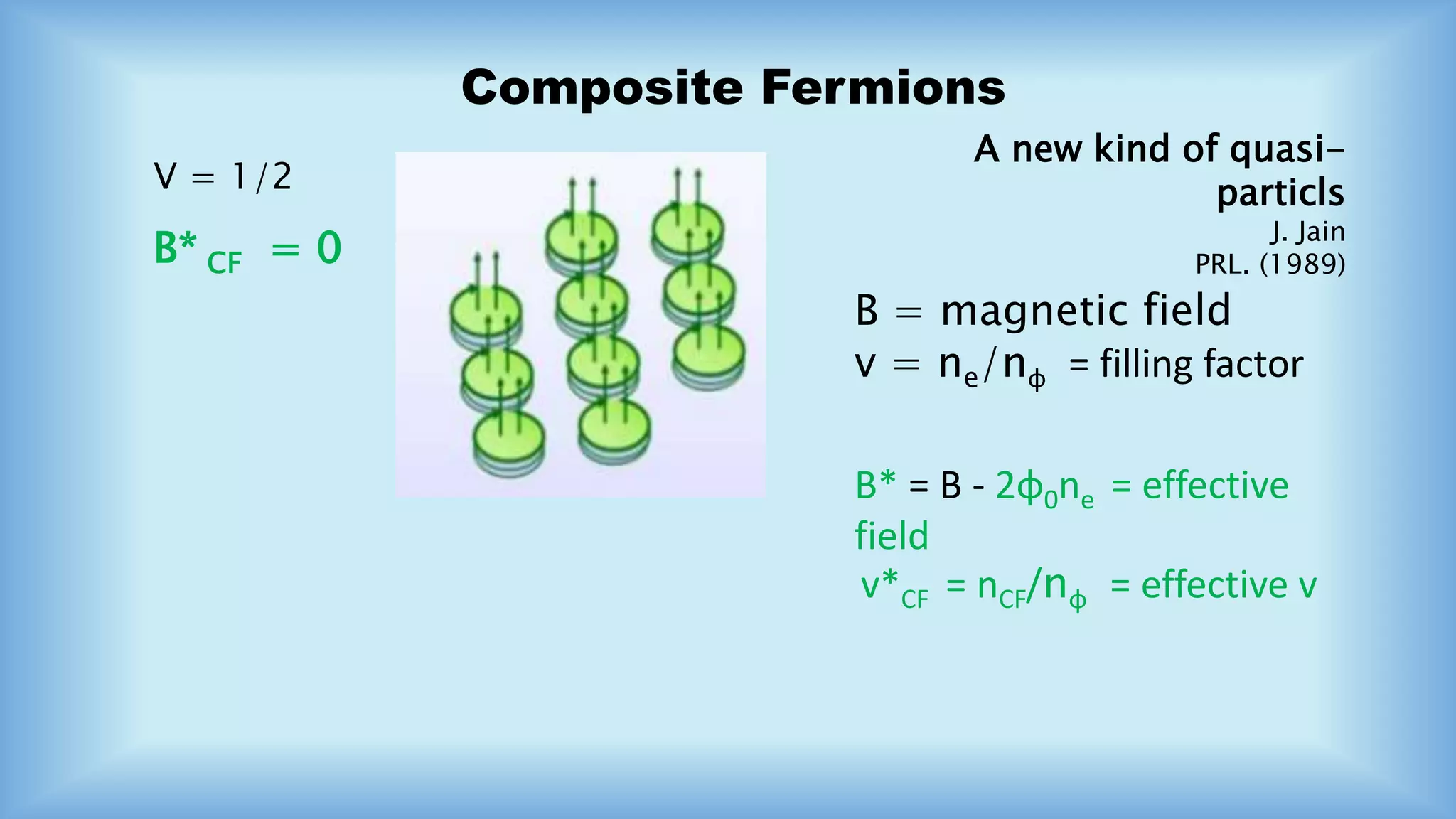
Composite Fermions
A new kind of quasi-
particls
J. Jain
PRL. (1989)
V = 1/2
B* CF = 0
B = magnetic field
v = ne/nɸ = filling factor
B* = B - 2ɸ0ne = effective
field
v*CF = nCF/nɸ = effective v
Composite Fermions
v =
1
v*CF =
1
v*CF = 2
v = 1/3 v*CF = p v =
𝑝
2𝑝+1
v = 2/3 v*CF = p v =
𝑝
2𝑝−1
q* CF= 2(e/3) + (-e) = - e/3 q*CF =
−𝑒
2𝑝+1
q* CF= 2(2e/3) + (-e) = + e/3 q*CF =
+𝑒
2𝑝−1
Charge of flux quantum
Ρbkgnd = +ene
q+ = A Ρbkgnd = +ene/nɸ = +ev
Fractional QHE
Applications
 Used as Magnetometers, i.e. to measure magnetic field.
 Hall effect sensor is also used as Current Sensor.
 Magnetic Position Sensing in Brushless DC Electric Motors
 Automotive fuel level indicator.
 Spacecraft propulsion.
 Quantum hall effect can be used for a determination of h/e2 or as a
resistance standard.
 Since the inverse fine structure constant α-1 is more or less identical h/e2 , high-
precision measurements of the quantized hall resistance are important for
all areas in physics that are connected with the fine structure constant.
THANK YOU

The integral & fractional quantum hall effect

  • 1.
    THE INTEGRAL & FRACTIONALQUANTUM HALL EFFECT SUDIPTO DAS 15PH40041 Presented by IIT Kharagpur
  • 2.
    Outline Classical to quantumhall effect 2 Dimensional Electron gas (2DEG) in B-field Integral Quantum Hall Effect Fractional Quantum Hall Effect Composite Fermion Application
  • 3.
    From Classical toQuantum hall effect xx L WR ne  xy B R ne  Electrical resistance Hall Resistance xy xx
  • 4.
    Low temperature T<4K HighMagnetic Field High mobility > 2 x 104 cm2/V From Classical to Quantum hall effect xy xx xx L WR ne  xy B R ne  Electrical resistance Hall Resistance
  • 5.
    2DEG in quantizingB-field   2 * 1 2 H p eA m   Landau Gauge, (0, )A xB 2 * * ( ) ; 2 2 yx y y eBx kp H p k m m     h h 2 * 2 2 * * 1 ( ) 2 2 ;k c x c p H m x Bx m e m     yk k eBx  h , ( 1/ 2) ( , ) ( ) y n ik y n k n k E n x y xx e        h xk centre coordinate
  • 6.
    xq= xk +(h/eBL) Thus flux between neighbouring states, ɸ0 = B.{ (xq- xk)L } = h/e Dirac flux quanta Degeneracy of States
  • 7.
    Integral Quantum HallEffect The Nobel Prize in Physics 1985 was awarded to Klaus von Klitzing "for the discovery of the quantized Hall effect”
  • 8.
    Integral Quantum HallEffect RH = 1 𝑖 ћ 𝑒2 RH = hall Resistance i = filling factor (having values1,2,…. for Integer QHE) xy xx
  • 9.
    Fractional Quantum HallEffect From where this fractional terms came !!
  • 10.
    Electrons in B-field Flux quantum: ɸ0 = BA = Bπr2 = h/e Degeneracy: nɸ = B/ɸ0 = eB/h Filling factor: v = ne/ nɸ
  • 11.
  • 12.
    Flux Attachment Transformation Fermionic: 𝛹(Z1,Z2) = - 𝛹(Z2, Z1) Fermionic Antisymmetry Bosonic: 𝛹(Z1, Z2) = - 𝛹(Z2, Z1)eiπ Fermionic Antisymmetry 𝛹(Z1, Z2) = + 𝛹(Z2, Z1) +2π phase shift
  • 13.
    Composite Fermions A newkind of quasi- particls J. Jain PRL. (1989) V = 1/2 B* CF = 0 B = magnetic field v = ne/nɸ = filling factor B* = B - 2ɸ0ne = effective field v*CF = nCF/nɸ = effective v
  • 14.
    Composite Fermions v = 1 v*CF= 1 v*CF = 2 v = 1/3 v*CF = p v = 𝑝 2𝑝+1 v = 2/3 v*CF = p v = 𝑝 2𝑝−1 q* CF= 2(e/3) + (-e) = - e/3 q*CF = −𝑒 2𝑝+1 q* CF= 2(2e/3) + (-e) = + e/3 q*CF = +𝑒 2𝑝−1 Charge of flux quantum Ρbkgnd = +ene q+ = A Ρbkgnd = +ene/nɸ = +ev
  • 15.
  • 16.
    Applications  Used asMagnetometers, i.e. to measure magnetic field.  Hall effect sensor is also used as Current Sensor.  Magnetic Position Sensing in Brushless DC Electric Motors  Automotive fuel level indicator.  Spacecraft propulsion.  Quantum hall effect can be used for a determination of h/e2 or as a resistance standard.  Since the inverse fine structure constant α-1 is more or less identical h/e2 , high- precision measurements of the quantized hall resistance are important for all areas in physics that are connected with the fine structure constant.
  • 17.