Management of Early breast cancer
Dr Veena P S
25/9/2021
Introduction
 Early breast cancer
Stage I and II
 Locally advanced
IIIA to IIIC
Work up
 History and physical examination
 Bilateral MMG/USG
 Core Biopsy-ER/PR/Her 2 neu, ,ki 67
 CBC/LFT/RFT
 No routine systemic imaging unless signs/symptoms present
Treatment
 Loco regional treatment Breast conservation therapy
  MRM +/- adjuvant Radiotherapy
 Systemic treatment  chemotherapy/Hormonal therapy
Based on tumor characteristics
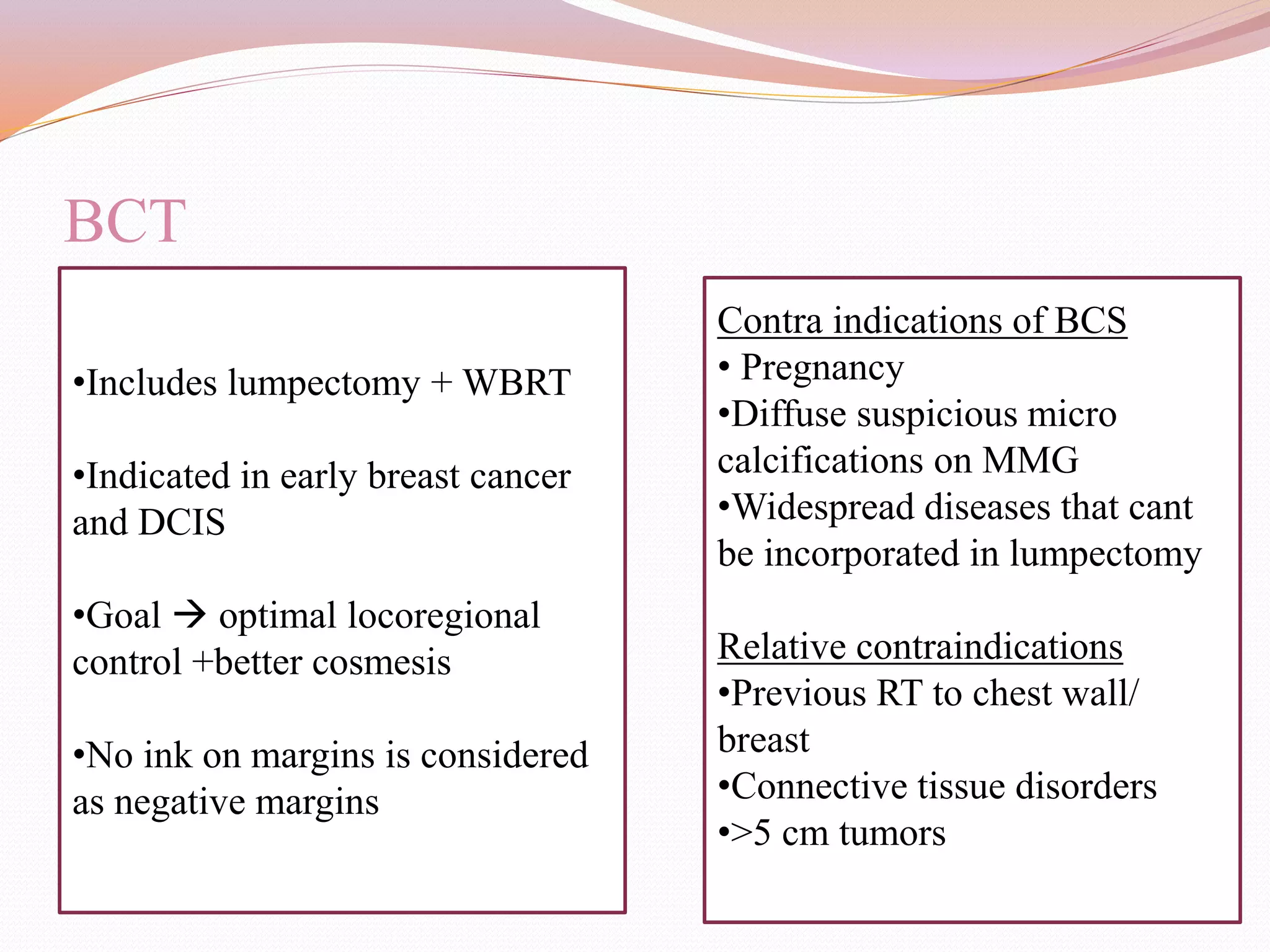
BCT
Contra indications of BCS
• Pregnancy
•Diffuse suspicious micro
calcifications on MMG
•Widespread diseases that cant
be incorporated in lumpectomy
Relative contraindications
•Previous RT to chest wall/
breast
•Connective tissue disorders
•>5 cm tumors
•Includes lumpectomy + WBRT
•Indicated in early breast cancer
and DCIS
•Goal  optimal locoregional
control +better cosmesis
•No ink on margins is considered
as negative margins
Mastectomy
Indications
 Multicentric tumors
 Large size tumors compared to breast size
 Inability to achieve negative margins after multiple resections
 Prior RT to chest wall or other CI to RT
 Patient choice
Types of mastectomy
 Total mastectomy Removal of entire breast alone. No axillary
nodes/ muscles removed.
 Radical mastectomy  Entire breast + level I, II, III nodes+ Chest
wall muscles
 Modified radical mastectomy  Entire breast+ removal of level I
and II nodes. No muscles are removed.
 Partial Mastectomy  Removal of tumor with margins
 Skin sparing mastectomy
 Nipple sparing mastectomy
Radical/ total mastectomy / BCT
NSABP B 04 ( Fischer et al, N Eng J Med ;August 2002)
N=1079
Operable breast cancer
cN0 Radical mastectomy/Total mastectomy + loco regional
or axillary RT /Total mastectomy
cN1 RM / TM + RT
LRR
cN0  9% vs 5% vs 13%
(p=.002)
cN1  16% vs 14% (p=.67)
No significant impact in OS
NSABP B 06 ( Fischer et al, N Eng J Med ;October 2002)
N= 1851
EBC < 4cm
Total mastectomy/lumpectomy alone/ lumpectomy + breast
irradiation
IBTR after 20 yrs 39% vs
14% (p<0.001)
No difference in OS/distant
DFS in 3 arms
L L+RT
IBTR 39% 14%
(p<0.0001)
LRR RM TM+
RT
TM
cN0 9% 5% 13%
(p=.002)
cN1 16% 14%
(p=.67)
-
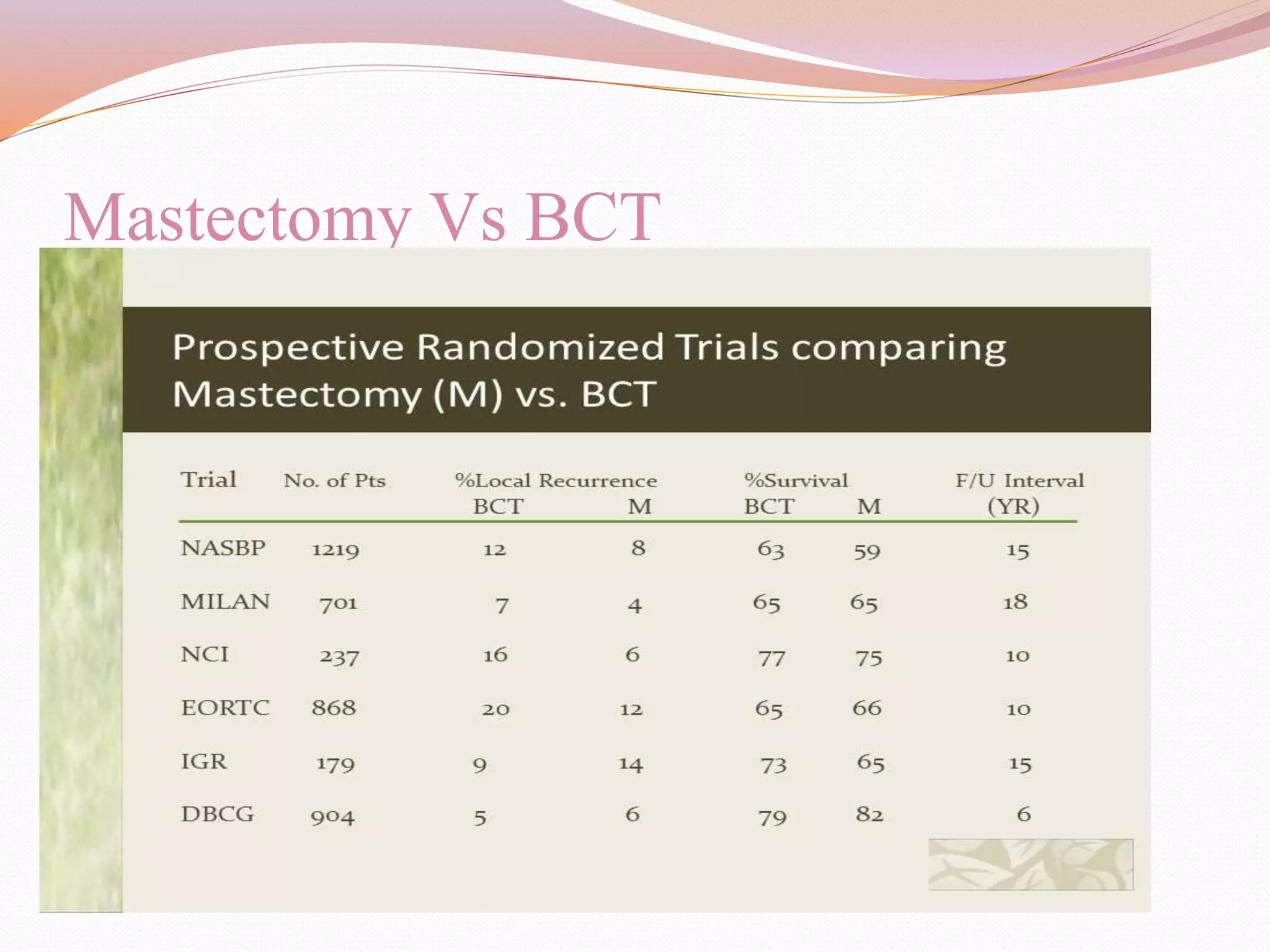
Mastectomy Vs BCT
Surgical management of axilla
 Appx 20 to 40% of cN0 patients will be having pathologic evidence
of lymph node mets
 20% of stage I and II cN0 patients will develop axillary recurrence if
axilla is not addressed.
 Axillary node dissection is the std of care in clinically + node.
 Level I and II dissection is limited to patients with biopsy proven
axillary mets
 Minimum 10 nodes should be dissected
 ALND of level III is done only if gross disease is present in level II
SLNB
 SLNB is done by periareolar injection of a blue dye and checking the
node which turns positive
 It is indicated in clinically node negative tumors.
 No need of axillary dissection in SLNB negative tumors.
 When no SLNB is identified, level I and II, ALND is carried out.
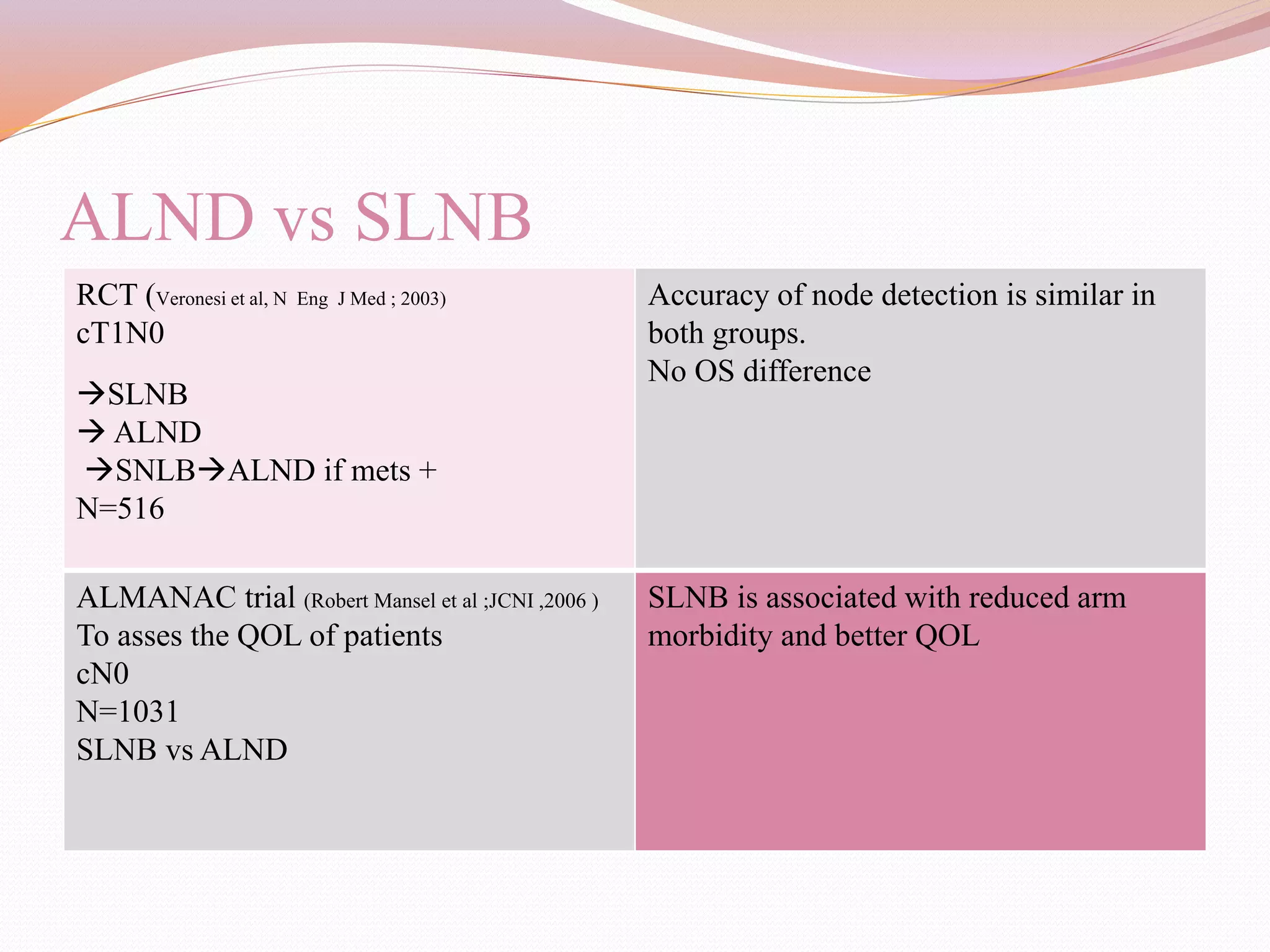
ALND vs SLNB
RCT (Veronesi et al, N Eng J Med ; 2003)
cT1N0
SLNB
 ALND
SNLBALND if mets +
N=516
Accuracy of node detection is similar in
both groups.
No OS difference
ALMANAC trial (Robert Mansel et al ;JCNI ,2006 )
To asses the QOL of patients
cN0
N=1031
SLNB vs ALND
SLNB is associated with reduced arm
morbidity and better QOL
SLNB vs ALND
ACOSOG Z 0011 (Giuliano et al ; JAMA, 2017 )
cT 1-2 N0 with <3 sentinel nodes 
ALND vs SLNB alone
N=446
9.3yr median F/u
IBCSG 2301 (Galimberti et al; Lancet, April 2014 )
cT1/2 N1 SLNB with one more micro
metastatic node<2mm
ALND vs no ALND
N=931
Median f/u= 5 yrs
ALND SLNB
OS 83.6% 86.3%(p=.85)
DFS 78.2% 80.2%(p=.85)
ALND No ALND
DFS 84.4% 87.8% ( p=0.0042)
OS 97.6% 97.5% (p=.73)
Radiation therapy
Indications in EBC
Breast RT
 WBRT +tumor bed boost as part of BCT
 APBI in selected cases after lumpectomy
Regional nodal irradiation
 All node positive cases
Chest wall irradiation after MRM
 All Node positive disease
 >5cm tumors
WBRT
 Several RCTs and meta analysis has shown improved local control
which translates to survival advantage with the addition of WBRT after
BCS (NSABP B 06, N Engl J Med 2002, EBCTCG metanalysis, Lancet November 2011)
 Conventional fractionation- 50 Gy in 25# with tumor bed boost of 10-
16GY in 5-10 fractions
 Current standard dose is 40 to 42Gy in 15-16# to breast. Boost of 10 -
16 Gy in 5 -8 fractions are given for tumor bed after lumpectomy
Adjuvant RT after lumpectomy
Vinh-Hung et al - Meta-analysis of survival in randomized trials comparing breast-
conserving surgery with or without radiation
Adjuvant RT after lumpectomy
This meta-analysis
demonstrated a
threefold reduction in
local relapse and a
small but significant
increase in survival with
the use of radiation
therapy following
lumpectomy
J Natl Cancer Inst 2004;96:115
Vinh-Hung et al - Meta-analysis of local
control in randomized trials comparing
breast-conserving surgery with or without
radiation
Adjuvant RT after lumpectomy
N=10801
17 RCT
RT VS no RT after BCS
BCS BCS+RT
First
recurrence
35% 19.3%
(p<0.00001)
15yr breast
cancer death
25.2% 21.4
(p=0.00005)
pN0, 15 yr
breast cancer
death
31% 15% (p<0.00001)
pN+ ,10yr
breast cancer
death
51.3% 42.8% (p=0.01)
one breast cancer death was avoided
by year 15 for every four recurrences
avoided by year 10 After breast-conserving surgery, radiotherapy
to the conserved breast halves the rate at which
the disease recurs and reduces the breast
cancer death rate by about a sixth.
Hypo vs conventional fractionation
Trial Regimen N Median
f/u
Local relapse
OCOG Canada (Whelen et al; N Eng J med,
2010 Feb)
T1/T2 N0M0 ,post BCS
50Gy/25# (612)
42.5Gy/16# (622)
10 yr 6.7%
6.2% 95% CI 2.5 to 3.5)
RMH GOC trial (Owen et al, Lancet 2006)
T1-III N0-N1,post BCS
50Gy/25# (470)
42.9Gy/13# (466)
39Gy/13# (474)
10yr 12.1%
9.6%
14.8% ( p=0.027)
START A (Haviland et al,Lancet 2013)
T1-III N0-N1,post BCS
50Gy/25# (749)
41.6Gy/13# (750)
39Gy/13# (739)
10yr 7.4%
6.3% (p=.65) HR 0.91
8.8% p=.41 HR 1.18
START B (Haviland et al,Lancet 2013)
T1-III N0-N1,post BCS
50Gy/25# (1105)
40Gy/15# (1110)
10yr 5.5%
4.3% (p=.21, HR=.77)
Hypo vs conventional fractionation
Regimen Results
UK FAST trial (Brunt et al, J clin
Oncol,May 2020)
T1/T2N0
Post BCS
N=915
50Gy/25#
30Gy/5# once weekly
28.5Gy/5#
No significant difference in
normal tissue effects in 3 arms.
Not powered enough to compare
the LR/tumor control
UK FAST FORWARD
TRIAL
(Brunt et al;Lancet,April 2020)
T1-3N0-1M0,post BCS
N=4096
5yr results
40Gy/15#
27Gy/5#
26Gy/5#
Incidence of loco regional
relapse/distant relapse and OS
were similar
40Gy 27Gy 26Gy
IBTR 2.1% 1.7% 1.4%
Role of post lumpectomy RT in elderly
Fyles et al; N Eng J Med,2004 sep
>/= 50 yr
T1/T2 N0, ER + tumor
Tam vs Tam +RT
N=769
Hughes et al ; N Eng J Med,2004
sep
>/= 70 yrs
T1N0M0,ER+
Tam vs Tam +RT
N= 636
PRIME II Kunkler et al;
Lancet 2015
>/=65 yrs
T1/T2 upto 3 cm N0 ,ER+
Adj Endo vs Endo +RT
N=1326
10yr results
At 5yr No RT RT
Local relapse 7.7% 0.6% (p<0.001)
DFS 84% 91%(p=0.004)
axillary relapse 2.5% 0.5%(p=0.0.49)
LR recurrence 4% 1% (p<0.001)
No difference between OS and DM in both groups
IBTR 9.8% 0.9%(p<0.00001)
No difference in DM and OS
Role of post lumpectomy RT in elderly
 Meta analysis by Matuschek et al (Radiation ocology,March 2017), 5 RCT and 3766
patients mostly elderly patients with early stage breast cancer treated
either with adjuvant endocrine therapy or with endocrine therapy+
WBRT after BCS
 The benefit of RT for elderly women is significant in terms of local
control, but this absolute benefit is relatively small and must be weighed
against comorbidities and other competing risks.
 For women with favorable T1/N0 receptor positive breast cancers,
tamoxifen alone is a reasonable option that should be discussed.
Tumor bed boost vs no boost
 Aim – to increase local control & decrease incidence of IBTR
 Rationale - Microscopic extension is unlikely beyond 1-2 cms from
tumor mass (Veronesi etal, Annals of oncology 2001)
 )
 Majority of failures are located at surgical resection site (75-80%)
Tumor bed boost vs no boost
EORTC 22881-10882 (Poortmans et al,cancer radiother, 2015)
N=5318
post lumpectomy  WBRT (50 Gy/25# )
No boost vs 16 Gy boost
(photon/electron/LDR)
ST. GEORGE AND WOLLONGONG
RANDOMIZED BREAST BOOST TRIAL (Eric
Hau et al ;IJROBP ,Nov 2010)
T1/T2 N0-1M0
Post lumpectomy WBRT 50Gy/25# vs
WBRT (45Gy/25 with boost 16Gy/8# with
elctron)
N=688
No difference in local control in both arms.
No
Boost
Boost
10 yr Local
recurrence
10.2% 6.2% (p <
0.0001)
20 yr IBTR 16.4% 12%
20 yr OS 61.1% 59.7% (p=0.323)
Fibrosis at
20 yr
1.8% 5.2 (p=0.00001)
Tumor bed boost vs no boost
LYON trial (Romestaing et al,IJROBP ,Nov 2001)
T1/T2 tumors, post lumpectomy 
WBRT 50 GY/20#
10Gy/4# electron boost vs No Boost
N=1024
Budapest boost trial (Polgar et al;Strahlenther onkol,
Nov 2002)
Stage I/II ,Post lumpectomy WBRT
(50Gy/25#)
No boost vs 16 Gy/8# with electrons or
12–14.25 Gy HDR
N=207
.
5yr No boost Boost
Local
relapse
4.5% 3.6%(p=0.044)
5.3yr Boost No Boost
Local tumor
control
92.7% 84.9% (p=0.049)
RFS 76.6% 66.2% (p=0.044)
CSS 90.4% 82.1% (p=0.053)
Tumor bed boost vs no boost
For patients younger than 50 years
old and in patients with high grade
invasive ductal carcinoma, the
boost dose reduced the local
relapse from 19.4% to 11.4% (P =
.0046; HR, 0.51) and from 18.9%
to 8.6% (P = .01; HR, 0.42),
respectively.
Tumor bed boost vs no boost
 NCCN advocates boost of 10 to 16 Gy in 4 to 8 # to high risk
individuals
 Can be delivered via enface electrons or photons or brachytherapy
 Boost volume includes the surgical bed plus an arbitrary margin of 1
to 2 cm
 For women with large breasts & deep seated tumors (>4cm below
skin) , interstitial brachytherapy boost can be considered- 10 to 20
Gy HDR/LDR
 Electrons – appropriate energy selected to allow 85 -90% isodose
line to encompass target volume & decrease dose to the lung
Energy – 9-16 MeV
Post mastectomy RT
 The rationale for post-mastectomy radiation is the prevention
of a local-regional recurrence.
 Clinically occult persistent disease in the operative site or
regional nodes could act as a source of distant metastases, and
eradication of this disease could result in an improvement in
disease-free and overall survival.
Post mastectomy RT in node+
Trial Inclusion Arms LRRS OS
British
columbia trial
N=318
f/u=20yr
Premenopausal
Post MRM
N+
Sx+chemo
No RT
RT
74%
90% (P=0.002)
34%
47% (p=0.03)
Danish 82b
N=1708
f/u= 10yr
Premenopausal
high risk
Stage 2/3
Sx+chemo
No RT
RT
68%
91% (p<0.001)
45%
54% (p<0.001)
Danish 82 c
N=1460
f/u=10yr
Postmenopausal
Stage 2/3
N+
Sx+/-
chemo+tam
No RT
RT
70%
92% (p<0.001)
36%
45% (p=0.01)
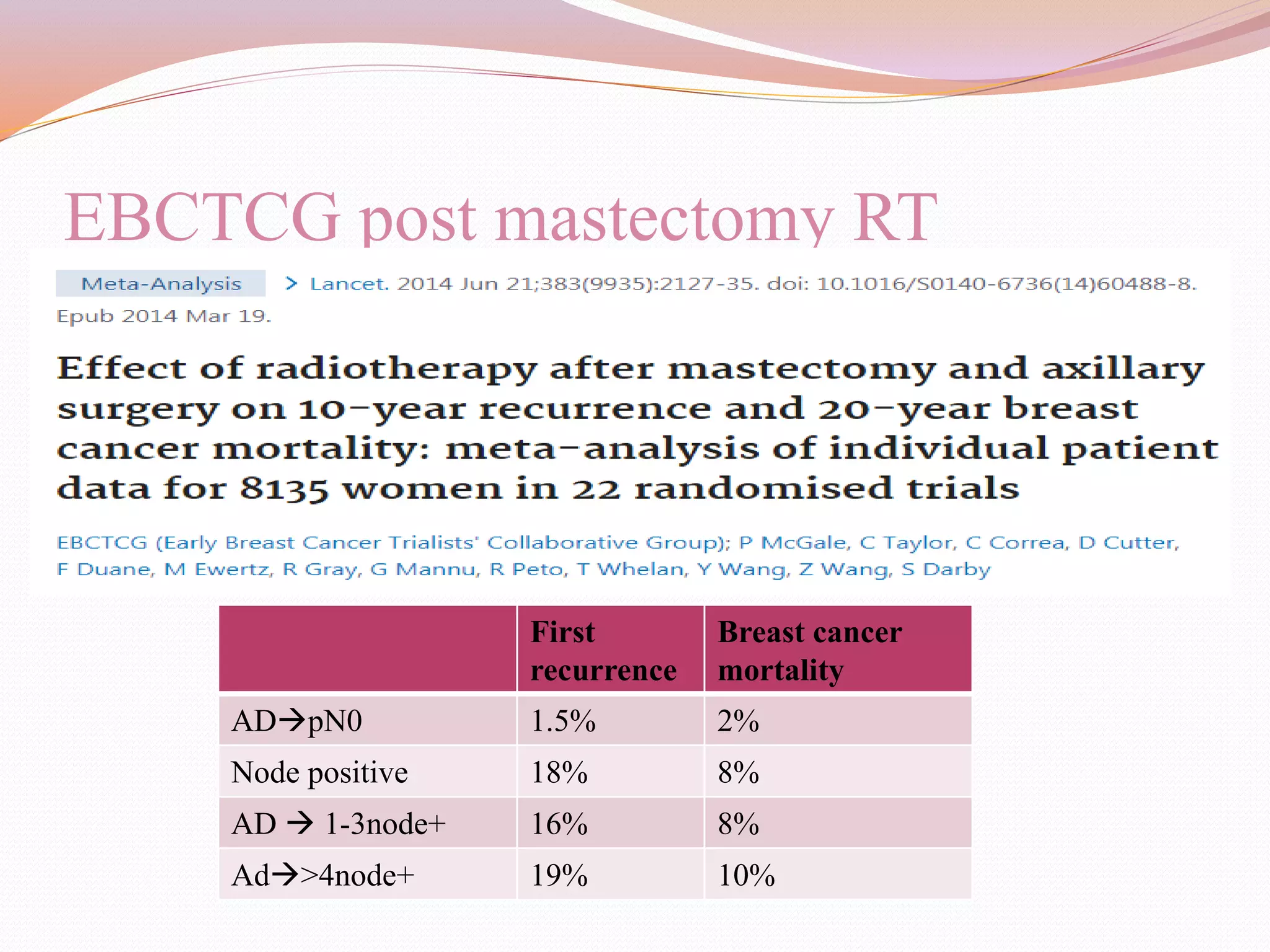
EBCTCG post mastectomy RT
First
recurrence
Breast cancer
mortality
ADpN0 1.5% 2%
Node positive 18% 8%
AD  1-3node+ 16% 8%
Ad>4node+ 19% 10%
EBCTCG post mastectomy RT
 The addition of radiation resulted in a statistically significant
decrease in isolated local-regional recurrence in all patients and a
significant improvement in overall survival.
 After mastectomy and axillary dissection, radiotherapy reduced both
recurrence and breast cancer mortality in the women with one to
three positive lymph nodes in these trials even when systemic therapy
was given
 Patients at highest risk for local-regional recurrence in these trials
were those with four or more positive axillary nodes & T3 tumours.
Post mastectomy RT in N0
4 RCT and 22 non RCT
Women of any age or menopausal status with
T1–4N0M0 breast cancer treated with
mastectomy without simultaneous reconstruction
and either axillary clearance or sentinel node
biopsy.
•If no risk factors risk of LRR 5%
• two or more risk factors15%
• In the meta-analysis of three
randomised trials of mastectomy
and axillary clearance (667
patients), the addition of
radiotherapy resulted in an 83%
reduction in the risk of LRR (P <
0.00001) and in a 14% improvement
in survival (P = 0.16)
•LRR is increased in the
presence
•LVSI
•Grade 3 tumour
• > 2 cm
• close margin
• pre-menopausal
•</=50.
Regional nodal irradiation
 The role of RT in management of the regional lymphatics is
influenced by the risk of subclinical microscopic disease in
regional nodal basins and patterns of failure.
 This risk is in part determined by disease characteristics and
the extent of surgical evaluation of the axilla.
Regional nodal irradiation
ALND RT
AMAROS trial
Positive SLNB
ALND vs Axillary
RT
N=4806
Median f/u= 6.1yr
Axillary
recurrence=0.54%
Lymphedema
40% at 1 yr
28% at 5yr
1.03% (p=NS)
22% at 1 yr
14% at 5yr (p<0.0001)
No difference in
PS or DFS
ALND vs axillary RT
Regional nodal irradiation
No RNI RNI
MA.20 intergroup study
1832
Lumpectomy ALND and
adjuvant treatment WBRT
10 yr DFS
77%
82%
HR .76,
p-.01
Axillary + SCF + ips
IMN in upper 3 ICS
No OS diff
EORTC 22922/10925
N=4004
Central/median tumors post
surgery and adjuvant
11yr DFS
69.1%
BCM- 14.4%
72.1%
12.5%
HR=.82,p=.02
All regional nodes
including IMN
RNI vs No RNI
Role of IMN irradiation
DBCG IMN (Thorsen et al ,JCO, Nov 2015)
Effect f IMN in early node +BC
3089 patients
Right side disease IMN RT
Left side disease  No IMN RT
Median f/u =8.9yr
French RCT (Hennequein ;IJROBP,Aug 2013)
cN+/ central/medial tumors
N=1334
11.3yrs median f/u
No benefit of IMN irradiation on the overall
survival could be demonstrated: the 10-year
overall survival was 59.3% in the IMN-
nonirradiated group versus 62.6% in the IMN-
irradiated group (P=.8).
IMN RT No IMN RT
OS 75.9% 72.2% (p=0.005)
Breast cancer
mortality
20.9% 23.4% (p=0.03)
Distant recurrence 27.4% 29.7%
EBCTCG -RNI
8 trials 1961-78
Median f/u 9.2
estimated >8 Gy mean heart dose and likely nodal dose <85% in the nodal RT
arm.
2178 women
Nodal RT had no effect on breast cancer recurrence [ (RR)=0.98, 95% CI 0.85–
1.13, p=0.83] or breast cancer mortality (RR=1.05, 0.91–1.21, p=0.54), but
increased non–breast cancer mortality (RR=1.44, 1.20–1.73, p<0.0001), leading to
a net increase in any death (RR=1.18, 1.06–1.32, p=0.004).
EBCTCG -RNI
6 trials 1989–2003,
9.1yr median f/u
Nodal dose ≥85%, and estimated mean heart
dose <8 Gy
10,954 women,
nodal RT reduced breast cancer recurrence
(RR=0.86, 95% CI 0.79–0.94, p=0.0006),
breast cancer mortality (RR=0.81, 0.74–0.90,
p<0.0001) and overall mortality (RR=0.86,
0.80–0.93, p=0.0002).
No excess of non–breast cancer mortality
was apparent (RR=0.96, 0.79–1.18, p=0.71).
Recurrence rate ratios did not vary
significantly according to nodal
region(s) irradiated
(axilla/SCF/IMC), or the use of
adjuvant chemotherapy
RNI
SCF RT indications
•>4 +LN after axillary
dissection
•1-3 +LN with high risk
features
•Tumor size >5cm
•Node + sentinel lymph node
with no dissection unless risk
of axillary disease is very
small
•High risk with no dissection
Axillla RT
If adequate axillary clearance(>10 lymph
nodes)
– Decision to give axillary nodal RT
depends on no. of node involvement &
prognostic factors (gross extracapsular
tumor extension).
Axillary recurrences after complete AC – 1-2%
RNI
IMN RT
Unresolved issue. No consensus on value of IMN irradiation
central and medial lesions with positive axillary nodes
: +SLN in the IM chain
: +SLN in axilla with drainage to IMN on lymphosintigraphy
Clinical recurrence in IMN rare (<3%) even when RT not given
Pts with pathologically +ve axilla – IMN mets <5%
RT leads to fibrosis & cardiac problems
RT technique
 Can be delivered via 2D ,3DCRT/IMRT technique
 3DCRT– better conformation of dose to target tissues, increased
sparing of normal tissues , limiting dose to lungs & heart
 IMRT - further improve the dose distribution, but may also increase
the volume of tissue exposed to lower doses of radiation may
increase the risk of second malignancies
 Studies have shown – 50% reduction in cardiac mortality rate ( Muren et
al)
Simulation
 Supine position
 Breast board
 Immobilization devices (e.g plastic molds ) reproduce daily
positioning and minimize day-to-day set up errors
 Lateral decubitus position - large, pendulous breasts.
 Prone breast borad
Reduction of dose in the high-dose region to the irradiated
breast
Reduction of volume and dose to the underlying lung and heart
Reduction of scattered dose to the contralateral breast.
Simulation
Fields
 Medial & lateral tangential fields – cover chest wall or
breast & lower axilla
 Single ant field – covers supraclavicular & upper axilla
Field borders
Tangential fields to chest wall or breast
 Upper border – 2nd ICS (angle of Louis) when s.c f used
When s.c f not – head of clavicle
 Medial border – at or 1cm over midline
 Lateral border – 2-3cm beyond palpable breast tissue – mid axillary
line
 Lower border – 2cm below opposite infra -mammary fold
Field borders
Anterior field for SCF
 Should cover lower 2/3rd of neck
 Upper border – thyrocricoid groove
 Medial border – at or 1cm across midline
 Lateral border – insertion of deltoid ms or medial 1/3rd of humerus
 Lower border – matched with upper border of tangential fields
RT planning
 The anterior chest wall slopes downward from the mid-chest to the
neck.
 To make the posterior edge of the tangential beam follow this
downward-sloping contour
- the collimator of the tangential beam may be rotated
- patient placed on a slant so that the slope of the chest wall is parallel
to the table.
- by means of a rotating beam splitter mounted on a tray without
rotation of the collimator
-using multileaf collimation.
Field matching
 Usually Mono-isocentric matching technique.
 Single isocenter is set at the match between the SCF and
tangential fields.
 The inferior portion of the beam is blocked for the SCF
treatment and the superior portion is blocked for the tangential
field, with no movement of the isocenter, resulting in an ideal
match using the asymmetric collimators
 Lungs and heart are shielded with MLC.
Central lung distance
 Impact of radiation technique on lung volumetric dose – largely
dependent on CLD in tangential set-up
 Perpendicular distance from post. tangential field edge to post part of
ant chest wall at centre of field
 Best predictor of % of ipsilateral lung vol. treated by tangential fields
 Dose to lungs must be limited & minimum possible lung tissue must
be irradiated
Central lung distance
 Usually 2-3cm of underlying lung included in tangential portals
 CLD >3cm , particularly in lt. breast - irradiation of significant vol.
of heart & lung
CLD (cm) %age of lung
included
1.5 6
2.5 16
3.5 26
Maximum heart distance
 The maximal heart distance (MHD) is the width of heart in the
tangent fields at its maximal level
 Maximal heart length (MHL)
is the maximal length in
tangential fields referring
to the heart contour in a
digitally reconstructed
radiograph (DRR
3DCRT planning
Steps in 3DCRT planning
 Simulation
 Transfer of images to TPS
 Contouring
 Beam arrangement and shaping
 Dose calculation
 Optimisation
 Plan approval and delivery
 QA
RTOG contouring guidelines
Radiation beam
Photons
 4-6MV linac /Co60
 If tangential separation wide (>22cm) – significant dose
inhomogeneity – can be minimized by using high energy photons
 Part of RT (50%) delivered using high energy (10-18MV) – to
maintain inhomogeneity throughout entire breast to 5% or less
 High energy photons helpful in larger breasts – decrease integral
dose
 But photon energies >6MV – under dose superficial tissues beneath
skin
Radiation beam
 Electrons – deliver minimal dose to underlying critical structures &
normal tissues – decreases lung dose
 Disadvantage – skin reactions (thinning of skin telengiectasia)
compromises cosmesis
 Chestwall  9-12 Mev
Dose constraints
structure RTOG 1005 criteria
Breast CTV D95% >/= 38Gy
D50% </= 43.2Gy
Boost CTV D95% >/= 9.5GyGy
V11Gy </=5%
Heart V16Gy </= 5%
V8Gy</=30%
Mean</=3.2Gy
Lung V16Gy</=15%
V8Gy</=35%
V4Gy</=50%
C/l lung V4Gy</=10%
C/l breast Dmax</=240cGy
D5%</=14cGy
APBI
 Accelerated partial breast irradiation to only tumor bearing quadrant
– shortens treatment time and healthcare costs.
 Logistical problems associated with integrating local and systemic
therapies would be eliminated.
 BCT becomes acceptable for more women.
 Additionally, toxicity to adjacent normal structures (i.e., heart,
underlying chest wall, contra lateral breast) could be reduced
significantly by decreasing the volume of irradiated tissue
Evidence of APBI
Evidence of APBI
NSABP B39
 NSABP B 39
APBI-ASCO
Systemic treatment
 Chemotherapy
 Endocrine therapy
 Her2 targeted therapy
Adjuvant systemic treatment
 Prognostic factors  age, tumor size, grade, no of nodes involved,
ER/PR and Her2 status
 Adjuvant chemo is given if >10% increase in mortality from breast
cancer at 10 yrs
In ER/PR positive Her2 neu neg
 T1a  No adjuvant chemotherapy. Only endocrine alone
 >Ta1N0  multigene assay 
 If no multigene assay available depends on clinical characteristics
shared decision making
Oncotype Dx
 NSABP B 14 RT PCR study 21 gene assay
 <18 low risk
 18-31 intermediate
 >31  high
 If recurrence score >31  chemothera
Recurrence
score
% of
patients
Rate of distant
recurrence at 10
yr in %
Low risk <18 51 6.8
Intermediate
>/=18-<31
22 14.3
High >31 27 30.5%
TAILORx
Prospective validation of Oncotype Dx
 Used different scoring system
RxPONDER trial
 5,015 patients
 stage II/III breast cancer
1-3 node+ and a RS ≤ 25.
 Randomly assigned to receive chemotherapy followed by endocrine therapy
or endocrine therapy alone
 Median f/u=5.1 yr interim results
 Postmenopausal women with HR-positive, HER2-negative breast cancer with
one to three positive nodes and a 21-gene recurrence score (RS) of ≤ 25
(Oncotype DX) derived no further benefit from chemotherapy added to
endocrine therapy and can safely avoid adjuvant treatment
RxPONDER trial
 5.2% absolute improvement in the iDFS (89.0% vs. 94.2%, HR 0.54, 95% CI
[0.38, 0.76]; p = 0.0004) favoring chemotherapy followed by endocrine therapy in
premenopausal patients (1,665 patients).
 This benefit was greater in premenopausal patients with RS 14-25 than
in patients with RS 0-13, with a 5-year iDFS absolute benefit of 6.2%
and 3.9%, respectively.
 The number of positive lymph nodes did not predict iDFS
 A 1.3% absolute benefit in overall survival was noted in the
premenopausal group.
Adjuvant chemotherapy
EBCTCG meta analysis 1988
 14% absolute benefit with addition of chemotherapy in annual odds
of death
 > in premenopausal women
 Poly chemotherapy is better than mono chemotherapy
 Addition of CMF 23% absolute reduction in odds of death
 6months CMF = 12 months CMF
Adjuvant chemotherapy
EBCTCG meta analysis 1995
 7% improvement in survival with the addition of antracycline
 6 CMF= 4AC
 Increasing doses of anthracycline improved benefit
 Triple drug antracyclines are superior to CMF in OS
 Magnitude of benefit is similar in all subgroups
Adjuvant chemotherapy
Taxanes
 1.4 to 3% absolute gain in survival with the addition of taxane with
antracycline
 Sequential regimens are better than concurrent regimens
 Weekly paclitaxel is better than 3 weekly paclitaxel in DFS
 3 weekly Docetaxel is equivalent to weekly paclitaxel
 In a subgroup analysis ,weekly paclitaxel is better in TNBC
 4 TC> 4AC= 6 CMF
 TC can be considered in case of CI to antracycline
 low risk ER +,node neg cases
Adjuvant chemotherapy
Dose dense chemotherapy
Principle
 Skipper–Schabel–Wilcox model, cell kill follows first order kinetics:
tumor growth is exponential and cytotoxic chemotherapy removes a
constant fraction of cells
 Norton–Simon hypothesis dictates that the rate of cancer cell death
as a result of cytotoxic treatment is directly proportional to the tumor
growth rate at the time of its administration
 2% improvement in breast cancer mortality in EBCTCG meta
analysis
 5 to 6% improvement in PFS and 3 to 6% improvement in OS
ASCO- adjuvant chemo in HR+
 In patients who can tolerate it, use of a regimen containing anthracycline-taxane
is considered the optimal strategy for adjuvant chemotherapy, particularly for
patients deemed to be at high risk.
 For patients with high-risk disease who will not receive a taxane, an optimal-dose
anthracycline three-drug regimen (cumulative dose of doxorubicin > 240 mg/m2
or epirubicin > 600 mg/m2 but no higher than 720 mg/m2 ) that contains
cyclophosphamide is recommended. The cumulative dose of doxorubicin in two-
drug regimens should not exceed 240 mg/m2 .
 For patients in whom anthracycline-taxane is contraindicated, cyclophosphamide-
methotrexate-fluorouracil (with oral cyclophosphamide) is an acceptable
chemotherapy alternative to doxorubicin-cyclophosphamide
Role of adjuvant endocrine therapy
 A tumor is said to be endocrine responsive ,if >10% of cells are
positive by IHC
 Available modalities are
Temporary Permanent
SERM AI SERD LHRH
agonist
Tamoxifen Letrozole Fulvestant Leupride
Anastrazole
Exemestane
Surgical
ablation
XRAM
Role of adjuvant endocrine therapy
Several trials have shown that adjuvant tamoxifen will add to DFS and 2 trials
have shown OS benefit also
1988 EBCTCG meta analysis
 ER expression predicts the responsiveness of therapy
 Tamoxifen increases the RFS and OS
 Both N0 and N+ patients have benefit in RFS and OS
 More benefit in N0 patients
 Optimal duration is 5 yrs
 11.5% absolute benefit in RFS and 9% absolute OS benefit
 16% absolute benefit in odds of death
Role of adjuvant endocrine therapy
EBCTCG meta analysis 2015 AI
 3.6% gain in RFS with AI over Tam at 10ys
 3.5% distant recurrence gain with AI over Tam at 10ys
 2.5% gain in OS with AI over Tam at 10yrs
 PR neg had higher gain
 Node + has higher gain
 2.8% more bone loss with AI at 10yrs
 0.2% gain in endometrial carcinoma with AI
Role of adjuvant endocrine therapy
 5yrs of AI reduces the 10yr breast caner mortality by atleast 40%
compared to no endocrine therapy
 AI is more effective than Tam in preventing breast cancer death
 Higher chance of recurrence is seen few years after diagnosis. Hence
better to start with AI than with Tam
 Once the patient is diseases free, switching to tam is similarly
effective to continuation of AI
Role of adjuvant endocrine therapy
 Which AI is better?
FATA GIM 3 study all the 3 – Anastrazole, Letrozole and
Exemestane are equal
 Timing
4 to 6 weeks after surgery
DFS is better if give sequentially with chemotherapy
Concurrent /sequential with RT
Extended duration of tam
 ATLAS(adjuvant tamoxifen shorter against longer)
 aTTOM (adjuvant tamoxifen treatment offer more)
Tam x
5
Tam x
5
Placebo
EBC
Any ER
/ER untested
(attom)
Any age/node
Extended duration of tam
Pooled analysis
 Decreased risk of recurrence beyond 10 yr with extended treatment
 Continued reduction in risk of recurrence and breast cancer
mortality from 7 yr onwards
 10 yr Tam can decrease the breast cancer mortality by 1/3 in first
10yrs and ½ in 2nd decade
Extended AI after tam
Arms DFS OS
MA 17
Postmenopausal
Median f/u=30 mon
n=5187
Letrozole x 5yrs
Placebo
94.4%
89.8% (p=0.01)
96%
94% (p=0.83)
NSABP 33
Postmenopausal
Median f/u=30 mon
N=1588
Exemestane x 5yr
Placebo
91%
89% (p=0.07)
No OS benefit
RFS benefit +
ABCSG 6a trial
Post menopausal
Median f/u=5 yrs
N=856
Anastrazole x 3 yrs
Placebo
RR 7.1%
11.8% (p=0.031)
No OS benefit
RFS and DM
benefit+
Extended AI after AI
 MA 17R
 NSABP B32
 IDEAL
 SOLE
 SALSA
 AERAS
Extended AI after AI
Study Randomisation N Med
ian
f/u
DFS OS
MA 17R Lx 5
L x 5yr
Placebo
1918 6.3
95%
91% (p=0.01)
93%
94% (p=.83)
NSABP
B 42
Lx 2-3 yrs+/tam
L x 5yr
Placebo
3936 9.3
76
72.1 (p=0.011)
86
85.5 p=0.0003)
DR benefit
+
IDEAL
trial
5yr endocrine trt
Let x 2.5yr
5yr
1824 6 No difference in DFS/OS in either arm
SOLE
trial
4-6 yrs endo
Let x5yrs
continuously
Intermittent
9mon3mon
break/yr
4884 5 No diff in DM/OS/DFS in both the arms
SALSA 5 yr endo 
Anastrazole x 2
x 5
3484 8 No difference between DFS and OS,but
high risk of bone fracture in 5 yr group
AERAS Anas x 5 or tam 2-
32-3 yr anas
5 yr anas
observation
1697 4.9 5% improvement in DFS. No OS benefit.
Increased risk of fracture in 5yr group
Extended AI
12 randomised trials that
compared 3-5 years of AI
versus no further treatment
after five or more years of
endocrine therapy.
Extended AI therapy after approximately 5 years of
tamoxifen:
• 33% risk reduction for any recurrence
5-year gain of 3.6% (P < .00001)
• 23% reduction in the risk of distant recurrence
5-year gain of 1.5% (P = .008)
•23% reduction in breast cancer mortality
5-year gain of 0.8% (P = .05)
Extended AI
Extended AI therapy after 5 years of an
AI alone
• 24% risk reduction for any
recurrence, with a 5-year gain of 1.2%
(P = .02)
• 22% risk reduction in distant
recurrences, with a 5-year gain of
0.3% (P = .09)
• 1% risk reduction in breast cancer
mortality, with a 5-year loss of 0.2%
(P = .97)
Extended AI after 5 to 10 years of tamoxifen,
then an AI:
•16% risk reduction for any recurrence, with a
5-year gain of 2.1% (P = .002)
• 8% reduction in the risk of distant
recurrence, with a 5-year gain of 1.0% (P =
.29)
•7% reduction in breast cancer mortality, with
a 5-year gain of 0.2% (P = .45).
Extended AI
 The impact of extended AI on recurrence depends on the type of
prior endocrine therapy
 Among women treated with prior tamoxifen, the risk reduction was
larger, 33% (P < .00001), compared to women who received AI for at
least part of their initial endocrine therapy (19%; P = .00010).
 Risk reduction is apparent in the first 2 years after prior tamoxifen
but not until the third year after prior AI therapy.
 The absolute benefits increase as more nodes are involved.
 The occurrence of bone fractures also increased by 24% with
extended endocrine therapy.
ASCO recommendations for optimal AI-2019
 For node-negative patients, the use of extended AI therapy for up to 10
years should be based on an assessment of established prognostic
factors for recurrence risk.
 For women with node-positive BC, AI therapy should be continued for
up to 10 years.
 For women on extended AI therapy, 10 years should be the maximum
duration of therapy.
 For women using or contemplating extended AI adjuvant treatment,
this decision should be part of a shared process between the clinical
team and the patient, with all involved weighing the risks and benefits of
prolonged treatment.
ASCO recommendations for optimal
AI-2019
 When extended adjuvant hormonal therapy is indicated, any of the following regimens
may be utilized:
 AI for up to a total of 10 years
 tamoxifen for 2 to 3 years followed by AI for 7 to 8 years
 tamoxifen for 5 years followed by AI for 5 year
 tamoxifen for 10 years
 Relative benefits for extended adjuvant endocrine therapy were greater in women
who switched from tamoxifen to AIs.
Less benefit may be seen among women who continue tamoxifen for 10 years or who
are treated with AIs in the first 5 years and then continue on AI therapy.
 AI therapy is recommended during the course of adjuvant endocrine therapy, if a
patient is intolerant to AIs, does not want to take AIs, or is premenopausal, the use of
tamoxifen is recommended.
Ovarian suppression in premenopausal
8 yr updated results of combined analysis
E+OF
S vs
T+OF
S
With
chemo
Witho
ut
chemo
HR Comb
ined
DFS 3% 2% 0.74 4%
OS 2% 1% 0.86 2%
Freedo
m
from
DR
2.4% 2% 0.6 No
diff
T+OFS vs T Absolute
benefit
DFS 7%
OS 4.3%
•E+OFS results in sustained and
consistently higher DFS and freedom from
distant recurrence
•Relative treatments were similar whether
they received chemo or not
•Absolute benefit more in women who
remained pre menopausal after chemo
•In woman with high risk clinico
pathological factors
5.3 percent point DFS benefit with
T+OFS vs T alone
7 percent points higher DFS with
E+OFS
St Gallens-2021
Endocrine treatment chemotherapy
T1a AI/T x 5 yr No
T1b AI/T x 5 yr +/-
Individualised decision
making
T1c AI/T x 5 yr
Stage 2 node neg and
premenopausal
OFS+T/AI
Stage 2 node neg and post
menopausal
=/-extended AI
Stage 2 node+ Extended AI
Role of NACT in HR+
Pre op systemic therapy
Rationale 
 Can render inoperable tumor to operable
 Downstaging  increased BCS rate
 Eliminate micro metastasis
 Better prognostic information based on the response to therapy
 Allow app time for genetic testing
 Can tailor the adjuvant treatment (TNBC)
Candidates of NACT
 Those with big tumors and want BCS
 Those subtype with high likelihood of response- her2 + and TNBC
>T1 or >/=N1
CI
 Extensive insitu disease
 Poorly defined extent/not palpable/clinically accessible
Preop vs post op chemo?
 NSABP B 18
TI,2,3,N0,1,M0
Operable breast
cancer
AC x
4Sx+/-RT
Sx+/- RT
AC x 4
No difference between adjuvant
and neoadjuvant treatment in DFS
or OS in patients with stage II or
stage III breast cancer who were
randomly assigned to AC either
before or after surgery
Neoadjuvant endocrine therapy in post
menopausal
Eligibility NACT arms Outcome
IMPACT
Study
Phase 3
ER+
Operable breast
cancer
Tam x 3mon
Anastrazolex
3mon
Tam+Anas x
3mon
•No SS differences among the three treatment
groups in tumor objective response
•A significantly higher proportion of patients
were deemed by their surgeon to be eligible for
BCS after treatment with anastrozole (46%)
versus with tamoxifen (22%, P 5 .03)
Semiglasov
et al
Phase 2
ER+
IIA to IIIB)
AT x 4
Anastrazole
x 3mon
Exemestane
x 3mon
•Clinical objective response was 64% in the
endocrine therapy and chemotherapy treatment
groups.
•Rates of pcr(3% vs 6%) and disease progression
(9% vs 9%) did not differ significantly in the
endocrine therapy or chemotherapy group,
respectively (P > .05).
•Rates of breast-conserving surgery were slightly
higher in the endocrine group (33% vs 24%; P
NACT in ER+
20 RCT
N=3490
18 of which
included only
post menopausal
•Neoadjuvant AI were more effective (better
clinical response rate and BCS rate) than
tamoxifen
•No differences observed in clinical
response rate between endocrine
monotherapy and dual endocrine therapy.
•Response rates and BCS rates with AI
based neoadjuvant endocrine monotherapy
were comparable with those observed with
combination neoadjuvant chemotherapy.
• Toxicity was significantly greater in the
neoadjuvant chemotherapy arms
Neoadjuvant endocrine therapy in HR+
premenopausal
STAGE trial
Phase 3
ER+
Operable
breast
cancer
N=204
Anastrazole +
Goserlin
monthly x
6mon
Tam+Goserlin
monthly x 6
mon
More patients in the anastrozole group had a complete or partial
response than did those in the tamoxifen group during 24 weeks
of neoadjuvant treatment (anastrozole 70·4% vs tamoxifen
50·5% .
Estimated diff erence between groups 19·9%, 95% CI 6·5–33·3; p=0·004).
No significant differences were observed in the quality-of-life
measures,
Kim et al
Phase 3
HR+,
Her 2neg
Node+
N=187
Ac x 4 Doce
x 4
Tam + Goserlin
mon thly x
6mon
More NCT patients had complete response or partial response
than NET patients using MRI (NCT 83.7% vs. NET 52.9%, 95% CI
17.6–44.0, p < 0.001) and callipers (NCT 83.9% vs. NET 71.3%, 95% CI 0.4–
24.9, p = 0.046).
Better clinical responses were observed in pre-menopausal
patients after 24 weeks of NCT compared to those observed after
NET.
ASCO –NACT in HR+
 Neoadjuvant chemotherapy can be used instead of adjuvant
chemotherapy in any patient with HR-positive, HER2-negative breast
cancer in whom the chemotherapy decision can be made without
surgical pathology data and/ or tumor-specific genomic testing
 For postmenopausal patients with HR-positive/HER2-negative
disease, neoadjuvant endocrine therapy with an AI may be offered to
increase locoregional treatment options. If there is no intent for
surgery, endocrine therapy may be used for disease control
 For premenopausal patients with HR-positive/HER2-negative early-
stage disease, neoadjuvant endocrine therapy should not be routinely
offered outside of a clinical trial
TNBC
TNBC-Adjuvant
 In CALGB
9344
N+
EBC
 Sparano et al
N+
high risk Node neg EBC
AC x 4 weekly pacli/q3w Pacli/weekly doce/q3w doc
TNBC and her2 over expressers
had better survival
TNBC benefitted more with weekly
Pacli
TNBC-Adjuvant
 Dose dense chemo
CALGB9741
TNBC benefited more
with improved DFS and OS
NACT in TNBC
Role of Carboplatin
 GEPAR SIXTO trial
 CALGB 40603
 Brightness trial
 Role of Capecitabine
Create X trial
SYSUCC trial
ECOG ACRIN 1131 trial
Carboplatin in TNBC
 GEPAR SIXTO
Phase2
Stage 2/3
TNBC
Her2+
 CALBG 40603
Phase 2
Stage2/3
TNBC
Pacli+doxo+bevaci+/-
anti her2 +Carbo
Pacli+doxo+bevaci+/-
anti her2
20% absolute
improvement in
PCR in TNBC
with Carboplatin
((p=0·005))
No improvement in OS /DFS
Carboplatin in TNBC
Improvement in pcr with carboplatin,not with veliparib
Carboplatin in TNBC
Role of Capecitabine in TNBC
CREATE X trial
Her2 neg
Residual tumor after
NACT
Capecitabine
(1.25gm/m2 D1-D14
BD q3w x 6-8 )
Observation
OS (4%,p=0.01)and DFS(6%, p=0.01)
benefit present with the addition of
capecitabine.
Better results in TNBC arm
SYSUCC 001 trial
EBC
TNBC after
NACTSX+/-RT
Capecitabine
(625mg/m2 contiously
x 1yr
Observation
5-year DFS was 82.8% in the capecitabine
group and 73.0% in the observation group
([HR= 0.64 [95% CI, 0.42-0.95]; P = .03)
5-year OS was 85.5% vs 81.3% (HR, 0.75 [95%
CI, 0.47-1.19]; P = .22),
ECOG ACRIN 1131
Stage2/3 TNBC
>1cm residue post
NACT and Sx
Carboplatin
Capecitabine
Ongoing trial
Interim results
Platinum agents do not improve outcomes in
patients with basal subtype TNBC RD post-
NAC and are associated with more severe
toxicity when compared with capecitabine
TNBC
 T1a chemo case by case
 T1b TC / ACT
 Stage 2  NACT is preferred AC T +/- Platinum
 Residual tumor after NACT add capectabine
Asco update on NACT
 Patients with TNBC who have clinically node-positive and/or at least
T1c disease should be offered an anthracycline- and taxane-
containing regimen in the neoadjuvant setting
 Patients with cT1a or cT1bN0 TNBC should not routinely be offered
neoadjuvant therapy outside of a clinical trial
 Carboplatin may be offered as part of a neoadjuvant regimen in
patients with TNBC to increase likelihood of pCR
 There is insufficient evidence to recommend routinely adding the
immune checkpoint inhibitors to neoadjuvant chemotherapy in
patients with early-stage TNBC
Her2 +
Her 2 + EBC
 Role of Traztuzumab
 Pertuzumab
 TDM1
 Neratinib
Role of TZB
 EBCTCG meta analysis on Tzb in EBC-2021
 7 RCT ; 13864 women
 Median f/u=10.7yr
 the addition of trastuzumab to chemotherapy reduces recurrence of,
and mortality from, breast cancer during the first decade of follow-
up by about a third
 10-year absolute reduction of 9·0% in recurrence and of 6·4% in
breast cancer mortality, compared with chemotherapy alone
 Concurrent TZB is better than sequential (5% improvement) 30 -40%
improvement in DFS and OS with the addition of traztuzumab
 10 -13% absolute improvement in survival by 1 year of TZB
Role of TZB
Role of TZB
APT trial Phase 2
410 =n
Median f/u
= 6.5yr
N0
</=3cm
Her2 +
Pacli(80
mg/m2) with
tzb x 12 wk
 tzb for 9
mon
DFS -93% (95% CI, 90.4 to 96.2)
OS- 95% (95% CI, 92.4 to 97.7)
RFI -97.5%
PERSEPHONE
Trial
Phase 3
N=2054
Median
f/u=5.4yr
Her2 +
EBC
Eligible for
chemo
TZB x 6mon
TZB x 1 yr
DFS 89·4% (95% CI 87·9–90·7) in the
6-month group and 89·8% (88·3–
91·1) in the 12-month group
(HR1·07 [90% CI 0·93–1·24], non-inferiority
p=0·011)
6-month TZB is non-inferior to
12-month with less cardiotoxicity
and fewer severe adverse events
6 month vs 1yr TZB
Very low risk group
Role of pertuzumab
IDFS analysis based on 508 events (intent-to-treat population) showed a hazard
ratio of 0.76 (95% CI, 0.64 to 0.91) and 6-year IDFS of 91% and 88% for
pertuzumab and placebo groups, respectively.
No OS benefit
Role of TDM -1
KATHERINE
trial
Phase 3
N=1486
Her2+
EBC wit
residual after
NACT
Adj TDM x 14
cycle
TZB x 14 cycle
Interim results
iDFS was significantly higher in the
T-DM1 group than in the Tzb group
(HR for invasive disease or death, 0.50; 95% CI, 0.39 to
0.64; P<0.001).
the risk of recurrence of invasive
breast cancer or death was 50%
lower with adjuvant T-DM1 than
with trastuzumab alon
ATTEMPT trial
Phase 2
N=497
Stage 1
Her 2+
TDM -1 x 1yr
Pacli q w x
12wk+Yzb x 1 yr
Complete results not out yet
3-year iDFS for T-DM1 was 97.8%
(95% CI, 96.3 to 99.3)
Neratinib in EBC
 Role of neratinib
 Exe net study
 Role of TDM1
 Katherine trial
Absolute iDFS benefits at
5 years were 5.1% in
HR+/≤ 1-year (HR, 0.58; 95% CI
0.41-0.82) and 1.3% in
HR+/>1-year (HR 0.74; 95% CI,
0.29-1.84).
In HR+/≤ 1-year, neratinib
was associated with a
numerical improvement in
OS at 8 years (absolute
benefit, 2.1%; (HR, 0.79; 95%
CI, 0.55-1.13)
ASCO update on NACT
 Patients with node-positive or high-risk node-negative, HER2-
positive disease should be offered neoadjuvant therapy with an
anthracycline and taxane or non–anthracycline-based regimen in
combination with trastuzumab. Pertuzumab may be used with
trastuzumab in the neoadjuvant setting
 Patients with T1a N0 and T1b N0, HER2-positive disease should not
be routinely offered neoadjuvant chemotherapy or anti-HER2 agents
outside of a clinical trial
Bisphosphonates in EBC
EBCTCG 2015
 Fewer bone recurrence [ 2·2%absolute gain at 10yr (95% CI 0·6–3·8)]
/distant recurrence [(RR 0·82, 0·74–0·92; 2p=0·0003)]and breast cancer
mortality [3·3% absolute benefit at 10 yr (95% CI 0·8–5·7)] with
bisphosphonates.
 More benefit in postmenopausal ladies
 Benefit is similar with amidronate / zolendronate / ibandronate
 Low intensity osteoporotic schedules(6monthly) have similar benefit
when compared with high intensity regimens
 Average effect is similar with 2yr treatment and 3-5 yrs treatment
 1.3% reduction in fracture risk in year 2-4
Thank you

Management of Early breast cancer

  • 1.
    Management of Earlybreast cancer Dr Veena P S 25/9/2021
  • 2.
    Introduction  Early breastcancer Stage I and II  Locally advanced IIIA to IIIC
  • 3.
    Work up  Historyand physical examination  Bilateral MMG/USG  Core Biopsy-ER/PR/Her 2 neu, ,ki 67  CBC/LFT/RFT  No routine systemic imaging unless signs/symptoms present
  • 4.
    Treatment  Loco regionaltreatment Breast conservation therapy   MRM +/- adjuvant Radiotherapy  Systemic treatment  chemotherapy/Hormonal therapy Based on tumor characteristics
  • 5.
    BCT Contra indications ofBCS • Pregnancy •Diffuse suspicious micro calcifications on MMG •Widespread diseases that cant be incorporated in lumpectomy Relative contraindications •Previous RT to chest wall/ breast •Connective tissue disorders •>5 cm tumors •Includes lumpectomy + WBRT •Indicated in early breast cancer and DCIS •Goal  optimal locoregional control +better cosmesis •No ink on margins is considered as negative margins
  • 6.
    Mastectomy Indications  Multicentric tumors Large size tumors compared to breast size  Inability to achieve negative margins after multiple resections  Prior RT to chest wall or other CI to RT  Patient choice
  • 7.
    Types of mastectomy Total mastectomy Removal of entire breast alone. No axillary nodes/ muscles removed.  Radical mastectomy  Entire breast + level I, II, III nodes+ Chest wall muscles  Modified radical mastectomy  Entire breast+ removal of level I and II nodes. No muscles are removed.  Partial Mastectomy  Removal of tumor with margins  Skin sparing mastectomy  Nipple sparing mastectomy
  • 8.
    Radical/ total mastectomy/ BCT NSABP B 04 ( Fischer et al, N Eng J Med ;August 2002) N=1079 Operable breast cancer cN0 Radical mastectomy/Total mastectomy + loco regional or axillary RT /Total mastectomy cN1 RM / TM + RT LRR cN0  9% vs 5% vs 13% (p=.002) cN1  16% vs 14% (p=.67) No significant impact in OS NSABP B 06 ( Fischer et al, N Eng J Med ;October 2002) N= 1851 EBC < 4cm Total mastectomy/lumpectomy alone/ lumpectomy + breast irradiation IBTR after 20 yrs 39% vs 14% (p<0.001) No difference in OS/distant DFS in 3 arms L L+RT IBTR 39% 14% (p<0.0001) LRR RM TM+ RT TM cN0 9% 5% 13% (p=.002) cN1 16% 14% (p=.67) -
  • 9.
  • 10.
    Surgical management ofaxilla  Appx 20 to 40% of cN0 patients will be having pathologic evidence of lymph node mets  20% of stage I and II cN0 patients will develop axillary recurrence if axilla is not addressed.  Axillary node dissection is the std of care in clinically + node.  Level I and II dissection is limited to patients with biopsy proven axillary mets  Minimum 10 nodes should be dissected  ALND of level III is done only if gross disease is present in level II
  • 11.
    SLNB  SLNB isdone by periareolar injection of a blue dye and checking the node which turns positive  It is indicated in clinically node negative tumors.  No need of axillary dissection in SLNB negative tumors.  When no SLNB is identified, level I and II, ALND is carried out.
  • 12.
    ALND vs SLNB RCT(Veronesi et al, N Eng J Med ; 2003) cT1N0 SLNB  ALND SNLBALND if mets + N=516 Accuracy of node detection is similar in both groups. No OS difference ALMANAC trial (Robert Mansel et al ;JCNI ,2006 ) To asses the QOL of patients cN0 N=1031 SLNB vs ALND SLNB is associated with reduced arm morbidity and better QOL
  • 13.
    SLNB vs ALND ACOSOGZ 0011 (Giuliano et al ; JAMA, 2017 ) cT 1-2 N0 with <3 sentinel nodes  ALND vs SLNB alone N=446 9.3yr median F/u IBCSG 2301 (Galimberti et al; Lancet, April 2014 ) cT1/2 N1 SLNB with one more micro metastatic node<2mm ALND vs no ALND N=931 Median f/u= 5 yrs ALND SLNB OS 83.6% 86.3%(p=.85) DFS 78.2% 80.2%(p=.85) ALND No ALND DFS 84.4% 87.8% ( p=0.0042) OS 97.6% 97.5% (p=.73)
  • 14.
    Radiation therapy Indications inEBC Breast RT  WBRT +tumor bed boost as part of BCT  APBI in selected cases after lumpectomy Regional nodal irradiation  All node positive cases Chest wall irradiation after MRM  All Node positive disease  >5cm tumors
  • 15.
    WBRT  Several RCTsand meta analysis has shown improved local control which translates to survival advantage with the addition of WBRT after BCS (NSABP B 06, N Engl J Med 2002, EBCTCG metanalysis, Lancet November 2011)  Conventional fractionation- 50 Gy in 25# with tumor bed boost of 10- 16GY in 5-10 fractions  Current standard dose is 40 to 42Gy in 15-16# to breast. Boost of 10 - 16 Gy in 5 -8 fractions are given for tumor bed after lumpectomy
  • 16.
    Adjuvant RT afterlumpectomy Vinh-Hung et al - Meta-analysis of survival in randomized trials comparing breast- conserving surgery with or without radiation
  • 17.
    Adjuvant RT afterlumpectomy This meta-analysis demonstrated a threefold reduction in local relapse and a small but significant increase in survival with the use of radiation therapy following lumpectomy J Natl Cancer Inst 2004;96:115 Vinh-Hung et al - Meta-analysis of local control in randomized trials comparing breast-conserving surgery with or without radiation
  • 18.
    Adjuvant RT afterlumpectomy N=10801 17 RCT RT VS no RT after BCS BCS BCS+RT First recurrence 35% 19.3% (p<0.00001) 15yr breast cancer death 25.2% 21.4 (p=0.00005) pN0, 15 yr breast cancer death 31% 15% (p<0.00001) pN+ ,10yr breast cancer death 51.3% 42.8% (p=0.01) one breast cancer death was avoided by year 15 for every four recurrences avoided by year 10 After breast-conserving surgery, radiotherapy to the conserved breast halves the rate at which the disease recurs and reduces the breast cancer death rate by about a sixth.
  • 19.
    Hypo vs conventionalfractionation Trial Regimen N Median f/u Local relapse OCOG Canada (Whelen et al; N Eng J med, 2010 Feb) T1/T2 N0M0 ,post BCS 50Gy/25# (612) 42.5Gy/16# (622) 10 yr 6.7% 6.2% 95% CI 2.5 to 3.5) RMH GOC trial (Owen et al, Lancet 2006) T1-III N0-N1,post BCS 50Gy/25# (470) 42.9Gy/13# (466) 39Gy/13# (474) 10yr 12.1% 9.6% 14.8% ( p=0.027) START A (Haviland et al,Lancet 2013) T1-III N0-N1,post BCS 50Gy/25# (749) 41.6Gy/13# (750) 39Gy/13# (739) 10yr 7.4% 6.3% (p=.65) HR 0.91 8.8% p=.41 HR 1.18 START B (Haviland et al,Lancet 2013) T1-III N0-N1,post BCS 50Gy/25# (1105) 40Gy/15# (1110) 10yr 5.5% 4.3% (p=.21, HR=.77)
  • 20.
    Hypo vs conventionalfractionation Regimen Results UK FAST trial (Brunt et al, J clin Oncol,May 2020) T1/T2N0 Post BCS N=915 50Gy/25# 30Gy/5# once weekly 28.5Gy/5# No significant difference in normal tissue effects in 3 arms. Not powered enough to compare the LR/tumor control UK FAST FORWARD TRIAL (Brunt et al;Lancet,April 2020) T1-3N0-1M0,post BCS N=4096 5yr results 40Gy/15# 27Gy/5# 26Gy/5# Incidence of loco regional relapse/distant relapse and OS were similar 40Gy 27Gy 26Gy IBTR 2.1% 1.7% 1.4%
  • 21.
    Role of postlumpectomy RT in elderly Fyles et al; N Eng J Med,2004 sep >/= 50 yr T1/T2 N0, ER + tumor Tam vs Tam +RT N=769 Hughes et al ; N Eng J Med,2004 sep >/= 70 yrs T1N0M0,ER+ Tam vs Tam +RT N= 636 PRIME II Kunkler et al; Lancet 2015 >/=65 yrs T1/T2 upto 3 cm N0 ,ER+ Adj Endo vs Endo +RT N=1326 10yr results At 5yr No RT RT Local relapse 7.7% 0.6% (p<0.001) DFS 84% 91%(p=0.004) axillary relapse 2.5% 0.5%(p=0.0.49) LR recurrence 4% 1% (p<0.001) No difference between OS and DM in both groups IBTR 9.8% 0.9%(p<0.00001) No difference in DM and OS
  • 22.
    Role of postlumpectomy RT in elderly  Meta analysis by Matuschek et al (Radiation ocology,March 2017), 5 RCT and 3766 patients mostly elderly patients with early stage breast cancer treated either with adjuvant endocrine therapy or with endocrine therapy+ WBRT after BCS  The benefit of RT for elderly women is significant in terms of local control, but this absolute benefit is relatively small and must be weighed against comorbidities and other competing risks.  For women with favorable T1/N0 receptor positive breast cancers, tamoxifen alone is a reasonable option that should be discussed.
  • 23.
    Tumor bed boostvs no boost  Aim – to increase local control & decrease incidence of IBTR  Rationale - Microscopic extension is unlikely beyond 1-2 cms from tumor mass (Veronesi etal, Annals of oncology 2001)  )  Majority of failures are located at surgical resection site (75-80%)
  • 24.
    Tumor bed boostvs no boost EORTC 22881-10882 (Poortmans et al,cancer radiother, 2015) N=5318 post lumpectomy  WBRT (50 Gy/25# ) No boost vs 16 Gy boost (photon/electron/LDR) ST. GEORGE AND WOLLONGONG RANDOMIZED BREAST BOOST TRIAL (Eric Hau et al ;IJROBP ,Nov 2010) T1/T2 N0-1M0 Post lumpectomy WBRT 50Gy/25# vs WBRT (45Gy/25 with boost 16Gy/8# with elctron) N=688 No difference in local control in both arms. No Boost Boost 10 yr Local recurrence 10.2% 6.2% (p < 0.0001) 20 yr IBTR 16.4% 12% 20 yr OS 61.1% 59.7% (p=0.323) Fibrosis at 20 yr 1.8% 5.2 (p=0.00001)
  • 25.
    Tumor bed boostvs no boost LYON trial (Romestaing et al,IJROBP ,Nov 2001) T1/T2 tumors, post lumpectomy  WBRT 50 GY/20# 10Gy/4# electron boost vs No Boost N=1024 Budapest boost trial (Polgar et al;Strahlenther onkol, Nov 2002) Stage I/II ,Post lumpectomy WBRT (50Gy/25#) No boost vs 16 Gy/8# with electrons or 12–14.25 Gy HDR N=207 . 5yr No boost Boost Local relapse 4.5% 3.6%(p=0.044) 5.3yr Boost No Boost Local tumor control 92.7% 84.9% (p=0.049) RFS 76.6% 66.2% (p=0.044) CSS 90.4% 82.1% (p=0.053)
  • 26.
    Tumor bed boostvs no boost For patients younger than 50 years old and in patients with high grade invasive ductal carcinoma, the boost dose reduced the local relapse from 19.4% to 11.4% (P = .0046; HR, 0.51) and from 18.9% to 8.6% (P = .01; HR, 0.42), respectively.
  • 27.
    Tumor bed boostvs no boost  NCCN advocates boost of 10 to 16 Gy in 4 to 8 # to high risk individuals  Can be delivered via enface electrons or photons or brachytherapy  Boost volume includes the surgical bed plus an arbitrary margin of 1 to 2 cm  For women with large breasts & deep seated tumors (>4cm below skin) , interstitial brachytherapy boost can be considered- 10 to 20 Gy HDR/LDR  Electrons – appropriate energy selected to allow 85 -90% isodose line to encompass target volume & decrease dose to the lung Energy – 9-16 MeV
  • 28.
    Post mastectomy RT The rationale for post-mastectomy radiation is the prevention of a local-regional recurrence.  Clinically occult persistent disease in the operative site or regional nodes could act as a source of distant metastases, and eradication of this disease could result in an improvement in disease-free and overall survival.
  • 29.
    Post mastectomy RTin node+ Trial Inclusion Arms LRRS OS British columbia trial N=318 f/u=20yr Premenopausal Post MRM N+ Sx+chemo No RT RT 74% 90% (P=0.002) 34% 47% (p=0.03) Danish 82b N=1708 f/u= 10yr Premenopausal high risk Stage 2/3 Sx+chemo No RT RT 68% 91% (p<0.001) 45% 54% (p<0.001) Danish 82 c N=1460 f/u=10yr Postmenopausal Stage 2/3 N+ Sx+/- chemo+tam No RT RT 70% 92% (p<0.001) 36% 45% (p=0.01)
  • 30.
    EBCTCG post mastectomyRT First recurrence Breast cancer mortality ADpN0 1.5% 2% Node positive 18% 8% AD  1-3node+ 16% 8% Ad>4node+ 19% 10%
  • 31.
  • 32.
  • 33.
    EBCTCG post mastectomyRT  The addition of radiation resulted in a statistically significant decrease in isolated local-regional recurrence in all patients and a significant improvement in overall survival.  After mastectomy and axillary dissection, radiotherapy reduced both recurrence and breast cancer mortality in the women with one to three positive lymph nodes in these trials even when systemic therapy was given  Patients at highest risk for local-regional recurrence in these trials were those with four or more positive axillary nodes & T3 tumours.
  • 34.
    Post mastectomy RTin N0 4 RCT and 22 non RCT Women of any age or menopausal status with T1–4N0M0 breast cancer treated with mastectomy without simultaneous reconstruction and either axillary clearance or sentinel node biopsy. •If no risk factors risk of LRR 5% • two or more risk factors15% • In the meta-analysis of three randomised trials of mastectomy and axillary clearance (667 patients), the addition of radiotherapy resulted in an 83% reduction in the risk of LRR (P < 0.00001) and in a 14% improvement in survival (P = 0.16) •LRR is increased in the presence •LVSI •Grade 3 tumour • > 2 cm • close margin • pre-menopausal •</=50.
  • 35.
    Regional nodal irradiation The role of RT in management of the regional lymphatics is influenced by the risk of subclinical microscopic disease in regional nodal basins and patterns of failure.  This risk is in part determined by disease characteristics and the extent of surgical evaluation of the axilla.
  • 36.
    Regional nodal irradiation ALNDRT AMAROS trial Positive SLNB ALND vs Axillary RT N=4806 Median f/u= 6.1yr Axillary recurrence=0.54% Lymphedema 40% at 1 yr 28% at 5yr 1.03% (p=NS) 22% at 1 yr 14% at 5yr (p<0.0001) No difference in PS or DFS ALND vs axillary RT
  • 37.
    Regional nodal irradiation NoRNI RNI MA.20 intergroup study 1832 Lumpectomy ALND and adjuvant treatment WBRT 10 yr DFS 77% 82% HR .76, p-.01 Axillary + SCF + ips IMN in upper 3 ICS No OS diff EORTC 22922/10925 N=4004 Central/median tumors post surgery and adjuvant 11yr DFS 69.1% BCM- 14.4% 72.1% 12.5% HR=.82,p=.02 All regional nodes including IMN RNI vs No RNI
  • 38.
    Role of IMNirradiation DBCG IMN (Thorsen et al ,JCO, Nov 2015) Effect f IMN in early node +BC 3089 patients Right side disease IMN RT Left side disease  No IMN RT Median f/u =8.9yr French RCT (Hennequein ;IJROBP,Aug 2013) cN+/ central/medial tumors N=1334 11.3yrs median f/u No benefit of IMN irradiation on the overall survival could be demonstrated: the 10-year overall survival was 59.3% in the IMN- nonirradiated group versus 62.6% in the IMN- irradiated group (P=.8). IMN RT No IMN RT OS 75.9% 72.2% (p=0.005) Breast cancer mortality 20.9% 23.4% (p=0.03) Distant recurrence 27.4% 29.7%
  • 39.
    EBCTCG -RNI 8 trials1961-78 Median f/u 9.2 estimated >8 Gy mean heart dose and likely nodal dose <85% in the nodal RT arm. 2178 women Nodal RT had no effect on breast cancer recurrence [ (RR)=0.98, 95% CI 0.85– 1.13, p=0.83] or breast cancer mortality (RR=1.05, 0.91–1.21, p=0.54), but increased non–breast cancer mortality (RR=1.44, 1.20–1.73, p<0.0001), leading to a net increase in any death (RR=1.18, 1.06–1.32, p=0.004).
  • 40.
    EBCTCG -RNI 6 trials1989–2003, 9.1yr median f/u Nodal dose ≥85%, and estimated mean heart dose <8 Gy 10,954 women, nodal RT reduced breast cancer recurrence (RR=0.86, 95% CI 0.79–0.94, p=0.0006), breast cancer mortality (RR=0.81, 0.74–0.90, p<0.0001) and overall mortality (RR=0.86, 0.80–0.93, p=0.0002). No excess of non–breast cancer mortality was apparent (RR=0.96, 0.79–1.18, p=0.71). Recurrence rate ratios did not vary significantly according to nodal region(s) irradiated (axilla/SCF/IMC), or the use of adjuvant chemotherapy
  • 41.
    RNI SCF RT indications •>4+LN after axillary dissection •1-3 +LN with high risk features •Tumor size >5cm •Node + sentinel lymph node with no dissection unless risk of axillary disease is very small •High risk with no dissection Axillla RT If adequate axillary clearance(>10 lymph nodes) – Decision to give axillary nodal RT depends on no. of node involvement & prognostic factors (gross extracapsular tumor extension). Axillary recurrences after complete AC – 1-2%
  • 42.
    RNI IMN RT Unresolved issue.No consensus on value of IMN irradiation central and medial lesions with positive axillary nodes : +SLN in the IM chain : +SLN in axilla with drainage to IMN on lymphosintigraphy Clinical recurrence in IMN rare (<3%) even when RT not given Pts with pathologically +ve axilla – IMN mets <5% RT leads to fibrosis & cardiac problems
  • 43.
    RT technique  Canbe delivered via 2D ,3DCRT/IMRT technique  3DCRT– better conformation of dose to target tissues, increased sparing of normal tissues , limiting dose to lungs & heart  IMRT - further improve the dose distribution, but may also increase the volume of tissue exposed to lower doses of radiation may increase the risk of second malignancies  Studies have shown – 50% reduction in cardiac mortality rate ( Muren et al)
  • 44.
    Simulation  Supine position Breast board  Immobilization devices (e.g plastic molds ) reproduce daily positioning and minimize day-to-day set up errors  Lateral decubitus position - large, pendulous breasts.  Prone breast borad Reduction of dose in the high-dose region to the irradiated breast Reduction of volume and dose to the underlying lung and heart Reduction of scattered dose to the contralateral breast.
  • 45.
  • 46.
    Fields  Medial &lateral tangential fields – cover chest wall or breast & lower axilla  Single ant field – covers supraclavicular & upper axilla
  • 47.
    Field borders Tangential fieldsto chest wall or breast  Upper border – 2nd ICS (angle of Louis) when s.c f used When s.c f not – head of clavicle  Medial border – at or 1cm over midline  Lateral border – 2-3cm beyond palpable breast tissue – mid axillary line  Lower border – 2cm below opposite infra -mammary fold
  • 48.
    Field borders Anterior fieldfor SCF  Should cover lower 2/3rd of neck  Upper border – thyrocricoid groove  Medial border – at or 1cm across midline  Lateral border – insertion of deltoid ms or medial 1/3rd of humerus  Lower border – matched with upper border of tangential fields
  • 49.
    RT planning  Theanterior chest wall slopes downward from the mid-chest to the neck.  To make the posterior edge of the tangential beam follow this downward-sloping contour - the collimator of the tangential beam may be rotated - patient placed on a slant so that the slope of the chest wall is parallel to the table. - by means of a rotating beam splitter mounted on a tray without rotation of the collimator -using multileaf collimation.
  • 50.
    Field matching  UsuallyMono-isocentric matching technique.  Single isocenter is set at the match between the SCF and tangential fields.  The inferior portion of the beam is blocked for the SCF treatment and the superior portion is blocked for the tangential field, with no movement of the isocenter, resulting in an ideal match using the asymmetric collimators  Lungs and heart are shielded with MLC.
  • 51.
    Central lung distance Impact of radiation technique on lung volumetric dose – largely dependent on CLD in tangential set-up  Perpendicular distance from post. tangential field edge to post part of ant chest wall at centre of field  Best predictor of % of ipsilateral lung vol. treated by tangential fields  Dose to lungs must be limited & minimum possible lung tissue must be irradiated
  • 52.
    Central lung distance Usually 2-3cm of underlying lung included in tangential portals  CLD >3cm , particularly in lt. breast - irradiation of significant vol. of heart & lung CLD (cm) %age of lung included 1.5 6 2.5 16 3.5 26
  • 53.
    Maximum heart distance The maximal heart distance (MHD) is the width of heart in the tangent fields at its maximal level  Maximal heart length (MHL) is the maximal length in tangential fields referring to the heart contour in a digitally reconstructed radiograph (DRR
  • 54.
    3DCRT planning Steps in3DCRT planning  Simulation  Transfer of images to TPS  Contouring  Beam arrangement and shaping  Dose calculation  Optimisation  Plan approval and delivery  QA
  • 55.
  • 56.
  • 57.
    Radiation beam Photons  4-6MVlinac /Co60  If tangential separation wide (>22cm) – significant dose inhomogeneity – can be minimized by using high energy photons  Part of RT (50%) delivered using high energy (10-18MV) – to maintain inhomogeneity throughout entire breast to 5% or less  High energy photons helpful in larger breasts – decrease integral dose  But photon energies >6MV – under dose superficial tissues beneath skin
  • 58.
    Radiation beam  Electrons– deliver minimal dose to underlying critical structures & normal tissues – decreases lung dose  Disadvantage – skin reactions (thinning of skin telengiectasia) compromises cosmesis  Chestwall  9-12 Mev
  • 59.
    Dose constraints structure RTOG1005 criteria Breast CTV D95% >/= 38Gy D50% </= 43.2Gy Boost CTV D95% >/= 9.5GyGy V11Gy </=5% Heart V16Gy </= 5% V8Gy</=30% Mean</=3.2Gy Lung V16Gy</=15% V8Gy</=35% V4Gy</=50% C/l lung V4Gy</=10% C/l breast Dmax</=240cGy D5%</=14cGy
  • 60.
    APBI  Accelerated partialbreast irradiation to only tumor bearing quadrant – shortens treatment time and healthcare costs.  Logistical problems associated with integrating local and systemic therapies would be eliminated.  BCT becomes acceptable for more women.  Additionally, toxicity to adjacent normal structures (i.e., heart, underlying chest wall, contra lateral breast) could be reduced significantly by decreasing the volume of irradiated tissue
  • 61.
  • 62.
  • 63.
  • 64.
  • 65.
    Systemic treatment  Chemotherapy Endocrine therapy  Her2 targeted therapy
  • 66.
    Adjuvant systemic treatment Prognostic factors  age, tumor size, grade, no of nodes involved, ER/PR and Her2 status  Adjuvant chemo is given if >10% increase in mortality from breast cancer at 10 yrs
  • 67.
    In ER/PR positiveHer2 neu neg  T1a  No adjuvant chemotherapy. Only endocrine alone  >Ta1N0  multigene assay   If no multigene assay available depends on clinical characteristics shared decision making
  • 68.
    Oncotype Dx  NSABPB 14 RT PCR study 21 gene assay  <18 low risk  18-31 intermediate  >31  high  If recurrence score >31  chemothera Recurrence score % of patients Rate of distant recurrence at 10 yr in % Low risk <18 51 6.8 Intermediate >/=18-<31 22 14.3 High >31 27 30.5%
  • 69.
    TAILORx Prospective validation ofOncotype Dx  Used different scoring system
  • 70.
    RxPONDER trial  5,015patients  stage II/III breast cancer 1-3 node+ and a RS ≤ 25.  Randomly assigned to receive chemotherapy followed by endocrine therapy or endocrine therapy alone  Median f/u=5.1 yr interim results  Postmenopausal women with HR-positive, HER2-negative breast cancer with one to three positive nodes and a 21-gene recurrence score (RS) of ≤ 25 (Oncotype DX) derived no further benefit from chemotherapy added to endocrine therapy and can safely avoid adjuvant treatment
  • 71.
    RxPONDER trial  5.2%absolute improvement in the iDFS (89.0% vs. 94.2%, HR 0.54, 95% CI [0.38, 0.76]; p = 0.0004) favoring chemotherapy followed by endocrine therapy in premenopausal patients (1,665 patients).  This benefit was greater in premenopausal patients with RS 14-25 than in patients with RS 0-13, with a 5-year iDFS absolute benefit of 6.2% and 3.9%, respectively.  The number of positive lymph nodes did not predict iDFS  A 1.3% absolute benefit in overall survival was noted in the premenopausal group.
  • 72.
    Adjuvant chemotherapy EBCTCG metaanalysis 1988  14% absolute benefit with addition of chemotherapy in annual odds of death  > in premenopausal women  Poly chemotherapy is better than mono chemotherapy  Addition of CMF 23% absolute reduction in odds of death  6months CMF = 12 months CMF
  • 73.
    Adjuvant chemotherapy EBCTCG metaanalysis 1995  7% improvement in survival with the addition of antracycline  6 CMF= 4AC  Increasing doses of anthracycline improved benefit  Triple drug antracyclines are superior to CMF in OS  Magnitude of benefit is similar in all subgroups
  • 74.
    Adjuvant chemotherapy Taxanes  1.4to 3% absolute gain in survival with the addition of taxane with antracycline  Sequential regimens are better than concurrent regimens  Weekly paclitaxel is better than 3 weekly paclitaxel in DFS  3 weekly Docetaxel is equivalent to weekly paclitaxel  In a subgroup analysis ,weekly paclitaxel is better in TNBC  4 TC> 4AC= 6 CMF  TC can be considered in case of CI to antracycline  low risk ER +,node neg cases
  • 75.
    Adjuvant chemotherapy Dose densechemotherapy Principle  Skipper–Schabel–Wilcox model, cell kill follows first order kinetics: tumor growth is exponential and cytotoxic chemotherapy removes a constant fraction of cells  Norton–Simon hypothesis dictates that the rate of cancer cell death as a result of cytotoxic treatment is directly proportional to the tumor growth rate at the time of its administration  2% improvement in breast cancer mortality in EBCTCG meta analysis  5 to 6% improvement in PFS and 3 to 6% improvement in OS
  • 76.
    ASCO- adjuvant chemoin HR+  In patients who can tolerate it, use of a regimen containing anthracycline-taxane is considered the optimal strategy for adjuvant chemotherapy, particularly for patients deemed to be at high risk.  For patients with high-risk disease who will not receive a taxane, an optimal-dose anthracycline three-drug regimen (cumulative dose of doxorubicin > 240 mg/m2 or epirubicin > 600 mg/m2 but no higher than 720 mg/m2 ) that contains cyclophosphamide is recommended. The cumulative dose of doxorubicin in two- drug regimens should not exceed 240 mg/m2 .  For patients in whom anthracycline-taxane is contraindicated, cyclophosphamide- methotrexate-fluorouracil (with oral cyclophosphamide) is an acceptable chemotherapy alternative to doxorubicin-cyclophosphamide
  • 77.
    Role of adjuvantendocrine therapy
  • 78.
    Role of adjuvantendocrine therapy  A tumor is said to be endocrine responsive ,if >10% of cells are positive by IHC  Available modalities are Temporary Permanent SERM AI SERD LHRH agonist Tamoxifen Letrozole Fulvestant Leupride Anastrazole Exemestane Surgical ablation XRAM
  • 79.
    Role of adjuvantendocrine therapy Several trials have shown that adjuvant tamoxifen will add to DFS and 2 trials have shown OS benefit also 1988 EBCTCG meta analysis  ER expression predicts the responsiveness of therapy  Tamoxifen increases the RFS and OS  Both N0 and N+ patients have benefit in RFS and OS  More benefit in N0 patients  Optimal duration is 5 yrs  11.5% absolute benefit in RFS and 9% absolute OS benefit  16% absolute benefit in odds of death
  • 80.
    Role of adjuvantendocrine therapy EBCTCG meta analysis 2015 AI  3.6% gain in RFS with AI over Tam at 10ys  3.5% distant recurrence gain with AI over Tam at 10ys  2.5% gain in OS with AI over Tam at 10yrs  PR neg had higher gain  Node + has higher gain  2.8% more bone loss with AI at 10yrs  0.2% gain in endometrial carcinoma with AI
  • 81.
    Role of adjuvantendocrine therapy  5yrs of AI reduces the 10yr breast caner mortality by atleast 40% compared to no endocrine therapy  AI is more effective than Tam in preventing breast cancer death  Higher chance of recurrence is seen few years after diagnosis. Hence better to start with AI than with Tam  Once the patient is diseases free, switching to tam is similarly effective to continuation of AI
  • 82.
    Role of adjuvantendocrine therapy  Which AI is better? FATA GIM 3 study all the 3 – Anastrazole, Letrozole and Exemestane are equal  Timing 4 to 6 weeks after surgery DFS is better if give sequentially with chemotherapy Concurrent /sequential with RT
  • 83.
    Extended duration oftam  ATLAS(adjuvant tamoxifen shorter against longer)  aTTOM (adjuvant tamoxifen treatment offer more) Tam x 5 Tam x 5 Placebo EBC Any ER /ER untested (attom) Any age/node
  • 84.
  • 85.
    Pooled analysis  Decreasedrisk of recurrence beyond 10 yr with extended treatment  Continued reduction in risk of recurrence and breast cancer mortality from 7 yr onwards  10 yr Tam can decrease the breast cancer mortality by 1/3 in first 10yrs and ½ in 2nd decade
  • 86.
    Extended AI aftertam Arms DFS OS MA 17 Postmenopausal Median f/u=30 mon n=5187 Letrozole x 5yrs Placebo 94.4% 89.8% (p=0.01) 96% 94% (p=0.83) NSABP 33 Postmenopausal Median f/u=30 mon N=1588 Exemestane x 5yr Placebo 91% 89% (p=0.07) No OS benefit RFS benefit + ABCSG 6a trial Post menopausal Median f/u=5 yrs N=856 Anastrazole x 3 yrs Placebo RR 7.1% 11.8% (p=0.031) No OS benefit RFS and DM benefit+
  • 87.
    Extended AI afterAI  MA 17R  NSABP B32  IDEAL  SOLE  SALSA  AERAS
  • 88.
    Extended AI afterAI Study Randomisation N Med ian f/u DFS OS MA 17R Lx 5 L x 5yr Placebo 1918 6.3 95% 91% (p=0.01) 93% 94% (p=.83) NSABP B 42 Lx 2-3 yrs+/tam L x 5yr Placebo 3936 9.3 76 72.1 (p=0.011) 86 85.5 p=0.0003) DR benefit +
  • 89.
    IDEAL trial 5yr endocrine trt Letx 2.5yr 5yr 1824 6 No difference in DFS/OS in either arm SOLE trial 4-6 yrs endo Let x5yrs continuously Intermittent 9mon3mon break/yr 4884 5 No diff in DM/OS/DFS in both the arms SALSA 5 yr endo  Anastrazole x 2 x 5 3484 8 No difference between DFS and OS,but high risk of bone fracture in 5 yr group AERAS Anas x 5 or tam 2- 32-3 yr anas 5 yr anas observation 1697 4.9 5% improvement in DFS. No OS benefit. Increased risk of fracture in 5yr group
  • 90.
    Extended AI 12 randomisedtrials that compared 3-5 years of AI versus no further treatment after five or more years of endocrine therapy. Extended AI therapy after approximately 5 years of tamoxifen: • 33% risk reduction for any recurrence 5-year gain of 3.6% (P < .00001) • 23% reduction in the risk of distant recurrence 5-year gain of 1.5% (P = .008) •23% reduction in breast cancer mortality 5-year gain of 0.8% (P = .05)
  • 91.
    Extended AI Extended AItherapy after 5 years of an AI alone • 24% risk reduction for any recurrence, with a 5-year gain of 1.2% (P = .02) • 22% risk reduction in distant recurrences, with a 5-year gain of 0.3% (P = .09) • 1% risk reduction in breast cancer mortality, with a 5-year loss of 0.2% (P = .97) Extended AI after 5 to 10 years of tamoxifen, then an AI: •16% risk reduction for any recurrence, with a 5-year gain of 2.1% (P = .002) • 8% reduction in the risk of distant recurrence, with a 5-year gain of 1.0% (P = .29) •7% reduction in breast cancer mortality, with a 5-year gain of 0.2% (P = .45).
  • 92.
    Extended AI  Theimpact of extended AI on recurrence depends on the type of prior endocrine therapy  Among women treated with prior tamoxifen, the risk reduction was larger, 33% (P < .00001), compared to women who received AI for at least part of their initial endocrine therapy (19%; P = .00010).  Risk reduction is apparent in the first 2 years after prior tamoxifen but not until the third year after prior AI therapy.  The absolute benefits increase as more nodes are involved.  The occurrence of bone fractures also increased by 24% with extended endocrine therapy.
  • 93.
    ASCO recommendations foroptimal AI-2019  For node-negative patients, the use of extended AI therapy for up to 10 years should be based on an assessment of established prognostic factors for recurrence risk.  For women with node-positive BC, AI therapy should be continued for up to 10 years.  For women on extended AI therapy, 10 years should be the maximum duration of therapy.  For women using or contemplating extended AI adjuvant treatment, this decision should be part of a shared process between the clinical team and the patient, with all involved weighing the risks and benefits of prolonged treatment.
  • 94.
    ASCO recommendations foroptimal AI-2019  When extended adjuvant hormonal therapy is indicated, any of the following regimens may be utilized:  AI for up to a total of 10 years  tamoxifen for 2 to 3 years followed by AI for 7 to 8 years  tamoxifen for 5 years followed by AI for 5 year  tamoxifen for 10 years  Relative benefits for extended adjuvant endocrine therapy were greater in women who switched from tamoxifen to AIs. Less benefit may be seen among women who continue tamoxifen for 10 years or who are treated with AIs in the first 5 years and then continue on AI therapy.  AI therapy is recommended during the course of adjuvant endocrine therapy, if a patient is intolerant to AIs, does not want to take AIs, or is premenopausal, the use of tamoxifen is recommended.
  • 95.
  • 96.
    8 yr updatedresults of combined analysis E+OF S vs T+OF S With chemo Witho ut chemo HR Comb ined DFS 3% 2% 0.74 4% OS 2% 1% 0.86 2% Freedo m from DR 2.4% 2% 0.6 No diff T+OFS vs T Absolute benefit DFS 7% OS 4.3% •E+OFS results in sustained and consistently higher DFS and freedom from distant recurrence •Relative treatments were similar whether they received chemo or not •Absolute benefit more in women who remained pre menopausal after chemo •In woman with high risk clinico pathological factors 5.3 percent point DFS benefit with T+OFS vs T alone 7 percent points higher DFS with E+OFS
  • 97.
    St Gallens-2021 Endocrine treatmentchemotherapy T1a AI/T x 5 yr No T1b AI/T x 5 yr +/- Individualised decision making T1c AI/T x 5 yr Stage 2 node neg and premenopausal OFS+T/AI Stage 2 node neg and post menopausal =/-extended AI Stage 2 node+ Extended AI
  • 98.
  • 99.
    Pre op systemictherapy Rationale   Can render inoperable tumor to operable  Downstaging  increased BCS rate  Eliminate micro metastasis  Better prognostic information based on the response to therapy  Allow app time for genetic testing  Can tailor the adjuvant treatment (TNBC)
  • 100.
    Candidates of NACT Those with big tumors and want BCS  Those subtype with high likelihood of response- her2 + and TNBC >T1 or >/=N1 CI  Extensive insitu disease  Poorly defined extent/not palpable/clinically accessible
  • 101.
    Preop vs postop chemo?  NSABP B 18 TI,2,3,N0,1,M0 Operable breast cancer AC x 4Sx+/-RT Sx+/- RT AC x 4 No difference between adjuvant and neoadjuvant treatment in DFS or OS in patients with stage II or stage III breast cancer who were randomly assigned to AC either before or after surgery
  • 102.
    Neoadjuvant endocrine therapyin post menopausal Eligibility NACT arms Outcome IMPACT Study Phase 3 ER+ Operable breast cancer Tam x 3mon Anastrazolex 3mon Tam+Anas x 3mon •No SS differences among the three treatment groups in tumor objective response •A significantly higher proportion of patients were deemed by their surgeon to be eligible for BCS after treatment with anastrozole (46%) versus with tamoxifen (22%, P 5 .03) Semiglasov et al Phase 2 ER+ IIA to IIIB) AT x 4 Anastrazole x 3mon Exemestane x 3mon •Clinical objective response was 64% in the endocrine therapy and chemotherapy treatment groups. •Rates of pcr(3% vs 6%) and disease progression (9% vs 9%) did not differ significantly in the endocrine therapy or chemotherapy group, respectively (P > .05). •Rates of breast-conserving surgery were slightly higher in the endocrine group (33% vs 24%; P
  • 103.
    NACT in ER+ 20RCT N=3490 18 of which included only post menopausal •Neoadjuvant AI were more effective (better clinical response rate and BCS rate) than tamoxifen •No differences observed in clinical response rate between endocrine monotherapy and dual endocrine therapy. •Response rates and BCS rates with AI based neoadjuvant endocrine monotherapy were comparable with those observed with combination neoadjuvant chemotherapy. • Toxicity was significantly greater in the neoadjuvant chemotherapy arms
  • 104.
    Neoadjuvant endocrine therapyin HR+ premenopausal STAGE trial Phase 3 ER+ Operable breast cancer N=204 Anastrazole + Goserlin monthly x 6mon Tam+Goserlin monthly x 6 mon More patients in the anastrozole group had a complete or partial response than did those in the tamoxifen group during 24 weeks of neoadjuvant treatment (anastrozole 70·4% vs tamoxifen 50·5% . Estimated diff erence between groups 19·9%, 95% CI 6·5–33·3; p=0·004). No significant differences were observed in the quality-of-life measures, Kim et al Phase 3 HR+, Her 2neg Node+ N=187 Ac x 4 Doce x 4 Tam + Goserlin mon thly x 6mon More NCT patients had complete response or partial response than NET patients using MRI (NCT 83.7% vs. NET 52.9%, 95% CI 17.6–44.0, p < 0.001) and callipers (NCT 83.9% vs. NET 71.3%, 95% CI 0.4– 24.9, p = 0.046). Better clinical responses were observed in pre-menopausal patients after 24 weeks of NCT compared to those observed after NET.
  • 105.
    ASCO –NACT inHR+  Neoadjuvant chemotherapy can be used instead of adjuvant chemotherapy in any patient with HR-positive, HER2-negative breast cancer in whom the chemotherapy decision can be made without surgical pathology data and/ or tumor-specific genomic testing  For postmenopausal patients with HR-positive/HER2-negative disease, neoadjuvant endocrine therapy with an AI may be offered to increase locoregional treatment options. If there is no intent for surgery, endocrine therapy may be used for disease control  For premenopausal patients with HR-positive/HER2-negative early- stage disease, neoadjuvant endocrine therapy should not be routinely offered outside of a clinical trial
  • 106.
  • 107.
    TNBC-Adjuvant  In CALGB 9344 N+ EBC Sparano et al N+ high risk Node neg EBC AC x 4 weekly pacli/q3w Pacli/weekly doce/q3w doc TNBC and her2 over expressers had better survival TNBC benefitted more with weekly Pacli
  • 108.
    TNBC-Adjuvant  Dose densechemo CALGB9741 TNBC benefited more with improved DFS and OS
  • 109.
    NACT in TNBC Roleof Carboplatin  GEPAR SIXTO trial  CALGB 40603  Brightness trial  Role of Capecitabine Create X trial SYSUCC trial ECOG ACRIN 1131 trial
  • 110.
    Carboplatin in TNBC GEPAR SIXTO Phase2 Stage 2/3 TNBC Her2+  CALBG 40603 Phase 2 Stage2/3 TNBC Pacli+doxo+bevaci+/- anti her2 +Carbo Pacli+doxo+bevaci+/- anti her2 20% absolute improvement in PCR in TNBC with Carboplatin ((p=0·005)) No improvement in OS /DFS
  • 111.
    Carboplatin in TNBC Improvementin pcr with carboplatin,not with veliparib
  • 112.
  • 113.
    Role of Capecitabinein TNBC CREATE X trial Her2 neg Residual tumor after NACT Capecitabine (1.25gm/m2 D1-D14 BD q3w x 6-8 ) Observation OS (4%,p=0.01)and DFS(6%, p=0.01) benefit present with the addition of capecitabine. Better results in TNBC arm SYSUCC 001 trial EBC TNBC after NACTSX+/-RT Capecitabine (625mg/m2 contiously x 1yr Observation 5-year DFS was 82.8% in the capecitabine group and 73.0% in the observation group ([HR= 0.64 [95% CI, 0.42-0.95]; P = .03) 5-year OS was 85.5% vs 81.3% (HR, 0.75 [95% CI, 0.47-1.19]; P = .22), ECOG ACRIN 1131 Stage2/3 TNBC >1cm residue post NACT and Sx Carboplatin Capecitabine Ongoing trial Interim results Platinum agents do not improve outcomes in patients with basal subtype TNBC RD post- NAC and are associated with more severe toxicity when compared with capecitabine
  • 114.
    TNBC  T1a chemocase by case  T1b TC / ACT  Stage 2  NACT is preferred AC T +/- Platinum  Residual tumor after NACT add capectabine
  • 115.
    Asco update onNACT  Patients with TNBC who have clinically node-positive and/or at least T1c disease should be offered an anthracycline- and taxane- containing regimen in the neoadjuvant setting  Patients with cT1a or cT1bN0 TNBC should not routinely be offered neoadjuvant therapy outside of a clinical trial  Carboplatin may be offered as part of a neoadjuvant regimen in patients with TNBC to increase likelihood of pCR  There is insufficient evidence to recommend routinely adding the immune checkpoint inhibitors to neoadjuvant chemotherapy in patients with early-stage TNBC
  • 116.
  • 117.
    Her 2 +EBC  Role of Traztuzumab  Pertuzumab  TDM1  Neratinib
  • 118.
    Role of TZB EBCTCG meta analysis on Tzb in EBC-2021  7 RCT ; 13864 women  Median f/u=10.7yr  the addition of trastuzumab to chemotherapy reduces recurrence of, and mortality from, breast cancer during the first decade of follow- up by about a third  10-year absolute reduction of 9·0% in recurrence and of 6·4% in breast cancer mortality, compared with chemotherapy alone  Concurrent TZB is better than sequential (5% improvement) 30 -40% improvement in DFS and OS with the addition of traztuzumab  10 -13% absolute improvement in survival by 1 year of TZB
  • 119.
  • 120.
    Role of TZB APTtrial Phase 2 410 =n Median f/u = 6.5yr N0 </=3cm Her2 + Pacli(80 mg/m2) with tzb x 12 wk  tzb for 9 mon DFS -93% (95% CI, 90.4 to 96.2) OS- 95% (95% CI, 92.4 to 97.7) RFI -97.5% PERSEPHONE Trial Phase 3 N=2054 Median f/u=5.4yr Her2 + EBC Eligible for chemo TZB x 6mon TZB x 1 yr DFS 89·4% (95% CI 87·9–90·7) in the 6-month group and 89·8% (88·3– 91·1) in the 12-month group (HR1·07 [90% CI 0·93–1·24], non-inferiority p=0·011) 6-month TZB is non-inferior to 12-month with less cardiotoxicity and fewer severe adverse events 6 month vs 1yr TZB Very low risk group
  • 121.
    Role of pertuzumab IDFSanalysis based on 508 events (intent-to-treat population) showed a hazard ratio of 0.76 (95% CI, 0.64 to 0.91) and 6-year IDFS of 91% and 88% for pertuzumab and placebo groups, respectively. No OS benefit
  • 122.
    Role of TDM-1 KATHERINE trial Phase 3 N=1486 Her2+ EBC wit residual after NACT Adj TDM x 14 cycle TZB x 14 cycle Interim results iDFS was significantly higher in the T-DM1 group than in the Tzb group (HR for invasive disease or death, 0.50; 95% CI, 0.39 to 0.64; P<0.001). the risk of recurrence of invasive breast cancer or death was 50% lower with adjuvant T-DM1 than with trastuzumab alon ATTEMPT trial Phase 2 N=497 Stage 1 Her 2+ TDM -1 x 1yr Pacli q w x 12wk+Yzb x 1 yr Complete results not out yet 3-year iDFS for T-DM1 was 97.8% (95% CI, 96.3 to 99.3)
  • 123.
    Neratinib in EBC Role of neratinib  Exe net study  Role of TDM1  Katherine trial Absolute iDFS benefits at 5 years were 5.1% in HR+/≤ 1-year (HR, 0.58; 95% CI 0.41-0.82) and 1.3% in HR+/>1-year (HR 0.74; 95% CI, 0.29-1.84). In HR+/≤ 1-year, neratinib was associated with a numerical improvement in OS at 8 years (absolute benefit, 2.1%; (HR, 0.79; 95% CI, 0.55-1.13)
  • 124.
    ASCO update onNACT  Patients with node-positive or high-risk node-negative, HER2- positive disease should be offered neoadjuvant therapy with an anthracycline and taxane or non–anthracycline-based regimen in combination with trastuzumab. Pertuzumab may be used with trastuzumab in the neoadjuvant setting  Patients with T1a N0 and T1b N0, HER2-positive disease should not be routinely offered neoadjuvant chemotherapy or anti-HER2 agents outside of a clinical trial
  • 125.
    Bisphosphonates in EBC EBCTCG2015  Fewer bone recurrence [ 2·2%absolute gain at 10yr (95% CI 0·6–3·8)] /distant recurrence [(RR 0·82, 0·74–0·92; 2p=0·0003)]and breast cancer mortality [3·3% absolute benefit at 10 yr (95% CI 0·8–5·7)] with bisphosphonates.  More benefit in postmenopausal ladies  Benefit is similar with amidronate / zolendronate / ibandronate  Low intensity osteoporotic schedules(6monthly) have similar benefit when compared with high intensity regimens  Average effect is similar with 2yr treatment and 3-5 yrs treatment  1.3% reduction in fracture risk in year 2-4
  • 126.