Ruby Programming
What is Ruby ?
• Ruby – Object Oriented Programming
    Language
• Written 1995 by Yukihiro Matsumoto
• Influenced by Python,Pearl,LISP
• Easy to understand and workwith
• Simple and nice syntax
• Powerful programming capabilities

                                       #
Advantages
•   Powerful And Expressive
•   Rich Library Support
•   Rapid Development
•   Open Source
•   Flexible and Dynamic
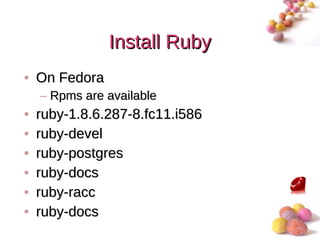
Install Ruby
• On Fedora
    – Rpms are available
•   ruby-1.8.6.287-8.fc11.i586
•   ruby-devel
•   ruby-postgres
•   ruby-docs
•   ruby-racc
•   ruby-docs
                                 #
Types
• Command “ruby”
• The extension is .rb


                         #
Ruby Documents
• Command ri
• Example
  – ri class
  –


                            #
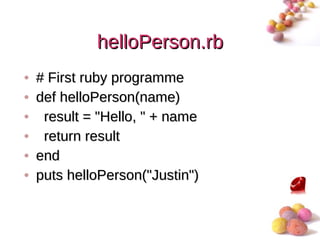
helloPerson.rb
•   # First ruby programme
•   def helloPerson(name)
•    result = "Hello, " + name
•    return result
•   end
•   puts helloPerson("Justin")


                                 #
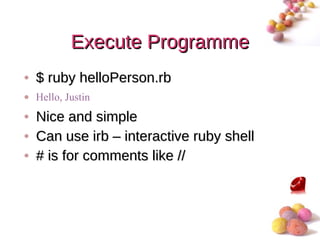
Execute Programme
•   $ ruby helloPerson.rb
•   Hello, Justin
•   Nice and simple
•   Can use irb – interactive ruby shell
•   # is for comments like //


                                           #
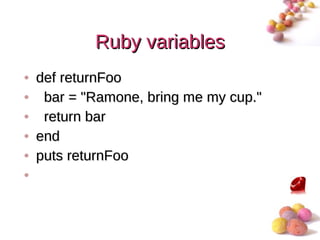
Ruby variables
• def returnFoo
• bar = "Ramone, bring me my cup."
• return bar
• end
• puts returnFoo
•


                                     #
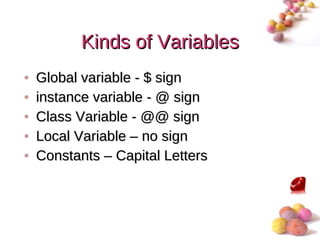
Kinds of Variables
•   Global variable - $ sign
•   instance variable - @ sign
•   Class Variable - @@ sign
•   Local Variable – no sign
•   Constants – Capital Letters


                                  #
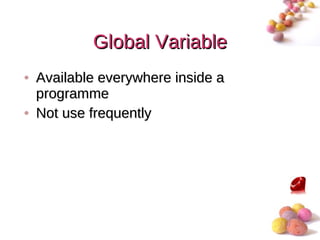
Global Variable
• Available everywhere inside a
  programme
• Not use frequently


                                  #
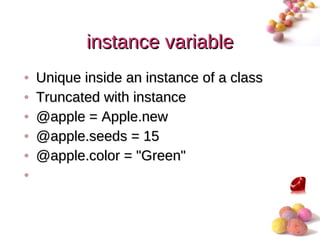
instance variable
•   Unique inside an instance of a class
•   Truncated with instance
•   @apple = Apple.new
•   @apple.seeds = 15
•   @apple.color = "Green"
•


                                           #
•   class Course
                               Classes
•    def initialize(dept, number, name, professor)
•     @dept = dept
•     @number = number
•     @name = name
•     @professor = professor
•    end
•    def to_s
•     "Course Information: #@dept #@number - #@name [#@professor]"
•    end
•    def
•     self.find_all_students
•     ...
•    end
•   end
                                                                 #
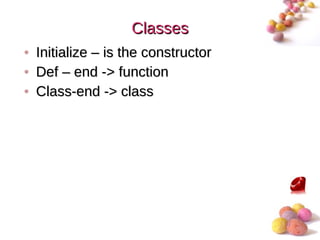
Classes
• Initialize – is the constructor
• Def – end -> function
• Class-end -> class


                                    #
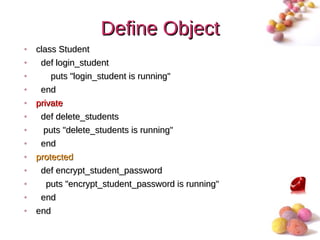
Define Object
•   class Student
•    def login_student
•      puts "login_student is running"
•    end
•   private
•    def delete_students
•    puts "delete_students is running"
•    end
•   protected
•    def encrypt_student_password
•     puts "encrypt_student_password is running"
•    end
•   end
                                                   #
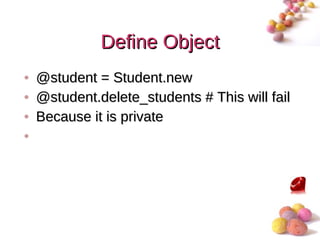
Define Object
• @student = Student.new
• @student.delete_students # This will fail
• Because it is private
•


                                          #
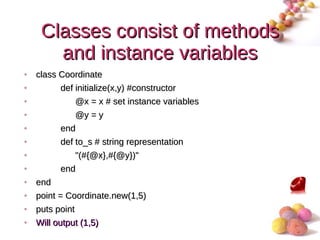
Classes consist of methods
       and instance variables
•   class Coordinate
•         def initialize(x,y) #constructor
•             @x = x # set instance variables
•             @y = y
•         end
•         def to_s # string representation
•            "(#{@x},#{@y})"
•         end
•   end
•   point = Coordinate.new(1,5)
•   puts point
•   Will output (1,5)                           #
Inheritance
•         class AnnotatedCoordinate < Coordinate
•            def initialize(x,y,comment)
•                              super(x,y)
•                                    @comment = comment
•            end
•            def to_s
•                                    super + "[#@comment]"
•           end
•         End
•   a_point =
•   AnnotatedCoordinate.new(8,14,"Centre");
•   puts a_point
•   Out Put Is ->   (8,14)[Centre]


                                                             #
Inheritance
• Inherit a parent class
• Extend functions and variables
• Add more features to base class


                                    #
Polymorphism
• The behavior of an object that varies
  depending on the input.
•
•


                                          #
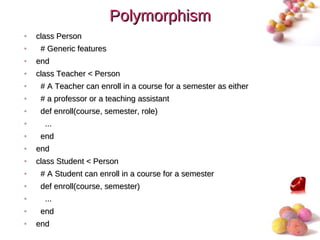
Polymorphism
•   class Person
•    # Generic features
•   end
•   class Teacher < Person
•    # A Teacher can enroll in a course for a semester as either
•    # a professor or a teaching assistant
•    def enroll(course, semester, role)
•     ...
•    end
•   end
•   class Student < Person
•    # A Student can enroll in a course for a semester
•    def enroll(course, semester)
•     ...
•    end
•   end                                                            #
Calling objects
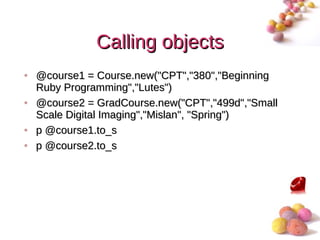
• @course1 = Course.new("CPT","380","Beginning
  Ruby Programming","Lutes")
• @course2 = GradCourse.new("CPT","499d","Small
  Scale Digital Imaging","Mislan", "Spring")
• p @course1.to_s
• p @course2.to_s


                                                  #
Calling Objects
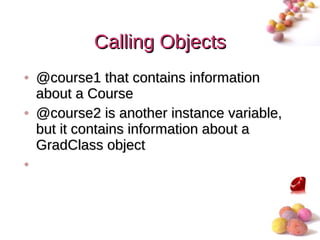
• @course1 that contains information
  about a Course
• @course2 is another instance variable,
  but it contains information about a
  GradClass object
•


                                           #
Arrays and hashes
•   fruit = ['Apple', 'Orange', 'Squash']
•   puts fruit[0]
•   fruit << 'Corn'
•   puts fruit[3]


                                            #
Arrays
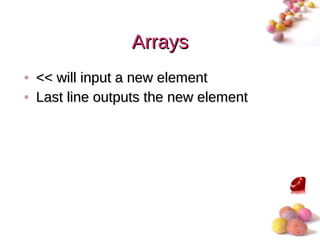
• << will input a new element
• Last line outputs the new element


                                      #
Arrays More...
•   fruit = {
•     :apple => 'fruit',
•     :orange => 'fruit',
•     :squash => 'vegetable'
•   }
•   puts fruit[:apple]
•   fruit[:corn] = 'vegetable'
•   puts fruit[:corn]
                                 #
Arrays More...
• h = {"Red" => 1, "Blue" => 2, "Green" =>
  3}
• CORPORATE
• p h["Red"]
• Outpus -> 1
• h["Yellow"] = 4
• p h["Yellow"]
• Outputs -> 4
                                         #
Decision structures
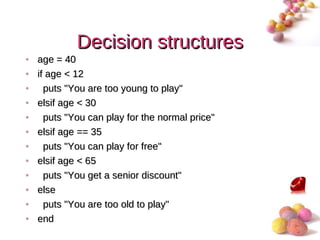
•   age = 40
•   if age < 12
•     puts "You are too young to play"
•   elsif age < 30
•     puts "You can play for the normal price"
•   elsif age == 35
•     puts "You can play for free"
•   elsif age < 65
•     puts "You get a senior discount"
•   else
•     puts "You are too old to play"
•   end
                                                 #
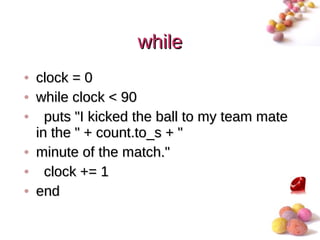
while
• clock = 0
• while clock < 90
• puts "I kicked the ball to my team mate
  in the " + count.to_s + "
• minute of the match."
• clock += 1
• end

                                        #
Iterators
• fruit = ['Apple', 'Orange', 'Squash']
• fruit.each do |f|
• puts f
• end


                                          #
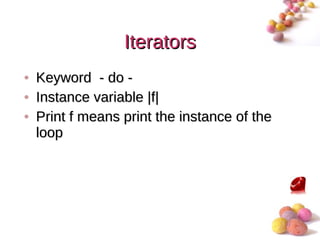
Iterators
• Keyword - do -
• Instance variable |f|
• Print f means print the instance of the
  loop


                                            #
Iterators
• fruit = ['Apple', 'Orange', 'Squash']
• fruit.each_with_index do |f,i|
• puts "#{i} is for #{f}"
• end
•


                                          #
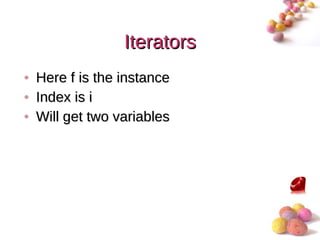
Iterators
• Here f is the instance
• Index is i
• Will get two variables


                            #
Iterators
• fruit = ['Apple', 'Orange', 'Squash']
• for i in 0...fruit.length
• puts fruit[i]
• end
•


                                          #
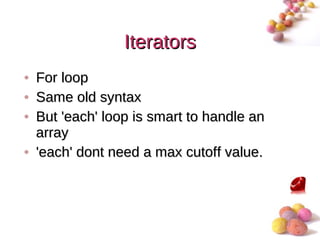
Iterators
• For loop
• Same old syntax
• But 'each' loop is smart to handle an
  array
• 'each' dont need a max cutoff value.


                                          #
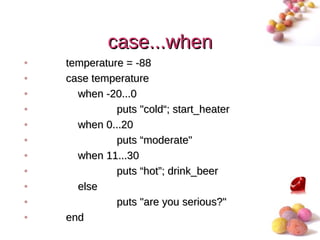
case...when
•   temperature = -88
•   case temperature
•     when -20...0
•             puts "cold“; start_heater
•     when 0...20
•             puts “moderate"
•     when 11...30
•             puts “hot”; drink_beer
•     else
•             puts "are you serious?"
•   end
                                          #
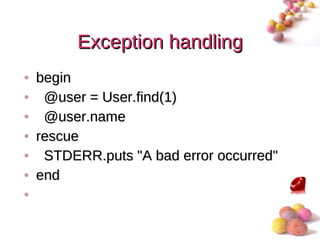
Exception handling
• begin
• @user = User.find(1)
• @user.name
• rescue
• STDERR.puts "A bad error occurred"
• end
•
                                       #
Thanks


         #

Introduction to Ruby

  • 1.
  • 2.
    What is Ruby? • Ruby – Object Oriented Programming Language • Written 1995 by Yukihiro Matsumoto • Influenced by Python,Pearl,LISP • Easy to understand and workwith • Simple and nice syntax • Powerful programming capabilities #
  • 3.
    Advantages • Powerful And Expressive • Rich Library Support • Rapid Development • Open Source • Flexible and Dynamic
  • 4.
    Install Ruby • OnFedora – Rpms are available • ruby-1.8.6.287-8.fc11.i586 • ruby-devel • ruby-postgres • ruby-docs • ruby-racc • ruby-docs #
  • 5.
    Types • Command “ruby” •The extension is .rb #
  • 6.
    Ruby Documents • Commandri • Example – ri class – #
  • 7.
    helloPerson.rb • # First ruby programme • def helloPerson(name) • result = "Hello, " + name • return result • end • puts helloPerson("Justin") #
  • 8.
    Execute Programme • $ ruby helloPerson.rb • Hello, Justin • Nice and simple • Can use irb – interactive ruby shell • # is for comments like // #
  • 9.
    Ruby variables • defreturnFoo • bar = "Ramone, bring me my cup." • return bar • end • puts returnFoo • #
  • 10.
    Kinds of Variables • Global variable - $ sign • instance variable - @ sign • Class Variable - @@ sign • Local Variable – no sign • Constants – Capital Letters #
  • 11.
    Global Variable • Availableeverywhere inside a programme • Not use frequently #
  • 12.
    instance variable • Unique inside an instance of a class • Truncated with instance • @apple = Apple.new • @apple.seeds = 15 • @apple.color = "Green" • #
  • 13.
    class Course Classes • def initialize(dept, number, name, professor) • @dept = dept • @number = number • @name = name • @professor = professor • end • def to_s • "Course Information: #@dept #@number - #@name [#@professor]" • end • def • self.find_all_students • ... • end • end #
  • 14.
    Classes • Initialize –is the constructor • Def – end -> function • Class-end -> class #
  • 15.
    Define Object • class Student • def login_student • puts "login_student is running" • end • private • def delete_students • puts "delete_students is running" • end • protected • def encrypt_student_password • puts "encrypt_student_password is running" • end • end #
  • 16.
    Define Object • @student= Student.new • @student.delete_students # This will fail • Because it is private • #
  • 17.
    Classes consist ofmethods and instance variables • class Coordinate • def initialize(x,y) #constructor • @x = x # set instance variables • @y = y • end • def to_s # string representation • "(#{@x},#{@y})" • end • end • point = Coordinate.new(1,5) • puts point • Will output (1,5) #
  • 18.
    Inheritance • class AnnotatedCoordinate < Coordinate • def initialize(x,y,comment) • super(x,y) • @comment = comment • end • def to_s • super + "[#@comment]" • end • End • a_point = • AnnotatedCoordinate.new(8,14,"Centre"); • puts a_point • Out Put Is -> (8,14)[Centre] #
  • 19.
    Inheritance • Inherit aparent class • Extend functions and variables • Add more features to base class #
  • 20.
    Polymorphism • The behaviorof an object that varies depending on the input. • • #
  • 21.
    Polymorphism • class Person • # Generic features • end • class Teacher < Person • # A Teacher can enroll in a course for a semester as either • # a professor or a teaching assistant • def enroll(course, semester, role) • ... • end • end • class Student < Person • # A Student can enroll in a course for a semester • def enroll(course, semester) • ... • end • end #
  • 22.
    Calling objects • @course1= Course.new("CPT","380","Beginning Ruby Programming","Lutes") • @course2 = GradCourse.new("CPT","499d","Small Scale Digital Imaging","Mislan", "Spring") • p @course1.to_s • p @course2.to_s #
  • 23.
    Calling Objects • @course1that contains information about a Course • @course2 is another instance variable, but it contains information about a GradClass object • #
  • 24.
    Arrays and hashes • fruit = ['Apple', 'Orange', 'Squash'] • puts fruit[0] • fruit << 'Corn' • puts fruit[3] #
  • 25.
    Arrays • << willinput a new element • Last line outputs the new element #
  • 26.
    Arrays More... • fruit = { • :apple => 'fruit', • :orange => 'fruit', • :squash => 'vegetable' • } • puts fruit[:apple] • fruit[:corn] = 'vegetable' • puts fruit[:corn] #
  • 27.
    Arrays More... • h= {"Red" => 1, "Blue" => 2, "Green" => 3} • CORPORATE • p h["Red"] • Outpus -> 1 • h["Yellow"] = 4 • p h["Yellow"] • Outputs -> 4 #
  • 28.
    Decision structures • age = 40 • if age < 12 • puts "You are too young to play" • elsif age < 30 • puts "You can play for the normal price" • elsif age == 35 • puts "You can play for free" • elsif age < 65 • puts "You get a senior discount" • else • puts "You are too old to play" • end #
  • 29.
    while • clock =0 • while clock < 90 • puts "I kicked the ball to my team mate in the " + count.to_s + " • minute of the match." • clock += 1 • end #
  • 30.
    Iterators • fruit =['Apple', 'Orange', 'Squash'] • fruit.each do |f| • puts f • end #
  • 31.
    Iterators • Keyword -do - • Instance variable |f| • Print f means print the instance of the loop #
  • 32.
    Iterators • fruit =['Apple', 'Orange', 'Squash'] • fruit.each_with_index do |f,i| • puts "#{i} is for #{f}" • end • #
  • 33.
    Iterators • Here fis the instance • Index is i • Will get two variables #
  • 34.
    Iterators • fruit =['Apple', 'Orange', 'Squash'] • for i in 0...fruit.length • puts fruit[i] • end • #
  • 35.
    Iterators • For loop •Same old syntax • But 'each' loop is smart to handle an array • 'each' dont need a max cutoff value. #
  • 36.
    case...when • temperature = -88 • case temperature • when -20...0 • puts "cold“; start_heater • when 0...20 • puts “moderate" • when 11...30 • puts “hot”; drink_beer • else • puts "are you serious?" • end #
  • 37.
    Exception handling • begin •@user = User.find(1) • @user.name • rescue • STDERR.puts "A bad error occurred" • end • #
  • 38.