Welcome to Our Presentation
Topic :Gene Expression Analysis
Slide Title
Group Name : Dream Gene
Outline :
• Biological Background
 Gene
 Gene Expression Analysis
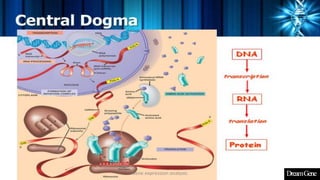
 Central Dogma
• Gene Expression
 Transcription
 Translation
• Microarrays
 Microarray Technologies
 Microarray Application
• Techniques and Tools
• Application of Gene Expression
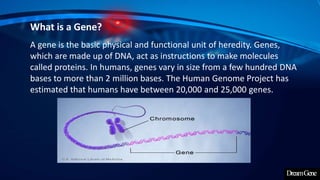
What is a Gene?
A gene is the basic physical and functional unit of heredity. Genes,
which are made up of DNA, act as instructions to make molecules
called proteins. In humans, genes vary in size from a few hundred DNA
bases to more than 2 million bases. The Human Genome Project has
estimated that humans have between 20,000 and 25,000 genes.
Gene expression analysis :
• Gene expression analysis is most simply described as
the study of the way genes are transcribed to
synthesize functional gene products — functional
RNA species or protein products
Two main stage of Gene Expression
• Transcription : the production of messenger RNA (mRNA) by
the enzyme RNA polymerase, and the processing of the
resulting mRNA molecule
• Translation: the use of mRNA to direct protein synthesis, and
the subsequent post-translational processing of the protein
molecule.
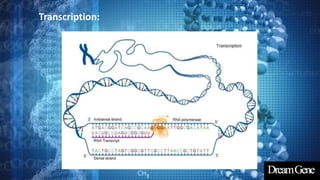
Transcription:
Transcription is the first step of gene expression. During this process, the
DNA sequence of a gene is copied into RNA.Transcription involves four steps:
 Initiation
 Elongation
 Termination
 Processing
Major Steps Of Transcription :
• RNA polymerase enzyme attaches to the start of the gene.
• mRNA is created.
• mRNA is processed,unnecessary sections are removed.
• mRNA moves out of nucleus into cytoplasm
Transcription:
Translation:
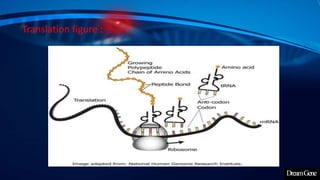
In translation the mature mRNA molecule is used as a template to
assemble a series of amino acids to produce a polypeptide with a specific
amino acid sequence. The complex in the cytoplasm at which this occurs is
called a ribosome. Ribosomes are a mixture of ribosomal proteins and
ribosomal RNA (rRNA), and consist of a large subunit and a small subunit
Major Steps Of Translation :
• mRNA binds to ribosome.
• Ribosome reads code in mRNA
• tRNA brings Amino acid corresponding to codon
• Chain of Amino acid formed
Translation also involves four steps:
 Initiation
 Elongation
 Termination
 Post-translation processing of the protein
Translation figure :
Techniques and tools:
The following experimental techniques are used to measure gene expression
 Low-to-mid-plex techniques:
 Reporter gene
 Northern blot
 Western blot
 Higher-plex techniques:
 SAGE
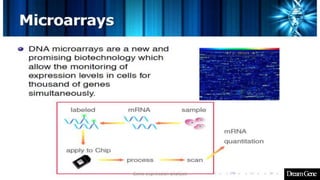
 DNA microarray
 Tiling array
 RNA-Se
Application of Gene Expression:
• Cancer diagnosis and it's treatment
• Over-expression studies
• Purification of a protein for further study
References:
• Wikipedia
• Khan Academy
• Genetics Home Reference
https://ghr.nlm.nih.gov/primer/basics/gene
• Cell
http://www.cell.com/cell/fulltext/S0092-8674(12)01226-3
• Scincing
https://sciencing.com/difference-between-prokaryotic-eukaryotic-gene-
expression-2609.html
Thank You

Gene expression-analysis

  • 1.
    Welcome to OurPresentation
  • 2.
  • 3.
  • 4.
    Outline : • BiologicalBackground  Gene  Gene Expression Analysis  Central Dogma • Gene Expression  Transcription  Translation • Microarrays  Microarray Technologies  Microarray Application • Techniques and Tools • Application of Gene Expression
  • 5.
    What is aGene? A gene is the basic physical and functional unit of heredity. Genes, which are made up of DNA, act as instructions to make molecules called proteins. In humans, genes vary in size from a few hundred DNA bases to more than 2 million bases. The Human Genome Project has estimated that humans have between 20,000 and 25,000 genes.
  • 6.
    Gene expression analysis: • Gene expression analysis is most simply described as the study of the way genes are transcribed to synthesize functional gene products — functional RNA species or protein products
  • 7.
    Two main stageof Gene Expression • Transcription : the production of messenger RNA (mRNA) by the enzyme RNA polymerase, and the processing of the resulting mRNA molecule • Translation: the use of mRNA to direct protein synthesis, and the subsequent post-translational processing of the protein molecule.
  • 8.
    Transcription: Transcription is thefirst step of gene expression. During this process, the DNA sequence of a gene is copied into RNA.Transcription involves four steps:  Initiation  Elongation  Termination  Processing
  • 9.
    Major Steps OfTranscription : • RNA polymerase enzyme attaches to the start of the gene. • mRNA is created. • mRNA is processed,unnecessary sections are removed. • mRNA moves out of nucleus into cytoplasm
  • 10.
  • 11.
    Translation: In translation themature mRNA molecule is used as a template to assemble a series of amino acids to produce a polypeptide with a specific amino acid sequence. The complex in the cytoplasm at which this occurs is called a ribosome. Ribosomes are a mixture of ribosomal proteins and ribosomal RNA (rRNA), and consist of a large subunit and a small subunit
  • 12.
    Major Steps OfTranslation : • mRNA binds to ribosome. • Ribosome reads code in mRNA • tRNA brings Amino acid corresponding to codon • Chain of Amino acid formed
  • 13.
    Translation also involvesfour steps:  Initiation  Elongation  Termination  Post-translation processing of the protein
  • 14.
  • 18.
    Techniques and tools: Thefollowing experimental techniques are used to measure gene expression  Low-to-mid-plex techniques:  Reporter gene  Northern blot  Western blot  Higher-plex techniques:  SAGE  DNA microarray  Tiling array  RNA-Se
  • 19.
    Application of GeneExpression: • Cancer diagnosis and it's treatment • Over-expression studies • Purification of a protein for further study
  • 20.
    References: • Wikipedia • KhanAcademy • Genetics Home Reference https://ghr.nlm.nih.gov/primer/basics/gene • Cell http://www.cell.com/cell/fulltext/S0092-8674(12)01226-3 • Scincing https://sciencing.com/difference-between-prokaryotic-eukaryotic-gene- expression-2609.html
  • 21.

Editor's Notes