SUBMITTED BY : AKBAR JAMAL SUBMITTED TO : VIKAS SIR
17EAYCE010 ASST. PROFESSOR
DEPARTMENT OF CIVIL
ENGINEERING
 INTRODUCTION TO BITUMEN
 INTRODUCTION TO BITUMEN ROAD
 OBJECTIVE OF BITUMEN ROAD
 PROPERTIES OF BITUMEN
 APPLICATION OF BITUMEN
 Asphalt, also known as bitumen. It is a sticky, black, highly viscous liquid or
semi-solid form of petroleum. It may be found in natural deposits or may be a
refined product, and is classed as a pitch. Before the 20th century, the term
asphalt was also used..
 Bitumen is a black or dark colored solid or viscous cementitious substance
having an adhesive properties.
 It consists chiefly high molecular weight hydrocarbons derivedfrom distillation
of petroleum or natural asphalt.
 The primary use (70%) of asphalt is in road construction, where it is used as the
glue or binder mixed with aggregate particles to create asphalt concrete. Its
other main uses are for bituminous waterproofing products, including
production of roofing felt and for sealing flat roofs.
 The Pitch Lake is the largest natural deposit of asphalt in the world, estimated to
contain 10 million tons. It is located in La Brea in southwest Trinidad, within
the Regional Corporation.
 A bituminous road is an asphalt concrete road, although it is rarely called a
bituminous road where I come from. Bitumen is by definition any of various
natural substances, such as asphalt, consisting of mainly hydrocarbons.
 Bitumen is often confused with tar. Although bitumen and coal tar are
similarly black and sticky, they are distinctly different substances origin,
chemical composition and in their properties
 Bituminous road is a road constructed by using bitumen. It is also called
flexible pavement because it changes its shape according to nature of load
and sub base
 A road or pavement is a structure consisting of super imposed layers of
processed materials above the natural soil sub-grade, whose primary
function is to distribute the applied vehicle loads to the subgrade.
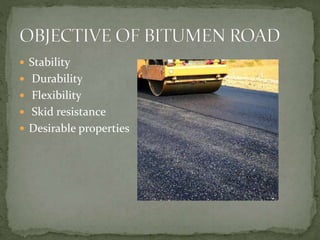
 Stability
 Durability
 Flexibility
 Skid resistance
 Desirable properties
 Adhesion:
The adhesive property of bitumen binds together all the
components without bringing about any positive or negative
changes in their properties. Bitumen has the ability to adhere to a
solid surface in a fluid state depending on the nature of the surface.
The presence of water on the surface will prevent adhesion.
 Economical:
It is available in cheaper rates almost all over the world which
makes it feasible and affordable in many applications.
 Strength:
Though the coarse aggregates are the main load bearing
component in a pavement, bitumen or asphalt also play a vital role
in distributing the traffic loads to the layers beneath.
 Resistance to Water:
Bitumen is insoluble in water and can serve as an
effective sealant Bitumen is water resistant. Under
some conditions water may be absorbed by minute
quantities of inorganic salts in the
 Versatility:
Due to versatility property of Bitumen it is relatively
easy to use it in many applications because of its
thermoplastic property. It can be spread easily along
the underlying pavement layers as it liquefies when
heated making the job easier and hardens in a solid
mass when cooled.
 There are many uses of bituminous materials in civil engineering works like:
 For paints: The industrial blown or R grade of bitumen is mainly used for
bituminous paints and other surfaces.
 Damp proofing: For damp proofing, prefabricated mats that are sprayed with
blown bitumen are used. They are also used to prevent pollution from spreading
in the form of small water-retaining, bituminous walls at refuse disposal sites.
 Roofing: Coverings of Roofs (Shingles) and Roofing felts are made of fibers or
plastics. These are impregnated with penetration-grade bitumen and coated with
blown-grade bitumen.
 Tanking of basements: Bitumen is the usual choice for waterproofing of
Basements like Asphalt.
 Pavements: Largely used for the construction of roads, runways, taxiways,
etc.
 Protection of structures: It is used as a protective coating by impregnation
for concrete elements such as slabs, piles, etc. Organic binders of 10-15 mm
thickness are also applied over these coatings, to prevent the bitumen from
corroding off.
THANK YOU

BITUMEN FOR ROAD CONSTRUCTION AND ITS APPLICATION

  • 1.
    SUBMITTED BY :AKBAR JAMAL SUBMITTED TO : VIKAS SIR 17EAYCE010 ASST. PROFESSOR DEPARTMENT OF CIVIL ENGINEERING
  • 2.
     INTRODUCTION TOBITUMEN  INTRODUCTION TO BITUMEN ROAD  OBJECTIVE OF BITUMEN ROAD  PROPERTIES OF BITUMEN  APPLICATION OF BITUMEN
  • 3.
     Asphalt, alsoknown as bitumen. It is a sticky, black, highly viscous liquid or semi-solid form of petroleum. It may be found in natural deposits or may be a refined product, and is classed as a pitch. Before the 20th century, the term asphalt was also used..  Bitumen is a black or dark colored solid or viscous cementitious substance having an adhesive properties.  It consists chiefly high molecular weight hydrocarbons derivedfrom distillation of petroleum or natural asphalt.  The primary use (70%) of asphalt is in road construction, where it is used as the glue or binder mixed with aggregate particles to create asphalt concrete. Its other main uses are for bituminous waterproofing products, including production of roofing felt and for sealing flat roofs.  The Pitch Lake is the largest natural deposit of asphalt in the world, estimated to contain 10 million tons. It is located in La Brea in southwest Trinidad, within the Regional Corporation.
  • 4.
     A bituminousroad is an asphalt concrete road, although it is rarely called a bituminous road where I come from. Bitumen is by definition any of various natural substances, such as asphalt, consisting of mainly hydrocarbons.  Bitumen is often confused with tar. Although bitumen and coal tar are similarly black and sticky, they are distinctly different substances origin, chemical composition and in their properties  Bituminous road is a road constructed by using bitumen. It is also called flexible pavement because it changes its shape according to nature of load and sub base  A road or pavement is a structure consisting of super imposed layers of processed materials above the natural soil sub-grade, whose primary function is to distribute the applied vehicle loads to the subgrade.
  • 6.
     Stability  Durability Flexibility  Skid resistance  Desirable properties
  • 7.
     Adhesion: The adhesiveproperty of bitumen binds together all the components without bringing about any positive or negative changes in their properties. Bitumen has the ability to adhere to a solid surface in a fluid state depending on the nature of the surface. The presence of water on the surface will prevent adhesion.  Economical: It is available in cheaper rates almost all over the world which makes it feasible and affordable in many applications.  Strength: Though the coarse aggregates are the main load bearing component in a pavement, bitumen or asphalt also play a vital role in distributing the traffic loads to the layers beneath.
  • 8.
     Resistance toWater: Bitumen is insoluble in water and can serve as an effective sealant Bitumen is water resistant. Under some conditions water may be absorbed by minute quantities of inorganic salts in the  Versatility: Due to versatility property of Bitumen it is relatively easy to use it in many applications because of its thermoplastic property. It can be spread easily along the underlying pavement layers as it liquefies when heated making the job easier and hardens in a solid mass when cooled.
  • 9.
     There aremany uses of bituminous materials in civil engineering works like:  For paints: The industrial blown or R grade of bitumen is mainly used for bituminous paints and other surfaces.  Damp proofing: For damp proofing, prefabricated mats that are sprayed with blown bitumen are used. They are also used to prevent pollution from spreading in the form of small water-retaining, bituminous walls at refuse disposal sites.  Roofing: Coverings of Roofs (Shingles) and Roofing felts are made of fibers or plastics. These are impregnated with penetration-grade bitumen and coated with blown-grade bitumen.  Tanking of basements: Bitumen is the usual choice for waterproofing of Basements like Asphalt.
  • 10.
     Pavements: Largelyused for the construction of roads, runways, taxiways, etc.  Protection of structures: It is used as a protective coating by impregnation for concrete elements such as slabs, piles, etc. Organic binders of 10-15 mm thickness are also applied over these coatings, to prevent the bitumen from corroding off.
  • 11.