BISOPROLOL
PHARMACOLOGICAL AND CLINICAL
          DEPICT


UNIVERSITY OF VETERINARY AND ANIMAL
         SCIENCES, LAHORE
           ASADULLAH, R. Ph.
         1st Semester ,Department of Pharmacology
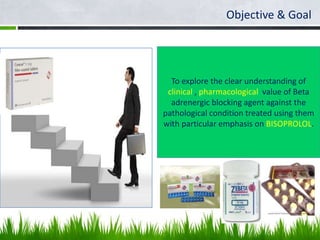
Objective & Goal


  To explore the clear understanding of
 clinical , pharmacological value of Beta
  adrenergic blocking agent against the
pathological condition treated using them
with particular emphasis on BISOPROLOL.
What is Bisoprolol?

    HISTORY AND APPROVAL


     PHARMACOLOGICAL PROPERTIES


     THERAPEUTIC INDICATION


    CONTRAINDICATION /AR


TOXICOLOGICAL STUDY
What is Bisoprolol?

    HISTORY AND APPROVAL


     PHARMACOLOGICAL PROPERTIES


     THERAPEUTIC INDICATION


    CONTRAINDICATION /AR


TOXICOLOGICAL STUDY
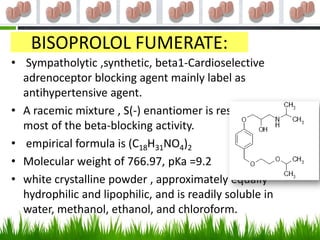
BISOPROLOL FUMERATE:
• Sympatholytic ,synthetic, beta1-Cardioselective
  adrenoceptor blocking agent mainly label as
  antihypertensive agent.
• A racemic mixture , S(-) enantiomer is responsible for
  most of the beta-blocking activity.
• empirical formula is (C18H31NO4)2
• Molecular weight of 766.97, pKa =9.2
• white crystalline powder , approximately equally
  hydrophilic and lipophilic, and is readily soluble in
  water, methanol, ethanol, and chloroform.
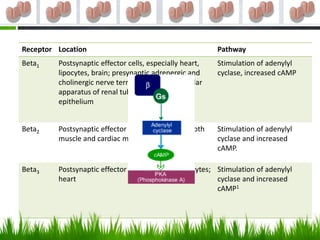
Receptor Location                                          Pathway
Beta1    Postsynaptic effector cells, especially heart,    Stimulation of adenylyl
         lipocytes, brain; presynaptic adrenergic and      cyclase, increased cAMP
         cholinergic nerve terminals, juxtaglomerular
         apparatus of renal tubules, ciliary body
         epithelium


Beta2    Postsynaptic effector cells, especially smooth    Stimulation of adenylyl
         muscle and cardiac muscle                         cyclase and increased
                                                           cAMP.

Beta3    Postsynaptic effector cells, especially lipocytes; Stimulation of adenylyl
         heart                                              cyclase and increased
                                                            cAMP1
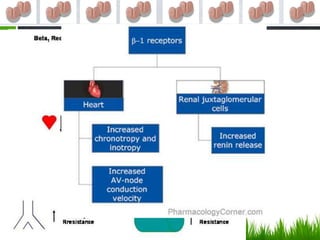
Heart


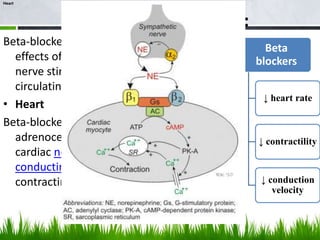
             Mechanism of Action:
Beta-blockers antagonise the
                             Sympathetic       Beta
  effects of sympathetic      influence      blockers
  nerve stimulation or
  circulating catecholamines
                               chronotropy    ↓ heart rate
• Heart
Beta-blockers bind to beta-
  adrenoceptors located in      Ionotropy    ↓ contractility
  cardiac nodal tissue, the
  conducting system, and
  contracting myocytes.                       ↓ conduction
                               dromotropy
                                                 velocity
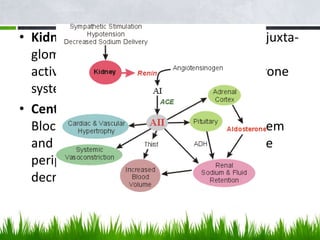
• Kidney: inhibit the release of renin from juxta-
  glomerular cells and thereby reduce the
  activity of the renin-angiotensin-aldosterone
  system.
• Central and peripheral nervous system:
  Blockade of beta-receptors in the brainstem
  and of prejunctional beta-receptors in the
  periphery inhibits the release of NT and
  decreases sympathetic activity.
What is Bisoprolol?

    HISTORY AND APPROVAL


     PHARMACOLOGICAL PROPERTIES


     THERAPEUTIC INDICATION


    CONTRAINDICATION /AR


TOXICOLOGICAL STUDY
Molecule entity approval:
July 31, 1992 FDA approved Duramed
Pharmaceutical's application for Zebeta
Oral Tablets (Bisoprolol Fumarate)

Generic Approval:

October 25, 2002 by Mutual pharma.
What is Bisoprolol?

    HISTORY AND APPROVAL


     PHARMACOLOGICAL PROPERTIES


     THERAPEUTIC INDICATION


    CONTRAINDICATION /AR


TOXICOLOGICAL STUDY
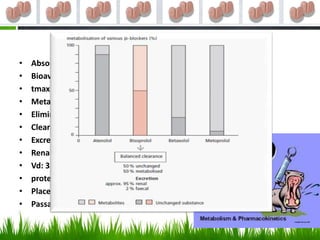
PHARMACOKINETICS
•   Absorption rate: >90%
•   Bioavailability: 90%
•   tmax: 2 –3 h
•   Metabolism:both liver & kidney
•   Elimination half-life: 10 –12 h
•   Clearance: 50% unchanged ,50% metabolised
•   Excretion: approx. 95% renal, 2% faecal
•   Renal clearance: 140ml /min
•   Vd: 3.21/kg
•   protein binding: ~30%
•   Placental patency: yes
•   Passage into milk: yes
Pharmacodynamics:
1- B1-selecivity:
bisoprolol is more selective for Beta 1 in human bronchus
   Hence bronchoconstriction drawback of ancient Beta blockers
   is overwhelmed .
       15-time b1-then b2
       31-time b1-then b3-
       In contrast, atenolol and metoprolol exhibited
       only 5-time selectivity for b1- versus b2- and b3
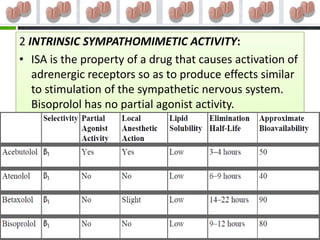
2 INTRINSIC SYMPATHOMIMETIC ACTIVITY:
• ISA is the property of a drug that causes activation of
   adrenergic receptors so as to produce effects similar
   to stimulation of the sympathetic nervous system.
   Bisoprolol has no partial agonist activity.
3-Membrane-stabilizing activity:
• Bisoprolol has no local anesthetic activity in the
   dose range relevant for b-receptor blockade.
• Some beta-blockers block sodium channels with
   properties similar to those of local anesthetics: they
   block late current preferentially over peak current
   and the interaction depends critically on the
   inactivated state of the channe
4- Renin-angiotensin system:
Bisoprolol inhibits basal and stimulated renin secretion.
The renin released from the cells of the juxtaglomerular
   apparatus leads to formation of angiotensin II. Renin
   release is stimulated by b1-receptors .
5-Antihypertensive effect:
• Bisoprolol had a pronounced antihypertensive effect in all
  hypertension models investigated.
• Bisoprolol reduced the blood pressure accompanied by only a
  slight decrease in heart rate. In comparison with bisoprolol,
  propranolol had a weaker antihypertensive effect even at a
  considerably higher dose level.
6-Cardioprotection:
• Bisoprolol protects the myocardium from ischemia-related
  damage. bisoprolol showed only a small negative inotropic
  effect.

• 7- Lipid metabolisim:
• increase in total cholesterol or LDL-cholesterol and a
  decrease in HDL-cholesterol are side effect of non
  selective beta receptor.
• Bisoprolol generally induces no change in the cholesterol
• fractions
8- Carbohydrate metabolism.
• Owing to its high b1-selectivity, bisoprolol generally has no
• influence on the carbohydrate metabolism.
• 9- Insulin sensitivity.
• b-blockers are speculated to have a negative impact on
   certain parameters of glycemic control such as insulin
   resistance.
• This is an adaptive physiological phenomenon, when the
   cellular requirement for glucose is jeopardised in
   conditions of low glucose availability or high demand
   (such as fasting, starving, stress or hypoglycemia).
SAFETY

• The performed animal experimental investigations
  indicated for bisoprolol no unexpected or serious side-
  effects.
• Even at high doses [30 and 100mg/ kg, single oral
  administration(rats)], the sedative effects ascribed to
  b-blockers are less marked with bisoprolol than, for
  instance, with propranolol .
What is Bisoprolol?

    HISTORY AND APPROVAL


     PHARMACOLOGICAL PROPERTIES


     THERAPEUTIC INDICATION


    CONTRAINDICATION /AR


TOXICOLOGICAL STUDY
Clinical Uses:
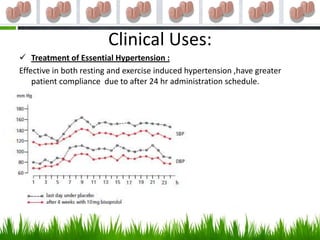
 Treatment of Essential Hypertension :
Effective in both resting and exercise induced hypertension ,have greater
    patient compliance due to after 24 hr administration schedule.
• As a single daily dose, bisoprolol normalised the
  blood pressure for 24 hours
• controls exercise-induced blood pressure peaks over
  24 hours.
• Control blood pressure peaks which may eventually
  result in cardiovascular complications, are avoided.
• Long-term treatment of arterial hypertension
• Regression of left ventricular hypertrophy
Treatment of angina pectoris in
          coronary heart disease
• reduce the number of angina pectoris attacks to a minimum, and to
  increase the patient’s exercise tolerance
• Bisoprolol increases the myocardial perfusion in coronary artery disease.
  makes the left ventricular function more economical
• After MI, early administration of a b-blocker without ISA reduces the
  mortality. b-blockers are established in secondary prevention.
Treatment of Chronic heart faliure
• In the past b-blockers were contraindicated in
  CHF due to negative ionotropic effect.
• Recent studies/ clinical trials have
  demonstrated improvements in symptoms,
• b-blockers without intrinsic sympathetic
  activity are efficient in reducing mortality
What is Bisoprolol?

    HISTORY AND APPROVAL


     PHARMACOLOGICAL PROPERTIES


     THERAPEUTIC INDICATION


    CONTRAINDICATION /AR


TOXICOLOGICAL STUDY
Contraindication

cardiogenic shock,
cardiac failure,
second or third degree AV block, and
marked sinus bradycardia.
Special consideration
 Cardiac Failure:
depression of myocardial contractility and precipitate more severe
   failure.
 Abrupt cessation:
Exacerbation angina pectoris, MI, ventricular arrhythmia
 Bronchospasm
 Anesthesia and Major Surgery
anesthetic depress myocardial function,risk of hypotension or
   bradychardia
 Diabetes and Hypoglycemia
Beta-blockers may mask symptoms of hypoglycemia, particularly
   tachycardia
 Thyrotoxicosis
 may mask clinical signs of hyperthyroidism, such as tachycardia.
Adverse Reaction:
Potentially Fatal:         Non Fetal:
o AV block, bradycardia.   • Increased sweating
o bronchospasm,            • Arthralgia
o hypoglycaemia,           • Insomnia, depression
o hypotension,             • Cough, dysnea
o orthostatic              • Nausea, vomiting,
  hypotension,               diarrhea
o Rebound phenomenon
What is Bisoprolol?

   HISTORY AND APPROVAL


     PHARMACOLOGICAL PROPERTIES


     THERAPEUTIC INDICATION


   CONTRAINDICATION /AR


TOXICOLOGICAL STUDY
TOXICITY
The toxicological studies revealed no irreversible organ damage.
  In animal not cytotoxic nor mutagenic. Although it was
  embryotoxic at higher doses it was not teratogenic nor
  carcinogenic in the mouse or rat.
Acute toxicity:
• On oral administration the LD50 was 734 for the mouse and 1116 mg/kg for
  the rat with a follow-up period of 14 days. On intravenous administration
  values of 127 (mouse), 53 (rat) and 24 (dog) mg/kg were found.
Chronic toxicity:
No toxic effects were detected in rats after oral administration for
6 months at daily doses of 15, 50 and 150mg/kg. 10 mg/kg was
not toxic for beagles after daily administration for 6 months.
Success is a journey not destination and there is no
    final destination in improvement journey

Bisoprolol

  • 2.
    BISOPROLOL PHARMACOLOGICAL AND CLINICAL DEPICT UNIVERSITY OF VETERINARY AND ANIMAL SCIENCES, LAHORE ASADULLAH, R. Ph. 1st Semester ,Department of Pharmacology
  • 3.
    Objective & Goal To explore the clear understanding of clinical , pharmacological value of Beta adrenergic blocking agent against the pathological condition treated using them with particular emphasis on BISOPROLOL.
  • 4.
    What is Bisoprolol? HISTORY AND APPROVAL PHARMACOLOGICAL PROPERTIES THERAPEUTIC INDICATION CONTRAINDICATION /AR TOXICOLOGICAL STUDY
  • 5.
    What is Bisoprolol? HISTORY AND APPROVAL PHARMACOLOGICAL PROPERTIES THERAPEUTIC INDICATION CONTRAINDICATION /AR TOXICOLOGICAL STUDY
  • 6.
    BISOPROLOL FUMERATE: • Sympatholytic,synthetic, beta1-Cardioselective adrenoceptor blocking agent mainly label as antihypertensive agent. • A racemic mixture , S(-) enantiomer is responsible for most of the beta-blocking activity. • empirical formula is (C18H31NO4)2 • Molecular weight of 766.97, pKa =9.2 • white crystalline powder , approximately equally hydrophilic and lipophilic, and is readily soluble in water, methanol, ethanol, and chloroform.
  • 7.
    Receptor Location Pathway Beta1 Postsynaptic effector cells, especially heart, Stimulation of adenylyl lipocytes, brain; presynaptic adrenergic and cyclase, increased cAMP cholinergic nerve terminals, juxtaglomerular apparatus of renal tubules, ciliary body epithelium Beta2 Postsynaptic effector cells, especially smooth Stimulation of adenylyl muscle and cardiac muscle cyclase and increased cAMP. Beta3 Postsynaptic effector cells, especially lipocytes; Stimulation of adenylyl heart cyclase and increased cAMP1
  • 10.
    Heart Mechanism of Action: Beta-blockers antagonise the Sympathetic Beta effects of sympathetic influence blockers nerve stimulation or circulating catecholamines chronotropy ↓ heart rate • Heart Beta-blockers bind to beta- adrenoceptors located in Ionotropy ↓ contractility cardiac nodal tissue, the conducting system, and contracting myocytes. ↓ conduction dromotropy velocity
  • 11.
    • Kidney: inhibitthe release of renin from juxta- glomerular cells and thereby reduce the activity of the renin-angiotensin-aldosterone system. • Central and peripheral nervous system: Blockade of beta-receptors in the brainstem and of prejunctional beta-receptors in the periphery inhibits the release of NT and decreases sympathetic activity.
  • 12.
    What is Bisoprolol? HISTORY AND APPROVAL PHARMACOLOGICAL PROPERTIES THERAPEUTIC INDICATION CONTRAINDICATION /AR TOXICOLOGICAL STUDY
  • 13.
    Molecule entity approval: July31, 1992 FDA approved Duramed Pharmaceutical's application for Zebeta Oral Tablets (Bisoprolol Fumarate) Generic Approval: October 25, 2002 by Mutual pharma.
  • 14.
    What is Bisoprolol? HISTORY AND APPROVAL PHARMACOLOGICAL PROPERTIES THERAPEUTIC INDICATION CONTRAINDICATION /AR TOXICOLOGICAL STUDY
  • 15.
    PHARMACOKINETICS • Absorption rate: >90% • Bioavailability: 90% • tmax: 2 –3 h • Metabolism:both liver & kidney • Elimination half-life: 10 –12 h • Clearance: 50% unchanged ,50% metabolised • Excretion: approx. 95% renal, 2% faecal • Renal clearance: 140ml /min • Vd: 3.21/kg • protein binding: ~30% • Placental patency: yes • Passage into milk: yes
  • 16.
    Pharmacodynamics: 1- B1-selecivity: bisoprolol ismore selective for Beta 1 in human bronchus Hence bronchoconstriction drawback of ancient Beta blockers is overwhelmed . 15-time b1-then b2 31-time b1-then b3- In contrast, atenolol and metoprolol exhibited only 5-time selectivity for b1- versus b2- and b3
  • 17.
    2 INTRINSIC SYMPATHOMIMETICACTIVITY: • ISA is the property of a drug that causes activation of adrenergic receptors so as to produce effects similar to stimulation of the sympathetic nervous system. Bisoprolol has no partial agonist activity. 3-Membrane-stabilizing activity: • Bisoprolol has no local anesthetic activity in the dose range relevant for b-receptor blockade. • Some beta-blockers block sodium channels with properties similar to those of local anesthetics: they block late current preferentially over peak current and the interaction depends critically on the inactivated state of the channe
  • 18.
    4- Renin-angiotensin system: Bisoprololinhibits basal and stimulated renin secretion. The renin released from the cells of the juxtaglomerular apparatus leads to formation of angiotensin II. Renin release is stimulated by b1-receptors . 5-Antihypertensive effect: • Bisoprolol had a pronounced antihypertensive effect in all hypertension models investigated. • Bisoprolol reduced the blood pressure accompanied by only a slight decrease in heart rate. In comparison with bisoprolol, propranolol had a weaker antihypertensive effect even at a considerably higher dose level.
  • 19.
    6-Cardioprotection: • Bisoprolol protectsthe myocardium from ischemia-related damage. bisoprolol showed only a small negative inotropic effect. • 7- Lipid metabolisim: • increase in total cholesterol or LDL-cholesterol and a decrease in HDL-cholesterol are side effect of non selective beta receptor. • Bisoprolol generally induces no change in the cholesterol • fractions
  • 20.
    8- Carbohydrate metabolism. •Owing to its high b1-selectivity, bisoprolol generally has no • influence on the carbohydrate metabolism. • 9- Insulin sensitivity. • b-blockers are speculated to have a negative impact on certain parameters of glycemic control such as insulin resistance. • This is an adaptive physiological phenomenon, when the cellular requirement for glucose is jeopardised in conditions of low glucose availability or high demand (such as fasting, starving, stress or hypoglycemia).
  • 21.
    SAFETY • The performedanimal experimental investigations indicated for bisoprolol no unexpected or serious side- effects. • Even at high doses [30 and 100mg/ kg, single oral administration(rats)], the sedative effects ascribed to b-blockers are less marked with bisoprolol than, for instance, with propranolol .
  • 22.
    What is Bisoprolol? HISTORY AND APPROVAL PHARMACOLOGICAL PROPERTIES THERAPEUTIC INDICATION CONTRAINDICATION /AR TOXICOLOGICAL STUDY
  • 23.
    Clinical Uses:  Treatmentof Essential Hypertension : Effective in both resting and exercise induced hypertension ,have greater patient compliance due to after 24 hr administration schedule.
  • 24.
    • As asingle daily dose, bisoprolol normalised the blood pressure for 24 hours • controls exercise-induced blood pressure peaks over 24 hours. • Control blood pressure peaks which may eventually result in cardiovascular complications, are avoided. • Long-term treatment of arterial hypertension • Regression of left ventricular hypertrophy
  • 25.
    Treatment of anginapectoris in coronary heart disease • reduce the number of angina pectoris attacks to a minimum, and to increase the patient’s exercise tolerance • Bisoprolol increases the myocardial perfusion in coronary artery disease. makes the left ventricular function more economical • After MI, early administration of a b-blocker without ISA reduces the mortality. b-blockers are established in secondary prevention.
  • 26.
    Treatment of Chronicheart faliure • In the past b-blockers were contraindicated in CHF due to negative ionotropic effect. • Recent studies/ clinical trials have demonstrated improvements in symptoms, • b-blockers without intrinsic sympathetic activity are efficient in reducing mortality
  • 27.
    What is Bisoprolol? HISTORY AND APPROVAL PHARMACOLOGICAL PROPERTIES THERAPEUTIC INDICATION CONTRAINDICATION /AR TOXICOLOGICAL STUDY
  • 28.
    Contraindication cardiogenic shock, cardiac failure, secondor third degree AV block, and marked sinus bradycardia.
  • 29.
    Special consideration  CardiacFailure: depression of myocardial contractility and precipitate more severe failure.  Abrupt cessation: Exacerbation angina pectoris, MI, ventricular arrhythmia  Bronchospasm  Anesthesia and Major Surgery anesthetic depress myocardial function,risk of hypotension or bradychardia  Diabetes and Hypoglycemia Beta-blockers may mask symptoms of hypoglycemia, particularly tachycardia  Thyrotoxicosis  may mask clinical signs of hyperthyroidism, such as tachycardia.
  • 30.
    Adverse Reaction: Potentially Fatal: Non Fetal: o AV block, bradycardia. • Increased sweating o bronchospasm, • Arthralgia o hypoglycaemia, • Insomnia, depression o hypotension, • Cough, dysnea o orthostatic • Nausea, vomiting, hypotension, diarrhea o Rebound phenomenon
  • 31.
    What is Bisoprolol? HISTORY AND APPROVAL PHARMACOLOGICAL PROPERTIES THERAPEUTIC INDICATION CONTRAINDICATION /AR TOXICOLOGICAL STUDY
  • 32.
    TOXICITY The toxicological studiesrevealed no irreversible organ damage. In animal not cytotoxic nor mutagenic. Although it was embryotoxic at higher doses it was not teratogenic nor carcinogenic in the mouse or rat. Acute toxicity: • On oral administration the LD50 was 734 for the mouse and 1116 mg/kg for the rat with a follow-up period of 14 days. On intravenous administration values of 127 (mouse), 53 (rat) and 24 (dog) mg/kg were found. Chronic toxicity: No toxic effects were detected in rats after oral administration for 6 months at daily doses of 15, 50 and 150mg/kg. 10 mg/kg was not toxic for beagles after daily administration for 6 months.
  • 34.
    Success is ajourney not destination and there is no final destination in improvement journey

Editor's Notes

  • #11 Beta-adrenoceptors are coupled to a Gs-proteins, which activate adenylylcyclase to form cAMP from ATP. Increased cAMP activates a cAMP-dependent protein kinase (PK-A) that phosphorylates L-type calcium channels, which causes increased calcium entry into the cell. Increased calcium entry during action potentials leads to enhanced release of calcium by the sarcoplasmic reticulum in the heart; these actions increase inotropy (contractility). Gs-protein activation also increases heart rate (chronotropy). PK-A also phosphorylates sites on the sarcoplasmic reticulum, which lead to enhanced release of calcium through the ryanodine receptors (ryanodine-sensitive, calcium-release channels) associated with the sarcoplasmic reticulum. This provides more calcium for binding thetroponin-C, which enhances inotropy. Finally, PK-A can phosphorylate myosin light chains, which may contribute to the positive inotropic effect of beta-adrenoceptor stimulation.
  • #18 Molecular determinants of local anesthetic action of beta-blocking drugs: Implications for therapeutic management of long QT syndrome variant 3John R. Bankston and Robert S. Kass*
  • #29 CardiogenicshockCardiogenic shock is when the heart has been damaged so much that it is unable to supply enough blood to the organs of the bodySecond-degree heart block may result in the heart skipping a beat or beats. This type of heart block also can make you feel dizzy or faint.Third-degree heart block limits the heart's ability to pump blood to the rest of the body. This type of heart block may cause fatigue (tiredness), dizziness, and fainting. Third-degree heart block requires prompt treatment because it can be fatalBackgroundSinus bradycardia can be defined as a sinus rhythm with a resting heart rate of 60 beats per minute or less. However, few patients actually become symptomatic until their heart rate drops to less than 50 beats per minute. The action potential responsible for this rhythm arises from the sinus node and causes a P wave on the surface ECG that is normal in terms of both amplitude and vector. These P waves are typically followed by a normal QRS complex and T wave.