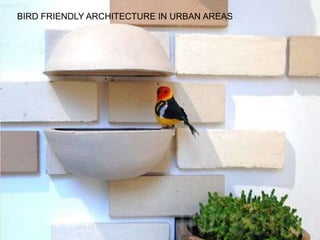
BIRD FRIENDLY ARCHITECTURE IN URBAN AREAS
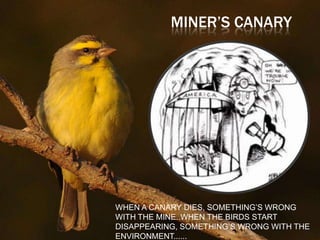
MINER’S CANARY


WHEN A CANARY DIES, SOMETHING’S WRONG
WITH THE MINE..WHEN THE BIRDS START
DISAPPEARING, SOMETHING’S WRONG WITH THE
ENVIRONMENT......
BY NATURE CITIES
                                                HAVE A GOOD
                                             SPECIES DIVERSITY
 FRAGMENTATION                                 BECAUSE THEY
                                                ARE USUALLY
HABITAT LOSS                     BIRDSSPECIE
                                              DEVELOPED NEAR
   PREDATORS                     S           WETLANDS, RIVERS
INVASIVE SPECIES                   DIVERSITY        ETC.
    SPECIES
  HOMOGENEITY
   POLLUTION
COLLISIONS         DEVELOPMENT               BIODIVERSITY


                    ARCHITECT
                                         SUSTAINABILITY
‘’Let's start by imagining a fine Persian carpet and a hunting
    knife. We set about cutting the carpet into thirty-six equal
  pieces. There's still nearly 216 square feet of recognizably
carpet like stuff. But what does it amount to? Have we got thirty-
   six nice Persian throw rugs? No. All we're left with is three
dozen ragged fragments, each one worthless and commencing
                          to come apart."
MANICURED
LANDSCAPE


              HABITAT COMPENSATION
             SEMI RUSTIC LANDSCAPE-
            URBAN,CAMPUS,CORPORATE,
                  HOME GARDEN
               CAR PARKING AREAS
•AMPLE NESTING SPACE
•COOLER
•SHALLOW PONDS
•FRUIT AND NECTAR
•INSECTS FROM LEAF
LITTER
•SAFETY FROM PREDATORS
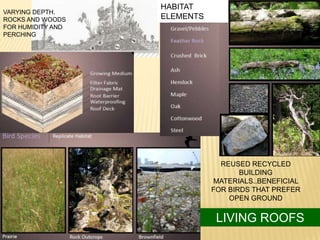
HABITAT
VARYING DEPTH.
ROCKS AND WOODS    ELEMENTS
FOR HUMIDITY AND
PERCHING


                                REUSED RECYCLED
                                     BUILDING
                              MATERIALS..BENEFICIAL
                              FOR BIRDS THAT PREFER
                                  OPEN GROUND


                               LIVING ROOFS
GRASS LAND


BROWN FIELD


ROCK OUTCROP
PLATFOR
                                 M
CAVITY                     CUP

                                  BIRD
                                  NEST
                                  TYPES


PENDENT   GROUND NESTING
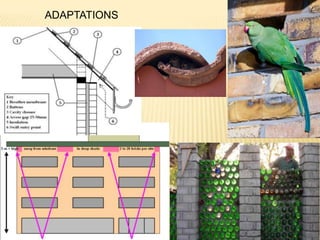
ADAPTATIONS
ADD-ON NEST BOXES
ADAPTATIONS
ADAPTATIONS
ADAPTATIONS
ADAPTATIONS


EARTH BERMS FOR GROUND NESTING
BIRDS
The Liyuan Library by architect Li
Xiaodong encourages birds to build
nests on its structure. The exterior is
clad with more than 400,000 locally
sourced sticks of firewood, which Li
hopes will attract birds that will
contribute mud and droppings to help
plant-life grow.
‘DANCING TREES,
SINGING BIRDS’ IN
JAPAN- EFFICIENT
USE OF SPACE
BIRD MORTALITY DUE TO
        COLLISION-
          GLASS
, TRANSPARENT, REFLECTIV
            E,
BIRDS CANNOT MAKE OUT...
   PATTERNED GLASS/UV
    GLASS/NETTING ETC.
        SOLUTIONS
ARTIFICIAL
LIGHTING-
DISORIENTATION
DOWNLIGHTING,
SHADED
LIGHTING, PREVE
NTING LIGHT
LEAKS
Avoid fragmentation. Cluster designs. green network.
Urban landscapes. semi rustic. Trees. Shallow water bodies. Lawns with local grass.
Leaf litter.
Roof gardens semi rustic
Attic spaces. Part of the attic spaces accessible to birds. Holes or openings of 5cm-
10cm diameter.
Compound walls as nesting spaces
Balconies, verandahs and sit outs with hooks.
Projecting decorative elements - window ledges, decorative bracket supports for
balconies, eave boards for sunshades, smaller gaps between the sunshade top and
roof overhang etc.
Courtyards and atria with greenery which are accessible to birds can be thought of as
part of lobby designs.
Avoid the use of plain transparent and reflective glass in general. They can be used
with narrow patterns, netting etc.
Artificial lighting in open spaces should be just enough for use, avoid light spilling,
and preferably use down lighting.
Being conscious about biodiversity during designing is most important, because this
can lead to context and project based design solutions encouraging bird presence.
REFERENCES
Daniel James Pedley (2010) Birds and People in Towns and Cities: An Exploration of Human-Bird Relations in Urban Areas; a Thesis submitted to
University of Hull
Hansell, Mike (2000). Bird Nests & Construction Behaviour. Cambridge: Cambridge University Press
Jameson F. Chacea, John J. Walshb(2004) Urban effects on native avifauna: a review
John M. Marzluff, Ewing, K., 2001. Restoration of fragmented landscapes for the con- servation of birds: a general framework and specific
recommendations for urbanizing landscapes. Restor. Ecol.
John M. Marzluff , Reed Bowman, and Roarke Donnelly(2001) ''Avian Ecology and Conservation in an Urbanizing World'' Kluwer Academic
Publishers
K. Wang1, Z. Cao 2 and L. Xu3 Ecological compensation in urban design of coastal lowland city: lincheng new town lowland technology international
Vol. 7, No. 2, December 2005 International Association of Lowland Technology
Mathey, J., and D. Rink. 2010 'Urban wastelands – a chance for biodiversity in cities? Ecological aspects, social perceptions and acceptance of
wilderness by residents' in Urban Biodiversity and Design edited by Norbert Muller, P. Werner, J. G. Kelcey. Wiley.
Melles, S., S. Glenn, and K. Martin. 2003. 'Urban bird diversity and landscape complexity: species-environment associations along a multiscale habitat
gradient'. Conservation Ecology
Raphael K Didham, Ecological Consequences of Habitat Fragmentation, Australia Published online: November 2010
Rendell, Wallace B.; Robertson, Raleigh J. (1994),"Cavity Entry Orientation and Nest-site Use by Secondary Hole-nesting Birds" (PDF), Journal of
Field Ornithology
http://www.metrofieldguide.com/a-roof-for-the-birds-creating-habitat-on-the-portland-mausoleum-roof/
R. Fernandez-Canero and P. Gonzalez-Redondo 2010 Green Roofs as a Habitat for Birds: A Review; Journal of Animal and Veterinary Advances;
Volume: 9, Issue: 15
Simone Fontana, ThomasSattler, FabioBontadina, MarcoMoretti (2011)How to manage the urban green to improve bird diversity and community
structure, Landscape and Urban Planning
Turner, W. R., T. Nakamura, and M. Dinetti. 2004. Global urbanization and the separation of humans from nature. BioScience
http://www.birdsandbuildings.org/docs/DougStotzFieldMuseum.pdf
http://www.birdfriendlybuildingdesign.com
http://www.krishnamb.com/composing-corporate-garden-landscapes
http://www.smartplanet.com/blog/design-architecture/building-for-the-birds-and-the-bees-and-bats/7749
http://www.artinfo.com/photo-galleries/slideshow-a-library-lost-in-the-woods-of-china
http://www.birdsandbuildings.org/documents/BirdFriendlyBuildingDesign.pdf
http://www.behav.org/student_essay/birds/behav/finne_2010_urban_birds.pdf
http://www.waterpark.org/documents/pages/birds_bats_and_buildings/690e5_007.pdf
http://www.livingroofs.org
http://www.waterpark.org/trust/biodiversity.html
THANK YOU

Bird Friendly Architecture

  • 1.
  • 2.
    MINER’S CANARY WHEN ACANARY DIES, SOMETHING’S WRONG WITH THE MINE..WHEN THE BIRDS START DISAPPEARING, SOMETHING’S WRONG WITH THE ENVIRONMENT......
  • 4.
    BY NATURE CITIES HAVE A GOOD SPECIES DIVERSITY FRAGMENTATION BECAUSE THEY ARE USUALLY HABITAT LOSS BIRDSSPECIE DEVELOPED NEAR PREDATORS S WETLANDS, RIVERS INVASIVE SPECIES DIVERSITY ETC. SPECIES HOMOGENEITY POLLUTION COLLISIONS DEVELOPMENT BIODIVERSITY ARCHITECT SUSTAINABILITY
  • 5.
    ‘’Let's start byimagining a fine Persian carpet and a hunting knife. We set about cutting the carpet into thirty-six equal pieces. There's still nearly 216 square feet of recognizably carpet like stuff. But what does it amount to? Have we got thirty- six nice Persian throw rugs? No. All we're left with is three dozen ragged fragments, each one worthless and commencing to come apart."
  • 7.
    MANICURED LANDSCAPE HABITAT COMPENSATION SEMI RUSTIC LANDSCAPE- URBAN,CAMPUS,CORPORATE, HOME GARDEN CAR PARKING AREAS
  • 8.
    •AMPLE NESTING SPACE •COOLER •SHALLOWPONDS •FRUIT AND NECTAR •INSECTS FROM LEAF LITTER •SAFETY FROM PREDATORS
  • 9.
    HABITAT VARYING DEPTH. ROCKS ANDWOODS ELEMENTS FOR HUMIDITY AND PERCHING REUSED RECYCLED BUILDING MATERIALS..BENEFICIAL FOR BIRDS THAT PREFER OPEN GROUND LIVING ROOFS
  • 10.
  • 11.
    PLATFOR M CAVITY CUP BIRD NEST TYPES PENDENT GROUND NESTING
  • 12.
  • 13.
  • 14.
  • 15.
  • 16.
  • 17.
    ADAPTATIONS EARTH BERMS FORGROUND NESTING BIRDS
  • 18.
    The Liyuan Libraryby architect Li Xiaodong encourages birds to build nests on its structure. The exterior is clad with more than 400,000 locally sourced sticks of firewood, which Li hopes will attract birds that will contribute mud and droppings to help plant-life grow.
  • 19.
    ‘DANCING TREES, SINGING BIRDS’IN JAPAN- EFFICIENT USE OF SPACE
  • 20.
    BIRD MORTALITY DUETO COLLISION- GLASS , TRANSPARENT, REFLECTIV E, BIRDS CANNOT MAKE OUT... PATTERNED GLASS/UV GLASS/NETTING ETC. SOLUTIONS
  • 22.
  • 24.
    Avoid fragmentation. Clusterdesigns. green network. Urban landscapes. semi rustic. Trees. Shallow water bodies. Lawns with local grass. Leaf litter. Roof gardens semi rustic Attic spaces. Part of the attic spaces accessible to birds. Holes or openings of 5cm- 10cm diameter. Compound walls as nesting spaces Balconies, verandahs and sit outs with hooks. Projecting decorative elements - window ledges, decorative bracket supports for balconies, eave boards for sunshades, smaller gaps between the sunshade top and roof overhang etc. Courtyards and atria with greenery which are accessible to birds can be thought of as part of lobby designs. Avoid the use of plain transparent and reflective glass in general. They can be used with narrow patterns, netting etc. Artificial lighting in open spaces should be just enough for use, avoid light spilling, and preferably use down lighting. Being conscious about biodiversity during designing is most important, because this can lead to context and project based design solutions encouraging bird presence.
  • 25.
    REFERENCES Daniel James Pedley(2010) Birds and People in Towns and Cities: An Exploration of Human-Bird Relations in Urban Areas; a Thesis submitted to University of Hull Hansell, Mike (2000). Bird Nests & Construction Behaviour. Cambridge: Cambridge University Press Jameson F. Chacea, John J. Walshb(2004) Urban effects on native avifauna: a review John M. Marzluff, Ewing, K., 2001. Restoration of fragmented landscapes for the con- servation of birds: a general framework and specific recommendations for urbanizing landscapes. Restor. Ecol. John M. Marzluff , Reed Bowman, and Roarke Donnelly(2001) ''Avian Ecology and Conservation in an Urbanizing World'' Kluwer Academic Publishers K. Wang1, Z. Cao 2 and L. Xu3 Ecological compensation in urban design of coastal lowland city: lincheng new town lowland technology international Vol. 7, No. 2, December 2005 International Association of Lowland Technology Mathey, J., and D. Rink. 2010 'Urban wastelands – a chance for biodiversity in cities? Ecological aspects, social perceptions and acceptance of wilderness by residents' in Urban Biodiversity and Design edited by Norbert Muller, P. Werner, J. G. Kelcey. Wiley. Melles, S., S. Glenn, and K. Martin. 2003. 'Urban bird diversity and landscape complexity: species-environment associations along a multiscale habitat gradient'. Conservation Ecology Raphael K Didham, Ecological Consequences of Habitat Fragmentation, Australia Published online: November 2010 Rendell, Wallace B.; Robertson, Raleigh J. (1994),"Cavity Entry Orientation and Nest-site Use by Secondary Hole-nesting Birds" (PDF), Journal of Field Ornithology http://www.metrofieldguide.com/a-roof-for-the-birds-creating-habitat-on-the-portland-mausoleum-roof/ R. Fernandez-Canero and P. Gonzalez-Redondo 2010 Green Roofs as a Habitat for Birds: A Review; Journal of Animal and Veterinary Advances; Volume: 9, Issue: 15 Simone Fontana, ThomasSattler, FabioBontadina, MarcoMoretti (2011)How to manage the urban green to improve bird diversity and community structure, Landscape and Urban Planning Turner, W. R., T. Nakamura, and M. Dinetti. 2004. Global urbanization and the separation of humans from nature. BioScience http://www.birdsandbuildings.org/docs/DougStotzFieldMuseum.pdf http://www.birdfriendlybuildingdesign.com http://www.krishnamb.com/composing-corporate-garden-landscapes http://www.smartplanet.com/blog/design-architecture/building-for-the-birds-and-the-bees-and-bats/7749 http://www.artinfo.com/photo-galleries/slideshow-a-library-lost-in-the-woods-of-china http://www.birdsandbuildings.org/documents/BirdFriendlyBuildingDesign.pdf http://www.behav.org/student_essay/birds/behav/finne_2010_urban_birds.pdf http://www.waterpark.org/documents/pages/birds_bats_and_buildings/690e5_007.pdf http://www.livingroofs.org http://www.waterpark.org/trust/biodiversity.html
  • 26.