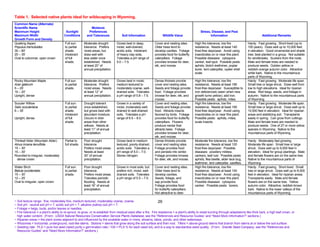
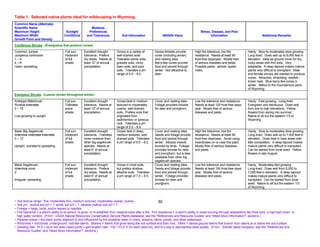
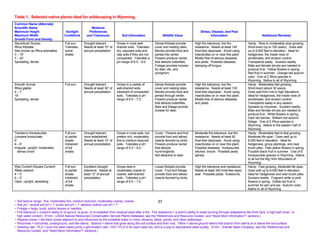
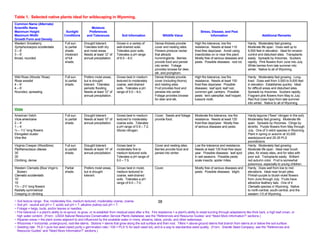
WYOMING WILDSCAPE
HOW TO DESIGN, PLANT, AND MAINTAIN LANDSCAPING
        TO BENEFIT PEOPLE AND WILDLIFE


                    Compiled by:
                   Andrea Cerovski
            Wyoming Game and Fish Department
                   Nongame Program
                    260 Buena Vista
                   Lander, WY 82520
                         2005
TABLE OF CONTENTS                                                                  INTRODUCTION
Introduction                                                       Page 1
Benefits of Wildscaping                                                 2
Designing Your Wildscape                                                2
Deciding What to Plant                                                  4
  Go for the Natives                                                    4
  Purchasing Trees and Shrubs                                           4       Wyoming is home to 325 species of birds – some are here year-round,
  Other Planting Considerations                                         5       while others only spend the summer or winter months in Wyoming, or
Planting and Wildscaping Guidelines                                     6
  How to Plant Trees and Shrubs                                         6       are found here only during spring and autumn migration. Nearly half of
  How to Plant Wildflowers                                              7       the 325 species are classified as Neotropical migratory birds. These are
  How to Plant Grasses                                                  8       simply the species of birds that migrate between breeding grounds in
  How to Create a Water Source                                          9       Canada and the United States, and wintering grounds in Latin America
  How to Create a Terrace                                             10        south of the U.S. border with Mexico.
  How to Create a Wetland                                              11
  How to Create Compost                                               11        Long-term Breeding Bird Survey data in North America show that
  How to Create Additional Diversity                                   12       populations of many species of Neotropical migrants have declined, as
  Other Wildscaping Considerations                                     12
Wildscape Maintenance                                                 13
                                                                                well as some resident species (those that don’t migrate or that migrate
  Watering                                                             13       within the U.S.). These declines are due to a number of problems,
  Disease                                                              13       especially habitat loss and degradation on breeding and wintering
  Nutrients and Fertilizers                                            13       grounds and along migration routes. In response to these population
  Pruning                                                              14       declines, the international Partners In Flight (PIF) program began in
  Pesticides                                                           15       1990, and Wyoming Partners In Flight, our state working group, began
  Other Maintenance Considerations                                    16
                                                                                in 1991. The goal of PIF is to conserve, restore, or enhance populations
Wildscaping Do’s and Don’ts                                            17
Seasonal To-Do List                                                    17       of landbirds and the habitats upon which they depend for survival, while
Need More Information?                                                18        including the needs of humans in all programs and endeavors.
  For More Information on Plants Native to Wyoming                    18
  For More Information on Landscaping with Native Plants              18        With that goal in mind, something we can do to help populations of both
  For More Information on Backyard Wildscaping                         18       resident and Neotropical migratory birds is to plant native wildscapes –
  For More Information on Creating a Healthy Yard                     18        landscaping that benefits both people and wildlife. Wildscaping can be
  For More Information on Watering Efficiently                         18       done on virtually any piece of land of any size if a wildscaping plan is
  For More Information on Water Conserving Landscape Methods          18
                                                                                developed and followed. Use this guide to design, plant, and maintain
  For More Information on Trees and Shrubs                            18
  For More Information on Wildflowers and Grasses                     18        your wildscape. In the back of the guide are some additional resources
  For More Information on Collecting Native Seeds and Plants          19        to help you find out more about wildscaping. While this list is by no
  For More Information on Creating a Wetland                          19        means exhaustive, it does give you a place to start. Contact your local
  For More Information on Building a Terrace                           19       Conservation District, greenhouse, or landscaping center to order native
  For More Information on Composting                                  19        plants, or obtain a permit to collect plants on state or federal lands.
  For More Information on Weeds, Pests, and Invasive Plants            19
  For More Information on Bats                                         19       For more information about Partners In Flight, contact the Nongame Bird
  For More Information on Butterflies                                 19        Biologist, Wyoming Game and Fish Department, 260 Buena Vista,
  For More Information on Beneficial Insects                          19
  For More Information on Birds                                        19       Lander, WY 82520 (307-332-2688 or in-state 1-800-654-7862), or visit
References and Resource Guides                                        20        the Partners In Flight website at www.partnersinflight.org.
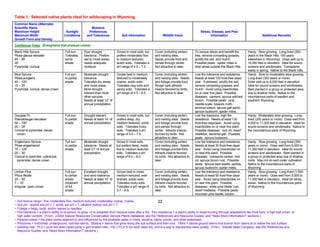
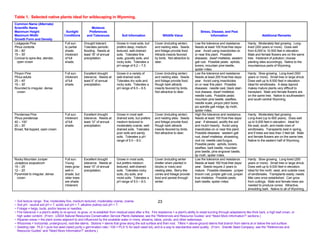
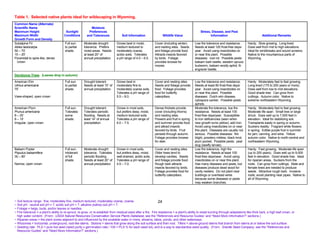
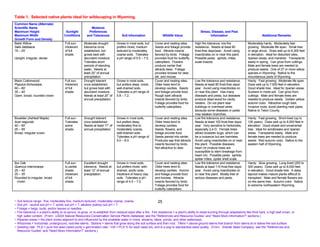
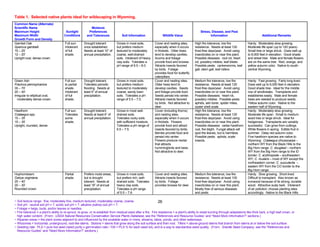
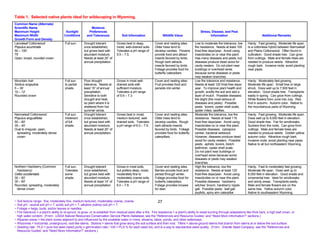
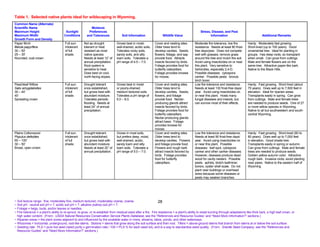
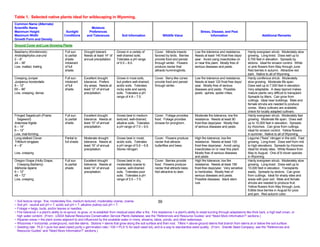
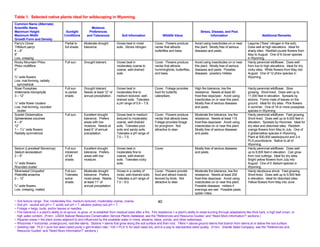
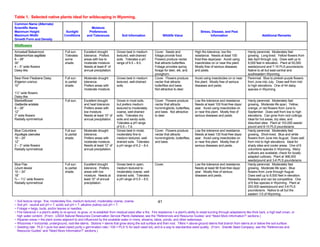
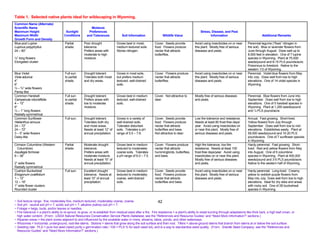
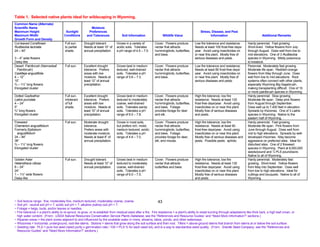
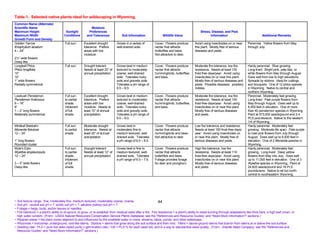
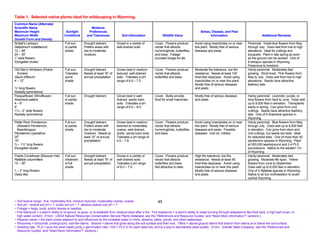
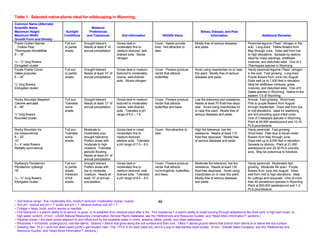
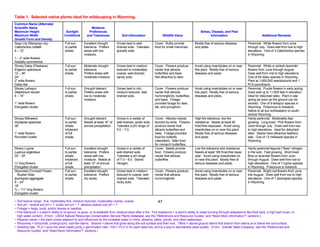
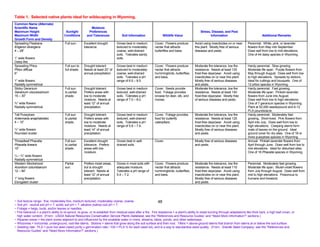
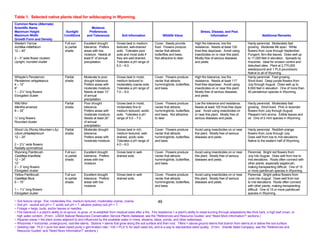
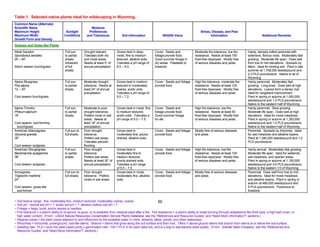
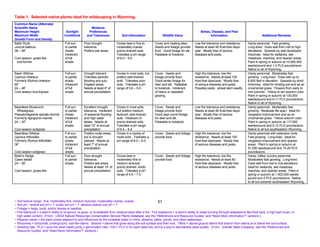
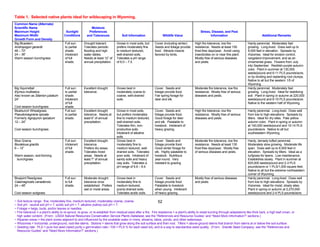
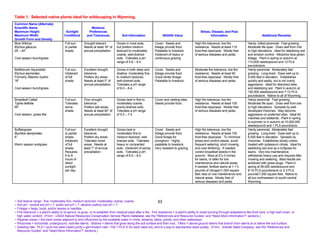
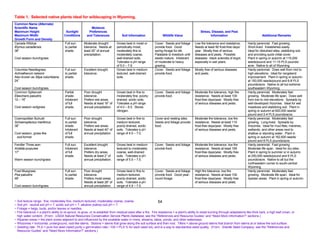
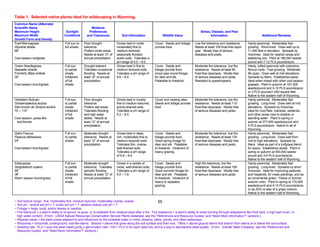
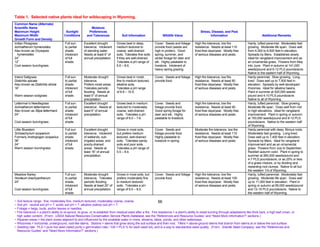
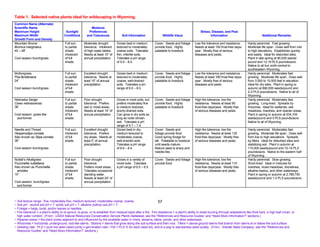
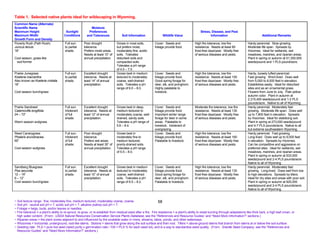
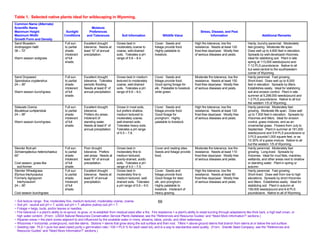
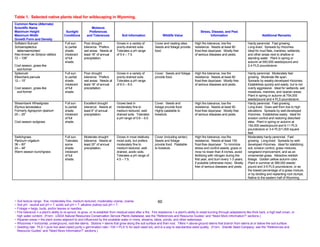
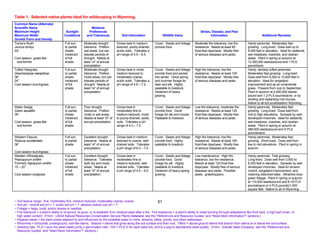
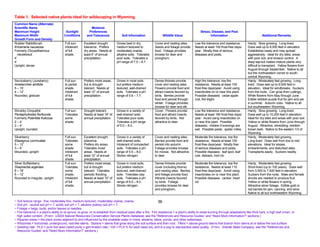
Table 1. Selected Native Plants Ideal for Wildscaping in Wyoming       22
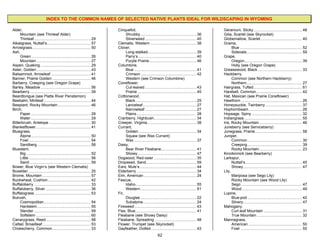
Index to the Common Names of Selected Native Plants                    62       Enjoy your Wyoming Wildscape!

                                                                            1
BENEFITS OF WILDSCAPING                                                         DESIGNING YOUR WILDSCAPE

♦ Wildscaping is attractive to people and it provides habitat for wildlife.       ♦ With a little planning and foresight, you can plant and enjoy a
  Native plants support up to 50 times as many species of native wildlife           wildscape in your backyard; on school grounds; at businesses,
  as do non-native, or exotic, plants.                                              churches, and golf courses; or in parks, greenbelts, and open areas.
♦ Wildscaping increases the value of your property.                               ♦ Plan to practice water-wise wildscaping, or xeriscaping (this uses less
♦ Plantings can be used to provide privacy and reduce noise.                        water, reduces the time and cost spent on lawn maintenance, and
♦ Proper placement of shade trees and shrubs reduces heating costs                  provides the best growing conditions for your plants).
  for homes and other buildings by 25 to 40%, and reduces cooling                     • Use water efficiently - water only when soil moisture is low.
  costs by 15 to 50%.                                                                 • Avoid watering during the hottest part of the day (10 am – 3 pm)
♦ Wildscaping can reduce water costs by up to 60% and water use by                      or in windy conditions to reduce water loss from evaporation.
  up to 70% because it saves water used in maintaining a non-native                   • Water thoroughly and completely, but not too often.
  lawn, which needs 36 inches or more of supplemental water per year.                 • Use native organic mulch (wood chips or shredded bark) to help
♦ Wildscaping increases water infiltration into the soil, which reduces                 retain moisture. Mulch also reduces weed growth, prevents soil
  soil erosion, runoff of urban pollutants, and flood damage.                           compaction, adds nutrients to the soil, encourages extensive
♦ Wildscaping with a diversity of plants will help guard against pests                  rooting, regulates soil temperature, and reduces plant damage.
  and disease, which have greater impacts on areas with only a few                    • Choose plants that are well adapted to your region, especially
  types of plants.                                                                      drought tolerant plants.
♦ Wildscaping protects human health, pets, and the environment by                 ♦ Plan to use minimal or no pesticides.
  minimizing or eliminating pesticide use and reducing fossil fuel use.               • Many insects and microorganisms are beneficial and can be
♦ Lawn maintenance is labor-intensive and has hidden costs such as                      controlled biologically by the birds using your wildscape.
  equipment, fuel, lubricants, blade sharpening, repair, and storage.                 • If insect control is needed, practice Integrated Pest Management
  Wildscaping can reduce the costs and labor associated with lawn                       (see the “Wildscape Maintenance” section).
  maintenance by up to 60% because it requires less mowing, fertilizing,          ♦ Plan to create habitat diversity in your wildscape.
  and pesticide use.                                                                  • All creatures need food; water; and cover in which to rest, escape
♦ Wildscaping saves landfill space by composting food wastes and by                     from predators and weather, and raise their young.
  recycling or composting yard wastes.                                                • To provide and improve habitat for wildlife and attract the most
♦ Trees help clean the air we breathe and replenish it with fresh oxygen.               species, include vertical, horizontal, and structural diversity.
♦ Wildscaping creates living classrooms for nature study and enjoyment,                   ∗ Vertical diversity - multi-layered vegetation including the
  and promotes awareness of ecology, biological diversity, and the                           canopy of tall trees; the understory of smaller trees, shrubs,
  integration of natural and human communities.                                              and vines; and the layer of ground vegetation comprised of
♦ With proper planning in appropriate areas, wildscaping can mimic                           low-growing shrubs, flowers, grasses, and ground-hugging
  natural ecosystems, providing a home for wildlife and a haven for you.                     plants. Vertical diversity increases the surface area for birds
                                                                                             and other wildlife to nest, feed, and rest upon.


                                                                              2
∗ Horizontal diversity - create clumps of different plant types                      ∗ Typical wind direction.
          and open space throughout your wildscape to produce “edge                          ∗ Path of the sun, and daily sun and shade patterns.
          effects” (the interface between distinct vegetation types).                        ∗ Moist and dry areas, water movement, drainage patterns, and
        ∗ Structural diversity - include a large variety of plant species                      slope of the land.
          in your wildscape plan to create different sizes, shapes, and                      ∗ Soil type – clay, silt, sand, or loam (an equal mix of all three).
          densities of vegetation.                                                           ∗ Problem spots (areas that are difficult to water, areas with
    • While waiting for plants to mature and provide food and nesting                          poor soil, areas with extreme snow or ice build up, etc.).
      sites, place feeding stations and nest boxes in your wildscape.
        ∗ Place bird feeders close enough to cover to allow easy                                             Open area (backyard property is owned by the city)
          escape, but not so close that predators, including domestic
                                                                                  N                                                           Clay soil; slight
          and feral cats, can hide and ambush unsuspecting birds.                                               Wind direction                slope to the N          Property
        ∗ Erect nest boxes and bat houses for specific species you wish                                                                                                 line
                                                                                                                                    Snow and ice
          to attract (first determine what should occur in your area) and                                       House and
                                                                                                                                  builds up; shady
                                                                                                                 driveway
          place them at the appropriate height and aspect (direction).                                                             and moist area

    • The number of species you attract will increase if you provide a                                                                         Shady and
                                                                                                                                               moist area
      source of water, especially a moving source of water (see the
      “Planting and Wildscaping Guidelines” section).                                                                                                Buried
                                                                                                                                                     cable          Existing tree
♦ Plan to use adapted plants, and choose native plants whenever                                                                                                     and shrubs
  possible.
                                                                                                                Dry areas;
    • Adapted plants are those suited to specific soil, moisture, and sun                                         sunny
                                                                                          Neighbors on the                                                        Arc of the sun
      environments, or “micro-climates”.                                                   east and west
    • Adapted plants are more disease resistant and are naturally                                                                                                  Sidewalk
                                                                                 Street
      attractive to wildlife.
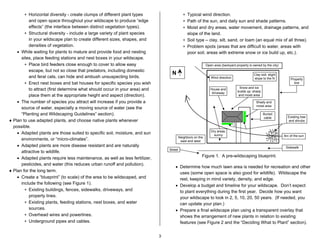
    • Adapted plants require less maintenance, as well as less fertilizer,                               Figure 1. A pre-wildscaping blueprint.
      pesticides, and water (this reduces urban runoff and pollution).
                                                                                     • Determine how much lawn area is needed for recreation and other
♦ Plan for the long term.
                                                                                       uses (some open space is also good for wildlife). Wildscape the
    • Create a “blueprint” (to scale) of the area to be wildscaped, and                rest, keeping in mind variety, density, and edge.
      include the following (see Figure 1).
                                                                                     • Develop a budget and timeline for your wildscape. Don’t expect
        ∗ Existing buildings, fences, sidewalks, driveways, and                        to plant everything during the first year. Decide how you want
          property lines.                                                              your wildscape to look in 2, 5, 10, 20, 50 years. (If needed, you
        ∗ Existing plants, feeding stations, nest boxes, and water                     can update your plan.)
          sources.                                                                   • Prepare a final wildscape plan using a transparent overlay that
        ∗ Overhead wires and powerlines.                                               shows the arrangement of new plants in relation to existing
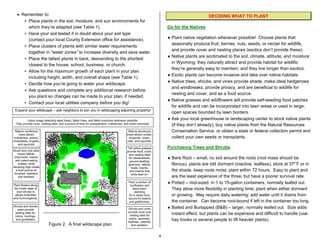
        ∗ Underground pipes and cables.                                                features (see Figure 2 and the “Deciding What to Plant” section).


                                                                             3
• Remember to:                                                                                                                          DECIDING WHAT TO PLANT
      ∗ Place plants in the soil, moisture, and sun environments for
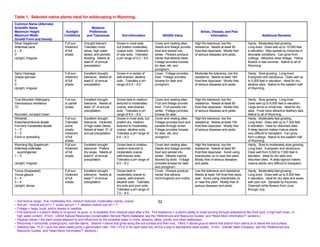
        which they’re adapted (see Table 1).                                                                        Go for the Natives
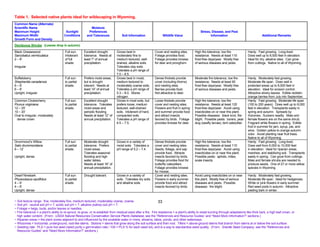
      ∗ Have your soil tested if in doubt about your soil type
        (contact your local County Extension office for assistance).                                                ♦ Plant native vegetation whenever possible! Choose plants that
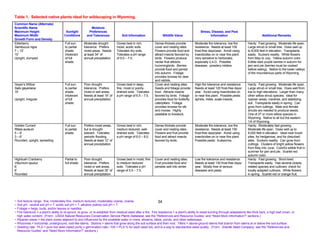
                                                                                                                      seasonally produce fruit, berries, nuts, seeds, or nectar for wildlife,
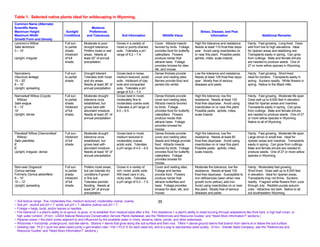
      ∗ Place clusters of plants with similar water requirements
                                                                                                                      and provide cover and nesting places (exotics don’t provide these).
        together in “water zones” to increase diversity and save water.
                                                                                                                    ♦ Native plants are acclimated to the soil, climate, altitude, and moisture
      ∗ Place the tallest plants in back, descending to the shortest
                                                                                                                      in Wyoming; they naturally attract and provide habitat for wildlife;
        closest to the house, school, business, or church.
                                                                                                                      they’re generally easy to maintain; and they live longer than exotics.
      ∗ Allow for the maximum growth of each plant in your plan
                                                                                                                    ♦ Exotic plants can become invasive and take over native habitats.
        including height, width, and overall shape (see Table 1).
                                                                                                                    ♦ Native trees, shrubs, and vines provide shade, make ideal hedgerows
      ∗ Decide how you’re going to water your wildscape.
                                                                                                                      and windbreaks, provide privacy, and are beneficial to wildlife for
      ∗ Ask questions and complete any additional research before
                                                                                                                      nesting and cover, and as a food source.
        you plant so changes can be made to your plan, if needed.
                                                                                                                    ♦ Native grasses and wildflowers will provide self-seeding food patches
      ∗ Contact your local utilities company before you dig!
                                                                                                                      for wildlife and can be incorporated into lawn areas or used in large,
 Expand your wildscape – ask neighbors to join you in wildscaping adjoining property!
                                                                                                                      open spaces bounded by lawn borders.
          Leave snags (standing dead trees), fallen trees, and fallen branches whenever possible.                   ♦ Ask your local greenhouse or landscaping center to stock native plants
  They provide cover, nesting sites, and a source of food for woodpeckers, nuthatches, and small mammals.
                                                                                                                      (if they don’t already), buy native plants from the Natural Resources
 Mature coniferous                                                                      Mature deciduous              Conservation Service, or obtain a state or federal collection permit and
     trees attract                                                                     trees attract orioles,
nuthatches, siskins,                                                                     kingbirds, vireos,           collect your own seeds or transplants.
chickadees, kinglets,                                                                  owls, and squirrels.
    and squirrels.
                                                                                       Tall native grasses          Purchasing Trees and Shrubs
Brush and rock piles                                                                   provide food, cover,
    house rabbits,                                                                      and nesting sites
 chipmunks, lizards,
  and rodent-eating
                                                                                        for meadowlarks,            ♦ Bare Root – small, no soil around the roots (root mass should be
                                                                                         ground-dwelling
    snakes, while                                                                       sparrows, rabbits,            fibrous), plants are still dormant (inactive, leafless), store at 37o F or in
decaying logs create                                                                      toads, lizards,
  a food source for                                                                      and insects that             the shade, keep roots moist, plant within 72 hours. Easy to plant and
 thrushes, warblers,                                                                      birds feed on.
    and towhees.                                                                                                      are the least expensive of the three, but have a poorer survival rate.
Plant flowers along
                                                                                        Plant a section of          ♦ Potted – mid-sized, in 1 to 15-gallon containers, normally leafed out.
                                                                                          sunflowers and
 the inside edge of                                                                         leave them                They allow more flexibility in planting time; plant when either dormant
   your shrubs to                                                                             standing
  attract butterflies                                                                    for a winter food            or growing. May require daily watering; add water until it drains from
and hummingbirds.                                                                       source for siskins
                                                                                        and goldfinches.              the container. Can become root-bound if left in the container too long.
Shrubs and shorter
   trees provide                                                                         Shrubs and vines           ♦ Balled and Burlapped (B&B) – larger, normally leafed out. Size adds
                                                                                        provide cover and
 nesting sites for,
                                                                                          nesting sites for           instant effect, but plants can be expensive and difficult to handle (use
 robins, buntings,
  and grosbeaks.                                                                         wrens, sparrows,
                                                                                        towhees, catbirds,
                                                                                                                      hay hooks or several people to lift heavier plants).
                           Figure 2. A final wildscape plan.                               and warblers.


                                                                                                                4
Other Planting Considerations                                                    ♦ Low-growing evergreens planted near building foundations, especially
                                                                                   on the windy or sunless side, can help insulate during the winter.
♦ If in doubt about what to plant, see what grows naturally around your          ♦ Plant shade tolerant shrubs and vines, like dogwood, buffaloberry, and
  county, and check the associated species on the U.S. Forest Service’s            Virginia creeper, near large trees to create diversity and provide food
  website (see the “References and Resources Guides” section).                     sources, nesting sites, and cover for birds.
♦ Match the plant’s purpose (food or cover for wildlife, shade, wind             ♦ Plant shrubby thickets next to fruiting shrubs to provide food, cover
  protection, privacy, color, etc.) to its characteristics.                        and nesting sites for birds. Plants like rose, juniper, hawthorn, and
♦ Borders and edges that curve look more natural than straight ones.               buffaloberry will attract birds but deter browsing by rabbits and deer.
  Arrange borders and edges to fit the size and curve of mature plants.          ♦ Plant shrubby hedgerows to create privacy screens or a small
♦ Buy or collect plants and seeds that are produced no farther away                windbreak, and provide cover and nesting sites for birds.
  than 200 miles north, 100 miles south, or 250 miles east or west of            ♦ Plant windbreaks 2 to 3 rows deep for a backyard, and 3 to 7 rows
  where you live to ensure plants will be well adapted to your climate.            deep for larger areas (windbreak length is more important than depth).
  A change of 1,000 feet in elevation is equivalent to 175 miles.                  Once established, windbreaks reduce wind for a distance of up to
♦ Collect plants from areas with growing conditions similar to your                10 times the height of the tallest plants, and improve air quality by
  wildscape. Consider shade, slope, aspect, soil type, and wind                    capturing dust. Use a variety of fast and slow growing trees and
  exposure when choosing plants to collect and transplant.                         shrubs to provide cover for a longer period of time and help prevent
♦ When collecting seeds and transplants, gather only a few seed heads              total losses to disease and severe weather. Include native wildflowers
  or plants from any one area, and only if there are plenty to begin with.         and grasses along the edge to provide food for hummingbirds, bees,
♦ Plants with underground stems transplant easily. Only young or small             butterflies, ground-feeding birds, and small mammals.
  bunchgrasses and plants with a taproot transplant successfully, and            ♦ Plant nectar-producing, tubular flowers to attract hummingbirds. Their
  only when they are dormant (not actively growing).                               favorite colors are (in order) red, orange, pink, purple, blue, and yellow.
♦ Choose plants with an adequate sized container or root ball to ensure          ♦ Plant nectar-producing blue and yellow flowers to attract bees. (Most
  that plants aren’t root-bound. Healthy root tips are clean and white.            of the 5,000 species of native bees in the U.S. are solitary, non-
♦ Trunks of balled and burlapped plants should not be loose in the soil            aggressive, nest in holes in the ground or burrows in twigs and dead
  ball. Burlap should be tightly wrapped, and not loose or broken.                 tree limbs, and pollinate plants – including 30% of the plants we eat.)
♦ Select trees and shrubs with a straight, strong form and well-spaced,          ♦ Plant nectar-producing red, orange, yellow, pink, and purple flowers
  firmly attached branches. Trunks and branches should be free of                  to attract adult butterflies. Flowers should be flat-topped or clustered,
  mechanical wounds, scars, insects, disease, and signs of stress.                 have short flower tubes so butterflies can reach the nectar, and be
♦ Store all plants in a cool, shady, windless spot, and keep roots moist.          planted in sunny areas protected from the wind.
♦ Deciduous trees, shrubs, and vines drop their leaves in autumn, and            ♦ To keep butterflies in your wildscape, plant butterfly caterpillar “host”
  are best placed to the east, west, and south to provide shade to                 plants to provide them with food. Remember, very few of the 700+
  decks, driveways, sidewalks, and buildings in the summer, while                  species of native butterflies in the U.S. are pests.
  allowing the sun to penetrate during the winter.                               ♦ Use low-growing or ground-hugging plants as a lawn substitute in
♦ Evergreen trees and shrubs keep their leaves or needles; plant these             shady or hard-to-mow sites for additional color, texture, variety, and
  to the north and west of buildings to block the wind.                            areas of low maintenance.

                                                                             5
♦ Plant native bunchgrasses to create low maintenance accent areas.                            PLANTING AND WILDSCAPING GUIDELINES
♦ Red, orange, and yellow are warm colors that attract attention; blue,
  green, and purple are cool colors that recede from view. Choose color             How to Plant Trees and Shrubs
  combinations that are complimentary – like red and orange, or blue
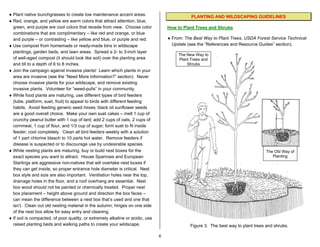
  and purple – or contrasting – like yellow and blue, or purple and red.            ♦ From: The Best Way to Plant Trees, USDA Forest Service Technical
♦ Use compost from homemade or ready-made bins in wildscape                           Update (see the “References and Resource Guides” section).
  plantings, garden beds, and lawn areas. Spread a 2- to 3-inch layer
                                                                                         The New Way to
  of well-aged compost (it should look like soil) over the planting area                 Plant Trees and
  and till to a depth of 6 to 8 inches.                                                      Shrubs
♦ Join the campaign against invasive plants! Learn which plants in your
  area are invasive (see the “Need More Information?” section). Never
  choose invasive plants for your wildscape, and remove existing
  invasive plants. Volunteer for “weed-pulls” in your community.
♦ While food plants are maturing, use different types of bird feeders
  (tube, platform, suet, fruit) to appeal to birds with different feeding
  habits. Avoid feeding generic seed mixes; black oil sunflower seeds
  are a good overall choice. Make your own suet cakes – melt 1 cup of
  crunchy peanut butter with 1 cup of lard; add 2 cups of oats, 2 cups of
  cornmeal, 1 cup of flour, and 1/3 cup of sugar; form suet to fit inside
  feeder; cool completely. Clean all bird feeders weekly with a solution
  of 1 part chlorine bleach to 10 parts hot water. Remove feeders if
  disease is suspected or to discourage use by undesirable species.
♦ While nesting plants are maturing, buy or build nest boxes for the                                                               The Old Way of
  exact species you want to attract. House Sparrows and European                                                                      Planting
  Starlings are aggressive non-natives that will overtake nest boxes if
  they can get inside, so proper entrance hole diameter is critical. Nest
  box style and size are also important. Ventilation holes near the top,
  drainage holes in the floor, and a roof overhang are essential. Nest
  box wood should not be painted or chemically treated. Proper nest
  box placement – height above ground and direction the box faces –
  can mean the difference between a nest box that’s used and one that
  isn’t. Clean out old nesting material in the autumn; hinges on one side
  of the nest box allow for easy entry and cleaning.
♦ If soil is compacted, of poor quality, or extremely alkaline or acidic, use
  raised planting beds and walking paths to create your wildscape.                            Figure 3. The best way to plant trees and shrubs.

                                                                                6
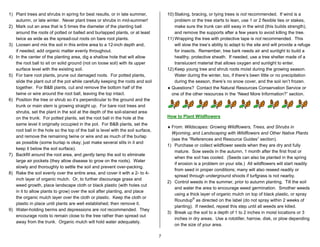
1) Plant trees and shrubs in spring for best results, or in late summer,              10) Staking, bracing, or tying trees is not recommended. If wind is a
   autumn, or late winter. Never plant trees or shrubs in mid-summer!                     problem or the tree starts to lean, use 1 or 2 flexible ties or stakes,
2) Mark out an area that is 5 times the diameter of the planting ball                     make sure the trunk can still sway in the wind (this builds strength),
   around the roots of potted or balled and burlapped plants, or at least                 and remove the supports after a few years to avoid killing the tree.
   twice as wide as the spread-out roots on bare root plants.                         11) Wrapping the tree with protective tape is not recommended. This
3) Loosen and mix the soil in this entire area to a 12-inch depth and,                    will slow the tree’s ability to adapt to the site and will provide a refuge
   if needed, add organic matter evenly throughout.                                       for insects. Remember, tree bark needs air and sunlight to build a
4) In the center of the planting area, dig a shallow hole that will allow                 healthy, protective sheath. If needed, use a tree shelter made of a
   the root ball to sit on solid ground (not on loose soil) with its upper                translucent material that allows oxygen and sunlight to enter.
   surface level with the existing soil.                                              12) Keep young tree and shrub roots moist during the growing season.
5) For bare root plants, prune out damaged roots. For potted plants,                      Water during the winter, too, if there’s been little or no precipitation
   slide the plant out of the pot while carefully keeping the roots and soil              during the season, there’s no snow cover, and the soil isn’t frozen.
   together. For B&B plants, cut and remove the bottom half of the                    ♦ Questions? Contact the Natural Resources Conservation Service or
   twine or wire around the root ball, leaving the top intact.                          one of the other resources in the “Need More Information?” section.
6) Position the tree or shrub so it’s perpendicular to the ground and the
   trunk or main stem is growing straight up. For bare root trees and
   shrubs, set the plant in the soil at the depth of the soil-stained area
   on the trunk. For potted plants, set the root ball in the hole at the              How to Plant Wildflowers
   same level it originally occupied in the pot. For B&B plants, set the
                                                                                      ♦ From: Wildscapes: Growing Wildflowers, Trees, and Shrubs in
   root ball in the hole so the top of the ball is level with the soil surface,
                                                                                        Wyoming, and Landscaping with Wildflowers and Other Native Plants
   and remove the remaining twine or wire and as much of the burlap
                                                                                        (see the “References and Resource Guides” section).
   as possible (some burlap is okay; just make several slits in it and
                                                                                      1) Purchase or collect wildflower seeds when they are dry and fully
   keep it below the soil surface).
                                                                                          mature. Sow seeds in the autumn, 1 month after the first frost or
7) Backfill around the root area, and gently tamp the soil to eliminate
                                                                                          when the soil has cooled. (Seeds can also be planted in the spring
   large air pockets (they allow disease to grow on the roots). Water
                                                                                          if erosion is a problem on your site.) All wildflowers will start readily
   slowly and thoroughly to settle the soil and prevent over-packing.
                                                                                          from seed in proper conditions; many will also reseed readily or
8) Rake the soil evenly over the entire area, and cover it with a 2- to 4-
                                                                                          spread through underground shoots if turfgrass is not nearby.
   inch layer of organic mulch. Or, to further discourage grass and
                                                                                      2) Control weeds in the summer, prior to autumn planting. Till the soil
   weed growth, place landscape cloth or black plastic (with holes cut
                                                                                          and water the area to encourage weed germination. Smother weeds
   in it to allow plants to grow) over the soil after planting, and place
                                                                                          using a thick layer of organic mulch on top of black plastic, or spray
   the organic mulch layer over the cloth or plastic. Keep the cloth or
                                                                                          Roundup® as directed on the label (do not spray within 2 weeks of
   plastic in place until plants are well established; then remove it.
                                                                                          planting). If needed, repeat this step until all weeds are killed.
9) Water-holding berms and depressions are not recommended. They
                                                                                      3) Break up the soil to a depth of 1 to 2 inches in moist locations or 3
   encourage roots to remain close to the tree rather than spread out
                                                                                          inches in dry areas. Use a rototiller, harrow, disk, or plow depending
   away from the trunk. Organic mulch will hold water adequately.
                                                                                          on the size of your area.

                                                                                  7
4) If needed, add compost, weed-free straw, grass clippings, or                    How to Plant Grasses
    sphagnum peat moss (do not use mountain peat; it’s too heavy for
                                                                                   ♦ From: Sharp Brothers Seed Company (see the “References and
    many plants, doesn’t drain well, and may have high levels of soluble
                                                                                     Resource Guides” section).
    salts). Do not add manure; it’s too hot for wildflowers and may
                                                                                   1) When choosing grasses, remember that warm season grasses grow
    contain weed seeds that will compete with flowers.
                                                                                      best in summer and are dormant (inactive) in autumn, winter, and
5) Fertilize only if needed! Test your soil first. Do not over fertilize,
                                                                                      spring, while cool season grasses grow best in spring and autumn,
    especially with high nitrogen fertilizers; this encourages weed growth.
                                                                                      may remain green in winter, and are dormant in summer.
    Try improving the soil by adding organic materials first.
                                                                                   2) Plant warm season grasses in late spring when the air temperature
6) Rake the planting area to smooth the soil.
                                                                                      is 70 to 90oF. Plant cool season grasses in early spring or early
7) Select a wildflower mix for your specific area, or make your own from
                                                                                      autumn. Larger areas may need to be burned, hayed, mowed, or
    native species (see Table 1, and the “Need More Information?” and
                                                                                      grazed to remove old growth and prepare the site for planting.
    “References and Resource Guides” sections). Include a few annual
                                                                                   3) For warm season grasses, control weeds in your planting area in the
    species along with the perennial species in your mix.
                                                                                      spring or previous autumn, prior to spring planting. Smother weeds
8) For 1 acre or more, sow 4 to 11 pounds of seed per acre. For ½
                                                                                      with black plastic and a thick layer of organic mulch, or use Roundup®
    acre or less, sow 4 to 5 ounces of seed per 1,000 square feet.
                                                                                      as directed on the label (don’t spray within 2 to 4 weeks of planting).
9) Broadcast seed by hand or use a seed spreader. Mix in seed carrier,
                                                                                      For cool season grasses, control weeds in the summer, prior to
    clean sand, or rice hulls to help distribute seed (use 1 to 2 parts seed
                                                                                      autumn planting. Smother weeds, or use Roundup® as directed
    carrier to 1 part seed).
                                                                                      on the label (don’t spray within 1 to 2 weeks of planting).
10) Gently rake the area to cover the seeds slightly (¼ to ½ inch) and
                                                                                   4) Till the soil to a depth of 4 to 6 inches, then prepare the seedbed so
    give them good contact with the soil.
                                                                                      the soil is smooth and firm (soil should not be fluffy or too hard). Or,
11) Mulch with weed-free straw, commercial mulch fabric, or pine
                                                                                      for large areas, no-till the seed into the stubble of a previous crop or
    needles in windy areas. Spread mulch lightly but evenly over seeds.
                                                                                      where the previous plants have been eliminated.
12) Soak the planted area thoroughly after sowing. Keep it moist for 4 to
                                                                                   5) Select a grass mix for your specific area, or make your own from
    6 weeks. Reduce watering once seedlings are up. Use up to ½ inch
                                                                                      native species (see Table 1, and the “Need More Information?” and
    of water per week for optimal blooming. Be careful not to wash the
                                                                                      “References and Resource Guides” sections). Include several
    seeds away. Reseed thin areas, using top sowing, in late autumn
                                                                                      different grasses in your mix to create diversity, but make sure all
    or early spring after frost cracks appear in the soil and when the
                                                                                      have similar requirements for sunlight, moisture, and soil type.
    existing wildflowers are dormant (not growing). Rake seeds into the
                                                                                   6) Plant seeds ¼ to ½ inch deep for proper seed-soil contact.
    wildflower bed so they are lightly covered and have good soil contact.
                                                                                   7) Use a grass drill for planting, or broadcast the seed in perpendicular
♦ Questions? Contact the Natural Resources Conservation Service,
                                                                                      directions onto the prepared seedbed (a seed carrier may be
  your local County Extension office, the Wyoming Native Plant Society,
                                                                                      needed) and roll lightly to ensure good contact with the soil.
  or one of the other resources in the “Need More Information?” section.
                                                                                   8) Keep your planting area moist until the new grass is 2 inches tall.
                                                                                   ♦ Questions? Contact your local County Extension office or one of the
                                                                                     other resources in the “Need More Information?” section.


                                                                               8
How to Create a Water Source
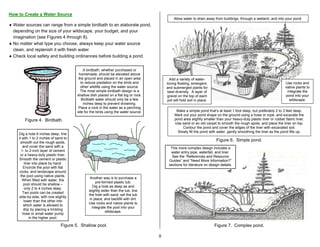
                                                                                             Allow water to drain away from buildings, through a wetland, and into your pond.
♦ Water sources can range from a simple birdbath to an elaborate pond,
  depending on the size of your wildscape, your budget, and your
  imagination (see Figures 4 through 8).
♦ No matter what type you choose, always keep your water source
  clean, and replenish it with fresh water.
♦ Check local safety and building ordinances before building a pond.


                                             A birdbath, whether purchased or
                                         homemade, should be elevated above
                                         the ground and placed in an open area             Add a variety of water-
                                           to reduce predation on the birds and          loving floating, emergent,                                                   Use rocks and
                                          other wildlife using the water source.         and submerged plants for                                                     native plants to
                                          The most simple birdbath design is a            best diversity. A layer of                                                   integrate the
                                        shallow dish placed on a flat log or rock.       gravel on the top of each                                                    pond into your
                                           Birdbath water should only be a few           pot will hold soil in place.                                                   wildscape.
                                             inches deep to prevent drowning.
                                         Place a rock in the water as a perching
                                        site for the birds using the water source.             Make a simple pond that’s at least 1 foot deep, but preferably 2 to 3 feet deep.
                                                                                              Mark out your pond shape on the ground using a hose or rope, and excavate the
         Figure 4. Birdbath.                                                                  pond area slightly smaller than your heavy-duty plastic liner or rubber fabric liner.
                                                                                              Use sand or an old carpet to smooth the rough spots, and place the liner on top.
                                                                                                   Contour the pond and cover the edges of the liner with excavated soil.
                                                                                                Slowly fill the pond with water, gently smoothing the liner as the pond fills up.
     Dig a hole 6 inches deep, line
     it with 1 to 2 inches of sand to
       smooth out the rough spots,
                                                                                                                         Figure 6. Simple pond.
         and cover the sand with a                                                         This more complex design includes a
        1- to 2-inch layer of cement                                                       water entry pipe, waterfall, and liner.
       or a heavy-duty plastic liner.                                                       See the “References and Resource
     Smooth the cement or plastic                                                         Guides” and “Need More Information?”
          liner into place by hand.                                                       sections for literature on design details.
         Encircle the pool with flat
      rocks, and landscape around
       the pool using native plants.
                                                Another way is to purchase a
        When filled with water, the
                                                     pre-formed plastic tub.
         pool should be shallow –
                                                  Dig a hole as deep as and
          only 2 to 4 inches deep.
                                               slightly wider than the tub, line
         Two pools can be created
                                               the hole with sand, set the tub
     side-by-side, with one slightly
                                                in place, and backfill with dirt.
          lower than the other into
                                               Use rocks and native plants to
         which water is allowed to
                                                  integrate the pool into your
         drip by placing a trickling
                                                           wildscape.
         hose or small water pump
              in the higher pool.

                                Figure 5. Shallow pool.                                                                 Figure 7. Complex pond.

                                                                                     9
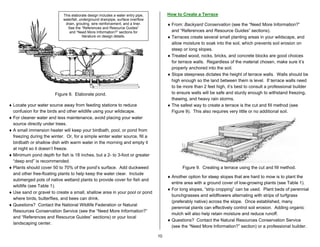
This elaborate design includes a water entry pipe,        How to Create a Terrace
                            waterfall, underground drainpipe, surface overflow
                             drain, grouting, wire reinforcement, and a liner.        ♦ From: Backyard Conservation (see the “Need More Information?”
                              See the “References and Resource Guides”
                               and “Need More Information?” sections for                and “References and Resource Guides” sections).
                                         literature on design details.                ♦ Terraces create several small planting areas in your wildscape, and
                                                                                        allow moisture to soak into the soil, which prevents soil erosion on
                                                                                        steep or long slopes.
                                                                                      ♦ Treated wood, rocks, bricks, and concrete blocks are good choices
                                                                                        for terrace walls. Regardless of the material chosen, make sure it’s
                                                                                        properly anchored into the soil.
                                                                                      ♦ Slope steepness dictates the height of terrace walls. Walls should be
                                                                                        high enough so the land between them is level. If terrace walls need
                                                                                        to be more than 2 feet high, it’s best to consult a professional builder
                       Figure 8. Elaborate pond.                                        to ensure walls will be safe and sturdy enough to withstand freezing,
                                                                                        thawing, and heavy rain storms.
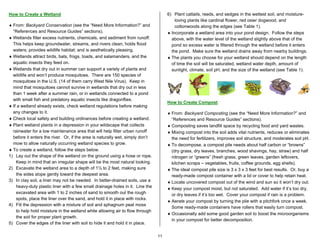
♦ Locate your water source away from feeding stations to reduce                       ♦ The safest way to create a terrace is the cut and fill method (see
  confusion for the birds and other wildlife using your wildscape.                      Figure 9). This also requires very little or no additional soil.
♦ For cleaner water and less maintenance, avoid placing your water
  source directly under trees.
♦ A small immersion heater will keep your birdbath, pool, or pond from
  freezing during the winter. Or, for a simple winter water source, fill a
  birdbath or shallow dish with warm water in the morning and empty it
  at night so it doesn’t freeze.
♦ Minimum pond depth for fish is 18 inches, but a 2- to 3-foot or greater
  “deep end” is recommended.
♦ Plants should cover 50 to 70% of the pond’s surface. Add duckweed                           Figure 9. Creating a terrace using the cut and fill method.
  and other free-floating plants to help keep the water clear. Include
                                                                                      ♦ Another option for steep slopes that are hard to mow is to plant the
  submerged pots of native wetland plants to provide cover for fish and
                                                                                        entire area with a ground cover of low-growing plants (see Table 1).
  wildlife (see Table 1).
                                                                                      ♦ For long slopes, “strip cropping” can be used. Plant beds of perennial
♦ Use sand or gravel to create a small, shallow area in your pool or pond
                                                                                        bunchgrasses and wildflowers alternating with strips of turfgrass
  where birds, butterflies, and bees can drink.
                                                                                        (preferably native) across the slope. Once established, many
♦ Questions? Contact the National Wildlife Federation or Natural
                                                                                        perennial plants can effectively control soil erosion. Adding organic
  Resources Conservation Service (see the “Need More Information?”
                                                                                        mulch will also help retain moisture and reduce runoff.
  and “References and Resource Guides” sections) or your local
                                                                                      ♦ Questions? Contact the Natural Resources Conservation Service
  landscaping center.
                                                                                        (see the “Need More Information?” section) or a professional builder.

                                                                                 10
How to Create a Wetland                                                             6) Plant cattails, reeds, and sedges in the wettest soil, and moisture-
                                                                                        loving plants like cardinal flower, red osier dogwood, and
♦ From: Backyard Conservation (see the “Need More Information?” and                     cottonwoods along the edges (see Table 1).
  “References and Resource Guides” sections).                                       ♦ Incorporate a wetland area into your pond design. Follow the steps
♦ Wetlands filter excess nutrients, chemicals, and sediment from runoff.              above, with the water level of the wetland slightly above that of the
  This helps keep groundwater, streams, and rivers clean; holds flood                 pond so excess water is filtered through the wetland before it enters
  waters; provides wildlife habitat; and is aesthetically pleasing.                   the pond. Make sure the wetland drains away from nearby buildings.
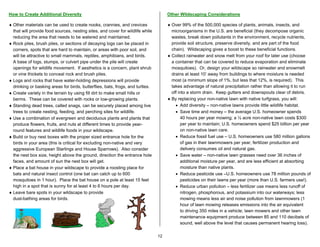
♦ Wetlands attract birds, bats, frogs, toads, and salamanders, and the              ♦ The plants you choose for your wetland should depend on the length
  aquatic insects they feed on.                                                       of time the soil will be saturated, wetland water depth, amount of
♦ Wetlands that dry out in summer can support a variety of plants and                 sunlight, climate, soil pH, and the size of the wetland (see Table 1).
  wildlife and won’t produce mosquitoes. There are 150 species of
  mosquitoes in the U.S. (14 of them carry West Nile Virus). Keep in
  mind that mosquitoes cannot survive in wetlands that dry out in less
  than 1 week after a summer rain, or in wetlands connected to a pond
  with small fish and predatory aquatic insects like dragonflies.
                                                                                    How to Create Compost
♦ If a wetland already exists, check wetland regulations before making
  any changes to it.                                                                ♦ From: Backyard Composting (see the “Need More Information?” and
♦ Check local safety and building ordinances before creating a wetland.               “References and Resource Guides” sections).
♦ Plant wetland plants in a depression in your wildscape that collects              ♦ Composting saves landfill space by recycling food and yard wastes.
  rainwater for a low maintenance area that will help filter urban runoff           ♦ Mixing compost into the soil adds vital nutrients, reduces or eliminates
  before it enters the river. Or, if the area is naturally wet, simply don’t          the need for fertilizers, improves soil structure, and moderates soil pH.
  mow to allow naturally occurring wetland species to grow.                         ♦ To decompose, a compost pile needs about half carbon or “browns”
♦ To create a wetland, follow the steps below.                                        (dry grass, dry leaves, branches, wood shavings, hay, straw) and half
1) Lay out the shape of the wetland on the ground using a hose or rope.               nitrogen or “greens” (fresh grass, green leaves, garden leftovers,
    Keep in mind that an irregular shape will be the most natural looking.            kitchen scraps – vegetables, fruits, coffee grounds, egg shells).
2) Excavate the wetland area to a depth of 1½ to 2 feet, making sure                ♦ The ideal compost pile size is 3 x 3 x 3 feet for best results. Or, buy a
    the sides slope gently toward the deepest area.                                   ready-made compost container with a lid or cover to help retain heat.
3) In clay soil, a liner may not be needed. In better-drained soils, use a          ♦ Locate uncovered compost out of the wind and sun so it won’t dry out.
    heavy-duty plastic liner with a few small drainage holes in it. Line the        ♦ Keep your compost moist, but not saturated. Add water if it’s too dry,
    excavated area with 1 to 2 inches of sand to smooth out the rough                 or dry leaves if it’s too wet. Cover your compost if rain is a problem.
    spots, place the liner over the sand, and hold it in place with rocks.
                                                                                    ♦ Aerate your compost by turning the pile with a pitchfork once a week.
4) Fill the depression with a mixture of soil and sphagnum peat moss
                                                                                      Some ready-made containers have rollers that easily turn compost.
    to help hold moisture in the wetland while allowing air to flow through
                                                                                    ♦ Occasionally add some good garden soil to boost the microorganisms
    the soil for proper plant growth.
                                                                                      in your compost for better decomposition.
5) Cover the edges of the liner with soil to hide it and hold it in place.

                                                                               11
How to Create Additional Diversity                                                   Other Wildscaping Considerations

♦ Other materials can be used to create nooks, crannies, and crevices                ♦ Over 99% of the 500,000 species of plants, animals, insects, and
  that will provide food sources, nesting sites, and cover for wildlife while          microorganisms in the U.S. are beneficial (they decompose organic
  reducing the area that needs to be watered and maintained.                           wastes, break down pollutants in the environment, recycle nutrients,
♦ Rock piles, brush piles, or sections of decaying logs can be placed in               provide soil structure, preserve diversity, and are part of the food
  corners, spots that are hard to maintain, or areas with poor soil, and               chain). Wildscaping gives a boost to these beneficial functions.
  will be attractive to small mammals, reptiles, amphibians, and birds.              ♦ Collect rainwater and snow melt from your roof for later use (choose
  A base of logs, stumps, or culvert pipe under the pile will create                   a container that can be covered to reduce evaporation and eliminate
  openings for wildlife movement. If aesthetics is a concern, plant shrub              mosquitoes). Or, design your wildscape so rainwater and snowmelt
  or vine thickets to conceal rock and brush piles.                                    drains at least 10’ away from buildings to where moisture is needed
♦ Logs and rocks that have water-holding depressions will provide                      most (a minimum slope of 1%, but less that 12%, is required). This
  drinking or basking areas for birds, butterflies, bats, frogs, and turtles.          takes advantage of natural precipitation rather than allowing it to run
♦ Create variety in the terrain by using fill dirt to make small hills or              off into a storm drain. Keep gutters and downspouts clear of debris.
  berms. These can be covered with rocks or low-growing plants.                      ♦ By replacing your non-native lawn with native turfgrass, you will:
♦ Standing dead trees, called snags, can be securely placed among live                   • Add diversity – non-native lawns provide little wildlife habitat.
  trees to create nesting, feeding, and perching sites for wildlife.                     • Save time and money – the average U.S. homeowner spends
♦ Use a combination of evergreen and deciduous plants and plants that                       40 hours per year mowing; a ½ acre non-native lawn costs $300
  produce flowers, fruits, and nuts at different times to provide year-                     per year to maintain; U.S. homeowners spend $25 billion per year
  round features and wildlife foods in your wildscape.                                      on non-native lawn care.
♦ Build or buy nest boxes with the proper sized entrance hole for the                    • Reduce fossil fuel use – U.S. homeowners use 580 million gallons
  birds in your area (this is critical for excluding non-native and very                    of gas in their lawnmowers per year; fertilizer production and
  aggressive European Starlings and House Sparrows). Also consider                          delivery consumes oil and natural gas.
  the nest box size, height above the ground, direction the entrance hole                • Save water – non-native lawn grasses need over 36 inches of
  faces, and amount of sun the nest box will get.                                           additional moisture per year, and are less efficient at absorbing
♦ Place a bat house in your wildscape to provide a roosting place for                       moisture than native plants.
  bats and natural insect control (one bat can catch up to 600                           • Reduce pesticide use –U.S. homeowners use 78 million pounds of
  mosquitoes in 1 hour). Place the bat house on a pole at least 15 feet                     pesticides on their lawns per year (more than U.S. farmers use!).
  high in a spot that is sunny for at least 4 to 6 hours per day.                        • Reduce urban pollution – less fertilizer use means less runoff of
♦ Leave bare spots in your wildscape to provide                                             nitrogen, phosphorous, and potassium into our waterways; less
  dust-bathing areas for birds.                                                             mowing means less air and noise pollution from lawnmowers (1
                                                                                            hour of lawn mowing releases emissions into the air equivalent
                                                                                            to driving 350 miles in a vehicle; lawn mowers and other lawn
                                                                                            maintenance equipment produce between 85 and 110 decibels of
                                                                                            sound, well above the level that causes permanent hearing loss).

                                                                                12
Disease
                      WILDSCAPE MAINTENANCE
                                                                                     ♦ Include a variety of plants in your wildscape to minimize disease; an
Watering
                                                                                       area with only a few types of plants can be devastated by disease.
♦ After 2 to 3 growing seasons, your plants should be well established               ♦ To help prevent disease, space plants properly, water early in the
  and will require less water and maintenance. Until they’re established,              morning so foliage is dry by evening, and remove dead plant parts.
  however, even drought tolerant plants need sufficient water all year.              ♦ Look for warning signs – large dead or dying branches; root and base
♦ To promote deeper, more drought tolerant root systems, water                         rot; and large, vertical, deep cracks on opposite sides of a tree’s trunk.
  thoroughly and completely, but not too often. Only germinating seeds               ♦ If disease is suspected, contact the Wyoming State Forestry Division
  need light, frequent watering for the first 4 to 6 weeks; otherwise, light           (see the “Need More Information?” section) or a tree care professional
  or daily sprinkling can harm plants by promoting shallow, weak root                  (also called an arborist).
  systems that depend on near-surface water, and are more vulnerable
                                                                                     Nutrients and Fertilizers
  to wind stress and the extremes of winter. Irrigate slowly to allow
  water to penetrate the soil rather than run off. Check soil moisture               ♦ Plants require 20 nutrients for proper growth. Six are needed in large
  when the temperature is above 80oF and when it’s dry or windy.                       amounts (macronutrients) – nitrogen (for lushness), phosphorous (for
    • Water trees and shrubs thoroughly once every 4 to 7 days for 1                   flowering, fruiting, and root strength), potassium (for durability and
      month, working up to once every 2 weeks throughout the summer.                   disease resistance), calcium, sulfur, and magnesium. The other 14
      Trees need about 10 gallons of water for each 1 inch of trunk                    nutrients are needed in very small amounts (micronutrients).
      diameter; a 5-gallon potted shrub needs up to 5 gallons of water.              ♦ Applying too many nutrients can be as harmful to plants as a nutrient
    • Perennial wildflowers and grasses need 1 to 2 gallons of water                   deficiency. Test your soil (preferably before you plant) for nutrients
      twice per week during the growing season. Dig down 6 to 8                        and pH levels (neutral soil pH=7, acidic soil pH<7, alkaline soil pH>7).
      inches; if this soil layer is dry, then water thoroughly.                        Correcting a problem before planting is easier and cheaper. If pH is
    • Lawns look dull-colored when moisture is out of reach of roots.                  too low, micronutrients become too available and can poison plants
      Dig down 1 foot; if soil in this layer is dry, then water thoroughly.            intolerant of acidic soils. If pH is too high, micronutrients become less
      Remember, native turfgrasses need less water than non-natives.                   available for plants intolerant of alkaline soils.
♦ Drip irrigation reduces evaporation loss and plant disease. Over the               ♦ Take periodic soil samples once your wildscape is established,
  years, savings of water, labor, and time will offset the initial cost. This          especially if you add amendments to the soil (compost, manure,
  system can be set on an automatic timer, and can also be moved to                    sphagnum peat moss, fertilizers).
  new plantings as older plantings mature and require less water.                    ♦ For low maintenance and reduced cost, limit or eliminate fertilizer use.
♦ Soaker hoses are effective, inexpensive, easy to use, and ideal for                ♦ If a nutrient deficiency is detected and fertilizing is needed, use
  zone watering. They’re a good alternative to a drip irrigation system.               effective fertilizer practices and follow label instructions carefully.
  Cover soaker hoses with organic mulch to prevent sun damage.                       ♦ When applying fertilizer, avoid digging too deeply or roughly around
♦ Automatic watering systems are convenient, but can waste water if                    plants so roots are not damaged.
  not properly set. Set sprinklers to deliver the right amount of water to
  your wildscape, and adjust the timing according to season.

                                                                                13
Pruning
                                                                                  Pinching

♦ Pruning allows more light to reach your understory plants (remove up
  to 1/3 of the canopy branches in the trees above), helps strengthen
                                                                                                         Heading
  stems and branches, gives plants a more vigorous and leafy look,
                                                                                                                                          Thinning
  and encourages flowering and fruiting.
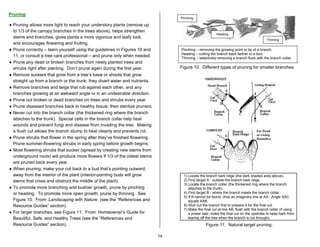
♦ Prune correctly – learn yourself using the guidelines in Figures 10 and         Pinching – removing the growing point or tip of a branch.
                                                                                  Heading – cutting the branch back farther to a bud.
  11, or consult a tree care professional – and prune only when needed.           Thinning – selectively removing a branch flush with the branch collar.
♦ Prune any dead or broken branches from newly planted trees and
  shrubs right after planting. Don’t prune again during the first year.           Figure 10. Different types of pruning for smaller branches.
♦ Remove suckers that grow from a tree’s base or shoots that grow
  straight up from a branch or the trunk; they divert water and nutrients.
♦ Remove branches and twigs that rub against each other, and any
  branches growing at an awkward angle or in an undesirable direction.
♦ Prune out broken or dead branches on trees and shrubs every year.
♦ Prune diseased branches back to healthy tissue; then sterilize pruners.
♦ Never cut into the branch collar (the thickened ring where the branch
  attaches to the trunk). Special cells in the branch collar help heal
  wounds and prevent fungi and disease from invading the tree. Making
  a flush cut allows the branch stump to heal cleanly and prevents rot.
♦ Prune shrubs that flower in the spring after they’ve finished flowering.
  Prune summer-flowering shrubs in early spring before growth begins.
♦ Most flowering shrubs that sucker (spread by creating new stems from
  underground roots) will produce more flowers if 1/3 of the oldest stems
  are pruned back every year.
♦ When pruning, make your cut back to a bud that’s pointing outward,
  away from the interior of the plant (interior-pointing buds will grow             1) Locate the branch bark ridge (the dark shaded area above).
  stems that cross and obstruct the middle of the plant).                           2) Find target A - outside the branch bark ridge.
                                                                                    3) Locate the branch collar (the thickened ring where the branch
♦ To promote more branching and bushier growth, prune by pinching                      attaches to the trunk).
  or heading. To promote more open growth, prune by thinning. See                   4) Find target B - where the branch meets the branch collar.
                                                                                    5) If B cannot be found, drop an imaginary line at AX. Angle XAC
  Figure 10. From: Landscaping with Nature (see the “References and                    equals XAB.
  Resource Guides” section).                                                        6) Stub cut the branch first to prepare it for the final cut.
                                                                                    7) Make the final cut at line AB, flush with the branch collar (if using
♦ For larger branches, see Figure 11. From: Homeowner’s Guide for                      a power saw, make the final cut on the upstroke to keep bark from
  Beautiful, Safe, and Healthy Trees (see the “References and                          tearing off the tree when the branch is cut through).
  Resource Guides” section).                                                                      Figure 11. Natural target pruning.

                                                                             14
Pesticides (Herbicides, Insecticides, Rodenticides)                                    • The IPM approach follows these steps for pest control:
                                                                                            1) Identify what the pest is and monitor it. Pests can include
♦ Prevent pest problems by choosing a variety of hardy, native plants                          weeds, insects, diseases, and some species of wildlife
  (they’re more resistant) that bloom and bear fruit during different times                    (typically rodents, rabbits, and deer in unwanted places).
  of the year. Water and add nutrients properly. Remove weeds before                        2) Determine the amount of damage the pest has caused to the
  they go to seed. Encourage birds, bats, and beneficial insects.                              plant’s health or its aesthetic value. Damage from chewing,
♦ Check plants regularly and look for signs of damage. Identify potential                      sucking, or boring insects will result in chewed plant leaves
  problems early so the most effective treatment can be applied.                               and flowers; misshapen plant leaves or flower petals; and
♦ Minimize pesticide use, follow label instructions carefully, and spot-                       bore holes in stems, fruit, and leaves. Plant diseases can
  treat only. Make sure pesticides are not hazardous to people, pets,                          cause mushroom-like growths on tree trunks; a grayish,
  wildlife, or beneficial insects. Never apply pesticides when it’s windy.                     mildewy look on leaves; spots on leaves, flowers, or fruit;
♦ For lowest maintenance, eliminate the use of insecticides altogether.                        sudden wilting or death of a plant or branch; oozing sap from
  Remember, many birds thrive on insects and are efficient at removing                         branches or tree trunks; and stunted growth. Remember that
  them from your wildscape.                                                                    improperly applied nutrients and pesticides, flooding, and
♦ Bees and butterflies (plant pollinators) are extremely sensitive to                          freezing can also cause conditions – leaves that are yellowing
  insecticides. Avoid using insecticides on or near plants that attract                        or reddening, curling, or misshapen – that resemble some
  these species.                                                                               disease problems.
♦ Most insects and microorganisms are beneficial; many will prey on                         3) Determine if control is needed. Use pest control only when
  insect pests, which reduces or eliminates the need for insecticides.                         the chosen control methods will prevent the pest from
  Beneficial insects include ladybugs (control aphids, potato bugs),                           causing more damage than is reasonably acceptable.
  lacewings (control aphids, mealy bugs, thrips, spider mites), praying                     4) Evaluate available control methods including cultural
  mantises (control almost any insect), predatory beetles (control                             (weeding, trimming, pruning, mulching, crop rotation), host
  caterpillars that attack trees and shrubs), parasitic nematodes (control                     resistance (choosing disease-resistant varieties of plants),
  grubs, beetles, cutworms, army worms), and several types of parasitic                        biological (natural predators), mechanical (removing by hand,
  wasps (control borers and other worms).                                                      trapping, vacuuming, spraying with water, fencing, covering,
♦ If control is necessary, use Integrated Pest Management (IPM)                                netting), sanitation (pest-free seeds, pruning), and chemical
  techniques. IPM is a logical, efficient, and economical approach to                          (pesticides).
  controlling pest problems, and uses the full range of pest control                        5) Select a combination of pest control methods that is most
  tactics (biological, mechanical, chemical) in an appropriate manner.                         effective to protect people, pets, and the environment.
     • From: PlainsScapes: Environmentally-Sound Landscape                         ♦ Questions? Contact your County Extension agent, your local Weed
       Management for the Western Plains and Backyard Conservation                   and Pest agent, the U.S. Forest Service, the Wyoming State Forestry
       (see the “References and Resource Guides” section).                           Division (see the “Need More
     • Ask yourself, “What is the pest?” “Is the pest causing                        Information?” section), or a tree
       unacceptable damage?” “Are controls needed?” “What pest                       care professional.
       control method or methods should be used?”

                                                                              15
Other Maintenance Considerations                                                   ♦ When plants are established (in 5 to 8 years), rake organic mulch
                                                                                     aside, remove all landscape cloth or black plastic, and reapply the
♦ If using black plastic as a weed barrier in your wildscape, punch a few            mulch so it can decompose directly into the soil.
  holes in it near your plants to allow water to drain into the root zone.         ♦ Keep weeds in check when planting wildflowers and grasses,
♦ Trees grow faster if grass is kept out from under the leaf canopy for              especially during the first few growing seasons while plants are setting
  5 to 8 years. Use organic mulch to reduce competition with grass.                  their roots and becoming established.
♦ Replace organic mulch as needed. Allow fallen leaves to decompose                ♦ Remove dead plant parts from wildflowers and grasses in late autumn
  into the mulch layer to reduce time and labor spent on raking. This                or early spring to minimize pest and disease problems and reduce
  will also provide a place for robins, thrushes, sparrows, and towhees              interference with new growth.
  to scratch for insects among the fallen leaves.                                  ♦ For larger wildscapes, burning to remove dead grass growth can
♦ Leave grass clippings on your lawn after mowing to reduce yard waste               replace mowing. Determine a “burn plan”, inquire about any
  and add up to 2 pounds of natural fertilizer per year to your turfgrass.           necessary permits, inform your local fire department and neighbors,
♦ Use fencing or chicken wire to protect small plants from browsing                  burn only under the proper conditions, have a source of water handy,
  damage by deer, pronghorn, elk, moose, rabbits, and porcupines.                    and take extreme caution.
  Use a 4-foot high barrier for pronghorn, a 6-foot high barrier for deer,         ♦ Use native plants to maintain an edge effect between formal lawn and
  and an 8-foot high barrier for moose and elk.                                      garden areas to increase diversity in your wildscape.
♦ Check trees and shrubs for signs of drought stress, especially the first         ♦ Define high traffic areas with a pathway of wood chips or stepping
  few years after planting. Deciduous leaves will curl or wilt, edges will           stones. Although walkways don’t provide habitat for wildlife, they’re
  turn brown, leaf veins will turn brown or yellow, and leaves may not               low maintenance features that will save time, water, and money.
  grow as large. Evergreen needles may turn purple or yellow, and tips             ♦ To conserve energy while maintaining your wildscape, use hand tools
  may turn brown. Focus limited water supplies on trees and shrubs                   rather than power tools, electric tools rather than gas tools, 4-cycle
  and allow lawns to go dormant; a lost tree or shrub takes years to                 engines rather than 2-cycle engines, and keep power tools well tuned.
  replace, while turfgrass rebounds the next growing season.                       ♦ It’s healthier for cats and the wildlife in your wildscape if cats are kept
♦ It’s better to monitor soil moisture to determine when to water rather             indoors. Cats kill millions of birds and other wildlife each year in the
  than relying on a pre-set watering schedule.                                       U.S. alone. If cats must be outside, use preventative steps like a
♦ Avoid using sprinkler systems that throw a fine mist of water into the             kennel or leash line to keep cats from killing birds and other wildlife.
  air; water is lost to evaporation instead of soaking into the soil.                A bell on your cat’s collar is not effective because birds and other
♦ Irrigate sloping landscapes more slowly than flat landscapes to allow              wildlife don’t naturally associate the sound of a bell with danger.
  water enough time to soak into the soil rather than running off the soil.          Have your cat spayed or neutered. Do not feed stray or feral cats.
♦ In winter if there’s been no precipitation, soak tree and shrub root               Contact your local animal control officer to remove stray or feral cats.
  zones every month during the first 3 years after planting.
♦ If needed, add limestone to raise the pH of acidic soil, or elemental
  sulphur to lower the pH of alkaline soil. However, it’s easier and less
  expensive to choose native plants that are adapted to a particular type
  of soil rather than trying to change the soil type to fit the plant.

                                                                              16
WILDSCAPING DO’S AND DON’TS                                                            SEASONAL TO-DO LIST

♦ Do choose to wildscape with plants native to Wyoming (see Table 1).             ♦ From: Creating Native Landscapes in the Northern Great Plains and
♦ Do check to ensure that the plants you choose are not invasive (plants            Rocky Mountains (see the “References and Resource Guides”
  that tend to spread out of control).                                              section).
♦ Do use wildscaping to replace as much of your non-native lawn as                ♦ Spring
  possible, and plant native turfgrass in place of the rest.                            Prune evergreen trees, evergreen shrubs, and summer-flowering
♦ Do add compost, organic matter, and amendments to soil, if needed.                    shrubs before new growth begins
♦ Do core aerate lawn areas every spring or autumn to improve soil                      Mow lawn to a 3-inch height; leave grass clippings to add nitrogen
  structure. Leave cores to add additional nutrients, or compost them.                  Aerate lawn, especially high traffic areas
♦ Do keep grass height above 2½ inches to ensure lawns are resistant                    Add last year’s compost to wildscape, lawn, and garden areas
  to drought, heat, weeds, disease, and insect pests.                                   Check automatic sprinklers and drip irrigation systems; make any
♦ Do choose a wildflower or grass mixture that’s adapted to your area                   needed repairs or adjustments; water all plants if it’s been dry
  rather than planting a generic wildflower or grass seed mixture.                      Plant trees, shrubs, and some grasses
♦ Do water your wildscape at night if foliage mold and fungus are not a           ♦ Summer
  problem. Otherwise, water early in the morning to reduce evaporative                  Water plants according to their needs; don’t over-water
  water loss and avoid scorching your plants during the heat of the day.                Prune suckers and shoots from trees
                                                                                        If needed, use Integrated Pest Management techniques to control
♦ Do add water to your compost pile, if needed. A dry pile won’t decay.
                                                                                        pests, while leaving beneficial insects and plants unharmed
♦ Do not include weeds; diseased plants; oils; animal scraps like meat,
                                                                                        Prune spring-flowering shrubs right after blooming has finished
  fat, or bones; manure; or human, dog, or cat waste in compost piles.
                                                                                        Mow and hand-pull weeds
♦ Do not use sand as a soil amendment. Sand alone will not work.
                                                                                  ♦ Autumn
♦ Do not use rocks or gravel in place of organic mulch near plants (they
                                                                                        Plant wildflowers and some grasses
  will raise soil temperature, cause moisture loss, and compact soil).
                                                                                        Compost equal parts of “browns” and “greens” for next spring’s
♦ Do not handle trees or shrubs by the trunk or branches; handle by the
                                                                                        soil amendment
  root ball. Do not drop B&B plants; gently slide or roll them into place.
                                                                                        Prepare the planting site for next year’s wildscape additions
♦ Do not plant large trees directly under overhead wires or adjacent to
                                                                                        Prune deciduous trees and late summer-flowering shrubs
  foundations (large roots can cause foundations to crack).
                                                                                        Remove dead plant material from flowers and grasses
♦ Do not “top” trees by cutting the apex (top growing) branch off.                      Water plants one last time before the onset of winter
  Topping a tree will weaken it, make it more susceptible to insects and                Drain and blow out automatic sprinklers, drip irrigation systems,
  disease, or kill it outright.                                                         and hoses
♦ Do not fertilize at planting time (this will encourage grass growth).           ♦ Winter
♦ Do not compact soil around plantings (this will restrict root growth).                Soak root zones of trees and shrubs once a month if there hasn’t
♦ Do not wound plantings with lawnmowers,                                               been any precipitation during the winter
  trimmers, or other tools.                                                             Water windy areas and south-facing slopes as needed

                                                                             17
For More Information on Water Conserving Landscape Methods
                    NEED MORE INFORMATION?
                                                                               ♦ Cheyenne Botanic Gardens, 710 South Lions Park Drive, Cheyenne,
For More Information on Plants Native to Wyoming
                                                                                 WY 82001 (307-637-6458) www.botanic.org.
♦ Natural Resources Conservation Service http://plants.usda.gov.               ♦ Colorado Springs Utilities, Xeriscape www.csu.org/xeri.
♦ University of Wyoming Botany Department Herbarium, P.O. Box 3165,            ♦ USDA Natural Resources Conservation Service, 100 East B Street,
  Laramie, WY 82071 (307-766-2236) www.rmh.uwyo.edu.                             Room 3124, Casper, WY 82601 (307-261-6453 or national office at
♦ University of Wyoming Department of Plant Sciences, P.O. Box 3354,             1-800-888-LANDCARE) www.nrcs.usda.gov/feature/backyard/.
  Laramie, WY 82071 (307-766-3103) plantsciences@uwyo.edu.                     ♦ Xeriscape Colorado, Inc., P.O. Box 40202, Denver, CO 80204-0202,
♦ Wyoming Native Plant Society, P.O. Box 3452, Laramie, WY 82070                 www.xeriscape.org.
  (307-745-5026) www.rmh.uwyo.edu/wnps.html.                                   ♦ Contact your local Conservation District.

For More Information on Landscaping with Native Plants                         For More Information on Trees and Shrubs

♦ Little Goose Native Plants and Wildflowers, 226 Main Street, P.O. Box        ♦ National Arbor Day Foundation, 100 Arbor Avenue, Nebraska City,
  445, Bighorn, WY 82833 (307-672-5340).                                         NE 68410 www.arborday.org.
♦ Northern Gardens, 84 County Road 2AB N, Cody, WY 82414                       ♦ Wyoming State Forestry Division, 1100 West 22nd Street, Cheyenne,
  (307-527-6272).                                                                WY 82002 (307-777-3626) www.lands.state.wy.us/forestry.htm.
♦ Sweetwater Garden, 1602 West Main Street, Riverton, WY 82501                 ♦ Contact your local Conservation District.
  (307-856-6663).
                                                                               For More Information on Wildflowers and Grasses
♦ Contact your local Conservation District.
                                                                               ♦ Granite Seed Company, 1697 West 2100 North, Lehi, UT 84043
For More Information on Backyard Wildscaping
                                                                                 (801-768-4422) www.graniteseed.com.
♦ National Wildlife Federation Backyard Wildlife Habitat Program,              ♦ High Plains Grasslands Research Station, 8408 Hildreth Road,
  11100 Wildlife Center Drive, Reston, VA 20190-5362                             Cheyenne, WY 82009 (307-772-2433) http://rrru.usda.gov.
  (1-800-822-9919) www.nwf.org/backyardwildlifehabitat.                        ♦ Mountain West Seeds, P.O. Box 1471, Cheyenne, WY 82003
                                                                                 (307-634-6328).
For More Information on Creating a Healthy Yard                                ♦ Super Seeds, 15 Riggs Road, Shoshone, WY 82649 (307-856-0500).
                                                                               ♦ University of Wyoming Cooperative Extension Service, Department
♦ National Audubon Society – Audubon at Home, 700 Broadway, New
                                                                                 3354, 1000 East University Avenue, Laramie, WY 82071
  York, NY 10003 (212-979-3000) www.audubon.org/bird/at_home/.
                                                                                 www.uwyo.edu/ces/ceshome.htm.
For More Information on Watering Efficiently                                   ♦ Wind River Seed, 3075 Lane 51½, Manderson, WY 82432
                                                                                 (307-568-3361) www.windriverseed.com.
♦ University of Wyoming Cooperative Extension Service, Department
                                                                               ♦ Wyoming Native Plant Society, P.O. Box 3452, Laramie, WY 82070
  3354, 1000 East University Avenue, Laramie, WY 82071
                                                                                 (307-745-5026) www.rmh.uwyo.edu/wnps.html.
  www.uwyo.edu/ces/ceshome.htm.

                                                                          18
For More Information on Collecting Native Seeds and Plants                    For More Information on Butterflies

♦ Wyoming Native Plant Society, P.O. Box 2500, Laramie, WY 82073              ♦ National Wildlife Federation, 11100 Wildlife Center Drive, Reston, VA
  http://uwadmnweb.uwyo.edu/WYNDD/wnps/wnps_home.htm.                           20190-5362 (1-800-822-9919) www.nwf.org/backyardwildlifehabitat.
♦ Obtain a permit to collect plants on state or federal lands from the        ♦ Northern Prairie Wildlife Research Center, USDI U.S. Geological
  Wyoming State Division of Forestry, U.S. Forest Service, U.S. Bureau          Survey, 8711 37th Street SE, Jamestown, ND 58401 (701-253-5500)
  of Land Management, or U.S. Bureau of Reclamation.                            www.npwrc.usgs.gov/resource/distr/lepid/bflyusa/wy/toc.htm.

For More Information on Creating a Wetland                                    For More Information on Beneficial Insects

♦ USDA Natural Resources Conservation Service, 100 East B Street,             ♦ National Audubon Society, 700 Broadway, New York, NY 10003,
  Room 3124, Casper, WY 82601 (307-261-6453 or national office at               (212-979-3000) www.audubon.org.
  1-800-888 LANDCARE) www.nrcs.usda.gov/feature/backyard/.                    ♦ Planet Natural, 1612 Gold Avenue, Bozeman, MT 59715
                                                                                (800-289-6656 or 406-587-5891) www.planetnatural.com.
For More Information on Building a Terrace
                                                                              ♦ University of Wyoming Cooperative Extension Service and Agricultural
♦ USDA Natural Resources Conservation Service, 100 East B Street,               Experiment Station; Plant, Soil, and Insect Sciences Publications –
  Room 3124, Casper, WY 82601 (307-261-6453 or national office at               Landscape Pests www.uwyo.edu/ces/pubs/b-1035.pdf.
  1-800-888-LANDCARE) www.nrcs.usda.gov/feature/backyard/.                    ♦ Contact your local Weed and Pest agent.

For More Information on Composting                                            For More Information on Birds

♦ University of Wyoming Cooperative Extension Service and Agricultural        ♦ American Bird Conservancy, P.O. Box 249, The Plains, VA 20198
  Experiment Station; Plant, Soil, and Insect Sciences Publications –           (540-253-5780) www.abcbirds.org.
  Backyard Composting www.uwyo.edu/ces/pubs/b974r.pdf.                        ♦ American Birding Association, P.O. Box 6599, Colorado Springs, CO
♦ USDA Natural Resources Conservation Service, 100 East B Street,               80934-6599 (719-578-9703) www.americanbirding.org.
  Room 3124, Casper, WY 82601 (307-261-6453 or national office at             ♦ Audubon Wyoming, 400 East 1st Street, Suite 308, Casper, WY 82601
  1-800-888-LANDCARE) www.nrcs.usda.gov/feature/backyard/.                      (307-235-3485) www.audubonwyoming.com.
                                                                              ♦ Cats Indoors! The Campaign for Safer Birds and Cats. American
For More Information on Weeds, Pests, and Invasive Plants                       Bird Conservancy, The Humane Society of the United States, and
♦ BLM Wyoming State Office, 5353 Yellowstone Road, Cheyenne, WY                 American Humane Association, www.abcbirds.org/cats/.
  82009 (307-775-6256) www.wy.blm.gov/weeds/index.htm.                        ♦ National Audubon Society, 700 Broadway, New York, NY 10003,
♦ Contact your local Conservation District or Weed and Pest agent.              (212-979-3000) www.audubon.org.
                                                                              ♦ Wyoming Game and Fish Department Nongame Bird Biologist,
For More Information on Bats                                                    260 Buena Vista, Lander, WY 82520 (in-state 1-800-654-7862 or
                                                                                307-332-2688) gf.state.wy.us.
♦ Bat Conservation International, P.O. Box 162603, Austin, TX 78716
  (512-327-9721) www.batcon.org.

                                                                         19
National Wildlife Federation Backyard Wildlife Habitat Program.
              REFERENCES AND RESOURCE GUIDES
                                                                                 www.nwf.org/backyardwildlifehabitat.
A Wyoming Wildflower Sampler. C. Madson. 1992. Wyoming Game                      Nest Boxes for Wildlife. S. Brockmann. 1995. Wyoming Game and
and Fish Department, Cheyenne.                                                   Fish Department, Cheyenne.
Backyard Composting. G. F. Vance and K. L. Panter. University of                 PlainsScapes: Environmentally-Sound Landscape Management for
Wyoming Cooperative Extension Service.                                           the Western Plains. D. Steinegger, A. Greving, E. Traylor, B. Volk,
                                                                                 R. Johnson, P. Ogle, B. Lorett, and B. H. Hurst, editors. University
Backyard Conservation. 1998. USDA Natural Resources Conservation
                                                                                 of Nebraska – Lincoln, and the U.S. Environmental Protection Agency.
Service, National Association of Conservation Districts, and the Wildlife
Habitat Council.                                                                 Plants Database. USDA Natural Resources Conservation Service.
                                                                                 http://plants.usda.gov.
Backyard Conservation: Terracing. 1998. USDA Natural Resources
Conservation Service, National Association of Conservation Districts,            Redesigning the American Lawn. F. H. Bormann, D. Balmori, and
and the Wildlife Habitat Council.                                                G. T. Geballe. 1993. Yale University Press.
Creating Native Landscapes in the Northern Great Plains and Rocky                Sharp Brothers Seed Company. 2003. Native Grasses and Wildflowers.
Mountains. USDA Natural Resources Conservation Service.                          www.sharpseed.com.
Fire Effects Information System Database. USDA Forest Service.                   The Best Way to Plant Trees. G. A. Moll and P. Rodbell. USDA Forest
www.fs.fed.us/database/feis/index.html.                                          Service Urban Forest Forum Technical Update.
Granite Seed Catalog. 2003. Granite Seed Company, Lehi, UT.                      The Landscaping Revolution. A. Wasowski. 2002. McGraw-Hill.
www.graniteseed.com.
                                                                                 Trees and Shrubs. 2003. Lander Urban Forest Council.
Homeowner’s Guide for Beautiful, Safe, and Healthy Trees. USDA
Forest Service, Northeastern Forest Experiment Station, Broomall, PA.            Trees for Conservation: A Buyer’s Guide. Colorado State Forest
                                                                                 Service.
Landscape Pests: Integrated Pest Management Strategies for
Controlling the Dastardly Dozen. M. K. Small and K. L. Panter. 1999.             UW Cooperative Extension Service. www.uwyo.edu/ces/plantsci.htm.
University of Wyoming Cooperative Extension Service, Laramie.                    Wildscape: Landscaping for Wildlife and the Homeowner. R. Rothwell.
Landscaping with Nature: Using Nature’s Designs to Plant Your Yard.              Wyoming Game and Fish Department, Cheyenne.
J. Cox. 1991. Rodale Press.                                                      Wildscapes: Growing Wildflowers, Trees, and Shrubs in Wyoming.
Landscaping: Turf in Wyoming. K. L. Panter, T. J. Koski, and R. M.               Cheyenne Botanic Gardens, and Wyoming State Forestry Department.
Hybner. 2002. University of Wyoming Cooperative Extension Service.               Windbreak Habitats for Wildlife. E. Oneale. 1992. Wyoming Game
Landscaping with Wildflowers and Other Native Plants. Teton County               and Fish Department, Cheyenne.
Chapter of the Wyoming Native Plant Society.                                     WyoScape: Landscaping for the Wyoming Climate. 2003. University
Living on a Few Acres in Wyoming. C. Buffington and S. Cotton, editors.          of Wyoming Cooperative Extension Service.
University of Wyoming Cooperative Extension Service. MP-86.                      Wildflowers of Wyoming. D. States and J. States. 2004. Mountain
National Audubon Society Field Guide to Wildflowers, Western Region.             Press Publishing Company, Missoula, MT.
2001. Chanticleer Press, Inc., New York.


                                                                            20
NOTES        NOTES


        21
Table 1. Selected native plants ideal for wildscaping in Wyoming.
Common Name (Alternate)
Scientific Name                                             Moisture
Maximum Height                          Sunlight          Preferences                                                                             Stress, Disease, and Pest
Maximum Width                          Conditions        and Tolerances             Soil Information                 Wildlife Value                      Information                               Additional Remarks
Growth Form and Density
Coniferous Trees (Evergreens that produce cones)
Black Hills Spruce                     Full sun.      Poor drought              Grows in most soils, but      Cover (including winter)        To reduce stress and benefit the          Hardy. Slow growing. Long-lived (200
Picea glauca densata                   Tolerates      tolerance. Prefers        prefers moderately fine       and nesting sites.              tree, remove competing grasses,           years in the Black Hills, 150 years
45 – 90’                               some           wet to moist areas;       to medium textured,           Seeds provide food and          acidify the soil, and mulch.              elsewhere in Wyoming). Does well up to
30’                                    shade.         needs adequate            acidic soils. Tolerates a     persist through winter.         Possible pests: spider mites in           10,000 feet in elevation. Ideal for sound
Pyramidal, conical                                    moisture.                 pH range of 4.5 – 7.5.        Not attractive to deer.         drier areas outside the Black Hills.      screens and windbreaks. Transplants
                                                                                                                                                                                        easily in spring. Native to the Black Hills.
Blue Spruce                            Full sun       Moderate drought          Grows best in medium          Cover (including winter)        Low fire tolerance and resistance.        Hardy. Slow to moderately slow growing.
Picea pungens                          to partial     tolerance.                textured to moderately        and nesting sites. Seeds        Needs at least 120 frost-free days/       Long-lived (300 years or more).
40 – 100’                              shade.         Tolerates dry areas       coarse, acidic soils.         and foliage provide food.       year. If stressed, acidify the soil,      Does well up to 9,000 feet in elevation.
15 – 35’                                              and moist areas.          Tolerates clay soils and      Rough bark attracts             remove competing grasses, and             Ideal for sound screens and windbreaks.
Pyramidal, conical, dense crown                       More drought              sandy soils. Tolerates a      insects favored by birds.       mulch. Avoid using insecticides           Best planted in a group or protected area
                                                      tolerant than most        pH range of 4.5 – 6.5.        Not attractive to deer.         on or near this plant. Possible           due to shallow roots. Native to the
                                                      other spruces.                                                                          diseases: cankers, spruce witches’        mountainous parts of western and
                                                      Needs at least 12” of                                                                   broom. Possible pests: pine               southern Wyoming.
                                                      annual precipitation.                                                                   needle scale, tussock moth,
                                                                                                                                              terminal weevil, spruce gall aphid,
                                                                                                                                              spruce budworm, spider mites.
Douglas Fir                            Full sun       Drought tolerant.         Grows in most soils, but      Cover (including winter)        Low fire tolerance, high fire             Hardy. Moderately slow growing. Long-
Pseudotsuga menziesii                  to partial     Needs at least 14” of     prefers deep, dry,            and nesting sites. Seeds        resistance. Needs at least 130            lived (200 years or more). Does well from
50 – 100’                              shade.         annual precipitation.     medium textured, acidic       and foliage provide food        frost-free days/year. Avoid using         4,000 to 11,000 feet in elevation. Ideal for
20 – 35’                                                                        soils. Tolerates rocky        and persist through             insecticides on or near this plant.       sound screens and windbreaks. Native to
Conical to pyramidal, dense                                                     soils. Tolerates a pH         winter. Attracts insects        Possible diseases: root rot, dwarf        the mountainous parts of Wyoming.
 crown                                                                          range of 5.0 – 7.5.           favored by birds. Not           mistletoe, bacterial gall. Possible
                                                                                                              attractive to deer.             pests: spruce budworm.
Englemann Spruce                       Full sun       Moderate drought          Grows in most soils,          Cover (including winter)        Low fire tolerance and resistance.        Hardy. Slow growing. Long-lived (350
Picea engelmannii                      to partial     tolerance. Needs at       but prefers deep, moist,      and nesting sites. Seeds        Needs at least 30 frost-free days/        years or more). Does well from 8,000 to
70 – 125’                              shade.         least 21” of annual       fine to medium textured       and foliage provide food.       year. Avoid using insecticides on         11,500 feet in elevation. Ideal for sound
20 – 30’                                              precipitation.            soils. Tolerates a pH         Attracts insects favored        or near this plant. Possible              screens and windbreaks. Best planted in
Conical to spire-like, cylindrical,                                             range of 6.0 – 8.0.           by birds. Not attractive to     diseases: cytospora canker, root          a group or protected area due to shallow
  pyramidal, dense crown                                                                                      deer.                           rot, spruce broom rust. Possible          roots. May not do well under cultivation.
                                                                                                                                              pests: spruce bark beetle, aphids,        Native to the mountainous parts of
                                                                                                                                              spruce budworm, spider mites.             Wyoming.
Limber Pine                            Full sun       Excellent drought         Grows best in moist,          Cover (including winter)        Low fire tolerance and resistance.        Hardy. Slow growing. Long-lived (1,000
Pinus flexilis                         to partial     and wind tolerance.       medium textured, well-        and nesting sites. Seeds        Needs at least 90 frost-free days/        years or more). Does well from 5,000 to
25 – 50’                               shade.         Needs at least 10” of     drained, acidic soils.        and foliage provide food.       year. Avoid using insecticides on         11,500 feet in elevation. Ideal for windy
7 – 10’                                Intolerant     annual precipitation.     Tolerates rocky soils.        Attracts insects favored        or near this plant. Possible              areas. Native to the mountainous parts
Irregular, open crown                  of full                                  Tolerates a pH range of       by birds. Not attractive to     diseases: white pine blister rust,        of Wyoming.
                                       shade.                                   5.7 – 6.5.                    deer.                           dwarf mistletoe. Possible pests:
                                                                                                                                              mountain pine beetle, borers.

~ Soil texture range: fine, moderately fine, medium textured, moderately coarse, coarse.                          22
~ Soil pH: neutral soil pH = 7, acidic soil pH < 7, alkaline (saline) soil pH > 7.
~ Foliage = twigs, buds, and/or leaves or needles.
~ Fire tolerance = a plant’s ability to re-sprout, re-grow, or re-establish from residual seed after a fire. Fire resistance = a plant’s ability to resist burning through adaptations like thick bark, a high leaf crown, or
  high water content. (From: USDA Natural Resources Conservation Service Plants Database, see the “References and Resource Guides” and “Need More Information?” sections.)
~ Riparian areas = the plant zones adjacent to and influenced by the available water in rivers, streams, lakes, ponds, and other waterways.
~ Rhizomes = horizontal, underground, root-like stems. Stolons = stems that grow along the soil surface and then root. Tillers = above-ground stems that branch from stems at or below the soil surface.
~ Seeding rate: PLS = pure live seed (seed purity x germination rate / 100 = PLS % for each seed lot), and is a way to standardize seed quality. (From: Granite Seed Company, see the “References and
  Resource Guides” and “Need More Information?” sections.)
Table 1. Selected native plants ideal for wildscaping in Wyoming.
Common Name (Alternate)
Scientific Name                                             Moisture
Maximum Height                          Sunlight          Preferences                                                                             Stress, Disease, and Pest
Maximum Width                          Conditions        and Tolerances             Soil Information                 Wildlife Value                      Information                               Additional Remarks
Growth Form and Density
Lodgepole Pine                         Full sun       Drought tolerant.         Grows in most soils, but      Cover (including winter)        Low fire tolerance and resistance.        Hardy. Moderately fast growing. Long-
Pinus contorta                         to partial     Tolerates periodic        prefers deep, medium          and nesting sites. Seeds        Needs at least 100 frost-free days/       lived (200 years or more). Does well
35 – 80’                               shade.         flooding. Needs at        textured, well-drained        and foliage provide food.       year. Avoid using insecticides on         from 6,000 to 10,500 feet in elevation.
15 – 30’                               Intolerant     least 18” of annual       soils. Tolerates fine         Attracts insects favored        or near this plant. Possible              Male and female flowers are on the same
Conical to spire-like, slender,        of full        precipitation.            soils, gravelly soils, and    by birds. Not attractive to     diseases: dwarf mistletoe, western        tree. Intolerant of pollution; choose
  open crown                           shade.                                   rocky soils. Tolerates a      deer.                           gall rust. Possible pests: aphids,        planting sites accordingly. Native to the
                                                                                pH range of 6.2 – 7.5.                                        borers, mountain pine beetle,             mountainous parts of Wyoming.
                                                                                                                                              spider mites.
Pinyon Pine                            Full sun.      Excellent drought         Grows in a variety of         Cover (including winter)        Low fire tolerance and resistance.        Hardy. Slow growing. Long-lived (500
Pinus edulis                           Intolerant     tolerance. Needs at       well-drained soils.           and nesting sites. Seeds        Needs at least 200 frost-free days/       years or more). Small tree or large shrub.
25 – 40’                               of full        least 9” of annual        Tolerates dry soils and       and foliage provide food.       year. Avoid using insecticides            Does well up to 8,500 feet in elevation.
15 – 30’                               shade.         precipitation.            rocky soils. Tolerates a      Rough bark attracts             on or near this plant. Possible           Ideal for windbreaks. A deep taproot
Rounded to irregular, dense                                                     pH range of 6.5 – 8.5.        insects favored by birds.       diseases: needle cast, black stain        makes mature plants very difficult to
  crown                                                                                                       Not attractive to deer.         root disease, dwarf mistletoe,            transplant. Male and female flowers are
                                                                                                                                              needle rusts. Possible pests:             on the same tree. Native to southwestern
                                                                                                                                              mountain pine beetle, sawflies,           and south-central Wyoming.
                                                                                                                                              needle scale, pinyon pitch borer,
                                                                                                                                              ips spindle gall midge, tip moth,
                                                                                                                                              spider mites.
Ponderosa Pine                         Full sun.      Excellent drought         Grows in most well-           Cover (including winter)        High fire tolerance and resistance.       Hardy. Moderately fast growing.
Pinus ponderosa                        Intolerant     tolerance. Needs at       drained soils, but prefers    and nesting sites. Seeds        Needs at least 150 frost-free days/       Long-lived (up to 600 years). Does well
40 – 100’                              of full        least 12” of annual       medium textured to            and foliage provide food.       year. If stressed, acidify the soil       up to 9,000 feet in elevation. Ideal for
20 – 30’                               shade.         precipitation.            moderately coarse, well-      Rough bark attracts             and mulch heavily. Avoid using            the east, south, and inside rows of
Broad, flat-topped, open crown                                                  drained soils. Tolerates      insects favored by birds.       insecticides on or near this plant.       windbreaks. Transplants best in spring,
                                                                                poor soils and sandy          Not attractive to deer.         Possible diseases: western gall           and if trees are less than 3 feet tall. Male
                                                                                soils. Tolerates a pH                                         rust, dwarf mistletoe, shoestring         and female flowers are on the same tree.
                                                                                range of 5.0 – 8.0.                                           root rot, needle cast fungus.             Native to the eastern half of Wyoming.
                                                                                                                                              Possible pests: aphids, borers,
                                                                                                                                              sawflies, bark beetle, mountain
                                                                                                                                              pine beetle, pine engraver beetle,
                                                                                                                                              tip moth, spider mites.
Rocky Mountain Juniper                 Full sun.      Excellent drought         Grows in most soils,          Cover (including winter         Low fire tolerance and resistance.        Hardy. Slow growing. Long-lived (200
Juniperus scopulorum                   Young          tolerance. Needs at       but prefers medium            shelter when planted in         Needs at least 160 frost-free days/       years or more). Small tree or large shrub.
15 – 25’                               trees grow     least 10” of annual       textured, well-drained        blocks or rows) and             year. Seeds require 2 years to            Does well up to 9,000 feet in elevation.
12 – 20’                               well in        precipitation.            soils. Tolerates rocky        nesting sites. Berry-like       mature. Possible diseases: juniper        Ideal for the north, west, and outside rows
Pyramidal to irregular, dense          shade, but                               soils, dry soils, and         cones and foliage provide       broom rust, juniper gall rust, juniper    of windbreaks. Transplants easily; needs
  crown                                older trees                              moist soils. Tolerates a      food and persist through        true mistletoe. Possible pests:           little care once established. Can grow
                                       are shade                                pH range of 5.0 – 8.0.        winter.                         bark beetle, spider mites.                from cuttings. Male and female trees are
                                       intolerant.                                                                                                                                      needed to produce cones. Attractive,
                                                                                                                                                                                        shredding bark. Native to all of Wyoming.


~ Soil texture range: fine, moderately fine, medium textured, moderately coarse, coarse.                          23
~ Soil pH: neutral soil pH = 7, acidic soil pH < 7, alkaline (saline) soil pH > 7.
~ Foliage = twigs, buds, and/or leaves or needles.
~ Fire tolerance = a plant’s ability to re-sprout, re-grow, or re-establish from residual seed after a fire. Fire resistance = a plant’s ability to resist burning through adaptations like thick bark, a high leaf crown, or
  high water content. (From: USDA Natural Resources Conservation Service Plants Database, see the “References and Resource Guides” and “Need More Information?” sections.)
~ Riparian areas = the plant zones adjacent to and influenced by the available water in rivers, streams, lakes, ponds, and other waterways.
~ Rhizomes = horizontal, underground, root-like stems. Stolons = stems that grow along the soil surface and then root. Tillers = above-ground stems that branch from stems at or below the soil surface.
~ Seeding rate: PLS = pure live seed (seed purity x germination rate / 100 = PLS % for each seed lot), and is a way to standardize seed quality. (From: Granite Seed Company, see the “References and
  Resource Guides” and “Need More Information?” sections.)
Table 1. Selected native plants ideal for wildscaping in Wyoming.
Common Name (Alternate)
Scientific Name                                             Moisture
Maximum Height                          Sunlight          Preferences                                                                             Stress, Disease, and Pest
Maximum Width                          Conditions        and Tolerances             Soil Information                 Wildlife Value                      Information                               Additional Remarks
Growth Form and Density
Subalpine Fir                          Full sun       Moderate drought          Grows best in moist,          Cover (including winter)        Low fire tolerance and resistance.        Hardy. Slow growing. Long-lived.
Abies lasiocarpa                       to partial     tolerance. Prefers        medium textured to            and nesting sites. Seeds        Needs at least 120 frost-free days/       Does well from mid to high elevations.
50 – 70’                               shade.         moist areas. Needs        moderately coarse,            and foliage provide food.       year. Avoid using insecticides on         Ideal for windbreaks and sound screens.
10 – 20’                                              at least 20” of           acidic soils. Tolerates       Attracts insects favored        or near this plant. Possible              Native to the mountainous parts of
Pyramidal to spire-like, dense                        annual precipitation.     a pH range of 4.0 – 6.5.      by birds. Foliage               diseases: root rot. Possible pests:       Wyoming.
 crown                                                                                                        provides browse for             balsam bark beetle, western spruce
                                                                                                              moose.                          budworm, balsam woolly aphid, fir
                                                                                                                                              engraver beetle.
Deciduous Trees (Leaves drop in autumn)
American Elm                           Full sun       Drought tolerant.         Grows best in                 Cover and nesting sites.        Low fire tolerance and resistance.        Hardy. Moderately fast to fast growing.
Ulmus americana                        to partial     Needs at least 15” of     moderately fine to            Seeds and foliage provide       Needs at least 80 frost-free days/        Long-lived (175 to 200 years or more).
75’                                    shade.         annual precipitation.     moderately coarse soils.      food. Foliage provides          year. Avoid using insecticides on         Does well from low to mid elevations.
                                                                                Tolerates a pH range of       food for butterfly              or near this plant. Possible              Good shade tree. Can grow from
Vase-shaped, open crown                                                         5.5 – 8.0.                    caterpillars.                   diseases: Dutch elm disease,              cuttings. Autumn color. Native to
                                                                                                                                              cytospora canker. Possible pests:         extreme northeastern Wyoming.
                                                                                                                                              aphids.
American Plum                          Full sun.      Drought tolerant.         Grows in most soils,          Dense thickets provide          Moderate fire tolerance, low fire         Hardy. Moderately fast to fast growing.
Prunus americana                       Tolerates      Tolerates periodic        but prefers deep, moist,      cover (including thorns)        resistance. Needs at least 100            Moderate life span. Small tree or large
8 – 25’                                some           flooding. Needs at        medium textured soils.        and nesting sites.              frost-free days/year. Susceptible         shrub. Does well up to 7,000 feet in
8 – 15’                                shade.         least 14” of annual       Tolerates a pH range of       Flowers and fruit in spring     to iron deficiencies (seen when           elevation. Ideal for stabilizing soil.
Irregular, open crown                                 precipitation.            6.0 – 7.5.                    and summer provide food         new growth turns yellow); add iron.       Transplants easily in spring or autumn.
                                                                                                              and attract insects             Avoid using insecticides on or near       Suckers readily. Fragrant white flowers
                                                                                                              favored by birds. Fruit         this plant. Diseases are usually not      in spring. Edible purple fruit in summer
                                                                                                              persists through autumn.        serious. Possible diseases: fire          for jam, canning, and wine. Yellow
                                                                                                              Foliage provides browse         blight, powdery mildew, black knot,       autumn color. Native to north-central and
                                                                                                              for deer.                       plum pocket. Possible pests: pear         northeastern Wyoming.
                                                                                                                                              slug (sawfly larvae).
Balsam Poplar                          Full sun.      Moderate drought          Grows in most soils,          Cover and nesting sites.        Low fire tolerance, high fire             Hardy. Fast growing. Moderate life span
Populus balsamifera                    Intolerant     tolerance. Tolerates      but prefers deep, moist,      Older trees tend to             resistance. Needs at least 100            (up to 200 years). Does well up to 9,000
30 – 80’                               of full        periodic flooding.        well-drained, acidic soils.   develop cavities. Seeds         frost-free days/year. Avoid using         feet in elevation. Good shade tree. Ideal
                                       shade.         Needs at least 20” of     Tolerates a pH range of       and foliage provide food.       insecticides on or near this plant.       for riparian areas. Suckers from the
Narrow, open crown                                    annual precipitation.     4.5 – 7.0.                    Rough bark attracts             Has many diseases and pests, but          roots. Can grow from cuttings. Male and
                                                                                                              insects favored by birds.       diseases produce dead wood for            female trees are needed to produce
                                                                                                              Foliage provides food for       cavity nesters. Do not plant near         seeds. Attractive rough bark. Invasive
                                                                                                              butterfly caterpillars.         buildings or overhead wires               roots; avoid planting near pipes. Native to
                                                                                                                                              because some diseases or pests            all of Wyoming.
                                                                                                                                              may weaken branches.


~ Soil texture range: fine, moderately fine, medium textured, moderately coarse, coarse.                          24
~ Soil pH: neutral soil pH = 7, acidic soil pH < 7, alkaline (saline) soil pH > 7.
~ Foliage = twigs, buds, and/or leaves or needles.
~ Fire tolerance = a plant’s ability to re-sprout, re-grow, or re-establish from residual seed after a fire. Fire resistance = a plant’s ability to resist burning through adaptations like thick bark, a high leaf crown, or
  high water content. (From: USDA Natural Resources Conservation Service Plants Database, see the “References and Resource Guides” and “Need More Information?” sections.)
~ Riparian areas = the plant zones adjacent to and influenced by the available water in rivers, streams, lakes, ponds, and other waterways.
~ Rhizomes = horizontal, underground, root-like stems. Stolons = stems that grow along the soil surface and then root. Tillers = above-ground stems that branch from stems at or below the soil surface.
~ Seeding rate: PLS = pure live seed (seed purity x germination rate / 100 = PLS % for each seed lot), and is a way to standardize seed quality. (From: Granite Seed Company, see the “References and
  Resource Guides” and “Need More Information?” sections.)
Table 1. Selected native plants ideal for wildscaping in Wyoming.
Common Name (Alternate)
Scientific Name                                             Moisture
Maximum Height                          Sunlight          Preferences                                                                             Stress, Disease, and Pest
Maximum Width                          Conditions        and Tolerances             Soil Information                 Wildlife Value                      Information                               Additional Remarks
Growth Form and Density
Bebb Willow                            Full sun.      Moderate drought          Grows in most soils, but      Cover and nesting sites.        High fire tolerance, low fire             Moderately hardy. Moderately fast
Salix bebbiana                         Intolerant     tolerance once            prefers moist, medium         Seeds and foliage provide       resistance. Needs at least 80             growing. Moderate life span. Small tree
15 – 25’                               of full        established, but          textured to moderately        food. Attracts insects          frost-free days/year. Avoid using         or large shrub. Does well up to 8,300 feet
                                       shade.         grows best with           coarse soils. Tolerates       favored by birds. Foliage       insecticides on or near this plant.       in elevation. Ideal for disturbed sites,
Upright, irregular, dense                             abundant moisture.        a pH range of 5.5 – 7.5.      provides food for butterfly     Possible pests: aphids, mites,            riparian areas, and marshes. Transplants
                                                      Tolerates short                                         caterpillars. Flowers           scale insects.                            easily in spring. Can grow from cuttings.
                                                      periods of standing                                     produce nectar that                                                       Male and female trees are needed to
                                                      water. Needs at                                         attracts bees. Foliage                                                    produce seeds. One of 27 or more willow
                                                      least 20” of annual                                     provides browse for deer,                                                 species in Wyoming. Native to the
                                                      precipitation.                                          elk, and moose.                                                           mountainous parts of Wyoming.
Black Cottonwood                       Full sun.      Drought tolerant          Grows in most soils,          Cover and nesting sites.        Low fire tolerance and resistance.        Hardy. Fast growing. Moderate life span.
Populus trichocarpa                    Intolerant     once established,         but prefers deep, moist,      Older trees tend to             Needs at least 80 frost-free days/        Does well up to 7,500 feet in elevation.
60 – 80’                               of full        but grows best with       well-drained soils.           develop cavities. Seeds         year. Avoid using insecticides on         Good shade tree. Ideal for riparian areas.
35 – 40’                               shade.         abundant moisture.        Tolerates a pH range of       and foliage provide food.       or near this plant. Has many              Suckers in moist soil. Can grow from
Open, broad, rounded crown                            Needs at least 20” of     5.8 – 7.2.                    Rough bark attracts             diseases and pests, but diseases          cuttings. Male and female trees are
                                                      annual precipitation.                                   insects favored by birds.       produce dead wood for cavity              needed to produce seeds. Golden yellow
                                                                                                              Foliage provides food for       nesters. Do not plant near                autumn color. Attractive rough bark.
                                                                                                              butterfly caterpillars.         buildings or overhead wires               Invasive roots; avoid planting near pipes.
                                                                                                                                              because some diseases or pests            Native to Teton County.
                                                                                                                                              may weaken branches.
Boxelder (Ashleaf Maple)               Full sun.      Drought tolerant          Grows in most soils,          Cover and nesting sites.        Low fire tolerance and resistance.        Hardy. Fast growing. Short-lived (up to
Acer negundo                           Tolerates      once established.         but prefers deep,             Older trees tend to             Needs at least 100 frost-free days/       100 years). Does well up to 8,000 feet in
40 – 60’                               some           Needs at least 17” of     moderately fine to            develop cavities.               year. Very sensitive to herbicides,       elevation. Good shade and ornamental
25 – 55’                               shade.         annual precipitation.     moderately coarse,            Seeds, flowers, and             especially 2,4-D. Female trees            tree. Ideal for windbreaks and riparian
Broad, irregular crown                                                          well-drained soils.           foliage provide food.           attract boxelder bugs, which can          areas. Transplants easily. Male and
                                                                                Tolerates a pH range of       Seeds persist into winter.      be a nuisance but are harmless.           female trees are needed to produce
                                                                                5.0 – 8.0.                    Produces sap that attracts      Avoid using insecticides on or near       seeds. Red autumn color. Native to the
                                                                                                              insects favored by birds.       this plant. Possible diseases:            eastern half of Wyoming.
                                                                                                              Not attractive to deer.         heart rot (mature trees are
                                                                                                                                              susceptible to stem breakage from
                                                                                                                                              heart rot). Possible pests: aphids,
                                                                                                                                              spider mites, oyster shell scale.
Bur Oak                                Full sun       Excellent drought         Grows in most soils,          Cover and nesting sites.        Low fire tolerance and resistance.        Hardy. Slow growing. Long-lived (200 to
Quercus macrocarpa                     to partial     tolerance. Needs at       but prefers moist, well-      Older trees tend to             Needs at least 110 frost-free days/       300 years). Does well up to 8,000 feet
25 – 40’                               shade.         least 12” of annual       drained, acidic soils.        develop cavities. Acorns        year. Avoid using insecticides on         in elevation. Good shade tree. A deep
20 – 35’                               Intolerant     precipitation.            Intolerant of heavy clay      and foliage provide food        or near this plant. Mostly free of        taproot makes mature plants difficult to
Rounded to irregular, broad            of full                                  soils. Tolerates a pH         and browse. Attracts            serious diseases and pests.               transplant. Male and female flowers are
 crown                                 shade.                                   range of 4.5 – 7.5.           insects favored by birds.                                                 on the same tree. Autumn color. Native
                                                                                                              Foliage provides food for                                                 to extreme northeastern Wyoming.
                                                                                                              butterfly caterpillars.


~ Soil texture range: fine, moderately fine, medium textured, moderately coarse, coarse.                          25
~ Soil pH: neutral soil pH = 7, acidic soil pH < 7, alkaline (saline) soil pH > 7.
~ Foliage = twigs, buds, and/or leaves or needles.
~ Fire tolerance = a plant’s ability to re-sprout, re-grow, or re-establish from residual seed after a fire. Fire resistance = a plant’s ability to resist burning through adaptations like thick bark, a high leaf crown, or
  high water content. (From: USDA Natural Resources Conservation Service Plants Database, see the “References and Resource Guides” and “Need More Information?” sections.)
~ Riparian areas = the plant zones adjacent to and influenced by the available water in rivers, streams, lakes, ponds, and other waterways.
~ Rhizomes = horizontal, underground, root-like stems. Stolons = stems that grow along the soil surface and then root. Tillers = above-ground stems that branch from stems at or below the soil surface.
~ Seeding rate: PLS = pure live seed (seed purity x germination rate / 100 = PLS % for each seed lot), and is a way to standardize seed quality. (From: Granite Seed Company, see the “References and
  Resource Guides” and “Need More Information?” sections.)
Table 1. Selected native plants ideal for wildscaping in Wyoming.
Common Name (Alternate)
Scientific Name                                             Moisture
Maximum Height                          Sunlight          Preferences                                                                             Stress, Disease, and Pest
Maximum Width                          Conditions        and Tolerances             Soil Information                 Wildlife Value                      Information                               Additional Remarks
Growth Form and Density
Gambel Oak                             Full sun.      Drought tolerant          Grows in most soils,          Cover and nesting sites,        High fire tolerance, low fire             Hardy. Moderately slow growing.
Quercus gambelii                       Intolerant     once established.         but prefers medium            especially when it occurs       resistance. Needs at least 120            Moderate life span (up to 120 years).
15 – 25’                               of full        Needs at least 10” of     textured to moderately        in thickets. Older trees        frost-free days/year. Avoid using         Small tree or large shrub. Does well up
12 – 20’                               shade.         annual precipitation.     coarse, well-drained          tend to develop cavities.       insecticides on or near this plant.       to 8,000 feet in elevation. Good shade
Upright oval, dense crown                                                       soils. Intolerant of heavy    Acorns and foliage              Possible diseases: root rot, heart        and street tree. Male and female flowers
                                                                                clay soils. Tolerates a       provide food and browse.        rot, powdery mildew, leaf blister.        are on the same tree. Red, orange, and
                                                                                pH range of 6.5 – 8.0.        Attracts insects favored        Possible pests: cankerworms, leaf         yellow autumn color. Native to south-
                                                                                                              by birds. Foliage               gall, stem gall, leaf rollers.            central Wyoming.
                                                                                                              provides food for butterfly
                                                                                                              caterpillars.
Green Ash                              Full sun       Drought tolerant.         Grows in most soils,          Cover and nesting sites.        Medium fire tolerance, low fire           Hardy. Fast growing. Fairly long-lived.
Fraxinus pennsylvanica                 to partial     Tolerates periodic        but prefers medium            Older trees tend to             resistance. Needs at least 120            Does well up to 6,000 feet in elevation.
35 – 70’                               shade.         flooding. Needs at        textured to moderately        develop cavities. Seeds         frost-free days/year. Avoid using         Good shade tree. Ideal for the middle
20 – 40’                               Intolerant     least 9” of annual        coarse, sandy loam            and foliage provide food.       insecticides on or near this plant.       row of windbreaks. Transplants and
Irregular to elliptical oval,          of full        precipitation.            soils. Tolerates a pH         Seeds persist into winter.      Possible diseases: heart rot,             establishes easily. Male and female
   moderately dense crown              shade.                                   range of 5.5 – 7.5.           Attracts insects favored        powdery mildew. Possible pests:           trees are needed to produce seeds.
                                                                                                              by birds. Not attractive to     aphids, ash borer, spider mites,          Yellow autumn color. Native to the
                                                                                                              deer.                           oyster shell scale.                       eastern half of Wyoming.
Hawthorn                               Full sun.      Drought tolerant.         Grows in most well-           Cover (including thorns)        High fire tolerance, low fire             Hardy. Moderately slow growing.
Crataegus spp.                         Tolerates      Needs at least 6” of      drained soils.                and nesting sites,              resistance. Needs at least 120            Moderate life span. Small to medium
15 – 35’                               some           annual precipitation.     Tolerates rocky soils         especially when it occurs       frost-free days/year. Avoid using         sized tree or large shrub. Ideal for
15 – 35’                               shade.                                   with sufficient moisture.     in thickets. Flowers            insecticides on or near this plant.       hedgerows. Transplants are variably
Upright, rounded, dense                                                         Tolerates a pH range of       provide food and attract        Possible diseases: cedar-hawthorn         successful. Can grow from cuttings.
                                                                                6.5 – 7.5.                    insects favored by birds.       rust, fire blight. Fungal attack will     White flowers in spring. Edible fruit in
                                                                                                              Berries provide food and        spot the leaves, but is harmless.         summer. Deep red autumn color.
                                                                                                              persist into winter.            Possible pests: aphids, scale             Five hawthorn species are native to
                                                                                                              Flowers produce nectar          insects.                                  Wyoming: Crataegus chrysocarpa –
                                                                                                              that attracts                                                             northern WY from the Black Hills to the
                                                                                                              hummingbirds and bees.                                                    Big Horn range; C. douglasii – northern
                                                                                                              Not attractive to deer.                                                   WY from the Big Horn range to the ID
                                                                                                                                                                                        border; C. erythropoda – southeastern
                                                                                                                                                                                        WY; C. rivularis – most of WY except the
                                                                                                                                                                                        northeastern corner; C. succulenta –
                                                                                                                                                                                        eastern WY from the CO border to the
                                                                                                                                                                                        Big Horn range.
Hophornbeam                            Partial        Prefers moist areas,      Grows in most soils,          Cover and nesting sites.        Medium fire tolerance, low fire           Hardy. Slow growing. Short-lived.
Ostrya virginiana                      shade.         but is drought            but prefers rich, well-       Attracts insects favored        resistance. Needs at least 100            Difficult to transplant. Also known as
25 – 40’                                              tolerant. Needs at        drained soils. Tolerates      by birds. Foliage               frost-free days/year. Avoid using         ironwood because of its strong, durable
20 – 30’                                              least 18” of annual       heavy clay soils.             provides browse for deer.       insecticides on or near this plant.       wood. Attractive scaly bark. Intolerant
Rounded crown                                         precipitation.            Tolerates a pH range                                          Mostly free of serious diseases           of air pollution; choose planting sites
                                                                                of 5.5 – 7.6.                                                 and pests.                                accordingly. Native to the Black Hills.

~ Soil texture range: fine, moderately fine, medium textured, moderately coarse, coarse.                          26
~ Soil pH: neutral soil pH = 7, acidic soil pH < 7, alkaline (saline) soil pH > 7.
~ Foliage = twigs, buds, and/or leaves or needles.
~ Fire tolerance = a plant’s ability to re-sprout, re-grow, or re-establish from residual seed after a fire. Fire resistance = a plant’s ability to resist burning through adaptations like thick bark, a high leaf crown, or
  high water content. (From: USDA Natural Resources Conservation Service Plants Database, see the “References and Resource Guides” and “Need More Information?” sections.)
~ Riparian areas = the plant zones adjacent to and influenced by the available water in rivers, streams, lakes, ponds, and other waterways.
~ Rhizomes = horizontal, underground, root-like stems. Stolons = stems that grow along the soil surface and then root. Tillers = above-ground stems that branch from stems at or below the soil surface.
~ Seeding rate: PLS = pure live seed (seed purity x germination rate / 100 = PLS % for each seed lot), and is a way to standardize seed quality. (From: Granite Seed Company, see the “References and
  Resource Guides” and “Need More Information?” sections.)
Table 1. Selected native plants ideal for wildscaping in Wyoming.
Common Name (Alternate)
Scientific Name                                             Moisture
Maximum Height                          Sunlight          Preferences                                                                             Stress, Disease, and Pest
Maximum Width                          Conditions        and Tolerances             Soil Information                 Wildlife Value                      Information                               Additional Remarks
Growth Form and Density
Lanceleaf Cottonwood                   Full sun.      Drought tolerant          Grows best in deep,           Cover and nesting sites.        Low to moderate fire tolerance, low       Hardy. Fast growing. Moderate life span.
Populus acuminata                                     once established,         moist, well-drained soils.    Older trees tend to             fire resistance. Needs at least 100       Is a cottonless hybrid between Narrowleaf
50 – 100’                                             but grows best with       Tolerates a pH range of       develop cavities. Flowers       frost-free days/year. Avoid using         and Plains Cottonwood. Often found in
75’                                                   abundant moisture.        5.5 – 7.5.                    provide food and attract        insecticides on or near this plant.       cultivation. Good shade tree. Can grow
Open, broad, rounded crown                            Needs at least 20” of                                   insects favored by birds.       Has many diseases and pests, but          from cuttings. Male and female trees are
                                                      annual precipitation.                                   Rough bark attracts             diseases produce dead wood for            needed to produce seeds. Attractive
                                                                                                              insects favored by birds.       cavity nesters. Do not plant near         rough bark. Invasive roots; avoid planting
                                                                                                              Foliage provides food for       buildings or overhead wires               near pipes.
                                                                                                              butterfly caterpillars.         because some diseases or pests
                                                                                                                                              may weaken branches.
Mountain Ash                           Full sun       Poor drought              Grows in most well-           Cover and nesting sites.        Low fire tolerance and resistance.        Hardy. Moderately fast growing.
Sorbus scopulina                       to partial     tolerance. Needs at       drained soils with            Fruit provides food and         Needs at least 120 frost-free days/       Moderate life span. Small tree or large
5 – 30’                                shade.         least 15” of annual       sufficient moisture.          persists into winter.           year. To improve plant health and         shrub. Does well up to 7,500 feet in
10 – 12’                                              precipitation.            Tolerates a pH range                                          growth, acidify the soil and add a        elevation. Good shade tree. Transplants
Rounded crown                                         Sensitive to both         of 5.6 – 7.3.                                                 layer of mulch. Possible diseases:        easily in spring. Can grow from cuttings.
                                                      drought and heat,                                                                       fire blight (the most serious of          White flowers from June into July. Red
                                                      so plant where it is                                                                    diseases and pests). Possible             fruit in autumn. Autumn color. Native to
                                                      sheltered from hot                                                                      pests: borers, oyster shell scale,        the mountainous parts of Wyoming.
                                                      summer winds.                                                                           spider mites, sawflies.
Narrowleaf Cottonwood                  Full sun.      Drought tolerant          Grows best in moist,          Cover and nesting sites.        Moderate fire tolerance, low fire         Hardy. Fast growing. Moderate life span.
Populus angustifolia                   Intolerant     once established,         medium textured, well-        Older trees tend to             resistance. Needs at least 115            Does well up to 8,000 feet in elevation.
50 – 60’                               of full        but grows best with       drained soils. Tolerates      develop cavities. Rough         frost-free days/year. Avoid using         Good shade tree. Fair for windbreaks.
35 – 40’                               shade.         abundant moisture.        a pH range of 6.0 – 7.5.      bark attracts insects           insecticides on or near this plant.       Suckers from the roots. Can grow from
Oval to irregular, open,                              Needs at least 20” of                                   favored by birds. Foliage       Possible diseases: cytospora              cuttings. Male and female trees are
 spreading, moderately dense                          annual precipitation.                                   provides food for butterfly     canker, bacterial wetwood.                needed to produce seeds. Golden yellow
 crown                                                                                                        caterpillars.                   However, diseases produce dead            autumn color. Attractive rough bark.
                                                                                                                                              wood for cavity nesters. Possible         Invasive roots; avoid planting near pipes.
                                                                                                                                              pests: aphids, borers, blotch             Native to all but northeastern Wyoming.
                                                                                                                                              leafminer, oyster shell scale.
                                                                                                                                              Do not plant near buildings or
                                                                                                                                              overhead wires because some
                                                                                                                                              diseases or pests may weaken
                                                                                                                                              branches.
Northern Hackberry (Common             Full sun.      Drought tolerant          Grows in most soils,          Cover and nesting sites.        High fire tolerance, low fire             Hardy. Fast to moderately fast growing.
 Hackberry)                            Tolerates      once established,         but prefers deep, moist,      Berries provide food and        resistance. Needs at least 120            Moderate life span. Does well up to
Celtis occidentalis                    some           but grows best with       moderately fine to            persist through winter.         frost-free days/year. Avoid using         6,000 feet in elevation. Good shade and
30 – 60’                               shade.         abundant moisture.        moderately coarse soils.      Foliage provides food for       insecticides on or near this plant.       ornamental tree. Ideal for windbreaks
30 – 60’                                              Needs at least 14” of     Tolerates a pH range of       butterfly caterpillars.         Possible diseases: hackberry              and windy areas. Transplants easily.
Rounded, spreading, moderately                        annual precipitation.     6.0 – 7.8.                    Foliage provides browse         witches’ broom, hackberry nipple          Male and female flowers are on the
 dense crown                                                                                                  for deer.                       gall. Possible pests: leaf gall           same tree. Yellow autumn color.
                                                                                                                                              psyllids, spiny elm caterpillar.          Native to southeastern Wyoming.

~ Soil texture range: fine, moderately fine, medium textured, moderately coarse, coarse.                          27
~ Soil pH: neutral soil pH = 7, acidic soil pH < 7, alkaline (saline) soil pH > 7.
~ Foliage = twigs, buds, and/or leaves or needles.
~ Fire tolerance = a plant’s ability to re-sprout, re-grow, or re-establish from residual seed after a fire. Fire resistance = a plant’s ability to resist burning through adaptations like thick bark, a high leaf crown, or
  high water content. (From: USDA Natural Resources Conservation Service Plants Database, see the “References and Resource Guides” and “Need More Information?” sections.)
~ Riparian areas = the plant zones adjacent to and influenced by the available water in rivers, streams, lakes, ponds, and other waterways.
~ Rhizomes = horizontal, underground, root-like stems. Stolons = stems that grow along the soil surface and then root. Tillers = above-ground stems that branch from stems at or below the soil surface.
~ Seeding rate: PLS = pure live seed (seed purity x germination rate / 100 = PLS % for each seed lot), and is a way to standardize seed quality. (From: Granite Seed Company, see the “References and
  Resource Guides” and “Need More Information?” sections.)
Table 1. Selected native plants ideal for wildscaping in Wyoming.
Common Name (Alternate)
Scientific Name                                             Moisture
Maximum Height                          Sunlight          Preferences                                                                             Stress, Disease, and Pest
Maximum Width                          Conditions        and Tolerances             Soil Information                 Wildlife Value                      Information                               Additional Remarks
Growth Form and Density
Paper Birch                            Full sun.      Not as drought            Grows best in moist,          Cover and nesting sites.        Moderate fire tolerance, low fire         Hardy. Moderately fast growing.
Betula papyrifera                      Intolerant     tolerant or heat          well-drained, acidic soils.   Older trees tend to             resistance. Needs at least 80 frost-      Short-lived (up to 100 years). Good
30 – 50’                               of full        resistant as most         Tolerates rocky soils,        develop cavities. Seeds,        free days/year. Does not compete          ornamental tree. Ideal for planting in
25 – 30’                               shade.         native species.           sandy soils, and silty        flowers, foliage, and sap       well with grasses; remove grass           groups. Has deep roots, so transplant
Rounded, oval crown                                   Needs at least 12” of     loam soils. Tolerates a       provide food. Attracts          around the tree and mulch the soil.       when small. Can grow from cuttings.
                                                      annual precipitation.     pH range of 4.5 – 7.0.        insects favored by birds.       Avoid using insecticides on or near       Male and female flowers are on the
                                                      Root system is                                          Foliage provides food for       this plant. Very sensitive to             same tree. Attractive paper-like bark.
                                                      sensitive to heat.                                      butterfly caterpillars.         herbicides, especially 2,4-D.             Native to the Black Hills.
                                                      Does best on cool,                                      Foliage provides browse         Possible diseases: cytospora
                                                      north-facing slopes.                                    for moose.                      canker. Possible pests: bronze
                                                                                                                                              birch borer.
Peachleaf Willow                       Full sun.      Drought tolerant          Grows best in moist           Cover and nesting sites.        Low fire tolerance and resistance.        Hardy. Fast growing. Short-lived (about
Salix amygdaloides                     Intolerant     once established,         or poorly-drained,            Older trees tend to             Needs at least 130 frost-free days/       75 years). Does well up to 7,500 feet in
30 – 40’                               of full        but grows best with       medium textured soils.        develop cavities. Seeds,        year. Avoid using insecticides on         elevation. Ideal for riparian areas.
40’                                    shade.         abundant moisture.        Tolerates a pH range of       flowers, and foliage            or near this plant. Hosts many            Transplants easily in spring. Can grow
Spreading crown                                       Tolerates periodic        6.0 – 8.0.                    provide food. Nectar-           fungal diseases and insects, but          from cuttings. Male and female trees
                                                      flooding. Needs at                                      producing glands attract        can survive most of their effects.        are needed to produce seeds. One of 27
                                                      least 24” of annual                                     insects favored by birds.                                                 or more willow species in Wyoming.
                                                      precipitation.                                          Foliage provides food for                                                 Native to all but southwestern and south-
                                                                                                              butterfly caterpillars.                                                   central Wyoming.
                                                                                                              Nectar-producing glands
                                                                                                              attract bees. Foliage
                                                                                                              provides browse for
                                                                                                              moose.
Plains Cottonwood                      Full sun.      Drought tolerant          Grows in most soils,          Cover and nesting sites.        Low fire tolerance and resistance.        Hardy. Fast growing. Short-lived (60 to
Populus deltoides                      Intolerant     once established,         but prefers deep, moist,      Older trees tend to             Needs at least 90 frost-free days/        80 years). Does well up to 7,000 feet
60 – 100’                              of full        but grows best with       well-drained, acidic,         develop cavities. Flowers       year. Avoid using insecticides on         in elevation. Good shade tree.
30 – 50’                               shade.         abundant moisture.        sandy loam and silty          and foliage provide food.       or near this plant. Possible              Transplants easily in spring or autumn.
Broad, open crown                                     Needs at least 20” of     loam soils. Tolerates a       Flowers and rough bark          diseases: leaf spot, cytospora            Can grow from cuttings. Male and female
                                                      annual precipitation.     pH range of 5.0 – 7.0.        attract insects favored by      canker and other canker diseases.         trees are needed to produce seeds.
                                                                                                              birds. Foliage provides         However, diseases produce dead            Golden yellow autumn color. Attractive
                                                                                                              food for butterfly              wood for cavity nesters. Possible         rough bark. Invasive roots; avoid planting
                                                                                                              caterpillars.                   pests: aphids, blotch leafminer,          near pipes. Native to the eastern half of
                                                                                                                                              borers, oyster shell scale. Do not        Wyoming.
                                                                                                                                              plant near buildings or overhead
                                                                                                                                              wires because some diseases or
                                                                                                                                              pests may weaken branches.


~ Soil texture range: fine, moderately fine, medium textured, moderately coarse, coarse.                          28
~ Soil pH: neutral soil pH = 7, acidic soil pH < 7, alkaline (saline) soil pH > 7.
~ Foliage = twigs, buds, and/or leaves or needles.
~ Fire tolerance = a plant’s ability to re-sprout, re-grow, or re-establish from residual seed after a fire. Fire resistance = a plant’s ability to resist burning through adaptations like thick bark, a high leaf crown, or
  high water content. (From: USDA Natural Resources Conservation Service Plants Database, see the “References and Resource Guides” and “Need More Information?” sections.)
~ Riparian areas = the plant zones adjacent to and influenced by the available water in rivers, streams, lakes, ponds, and other waterways.
~ Rhizomes = horizontal, underground, root-like stems. Stolons = stems that grow along the soil surface and then root. Tillers = above-ground stems that branch from stems at or below the soil surface.
~ Seeding rate: PLS = pure live seed (seed purity x germination rate / 100 = PLS % for each seed lot), and is a way to standardize seed quality. (From: Granite Seed Company, see the “References and
  Resource Guides” and “Need More Information?” sections.)
Table 1. Selected native plants ideal for wildscaping in Wyoming.
Common Name (Alternate)
Scientific Name                                             Moisture
Maximum Height                          Sunlight          Preferences                                                                             Stress, Disease, and Pest
Maximum Width                          Conditions        and Tolerances             Soil Information                 Wildlife Value                      Information                               Additional Remarks
Growth Form and Density
Quaking Aspen                          Full sun       Moderate drought          Grows best in deep,           Cover and nesting sites.        High fire tolerance, low fire             Hardy. Fast growing. Short-lived (up to
Populus tremuloides                    to partial     tolerance. Prefers        moist, well-drained,          Older trees tend to             resistance. Needs at least 140            100 years). Does well up to 10,000 feet
30 – 60’                               shade.         moist areas, but          acidic soils. Intolerant      develop cavities. Foliage       frost-free days/year. Avoid using         in elevation. Good ornamental and shade
20 – 35’                               Intolerant     does well with            of heavy clay soils.          provides food for butterfly     insecticides on or near this plant.       tree; best planted in a group. Not suitable
Oval to columnar, open crown           of full        less water once           Tolerates a pH range of       caterpillars. Foliage           Possible diseases: cytospora              for windbreaks. Suckers from the roots.
                                       shade.         established. Needs        5.0 – 7.5.                    provides browse for deer,       canker, leaf spot. Possible pests:        Male and female trees are needed to
                                                      at least 20” of                                         elk, and moose.                 aphids, blotch leafminer, poplar          produce seeds. Golden yellow or
                                                      annual precipitation.                                                                   borer, tent caterpillar, oyster shell     reddish-orange autumn color. Attractive
                                                                                                                                              scale.                                    white bark. Native to the mountainous
                                                                                                                                                                                        parts of Wyoming.
Rocky Mountain Maple                   Full sun       Moderate drought          Grows best in moist,          Dense thickets provide          High fire tolerance, low fire             Hardy. Fast growing. Moderate life span.
Acer glabrum                           to partial     tolerance. Prefers        medium textured to            cover and nesting sites.        resistance. Needs at least 180            Small tree or large shrub. Does well from
5 – 25’                                shade.         moist areas. Needs        moderately coarse, well-      Seeds and foliage provide       frost-free days/year. Susceptible to      low to high elevations. Ideal for riparian
10 – 20’                                              at least 12” of           drained soils. Tolerates      food. Foliage provides          iron deficiencies (seen when new          areas. Red twigs, seeds, and foliage in
Upright, dense                                        annual precipitation.     a pH range of 5.8 – 7.5.      browse for deer, elk, and       growth turns yellow); add iron.           autumn. Native to the mountainous parts
                                                                                                              moose.                          Possible pests: aphids, mites.            of Wyoming.
Scouler Willow                         Full sun       Drought tolerant          Grows in a variety of         Cover and nesting sites.        High fire tolerance, low fire             Hardy. Fast growing. Moderate life span.
Salix scouleriana                      to partial     once established,         moist, moderately well-       Seeds and foliage provide       resistance. Needs at least 180            Small tree or large shrub. Does well up to
6 – 35’                                shade.         but grows best with       drained to well-drained       food. Attracts insects          frost-free days/year. Avoid using         10,500 feet in elevation. Ideal for riparian
                                       Intolerant     abundant moisture.        soils. Tolerates a pH         favored by birds. Foliage       insecticides on or near this plant.       areas and stabilizing soil. Transplants
Upright, dense                         of full        Occurs in drier           range of 6.5 – 8.0.           provides food for butterfly     Possible pests: aphids, mites,            easily in spring. Can grow from cuttings.
                                       shade.         areas than other                                        caterpillars. Flowers           scale insects.                            Male and female trees are needed to
                                                      willows. Needs at                                       produce nectar that                                                       produce seeds. One of 27 or more willow
                                                      least 11” of annual                                     attracts bees. Foliage                                                    species in Wyoming. Native to the
                                                      precipitation.                                          provides browse for deer,                                                 mountainous parts of Wyoming.
                                                                                                              elk, and moose.
Thinleaf Alder (Mountain Alder)        Partial to     Poor drought              Grows best in medium          Dense thickets provide          Moderate fire tolerance, low fire         Hardy. Moderately fast growing.
Alnus incana tenuifolia                full shade.    tolerance.                textured, poorly-drained,     cover and nesting sites.        resistance. Needs at least 120            Moderate life span. Small tree or large
15 – 30’                                              Prefers moist areas.      acidic soils. Tolerates a     Foliage provides food           frost-free days/year. Possible            shrub. Does well up to 9,000 feet in
15 – 30’                                              Needs at least            pH range of 5.0 – 7.0.        and persists into winter.       diseases: powdery mildew,                 elevation. Ideal for group plantings. Male
Rounded to irregular, moderately                      30” of annual             Stores nitrogen.              Foliage provides browse         cankers, leaf rust. Possible pests:       and female flowers are on the same tree.
  dense crown                                         precipitation.                                          for deer, elk, and moose.       aphids, flea beetle, alder lace bug,      Native to the mountainous parts of
                                                                                                                                              leafminer, tent caterpillar, sawflies.    Wyoming.
Water Birch                            Full sun       Poor drought              Grows in most soils, but      Cover and nesting sites.        High fire tolerance, low fire             Hardy. Fast growing. Short-lived. Small
Betula occidentalis                    to partial     tolerance.                prefers rich, moist, well-    Older trees tend to             resistance. Needs at least 140            tree or large shrub. Does well up to 8,500
15 – 30’                               shade.         Prefers moist areas.      drained soils. Tolerates      develop cavities.               frost-free days/year. Avoid using         feet in elevation. Ideal for riparian areas.
12 – 25’                                              Tolerates periodic        a pH range of 5.5 – 7.0.      Seeds, foliage, and             insecticides on or near this plant.       Transplants easily. Male and female
Oval to irregular, open crown                         flooding. Needs at                                      sap provide food.               Possible diseases: cytospora              flowers are on the same tree. Yellow
                                                      least 16” of annual                                     Foliage provides food           canker. Possible pests: borers.           autumn color. Attractive, reddish-brown
                                                      precipitation.                                          for butterfly caterpillars.                                               bark. Native to the lower valleys of the
                                                                                                              Not attractive to deer.                                                   mountainous parts of Wyoming.

~ Soil texture range: fine, moderately fine, medium textured, moderately coarse, coarse.                          29
~ Soil pH: neutral soil pH = 7, acidic soil pH < 7, alkaline (saline) soil pH > 7.
~ Foliage = twigs, buds, and/or leaves or needles.
~ Fire tolerance = a plant’s ability to re-sprout, re-grow, or re-establish from residual seed after a fire. Fire resistance = a plant’s ability to resist burning through adaptations like thick bark, a high leaf crown, or
  high water content. (From: USDA Natural Resources Conservation Service Plants Database, see the “References and Resource Guides” and “Need More Information?” sections.)
~ Riparian areas = the plant zones adjacent to and influenced by the available water in rivers, streams, lakes, ponds, and other waterways.
~ Rhizomes = horizontal, underground, root-like stems. Stolons = stems that grow along the soil surface and then root. Tillers = above-ground stems that branch from stems at or below the soil surface.
~ Seeding rate: PLS = pure live seed (seed purity x germination rate / 100 = PLS % for each seed lot), and is a way to standardize seed quality. (From: Granite Seed Company, see the “References and
  Resource Guides” and “Need More Information?” sections.)
Table 1. Selected native plants ideal for wildscaping in Wyoming.
Common Name (Alternate)
Scientific Name                                             Moisture
Maximum Height                          Sunlight          Preferences                                                                             Stress, Disease, and Pest
Maximum Width                          Conditions        and Tolerances             Soil Information                 Wildlife Value                      Information                               Additional Remarks
Growth Form and Density
Coniferous Shrubs (Evergreens that produce cones)
Common Juniper                         Full sun.      Excellent drought         Grows in a variety of         Dense thickets provide          High fire tolerance, low fire             Hardy. Slow to moderately slow growing.
Juniperus communis                     Intolerant     tolerance. Prefers        well-drained soils.           cover (including winter)        resistance. Needs at least 90             Long-lived. Does well up to 9,000 feet in
1 – 4’                                 of full        dry areas. Needs at       Tolerates sandy soils,        and nesting sites.              frost-free days/year. Mostly free         elevation. Ideal as ground cover for dry,
4 – 8’                                 shade.         least 12” of annual       gravelly soils, rocky         Berry-like cones provide        of serious diseases and pests.            rocky areas with thin soils. Very
Open, spreading                                       precipitation.            loam soils, and poor          food and persist through        Possible pests: aphids, spider            adaptable. A deep taproot makes mature
                                                                                soils. Tolerates a pH         winter. Not attractive to       mites.                                    plants very difficult to transplant. Male
                                                                                range of 5.5 – 8.0.           deer.                                                                     and female shrubs are needed to produce
                                                                                                                                                                                        cones. Attractive, shredding, reddish-
                                                                                                                                                                                        brown bark. Blue berry-like cones in
                                                                                                                                                                                        winter. Native to the mountainous parts
                                                                                                                                                                                        of Wyoming.
Evergreen Shrubs (Leaves remain throughout winter)

Antelope Bitterbrush                   Full sun.      Excellent drought         Grows best in medium          Cover and nesting sites.        Low fire tolerance and resistance.        Hardy. Fast growing. Long-lived.
Purshia tridentata                     Tolerates      tolerance. Needs at       textured to moderately        Foliage provides browse         Needs at least 120 frost-free days/       Evergreen and deciduous. Does well
2 – 15’                                some           least 12” of annual       coarse, well-drained          for deer and pronghorn.         year. Mostly free of serious              from low to high elevations. Yellow
                                       shade.         precipitation.            soils. Prefers soils that                                     diseases and pests.                       flowers from spring into summer.
Low-growing to upright                                                          originated from                                                                                         Native to all but the eastern 1/3 of
                                                                                sedimentary or igneous                                                                                  Wyoming.
                                                                                rock. Tolerates a pH
                                                                                range of 5.5 – 8.4.
Basin Big Sagebrush                    Full sun.      Excellent drought         Grows best in deep,           Cover and nesting sites.        High fire tolerance, low fire             Hardy. Slow to moderately slow growing.
Artemisia tridentata tridentata        Intolerant     tolerance. Tolerates      medium textured, well-        Seeds and foliage provide       resistance. Needs at least 90             Long-lived. Does well up to 7,000 feet in
3 – 12’                                of full        more moisture than        drained soils. Tolerates      food and persist through        frost-free days/year. Avoid using         elevation. Does best in bare areas with
                                       shade.         other big sagebrush       a pH range of 6.0 – 8.2.      winter. Attracts insects        insecticides on or near this plant.       little competition. A deep taproot makes
Upright, rounded to spreading                         species. Needs at                                       favored by birds. Foliage       Mostly free of serious diseases           mature plants very difficult to transplant.
                                                      least 6” of annual                                      provides browse for deer        and pests.                                Can be started from local seed. Yellow
                                                      precipitation.                                          and pronghorn, but is less                                                flowers in late August.
                                                                                                              palatable than other big
                                                                                                              sagebrush species.
Black Sagebrush                        Full sun.      Excellent drought         Grows in most soils,          Cover and nesting sites.        Low fire tolerance and resistance.        Hardy. Moderately fast growing.
Artemisia nova                         Intolerant     tolerance. Prefers        but prefers shallow,          Seeds and foliage provide       Needs at least 150 frost-free days/       Long-lived. Does well from 5,000 to
2’                                     of full        dry areas. Needs at       alkaline soils. Tolerates     food and persist through        year. Mostly free of serious              7,000 feet in elevation. A deep taproot
                                       shade.         least 6” of annual        a pH range of 7.0 – 8.5.      winter. Foliage provides        diseases and pests.                       makes mature plants very difficult to
Irregular, spreading                                  precipitation.                                          browse for deer and                                                       transplant. Can be started from local
                                                                                                              pronghorn.                                                                seed. Native to all but the eastern 1/3
                                                                                                                                                                                        of Wyoming.


~ Soil texture range: fine, moderately fine, medium textured, moderately coarse, coarse.                          30
~ Soil pH: neutral soil pH = 7, acidic soil pH < 7, alkaline (saline) soil pH > 7.
~ Foliage = twigs, buds, and/or leaves or needles.
~ Fire tolerance = a plant’s ability to re-sprout, re-grow, or re-establish from residual seed after a fire. Fire resistance = a plant’s ability to resist burning through adaptations like thick bark, a high leaf crown, or
  high water content. (From: USDA Natural Resources Conservation Service Plants Database, see the “References and Resource Guides” and “Need More Information?” sections.)
~ Riparian areas = the plant zones adjacent to and influenced by the available water in rivers, streams, lakes, ponds, and other waterways.
~ Rhizomes = horizontal, underground, root-like stems. Stolons = stems that grow along the soil surface and then root. Tillers = above-ground stems that branch from stems at or below the soil surface.
~ Seeding rate: PLS = pure live seed (seed purity x germination rate / 100 = PLS % for each seed lot), and is a way to standardize seed quality. (From: Granite Seed Company, see the “References and
  Resource Guides” and “Need More Information?” sections.)
Table 1. Selected native plants ideal for wildscaping in Wyoming.
Common Name (Alternate)
Scientific Name                                             Moisture
Maximum Height                          Sunlight          Preferences                                                                             Stress, Disease, and Pest
Maximum Width                          Conditions        and Tolerances             Soil Information                 Wildlife Value                      Information                               Additional Remarks
Growth Form and Density
Curl-leaf Mountain Mahogany            Full sun       Excellent drought         Grows best in dry,            Cover and nesting sites.        High fire tolerance, low fire             Hardy. Moderately slow growing.
Cercocarpus ledifolius                 to partial     tolerance. Needs at       shallow to medium             Fruit and foliage provide       resistance. Needs at least 90             Long-lived. Large shrub or small tree.
6 – 20’                                shade.         least 10” of annual       depth, medium textured        food. Fruit persists into       frost-free days/year. Mostly free         Does well up to 9,000 feet in elevation.
6 – 12’                                               precipitation.            soils. Tolerates a pH         winter. Foliage provides        of serious diseases and pests.            Ideal for dry sites. White to pale yellow
Rounded, compact crown                                                          range of 6.0 – 9.0.           browse for deer and                                                       flowers in spring. Fruits have attractive
                                                                                                              pronghorn.                                                                feathery tails. Native to the eastern 1/3
                                                                                                                                                                                        of Wyoming.
Fourwing Saltbush                      Full sun       Excellent drought         Grows in most soils, but      Cover and nesting sites.        High fire tolerance, low fire             Hardy. Moderately slow growing. Long-
Atriplex canescens                     to partial     tolerance. Intolerant     prefers moderately fine       Seeds and foliage provide       resistance. Needs at least 240            lived. Evergreen and deciduous. Does
3 – 6’                                 shade.         of high water tables.     to coarse, well-drained,      food and persist into           frost-free days/year. Mostly free         well up to 8,500 feet in elevation. Ideal
2 – 5’                                                Needs at least 10” of     alkaline soils. Tolerates     winter. Foliage provides        of serious diseases and pests.            for harsh sites. A deep taproot makes
Upright, irregular                                    annual precipitation.     a pH range of 6.6 – 9.0.      browse for deer and                                                       mature plants very difficult to transplant.
                                                                                                              pronghorn.                                                                Seeds or transplants should be from
                                                                                                                                                                                        areas with similar conditions, especially
                                                                                                                                                                                        precipitation, temperature, and elevation.
                                                                                                                                                                                        Male and female shrubs are needed to
                                                                                                                                                                                        produce seeds. Native to all but
                                                                                                                                                                                        northwestern to south-central Wyoming.
Gardner’s Saltbush                     Full sun.      Excellent drought         Grows in most soils, but      Cover and nesting sites.        High fire tolerance, low fire             Hardy. Slow growing. Long-lived. Does
Atriplex gardneri                      Intolerant     tolerance. Needs at       prefers moderately fine,      Seeds and foliage provide       resistance. Needs at least 110            well from 3,500 to 7,000 feet in elevation.
½ - 1’                                 of full        least 5” of annual        alkaline soils. Tolerates     food. Foliage provides          frost-free days/year. Mostly free         Ideal for dry sites. Native to all but
                                       shade.         precipitation.            a pH range of 6.6 – 9.0.      browse for deer and             of serious diseases and pests.            southeastern Wyoming.
Irregular                                                                                                     pronghorn.
Mountain Big Sagebrush                 Full sun.      Excellent drought         Grows best in medium          Cover and nesting sites.        High fire tolerance, low fire             Hardy. Slow to moderately slow growing.
Artemisia tridentata vaseyana          Intolerant     tolerance. Prefers        textured, well-drained        Seeds and foliage provide       resistance. Needs at least 90             Long-lived. Does well from mid to high
2 – 5’                                 of full        dry areas. Needs at       soils. Tolerates a pH         food and persist through        frost-free days/year. Avoid using         elevations. A deep taproot makes mature
                                       shade.         least 6” of annual        range of 6.0 – 8.2.           winter. Attracts insects        insecticides on or near this plant.       plants very difficult to transplant. Can be
Upright                                               precipitation.                                          favored by birds. Foliage       Mostly free of serious diseases           started from local seed.
                                                                                                              provides browse for deer        and pests.
                                                                                                              and pronghorn.
Prairie Sage (White Sage)              Full sun.      Drought tolerant.         Grows in most soils,          Cover and nesting sites.        High fire tolerance and resistance.       Hardy. Fast growing. Moderate life span.
Artemisia ludoviciana                  Intolerant     Needs at least 10” of     but prefers medium            Foliage provides food.          Needs at least 100 frost-free days/       Does well from 2,500 to 9,000 feet in
1 – 2’                                 of full        annual precipitation.     textured to moderately        Foliage provides browse         year. Mostly free of serious              elevation. Spreads by rhizomes.
                                       shade.                                   coarse soils. Tolerates       for deer, elk, and              diseases and pests.                       Establishes quickly and easily, even on
Upright, irregular                                                              a pH range of 6.0 – 7.5.      pronghorn.                                                                harsh sites.
Shadscale Saltbush                     Full sun.      Excellent drought         Grows best in                 Cover and nesting sites.        Low fire tolerance, high fire             Hardy. Slow growing. Moderate life
Atriplex confertifolia                 Intolerant     tolerance. Needs at       moderately fine to            Seeds and foliage provide       resistance. Needs at least 165            span. Evergreen and deciduous. Does
1 – 3’                                 of full        least 4” of annual        medium textured, well-        food. Foliage provides          frost-free days/year. Mostly free         well up to 7,500 feet in elevation. Ideal for
1 – 5’                                 shade.         precipitation.            drained, alkaline soils.      browse for deer and             of serious diseases and pests.            dry sites. Male and female shrubs are
Irregular                                                                       Tolerates a pH range of       pronghorn.                                                                needed to produce seeds. Native to all
                                                                                7.5 – 9.0.                                                                                              but the eastern 1/3 of Wyoming.

~ Soil texture range: fine, moderately fine, medium textured, moderately coarse, coarse.                          31
~ Soil pH: neutral soil pH = 7, acidic soil pH < 7, alkaline (saline) soil pH > 7.
~ Foliage = twigs, buds, and/or leaves or needles.
~ Fire tolerance = a plant’s ability to re-sprout, re-grow, or re-establish from residual seed after a fire. Fire resistance = a plant’s ability to resist burning through adaptations like thick bark, a high leaf crown, or
  high water content. (From: USDA Natural Resources Conservation Service Plants Database, see the “References and Resource Guides” and “Need More Information?” sections.)
~ Riparian areas = the plant zones adjacent to and influenced by the available water in rivers, streams, lakes, ponds, and other waterways.
~ Rhizomes = horizontal, underground, root-like stems. Stolons = stems that grow along the soil surface and then root. Tillers = above-ground stems that branch from stems at or below the soil surface.
~ Seeding rate: PLS = pure live seed (seed purity x germination rate / 100 = PLS % for each seed lot), and is a way to standardize seed quality. (From: Granite Seed Company, see the “References and
  Resource Guides” and “Need More Information?” sections.)
Table 1. Selected native plants ideal for wildscaping in Wyoming.
Common Name (Alternate)
Scientific Name                                             Moisture
Maximum Height                          Sunlight          Preferences                                                                             Stress, Disease, and Pest
Maximum Width                          Conditions        and Tolerances             Soil Information                 Wildlife Value                      Information                               Additional Remarks
Growth Form and Density
Silver Sagebrush                       Full sun.      Drought tolerant.         Grows in most soils,          Cover and nesting sites.        High fire tolerance, low fire             Hardy. Moderately fast growing.
Artemisia cana                         Intolerant     Tolerates moist           but prefers moderately        Seeds and foliage provide       resistance. Needs at least 90             Long-lived. Does well up to 10,000 feet
2 – 5’                                 of full        areas, high water         coarse soils. Intolerant      food and persist into           frost-free days/year. Mostly free         in elevation. May spread by rhizomes in
3’                                     shade.         tables, and periodic      of clay soils. Tolerates      winter. Flowers produce         of serious diseases and pests.            favorable conditions. Can grow from
Upright, irregular                                    flooding. Needs at        a pH range of 5.2 – 9.0.      nectar that attracts bees.                                                cuttings. Attractive silver foliage. Yellow
                                                      least 8” of annual                                      Foliage provides browse                                                   flowers in late summer. Native to all of
                                                      precipitation.                                          for deer, elk, and                                                        Wyoming.
                                                                                                              pronghorn.
Spiny Hopsage                          Full sun.      Excellent drought         Grows in a variety of         Cover. Foliage provides         Moderate fire tolerance, low fire         Hardy. Slow growing. Long-lived.
Grayia spinosa                         Intolerant     tolerance. Needs at       well-drained, alkaline        food. Foliage provides          resistance. Needs at least 160            Evergreen and deciduous. Does well up
3’                                     of full        least 8” of annual        soils. Tolerates a pH         browse for deer and             frost-free days/year. Mostly free         to 5,500 feet in elevation. Ideal for dry,
3’                                     shade.         precipitation.            range of 6.5 – 9.0.           pronghorn.                      of serious diseases and pests.            alkaline sites. Native to the western half
Upright, irregular                                                                                                                                                                      of Wyoming.


True Mountain Mahogany                 Full sun       Excellent drought         Grows best in medium          Cover and nesting sites.        High fire tolerance, low fire             Hardy. Slow growing. Long-lived.
Cercocarpus montanus                   to partial     tolerance. Needs at       textured to moderately        Fruit and foliage provide       resistance. Needs at least 90             Does well up to 8,500 feet in elevation.
12’                                    shade.         least 10” of annual       coarse, well-drained          food. Fruit persists into       frost-free days/year. Mostly free         Large shrub or small tree. Ideal for dry
                                                      precipitation.            soils. Tolerates a pH         winter. Foliage provides        of serious diseases and pests.            sites. Fruits have attractive feathery tails.
Rounded, compact crown                                                          range of 6.0 – 8.0.           browse for deer.                                                          Native to all of Wyoming.
Winterfat                              Full sun.      Excellent drought         Grows in most soils, but      Cover and nesting sites.        High fire tolerance, low fire             Hardy. Moderately fast growing.
Krascheninnikovia lanata               Tolerates      tolerance. Intolerant     prefers dry, medium           Foliage provides food and       resistance. Needs at least 150            Long-lived. Does well up to 7,300 feet
Formerly Ceratoides lanata             some           of high water tables.     textured to moderately        persists through winter.        frost-free days/year. Mostly free         in elevation. Ideal for disturbed sites.
1 – 3’                                 shade.         Needs at least 10” of     coarse, alkaline soils.       Foliage provides browse         of serious diseases and pests.            A deep taproot makes mature plants
1 – 3’                                 Intolerant     annual precipitation.     Tolerates a pH range of       for deer, elk, and                                                        very difficult to transplant. Can grow
Erect or spreading                     of full                                  6.6 – 8.3.                    pronghorn.                                                                from cuttings. Native to the eastern half
                                       shade.                                                                                                                                           of Wyoming.
Wyoming Big Sagebrush                  Full sun.      Excellent drought         Grows best in shallow,        Cover and nesting sites.        High fire tolerance, low fire             Hardy. Slow to moderately slow growing.
Artemisia tridentata                   Intolerant     tolerance. Prefers        medium textured to            Seeds and foliage provide       resistance. Needs at least 90             Long-lived. Evergreen and deciduous.
  wyomingensis                         of full        dry areas. Needs at       moderately coarse,            food and persist into           frost-free days/year. Avoid using         Does well from 5,000 to 7,000 feet in
1 – 3’                                 shade.         least 6” of annual        well-drained soils.           winter. Attracts insects        insecticides on or near this plant.       elevation. Ideal for dry sites and
                                                      precipitation.            Tolerates a pH range of       favored by birds. Foliage       Mostly free of serious diseases           disturbed sites. A deep taproot makes
Upright, irregular                                                              6.0 – 8.2.                    provides browse for deer        and pests.                                mature plants very difficult to transplant.
                                                                                                              and pronghorn.
Yucca (Soapweed)                       Full sun.      Excellent drought         Grows best in                 Cover. Flowers produce          Low fire tolerance and resistance.        Hardy. Moderately fast growing.
Yucca glauca                           Intolerant     tolerance. Needs at       moderately coarse to          nectar that attracts            Needs at least 140 frost-free days/       Long-lived. Does well up to 6,500 feet
3 – 4’                                 of full        least 7” of annual        coarse, well-drained,         hummingbirds and moths.         year. Avoid using insecticides on         in elevation. Ideal for dry sites and areas
3 – 4’                                 shade.         precipitation.            alkaline soils. Tolerates                                     or near this plant. Mostly free of        with poor soil. Spreads by rhizomes.
Upright, dense                                                                  dry soils and poor soils.                                     serious diseases and pests.               Greenish-white flowers from June
                                                                                Tolerates a pH range of                                                                                 through July.
                                                                                7.0 – 8.5.

~ Soil texture range: fine, moderately fine, medium textured, moderately coarse, coarse.                          32
~ Soil pH: neutral soil pH = 7, acidic soil pH < 7, alkaline (saline) soil pH > 7.
~ Foliage = twigs, buds, and/or leaves or needles.
~ Fire tolerance = a plant’s ability to re-sprout, re-grow, or re-establish from residual seed after a fire. Fire resistance = a plant’s ability to resist burning through adaptations like thick bark, a high leaf crown, or
  high water content. (From: USDA Natural Resources Conservation Service Plants Database, see the “References and Resource Guides” and “Need More Information?” sections.)
~ Riparian areas = the plant zones adjacent to and influenced by the available water in rivers, streams, lakes, ponds, and other waterways.
~ Rhizomes = horizontal, underground, root-like stems. Stolons = stems that grow along the soil surface and then root. Tillers = above-ground stems that branch from stems at or below the soil surface.
~ Seeding rate: PLS = pure live seed (seed purity x germination rate / 100 = PLS % for each seed lot), and is a way to standardize seed quality. (From: Granite Seed Company, see the “References and
  Resource Guides” and “Need More Information?” sections.)
Table 1. Selected native plants ideal for wildscaping in Wyoming.
Common Name (Alternate)
Scientific Name                                             Moisture
Maximum Height                          Sunlight          Preferences                                                                             Stress, Disease, and Pest
Maximum Width                          Conditions        and Tolerances             Soil Information                 Wildlife Value                      Information                               Additional Remarks
Growth Form and Density
Deciduous Shrubs (Leaves drop in autumn)
Black Greasewood                       Full sun.      Excellent drought         Grows best in                 Cover and nesting sites.        High fire tolerance, low fire             Hardy. Fast growing. Long-lived.
Sarcobatus vermiculatus                Intolerant     tolerance. Needs at       moderately fine to            Foliage provides food.          resistance. Needs at least 110            Does well up to 8,500 feet in elevation.
2 – 8’                                 of full        least 7” of annual        medium textured, well-        Foliage provides browse         frost-free days/year. Mostly free         Ideal for dry, alkaline sites. Can grow
                                       shade.         precipitation.            drained, alkaline soils.      for deer and pronghorn.         of serious diseases and pests.            from cuttings. Native to all of Wyoming.
Irregular                                                                       Tolerates clay soils.
                                                                                Tolerates a pH range of
                                                                                7.0 – 8.5.
Buffaloberry                           Full sun       Prefers moist areas,      Grows best in moist,          Dense thickets provide          Moderate fire tolerance, low fire         Hardy. Moderately fast growing.
Shepherdia canadensis                  to partial     but is drought            medium textured to            cover (including thorns)        resistance. Needs at least 95             Moderate life span. Does well in
6 – 8’                                 shade.         tolerant. Needs at        moderately coarse soils.      and nesting sites.              frost-free days/year. Mostly free         protected areas up to 8,500 feet in
6 – 8’                                                least 14” of annual       Tolerates a pH range of       Berries provide food.           of serious diseases and pests.            elevation. Ideal for erosion control.
Upright, irregular                                    precipitation.            5.3 – 8.0. Stores             Not attractive to deer.                                                   Attractive silvery leaves. Edible reddish-
                                                                                nitrogen.                                                                                               orange berries from July into September.
Common Chokecherry                     Full sun       Excellent drought         Grows in most soils, but      Loose thickets provide          High fire tolerance, low fire             Hardy. Fast growing. Moderate life span
Prunus virginiana                      to partial     tolerance. Tolerates      prefers loose, medium         cover and nesting sites.        resistance. Needs at least 120            (100 to 200 years). Does well up to 9,000
12 – 25’                               shade.         moist areas and           textured, well-drained        Flowers and fruit in spring     frost-free days/year. Avoid using         feet in elevation. Transplants easily in
10 – 20’                                              periodic flooding.        soils. Intolerant of hard,    and summer provide food         insecticides on or near this plant.       spring and autumn. Spreads by
Oval to irregular, moderately                         Needs at least 12” of     compacted soils.              and attract insects             Possible diseases: black knot, fire       rhizomes. Suckers readily. Male and
 dense crown                                          annual precipitation.     Tolerates a pH range of       favored by birds. Foliage       blight. Possible pests: borers, pear      female flowers are on the same shrub.
                                                                                6.5 – 7.5.                    provides browse for deer.       slug (sawfly larvae), tent caterpillar.   Fragrant white flowers in spring. Edible
                                                                                                                                                                                        fruit in summer for jam, syrup, pie, and
                                                                                                                                                                                        wine. Golden yellow to orange autumn
                                                                                                                                                                                        color. Avoid planting near fruit trees.
                                                                                                                                                                                        Native to all of Wyoming.
Drummond’s Willow                      Full sun       Moderate drought          Grows in a variety of         Dense thickets provide          High fire tolerance, low fire             Hardy. Fast growing. Long-lived.
Salix drummondiana                     to partial     tolerance. Prefers        moist soils. Tolerates a      cover and nesting sites.        resistance. Needs at least 110            Does well from 6,000 to 10,000 feet
6 – 12’                                shade.         moist areas.              pH range of 5.2 – 7.4.        Seeds, foliage, and sap         frost-free days/year. Avoid using         in elevation. Ideal for riparian areas,
                                                      Tolerates seasonal                                      provide food. Attracts          insecticides on or near this plant.       marshes, and stabilizing soil. Transplants
Upright, dense                                        flooding and high                                       insects favored by birds.       Possible pests: aphids, mites,            easily in spring. Can grow from cuttings.
                                                      water tables.                                           Foliage provides food for       scale insects.                            Male and female shrubs are needed to
                                                      Needs at least 16” of                                   butterfly caterpillars.                                                   produce seeds. One of 27 or more willow
                                                      annual precipitation.                                   Foliage provides browse                                                   species in Wyoming.
                                                                                                              for moose.
Dwarf Ninebark                         Full sun       Drought tolerant.         Grows in a variety of         Cover and nesting sites.        Avoid using insecticides on or near       Hardy. Moderately fast growing.
Physocarpus opulifolus                 to partial                               soils. Tolerates dry soils    Flowers in early summer         this plant. Mostly free of serious        Moderate life span. Ideal for hedgerows.
4 – 6’                                 shade.                                   and alkaline soils.           provide food and attract        diseases and pests. Possible              White or pink flowers in early summer.
4 – 6’                                                                                                        insects favored by birds.       diseases: fire blight.                    Red seed pods in autumn. Attractive
Upright, dense                                                                                                                                                                          peeling bark in winter.


~ Soil texture range: fine, moderately fine, medium textured, moderately coarse, coarse.                          33
~ Soil pH: neutral soil pH = 7, acidic soil pH < 7, alkaline (saline) soil pH > 7.
~ Foliage = twigs, buds, and/or leaves or needles.
~ Fire tolerance = a plant’s ability to re-sprout, re-grow, or re-establish from residual seed after a fire. Fire resistance = a plant’s ability to resist burning through adaptations like thick bark, a high leaf crown, or
  high water content. (From: USDA Natural Resources Conservation Service Plants Database, see the “References and Resource Guides” and “Need More Information?” sections.)
~ Riparian areas = the plant zones adjacent to and influenced by the available water in rivers, streams, lakes, ponds, and other waterways.
~ Rhizomes = horizontal, underground, root-like stems. Stolons = stems that grow along the soil surface and then root. Tillers = above-ground stems that branch from stems at or below the soil surface.
~ Seeding rate: PLS = pure live seed (seed purity x germination rate / 100 = PLS % for each seed lot), and is a way to standardize seed quality. (From: Granite Seed Company, see the “References and
  Resource Guides” and “Need More Information?” sections.)
Table 1. Selected native plants ideal for wildscaping in Wyoming.
Common Name (Alternate)
Scientific Name                                             Moisture
Maximum Height                          Sunlight          Preferences                                                                             Stress, Disease, and Pest
Maximum Width                          Conditions        and Tolerances             Soil Information                 Wildlife Value                      Information                               Additional Remarks
Growth Form and Density
Elderberry                             Full sun       Moderate drought          Grows best in rich,           Dense thickets provide          Moderate fire tolerance, low fire         Hardy. Fast growing. Moderate life span.
Sambucus nigra                         to partial     tolerance. Prefers        moist, acidic soils.          cover and nesting sites.        resistance. Needs at least 100            Large shrub or small tree. Does well up
7 – 12’                                shade.         moist areas. Needs        Tolerates dry soils.          Flowers provide food and        frost-free days/year. Avoid using         to 8,000 feet in elevation. Transplants
10’                                    Intolerant     at least 34” of           Tolerates a pH range          attract insects favored by      insecticides on or near this plant.       easily. Suckers readily. White flowers
Upright, clumped                       of full        annual precipitation.     of 5.0 – 7.0.                 birds. Flowers produce          Very sensitive to herbicides,             from May to July. Yellow autumn color.
                                       shade.                                                                 nectar that attracts            especially 2,4-D. Possible                Edible dark purple berries in autumn for
                                                                                                              hummingbirds. Berries           diseases: powdery mildew.                 jam and pie (berries must be cooked
                                                                                                              provide food and persist                                                  before eating). Native to the lower valleys
                                                                                                              into autumn. Foliage                                                      of the mountainous parts of Wyoming.
                                                                                                              provides browse for deer
                                                                                                              and rabbits.
Geyer’s Willow                         Full sun       Poor drought              Grows best in deep,           Cover and nesting sites.        High fire tolerance and resistance.       Hardy. Fast growing. Moderate life span.
Salix geyeriana                        to partial     tolerance. Prefers        fine, moist or poorly-        Seeds and foliage provide       Needs at least 120 frost-free days/       Large shrub or small tree. Does well from
15’                                    shade.         moist or wet areas.       drained soils. Tolerates      food. Attracts insects          year. Avoid using insecticides on         low to high elevations. Larger than many
                                       Intolerant     Needs at least 19” of     a pH range of 6.5 – 7.5.      favored by birds. Foliage       or near this plant. Possible pests:       other willow shrub species. Ideal for
Upright, irregular                     of full        annual precipitation.                                   provides food for butterfly     aphids, mites, scale insects.             riparian areas, marshes, and stabilizing
                                       shade.                                                                 caterpillars. Foliage                                                     soil. Transplants easily in spring. Can
                                                                                                              provides browse for elk                                                   grow from cuttings. Male and female
                                                                                                              and moose. Highly                                                         shrubs are needed to produce seeds.
                                                                                                              palatable to livestock.                                                   One of 27 or more willow species in
                                                                                                                                                                                        Wyoming. Native to all but the eastern
                                                                                                                                                                                        1/4 of Wyoming.
Golden Currant                         Full sun       Prefers moist areas,      Grows best in rich,           Dense thickets provide          Moderate fire tolerance, low fire         Hardy. Moderately fast growing.
Ribes aureum                           to partial     but is drought            medium textured, well-        cover and nesting sites.        resistance. Needs at least 150            Moderate life span. Does well up to
5 – 8’                                 shade.         tolerant. Tolerates       drained soils. Tolerates      Flowers and fruit provide       frost-free days/year. Avoid using         9,000 feet in elevation. Ideal near brush
3 – 6’                                                periodic flooding.        a pH range of 6.0 – 8.0.      food and attract insects        insecticides on or near this plant.       piles, for hedgerows, and for disturbed
Rounded, upright, spreading                           Needs at least 12” of                                   favored by birds.               Possible pests: fruitworms.               sites. Suckers readily. Can grow from
                                                      annual precipitation.                                                                                                             cuttings. Clusters of bright yellow flowers
                                                                                                                                                                                        from May into June. Colorful edible fruit in
                                                                                                                                                                                        summer for jam and pie. Scarlet red
                                                                                                                                                                                        autumn color.
Highbush Cranberry                     Partial to     Poor drought              Grows best in moist, fine     Cover and nesting sites.        Low fire tolerance and resistance.        Hardy. Fast growing. Short-lived.
Viburnum opulus                        full shade.    tolerance. Prefers        to medium textured            Fruit provides food and         Needs at least 130 frost-free days/       Transplants easily. Has several closely
6’                                                    moist or wet areas.       soils. Tolerates a pH         persists well into winter.      year. Mostly free of serious              related species and cultivars; check for
6’                                                    Needs at least 35” of     range of 5.5 – 7.5.                                           diseases and pests.                       locally adapted cultivars. White flowers
Rounded                                               annual precipitation.                                                                                                             in spring. Scarlet red or orange fruit.


~ Soil texture range: fine, moderately fine, medium textured, moderately coarse, coarse.                          34
~ Soil pH: neutral soil pH = 7, acidic soil pH < 7, alkaline (saline) soil pH > 7.
~ Foliage = twigs, buds, and/or leaves or needles.
~ Fire tolerance = a plant’s ability to re-sprout, re-grow, or re-establish from residual seed after a fire. Fire resistance = a plant’s ability to resist burning through adaptations like thick bark, a high leaf crown, or
  high water content. (From: USDA Natural Resources Conservation Service Plants Database, see the “References and Resource Guides” and “Need More Information?” sections.)
~ Riparian areas = the plant zones adjacent to and influenced by the available water in rivers, streams, lakes, ponds, and other waterways.
~ Rhizomes = horizontal, underground, root-like stems. Stolons = stems that grow along the soil surface and then root. Tillers = above-ground stems that branch from stems at or below the soil surface.
~ Seeding rate: PLS = pure live seed (seed purity x germination rate / 100 = PLS % for each seed lot), and is a way to standardize seed quality. (From: Granite Seed Company, see the “References and
  Resource Guides” and “Need More Information?” sections.)
Table 1. Selected native plants ideal for wildscaping in Wyoming.
Common Name (Alternate)
Scientific Name                                             Moisture
Maximum Height                          Sunlight          Preferences                                                                             Stress, Disease, and Pest
Maximum Width                          Conditions        and Tolerances             Soil Information                 Wildlife Value                      Information                               Additional Remarks
Growth Form and Density
Lemmon’s Willow                        Full sun       Moderate to poor          Grows in a variety of         Cover. Attracts insects         High fire tolerance and resistance.       Hardy. Fast growing. Long-lived. Does
Salix lemmonii                         to partial     drought tolerance.        moist or poorly-drained       favored by birds. Foliage       Needs at least 110 frost-free days/       well from low to high elevations. Ideal
3 – 10’                                shade.         Prefers moist or wet      soils. Tolerates a pH         provides food for butterfly     year. Avoid using insecticides on         for riparian areas and stabilizing soil.
                                       Intolerant     areas. Needs at           range of 5.2 – 7.4.           caterpillars. Flowers           or near this plant. Possible pests:       Transplants easily in spring. Can grow
Upright, irregular                     of full        least 20” of annual                                     produce nectar that             aphids, mites, scale insects.             from cuttings. Male and female shrubs
                                       shade.         precipitation.                                          attracts bees. Foliage                                                    are needed to produce seeds. One of
                                                                                                              provides browse for deer,                                                 27 or more willow species in Wyoming.
                                                                                                              elk, and moose.
Nannyberry                             Full sun       Drought tolerant.         Grows best in loose,          Dense thickets provide          Low fire tolerance and resistance.        Hardy. Fast growing. Short-lived.
Viburnum lentago                       to partial     Tolerates both moist      medium textured, acidic       cover and nesting sites.        Needs at least 128 frost-free days/       Ideal for borders. Transplants easily in
10 – 20’                               shade.         and dry areas.            soils. Intolerant of clay     Berries provide food and        year. Mostly free of serious              spring. Suckers readily. White flowers in
8 – 15’                                               Needs at least 38” of     soils and compacted           persist into winter.            diseases and pests.                       spring. Native to the Black Hills.
Upright, spreading                                    annual precipitation.     soils. Tolerates a pH
                                                                                range of 5.0 – 7.0.
Narrowleaf Willow (Coyote              Full sun       Moderate drought          Grows best in moist,          Dense thickets provide          High fire tolerance, low fire             Hardy. Fast growing. Moderate life span.
  Willow)                              to partial     tolerance once            moderately fine to            cover and nesting sites.        resistance. Needs at least 120            Does well up to 8,500 feet in elevation.
Salix exigua                           shade.         established, but          moderately coarse soils.      Attracts insects favored        frost-free days/year. Avoid using         Ideal for riparian areas and marshes.
6 – 12’                                Intolerant     grows best with           Tolerates a pH range of       by birds. Foliage               insecticides on or near this plant.       Transplants easily in spring. Can grow
10’                                    of full        abundant moisture.        6.0 – 8.5.                    provides food for butterfly     Possible pests: aphids, mites,            from cuttings. Male and female shrubs
Upright, dense                         shade.         Needs at least 20” of                                   caterpillars. Flowers           scale insects.                            are needed to produce seeds. One of 27
                                                      annual precipitation.                                   produce nectar that                                                       or more willow species in Wyoming.
                                                                                                              attracts bees. Foliage                                                    Native to all of Wyoming.
                                                                                                              provides browse for
                                                                                                              moose.
Planeleaf Willow (Diamondleaf          Full sun.      Moderate drought          Grows best in moist,          Dense thickets provide          High fire tolerance, low fire             Hardy. Fast growing. Moderate life span.
   Willow)                             Intolerant     tolerance once            medium textured to            cover and nesting sites.        resistance. Needs at least 80             Large shrub or small tree. Ideal for
Salix planifolia                       of full        established, but          moderately coarse,            Seeds and foliage provide       frost-free days/year. Avoid using         riparian areas and marshes. Transplants
8’                                     shade.         grows best with           acidic soils. Tolerates       food. Attracts insects          insecticides on or near this plant.       easily in spring. Can grow from cuttings.
6’                                                    abundant moisture.        a pH range of 4.5 – 6.0.      favored by birds. Foliage       Possible pests: aphids, mites,            Male and female shrubs are needed to
Upright, irregular, dense                             Needs at least 18” of                                   provides food for butterfly     scale insects.                            produce seeds. One of 27 or more willow
                                                      annual precipitation.                                   caterpillars. Foliage                                                     species in Wyoming.
                                                                                                              provides browse for
                                                                                                              moose.
Red-osier Dogwood                      Full sun       Prefers moist areas,      Grows in a variety of         Cover and nesting sites.        Moderate fire tolerance, low fire         Hardy. Moderately fast growing.
Cornus sericea                         to partial     but can tolerate dry      rich, moist, acidic soils.    Foliage and berries             resistance. Needs at least 100            Short-lived. Does well up to 8,500 feet
Formerly Cornus stolonifera            shade.         conditions if grown       Will need care in dry,        provide food. Flowers           frost-free days/year. Susceptible to      in elevation. Ideal for riparian areas.
6 – 10’                                Intolerant     in fine soil.             rocky soils. Tolerates        produce nectar that             iron deficiencies (seen when new          Transplants may not thrive. Suckers
10 – 12’                               of full        Tolerates periodic        a pH range of 5.0 – 7.5.      attracts butterflies and        growth turns yellow); add iron.           readily. Fragrant white flowers from June
Upright, spreading                     shade.         flooding. Needs at                                      bees. Foliage provides          Avoid using insecticides on or near       through July. Reddish-purple autumn
                                                      least 24” of annual                                     browse for deer, elk, and       this plant. Mostly free of serious        color. Attractive red bark. Native to all
                                                      precipitation.                                          moose.                          diseases and pests.                       but southeastern Wyoming.

~ Soil texture range: fine, moderately fine, medium textured, moderately coarse, coarse.                          35
~ Soil pH: neutral soil pH = 7, acidic soil pH < 7, alkaline (saline) soil pH > 7.
~ Foliage = twigs, buds, and/or leaves or needles.
~ Fire tolerance = a plant’s ability to re-sprout, re-grow, or re-establish from residual seed after a fire. Fire resistance = a plant’s ability to resist burning through adaptations like thick bark, a high leaf crown, or
  high water content. (From: USDA Natural Resources Conservation Service Plants Database, see the “References and Resource Guides” and “Need More Information?” sections.)
~ Riparian areas = the plant zones adjacent to and influenced by the available water in rivers, streams, lakes, ponds, and other waterways.
~ Rhizomes = horizontal, underground, root-like stems. Stolons = stems that grow along the soil surface and then root. Tillers = above-ground stems that branch from stems at or below the soil surface.
~ Seeding rate: PLS = pure live seed (seed purity x germination rate / 100 = PLS % for each seed lot), and is a way to standardize seed quality. (From: Granite Seed Company, see the “References and
  Resource Guides” and “Need More Information?” sections.)
Table 1. Selected native plants ideal for wildscaping in Wyoming.
Common Name (Alternate)
Scientific Name                                             Moisture
Maximum Height                          Sunlight          Preferences                                                                             Stress, Disease, and Pest
Maximum Width                          Conditions        and Tolerances             Soil Information                 Wildlife Value                      Information                               Additional Remarks
Growth Form and Density
Rubber Rabbitbrush                     Full sun.      Excellent drought         Grows best in dry,            Cover and nesting sites.        Low fire tolerance and resistance.        Hardy. Slow growing. Long-lived.
Ericameria nauseosa                    Intolerant     tolerance. Prefers        medium textured to            Seeds and foliage provide       Needs at least 150 frost-free days/       Does well up to 8,500 feet in elevation.
Formerly Chrysothamnus                 of full        dry areas. Needs at       moderately coarse,            food. Foliage provides          year. Mostly free of serious              Establishes easily and may spread
   nauseosus                           shade.         least 6” of annual        alkaline soils. Tolerates     browse for deer and             diseases and pests.                       aggressively. Ideal for dry sites, areas
4’                                                    precipitation.            poor soils. Tolerates a       pronghorn.                                                                with poor soil, and erosion control. A
4’                                                                              pH range of 7.5 – 8.7.                                                                                  deep taproot makes mature plants very
Upright, dense                                                                                                                                                                          difficult to transplant. Yellow flowers from
                                                                                                                                                                                        August through September. Native to all
                                                                                                                                                                                        but the northwestern corner to south-
                                                                                                                                                                                        central Wyoming.
Serviceberry (Juneberry)               Full sun       Prefers moist areas,      Grows in most soils,          Dense thickets provide          High fire tolerance, low fire             Hardy. Moderately fast growing. Long-
Amelanchier alnifolia                  to partial     but is drought            but prefers medium            cover and nesting sites.        resistance. Needs at least 100            lived. Does well up to 9,000 feet in
5 – 15’                                shade.         tolerant. Needs at        textured, well-drained        Flowers provide food and        frost-free days/year. Avoid using         elevation. Ideal for windbreaks. Suckers
4 – 12’                                Intolerant     least 12” of annual       soils. Tolerates a pH         attract insects favored by      insecticides on or near this plant.       from the roots. Can grow from cuttings.
Rounded, globular                      of full        precipitation.            range of 5.6 – 7.7.           birds. Berries provide          Possible diseases: cedar apple            White flowers from May through June.
                                       shade.                                                                 food and persist through        rust, fire blight.                        Edible reddish-purple fruit for jam and pie
                                                                                                              winter. Foliage provides                                                  in summer. Autumn color. Native to all
                                                                                                              browse for deer and elk.                                                  but southeastern Wyoming.
Shrubby Cinquefoil                     Full sun.      Drought tolerant.         Grows in a variety of         Cover. Flowers provide          Low fire tolerance and resistance.        Hardy. Slow growing. Long-lived.
Pentaphylloides floribunda             Tolerates      Needs at least 16” of     well-drained soils.           food and attract insects        Needs at least 180 frost-free days/       Does well up to 10,000 feet in elevation.
Formerly Potentilla fruticosa          some           annual precipitation.     Tolerates poor soils.         favored by birds. Not           year. Avoid using insecticides on         Ideal for dry sites and areas with poor soil.
2 – 4’                                 shade.                                   Tolerates a pH range          attractive to deer.             or near this plant. Possible              Yellow or white flowers from June through
2 – 4’                                                                          of 5.0 – 8.0.                                                 diseases: mildew if evenings are          August. Attractive, shredding, reddish-
Upright, rounded                                                                                                                              wet. Possible pests: spider mites.        brown bark. Native to the eastern 1/3 of
                                                                                                                                                                                        Wyoming.
Silverberry                            Full sun.      Excellent drought         Grows in a variety of         Cover and nesting sites.        Moderate fire tolerance, low fire         Hardy. Moderately fast growing.
Elaeagnus commutata                    Tolerates      tolerance.                well-drained soils.           Berries provide food and        resistance. Needs at least 100            Long-lived. Does well from low to mid
5 – 12’                                some           Prefers dry areas.        Intolerant of compacted       persist into autumn.            frost-free days/year. Mostly free         elevations. Ideal for slopes,
3 – 6’                                 shade.         Tolerates moist           soils. Tolerates a pH         Foliage provides browse         of serious diseases and pests.            embankments, and disturbed sites.
Mounded, upright                       Intolerant     areas. Needs at           range of 5.5 – 8.0.           for moose. Not attractive       Possible diseases: leaf spot, leaf        Transplants easily. Suckers readily.
                                       of full        least 12” of annual       Stores nitrogen.              to deer.                        rust, dieback, root rot.
                                       shade.         precipitation.
Silver Buffaloberry                    Full sun.      Prefers moist areas,      Grows in most soils,          Dense thickets provide          Moderate fire tolerance, low fire         Hardy. Moderately fast growing.
Shepherdia argentea                    Tolerates      but is drought            but prefers medium            cover (including thorns)        resistance. Needs at least 110            Short-lived (up to 100 years). Does well
8 – 18’                                some           tolerant. Tolerates       textured, well-drained        and nesting sites. Berries      frost-free days/year. Avoid using         from 3,500 to 7,500 feet in elevation.
6 – 12’                                shade.         periodic flooding.        soils. Tolerates clay         and foliage provide food.       insecticides on or near this plant.       Suckers from the roots. Male and female
Rounded to irregular, upright          Intolerant     Needs at least 10” of     soils. Tolerates a pH         Attracts insects favored        Possible diseases: canker, heart          shrubs are needed to produce fruit.
                                       of full        annual precipitation.     range of 6.0 – 8.0.           by birds. Foliage               rot.                                      Yellow or white flowers in spring.
                                       shade.                                   Stores nitrogen.              provides browse for deer                                                  Attractive silver foliage. Edible gold or
                                                                                                              and pronghorn.                                                            red berries for jam, canning, and wine.
                                                                                                                                                                                        Native to all but northwestern Wyoming.

~ Soil texture range: fine, moderately fine, medium textured, moderately coarse, coarse.                          36
~ Soil pH: neutral soil pH = 7, acidic soil pH < 7, alkaline (saline) soil pH > 7.
~ Foliage = twigs, buds, and/or leaves or needles.
~ Fire tolerance = a plant’s ability to re-sprout, re-grow, or re-establish from residual seed after a fire. Fire resistance = a plant’s ability to resist burning through adaptations like thick bark, a high leaf crown, or
  high water content. (From: USDA Natural Resources Conservation Service Plants Database, see the “References and Resource Guides” and “Need More Information?” sections.)
~ Riparian areas = the plant zones adjacent to and influenced by the available water in rivers, streams, lakes, ponds, and other waterways.
~ Rhizomes = horizontal, underground, root-like stems. Stolons = stems that grow along the soil surface and then root. Tillers = above-ground stems that branch from stems at or below the soil surface.
~ Seeding rate: PLS = pure live seed (seed purity x germination rate / 100 = PLS % for each seed lot), and is a way to standardize seed quality. (From: Granite Seed Company, see the “References and
  Resource Guides” and “Need More Information?” sections.)
Table 1. Selected native plants ideal for wildscaping in Wyoming.
Common Name (Alternate)
Scientific Name                                             Moisture
Maximum Height                          Sunlight          Preferences                                                                             Stress, Disease, and Pest
Maximum Width                          Conditions        and Tolerances             Soil Information                 Wildlife Value                      Information                               Additional Remarks
Growth Form and Density
Skunkbush Sumac                        Full sun.      Drought tolerant.         Grows in most well-           Dense thickets provide          High fire tolerance, low fire             Hardy. Slow to moderately slow growing.
Rhus trilobata                         Tolerates      Needs at least 10” of     drained soils. Tolerates      cover and nesting sites.        resistance. Needs at least 140            Short-lived (up to 100 years). Does well
Also known as Rhus aromatica           some           annual precipitation.     dry, exposed soils and        Berries provide food and        frost-free days/year. Avoid using         up to 9,000 feet in elevation. Ideal for
3 – 10’                                shade.                                   clay soils if they are not    persist into winter.            insecticides on or near this plant.       hedgerows, the inside rows of
7 – 20’                                                                         compacted. Tolerates a        Flowers produce nectar          Mostly free of serious diseases           windbreaks, and erosion control.
Spreading, dense                                                                pH range of 6.5 – 8.0.        that attracts butterflies.      and pests. Possible diseases:             Transplants easily. Suckers readily.
                                                                                                              Foliage provides browse         damping-off fungus.                       Male and female shrubs are needed to
                                                                                                              for deer, elk, and                                                        produce fruit. Yellow flowers in spring.
                                                                                                              pronghorn.                                                                Red fruit in summer. Orange-red autumn
                                                                                                                                                                                        color. One of 2 Rhus species in
                                                                                                                                                                                        Wyoming. Native to all of Wyoming.
Smooth Sumac                           Full sun.      Drought tolerant.         Grows in a variety of         Dense thickets provide          High fire tolerance, low fire             Hardy. Moderately fast growing.
Rhus glabra                                           Needs at least 30” of     well-drained soils.           cover and nesting sites.        resistance. Needs at least 135            Short-lived (about 30 years).
4 – 7’                                                annual precipitation.     Intolerant of compacted       Berries provide food and        frost-free days/year. Avoid using         Does well from mid to high elevations.
15’                                                                             soils. Tolerates a pH         persist through winter.         insecticides on or near this plant.       Ideal for hedgerows, the inside rows of
Spreading, dense                                                                range of 6.0 – 7.5.           Flowers produce nectar          Mostly free of serious diseases           windbreaks, and erosion control.
                                                                                                              that attracts butterflies.      and pests.                                Transplants easily in any season.
                                                                                                              Bark and foliage provide                                                  Spreads by rhizomes. Suckers readily.
                                                                                                              browse for deer.                                                          Male and female shrubs are needed to
                                                                                                                                                                                        produce fruit. White flowers in spring.
                                                                                                                                                                                        Dark red berries. Brilliant red autumn
                                                                                                                                                                                        foliage. One of 2 Rhus species in
                                                                                                                                                                                        Wyoming. Native to the eastern half of
                                                                                                                                                                                        Wyoming.
Twinberry Honeysuckle                  Full sun       Drought tolerant          Grows in most soils, but      Cover. Flowers and fruit        Moderate fire tolerance, low fire         Hardy. Moderately fast to fast growing.
Lonicera involucrata                   to partial     once established.         prefers rich, moderately      provide food and attract        resistance. Needs at least 90             Moderate life span. Does well up to
6’                                     shade.         Needs at least 14” of     fine to medium textured       insects favored by birds.       frost-free days/year. Avoid using         8,000 feet in elevation. Ideal for
4 – 6’                                 Intolerant     annual precipitation.     soils. Tolerates a pH         Flowers produce nectar          insecticides on or near this plant.       hedgerows, group plantings, and near
Irregular, upright, moderately         of full                                  range of 5.5 – 8.0.           that attracts                   Possible diseases: honeysuckle            brush piles. Pale yellow flowers in spring.
   dense crown                         shade.                                                                 hummingbirds.                   witches’ broom. Possible pests:           Purplish-black fruit in summer. One of 6
                                                                                                              Not attractive to deer.         aphids.                                   honeysuckle species in Wyoming. Native
                                                                                                                                                                                        to all but the Big Horn Mountains of
                                                                                                                                                                                        Wyoming.
Wax Currant (Squaw Currant)            Full sun       Excellent drought         Grows best in                 Loose thickets provide          High fire tolerance and resistance.       Hardy. Fast growing. Moderate life span.
Ribes cereum                           to partial     tolerance. Needs at       moderately coarse to          cover. Fruit and foliage        Needs at least 300 frost-free days/       Does well up to 8,000 feet in elevation.
4 – 5’                                 shade.         least 13” of annual       coarse, well-drained          provide food and attract        year. Possible pests: fruitworms.         Ideal for hedgerows and near brush piles.
4 – 5’                                 Intolerant     precipitation.            soils. Tolerates a pH         insects favored by birds.                                                 Suckers readily. Fragrant white or pink
Open, upright, spreading               of full                                  range of 6.5 – 7.5.                                                                                     flowers in spring. Edible red fruit in
                                       shade.                                                                                                                                           summer for jam and pie. Autumn color.
                                                                                                                                                                                        Native to all of Wyoming.


~ Soil texture range: fine, moderately fine, medium textured, moderately coarse, coarse.                          37
~ Soil pH: neutral soil pH = 7, acidic soil pH < 7, alkaline (saline) soil pH > 7.
~ Foliage = twigs, buds, and/or leaves or needles.
~ Fire tolerance = a plant’s ability to re-sprout, re-grow, or re-establish from residual seed after a fire. Fire resistance = a plant’s ability to resist burning through adaptations like thick bark, a high leaf crown, or
  high water content. (From: USDA Natural Resources Conservation Service Plants Database, see the “References and Resource Guides” and “Need More Information?” sections.)
~ Riparian areas = the plant zones adjacent to and influenced by the available water in rivers, streams, lakes, ponds, and other waterways.
~ Rhizomes = horizontal, underground, root-like stems. Stolons = stems that grow along the soil surface and then root. Tillers = above-ground stems that branch from stems at or below the soil surface.
~ Seeding rate: PLS = pure live seed (seed purity x germination rate / 100 = PLS % for each seed lot), and is a way to standardize seed quality. (From: Granite Seed Company, see the “References and
  Resource Guides” and “Need More Information?” sections.)
Table 1. Selected native plants ideal for wildscaping in Wyoming.
Common Name (Alternate)
Scientific Name                                             Moisture
Maximum Height                          Sunlight          Preferences                                                                             Stress, Disease, and Pest
Maximum Width                          Conditions        and Tolerances             Soil Information                 Wildlife Value                      Information                               Additional Remarks
Growth Form and Density
Western Snowberry                      Full sun       Drought tolerant.         Grows in a variety of         Dense thickets provide          High fire tolerance, low fire             Hardy. Moderately fast growing.
Symphoricarpos occidentalis            to partial     Tolerates both dry        well-drained soils.           cover and nesting sites.        resistance. Needs at least 110            Moderate life span. Does well up to
3 – 6’                                 shade.         and moist areas.          Tolerates poor soils.         Flowers produce nectar          frost-free days/year. Avoid using         9,500 feet in elevation. Ideal for erosion
3 – 6’                                 Intolerant     Needs at least 12” of     Tolerates a pH range          that attracts                   insecticides on or near this plant.       control and disturbed sites. Transplants
Broad, rounded                         of full        annual precipitation.     of 6.5 – 8.0.                 hummingbirds. Berries           Mostly free of serious diseases and       easily. Spreads by rhizomes. Suckers
                                       shade.                                                                 provide food and persist        pests. Possible diseases: root rot.       rapidly. Pink flowers from June into July.
                                                                                                              into winter. Foliage                                                      White berries from late summer into
                                                                                                              provides browse for deer,                                                 winter. Native to all of Wyoming.
                                                                                                              elk, and pronghorn.
Wild Rose (Woods’ Rose)                Full sun       Prefers moist areas,      Grows best in medium          Dense thickets provide          High fire tolerance, low fire             Hardy. Moderately fast growing. Long-
Rosa woodsii                           to partial     but is drought            textured to moderately        cover (including thorns)        resistance. Needs at least 150            lived. Does well from 3,500 to 9,000 feet
4 – 6’                                 shade.         tolerant. Tolerates       coarse, well-drained          and nesting sites.              frost-free days/year. Possible            in elevation. Establishes quickly. Ideal
4 – 6’                                                periodic flooding.        soils. Tolerates a pH         Fruit provides food and         diseases: leaf spot, leaf rust,           for difficult areas and disturbed sites.
Rounded, spreading                                    Needs at least 12” of     range of 5.0 – 8.0.           persists into winter.           common gall, cankers. Possible            Spreads by rhizomes. Suckers rapidly.
                                                      annual precipitation.                                   Foliage provides browse         pests: tent caterpillar, leaf hopper,     Fragrant pink flowers from May to July.
                                                                                                              for deer and elk.               tussock moth.                             Red fruit (rose hips) from late summer
                                                                                                                                                                                        into winter. Native to all of Wyoming.
Vines
American Vetch                         Full sun       Drought tolerant.         Grows best in medium          Cover. Seeds and foliage        Moderate fire tolerance, low fire         Hardy legume (“fixes” nitrogen in the soil).
Vicia americana                        to partial     Needs at least 10” of     textured to moderately        provide food.                   resistance. Needs at least 120            Moderately fast growing. Moderate life
2 – 4’                                 shade.         annual precipitation.     coarse soils. Tolerates                                       frost-free days/year. Mostly free         span. Spreads by rhizomes. Clings by
1 – 4’                                                                          a pH range of 5.9 – 7.2.                                      of serious diseases and pests.            tendrils. Purple flowers from May through
½ – 1¼” long flowers                                                            Stores nitrogen.                                                                                        July. One of 3 vetch species in Wyoming.
Elongated cluster                                                                                                                                                                       Plant in spring or autumn at 33,000
Vine-like                                                                                                                                                                               seeds/pound and 25-35 PLS
                                                                                                                                                                                        pounds/acre.
Virginia Creeper (Woodbine)            Full sun       Drought tolerant.         Grows best in                 Cover and nesting sites.        Low fire tolerance and resistance.        Hardy. Moderately fast growing.
Parthenocissus vitacea                 to partial     Needs at least 14” of     moderately fine to            Berries provide food and        Needs at least 130 frost-free days/       Moderate life span. Ideal near brush
35’                                    shade.         annual precipitation.     medium textured soils.        persist into winter.            year. Possible diseases: leaf spot        piles, for shady sites, and for sites with
35’                                                                             Tolerates a pH range of                                       in wet seasons. Possible pests:           poor soil. Transplants easily. Brilliant
Climbing, dense                                                                 5.0 – 7.5.                                                    scale insects, spider mites.              red autumn color. Fruit is somewhat
                                                                                                                                                                                        poisonous, especially to young children.
Western Clematis (Blue Virgin’s        Partial        Prefers moist areas,      Grows best in moist,          Cover.                          Mostly free of serious diseases and       Hardy. Does well from low to mid
 Bower)                                shade.         but is drought            medium textured to                                            pests. Possible diseases: blight.         elevations. Ideal near brush piles.
Clematis occidentalis                                 tolerant.                 coarse, well-drained                                                                                    Pinkish-purple to bluish-violet flowers
10’                                                                             soils. Tolerates a pH                                                                                   from June through July. Fruits have
15’                                                                             range of 6.0 – 7.0.                                                                                     attractive feathery tails. One of 4
1½ – 2½” long flowers                                                                                                                                                                   Clematis species in Wyoming. Native
Radially symmetrical                                                                                                                                                                    to north-central, south-central, and the
Creeping or climbing                                                                                                                                                                    western 1/3 of Wyoming.

~ Soil texture range: fine, moderately fine, medium textured, moderately coarse, coarse.                          38
~ Soil pH: neutral soil pH = 7, acidic soil pH < 7, alkaline (saline) soil pH > 7.
~ Foliage = twigs, buds, and/or leaves or needles.
~ Fire tolerance = a plant’s ability to re-sprout, re-grow, or re-establish from residual seed after a fire. Fire resistance = a plant’s ability to resist burning through adaptations like thick bark, a high leaf crown, or
  high water content. (From: USDA Natural Resources Conservation Service Plants Database, see the “References and Resource Guides” and “Need More Information?” sections.)
~ Riparian areas = the plant zones adjacent to and influenced by the available water in rivers, streams, lakes, ponds, and other waterways.
~ Rhizomes = horizontal, underground, root-like stems. Stolons = stems that grow along the soil surface and then root. Tillers = above-ground stems that branch from stems at or below the soil surface.
~ Seeding rate: PLS = pure live seed (seed purity x germination rate / 100 = PLS % for each seed lot), and is a way to standardize seed quality. (From: Granite Seed Company, see the “References and
  Resource Guides” and “Need More Information?” sections.)
Table 1. Selected native plants ideal for wildscaping in Wyoming.
Common Name (Alternate)
Scientific Name                                             Moisture
Maximum Height                          Sunlight          Preferences                                                                             Stress, Disease, and Pest
Maximum Width                          Conditions        and Tolerances             Soil Information                 Wildlife Value                      Information                               Additional Remarks
Growth Form and Density
Ground Cover and Low-Growing Plants
Bearberry (Kinnikinnick)               Full sun       Drought tolerant.         Grows in a variety of         Cover. Attracts insects         Low fire tolerance and resistance.        Hardy evergreen shrub. Moderately slow
Arctostaphylos uva-ursi                to partial     Needs at least 14” of     well-drained soils.           favored by birds. Berries       Needs at least 140 frost-free days/       growing. Long-lived. Does well up to
2 – 6”                                 shade.         annual precipitation.     Tolerates a pH range          provide food and persist        year. Avoid using insecticides on         9,700 feet in elevation. Spreads by
24 – 36”                               Intolerant                               of 5.5 – 8.0.                 through winter. Flowers         or near this plant. Mostly free of        stolons. Ideal for erosion control. White
Low, matted, trailing                  of full                                                                produce nectar that             serious diseases and pests.               or pink flowers from May through June.
                                       shade.                                                                 attracts hummingbirds.                                                    Red berries in autumn. Attractive red
                                                                                                                                                                                        bark. Native to all of Wyoming.
Creeping Juniper                       Full sun.      Excellent drought         Grows in most soils,          Cover. Berry-like cones         Low fire tolerance and resistance.        Hardy coniferous shrub. Moderately
Juniperus horizontalis                 Intolerant     tolerance. Prefers        but prefers well-drained,     provide food and persist        Needs at least 120 frost-free days/       slow growing. Moderate life span.
8 – 12”                                of full        dry areas. Needs at       acidic soils. Tolerates       through winter.                 year. Mostly free of serious              Does well up to 7,000 feet in elevation.
60 – 96”                               shade.         least 12” of annual       rocky soils and sandy                                         diseases and pests. Possible              Very adaptable. A deep taproot makes
Low, creeping, dense                                  precipitation.            soils. Tolerates a pH                                         pests: aphids, spider mites.              mature plants very difficult to transplant.
                                                                                range of 4.8 – 7.5.                                                                                     Spreads by tillers. Can grow from
                                                                                                                                                                                        cuttings. Ideal near buildings. Male and
                                                                                                                                                                                        female shrubs are needed to produce
                                                                                                                                                                                        cones. Many cultivars are available;
                                                                                                                                                                                        check for locally adapted cultivars.
Fringed Sagebrush (Prairie             Full sun       Excellent drought         Grows best in medium          Cover. Foliage provides         Moderate fire tolerance, low fire         Hardy evergreen shrub. Moderately fast
  Sagewort)                            to partial     tolerance. Needs at       textured, well-drained,       food. Foliage provides          resistance. Needs at least 90             growing. Moderate life span. Does well
Artemisia frigida                      shade.         least 10” of annual       alkaline soils. Tolerates     browse for pronghorn.           frost-free days/year. Mostly free         up to 10,500 feet in elevation. Spreads
6 – 14”                                               precipitation.            a pH range of 7.0 – 9.0.                                      of serious diseases and pests.            by rhizomes. Can grow from cuttings.
6 – 12”                                                                                                                                                                                 Ideal for erosion control. Yellow flowers
Low, mat-forming                                                                                                                                                                        in summer. Native to all of Wyoming.
Long-stalked Clover                    Partial to     Moderate drought          Grows best in moist,          Cover. Flowers produce          High fire tolerance, low fire             Legume (“fixes” nitrogen in the soil). Fast
Trifolium longipes                     full shade.    tolerance. Needs at       acidic soils. Tolerates       nectar that attracts            resistance. Needs at least 120            growing. Long-lived. Does well from mid
4 – 8”                                                least 19” of annual       a pH range of 5.6 – 6.8.      butterflies and bees.           frost-free days/year. Avoid using         to high elevations. Spreads by rhizomes.
                                                      precipitation.            Stores nitrogen.                                              insecticides on or near this plant.       Ideal for shady sites. White flowers from
Low, creeping                                                                                                                                 Mostly free of serious diseases           May to August. One of 8 clover species
                                                                                                                                              and pests.                                in Wyoming.
Oregon Grape (Holly Grape,             Full sun       Excellent drought         Grows best in dry,            Cover. Berries provide          High fire tolerance, low fire             Hardy evergreen shrub. Moderately slow
  Creeping Barberry)                   to partial     tolerance. Needs at       moderately coarse to          food. Flowers produce           resistance. Needs at least 180            growing. Long-lived. Does well up to
Mahonia repens                         shade.         least 14” of annual       coarse, well-drained          nectar that attracts bees.      frost-free days/year. Very sensitive      10,000 feet in elevation. Transplants
6 – 12”                                               precipitation.            soils. Tolerates poor         Not attractive to deer.         to herbicides. Mostly free of             easily. Spreads by stolons. Can grow
48 – 72”                                                                        soils. Tolerates a pH                                         serious diseases and pests.               from cuttings. Ideal for shady sites and
Low, creeping                                                                   range of 5.5 – 7.5.                                           Possible diseases: black stem             areas with poor soil. Male and female
                                                                                                                                              rust.                                     shrubs are needed to produce fruit.
                                                                                                                                                                                        Yellow flowers from May through June.
                                                                                                                                                                                        Edible blue berries in August for juice
                                                                                                                                                                                        and jam. Red autumn color.

~ Soil texture range: fine, moderately fine, medium textured, moderately coarse, coarse.                          39
~ Soil pH: neutral soil pH = 7, acidic soil pH < 7, alkaline (saline) soil pH > 7.
~ Foliage = twigs, buds, and/or leaves or needles.
~ Fire tolerance = a plant’s ability to re-sprout, re-grow, or re-establish from residual seed after a fire. Fire resistance = a plant’s ability to resist burning through adaptations like thick bark, a high leaf crown, or
  high water content. (From: USDA Natural Resources Conservation Service Plants Database, see the “References and Resource Guides” and “Need More Information?” sections.)
~ Riparian areas = the plant zones adjacent to and influenced by the available water in rivers, streams, lakes, ponds, and other waterways.
~ Rhizomes = horizontal, underground, root-like stems. Stolons = stems that grow along the soil surface and then root. Tillers = above-ground stems that branch from stems at or below the soil surface.
~ Seeding rate: PLS = pure live seed (seed purity x germination rate / 100 = PLS % for each seed lot), and is a way to standardize seed quality. (From: Granite Seed Company, see the “References and
  Resource Guides” and “Need More Information?” sections.)
Table 1. Selected native plants ideal for wildscaping in Wyoming.
Common Name (Alternate)
Scientific Name                                             Moisture
Maximum Height                          Sunlight          Preferences                                                                             Stress, Disease, and Pest
Maximum Width                          Conditions        and Tolerances             Soil Information                 Wildlife Value                      Information                               Additional Remarks
Growth Form and Density
Parry’s Clover                         Partial to     Moderate drought          Grows best in moist           Cover. Flowers produce          Avoid using insecticides on or near       Legume (“fixes” nitrogen in the soil).
Trifolium parryi                       full shade.    tolerance.                soils. Stores nitrogen.       nectar that attracts            this plant. Mostly free of serious        Does well at high elevations. Ideal for
4 – 8”                                                                                                        butterflies and bees.           diseases and pests.                       shady sites. Reddish-purple flowers from
8”                                                                                                                                                                                      May to August. One of 8 clover species
Low, creeping                                                                                                                                                                           in Wyoming.
Rocky Mountain Phlox                   Full sun.      Drought tolerant.         Grows best in                 Cover. Flowers produce          Avoid using insecticides on or near       Hardy perennial wildflower. Does well
Phlox multiflora                                                                moderately coarse to          nectar that attracts            this plant. Mostly free of serious        from low to high elevations. Ideal for dry,
5”                                                                              coarse, well-drained          hummingbirds, butterflies,      diseases and pests. Possible              rocky sites. White flowers from May into
                                                                                soils.                        and bees.                       diseases: powdery mildew.                 August. One of 12 phlox species in
¾” wide flowers                                                                                                                                                                         Wyoming.
Low, mat-forming, radially
  symmetrical
Rose Pussytoes                         Full sun       Drought tolerant.         Grows best in                 Cover. Foliage provides         High fire tolerance, low fire             Hardy perennial wildflower. Slow
Antennaria microphylla                 to partial     Needs at least 12” of     moderately fine to            food for butterfly              resistance. Needs at least 90             growing. Short-lived. Does well up to
3 – 12”                                shade.         annual precipitation.     medium textured, well-        caterpillars.                   frost-free days/year. Avoid using         11,000 feet in elevation. Spreads by
                                                                                drained soils. Tolerates                                      insecticides on or near this plant.       stolons. Forms mats of leaves on the
¼” wide flower clusters                                                         a pH range of 5.9 – 7.8.                                      Mostly free of serious diseases           ground. Ideal for dry sites. Pink flowers
Low, mat-forming, rounded                                                                                                                     and pests.                                in summer. One of 18 or more pussytoes
  cluster                                                                                                                                                                               species in Wyoming.
Scarlet Globemallow                    Full sun.      Excellent drought         Grows best in medium          Cover. Flowers produce          Moderate fire tolerance, low fire         Hardy perennial wildflower. Fast growing.
Sphaeralcea coccinea                                  tolerance. Prefers        textured to moderately        nectar that attracts bees.      resistance. Needs at least 115            Short-lived. Does well up to 9,000 feet in
4 – 8”                                                areas with low            coarse, well-drained          Foliage provides forage         frost-free days/year. Avoid using         elevation. Spreads by rhizomes. Ideal for
12”                                                   moisture. Needs at        soils. Tolerates poor         for pronghorn. Not              insecticides on or near this plant.       dry sites and disturbed sites. Reddish-
1 – 1¼” wide flowers                                  least 6” of annual        soils and sandy soils.        attractive to deer.             Mostly free of serious diseases           orange flowers from May to July. One of
Radially symmetrical                                  precipitation.            Tolerates a pH range of                                       and pests.                                2 globemallow species in Wyoming.
                                                                                7.0 – 7.5.                                                                                              Plant at 500,000 seeds/pound and 2-4
                                                                                                                                                                                        PLS pounds/acre. Native to all of
                                                                                                                                                                                        Wyoming.
Sedum (Lanceleaf Stonecrop)            Full sun.      Excellent drought         Grows best in                 Cover.                          Mostly free of serious diseases           Hardy perennial wildflower. Does well
Sedum lanceolatum                      Intolerant     tolerance. Prefers        moderately fine to                                            and pests.                                up to 8,000 feet in elevation. Can grow
2 – 8”                                 of full        areas with low            coarse, well-drained                                                                                    from root cuttings. Ideal for dry sites.
                                       shade.         moisture.                 soils. Tolerates rocky                                                                                  Bright yellow flowers from July into
½” wide flowers                                                                 soils.                                                                                                  August. One of 6 Sedum species in
Rounded cluster                                                                                                                                                                         Wyoming.
Silverweed Cinquefoil                  Full sun.      Moderate drought          Grows in a variety of         Cover. Flowers provide          Moderate fire tolerance, low fire         Hardy deciduous shrub. Fast growing.
Potentilla anserina                    Tolerates      tolerance. Prefers        moist, well-drained soils.    food and attract insects        resistance. Needs at least 200            Short-lived. Does well up to 9,500 feet
2 – 12”                                some           moist areas. Needs        Tolerates a pH range of       favored by birds. Not           frost-free days/year. Avoid using         in elevation. Ideal for disturbed sites.
                                       shade.         at least 11” of           7.0 – 8.0.                    attractive to deer.             insecticides on or near this plant.       Yellow flowers from May into June.
¾” wide flowers                                       annual precipitation.                                                                   Possible diseases: mildew if
Low, creeping, matted                                                                                                                         evenings are wet. Possible pests:
                                                                                                                                              spider mites.

~ Soil texture range: fine, moderately fine, medium textured, moderately coarse, coarse.                          40
~ Soil pH: neutral soil pH = 7, acidic soil pH < 7, alkaline (saline) soil pH > 7.
~ Foliage = twigs, buds, and/or leaves or needles.
~ Fire tolerance = a plant’s ability to re-sprout, re-grow, or re-establish from residual seed after a fire. Fire resistance = a plant’s ability to resist burning through adaptations like thick bark, a high leaf crown, or
  high water content. (From: USDA Natural Resources Conservation Service Plants Database, see the “References and Resource Guides” and “Need More Information?” sections.)
~ Riparian areas = the plant zones adjacent to and influenced by the available water in rivers, streams, lakes, ponds, and other waterways.
~ Rhizomes = horizontal, underground, root-like stems. Stolons = stems that grow along the soil surface and then root. Tillers = above-ground stems that branch from stems at or below the soil surface.
~ Seeding rate: PLS = pure live seed (seed purity x germination rate / 100 = PLS % for each seed lot), and is a way to standardize seed quality. (From: Granite Seed Company, see the “References and
  Resource Guides” and “Need More Information?” sections.)
Table 1. Selected native plants ideal for wildscaping in Wyoming.
Common Name (Alternate)
Scientific Name                                             Moisture
Maximum Height                          Sunlight          Preferences                                                                             Stress, Disease, and Pest
Maximum Width                          Conditions        and Tolerances             Soil Information                 Wildlife Value                      Information                               Additional Remarks
Growth Form and Density
Wildflowers
Arrowleaf Balsamroot                   Full sun.      Excellent drought         Grows best in medium          Cover. Seeds and                High fire tolerance, low fire             Hardy perennial. Moderately fast
Balsamorhiza sagittata                 Tolerates      tolerance. Prefers        textured, well-drained        foliage provide food.           resistance. Needs at least 150            growing. Long-lived. Yellow flowers from
8 – 28”                                some           areas with low to         soils. Tolerates a pH         Flowers produce nectar          frost-free days/year. Avoid using         late April through July. Does well up to
30”                                    shade.         moderate moisture.        range of 6.5 – 8.0.           that attracts butterflies.      insecticides on or near this plant.       9,000 feet in elevation. Plant at 55,000
4 – 5” wide flowers                                   Needs at least 8” of                                    Foliage provides spring         Mostly free of serious diseases           seeds/pound and 7-15 PLS pounds/acre.
Daisy-like                                            annual precipitation.                                   forage for deer, elk, and       and pests.                                Native to all but east-central and
                                                                                                              pronghorn.                                                                southeastern Wyoming.
Bear River Fleabane Daisy              Full sun       Moderate drought          Grows best in medium          Cover. Flowers produce          Avoid using insecticides on or near       Perennial. Blue to pinkish-purple flowers
Erigeron ursinus                       to partial     tolerance.                textured, well-drained        nectar that attracts            this plant. Mostly free of serious        from June into July. Does well from mid
10”                                    shade.         Prefers areas with        soils.                        butterflies and bees.           diseases and pests.                       to high elevations. One of 44 daisy
                                                      moderate moisture.                                      Not attractive to deer.                                                   species in Wyoming.
1½” wide flowers
Daisy-like
Blanketflower                          Full sun.      Excellent drought         Grows in most soils,          Cover. Flowers produce          Low fire tolerance and resistance.        Hardy perennial. Moderately fast
Gaillardia aristata                                   and heat tolerance.       but prefers medium            nectar that attracts            Needs at least 100 frost-free days/       growing. Moderate life span. Yellow,
8 – 28”                                               Prefers areas with        textured to moderately        hummingbirds, butterflies,      year. Avoid using insecticides on         orange, or red flowers from June to
12”                                                   low moisture.             coarse, well-drained          and bees. Not attractive        or near this plant. Mostly free of        September. Does well from low to high
3” wide flowers                                       Needs at least 10” of     soils. Tolerates dry          to deer.                        serious diseases and pests.               elevations. Can grow from root cuttings.
Radially symmetrical                                  annual precipitation.     soils and sandy soils.                                                                                  Ideal for hot areas, dry sites, and
                                                                                Tolerates a pH range                                                                                    disturbed sites. Plant at 153,000 seeds/
                                                                                of 5.5 – 7.9.                                                                                           pound and 6-10 PLS pounds/acre.
Blue Columbine                         Full sun       Moderate drought          Grows best in moist,          Cover. Flowers produce          Low fire tolerance and resistance.        Hardy perennial. Moderately fast
Aquilegia caerulea                     to partial     tolerance.                moderately fine to            nectar that attracts            Needs at least 130 frost-free days/       growing. Short-lived. Blue and white
18 – 24”                               shade.         Prefers areas with        medium textured, well-        hummingbirds, butterflies,      year. Avoid using insecticides on         flowers from June into August. Does well
12”                                                   moderate moisture.        drained soils. Tolerates      and bees.                       or near this plant. Mostly free of        from mid to high elevations. Ideal for
2 – 3” wide flowers                                   Needs at least 12” of     a pH range of 6.2 – 8.4.                                      serious diseases and pests.               shady sites and cooler areas. One of 6
Radially symmetrical                                  annual precipitation.                                                                                                             columbine species in Wyoming. Many
                                                                                                                                                                                        cultivars are available; check for locally
                                                                                                                                                                                        adapted cultivars. Plant at 368,000
                                                                                                                                                                                        seeds/pound and 3-6 PLS pounds/acre.
Blue Flax                              Full sun       Excellent drought         Grows best in open,           Cover.                          Low fire tolerance and resistance.        Hardy perennial. Moderately fast
Linum lewisii                          to partial     tolerance. Prefers        medium textured to                                            Needs at least 90 frost-free days/        growing. Moderate life span. Blue
10 – 24”                               shade.         areas with low            moderately coarse, well-                                      year. Mostly free of serious              flowers from June through August.
18”                                                   moisture. Needs at        drained soils. Tolerates                                      diseases and pests.                       Does well up to 8,500 feet in elevation.
¾ – 1½” wide flowers                                  least 10” of annual       a pH range of 5.5 – 8.0.                                                                                Reseeds and can be competitive. One
Radially symmetrical                                  precipitation.                                                                                                                    of 6 flax species in Wyoming. Plant at
                                                                                                                                                                                        293,000 seeds/pound and 3-6 PLS
                                                                                                                                                                                        pounds/acre. Native to all but the
                                                                                                                                                                                        eastern 1/3 of Wyoming.

~ Soil texture range: fine, moderately fine, medium textured, moderately coarse, coarse.                          41
~ Soil pH: neutral soil pH = 7, acidic soil pH < 7, alkaline (saline) soil pH > 7.
~ Foliage = twigs, buds, and/or leaves or needles.
~ Fire tolerance = a plant’s ability to re-sprout, re-grow, or re-establish from residual seed after a fire. Fire resistance = a plant’s ability to resist burning through adaptations like thick bark, a high leaf crown, or
  high water content. (From: USDA Natural Resources Conservation Service Plants Database, see the “References and Resource Guides” and “Need More Information?” sections.)
~ Riparian areas = the plant zones adjacent to and influenced by the available water in rivers, streams, lakes, ponds, and other waterways.
~ Rhizomes = horizontal, underground, root-like stems. Stolons = stems that grow along the soil surface and then root. Tillers = above-ground stems that branch from stems at or below the soil surface.
~ Seeding rate: PLS = pure live seed (seed purity x germination rate / 100 = PLS % for each seed lot), and is a way to standardize seed quality. (From: Granite Seed Company, see the “References and
  Resource Guides” and “Need More Information?” sections.)
Table 1. Selected native plants ideal for wildscaping in Wyoming.
Common Name (Alternate)
Scientific Name                                             Moisture
Maximum Height                          Sunlight          Preferences                                                                             Stress, Disease, and Pest
Maximum Width                          Conditions        and Tolerances             Soil Information                 Wildlife Value                      Information                               Additional Remarks
Growth Form and Density
Blue-pod Lupine                        Partial        Poor drought              Grows best in moist,          Cover. Seeds provide            Avoid using insecticides on or near       Perennial legume (“fixes” nitrogen in
Lupinus polyphyllus                    shade.         tolerance.                medium textured soils.        food. Flowers produce           this plant. Mostly free of serious        the soil). Blue or lavender flowers from
24 – 60”                                              Prefers areas with        Stores nitrogen.              nectar that attracts            diseases and pests.                       June through August. Does well up to
                                                      moderate to high                                        butterflies.                                                              8,500 feet in elevation. One of 7 lupine
½” long flowers                                       moisture.                                                                                                                         species in Wyoming. Plant at 75,000
Elongated cluster                                                                                                                                                                       seeds/pound and 8-15 PLS pounds/acre.
                                                                                                                                                                                        Poisonous to livestock. Native to the
                                                                                                                                                                                        western 1/3 of Wyoming.
Blue Violet                            Full sun       Drought tolerant.         Grows in most soils,          Cover. Flowers produce          Avoid using insecticides on or near       Perennial. Violet-blue flowers from May
Viola adunca                           to partial     Tolerates both moist      but prefers medium            nectar that attracts            this plant. Mostly free of serious        into July. Does well from low to high
4”                                     shade.         and dry areas.            textured, well-drained        butterflies.                    diseases and pests.                       elevations. One of 14 violet species in
6”                                                                              soils.                                                                                                  Wyoming.
½ – ¾” wide flowers
Pansy-like
Common Harebell                        Full sun       Drought tolerant.         Grows best in medium          Cover. Not attractive to        Mostly free of serious diseases           Perennial. Blue flowers from June into
Campanula rotundifolia                 to partial     Prefers areas with        textured, well-drained        deer.                           and pests.                                September. Does well from low to high
4 – 12”                                shade.         low to moderate           soils.                                                                                                  elevations. One of 5 harebell species in
6”                                                    moisture.                                                                                                                         Wyoming. Plant at 1,200 seeds/pound
½ – 1” long flowers                                                                                                                                                                     and ¼ PLS pound/acre.
Radially symmetrical
Common Sunflower                       Full sun.      Drought tolerant.         Grows in a variety of         Cover. Seeds provide            Low fire tolerance and resistance.        Annual. Fast growing. Short-lived.
Helianthus annuus                                     Tolerates both dry        well-drained soils.           food. Flowers produce           Needs at least 80 frost-free days/        Yellow flowers from July through
24 – 72”                                              and moist areas.          Tolerates disturbed           nectar that attracts            year. Avoid using insecticides on         September. Does well from low to mid
24 – 72”                                              Needs at least 12” of     soils. Tolerates a pH         butterflies and bees.           or near this plant. Mostly free of        elevations. Establishes easily. Plant at
3 – 5” wide flowers                                   annual precipitation.     range of 5.5 – 7.8.           Not attractive to deer.         serious diseases and pests.               58,500 seeds/pound and 10-20 PLS
Daisy-like                                                                                                                                                                              pounds/acre. One of 7 sunflower species
                                                                                                                                                                                        in Wyoming.
Crimson Columbine (Western             Partial        Moderate drought          Grows best in medium          Cover. Flowers produce          High fire tolerance, low fire             Hardy perennial. Fast growing. Short-
  Columbine)                           shade.         tolerance.                textured to moderately        nectar that attracts            resistance. Needs at least 100            lived. Red and yellow flowers from May
Aquilegia formosa                                     Prefers areas with        coarse soils. Tolerates       hummingbirds, butterflies,      frost-free days/year. Avoid using         into August. One of 6 columbine
6 – 36”                                               moderate moisture.        a pH range of 6.0 – 7.5.      and bees.                       insecticides on or near this plant.       species in Wyoming. Plant at 400,000
                                                      Needs at least 15” of                                                                   Mostly free of serious diseases           seeds/pound and 3-5 PLS pounds/acre.
2” wide flowers                                       annual precipitation.                                                                   and pests.                                Native to the western half of Wyoming.
Radially symmetrical
Cushion Buckwheat                      Full sun.      Excellent drought         Grows best in medium          Cover. Seeds provide            Avoid using insecticides on or near       Hardy perennial. Long-lived. Creamy
Eriogonum ovalifolium                                 tolerance. Needs at       textured to moderately        food. Flowers produce           this plant. Mostly free of serious        yellow to reddish-purple flowers from
1 – 12”                                               least 10” of annual       coarse, well-drained          nectar that attracts            diseases and pests.                       May into July. Does well from low to high
12 – 18”                                              precipitation.            soils.                        butterflies and bees.                                                     elevations. Ideal for dry sites and areas
1” wide flower clusters                                                                                                                                                                 with rocky soil. One of 28 buckwheat
Rounded cluster                                                                                                                                                                         species in Wyoming.


~ Soil texture range: fine, moderately fine, medium textured, moderately coarse, coarse.                          42
~ Soil pH: neutral soil pH = 7, acidic soil pH < 7, alkaline (saline) soil pH > 7.
~ Foliage = twigs, buds, and/or leaves or needles.
~ Fire tolerance = a plant’s ability to re-sprout, re-grow, or re-establish from residual seed after a fire. Fire resistance = a plant’s ability to resist burning through adaptations like thick bark, a high leaf crown, or
  high water content. (From: USDA Natural Resources Conservation Service Plants Database, see the “References and Resource Guides” and “Need More Information?” sections.)
~ Riparian areas = the plant zones adjacent to and influenced by the available water in rivers, streams, lakes, ponds, and other waterways.
~ Rhizomes = horizontal, underground, root-like stems. Stolons = stems that grow along the soil surface and then root. Tillers = above-ground stems that branch from stems at or below the soil surface.
~ Seeding rate: PLS = pure live seed (seed purity x germination rate / 100 = PLS % for each seed lot), and is a way to standardize seed quality. (From: Granite Seed Company, see the “References and
  Resource Guides” and “Need More Information?” sections.)
Table 1. Selected native plants ideal for wildscaping in Wyoming.
Common Name (Alternate)
Scientific Name                                             Moisture
Maximum Height                          Sunlight          Preferences                                                                             Stress, Disease, and Pest
Maximum Width                          Conditions        and Tolerances             Soil Information                 Wildlife Value                      Information                               Additional Remarks
Growth Form and Density
Cut-leaved Coneflower                  Full sun       Drought tolerant.         Grows in a variety of         Cover. Flowers produce          Low fire tolerance and resistance.        Hardy perennial. Fast growing.
Rudbeckia laciniata                    to partial     Needs at least 15” of     acidic soils. Tolerates       nectar that attracts            Needs at least 100 frost-free days/       Short-lived. Yellow flowers from July
24 – 40”                               shade.         annual precipitation.     a pH range of 4.5 – 7.0.      hummingbirds, butterflies,      year. Avoid using insecticides on         through August. Does well from low to
                                                                                                              and bees.                       or near this plant. Mostly free of        mid elevations. One of 3 Rudbeckia
3 – 6” wide flowers                                                                                                                           serious diseases and pests.               species in Wyoming. Mildly poisonous
Daisy-like                                                                                                                                                                              to livestock.
Desert Paintbrush (Narrowleaf          Full sun.      Excellent drought         Grows best in medium          Cover. Flowers produce          Low fire tolerance and resistance.        Perennial. Moderately fast growing.
  Paintbrush)                                         tolerance. Prefers        textured, well-drained        nectar that attracts            Needs at least 85 frost-free days/        Moderate life span. Reddish-orange
Castilleja angustifolia                               areas with low            soils. Tolerates a pH         hummingbirds, butterflies,      year. Avoid using insecticides on         flowers from May through June. Does
4 – 12”                                               moisture. Needs at        range of 5.6 – 7.3.           and bees.                       or near this plant. Mostly free of        well from low to mid elevations. Root
10”                                                   least 12” of annual                                                                     serious diseases and pests.               systems often connect with other plants,
¾ – 1¼” long flowers                                  precipitation.                                                                                                                    especially Wyoming Big Sagebrush,
Elongated cluster                                                                                                                                                                       making transplanting difficult. One of 15
                                                                                                                                                                                        or more paintbrush species in Wyoming.
Dotted Gayfeather                      Full sun.      Excellent drought         Grows best in medium          Cover. Flowers produce          High fire tolerance, low fire             Hardy perennial. Slow growing.
Liatris punctata                       Intolerant     tolerance. Prefers        textured to moderately        nectar that attracts            resistance. Needs at least 120            Moderate life span. Deep pink flowers
4 – 24”                                of full        areas with low            coarse, well-drained          hummingbirds, butterflies,      frost-free days/year. Avoid using         from August through September.
5”                                     shade.         moisture. Needs at        soils. Tolerates sandy        and bees. Foliage               insecticides on or near this plant.       Does well up to 7,400 feet in elevation.
¾” long flowers                                       least 10” of annual       soils. Tolerates a pH         provides forage for deer        Mostly free of serious diseases           Spreads by rhizomes. One of 3 Liatris
Elongated cluster                                     precipitation.            range of 6.0 – 7.8.           and elk.                        and pests.                                species in Wyoming. Native to the
                                                                                                                                                                                        eastern half of Wyoming.
Fireweed                               Full sun.      Moderate drought          Grows in most soils,          Cover. Flowers produce          High fire tolerance, low fire             Hardy perennial. Fast growing.
Chamerion angustifolium                               tolerance.                but prefers rich, moist,      nectar that attracts            resistance. Needs at least 90             Moderate life span. Pink flowers from
Formerly Epilobium                                    Prefers areas with        medium textured, acidic       hummingbirds, butterflies,      frost-free days/year. Avoid using         June through August. Does well from
  angustifolium                                       moderate moisture.        soils. Tolerates a pH         and bees. Foliage               insecticides on or near this plant.       mid to high elevations. Spreads by well-
24 – 84”                                              Needs at least 8” of      range of 4.8 – 7.0.           provides forage for deer,       Mostly free of serious diseases and       developed rhizomes. May become
36”                                                   annual precipitation.                                   elk, and moose.                 pests. Possible pests: aphids.            aggressive on preferred sites. Ideal for
¾ – 1¼” long flowers                                                                                                                                                                    disturbed sites. One of 2 fireweed
Elongated cluster                                                                                                                                                                       species in Wyoming. Plant at 8,500,000
                                                                                                                                                                                        seeds/pound and ¼ PLS pound/acre.
                                                                                                                                                                                        Native to all of Wyoming.
Golden Aster                           Full sun.      Drought tolerant.         Grows best in medium          Cover. Flowers produce          High fire tolerance, low fire             Hardy perennial. Moderately fast
Heterotheca villosa                                   Needs at least 10” of     textured to moderately        nectar that attracts            resistance. Needs at least 130            growing. Short-lived. Yellow flowers
8 – 24”                                               annual precipitation.     coarse, well-drained          butterflies and bees.           frost-free days/year. Avoid using         from May into September. Does well
24”                                                                             soils. Tolerates a pH                                         insecticides on or near this plant.       from low to high elevations. Ideal for
1 – 1½” wide flowers                                                            range of 6.0 – 7.5.                                           Mostly free of serious diseases           cuttings and bouquets. Native to all of
Daisy-like                                                                                                                                    and pests.                                Wyoming.


~ Soil texture range: fine, moderately fine, medium textured, moderately coarse, coarse.                          43
~ Soil pH: neutral soil pH = 7, acidic soil pH < 7, alkaline (saline) soil pH > 7.
~ Foliage = twigs, buds, and/or leaves or needles.
~ Fire tolerance = a plant’s ability to re-sprout, re-grow, or re-establish from residual seed after a fire. Fire resistance = a plant’s ability to resist burning through adaptations like thick bark, a high leaf crown, or
  high water content. (From: USDA Natural Resources Conservation Service Plants Database, see the “References and Resource Guides” and “Need More Information?” sections.)
~ Riparian areas = the plant zones adjacent to and influenced by the available water in rivers, streams, lakes, ponds, and other waterways.
~ Rhizomes = horizontal, underground, root-like stems. Stolons = stems that grow along the soil surface and then root. Tillers = above-ground stems that branch from stems at or below the soil surface.
~ Seeding rate: PLS = pure live seed (seed purity x germination rate / 100 = PLS % for each seed lot), and is a way to standardize seed quality. (From: Granite Seed Company, see the “References and
  Resource Guides” and “Need More Information?” sections.)
Table 1. Selected native plants ideal for wildscaping in Wyoming.
Common Name (Alternate)
Scientific Name                                             Moisture
Maximum Height                          Sunlight          Preferences                                                                             Stress, Disease, and Pest
Maximum Width                          Conditions        and Tolerances             Soil Information                 Wildlife Value                      Information                               Additional Remarks
Growth Form and Density
Golden Yarrow                          Full sun.      Excellent drought         Grows in a variety of         Cover. Flowers produce          Avoid using insecticides on or near       Perennial. Yellow flowers from May
Eriophyllum lanatum                                   tolerance. Prefers        well-drained soils.           nectar that attracts            this plant. Mostly free of serious        through July.
4 – 24”                                               areas with low                                          butterflies and bees.           diseases and pests.
                                                      moisture.                                               Not attractive to deer.
2½” wide flowers
Daisy-like
Longleaf Phlox                         Full sun.      Drought tolerant.         Grows best in medium          Cover. Flowers produce          Moderate fire tolerance, low fire         Hardy perennial. Slow growing.
Phlox longifolia                                      Needs at least 20” of     textured to moderately        nectar that attracts            resistance. Needs at least 120            Long-lived. Bright pink, pale lilac, or
10”                                                   annual precipitation.     coarse, well-drained          hummingbirds, butterflies,      frost-free days/year. Avoid using         white flowers from May through August.
10”                                                                             soils. Tolerates rocky        and bees.                       insecticides on or near this plant.       Does well from low to high elevations.
1” wide flowers                                                                 soils and gravelly soils.                                     Mostly free of serious diseases and       Spreads by stolons. Ideal for cuttings
Radially symmetrical                                                            Tolerates a pH range of                                       pests. Possible diseases: powdery         and bouquets. One of 12 phlox species
                                                                                6.5 – 8.5.                                                    mildew.                                   in Wyoming. Native to central and
                                                                                                                                                                                        northern Wyoming.
Lowbush Penstemon                      Full sun       Excellent drought         Grows best in medium          Cover. Flowers produce          Moderate fire tolerance, low fire         Perennial. Moderately fast growing.
Penstemon fruticosus                   to partial     tolerance. Prefers        textured to moderately        nectar that attracts            resistance. Needs at least 100            Long-lived. Pale purple flowers from
6 – 16”                                shade.         areas with low            coarse, well-drained          hummingbirds, butterflies,      frost-free days/year. Avoid using         May through August. Does well up to
8”                                     Intolerant     moisture. Needs at        soils. Tolerates rocky        and bees.                       insecticides on or near this plant.       8,500 feet in elevation. One of more
1 – 2” long flowers                    of full        least 10” of annual       soils and gravelly soils.                                     Mostly free of serious diseases           than 40 penstemon species in Wyoming.
Bilaterally symmetrical                shade.         precipitation.            Tolerates a pH range of                                       and pests.                                Plant at 573,000 seeds/pound and 2-4
                                                                                6.0 – 8.0.                                                                                              PLS pounds/acre. Native to the western
                                                                                                                                                                                        1/4 of Wyoming.
Mintleaf Beebalm                       Full sun       Moderate drought          Grows best in                 Cover. Flowers produce          Low fire tolerance and resistance.        Hardy perennial. Moderately fast
Monarda fistulosa                      to partial     tolerance. Needs at       moderately fine to            nectar that attracts            Needs at least 150 frost-free days/       growing. Moderate life span. Pale purple
12 – 24”                               shade.         least 20” of annual       medium textured, well-        hummingbirds and bees.          year. Avoid using insecticides on         to rose pink flowers from July through
                                                      precipitation.            drained soils. Tolerates      Not attractive to deer.         or near this plant. Mostly free of        August. Does well up to 8,500 feet in
1” long flowers                                                                 a pH range of 6.0 – 8.0.                                      serious diseases and pests.               elevation. One of 2 Monarda species in
Rounded cluster                                                                                                                                                                         Wyoming.
Mule’s Ears                            Full sun       Drought tolerant.         Grows best in fine to         Cover. Flowers produce          High fire tolerance, low fire             Hardy perennial. Moderately fast
Wyethia amplexicaulis                  to partial     Needs at least 12” of     medium textured, well-        nectar that attracts            resistance. Needs at least 110            growing. Long-lived. Deep yellow
12 – 24”                               shade.         annual precipitation.     drained soils. Tolerates      butterflies and bees.           frost-free days/year. Avoid using         flowers from May into July. Does well
                                       Intolerant                               a pH range of 6.0 – 7.6.      Foliage provides forage         insecticides on or near this plant.       up to 11,000 feet in elevation. One of 3
3 – 5” wide flowers                    of full                                                                for deer and pronghorn.         Mostly free of serious diseases           Wyethia species in Wyoming. Plant at
Daisy-like                             shade.                                                                                                 and pests.                                24,625 seeds/pound and 16 PLS
                                                                                                                                                                                        pounds/acre. Native to all but north-
                                                                                                                                                                                        central to southeastern Wyoming.


~ Soil texture range: fine, moderately fine, medium textured, moderately coarse, coarse.                          44
~ Soil pH: neutral soil pH = 7, acidic soil pH < 7, alkaline (saline) soil pH > 7.
~ Foliage = twigs, buds, and/or leaves or needles.
~ Fire tolerance = a plant’s ability to re-sprout, re-grow, or re-establish from residual seed after a fire. Fire resistance = a plant’s ability to resist burning through adaptations like thick bark, a high leaf crown, or
  high water content. (From: USDA Natural Resources Conservation Service Plants Database, see the “References and Resource Guides” and “Need More Information?” sections.)
~ Riparian areas = the plant zones adjacent to and influenced by the available water in rivers, streams, lakes, ponds, and other waterways.
~ Rhizomes = horizontal, underground, root-like stems. Stolons = stems that grow along the soil surface and then root. Tillers = above-ground stems that branch from stems at or below the soil surface.
~ Seeding rate: PLS = pure live seed (seed purity x germination rate / 100 = PLS % for each seed lot), and is a way to standardize seed quality. (From: Granite Seed Company, see the “References and
  Resource Guides” and “Need More Information?” sections.)
Table 1. Selected native plants ideal for wildscaping in Wyoming.
Common Name (Alternate)
Scientific Name                                             Moisture
Maximum Height                          Sunlight          Preferences                                                                             Stress, Disease, and Pest
Maximum Width                          Conditions        and Tolerances             Soil Information                 Wildlife Value                      Information                               Additional Remarks
Growth Form and Density
Nuttall’s Larkspur                     Full sun       Drought tolerant.         Grows in a variety of         Cover. Flowers produce          Avoid using insecticides on or near       Perennial. Violet-blue flowers from May
Delphinium nuttallianum                to partial     Prefers areas with        well-drained soils.           nectar that attracts            this plant. Mostly free of serious        through July. Does well from low to high
12 – 48”                               shade.         low to moderate                                         hummingbirds, butterflies,      diseases and pests.                       elevations. Ideal for cuttings and
24 – 30”                                              moisture.                                               and bees. Foliage                                                         bouquets. Plant in late spring as soon
1” wide flowers                                                                                               provides forage for elk.                                                  as the ground can be worked. One of
Elongated cluster                                                                                                                                                                       9 larkspur species in Wyoming.
                                                                                                                                                                                        Poisonous to livestock.
Old Man’s Whiskers (Prairie            Full sun.      Drought tolerant.         Grows best in medium          Cover. Flowers produce          Moderate fire tolerance, low fire         Hardy perennial. Moderately fast
  Smoke)                               Tolerates      Needs at least 16” of     textured, well-drained        nectar that attracts            resistance. Needs at least 100            growing. Short-lived. Pink flowers from
Geum triflorum                         some           annual precipitation.     soils. Tolerates a pH         butterflies and bees.           frost-free days/year. Avoid using         May to July. Does well from low to high
4 – 12”                                shade.                                   range of 6.0 – 7.5.                                           insecticides on or near this plant.       elevations. Seeds have attractive
                                                                                                                                              Mostly free of serious diseases           feathery tails.
½” long flowers                                                                                                                               and pests.
Radially symmetrical
Pasqueflower (Windflower)              Full sun       Drought tolerant.         Grows best in well-           Cover. Bulbs provide            Mostly free of serious diseases           Hardy perennial. Lavender, purple, or
Anemone patens                         to partial                               drained, sandy loam           food for small mammals.         and pests.                                blue flowers from April to June. Does well
4 – 6”                                 shade.                                   soils. Tolerates a pH                                                                                   up to 9,000 feet in elevation. Transplants
6”                                                                              range of 6.0 – 8.0.                                                                                     easily in spring. Can grow from root
1½ – 2” wide flowers                                                                                                                                                                    cuttings. Seeds have attractive feathery
Radially symmetrical                                                                                                                                                                    tails. One of 9 Anemone species in
                                                                                                                                                                                        Wyoming.
Platte River Penstemon                 Full sun       Drought tolerant.         Grows best in medium          Cover. Flowers produce          Avoid using insecticides on or near       Hardy perennial. Blue flowers from May
  (Wasatch Penstemon,                  to partial     Prefers areas with        textured to moderately        nectar that attracts            this plant. Mostly free of serious        through July. Does well up to 8,500 feet
  Beardtongue)                         shade.         low to moderate           coarse, well-drained,         hummingbirds, butterflies,      diseases and pests. Possible              in elevation. Can grow from stem and
Penstemon cyanathus                                   moisture. Needs at        acidic, sandy loam soils.     and bees.                       diseases: root rot, mildew.               root cuttings, but seeds are best. Ideal
20”                                                   least 10” of annual       Tolerates a pH range of                                                                                 for disturbed sites. One of more than 40
15”                                                   precipitation.            4.5 – 7.8.                                                                                              penstemon species in Wyoming. Plant
¾ – 1¼” long flowers                                                                                                                                                                    at 550,000 seeds/pound and 2-4 PLS
Elongated cluster                                                                                                                                                                       pounds/acre. Native to the western 1/3
                                                                                                                                                                                        of Wyoming.
Prairie Coneflower (Mexican Hat)       Full sun.      Drought tolerant.         Grows in a variety of         Cover. Flowers produce          High fire tolerance, low fire             Hardy perennial. Moderately fast
Ratibida columnifera                   Intolerant     Needs at least 16” of     well-drained soils.           nectar that attracts            resistance. Needs at least 90             growing. Moderate life span. Yellow
12 – 36”                               of full        annual precipitation.     Tolerates a pH range          butterflies and bees.           frost-free days/year. Avoid using         flowers from June to September.
                                       shade.                                   of 6.0 – 7.5.                 Not attractive to deer.         insecticides on or near this plant.       Does well up to 8,000 feet in elevation.
1 – 3” long flowers                                                                                                                           Mostly free of serious diseases           One of 2 Ratibida species in Wyoming.
Daisy-like                                                                                                                                    and pests.                                Native to all but northwestern to south-
                                                                                                                                                                                        central Wyoming.


~ Soil texture range: fine, moderately fine, medium textured, moderately coarse, coarse.                          45
~ Soil pH: neutral soil pH = 7, acidic soil pH < 7, alkaline (saline) soil pH > 7.
~ Foliage = twigs, buds, and/or leaves or needles.
~ Fire tolerance = a plant’s ability to re-sprout, re-grow, or re-establish from residual seed after a fire. Fire resistance = a plant’s ability to resist burning through adaptations like thick bark, a high leaf crown, or
  high water content. (From: USDA Natural Resources Conservation Service Plants Database, see the “References and Resource Guides” and “Need More Information?” sections.)
~ Riparian areas = the plant zones adjacent to and influenced by the available water in rivers, streams, lakes, ponds, and other waterways.
~ Rhizomes = horizontal, underground, root-like stems. Stolons = stems that grow along the soil surface and then root. Tillers = above-ground stems that branch from stems at or below the soil surface.
~ Seeding rate: PLS = pure live seed (seed purity x germination rate / 100 = PLS % for each seed lot), and is a way to standardize seed quality. (From: Granite Seed Company, see the “References and
  Resource Guides” and “Need More Information?” sections.)
Table 1. Selected native plants ideal for wildscaping in Wyoming.
Common Name (Alternate)
Scientific Name                                             Moisture
Maximum Height                          Sunlight          Preferences                                                                             Stress, Disease, and Pest
Maximum Width                          Conditions        and Tolerances             Soil Information                 Wildlife Value                      Information                               Additional Remarks
Growth Form and Density
Prairie Golden Banner                  Full sun       Drought tolerant.         Grows best in                 Cover. Seeds provide            Mostly free of serious diseases           Perennial legume (“fixes” nitrogen in the
  (Yellow Pea)                         to partial     Needs at least 8” of      moderately fine to            food. Not attractive to         and pests.                                soil). Long-lived. Yellow flowers from
Thermopsis rhombifolia                 shade.         annual precipitation.     medium textured, well-        deer.                                                                     May through June. Does well from low
6 – 16”                                                                         drained soils. Stores                                                                                   to high elevations. Spreads by stolons.
                                                                                nitrogen.                                                                                               Ideal for mass plantings, wildflower
½ – ¾” long flowers                                                                                                                                                                     mixtures, and disturbed sites. One of 3
Elongated cluster                                                                                                                                                                       Thermopsis species in Wyoming.
Purple Prairie Clover                  Full sun       Drought tolerant.         Grows best in medium          Cover. Flowers produce          Avoid using insecticides on or near       Hardy perennial legume (“fixes” nitrogen
Dalea purpurea                         to partial     Needs at least 14” of     textured to moderately        nectar that attracts            this plant. Mostly free of serious        in the soil). Fast growing. Long-lived.
8 – 30”                                shade.         annual precipitation.     coarse, well-drained          butterflies.                    diseases and pests.                       Purple flowers from June into August.
                                                                                soils. Stores nitrogen.                                                                                 Does well up to 7,500 feet in elevation.
¼” long flowers                                                                                                                                                                         Ideal for wildflower mixtures, grass
Elongated cluster                                                                                                                                                                       mixtures, and disturbed sites. One of 6
                                                                                                                                                                                        Dalea species in Wyoming. Native to the
                                                                                                                                                                                        eastern 1/3 of Wyoming.
Rocky Mountain Beeplant                Full sun.      Drought tolerant.         Grows best in medium          Cover. Flowers produce          Low fire tolerance and resistance.        Annual. Fast growing. Short-lived.
Cleome serrulata                       Tolerates      Needs at least 13” of     textured to moderately        nectar that attracts            Needs at least 70 frost-free days/        Pink to purple flowers from August
6 – 48”                                some           annual precipitation.     coarse, well-drained          butterflies and bees.           year. Avoid using insecticides on         through September. Does well from low
                                       shade.                                   soils. Tolerates a pH                                         or near this plant. Mostly free of        to mid elevations. Ideal for stabilizing
½” long flowers                                                                 range of 6.0 – 7.6.                                           serious diseases and pests.               soil and providing quick initial cover.
Rounded cluster                                                                                                                                                                         One of 3 beeplant species in Wyoming.
                                                                                                                                                                                        Plant at 65,900 seeds/pound and 10-16
                                                                                                                                                                                        PLS pounds/acre.
Rocky Mountain Iris                    Full sun.      Moderate to               Grows best in moist,          Cover. Not attractive to        High fire tolerance, low fire             Hardy perennial. Fast growing.
Iris missouriensis                     Tolerates      moderately poor           moderately fine to            deer.                           resistance. Needs at least 115            Short-lived. Pale blue to bluish-violet
8 – 20”                                some           drought tolerance.        medium textured,                                              frost-free days/year. Mostly free         flowers from May through June.
10”                                    shade.         Prefers areas with        alkaline soils. Tolerates                                     of serious diseases and pests.            Does well up to 8,000 feet in elevation.
3 – 4” wide flowers                                   moderate to high          a pH range of 7.0 – 8.5.                                                                                Spreads by stolons. Plant at 21,000
Radially symmetrical                                  moisture. Tolerates                                                                                                               seeds/pound and 20-30 PLS pounds/
                                                      periodic flooding.                                                                                                                acre. May be poisonous to livestock.
                                                      Needs at least 24” of
                                                      annual precipitation.
Rydberg’s Penstemon                    Full sun       Drought tolerant.         Grows best in                 Cover. Flowers produce          Moderate fire tolerance, low fire         Hardy perennial. Moderately fast
Penstemon rydbergii                    to partial     Prefers areas with        moderately fine to            nectar that attracts            resistance. Needs at least 130            growing. Moderate life span. Purple
16”                                    shade.         low to moderate           medium textured, well-        hummingbirds, butterflies,      frost-free days/year. Avoid using         flowers from June into August. Does
                                       Intolerant     moisture. Needs at        drained soils. Tolerates      and bees.                       insecticides on or near this plant.       well from mid to high elevations. Ideal
½ – ¾” long flowers                    of full        least 15” of annual       a pH range of 6.0 – 8.0.                                      Mostly free of serious diseases           for cuttings and bouquets. One of more
Elongated cluster                      shade.         precipitation.                                                                          and pests.                                than 40 penstemon species in Wyoming.
                                                                                                                                                                                        Plant at 850,000 seeds/pound and 1-2
                                                                                                                                                                                        PLS pounds/acre.


~ Soil texture range: fine, moderately fine, medium textured, moderately coarse, coarse.                          46
~ Soil pH: neutral soil pH = 7, acidic soil pH < 7, alkaline (saline) soil pH > 7.
~ Foliage = twigs, buds, and/or leaves or needles.
~ Fire tolerance = a plant’s ability to re-sprout, re-grow, or re-establish from residual seed after a fire. Fire resistance = a plant’s ability to resist burning through adaptations like thick bark, a high leaf crown, or
  high water content. (From: USDA Natural Resources Conservation Service Plants Database, see the “References and Resource Guides” and “Need More Information?” sections.)
~ Riparian areas = the plant zones adjacent to and influenced by the available water in rivers, streams, lakes, ponds, and other waterways.
~ Rhizomes = horizontal, underground, root-like stems. Stolons = stems that grow along the soil surface and then root. Tillers = above-ground stems that branch from stems at or below the soil surface.
~ Seeding rate: PLS = pure live seed (seed purity x germination rate / 100 = PLS % for each seed lot), and is a way to standardize seed quality. (From: Granite Seed Company, see the “References and
  Resource Guides” and “Need More Information?” sections.)
Table 1. Selected native plants ideal for wildscaping in Wyoming.
Common Name (Alternate)
Scientific Name                                             Moisture
Maximum Height                          Sunlight          Preferences                                                                             Stress, Disease, and Pest
Maximum Width                          Conditions        and Tolerances             Soil Information                 Wildlife Value                      Information                               Additional Remarks
Growth Form and Density
Sego Lily (Mariposa Lily)              Full sun       Excellent drought         Grows best in well-           Cover. Bulbs provide            Mostly free of serious diseases           Perennial. White flowers from June
Calochortus nuttallii                  to partial     tolerance. Prefers        drained soils. Tolerates      food for small mammals.         and pests.                                through July. Does well from low to high
4 – 12”                                shade.         areas with low            gravelly soils.                                                                                         elevations. One of 3 Calochortus species
                                                      moisture.                                                                                                                         in Wyoming.
1 – 2” wide flowers
Radially symmetrical
Showy Daisy (Fleabane)                 Full sun       Moderate drought          Grows best in medium          Cover. Flowers produce          Avoid using insecticides on or near       Perennial. White or pinkish-lavender
Erigeron speciosus                     to partial     tolerance.                textured to moderately        nectar that attracts            this plant. Mostly free of serious        flowers from June through August.
12 – 36”                               shade.         Prefers areas with        coarse, well-drained,         butterflies and bees.           diseases and pests.                       Does well from mid to high elevations.
24”                                                   moderate moisture.        sandy soils.                  Not attractive to deer.                                                   One of 44 daisy species in Wyoming.
2” wide flowers                                                                                                                                                                         Plant at 1,600,000 seeds/pound and 1
Daisy-like                                                                                                                                                                              PLS pound/acre.
Showy Larkspur                         Full sun       Drought tolerant.         Grows best in rich,           Cover. Flowers produce          Avoid using insecticides on or near       Perennial. Purple flowers in early spring.
Delphinium bicolor                     to partial     Prefers areas with        medium textured, well-        nectar that attracts            this plant. Mostly free of serious        Does well up to 11,600 feet in elevation.
4 – 15”                                shade.         low to moderate           drained soils.                hummingbirds, butterflies,      diseases and pests.                       Ideal for disturbed sites. Plant in late
                                                      moisture.                                               and bees. Foliage                                                         spring as soon as the ground can be
1” wide flowers                                                                                               provides forage for deer,                                                 worked. One of 9 larkspur species in
Elongated cluster                                                                                             elk, and pronghorn.                                                       Wyoming. Poisonous to livestock.
                                                                                                                                                                                        Native to all but northeastern to south-
                                                                                                                                                                                        central Wyoming.
Showy Milkweed                         Full sun       Drought tolerant.         Grows in a variety of         Cover. Attracts insects         High fire tolerance, low fire             Hardy perennial. Moderately fast
Asclepias speciosa                     to partial     Needs at least 16” of     well-drained, acidic soils.   favored by birds. Flowers       resistance. Needs at least 90             growing. Long-lived. Pink flowers from
36”                                    shade.         annual precipitation.     Tolerates a pH range of       produce nectar that             frost-free days/year. Avoid using         June through July. Does well from low
                                       Intolerant                               5.0 – 7.0.                    attracts butterflies and        insecticides on or near this plant.       to high elevations. Ideal for disturbed
1” wide flowers                        of full                                                                bees. Foliage provides          Mostly free of serious diseases           sites. Seeds have attractive feathery
Rounded cluster                        shade.                                                                 food for butterfly              and pests.                                tails. One of 13 milkweed species in
                                                                                                              caterpillars. Main food                                                   Wyoming.
                                                                                                              for monarch butterflies.
Silvery Lupine                         Full sun       Excellent drought         Grows in a variety of         Cover. Seeds provide            Low fire tolerance and resistance.        Hardy perennial legume (“fixes” nitrogen
Lupinus argenteus                      to partial     tolerance. Prefers        well-drained soils.           food. Flowers produce           Needs at least 180 frost-free days/       in the soil). Fast growing. Short-lived.
20 – 30”                               shade.         areas with low            Tolerates a pH range          nectar that attracts            year. Avoid using insecticides on         Blue or lavender flowers from June
                                       Intolerant     moisture. Needs at        of 7.0 – 8.0. Stores          butterflies.                    or near this plant. Mostly free of        through August. Does well from low to
½” long flowers                        of full        least 10” of annual       nitrogen.                                                     serious diseases and pests.               high elevations. One of 7 lupine species
Elongated cluster                      shade.         precipitation.                                                                                                                    in Wyoming. Poisonous to livestock.
Skyrocket (Trumpet Flower,             Full sun       Excellent drought         Grows best in medium          Cover. Flowers produce          Avoid using insecticides on or near       Perennial. Bright red flowers from June
  Scarlet Gilia)                       to partial     tolerance. Prefers        textured to coarse, well-     nectar that attracts            this plant. Mostly free of serious        into August. Does well from low to high
Ipomopsis aggregata                    shade.         dry areas.                drained soils. Tolerates      hummingbirds.                   diseases and pests.                       elevations. One of 7 Ipomopsis species
6 – 24”                                                                         rocky soils.                                                                                            in Wyoming.
18”
¾ – 1¼” long flowers
Elongated cluster

~ Soil texture range: fine, moderately fine, medium textured, moderately coarse, coarse.                          47
~ Soil pH: neutral soil pH = 7, acidic soil pH < 7, alkaline (saline) soil pH > 7.
~ Foliage = twigs, buds, and/or leaves or needles.
~ Fire tolerance = a plant’s ability to re-sprout, re-grow, or re-establish from residual seed after a fire. Fire resistance = a plant’s ability to resist burning through adaptations like thick bark, a high leaf crown, or
  high water content. (From: USDA Natural Resources Conservation Service Plants Database, see the “References and Resource Guides” and “Need More Information?” sections.)
~ Riparian areas = the plant zones adjacent to and influenced by the available water in rivers, streams, lakes, ponds, and other waterways.
~ Rhizomes = horizontal, underground, root-like stems. Stolons = stems that grow along the soil surface and then root. Tillers = above-ground stems that branch from stems at or below the soil surface.
~ Seeding rate: PLS = pure live seed (seed purity x germination rate / 100 = PLS % for each seed lot), and is a way to standardize seed quality. (From: Granite Seed Company, see the “References and
  Resource Guides” and “Need More Information?” sections.)
Table 1. Selected native plants ideal for wildscaping in Wyoming.
Common Name (Alternate)
Scientific Name                                             Moisture
Maximum Height                          Sunlight          Preferences                                                                             Stress, Disease, and Pest
Maximum Width                          Conditions        and Tolerances             Soil Information                 Wildlife Value                      Information                               Additional Remarks
Growth Form and Density
Spreading Fleabane                     Full sun.      Excellent drought         Grows best in medium          Cover. Flowers produce          Avoid using insecticides on or near       Perennial. White, pink, or lavender
Erigeron divergens                                    tolerance.                textured to moderately        nectar that attracts            this plant. Mostly free of serious        flowers from May into September.
4 – 28”                                                                         coarse, well-drained          butterflies and bees.           diseases and pests.                       Does well from low to mid elevations.
                                                                                soils. Tolerates sandy                                                                                  One of 44 daisy species in Wyoming.
1” wide flowers                                                                 soils.
Daisy-like
Spreading Phlox                        Full sun to    Drought tolerant.         Grows best in medium          Cover. Flowers produce          Moderate fire tolerance, low fire         Hardy perennial. Slow growing.
Phlox diffusa                          full shade.    Needs at least 20” of     textured to moderately        nectar that attracts            resistance. Needs at least 120            Moderate life span. Purple flowers from
6”                                                    annual precipitation.     coarse, well-drained          hummingbirds, butterflies,      frost-free days/year. Avoid using         May through August. Does well from low
                                                                                soils. Tolerates a pH         and bees.                       insecticides on or near this plant.       to high elevations. Spreads by stolons.
1” wide flowers                                                                 range of 6.5 – 8.5.                                           Mostly free of serious diseases           Ideal for cuttings and bouquets. One of
Radially symmetrical                                                                                                                          and pests.                                12 phlox species in Wyoming.
Sticky Geranium                        Full sun       Drought tolerant.         Grows best in medium          Cover. Seeds provide            Moderate fire tolerance, low fire         Hardy perennial. Fast growing.
Geranium viscosissimum                 to partial     Prefers areas with        textured, well-drained        food. Foliage provides          resistance. Needs at least 140            Moderate life span. Pinkish-lavender
15 – 30”                               shade.         low to moderate           soils. Tolerates a pH         browse for deer, elk, and       frost-free days/year. Mostly free         flowers from June into August.
                                                      moisture. Needs at        range of 7.0 – 8.0.           moose.                          of serious diseases and pests.            Does well from low to high elevations.
¾” wide flowers                                       least 12” of annual                                                                                                               One of 7 geranium species in Wyoming.
Radially symmetrical                                  precipitation.                                                                                                                    Plant at 52,000 seeds/pound and 6-12
                                                                                                                                                                                        PLS pounds/acre.
Tall Pussytoes                         Full sun       Drought tolerant.         Grows best in medium          Cover. Foliage provides         Moderate fire tolerance, low fire         Hardy perennial. Moderately fast
Antennaria anaphaloides                to partial     Prefers areas with        textured, well-drained        food for butterfly              resistance. Needs at least 120            growing. Short-lived. Pink flowers from
4 – 10”                                shade.         low to moderate           soils. Tolerates a pH         caterpillars.                   frost-free days/year. Avoid using         April into July. Does well from low to
                                                      moisture. Needs at        range of 5.8 – 7.9.                                           insecticides on or near this plant.       high elevations. Creeping stems form
¼” wide flowers                                       least 14” of annual                                                                     Mostly free of serious diseases           mats of leaves on the ground. Ideal
Rounded cluster                                       precipitation.                                                                          and pests.                                ground cover for dry sites. One of 18 or
                                                                                                                                                                                        more pussytoes species in Wyoming.
Threadleaf Phacelia                    Full sun       Excellent drought         Grows best in well-           Cover.                          Mostly free of serious diseases           Annual. Pinkish-lavender flowers from
Phacelia linearis                      to partial     tolerance. Prefers        drained soils.                                                and pests.                                April through June. Does well from low to
10”                                    shade.         areas with low                                                                                                                    mid elevations. Ideal for disturbed sites.
                                                      moisture.                                                                                                                         One of 18 Phacelia species in Wyoming.
¼ – ¾” wide flowers
Radially symmetrical
Western Monkshood                      Partial        Prefers moist areas,      Grows in most soils with      Cover. Flowers produce          Moderate fire tolerance, low fire         Perennial. Moderately fast growing.
Aconitum columbianum                   sun.           but is drought            adequate moisture.            nectar that attracts            resistance. Needs at least 110            Moderate life span. Bluish-violet flowers
12 – 84”                                              tolerant. Needs at        Tolerates a pH range of       hummingbirds, butterflies,      frost-free days/year. Avoid using         from July through August. Does well from
                                                      least 12” of annual       5.4 – 7.2.                    and bees.                       insecticides on or near this plant.       mid to high elevations. Poisonous to
1” long flowers                                       precipitation.                                                                          Mostly free of serious diseases           humans and livestock.
Elongated cluster                                                                                                                             and pests.


~ Soil texture range: fine, moderately fine, medium textured, moderately coarse, coarse.                          48
~ Soil pH: neutral soil pH = 7, acidic soil pH < 7, alkaline (saline) soil pH > 7.
~ Foliage = twigs, buds, and/or leaves or needles.
~ Fire tolerance = a plant’s ability to re-sprout, re-grow, or re-establish from residual seed after a fire. Fire resistance = a plant’s ability to resist burning through adaptations like thick bark, a high leaf crown, or
  high water content. (From: USDA Natural Resources Conservation Service Plants Database, see the “References and Resource Guides” and “Need More Information?” sections.)
~ Riparian areas = the plant zones adjacent to and influenced by the available water in rivers, streams, lakes, ponds, and other waterways.
~ Rhizomes = horizontal, underground, root-like stems. Stolons = stems that grow along the soil surface and then root. Tillers = above-ground stems that branch from stems at or below the soil surface.
~ Seeding rate: PLS = pure live seed (seed purity x germination rate / 100 = PLS % for each seed lot), and is a way to standardize seed quality. (From: Granite Seed Company, see the “References and
  Resource Guides” and “Need More Information?” sections.)
Table 1. Selected native plants ideal for wildscaping in Wyoming.
Common Name (Alternate)
Scientific Name                                             Moisture
Maximum Height                          Sunlight          Preferences                                                                             Stress, Disease, and Pest
Maximum Width                          Conditions        and Tolerances             Soil Information                 Wildlife Value                      Information                               Additional Remarks
Growth Form and Density
Western Yarrow                         Full sun       Excellent drought         Grows best in medium          Cover. Seeds provide            High fire tolerance, low fire             Hardy perennial. Moderately fast
Achillea millefolium                   to partial     tolerance. Prefers        textured, well-drained        food. Flowers produce           resistance. Needs at least 120            growing. Moderate life span. White
12 – 40”                               shade.         areas with low            soils. Tolerates poor         nectar that attracts            frost-free days/year. Avoid using         flowers from June through September.
                                                      moisture. Needs at        soils and moist soils if      butterflies and bees.           insecticides on or near this plant.       Pungent, fern-like leaves. Does well up
2 – 5” wide flower clusters                           least 8” of annual        they are well-drained.        Not attractive to deer.         Mostly free of serious diseases           to 11,000 feet in elevation. Spreads by
Upright, rounded cluster                              precipitation.            Tolerates a pH range of                                       and pests.                                rhizomes. Ideal for erosion control and
                                                                                6.0 – 8.0.                                                                                              disturbed sites. Plant at 2,770,000
                                                                                                                                                                                        seeds/pound and 1 PLS pound/acre.
                                                                                                                                                                                        Native to all of Wyoming.
Whipple’s Penstemon                    Partial        Moderate to poor          Grows best in moist,          Cover. Flowers produce          High fire tolerance, low fire             Hardy perennial. Fast growing.
Penstemon whippleanus                  shade.         drought tolerance.        medium textured to            nectar that attracts            resistance. Needs at least 117            Short-lived. Deep purple flowers from
4 – 12”                                               Prefers areas with        moderately coarse soils.      hummingbirds, butterflies,      frost-free days/year. Avoid using         July through August. Does well up to
8”                                                    moderate moisture.        Tolerates a pH range of       and bees.                       insecticides on or near this plant.       8,500 feet in elevation. One of more than
1 – 2½” long flowers                                  Needs at least 13”        7.0 – 8.0.                                                    Mostly free of serious diseases           40 penstemon species in Wyoming.
Elongated cluster                                     of annual                                                                               and pests.
                                                      precipitation.
Wild Mint                              Partial        Poor drought              Grows best in moist,          Cover. Flowers produce          Low fire tolerance and resistance.        Hardy perennial. Moderately fast
Mentha arvensis                        shade.         tolerance.                moderately fine to            nectar that attracts            Needs at least 100 frost-free days/       growing. Short-lived. Pink or lavender
8 – 32”                                               Prefers areas with        medium textured, acidic       hummingbirds, butterflies,      year. Avoid using insecticides on         flowers from July through August.
                                                      moderate moisture.        soils. Tolerates a pH         and bees. Not attractive        or near this plant. Mostly free of        Pleasant mint aroma. Edible leaves and
¼” long flowers                                       Needs at least 20”        range of 5.0 – 7.0.           to deer.                        serious diseases and pests.               oil. One of 2 mint species in Wyoming.
Rounded cluster                                       of annual
                                                      precipitation.
Wood Lily (Rocky Mountain Lily)        Partial        Moderate drought          Grows best in rich,           Cover. Flowers produce          Avoid using insecticides on or near       Hardy perennial. Reddish-orange
Lilium philadelphicum                  shade.         tolerance.                medium textured, well-        nectar that attracts            this plant. Mostly free of serious        flowers from June through July.
12 – 24”                                              Prefers areas with        drained, acidic soils.        hummingbirds, butterflies,      diseases and pests.                       Does well from low to mid elevations.
                                                      moderate moisture.        Tolerates a pH range of       and bees.                                                                 Native to the eastern half of Wyoming.
2 – 2½” wide flowers                                                            4.0 – 6.0.
Radially symmetrical
Wyoming Paintbrush                     Full sun       Excellent drought         Grows best in well-           Cover. Flowers produce          Avoid using insecticides on or near       Perennial. Bright red flowers from
Castilleja linariifolia                to partial     tolerance. Prefers        drained soils.                nectar that attracts            this plant. Mostly free of serious        July into August. Does well from low to
12 – 24”                               shade.         areas with low                                          hummingbirds, butterflies,      diseases and pests.                       mid elevations. Roots often connect with
12”                                                   moisture.                                               and bees.                                                                 other plants, especially sagebrush,
2 – 3” long flowers                                                                                                                                                                     making transplanting difficult. One of 15
Elongated cluster                                                                                                                                                                       or more paintbrush species in Wyoming.
Yellow Paintbrush                      Full sun       Excellent drought         Grows best in well-           Cover. Flowers produce          Avoid using insecticides on or near       Perennial. Bright yellow flowers from
Castilleja flava                       to partial     tolerance. Prefers        drained soils.                nectar that attracts            this plant. Mostly free of serious        June into August. Does well from low
6 – 15”                                shade.         areas with low                                          hummingbirds, butterflies,      diseases and pests.                       to mid elevations. Roots often connect
                                                      moisture.                                               and bees.                                                                 with other plants, making transplanting
1 – 1¼” long flowers                                                                                                                                                                    difficult. One of 15 or more paintbrush
Elongated cluster                                                                                                                                                                       species in Wyoming.

~ Soil texture range: fine, moderately fine, medium textured, moderately coarse, coarse.                          49
~ Soil pH: neutral soil pH = 7, acidic soil pH < 7, alkaline (saline) soil pH > 7.
~ Foliage = twigs, buds, and/or leaves or needles.
~ Fire tolerance = a plant’s ability to re-sprout, re-grow, or re-establish from residual seed after a fire. Fire resistance = a plant’s ability to resist burning through adaptations like thick bark, a high leaf crown, or
  high water content. (From: USDA Natural Resources Conservation Service Plants Database, see the “References and Resource Guides” and “Need More Information?” sections.)
~ Riparian areas = the plant zones adjacent to and influenced by the available water in rivers, streams, lakes, ponds, and other waterways.
~ Rhizomes = horizontal, underground, root-like stems. Stolons = stems that grow along the soil surface and then root. Tillers = above-ground stems that branch from stems at or below the soil surface.
~ Seeding rate: PLS = pure live seed (seed purity x germination rate / 100 = PLS % for each seed lot), and is a way to standardize seed quality. (From: Granite Seed Company, see the “References and
  Resource Guides” and “Need More Information?” sections.)
Table 1. Selected native plants ideal for wildscaping in Wyoming.
Common Name (Alternate)
Scientific Name                                             Moisture
Maximum Height                          Sunlight          Preferences                                                                             Stress, Disease, and Pest
Maximum Width                          Conditions        and Tolerances             Soil Information                 Wildlife Value                      Information                               Additional Remarks
Growth Form and Density
Grasses and Grass-like Plants
Alkali Sacaton                         Full sun       Drought tolerant.         Grows best in deep,           Cover. Seeds and                Moderate fire tolerance, low fire         Hardy, densely tufted perennial with
Sporobolus airoides                    to partial     Tolerates both dry        moist, fine to medium         foliage provide food.           resistance. Needs at least 150            extensive, fibrous roots. Moderately fast
20 – 40”                               shade.         and moist areas.          textured, alkaline soils.     Good summer forage in           frost-free days/year. Mostly free         growing. Moderate life span. Does well
                                       Intolerant     Needs at least 5” of      Tolerates a pH range of       dry areas. Palatable to         of serious diseases and pests.            from low to mid elevations. Spreads by
Warm season bunchgrass                 of full        annual precipitation.     6.5 – 9.0.                    livestock.                                                                tillers. Ideal for binding soil. Plant in late
                                       shade.                                                                                                                                           summer at 1,758,000 seeds/pound and
                                                                                                                                                                                        2-3 PLS pounds/acre. Native to all of
                                                                                                                                                                                        Wyoming.
Alpine Bluegrass                       Full sun       Moderate drought          Grows best in medium          Cover. Seeds and foliage        High fire tolerance, moderate fire        Hardy perennial. Moderately fast
Poa alpina                             to partial     tolerance. Needs at       textured to moderately        provide food.                   resistance. Needs at least 120            growing. Long-lived. Does well at high
12 – 20”                               shade.         least 24” of annual       coarse, acidic soils.                                         frost-free days/year. Mostly free         elevations. Leaves form a dense mat.
                                                      precipitation.            Tolerates a pH range of                                       of serious diseases and pests.            Ideal for rangeland improvement.
Cool season bunchgrass                                                          5.0 – 7.2.                                                                                              Plant in spring or autumn at 1,000,000
                                                                                                                                                                                        seeds/pound and 1-2 PLS pounds/acre.
                                                                                                                                                                                        Native to the western half of Wyoming.
Alpine Timothy                         Full sun       Moderate to poor          Grows best in moist, fine     Cover. Seeds and                High fire tolerance, low fire             Hardy perennial. Slow growing.
Phleum alpinum                         to partial     drought tolerance.        to medium textured,           foliage provide food.           resistance. Needs at least 90             Moderate life span. Does well at high
18”                                    shade.         Prefers moist or wet      acidic soils. Tolerates a     Good summer forage              frost-free days/year. Mostly free         elevations. Ideal for moist meadows.
                                                      areas. Needs at           pH range of 5.0 – 7.5.        for elk.                        of serious diseases and pests.            Plant in spring or autumn at 1,300,000
Cool season, sod-forming                              least 16” of annual                                                                                                               seeds/pound and 1-2 PLS pounds/acre.
 bunchgrass                                           precipitation.                                                                                                                    Native to the western half of Wyoming.
American Mannagrass                    Full sun to    Poor drought              Grows best in                 Cover. Seeds and foliage        Mostly free of serious diseases           Perennial. Spreads by rhizomes. Ideal
Glyceria grandis                       full shade.    tolerance.                moderately fine, poorly-      provide food.                   and pests.                                for wet meadows and alkaline basins.
36”                                                   Prefers wet areas.        drained, alkaline soils.                                                                                Plant at 1,280,000 seeds/pound and 1-2
                                                      Tolerates periodic                                                                                                                PLS pounds/acre.
Cool season sodgrass                                  flooding.
American Sloughgrass                   Full sun       Poor drought              Grows best in                 Cover. Seeds and foliage        High fire tolerance, low fire             Hardy annual. Moderately fast growing.
Beckmannia syzigachne                  to partial     tolerance.                moderately fine to            provide food.                   resistance. Needs at least 100            Moderate life span. Ideal for wetlands,
36”                                    shade.         Prefers wet areas.        medium textured,                                              frost-free days/year. Mostly free         wet meadows, and riparian areas.
                                                      Needs at least 30” of     poorly-drained soils.                                         of serious diseases and pests.            Plant in spring or autumn at 1,150,000
Cool season sodgrass                                  annual precipitation.     Tolerates a pH range                                                                                    seeds/pound and 3-5 PLS pounds/acre.
                                                                                of 5.5 – 7.5.                                                                                           Native to the eastern 1/3 of Wyoming.
Arrowgrass                             Full sun to    Poor drought              Grows best in moist,          Cover. Seeds and foliage        Mostly free of serious diseases           Perennial. Does well from low to mid
Triglochin maritime                    full shade.    tolerance. Prefers        moderately fine, alkaline     provide food.                   and pests.                                elevations. Ideal for moist meadows
24”                                                   moist or wet areas.       soils.                                                                                                  and alkaline basins. Plant in spring or
                                                                                                                                                                                        autumn at 469,000 seeds/pound and
Cool season, grass-like                                                                                                                                                                 5 PLS pounds/acre. Poisonous to
 sod-former                                                                                                                                                                             livestock.


~ Soil texture range: fine, moderately fine, medium textured, moderately coarse, coarse.                          50
~ Soil pH: neutral soil pH = 7, acidic soil pH < 7, alkaline (saline) soil pH > 7.
~ Foliage = twigs, buds, and/or leaves or needles.
~ Fire tolerance = a plant’s ability to re-sprout, re-grow, or re-establish from residual seed after a fire. Fire resistance = a plant’s ability to resist burning through adaptations like thick bark, a high leaf crown, or
  high water content. (From: USDA Natural Resources Conservation Service Plants Database, see the “References and Resource Guides” and “Need More Information?” sections.)
~ Riparian areas = the plant zones adjacent to and influenced by the available water in rivers, streams, lakes, ponds, and other waterways.
~ Rhizomes = horizontal, underground, root-like stems. Stolons = stems that grow along the soil surface and then root. Tillers = above-ground stems that branch from stems at or below the soil surface.
~ Seeding rate: PLS = pure live seed (seed purity x germination rate / 100 = PLS % for each seed lot), and is a way to standardize seed quality. (From: Granite Seed Company, see the “References and
  Resource Guides” and “Need More Information?” sections.)
Table 1. Selected native plants ideal for wildscaping in Wyoming.
Common Name (Alternate)
Scientific Name                                             Moisture
Maximum Height                          Sunlight          Preferences                                                                             Stress, Disease, and Pest
Maximum Width                          Conditions        and Tolerances             Soil Information                 Wildlife Value                      Information                               Additional Remarks
Growth Form and Density
Baltic Rush                            Full sun       Poor drought              Grows best in fine to         Cover and nesting sites.        Low fire tolerance and resistance.        Hardy perennial. Fast growing.
Juncus balticus                        to partial     tolerance.                moderately coarse,            Seeds and foliage provide       Needs at least 90 frost-free days/        Long-lived. Does well from mid to high
36 – 48”                               shade.         Prefers wet areas.        poorly-drained soils.         food. Good forage for elk.      year. Mostly free of serious              elevations. Spreads by well-developed
                                       Intolerant                               Tolerates a pH range          Palatable to livestock.         diseases and pests.                       rhizomes. Ideal for wetlands, wet
Cool season, grass-like                of full                                  of 6.0 – 9.0.                                                                                           meadows, marshes, and riparian areas.
 sod-former                            shade.                                                                                                                                           Plant in spring or autumn at 10,900,000
                                                                                                                                                                                        seeds/pound and 1-2 PLS pounds/acre.
                                                                                                                                                                                        Native to all of Wyoming.
Basin Wildrye                          Full sun       Drought tolerant.         Grows in most soils, but      Cover. Seeds and                High fire tolerance, low fire             Hardy perennial. Moderately fast
Leymus cinereus                        to partial     Tolerates periodic        prefers well-drained          foliage provide food.           resistance. Needs at least 100            growing. Long-lived. Does well up to
Formerly Elymus cinereus               shade.         flooding and sub-         soils. Tolerates poor         Good winter forage for          frost-free days/year. Mostly free         6,800 feet in elevation. Spreads by short
60”                                    Intolerant     irrigated areas.          soils. Tolerates a pH         deer and elk. Palatable         of serious diseases and pests.            rhizomes. Ideal for binding soil and as an
24 – 48”                               of full        Needs at least 8” of      range of 5.6 – 9.0.           to livestock. Intolerant        Possible pests: wheat stem sawfly.        ornamental grass. Flowers from early to
Cool season bunchgrass                 shade.         annual precipitation.                                   of heavy or repeated                                                      mid summer. Yellow or tan autumn color.
                                                                                                              grazing.                                                                  Plant in spring or autumn at 130,000
                                                                                                                                                                                        seeds/pound and 6-11 PLS pounds/acre.
                                                                                                                                                                                        Native to all of Wyoming.
Beardless Bluebunch                    Full sun       Excellent drought         Grows in most soils,          Cover. Seeds and                Low fire tolerance and resistance.        Hardy perennial. Moderately fast
 Wheatgrass                            to partial     tolerance. Intolerant     but prefers medium            foliage provide food.           Needs at least 90 frost-free days/        growing. Moderate life span. Ideal for
Pseudoroegneria spicata inermis        shade.         of seasonal flooding      textured, well-drained        Good year-round forage          year. Mostly free of serious              rangeland improvement and as an
Formerly Agropyron inerme              Intolerant     and high water            soils. Intolerant of          for deer and elk.               diseases and pests.                       ornamental grass. Yellow autumn color.
24 – 30”                               of full        tables. Needs at          poorly-drained soils.         Palatable to livestock.                                                   Plant in spring or autumn at 117,000
                                       shade.         least 10” of annual       Tolerates a pH range                                                                                    seeds/pound and 6-12 PLS pounds/acre.
Cool season sodgrass                                  precipitation.            of 6.4 – 8.4.                                                                                           Native to all but southeastern Wyoming.
Beardless Wildrye                      Full sun       Prefers moist areas,      Grows in a variety of         Cover. Seeds and foliage        High fire tolerance, low fire             Hardy perennial with extensive roots.
Leymus triticoides                     to partial     but is drought            moist soils. Tolerates a      provide food.                   resistance. Needs at least 150            Fast growing. Long-lived. Ideal for
Formerly Elymus triticoides            shade.         tolerant. Needs at        pH range of 6.0 – 9.0.                                        frost-free days/year. Mostly free         rangeland improvement and riparian
36”                                    Intolerant     least 7” of annual                                                                      of serious diseases and pests.            areas. Plant in spring or autumn at
                                       of full        precipitation.                                                                                                                    51,000 seeds/pound and 15-20 PLS
Cool season sodgrass                   shade.                                                                                                                                           pounds/acre.
Bebb’s Sedge                           Full sun       Poor drought              Grows best in                 Cover. Seeds and foliage        High fire tolerance, low fire             Hardy, tufted, bunchy perennial.
Carex bebbii                           to partial     tolerance.                moderately fine to            provide food.                   resistance. Needs at least 80             Moderately fast growing. Long-lived.
24 – 36”                               shade.         Prefers wet areas.        medium textured,                                              frost-free days/year. Mostly free         Does well from low to mid elevations.
                                                      Needs at least 14” of     poorly-drained, acidic                                        of serious diseases and pests.            Ideal for wetlands, wet meadows,
Cool season, grass-like                               annual precipitation.     soils. Tolerates a pH                                                                                   marshes, and riparian areas. Plant in
                                                                                range of 4.6 – 7.0.                                                                                     spring or autumn at 1,402,000 seeds/
                                                                                                                                                                                        pound and 2 PLS pounds/acre. Native
                                                                                                                                                                                        to all but extreme southeastern Wyoming.


~ Soil texture range: fine, moderately fine, medium textured, moderately coarse, coarse.                          51
~ Soil pH: neutral soil pH = 7, acidic soil pH < 7, alkaline (saline) soil pH > 7.
~ Foliage = twigs, buds, and/or leaves or needles.
~ Fire tolerance = a plant’s ability to re-sprout, re-grow, or re-establish from residual seed after a fire. Fire resistance = a plant’s ability to resist burning through adaptations like thick bark, a high leaf crown, or
  high water content. (From: USDA Natural Resources Conservation Service Plants Database, see the “References and Resource Guides” and “Need More Information?” sections.)
~ Riparian areas = the plant zones adjacent to and influenced by the available water in rivers, streams, lakes, ponds, and other waterways.
~ Rhizomes = horizontal, underground, root-like stems. Stolons = stems that grow along the soil surface and then root. Tillers = above-ground stems that branch from stems at or below the soil surface.
~ Seeding rate: PLS = pure live seed (seed purity x germination rate / 100 = PLS % for each seed lot), and is a way to standardize seed quality. (From: Granite Seed Company, see the “References and
  Resource Guides” and “Need More Information?” sections.)
Table 1. Selected native plants ideal for wildscaping in Wyoming.
Common Name (Alternate)
Scientific Name                                             Moisture
Maximum Height                          Sunlight          Preferences                                                                             Stress, Disease, and Pest
Maximum Width                          Conditions        and Tolerances             Soil Information                 Wildlife Value                      Information                               Additional Remarks
Growth Form and Density
Big Bluestem                           Full sun       Drought tolerant.         Grows in most soils, but      Cover (including winter).       High fire tolerance, low fire             Hardy perennial. Moderately fast
Andropogon gerardii                    to partial     Tolerates periodic        prefers moderately fine       Seeds and foliage provide       resistance. Needs at least 155            growing. Long-lived. Does well up to
48 – 72”                               shade.         flooding and high         to medium textured,           food. Attracts insects          frost-free days/year. Avoid using         9,000 feet in elevation. Spreads by
24 – 36”                               Intolerant     water tables.             well-drained soils.           favored by birds.               insecticides on or near this plant.       rhizomes. Ideal for erosion control,
Warm season bunchgrass                 of full        Needs at least 12” of     Tolerates a pH range                                          Mostly free of serious diseases           rangeland improvement, and as an
                                       shade.         annual precipitation.     of 6.0 – 7.5.                                                 and pests.                                ornamental grass. Flowers from July
                                                                                                                                                                                        into September. Reddish-purple autumn
                                                                                                                                                                                        color. Plant in summer at 130,000
                                                                                                                                                                                        seeds/pound and 6-11 PLS pounds/acre,
                                                                                                                                                                                        or by dividing and replanting root clumps.
                                                                                                                                                                                        Native to all but the western 1/5 of
                                                                                                                                                                                        Wyoming.
Big Squirreltail                       Full sun       Excellent drought         Grows best in                 Cover. Seeds and                Moderate fire tolerance, low fire         Hardy perennial. Moderately fast
Elymus multisetus                      to partial     tolerance.                moderately coarse to          foliage provide food.           resistance. Mostly free of serious        growing. Long-lived. Ideal for stabilizing
Also known as Sitanion jubatum         shade.                                   coarse, well-drained          Fair spring forage for          diseases and pests.                       soil. Plant in spring or autumn at 220,000
24”                                    Intolerant                               soils.                        deer and elk.                                                             seeds/pound and 6-10 PLS pounds/acre.
                                       of full                                                                                                                                          Native to the western half of Wyoming.
Cool season bunchgrass                 shade.
Bluebunch Wheatgrass                   Full sun       Excellent drought         Grows in most soils,          Cover. Seeds and                High fire tolerance, low fire             Hardy perennial. Long-lived. Does well
Pseudoroegneria spicata                to partial     tolerance. Needs at       but prefers moderately        foliage provide food.           resistance. Mostly free of serious        from low to high elevations. Spreads by
Formerly Agropyron spicatum            shade.         least 6” of annual        fine to medium textured,      Good forage for deer            diseases and pests.                       tillers. Ideal for dry sites. Pale yellow
12 – 24”                                              precipitation.            well-drained soils.           and elk. Palatable to                                                     autumn color. Plant in spring or autumn
                                                                                Tolerates thin, non-          livestock. Intolerant of                                                  at 140,000 seeds/pound and 10-14 PLS
Cool season bunchgrass                                                          productive soils.             heavy grazing.                                                            pounds/acre. Native to all but
                                                                                Intolerant of alkaline                                                                                  southeastern Wyoming.
                                                                                soils.
Blue Grama                             Full sun.      Excellent drought         Grows best in                 Cover. Seeds and                Moderate fire tolerance, low fire         Hardy, densely tufted perennial.
Bouteloua gracilis                     Intolerant     tolerance.                moderately fine to            foliage provide food.           resistance. Needs at least 130            Moderately slow growing. Moderate life
6 – 12”                                of full        Prefers dry areas.        medium textured, well-        Good winter forage for          frost-free days/year. Mostly free         span. Does well up to 6,500 feet in
                                       shade.         Tolerates moist           drained soils. Tolerates      elk. Highly palatable to        of serious diseases and pests.            elevation. Spreads by tillers. Ideal as a
Warm season, sod-forming                              areas. Needs at           poor soils. Intolerant of     livestock. Nutritious                                                     turfgrass for lawns. Low maintenance.
 bunchgrass                                           least 7” of annual        sandy soils and heavy         year-round. Very                                                          Establishes slowly. Plant in summer at
                                                      precipitation.            clay soils. Tolerates a       resistant to grazing.                                                     825,000 seeds/pound and 2-3 PLS
                                                                                pH range of 6.8 – 8.4.                                                                                  pounds/acre or 1 PLS/1,000 square feet.
                                                                                                                                                                                        Native to all but the extreme northwestern
                                                                                                                                                                                        corner of Wyoming.
Bluejoint Reedgrass                    Full sun       Moderate drought          Grows best in                 Cover. Seeds and                Mostly free of serious diseases           Hardy perennial. Long-lived. Does well
Calamagrostis canadensis               to full        tolerance once            moderately fine to            foliage provide food.           and pests.                                from low to high elevations. Spreads by
24 – 48”                               shade.         established. Prefers      medium textured,              Palatable to livestock                                                    rhizomes. Ideal for moist, shady sites.
                                                      wet or moist areas.       poorly-drained soils.         when young. Intolerant                                                    Plant in spring or autumn at 2,270,000
Cool season sodgrass                                                            Tolerates acidic soils.       of heavy grazing.                                                         seeds/pound and 2-4 PLS pounds/acre.

~ Soil texture range: fine, moderately fine, medium textured, moderately coarse, coarse.                          52
~ Soil pH: neutral soil pH = 7, acidic soil pH < 7, alkaline (saline) soil pH > 7.
~ Foliage = twigs, buds, and/or leaves or needles.
~ Fire tolerance = a plant’s ability to re-sprout, re-grow, or re-establish from residual seed after a fire. Fire resistance = a plant’s ability to resist burning through adaptations like thick bark, a high leaf crown, or
  high water content. (From: USDA Natural Resources Conservation Service Plants Database, see the “References and Resource Guides” and “Need More Information?” sections.)
~ Riparian areas = the plant zones adjacent to and influenced by the available water in rivers, streams, lakes, ponds, and other waterways.
~ Rhizomes = horizontal, underground, root-like stems. Stolons = stems that grow along the soil surface and then root. Tillers = above-ground stems that branch from stems at or below the soil surface.
~ Seeding rate: PLS = pure live seed (seed purity x germination rate / 100 = PLS % for each seed lot), and is a way to standardize seed quality. (From: Granite Seed Company, see the “References and
  Resource Guides” and “Need More Information?” sections.)
Table 1. Selected native plants ideal for wildscaping in Wyoming.
Common Name (Alternate)
Scientific Name                                             Moisture
Maximum Height                          Sunlight          Preferences                                                                             Stress, Disease, and Pest
Maximum Width                          Conditions        and Tolerances             Soil Information                 Wildlife Value                      Information                               Additional Remarks
Growth Form and Density
Blue Wildrye                           Full sun       Drought tolerant.         Grows in most soils,          Cover. Seeds and                High fire tolerance, low fire             Hardy, tufted perennial. Fast growing.
Elymus glaucus                         to partial     Needs at least 16” of     but prefers medium            foliage provide food.           resistance. Needs at least 110            Moderate life span. Does well from mid
25 – 40”                               shade.         annual precipitation.     textured to moderately        Palatable to livestock.         frost-free days/year. Mostly free         to high elevations. Ideal for stabilizing soil
                                                                                coarse, well-drained          Intolerant of heavy or          of serious diseases and pests.            and erosion control. Attractive blue-green
Cool season bunchgrass                                                          soils. Tolerates a pH         continuous grazing.                                                       foliage. Plant in spring or autumn at
                                                                                range of 5.8 – 8.5.                                                                                     110,000 seeds/pound and 12 PLS
                                                                                                                                                                                        pounds/acre.
Bottlebrush Squirreltail               Full sun.      Excellent drought         Grows in both deep and        Cover. Seeds and                Moderate fire tolerance, low fire         Hardy perennial. Moderately fast
Elymus elymoides                       Intolerant     tolerance.                shallow, moderately fine      foliage provide food.           resistance. Needs at least 90             growing. Long-lived. Does well up to
Formerly Sitanion hystrix              of full        Prefers dry areas.        to medium textured,           Good winter forage.             frost-free days/year. Mostly free         9,500 feet in elevation. Establishes
18”                                    shade.         Needs at least 5” of      well-drained soils.           Palatable to livestock.         of serious diseases and pests.            quickly and easily, but is not overly
                                                      annual precipitation.     Tolerates a pH range                                                                                    aggressive. Ideal for disturbed sites
Cool season bunchgrass                                                          of 6.0 – 8.4.                                                                                           and stabilizing soil. Plant in autumn at
                                                                                                                                                                                        192,000 seeds/pound and 7-12 PLS
                                                                                                                                                                                        pounds/acre. Native to all of Wyoming.
Broadleaf Cattail                      Full sun.      Poor drought              Grows best in fine to         Cover and nesting sites.        High fire tolerance, low fire             Hardy perennial. Fast growing.
Typha latifolia                        Tolerates      tolerance.                moderately coarse,            Seeds provide food.             resistance. Needs at least 100            Moderate life span. Does well from low
60”                                    some           Prefers wet areas.        poorly-drained soils.                                         frost-free days/year. Mostly free         to high elevations. Spreads by well-
                                       shade.         Needs at least 60” of     Tolerates a pH range                                          of serious diseases and pests.            developed rhizomes. May become
Cool season, grass-like                               annual precipitation.     of 5.5 – 7.5.                                                                                           aggressive on preferred sites. Ideal for
                                                                                                                                                                                        marshes and wetlands. Plant in spring
                                                                                                                                                                                        to summer or in autumn at 10,000,000
                                                                                                                                                                                        seeds/pound and 1 PLS pound/acre.
Buffalograss                           Full sun       Excellent drought         Grows best in                 Cover. Seeds and                High fire tolerance, low fire             Hardy perennial. Moderately fast
Buchloe dactyloides                    to partial     tolerance.                moderately fine to            foliage provide food.           resistance. Needs at least 150            growing. Long-lived. Does well up to
6”                                     shade.         Prefers dry areas.        medium textured, well-        Good forage for                 frost-free days/year. To minimize         6,500 feet in elevation. Spreads by
                                       Intolerant     Tolerates moist           drained soils. Tolerates      pronghorn. Highly               stress and control weeds, avoid           rhizomes. Establishes slowly unless
Warm season sodgrass                   of full        areas. Needs at           heavy or compacted            palatable to livestock.         frequent watering, short mowing,          treated with potassium nitrate. Ideal for
                                       shade.         least 7” of annual        soils. Intolerant of sandy    Very resistant to grazing.      and over-fertilizing. If needed,          stabilizing soil and as a turfgrass for
                                       Requires       precipitation.            soils. Tolerates a pH                                         control broadleaf weeds in the            lawns. Very low maintenance;
                                       6 to 8                                   range of 6.5 – 8.0.                                           autumn. Mow at 2½-3 inches                withstands heavy use and requires little
                                       hours of                                                                                               for lawns, or taller for low              mowing and watering. Best results are
                                       direct                                                                                                 maintenance and natural areas.            achieved with grass plugs. Plant in
                                       sunlight                                                                                               If needed, fertilize lawns at 1-1½        spring at 56,000 seeds/pound and
                                       per day.                                                                                               pounds of nitrogen/1,000 square           8-16 PLS pounds/acre or 2-3 PLS
                                                                                                                                              feet; less on low maintenance and         pounds/1,000 square feet. Native to
                                                                                                                                              natural areas. Mostly free of             all but northwestern to south-central
                                                                                                                                              serious diseases and pests.               Wyoming.


~ Soil texture range: fine, moderately fine, medium textured, moderately coarse, coarse.                          53
~ Soil pH: neutral soil pH = 7, acidic soil pH < 7, alkaline (saline) soil pH > 7.
~ Foliage = twigs, buds, and/or leaves or needles.
~ Fire tolerance = a plant’s ability to re-sprout, re-grow, or re-establish from residual seed after a fire. Fire resistance = a plant’s ability to resist burning through adaptations like thick bark, a high leaf crown, or
  high water content. (From: USDA Natural Resources Conservation Service Plants Database, see the “References and Resource Guides” and “Need More Information?” sections.)
~ Riparian areas = the plant zones adjacent to and influenced by the available water in rivers, streams, lakes, ponds, and other waterways.
~ Rhizomes = horizontal, underground, root-like stems. Stolons = stems that grow along the soil surface and then root. Tillers = above-ground stems that branch from stems at or below the soil surface.
~ Seeding rate: PLS = pure live seed (seed purity x germination rate / 100 = PLS % for each seed lot), and is a way to standardize seed quality. (From: Granite Seed Company, see the “References and
  Resource Guides” and “Need More Information?” sections.)
Table 1. Selected native plants ideal for wildscaping in Wyoming.
Common Name (Alternate)
Scientific Name                                             Moisture
Maximum Height                          Sunlight          Preferences                                                                             Stress, Disease, and Pest
Maximum Width                          Conditions        and Tolerances             Soil Information                 Wildlife Value                      Information                               Additional Remarks
Growth Form and Density
Canada Wildrye                         Full sun       Moderate drought          Grows best in moist or        Cover. Seeds and foliage        Low fire tolerance and resistance.        Hardy perennial. Fast growing.
Elymus canadensis                      to partial     tolerance. Needs at       periodically moist,           provide food. Good              Needs at least 90 frost-free days/        Short-lived. Establishes easily.
36”                                    shade.         least 20” of annual       moderately fine to            spring forage for elk.          year. Mostly free of serious              Ideal for disturbed sites, stabilizing soil,
                                                      precipitation.            moderately coarse,            Palatable to livestock until    diseases and pests. Possible              and providing quick initial cover.
Cool season bunchgrass                                                          well-drained soils.           seeds mature. Intolerant        diseases: black sclerotia of ergot,       Plant in spring or autumn at 115,000
                                                                                Tolerates a pH range          of moderate to heavy            especially in wet years.                  seeds/pound and 11-15 PLS pounds/
                                                                                of 5.0 – 7.9.                 grazing.                                                                  acre. Native to all of Wyoming.
Columbia Needlegrass                   Full sun       Excellent drought         Grows best in medium          Cover. Seeds and foliage        Mostly free of serious diseases           Hardy perennial. Does well from mid to
Achnatherum nelsonii                   to partial     tolerance.                textured, well-drained        provide food.                   and pests.                                high elevations. Ideal for rangeland
Also known as Stipa columbiana         shade.                                   soils.                                                                                                  improvement. Plant in spring or autumn
24”                                                                                                                                                                                     at 150,000 seeds/pound and 6-8 PLS
                                                                                                                                                                                        pounds/acre. Native to all but extreme
Cool season bunchgrass                                                                                                                                                                  southeastern Wyoming.
Common Spikerush                       Partial        Poor drought              Grows best in fine to         Cover. Seeds and foliage        Moderate fire tolerance, high fire        Hardy perennial. Moderately fast
Eleocharis palustris                   shade.         tolerance.                moderately fine, poorly-      provide food.                   resistance. Needs at least 100            growing. Moderate life span. Does well
12 – 16”                               Intolerant     Prefers wet areas.        drained, acidic soils.                                        frost-free days/year. Mostly free         from low to mid elevations. Spreads by
                                       of full        Needs at least 16” of     Tolerates a pH range                                          of serious diseases and pests.            well-developed rhizomes. Ideal for wet
Cool season sodgrass                   shade.         annual precipitation.     of 4.0 – 8.0. Stores                                                                                    meadows and stabilizing soil. Plant in
                                                                                nitrogen.                                                                                               spring or autumn at 620,000 seeds/
                                                                                                                                                                                        pound and 2-4 PLS pounds/acre.
Cosmopolitan Bulrush                   Full sun       Poor drought              Grows best in fine to         Cover and nesting sites.        Moderate fire tolerance, low fire         Hardy perennial. Moderately fast
Schoenoplectus maritimus               to partial     tolerance.                medium textured,              Seeds and foliage provide       resistance. Needs at least 110            growing. Long-lived. Spreads by
38”                                    shade.         Prefers wet areas.        poorly-drained, acidic        food.                           frost-free days/year. Mostly free         rhizomes. Ideal for mud flats, marshes,
                                       Intolerant     Needs at least 40” of     soils. Tolerates a pH                                         of serious diseases and pests.            wetlands, and other areas next to
Cool season, grass-like                of full        annual precipitation.     range of 4.0 – 7.0.                                                                                     shallow or standing water. Plant in
 sod-former                            shade.                                                                                                                                           spring or autumn at 162,600 seeds/
                                                                                                                                                                                        pound and 8 PLS pounds/acre.
Fendler Three-awn                      Full sun.      Excellent drought         Grows best in medium          Cover. Seeds and foliage        Moderate fire tolerance, low fire         Hardy perennial. Fast growing.
Aristida purpurea                      Intolerant     tolerance.                textured to moderately        provide food.                   resistance. Needs at least 165            Moderate life span. Ideal for dry sites.
17”                                    of full        Prefers dry areas.        coarse, well-drained                                          frost-free days/year. Mostly free         Plant in spring to summer or in autumn
                                       shade.         Needs at least 2” of      soils. Tolerates a pH                                         of serious diseases and pests.            at 250,000 seeds/pound and 6 PLS
Warm season bunchgrass                                annual precipitation.     range of 5.5 – 7.5.                                                                                     pounds/acre. Native to all but the
                                                                                                                                                                                        northwestern corner to south-central
                                                                                                                                                                                        Wyoming.
Fowl Bluegrass                         Full sun       Poor drought              Grows best in fine to         Cover. Seeds and foliage        High fire tolerance, low fire             Hardy perennial. Moderately fast
Poa palustris                          to partial     tolerance.                medium textured,              provide food. Good year-        resistance. Needs at least 100            growing. Moderate life span. Ideal for
48”                                    shade.         Prefers moist areas.      poorly-drained, acidic        round forage.                   frost-free days/year. Mostly free         riparian areas. Plant in spring or autumn.
                                                      Needs at least 28” of     soils. Tolerates a pH                                         of serious diseases and pests.
Cool season bunchgrass                                annual precipitation.     range of 4.9 – 7.5.


~ Soil texture range: fine, moderately fine, medium textured, moderately coarse, coarse.                          54
~ Soil pH: neutral soil pH = 7, acidic soil pH < 7, alkaline (saline) soil pH > 7.
~ Foliage = twigs, buds, and/or leaves or needles.
~ Fire tolerance = a plant’s ability to re-sprout, re-grow, or re-establish from residual seed after a fire. Fire resistance = a plant’s ability to resist burning through adaptations like thick bark, a high leaf crown, or
  high water content. (From: USDA Natural Resources Conservation Service Plants Database, see the “References and Resource Guides” and “Need More Information?” sections.)
~ Riparian areas = the plant zones adjacent to and influenced by the available water in rivers, streams, lakes, ponds, and other waterways.
~ Rhizomes = horizontal, underground, root-like stems. Stolons = stems that grow along the soil surface and then root. Tillers = above-ground stems that branch from stems at or below the soil surface.
~ Seeding rate: PLS = pure live seed (seed purity x germination rate / 100 = PLS % for each seed lot), and is a way to standardize seed quality. (From: Granite Seed Company, see the “References and
  Resource Guides” and “Need More Information?” sections.)
Table 1. Selected native plants ideal for wildscaping in Wyoming.
Common Name (Alternate)
Scientific Name                                             Moisture
Maximum Height                          Sunlight          Preferences                                                                             Stress, Disease, and Pest
Maximum Width                          Conditions        and Tolerances             Soil Information                 Wildlife Value                      Information                               Additional Remarks
Growth Form and Density
Fowl Mannagrass                        Full sun to    Poor drought              Grows best in moist,          Cover. Seeds and foliage        Low fire tolerance and resistance.        Hardy perennial. Moderately fast
Glyceria striata                       full shade.    tolerance.                moderately fine to            provide food.                   Needs at least 100 frost-free days/       growing. Short-lived. Does well up to
68”                                                   Prefers moist areas.      medium textured,                                              year. Mostly free of serious              11,500 feet in elevation. Spreads by
                                                      Needs at least 10” of     seasonally flooded,                                           diseases and pests.                       rhizomes. Ideal for riparian areas and
Cool season sodgrass                                  annual precipitation.     acidic soils. Tolerates a                                                                               stabilizing soil. Plant at 180,000 seeds/
                                                                                pH range of 4.0 – 8.0.                                                                                  pound and 7-12 PLS pounds/acre.
Green Needlegrass                      Full sun       Drought tolerant.         Grows best in fine to         Cover. Seeds and                Moderate fire tolerance, low fire         Hardy, tufted perennial with extensive,
Nassella viridula                      to partial     Tolerates occasional      medium textured soils.        foliage provide food.           resistance. Needs at least 90             fibrous roots. Fast growing. Moderate
Formerly Stipa viridula                shade.         flooding. Needs at        Tolerates a pH range of       Good year-round forage          frost-free days/year. Mostly free         life span. Does well at mid elevations.
30”                                    Intolerant     least 10” of annual       6.6 – 8.4.                    for deer and elk.               of serious diseases and pests.            Spreads by tillers. Establishes easily.
                                       of full        precipitation.                                          Palatable to livestock.         Resistant to grasshoppers.                Ideal when mixed with other cool season
Cool season bunchgrass                 shade.                                                                                                                                           grasses. Plant in autumn at 181,000
                                                                                                                                                                                        seeds/pound and 5-10 PLS pounds/acre
                                                                                                                                                                                        or 3 PLS pounds/1,000 square feet.
                                                                                                                                                                                        Native to the eastern half of Wyoming.
Hardstem Bulrush                       Full sun       Poor drought              Grows best in muddy,          Cover and nesting sites.        Moderate fire tolerance, low fire         Hardy perennial. Moderately fast
Schoenoplectus acutus                  to partial     tolerance.                fine to medium textured,      Seeds and foliage provide       resistance. Needs at least 110            growing. Long-lived. Does well at mid
Also known as Scirpus acutus           shade.         Prefers wet areas.        poorly-drained soils.         food.                           frost-free days/year. Mostly free         elevations. Spreads by rhizomes.
70 – 115”                              Intolerant     Tolerates flooding        Tolerates a pH range of                                       of serious diseases and pests.            Ideal for mud flats, marshes, wetlands,
                                       of full        and high water            5.2 – 8.5.                                                                                              and other areas next to shallow or
Cool season, grass-like                shade.         tables. Needs at                                                                                                                  standing water. Plant in spring or
 sod-former                                           least 12” of annual                                                                                                               autumn at 377,600 seeds/pound and
                                                      precipitation.                                                                                                                    5 PLS pounds/acre. Native to all of
                                                                                                                                                                                        Wyoming.
Idaho Fescue                           Full sun       Moderate drought          Grows best in deep,           Cover. Seeds and                Moderate fire tolerance, low fire         Hardy perennial. Moderately fast
Festuca idahoensis                     to partial     tolerance. Needs at       rich, moderately fine to      foliage provide food.           resistance. Needs at least 130            growing. Long-lived. Does well from
24”                                    shade.         least 12” of annual       medium textured soils.        Good spring forage for          frost-free days/year. Mostly free         mid to high elevations. Spreads by
                                                      precipitation.            Tolerates thin, coarse,       deer and elk. Palatable         of serious diseases and pests.            tillers. Ideal as part of a turfgrass blend
Cool season bunchgrass                                                          well-drained soils.           to livestock. Intolerant of                                               for lawns. Establishes slowly. Plant in
                                                                                Tolerates a pH range          heavy grazing.                                                            spring or autumn at 450,000 seeds/
                                                                                of 5.6 – 8.4.                                                                                           pound and 3-6 PLS pounds/acre.
                                                                                                                                                                                        Native to the western half of Wyoming.
Indiangrass                            Full sun       Moderate drought          Grows in a variety of         Cover. Seeds and                High fire tolerance, low fire             Hardy perennial. Moderately fast
Sorghastrum nutans                     to partial     tolerance. Tolerates      moist, well-drained soils.    foliage provide food.           resistance. Needs at least 160            growing. Long-lived. Spreads by short
48”                                    shade.         periodic flooding.        Tolerates a pH range of       Good summer forage for          frost-free days/year. Mostly free         rhizomes. Ideal for improving pastures
36”                                    Intolerant     Needs at least 12” of     5.0 – 7.8.                    deer and elk. Palatable         of serious diseases and pests.            and haylands, for mass plantings, and as
Warm season bunchgrass                 of full        annual precipitation.                                   to livestock. Intolerant of                                               an ornamental grass. Yellow or bronze
                                       shade.                                                                 heavy or repeated                                                         autumn color. Plant in spring at 170,000
                                                                                                              grazing.                                                                  seeds/pound and 5-10 PLS pounds/acre,
                                                                                                                                                                                        or as 25% or less of a grass mixture.
                                                                                                                                                                                        Native to the eastern half of Wyoming.

~ Soil texture range: fine, moderately fine, medium textured, moderately coarse, coarse.                          55
~ Soil pH: neutral soil pH = 7, acidic soil pH < 7, alkaline (saline) soil pH > 7.
~ Foliage = twigs, buds, and/or leaves or needles.
~ Fire tolerance = a plant’s ability to re-sprout, re-grow, or re-establish from residual seed after a fire. Fire resistance = a plant’s ability to resist burning through adaptations like thick bark, a high leaf crown, or
  high water content. (From: USDA Natural Resources Conservation Service Plants Database, see the “References and Resource Guides” and “Need More Information?” sections.)
~ Riparian areas = the plant zones adjacent to and influenced by the available water in rivers, streams, lakes, ponds, and other waterways.
~ Rhizomes = horizontal, underground, root-like stems. Stolons = stems that grow along the soil surface and then root. Tillers = above-ground stems that branch from stems at or below the soil surface.
~ Seeding rate: PLS = pure live seed (seed purity x germination rate / 100 = PLS % for each seed lot), and is a way to standardize seed quality. (From: Granite Seed Company, see the “References and
  Resource Guides” and “Need More Information?” sections.)
Table 1. Selected native plants ideal for wildscaping in Wyoming.
Common Name (Alternate)
Scientific Name                                             Moisture
Maximum Height                          Sunlight          Preferences                                                                             Stress, Disease, and Pest
Maximum Width                          Conditions        and Tolerances             Soil Information                 Wildlife Value                      Information                               Additional Remarks
Growth Form and Density
Indian Ricegrass                       Full sun       Excellent drought         Grows best in deep,           Cover. Seeds and foliage        High fire tolerance, low fire             Hardy, tufted perennial. Moderately fast
Achnatherum hymenoides                 to partial     tolerance. Intolerant     medium textured to            provide food (seeds are         resistance. Needs at least 110            growing. Moderate life span. Does well
Also known as Oryzopsis                shade.         of standing water.        coarse, well-drained          high in protein). Good          frost-free days/year. Mostly free         from 4,300 to 8,500 feet in elevation.
  hymenoides                           Intolerant     Needs at least 6” of      soils. Tolerates fine soils   spring, summer, and             of serious diseases and pests.            Spreads by tillers. Establishes slowly.
24”                                    of full        annual precipitation.     if they are well-drained.     winter forage for deer and                                                Ideal for rangeland improvement and as
12”                                    shade.                                   Tolerates a pH range of       elk. Highly palatable to                                                  an ornamental grass. Flowers from May
Cool season bunchgrass                                                          6.6 – 8.6.                    livestock. Intolerant of                                                  into June. Plant in autumn at 141,000
                                                                                                              heavy spring grazing.                                                     seeds/pound and 6-12 PLS pounds/acre.
                                                                                                                                                                                        Native to the eastern half of Wyoming.
Inland Saltgrass                       Full sun       Moderate drought          Grows best in moist,          Cover. Seeds and foliage        High fire tolerance, low fire             Hardy perennial. Slow growing. Long-
Distichlis spicata                     to partial     tolerance.                fine to medium textured,      provide food.                   resistance. Needs at least 80             lived. Does well up to 7,500 feet in
Also known as Distichlis stricta       shade.         Prefers moist areas.      alkaline soils.                                               frost-free days/year. Mostly free         elevation. Spreads by well-developed
16”                                    Intolerant     Tolerates periodic        Tolerates a pH range                                          of serious diseases and pests.            rhizomes. Ideal for alkaline basins.
                                       of full        flooding. Needs at        of 6.8 – 10.5.                                                                                          Plant in summer at 520,000 seeds/
Warm season sodgrass                   shade.         least 5” of annual                                                                                                                pound and 4-10 PLS pounds/acre.
                                                      precipitation.                                                                                                                    Native to all of Wyoming.
Letterman’s Needlegrass                Full sun       Excellent drought         Grows best in medium          Cover. Seeds and                High fire tolerance, low fire             Hardy, tufted perennial. Slow growing.
Achnatherum lettermannii               to partial     tolerance. Needs at       textured to moderately        foliage provide food.           resistance. Needs at least 90             Moderate life span. Does well from mid
Also known as Stipa lettermanii        shade.         least 6” of annual        coarse, well-drained          Good spring forage for          frost-free days/year. Mostly free         to high elevations. Ideal for rangeland
24”                                    Intolerant     precipitation.            soils. Tolerates a pH         deer and elk. Highly            of serious diseases and pests.            improvement. Plant in spring or autumn
                                       of full                                  range of 6.0 – 7.6.           palatable to livestock.                                                   at 150,000 seeds/pound and 8-12 PLS
Cool season bunchgrass                 shade.                                                                                                                                           pounds/acre. Native to the western half
                                                                                                                                                                                        of Wyoming.
Little Bluestem                        Full sun       Excellent drought         Grows in most soils,          Cover. Seeds and                Moderate fire tolerance, low fire         Hardy perennial with deep, fibrous roots.
Schizachyrium scoparium                to partial     tolerance. Intolerant     but prefers medium            foliage provide food.           resistance. Needs at least 110            Moderately fast growing. Long-lived.
Formerly Andropogon scoparius          shade.         of wetlands, sub-         textured, well-drained        Highly palatable to             frost-free days/year. Mostly free         Does well up to 7,400 feet in elevation.
36”                                    Intolerant     irrigated areas, and      soils. Tolerates sandy        livestock in spring.            of serious diseases and pests.            Spreads by tillers. Ideal for rangeland
24”                                    of full        poorly-drained            soils and poor soils.                                                                                   improvement and as an ornamental
Warm season bunchgrass                 shade.         areas. Needs at           Tolerates a pH range of                                                                                 grass. Flowers from July to September.
                                                      least 16” of annual       5.5 – 8.4.                                                                                              Reddish autumn color. Plant in spring to
                                                      precipitation.                                                                                                                    summer at 260,000 seeds/pound and
                                                                                                                                                                                        4-7 PLS pounds/acre, or as 25% or less
                                                                                                                                                                                        of a grass mixture, or by dividing and
                                                                                                                                                                                        replanting root clumps. Native to all but
                                                                                                                                                                                        the western 1/4 of Wyoming.
Meadow Barley                          Full sun       Moderate drought          Grows in most soils, but      Cover. Seeds and foliage        High fire tolerance, low fire             Hardy, tufted perennial. Moderately fast
Hordeum brachyantherum                 to partial     tolerance. Tolerates      prefers moderately fine       provide food.                   resistance. Needs at least 100            growing. Moderate life span. Does well
24”                                    shade.         periodic flooding.        to medium textured                                            frost-free days/year. Mostly free         up to 11,000 feet in elevation. Plant in
                                       Intolerant     Needs at least 20” of     soils. Tolerates a pH                                         of serious diseases and pests.            spring or autumn at 85,000 seeds/pound
Cool season bunchgrass                 of full        annual precipitation.     range of 6.0 – 8.5.                                                                                     and 12-15 PLS pounds/acre. Native to
                                       shade.                                                                                                                                           the western half of Wyoming.

~ Soil texture range: fine, moderately fine, medium textured, moderately coarse, coarse.                          56
~ Soil pH: neutral soil pH = 7, acidic soil pH < 7, alkaline (saline) soil pH > 7.
~ Foliage = twigs, buds, and/or leaves or needles.
~ Fire tolerance = a plant’s ability to re-sprout, re-grow, or re-establish from residual seed after a fire. Fire resistance = a plant’s ability to resist burning through adaptations like thick bark, a high leaf crown, or
  high water content. (From: USDA Natural Resources Conservation Service Plants Database, see the “References and Resource Guides” and “Need More Information?” sections.)
~ Riparian areas = the plant zones adjacent to and influenced by the available water in rivers, streams, lakes, ponds, and other waterways.
~ Rhizomes = horizontal, underground, root-like stems. Stolons = stems that grow along the soil surface and then root. Tillers = above-ground stems that branch from stems at or below the soil surface.
~ Seeding rate: PLS = pure live seed (seed purity x germination rate / 100 = PLS % for each seed lot), and is a way to standardize seed quality. (From: Granite Seed Company, see the “References and
  Resource Guides” and “Need More Information?” sections.)
Table 1. Selected native plants ideal for wildscaping in Wyoming.
Common Name (Alternate)
Scientific Name                                             Moisture
Maximum Height                          Sunlight          Preferences                                                                             Stress, Disease, and Pest
Maximum Width                          Conditions        and Tolerances             Soil Information                 Wildlife Value                      Information                               Additional Remarks
Growth Form and Density
Mountain Brome                         Full sun       Moderate drought          Grows best in medium          Cover. Seeds and foliage        Low fire tolerance and resistance.        Hardy perennial. Fast growing.
Bromus marginatus                      to partial     tolerance. Intolerant     textured to moderately        provide food. Highly            Needs at least 150 frost-free days/       Moderate life span. Does well from mid
40 – 48”                               shade.         of high water tables.     coarse soils. Tolerates       palatable to livestock.         year. Mostly free of serious              to high elevations. Establishes quickly
                                       Intolerant     Needs at least 10” of     thin, infertile soils.                                        diseases and pests.                       and easily. Ideal for disturbed sites.
Cool season bunchgrass                 of full        annual precipitation.     Tolerates a pH range                                                                                    Plant in late spring at 90,000 seeds/
                                       shade.                                   of 5.5 – 8.0.                                                                                           pound and 12-19 PLS pounds/acre.
                                                                                                                                                                                        Native to all but north-central to
                                                                                                                                                                                        southeastern Wyoming.
Muttongrass                            Full sun       Excellent drought         Grows best in medium          Cover. Seeds and foliage        Low fire tolerance and resistance.        Hardy perennial. Moderately fast
Poa fendleriana                        to partial     tolerance. Needs at       textured to moderately        provide food. Highly            Needs at least 180 frost-free days/       growing. Moderate life span. Does well
24”                                    shade.         least 10” of annual       coarse, well-drained          palatable to livestock.         year. Mostly free of serious              from 3,500 to 10,500 feet in elevation.
                                       Intolerant     precipitation.            soils. Tolerates a pH                                         diseases and pests.                       Ideal for dry sites. Plant in spring or
Cool season bunchgrass                 of full                                  range of 6.0 – 8.0.                                                                                     autumn at 890,000 seeds/pound and
                                       shade.                                                                                                                                           2-3 PLS pounds/acre. Native to all of
                                                                                                                                                                                        Wyoming.
Nebraska Sedge                         Full sun       Poor drought              Grows in most soils, but      Cover. Seeds and foliage        High fire tolerance, low fire             Hardy perennial. Moderately fast
Carex nebrascensis                     to partial     tolerance. Prefers        prefers moderately fine       provide food. Highly            resistance. Needs at least 85             growing. Long-lived. Spreads by
36”                                    shade.         wet or moist areas.       to medium textured,           palatable to livestock.         frost-free days/year. Mostly free         rhizomes. Ideal for wetlands, wet
                                       Intolerant     Needs at least 14” of     poorly-drained soils.                                         of serious diseases and pests.            meadows, marshes, and riparian areas.
Cool season, grass-like                of full        annual precipitation.     Can grow in dry soils as                                                                                Plant in spring or autumn at 534,100
 sod-former                            shade.                                   long as roots remain                                                                                    seeds/pound and 5 PLS pounds/acre.
                                                                                wet. Tolerates a pH                                                                                     Native to all of Wyoming.
                                                                                range of 5.7 – 7.4.
Needle and Thread                      Full sun.      Excellent drought         Grows best in dry,            Cover. Seeds and                High fire tolerance, low fire             Hardy perennial. Moderately fast
Hesperostipa comata                    Intolerant     tolerance. Prefers        medium textured to            foliage provide food.           resistance. Needs at least 130            growing. Moderate life span. Does well
Also known as Stipa comata             of full        dry areas. Needs at       moderately coarse,            Good spring forage for          frost-free days/year. Mostly free         from low to high elevations. Spreads
36”                                    shade.         least 5” of annual        well-drained soils.           elk. Palatable to livestock     of serious diseases and pests.            by tillers. Ideal for disturbed sites and
                                                      precipitation.            Tolerates a pH range          until seeds mature.                                                       stabilizing soil. Plant in autumn at
Cool season bunchgrass                                                          of 6.6 – 8.4.                 Mature seed is sharp and                                                  115,000 seeds/pound and 10-14 PLS
                                                                                                              needle-like.                                                              pounds/acre. Native to the eastern half
                                                                                                                                                                                        of Wyoming.
Nuttall’s Alkaligrass                  Full sun       Poor drought              Grows in a variety of         Cover. Seeds and foliage        High fire tolerance, low fire             Hardy perennial. Slow growing.
Puccinellia nuttalliana                to partial     tolerance.                moist soils. Tolerates        provide food.                   resistance. Needs at least 110            Short-lived. Ideal in mixtures for
Also known as Puccinellia              shade.         Prefers moist areas.      a pH range of 6.5 – 8.5.                                      frost-free days/year. Mostly free         marshes, moist meadows, shorelines,
  airoides                             Intolerant     Tolerates occasional                                                                    of serious diseases and pests.            alkaline basins, and other waterways.
10”                                    of full        standing water.                                                                                                                   Plant in spring or autumn at 2,788,700
                                       shade.         Needs at least 24” of                                                                                                             seeds/pound and 1-3 PLS pounds/acre.
Cool season, bunchgrass                               annual precipitation.
 sod-former


~ Soil texture range: fine, moderately fine, medium textured, moderately coarse, coarse.                          57
~ Soil pH: neutral soil pH = 7, acidic soil pH < 7, alkaline (saline) soil pH > 7.
~ Foliage = twigs, buds, and/or leaves or needles.
~ Fire tolerance = a plant’s ability to re-sprout, re-grow, or re-establish from residual seed after a fire. Fire resistance = a plant’s ability to resist burning through adaptations like thick bark, a high leaf crown, or
  high water content. (From: USDA Natural Resources Conservation Service Plants Database, see the “References and Resource Guides” and “Need More Information?” sections.)
~ Riparian areas = the plant zones adjacent to and influenced by the available water in rivers, streams, lakes, ponds, and other waterways.
~ Rhizomes = horizontal, underground, root-like stems. Stolons = stems that grow along the soil surface and then root. Tillers = above-ground stems that branch from stems at or below the soil surface.
~ Seeding rate: PLS = pure live seed (seed purity x germination rate / 100 = PLS % for each seed lot), and is a way to standardize seed quality. (From: Granite Seed Company, see the “References and
  Resource Guides” and “Need More Information?” sections.)
Table 1. Selected native plants ideal for wildscaping in Wyoming.
Common Name (Alternate)
Scientific Name                                             Moisture
Maximum Height                          Sunlight          Preferences                                                                             Stress, Disease, and Pest
Maximum Width                          Conditions        and Tolerances             Soil Information                 Wildlife Value                      Information                               Additional Remarks
Growth Form and Density
Poverty Rush (Path Rush)               Full sun       Poor drought              Grows in most soils,          Cover. Seeds and                High fire tolerance, low fire             Hardy perennial. Slow growing.
Juncus tenuis                          to partial     tolerance.                but prefers moist,            foliage provide food.           resistance. Needs at least 85             Moderate life span. Spreads by
18”                                    shade.         Prefers moist areas.      moderately fine, acidic                                       frost-free days/year. Mostly free         rhizomes. Ideal for wetlands, wet
                                                      Needs at least 10” of     soils. Tolerates                                              of serious diseases and pests.            meadows, marshes, and riparian areas.
Cool season, grass-like                               annual precipitation.     disturbed soils and                                                                                     Plant in spring or autumn at 51,300,000
 sod-former                                                                     compacted soils.                                                                                        seeds/pound and 1 PLS pound/acre.
                                                                                Tolerates a pH range
                                                                                of 4.5 – 7.0.
Prairie Junegrass                      Full sun       Excellent drought         Grows best in medium          Cover. Seeds and                High fire tolerance, low fire             Hardy, loosely tufted perennial.
Koeleria macrantha                     to partial     tolerance. Needs at       textured to moderately        foliage provide food.           resistance. Needs at least 150            Fast growing. Short-lived. Does well
Also known as Koeleria cristata        shade.         least 14” of annual       coarse, well-drained          Good spring forage for          frost-free days/year. Mostly free         from 5,000 to 8,000 feet in elevation.
18”                                                   precipitation.            soils. Tolerates a pH         deer, elk, and pronghorn.       of serious diseases and pests.            Establishes easily. Ideal for disturbed
                                                                                range of 6.0 – 8.0.           Highly palatable to                                                       sites and as an ornamental grass.
Cool season bunchgrass                                                                                        livestock.                                                                Flowers from June to July. Pale yellow
                                                                                                                                                                                        autumn color. Plant in autumn at
                                                                                                                                                                                        2,315,400 seeds/pound and 1-2 PLS
                                                                                                                                                                                        pounds/acre. Native to all of Wyoming.
Prairie Sandreed                       Full sun.      Excellent drought         Grows best in deep,           Cover. Seeds and                Moderate fire tolerance, low fire         Hardy perennial. Moderately fast
Calamovilfa longifolia                 Intolerant     tolerance. Needs at       medium textured to            foliage provide food.           resistance. Needs at least 130            growing. Moderate life span. Does well
24 – 72”                               of full        least 12” of annual       moderately coarse, well-      Important winter range          frost-free days/year. Mostly free         up to 7,800 feet in elevation. Spreads
                                       shade.         precipitation.            drained, sandy soils.         forage for deer in some         of serious diseases and pests.            by rhizomes. Ideal for stabilizing soil.
Warm season sodgrass                                                            Tolerates a pH range of       areas. Palatable to                                                       Plant in spring at 273,000 seeds/pound
                                                                                5.6 – 8.4.                    livestock. Intolerant of                                                  and 4-7 PLS pounds/acre. Native to all
                                                                                                              overgrazing.                                                              but extreme southwestern Wyoming.
Reed Canarygrass                       Full sun.      Poor drought              Grows best in                 Cover. Seeds and                High fire tolerance, low fire             Hardy perennial. Fast growing.
Phalaris arundinacea                   Intolerant     tolerance.                moderately fine to            foliage provide food.           resistance. Needs at least 160            Long-lived. Does well up to 9,000 feet
60”                                    of full        Prefers wet areas.        medium textured,              Palatable to livestock.         frost-free days/year. Mostly free         in elevation. Spreads by rhizomes.
                                       shade.         Needs at least 35” of     poorly-drained soils.                                         of serious diseases and pests.            Can be competitive and aggressive on
Cool season sodgrass                                  annual precipitation.     Tolerates a pH range                                                                                    preferred sites. Ideal for wetlands, wet
                                                                                of 5.5 – 8.0.                                                                                           meadows, marshes, and riparian areas.
                                                                                                                                                                                        Plant in spring or autumn at 533,000
                                                                                                                                                                                        seeds/pound and 2-4 PLS pounds/acre.
                                                                                                                                                                                        Native to all of Wyoming.
Sandberg Bluegrass                     Full sun       Excellent drought         Grows best in medium          Cover. Seeds and                High fire tolerance, low fire             Hardy perennial. Moderately fast
Poa secunda                            to partial     tolerance. Needs at       textured to moderately        foliage provide food.           resistance. Needs at least 130            growing. Long-lived. Does well from low
12 – 16”                               shade.         least 10” of annual       coarse, well-drained          Good spring forage for          frost-free days/year. Mostly free         to high elevations. Spreads by tillers.
6 – 12”                                               precipitation.            soils. Tolerates a pH         deer, elk, and pronghorn.       of serious diseases and pests.            Ideal for dry sites and areas with poor soil.
Cool season bunchgrass                                                          range of 6.5 – 8.2.           Palatable to livestock.                                                   Plant in spring or autumn at 925,000
                                                                                                                                                                                        seeds/pound and 2-4 PLS pounds/acre.
                                                                                                                                                                                        Native to all of Wyoming.


~ Soil texture range: fine, moderately fine, medium textured, moderately coarse, coarse.                          58
~ Soil pH: neutral soil pH = 7, acidic soil pH < 7, alkaline (saline) soil pH > 7.
~ Foliage = twigs, buds, and/or leaves or needles.
~ Fire tolerance = a plant’s ability to re-sprout, re-grow, or re-establish from residual seed after a fire. Fire resistance = a plant’s ability to resist burning through adaptations like thick bark, a high leaf crown, or
  high water content. (From: USDA Natural Resources Conservation Service Plants Database, see the “References and Resource Guides” and “Need More Information?” sections.)
~ Riparian areas = the plant zones adjacent to and influenced by the available water in rivers, streams, lakes, ponds, and other waterways.
~ Rhizomes = horizontal, underground, root-like stems. Stolons = stems that grow along the soil surface and then root. Tillers = above-ground stems that branch from stems at or below the soil surface.
~ Seeding rate: PLS = pure live seed (seed purity x germination rate / 100 = PLS % for each seed lot), and is a way to standardize seed quality. (From: Granite Seed Company, see the “References and
  Resource Guides” and “Need More Information?” sections.)
Table 1. Selected native plants ideal for wildscaping in Wyoming.
Common Name (Alternate)
Scientific Name                                             Moisture
Maximum Height                          Sunlight          Preferences                                                                             Stress, Disease, and Pest
Maximum Width                          Conditions        and Tolerances             Soil Information                 Wildlife Value                      Information                               Additional Remarks
Growth Form and Density
Sand Bluestem                          Full sun       Excellent drought         Grows best in                 Cover. Seeds and                High fire tolerance, low fire             Hardy, bunchy perennial. Moderately
Andropogon hallii                      to partial     tolerance. Needs at       moderately coarse to          foliage provide food.           resistance. Needs at least 120            fast growing. Moderate life span.
36 – 72”                               shade.         least 10” of annual       coarse, well-drained          Highly palatable to             frost-free days/year. Mostly free         Does well up to 4,800 feet in elevation.
                                       Intolerant     precipitation.            soils. Tolerates a pH         livestock.                      of serious diseases and pests.            Spreads by well-developed rhizomes.
Warm season sodgrass                   of full                                  range of 5.6 – 8.4.                                                                                     Ideal for stabilizing soil. Plant in late
                                       shade.                                                                                                                                           spring at 113,000 seeds/pound and
                                                                                                                                                                                        7-12 PLS pounds/acre. Native to all
                                                                                                                                                                                        but west-central to the southwestern
                                                                                                                                                                                        corner of Wyoming.
Sand Dropseed                          Full sun       Excellent drought         Grows best in medium          Cover. Seeds and                Moderate fire tolerance, low fire         Hardy perennial. Fast growing.
Sporobolus cryptandrus                 to partial     tolerance. Tolerates      textured to moderately        foliage provide food.           resistance. Needs at least 150            Short-lived. Does well up to 8,000
24 – 36”                               shade.         periodic flooding.        coarse, well-drained          Good spring forage for          frost-free days/year. Mostly free         feet in elevation. Spreads by tillers.
                                       Intolerant     Needs at least 8” of      soils. Tolerates a pH         elk. Palatable to livestock     of serious diseases and pests.            Establishes easily. Ideal for stabilizing
Warm season bunchgrass                 of full        annual precipitation.     range of 6.6 – 8.0.           while green.                                                              soil and erosion control. Plant in late
                                       shade.                                                                                                                                           summer at 5,298,000 seeds/pound and
                                                                                                                                                                                        1-2 PLS pounds/acre. Native to all but
                                                                                                                                                                                        the western 1/5 of Wyoming.
Sideoats Grama                         Full sun       Excellent drought         Grows in most soils,          Cover. Seeds and                High fire tolerance, low fire             Hardy perennial. Moderately fast
Bouteloua curtipendula                 to partial     tolerance.                but prefers shallow,          foliage provide food.           resistance. Needs at least 120            growing. Moderate life span. Does well
24 – 36”                               shade.         Prefers dry areas.        medium textured to            Good forage for                 frost-free days/year. Mostly free         up to 7,500 feet in elevation. Spreads by
                                       Intolerant     Intolerant of             moderately coarse,            pronghorn. Highly               of serious diseases and pests.            rhizomes and tillers. Ideal for erosion
Warm season bunchgrass                 of full        standing water.           well-drained soils.           palatable to livestock.                                                   control, grass mixtures, and as an
                                       shade.         Needs at least 6” of      Tolerates heavy soils.                                                                                  ornamental grass. Flowers from July to
                                                      annual precipitation.     Tolerates a pH range                                                                                    September. Plant in summer at 191,000
                                                                                of 5.5 – 7.8.                                                                                           seeds/pound and 5-9 PLS pounds/acre or
                                                                                                                                                                                        3 PLS pounds/1,000 square feet, or as
                                                                                                                                                                                        10-30% of a grass mixture. Native to all
                                                                                                                                                                                        but the western 1/5 of Wyoming.
Slender Bulrush                        Full sun       Poor drought              Grows best in                 Cover and nesting sites.        Moderate fire tolerance, low fire         Hardy perennial. Moderately fast
Schoenoplectus heterochaetus           to partial     tolerance. Prefers        moderately fine to            Seeds and foliage provide       resistance. Needs at least 110            growing. Long-lived. Spreads by
60”                                    shade.         wet areas. Needs at       medium textured,              food.                           frost-free days/year. Mostly free         rhizomes. Ideal for mud flats, marshes,
                                       Intolerant     least 16” of annual       poorly-drained, acidic                                        of serious diseases and pests.            wetlands, and other areas next to shallow
Cool season, grass-like                of full        precipitation.            soils. Tolerates a pH                                                                                   or standing water. Plant in spring or
  sod-former                           shade.                                   range of 4.0 – 7.5.                                                                                     autumn.
Slender Wheatgrass                     Full sun       Excellent drought         Grows best in                 Cover. Seeds and                High fire tolerance, low fire             Hardy perennial. Fast growing.
Elymus trachycaulus                    to partial     tolerance. Needs at       moderately fine to            foliage provide food.           resistance. Needs at least 90             Short-lived. Does well from low to high
Formerly Agropyron                     shade.         least 8” of annual        medium textured, well-        Good forage for deer,           frost-free days/year. Mostly free         elevations. Spreads by short rhizomes
  trachycaulum                         Intolerant     precipitation.            drained soils. Tolerates      elk, and pronghorn.             of serious diseases and pests.            and tillers. Establishes easily. Ideal for
24 – 36”                               of full                                  a pH range of 5.6 – 9.0.      Highly palatable to                                                       stabilizing soil. Plant in autumn at
                                       shade.                                                                 livestock. Intolerant of                                                  159,000 seeds/pound and 6-8 PLS
Cool season bunchgrass                                                                                        heavy grazing.                                                            pounds/acre. Native to all of Wyoming.

~ Soil texture range: fine, moderately fine, medium textured, moderately coarse, coarse.                          59
~ Soil pH: neutral soil pH = 7, acidic soil pH < 7, alkaline (saline) soil pH > 7.
~ Foliage = twigs, buds, and/or leaves or needles.
~ Fire tolerance = a plant’s ability to re-sprout, re-grow, or re-establish from residual seed after a fire. Fire resistance = a plant’s ability to resist burning through adaptations like thick bark, a high leaf crown, or
  high water content. (From: USDA Natural Resources Conservation Service Plants Database, see the “References and Resource Guides” and “Need More Information?” sections.)
~ Riparian areas = the plant zones adjacent to and influenced by the available water in rivers, streams, lakes, ponds, and other waterways.
~ Rhizomes = horizontal, underground, root-like stems. Stolons = stems that grow along the soil surface and then root. Tillers = above-ground stems that branch from stems at or below the soil surface.
~ Seeding rate: PLS = pure live seed (seed purity x germination rate / 100 = PLS % for each seed lot), and is a way to standardize seed quality. (From: Granite Seed Company, see the “References and
  Resource Guides” and “Need More Information?” sections.)
Table 1. Selected native plants ideal for wildscaping in Wyoming.
Common Name (Alternate)
Scientific Name                                             Moisture
Maximum Height                          Sunlight          Preferences                                                                             Stress, Disease, and Pest
Maximum Width                          Conditions        and Tolerances             Soil Information                 Wildlife Value                      Information                               Additional Remarks
Growth Form and Density
Softstem Bulrush                       Full sun       Poor drought              Grows in a variety of         Cover and nesting sites.        High fire tolerance, low fire             Hardy perennial. Fast growing.
Schoenoplectus                         to partial     tolerance. Prefers        poorly-drained soils.         Seeds and foliage provide       resistance. Needs at least 80             Long-lived. Spreads by rhizomes.
  tabernaemontani                      shade.         wet areas. Needs at       Tolerates a pH range          food.                           frost-free days/year. Mostly free         Ideal for mud flats, marshes, wetlands,
Also known as Scirpus validus          Intolerant     least 18” of annual       of 5.4 – 7.5.                                                 of serious diseases and pests.            and other areas next to shallow or
72 – 108”                              of full        precipitation.                                                                                                                    standing water. Plant in spring or
                                       shade.                                                                                                                                           autumn at 550,000 seeds/pound and
Cool season, grass-like                                                                                                                                                                 2-4 PLS pounds/acre.
  sod-former
Spikerush                              Full sun       Poor drought              Grows in a variety of         Cover. Seeds and foliage        High fire tolerance, low fire             Hardy perennial. Moderately fast
Eleocharis parvula                     to partial     tolerance. Prefers        poorly-drained soils.         provide food.                   resistance. Needs at least 80             growing. Moderate life span.
12 – 15”                               shade.         wet areas. Needs at       Tolerates a pH range                                          frost-free days/year. Mostly free         Spreads by weakly-developed rhizomes.
                                       Intolerant     least 18” of annual       of 6.0 – 8.0.                                                 of serious diseases and pests.            Establishes quickly and easily, but is not
Cool season, grass-like                of full        precipitation.                                                                                                                    overly aggressive. Ideal for wetlands, wet
 sod-former                            shade.                                                                                                                                           meadows, marshes, and riparian areas.
                                                                                                                                                                                        Plant in spring or autumn at 754,000
                                                                                                                                                                                        seeds/pound and 4 PLS pounds/acre.
Streambank Wheatgrass                  Full sun       Excellent drought         Grows best in                 Cover. Seeds and                High fire tolerance, low fire             Hardy perennial. Fast growing.
Elymus lanceolatus                     to partial     tolerance. Needs at       moderately fine to            foliage provide food.           resistance. Needs at least 90             Long-lived. Does well from low to high
Formerly Agropyron riparium            shade.         least 8” of annual        medium textured, well-        Highly palatable to             frost-free days/year. Mostly free         elevations. Spreads by well-developed
20 – 25”                               Intolerant     precipitation.            drained soils. Tolerates      livestock.                      of serious diseases and pests.            rhizomes. Establishes easily. Ideal for
                                       of full                                  a pH range of 5.6 – 9.0.                                                                                erosion control and restoring disturbed
Cool season sodgrass                   shade.                                                                                                                                           sites. Plant in spring or autumn at
                                                                                                                                                                                        154,000 seeds/pound and 6-11 PLS
                                                                                                                                                                                        pounds/acre or 3-4 PLS/1,000 square
                                                                                                                                                                                        feet.
Switchgrass                            Full sun.      Moderate drought          Grows in most relatively      Cover (including winter).       High fire tolerance, low fire             Moderately hardy perennial. Fast
Panicum virgatum                       Tolerates      tolerance. Needs at       moist soils, but prefers      Seeds and foliage               resistance. Needs at least 150            growing. Long-lived. Spreads by well-
36 – 60”                               some           least 20” of annual       moderately fine to            provide food. Palatable         frost-free days/year. To minimize         developed rhizomes. Ideal for stabilizing
24 – 48”                               shade.         precipitation.            medium textured, well-        to livestock.                   stress and control weeds, graze or        soil, erosion control, grass mixtures,
Warm season bunchgrass                 Intolerant                               drained, acidic soils.                                        mow no lower than 8 inches, avoid         rangeland improvement, and as an
                                       of full                                  Tolerates a pH range of                                       fertilizing with nitrogen during the      ornamental grass. Attractive reddish
                                       shade.                                   4.5 – 7.5.                                                    first year, and burn every 1-3 years,     foliage. Golden yellow autumn color.
                                                                                                                                              if possible (otherwise mow). Mostly       Plant in summer at 389,000 seeds/
                                                                                                                                              free of serious diseases and pests.       pound and 3-5 PLS pounds/acre, or as
                                                                                                                                                                                        the lowest percentage of a grass mixture,
                                                                                                                                                                                        or by dividing and replanting root clumps.
                                                                                                                                                                                        Native to the eastern half of Wyoming.


~ Soil texture range: fine, moderately fine, medium textured, moderately coarse, coarse.                          60
~ Soil pH: neutral soil pH = 7, acidic soil pH < 7, alkaline (saline) soil pH > 7.
~ Foliage = twigs, buds, and/or leaves or needles.
~ Fire tolerance = a plant’s ability to re-sprout, re-grow, or re-establish from residual seed after a fire. Fire resistance = a plant’s ability to resist burning through adaptations like thick bark, a high leaf crown, or
  high water content. (From: USDA Natural Resources Conservation Service Plants Database, see the “References and Resource Guides” and “Need More Information?” sections.)
~ Riparian areas = the plant zones adjacent to and influenced by the available water in rivers, streams, lakes, ponds, and other waterways.
~ Rhizomes = horizontal, underground, root-like stems. Stolons = stems that grow along the soil surface and then root. Tillers = above-ground stems that branch from stems at or below the soil surface.
~ Seeding rate: PLS = pure live seed (seed purity x germination rate / 100 = PLS % for each seed lot), and is a way to standardize seed quality. (From: Granite Seed Company, see the “References and
  Resource Guides” and “Need More Information?” sections.)
Table 1. Selected native plants ideal for wildscaping in Wyoming.
Common Name (Alternate)
Scientific Name                                             Moisture
Maximum Height                          Sunlight          Preferences                                                                             Stress, Disease, and Pest
Maximum Width                          Conditions        and Tolerances             Soil Information                 Wildlife Value                      Information                               Additional Remarks
Growth Form and Density
Torrey’s Rush                          Full sun       Moderate drought          Grows best in medium          Cover. Seeds and foliage        Moderate fire tolerance, low fire         Hardy perennial. Moderately fast
Juncus torreyi                         to partial     tolerance. Prefers        textured, poorly-drained,     provide food.                   resistance. Needs at least 85             growing. Long-lived. Does well up to
24”                                    shade.         wet areas, but can        acidic soils. Tolerates a                                     frost-free days/year. Mostly free         9,000 feet in elevation. Ideal for wetlands,
                                       Intolerant     tolerate periods of       pH range of 4.5 – 6.5.                                        of serious diseases and pests.            wet meadows, marshes, and riparian
Cool season, grass-like                of full        drought. Needs at                                                                                                                 areas. Plant in spring or autumn at
 sod-former                            shade.         least 14” of annual                                                                                                               12,300,000 seeds/pound and 1 PLS
                                                      precipitation.                                                                                                                    pound/acre.
Tufted Hairgrass                       Full sun       Moderate drought          Grows best in moist,          Cover. Seeds and foliage        High fire tolerance, low fire             Hardy, densely tufted perennial.
Deschampsia caespitosa                 to partial     tolerance. Prefers        medium textured to            provide food and persist        resistance. Needs at least 100            Moderately fast growing. Long-lived.
36”                                    shade.         moist areas, but can      moderately coarse,            into winter. Good spring        frost-free days/year. Mostly free         Does well from 4,000 to 12,000 feet in
24”                                    Intolerant     tolerate periods of       acidic soils. Tolerates a     and summer forage for           of serious diseases and pests.            elevation. Ideal for rangeland
Cool season bunchgrass                 of full        drought. Needs at         pH range of 4.8 – 7.2.        deer and elk. Highly                                                      improvement and as an ornamental
                                       shade.         least 14” of annual                                     palatable to livestock.                                                   grass. Flowers from July to September.
                                                      precipitation.                                          Intolerant of heavy                                                       Plant in autumn at 2,500,000 seeds/
                                                                                                              grazing.                                                                  pound and 1-2 PLS pounds/acre, or by
                                                                                                                                                                                        dividing and replanting root clumps.
                                                                                                                                                                                        Native to all but southeastern Wyoming.
Water Sedge                            Full sun       Poor drought              Grows best in                 Cover. Seeds and foliage        Low fire tolerance, moderate fire         Hardy perennial. Moderately fast
Carex aquatilis                        to partial     tolerance. Prefers        moderately fine to            provide food. Good              resistance. Needs at least 120            growing. Long-lived. Does well from
35”                                    shade.         moist or wet areas.       medium textured, moist        forage for elk and moose.       frost-free days/year. Mostly free         mid to high elevations. Spreads by well-
                                       Intolerant     Needs at least 15” of     to poorly-drained, acidic     Palatable to livestock.         of serious diseases and pests.            developed rhizomes. Ideal for wetlands,
Cool season, grass-like                of full        annual precipitation.     soils. Tolerates a pH                                                                                   wet meadows, marshes, and riparian
 sod-former                            shade.                                   range of 4.0 – 7.5.                                                                                     areas. Plant in spring or autumn at
                                                                                                                                                                                        485,000 seeds/pound and 5 PLS
                                                                                                                                                                                        pounds/acre.
Western Fescue                         Full sun       Excellent drought         Grows best in medium          Cover. Seeds and foliage        High fire tolerance, low fire             Hardy perennial. Moderately fast
Festuca occidentalis                   to partial     tolerance. Needs at       textured to coarse, well-     provide food. Highly            resistance. Needs at least 160            growing. Short-lived. Does well from
36”                                    shade.         least 14” of annual       drained soils. Tolerates      palatable to livestock.         frost-free days/year. Mostly free         low to mid elevations. Plant in spring or
                                                      precipitation.            a pH range of 6.0 – 7.5.                                      of serious diseases and pests.            autumn.
Cool season bunchgrass
Western Wheatgrass                     Full sun       Excellent drought         Grows best in                 Cover. Seeds and foliage        Low maintenance. High fire                Hardy perennial. Fast growing.
Pascopyrum smithii                     to partial     tolerance. Tolerates      moderately fine to            provide food. Good              tolerance, low fire resistance.           Long-lived. Does well from 3,400 to
Formerly Agropyron smithii             shade.         both dry and moist        medium textured, well-        forage for elk. Highly          Needs at least 120 frost-free             8,200 feet in elevation. Spreads by well-
15 – 20”                               Intolerant     areas. Needs at           drained soils. Tolerates      palatable to livestock.         days/year. Mostly free of serious         developed rhizomes. Ideal for erosion
                                       of full        least 10” of annual       a pH range of 4.5 – 9.0.      Intolerant of heavy spring      diseases and pests. Possible              control, rangeland improvement, and
Cool season sodgrass                   shade.         precipitation.                                          grazing.                        pests: grasshoppers.                      restoring disturbed sites. Attractive blue-
                                                                                                                                                                                        green foliage. Plant in spring or autumn
                                                                                                                                                                                        at 110,000 seeds/pound and 8-16 PLS
                                                                                                                                                                                        pounds/acre or 4 PLS pounds/1,000
                                                                                                                                                                                        square feet. Native to all of Wyoming.


~ Soil texture range: fine, moderately fine, medium textured, moderately coarse, coarse.                          61
~ Soil pH: neutral soil pH = 7, acidic soil pH < 7, alkaline (saline) soil pH > 7.
~ Foliage = twigs, buds, and/or leaves or needles.
~ Fire tolerance = a plant’s ability to re-sprout, re-grow, or re-establish from residual seed after a fire. Fire resistance = a plant’s ability to resist burning through adaptations like thick bark, a high leaf crown, or
  high water content. (From: USDA Natural Resources Conservation Service Plants Database, see the “References and Resource Guides” and “Need More Information?” sections.)
~ Riparian areas = the plant zones adjacent to and influenced by the available water in rivers, streams, lakes, ponds, and other waterways.
~ Rhizomes = horizontal, underground, root-like stems. Stolons = stems that grow along the soil surface and then root. Tillers = above-ground stems that branch from stems at or below the soil surface.
~ Seeding rate: PLS = pure live seed (seed purity x germination rate / 100 = PLS % for each seed lot), and is a way to standardize seed quality. (From: Granite Seed Company, see the “References and
  Resource Guides” and “Need More Information?” sections.)
INDEX TO THE COMMON NAMES OF SELECTED NATIVE PLANTS IDEAL FOR WILDSCAPING IN WYOMING

Alder,                                                                      Cinquefoil,                                                               Geranium, Sticky ............................................. 48
     Mountain (see Thinleaf Alder)                                               Shrubby .................................................... 36      Gilia, Scarlet (see Skyrocket)
     Thinleaf ..................................................... 29           Silverweed ................................................ 40       Globemallow, Scarlet....................................... 40
Alkaligrass, Nuttall’s......................................... 57          Clematis, Western ........................................... 38          Grama,
Arrowgrass....................................................... 50        Clover,                                                                         Blue .......................................................... 52
Ash,                                                                             Long-stalked ............................................. 39              Sideoats.................................................... 59
     Green........................................................ 26            Parry’s ...................................................... 40    Grape,
     Mountain ................................................... 27             Purple Prairie............................................ 46              Oregon...................................................... 39
Aspen, Quaking ............................................... 29           Columbine,                                                                      Holly (see Oregon Grape)
Aster, Golden................................................... 43              Blue .......................................................... 41   Greasewood, Black ......................................... 33
Balsamroot, Arrowleaf ..................................... 41                   Crimson .................................................... 42      Hackberry,
Banner, Prairie Golden .................................... 46                   Western (see Crimson Columbine)                                            Common (see Northern Hackberry)
Barberry, Creeping (see Oregon Grape)                                       Coneflower,                                                                     Northern.................................................... 27
Barley, Meadow ............................................... 56                Cut-leaved ................................................ 43       Hairgrass, Tufted ............................................. 61
Bearberry ......................................................... 39           Prairie ....................................................... 45   Harebell, Common........................................... 42
Beardtongue (see Platte River Penstemon)                                    Cottonwood,                                                               Hat, Mexican (see Prairie Coneflower)
Beebalm, Mintleaf ............................................ 44                Black......................................................... 25    Hawthorn ......................................................... 26
Beeplant, Rocky Mountain............................... 46                       Lanceleaf .................................................. 27      Honeysuckle, Twinberry .................................. 37
Birch,                                                                           Narrowleaf ................................................ 27       Hophornbeam.................................................. 26
     Paper ........................................................ 28           Plains........................................................ 28    Hopsage, Spiny ............................................... 32
     Water ........................................................ 29      Cranberry, Highbush........................................ 34            Indiangrass ...................................................... 55
Bitterbrush, Antelope ....................................... 30            Creeper, Virginia.............................................. 38        Iris, Rocky Mountain ........................................ 46
Blanketflower ................................................... 41        Currant,                                                                  Juneberry (see Serviceberry)
Bluegrass,                                                                       Golden ...................................................... 34     Junegrass, Prairie............................................ 58
     Alpine........................................................ 50           Squaw (see Wax Currant)                                              Juniper,
     Fowl .......................................................... 54          Wax .......................................................... 37          Common ................................................... 30
     Sandberg .................................................. 58         Daisy,                                                                          Creeping ................................................... 39
Bluestem,                                                                        Bear River Fleabane................................. 41                    Rocky Mountain........................................ 23
     Big ............................................................ 52         Showy....................................................... 47      Kinnikinnick (see Bearberry)
     Little .......................................................... 56   Dogwood, Red-osier ........................................ 35            Larkspur,
     Sand ......................................................... 59      Dropseed, Sand............................................... 59                Nuttall’s..................................................... 45
Bower, Blue Virgin’s (see Western Clematis)                                 Ears, Mule’s ..................................................... 44           Showy....................................................... 47
Boxelder........................................................... 25      Elderberry ........................................................ 34    Lily,
Brome, Mountain ............................................. 57            Elm, American ................................................. 24              Mariposa (see Sego Lily)
Buckwheat, Cushion ........................................ 42              Fescue,                                                                         Rocky Mountain (see Wood Lily)
Buffaloberry ..................................................... 33            Idaho......................................................... 55          Sego ......................................................... 47
Buffaloberry, Silver .......................................... 36               Western .................................................... 61            Wood ........................................................ 49
Buffalograss..................................................... 53        Fir,                                                                      Lupine,
Bulrush,                                                                         Douglas .................................................... 22            Blue-pod ................................................... 42
     Cosmopolitan............................................ 54                 Subalpine.................................................. 24             Silvery....................................................... 47
     Hardstem .................................................. 55         Fireweed .......................................................... 43    Mahogany,
     Slender ..................................................... 59       Flax, Blue......................................................... 41          Curl-leaf Mountain .................................... 31
     Softstem ................................................... 60        Fleabane (see Showy Daisy)                                                      True Mountain .......................................... 32
Canarygrass, Reed.......................................... 58              Fleabane, Spreading ....................................... 48            Mannagrass,
Cattail, Broadleaf ............................................. 53         Flower, Trumpet (see Skyrocket)                                                 American .................................................. 50
Chokecherry, Common.................................... 33                  Gayfeather, Dotted .......................................... 43                Fowl ......................................................... 55
                                                                                                             62
INDEX TO THE COMMON NAMES OF SELECTED NATIVE PLANTS IDEAL FOR WILDSCAPING IN WYOMING

Maple,                                                                     Rabbitbrush, Rubber ....................................... 36                 Blue .......................................................... 22
    Ashleaf (see Boxelder)                                                 Reedgrass, Bluejoint ....................................... 52                Englemann ............................................... 22
    Rocky Mountain ........................................ 29             Ricegrass, Indian ............................................. 56        Squirreltail,
Milkweed, Showy ............................................. 47           Rose,                                                                          Big ............................................................ 52
Mint, Wild ......................................................... 49         Wild........................................................... 38        Bottlebrush ............................................... 53
Monkshood, Western....................................... 48                    Woods’ (see Wild Rose)                                               Stonecrop, Lanceleaf (see Sedum)
Muttongrass ..................................................... 57       Rush,                                                                     Sumac,
Nannyberry ...................................................... 35            Baltic......................................................... 51        Skunkbush................................................ 37
Needle and Thread .......................................... 57                 Path (see Poverty Rush)                                                   Smooth ..................................................... 37
Needlegrass,                                                                    Poverty ..................................................... 58     Sunflower, Common ........................................ 42
    Columbia .................................................. 54              Torrey’s..................................................... 61     Switchgrass ..................................................... 60
    Green........................................................ 55       Sacaton, Alkali ................................................. 50      Three-awn, Fendler ......................................... 54
    Letterman’s ............................................... 56         Sage,                                                                     Timothy, Alpine................................................ 50
Ninebark, Dwarf ............................................... 33              Prairie ....................................................... 31   Vetch, American .............................................. 38
Oak,                                                                            White (see Prairie Sage)                                             Violet, Blue ...................................................... 42
    Bur ............................................................ 25    Sagebrush,                                                                Wheatgrass,
    Gambel ..................................................... 26             Basin Big .................................................. 30           Beardless Bluebunch................................ 51
Paintbrush,                                                                     Black......................................................... 30         Bluebunch................................................. 52
    Desert ....................................................... 43           Fringed ..................................................... 39          Slender ..................................................... 59
    Narrowleaf (see Desert Paintbrush)                                          Mountain Big............................................. 31              Streambank .............................................. 60
    Wyoming................................................... 49               Silver......................................................... 32        Western .................................................... 61
    Yellow ....................................................... 49           Wyoming Big ............................................ 32          Whiskers, Old Man’s........................................ 45
Pasqueflower ................................................... 45        Sagewort, Prairie (see Fringed Sagebrush)                                 Wildrye,
Pea, Yellow (see Prairie Golden Banner)                                    Saltbush,                                                                      Basin......................................................... 51
Penstemon,                                                                      Fourwing................................................... 31            Beardless.................................................. 51
    Lowbush ................................................... 44              Gardner’s.................................................. 31            Blue .......................................................... 53
    Platte River ............................................... 45             Shadscale................................................. 31             Canada ..................................................... 54
    Rydberg’s ................................................. 46         Saltgrass, Inland .............................................. 56       Willow,
    Wasatch (see Platte River Penstemon)                                   Sandreed, Prairie............................................. 58              Bebb ......................................................... 25
    Whipple’s .................................................. 49        Sedge,                                                                         Coyote (see Narrowleaf Willow)
Phacelia, Threadleaf........................................ 48                 Bebb’s....................................................... 51          Diamondleaf (see Planeleaf Willow)
Phlox,                                                                          Nebraska .................................................. 57            Drummond’s ............................................. 33
    Longleaf .................................................... 44            Water ........................................................ 61         Geyer’s ..................................................... 34
    Rocky Mountain ........................................ 40             Sedum ............................................................. 40         Lemmon’s ................................................. 35
    Spreading ................................................. 48         Serviceberry .................................................... 36           Narrowleaf ................................................ 35
Pine,                                                                      Silverberry ....................................................... 36         Peachleaf.................................................. 28
    Limber....................................................... 22       Skyrocket ......................................................... 47         Planeleaf................................................... 35
    Lodgepole ................................................. 23         Sloughgrass, American ................................... 50                   Scouler ..................................................... 29
    Pinyon....................................................... 23       Smoke, Prairie (see Old Man’s Whiskers)                                   Windflower (see Pasqueflower)
    Ponderosa ................................................ 23          Snowberry, Western ........................................ 38            Winterfat .......................................................... 32
Plum, American ............................................... 24          Soapweed (see Yucca)                                                      Woodbine (see Virginia Creeper)
Poplar, Balsam ................................................ 24         Spikerush......................................................... 60     Yarrow,
Pussytoes,                                                                 Spikerush, Common ........................................ 54                  Golden ...................................................... 44
    Rose ......................................................... 40      Spruce,                                                                        Western .................................................... 49
    Tall ............................................................ 48        Black Hills ................................................. 22     Yucca............................................................... 32
                                                                                                            63
NOTES        NOTES


        64
THIS WYOMING PARTNERS IN FLIGHT PUBLICATION WAS MADE AVAILABLE BY THE WYOMING GAME AND FISH DEPARTMENT
      THROUGH FUNDING ASSISTANCE FROM THE WYOMING STATE OFFICE OF THE BUREAU OF LAND MANAGEMENT
                           AND DISTRIBUTION ASSISTANCE FROM AUDUBON WYOMING


                                   Please cite this publication as follows:

      Cerovski, A. 2005. Wyoming Wildscape: How to Design, Plant, and Maintain Landscaping to
      Benefit People and Wildlife. Wyoming Game and Fish Department Nongame Program, Lander.


                                      Printed on recycled paper

Wyoming Wildscape: How to Design, Pland and Maintain Landscaping

  • 1.
    WYOMING WILDSCAPE HOW TODESIGN, PLANT, AND MAINTAIN LANDSCAPING TO BENEFIT PEOPLE AND WILDLIFE Compiled by: Andrea Cerovski Wyoming Game and Fish Department Nongame Program 260 Buena Vista Lander, WY 82520 2005
  • 3.
    TABLE OF CONTENTS INTRODUCTION Introduction Page 1 Benefits of Wildscaping 2 Designing Your Wildscape 2 Deciding What to Plant 4 Go for the Natives 4 Purchasing Trees and Shrubs 4 Wyoming is home to 325 species of birds – some are here year-round, Other Planting Considerations 5 while others only spend the summer or winter months in Wyoming, or Planting and Wildscaping Guidelines 6 How to Plant Trees and Shrubs 6 are found here only during spring and autumn migration. Nearly half of How to Plant Wildflowers 7 the 325 species are classified as Neotropical migratory birds. These are How to Plant Grasses 8 simply the species of birds that migrate between breeding grounds in How to Create a Water Source 9 Canada and the United States, and wintering grounds in Latin America How to Create a Terrace 10 south of the U.S. border with Mexico. How to Create a Wetland 11 How to Create Compost 11 Long-term Breeding Bird Survey data in North America show that How to Create Additional Diversity 12 populations of many species of Neotropical migrants have declined, as Other Wildscaping Considerations 12 Wildscape Maintenance 13 well as some resident species (those that don’t migrate or that migrate Watering 13 within the U.S.). These declines are due to a number of problems, Disease 13 especially habitat loss and degradation on breeding and wintering Nutrients and Fertilizers 13 grounds and along migration routes. In response to these population Pruning 14 declines, the international Partners In Flight (PIF) program began in Pesticides 15 1990, and Wyoming Partners In Flight, our state working group, began Other Maintenance Considerations 16 in 1991. The goal of PIF is to conserve, restore, or enhance populations Wildscaping Do’s and Don’ts 17 Seasonal To-Do List 17 of landbirds and the habitats upon which they depend for survival, while Need More Information? 18 including the needs of humans in all programs and endeavors. For More Information on Plants Native to Wyoming 18 For More Information on Landscaping with Native Plants 18 With that goal in mind, something we can do to help populations of both For More Information on Backyard Wildscaping 18 resident and Neotropical migratory birds is to plant native wildscapes – For More Information on Creating a Healthy Yard 18 landscaping that benefits both people and wildlife. Wildscaping can be For More Information on Watering Efficiently 18 done on virtually any piece of land of any size if a wildscaping plan is For More Information on Water Conserving Landscape Methods 18 developed and followed. Use this guide to design, plant, and maintain For More Information on Trees and Shrubs 18 For More Information on Wildflowers and Grasses 18 your wildscape. In the back of the guide are some additional resources For More Information on Collecting Native Seeds and Plants 19 to help you find out more about wildscaping. While this list is by no For More Information on Creating a Wetland 19 means exhaustive, it does give you a place to start. Contact your local For More Information on Building a Terrace 19 Conservation District, greenhouse, or landscaping center to order native For More Information on Composting 19 plants, or obtain a permit to collect plants on state or federal lands. For More Information on Weeds, Pests, and Invasive Plants 19 For More Information on Bats 19 For more information about Partners In Flight, contact the Nongame Bird For More Information on Butterflies 19 Biologist, Wyoming Game and Fish Department, 260 Buena Vista, For More Information on Beneficial Insects 19 For More Information on Birds 19 Lander, WY 82520 (307-332-2688 or in-state 1-800-654-7862), or visit References and Resource Guides 20 the Partners In Flight website at www.partnersinflight.org. Table 1. Selected Native Plants Ideal for Wildscaping in Wyoming 22 Index to the Common Names of Selected Native Plants 62 Enjoy your Wyoming Wildscape! 1
  • 4.
    BENEFITS OF WILDSCAPING DESIGNING YOUR WILDSCAPE ♦ Wildscaping is attractive to people and it provides habitat for wildlife. ♦ With a little planning and foresight, you can plant and enjoy a Native plants support up to 50 times as many species of native wildlife wildscape in your backyard; on school grounds; at businesses, as do non-native, or exotic, plants. churches, and golf courses; or in parks, greenbelts, and open areas. ♦ Wildscaping increases the value of your property. ♦ Plan to practice water-wise wildscaping, or xeriscaping (this uses less ♦ Plantings can be used to provide privacy and reduce noise. water, reduces the time and cost spent on lawn maintenance, and ♦ Proper placement of shade trees and shrubs reduces heating costs provides the best growing conditions for your plants). for homes and other buildings by 25 to 40%, and reduces cooling • Use water efficiently - water only when soil moisture is low. costs by 15 to 50%. • Avoid watering during the hottest part of the day (10 am – 3 pm) ♦ Wildscaping can reduce water costs by up to 60% and water use by or in windy conditions to reduce water loss from evaporation. up to 70% because it saves water used in maintaining a non-native • Water thoroughly and completely, but not too often. lawn, which needs 36 inches or more of supplemental water per year. • Use native organic mulch (wood chips or shredded bark) to help ♦ Wildscaping increases water infiltration into the soil, which reduces retain moisture. Mulch also reduces weed growth, prevents soil soil erosion, runoff of urban pollutants, and flood damage. compaction, adds nutrients to the soil, encourages extensive ♦ Wildscaping with a diversity of plants will help guard against pests rooting, regulates soil temperature, and reduces plant damage. and disease, which have greater impacts on areas with only a few • Choose plants that are well adapted to your region, especially types of plants. drought tolerant plants. ♦ Wildscaping protects human health, pets, and the environment by ♦ Plan to use minimal or no pesticides. minimizing or eliminating pesticide use and reducing fossil fuel use. • Many insects and microorganisms are beneficial and can be ♦ Lawn maintenance is labor-intensive and has hidden costs such as controlled biologically by the birds using your wildscape. equipment, fuel, lubricants, blade sharpening, repair, and storage. • If insect control is needed, practice Integrated Pest Management Wildscaping can reduce the costs and labor associated with lawn (see the “Wildscape Maintenance” section). maintenance by up to 60% because it requires less mowing, fertilizing, ♦ Plan to create habitat diversity in your wildscape. and pesticide use. • All creatures need food; water; and cover in which to rest, escape ♦ Wildscaping saves landfill space by composting food wastes and by from predators and weather, and raise their young. recycling or composting yard wastes. • To provide and improve habitat for wildlife and attract the most ♦ Trees help clean the air we breathe and replenish it with fresh oxygen. species, include vertical, horizontal, and structural diversity. ♦ Wildscaping creates living classrooms for nature study and enjoyment, ∗ Vertical diversity - multi-layered vegetation including the and promotes awareness of ecology, biological diversity, and the canopy of tall trees; the understory of smaller trees, shrubs, integration of natural and human communities. and vines; and the layer of ground vegetation comprised of ♦ With proper planning in appropriate areas, wildscaping can mimic low-growing shrubs, flowers, grasses, and ground-hugging natural ecosystems, providing a home for wildlife and a haven for you. plants. Vertical diversity increases the surface area for birds and other wildlife to nest, feed, and rest upon. 2
  • 5.
    ∗ Horizontal diversity- create clumps of different plant types ∗ Typical wind direction. and open space throughout your wildscape to produce “edge ∗ Path of the sun, and daily sun and shade patterns. effects” (the interface between distinct vegetation types). ∗ Moist and dry areas, water movement, drainage patterns, and ∗ Structural diversity - include a large variety of plant species slope of the land. in your wildscape plan to create different sizes, shapes, and ∗ Soil type – clay, silt, sand, or loam (an equal mix of all three). densities of vegetation. ∗ Problem spots (areas that are difficult to water, areas with • While waiting for plants to mature and provide food and nesting poor soil, areas with extreme snow or ice build up, etc.). sites, place feeding stations and nest boxes in your wildscape. ∗ Place bird feeders close enough to cover to allow easy Open area (backyard property is owned by the city) escape, but not so close that predators, including domestic N Clay soil; slight and feral cats, can hide and ambush unsuspecting birds. Wind direction slope to the N Property ∗ Erect nest boxes and bat houses for specific species you wish line Snow and ice to attract (first determine what should occur in your area) and House and builds up; shady driveway place them at the appropriate height and aspect (direction). and moist area • The number of species you attract will increase if you provide a Shady and moist area source of water, especially a moving source of water (see the “Planting and Wildscaping Guidelines” section). Buried cable Existing tree ♦ Plan to use adapted plants, and choose native plants whenever and shrubs possible. Dry areas; • Adapted plants are those suited to specific soil, moisture, and sun sunny Neighbors on the Arc of the sun environments, or “micro-climates”. east and west • Adapted plants are more disease resistant and are naturally Sidewalk Street attractive to wildlife. • Adapted plants require less maintenance, as well as less fertilizer, Figure 1. A pre-wildscaping blueprint. pesticides, and water (this reduces urban runoff and pollution). • Determine how much lawn area is needed for recreation and other ♦ Plan for the long term. uses (some open space is also good for wildlife). Wildscape the • Create a “blueprint” (to scale) of the area to be wildscaped, and rest, keeping in mind variety, density, and edge. include the following (see Figure 1). • Develop a budget and timeline for your wildscape. Don’t expect ∗ Existing buildings, fences, sidewalks, driveways, and to plant everything during the first year. Decide how you want property lines. your wildscape to look in 2, 5, 10, 20, 50 years. (If needed, you ∗ Existing plants, feeding stations, nest boxes, and water can update your plan.) sources. • Prepare a final wildscape plan using a transparent overlay that ∗ Overhead wires and powerlines. shows the arrangement of new plants in relation to existing ∗ Underground pipes and cables. features (see Figure 2 and the “Deciding What to Plant” section). 3
  • 6.
    • Remember to: DECIDING WHAT TO PLANT ∗ Place plants in the soil, moisture, and sun environments for which they’re adapted (see Table 1). Go for the Natives ∗ Have your soil tested if in doubt about your soil type (contact your local County Extension office for assistance). ♦ Plant native vegetation whenever possible! Choose plants that seasonally produce fruit, berries, nuts, seeds, or nectar for wildlife, ∗ Place clusters of plants with similar water requirements and provide cover and nesting places (exotics don’t provide these). together in “water zones” to increase diversity and save water. ♦ Native plants are acclimated to the soil, climate, altitude, and moisture ∗ Place the tallest plants in back, descending to the shortest in Wyoming; they naturally attract and provide habitat for wildlife; closest to the house, school, business, or church. they’re generally easy to maintain; and they live longer than exotics. ∗ Allow for the maximum growth of each plant in your plan ♦ Exotic plants can become invasive and take over native habitats. including height, width, and overall shape (see Table 1). ♦ Native trees, shrubs, and vines provide shade, make ideal hedgerows ∗ Decide how you’re going to water your wildscape. and windbreaks, provide privacy, and are beneficial to wildlife for ∗ Ask questions and complete any additional research before nesting and cover, and as a food source. you plant so changes can be made to your plan, if needed. ♦ Native grasses and wildflowers will provide self-seeding food patches ∗ Contact your local utilities company before you dig! for wildlife and can be incorporated into lawn areas or used in large, Expand your wildscape – ask neighbors to join you in wildscaping adjoining property! open spaces bounded by lawn borders. Leave snags (standing dead trees), fallen trees, and fallen branches whenever possible. ♦ Ask your local greenhouse or landscaping center to stock native plants They provide cover, nesting sites, and a source of food for woodpeckers, nuthatches, and small mammals. (if they don’t already), buy native plants from the Natural Resources Mature coniferous Mature deciduous Conservation Service, or obtain a state or federal collection permit and trees attract trees attract orioles, nuthatches, siskins, kingbirds, vireos, collect your own seeds or transplants. chickadees, kinglets, owls, and squirrels. and squirrels. Tall native grasses Purchasing Trees and Shrubs Brush and rock piles provide food, cover, house rabbits, and nesting sites chipmunks, lizards, and rodent-eating for meadowlarks, ♦ Bare Root – small, no soil around the roots (root mass should be ground-dwelling snakes, while sparrows, rabbits, fibrous), plants are still dormant (inactive, leafless), store at 37o F or in decaying logs create toads, lizards, a food source for and insects that the shade, keep roots moist, plant within 72 hours. Easy to plant and thrushes, warblers, birds feed on. and towhees. are the least expensive of the three, but have a poorer survival rate. Plant flowers along Plant a section of ♦ Potted – mid-sized, in 1 to 15-gallon containers, normally leafed out. sunflowers and the inside edge of leave them They allow more flexibility in planting time; plant when either dormant your shrubs to standing attract butterflies for a winter food or growing. May require daily watering; add water until it drains from and hummingbirds. source for siskins and goldfinches. the container. Can become root-bound if left in the container too long. Shrubs and shorter trees provide Shrubs and vines ♦ Balled and Burlapped (B&B) – larger, normally leafed out. Size adds provide cover and nesting sites for, nesting sites for instant effect, but plants can be expensive and difficult to handle (use robins, buntings, and grosbeaks. wrens, sparrows, towhees, catbirds, hay hooks or several people to lift heavier plants). Figure 2. A final wildscape plan. and warblers. 4
  • 7.
    Other Planting Considerations ♦ Low-growing evergreens planted near building foundations, especially on the windy or sunless side, can help insulate during the winter. ♦ If in doubt about what to plant, see what grows naturally around your ♦ Plant shade tolerant shrubs and vines, like dogwood, buffaloberry, and county, and check the associated species on the U.S. Forest Service’s Virginia creeper, near large trees to create diversity and provide food website (see the “References and Resources Guides” section). sources, nesting sites, and cover for birds. ♦ Match the plant’s purpose (food or cover for wildlife, shade, wind ♦ Plant shrubby thickets next to fruiting shrubs to provide food, cover protection, privacy, color, etc.) to its characteristics. and nesting sites for birds. Plants like rose, juniper, hawthorn, and ♦ Borders and edges that curve look more natural than straight ones. buffaloberry will attract birds but deter browsing by rabbits and deer. Arrange borders and edges to fit the size and curve of mature plants. ♦ Plant shrubby hedgerows to create privacy screens or a small ♦ Buy or collect plants and seeds that are produced no farther away windbreak, and provide cover and nesting sites for birds. than 200 miles north, 100 miles south, or 250 miles east or west of ♦ Plant windbreaks 2 to 3 rows deep for a backyard, and 3 to 7 rows where you live to ensure plants will be well adapted to your climate. deep for larger areas (windbreak length is more important than depth). A change of 1,000 feet in elevation is equivalent to 175 miles. Once established, windbreaks reduce wind for a distance of up to ♦ Collect plants from areas with growing conditions similar to your 10 times the height of the tallest plants, and improve air quality by wildscape. Consider shade, slope, aspect, soil type, and wind capturing dust. Use a variety of fast and slow growing trees and exposure when choosing plants to collect and transplant. shrubs to provide cover for a longer period of time and help prevent ♦ When collecting seeds and transplants, gather only a few seed heads total losses to disease and severe weather. Include native wildflowers or plants from any one area, and only if there are plenty to begin with. and grasses along the edge to provide food for hummingbirds, bees, ♦ Plants with underground stems transplant easily. Only young or small butterflies, ground-feeding birds, and small mammals. bunchgrasses and plants with a taproot transplant successfully, and ♦ Plant nectar-producing, tubular flowers to attract hummingbirds. Their only when they are dormant (not actively growing). favorite colors are (in order) red, orange, pink, purple, blue, and yellow. ♦ Choose plants with an adequate sized container or root ball to ensure ♦ Plant nectar-producing blue and yellow flowers to attract bees. (Most that plants aren’t root-bound. Healthy root tips are clean and white. of the 5,000 species of native bees in the U.S. are solitary, non- ♦ Trunks of balled and burlapped plants should not be loose in the soil aggressive, nest in holes in the ground or burrows in twigs and dead ball. Burlap should be tightly wrapped, and not loose or broken. tree limbs, and pollinate plants – including 30% of the plants we eat.) ♦ Select trees and shrubs with a straight, strong form and well-spaced, ♦ Plant nectar-producing red, orange, yellow, pink, and purple flowers firmly attached branches. Trunks and branches should be free of to attract adult butterflies. Flowers should be flat-topped or clustered, mechanical wounds, scars, insects, disease, and signs of stress. have short flower tubes so butterflies can reach the nectar, and be ♦ Store all plants in a cool, shady, windless spot, and keep roots moist. planted in sunny areas protected from the wind. ♦ Deciduous trees, shrubs, and vines drop their leaves in autumn, and ♦ To keep butterflies in your wildscape, plant butterfly caterpillar “host” are best placed to the east, west, and south to provide shade to plants to provide them with food. Remember, very few of the 700+ decks, driveways, sidewalks, and buildings in the summer, while species of native butterflies in the U.S. are pests. allowing the sun to penetrate during the winter. ♦ Use low-growing or ground-hugging plants as a lawn substitute in ♦ Evergreen trees and shrubs keep their leaves or needles; plant these shady or hard-to-mow sites for additional color, texture, variety, and to the north and west of buildings to block the wind. areas of low maintenance. 5
  • 8.
    ♦ Plant nativebunchgrasses to create low maintenance accent areas. PLANTING AND WILDSCAPING GUIDELINES ♦ Red, orange, and yellow are warm colors that attract attention; blue, green, and purple are cool colors that recede from view. Choose color How to Plant Trees and Shrubs combinations that are complimentary – like red and orange, or blue and purple – or contrasting – like yellow and blue, or purple and red. ♦ From: The Best Way to Plant Trees, USDA Forest Service Technical ♦ Use compost from homemade or ready-made bins in wildscape Update (see the “References and Resource Guides” section). plantings, garden beds, and lawn areas. Spread a 2- to 3-inch layer The New Way to of well-aged compost (it should look like soil) over the planting area Plant Trees and and till to a depth of 6 to 8 inches. Shrubs ♦ Join the campaign against invasive plants! Learn which plants in your area are invasive (see the “Need More Information?” section). Never choose invasive plants for your wildscape, and remove existing invasive plants. Volunteer for “weed-pulls” in your community. ♦ While food plants are maturing, use different types of bird feeders (tube, platform, suet, fruit) to appeal to birds with different feeding habits. Avoid feeding generic seed mixes; black oil sunflower seeds are a good overall choice. Make your own suet cakes – melt 1 cup of crunchy peanut butter with 1 cup of lard; add 2 cups of oats, 2 cups of cornmeal, 1 cup of flour, and 1/3 cup of sugar; form suet to fit inside feeder; cool completely. Clean all bird feeders weekly with a solution of 1 part chlorine bleach to 10 parts hot water. Remove feeders if disease is suspected or to discourage use by undesirable species. ♦ While nesting plants are maturing, buy or build nest boxes for the The Old Way of exact species you want to attract. House Sparrows and European Planting Starlings are aggressive non-natives that will overtake nest boxes if they can get inside, so proper entrance hole diameter is critical. Nest box style and size are also important. Ventilation holes near the top, drainage holes in the floor, and a roof overhang are essential. Nest box wood should not be painted or chemically treated. Proper nest box placement – height above ground and direction the box faces – can mean the difference between a nest box that’s used and one that isn’t. Clean out old nesting material in the autumn; hinges on one side of the nest box allow for easy entry and cleaning. ♦ If soil is compacted, of poor quality, or extremely alkaline or acidic, use raised planting beds and walking paths to create your wildscape. Figure 3. The best way to plant trees and shrubs. 6
  • 9.
    1) Plant treesand shrubs in spring for best results, or in late summer, 10) Staking, bracing, or tying trees is not recommended. If wind is a autumn, or late winter. Never plant trees or shrubs in mid-summer! problem or the tree starts to lean, use 1 or 2 flexible ties or stakes, 2) Mark out an area that is 5 times the diameter of the planting ball make sure the trunk can still sway in the wind (this builds strength), around the roots of potted or balled and burlapped plants, or at least and remove the supports after a few years to avoid killing the tree. twice as wide as the spread-out roots on bare root plants. 11) Wrapping the tree with protective tape is not recommended. This 3) Loosen and mix the soil in this entire area to a 12-inch depth and, will slow the tree’s ability to adapt to the site and will provide a refuge if needed, add organic matter evenly throughout. for insects. Remember, tree bark needs air and sunlight to build a 4) In the center of the planting area, dig a shallow hole that will allow healthy, protective sheath. If needed, use a tree shelter made of a the root ball to sit on solid ground (not on loose soil) with its upper translucent material that allows oxygen and sunlight to enter. surface level with the existing soil. 12) Keep young tree and shrub roots moist during the growing season. 5) For bare root plants, prune out damaged roots. For potted plants, Water during the winter, too, if there’s been little or no precipitation slide the plant out of the pot while carefully keeping the roots and soil during the season, there’s no snow cover, and the soil isn’t frozen. together. For B&B plants, cut and remove the bottom half of the ♦ Questions? Contact the Natural Resources Conservation Service or twine or wire around the root ball, leaving the top intact. one of the other resources in the “Need More Information?” section. 6) Position the tree or shrub so it’s perpendicular to the ground and the trunk or main stem is growing straight up. For bare root trees and shrubs, set the plant in the soil at the depth of the soil-stained area on the trunk. For potted plants, set the root ball in the hole at the How to Plant Wildflowers same level it originally occupied in the pot. For B&B plants, set the ♦ From: Wildscapes: Growing Wildflowers, Trees, and Shrubs in root ball in the hole so the top of the ball is level with the soil surface, Wyoming, and Landscaping with Wildflowers and Other Native Plants and remove the remaining twine or wire and as much of the burlap (see the “References and Resource Guides” section). as possible (some burlap is okay; just make several slits in it and 1) Purchase or collect wildflower seeds when they are dry and fully keep it below the soil surface). mature. Sow seeds in the autumn, 1 month after the first frost or 7) Backfill around the root area, and gently tamp the soil to eliminate when the soil has cooled. (Seeds can also be planted in the spring large air pockets (they allow disease to grow on the roots). Water if erosion is a problem on your site.) All wildflowers will start readily slowly and thoroughly to settle the soil and prevent over-packing. from seed in proper conditions; many will also reseed readily or 8) Rake the soil evenly over the entire area, and cover it with a 2- to 4- spread through underground shoots if turfgrass is not nearby. inch layer of organic mulch. Or, to further discourage grass and 2) Control weeds in the summer, prior to autumn planting. Till the soil weed growth, place landscape cloth or black plastic (with holes cut and water the area to encourage weed germination. Smother weeds in it to allow plants to grow) over the soil after planting, and place using a thick layer of organic mulch on top of black plastic, or spray the organic mulch layer over the cloth or plastic. Keep the cloth or Roundup® as directed on the label (do not spray within 2 weeks of plastic in place until plants are well established; then remove it. planting). If needed, repeat this step until all weeds are killed. 9) Water-holding berms and depressions are not recommended. They 3) Break up the soil to a depth of 1 to 2 inches in moist locations or 3 encourage roots to remain close to the tree rather than spread out inches in dry areas. Use a rototiller, harrow, disk, or plow depending away from the trunk. Organic mulch will hold water adequately. on the size of your area. 7
  • 10.
    4) If needed,add compost, weed-free straw, grass clippings, or How to Plant Grasses sphagnum peat moss (do not use mountain peat; it’s too heavy for ♦ From: Sharp Brothers Seed Company (see the “References and many plants, doesn’t drain well, and may have high levels of soluble Resource Guides” section). salts). Do not add manure; it’s too hot for wildflowers and may 1) When choosing grasses, remember that warm season grasses grow contain weed seeds that will compete with flowers. best in summer and are dormant (inactive) in autumn, winter, and 5) Fertilize only if needed! Test your soil first. Do not over fertilize, spring, while cool season grasses grow best in spring and autumn, especially with high nitrogen fertilizers; this encourages weed growth. may remain green in winter, and are dormant in summer. Try improving the soil by adding organic materials first. 2) Plant warm season grasses in late spring when the air temperature 6) Rake the planting area to smooth the soil. is 70 to 90oF. Plant cool season grasses in early spring or early 7) Select a wildflower mix for your specific area, or make your own from autumn. Larger areas may need to be burned, hayed, mowed, or native species (see Table 1, and the “Need More Information?” and grazed to remove old growth and prepare the site for planting. “References and Resource Guides” sections). Include a few annual 3) For warm season grasses, control weeds in your planting area in the species along with the perennial species in your mix. spring or previous autumn, prior to spring planting. Smother weeds 8) For 1 acre or more, sow 4 to 11 pounds of seed per acre. For ½ with black plastic and a thick layer of organic mulch, or use Roundup® acre or less, sow 4 to 5 ounces of seed per 1,000 square feet. as directed on the label (don’t spray within 2 to 4 weeks of planting). 9) Broadcast seed by hand or use a seed spreader. Mix in seed carrier, For cool season grasses, control weeds in the summer, prior to clean sand, or rice hulls to help distribute seed (use 1 to 2 parts seed autumn planting. Smother weeds, or use Roundup® as directed carrier to 1 part seed). on the label (don’t spray within 1 to 2 weeks of planting). 10) Gently rake the area to cover the seeds slightly (¼ to ½ inch) and 4) Till the soil to a depth of 4 to 6 inches, then prepare the seedbed so give them good contact with the soil. the soil is smooth and firm (soil should not be fluffy or too hard). Or, 11) Mulch with weed-free straw, commercial mulch fabric, or pine for large areas, no-till the seed into the stubble of a previous crop or needles in windy areas. Spread mulch lightly but evenly over seeds. where the previous plants have been eliminated. 12) Soak the planted area thoroughly after sowing. Keep it moist for 4 to 5) Select a grass mix for your specific area, or make your own from 6 weeks. Reduce watering once seedlings are up. Use up to ½ inch native species (see Table 1, and the “Need More Information?” and of water per week for optimal blooming. Be careful not to wash the “References and Resource Guides” sections). Include several seeds away. Reseed thin areas, using top sowing, in late autumn different grasses in your mix to create diversity, but make sure all or early spring after frost cracks appear in the soil and when the have similar requirements for sunlight, moisture, and soil type. existing wildflowers are dormant (not growing). Rake seeds into the 6) Plant seeds ¼ to ½ inch deep for proper seed-soil contact. wildflower bed so they are lightly covered and have good soil contact. 7) Use a grass drill for planting, or broadcast the seed in perpendicular ♦ Questions? Contact the Natural Resources Conservation Service, directions onto the prepared seedbed (a seed carrier may be your local County Extension office, the Wyoming Native Plant Society, needed) and roll lightly to ensure good contact with the soil. or one of the other resources in the “Need More Information?” section. 8) Keep your planting area moist until the new grass is 2 inches tall. ♦ Questions? Contact your local County Extension office or one of the other resources in the “Need More Information?” section. 8
  • 11.
    How to Createa Water Source Allow water to drain away from buildings, through a wetland, and into your pond. ♦ Water sources can range from a simple birdbath to an elaborate pond, depending on the size of your wildscape, your budget, and your imagination (see Figures 4 through 8). ♦ No matter what type you choose, always keep your water source clean, and replenish it with fresh water. ♦ Check local safety and building ordinances before building a pond. A birdbath, whether purchased or homemade, should be elevated above the ground and placed in an open area Add a variety of water- to reduce predation on the birds and loving floating, emergent, Use rocks and other wildlife using the water source. and submerged plants for native plants to The most simple birdbath design is a best diversity. A layer of integrate the shallow dish placed on a flat log or rock. gravel on the top of each pond into your Birdbath water should only be a few pot will hold soil in place. wildscape. inches deep to prevent drowning. Place a rock in the water as a perching site for the birds using the water source. Make a simple pond that’s at least 1 foot deep, but preferably 2 to 3 feet deep. Mark out your pond shape on the ground using a hose or rope, and excavate the Figure 4. Birdbath. pond area slightly smaller than your heavy-duty plastic liner or rubber fabric liner. Use sand or an old carpet to smooth the rough spots, and place the liner on top. Contour the pond and cover the edges of the liner with excavated soil. Slowly fill the pond with water, gently smoothing the liner as the pond fills up. Dig a hole 6 inches deep, line it with 1 to 2 inches of sand to smooth out the rough spots, Figure 6. Simple pond. and cover the sand with a This more complex design includes a 1- to 2-inch layer of cement water entry pipe, waterfall, and liner. or a heavy-duty plastic liner. See the “References and Resource Smooth the cement or plastic Guides” and “Need More Information?” liner into place by hand. sections for literature on design details. Encircle the pool with flat rocks, and landscape around the pool using native plants. Another way is to purchase a When filled with water, the pre-formed plastic tub. pool should be shallow – Dig a hole as deep as and only 2 to 4 inches deep. slightly wider than the tub, line Two pools can be created the hole with sand, set the tub side-by-side, with one slightly in place, and backfill with dirt. lower than the other into Use rocks and native plants to which water is allowed to integrate the pool into your drip by placing a trickling wildscape. hose or small water pump in the higher pool. Figure 5. Shallow pool. Figure 7. Complex pond. 9
  • 12.
    This elaborate designincludes a water entry pipe, How to Create a Terrace waterfall, underground drainpipe, surface overflow drain, grouting, wire reinforcement, and a liner. ♦ From: Backyard Conservation (see the “Need More Information?” See the “References and Resource Guides” and “Need More Information?” sections for and “References and Resource Guides” sections). literature on design details. ♦ Terraces create several small planting areas in your wildscape, and allow moisture to soak into the soil, which prevents soil erosion on steep or long slopes. ♦ Treated wood, rocks, bricks, and concrete blocks are good choices for terrace walls. Regardless of the material chosen, make sure it’s properly anchored into the soil. ♦ Slope steepness dictates the height of terrace walls. Walls should be high enough so the land between them is level. If terrace walls need to be more than 2 feet high, it’s best to consult a professional builder Figure 8. Elaborate pond. to ensure walls will be safe and sturdy enough to withstand freezing, thawing, and heavy rain storms. ♦ Locate your water source away from feeding stations to reduce ♦ The safest way to create a terrace is the cut and fill method (see confusion for the birds and other wildlife using your wildscape. Figure 9). This also requires very little or no additional soil. ♦ For cleaner water and less maintenance, avoid placing your water source directly under trees. ♦ A small immersion heater will keep your birdbath, pool, or pond from freezing during the winter. Or, for a simple winter water source, fill a birdbath or shallow dish with warm water in the morning and empty it at night so it doesn’t freeze. ♦ Minimum pond depth for fish is 18 inches, but a 2- to 3-foot or greater “deep end” is recommended. ♦ Plants should cover 50 to 70% of the pond’s surface. Add duckweed Figure 9. Creating a terrace using the cut and fill method. and other free-floating plants to help keep the water clear. Include ♦ Another option for steep slopes that are hard to mow is to plant the submerged pots of native wetland plants to provide cover for fish and entire area with a ground cover of low-growing plants (see Table 1). wildlife (see Table 1). ♦ For long slopes, “strip cropping” can be used. Plant beds of perennial ♦ Use sand or gravel to create a small, shallow area in your pool or pond bunchgrasses and wildflowers alternating with strips of turfgrass where birds, butterflies, and bees can drink. (preferably native) across the slope. Once established, many ♦ Questions? Contact the National Wildlife Federation or Natural perennial plants can effectively control soil erosion. Adding organic Resources Conservation Service (see the “Need More Information?” mulch will also help retain moisture and reduce runoff. and “References and Resource Guides” sections) or your local ♦ Questions? Contact the Natural Resources Conservation Service landscaping center. (see the “Need More Information?” section) or a professional builder. 10
  • 13.
    How to Createa Wetland 6) Plant cattails, reeds, and sedges in the wettest soil, and moisture- loving plants like cardinal flower, red osier dogwood, and ♦ From: Backyard Conservation (see the “Need More Information?” and cottonwoods along the edges (see Table 1). “References and Resource Guides” sections). ♦ Incorporate a wetland area into your pond design. Follow the steps ♦ Wetlands filter excess nutrients, chemicals, and sediment from runoff. above, with the water level of the wetland slightly above that of the This helps keep groundwater, streams, and rivers clean; holds flood pond so excess water is filtered through the wetland before it enters waters; provides wildlife habitat; and is aesthetically pleasing. the pond. Make sure the wetland drains away from nearby buildings. ♦ Wetlands attract birds, bats, frogs, toads, and salamanders, and the ♦ The plants you choose for your wetland should depend on the length aquatic insects they feed on. of time the soil will be saturated, wetland water depth, amount of ♦ Wetlands that dry out in summer can support a variety of plants and sunlight, climate, soil pH, and the size of the wetland (see Table 1). wildlife and won’t produce mosquitoes. There are 150 species of mosquitoes in the U.S. (14 of them carry West Nile Virus). Keep in mind that mosquitoes cannot survive in wetlands that dry out in less than 1 week after a summer rain, or in wetlands connected to a pond with small fish and predatory aquatic insects like dragonflies. How to Create Compost ♦ If a wetland already exists, check wetland regulations before making any changes to it. ♦ From: Backyard Composting (see the “Need More Information?” and ♦ Check local safety and building ordinances before creating a wetland. “References and Resource Guides” sections). ♦ Plant wetland plants in a depression in your wildscape that collects ♦ Composting saves landfill space by recycling food and yard wastes. rainwater for a low maintenance area that will help filter urban runoff ♦ Mixing compost into the soil adds vital nutrients, reduces or eliminates before it enters the river. Or, if the area is naturally wet, simply don’t the need for fertilizers, improves soil structure, and moderates soil pH. mow to allow naturally occurring wetland species to grow. ♦ To decompose, a compost pile needs about half carbon or “browns” ♦ To create a wetland, follow the steps below. (dry grass, dry leaves, branches, wood shavings, hay, straw) and half 1) Lay out the shape of the wetland on the ground using a hose or rope. nitrogen or “greens” (fresh grass, green leaves, garden leftovers, Keep in mind that an irregular shape will be the most natural looking. kitchen scraps – vegetables, fruits, coffee grounds, egg shells). 2) Excavate the wetland area to a depth of 1½ to 2 feet, making sure ♦ The ideal compost pile size is 3 x 3 x 3 feet for best results. Or, buy a the sides slope gently toward the deepest area. ready-made compost container with a lid or cover to help retain heat. 3) In clay soil, a liner may not be needed. In better-drained soils, use a ♦ Locate uncovered compost out of the wind and sun so it won’t dry out. heavy-duty plastic liner with a few small drainage holes in it. Line the ♦ Keep your compost moist, but not saturated. Add water if it’s too dry, excavated area with 1 to 2 inches of sand to smooth out the rough or dry leaves if it’s too wet. Cover your compost if rain is a problem. spots, place the liner over the sand, and hold it in place with rocks. ♦ Aerate your compost by turning the pile with a pitchfork once a week. 4) Fill the depression with a mixture of soil and sphagnum peat moss Some ready-made containers have rollers that easily turn compost. to help hold moisture in the wetland while allowing air to flow through ♦ Occasionally add some good garden soil to boost the microorganisms the soil for proper plant growth. in your compost for better decomposition. 5) Cover the edges of the liner with soil to hide it and hold it in place. 11
  • 14.
    How to CreateAdditional Diversity Other Wildscaping Considerations ♦ Other materials can be used to create nooks, crannies, and crevices ♦ Over 99% of the 500,000 species of plants, animals, insects, and that will provide food sources, nesting sites, and cover for wildlife while microorganisms in the U.S. are beneficial (they decompose organic reducing the area that needs to be watered and maintained. wastes, break down pollutants in the environment, recycle nutrients, ♦ Rock piles, brush piles, or sections of decaying logs can be placed in provide soil structure, preserve diversity, and are part of the food corners, spots that are hard to maintain, or areas with poor soil, and chain). Wildscaping gives a boost to these beneficial functions. will be attractive to small mammals, reptiles, amphibians, and birds. ♦ Collect rainwater and snow melt from your roof for later use (choose A base of logs, stumps, or culvert pipe under the pile will create a container that can be covered to reduce evaporation and eliminate openings for wildlife movement. If aesthetics is a concern, plant shrub mosquitoes). Or, design your wildscape so rainwater and snowmelt or vine thickets to conceal rock and brush piles. drains at least 10’ away from buildings to where moisture is needed ♦ Logs and rocks that have water-holding depressions will provide most (a minimum slope of 1%, but less that 12%, is required). This drinking or basking areas for birds, butterflies, bats, frogs, and turtles. takes advantage of natural precipitation rather than allowing it to run ♦ Create variety in the terrain by using fill dirt to make small hills or off into a storm drain. Keep gutters and downspouts clear of debris. berms. These can be covered with rocks or low-growing plants. ♦ By replacing your non-native lawn with native turfgrass, you will: ♦ Standing dead trees, called snags, can be securely placed among live • Add diversity – non-native lawns provide little wildlife habitat. trees to create nesting, feeding, and perching sites for wildlife. • Save time and money – the average U.S. homeowner spends ♦ Use a combination of evergreen and deciduous plants and plants that 40 hours per year mowing; a ½ acre non-native lawn costs $300 produce flowers, fruits, and nuts at different times to provide year- per year to maintain; U.S. homeowners spend $25 billion per year round features and wildlife foods in your wildscape. on non-native lawn care. ♦ Build or buy nest boxes with the proper sized entrance hole for the • Reduce fossil fuel use – U.S. homeowners use 580 million gallons birds in your area (this is critical for excluding non-native and very of gas in their lawnmowers per year; fertilizer production and aggressive European Starlings and House Sparrows). Also consider delivery consumes oil and natural gas. the nest box size, height above the ground, direction the entrance hole • Save water – non-native lawn grasses need over 36 inches of faces, and amount of sun the nest box will get. additional moisture per year, and are less efficient at absorbing ♦ Place a bat house in your wildscape to provide a roosting place for moisture than native plants. bats and natural insect control (one bat can catch up to 600 • Reduce pesticide use –U.S. homeowners use 78 million pounds of mosquitoes in 1 hour). Place the bat house on a pole at least 15 feet pesticides on their lawns per year (more than U.S. farmers use!). high in a spot that is sunny for at least 4 to 6 hours per day. • Reduce urban pollution – less fertilizer use means less runoff of ♦ Leave bare spots in your wildscape to provide nitrogen, phosphorous, and potassium into our waterways; less dust-bathing areas for birds. mowing means less air and noise pollution from lawnmowers (1 hour of lawn mowing releases emissions into the air equivalent to driving 350 miles in a vehicle; lawn mowers and other lawn maintenance equipment produce between 85 and 110 decibels of sound, well above the level that causes permanent hearing loss). 12
  • 15.
    Disease WILDSCAPE MAINTENANCE ♦ Include a variety of plants in your wildscape to minimize disease; an Watering area with only a few types of plants can be devastated by disease. ♦ After 2 to 3 growing seasons, your plants should be well established ♦ To help prevent disease, space plants properly, water early in the and will require less water and maintenance. Until they’re established, morning so foliage is dry by evening, and remove dead plant parts. however, even drought tolerant plants need sufficient water all year. ♦ Look for warning signs – large dead or dying branches; root and base ♦ To promote deeper, more drought tolerant root systems, water rot; and large, vertical, deep cracks on opposite sides of a tree’s trunk. thoroughly and completely, but not too often. Only germinating seeds ♦ If disease is suspected, contact the Wyoming State Forestry Division need light, frequent watering for the first 4 to 6 weeks; otherwise, light (see the “Need More Information?” section) or a tree care professional or daily sprinkling can harm plants by promoting shallow, weak root (also called an arborist). systems that depend on near-surface water, and are more vulnerable Nutrients and Fertilizers to wind stress and the extremes of winter. Irrigate slowly to allow water to penetrate the soil rather than run off. Check soil moisture ♦ Plants require 20 nutrients for proper growth. Six are needed in large when the temperature is above 80oF and when it’s dry or windy. amounts (macronutrients) – nitrogen (for lushness), phosphorous (for • Water trees and shrubs thoroughly once every 4 to 7 days for 1 flowering, fruiting, and root strength), potassium (for durability and month, working up to once every 2 weeks throughout the summer. disease resistance), calcium, sulfur, and magnesium. The other 14 Trees need about 10 gallons of water for each 1 inch of trunk nutrients are needed in very small amounts (micronutrients). diameter; a 5-gallon potted shrub needs up to 5 gallons of water. ♦ Applying too many nutrients can be as harmful to plants as a nutrient • Perennial wildflowers and grasses need 1 to 2 gallons of water deficiency. Test your soil (preferably before you plant) for nutrients twice per week during the growing season. Dig down 6 to 8 and pH levels (neutral soil pH=7, acidic soil pH<7, alkaline soil pH>7). inches; if this soil layer is dry, then water thoroughly. Correcting a problem before planting is easier and cheaper. If pH is • Lawns look dull-colored when moisture is out of reach of roots. too low, micronutrients become too available and can poison plants Dig down 1 foot; if soil in this layer is dry, then water thoroughly. intolerant of acidic soils. If pH is too high, micronutrients become less Remember, native turfgrasses need less water than non-natives. available for plants intolerant of alkaline soils. ♦ Drip irrigation reduces evaporation loss and plant disease. Over the ♦ Take periodic soil samples once your wildscape is established, years, savings of water, labor, and time will offset the initial cost. This especially if you add amendments to the soil (compost, manure, system can be set on an automatic timer, and can also be moved to sphagnum peat moss, fertilizers). new plantings as older plantings mature and require less water. ♦ For low maintenance and reduced cost, limit or eliminate fertilizer use. ♦ Soaker hoses are effective, inexpensive, easy to use, and ideal for ♦ If a nutrient deficiency is detected and fertilizing is needed, use zone watering. They’re a good alternative to a drip irrigation system. effective fertilizer practices and follow label instructions carefully. Cover soaker hoses with organic mulch to prevent sun damage. ♦ When applying fertilizer, avoid digging too deeply or roughly around ♦ Automatic watering systems are convenient, but can waste water if plants so roots are not damaged. not properly set. Set sprinklers to deliver the right amount of water to your wildscape, and adjust the timing according to season. 13
  • 16.
    Pruning Pinching ♦ Pruning allows more light to reach your understory plants (remove up to 1/3 of the canopy branches in the trees above), helps strengthen Heading stems and branches, gives plants a more vigorous and leafy look, Thinning and encourages flowering and fruiting. ♦ Prune correctly – learn yourself using the guidelines in Figures 10 and Pinching – removing the growing point or tip of a branch. Heading – cutting the branch back farther to a bud. 11, or consult a tree care professional – and prune only when needed. Thinning – selectively removing a branch flush with the branch collar. ♦ Prune any dead or broken branches from newly planted trees and shrubs right after planting. Don’t prune again during the first year. Figure 10. Different types of pruning for smaller branches. ♦ Remove suckers that grow from a tree’s base or shoots that grow straight up from a branch or the trunk; they divert water and nutrients. ♦ Remove branches and twigs that rub against each other, and any branches growing at an awkward angle or in an undesirable direction. ♦ Prune out broken or dead branches on trees and shrubs every year. ♦ Prune diseased branches back to healthy tissue; then sterilize pruners. ♦ Never cut into the branch collar (the thickened ring where the branch attaches to the trunk). Special cells in the branch collar help heal wounds and prevent fungi and disease from invading the tree. Making a flush cut allows the branch stump to heal cleanly and prevents rot. ♦ Prune shrubs that flower in the spring after they’ve finished flowering. Prune summer-flowering shrubs in early spring before growth begins. ♦ Most flowering shrubs that sucker (spread by creating new stems from underground roots) will produce more flowers if 1/3 of the oldest stems are pruned back every year. ♦ When pruning, make your cut back to a bud that’s pointing outward, away from the interior of the plant (interior-pointing buds will grow 1) Locate the branch bark ridge (the dark shaded area above). stems that cross and obstruct the middle of the plant). 2) Find target A - outside the branch bark ridge. 3) Locate the branch collar (the thickened ring where the branch ♦ To promote more branching and bushier growth, prune by pinching attaches to the trunk). or heading. To promote more open growth, prune by thinning. See 4) Find target B - where the branch meets the branch collar. 5) If B cannot be found, drop an imaginary line at AX. Angle XAC Figure 10. From: Landscaping with Nature (see the “References and equals XAB. Resource Guides” section). 6) Stub cut the branch first to prepare it for the final cut. 7) Make the final cut at line AB, flush with the branch collar (if using ♦ For larger branches, see Figure 11. From: Homeowner’s Guide for a power saw, make the final cut on the upstroke to keep bark from Beautiful, Safe, and Healthy Trees (see the “References and tearing off the tree when the branch is cut through). Resource Guides” section). Figure 11. Natural target pruning. 14
  • 17.
    Pesticides (Herbicides, Insecticides,Rodenticides) • The IPM approach follows these steps for pest control: 1) Identify what the pest is and monitor it. Pests can include ♦ Prevent pest problems by choosing a variety of hardy, native plants weeds, insects, diseases, and some species of wildlife (they’re more resistant) that bloom and bear fruit during different times (typically rodents, rabbits, and deer in unwanted places). of the year. Water and add nutrients properly. Remove weeds before 2) Determine the amount of damage the pest has caused to the they go to seed. Encourage birds, bats, and beneficial insects. plant’s health or its aesthetic value. Damage from chewing, ♦ Check plants regularly and look for signs of damage. Identify potential sucking, or boring insects will result in chewed plant leaves problems early so the most effective treatment can be applied. and flowers; misshapen plant leaves or flower petals; and ♦ Minimize pesticide use, follow label instructions carefully, and spot- bore holes in stems, fruit, and leaves. Plant diseases can treat only. Make sure pesticides are not hazardous to people, pets, cause mushroom-like growths on tree trunks; a grayish, wildlife, or beneficial insects. Never apply pesticides when it’s windy. mildewy look on leaves; spots on leaves, flowers, or fruit; ♦ For lowest maintenance, eliminate the use of insecticides altogether. sudden wilting or death of a plant or branch; oozing sap from Remember, many birds thrive on insects and are efficient at removing branches or tree trunks; and stunted growth. Remember that them from your wildscape. improperly applied nutrients and pesticides, flooding, and ♦ Bees and butterflies (plant pollinators) are extremely sensitive to freezing can also cause conditions – leaves that are yellowing insecticides. Avoid using insecticides on or near plants that attract or reddening, curling, or misshapen – that resemble some these species. disease problems. ♦ Most insects and microorganisms are beneficial; many will prey on 3) Determine if control is needed. Use pest control only when insect pests, which reduces or eliminates the need for insecticides. the chosen control methods will prevent the pest from Beneficial insects include ladybugs (control aphids, potato bugs), causing more damage than is reasonably acceptable. lacewings (control aphids, mealy bugs, thrips, spider mites), praying 4) Evaluate available control methods including cultural mantises (control almost any insect), predatory beetles (control (weeding, trimming, pruning, mulching, crop rotation), host caterpillars that attack trees and shrubs), parasitic nematodes (control resistance (choosing disease-resistant varieties of plants), grubs, beetles, cutworms, army worms), and several types of parasitic biological (natural predators), mechanical (removing by hand, wasps (control borers and other worms). trapping, vacuuming, spraying with water, fencing, covering, ♦ If control is necessary, use Integrated Pest Management (IPM) netting), sanitation (pest-free seeds, pruning), and chemical techniques. IPM is a logical, efficient, and economical approach to (pesticides). controlling pest problems, and uses the full range of pest control 5) Select a combination of pest control methods that is most tactics (biological, mechanical, chemical) in an appropriate manner. effective to protect people, pets, and the environment. • From: PlainsScapes: Environmentally-Sound Landscape ♦ Questions? Contact your County Extension agent, your local Weed Management for the Western Plains and Backyard Conservation and Pest agent, the U.S. Forest Service, the Wyoming State Forestry (see the “References and Resource Guides” section). Division (see the “Need More • Ask yourself, “What is the pest?” “Is the pest causing Information?” section), or a tree unacceptable damage?” “Are controls needed?” “What pest care professional. control method or methods should be used?” 15
  • 18.
    Other Maintenance Considerations ♦ When plants are established (in 5 to 8 years), rake organic mulch aside, remove all landscape cloth or black plastic, and reapply the ♦ If using black plastic as a weed barrier in your wildscape, punch a few mulch so it can decompose directly into the soil. holes in it near your plants to allow water to drain into the root zone. ♦ Keep weeds in check when planting wildflowers and grasses, ♦ Trees grow faster if grass is kept out from under the leaf canopy for especially during the first few growing seasons while plants are setting 5 to 8 years. Use organic mulch to reduce competition with grass. their roots and becoming established. ♦ Replace organic mulch as needed. Allow fallen leaves to decompose ♦ Remove dead plant parts from wildflowers and grasses in late autumn into the mulch layer to reduce time and labor spent on raking. This or early spring to minimize pest and disease problems and reduce will also provide a place for robins, thrushes, sparrows, and towhees interference with new growth. to scratch for insects among the fallen leaves. ♦ For larger wildscapes, burning to remove dead grass growth can ♦ Leave grass clippings on your lawn after mowing to reduce yard waste replace mowing. Determine a “burn plan”, inquire about any and add up to 2 pounds of natural fertilizer per year to your turfgrass. necessary permits, inform your local fire department and neighbors, ♦ Use fencing or chicken wire to protect small plants from browsing burn only under the proper conditions, have a source of water handy, damage by deer, pronghorn, elk, moose, rabbits, and porcupines. and take extreme caution. Use a 4-foot high barrier for pronghorn, a 6-foot high barrier for deer, ♦ Use native plants to maintain an edge effect between formal lawn and and an 8-foot high barrier for moose and elk. garden areas to increase diversity in your wildscape. ♦ Check trees and shrubs for signs of drought stress, especially the first ♦ Define high traffic areas with a pathway of wood chips or stepping few years after planting. Deciduous leaves will curl or wilt, edges will stones. Although walkways don’t provide habitat for wildlife, they’re turn brown, leaf veins will turn brown or yellow, and leaves may not low maintenance features that will save time, water, and money. grow as large. Evergreen needles may turn purple or yellow, and tips ♦ To conserve energy while maintaining your wildscape, use hand tools may turn brown. Focus limited water supplies on trees and shrubs rather than power tools, electric tools rather than gas tools, 4-cycle and allow lawns to go dormant; a lost tree or shrub takes years to engines rather than 2-cycle engines, and keep power tools well tuned. replace, while turfgrass rebounds the next growing season. ♦ It’s healthier for cats and the wildlife in your wildscape if cats are kept ♦ It’s better to monitor soil moisture to determine when to water rather indoors. Cats kill millions of birds and other wildlife each year in the than relying on a pre-set watering schedule. U.S. alone. If cats must be outside, use preventative steps like a ♦ Avoid using sprinkler systems that throw a fine mist of water into the kennel or leash line to keep cats from killing birds and other wildlife. air; water is lost to evaporation instead of soaking into the soil. A bell on your cat’s collar is not effective because birds and other ♦ Irrigate sloping landscapes more slowly than flat landscapes to allow wildlife don’t naturally associate the sound of a bell with danger. water enough time to soak into the soil rather than running off the soil. Have your cat spayed or neutered. Do not feed stray or feral cats. ♦ In winter if there’s been no precipitation, soak tree and shrub root Contact your local animal control officer to remove stray or feral cats. zones every month during the first 3 years after planting. ♦ If needed, add limestone to raise the pH of acidic soil, or elemental sulphur to lower the pH of alkaline soil. However, it’s easier and less expensive to choose native plants that are adapted to a particular type of soil rather than trying to change the soil type to fit the plant. 16
  • 19.
    WILDSCAPING DO’S ANDDON’TS SEASONAL TO-DO LIST ♦ Do choose to wildscape with plants native to Wyoming (see Table 1). ♦ From: Creating Native Landscapes in the Northern Great Plains and ♦ Do check to ensure that the plants you choose are not invasive (plants Rocky Mountains (see the “References and Resource Guides” that tend to spread out of control). section). ♦ Do use wildscaping to replace as much of your non-native lawn as ♦ Spring possible, and plant native turfgrass in place of the rest. Prune evergreen trees, evergreen shrubs, and summer-flowering ♦ Do add compost, organic matter, and amendments to soil, if needed. shrubs before new growth begins ♦ Do core aerate lawn areas every spring or autumn to improve soil Mow lawn to a 3-inch height; leave grass clippings to add nitrogen structure. Leave cores to add additional nutrients, or compost them. Aerate lawn, especially high traffic areas ♦ Do keep grass height above 2½ inches to ensure lawns are resistant Add last year’s compost to wildscape, lawn, and garden areas to drought, heat, weeds, disease, and insect pests. Check automatic sprinklers and drip irrigation systems; make any ♦ Do choose a wildflower or grass mixture that’s adapted to your area needed repairs or adjustments; water all plants if it’s been dry rather than planting a generic wildflower or grass seed mixture. Plant trees, shrubs, and some grasses ♦ Do water your wildscape at night if foliage mold and fungus are not a ♦ Summer problem. Otherwise, water early in the morning to reduce evaporative Water plants according to their needs; don’t over-water water loss and avoid scorching your plants during the heat of the day. Prune suckers and shoots from trees If needed, use Integrated Pest Management techniques to control ♦ Do add water to your compost pile, if needed. A dry pile won’t decay. pests, while leaving beneficial insects and plants unharmed ♦ Do not include weeds; diseased plants; oils; animal scraps like meat, Prune spring-flowering shrubs right after blooming has finished fat, or bones; manure; or human, dog, or cat waste in compost piles. Mow and hand-pull weeds ♦ Do not use sand as a soil amendment. Sand alone will not work. ♦ Autumn ♦ Do not use rocks or gravel in place of organic mulch near plants (they Plant wildflowers and some grasses will raise soil temperature, cause moisture loss, and compact soil). Compost equal parts of “browns” and “greens” for next spring’s ♦ Do not handle trees or shrubs by the trunk or branches; handle by the soil amendment root ball. Do not drop B&B plants; gently slide or roll them into place. Prepare the planting site for next year’s wildscape additions ♦ Do not plant large trees directly under overhead wires or adjacent to Prune deciduous trees and late summer-flowering shrubs foundations (large roots can cause foundations to crack). Remove dead plant material from flowers and grasses ♦ Do not “top” trees by cutting the apex (top growing) branch off. Water plants one last time before the onset of winter Topping a tree will weaken it, make it more susceptible to insects and Drain and blow out automatic sprinklers, drip irrigation systems, disease, or kill it outright. and hoses ♦ Do not fertilize at planting time (this will encourage grass growth). ♦ Winter ♦ Do not compact soil around plantings (this will restrict root growth). Soak root zones of trees and shrubs once a month if there hasn’t ♦ Do not wound plantings with lawnmowers, been any precipitation during the winter trimmers, or other tools. Water windy areas and south-facing slopes as needed 17
  • 20.
    For More Informationon Water Conserving Landscape Methods NEED MORE INFORMATION? ♦ Cheyenne Botanic Gardens, 710 South Lions Park Drive, Cheyenne, For More Information on Plants Native to Wyoming WY 82001 (307-637-6458) www.botanic.org. ♦ Natural Resources Conservation Service http://plants.usda.gov. ♦ Colorado Springs Utilities, Xeriscape www.csu.org/xeri. ♦ University of Wyoming Botany Department Herbarium, P.O. Box 3165, ♦ USDA Natural Resources Conservation Service, 100 East B Street, Laramie, WY 82071 (307-766-2236) www.rmh.uwyo.edu. Room 3124, Casper, WY 82601 (307-261-6453 or national office at ♦ University of Wyoming Department of Plant Sciences, P.O. Box 3354, 1-800-888-LANDCARE) www.nrcs.usda.gov/feature/backyard/. Laramie, WY 82071 (307-766-3103) plantsciences@uwyo.edu. ♦ Xeriscape Colorado, Inc., P.O. Box 40202, Denver, CO 80204-0202, ♦ Wyoming Native Plant Society, P.O. Box 3452, Laramie, WY 82070 www.xeriscape.org. (307-745-5026) www.rmh.uwyo.edu/wnps.html. ♦ Contact your local Conservation District. For More Information on Landscaping with Native Plants For More Information on Trees and Shrubs ♦ Little Goose Native Plants and Wildflowers, 226 Main Street, P.O. Box ♦ National Arbor Day Foundation, 100 Arbor Avenue, Nebraska City, 445, Bighorn, WY 82833 (307-672-5340). NE 68410 www.arborday.org. ♦ Northern Gardens, 84 County Road 2AB N, Cody, WY 82414 ♦ Wyoming State Forestry Division, 1100 West 22nd Street, Cheyenne, (307-527-6272). WY 82002 (307-777-3626) www.lands.state.wy.us/forestry.htm. ♦ Sweetwater Garden, 1602 West Main Street, Riverton, WY 82501 ♦ Contact your local Conservation District. (307-856-6663). For More Information on Wildflowers and Grasses ♦ Contact your local Conservation District. ♦ Granite Seed Company, 1697 West 2100 North, Lehi, UT 84043 For More Information on Backyard Wildscaping (801-768-4422) www.graniteseed.com. ♦ National Wildlife Federation Backyard Wildlife Habitat Program, ♦ High Plains Grasslands Research Station, 8408 Hildreth Road, 11100 Wildlife Center Drive, Reston, VA 20190-5362 Cheyenne, WY 82009 (307-772-2433) http://rrru.usda.gov. (1-800-822-9919) www.nwf.org/backyardwildlifehabitat. ♦ Mountain West Seeds, P.O. Box 1471, Cheyenne, WY 82003 (307-634-6328). For More Information on Creating a Healthy Yard ♦ Super Seeds, 15 Riggs Road, Shoshone, WY 82649 (307-856-0500). ♦ University of Wyoming Cooperative Extension Service, Department ♦ National Audubon Society – Audubon at Home, 700 Broadway, New 3354, 1000 East University Avenue, Laramie, WY 82071 York, NY 10003 (212-979-3000) www.audubon.org/bird/at_home/. www.uwyo.edu/ces/ceshome.htm. For More Information on Watering Efficiently ♦ Wind River Seed, 3075 Lane 51½, Manderson, WY 82432 (307-568-3361) www.windriverseed.com. ♦ University of Wyoming Cooperative Extension Service, Department ♦ Wyoming Native Plant Society, P.O. Box 3452, Laramie, WY 82070 3354, 1000 East University Avenue, Laramie, WY 82071 (307-745-5026) www.rmh.uwyo.edu/wnps.html. www.uwyo.edu/ces/ceshome.htm. 18
  • 21.
    For More Informationon Collecting Native Seeds and Plants For More Information on Butterflies ♦ Wyoming Native Plant Society, P.O. Box 2500, Laramie, WY 82073 ♦ National Wildlife Federation, 11100 Wildlife Center Drive, Reston, VA http://uwadmnweb.uwyo.edu/WYNDD/wnps/wnps_home.htm. 20190-5362 (1-800-822-9919) www.nwf.org/backyardwildlifehabitat. ♦ Obtain a permit to collect plants on state or federal lands from the ♦ Northern Prairie Wildlife Research Center, USDI U.S. Geological Wyoming State Division of Forestry, U.S. Forest Service, U.S. Bureau Survey, 8711 37th Street SE, Jamestown, ND 58401 (701-253-5500) of Land Management, or U.S. Bureau of Reclamation. www.npwrc.usgs.gov/resource/distr/lepid/bflyusa/wy/toc.htm. For More Information on Creating a Wetland For More Information on Beneficial Insects ♦ USDA Natural Resources Conservation Service, 100 East B Street, ♦ National Audubon Society, 700 Broadway, New York, NY 10003, Room 3124, Casper, WY 82601 (307-261-6453 or national office at (212-979-3000) www.audubon.org. 1-800-888 LANDCARE) www.nrcs.usda.gov/feature/backyard/. ♦ Planet Natural, 1612 Gold Avenue, Bozeman, MT 59715 (800-289-6656 or 406-587-5891) www.planetnatural.com. For More Information on Building a Terrace ♦ University of Wyoming Cooperative Extension Service and Agricultural ♦ USDA Natural Resources Conservation Service, 100 East B Street, Experiment Station; Plant, Soil, and Insect Sciences Publications – Room 3124, Casper, WY 82601 (307-261-6453 or national office at Landscape Pests www.uwyo.edu/ces/pubs/b-1035.pdf. 1-800-888-LANDCARE) www.nrcs.usda.gov/feature/backyard/. ♦ Contact your local Weed and Pest agent. For More Information on Composting For More Information on Birds ♦ University of Wyoming Cooperative Extension Service and Agricultural ♦ American Bird Conservancy, P.O. Box 249, The Plains, VA 20198 Experiment Station; Plant, Soil, and Insect Sciences Publications – (540-253-5780) www.abcbirds.org. Backyard Composting www.uwyo.edu/ces/pubs/b974r.pdf. ♦ American Birding Association, P.O. Box 6599, Colorado Springs, CO ♦ USDA Natural Resources Conservation Service, 100 East B Street, 80934-6599 (719-578-9703) www.americanbirding.org. Room 3124, Casper, WY 82601 (307-261-6453 or national office at ♦ Audubon Wyoming, 400 East 1st Street, Suite 308, Casper, WY 82601 1-800-888-LANDCARE) www.nrcs.usda.gov/feature/backyard/. (307-235-3485) www.audubonwyoming.com. ♦ Cats Indoors! The Campaign for Safer Birds and Cats. American For More Information on Weeds, Pests, and Invasive Plants Bird Conservancy, The Humane Society of the United States, and ♦ BLM Wyoming State Office, 5353 Yellowstone Road, Cheyenne, WY American Humane Association, www.abcbirds.org/cats/. 82009 (307-775-6256) www.wy.blm.gov/weeds/index.htm. ♦ National Audubon Society, 700 Broadway, New York, NY 10003, ♦ Contact your local Conservation District or Weed and Pest agent. (212-979-3000) www.audubon.org. ♦ Wyoming Game and Fish Department Nongame Bird Biologist, For More Information on Bats 260 Buena Vista, Lander, WY 82520 (in-state 1-800-654-7862 or 307-332-2688) gf.state.wy.us. ♦ Bat Conservation International, P.O. Box 162603, Austin, TX 78716 (512-327-9721) www.batcon.org. 19
  • 22.
    National Wildlife FederationBackyard Wildlife Habitat Program. REFERENCES AND RESOURCE GUIDES www.nwf.org/backyardwildlifehabitat. A Wyoming Wildflower Sampler. C. Madson. 1992. Wyoming Game Nest Boxes for Wildlife. S. Brockmann. 1995. Wyoming Game and and Fish Department, Cheyenne. Fish Department, Cheyenne. Backyard Composting. G. F. Vance and K. L. Panter. University of PlainsScapes: Environmentally-Sound Landscape Management for Wyoming Cooperative Extension Service. the Western Plains. D. Steinegger, A. Greving, E. Traylor, B. Volk, R. Johnson, P. Ogle, B. Lorett, and B. H. Hurst, editors. University Backyard Conservation. 1998. USDA Natural Resources Conservation of Nebraska – Lincoln, and the U.S. Environmental Protection Agency. Service, National Association of Conservation Districts, and the Wildlife Habitat Council. Plants Database. USDA Natural Resources Conservation Service. http://plants.usda.gov. Backyard Conservation: Terracing. 1998. USDA Natural Resources Conservation Service, National Association of Conservation Districts, Redesigning the American Lawn. F. H. Bormann, D. Balmori, and and the Wildlife Habitat Council. G. T. Geballe. 1993. Yale University Press. Creating Native Landscapes in the Northern Great Plains and Rocky Sharp Brothers Seed Company. 2003. Native Grasses and Wildflowers. Mountains. USDA Natural Resources Conservation Service. www.sharpseed.com. Fire Effects Information System Database. USDA Forest Service. The Best Way to Plant Trees. G. A. Moll and P. Rodbell. USDA Forest www.fs.fed.us/database/feis/index.html. Service Urban Forest Forum Technical Update. Granite Seed Catalog. 2003. Granite Seed Company, Lehi, UT. The Landscaping Revolution. A. Wasowski. 2002. McGraw-Hill. www.graniteseed.com. Trees and Shrubs. 2003. Lander Urban Forest Council. Homeowner’s Guide for Beautiful, Safe, and Healthy Trees. USDA Forest Service, Northeastern Forest Experiment Station, Broomall, PA. Trees for Conservation: A Buyer’s Guide. Colorado State Forest Service. Landscape Pests: Integrated Pest Management Strategies for Controlling the Dastardly Dozen. M. K. Small and K. L. Panter. 1999. UW Cooperative Extension Service. www.uwyo.edu/ces/plantsci.htm. University of Wyoming Cooperative Extension Service, Laramie. Wildscape: Landscaping for Wildlife and the Homeowner. R. Rothwell. Landscaping with Nature: Using Nature’s Designs to Plant Your Yard. Wyoming Game and Fish Department, Cheyenne. J. Cox. 1991. Rodale Press. Wildscapes: Growing Wildflowers, Trees, and Shrubs in Wyoming. Landscaping: Turf in Wyoming. K. L. Panter, T. J. Koski, and R. M. Cheyenne Botanic Gardens, and Wyoming State Forestry Department. Hybner. 2002. University of Wyoming Cooperative Extension Service. Windbreak Habitats for Wildlife. E. Oneale. 1992. Wyoming Game Landscaping with Wildflowers and Other Native Plants. Teton County and Fish Department, Cheyenne. Chapter of the Wyoming Native Plant Society. WyoScape: Landscaping for the Wyoming Climate. 2003. University Living on a Few Acres in Wyoming. C. Buffington and S. Cotton, editors. of Wyoming Cooperative Extension Service. University of Wyoming Cooperative Extension Service. MP-86. Wildflowers of Wyoming. D. States and J. States. 2004. Mountain National Audubon Society Field Guide to Wildflowers, Western Region. Press Publishing Company, Missoula, MT. 2001. Chanticleer Press, Inc., New York. 20
  • 23.
    NOTES NOTES 21
  • 24.
    Table 1. Selectednative plants ideal for wildscaping in Wyoming. Common Name (Alternate) Scientific Name Moisture Maximum Height Sunlight Preferences Stress, Disease, and Pest Maximum Width Conditions and Tolerances Soil Information Wildlife Value Information Additional Remarks Growth Form and Density Coniferous Trees (Evergreens that produce cones) Black Hills Spruce Full sun. Poor drought Grows in most soils, but Cover (including winter) To reduce stress and benefit the Hardy. Slow growing. Long-lived (200 Picea glauca densata Tolerates tolerance. Prefers prefers moderately fine and nesting sites. tree, remove competing grasses, years in the Black Hills, 150 years 45 – 90’ some wet to moist areas; to medium textured, Seeds provide food and acidify the soil, and mulch. elsewhere in Wyoming). Does well up to 30’ shade. needs adequate acidic soils. Tolerates a persist through winter. Possible pests: spider mites in 10,000 feet in elevation. Ideal for sound Pyramidal, conical moisture. pH range of 4.5 – 7.5. Not attractive to deer. drier areas outside the Black Hills. screens and windbreaks. Transplants easily in spring. Native to the Black Hills. Blue Spruce Full sun Moderate drought Grows best in medium Cover (including winter) Low fire tolerance and resistance. Hardy. Slow to moderately slow growing. Picea pungens to partial tolerance. textured to moderately and nesting sites. Seeds Needs at least 120 frost-free days/ Long-lived (300 years or more). 40 – 100’ shade. Tolerates dry areas coarse, acidic soils. and foliage provide food. year. If stressed, acidify the soil, Does well up to 9,000 feet in elevation. 15 – 35’ and moist areas. Tolerates clay soils and Rough bark attracts remove competing grasses, and Ideal for sound screens and windbreaks. Pyramidal, conical, dense crown More drought sandy soils. Tolerates a insects favored by birds. mulch. Avoid using insecticides Best planted in a group or protected area tolerant than most pH range of 4.5 – 6.5. Not attractive to deer. on or near this plant. Possible due to shallow roots. Native to the other spruces. diseases: cankers, spruce witches’ mountainous parts of western and Needs at least 12” of broom. Possible pests: pine southern Wyoming. annual precipitation. needle scale, tussock moth, terminal weevil, spruce gall aphid, spruce budworm, spider mites. Douglas Fir Full sun Drought tolerant. Grows in most soils, but Cover (including winter) Low fire tolerance, high fire Hardy. Moderately slow growing. Long- Pseudotsuga menziesii to partial Needs at least 14” of prefers deep, dry, and nesting sites. Seeds resistance. Needs at least 130 lived (200 years or more). Does well from 50 – 100’ shade. annual precipitation. medium textured, acidic and foliage provide food frost-free days/year. Avoid using 4,000 to 11,000 feet in elevation. Ideal for 20 – 35’ soils. Tolerates rocky and persist through insecticides on or near this plant. sound screens and windbreaks. Native to Conical to pyramidal, dense soils. Tolerates a pH winter. Attracts insects Possible diseases: root rot, dwarf the mountainous parts of Wyoming. crown range of 5.0 – 7.5. favored by birds. Not mistletoe, bacterial gall. Possible attractive to deer. pests: spruce budworm. Englemann Spruce Full sun Moderate drought Grows in most soils, Cover (including winter) Low fire tolerance and resistance. Hardy. Slow growing. Long-lived (350 Picea engelmannii to partial tolerance. Needs at but prefers deep, moist, and nesting sites. Seeds Needs at least 30 frost-free days/ years or more). Does well from 8,000 to 70 – 125’ shade. least 21” of annual fine to medium textured and foliage provide food. year. Avoid using insecticides on 11,500 feet in elevation. Ideal for sound 20 – 30’ precipitation. soils. Tolerates a pH Attracts insects favored or near this plant. Possible screens and windbreaks. Best planted in Conical to spire-like, cylindrical, range of 6.0 – 8.0. by birds. Not attractive to diseases: cytospora canker, root a group or protected area due to shallow pyramidal, dense crown deer. rot, spruce broom rust. Possible roots. May not do well under cultivation. pests: spruce bark beetle, aphids, Native to the mountainous parts of spruce budworm, spider mites. Wyoming. Limber Pine Full sun Excellent drought Grows best in moist, Cover (including winter) Low fire tolerance and resistance. Hardy. Slow growing. Long-lived (1,000 Pinus flexilis to partial and wind tolerance. medium textured, well- and nesting sites. Seeds Needs at least 90 frost-free days/ years or more). Does well from 5,000 to 25 – 50’ shade. Needs at least 10” of drained, acidic soils. and foliage provide food. year. Avoid using insecticides on 11,500 feet in elevation. Ideal for windy 7 – 10’ Intolerant annual precipitation. Tolerates rocky soils. Attracts insects favored or near this plant. Possible areas. Native to the mountainous parts Irregular, open crown of full Tolerates a pH range of by birds. Not attractive to diseases: white pine blister rust, of Wyoming. shade. 5.7 – 6.5. deer. dwarf mistletoe. Possible pests: mountain pine beetle, borers. ~ Soil texture range: fine, moderately fine, medium textured, moderately coarse, coarse. 22 ~ Soil pH: neutral soil pH = 7, acidic soil pH < 7, alkaline (saline) soil pH > 7. ~ Foliage = twigs, buds, and/or leaves or needles. ~ Fire tolerance = a plant’s ability to re-sprout, re-grow, or re-establish from residual seed after a fire. Fire resistance = a plant’s ability to resist burning through adaptations like thick bark, a high leaf crown, or high water content. (From: USDA Natural Resources Conservation Service Plants Database, see the “References and Resource Guides” and “Need More Information?” sections.) ~ Riparian areas = the plant zones adjacent to and influenced by the available water in rivers, streams, lakes, ponds, and other waterways. ~ Rhizomes = horizontal, underground, root-like stems. Stolons = stems that grow along the soil surface and then root. Tillers = above-ground stems that branch from stems at or below the soil surface. ~ Seeding rate: PLS = pure live seed (seed purity x germination rate / 100 = PLS % for each seed lot), and is a way to standardize seed quality. (From: Granite Seed Company, see the “References and Resource Guides” and “Need More Information?” sections.)
  • 25.
    Table 1. Selectednative plants ideal for wildscaping in Wyoming. Common Name (Alternate) Scientific Name Moisture Maximum Height Sunlight Preferences Stress, Disease, and Pest Maximum Width Conditions and Tolerances Soil Information Wildlife Value Information Additional Remarks Growth Form and Density Lodgepole Pine Full sun Drought tolerant. Grows in most soils, but Cover (including winter) Low fire tolerance and resistance. Hardy. Moderately fast growing. Long- Pinus contorta to partial Tolerates periodic prefers deep, medium and nesting sites. Seeds Needs at least 100 frost-free days/ lived (200 years or more). Does well 35 – 80’ shade. flooding. Needs at textured, well-drained and foliage provide food. year. Avoid using insecticides on from 6,000 to 10,500 feet in elevation. 15 – 30’ Intolerant least 18” of annual soils. Tolerates fine Attracts insects favored or near this plant. Possible Male and female flowers are on the same Conical to spire-like, slender, of full precipitation. soils, gravelly soils, and by birds. Not attractive to diseases: dwarf mistletoe, western tree. Intolerant of pollution; choose open crown shade. rocky soils. Tolerates a deer. gall rust. Possible pests: aphids, planting sites accordingly. Native to the pH range of 6.2 – 7.5. borers, mountain pine beetle, mountainous parts of Wyoming. spider mites. Pinyon Pine Full sun. Excellent drought Grows in a variety of Cover (including winter) Low fire tolerance and resistance. Hardy. Slow growing. Long-lived (500 Pinus edulis Intolerant tolerance. Needs at well-drained soils. and nesting sites. Seeds Needs at least 200 frost-free days/ years or more). Small tree or large shrub. 25 – 40’ of full least 9” of annual Tolerates dry soils and and foliage provide food. year. Avoid using insecticides Does well up to 8,500 feet in elevation. 15 – 30’ shade. precipitation. rocky soils. Tolerates a Rough bark attracts on or near this plant. Possible Ideal for windbreaks. A deep taproot Rounded to irregular, dense pH range of 6.5 – 8.5. insects favored by birds. diseases: needle cast, black stain makes mature plants very difficult to crown Not attractive to deer. root disease, dwarf mistletoe, transplant. Male and female flowers are needle rusts. Possible pests: on the same tree. Native to southwestern mountain pine beetle, sawflies, and south-central Wyoming. needle scale, pinyon pitch borer, ips spindle gall midge, tip moth, spider mites. Ponderosa Pine Full sun. Excellent drought Grows in most well- Cover (including winter) High fire tolerance and resistance. Hardy. Moderately fast growing. Pinus ponderosa Intolerant tolerance. Needs at drained soils, but prefers and nesting sites. Seeds Needs at least 150 frost-free days/ Long-lived (up to 600 years). Does well 40 – 100’ of full least 12” of annual medium textured to and foliage provide food. year. If stressed, acidify the soil up to 9,000 feet in elevation. Ideal for 20 – 30’ shade. precipitation. moderately coarse, well- Rough bark attracts and mulch heavily. Avoid using the east, south, and inside rows of Broad, flat-topped, open crown drained soils. Tolerates insects favored by birds. insecticides on or near this plant. windbreaks. Transplants best in spring, poor soils and sandy Not attractive to deer. Possible diseases: western gall and if trees are less than 3 feet tall. Male soils. Tolerates a pH rust, dwarf mistletoe, shoestring and female flowers are on the same tree. range of 5.0 – 8.0. root rot, needle cast fungus. Native to the eastern half of Wyoming. Possible pests: aphids, borers, sawflies, bark beetle, mountain pine beetle, pine engraver beetle, tip moth, spider mites. Rocky Mountain Juniper Full sun. Excellent drought Grows in most soils, Cover (including winter Low fire tolerance and resistance. Hardy. Slow growing. Long-lived (200 Juniperus scopulorum Young tolerance. Needs at but prefers medium shelter when planted in Needs at least 160 frost-free days/ years or more). Small tree or large shrub. 15 – 25’ trees grow least 10” of annual textured, well-drained blocks or rows) and year. Seeds require 2 years to Does well up to 9,000 feet in elevation. 12 – 20’ well in precipitation. soils. Tolerates rocky nesting sites. Berry-like mature. Possible diseases: juniper Ideal for the north, west, and outside rows Pyramidal to irregular, dense shade, but soils, dry soils, and cones and foliage provide broom rust, juniper gall rust, juniper of windbreaks. Transplants easily; needs crown older trees moist soils. Tolerates a food and persist through true mistletoe. Possible pests: little care once established. Can grow are shade pH range of 5.0 – 8.0. winter. bark beetle, spider mites. from cuttings. Male and female trees are intolerant. needed to produce cones. Attractive, shredding bark. Native to all of Wyoming. ~ Soil texture range: fine, moderately fine, medium textured, moderately coarse, coarse. 23 ~ Soil pH: neutral soil pH = 7, acidic soil pH < 7, alkaline (saline) soil pH > 7. ~ Foliage = twigs, buds, and/or leaves or needles. ~ Fire tolerance = a plant’s ability to re-sprout, re-grow, or re-establish from residual seed after a fire. Fire resistance = a plant’s ability to resist burning through adaptations like thick bark, a high leaf crown, or high water content. (From: USDA Natural Resources Conservation Service Plants Database, see the “References and Resource Guides” and “Need More Information?” sections.) ~ Riparian areas = the plant zones adjacent to and influenced by the available water in rivers, streams, lakes, ponds, and other waterways. ~ Rhizomes = horizontal, underground, root-like stems. Stolons = stems that grow along the soil surface and then root. Tillers = above-ground stems that branch from stems at or below the soil surface. ~ Seeding rate: PLS = pure live seed (seed purity x germination rate / 100 = PLS % for each seed lot), and is a way to standardize seed quality. (From: Granite Seed Company, see the “References and Resource Guides” and “Need More Information?” sections.)
  • 26.
    Table 1. Selectednative plants ideal for wildscaping in Wyoming. Common Name (Alternate) Scientific Name Moisture Maximum Height Sunlight Preferences Stress, Disease, and Pest Maximum Width Conditions and Tolerances Soil Information Wildlife Value Information Additional Remarks Growth Form and Density Subalpine Fir Full sun Moderate drought Grows best in moist, Cover (including winter) Low fire tolerance and resistance. Hardy. Slow growing. Long-lived. Abies lasiocarpa to partial tolerance. Prefers medium textured to and nesting sites. Seeds Needs at least 120 frost-free days/ Does well from mid to high elevations. 50 – 70’ shade. moist areas. Needs moderately coarse, and foliage provide food. year. Avoid using insecticides on Ideal for windbreaks and sound screens. 10 – 20’ at least 20” of acidic soils. Tolerates Attracts insects favored or near this plant. Possible Native to the mountainous parts of Pyramidal to spire-like, dense annual precipitation. a pH range of 4.0 – 6.5. by birds. Foliage diseases: root rot. Possible pests: Wyoming. crown provides browse for balsam bark beetle, western spruce moose. budworm, balsam woolly aphid, fir engraver beetle. Deciduous Trees (Leaves drop in autumn) American Elm Full sun Drought tolerant. Grows best in Cover and nesting sites. Low fire tolerance and resistance. Hardy. Moderately fast to fast growing. Ulmus americana to partial Needs at least 15” of moderately fine to Seeds and foliage provide Needs at least 80 frost-free days/ Long-lived (175 to 200 years or more). 75’ shade. annual precipitation. moderately coarse soils. food. Foliage provides year. Avoid using insecticides on Does well from low to mid elevations. Tolerates a pH range of food for butterfly or near this plant. Possible Good shade tree. Can grow from Vase-shaped, open crown 5.5 – 8.0. caterpillars. diseases: Dutch elm disease, cuttings. Autumn color. Native to cytospora canker. Possible pests: extreme northeastern Wyoming. aphids. American Plum Full sun. Drought tolerant. Grows in most soils, Dense thickets provide Moderate fire tolerance, low fire Hardy. Moderately fast to fast growing. Prunus americana Tolerates Tolerates periodic but prefers deep, moist, cover (including thorns) resistance. Needs at least 100 Moderate life span. Small tree or large 8 – 25’ some flooding. Needs at medium textured soils. and nesting sites. frost-free days/year. Susceptible shrub. Does well up to 7,000 feet in 8 – 15’ shade. least 14” of annual Tolerates a pH range of Flowers and fruit in spring to iron deficiencies (seen when elevation. Ideal for stabilizing soil. Irregular, open crown precipitation. 6.0 – 7.5. and summer provide food new growth turns yellow); add iron. Transplants easily in spring or autumn. and attract insects Avoid using insecticides on or near Suckers readily. Fragrant white flowers favored by birds. Fruit this plant. Diseases are usually not in spring. Edible purple fruit in summer persists through autumn. serious. Possible diseases: fire for jam, canning, and wine. Yellow Foliage provides browse blight, powdery mildew, black knot, autumn color. Native to north-central and for deer. plum pocket. Possible pests: pear northeastern Wyoming. slug (sawfly larvae). Balsam Poplar Full sun. Moderate drought Grows in most soils, Cover and nesting sites. Low fire tolerance, high fire Hardy. Fast growing. Moderate life span Populus balsamifera Intolerant tolerance. Tolerates but prefers deep, moist, Older trees tend to resistance. Needs at least 100 (up to 200 years). Does well up to 9,000 30 – 80’ of full periodic flooding. well-drained, acidic soils. develop cavities. Seeds frost-free days/year. Avoid using feet in elevation. Good shade tree. Ideal shade. Needs at least 20” of Tolerates a pH range of and foliage provide food. insecticides on or near this plant. for riparian areas. Suckers from the Narrow, open crown annual precipitation. 4.5 – 7.0. Rough bark attracts Has many diseases and pests, but roots. Can grow from cuttings. Male and insects favored by birds. diseases produce dead wood for female trees are needed to produce Foliage provides food for cavity nesters. Do not plant near seeds. Attractive rough bark. Invasive butterfly caterpillars. buildings or overhead wires roots; avoid planting near pipes. Native to because some diseases or pests all of Wyoming. may weaken branches. ~ Soil texture range: fine, moderately fine, medium textured, moderately coarse, coarse. 24 ~ Soil pH: neutral soil pH = 7, acidic soil pH < 7, alkaline (saline) soil pH > 7. ~ Foliage = twigs, buds, and/or leaves or needles. ~ Fire tolerance = a plant’s ability to re-sprout, re-grow, or re-establish from residual seed after a fire. Fire resistance = a plant’s ability to resist burning through adaptations like thick bark, a high leaf crown, or high water content. (From: USDA Natural Resources Conservation Service Plants Database, see the “References and Resource Guides” and “Need More Information?” sections.) ~ Riparian areas = the plant zones adjacent to and influenced by the available water in rivers, streams, lakes, ponds, and other waterways. ~ Rhizomes = horizontal, underground, root-like stems. Stolons = stems that grow along the soil surface and then root. Tillers = above-ground stems that branch from stems at or below the soil surface. ~ Seeding rate: PLS = pure live seed (seed purity x germination rate / 100 = PLS % for each seed lot), and is a way to standardize seed quality. (From: Granite Seed Company, see the “References and Resource Guides” and “Need More Information?” sections.)
  • 27.
    Table 1. Selectednative plants ideal for wildscaping in Wyoming. Common Name (Alternate) Scientific Name Moisture Maximum Height Sunlight Preferences Stress, Disease, and Pest Maximum Width Conditions and Tolerances Soil Information Wildlife Value Information Additional Remarks Growth Form and Density Bebb Willow Full sun. Moderate drought Grows in most soils, but Cover and nesting sites. High fire tolerance, low fire Moderately hardy. Moderately fast Salix bebbiana Intolerant tolerance once prefers moist, medium Seeds and foliage provide resistance. Needs at least 80 growing. Moderate life span. Small tree 15 – 25’ of full established, but textured to moderately food. Attracts insects frost-free days/year. Avoid using or large shrub. Does well up to 8,300 feet shade. grows best with coarse soils. Tolerates favored by birds. Foliage insecticides on or near this plant. in elevation. Ideal for disturbed sites, Upright, irregular, dense abundant moisture. a pH range of 5.5 – 7.5. provides food for butterfly Possible pests: aphids, mites, riparian areas, and marshes. Transplants Tolerates short caterpillars. Flowers scale insects. easily in spring. Can grow from cuttings. periods of standing produce nectar that Male and female trees are needed to water. Needs at attracts bees. Foliage produce seeds. One of 27 or more willow least 20” of annual provides browse for deer, species in Wyoming. Native to the precipitation. elk, and moose. mountainous parts of Wyoming. Black Cottonwood Full sun. Drought tolerant Grows in most soils, Cover and nesting sites. Low fire tolerance and resistance. Hardy. Fast growing. Moderate life span. Populus trichocarpa Intolerant once established, but prefers deep, moist, Older trees tend to Needs at least 80 frost-free days/ Does well up to 7,500 feet in elevation. 60 – 80’ of full but grows best with well-drained soils. develop cavities. Seeds year. Avoid using insecticides on Good shade tree. Ideal for riparian areas. 35 – 40’ shade. abundant moisture. Tolerates a pH range of and foliage provide food. or near this plant. Has many Suckers in moist soil. Can grow from Open, broad, rounded crown Needs at least 20” of 5.8 – 7.2. Rough bark attracts diseases and pests, but diseases cuttings. Male and female trees are annual precipitation. insects favored by birds. produce dead wood for cavity needed to produce seeds. Golden yellow Foliage provides food for nesters. Do not plant near autumn color. Attractive rough bark. butterfly caterpillars. buildings or overhead wires Invasive roots; avoid planting near pipes. because some diseases or pests Native to Teton County. may weaken branches. Boxelder (Ashleaf Maple) Full sun. Drought tolerant Grows in most soils, Cover and nesting sites. Low fire tolerance and resistance. Hardy. Fast growing. Short-lived (up to Acer negundo Tolerates once established. but prefers deep, Older trees tend to Needs at least 100 frost-free days/ 100 years). Does well up to 8,000 feet in 40 – 60’ some Needs at least 17” of moderately fine to develop cavities. year. Very sensitive to herbicides, elevation. Good shade and ornamental 25 – 55’ shade. annual precipitation. moderately coarse, Seeds, flowers, and especially 2,4-D. Female trees tree. Ideal for windbreaks and riparian Broad, irregular crown well-drained soils. foliage provide food. attract boxelder bugs, which can areas. Transplants easily. Male and Tolerates a pH range of Seeds persist into winter. be a nuisance but are harmless. female trees are needed to produce 5.0 – 8.0. Produces sap that attracts Avoid using insecticides on or near seeds. Red autumn color. Native to the insects favored by birds. this plant. Possible diseases: eastern half of Wyoming. Not attractive to deer. heart rot (mature trees are susceptible to stem breakage from heart rot). Possible pests: aphids, spider mites, oyster shell scale. Bur Oak Full sun Excellent drought Grows in most soils, Cover and nesting sites. Low fire tolerance and resistance. Hardy. Slow growing. Long-lived (200 to Quercus macrocarpa to partial tolerance. Needs at but prefers moist, well- Older trees tend to Needs at least 110 frost-free days/ 300 years). Does well up to 8,000 feet 25 – 40’ shade. least 12” of annual drained, acidic soils. develop cavities. Acorns year. Avoid using insecticides on in elevation. Good shade tree. A deep 20 – 35’ Intolerant precipitation. Intolerant of heavy clay and foliage provide food or near this plant. Mostly free of taproot makes mature plants difficult to Rounded to irregular, broad of full soils. Tolerates a pH and browse. Attracts serious diseases and pests. transplant. Male and female flowers are crown shade. range of 4.5 – 7.5. insects favored by birds. on the same tree. Autumn color. Native Foliage provides food for to extreme northeastern Wyoming. butterfly caterpillars. ~ Soil texture range: fine, moderately fine, medium textured, moderately coarse, coarse. 25 ~ Soil pH: neutral soil pH = 7, acidic soil pH < 7, alkaline (saline) soil pH > 7. ~ Foliage = twigs, buds, and/or leaves or needles. ~ Fire tolerance = a plant’s ability to re-sprout, re-grow, or re-establish from residual seed after a fire. Fire resistance = a plant’s ability to resist burning through adaptations like thick bark, a high leaf crown, or high water content. (From: USDA Natural Resources Conservation Service Plants Database, see the “References and Resource Guides” and “Need More Information?” sections.) ~ Riparian areas = the plant zones adjacent to and influenced by the available water in rivers, streams, lakes, ponds, and other waterways. ~ Rhizomes = horizontal, underground, root-like stems. Stolons = stems that grow along the soil surface and then root. Tillers = above-ground stems that branch from stems at or below the soil surface. ~ Seeding rate: PLS = pure live seed (seed purity x germination rate / 100 = PLS % for each seed lot), and is a way to standardize seed quality. (From: Granite Seed Company, see the “References and Resource Guides” and “Need More Information?” sections.)
  • 28.
    Table 1. Selectednative plants ideal for wildscaping in Wyoming. Common Name (Alternate) Scientific Name Moisture Maximum Height Sunlight Preferences Stress, Disease, and Pest Maximum Width Conditions and Tolerances Soil Information Wildlife Value Information Additional Remarks Growth Form and Density Gambel Oak Full sun. Drought tolerant Grows in most soils, Cover and nesting sites, High fire tolerance, low fire Hardy. Moderately slow growing. Quercus gambelii Intolerant once established. but prefers medium especially when it occurs resistance. Needs at least 120 Moderate life span (up to 120 years). 15 – 25’ of full Needs at least 10” of textured to moderately in thickets. Older trees frost-free days/year. Avoid using Small tree or large shrub. Does well up 12 – 20’ shade. annual precipitation. coarse, well-drained tend to develop cavities. insecticides on or near this plant. to 8,000 feet in elevation. Good shade Upright oval, dense crown soils. Intolerant of heavy Acorns and foliage Possible diseases: root rot, heart and street tree. Male and female flowers clay soils. Tolerates a provide food and browse. rot, powdery mildew, leaf blister. are on the same tree. Red, orange, and pH range of 6.5 – 8.0. Attracts insects favored Possible pests: cankerworms, leaf yellow autumn color. Native to south- by birds. Foliage gall, stem gall, leaf rollers. central Wyoming. provides food for butterfly caterpillars. Green Ash Full sun Drought tolerant. Grows in most soils, Cover and nesting sites. Medium fire tolerance, low fire Hardy. Fast growing. Fairly long-lived. Fraxinus pennsylvanica to partial Tolerates periodic but prefers medium Older trees tend to resistance. Needs at least 120 Does well up to 6,000 feet in elevation. 35 – 70’ shade. flooding. Needs at textured to moderately develop cavities. Seeds frost-free days/year. Avoid using Good shade tree. Ideal for the middle 20 – 40’ Intolerant least 9” of annual coarse, sandy loam and foliage provide food. insecticides on or near this plant. row of windbreaks. Transplants and Irregular to elliptical oval, of full precipitation. soils. Tolerates a pH Seeds persist into winter. Possible diseases: heart rot, establishes easily. Male and female moderately dense crown shade. range of 5.5 – 7.5. Attracts insects favored powdery mildew. Possible pests: trees are needed to produce seeds. by birds. Not attractive to aphids, ash borer, spider mites, Yellow autumn color. Native to the deer. oyster shell scale. eastern half of Wyoming. Hawthorn Full sun. Drought tolerant. Grows in most well- Cover (including thorns) High fire tolerance, low fire Hardy. Moderately slow growing. Crataegus spp. Tolerates Needs at least 6” of drained soils. and nesting sites, resistance. Needs at least 120 Moderate life span. Small to medium 15 – 35’ some annual precipitation. Tolerates rocky soils especially when it occurs frost-free days/year. Avoid using sized tree or large shrub. Ideal for 15 – 35’ shade. with sufficient moisture. in thickets. Flowers insecticides on or near this plant. hedgerows. Transplants are variably Upright, rounded, dense Tolerates a pH range of provide food and attract Possible diseases: cedar-hawthorn successful. Can grow from cuttings. 6.5 – 7.5. insects favored by birds. rust, fire blight. Fungal attack will White flowers in spring. Edible fruit in Berries provide food and spot the leaves, but is harmless. summer. Deep red autumn color. persist into winter. Possible pests: aphids, scale Five hawthorn species are native to Flowers produce nectar insects. Wyoming: Crataegus chrysocarpa – that attracts northern WY from the Black Hills to the hummingbirds and bees. Big Horn range; C. douglasii – northern Not attractive to deer. WY from the Big Horn range to the ID border; C. erythropoda – southeastern WY; C. rivularis – most of WY except the northeastern corner; C. succulenta – eastern WY from the CO border to the Big Horn range. Hophornbeam Partial Prefers moist areas, Grows in most soils, Cover and nesting sites. Medium fire tolerance, low fire Hardy. Slow growing. Short-lived. Ostrya virginiana shade. but is drought but prefers rich, well- Attracts insects favored resistance. Needs at least 100 Difficult to transplant. Also known as 25 – 40’ tolerant. Needs at drained soils. Tolerates by birds. Foliage frost-free days/year. Avoid using ironwood because of its strong, durable 20 – 30’ least 18” of annual heavy clay soils. provides browse for deer. insecticides on or near this plant. wood. Attractive scaly bark. Intolerant Rounded crown precipitation. Tolerates a pH range Mostly free of serious diseases of air pollution; choose planting sites of 5.5 – 7.6. and pests. accordingly. Native to the Black Hills. ~ Soil texture range: fine, moderately fine, medium textured, moderately coarse, coarse. 26 ~ Soil pH: neutral soil pH = 7, acidic soil pH < 7, alkaline (saline) soil pH > 7. ~ Foliage = twigs, buds, and/or leaves or needles. ~ Fire tolerance = a plant’s ability to re-sprout, re-grow, or re-establish from residual seed after a fire. Fire resistance = a plant’s ability to resist burning through adaptations like thick bark, a high leaf crown, or high water content. (From: USDA Natural Resources Conservation Service Plants Database, see the “References and Resource Guides” and “Need More Information?” sections.) ~ Riparian areas = the plant zones adjacent to and influenced by the available water in rivers, streams, lakes, ponds, and other waterways. ~ Rhizomes = horizontal, underground, root-like stems. Stolons = stems that grow along the soil surface and then root. Tillers = above-ground stems that branch from stems at or below the soil surface. ~ Seeding rate: PLS = pure live seed (seed purity x germination rate / 100 = PLS % for each seed lot), and is a way to standardize seed quality. (From: Granite Seed Company, see the “References and Resource Guides” and “Need More Information?” sections.)
  • 29.
    Table 1. Selectednative plants ideal for wildscaping in Wyoming. Common Name (Alternate) Scientific Name Moisture Maximum Height Sunlight Preferences Stress, Disease, and Pest Maximum Width Conditions and Tolerances Soil Information Wildlife Value Information Additional Remarks Growth Form and Density Lanceleaf Cottonwood Full sun. Drought tolerant Grows best in deep, Cover and nesting sites. Low to moderate fire tolerance, low Hardy. Fast growing. Moderate life span. Populus acuminata once established, moist, well-drained soils. Older trees tend to fire resistance. Needs at least 100 Is a cottonless hybrid between Narrowleaf 50 – 100’ but grows best with Tolerates a pH range of develop cavities. Flowers frost-free days/year. Avoid using and Plains Cottonwood. Often found in 75’ abundant moisture. 5.5 – 7.5. provide food and attract insecticides on or near this plant. cultivation. Good shade tree. Can grow Open, broad, rounded crown Needs at least 20” of insects favored by birds. Has many diseases and pests, but from cuttings. Male and female trees are annual precipitation. Rough bark attracts diseases produce dead wood for needed to produce seeds. Attractive insects favored by birds. cavity nesters. Do not plant near rough bark. Invasive roots; avoid planting Foliage provides food for buildings or overhead wires near pipes. butterfly caterpillars. because some diseases or pests may weaken branches. Mountain Ash Full sun Poor drought Grows in most well- Cover and nesting sites. Low fire tolerance and resistance. Hardy. Moderately fast growing. Sorbus scopulina to partial tolerance. Needs at drained soils with Fruit provides food and Needs at least 120 frost-free days/ Moderate life span. Small tree or large 5 – 30’ shade. least 15” of annual sufficient moisture. persists into winter. year. To improve plant health and shrub. Does well up to 7,500 feet in 10 – 12’ precipitation. Tolerates a pH range growth, acidify the soil and add a elevation. Good shade tree. Transplants Rounded crown Sensitive to both of 5.6 – 7.3. layer of mulch. Possible diseases: easily in spring. Can grow from cuttings. drought and heat, fire blight (the most serious of White flowers from June into July. Red so plant where it is diseases and pests). Possible fruit in autumn. Autumn color. Native to sheltered from hot pests: borers, oyster shell scale, the mountainous parts of Wyoming. summer winds. spider mites, sawflies. Narrowleaf Cottonwood Full sun. Drought tolerant Grows best in moist, Cover and nesting sites. Moderate fire tolerance, low fire Hardy. Fast growing. Moderate life span. Populus angustifolia Intolerant once established, medium textured, well- Older trees tend to resistance. Needs at least 115 Does well up to 8,000 feet in elevation. 50 – 60’ of full but grows best with drained soils. Tolerates develop cavities. Rough frost-free days/year. Avoid using Good shade tree. Fair for windbreaks. 35 – 40’ shade. abundant moisture. a pH range of 6.0 – 7.5. bark attracts insects insecticides on or near this plant. Suckers from the roots. Can grow from Oval to irregular, open, Needs at least 20” of favored by birds. Foliage Possible diseases: cytospora cuttings. Male and female trees are spreading, moderately dense annual precipitation. provides food for butterfly canker, bacterial wetwood. needed to produce seeds. Golden yellow crown caterpillars. However, diseases produce dead autumn color. Attractive rough bark. wood for cavity nesters. Possible Invasive roots; avoid planting near pipes. pests: aphids, borers, blotch Native to all but northeastern Wyoming. leafminer, oyster shell scale. Do not plant near buildings or overhead wires because some diseases or pests may weaken branches. Northern Hackberry (Common Full sun. Drought tolerant Grows in most soils, Cover and nesting sites. High fire tolerance, low fire Hardy. Fast to moderately fast growing. Hackberry) Tolerates once established, but prefers deep, moist, Berries provide food and resistance. Needs at least 120 Moderate life span. Does well up to Celtis occidentalis some but grows best with moderately fine to persist through winter. frost-free days/year. Avoid using 6,000 feet in elevation. Good shade and 30 – 60’ shade. abundant moisture. moderately coarse soils. Foliage provides food for insecticides on or near this plant. ornamental tree. Ideal for windbreaks 30 – 60’ Needs at least 14” of Tolerates a pH range of butterfly caterpillars. Possible diseases: hackberry and windy areas. Transplants easily. Rounded, spreading, moderately annual precipitation. 6.0 – 7.8. Foliage provides browse witches’ broom, hackberry nipple Male and female flowers are on the dense crown for deer. gall. Possible pests: leaf gall same tree. Yellow autumn color. psyllids, spiny elm caterpillar. Native to southeastern Wyoming. ~ Soil texture range: fine, moderately fine, medium textured, moderately coarse, coarse. 27 ~ Soil pH: neutral soil pH = 7, acidic soil pH < 7, alkaline (saline) soil pH > 7. ~ Foliage = twigs, buds, and/or leaves or needles. ~ Fire tolerance = a plant’s ability to re-sprout, re-grow, or re-establish from residual seed after a fire. Fire resistance = a plant’s ability to resist burning through adaptations like thick bark, a high leaf crown, or high water content. (From: USDA Natural Resources Conservation Service Plants Database, see the “References and Resource Guides” and “Need More Information?” sections.) ~ Riparian areas = the plant zones adjacent to and influenced by the available water in rivers, streams, lakes, ponds, and other waterways. ~ Rhizomes = horizontal, underground, root-like stems. Stolons = stems that grow along the soil surface and then root. Tillers = above-ground stems that branch from stems at or below the soil surface. ~ Seeding rate: PLS = pure live seed (seed purity x germination rate / 100 = PLS % for each seed lot), and is a way to standardize seed quality. (From: Granite Seed Company, see the “References and Resource Guides” and “Need More Information?” sections.)
  • 30.
    Table 1. Selectednative plants ideal for wildscaping in Wyoming. Common Name (Alternate) Scientific Name Moisture Maximum Height Sunlight Preferences Stress, Disease, and Pest Maximum Width Conditions and Tolerances Soil Information Wildlife Value Information Additional Remarks Growth Form and Density Paper Birch Full sun. Not as drought Grows best in moist, Cover and nesting sites. Moderate fire tolerance, low fire Hardy. Moderately fast growing. Betula papyrifera Intolerant tolerant or heat well-drained, acidic soils. Older trees tend to resistance. Needs at least 80 frost- Short-lived (up to 100 years). Good 30 – 50’ of full resistant as most Tolerates rocky soils, develop cavities. Seeds, free days/year. Does not compete ornamental tree. Ideal for planting in 25 – 30’ shade. native species. sandy soils, and silty flowers, foliage, and sap well with grasses; remove grass groups. Has deep roots, so transplant Rounded, oval crown Needs at least 12” of loam soils. Tolerates a provide food. Attracts around the tree and mulch the soil. when small. Can grow from cuttings. annual precipitation. pH range of 4.5 – 7.0. insects favored by birds. Avoid using insecticides on or near Male and female flowers are on the Root system is Foliage provides food for this plant. Very sensitive to same tree. Attractive paper-like bark. sensitive to heat. butterfly caterpillars. herbicides, especially 2,4-D. Native to the Black Hills. Does best on cool, Foliage provides browse Possible diseases: cytospora north-facing slopes. for moose. canker. Possible pests: bronze birch borer. Peachleaf Willow Full sun. Drought tolerant Grows best in moist Cover and nesting sites. Low fire tolerance and resistance. Hardy. Fast growing. Short-lived (about Salix amygdaloides Intolerant once established, or poorly-drained, Older trees tend to Needs at least 130 frost-free days/ 75 years). Does well up to 7,500 feet in 30 – 40’ of full but grows best with medium textured soils. develop cavities. Seeds, year. Avoid using insecticides on elevation. Ideal for riparian areas. 40’ shade. abundant moisture. Tolerates a pH range of flowers, and foliage or near this plant. Hosts many Transplants easily in spring. Can grow Spreading crown Tolerates periodic 6.0 – 8.0. provide food. Nectar- fungal diseases and insects, but from cuttings. Male and female trees flooding. Needs at producing glands attract can survive most of their effects. are needed to produce seeds. One of 27 least 24” of annual insects favored by birds. or more willow species in Wyoming. precipitation. Foliage provides food for Native to all but southwestern and south- butterfly caterpillars. central Wyoming. Nectar-producing glands attract bees. Foliage provides browse for moose. Plains Cottonwood Full sun. Drought tolerant Grows in most soils, Cover and nesting sites. Low fire tolerance and resistance. Hardy. Fast growing. Short-lived (60 to Populus deltoides Intolerant once established, but prefers deep, moist, Older trees tend to Needs at least 90 frost-free days/ 80 years). Does well up to 7,000 feet 60 – 100’ of full but grows best with well-drained, acidic, develop cavities. Flowers year. Avoid using insecticides on in elevation. Good shade tree. 30 – 50’ shade. abundant moisture. sandy loam and silty and foliage provide food. or near this plant. Possible Transplants easily in spring or autumn. Broad, open crown Needs at least 20” of loam soils. Tolerates a Flowers and rough bark diseases: leaf spot, cytospora Can grow from cuttings. Male and female annual precipitation. pH range of 5.0 – 7.0. attract insects favored by canker and other canker diseases. trees are needed to produce seeds. birds. Foliage provides However, diseases produce dead Golden yellow autumn color. Attractive food for butterfly wood for cavity nesters. Possible rough bark. Invasive roots; avoid planting caterpillars. pests: aphids, blotch leafminer, near pipes. Native to the eastern half of borers, oyster shell scale. Do not Wyoming. plant near buildings or overhead wires because some diseases or pests may weaken branches. ~ Soil texture range: fine, moderately fine, medium textured, moderately coarse, coarse. 28 ~ Soil pH: neutral soil pH = 7, acidic soil pH < 7, alkaline (saline) soil pH > 7. ~ Foliage = twigs, buds, and/or leaves or needles. ~ Fire tolerance = a plant’s ability to re-sprout, re-grow, or re-establish from residual seed after a fire. Fire resistance = a plant’s ability to resist burning through adaptations like thick bark, a high leaf crown, or high water content. (From: USDA Natural Resources Conservation Service Plants Database, see the “References and Resource Guides” and “Need More Information?” sections.) ~ Riparian areas = the plant zones adjacent to and influenced by the available water in rivers, streams, lakes, ponds, and other waterways. ~ Rhizomes = horizontal, underground, root-like stems. Stolons = stems that grow along the soil surface and then root. Tillers = above-ground stems that branch from stems at or below the soil surface. ~ Seeding rate: PLS = pure live seed (seed purity x germination rate / 100 = PLS % for each seed lot), and is a way to standardize seed quality. (From: Granite Seed Company, see the “References and Resource Guides” and “Need More Information?” sections.)
  • 31.
    Table 1. Selectednative plants ideal for wildscaping in Wyoming. Common Name (Alternate) Scientific Name Moisture Maximum Height Sunlight Preferences Stress, Disease, and Pest Maximum Width Conditions and Tolerances Soil Information Wildlife Value Information Additional Remarks Growth Form and Density Quaking Aspen Full sun Moderate drought Grows best in deep, Cover and nesting sites. High fire tolerance, low fire Hardy. Fast growing. Short-lived (up to Populus tremuloides to partial tolerance. Prefers moist, well-drained, Older trees tend to resistance. Needs at least 140 100 years). Does well up to 10,000 feet 30 – 60’ shade. moist areas, but acidic soils. Intolerant develop cavities. Foliage frost-free days/year. Avoid using in elevation. Good ornamental and shade 20 – 35’ Intolerant does well with of heavy clay soils. provides food for butterfly insecticides on or near this plant. tree; best planted in a group. Not suitable Oval to columnar, open crown of full less water once Tolerates a pH range of caterpillars. Foliage Possible diseases: cytospora for windbreaks. Suckers from the roots. shade. established. Needs 5.0 – 7.5. provides browse for deer, canker, leaf spot. Possible pests: Male and female trees are needed to at least 20” of elk, and moose. aphids, blotch leafminer, poplar produce seeds. Golden yellow or annual precipitation. borer, tent caterpillar, oyster shell reddish-orange autumn color. Attractive scale. white bark. Native to the mountainous parts of Wyoming. Rocky Mountain Maple Full sun Moderate drought Grows best in moist, Dense thickets provide High fire tolerance, low fire Hardy. Fast growing. Moderate life span. Acer glabrum to partial tolerance. Prefers medium textured to cover and nesting sites. resistance. Needs at least 180 Small tree or large shrub. Does well from 5 – 25’ shade. moist areas. Needs moderately coarse, well- Seeds and foliage provide frost-free days/year. Susceptible to low to high elevations. Ideal for riparian 10 – 20’ at least 12” of drained soils. Tolerates food. Foliage provides iron deficiencies (seen when new areas. Red twigs, seeds, and foliage in Upright, dense annual precipitation. a pH range of 5.8 – 7.5. browse for deer, elk, and growth turns yellow); add iron. autumn. Native to the mountainous parts moose. Possible pests: aphids, mites. of Wyoming. Scouler Willow Full sun Drought tolerant Grows in a variety of Cover and nesting sites. High fire tolerance, low fire Hardy. Fast growing. Moderate life span. Salix scouleriana to partial once established, moist, moderately well- Seeds and foliage provide resistance. Needs at least 180 Small tree or large shrub. Does well up to 6 – 35’ shade. but grows best with drained to well-drained food. Attracts insects frost-free days/year. Avoid using 10,500 feet in elevation. Ideal for riparian Intolerant abundant moisture. soils. Tolerates a pH favored by birds. Foliage insecticides on or near this plant. areas and stabilizing soil. Transplants Upright, dense of full Occurs in drier range of 6.5 – 8.0. provides food for butterfly Possible pests: aphids, mites, easily in spring. Can grow from cuttings. shade. areas than other caterpillars. Flowers scale insects. Male and female trees are needed to willows. Needs at produce nectar that produce seeds. One of 27 or more willow least 11” of annual attracts bees. Foliage species in Wyoming. Native to the precipitation. provides browse for deer, mountainous parts of Wyoming. elk, and moose. Thinleaf Alder (Mountain Alder) Partial to Poor drought Grows best in medium Dense thickets provide Moderate fire tolerance, low fire Hardy. Moderately fast growing. Alnus incana tenuifolia full shade. tolerance. textured, poorly-drained, cover and nesting sites. resistance. Needs at least 120 Moderate life span. Small tree or large 15 – 30’ Prefers moist areas. acidic soils. Tolerates a Foliage provides food frost-free days/year. Possible shrub. Does well up to 9,000 feet in 15 – 30’ Needs at least pH range of 5.0 – 7.0. and persists into winter. diseases: powdery mildew, elevation. Ideal for group plantings. Male Rounded to irregular, moderately 30” of annual Stores nitrogen. Foliage provides browse cankers, leaf rust. Possible pests: and female flowers are on the same tree. dense crown precipitation. for deer, elk, and moose. aphids, flea beetle, alder lace bug, Native to the mountainous parts of leafminer, tent caterpillar, sawflies. Wyoming. Water Birch Full sun Poor drought Grows in most soils, but Cover and nesting sites. High fire tolerance, low fire Hardy. Fast growing. Short-lived. Small Betula occidentalis to partial tolerance. prefers rich, moist, well- Older trees tend to resistance. Needs at least 140 tree or large shrub. Does well up to 8,500 15 – 30’ shade. Prefers moist areas. drained soils. Tolerates develop cavities. frost-free days/year. Avoid using feet in elevation. Ideal for riparian areas. 12 – 25’ Tolerates periodic a pH range of 5.5 – 7.0. Seeds, foliage, and insecticides on or near this plant. Transplants easily. Male and female Oval to irregular, open crown flooding. Needs at sap provide food. Possible diseases: cytospora flowers are on the same tree. Yellow least 16” of annual Foliage provides food canker. Possible pests: borers. autumn color. Attractive, reddish-brown precipitation. for butterfly caterpillars. bark. Native to the lower valleys of the Not attractive to deer. mountainous parts of Wyoming. ~ Soil texture range: fine, moderately fine, medium textured, moderately coarse, coarse. 29 ~ Soil pH: neutral soil pH = 7, acidic soil pH < 7, alkaline (saline) soil pH > 7. ~ Foliage = twigs, buds, and/or leaves or needles. ~ Fire tolerance = a plant’s ability to re-sprout, re-grow, or re-establish from residual seed after a fire. Fire resistance = a plant’s ability to resist burning through adaptations like thick bark, a high leaf crown, or high water content. (From: USDA Natural Resources Conservation Service Plants Database, see the “References and Resource Guides” and “Need More Information?” sections.) ~ Riparian areas = the plant zones adjacent to and influenced by the available water in rivers, streams, lakes, ponds, and other waterways. ~ Rhizomes = horizontal, underground, root-like stems. Stolons = stems that grow along the soil surface and then root. Tillers = above-ground stems that branch from stems at or below the soil surface. ~ Seeding rate: PLS = pure live seed (seed purity x germination rate / 100 = PLS % for each seed lot), and is a way to standardize seed quality. (From: Granite Seed Company, see the “References and Resource Guides” and “Need More Information?” sections.)
  • 32.
    Table 1. Selectednative plants ideal for wildscaping in Wyoming. Common Name (Alternate) Scientific Name Moisture Maximum Height Sunlight Preferences Stress, Disease, and Pest Maximum Width Conditions and Tolerances Soil Information Wildlife Value Information Additional Remarks Growth Form and Density Coniferous Shrubs (Evergreens that produce cones) Common Juniper Full sun. Excellent drought Grows in a variety of Dense thickets provide High fire tolerance, low fire Hardy. Slow to moderately slow growing. Juniperus communis Intolerant tolerance. Prefers well-drained soils. cover (including winter) resistance. Needs at least 90 Long-lived. Does well up to 9,000 feet in 1 – 4’ of full dry areas. Needs at Tolerates sandy soils, and nesting sites. frost-free days/year. Mostly free elevation. Ideal as ground cover for dry, 4 – 8’ shade. least 12” of annual gravelly soils, rocky Berry-like cones provide of serious diseases and pests. rocky areas with thin soils. Very Open, spreading precipitation. loam soils, and poor food and persist through Possible pests: aphids, spider adaptable. A deep taproot makes mature soils. Tolerates a pH winter. Not attractive to mites. plants very difficult to transplant. Male range of 5.5 – 8.0. deer. and female shrubs are needed to produce cones. Attractive, shredding, reddish- brown bark. Blue berry-like cones in winter. Native to the mountainous parts of Wyoming. Evergreen Shrubs (Leaves remain throughout winter) Antelope Bitterbrush Full sun. Excellent drought Grows best in medium Cover and nesting sites. Low fire tolerance and resistance. Hardy. Fast growing. Long-lived. Purshia tridentata Tolerates tolerance. Needs at textured to moderately Foliage provides browse Needs at least 120 frost-free days/ Evergreen and deciduous. Does well 2 – 15’ some least 12” of annual coarse, well-drained for deer and pronghorn. year. Mostly free of serious from low to high elevations. Yellow shade. precipitation. soils. Prefers soils that diseases and pests. flowers from spring into summer. Low-growing to upright originated from Native to all but the eastern 1/3 of sedimentary or igneous Wyoming. rock. Tolerates a pH range of 5.5 – 8.4. Basin Big Sagebrush Full sun. Excellent drought Grows best in deep, Cover and nesting sites. High fire tolerance, low fire Hardy. Slow to moderately slow growing. Artemisia tridentata tridentata Intolerant tolerance. Tolerates medium textured, well- Seeds and foliage provide resistance. Needs at least 90 Long-lived. Does well up to 7,000 feet in 3 – 12’ of full more moisture than drained soils. Tolerates food and persist through frost-free days/year. Avoid using elevation. Does best in bare areas with shade. other big sagebrush a pH range of 6.0 – 8.2. winter. Attracts insects insecticides on or near this plant. little competition. A deep taproot makes Upright, rounded to spreading species. Needs at favored by birds. Foliage Mostly free of serious diseases mature plants very difficult to transplant. least 6” of annual provides browse for deer and pests. Can be started from local seed. Yellow precipitation. and pronghorn, but is less flowers in late August. palatable than other big sagebrush species. Black Sagebrush Full sun. Excellent drought Grows in most soils, Cover and nesting sites. Low fire tolerance and resistance. Hardy. Moderately fast growing. Artemisia nova Intolerant tolerance. Prefers but prefers shallow, Seeds and foliage provide Needs at least 150 frost-free days/ Long-lived. Does well from 5,000 to 2’ of full dry areas. Needs at alkaline soils. Tolerates food and persist through year. Mostly free of serious 7,000 feet in elevation. A deep taproot shade. least 6” of annual a pH range of 7.0 – 8.5. winter. Foliage provides diseases and pests. makes mature plants very difficult to Irregular, spreading precipitation. browse for deer and transplant. Can be started from local pronghorn. seed. Native to all but the eastern 1/3 of Wyoming. ~ Soil texture range: fine, moderately fine, medium textured, moderately coarse, coarse. 30 ~ Soil pH: neutral soil pH = 7, acidic soil pH < 7, alkaline (saline) soil pH > 7. ~ Foliage = twigs, buds, and/or leaves or needles. ~ Fire tolerance = a plant’s ability to re-sprout, re-grow, or re-establish from residual seed after a fire. Fire resistance = a plant’s ability to resist burning through adaptations like thick bark, a high leaf crown, or high water content. (From: USDA Natural Resources Conservation Service Plants Database, see the “References and Resource Guides” and “Need More Information?” sections.) ~ Riparian areas = the plant zones adjacent to and influenced by the available water in rivers, streams, lakes, ponds, and other waterways. ~ Rhizomes = horizontal, underground, root-like stems. Stolons = stems that grow along the soil surface and then root. Tillers = above-ground stems that branch from stems at or below the soil surface. ~ Seeding rate: PLS = pure live seed (seed purity x germination rate / 100 = PLS % for each seed lot), and is a way to standardize seed quality. (From: Granite Seed Company, see the “References and Resource Guides” and “Need More Information?” sections.)
  • 33.
    Table 1. Selectednative plants ideal for wildscaping in Wyoming. Common Name (Alternate) Scientific Name Moisture Maximum Height Sunlight Preferences Stress, Disease, and Pest Maximum Width Conditions and Tolerances Soil Information Wildlife Value Information Additional Remarks Growth Form and Density Curl-leaf Mountain Mahogany Full sun Excellent drought Grows best in dry, Cover and nesting sites. High fire tolerance, low fire Hardy. Moderately slow growing. Cercocarpus ledifolius to partial tolerance. Needs at shallow to medium Fruit and foliage provide resistance. Needs at least 90 Long-lived. Large shrub or small tree. 6 – 20’ shade. least 10” of annual depth, medium textured food. Fruit persists into frost-free days/year. Mostly free Does well up to 9,000 feet in elevation. 6 – 12’ precipitation. soils. Tolerates a pH winter. Foliage provides of serious diseases and pests. Ideal for dry sites. White to pale yellow Rounded, compact crown range of 6.0 – 9.0. browse for deer and flowers in spring. Fruits have attractive pronghorn. feathery tails. Native to the eastern 1/3 of Wyoming. Fourwing Saltbush Full sun Excellent drought Grows in most soils, but Cover and nesting sites. High fire tolerance, low fire Hardy. Moderately slow growing. Long- Atriplex canescens to partial tolerance. Intolerant prefers moderately fine Seeds and foliage provide resistance. Needs at least 240 lived. Evergreen and deciduous. Does 3 – 6’ shade. of high water tables. to coarse, well-drained, food and persist into frost-free days/year. Mostly free well up to 8,500 feet in elevation. Ideal 2 – 5’ Needs at least 10” of alkaline soils. Tolerates winter. Foliage provides of serious diseases and pests. for harsh sites. A deep taproot makes Upright, irregular annual precipitation. a pH range of 6.6 – 9.0. browse for deer and mature plants very difficult to transplant. pronghorn. Seeds or transplants should be from areas with similar conditions, especially precipitation, temperature, and elevation. Male and female shrubs are needed to produce seeds. Native to all but northwestern to south-central Wyoming. Gardner’s Saltbush Full sun. Excellent drought Grows in most soils, but Cover and nesting sites. High fire tolerance, low fire Hardy. Slow growing. Long-lived. Does Atriplex gardneri Intolerant tolerance. Needs at prefers moderately fine, Seeds and foliage provide resistance. Needs at least 110 well from 3,500 to 7,000 feet in elevation. ½ - 1’ of full least 5” of annual alkaline soils. Tolerates food. Foliage provides frost-free days/year. Mostly free Ideal for dry sites. Native to all but shade. precipitation. a pH range of 6.6 – 9.0. browse for deer and of serious diseases and pests. southeastern Wyoming. Irregular pronghorn. Mountain Big Sagebrush Full sun. Excellent drought Grows best in medium Cover and nesting sites. High fire tolerance, low fire Hardy. Slow to moderately slow growing. Artemisia tridentata vaseyana Intolerant tolerance. Prefers textured, well-drained Seeds and foliage provide resistance. Needs at least 90 Long-lived. Does well from mid to high 2 – 5’ of full dry areas. Needs at soils. Tolerates a pH food and persist through frost-free days/year. Avoid using elevations. A deep taproot makes mature shade. least 6” of annual range of 6.0 – 8.2. winter. Attracts insects insecticides on or near this plant. plants very difficult to transplant. Can be Upright precipitation. favored by birds. Foliage Mostly free of serious diseases started from local seed. provides browse for deer and pests. and pronghorn. Prairie Sage (White Sage) Full sun. Drought tolerant. Grows in most soils, Cover and nesting sites. High fire tolerance and resistance. Hardy. Fast growing. Moderate life span. Artemisia ludoviciana Intolerant Needs at least 10” of but prefers medium Foliage provides food. Needs at least 100 frost-free days/ Does well from 2,500 to 9,000 feet in 1 – 2’ of full annual precipitation. textured to moderately Foliage provides browse year. Mostly free of serious elevation. Spreads by rhizomes. shade. coarse soils. Tolerates for deer, elk, and diseases and pests. Establishes quickly and easily, even on Upright, irregular a pH range of 6.0 – 7.5. pronghorn. harsh sites. Shadscale Saltbush Full sun. Excellent drought Grows best in Cover and nesting sites. Low fire tolerance, high fire Hardy. Slow growing. Moderate life Atriplex confertifolia Intolerant tolerance. Needs at moderately fine to Seeds and foliage provide resistance. Needs at least 165 span. Evergreen and deciduous. Does 1 – 3’ of full least 4” of annual medium textured, well- food. Foliage provides frost-free days/year. Mostly free well up to 7,500 feet in elevation. Ideal for 1 – 5’ shade. precipitation. drained, alkaline soils. browse for deer and of serious diseases and pests. dry sites. Male and female shrubs are Irregular Tolerates a pH range of pronghorn. needed to produce seeds. Native to all 7.5 – 9.0. but the eastern 1/3 of Wyoming. ~ Soil texture range: fine, moderately fine, medium textured, moderately coarse, coarse. 31 ~ Soil pH: neutral soil pH = 7, acidic soil pH < 7, alkaline (saline) soil pH > 7. ~ Foliage = twigs, buds, and/or leaves or needles. ~ Fire tolerance = a plant’s ability to re-sprout, re-grow, or re-establish from residual seed after a fire. Fire resistance = a plant’s ability to resist burning through adaptations like thick bark, a high leaf crown, or high water content. (From: USDA Natural Resources Conservation Service Plants Database, see the “References and Resource Guides” and “Need More Information?” sections.) ~ Riparian areas = the plant zones adjacent to and influenced by the available water in rivers, streams, lakes, ponds, and other waterways. ~ Rhizomes = horizontal, underground, root-like stems. Stolons = stems that grow along the soil surface and then root. Tillers = above-ground stems that branch from stems at or below the soil surface. ~ Seeding rate: PLS = pure live seed (seed purity x germination rate / 100 = PLS % for each seed lot), and is a way to standardize seed quality. (From: Granite Seed Company, see the “References and Resource Guides” and “Need More Information?” sections.)
  • 34.
    Table 1. Selectednative plants ideal for wildscaping in Wyoming. Common Name (Alternate) Scientific Name Moisture Maximum Height Sunlight Preferences Stress, Disease, and Pest Maximum Width Conditions and Tolerances Soil Information Wildlife Value Information Additional Remarks Growth Form and Density Silver Sagebrush Full sun. Drought tolerant. Grows in most soils, Cover and nesting sites. High fire tolerance, low fire Hardy. Moderately fast growing. Artemisia cana Intolerant Tolerates moist but prefers moderately Seeds and foliage provide resistance. Needs at least 90 Long-lived. Does well up to 10,000 feet 2 – 5’ of full areas, high water coarse soils. Intolerant food and persist into frost-free days/year. Mostly free in elevation. May spread by rhizomes in 3’ shade. tables, and periodic of clay soils. Tolerates winter. Flowers produce of serious diseases and pests. favorable conditions. Can grow from Upright, irregular flooding. Needs at a pH range of 5.2 – 9.0. nectar that attracts bees. cuttings. Attractive silver foliage. Yellow least 8” of annual Foliage provides browse flowers in late summer. Native to all of precipitation. for deer, elk, and Wyoming. pronghorn. Spiny Hopsage Full sun. Excellent drought Grows in a variety of Cover. Foliage provides Moderate fire tolerance, low fire Hardy. Slow growing. Long-lived. Grayia spinosa Intolerant tolerance. Needs at well-drained, alkaline food. Foliage provides resistance. Needs at least 160 Evergreen and deciduous. Does well up 3’ of full least 8” of annual soils. Tolerates a pH browse for deer and frost-free days/year. Mostly free to 5,500 feet in elevation. Ideal for dry, 3’ shade. precipitation. range of 6.5 – 9.0. pronghorn. of serious diseases and pests. alkaline sites. Native to the western half Upright, irregular of Wyoming. True Mountain Mahogany Full sun Excellent drought Grows best in medium Cover and nesting sites. High fire tolerance, low fire Hardy. Slow growing. Long-lived. Cercocarpus montanus to partial tolerance. Needs at textured to moderately Fruit and foliage provide resistance. Needs at least 90 Does well up to 8,500 feet in elevation. 12’ shade. least 10” of annual coarse, well-drained food. Fruit persists into frost-free days/year. Mostly free Large shrub or small tree. Ideal for dry precipitation. soils. Tolerates a pH winter. Foliage provides of serious diseases and pests. sites. Fruits have attractive feathery tails. Rounded, compact crown range of 6.0 – 8.0. browse for deer. Native to all of Wyoming. Winterfat Full sun. Excellent drought Grows in most soils, but Cover and nesting sites. High fire tolerance, low fire Hardy. Moderately fast growing. Krascheninnikovia lanata Tolerates tolerance. Intolerant prefers dry, medium Foliage provides food and resistance. Needs at least 150 Long-lived. Does well up to 7,300 feet Formerly Ceratoides lanata some of high water tables. textured to moderately persists through winter. frost-free days/year. Mostly free in elevation. Ideal for disturbed sites. 1 – 3’ shade. Needs at least 10” of coarse, alkaline soils. Foliage provides browse of serious diseases and pests. A deep taproot makes mature plants 1 – 3’ Intolerant annual precipitation. Tolerates a pH range of for deer, elk, and very difficult to transplant. Can grow Erect or spreading of full 6.6 – 8.3. pronghorn. from cuttings. Native to the eastern half shade. of Wyoming. Wyoming Big Sagebrush Full sun. Excellent drought Grows best in shallow, Cover and nesting sites. High fire tolerance, low fire Hardy. Slow to moderately slow growing. Artemisia tridentata Intolerant tolerance. Prefers medium textured to Seeds and foliage provide resistance. Needs at least 90 Long-lived. Evergreen and deciduous. wyomingensis of full dry areas. Needs at moderately coarse, food and persist into frost-free days/year. Avoid using Does well from 5,000 to 7,000 feet in 1 – 3’ shade. least 6” of annual well-drained soils. winter. Attracts insects insecticides on or near this plant. elevation. Ideal for dry sites and precipitation. Tolerates a pH range of favored by birds. Foliage Mostly free of serious diseases disturbed sites. A deep taproot makes Upright, irregular 6.0 – 8.2. provides browse for deer and pests. mature plants very difficult to transplant. and pronghorn. Yucca (Soapweed) Full sun. Excellent drought Grows best in Cover. Flowers produce Low fire tolerance and resistance. Hardy. Moderately fast growing. Yucca glauca Intolerant tolerance. Needs at moderately coarse to nectar that attracts Needs at least 140 frost-free days/ Long-lived. Does well up to 6,500 feet 3 – 4’ of full least 7” of annual coarse, well-drained, hummingbirds and moths. year. Avoid using insecticides on in elevation. Ideal for dry sites and areas 3 – 4’ shade. precipitation. alkaline soils. Tolerates or near this plant. Mostly free of with poor soil. Spreads by rhizomes. Upright, dense dry soils and poor soils. serious diseases and pests. Greenish-white flowers from June Tolerates a pH range of through July. 7.0 – 8.5. ~ Soil texture range: fine, moderately fine, medium textured, moderately coarse, coarse. 32 ~ Soil pH: neutral soil pH = 7, acidic soil pH < 7, alkaline (saline) soil pH > 7. ~ Foliage = twigs, buds, and/or leaves or needles. ~ Fire tolerance = a plant’s ability to re-sprout, re-grow, or re-establish from residual seed after a fire. Fire resistance = a plant’s ability to resist burning through adaptations like thick bark, a high leaf crown, or high water content. (From: USDA Natural Resources Conservation Service Plants Database, see the “References and Resource Guides” and “Need More Information?” sections.) ~ Riparian areas = the plant zones adjacent to and influenced by the available water in rivers, streams, lakes, ponds, and other waterways. ~ Rhizomes = horizontal, underground, root-like stems. Stolons = stems that grow along the soil surface and then root. Tillers = above-ground stems that branch from stems at or below the soil surface. ~ Seeding rate: PLS = pure live seed (seed purity x germination rate / 100 = PLS % for each seed lot), and is a way to standardize seed quality. (From: Granite Seed Company, see the “References and Resource Guides” and “Need More Information?” sections.)
  • 35.
    Table 1. Selectednative plants ideal for wildscaping in Wyoming. Common Name (Alternate) Scientific Name Moisture Maximum Height Sunlight Preferences Stress, Disease, and Pest Maximum Width Conditions and Tolerances Soil Information Wildlife Value Information Additional Remarks Growth Form and Density Deciduous Shrubs (Leaves drop in autumn) Black Greasewood Full sun. Excellent drought Grows best in Cover and nesting sites. High fire tolerance, low fire Hardy. Fast growing. Long-lived. Sarcobatus vermiculatus Intolerant tolerance. Needs at moderately fine to Foliage provides food. resistance. Needs at least 110 Does well up to 8,500 feet in elevation. 2 – 8’ of full least 7” of annual medium textured, well- Foliage provides browse frost-free days/year. Mostly free Ideal for dry, alkaline sites. Can grow shade. precipitation. drained, alkaline soils. for deer and pronghorn. of serious diseases and pests. from cuttings. Native to all of Wyoming. Irregular Tolerates clay soils. Tolerates a pH range of 7.0 – 8.5. Buffaloberry Full sun Prefers moist areas, Grows best in moist, Dense thickets provide Moderate fire tolerance, low fire Hardy. Moderately fast growing. Shepherdia canadensis to partial but is drought medium textured to cover (including thorns) resistance. Needs at least 95 Moderate life span. Does well in 6 – 8’ shade. tolerant. Needs at moderately coarse soils. and nesting sites. frost-free days/year. Mostly free protected areas up to 8,500 feet in 6 – 8’ least 14” of annual Tolerates a pH range of Berries provide food. of serious diseases and pests. elevation. Ideal for erosion control. Upright, irregular precipitation. 5.3 – 8.0. Stores Not attractive to deer. Attractive silvery leaves. Edible reddish- nitrogen. orange berries from July into September. Common Chokecherry Full sun Excellent drought Grows in most soils, but Loose thickets provide High fire tolerance, low fire Hardy. Fast growing. Moderate life span Prunus virginiana to partial tolerance. Tolerates prefers loose, medium cover and nesting sites. resistance. Needs at least 120 (100 to 200 years). Does well up to 9,000 12 – 25’ shade. moist areas and textured, well-drained Flowers and fruit in spring frost-free days/year. Avoid using feet in elevation. Transplants easily in 10 – 20’ periodic flooding. soils. Intolerant of hard, and summer provide food insecticides on or near this plant. spring and autumn. Spreads by Oval to irregular, moderately Needs at least 12” of compacted soils. and attract insects Possible diseases: black knot, fire rhizomes. Suckers readily. Male and dense crown annual precipitation. Tolerates a pH range of favored by birds. Foliage blight. Possible pests: borers, pear female flowers are on the same shrub. 6.5 – 7.5. provides browse for deer. slug (sawfly larvae), tent caterpillar. Fragrant white flowers in spring. Edible fruit in summer for jam, syrup, pie, and wine. Golden yellow to orange autumn color. Avoid planting near fruit trees. Native to all of Wyoming. Drummond’s Willow Full sun Moderate drought Grows in a variety of Dense thickets provide High fire tolerance, low fire Hardy. Fast growing. Long-lived. Salix drummondiana to partial tolerance. Prefers moist soils. Tolerates a cover and nesting sites. resistance. Needs at least 110 Does well from 6,000 to 10,000 feet 6 – 12’ shade. moist areas. pH range of 5.2 – 7.4. Seeds, foliage, and sap frost-free days/year. Avoid using in elevation. Ideal for riparian areas, Tolerates seasonal provide food. Attracts insecticides on or near this plant. marshes, and stabilizing soil. Transplants Upright, dense flooding and high insects favored by birds. Possible pests: aphids, mites, easily in spring. Can grow from cuttings. water tables. Foliage provides food for scale insects. Male and female shrubs are needed to Needs at least 16” of butterfly caterpillars. produce seeds. One of 27 or more willow annual precipitation. Foliage provides browse species in Wyoming. for moose. Dwarf Ninebark Full sun Drought tolerant. Grows in a variety of Cover and nesting sites. Avoid using insecticides on or near Hardy. Moderately fast growing. Physocarpus opulifolus to partial soils. Tolerates dry soils Flowers in early summer this plant. Mostly free of serious Moderate life span. Ideal for hedgerows. 4 – 6’ shade. and alkaline soils. provide food and attract diseases and pests. Possible White or pink flowers in early summer. 4 – 6’ insects favored by birds. diseases: fire blight. Red seed pods in autumn. Attractive Upright, dense peeling bark in winter. ~ Soil texture range: fine, moderately fine, medium textured, moderately coarse, coarse. 33 ~ Soil pH: neutral soil pH = 7, acidic soil pH < 7, alkaline (saline) soil pH > 7. ~ Foliage = twigs, buds, and/or leaves or needles. ~ Fire tolerance = a plant’s ability to re-sprout, re-grow, or re-establish from residual seed after a fire. Fire resistance = a plant’s ability to resist burning through adaptations like thick bark, a high leaf crown, or high water content. (From: USDA Natural Resources Conservation Service Plants Database, see the “References and Resource Guides” and “Need More Information?” sections.) ~ Riparian areas = the plant zones adjacent to and influenced by the available water in rivers, streams, lakes, ponds, and other waterways. ~ Rhizomes = horizontal, underground, root-like stems. Stolons = stems that grow along the soil surface and then root. Tillers = above-ground stems that branch from stems at or below the soil surface. ~ Seeding rate: PLS = pure live seed (seed purity x germination rate / 100 = PLS % for each seed lot), and is a way to standardize seed quality. (From: Granite Seed Company, see the “References and Resource Guides” and “Need More Information?” sections.)
  • 36.
    Table 1. Selectednative plants ideal for wildscaping in Wyoming. Common Name (Alternate) Scientific Name Moisture Maximum Height Sunlight Preferences Stress, Disease, and Pest Maximum Width Conditions and Tolerances Soil Information Wildlife Value Information Additional Remarks Growth Form and Density Elderberry Full sun Moderate drought Grows best in rich, Dense thickets provide Moderate fire tolerance, low fire Hardy. Fast growing. Moderate life span. Sambucus nigra to partial tolerance. Prefers moist, acidic soils. cover and nesting sites. resistance. Needs at least 100 Large shrub or small tree. Does well up 7 – 12’ shade. moist areas. Needs Tolerates dry soils. Flowers provide food and frost-free days/year. Avoid using to 8,000 feet in elevation. Transplants 10’ Intolerant at least 34” of Tolerates a pH range attract insects favored by insecticides on or near this plant. easily. Suckers readily. White flowers Upright, clumped of full annual precipitation. of 5.0 – 7.0. birds. Flowers produce Very sensitive to herbicides, from May to July. Yellow autumn color. shade. nectar that attracts especially 2,4-D. Possible Edible dark purple berries in autumn for hummingbirds. Berries diseases: powdery mildew. jam and pie (berries must be cooked provide food and persist before eating). Native to the lower valleys into autumn. Foliage of the mountainous parts of Wyoming. provides browse for deer and rabbits. Geyer’s Willow Full sun Poor drought Grows best in deep, Cover and nesting sites. High fire tolerance and resistance. Hardy. Fast growing. Moderate life span. Salix geyeriana to partial tolerance. Prefers fine, moist or poorly- Seeds and foliage provide Needs at least 120 frost-free days/ Large shrub or small tree. Does well from 15’ shade. moist or wet areas. drained soils. Tolerates food. Attracts insects year. Avoid using insecticides on low to high elevations. Larger than many Intolerant Needs at least 19” of a pH range of 6.5 – 7.5. favored by birds. Foliage or near this plant. Possible pests: other willow shrub species. Ideal for Upright, irregular of full annual precipitation. provides food for butterfly aphids, mites, scale insects. riparian areas, marshes, and stabilizing shade. caterpillars. Foliage soil. Transplants easily in spring. Can provides browse for elk grow from cuttings. Male and female and moose. Highly shrubs are needed to produce seeds. palatable to livestock. One of 27 or more willow species in Wyoming. Native to all but the eastern 1/4 of Wyoming. Golden Currant Full sun Prefers moist areas, Grows best in rich, Dense thickets provide Moderate fire tolerance, low fire Hardy. Moderately fast growing. Ribes aureum to partial but is drought medium textured, well- cover and nesting sites. resistance. Needs at least 150 Moderate life span. Does well up to 5 – 8’ shade. tolerant. Tolerates drained soils. Tolerates Flowers and fruit provide frost-free days/year. Avoid using 9,000 feet in elevation. Ideal near brush 3 – 6’ periodic flooding. a pH range of 6.0 – 8.0. food and attract insects insecticides on or near this plant. piles, for hedgerows, and for disturbed Rounded, upright, spreading Needs at least 12” of favored by birds. Possible pests: fruitworms. sites. Suckers readily. Can grow from annual precipitation. cuttings. Clusters of bright yellow flowers from May into June. Colorful edible fruit in summer for jam and pie. Scarlet red autumn color. Highbush Cranberry Partial to Poor drought Grows best in moist, fine Cover and nesting sites. Low fire tolerance and resistance. Hardy. Fast growing. Short-lived. Viburnum opulus full shade. tolerance. Prefers to medium textured Fruit provides food and Needs at least 130 frost-free days/ Transplants easily. Has several closely 6’ moist or wet areas. soils. Tolerates a pH persists well into winter. year. Mostly free of serious related species and cultivars; check for 6’ Needs at least 35” of range of 5.5 – 7.5. diseases and pests. locally adapted cultivars. White flowers Rounded annual precipitation. in spring. Scarlet red or orange fruit. ~ Soil texture range: fine, moderately fine, medium textured, moderately coarse, coarse. 34 ~ Soil pH: neutral soil pH = 7, acidic soil pH < 7, alkaline (saline) soil pH > 7. ~ Foliage = twigs, buds, and/or leaves or needles. ~ Fire tolerance = a plant’s ability to re-sprout, re-grow, or re-establish from residual seed after a fire. Fire resistance = a plant’s ability to resist burning through adaptations like thick bark, a high leaf crown, or high water content. (From: USDA Natural Resources Conservation Service Plants Database, see the “References and Resource Guides” and “Need More Information?” sections.) ~ Riparian areas = the plant zones adjacent to and influenced by the available water in rivers, streams, lakes, ponds, and other waterways. ~ Rhizomes = horizontal, underground, root-like stems. Stolons = stems that grow along the soil surface and then root. Tillers = above-ground stems that branch from stems at or below the soil surface. ~ Seeding rate: PLS = pure live seed (seed purity x germination rate / 100 = PLS % for each seed lot), and is a way to standardize seed quality. (From: Granite Seed Company, see the “References and Resource Guides” and “Need More Information?” sections.)
  • 37.
    Table 1. Selectednative plants ideal for wildscaping in Wyoming. Common Name (Alternate) Scientific Name Moisture Maximum Height Sunlight Preferences Stress, Disease, and Pest Maximum Width Conditions and Tolerances Soil Information Wildlife Value Information Additional Remarks Growth Form and Density Lemmon’s Willow Full sun Moderate to poor Grows in a variety of Cover. Attracts insects High fire tolerance and resistance. Hardy. Fast growing. Long-lived. Does Salix lemmonii to partial drought tolerance. moist or poorly-drained favored by birds. Foliage Needs at least 110 frost-free days/ well from low to high elevations. Ideal 3 – 10’ shade. Prefers moist or wet soils. Tolerates a pH provides food for butterfly year. Avoid using insecticides on for riparian areas and stabilizing soil. Intolerant areas. Needs at range of 5.2 – 7.4. caterpillars. Flowers or near this plant. Possible pests: Transplants easily in spring. Can grow Upright, irregular of full least 20” of annual produce nectar that aphids, mites, scale insects. from cuttings. Male and female shrubs shade. precipitation. attracts bees. Foliage are needed to produce seeds. One of provides browse for deer, 27 or more willow species in Wyoming. elk, and moose. Nannyberry Full sun Drought tolerant. Grows best in loose, Dense thickets provide Low fire tolerance and resistance. Hardy. Fast growing. Short-lived. Viburnum lentago to partial Tolerates both moist medium textured, acidic cover and nesting sites. Needs at least 128 frost-free days/ Ideal for borders. Transplants easily in 10 – 20’ shade. and dry areas. soils. Intolerant of clay Berries provide food and year. Mostly free of serious spring. Suckers readily. White flowers in 8 – 15’ Needs at least 38” of soils and compacted persist into winter. diseases and pests. spring. Native to the Black Hills. Upright, spreading annual precipitation. soils. Tolerates a pH range of 5.0 – 7.0. Narrowleaf Willow (Coyote Full sun Moderate drought Grows best in moist, Dense thickets provide High fire tolerance, low fire Hardy. Fast growing. Moderate life span. Willow) to partial tolerance once moderately fine to cover and nesting sites. resistance. Needs at least 120 Does well up to 8,500 feet in elevation. Salix exigua shade. established, but moderately coarse soils. Attracts insects favored frost-free days/year. Avoid using Ideal for riparian areas and marshes. 6 – 12’ Intolerant grows best with Tolerates a pH range of by birds. Foliage insecticides on or near this plant. Transplants easily in spring. Can grow 10’ of full abundant moisture. 6.0 – 8.5. provides food for butterfly Possible pests: aphids, mites, from cuttings. Male and female shrubs Upright, dense shade. Needs at least 20” of caterpillars. Flowers scale insects. are needed to produce seeds. One of 27 annual precipitation. produce nectar that or more willow species in Wyoming. attracts bees. Foliage Native to all of Wyoming. provides browse for moose. Planeleaf Willow (Diamondleaf Full sun. Moderate drought Grows best in moist, Dense thickets provide High fire tolerance, low fire Hardy. Fast growing. Moderate life span. Willow) Intolerant tolerance once medium textured to cover and nesting sites. resistance. Needs at least 80 Large shrub or small tree. Ideal for Salix planifolia of full established, but moderately coarse, Seeds and foliage provide frost-free days/year. Avoid using riparian areas and marshes. Transplants 8’ shade. grows best with acidic soils. Tolerates food. Attracts insects insecticides on or near this plant. easily in spring. Can grow from cuttings. 6’ abundant moisture. a pH range of 4.5 – 6.0. favored by birds. Foliage Possible pests: aphids, mites, Male and female shrubs are needed to Upright, irregular, dense Needs at least 18” of provides food for butterfly scale insects. produce seeds. One of 27 or more willow annual precipitation. caterpillars. Foliage species in Wyoming. provides browse for moose. Red-osier Dogwood Full sun Prefers moist areas, Grows in a variety of Cover and nesting sites. Moderate fire tolerance, low fire Hardy. Moderately fast growing. Cornus sericea to partial but can tolerate dry rich, moist, acidic soils. Foliage and berries resistance. Needs at least 100 Short-lived. Does well up to 8,500 feet Formerly Cornus stolonifera shade. conditions if grown Will need care in dry, provide food. Flowers frost-free days/year. Susceptible to in elevation. Ideal for riparian areas. 6 – 10’ Intolerant in fine soil. rocky soils. Tolerates produce nectar that iron deficiencies (seen when new Transplants may not thrive. Suckers 10 – 12’ of full Tolerates periodic a pH range of 5.0 – 7.5. attracts butterflies and growth turns yellow); add iron. readily. Fragrant white flowers from June Upright, spreading shade. flooding. Needs at bees. Foliage provides Avoid using insecticides on or near through July. Reddish-purple autumn least 24” of annual browse for deer, elk, and this plant. Mostly free of serious color. Attractive red bark. Native to all precipitation. moose. diseases and pests. but southeastern Wyoming. ~ Soil texture range: fine, moderately fine, medium textured, moderately coarse, coarse. 35 ~ Soil pH: neutral soil pH = 7, acidic soil pH < 7, alkaline (saline) soil pH > 7. ~ Foliage = twigs, buds, and/or leaves or needles. ~ Fire tolerance = a plant’s ability to re-sprout, re-grow, or re-establish from residual seed after a fire. Fire resistance = a plant’s ability to resist burning through adaptations like thick bark, a high leaf crown, or high water content. (From: USDA Natural Resources Conservation Service Plants Database, see the “References and Resource Guides” and “Need More Information?” sections.) ~ Riparian areas = the plant zones adjacent to and influenced by the available water in rivers, streams, lakes, ponds, and other waterways. ~ Rhizomes = horizontal, underground, root-like stems. Stolons = stems that grow along the soil surface and then root. Tillers = above-ground stems that branch from stems at or below the soil surface. ~ Seeding rate: PLS = pure live seed (seed purity x germination rate / 100 = PLS % for each seed lot), and is a way to standardize seed quality. (From: Granite Seed Company, see the “References and Resource Guides” and “Need More Information?” sections.)
  • 38.
    Table 1. Selectednative plants ideal for wildscaping in Wyoming. Common Name (Alternate) Scientific Name Moisture Maximum Height Sunlight Preferences Stress, Disease, and Pest Maximum Width Conditions and Tolerances Soil Information Wildlife Value Information Additional Remarks Growth Form and Density Rubber Rabbitbrush Full sun. Excellent drought Grows best in dry, Cover and nesting sites. Low fire tolerance and resistance. Hardy. Slow growing. Long-lived. Ericameria nauseosa Intolerant tolerance. Prefers medium textured to Seeds and foliage provide Needs at least 150 frost-free days/ Does well up to 8,500 feet in elevation. Formerly Chrysothamnus of full dry areas. Needs at moderately coarse, food. Foliage provides year. Mostly free of serious Establishes easily and may spread nauseosus shade. least 6” of annual alkaline soils. Tolerates browse for deer and diseases and pests. aggressively. Ideal for dry sites, areas 4’ precipitation. poor soils. Tolerates a pronghorn. with poor soil, and erosion control. A 4’ pH range of 7.5 – 8.7. deep taproot makes mature plants very Upright, dense difficult to transplant. Yellow flowers from August through September. Native to all but the northwestern corner to south- central Wyoming. Serviceberry (Juneberry) Full sun Prefers moist areas, Grows in most soils, Dense thickets provide High fire tolerance, low fire Hardy. Moderately fast growing. Long- Amelanchier alnifolia to partial but is drought but prefers medium cover and nesting sites. resistance. Needs at least 100 lived. Does well up to 9,000 feet in 5 – 15’ shade. tolerant. Needs at textured, well-drained Flowers provide food and frost-free days/year. Avoid using elevation. Ideal for windbreaks. Suckers 4 – 12’ Intolerant least 12” of annual soils. Tolerates a pH attract insects favored by insecticides on or near this plant. from the roots. Can grow from cuttings. Rounded, globular of full precipitation. range of 5.6 – 7.7. birds. Berries provide Possible diseases: cedar apple White flowers from May through June. shade. food and persist through rust, fire blight. Edible reddish-purple fruit for jam and pie winter. Foliage provides in summer. Autumn color. Native to all browse for deer and elk. but southeastern Wyoming. Shrubby Cinquefoil Full sun. Drought tolerant. Grows in a variety of Cover. Flowers provide Low fire tolerance and resistance. Hardy. Slow growing. Long-lived. Pentaphylloides floribunda Tolerates Needs at least 16” of well-drained soils. food and attract insects Needs at least 180 frost-free days/ Does well up to 10,000 feet in elevation. Formerly Potentilla fruticosa some annual precipitation. Tolerates poor soils. favored by birds. Not year. Avoid using insecticides on Ideal for dry sites and areas with poor soil. 2 – 4’ shade. Tolerates a pH range attractive to deer. or near this plant. Possible Yellow or white flowers from June through 2 – 4’ of 5.0 – 8.0. diseases: mildew if evenings are August. Attractive, shredding, reddish- Upright, rounded wet. Possible pests: spider mites. brown bark. Native to the eastern 1/3 of Wyoming. Silverberry Full sun. Excellent drought Grows in a variety of Cover and nesting sites. Moderate fire tolerance, low fire Hardy. Moderately fast growing. Elaeagnus commutata Tolerates tolerance. well-drained soils. Berries provide food and resistance. Needs at least 100 Long-lived. Does well from low to mid 5 – 12’ some Prefers dry areas. Intolerant of compacted persist into autumn. frost-free days/year. Mostly free elevations. Ideal for slopes, 3 – 6’ shade. Tolerates moist soils. Tolerates a pH Foliage provides browse of serious diseases and pests. embankments, and disturbed sites. Mounded, upright Intolerant areas. Needs at range of 5.5 – 8.0. for moose. Not attractive Possible diseases: leaf spot, leaf Transplants easily. Suckers readily. of full least 12” of annual Stores nitrogen. to deer. rust, dieback, root rot. shade. precipitation. Silver Buffaloberry Full sun. Prefers moist areas, Grows in most soils, Dense thickets provide Moderate fire tolerance, low fire Hardy. Moderately fast growing. Shepherdia argentea Tolerates but is drought but prefers medium cover (including thorns) resistance. Needs at least 110 Short-lived (up to 100 years). Does well 8 – 18’ some tolerant. Tolerates textured, well-drained and nesting sites. Berries frost-free days/year. Avoid using from 3,500 to 7,500 feet in elevation. 6 – 12’ shade. periodic flooding. soils. Tolerates clay and foliage provide food. insecticides on or near this plant. Suckers from the roots. Male and female Rounded to irregular, upright Intolerant Needs at least 10” of soils. Tolerates a pH Attracts insects favored Possible diseases: canker, heart shrubs are needed to produce fruit. of full annual precipitation. range of 6.0 – 8.0. by birds. Foliage rot. Yellow or white flowers in spring. shade. Stores nitrogen. provides browse for deer Attractive silver foliage. Edible gold or and pronghorn. red berries for jam, canning, and wine. Native to all but northwestern Wyoming. ~ Soil texture range: fine, moderately fine, medium textured, moderately coarse, coarse. 36 ~ Soil pH: neutral soil pH = 7, acidic soil pH < 7, alkaline (saline) soil pH > 7. ~ Foliage = twigs, buds, and/or leaves or needles. ~ Fire tolerance = a plant’s ability to re-sprout, re-grow, or re-establish from residual seed after a fire. Fire resistance = a plant’s ability to resist burning through adaptations like thick bark, a high leaf crown, or high water content. (From: USDA Natural Resources Conservation Service Plants Database, see the “References and Resource Guides” and “Need More Information?” sections.) ~ Riparian areas = the plant zones adjacent to and influenced by the available water in rivers, streams, lakes, ponds, and other waterways. ~ Rhizomes = horizontal, underground, root-like stems. Stolons = stems that grow along the soil surface and then root. Tillers = above-ground stems that branch from stems at or below the soil surface. ~ Seeding rate: PLS = pure live seed (seed purity x germination rate / 100 = PLS % for each seed lot), and is a way to standardize seed quality. (From: Granite Seed Company, see the “References and Resource Guides” and “Need More Information?” sections.)
  • 39.
    Table 1. Selectednative plants ideal for wildscaping in Wyoming. Common Name (Alternate) Scientific Name Moisture Maximum Height Sunlight Preferences Stress, Disease, and Pest Maximum Width Conditions and Tolerances Soil Information Wildlife Value Information Additional Remarks Growth Form and Density Skunkbush Sumac Full sun. Drought tolerant. Grows in most well- Dense thickets provide High fire tolerance, low fire Hardy. Slow to moderately slow growing. Rhus trilobata Tolerates Needs at least 10” of drained soils. Tolerates cover and nesting sites. resistance. Needs at least 140 Short-lived (up to 100 years). Does well Also known as Rhus aromatica some annual precipitation. dry, exposed soils and Berries provide food and frost-free days/year. Avoid using up to 9,000 feet in elevation. Ideal for 3 – 10’ shade. clay soils if they are not persist into winter. insecticides on or near this plant. hedgerows, the inside rows of 7 – 20’ compacted. Tolerates a Flowers produce nectar Mostly free of serious diseases windbreaks, and erosion control. Spreading, dense pH range of 6.5 – 8.0. that attracts butterflies. and pests. Possible diseases: Transplants easily. Suckers readily. Foliage provides browse damping-off fungus. Male and female shrubs are needed to for deer, elk, and produce fruit. Yellow flowers in spring. pronghorn. Red fruit in summer. Orange-red autumn color. One of 2 Rhus species in Wyoming. Native to all of Wyoming. Smooth Sumac Full sun. Drought tolerant. Grows in a variety of Dense thickets provide High fire tolerance, low fire Hardy. Moderately fast growing. Rhus glabra Needs at least 30” of well-drained soils. cover and nesting sites. resistance. Needs at least 135 Short-lived (about 30 years). 4 – 7’ annual precipitation. Intolerant of compacted Berries provide food and frost-free days/year. Avoid using Does well from mid to high elevations. 15’ soils. Tolerates a pH persist through winter. insecticides on or near this plant. Ideal for hedgerows, the inside rows of Spreading, dense range of 6.0 – 7.5. Flowers produce nectar Mostly free of serious diseases windbreaks, and erosion control. that attracts butterflies. and pests. Transplants easily in any season. Bark and foliage provide Spreads by rhizomes. Suckers readily. browse for deer. Male and female shrubs are needed to produce fruit. White flowers in spring. Dark red berries. Brilliant red autumn foliage. One of 2 Rhus species in Wyoming. Native to the eastern half of Wyoming. Twinberry Honeysuckle Full sun Drought tolerant Grows in most soils, but Cover. Flowers and fruit Moderate fire tolerance, low fire Hardy. Moderately fast to fast growing. Lonicera involucrata to partial once established. prefers rich, moderately provide food and attract resistance. Needs at least 90 Moderate life span. Does well up to 6’ shade. Needs at least 14” of fine to medium textured insects favored by birds. frost-free days/year. Avoid using 8,000 feet in elevation. Ideal for 4 – 6’ Intolerant annual precipitation. soils. Tolerates a pH Flowers produce nectar insecticides on or near this plant. hedgerows, group plantings, and near Irregular, upright, moderately of full range of 5.5 – 8.0. that attracts Possible diseases: honeysuckle brush piles. Pale yellow flowers in spring. dense crown shade. hummingbirds. witches’ broom. Possible pests: Purplish-black fruit in summer. One of 6 Not attractive to deer. aphids. honeysuckle species in Wyoming. Native to all but the Big Horn Mountains of Wyoming. Wax Currant (Squaw Currant) Full sun Excellent drought Grows best in Loose thickets provide High fire tolerance and resistance. Hardy. Fast growing. Moderate life span. Ribes cereum to partial tolerance. Needs at moderately coarse to cover. Fruit and foliage Needs at least 300 frost-free days/ Does well up to 8,000 feet in elevation. 4 – 5’ shade. least 13” of annual coarse, well-drained provide food and attract year. Possible pests: fruitworms. Ideal for hedgerows and near brush piles. 4 – 5’ Intolerant precipitation. soils. Tolerates a pH insects favored by birds. Suckers readily. Fragrant white or pink Open, upright, spreading of full range of 6.5 – 7.5. flowers in spring. Edible red fruit in shade. summer for jam and pie. Autumn color. Native to all of Wyoming. ~ Soil texture range: fine, moderately fine, medium textured, moderately coarse, coarse. 37 ~ Soil pH: neutral soil pH = 7, acidic soil pH < 7, alkaline (saline) soil pH > 7. ~ Foliage = twigs, buds, and/or leaves or needles. ~ Fire tolerance = a plant’s ability to re-sprout, re-grow, or re-establish from residual seed after a fire. Fire resistance = a plant’s ability to resist burning through adaptations like thick bark, a high leaf crown, or high water content. (From: USDA Natural Resources Conservation Service Plants Database, see the “References and Resource Guides” and “Need More Information?” sections.) ~ Riparian areas = the plant zones adjacent to and influenced by the available water in rivers, streams, lakes, ponds, and other waterways. ~ Rhizomes = horizontal, underground, root-like stems. Stolons = stems that grow along the soil surface and then root. Tillers = above-ground stems that branch from stems at or below the soil surface. ~ Seeding rate: PLS = pure live seed (seed purity x germination rate / 100 = PLS % for each seed lot), and is a way to standardize seed quality. (From: Granite Seed Company, see the “References and Resource Guides” and “Need More Information?” sections.)
  • 40.
    Table 1. Selectednative plants ideal for wildscaping in Wyoming. Common Name (Alternate) Scientific Name Moisture Maximum Height Sunlight Preferences Stress, Disease, and Pest Maximum Width Conditions and Tolerances Soil Information Wildlife Value Information Additional Remarks Growth Form and Density Western Snowberry Full sun Drought tolerant. Grows in a variety of Dense thickets provide High fire tolerance, low fire Hardy. Moderately fast growing. Symphoricarpos occidentalis to partial Tolerates both dry well-drained soils. cover and nesting sites. resistance. Needs at least 110 Moderate life span. Does well up to 3 – 6’ shade. and moist areas. Tolerates poor soils. Flowers produce nectar frost-free days/year. Avoid using 9,500 feet in elevation. Ideal for erosion 3 – 6’ Intolerant Needs at least 12” of Tolerates a pH range that attracts insecticides on or near this plant. control and disturbed sites. Transplants Broad, rounded of full annual precipitation. of 6.5 – 8.0. hummingbirds. Berries Mostly free of serious diseases and easily. Spreads by rhizomes. Suckers shade. provide food and persist pests. Possible diseases: root rot. rapidly. Pink flowers from June into July. into winter. Foliage White berries from late summer into provides browse for deer, winter. Native to all of Wyoming. elk, and pronghorn. Wild Rose (Woods’ Rose) Full sun Prefers moist areas, Grows best in medium Dense thickets provide High fire tolerance, low fire Hardy. Moderately fast growing. Long- Rosa woodsii to partial but is drought textured to moderately cover (including thorns) resistance. Needs at least 150 lived. Does well from 3,500 to 9,000 feet 4 – 6’ shade. tolerant. Tolerates coarse, well-drained and nesting sites. frost-free days/year. Possible in elevation. Establishes quickly. Ideal 4 – 6’ periodic flooding. soils. Tolerates a pH Fruit provides food and diseases: leaf spot, leaf rust, for difficult areas and disturbed sites. Rounded, spreading Needs at least 12” of range of 5.0 – 8.0. persists into winter. common gall, cankers. Possible Spreads by rhizomes. Suckers rapidly. annual precipitation. Foliage provides browse pests: tent caterpillar, leaf hopper, Fragrant pink flowers from May to July. for deer and elk. tussock moth. Red fruit (rose hips) from late summer into winter. Native to all of Wyoming. Vines American Vetch Full sun Drought tolerant. Grows best in medium Cover. Seeds and foliage Moderate fire tolerance, low fire Hardy legume (“fixes” nitrogen in the soil). Vicia americana to partial Needs at least 10” of textured to moderately provide food. resistance. Needs at least 120 Moderately fast growing. Moderate life 2 – 4’ shade. annual precipitation. coarse soils. Tolerates frost-free days/year. Mostly free span. Spreads by rhizomes. Clings by 1 – 4’ a pH range of 5.9 – 7.2. of serious diseases and pests. tendrils. Purple flowers from May through ½ – 1¼” long flowers Stores nitrogen. July. One of 3 vetch species in Wyoming. Elongated cluster Plant in spring or autumn at 33,000 Vine-like seeds/pound and 25-35 PLS pounds/acre. Virginia Creeper (Woodbine) Full sun Drought tolerant. Grows best in Cover and nesting sites. Low fire tolerance and resistance. Hardy. Moderately fast growing. Parthenocissus vitacea to partial Needs at least 14” of moderately fine to Berries provide food and Needs at least 130 frost-free days/ Moderate life span. Ideal near brush 35’ shade. annual precipitation. medium textured soils. persist into winter. year. Possible diseases: leaf spot piles, for shady sites, and for sites with 35’ Tolerates a pH range of in wet seasons. Possible pests: poor soil. Transplants easily. Brilliant Climbing, dense 5.0 – 7.5. scale insects, spider mites. red autumn color. Fruit is somewhat poisonous, especially to young children. Western Clematis (Blue Virgin’s Partial Prefers moist areas, Grows best in moist, Cover. Mostly free of serious diseases and Hardy. Does well from low to mid Bower) shade. but is drought medium textured to pests. Possible diseases: blight. elevations. Ideal near brush piles. Clematis occidentalis tolerant. coarse, well-drained Pinkish-purple to bluish-violet flowers 10’ soils. Tolerates a pH from June through July. Fruits have 15’ range of 6.0 – 7.0. attractive feathery tails. One of 4 1½ – 2½” long flowers Clematis species in Wyoming. Native Radially symmetrical to north-central, south-central, and the Creeping or climbing western 1/3 of Wyoming. ~ Soil texture range: fine, moderately fine, medium textured, moderately coarse, coarse. 38 ~ Soil pH: neutral soil pH = 7, acidic soil pH < 7, alkaline (saline) soil pH > 7. ~ Foliage = twigs, buds, and/or leaves or needles. ~ Fire tolerance = a plant’s ability to re-sprout, re-grow, or re-establish from residual seed after a fire. Fire resistance = a plant’s ability to resist burning through adaptations like thick bark, a high leaf crown, or high water content. (From: USDA Natural Resources Conservation Service Plants Database, see the “References and Resource Guides” and “Need More Information?” sections.) ~ Riparian areas = the plant zones adjacent to and influenced by the available water in rivers, streams, lakes, ponds, and other waterways. ~ Rhizomes = horizontal, underground, root-like stems. Stolons = stems that grow along the soil surface and then root. Tillers = above-ground stems that branch from stems at or below the soil surface. ~ Seeding rate: PLS = pure live seed (seed purity x germination rate / 100 = PLS % for each seed lot), and is a way to standardize seed quality. (From: Granite Seed Company, see the “References and Resource Guides” and “Need More Information?” sections.)
  • 41.
    Table 1. Selectednative plants ideal for wildscaping in Wyoming. Common Name (Alternate) Scientific Name Moisture Maximum Height Sunlight Preferences Stress, Disease, and Pest Maximum Width Conditions and Tolerances Soil Information Wildlife Value Information Additional Remarks Growth Form and Density Ground Cover and Low-Growing Plants Bearberry (Kinnikinnick) Full sun Drought tolerant. Grows in a variety of Cover. Attracts insects Low fire tolerance and resistance. Hardy evergreen shrub. Moderately slow Arctostaphylos uva-ursi to partial Needs at least 14” of well-drained soils. favored by birds. Berries Needs at least 140 frost-free days/ growing. Long-lived. Does well up to 2 – 6” shade. annual precipitation. Tolerates a pH range provide food and persist year. Avoid using insecticides on 9,700 feet in elevation. Spreads by 24 – 36” Intolerant of 5.5 – 8.0. through winter. Flowers or near this plant. Mostly free of stolons. Ideal for erosion control. White Low, matted, trailing of full produce nectar that serious diseases and pests. or pink flowers from May through June. shade. attracts hummingbirds. Red berries in autumn. Attractive red bark. Native to all of Wyoming. Creeping Juniper Full sun. Excellent drought Grows in most soils, Cover. Berry-like cones Low fire tolerance and resistance. Hardy coniferous shrub. Moderately Juniperus horizontalis Intolerant tolerance. Prefers but prefers well-drained, provide food and persist Needs at least 120 frost-free days/ slow growing. Moderate life span. 8 – 12” of full dry areas. Needs at acidic soils. Tolerates through winter. year. Mostly free of serious Does well up to 7,000 feet in elevation. 60 – 96” shade. least 12” of annual rocky soils and sandy diseases and pests. Possible Very adaptable. A deep taproot makes Low, creeping, dense precipitation. soils. Tolerates a pH pests: aphids, spider mites. mature plants very difficult to transplant. range of 4.8 – 7.5. Spreads by tillers. Can grow from cuttings. Ideal near buildings. Male and female shrubs are needed to produce cones. Many cultivars are available; check for locally adapted cultivars. Fringed Sagebrush (Prairie Full sun Excellent drought Grows best in medium Cover. Foliage provides Moderate fire tolerance, low fire Hardy evergreen shrub. Moderately fast Sagewort) to partial tolerance. Needs at textured, well-drained, food. Foliage provides resistance. Needs at least 90 growing. Moderate life span. Does well Artemisia frigida shade. least 10” of annual alkaline soils. Tolerates browse for pronghorn. frost-free days/year. Mostly free up to 10,500 feet in elevation. Spreads 6 – 14” precipitation. a pH range of 7.0 – 9.0. of serious diseases and pests. by rhizomes. Can grow from cuttings. 6 – 12” Ideal for erosion control. Yellow flowers Low, mat-forming in summer. Native to all of Wyoming. Long-stalked Clover Partial to Moderate drought Grows best in moist, Cover. Flowers produce High fire tolerance, low fire Legume (“fixes” nitrogen in the soil). Fast Trifolium longipes full shade. tolerance. Needs at acidic soils. Tolerates nectar that attracts resistance. Needs at least 120 growing. Long-lived. Does well from mid 4 – 8” least 19” of annual a pH range of 5.6 – 6.8. butterflies and bees. frost-free days/year. Avoid using to high elevations. Spreads by rhizomes. precipitation. Stores nitrogen. insecticides on or near this plant. Ideal for shady sites. White flowers from Low, creeping Mostly free of serious diseases May to August. One of 8 clover species and pests. in Wyoming. Oregon Grape (Holly Grape, Full sun Excellent drought Grows best in dry, Cover. Berries provide High fire tolerance, low fire Hardy evergreen shrub. Moderately slow Creeping Barberry) to partial tolerance. Needs at moderately coarse to food. Flowers produce resistance. Needs at least 180 growing. Long-lived. Does well up to Mahonia repens shade. least 14” of annual coarse, well-drained nectar that attracts bees. frost-free days/year. Very sensitive 10,000 feet in elevation. Transplants 6 – 12” precipitation. soils. Tolerates poor Not attractive to deer. to herbicides. Mostly free of easily. Spreads by stolons. Can grow 48 – 72” soils. Tolerates a pH serious diseases and pests. from cuttings. Ideal for shady sites and Low, creeping range of 5.5 – 7.5. Possible diseases: black stem areas with poor soil. Male and female rust. shrubs are needed to produce fruit. Yellow flowers from May through June. Edible blue berries in August for juice and jam. Red autumn color. ~ Soil texture range: fine, moderately fine, medium textured, moderately coarse, coarse. 39 ~ Soil pH: neutral soil pH = 7, acidic soil pH < 7, alkaline (saline) soil pH > 7. ~ Foliage = twigs, buds, and/or leaves or needles. ~ Fire tolerance = a plant’s ability to re-sprout, re-grow, or re-establish from residual seed after a fire. Fire resistance = a plant’s ability to resist burning through adaptations like thick bark, a high leaf crown, or high water content. (From: USDA Natural Resources Conservation Service Plants Database, see the “References and Resource Guides” and “Need More Information?” sections.) ~ Riparian areas = the plant zones adjacent to and influenced by the available water in rivers, streams, lakes, ponds, and other waterways. ~ Rhizomes = horizontal, underground, root-like stems. Stolons = stems that grow along the soil surface and then root. Tillers = above-ground stems that branch from stems at or below the soil surface. ~ Seeding rate: PLS = pure live seed (seed purity x germination rate / 100 = PLS % for each seed lot), and is a way to standardize seed quality. (From: Granite Seed Company, see the “References and Resource Guides” and “Need More Information?” sections.)
  • 42.
    Table 1. Selectednative plants ideal for wildscaping in Wyoming. Common Name (Alternate) Scientific Name Moisture Maximum Height Sunlight Preferences Stress, Disease, and Pest Maximum Width Conditions and Tolerances Soil Information Wildlife Value Information Additional Remarks Growth Form and Density Parry’s Clover Partial to Moderate drought Grows best in moist Cover. Flowers produce Avoid using insecticides on or near Legume (“fixes” nitrogen in the soil). Trifolium parryi full shade. tolerance. soils. Stores nitrogen. nectar that attracts this plant. Mostly free of serious Does well at high elevations. Ideal for 4 – 8” butterflies and bees. diseases and pests. shady sites. Reddish-purple flowers from 8” May to August. One of 8 clover species Low, creeping in Wyoming. Rocky Mountain Phlox Full sun. Drought tolerant. Grows best in Cover. Flowers produce Avoid using insecticides on or near Hardy perennial wildflower. Does well Phlox multiflora moderately coarse to nectar that attracts this plant. Mostly free of serious from low to high elevations. Ideal for dry, 5” coarse, well-drained hummingbirds, butterflies, diseases and pests. Possible rocky sites. White flowers from May into soils. and bees. diseases: powdery mildew. August. One of 12 phlox species in ¾” wide flowers Wyoming. Low, mat-forming, radially symmetrical Rose Pussytoes Full sun Drought tolerant. Grows best in Cover. Foliage provides High fire tolerance, low fire Hardy perennial wildflower. Slow Antennaria microphylla to partial Needs at least 12” of moderately fine to food for butterfly resistance. Needs at least 90 growing. Short-lived. Does well up to 3 – 12” shade. annual precipitation. medium textured, well- caterpillars. frost-free days/year. Avoid using 11,000 feet in elevation. Spreads by drained soils. Tolerates insecticides on or near this plant. stolons. Forms mats of leaves on the ¼” wide flower clusters a pH range of 5.9 – 7.8. Mostly free of serious diseases ground. Ideal for dry sites. Pink flowers Low, mat-forming, rounded and pests. in summer. One of 18 or more pussytoes cluster species in Wyoming. Scarlet Globemallow Full sun. Excellent drought Grows best in medium Cover. Flowers produce Moderate fire tolerance, low fire Hardy perennial wildflower. Fast growing. Sphaeralcea coccinea tolerance. Prefers textured to moderately nectar that attracts bees. resistance. Needs at least 115 Short-lived. Does well up to 9,000 feet in 4 – 8” areas with low coarse, well-drained Foliage provides forage frost-free days/year. Avoid using elevation. Spreads by rhizomes. Ideal for 12” moisture. Needs at soils. Tolerates poor for pronghorn. Not insecticides on or near this plant. dry sites and disturbed sites. Reddish- 1 – 1¼” wide flowers least 6” of annual soils and sandy soils. attractive to deer. Mostly free of serious diseases orange flowers from May to July. One of Radially symmetrical precipitation. Tolerates a pH range of and pests. 2 globemallow species in Wyoming. 7.0 – 7.5. Plant at 500,000 seeds/pound and 2-4 PLS pounds/acre. Native to all of Wyoming. Sedum (Lanceleaf Stonecrop) Full sun. Excellent drought Grows best in Cover. Mostly free of serious diseases Hardy perennial wildflower. Does well Sedum lanceolatum Intolerant tolerance. Prefers moderately fine to and pests. up to 8,000 feet in elevation. Can grow 2 – 8” of full areas with low coarse, well-drained from root cuttings. Ideal for dry sites. shade. moisture. soils. Tolerates rocky Bright yellow flowers from July into ½” wide flowers soils. August. One of 6 Sedum species in Rounded cluster Wyoming. Silverweed Cinquefoil Full sun. Moderate drought Grows in a variety of Cover. Flowers provide Moderate fire tolerance, low fire Hardy deciduous shrub. Fast growing. Potentilla anserina Tolerates tolerance. Prefers moist, well-drained soils. food and attract insects resistance. Needs at least 200 Short-lived. Does well up to 9,500 feet 2 – 12” some moist areas. Needs Tolerates a pH range of favored by birds. Not frost-free days/year. Avoid using in elevation. Ideal for disturbed sites. shade. at least 11” of 7.0 – 8.0. attractive to deer. insecticides on or near this plant. Yellow flowers from May into June. ¾” wide flowers annual precipitation. Possible diseases: mildew if Low, creeping, matted evenings are wet. Possible pests: spider mites. ~ Soil texture range: fine, moderately fine, medium textured, moderately coarse, coarse. 40 ~ Soil pH: neutral soil pH = 7, acidic soil pH < 7, alkaline (saline) soil pH > 7. ~ Foliage = twigs, buds, and/or leaves or needles. ~ Fire tolerance = a plant’s ability to re-sprout, re-grow, or re-establish from residual seed after a fire. Fire resistance = a plant’s ability to resist burning through adaptations like thick bark, a high leaf crown, or high water content. (From: USDA Natural Resources Conservation Service Plants Database, see the “References and Resource Guides” and “Need More Information?” sections.) ~ Riparian areas = the plant zones adjacent to and influenced by the available water in rivers, streams, lakes, ponds, and other waterways. ~ Rhizomes = horizontal, underground, root-like stems. Stolons = stems that grow along the soil surface and then root. Tillers = above-ground stems that branch from stems at or below the soil surface. ~ Seeding rate: PLS = pure live seed (seed purity x germination rate / 100 = PLS % for each seed lot), and is a way to standardize seed quality. (From: Granite Seed Company, see the “References and Resource Guides” and “Need More Information?” sections.)
  • 43.
    Table 1. Selectednative plants ideal for wildscaping in Wyoming. Common Name (Alternate) Scientific Name Moisture Maximum Height Sunlight Preferences Stress, Disease, and Pest Maximum Width Conditions and Tolerances Soil Information Wildlife Value Information Additional Remarks Growth Form and Density Wildflowers Arrowleaf Balsamroot Full sun. Excellent drought Grows best in medium Cover. Seeds and High fire tolerance, low fire Hardy perennial. Moderately fast Balsamorhiza sagittata Tolerates tolerance. Prefers textured, well-drained foliage provide food. resistance. Needs at least 150 growing. Long-lived. Yellow flowers from 8 – 28” some areas with low to soils. Tolerates a pH Flowers produce nectar frost-free days/year. Avoid using late April through July. Does well up to 30” shade. moderate moisture. range of 6.5 – 8.0. that attracts butterflies. insecticides on or near this plant. 9,000 feet in elevation. Plant at 55,000 4 – 5” wide flowers Needs at least 8” of Foliage provides spring Mostly free of serious diseases seeds/pound and 7-15 PLS pounds/acre. Daisy-like annual precipitation. forage for deer, elk, and and pests. Native to all but east-central and pronghorn. southeastern Wyoming. Bear River Fleabane Daisy Full sun Moderate drought Grows best in medium Cover. Flowers produce Avoid using insecticides on or near Perennial. Blue to pinkish-purple flowers Erigeron ursinus to partial tolerance. textured, well-drained nectar that attracts this plant. Mostly free of serious from June into July. Does well from mid 10” shade. Prefers areas with soils. butterflies and bees. diseases and pests. to high elevations. One of 44 daisy moderate moisture. Not attractive to deer. species in Wyoming. 1½” wide flowers Daisy-like Blanketflower Full sun. Excellent drought Grows in most soils, Cover. Flowers produce Low fire tolerance and resistance. Hardy perennial. Moderately fast Gaillardia aristata and heat tolerance. but prefers medium nectar that attracts Needs at least 100 frost-free days/ growing. Moderate life span. Yellow, 8 – 28” Prefers areas with textured to moderately hummingbirds, butterflies, year. Avoid using insecticides on orange, or red flowers from June to 12” low moisture. coarse, well-drained and bees. Not attractive or near this plant. Mostly free of September. Does well from low to high 3” wide flowers Needs at least 10” of soils. Tolerates dry to deer. serious diseases and pests. elevations. Can grow from root cuttings. Radially symmetrical annual precipitation. soils and sandy soils. Ideal for hot areas, dry sites, and Tolerates a pH range disturbed sites. Plant at 153,000 seeds/ of 5.5 – 7.9. pound and 6-10 PLS pounds/acre. Blue Columbine Full sun Moderate drought Grows best in moist, Cover. Flowers produce Low fire tolerance and resistance. Hardy perennial. Moderately fast Aquilegia caerulea to partial tolerance. moderately fine to nectar that attracts Needs at least 130 frost-free days/ growing. Short-lived. Blue and white 18 – 24” shade. Prefers areas with medium textured, well- hummingbirds, butterflies, year. Avoid using insecticides on flowers from June into August. Does well 12” moderate moisture. drained soils. Tolerates and bees. or near this plant. Mostly free of from mid to high elevations. Ideal for 2 – 3” wide flowers Needs at least 12” of a pH range of 6.2 – 8.4. serious diseases and pests. shady sites and cooler areas. One of 6 Radially symmetrical annual precipitation. columbine species in Wyoming. Many cultivars are available; check for locally adapted cultivars. Plant at 368,000 seeds/pound and 3-6 PLS pounds/acre. Blue Flax Full sun Excellent drought Grows best in open, Cover. Low fire tolerance and resistance. Hardy perennial. Moderately fast Linum lewisii to partial tolerance. Prefers medium textured to Needs at least 90 frost-free days/ growing. Moderate life span. Blue 10 – 24” shade. areas with low moderately coarse, well- year. Mostly free of serious flowers from June through August. 18” moisture. Needs at drained soils. Tolerates diseases and pests. Does well up to 8,500 feet in elevation. ¾ – 1½” wide flowers least 10” of annual a pH range of 5.5 – 8.0. Reseeds and can be competitive. One Radially symmetrical precipitation. of 6 flax species in Wyoming. Plant at 293,000 seeds/pound and 3-6 PLS pounds/acre. Native to all but the eastern 1/3 of Wyoming. ~ Soil texture range: fine, moderately fine, medium textured, moderately coarse, coarse. 41 ~ Soil pH: neutral soil pH = 7, acidic soil pH < 7, alkaline (saline) soil pH > 7. ~ Foliage = twigs, buds, and/or leaves or needles. ~ Fire tolerance = a plant’s ability to re-sprout, re-grow, or re-establish from residual seed after a fire. Fire resistance = a plant’s ability to resist burning through adaptations like thick bark, a high leaf crown, or high water content. (From: USDA Natural Resources Conservation Service Plants Database, see the “References and Resource Guides” and “Need More Information?” sections.) ~ Riparian areas = the plant zones adjacent to and influenced by the available water in rivers, streams, lakes, ponds, and other waterways. ~ Rhizomes = horizontal, underground, root-like stems. Stolons = stems that grow along the soil surface and then root. Tillers = above-ground stems that branch from stems at or below the soil surface. ~ Seeding rate: PLS = pure live seed (seed purity x germination rate / 100 = PLS % for each seed lot), and is a way to standardize seed quality. (From: Granite Seed Company, see the “References and Resource Guides” and “Need More Information?” sections.)
  • 44.
    Table 1. Selectednative plants ideal for wildscaping in Wyoming. Common Name (Alternate) Scientific Name Moisture Maximum Height Sunlight Preferences Stress, Disease, and Pest Maximum Width Conditions and Tolerances Soil Information Wildlife Value Information Additional Remarks Growth Form and Density Blue-pod Lupine Partial Poor drought Grows best in moist, Cover. Seeds provide Avoid using insecticides on or near Perennial legume (“fixes” nitrogen in Lupinus polyphyllus shade. tolerance. medium textured soils. food. Flowers produce this plant. Mostly free of serious the soil). Blue or lavender flowers from 24 – 60” Prefers areas with Stores nitrogen. nectar that attracts diseases and pests. June through August. Does well up to moderate to high butterflies. 8,500 feet in elevation. One of 7 lupine ½” long flowers moisture. species in Wyoming. Plant at 75,000 Elongated cluster seeds/pound and 8-15 PLS pounds/acre. Poisonous to livestock. Native to the western 1/3 of Wyoming. Blue Violet Full sun Drought tolerant. Grows in most soils, Cover. Flowers produce Avoid using insecticides on or near Perennial. Violet-blue flowers from May Viola adunca to partial Tolerates both moist but prefers medium nectar that attracts this plant. Mostly free of serious into July. Does well from low to high 4” shade. and dry areas. textured, well-drained butterflies. diseases and pests. elevations. One of 14 violet species in 6” soils. Wyoming. ½ – ¾” wide flowers Pansy-like Common Harebell Full sun Drought tolerant. Grows best in medium Cover. Not attractive to Mostly free of serious diseases Perennial. Blue flowers from June into Campanula rotundifolia to partial Prefers areas with textured, well-drained deer. and pests. September. Does well from low to high 4 – 12” shade. low to moderate soils. elevations. One of 5 harebell species in 6” moisture. Wyoming. Plant at 1,200 seeds/pound ½ – 1” long flowers and ¼ PLS pound/acre. Radially symmetrical Common Sunflower Full sun. Drought tolerant. Grows in a variety of Cover. Seeds provide Low fire tolerance and resistance. Annual. Fast growing. Short-lived. Helianthus annuus Tolerates both dry well-drained soils. food. Flowers produce Needs at least 80 frost-free days/ Yellow flowers from July through 24 – 72” and moist areas. Tolerates disturbed nectar that attracts year. Avoid using insecticides on September. Does well from low to mid 24 – 72” Needs at least 12” of soils. Tolerates a pH butterflies and bees. or near this plant. Mostly free of elevations. Establishes easily. Plant at 3 – 5” wide flowers annual precipitation. range of 5.5 – 7.8. Not attractive to deer. serious diseases and pests. 58,500 seeds/pound and 10-20 PLS Daisy-like pounds/acre. One of 7 sunflower species in Wyoming. Crimson Columbine (Western Partial Moderate drought Grows best in medium Cover. Flowers produce High fire tolerance, low fire Hardy perennial. Fast growing. Short- Columbine) shade. tolerance. textured to moderately nectar that attracts resistance. Needs at least 100 lived. Red and yellow flowers from May Aquilegia formosa Prefers areas with coarse soils. Tolerates hummingbirds, butterflies, frost-free days/year. Avoid using into August. One of 6 columbine 6 – 36” moderate moisture. a pH range of 6.0 – 7.5. and bees. insecticides on or near this plant. species in Wyoming. Plant at 400,000 Needs at least 15” of Mostly free of serious diseases seeds/pound and 3-5 PLS pounds/acre. 2” wide flowers annual precipitation. and pests. Native to the western half of Wyoming. Radially symmetrical Cushion Buckwheat Full sun. Excellent drought Grows best in medium Cover. Seeds provide Avoid using insecticides on or near Hardy perennial. Long-lived. Creamy Eriogonum ovalifolium tolerance. Needs at textured to moderately food. Flowers produce this plant. Mostly free of serious yellow to reddish-purple flowers from 1 – 12” least 10” of annual coarse, well-drained nectar that attracts diseases and pests. May into July. Does well from low to high 12 – 18” precipitation. soils. butterflies and bees. elevations. Ideal for dry sites and areas 1” wide flower clusters with rocky soil. One of 28 buckwheat Rounded cluster species in Wyoming. ~ Soil texture range: fine, moderately fine, medium textured, moderately coarse, coarse. 42 ~ Soil pH: neutral soil pH = 7, acidic soil pH < 7, alkaline (saline) soil pH > 7. ~ Foliage = twigs, buds, and/or leaves or needles. ~ Fire tolerance = a plant’s ability to re-sprout, re-grow, or re-establish from residual seed after a fire. Fire resistance = a plant’s ability to resist burning through adaptations like thick bark, a high leaf crown, or high water content. (From: USDA Natural Resources Conservation Service Plants Database, see the “References and Resource Guides” and “Need More Information?” sections.) ~ Riparian areas = the plant zones adjacent to and influenced by the available water in rivers, streams, lakes, ponds, and other waterways. ~ Rhizomes = horizontal, underground, root-like stems. Stolons = stems that grow along the soil surface and then root. Tillers = above-ground stems that branch from stems at or below the soil surface. ~ Seeding rate: PLS = pure live seed (seed purity x germination rate / 100 = PLS % for each seed lot), and is a way to standardize seed quality. (From: Granite Seed Company, see the “References and Resource Guides” and “Need More Information?” sections.)
  • 45.
    Table 1. Selectednative plants ideal for wildscaping in Wyoming. Common Name (Alternate) Scientific Name Moisture Maximum Height Sunlight Preferences Stress, Disease, and Pest Maximum Width Conditions and Tolerances Soil Information Wildlife Value Information Additional Remarks Growth Form and Density Cut-leaved Coneflower Full sun Drought tolerant. Grows in a variety of Cover. Flowers produce Low fire tolerance and resistance. Hardy perennial. Fast growing. Rudbeckia laciniata to partial Needs at least 15” of acidic soils. Tolerates nectar that attracts Needs at least 100 frost-free days/ Short-lived. Yellow flowers from July 24 – 40” shade. annual precipitation. a pH range of 4.5 – 7.0. hummingbirds, butterflies, year. Avoid using insecticides on through August. Does well from low to and bees. or near this plant. Mostly free of mid elevations. One of 3 Rudbeckia 3 – 6” wide flowers serious diseases and pests. species in Wyoming. Mildly poisonous Daisy-like to livestock. Desert Paintbrush (Narrowleaf Full sun. Excellent drought Grows best in medium Cover. Flowers produce Low fire tolerance and resistance. Perennial. Moderately fast growing. Paintbrush) tolerance. Prefers textured, well-drained nectar that attracts Needs at least 85 frost-free days/ Moderate life span. Reddish-orange Castilleja angustifolia areas with low soils. Tolerates a pH hummingbirds, butterflies, year. Avoid using insecticides on flowers from May through June. Does 4 – 12” moisture. Needs at range of 5.6 – 7.3. and bees. or near this plant. Mostly free of well from low to mid elevations. Root 10” least 12” of annual serious diseases and pests. systems often connect with other plants, ¾ – 1¼” long flowers precipitation. especially Wyoming Big Sagebrush, Elongated cluster making transplanting difficult. One of 15 or more paintbrush species in Wyoming. Dotted Gayfeather Full sun. Excellent drought Grows best in medium Cover. Flowers produce High fire tolerance, low fire Hardy perennial. Slow growing. Liatris punctata Intolerant tolerance. Prefers textured to moderately nectar that attracts resistance. Needs at least 120 Moderate life span. Deep pink flowers 4 – 24” of full areas with low coarse, well-drained hummingbirds, butterflies, frost-free days/year. Avoid using from August through September. 5” shade. moisture. Needs at soils. Tolerates sandy and bees. Foliage insecticides on or near this plant. Does well up to 7,400 feet in elevation. ¾” long flowers least 10” of annual soils. Tolerates a pH provides forage for deer Mostly free of serious diseases Spreads by rhizomes. One of 3 Liatris Elongated cluster precipitation. range of 6.0 – 7.8. and elk. and pests. species in Wyoming. Native to the eastern half of Wyoming. Fireweed Full sun. Moderate drought Grows in most soils, Cover. Flowers produce High fire tolerance, low fire Hardy perennial. Fast growing. Chamerion angustifolium tolerance. but prefers rich, moist, nectar that attracts resistance. Needs at least 90 Moderate life span. Pink flowers from Formerly Epilobium Prefers areas with medium textured, acidic hummingbirds, butterflies, frost-free days/year. Avoid using June through August. Does well from angustifolium moderate moisture. soils. Tolerates a pH and bees. Foliage insecticides on or near this plant. mid to high elevations. Spreads by well- 24 – 84” Needs at least 8” of range of 4.8 – 7.0. provides forage for deer, Mostly free of serious diseases and developed rhizomes. May become 36” annual precipitation. elk, and moose. pests. Possible pests: aphids. aggressive on preferred sites. Ideal for ¾ – 1¼” long flowers disturbed sites. One of 2 fireweed Elongated cluster species in Wyoming. Plant at 8,500,000 seeds/pound and ¼ PLS pound/acre. Native to all of Wyoming. Golden Aster Full sun. Drought tolerant. Grows best in medium Cover. Flowers produce High fire tolerance, low fire Hardy perennial. Moderately fast Heterotheca villosa Needs at least 10” of textured to moderately nectar that attracts resistance. Needs at least 130 growing. Short-lived. Yellow flowers 8 – 24” annual precipitation. coarse, well-drained butterflies and bees. frost-free days/year. Avoid using from May into September. Does well 24” soils. Tolerates a pH insecticides on or near this plant. from low to high elevations. Ideal for 1 – 1½” wide flowers range of 6.0 – 7.5. Mostly free of serious diseases cuttings and bouquets. Native to all of Daisy-like and pests. Wyoming. ~ Soil texture range: fine, moderately fine, medium textured, moderately coarse, coarse. 43 ~ Soil pH: neutral soil pH = 7, acidic soil pH < 7, alkaline (saline) soil pH > 7. ~ Foliage = twigs, buds, and/or leaves or needles. ~ Fire tolerance = a plant’s ability to re-sprout, re-grow, or re-establish from residual seed after a fire. Fire resistance = a plant’s ability to resist burning through adaptations like thick bark, a high leaf crown, or high water content. (From: USDA Natural Resources Conservation Service Plants Database, see the “References and Resource Guides” and “Need More Information?” sections.) ~ Riparian areas = the plant zones adjacent to and influenced by the available water in rivers, streams, lakes, ponds, and other waterways. ~ Rhizomes = horizontal, underground, root-like stems. Stolons = stems that grow along the soil surface and then root. Tillers = above-ground stems that branch from stems at or below the soil surface. ~ Seeding rate: PLS = pure live seed (seed purity x germination rate / 100 = PLS % for each seed lot), and is a way to standardize seed quality. (From: Granite Seed Company, see the “References and Resource Guides” and “Need More Information?” sections.)
  • 46.
    Table 1. Selectednative plants ideal for wildscaping in Wyoming. Common Name (Alternate) Scientific Name Moisture Maximum Height Sunlight Preferences Stress, Disease, and Pest Maximum Width Conditions and Tolerances Soil Information Wildlife Value Information Additional Remarks Growth Form and Density Golden Yarrow Full sun. Excellent drought Grows in a variety of Cover. Flowers produce Avoid using insecticides on or near Perennial. Yellow flowers from May Eriophyllum lanatum tolerance. Prefers well-drained soils. nectar that attracts this plant. Mostly free of serious through July. 4 – 24” areas with low butterflies and bees. diseases and pests. moisture. Not attractive to deer. 2½” wide flowers Daisy-like Longleaf Phlox Full sun. Drought tolerant. Grows best in medium Cover. Flowers produce Moderate fire tolerance, low fire Hardy perennial. Slow growing. Phlox longifolia Needs at least 20” of textured to moderately nectar that attracts resistance. Needs at least 120 Long-lived. Bright pink, pale lilac, or 10” annual precipitation. coarse, well-drained hummingbirds, butterflies, frost-free days/year. Avoid using white flowers from May through August. 10” soils. Tolerates rocky and bees. insecticides on or near this plant. Does well from low to high elevations. 1” wide flowers soils and gravelly soils. Mostly free of serious diseases and Spreads by stolons. Ideal for cuttings Radially symmetrical Tolerates a pH range of pests. Possible diseases: powdery and bouquets. One of 12 phlox species 6.5 – 8.5. mildew. in Wyoming. Native to central and northern Wyoming. Lowbush Penstemon Full sun Excellent drought Grows best in medium Cover. Flowers produce Moderate fire tolerance, low fire Perennial. Moderately fast growing. Penstemon fruticosus to partial tolerance. Prefers textured to moderately nectar that attracts resistance. Needs at least 100 Long-lived. Pale purple flowers from 6 – 16” shade. areas with low coarse, well-drained hummingbirds, butterflies, frost-free days/year. Avoid using May through August. Does well up to 8” Intolerant moisture. Needs at soils. Tolerates rocky and bees. insecticides on or near this plant. 8,500 feet in elevation. One of more 1 – 2” long flowers of full least 10” of annual soils and gravelly soils. Mostly free of serious diseases than 40 penstemon species in Wyoming. Bilaterally symmetrical shade. precipitation. Tolerates a pH range of and pests. Plant at 573,000 seeds/pound and 2-4 6.0 – 8.0. PLS pounds/acre. Native to the western 1/4 of Wyoming. Mintleaf Beebalm Full sun Moderate drought Grows best in Cover. Flowers produce Low fire tolerance and resistance. Hardy perennial. Moderately fast Monarda fistulosa to partial tolerance. Needs at moderately fine to nectar that attracts Needs at least 150 frost-free days/ growing. Moderate life span. Pale purple 12 – 24” shade. least 20” of annual medium textured, well- hummingbirds and bees. year. Avoid using insecticides on to rose pink flowers from July through precipitation. drained soils. Tolerates Not attractive to deer. or near this plant. Mostly free of August. Does well up to 8,500 feet in 1” long flowers a pH range of 6.0 – 8.0. serious diseases and pests. elevation. One of 2 Monarda species in Rounded cluster Wyoming. Mule’s Ears Full sun Drought tolerant. Grows best in fine to Cover. Flowers produce High fire tolerance, low fire Hardy perennial. Moderately fast Wyethia amplexicaulis to partial Needs at least 12” of medium textured, well- nectar that attracts resistance. Needs at least 110 growing. Long-lived. Deep yellow 12 – 24” shade. annual precipitation. drained soils. Tolerates butterflies and bees. frost-free days/year. Avoid using flowers from May into July. Does well Intolerant a pH range of 6.0 – 7.6. Foliage provides forage insecticides on or near this plant. up to 11,000 feet in elevation. One of 3 3 – 5” wide flowers of full for deer and pronghorn. Mostly free of serious diseases Wyethia species in Wyoming. Plant at Daisy-like shade. and pests. 24,625 seeds/pound and 16 PLS pounds/acre. Native to all but north- central to southeastern Wyoming. ~ Soil texture range: fine, moderately fine, medium textured, moderately coarse, coarse. 44 ~ Soil pH: neutral soil pH = 7, acidic soil pH < 7, alkaline (saline) soil pH > 7. ~ Foliage = twigs, buds, and/or leaves or needles. ~ Fire tolerance = a plant’s ability to re-sprout, re-grow, or re-establish from residual seed after a fire. Fire resistance = a plant’s ability to resist burning through adaptations like thick bark, a high leaf crown, or high water content. (From: USDA Natural Resources Conservation Service Plants Database, see the “References and Resource Guides” and “Need More Information?” sections.) ~ Riparian areas = the plant zones adjacent to and influenced by the available water in rivers, streams, lakes, ponds, and other waterways. ~ Rhizomes = horizontal, underground, root-like stems. Stolons = stems that grow along the soil surface and then root. Tillers = above-ground stems that branch from stems at or below the soil surface. ~ Seeding rate: PLS = pure live seed (seed purity x germination rate / 100 = PLS % for each seed lot), and is a way to standardize seed quality. (From: Granite Seed Company, see the “References and Resource Guides” and “Need More Information?” sections.)
  • 47.
    Table 1. Selectednative plants ideal for wildscaping in Wyoming. Common Name (Alternate) Scientific Name Moisture Maximum Height Sunlight Preferences Stress, Disease, and Pest Maximum Width Conditions and Tolerances Soil Information Wildlife Value Information Additional Remarks Growth Form and Density Nuttall’s Larkspur Full sun Drought tolerant. Grows in a variety of Cover. Flowers produce Avoid using insecticides on or near Perennial. Violet-blue flowers from May Delphinium nuttallianum to partial Prefers areas with well-drained soils. nectar that attracts this plant. Mostly free of serious through July. Does well from low to high 12 – 48” shade. low to moderate hummingbirds, butterflies, diseases and pests. elevations. Ideal for cuttings and 24 – 30” moisture. and bees. Foliage bouquets. Plant in late spring as soon 1” wide flowers provides forage for elk. as the ground can be worked. One of Elongated cluster 9 larkspur species in Wyoming. Poisonous to livestock. Old Man’s Whiskers (Prairie Full sun. Drought tolerant. Grows best in medium Cover. Flowers produce Moderate fire tolerance, low fire Hardy perennial. Moderately fast Smoke) Tolerates Needs at least 16” of textured, well-drained nectar that attracts resistance. Needs at least 100 growing. Short-lived. Pink flowers from Geum triflorum some annual precipitation. soils. Tolerates a pH butterflies and bees. frost-free days/year. Avoid using May to July. Does well from low to high 4 – 12” shade. range of 6.0 – 7.5. insecticides on or near this plant. elevations. Seeds have attractive Mostly free of serious diseases feathery tails. ½” long flowers and pests. Radially symmetrical Pasqueflower (Windflower) Full sun Drought tolerant. Grows best in well- Cover. Bulbs provide Mostly free of serious diseases Hardy perennial. Lavender, purple, or Anemone patens to partial drained, sandy loam food for small mammals. and pests. blue flowers from April to June. Does well 4 – 6” shade. soils. Tolerates a pH up to 9,000 feet in elevation. Transplants 6” range of 6.0 – 8.0. easily in spring. Can grow from root 1½ – 2” wide flowers cuttings. Seeds have attractive feathery Radially symmetrical tails. One of 9 Anemone species in Wyoming. Platte River Penstemon Full sun Drought tolerant. Grows best in medium Cover. Flowers produce Avoid using insecticides on or near Hardy perennial. Blue flowers from May (Wasatch Penstemon, to partial Prefers areas with textured to moderately nectar that attracts this plant. Mostly free of serious through July. Does well up to 8,500 feet Beardtongue) shade. low to moderate coarse, well-drained, hummingbirds, butterflies, diseases and pests. Possible in elevation. Can grow from stem and Penstemon cyanathus moisture. Needs at acidic, sandy loam soils. and bees. diseases: root rot, mildew. root cuttings, but seeds are best. Ideal 20” least 10” of annual Tolerates a pH range of for disturbed sites. One of more than 40 15” precipitation. 4.5 – 7.8. penstemon species in Wyoming. Plant ¾ – 1¼” long flowers at 550,000 seeds/pound and 2-4 PLS Elongated cluster pounds/acre. Native to the western 1/3 of Wyoming. Prairie Coneflower (Mexican Hat) Full sun. Drought tolerant. Grows in a variety of Cover. Flowers produce High fire tolerance, low fire Hardy perennial. Moderately fast Ratibida columnifera Intolerant Needs at least 16” of well-drained soils. nectar that attracts resistance. Needs at least 90 growing. Moderate life span. Yellow 12 – 36” of full annual precipitation. Tolerates a pH range butterflies and bees. frost-free days/year. Avoid using flowers from June to September. shade. of 6.0 – 7.5. Not attractive to deer. insecticides on or near this plant. Does well up to 8,000 feet in elevation. 1 – 3” long flowers Mostly free of serious diseases One of 2 Ratibida species in Wyoming. Daisy-like and pests. Native to all but northwestern to south- central Wyoming. ~ Soil texture range: fine, moderately fine, medium textured, moderately coarse, coarse. 45 ~ Soil pH: neutral soil pH = 7, acidic soil pH < 7, alkaline (saline) soil pH > 7. ~ Foliage = twigs, buds, and/or leaves or needles. ~ Fire tolerance = a plant’s ability to re-sprout, re-grow, or re-establish from residual seed after a fire. Fire resistance = a plant’s ability to resist burning through adaptations like thick bark, a high leaf crown, or high water content. (From: USDA Natural Resources Conservation Service Plants Database, see the “References and Resource Guides” and “Need More Information?” sections.) ~ Riparian areas = the plant zones adjacent to and influenced by the available water in rivers, streams, lakes, ponds, and other waterways. ~ Rhizomes = horizontal, underground, root-like stems. Stolons = stems that grow along the soil surface and then root. Tillers = above-ground stems that branch from stems at or below the soil surface. ~ Seeding rate: PLS = pure live seed (seed purity x germination rate / 100 = PLS % for each seed lot), and is a way to standardize seed quality. (From: Granite Seed Company, see the “References and Resource Guides” and “Need More Information?” sections.)
  • 48.
    Table 1. Selectednative plants ideal for wildscaping in Wyoming. Common Name (Alternate) Scientific Name Moisture Maximum Height Sunlight Preferences Stress, Disease, and Pest Maximum Width Conditions and Tolerances Soil Information Wildlife Value Information Additional Remarks Growth Form and Density Prairie Golden Banner Full sun Drought tolerant. Grows best in Cover. Seeds provide Mostly free of serious diseases Perennial legume (“fixes” nitrogen in the (Yellow Pea) to partial Needs at least 8” of moderately fine to food. Not attractive to and pests. soil). Long-lived. Yellow flowers from Thermopsis rhombifolia shade. annual precipitation. medium textured, well- deer. May through June. Does well from low 6 – 16” drained soils. Stores to high elevations. Spreads by stolons. nitrogen. Ideal for mass plantings, wildflower ½ – ¾” long flowers mixtures, and disturbed sites. One of 3 Elongated cluster Thermopsis species in Wyoming. Purple Prairie Clover Full sun Drought tolerant. Grows best in medium Cover. Flowers produce Avoid using insecticides on or near Hardy perennial legume (“fixes” nitrogen Dalea purpurea to partial Needs at least 14” of textured to moderately nectar that attracts this plant. Mostly free of serious in the soil). Fast growing. Long-lived. 8 – 30” shade. annual precipitation. coarse, well-drained butterflies. diseases and pests. Purple flowers from June into August. soils. Stores nitrogen. Does well up to 7,500 feet in elevation. ¼” long flowers Ideal for wildflower mixtures, grass Elongated cluster mixtures, and disturbed sites. One of 6 Dalea species in Wyoming. Native to the eastern 1/3 of Wyoming. Rocky Mountain Beeplant Full sun. Drought tolerant. Grows best in medium Cover. Flowers produce Low fire tolerance and resistance. Annual. Fast growing. Short-lived. Cleome serrulata Tolerates Needs at least 13” of textured to moderately nectar that attracts Needs at least 70 frost-free days/ Pink to purple flowers from August 6 – 48” some annual precipitation. coarse, well-drained butterflies and bees. year. Avoid using insecticides on through September. Does well from low shade. soils. Tolerates a pH or near this plant. Mostly free of to mid elevations. Ideal for stabilizing ½” long flowers range of 6.0 – 7.6. serious diseases and pests. soil and providing quick initial cover. Rounded cluster One of 3 beeplant species in Wyoming. Plant at 65,900 seeds/pound and 10-16 PLS pounds/acre. Rocky Mountain Iris Full sun. Moderate to Grows best in moist, Cover. Not attractive to High fire tolerance, low fire Hardy perennial. Fast growing. Iris missouriensis Tolerates moderately poor moderately fine to deer. resistance. Needs at least 115 Short-lived. Pale blue to bluish-violet 8 – 20” some drought tolerance. medium textured, frost-free days/year. Mostly free flowers from May through June. 10” shade. Prefers areas with alkaline soils. Tolerates of serious diseases and pests. Does well up to 8,000 feet in elevation. 3 – 4” wide flowers moderate to high a pH range of 7.0 – 8.5. Spreads by stolons. Plant at 21,000 Radially symmetrical moisture. Tolerates seeds/pound and 20-30 PLS pounds/ periodic flooding. acre. May be poisonous to livestock. Needs at least 24” of annual precipitation. Rydberg’s Penstemon Full sun Drought tolerant. Grows best in Cover. Flowers produce Moderate fire tolerance, low fire Hardy perennial. Moderately fast Penstemon rydbergii to partial Prefers areas with moderately fine to nectar that attracts resistance. Needs at least 130 growing. Moderate life span. Purple 16” shade. low to moderate medium textured, well- hummingbirds, butterflies, frost-free days/year. Avoid using flowers from June into August. Does Intolerant moisture. Needs at drained soils. Tolerates and bees. insecticides on or near this plant. well from mid to high elevations. Ideal ½ – ¾” long flowers of full least 15” of annual a pH range of 6.0 – 8.0. Mostly free of serious diseases for cuttings and bouquets. One of more Elongated cluster shade. precipitation. and pests. than 40 penstemon species in Wyoming. Plant at 850,000 seeds/pound and 1-2 PLS pounds/acre. ~ Soil texture range: fine, moderately fine, medium textured, moderately coarse, coarse. 46 ~ Soil pH: neutral soil pH = 7, acidic soil pH < 7, alkaline (saline) soil pH > 7. ~ Foliage = twigs, buds, and/or leaves or needles. ~ Fire tolerance = a plant’s ability to re-sprout, re-grow, or re-establish from residual seed after a fire. Fire resistance = a plant’s ability to resist burning through adaptations like thick bark, a high leaf crown, or high water content. (From: USDA Natural Resources Conservation Service Plants Database, see the “References and Resource Guides” and “Need More Information?” sections.) ~ Riparian areas = the plant zones adjacent to and influenced by the available water in rivers, streams, lakes, ponds, and other waterways. ~ Rhizomes = horizontal, underground, root-like stems. Stolons = stems that grow along the soil surface and then root. Tillers = above-ground stems that branch from stems at or below the soil surface. ~ Seeding rate: PLS = pure live seed (seed purity x germination rate / 100 = PLS % for each seed lot), and is a way to standardize seed quality. (From: Granite Seed Company, see the “References and Resource Guides” and “Need More Information?” sections.)
  • 49.
    Table 1. Selectednative plants ideal for wildscaping in Wyoming. Common Name (Alternate) Scientific Name Moisture Maximum Height Sunlight Preferences Stress, Disease, and Pest Maximum Width Conditions and Tolerances Soil Information Wildlife Value Information Additional Remarks Growth Form and Density Sego Lily (Mariposa Lily) Full sun Excellent drought Grows best in well- Cover. Bulbs provide Mostly free of serious diseases Perennial. White flowers from June Calochortus nuttallii to partial tolerance. Prefers drained soils. Tolerates food for small mammals. and pests. through July. Does well from low to high 4 – 12” shade. areas with low gravelly soils. elevations. One of 3 Calochortus species moisture. in Wyoming. 1 – 2” wide flowers Radially symmetrical Showy Daisy (Fleabane) Full sun Moderate drought Grows best in medium Cover. Flowers produce Avoid using insecticides on or near Perennial. White or pinkish-lavender Erigeron speciosus to partial tolerance. textured to moderately nectar that attracts this plant. Mostly free of serious flowers from June through August. 12 – 36” shade. Prefers areas with coarse, well-drained, butterflies and bees. diseases and pests. Does well from mid to high elevations. 24” moderate moisture. sandy soils. Not attractive to deer. One of 44 daisy species in Wyoming. 2” wide flowers Plant at 1,600,000 seeds/pound and 1 Daisy-like PLS pound/acre. Showy Larkspur Full sun Drought tolerant. Grows best in rich, Cover. Flowers produce Avoid using insecticides on or near Perennial. Purple flowers in early spring. Delphinium bicolor to partial Prefers areas with medium textured, well- nectar that attracts this plant. Mostly free of serious Does well up to 11,600 feet in elevation. 4 – 15” shade. low to moderate drained soils. hummingbirds, butterflies, diseases and pests. Ideal for disturbed sites. Plant in late moisture. and bees. Foliage spring as soon as the ground can be 1” wide flowers provides forage for deer, worked. One of 9 larkspur species in Elongated cluster elk, and pronghorn. Wyoming. Poisonous to livestock. Native to all but northeastern to south- central Wyoming. Showy Milkweed Full sun Drought tolerant. Grows in a variety of Cover. Attracts insects High fire tolerance, low fire Hardy perennial. Moderately fast Asclepias speciosa to partial Needs at least 16” of well-drained, acidic soils. favored by birds. Flowers resistance. Needs at least 90 growing. Long-lived. Pink flowers from 36” shade. annual precipitation. Tolerates a pH range of produce nectar that frost-free days/year. Avoid using June through July. Does well from low Intolerant 5.0 – 7.0. attracts butterflies and insecticides on or near this plant. to high elevations. Ideal for disturbed 1” wide flowers of full bees. Foliage provides Mostly free of serious diseases sites. Seeds have attractive feathery Rounded cluster shade. food for butterfly and pests. tails. One of 13 milkweed species in caterpillars. Main food Wyoming. for monarch butterflies. Silvery Lupine Full sun Excellent drought Grows in a variety of Cover. Seeds provide Low fire tolerance and resistance. Hardy perennial legume (“fixes” nitrogen Lupinus argenteus to partial tolerance. Prefers well-drained soils. food. Flowers produce Needs at least 180 frost-free days/ in the soil). Fast growing. Short-lived. 20 – 30” shade. areas with low Tolerates a pH range nectar that attracts year. Avoid using insecticides on Blue or lavender flowers from June Intolerant moisture. Needs at of 7.0 – 8.0. Stores butterflies. or near this plant. Mostly free of through August. Does well from low to ½” long flowers of full least 10” of annual nitrogen. serious diseases and pests. high elevations. One of 7 lupine species Elongated cluster shade. precipitation. in Wyoming. Poisonous to livestock. Skyrocket (Trumpet Flower, Full sun Excellent drought Grows best in medium Cover. Flowers produce Avoid using insecticides on or near Perennial. Bright red flowers from June Scarlet Gilia) to partial tolerance. Prefers textured to coarse, well- nectar that attracts this plant. Mostly free of serious into August. Does well from low to high Ipomopsis aggregata shade. dry areas. drained soils. Tolerates hummingbirds. diseases and pests. elevations. One of 7 Ipomopsis species 6 – 24” rocky soils. in Wyoming. 18” ¾ – 1¼” long flowers Elongated cluster ~ Soil texture range: fine, moderately fine, medium textured, moderately coarse, coarse. 47 ~ Soil pH: neutral soil pH = 7, acidic soil pH < 7, alkaline (saline) soil pH > 7. ~ Foliage = twigs, buds, and/or leaves or needles. ~ Fire tolerance = a plant’s ability to re-sprout, re-grow, or re-establish from residual seed after a fire. Fire resistance = a plant’s ability to resist burning through adaptations like thick bark, a high leaf crown, or high water content. (From: USDA Natural Resources Conservation Service Plants Database, see the “References and Resource Guides” and “Need More Information?” sections.) ~ Riparian areas = the plant zones adjacent to and influenced by the available water in rivers, streams, lakes, ponds, and other waterways. ~ Rhizomes = horizontal, underground, root-like stems. Stolons = stems that grow along the soil surface and then root. Tillers = above-ground stems that branch from stems at or below the soil surface. ~ Seeding rate: PLS = pure live seed (seed purity x germination rate / 100 = PLS % for each seed lot), and is a way to standardize seed quality. (From: Granite Seed Company, see the “References and Resource Guides” and “Need More Information?” sections.)
  • 50.
    Table 1. Selectednative plants ideal for wildscaping in Wyoming. Common Name (Alternate) Scientific Name Moisture Maximum Height Sunlight Preferences Stress, Disease, and Pest Maximum Width Conditions and Tolerances Soil Information Wildlife Value Information Additional Remarks Growth Form and Density Spreading Fleabane Full sun. Excellent drought Grows best in medium Cover. Flowers produce Avoid using insecticides on or near Perennial. White, pink, or lavender Erigeron divergens tolerance. textured to moderately nectar that attracts this plant. Mostly free of serious flowers from May into September. 4 – 28” coarse, well-drained butterflies and bees. diseases and pests. Does well from low to mid elevations. soils. Tolerates sandy One of 44 daisy species in Wyoming. 1” wide flowers soils. Daisy-like Spreading Phlox Full sun to Drought tolerant. Grows best in medium Cover. Flowers produce Moderate fire tolerance, low fire Hardy perennial. Slow growing. Phlox diffusa full shade. Needs at least 20” of textured to moderately nectar that attracts resistance. Needs at least 120 Moderate life span. Purple flowers from 6” annual precipitation. coarse, well-drained hummingbirds, butterflies, frost-free days/year. Avoid using May through August. Does well from low soils. Tolerates a pH and bees. insecticides on or near this plant. to high elevations. Spreads by stolons. 1” wide flowers range of 6.5 – 8.5. Mostly free of serious diseases Ideal for cuttings and bouquets. One of Radially symmetrical and pests. 12 phlox species in Wyoming. Sticky Geranium Full sun Drought tolerant. Grows best in medium Cover. Seeds provide Moderate fire tolerance, low fire Hardy perennial. Fast growing. Geranium viscosissimum to partial Prefers areas with textured, well-drained food. Foliage provides resistance. Needs at least 140 Moderate life span. Pinkish-lavender 15 – 30” shade. low to moderate soils. Tolerates a pH browse for deer, elk, and frost-free days/year. Mostly free flowers from June into August. moisture. Needs at range of 7.0 – 8.0. moose. of serious diseases and pests. Does well from low to high elevations. ¾” wide flowers least 12” of annual One of 7 geranium species in Wyoming. Radially symmetrical precipitation. Plant at 52,000 seeds/pound and 6-12 PLS pounds/acre. Tall Pussytoes Full sun Drought tolerant. Grows best in medium Cover. Foliage provides Moderate fire tolerance, low fire Hardy perennial. Moderately fast Antennaria anaphaloides to partial Prefers areas with textured, well-drained food for butterfly resistance. Needs at least 120 growing. Short-lived. Pink flowers from 4 – 10” shade. low to moderate soils. Tolerates a pH caterpillars. frost-free days/year. Avoid using April into July. Does well from low to moisture. Needs at range of 5.8 – 7.9. insecticides on or near this plant. high elevations. Creeping stems form ¼” wide flowers least 14” of annual Mostly free of serious diseases mats of leaves on the ground. Ideal Rounded cluster precipitation. and pests. ground cover for dry sites. One of 18 or more pussytoes species in Wyoming. Threadleaf Phacelia Full sun Excellent drought Grows best in well- Cover. Mostly free of serious diseases Annual. Pinkish-lavender flowers from Phacelia linearis to partial tolerance. Prefers drained soils. and pests. April through June. Does well from low to 10” shade. areas with low mid elevations. Ideal for disturbed sites. moisture. One of 18 Phacelia species in Wyoming. ¼ – ¾” wide flowers Radially symmetrical Western Monkshood Partial Prefers moist areas, Grows in most soils with Cover. Flowers produce Moderate fire tolerance, low fire Perennial. Moderately fast growing. Aconitum columbianum sun. but is drought adequate moisture. nectar that attracts resistance. Needs at least 110 Moderate life span. Bluish-violet flowers 12 – 84” tolerant. Needs at Tolerates a pH range of hummingbirds, butterflies, frost-free days/year. Avoid using from July through August. Does well from least 12” of annual 5.4 – 7.2. and bees. insecticides on or near this plant. mid to high elevations. Poisonous to 1” long flowers precipitation. Mostly free of serious diseases humans and livestock. Elongated cluster and pests. ~ Soil texture range: fine, moderately fine, medium textured, moderately coarse, coarse. 48 ~ Soil pH: neutral soil pH = 7, acidic soil pH < 7, alkaline (saline) soil pH > 7. ~ Foliage = twigs, buds, and/or leaves or needles. ~ Fire tolerance = a plant’s ability to re-sprout, re-grow, or re-establish from residual seed after a fire. Fire resistance = a plant’s ability to resist burning through adaptations like thick bark, a high leaf crown, or high water content. (From: USDA Natural Resources Conservation Service Plants Database, see the “References and Resource Guides” and “Need More Information?” sections.) ~ Riparian areas = the plant zones adjacent to and influenced by the available water in rivers, streams, lakes, ponds, and other waterways. ~ Rhizomes = horizontal, underground, root-like stems. Stolons = stems that grow along the soil surface and then root. Tillers = above-ground stems that branch from stems at or below the soil surface. ~ Seeding rate: PLS = pure live seed (seed purity x germination rate / 100 = PLS % for each seed lot), and is a way to standardize seed quality. (From: Granite Seed Company, see the “References and Resource Guides” and “Need More Information?” sections.)
  • 51.
    Table 1. Selectednative plants ideal for wildscaping in Wyoming. Common Name (Alternate) Scientific Name Moisture Maximum Height Sunlight Preferences Stress, Disease, and Pest Maximum Width Conditions and Tolerances Soil Information Wildlife Value Information Additional Remarks Growth Form and Density Western Yarrow Full sun Excellent drought Grows best in medium Cover. Seeds provide High fire tolerance, low fire Hardy perennial. Moderately fast Achillea millefolium to partial tolerance. Prefers textured, well-drained food. Flowers produce resistance. Needs at least 120 growing. Moderate life span. White 12 – 40” shade. areas with low soils. Tolerates poor nectar that attracts frost-free days/year. Avoid using flowers from June through September. moisture. Needs at soils and moist soils if butterflies and bees. insecticides on or near this plant. Pungent, fern-like leaves. Does well up 2 – 5” wide flower clusters least 8” of annual they are well-drained. Not attractive to deer. Mostly free of serious diseases to 11,000 feet in elevation. Spreads by Upright, rounded cluster precipitation. Tolerates a pH range of and pests. rhizomes. Ideal for erosion control and 6.0 – 8.0. disturbed sites. Plant at 2,770,000 seeds/pound and 1 PLS pound/acre. Native to all of Wyoming. Whipple’s Penstemon Partial Moderate to poor Grows best in moist, Cover. Flowers produce High fire tolerance, low fire Hardy perennial. Fast growing. Penstemon whippleanus shade. drought tolerance. medium textured to nectar that attracts resistance. Needs at least 117 Short-lived. Deep purple flowers from 4 – 12” Prefers areas with moderately coarse soils. hummingbirds, butterflies, frost-free days/year. Avoid using July through August. Does well up to 8” moderate moisture. Tolerates a pH range of and bees. insecticides on or near this plant. 8,500 feet in elevation. One of more than 1 – 2½” long flowers Needs at least 13” 7.0 – 8.0. Mostly free of serious diseases 40 penstemon species in Wyoming. Elongated cluster of annual and pests. precipitation. Wild Mint Partial Poor drought Grows best in moist, Cover. Flowers produce Low fire tolerance and resistance. Hardy perennial. Moderately fast Mentha arvensis shade. tolerance. moderately fine to nectar that attracts Needs at least 100 frost-free days/ growing. Short-lived. Pink or lavender 8 – 32” Prefers areas with medium textured, acidic hummingbirds, butterflies, year. Avoid using insecticides on flowers from July through August. moderate moisture. soils. Tolerates a pH and bees. Not attractive or near this plant. Mostly free of Pleasant mint aroma. Edible leaves and ¼” long flowers Needs at least 20” range of 5.0 – 7.0. to deer. serious diseases and pests. oil. One of 2 mint species in Wyoming. Rounded cluster of annual precipitation. Wood Lily (Rocky Mountain Lily) Partial Moderate drought Grows best in rich, Cover. Flowers produce Avoid using insecticides on or near Hardy perennial. Reddish-orange Lilium philadelphicum shade. tolerance. medium textured, well- nectar that attracts this plant. Mostly free of serious flowers from June through July. 12 – 24” Prefers areas with drained, acidic soils. hummingbirds, butterflies, diseases and pests. Does well from low to mid elevations. moderate moisture. Tolerates a pH range of and bees. Native to the eastern half of Wyoming. 2 – 2½” wide flowers 4.0 – 6.0. Radially symmetrical Wyoming Paintbrush Full sun Excellent drought Grows best in well- Cover. Flowers produce Avoid using insecticides on or near Perennial. Bright red flowers from Castilleja linariifolia to partial tolerance. Prefers drained soils. nectar that attracts this plant. Mostly free of serious July into August. Does well from low to 12 – 24” shade. areas with low hummingbirds, butterflies, diseases and pests. mid elevations. Roots often connect with 12” moisture. and bees. other plants, especially sagebrush, 2 – 3” long flowers making transplanting difficult. One of 15 Elongated cluster or more paintbrush species in Wyoming. Yellow Paintbrush Full sun Excellent drought Grows best in well- Cover. Flowers produce Avoid using insecticides on or near Perennial. Bright yellow flowers from Castilleja flava to partial tolerance. Prefers drained soils. nectar that attracts this plant. Mostly free of serious June into August. Does well from low 6 – 15” shade. areas with low hummingbirds, butterflies, diseases and pests. to mid elevations. Roots often connect moisture. and bees. with other plants, making transplanting 1 – 1¼” long flowers difficult. One of 15 or more paintbrush Elongated cluster species in Wyoming. ~ Soil texture range: fine, moderately fine, medium textured, moderately coarse, coarse. 49 ~ Soil pH: neutral soil pH = 7, acidic soil pH < 7, alkaline (saline) soil pH > 7. ~ Foliage = twigs, buds, and/or leaves or needles. ~ Fire tolerance = a plant’s ability to re-sprout, re-grow, or re-establish from residual seed after a fire. Fire resistance = a plant’s ability to resist burning through adaptations like thick bark, a high leaf crown, or high water content. (From: USDA Natural Resources Conservation Service Plants Database, see the “References and Resource Guides” and “Need More Information?” sections.) ~ Riparian areas = the plant zones adjacent to and influenced by the available water in rivers, streams, lakes, ponds, and other waterways. ~ Rhizomes = horizontal, underground, root-like stems. Stolons = stems that grow along the soil surface and then root. Tillers = above-ground stems that branch from stems at or below the soil surface. ~ Seeding rate: PLS = pure live seed (seed purity x germination rate / 100 = PLS % for each seed lot), and is a way to standardize seed quality. (From: Granite Seed Company, see the “References and Resource Guides” and “Need More Information?” sections.)
  • 52.
    Table 1. Selectednative plants ideal for wildscaping in Wyoming. Common Name (Alternate) Scientific Name Moisture Maximum Height Sunlight Preferences Stress, Disease, and Pest Maximum Width Conditions and Tolerances Soil Information Wildlife Value Information Additional Remarks Growth Form and Density Grasses and Grass-like Plants Alkali Sacaton Full sun Drought tolerant. Grows best in deep, Cover. Seeds and Moderate fire tolerance, low fire Hardy, densely tufted perennial with Sporobolus airoides to partial Tolerates both dry moist, fine to medium foliage provide food. resistance. Needs at least 150 extensive, fibrous roots. Moderately fast 20 – 40” shade. and moist areas. textured, alkaline soils. Good summer forage in frost-free days/year. Mostly free growing. Moderate life span. Does well Intolerant Needs at least 5” of Tolerates a pH range of dry areas. Palatable to of serious diseases and pests. from low to mid elevations. Spreads by Warm season bunchgrass of full annual precipitation. 6.5 – 9.0. livestock. tillers. Ideal for binding soil. Plant in late shade. summer at 1,758,000 seeds/pound and 2-3 PLS pounds/acre. Native to all of Wyoming. Alpine Bluegrass Full sun Moderate drought Grows best in medium Cover. Seeds and foliage High fire tolerance, moderate fire Hardy perennial. Moderately fast Poa alpina to partial tolerance. Needs at textured to moderately provide food. resistance. Needs at least 120 growing. Long-lived. Does well at high 12 – 20” shade. least 24” of annual coarse, acidic soils. frost-free days/year. Mostly free elevations. Leaves form a dense mat. precipitation. Tolerates a pH range of of serious diseases and pests. Ideal for rangeland improvement. Cool season bunchgrass 5.0 – 7.2. Plant in spring or autumn at 1,000,000 seeds/pound and 1-2 PLS pounds/acre. Native to the western half of Wyoming. Alpine Timothy Full sun Moderate to poor Grows best in moist, fine Cover. Seeds and High fire tolerance, low fire Hardy perennial. Slow growing. Phleum alpinum to partial drought tolerance. to medium textured, foliage provide food. resistance. Needs at least 90 Moderate life span. Does well at high 18” shade. Prefers moist or wet acidic soils. Tolerates a Good summer forage frost-free days/year. Mostly free elevations. Ideal for moist meadows. areas. Needs at pH range of 5.0 – 7.5. for elk. of serious diseases and pests. Plant in spring or autumn at 1,300,000 Cool season, sod-forming least 16” of annual seeds/pound and 1-2 PLS pounds/acre. bunchgrass precipitation. Native to the western half of Wyoming. American Mannagrass Full sun to Poor drought Grows best in Cover. Seeds and foliage Mostly free of serious diseases Perennial. Spreads by rhizomes. Ideal Glyceria grandis full shade. tolerance. moderately fine, poorly- provide food. and pests. for wet meadows and alkaline basins. 36” Prefers wet areas. drained, alkaline soils. Plant at 1,280,000 seeds/pound and 1-2 Tolerates periodic PLS pounds/acre. Cool season sodgrass flooding. American Sloughgrass Full sun Poor drought Grows best in Cover. Seeds and foliage High fire tolerance, low fire Hardy annual. Moderately fast growing. Beckmannia syzigachne to partial tolerance. moderately fine to provide food. resistance. Needs at least 100 Moderate life span. Ideal for wetlands, 36” shade. Prefers wet areas. medium textured, frost-free days/year. Mostly free wet meadows, and riparian areas. Needs at least 30” of poorly-drained soils. of serious diseases and pests. Plant in spring or autumn at 1,150,000 Cool season sodgrass annual precipitation. Tolerates a pH range seeds/pound and 3-5 PLS pounds/acre. of 5.5 – 7.5. Native to the eastern 1/3 of Wyoming. Arrowgrass Full sun to Poor drought Grows best in moist, Cover. Seeds and foliage Mostly free of serious diseases Perennial. Does well from low to mid Triglochin maritime full shade. tolerance. Prefers moderately fine, alkaline provide food. and pests. elevations. Ideal for moist meadows 24” moist or wet areas. soils. and alkaline basins. Plant in spring or autumn at 469,000 seeds/pound and Cool season, grass-like 5 PLS pounds/acre. Poisonous to sod-former livestock. ~ Soil texture range: fine, moderately fine, medium textured, moderately coarse, coarse. 50 ~ Soil pH: neutral soil pH = 7, acidic soil pH < 7, alkaline (saline) soil pH > 7. ~ Foliage = twigs, buds, and/or leaves or needles. ~ Fire tolerance = a plant’s ability to re-sprout, re-grow, or re-establish from residual seed after a fire. Fire resistance = a plant’s ability to resist burning through adaptations like thick bark, a high leaf crown, or high water content. (From: USDA Natural Resources Conservation Service Plants Database, see the “References and Resource Guides” and “Need More Information?” sections.) ~ Riparian areas = the plant zones adjacent to and influenced by the available water in rivers, streams, lakes, ponds, and other waterways. ~ Rhizomes = horizontal, underground, root-like stems. Stolons = stems that grow along the soil surface and then root. Tillers = above-ground stems that branch from stems at or below the soil surface. ~ Seeding rate: PLS = pure live seed (seed purity x germination rate / 100 = PLS % for each seed lot), and is a way to standardize seed quality. (From: Granite Seed Company, see the “References and Resource Guides” and “Need More Information?” sections.)
  • 53.
    Table 1. Selectednative plants ideal for wildscaping in Wyoming. Common Name (Alternate) Scientific Name Moisture Maximum Height Sunlight Preferences Stress, Disease, and Pest Maximum Width Conditions and Tolerances Soil Information Wildlife Value Information Additional Remarks Growth Form and Density Baltic Rush Full sun Poor drought Grows best in fine to Cover and nesting sites. Low fire tolerance and resistance. Hardy perennial. Fast growing. Juncus balticus to partial tolerance. moderately coarse, Seeds and foliage provide Needs at least 90 frost-free days/ Long-lived. Does well from mid to high 36 – 48” shade. Prefers wet areas. poorly-drained soils. food. Good forage for elk. year. Mostly free of serious elevations. Spreads by well-developed Intolerant Tolerates a pH range Palatable to livestock. diseases and pests. rhizomes. Ideal for wetlands, wet Cool season, grass-like of full of 6.0 – 9.0. meadows, marshes, and riparian areas. sod-former shade. Plant in spring or autumn at 10,900,000 seeds/pound and 1-2 PLS pounds/acre. Native to all of Wyoming. Basin Wildrye Full sun Drought tolerant. Grows in most soils, but Cover. Seeds and High fire tolerance, low fire Hardy perennial. Moderately fast Leymus cinereus to partial Tolerates periodic prefers well-drained foliage provide food. resistance. Needs at least 100 growing. Long-lived. Does well up to Formerly Elymus cinereus shade. flooding and sub- soils. Tolerates poor Good winter forage for frost-free days/year. Mostly free 6,800 feet in elevation. Spreads by short 60” Intolerant irrigated areas. soils. Tolerates a pH deer and elk. Palatable of serious diseases and pests. rhizomes. Ideal for binding soil and as an 24 – 48” of full Needs at least 8” of range of 5.6 – 9.0. to livestock. Intolerant Possible pests: wheat stem sawfly. ornamental grass. Flowers from early to Cool season bunchgrass shade. annual precipitation. of heavy or repeated mid summer. Yellow or tan autumn color. grazing. Plant in spring or autumn at 130,000 seeds/pound and 6-11 PLS pounds/acre. Native to all of Wyoming. Beardless Bluebunch Full sun Excellent drought Grows in most soils, Cover. Seeds and Low fire tolerance and resistance. Hardy perennial. Moderately fast Wheatgrass to partial tolerance. Intolerant but prefers medium foliage provide food. Needs at least 90 frost-free days/ growing. Moderate life span. Ideal for Pseudoroegneria spicata inermis shade. of seasonal flooding textured, well-drained Good year-round forage year. Mostly free of serious rangeland improvement and as an Formerly Agropyron inerme Intolerant and high water soils. Intolerant of for deer and elk. diseases and pests. ornamental grass. Yellow autumn color. 24 – 30” of full tables. Needs at poorly-drained soils. Palatable to livestock. Plant in spring or autumn at 117,000 shade. least 10” of annual Tolerates a pH range seeds/pound and 6-12 PLS pounds/acre. Cool season sodgrass precipitation. of 6.4 – 8.4. Native to all but southeastern Wyoming. Beardless Wildrye Full sun Prefers moist areas, Grows in a variety of Cover. Seeds and foliage High fire tolerance, low fire Hardy perennial with extensive roots. Leymus triticoides to partial but is drought moist soils. Tolerates a provide food. resistance. Needs at least 150 Fast growing. Long-lived. Ideal for Formerly Elymus triticoides shade. tolerant. Needs at pH range of 6.0 – 9.0. frost-free days/year. Mostly free rangeland improvement and riparian 36” Intolerant least 7” of annual of serious diseases and pests. areas. Plant in spring or autumn at of full precipitation. 51,000 seeds/pound and 15-20 PLS Cool season sodgrass shade. pounds/acre. Bebb’s Sedge Full sun Poor drought Grows best in Cover. Seeds and foliage High fire tolerance, low fire Hardy, tufted, bunchy perennial. Carex bebbii to partial tolerance. moderately fine to provide food. resistance. Needs at least 80 Moderately fast growing. Long-lived. 24 – 36” shade. Prefers wet areas. medium textured, frost-free days/year. Mostly free Does well from low to mid elevations. Needs at least 14” of poorly-drained, acidic of serious diseases and pests. Ideal for wetlands, wet meadows, Cool season, grass-like annual precipitation. soils. Tolerates a pH marshes, and riparian areas. Plant in range of 4.6 – 7.0. spring or autumn at 1,402,000 seeds/ pound and 2 PLS pounds/acre. Native to all but extreme southeastern Wyoming. ~ Soil texture range: fine, moderately fine, medium textured, moderately coarse, coarse. 51 ~ Soil pH: neutral soil pH = 7, acidic soil pH < 7, alkaline (saline) soil pH > 7. ~ Foliage = twigs, buds, and/or leaves or needles. ~ Fire tolerance = a plant’s ability to re-sprout, re-grow, or re-establish from residual seed after a fire. Fire resistance = a plant’s ability to resist burning through adaptations like thick bark, a high leaf crown, or high water content. (From: USDA Natural Resources Conservation Service Plants Database, see the “References and Resource Guides” and “Need More Information?” sections.) ~ Riparian areas = the plant zones adjacent to and influenced by the available water in rivers, streams, lakes, ponds, and other waterways. ~ Rhizomes = horizontal, underground, root-like stems. Stolons = stems that grow along the soil surface and then root. Tillers = above-ground stems that branch from stems at or below the soil surface. ~ Seeding rate: PLS = pure live seed (seed purity x germination rate / 100 = PLS % for each seed lot), and is a way to standardize seed quality. (From: Granite Seed Company, see the “References and Resource Guides” and “Need More Information?” sections.)
  • 54.
    Table 1. Selectednative plants ideal for wildscaping in Wyoming. Common Name (Alternate) Scientific Name Moisture Maximum Height Sunlight Preferences Stress, Disease, and Pest Maximum Width Conditions and Tolerances Soil Information Wildlife Value Information Additional Remarks Growth Form and Density Big Bluestem Full sun Drought tolerant. Grows in most soils, but Cover (including winter). High fire tolerance, low fire Hardy perennial. Moderately fast Andropogon gerardii to partial Tolerates periodic prefers moderately fine Seeds and foliage provide resistance. Needs at least 155 growing. Long-lived. Does well up to 48 – 72” shade. flooding and high to medium textured, food. Attracts insects frost-free days/year. Avoid using 9,000 feet in elevation. Spreads by 24 – 36” Intolerant water tables. well-drained soils. favored by birds. insecticides on or near this plant. rhizomes. Ideal for erosion control, Warm season bunchgrass of full Needs at least 12” of Tolerates a pH range Mostly free of serious diseases rangeland improvement, and as an shade. annual precipitation. of 6.0 – 7.5. and pests. ornamental grass. Flowers from July into September. Reddish-purple autumn color. Plant in summer at 130,000 seeds/pound and 6-11 PLS pounds/acre, or by dividing and replanting root clumps. Native to all but the western 1/5 of Wyoming. Big Squirreltail Full sun Excellent drought Grows best in Cover. Seeds and Moderate fire tolerance, low fire Hardy perennial. Moderately fast Elymus multisetus to partial tolerance. moderately coarse to foliage provide food. resistance. Mostly free of serious growing. Long-lived. Ideal for stabilizing Also known as Sitanion jubatum shade. coarse, well-drained Fair spring forage for diseases and pests. soil. Plant in spring or autumn at 220,000 24” Intolerant soils. deer and elk. seeds/pound and 6-10 PLS pounds/acre. of full Native to the western half of Wyoming. Cool season bunchgrass shade. Bluebunch Wheatgrass Full sun Excellent drought Grows in most soils, Cover. Seeds and High fire tolerance, low fire Hardy perennial. Long-lived. Does well Pseudoroegneria spicata to partial tolerance. Needs at but prefers moderately foliage provide food. resistance. Mostly free of serious from low to high elevations. Spreads by Formerly Agropyron spicatum shade. least 6” of annual fine to medium textured, Good forage for deer diseases and pests. tillers. Ideal for dry sites. Pale yellow 12 – 24” precipitation. well-drained soils. and elk. Palatable to autumn color. Plant in spring or autumn Tolerates thin, non- livestock. Intolerant of at 140,000 seeds/pound and 10-14 PLS Cool season bunchgrass productive soils. heavy grazing. pounds/acre. Native to all but Intolerant of alkaline southeastern Wyoming. soils. Blue Grama Full sun. Excellent drought Grows best in Cover. Seeds and Moderate fire tolerance, low fire Hardy, densely tufted perennial. Bouteloua gracilis Intolerant tolerance. moderately fine to foliage provide food. resistance. Needs at least 130 Moderately slow growing. Moderate life 6 – 12” of full Prefers dry areas. medium textured, well- Good winter forage for frost-free days/year. Mostly free span. Does well up to 6,500 feet in shade. Tolerates moist drained soils. Tolerates elk. Highly palatable to of serious diseases and pests. elevation. Spreads by tillers. Ideal as a Warm season, sod-forming areas. Needs at poor soils. Intolerant of livestock. Nutritious turfgrass for lawns. Low maintenance. bunchgrass least 7” of annual sandy soils and heavy year-round. Very Establishes slowly. Plant in summer at precipitation. clay soils. Tolerates a resistant to grazing. 825,000 seeds/pound and 2-3 PLS pH range of 6.8 – 8.4. pounds/acre or 1 PLS/1,000 square feet. Native to all but the extreme northwestern corner of Wyoming. Bluejoint Reedgrass Full sun Moderate drought Grows best in Cover. Seeds and Mostly free of serious diseases Hardy perennial. Long-lived. Does well Calamagrostis canadensis to full tolerance once moderately fine to foliage provide food. and pests. from low to high elevations. Spreads by 24 – 48” shade. established. Prefers medium textured, Palatable to livestock rhizomes. Ideal for moist, shady sites. wet or moist areas. poorly-drained soils. when young. Intolerant Plant in spring or autumn at 2,270,000 Cool season sodgrass Tolerates acidic soils. of heavy grazing. seeds/pound and 2-4 PLS pounds/acre. ~ Soil texture range: fine, moderately fine, medium textured, moderately coarse, coarse. 52 ~ Soil pH: neutral soil pH = 7, acidic soil pH < 7, alkaline (saline) soil pH > 7. ~ Foliage = twigs, buds, and/or leaves or needles. ~ Fire tolerance = a plant’s ability to re-sprout, re-grow, or re-establish from residual seed after a fire. Fire resistance = a plant’s ability to resist burning through adaptations like thick bark, a high leaf crown, or high water content. (From: USDA Natural Resources Conservation Service Plants Database, see the “References and Resource Guides” and “Need More Information?” sections.) ~ Riparian areas = the plant zones adjacent to and influenced by the available water in rivers, streams, lakes, ponds, and other waterways. ~ Rhizomes = horizontal, underground, root-like stems. Stolons = stems that grow along the soil surface and then root. Tillers = above-ground stems that branch from stems at or below the soil surface. ~ Seeding rate: PLS = pure live seed (seed purity x germination rate / 100 = PLS % for each seed lot), and is a way to standardize seed quality. (From: Granite Seed Company, see the “References and Resource Guides” and “Need More Information?” sections.)
  • 55.
    Table 1. Selectednative plants ideal for wildscaping in Wyoming. Common Name (Alternate) Scientific Name Moisture Maximum Height Sunlight Preferences Stress, Disease, and Pest Maximum Width Conditions and Tolerances Soil Information Wildlife Value Information Additional Remarks Growth Form and Density Blue Wildrye Full sun Drought tolerant. Grows in most soils, Cover. Seeds and High fire tolerance, low fire Hardy, tufted perennial. Fast growing. Elymus glaucus to partial Needs at least 16” of but prefers medium foliage provide food. resistance. Needs at least 110 Moderate life span. Does well from mid 25 – 40” shade. annual precipitation. textured to moderately Palatable to livestock. frost-free days/year. Mostly free to high elevations. Ideal for stabilizing soil coarse, well-drained Intolerant of heavy or of serious diseases and pests. and erosion control. Attractive blue-green Cool season bunchgrass soils. Tolerates a pH continuous grazing. foliage. Plant in spring or autumn at range of 5.8 – 8.5. 110,000 seeds/pound and 12 PLS pounds/acre. Bottlebrush Squirreltail Full sun. Excellent drought Grows in both deep and Cover. Seeds and Moderate fire tolerance, low fire Hardy perennial. Moderately fast Elymus elymoides Intolerant tolerance. shallow, moderately fine foliage provide food. resistance. Needs at least 90 growing. Long-lived. Does well up to Formerly Sitanion hystrix of full Prefers dry areas. to medium textured, Good winter forage. frost-free days/year. Mostly free 9,500 feet in elevation. Establishes 18” shade. Needs at least 5” of well-drained soils. Palatable to livestock. of serious diseases and pests. quickly and easily, but is not overly annual precipitation. Tolerates a pH range aggressive. Ideal for disturbed sites Cool season bunchgrass of 6.0 – 8.4. and stabilizing soil. Plant in autumn at 192,000 seeds/pound and 7-12 PLS pounds/acre. Native to all of Wyoming. Broadleaf Cattail Full sun. Poor drought Grows best in fine to Cover and nesting sites. High fire tolerance, low fire Hardy perennial. Fast growing. Typha latifolia Tolerates tolerance. moderately coarse, Seeds provide food. resistance. Needs at least 100 Moderate life span. Does well from low 60” some Prefers wet areas. poorly-drained soils. frost-free days/year. Mostly free to high elevations. Spreads by well- shade. Needs at least 60” of Tolerates a pH range of serious diseases and pests. developed rhizomes. May become Cool season, grass-like annual precipitation. of 5.5 – 7.5. aggressive on preferred sites. Ideal for marshes and wetlands. Plant in spring to summer or in autumn at 10,000,000 seeds/pound and 1 PLS pound/acre. Buffalograss Full sun Excellent drought Grows best in Cover. Seeds and High fire tolerance, low fire Hardy perennial. Moderately fast Buchloe dactyloides to partial tolerance. moderately fine to foliage provide food. resistance. Needs at least 150 growing. Long-lived. Does well up to 6” shade. Prefers dry areas. medium textured, well- Good forage for frost-free days/year. To minimize 6,500 feet in elevation. Spreads by Intolerant Tolerates moist drained soils. Tolerates pronghorn. Highly stress and control weeds, avoid rhizomes. Establishes slowly unless Warm season sodgrass of full areas. Needs at heavy or compacted palatable to livestock. frequent watering, short mowing, treated with potassium nitrate. Ideal for shade. least 7” of annual soils. Intolerant of sandy Very resistant to grazing. and over-fertilizing. If needed, stabilizing soil and as a turfgrass for Requires precipitation. soils. Tolerates a pH control broadleaf weeds in the lawns. Very low maintenance; 6 to 8 range of 6.5 – 8.0. autumn. Mow at 2½-3 inches withstands heavy use and requires little hours of for lawns, or taller for low mowing and watering. Best results are direct maintenance and natural areas. achieved with grass plugs. Plant in sunlight If needed, fertilize lawns at 1-1½ spring at 56,000 seeds/pound and per day. pounds of nitrogen/1,000 square 8-16 PLS pounds/acre or 2-3 PLS feet; less on low maintenance and pounds/1,000 square feet. Native to natural areas. Mostly free of all but northwestern to south-central serious diseases and pests. Wyoming. ~ Soil texture range: fine, moderately fine, medium textured, moderately coarse, coarse. 53 ~ Soil pH: neutral soil pH = 7, acidic soil pH < 7, alkaline (saline) soil pH > 7. ~ Foliage = twigs, buds, and/or leaves or needles. ~ Fire tolerance = a plant’s ability to re-sprout, re-grow, or re-establish from residual seed after a fire. Fire resistance = a plant’s ability to resist burning through adaptations like thick bark, a high leaf crown, or high water content. (From: USDA Natural Resources Conservation Service Plants Database, see the “References and Resource Guides” and “Need More Information?” sections.) ~ Riparian areas = the plant zones adjacent to and influenced by the available water in rivers, streams, lakes, ponds, and other waterways. ~ Rhizomes = horizontal, underground, root-like stems. Stolons = stems that grow along the soil surface and then root. Tillers = above-ground stems that branch from stems at or below the soil surface. ~ Seeding rate: PLS = pure live seed (seed purity x germination rate / 100 = PLS % for each seed lot), and is a way to standardize seed quality. (From: Granite Seed Company, see the “References and Resource Guides” and “Need More Information?” sections.)
  • 56.
    Table 1. Selectednative plants ideal for wildscaping in Wyoming. Common Name (Alternate) Scientific Name Moisture Maximum Height Sunlight Preferences Stress, Disease, and Pest Maximum Width Conditions and Tolerances Soil Information Wildlife Value Information Additional Remarks Growth Form and Density Canada Wildrye Full sun Moderate drought Grows best in moist or Cover. Seeds and foliage Low fire tolerance and resistance. Hardy perennial. Fast growing. Elymus canadensis to partial tolerance. Needs at periodically moist, provide food. Good Needs at least 90 frost-free days/ Short-lived. Establishes easily. 36” shade. least 20” of annual moderately fine to spring forage for elk. year. Mostly free of serious Ideal for disturbed sites, stabilizing soil, precipitation. moderately coarse, Palatable to livestock until diseases and pests. Possible and providing quick initial cover. Cool season bunchgrass well-drained soils. seeds mature. Intolerant diseases: black sclerotia of ergot, Plant in spring or autumn at 115,000 Tolerates a pH range of moderate to heavy especially in wet years. seeds/pound and 11-15 PLS pounds/ of 5.0 – 7.9. grazing. acre. Native to all of Wyoming. Columbia Needlegrass Full sun Excellent drought Grows best in medium Cover. Seeds and foliage Mostly free of serious diseases Hardy perennial. Does well from mid to Achnatherum nelsonii to partial tolerance. textured, well-drained provide food. and pests. high elevations. Ideal for rangeland Also known as Stipa columbiana shade. soils. improvement. Plant in spring or autumn 24” at 150,000 seeds/pound and 6-8 PLS pounds/acre. Native to all but extreme Cool season bunchgrass southeastern Wyoming. Common Spikerush Partial Poor drought Grows best in fine to Cover. Seeds and foliage Moderate fire tolerance, high fire Hardy perennial. Moderately fast Eleocharis palustris shade. tolerance. moderately fine, poorly- provide food. resistance. Needs at least 100 growing. Moderate life span. Does well 12 – 16” Intolerant Prefers wet areas. drained, acidic soils. frost-free days/year. Mostly free from low to mid elevations. Spreads by of full Needs at least 16” of Tolerates a pH range of serious diseases and pests. well-developed rhizomes. Ideal for wet Cool season sodgrass shade. annual precipitation. of 4.0 – 8.0. Stores meadows and stabilizing soil. Plant in nitrogen. spring or autumn at 620,000 seeds/ pound and 2-4 PLS pounds/acre. Cosmopolitan Bulrush Full sun Poor drought Grows best in fine to Cover and nesting sites. Moderate fire tolerance, low fire Hardy perennial. Moderately fast Schoenoplectus maritimus to partial tolerance. medium textured, Seeds and foliage provide resistance. Needs at least 110 growing. Long-lived. Spreads by 38” shade. Prefers wet areas. poorly-drained, acidic food. frost-free days/year. Mostly free rhizomes. Ideal for mud flats, marshes, Intolerant Needs at least 40” of soils. Tolerates a pH of serious diseases and pests. wetlands, and other areas next to Cool season, grass-like of full annual precipitation. range of 4.0 – 7.0. shallow or standing water. Plant in sod-former shade. spring or autumn at 162,600 seeds/ pound and 8 PLS pounds/acre. Fendler Three-awn Full sun. Excellent drought Grows best in medium Cover. Seeds and foliage Moderate fire tolerance, low fire Hardy perennial. Fast growing. Aristida purpurea Intolerant tolerance. textured to moderately provide food. resistance. Needs at least 165 Moderate life span. Ideal for dry sites. 17” of full Prefers dry areas. coarse, well-drained frost-free days/year. Mostly free Plant in spring to summer or in autumn shade. Needs at least 2” of soils. Tolerates a pH of serious diseases and pests. at 250,000 seeds/pound and 6 PLS Warm season bunchgrass annual precipitation. range of 5.5 – 7.5. pounds/acre. Native to all but the northwestern corner to south-central Wyoming. Fowl Bluegrass Full sun Poor drought Grows best in fine to Cover. Seeds and foliage High fire tolerance, low fire Hardy perennial. Moderately fast Poa palustris to partial tolerance. medium textured, provide food. Good year- resistance. Needs at least 100 growing. Moderate life span. Ideal for 48” shade. Prefers moist areas. poorly-drained, acidic round forage. frost-free days/year. Mostly free riparian areas. Plant in spring or autumn. Needs at least 28” of soils. Tolerates a pH of serious diseases and pests. Cool season bunchgrass annual precipitation. range of 4.9 – 7.5. ~ Soil texture range: fine, moderately fine, medium textured, moderately coarse, coarse. 54 ~ Soil pH: neutral soil pH = 7, acidic soil pH < 7, alkaline (saline) soil pH > 7. ~ Foliage = twigs, buds, and/or leaves or needles. ~ Fire tolerance = a plant’s ability to re-sprout, re-grow, or re-establish from residual seed after a fire. Fire resistance = a plant’s ability to resist burning through adaptations like thick bark, a high leaf crown, or high water content. (From: USDA Natural Resources Conservation Service Plants Database, see the “References and Resource Guides” and “Need More Information?” sections.) ~ Riparian areas = the plant zones adjacent to and influenced by the available water in rivers, streams, lakes, ponds, and other waterways. ~ Rhizomes = horizontal, underground, root-like stems. Stolons = stems that grow along the soil surface and then root. Tillers = above-ground stems that branch from stems at or below the soil surface. ~ Seeding rate: PLS = pure live seed (seed purity x germination rate / 100 = PLS % for each seed lot), and is a way to standardize seed quality. (From: Granite Seed Company, see the “References and Resource Guides” and “Need More Information?” sections.)
  • 57.
    Table 1. Selectednative plants ideal for wildscaping in Wyoming. Common Name (Alternate) Scientific Name Moisture Maximum Height Sunlight Preferences Stress, Disease, and Pest Maximum Width Conditions and Tolerances Soil Information Wildlife Value Information Additional Remarks Growth Form and Density Fowl Mannagrass Full sun to Poor drought Grows best in moist, Cover. Seeds and foliage Low fire tolerance and resistance. Hardy perennial. Moderately fast Glyceria striata full shade. tolerance. moderately fine to provide food. Needs at least 100 frost-free days/ growing. Short-lived. Does well up to 68” Prefers moist areas. medium textured, year. Mostly free of serious 11,500 feet in elevation. Spreads by Needs at least 10” of seasonally flooded, diseases and pests. rhizomes. Ideal for riparian areas and Cool season sodgrass annual precipitation. acidic soils. Tolerates a stabilizing soil. Plant at 180,000 seeds/ pH range of 4.0 – 8.0. pound and 7-12 PLS pounds/acre. Green Needlegrass Full sun Drought tolerant. Grows best in fine to Cover. Seeds and Moderate fire tolerance, low fire Hardy, tufted perennial with extensive, Nassella viridula to partial Tolerates occasional medium textured soils. foliage provide food. resistance. Needs at least 90 fibrous roots. Fast growing. Moderate Formerly Stipa viridula shade. flooding. Needs at Tolerates a pH range of Good year-round forage frost-free days/year. Mostly free life span. Does well at mid elevations. 30” Intolerant least 10” of annual 6.6 – 8.4. for deer and elk. of serious diseases and pests. Spreads by tillers. Establishes easily. of full precipitation. Palatable to livestock. Resistant to grasshoppers. Ideal when mixed with other cool season Cool season bunchgrass shade. grasses. Plant in autumn at 181,000 seeds/pound and 5-10 PLS pounds/acre or 3 PLS pounds/1,000 square feet. Native to the eastern half of Wyoming. Hardstem Bulrush Full sun Poor drought Grows best in muddy, Cover and nesting sites. Moderate fire tolerance, low fire Hardy perennial. Moderately fast Schoenoplectus acutus to partial tolerance. fine to medium textured, Seeds and foliage provide resistance. Needs at least 110 growing. Long-lived. Does well at mid Also known as Scirpus acutus shade. Prefers wet areas. poorly-drained soils. food. frost-free days/year. Mostly free elevations. Spreads by rhizomes. 70 – 115” Intolerant Tolerates flooding Tolerates a pH range of of serious diseases and pests. Ideal for mud flats, marshes, wetlands, of full and high water 5.2 – 8.5. and other areas next to shallow or Cool season, grass-like shade. tables. Needs at standing water. Plant in spring or sod-former least 12” of annual autumn at 377,600 seeds/pound and precipitation. 5 PLS pounds/acre. Native to all of Wyoming. Idaho Fescue Full sun Moderate drought Grows best in deep, Cover. Seeds and Moderate fire tolerance, low fire Hardy perennial. Moderately fast Festuca idahoensis to partial tolerance. Needs at rich, moderately fine to foliage provide food. resistance. Needs at least 130 growing. Long-lived. Does well from 24” shade. least 12” of annual medium textured soils. Good spring forage for frost-free days/year. Mostly free mid to high elevations. Spreads by precipitation. Tolerates thin, coarse, deer and elk. Palatable of serious diseases and pests. tillers. Ideal as part of a turfgrass blend Cool season bunchgrass well-drained soils. to livestock. Intolerant of for lawns. Establishes slowly. Plant in Tolerates a pH range heavy grazing. spring or autumn at 450,000 seeds/ of 5.6 – 8.4. pound and 3-6 PLS pounds/acre. Native to the western half of Wyoming. Indiangrass Full sun Moderate drought Grows in a variety of Cover. Seeds and High fire tolerance, low fire Hardy perennial. Moderately fast Sorghastrum nutans to partial tolerance. Tolerates moist, well-drained soils. foliage provide food. resistance. Needs at least 160 growing. Long-lived. Spreads by short 48” shade. periodic flooding. Tolerates a pH range of Good summer forage for frost-free days/year. Mostly free rhizomes. Ideal for improving pastures 36” Intolerant Needs at least 12” of 5.0 – 7.8. deer and elk. Palatable of serious diseases and pests. and haylands, for mass plantings, and as Warm season bunchgrass of full annual precipitation. to livestock. Intolerant of an ornamental grass. Yellow or bronze shade. heavy or repeated autumn color. Plant in spring at 170,000 grazing. seeds/pound and 5-10 PLS pounds/acre, or as 25% or less of a grass mixture. Native to the eastern half of Wyoming. ~ Soil texture range: fine, moderately fine, medium textured, moderately coarse, coarse. 55 ~ Soil pH: neutral soil pH = 7, acidic soil pH < 7, alkaline (saline) soil pH > 7. ~ Foliage = twigs, buds, and/or leaves or needles. ~ Fire tolerance = a plant’s ability to re-sprout, re-grow, or re-establish from residual seed after a fire. Fire resistance = a plant’s ability to resist burning through adaptations like thick bark, a high leaf crown, or high water content. (From: USDA Natural Resources Conservation Service Plants Database, see the “References and Resource Guides” and “Need More Information?” sections.) ~ Riparian areas = the plant zones adjacent to and influenced by the available water in rivers, streams, lakes, ponds, and other waterways. ~ Rhizomes = horizontal, underground, root-like stems. Stolons = stems that grow along the soil surface and then root. Tillers = above-ground stems that branch from stems at or below the soil surface. ~ Seeding rate: PLS = pure live seed (seed purity x germination rate / 100 = PLS % for each seed lot), and is a way to standardize seed quality. (From: Granite Seed Company, see the “References and Resource Guides” and “Need More Information?” sections.)
  • 58.
    Table 1. Selectednative plants ideal for wildscaping in Wyoming. Common Name (Alternate) Scientific Name Moisture Maximum Height Sunlight Preferences Stress, Disease, and Pest Maximum Width Conditions and Tolerances Soil Information Wildlife Value Information Additional Remarks Growth Form and Density Indian Ricegrass Full sun Excellent drought Grows best in deep, Cover. Seeds and foliage High fire tolerance, low fire Hardy, tufted perennial. Moderately fast Achnatherum hymenoides to partial tolerance. Intolerant medium textured to provide food (seeds are resistance. Needs at least 110 growing. Moderate life span. Does well Also known as Oryzopsis shade. of standing water. coarse, well-drained high in protein). Good frost-free days/year. Mostly free from 4,300 to 8,500 feet in elevation. hymenoides Intolerant Needs at least 6” of soils. Tolerates fine soils spring, summer, and of serious diseases and pests. Spreads by tillers. Establishes slowly. 24” of full annual precipitation. if they are well-drained. winter forage for deer and Ideal for rangeland improvement and as 12” shade. Tolerates a pH range of elk. Highly palatable to an ornamental grass. Flowers from May Cool season bunchgrass 6.6 – 8.6. livestock. Intolerant of into June. Plant in autumn at 141,000 heavy spring grazing. seeds/pound and 6-12 PLS pounds/acre. Native to the eastern half of Wyoming. Inland Saltgrass Full sun Moderate drought Grows best in moist, Cover. Seeds and foliage High fire tolerance, low fire Hardy perennial. Slow growing. Long- Distichlis spicata to partial tolerance. fine to medium textured, provide food. resistance. Needs at least 80 lived. Does well up to 7,500 feet in Also known as Distichlis stricta shade. Prefers moist areas. alkaline soils. frost-free days/year. Mostly free elevation. Spreads by well-developed 16” Intolerant Tolerates periodic Tolerates a pH range of serious diseases and pests. rhizomes. Ideal for alkaline basins. of full flooding. Needs at of 6.8 – 10.5. Plant in summer at 520,000 seeds/ Warm season sodgrass shade. least 5” of annual pound and 4-10 PLS pounds/acre. precipitation. Native to all of Wyoming. Letterman’s Needlegrass Full sun Excellent drought Grows best in medium Cover. Seeds and High fire tolerance, low fire Hardy, tufted perennial. Slow growing. Achnatherum lettermannii to partial tolerance. Needs at textured to moderately foliage provide food. resistance. Needs at least 90 Moderate life span. Does well from mid Also known as Stipa lettermanii shade. least 6” of annual coarse, well-drained Good spring forage for frost-free days/year. Mostly free to high elevations. Ideal for rangeland 24” Intolerant precipitation. soils. Tolerates a pH deer and elk. Highly of serious diseases and pests. improvement. Plant in spring or autumn of full range of 6.0 – 7.6. palatable to livestock. at 150,000 seeds/pound and 8-12 PLS Cool season bunchgrass shade. pounds/acre. Native to the western half of Wyoming. Little Bluestem Full sun Excellent drought Grows in most soils, Cover. Seeds and Moderate fire tolerance, low fire Hardy perennial with deep, fibrous roots. Schizachyrium scoparium to partial tolerance. Intolerant but prefers medium foliage provide food. resistance. Needs at least 110 Moderately fast growing. Long-lived. Formerly Andropogon scoparius shade. of wetlands, sub- textured, well-drained Highly palatable to frost-free days/year. Mostly free Does well up to 7,400 feet in elevation. 36” Intolerant irrigated areas, and soils. Tolerates sandy livestock in spring. of serious diseases and pests. Spreads by tillers. Ideal for rangeland 24” of full poorly-drained soils and poor soils. improvement and as an ornamental Warm season bunchgrass shade. areas. Needs at Tolerates a pH range of grass. Flowers from July to September. least 16” of annual 5.5 – 8.4. Reddish autumn color. Plant in spring to precipitation. summer at 260,000 seeds/pound and 4-7 PLS pounds/acre, or as 25% or less of a grass mixture, or by dividing and replanting root clumps. Native to all but the western 1/4 of Wyoming. Meadow Barley Full sun Moderate drought Grows in most soils, but Cover. Seeds and foliage High fire tolerance, low fire Hardy, tufted perennial. Moderately fast Hordeum brachyantherum to partial tolerance. Tolerates prefers moderately fine provide food. resistance. Needs at least 100 growing. Moderate life span. Does well 24” shade. periodic flooding. to medium textured frost-free days/year. Mostly free up to 11,000 feet in elevation. Plant in Intolerant Needs at least 20” of soils. Tolerates a pH of serious diseases and pests. spring or autumn at 85,000 seeds/pound Cool season bunchgrass of full annual precipitation. range of 6.0 – 8.5. and 12-15 PLS pounds/acre. Native to shade. the western half of Wyoming. ~ Soil texture range: fine, moderately fine, medium textured, moderately coarse, coarse. 56 ~ Soil pH: neutral soil pH = 7, acidic soil pH < 7, alkaline (saline) soil pH > 7. ~ Foliage = twigs, buds, and/or leaves or needles. ~ Fire tolerance = a plant’s ability to re-sprout, re-grow, or re-establish from residual seed after a fire. Fire resistance = a plant’s ability to resist burning through adaptations like thick bark, a high leaf crown, or high water content. (From: USDA Natural Resources Conservation Service Plants Database, see the “References and Resource Guides” and “Need More Information?” sections.) ~ Riparian areas = the plant zones adjacent to and influenced by the available water in rivers, streams, lakes, ponds, and other waterways. ~ Rhizomes = horizontal, underground, root-like stems. Stolons = stems that grow along the soil surface and then root. Tillers = above-ground stems that branch from stems at or below the soil surface. ~ Seeding rate: PLS = pure live seed (seed purity x germination rate / 100 = PLS % for each seed lot), and is a way to standardize seed quality. (From: Granite Seed Company, see the “References and Resource Guides” and “Need More Information?” sections.)
  • 59.
    Table 1. Selectednative plants ideal for wildscaping in Wyoming. Common Name (Alternate) Scientific Name Moisture Maximum Height Sunlight Preferences Stress, Disease, and Pest Maximum Width Conditions and Tolerances Soil Information Wildlife Value Information Additional Remarks Growth Form and Density Mountain Brome Full sun Moderate drought Grows best in medium Cover. Seeds and foliage Low fire tolerance and resistance. Hardy perennial. Fast growing. Bromus marginatus to partial tolerance. Intolerant textured to moderately provide food. Highly Needs at least 150 frost-free days/ Moderate life span. Does well from mid 40 – 48” shade. of high water tables. coarse soils. Tolerates palatable to livestock. year. Mostly free of serious to high elevations. Establishes quickly Intolerant Needs at least 10” of thin, infertile soils. diseases and pests. and easily. Ideal for disturbed sites. Cool season bunchgrass of full annual precipitation. Tolerates a pH range Plant in late spring at 90,000 seeds/ shade. of 5.5 – 8.0. pound and 12-19 PLS pounds/acre. Native to all but north-central to southeastern Wyoming. Muttongrass Full sun Excellent drought Grows best in medium Cover. Seeds and foliage Low fire tolerance and resistance. Hardy perennial. Moderately fast Poa fendleriana to partial tolerance. Needs at textured to moderately provide food. Highly Needs at least 180 frost-free days/ growing. Moderate life span. Does well 24” shade. least 10” of annual coarse, well-drained palatable to livestock. year. Mostly free of serious from 3,500 to 10,500 feet in elevation. Intolerant precipitation. soils. Tolerates a pH diseases and pests. Ideal for dry sites. Plant in spring or Cool season bunchgrass of full range of 6.0 – 8.0. autumn at 890,000 seeds/pound and shade. 2-3 PLS pounds/acre. Native to all of Wyoming. Nebraska Sedge Full sun Poor drought Grows in most soils, but Cover. Seeds and foliage High fire tolerance, low fire Hardy perennial. Moderately fast Carex nebrascensis to partial tolerance. Prefers prefers moderately fine provide food. Highly resistance. Needs at least 85 growing. Long-lived. Spreads by 36” shade. wet or moist areas. to medium textured, palatable to livestock. frost-free days/year. Mostly free rhizomes. Ideal for wetlands, wet Intolerant Needs at least 14” of poorly-drained soils. of serious diseases and pests. meadows, marshes, and riparian areas. Cool season, grass-like of full annual precipitation. Can grow in dry soils as Plant in spring or autumn at 534,100 sod-former shade. long as roots remain seeds/pound and 5 PLS pounds/acre. wet. Tolerates a pH Native to all of Wyoming. range of 5.7 – 7.4. Needle and Thread Full sun. Excellent drought Grows best in dry, Cover. Seeds and High fire tolerance, low fire Hardy perennial. Moderately fast Hesperostipa comata Intolerant tolerance. Prefers medium textured to foliage provide food. resistance. Needs at least 130 growing. Moderate life span. Does well Also known as Stipa comata of full dry areas. Needs at moderately coarse, Good spring forage for frost-free days/year. Mostly free from low to high elevations. Spreads 36” shade. least 5” of annual well-drained soils. elk. Palatable to livestock of serious diseases and pests. by tillers. Ideal for disturbed sites and precipitation. Tolerates a pH range until seeds mature. stabilizing soil. Plant in autumn at Cool season bunchgrass of 6.6 – 8.4. Mature seed is sharp and 115,000 seeds/pound and 10-14 PLS needle-like. pounds/acre. Native to the eastern half of Wyoming. Nuttall’s Alkaligrass Full sun Poor drought Grows in a variety of Cover. Seeds and foliage High fire tolerance, low fire Hardy perennial. Slow growing. Puccinellia nuttalliana to partial tolerance. moist soils. Tolerates provide food. resistance. Needs at least 110 Short-lived. Ideal in mixtures for Also known as Puccinellia shade. Prefers moist areas. a pH range of 6.5 – 8.5. frost-free days/year. Mostly free marshes, moist meadows, shorelines, airoides Intolerant Tolerates occasional of serious diseases and pests. alkaline basins, and other waterways. 10” of full standing water. Plant in spring or autumn at 2,788,700 shade. Needs at least 24” of seeds/pound and 1-3 PLS pounds/acre. Cool season, bunchgrass annual precipitation. sod-former ~ Soil texture range: fine, moderately fine, medium textured, moderately coarse, coarse. 57 ~ Soil pH: neutral soil pH = 7, acidic soil pH < 7, alkaline (saline) soil pH > 7. ~ Foliage = twigs, buds, and/or leaves or needles. ~ Fire tolerance = a plant’s ability to re-sprout, re-grow, or re-establish from residual seed after a fire. Fire resistance = a plant’s ability to resist burning through adaptations like thick bark, a high leaf crown, or high water content. (From: USDA Natural Resources Conservation Service Plants Database, see the “References and Resource Guides” and “Need More Information?” sections.) ~ Riparian areas = the plant zones adjacent to and influenced by the available water in rivers, streams, lakes, ponds, and other waterways. ~ Rhizomes = horizontal, underground, root-like stems. Stolons = stems that grow along the soil surface and then root. Tillers = above-ground stems that branch from stems at or below the soil surface. ~ Seeding rate: PLS = pure live seed (seed purity x germination rate / 100 = PLS % for each seed lot), and is a way to standardize seed quality. (From: Granite Seed Company, see the “References and Resource Guides” and “Need More Information?” sections.)
  • 60.
    Table 1. Selectednative plants ideal for wildscaping in Wyoming. Common Name (Alternate) Scientific Name Moisture Maximum Height Sunlight Preferences Stress, Disease, and Pest Maximum Width Conditions and Tolerances Soil Information Wildlife Value Information Additional Remarks Growth Form and Density Poverty Rush (Path Rush) Full sun Poor drought Grows in most soils, Cover. Seeds and High fire tolerance, low fire Hardy perennial. Slow growing. Juncus tenuis to partial tolerance. but prefers moist, foliage provide food. resistance. Needs at least 85 Moderate life span. Spreads by 18” shade. Prefers moist areas. moderately fine, acidic frost-free days/year. Mostly free rhizomes. Ideal for wetlands, wet Needs at least 10” of soils. Tolerates of serious diseases and pests. meadows, marshes, and riparian areas. Cool season, grass-like annual precipitation. disturbed soils and Plant in spring or autumn at 51,300,000 sod-former compacted soils. seeds/pound and 1 PLS pound/acre. Tolerates a pH range of 4.5 – 7.0. Prairie Junegrass Full sun Excellent drought Grows best in medium Cover. Seeds and High fire tolerance, low fire Hardy, loosely tufted perennial. Koeleria macrantha to partial tolerance. Needs at textured to moderately foliage provide food. resistance. Needs at least 150 Fast growing. Short-lived. Does well Also known as Koeleria cristata shade. least 14” of annual coarse, well-drained Good spring forage for frost-free days/year. Mostly free from 5,000 to 8,000 feet in elevation. 18” precipitation. soils. Tolerates a pH deer, elk, and pronghorn. of serious diseases and pests. Establishes easily. Ideal for disturbed range of 6.0 – 8.0. Highly palatable to sites and as an ornamental grass. Cool season bunchgrass livestock. Flowers from June to July. Pale yellow autumn color. Plant in autumn at 2,315,400 seeds/pound and 1-2 PLS pounds/acre. Native to all of Wyoming. Prairie Sandreed Full sun. Excellent drought Grows best in deep, Cover. Seeds and Moderate fire tolerance, low fire Hardy perennial. Moderately fast Calamovilfa longifolia Intolerant tolerance. Needs at medium textured to foliage provide food. resistance. Needs at least 130 growing. Moderate life span. Does well 24 – 72” of full least 12” of annual moderately coarse, well- Important winter range frost-free days/year. Mostly free up to 7,800 feet in elevation. Spreads shade. precipitation. drained, sandy soils. forage for deer in some of serious diseases and pests. by rhizomes. Ideal for stabilizing soil. Warm season sodgrass Tolerates a pH range of areas. Palatable to Plant in spring at 273,000 seeds/pound 5.6 – 8.4. livestock. Intolerant of and 4-7 PLS pounds/acre. Native to all overgrazing. but extreme southwestern Wyoming. Reed Canarygrass Full sun. Poor drought Grows best in Cover. Seeds and High fire tolerance, low fire Hardy perennial. Fast growing. Phalaris arundinacea Intolerant tolerance. moderately fine to foliage provide food. resistance. Needs at least 160 Long-lived. Does well up to 9,000 feet 60” of full Prefers wet areas. medium textured, Palatable to livestock. frost-free days/year. Mostly free in elevation. Spreads by rhizomes. shade. Needs at least 35” of poorly-drained soils. of serious diseases and pests. Can be competitive and aggressive on Cool season sodgrass annual precipitation. Tolerates a pH range preferred sites. Ideal for wetlands, wet of 5.5 – 8.0. meadows, marshes, and riparian areas. Plant in spring or autumn at 533,000 seeds/pound and 2-4 PLS pounds/acre. Native to all of Wyoming. Sandberg Bluegrass Full sun Excellent drought Grows best in medium Cover. Seeds and High fire tolerance, low fire Hardy perennial. Moderately fast Poa secunda to partial tolerance. Needs at textured to moderately foliage provide food. resistance. Needs at least 130 growing. Long-lived. Does well from low 12 – 16” shade. least 10” of annual coarse, well-drained Good spring forage for frost-free days/year. Mostly free to high elevations. Spreads by tillers. 6 – 12” precipitation. soils. Tolerates a pH deer, elk, and pronghorn. of serious diseases and pests. Ideal for dry sites and areas with poor soil. Cool season bunchgrass range of 6.5 – 8.2. Palatable to livestock. Plant in spring or autumn at 925,000 seeds/pound and 2-4 PLS pounds/acre. Native to all of Wyoming. ~ Soil texture range: fine, moderately fine, medium textured, moderately coarse, coarse. 58 ~ Soil pH: neutral soil pH = 7, acidic soil pH < 7, alkaline (saline) soil pH > 7. ~ Foliage = twigs, buds, and/or leaves or needles. ~ Fire tolerance = a plant’s ability to re-sprout, re-grow, or re-establish from residual seed after a fire. Fire resistance = a plant’s ability to resist burning through adaptations like thick bark, a high leaf crown, or high water content. (From: USDA Natural Resources Conservation Service Plants Database, see the “References and Resource Guides” and “Need More Information?” sections.) ~ Riparian areas = the plant zones adjacent to and influenced by the available water in rivers, streams, lakes, ponds, and other waterways. ~ Rhizomes = horizontal, underground, root-like stems. Stolons = stems that grow along the soil surface and then root. Tillers = above-ground stems that branch from stems at or below the soil surface. ~ Seeding rate: PLS = pure live seed (seed purity x germination rate / 100 = PLS % for each seed lot), and is a way to standardize seed quality. (From: Granite Seed Company, see the “References and Resource Guides” and “Need More Information?” sections.)
  • 61.
    Table 1. Selectednative plants ideal for wildscaping in Wyoming. Common Name (Alternate) Scientific Name Moisture Maximum Height Sunlight Preferences Stress, Disease, and Pest Maximum Width Conditions and Tolerances Soil Information Wildlife Value Information Additional Remarks Growth Form and Density Sand Bluestem Full sun Excellent drought Grows best in Cover. Seeds and High fire tolerance, low fire Hardy, bunchy perennial. Moderately Andropogon hallii to partial tolerance. Needs at moderately coarse to foliage provide food. resistance. Needs at least 120 fast growing. Moderate life span. 36 – 72” shade. least 10” of annual coarse, well-drained Highly palatable to frost-free days/year. Mostly free Does well up to 4,800 feet in elevation. Intolerant precipitation. soils. Tolerates a pH livestock. of serious diseases and pests. Spreads by well-developed rhizomes. Warm season sodgrass of full range of 5.6 – 8.4. Ideal for stabilizing soil. Plant in late shade. spring at 113,000 seeds/pound and 7-12 PLS pounds/acre. Native to all but west-central to the southwestern corner of Wyoming. Sand Dropseed Full sun Excellent drought Grows best in medium Cover. Seeds and Moderate fire tolerance, low fire Hardy perennial. Fast growing. Sporobolus cryptandrus to partial tolerance. Tolerates textured to moderately foliage provide food. resistance. Needs at least 150 Short-lived. Does well up to 8,000 24 – 36” shade. periodic flooding. coarse, well-drained Good spring forage for frost-free days/year. Mostly free feet in elevation. Spreads by tillers. Intolerant Needs at least 8” of soils. Tolerates a pH elk. Palatable to livestock of serious diseases and pests. Establishes easily. Ideal for stabilizing Warm season bunchgrass of full annual precipitation. range of 6.6 – 8.0. while green. soil and erosion control. Plant in late shade. summer at 5,298,000 seeds/pound and 1-2 PLS pounds/acre. Native to all but the western 1/5 of Wyoming. Sideoats Grama Full sun Excellent drought Grows in most soils, Cover. Seeds and High fire tolerance, low fire Hardy perennial. Moderately fast Bouteloua curtipendula to partial tolerance. but prefers shallow, foliage provide food. resistance. Needs at least 120 growing. Moderate life span. Does well 24 – 36” shade. Prefers dry areas. medium textured to Good forage for frost-free days/year. Mostly free up to 7,500 feet in elevation. Spreads by Intolerant Intolerant of moderately coarse, pronghorn. Highly of serious diseases and pests. rhizomes and tillers. Ideal for erosion Warm season bunchgrass of full standing water. well-drained soils. palatable to livestock. control, grass mixtures, and as an shade. Needs at least 6” of Tolerates heavy soils. ornamental grass. Flowers from July to annual precipitation. Tolerates a pH range September. Plant in summer at 191,000 of 5.5 – 7.8. seeds/pound and 5-9 PLS pounds/acre or 3 PLS pounds/1,000 square feet, or as 10-30% of a grass mixture. Native to all but the western 1/5 of Wyoming. Slender Bulrush Full sun Poor drought Grows best in Cover and nesting sites. Moderate fire tolerance, low fire Hardy perennial. Moderately fast Schoenoplectus heterochaetus to partial tolerance. Prefers moderately fine to Seeds and foliage provide resistance. Needs at least 110 growing. Long-lived. Spreads by 60” shade. wet areas. Needs at medium textured, food. frost-free days/year. Mostly free rhizomes. Ideal for mud flats, marshes, Intolerant least 16” of annual poorly-drained, acidic of serious diseases and pests. wetlands, and other areas next to shallow Cool season, grass-like of full precipitation. soils. Tolerates a pH or standing water. Plant in spring or sod-former shade. range of 4.0 – 7.5. autumn. Slender Wheatgrass Full sun Excellent drought Grows best in Cover. Seeds and High fire tolerance, low fire Hardy perennial. Fast growing. Elymus trachycaulus to partial tolerance. Needs at moderately fine to foliage provide food. resistance. Needs at least 90 Short-lived. Does well from low to high Formerly Agropyron shade. least 8” of annual medium textured, well- Good forage for deer, frost-free days/year. Mostly free elevations. Spreads by short rhizomes trachycaulum Intolerant precipitation. drained soils. Tolerates elk, and pronghorn. of serious diseases and pests. and tillers. Establishes easily. Ideal for 24 – 36” of full a pH range of 5.6 – 9.0. Highly palatable to stabilizing soil. Plant in autumn at shade. livestock. Intolerant of 159,000 seeds/pound and 6-8 PLS Cool season bunchgrass heavy grazing. pounds/acre. Native to all of Wyoming. ~ Soil texture range: fine, moderately fine, medium textured, moderately coarse, coarse. 59 ~ Soil pH: neutral soil pH = 7, acidic soil pH < 7, alkaline (saline) soil pH > 7. ~ Foliage = twigs, buds, and/or leaves or needles. ~ Fire tolerance = a plant’s ability to re-sprout, re-grow, or re-establish from residual seed after a fire. Fire resistance = a plant’s ability to resist burning through adaptations like thick bark, a high leaf crown, or high water content. (From: USDA Natural Resources Conservation Service Plants Database, see the “References and Resource Guides” and “Need More Information?” sections.) ~ Riparian areas = the plant zones adjacent to and influenced by the available water in rivers, streams, lakes, ponds, and other waterways. ~ Rhizomes = horizontal, underground, root-like stems. Stolons = stems that grow along the soil surface and then root. Tillers = above-ground stems that branch from stems at or below the soil surface. ~ Seeding rate: PLS = pure live seed (seed purity x germination rate / 100 = PLS % for each seed lot), and is a way to standardize seed quality. (From: Granite Seed Company, see the “References and Resource Guides” and “Need More Information?” sections.)
  • 62.
    Table 1. Selectednative plants ideal for wildscaping in Wyoming. Common Name (Alternate) Scientific Name Moisture Maximum Height Sunlight Preferences Stress, Disease, and Pest Maximum Width Conditions and Tolerances Soil Information Wildlife Value Information Additional Remarks Growth Form and Density Softstem Bulrush Full sun Poor drought Grows in a variety of Cover and nesting sites. High fire tolerance, low fire Hardy perennial. Fast growing. Schoenoplectus to partial tolerance. Prefers poorly-drained soils. Seeds and foliage provide resistance. Needs at least 80 Long-lived. Spreads by rhizomes. tabernaemontani shade. wet areas. Needs at Tolerates a pH range food. frost-free days/year. Mostly free Ideal for mud flats, marshes, wetlands, Also known as Scirpus validus Intolerant least 18” of annual of 5.4 – 7.5. of serious diseases and pests. and other areas next to shallow or 72 – 108” of full precipitation. standing water. Plant in spring or shade. autumn at 550,000 seeds/pound and Cool season, grass-like 2-4 PLS pounds/acre. sod-former Spikerush Full sun Poor drought Grows in a variety of Cover. Seeds and foliage High fire tolerance, low fire Hardy perennial. Moderately fast Eleocharis parvula to partial tolerance. Prefers poorly-drained soils. provide food. resistance. Needs at least 80 growing. Moderate life span. 12 – 15” shade. wet areas. Needs at Tolerates a pH range frost-free days/year. Mostly free Spreads by weakly-developed rhizomes. Intolerant least 18” of annual of 6.0 – 8.0. of serious diseases and pests. Establishes quickly and easily, but is not Cool season, grass-like of full precipitation. overly aggressive. Ideal for wetlands, wet sod-former shade. meadows, marshes, and riparian areas. Plant in spring or autumn at 754,000 seeds/pound and 4 PLS pounds/acre. Streambank Wheatgrass Full sun Excellent drought Grows best in Cover. Seeds and High fire tolerance, low fire Hardy perennial. Fast growing. Elymus lanceolatus to partial tolerance. Needs at moderately fine to foliage provide food. resistance. Needs at least 90 Long-lived. Does well from low to high Formerly Agropyron riparium shade. least 8” of annual medium textured, well- Highly palatable to frost-free days/year. Mostly free elevations. Spreads by well-developed 20 – 25” Intolerant precipitation. drained soils. Tolerates livestock. of serious diseases and pests. rhizomes. Establishes easily. Ideal for of full a pH range of 5.6 – 9.0. erosion control and restoring disturbed Cool season sodgrass shade. sites. Plant in spring or autumn at 154,000 seeds/pound and 6-11 PLS pounds/acre or 3-4 PLS/1,000 square feet. Switchgrass Full sun. Moderate drought Grows in most relatively Cover (including winter). High fire tolerance, low fire Moderately hardy perennial. Fast Panicum virgatum Tolerates tolerance. Needs at moist soils, but prefers Seeds and foliage resistance. Needs at least 150 growing. Long-lived. Spreads by well- 36 – 60” some least 20” of annual moderately fine to provide food. Palatable frost-free days/year. To minimize developed rhizomes. Ideal for stabilizing 24 – 48” shade. precipitation. medium textured, well- to livestock. stress and control weeds, graze or soil, erosion control, grass mixtures, Warm season bunchgrass Intolerant drained, acidic soils. mow no lower than 8 inches, avoid rangeland improvement, and as an of full Tolerates a pH range of fertilizing with nitrogen during the ornamental grass. Attractive reddish shade. 4.5 – 7.5. first year, and burn every 1-3 years, foliage. Golden yellow autumn color. if possible (otherwise mow). Mostly Plant in summer at 389,000 seeds/ free of serious diseases and pests. pound and 3-5 PLS pounds/acre, or as the lowest percentage of a grass mixture, or by dividing and replanting root clumps. Native to the eastern half of Wyoming. ~ Soil texture range: fine, moderately fine, medium textured, moderately coarse, coarse. 60 ~ Soil pH: neutral soil pH = 7, acidic soil pH < 7, alkaline (saline) soil pH > 7. ~ Foliage = twigs, buds, and/or leaves or needles. ~ Fire tolerance = a plant’s ability to re-sprout, re-grow, or re-establish from residual seed after a fire. Fire resistance = a plant’s ability to resist burning through adaptations like thick bark, a high leaf crown, or high water content. (From: USDA Natural Resources Conservation Service Plants Database, see the “References and Resource Guides” and “Need More Information?” sections.) ~ Riparian areas = the plant zones adjacent to and influenced by the available water in rivers, streams, lakes, ponds, and other waterways. ~ Rhizomes = horizontal, underground, root-like stems. Stolons = stems that grow along the soil surface and then root. Tillers = above-ground stems that branch from stems at or below the soil surface. ~ Seeding rate: PLS = pure live seed (seed purity x germination rate / 100 = PLS % for each seed lot), and is a way to standardize seed quality. (From: Granite Seed Company, see the “References and Resource Guides” and “Need More Information?” sections.)
  • 63.
    Table 1. Selectednative plants ideal for wildscaping in Wyoming. Common Name (Alternate) Scientific Name Moisture Maximum Height Sunlight Preferences Stress, Disease, and Pest Maximum Width Conditions and Tolerances Soil Information Wildlife Value Information Additional Remarks Growth Form and Density Torrey’s Rush Full sun Moderate drought Grows best in medium Cover. Seeds and foliage Moderate fire tolerance, low fire Hardy perennial. Moderately fast Juncus torreyi to partial tolerance. Prefers textured, poorly-drained, provide food. resistance. Needs at least 85 growing. Long-lived. Does well up to 24” shade. wet areas, but can acidic soils. Tolerates a frost-free days/year. Mostly free 9,000 feet in elevation. Ideal for wetlands, Intolerant tolerate periods of pH range of 4.5 – 6.5. of serious diseases and pests. wet meadows, marshes, and riparian Cool season, grass-like of full drought. Needs at areas. Plant in spring or autumn at sod-former shade. least 14” of annual 12,300,000 seeds/pound and 1 PLS precipitation. pound/acre. Tufted Hairgrass Full sun Moderate drought Grows best in moist, Cover. Seeds and foliage High fire tolerance, low fire Hardy, densely tufted perennial. Deschampsia caespitosa to partial tolerance. Prefers medium textured to provide food and persist resistance. Needs at least 100 Moderately fast growing. Long-lived. 36” shade. moist areas, but can moderately coarse, into winter. Good spring frost-free days/year. Mostly free Does well from 4,000 to 12,000 feet in 24” Intolerant tolerate periods of acidic soils. Tolerates a and summer forage for of serious diseases and pests. elevation. Ideal for rangeland Cool season bunchgrass of full drought. Needs at pH range of 4.8 – 7.2. deer and elk. Highly improvement and as an ornamental shade. least 14” of annual palatable to livestock. grass. Flowers from July to September. precipitation. Intolerant of heavy Plant in autumn at 2,500,000 seeds/ grazing. pound and 1-2 PLS pounds/acre, or by dividing and replanting root clumps. Native to all but southeastern Wyoming. Water Sedge Full sun Poor drought Grows best in Cover. Seeds and foliage Low fire tolerance, moderate fire Hardy perennial. Moderately fast Carex aquatilis to partial tolerance. Prefers moderately fine to provide food. Good resistance. Needs at least 120 growing. Long-lived. Does well from 35” shade. moist or wet areas. medium textured, moist forage for elk and moose. frost-free days/year. Mostly free mid to high elevations. Spreads by well- Intolerant Needs at least 15” of to poorly-drained, acidic Palatable to livestock. of serious diseases and pests. developed rhizomes. Ideal for wetlands, Cool season, grass-like of full annual precipitation. soils. Tolerates a pH wet meadows, marshes, and riparian sod-former shade. range of 4.0 – 7.5. areas. Plant in spring or autumn at 485,000 seeds/pound and 5 PLS pounds/acre. Western Fescue Full sun Excellent drought Grows best in medium Cover. Seeds and foliage High fire tolerance, low fire Hardy perennial. Moderately fast Festuca occidentalis to partial tolerance. Needs at textured to coarse, well- provide food. Highly resistance. Needs at least 160 growing. Short-lived. Does well from 36” shade. least 14” of annual drained soils. Tolerates palatable to livestock. frost-free days/year. Mostly free low to mid elevations. Plant in spring or precipitation. a pH range of 6.0 – 7.5. of serious diseases and pests. autumn. Cool season bunchgrass Western Wheatgrass Full sun Excellent drought Grows best in Cover. Seeds and foliage Low maintenance. High fire Hardy perennial. Fast growing. Pascopyrum smithii to partial tolerance. Tolerates moderately fine to provide food. Good tolerance, low fire resistance. Long-lived. Does well from 3,400 to Formerly Agropyron smithii shade. both dry and moist medium textured, well- forage for elk. Highly Needs at least 120 frost-free 8,200 feet in elevation. Spreads by well- 15 – 20” Intolerant areas. Needs at drained soils. Tolerates palatable to livestock. days/year. Mostly free of serious developed rhizomes. Ideal for erosion of full least 10” of annual a pH range of 4.5 – 9.0. Intolerant of heavy spring diseases and pests. Possible control, rangeland improvement, and Cool season sodgrass shade. precipitation. grazing. pests: grasshoppers. restoring disturbed sites. Attractive blue- green foliage. Plant in spring or autumn at 110,000 seeds/pound and 8-16 PLS pounds/acre or 4 PLS pounds/1,000 square feet. Native to all of Wyoming. ~ Soil texture range: fine, moderately fine, medium textured, moderately coarse, coarse. 61 ~ Soil pH: neutral soil pH = 7, acidic soil pH < 7, alkaline (saline) soil pH > 7. ~ Foliage = twigs, buds, and/or leaves or needles. ~ Fire tolerance = a plant’s ability to re-sprout, re-grow, or re-establish from residual seed after a fire. Fire resistance = a plant’s ability to resist burning through adaptations like thick bark, a high leaf crown, or high water content. (From: USDA Natural Resources Conservation Service Plants Database, see the “References and Resource Guides” and “Need More Information?” sections.) ~ Riparian areas = the plant zones adjacent to and influenced by the available water in rivers, streams, lakes, ponds, and other waterways. ~ Rhizomes = horizontal, underground, root-like stems. Stolons = stems that grow along the soil surface and then root. Tillers = above-ground stems that branch from stems at or below the soil surface. ~ Seeding rate: PLS = pure live seed (seed purity x germination rate / 100 = PLS % for each seed lot), and is a way to standardize seed quality. (From: Granite Seed Company, see the “References and Resource Guides” and “Need More Information?” sections.)
  • 64.
    INDEX TO THECOMMON NAMES OF SELECTED NATIVE PLANTS IDEAL FOR WILDSCAPING IN WYOMING Alder, Cinquefoil, Geranium, Sticky ............................................. 48 Mountain (see Thinleaf Alder) Shrubby .................................................... 36 Gilia, Scarlet (see Skyrocket) Thinleaf ..................................................... 29 Silverweed ................................................ 40 Globemallow, Scarlet....................................... 40 Alkaligrass, Nuttall’s......................................... 57 Clematis, Western ........................................... 38 Grama, Arrowgrass....................................................... 50 Clover, Blue .......................................................... 52 Ash, Long-stalked ............................................. 39 Sideoats.................................................... 59 Green........................................................ 26 Parry’s ...................................................... 40 Grape, Mountain ................................................... 27 Purple Prairie............................................ 46 Oregon...................................................... 39 Aspen, Quaking ............................................... 29 Columbine, Holly (see Oregon Grape) Aster, Golden................................................... 43 Blue .......................................................... 41 Greasewood, Black ......................................... 33 Balsamroot, Arrowleaf ..................................... 41 Crimson .................................................... 42 Hackberry, Banner, Prairie Golden .................................... 46 Western (see Crimson Columbine) Common (see Northern Hackberry) Barberry, Creeping (see Oregon Grape) Coneflower, Northern.................................................... 27 Barley, Meadow ............................................... 56 Cut-leaved ................................................ 43 Hairgrass, Tufted ............................................. 61 Bearberry ......................................................... 39 Prairie ....................................................... 45 Harebell, Common........................................... 42 Beardtongue (see Platte River Penstemon) Cottonwood, Hat, Mexican (see Prairie Coneflower) Beebalm, Mintleaf ............................................ 44 Black......................................................... 25 Hawthorn ......................................................... 26 Beeplant, Rocky Mountain............................... 46 Lanceleaf .................................................. 27 Honeysuckle, Twinberry .................................. 37 Birch, Narrowleaf ................................................ 27 Hophornbeam.................................................. 26 Paper ........................................................ 28 Plains........................................................ 28 Hopsage, Spiny ............................................... 32 Water ........................................................ 29 Cranberry, Highbush........................................ 34 Indiangrass ...................................................... 55 Bitterbrush, Antelope ....................................... 30 Creeper, Virginia.............................................. 38 Iris, Rocky Mountain ........................................ 46 Blanketflower ................................................... 41 Currant, Juneberry (see Serviceberry) Bluegrass, Golden ...................................................... 34 Junegrass, Prairie............................................ 58 Alpine........................................................ 50 Squaw (see Wax Currant) Juniper, Fowl .......................................................... 54 Wax .......................................................... 37 Common ................................................... 30 Sandberg .................................................. 58 Daisy, Creeping ................................................... 39 Bluestem, Bear River Fleabane................................. 41 Rocky Mountain........................................ 23 Big ............................................................ 52 Showy....................................................... 47 Kinnikinnick (see Bearberry) Little .......................................................... 56 Dogwood, Red-osier ........................................ 35 Larkspur, Sand ......................................................... 59 Dropseed, Sand............................................... 59 Nuttall’s..................................................... 45 Bower, Blue Virgin’s (see Western Clematis) Ears, Mule’s ..................................................... 44 Showy....................................................... 47 Boxelder........................................................... 25 Elderberry ........................................................ 34 Lily, Brome, Mountain ............................................. 57 Elm, American ................................................. 24 Mariposa (see Sego Lily) Buckwheat, Cushion ........................................ 42 Fescue, Rocky Mountain (see Wood Lily) Buffaloberry ..................................................... 33 Idaho......................................................... 55 Sego ......................................................... 47 Buffaloberry, Silver .......................................... 36 Western .................................................... 61 Wood ........................................................ 49 Buffalograss..................................................... 53 Fir, Lupine, Bulrush, Douglas .................................................... 22 Blue-pod ................................................... 42 Cosmopolitan............................................ 54 Subalpine.................................................. 24 Silvery....................................................... 47 Hardstem .................................................. 55 Fireweed .......................................................... 43 Mahogany, Slender ..................................................... 59 Flax, Blue......................................................... 41 Curl-leaf Mountain .................................... 31 Softstem ................................................... 60 Fleabane (see Showy Daisy) True Mountain .......................................... 32 Canarygrass, Reed.......................................... 58 Fleabane, Spreading ....................................... 48 Mannagrass, Cattail, Broadleaf ............................................. 53 Flower, Trumpet (see Skyrocket) American .................................................. 50 Chokecherry, Common.................................... 33 Gayfeather, Dotted .......................................... 43 Fowl ......................................................... 55 62
  • 65.
    INDEX TO THECOMMON NAMES OF SELECTED NATIVE PLANTS IDEAL FOR WILDSCAPING IN WYOMING Maple, Rabbitbrush, Rubber ....................................... 36 Blue .......................................................... 22 Ashleaf (see Boxelder) Reedgrass, Bluejoint ....................................... 52 Englemann ............................................... 22 Rocky Mountain ........................................ 29 Ricegrass, Indian ............................................. 56 Squirreltail, Milkweed, Showy ............................................. 47 Rose, Big ............................................................ 52 Mint, Wild ......................................................... 49 Wild........................................................... 38 Bottlebrush ............................................... 53 Monkshood, Western....................................... 48 Woods’ (see Wild Rose) Stonecrop, Lanceleaf (see Sedum) Muttongrass ..................................................... 57 Rush, Sumac, Nannyberry ...................................................... 35 Baltic......................................................... 51 Skunkbush................................................ 37 Needle and Thread .......................................... 57 Path (see Poverty Rush) Smooth ..................................................... 37 Needlegrass, Poverty ..................................................... 58 Sunflower, Common ........................................ 42 Columbia .................................................. 54 Torrey’s..................................................... 61 Switchgrass ..................................................... 60 Green........................................................ 55 Sacaton, Alkali ................................................. 50 Three-awn, Fendler ......................................... 54 Letterman’s ............................................... 56 Sage, Timothy, Alpine................................................ 50 Ninebark, Dwarf ............................................... 33 Prairie ....................................................... 31 Vetch, American .............................................. 38 Oak, White (see Prairie Sage) Violet, Blue ...................................................... 42 Bur ............................................................ 25 Sagebrush, Wheatgrass, Gambel ..................................................... 26 Basin Big .................................................. 30 Beardless Bluebunch................................ 51 Paintbrush, Black......................................................... 30 Bluebunch................................................. 52 Desert ....................................................... 43 Fringed ..................................................... 39 Slender ..................................................... 59 Narrowleaf (see Desert Paintbrush) Mountain Big............................................. 31 Streambank .............................................. 60 Wyoming................................................... 49 Silver......................................................... 32 Western .................................................... 61 Yellow ....................................................... 49 Wyoming Big ............................................ 32 Whiskers, Old Man’s........................................ 45 Pasqueflower ................................................... 45 Sagewort, Prairie (see Fringed Sagebrush) Wildrye, Pea, Yellow (see Prairie Golden Banner) Saltbush, Basin......................................................... 51 Penstemon, Fourwing................................................... 31 Beardless.................................................. 51 Lowbush ................................................... 44 Gardner’s.................................................. 31 Blue .......................................................... 53 Platte River ............................................... 45 Shadscale................................................. 31 Canada ..................................................... 54 Rydberg’s ................................................. 46 Saltgrass, Inland .............................................. 56 Willow, Wasatch (see Platte River Penstemon) Sandreed, Prairie............................................. 58 Bebb ......................................................... 25 Whipple’s .................................................. 49 Sedge, Coyote (see Narrowleaf Willow) Phacelia, Threadleaf........................................ 48 Bebb’s....................................................... 51 Diamondleaf (see Planeleaf Willow) Phlox, Nebraska .................................................. 57 Drummond’s ............................................. 33 Longleaf .................................................... 44 Water ........................................................ 61 Geyer’s ..................................................... 34 Rocky Mountain ........................................ 40 Sedum ............................................................. 40 Lemmon’s ................................................. 35 Spreading ................................................. 48 Serviceberry .................................................... 36 Narrowleaf ................................................ 35 Pine, Silverberry ....................................................... 36 Peachleaf.................................................. 28 Limber....................................................... 22 Skyrocket ......................................................... 47 Planeleaf................................................... 35 Lodgepole ................................................. 23 Sloughgrass, American ................................... 50 Scouler ..................................................... 29 Pinyon....................................................... 23 Smoke, Prairie (see Old Man’s Whiskers) Windflower (see Pasqueflower) Ponderosa ................................................ 23 Snowberry, Western ........................................ 38 Winterfat .......................................................... 32 Plum, American ............................................... 24 Soapweed (see Yucca) Woodbine (see Virginia Creeper) Poplar, Balsam ................................................ 24 Spikerush......................................................... 60 Yarrow, Pussytoes, Spikerush, Common ........................................ 54 Golden ...................................................... 44 Rose ......................................................... 40 Spruce, Western .................................................... 49 Tall ............................................................ 48 Black Hills ................................................. 22 Yucca............................................................... 32 63
  • 66.
    NOTES NOTES 64
  • 68.
    THIS WYOMING PARTNERSIN FLIGHT PUBLICATION WAS MADE AVAILABLE BY THE WYOMING GAME AND FISH DEPARTMENT THROUGH FUNDING ASSISTANCE FROM THE WYOMING STATE OFFICE OF THE BUREAU OF LAND MANAGEMENT AND DISTRIBUTION ASSISTANCE FROM AUDUBON WYOMING Please cite this publication as follows: Cerovski, A. 2005. Wyoming Wildscape: How to Design, Plant, and Maintain Landscaping to Benefit People and Wildlife. Wyoming Game and Fish Department Nongame Program, Lander. Printed on recycled paper