Gene Silencing And Editing
Dr. Saritha Francis
Assistant Professor
Department of Biotechnology
St. Mary’s College Thrissur
Gene Silencing And Editing, Saritha Francis, St.Mary’s College
GENE SILENCING
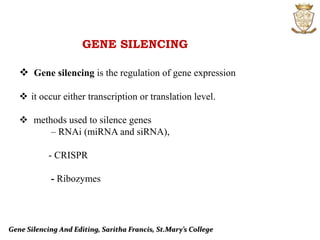
 Gene silencing is the regulation of gene expression
 it occur either transcription or translation level.
 methods used to silence genes
– RNAi (miRNA and siRNA),
- CRISPR
- Ribozymes
Gene Silencing And Editing, Saritha Francis, St.Mary’s College
RNA interference (RNAi)
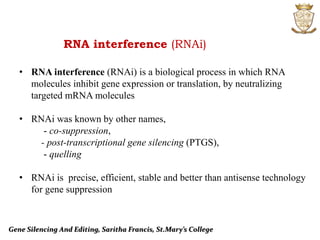
• RNA interference (RNAi) is a biological process in which RNA
molecules inhibit gene expression or translation, by neutralizing
targeted mRNA molecules
• RNAi was known by other names,
- co-suppression,
- post-transcriptional gene silencing (PTGS),
- quelling
• RNAi is precise, efficient, stable and better than antisense technology
for gene suppression
Gene Silencing And Editing, Saritha Francis, St.Mary’s College
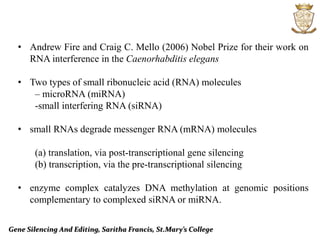
• Andrew Fire and Craig C. Mello (2006) Nobel Prize for their work on
RNA interference in the Caenorhabditis elegans
• Two types of small ribonucleic acid (RNA) molecules
– microRNA (miRNA)
-small interfering RNA (siRNA)
• small RNAs degrade messenger RNA (mRNA) molecules
(a) translation, via post-transcriptional gene silencing
(b) transcription, via the pre-transcriptional silencing
• enzyme complex catalyzes DNA methylation at genomic positions
complementary to complexed siRNA or miRNA.
Gene Silencing And Editing, Saritha Francis, St.Mary’s College
Small interfering RNA (siRNA)
• known as short interfering RNA or silencing RNA
• is a class of double-stranded RNA molecules
• 20-25 base pairs in length
• similar to miRNA, and operating within the RNA interference (RNAi)
pathway
Gene Silencing And Editing, Saritha Francis, St.Mary’s College
• the enzyme involved in RNAi is Dicer
• cleaves long double-stranded RNA (dsRNA) into short double-
stranded fragments of ~21 nucleotide siRNAs
• Each siRNA is unwound into two single-stranded RNAs (ssRNAs), the
passenger strand and the guide strand
• The passenger strand is degraded and the guide strand is incorporated
into the RNA-induced silencing complex (RISC)
• when the guide strand pairs with a complementary sequence in a
messenger RNA and induces cleavage by Argonaute 2 (Ago2), the
catalytic component of the RISC
Gene Silencing And Editing, Saritha Francis, St.Mary’s College
Ribozymes
• Ribozymes are catalytic RNA molecules used in gene silencing
• work by cleaving mRNA molecules.
Gene Silencing And Editing, Saritha Francis, St.Mary’s College
Application
• Medicine include
- cancer,
- infectious diseases,
- respiratory diseases(asthma, chronic obstructive pulmonary
disease (COPD) and cystic fibrosis),
-neurodegenerative disorders (Huntington's disease)
• Food -Arctic Apples:
non-browning trait create by using gene silencing to reduce the
expression of polyphenol oxidase (PPO).
Gene Silencing And Editing, Saritha Francis, St.Mary’s College
Gene Editing
• type of genetic engineering in which DNA is inserted, deleted,
modified or replaced in the genome of a living organism
• editing use engineered nucleases, or "molecular scissors".
• these nucleases create site-specific double-strand breaks (DSBs)
• The induced double-strand breaks are repaired through
-nonhomologous end-joining (NHEJ)
or -homologous recombination (HR),
• resulting in targeted mutations ('edits').
Gene Silencing And Editing, Saritha Francis, St.Mary’s College
ENGINEERED NUCLEASES
1) meganucleases (enzymes in the endonuclease family )
2) zinc finger nucleases (ZFNs),
3) transcription activator-like effector-based nucleases (TALEN)
4) the clustered regularly interspaced short palindromic repeats
(CRISPR/Cas9) system.
Gene Silencing And Editing, Saritha Francis, St.Mary’s College
CRISPR - Clustered Regularly Interspaced
Short Palindromic Repeats
• is a family of DNA sequences found within the genomes of
prokaryotic organisms (bacteria and archaea)
• are derived from DNA fragments from viruses that have previously
infected the prokaryote
• and are used to detect and destroy DNA from similar viruses during
subsequent infections.
Gene Silencing And Editing, Saritha Francis, St.Mary’s College
CRISPR - Clustered Regularly Interspaced
Short Palindromic Repeats
• Cas9 (or "CRISPR-associated 9") is an enzyme that uses CRISPR
sequences as a guide to recognize and cleave specific strands of DNA
that are complementary to the CRISPR sequence.
• CRISPR/Cas9 can be used to edit genes within organisms.
Gene Silencing And Editing, Saritha Francis, St.Mary’s College
Gene Editing Application
• Gene therapy
-The first clinical use of TALEN-based genome editing was in
the treatment of CD19+ acute lymphoblastic leukemia
- in an 11-month old child in 2015.
-Modified donor T cells were engineered to attack the leukemia
cells
• CRISPR-Cas9 is used to correct genetic mutation
-such as Down syndrome, spina bifida, anencephaly, Tuner and
Klinefelter syndromes.
Gene Silencing And Editing, Saritha Francis, St.Mary’s College
Gene Editing Application
• Eradicating diseases
-CRISPR-Cas9 gene drives used to modify genes associated with
sterility in A. gambiae, the vector for malaria.
- further implications in eradicating other vector borne diseases
such as yellow fever, dengue, and Zika.
Gene Silencing And Editing, Saritha Francis, St.Mary’s College
Reference
ghr.nlm.nih.gov/primer/genomicresearch/genomeediting
www.news-medical.net/life-sciences/How-Does
www.frontiersin.org/research-topics/7276/precise
www.ncbi.nlm.nih.gov/probe/docs/applsilencing
www.doublehelixresearch.com/files/journals/dhr-ijbls/v
www.sciencedirect.com/.../gene-silencing

Biotechnology:Gene Silencing And Editing

  • 1.
    Gene Silencing AndEditing Dr. Saritha Francis Assistant Professor Department of Biotechnology St. Mary’s College Thrissur
  • 2.
    Gene Silencing AndEditing, Saritha Francis, St.Mary’s College GENE SILENCING  Gene silencing is the regulation of gene expression  it occur either transcription or translation level.  methods used to silence genes – RNAi (miRNA and siRNA), - CRISPR - Ribozymes
  • 3.
    Gene Silencing AndEditing, Saritha Francis, St.Mary’s College RNA interference (RNAi) • RNA interference (RNAi) is a biological process in which RNA molecules inhibit gene expression or translation, by neutralizing targeted mRNA molecules • RNAi was known by other names, - co-suppression, - post-transcriptional gene silencing (PTGS), - quelling • RNAi is precise, efficient, stable and better than antisense technology for gene suppression
  • 4.
    Gene Silencing AndEditing, Saritha Francis, St.Mary’s College • Andrew Fire and Craig C. Mello (2006) Nobel Prize for their work on RNA interference in the Caenorhabditis elegans • Two types of small ribonucleic acid (RNA) molecules – microRNA (miRNA) -small interfering RNA (siRNA) • small RNAs degrade messenger RNA (mRNA) molecules (a) translation, via post-transcriptional gene silencing (b) transcription, via the pre-transcriptional silencing • enzyme complex catalyzes DNA methylation at genomic positions complementary to complexed siRNA or miRNA.
  • 5.
    Gene Silencing AndEditing, Saritha Francis, St.Mary’s College Small interfering RNA (siRNA) • known as short interfering RNA or silencing RNA • is a class of double-stranded RNA molecules • 20-25 base pairs in length • similar to miRNA, and operating within the RNA interference (RNAi) pathway
  • 6.
    Gene Silencing AndEditing, Saritha Francis, St.Mary’s College • the enzyme involved in RNAi is Dicer • cleaves long double-stranded RNA (dsRNA) into short double- stranded fragments of ~21 nucleotide siRNAs • Each siRNA is unwound into two single-stranded RNAs (ssRNAs), the passenger strand and the guide strand • The passenger strand is degraded and the guide strand is incorporated into the RNA-induced silencing complex (RISC) • when the guide strand pairs with a complementary sequence in a messenger RNA and induces cleavage by Argonaute 2 (Ago2), the catalytic component of the RISC
  • 7.
    Gene Silencing AndEditing, Saritha Francis, St.Mary’s College Ribozymes • Ribozymes are catalytic RNA molecules used in gene silencing • work by cleaving mRNA molecules.
  • 8.
    Gene Silencing AndEditing, Saritha Francis, St.Mary’s College Application • Medicine include - cancer, - infectious diseases, - respiratory diseases(asthma, chronic obstructive pulmonary disease (COPD) and cystic fibrosis), -neurodegenerative disorders (Huntington's disease) • Food -Arctic Apples: non-browning trait create by using gene silencing to reduce the expression of polyphenol oxidase (PPO).
  • 9.
    Gene Silencing AndEditing, Saritha Francis, St.Mary’s College Gene Editing • type of genetic engineering in which DNA is inserted, deleted, modified or replaced in the genome of a living organism • editing use engineered nucleases, or "molecular scissors". • these nucleases create site-specific double-strand breaks (DSBs) • The induced double-strand breaks are repaired through -nonhomologous end-joining (NHEJ) or -homologous recombination (HR), • resulting in targeted mutations ('edits').
  • 10.
    Gene Silencing AndEditing, Saritha Francis, St.Mary’s College ENGINEERED NUCLEASES 1) meganucleases (enzymes in the endonuclease family ) 2) zinc finger nucleases (ZFNs), 3) transcription activator-like effector-based nucleases (TALEN) 4) the clustered regularly interspaced short palindromic repeats (CRISPR/Cas9) system.
  • 11.
    Gene Silencing AndEditing, Saritha Francis, St.Mary’s College CRISPR - Clustered Regularly Interspaced Short Palindromic Repeats • is a family of DNA sequences found within the genomes of prokaryotic organisms (bacteria and archaea) • are derived from DNA fragments from viruses that have previously infected the prokaryote • and are used to detect and destroy DNA from similar viruses during subsequent infections.
  • 12.
    Gene Silencing AndEditing, Saritha Francis, St.Mary’s College CRISPR - Clustered Regularly Interspaced Short Palindromic Repeats • Cas9 (or "CRISPR-associated 9") is an enzyme that uses CRISPR sequences as a guide to recognize and cleave specific strands of DNA that are complementary to the CRISPR sequence. • CRISPR/Cas9 can be used to edit genes within organisms.
  • 13.
    Gene Silencing AndEditing, Saritha Francis, St.Mary’s College Gene Editing Application • Gene therapy -The first clinical use of TALEN-based genome editing was in the treatment of CD19+ acute lymphoblastic leukemia - in an 11-month old child in 2015. -Modified donor T cells were engineered to attack the leukemia cells • CRISPR-Cas9 is used to correct genetic mutation -such as Down syndrome, spina bifida, anencephaly, Tuner and Klinefelter syndromes.
  • 14.
    Gene Silencing AndEditing, Saritha Francis, St.Mary’s College Gene Editing Application • Eradicating diseases -CRISPR-Cas9 gene drives used to modify genes associated with sterility in A. gambiae, the vector for malaria. - further implications in eradicating other vector borne diseases such as yellow fever, dengue, and Zika.
  • 15.
    Gene Silencing AndEditing, Saritha Francis, St.Mary’s College Reference ghr.nlm.nih.gov/primer/genomicresearch/genomeediting www.news-medical.net/life-sciences/How-Does www.frontiersin.org/research-topics/7276/precise www.ncbi.nlm.nih.gov/probe/docs/applsilencing www.doublehelixresearch.com/files/journals/dhr-ijbls/v www.sciencedirect.com/.../gene-silencing