8/13/2020ByAzanawA1
College of Medicine and Health Science
School of Biomedical and Laboratory Science
Department of Medical Microbiology
Diagnosis microbiology
Biosafety Practice In Microbiology Laboratory
Gondar, Ethiopia
Outline of presentation
8/13/2020ByAzanawA2
➢ Introduction to principle of biosafety
➢ Biosafety practices and technique in microbiological laboratories
➢ Primary Barriers and PPE
➢ Biosafety cabinet
➢ Secondary Barriers
➢ Biosafety Levels
➢ Animals Facility
➢ Clinical Laboratories
➢ Importation and Interstate Shipment
➢ Laboratory Biosafety level Criteria
➢ Summary
➢ Reference
8/13/2020ByAzanawA3
Introduction Principles of Biosafety
❖ A fundamental objective of any biosafety program is the containment
of potentially harmful biological agents.
❖ The term “containment” is used in describing safe methods, facilities
and equipment for managing infectious materials in the laboratory
environment where they are being handled or maintained.
❖ The purpose of containment is to reduce or eliminate exposure of
laboratory workers, other persons, and the outside environment to
potentially hazardous agents.
❖ The use of vaccines may provide an increased level of personal
protection.
❖ The risk assessment of the work to be done with a specific agent will
determine the appropriate combination of these elements.
Biosafety practices and technique in
microbiological laboratories
8/13/2020ByAzanawA4
❖The most important element of containment is strict
adherence to standard, special microbiological practices
and techniques.
❖ Persons working with infectious agents or potentially
infected materials must be aware of potential hazards, and
must be trained.
❖The director or person in charge of the laboratory is
responsible for providing or arranging the appropriate
training of personnel.
Cont.….
8/13/2020ByAzanawA5
❖Each laboratory should develop or adopt a biosafety or
operations manual
❖A scientist, trained and knowledgeable in appropriate
laboratory techniques, safety procedures, and hazards
associated with handling infectious agents must be responsible
for the conduct of work with any infectious agents or materials
Cont.….
8/13/2020ByAzanawA6
❖When standard laboratory practices are not sufficient to
control the hazards associated with a particular agent or
laboratory procedure, additional measures may be needed.
❖The laboratory director is responsible for selecting additional
safety practices.
❖Appropriate facility design and engineering features, safety
equipment, and management practices must supplement
laboratory personnel, safety practices, and techniques.
Safety Equipment (Primary Barriers and PPE)
8/13/2020ByAzanawA7
 Safety equipment includes BSCs, enclosed containers, and other
engineering controls.
 The BSC is the principal device used to provide containment of
infectious droplets or aerosols generated by many
microbiological procedures.
 Three types of BSCs (Class I, II, III) used in microbiological
laboratories.
Primary barrier cont.…
8/13/2020ByAzanawA8
❖ Others primary barrier is the safety centrifuge cup, an enclosed
container designed to prevent aerosols.
❖ PPEs, such as gloves, coats, gowns, shoe covers, boots, respirators,
face shields, safety glasses, or goggles.
❖ PPE is often used in combination with BSCs and other devices that
contain the agents, animals, or materials being handled.
❖ BSCs impractical in some situation, PPT only used.
❖ Such as animal studies, animal necropsy, agent production activities,
and activities relating to maintenance, service, or support of the
laboratory facility
8/13/2020ByAzanawA9
Biosafety
cabinet
Class I biological safety cabinet
8/13/2020ByAzanawA10
Room air is drawn in through the front opening at a minimum velocity of 0.38 m/s, it
passes over the work surface and is discharged from the cabinet through the exhaust
duct.
The directional flow of air whisks aerosol particles that may be generated on the work
surface away from the laboratory worker and into the exhaust duct.
The front opening allows the operator’s arms to reach the work surface inside the
cabinet while he or she observes the work surface through a glass window.
The window can also be fully raised to provide access to the work surface for
cleaning or other purposes.
The air from the cabinet is exhausted through a HEPA filter:
(a) Into the laboratory and then to the outside of the building through the building
exhaust;
(b) Directly to the outside. Advantage of providing personnel and environmental
protection and can also work with radionuclides and volatile toxic chemicals.
Class II biological safety cabinets
8/13/2020ByAzanawA11
❑Use of cell and tissue cultures for the propagation of viruses
and other purposes.
❑Was designed not only to provide personnel protection but also
to protect work surface materials from contaminated room air.
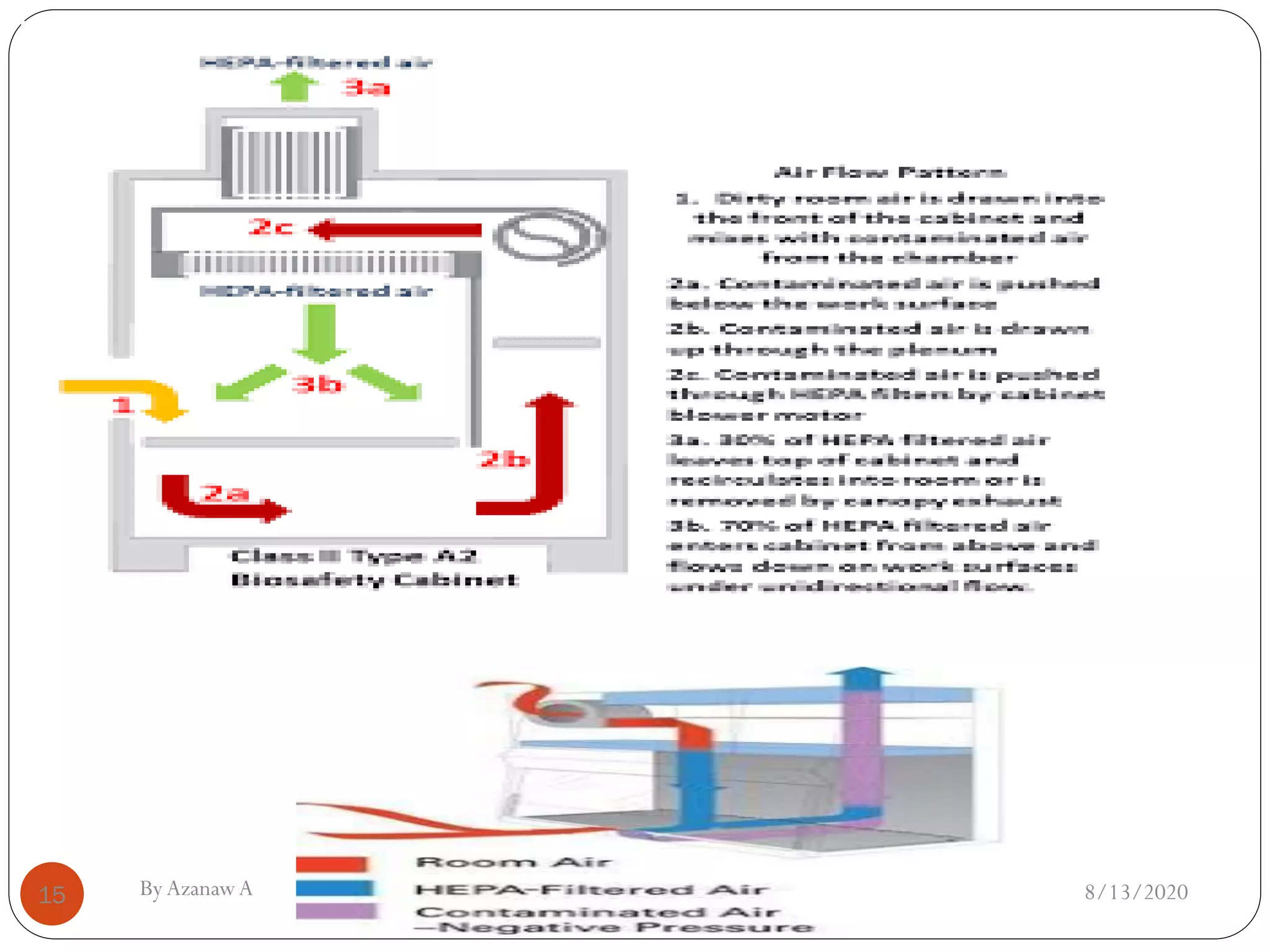
❑There are four types class II BSCS (a1, a2, b1 and b2), differ
from class I BSCS by allowing only air from a HEPA-filtered
(sterile) supply to flow over the work surface.
❑Used for working with infectious agents in risk groups 2 and 3.
❑Can also be used for working with infectious agents in risk
group 4 when positive-pressure suits are used.
Class III biological safety cabinet
8/13/2020ByAzanawA12
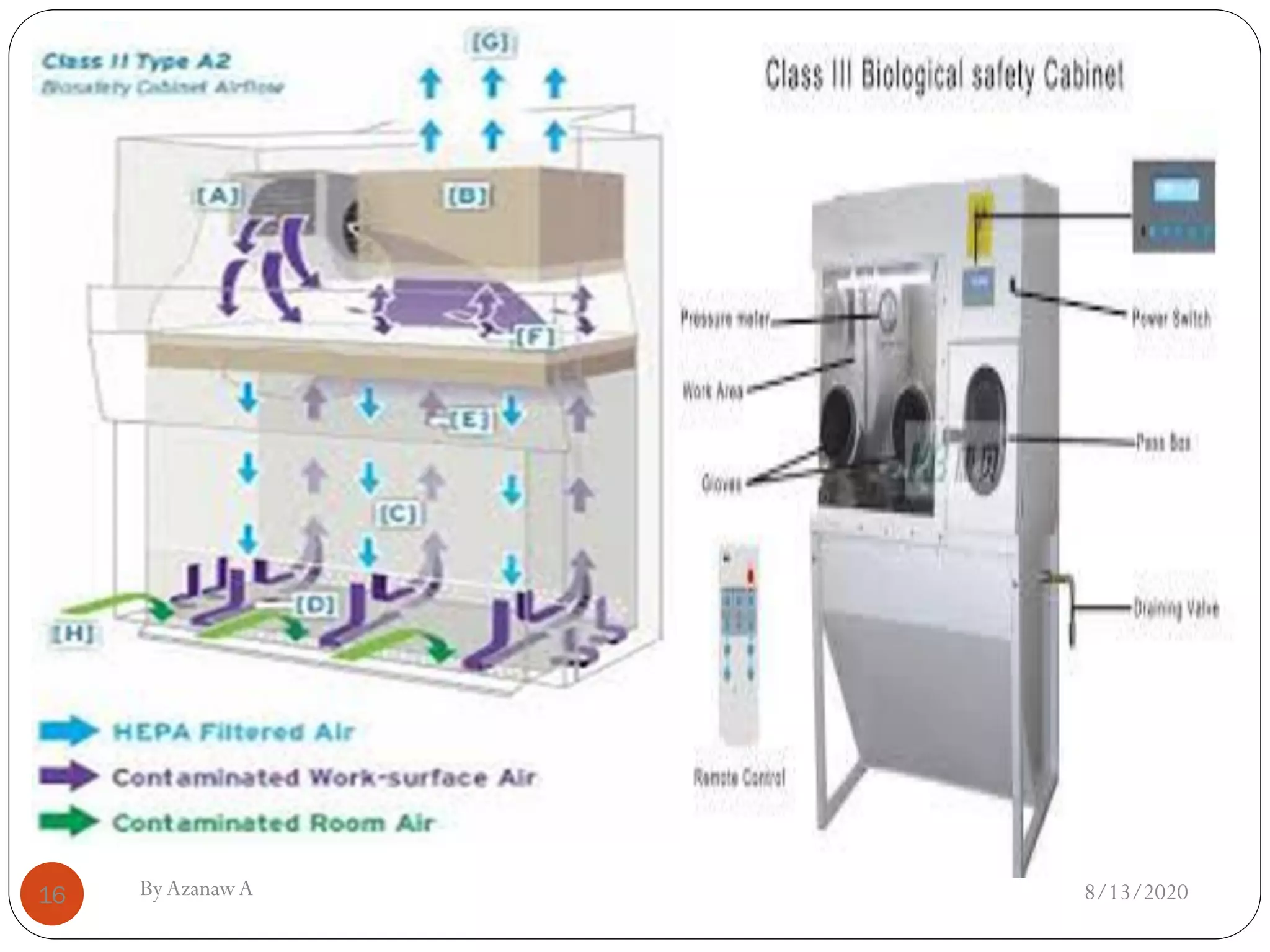
➢ Highest level of personnel protection and is used for risk group 4
agents.
➢ All penetrations are sealed “gas tight”.
➢ Supply air is HEPA-filtered and exhaust air passes through two
HEPA filters.
➢ Airflow is maintained by a dedicated exhaust system exterior to
the cabinet, which keeps the cabinet interior under negative
pressure (about 124.5 pa).
Class III biological safety cabinet cont..
8/13/2020ByAzanawA13
➢ Heavy duty rubber gloves, which are attached to ports in the
cabinet.
➢ Should have an attached pass-through box that can be sterilized
and is equipped with a HEPA-filtered exhaust.
➢ May be connected to a double-door autoclave used to
decontaminate all materials entering or exiting the cabinet.
➢ Several glove boxes can be joined together to extend the work
surface.
➢ Are suitable for work in biosafety level 3 and 4 laboratories
8/13/2020ByAzanawA14
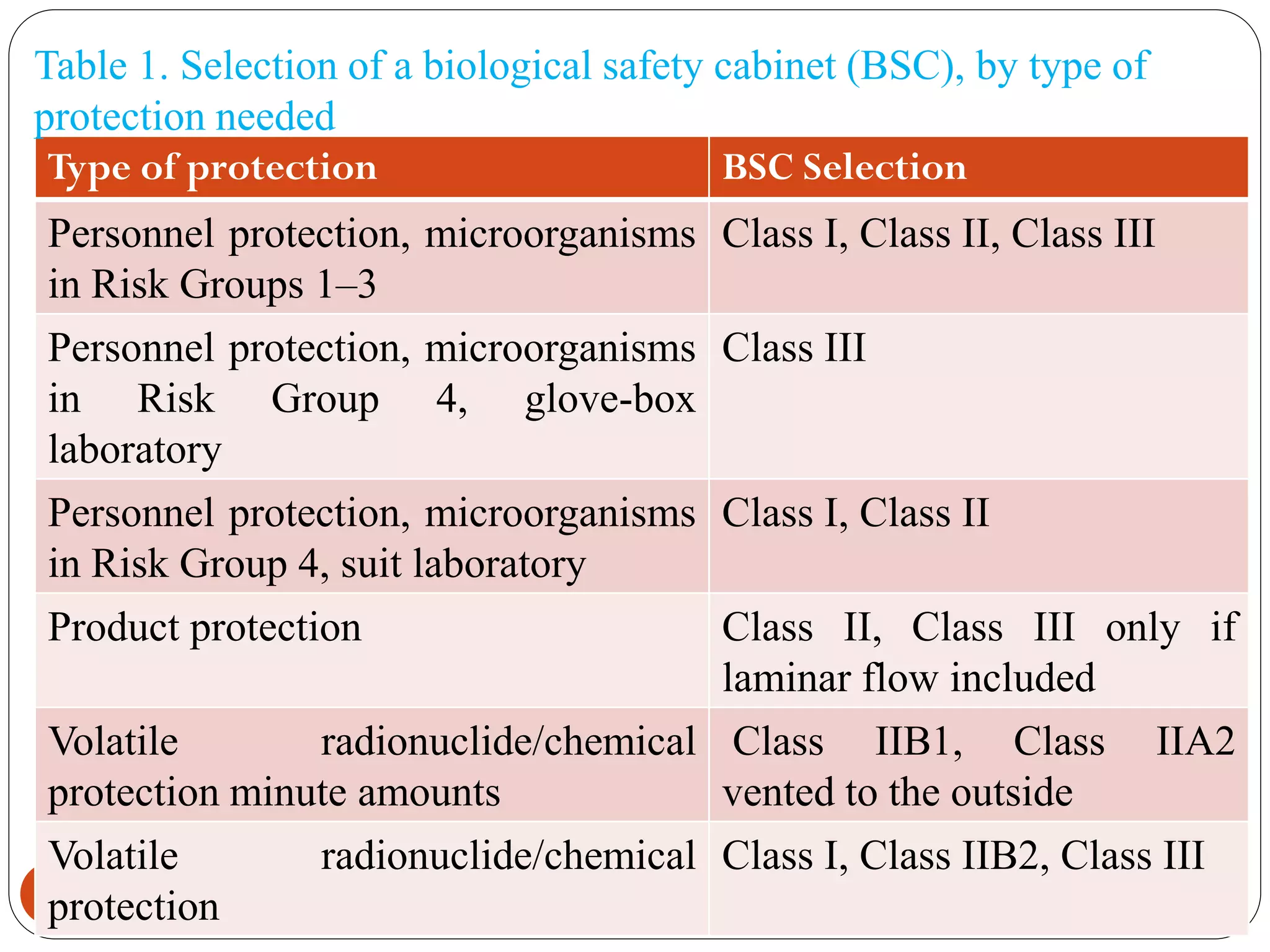
Type of protection BSC Selection
Personnel protection, microorganisms
in Risk Groups 1–3
Class I, Class II, Class III
Personnel protection, microorganisms
in Risk Group 4, glove-box
laboratory
Class III
Personnel protection, microorganisms
in Risk Group 4, suit laboratory
Class I, Class II
Product protection Class II, Class III only if
laminar flow included
Volatile radionuclide/chemical
protection minute amounts
Class IIB1, Class IIA2
vented to the outside
Volatile radionuclide/chemical
protection
Class I, Class IIB2, Class III
Table 1. Selection of a biological safety cabinet (BSC), by type of
protection needed
8/13/2020ByAzanawA15
8/13/2020ByAzanawA16
8/13/2020ByAzanawA17
Laminar Flow Hoods
◼ Laminar vertical flow hoods
 Contains HEPA filter
◼ Removes 99.97% of particles
of 0.3μM or higher
◼ Usually used in virological
laboratories
Figure 5-3: Vertical laminar flow hood.
8/13/2020ByAzanawA18
Facility Design and Construction (Secondary Barriers)
8/13/2020ByAzanawA19
❖The design and construction of the facility contributes to the
laboratory workers’ protection,
❖provides a barrier to protect persons outside the laboratory,
❖and protects persons or animals in the community from
infectious agents that may be accidentally released from the
laboratory.
❖ Laboratory directors are responsible for providing facilities
commensurate with the laboratory’s function and the
recommended biosafety level for the agents being manipulated.
Secondary barrier cont.….
8/13/2020ByAzanawA20
❖Design features include specialized ventilation systems
❖To ensure directional airflow,
❖ Air treatment systems to decontaminate or
❖Remove agents from exhaust air,
❖Controlled access zones,
❖Airlocks at laboratory entrances, or
❖Separate buildings or
❖Modules to isolate the laboratory
❖specialized ventilation systems based on American Society
of Heating, Refrigerating, and Air-Conditioning Engineers
(ASHRAE).
Animal facility
8/13/2020ByAzanawA21
 Four standard biosafety levels are also described for
activities involving infectious disease work with
commonly used experimental animals.
 These four combinations of practices, safety equipment,
and facilities are designated Animal Biosafety Levels 1, 2,
3, and 4, and provide increasing levels of protection to
personnel and the environment.
 One additional biosafety level, designated BSL-3-
Agriculture (or BSL 3-Ag) addresses activities involving
large or loose-housed animals and/or studies involving
agents designated as High Consequence Pathogens by the
USDA.
Clinical Laboratories
8/13/2020ByAzanawA22
 Specially those in health care facilities, receive clinical
specimens with requests for a variety of diagnostic and
clinical support services.
 Typically, the infectious nature of clinical material is
unknown (e.g., Sputa submitted for “routine,” acid-fast,
and fungal cultures).
 Except in extraordinary circumstances (e.g., Suspected
hemorrhagic fever), the initial processing of clinical
specimens and serological identification of isolates can be
done safely at BSL-2, the recommended level for work
with blood borne pathogens such as HBV and HIV.
Importation and Interstate Shipment of Certain Biomedical Materials
8/13/2020ByAzanawA23
 The importation of etiologic agents and vectors of human
diseases is subject to the requirements of the Public Health
Service Foreign Quarantine regulations.
➢Companion regulations of the public health service,
➢The department of transportation specify packaging,
➢ Labeling,
➢Shipping requirements for etiologic agents and
➢ Diagnostic specimens shipped in interstate commerce.
➢In Ethiopia know a days there is a regulation of triple
packaging system through postal transportation of
specimen.
Select Agents
8/13/2020ByAzanawA24
 In recent years, with the passing of federal legislation regulating the
possession, use, and transfer of agents with high adverse public
health and/or agricultural consequences, much greater emphasis has
been placed in the emerging field of biosecurity.
 In contrast with biosafety, a field dedicated to the protection of
workers and the environment from exposures to infectious materials,
 The field of biosecurity prevents loss of valuable research materials
and limits access to infectious materials by individuals who would
use them for harmful purposes.
 Nevertheless, adequate containment of biological materials is a
fundamental program component for both biosafety and biosecurity.
Universal or Standard Precautions
8/13/2020ByAzanawA25
Every specimen should
be treated as infectious
Biosafety Levels
8/13/2020ByAzanawA26
❖There are four BSLs, which consist of combinations of
laboratory practices and techniques, safety equipment, and
laboratory facilities as described the WHO Laboratory
Biosafety Manual.
❖Risk groups are the result of a classification of
microbiological agents based on:-
➢Severity of disease in humans
➢Mode of transmission,
➢Procedural protocols,
➢Experience of staff and
➢Other factors in determining the BSL in which the
work will be conducted.
Biosafety levels cont.---
8/13/2020ByAzanawA27
➢ The laboratory director is specifically and primarily responsible for
assessing the risks and applying the appropriate biosafety levels.
➢ The institution’s Biological Safety Officer (BSO) and Institution’s
biosafety Coordinator can be of great assistance in performing and
reviewing the required risk assessment.
➢ BSOs were required only when large-scale research or production of
organisms containing recombinant DNA molecules was conducted at
BSL-3 or above.
➢ IBCs were required only when an institution was performing non-
exempt recombinant DNA experiments
Biosafety Level 1 laboratories
8/13/2020ByAzanawA28
 Biosafety level 1 practices, safety equipment, and facility design and construction
are appropriate for
 Undergraduate and secondary educational training and teaching laboratories, and
 For other laboratories in which work is done with defined and characterized
strains of viable microorganisms not known to consistently cause disease in
healthy adult humans.
 However, opportunistic pathogens and may cause infection in the young, the
aged, and immunodeficient or immunosuppressed individuals.
 Vaccine strains that have undergone multiple in vivo passages should not be
considered avirulent simply because they are vaccine strains.
 BSL-1 represents a basic level of containment that relies on standard
microbiological practices with no special primary or secondary barriers
recommended, other than a sink for hand washing.
Biosafety Level 2 laboratories
8/13/2020ByAzanawA29
 Biosafety level 2 practices, equipment, and facility design and
construction are applicable to Clinical, diagnostic, teaching, and
 Also broad spectrum of indigenous moderate-risk agents that are
present in the community and associated with human disease of
varying severity.
 Hepatitis B virus, HIV, the salmonella, and toxoplasma are
representative of microorganisms assigned to this containment level.
 BSL-2 is appropriate when work is done with any human-derived
blood, body fluids, tissues, or primary human cell lines where the
presence of an infectious agent may be unknown.
Biosafety Level 2 lab. Cont.….
8/13/2020ByAzanawA30
 Primary hazards to personnel working with these agents relate to accidental
percutaneous or mucous membrane exposures, or ingestion of infectious
materials.
 Extreme caution should be taken with contaminated needles or sharp
instruments.
 Even though organisms routinely manipulated at BSL-2 are not known to be
transmissible by the aerosol route, procedures with aerosol or high splash
potential that may increase the risk of such personnel exposure must be
conducted in primary containment equipment, or in devices such as a BSC or
safety centrifuge cups.
 PPT should be used as appropriate, such as splash shields, face protection,
gowns, and gloves.
 Secondary barriers, such as hand washing sinks and waste decontamination
facilities, must be available to reduce potential environmental contamination.
Biosafety Level 3 Laboratories
8/13/2020ByAzanawA31
 Biosafety Level 3 practices, safety equipment, and facility design and construction are
applicable to clinical, diagnostic, teaching, research, or production facilities in which work
is done with indigenous or exotic agents with a potential for respiratory transmission, and
which may cause serious and potentially lethal infection.
 M.TB, St. Louis encephalitis virus, Brucella and Coxiella burnetii are representative of
the microorganisms assigned to this level.
 Primary hazards to personnel working with these agents relate to autoinoculation,
ingestion, and exposure to infectious aerosols.
 At BSL-3, more emphasis is placed on primary and secondary barriers to protect
personnel in contiguous areas, the community, and the environment from exposure to
potentially infectious aerosols.
 For example, all laboratory manipulations should be performed in a BSC or other
enclosed equipment, such as a gas-tight aerosol generation chamber.
 Secondary barriers for this level include controlled access to the laboratory and ventilation
requirements that minimize the release of infectious aerosols from the laboratory.
Biosafety Level 4 laboratories
8/13/2020ByAzanawA32
 Biosafety Level 4 practices, safety equipment, and facility
design and construction are applicable for work with dangerous
and exotic agents that pose a high individual risk of life-
threatening disease,
 transmitted via the aerosol route and for which there is no
available vaccine or therapy.
 When sufficient data are obtained, work with these agents may
continue at this level or at a lower level.
 Viruses such as Marburg or Congo-Crimean hemorrhagic fever
are manipulated at BSL-4.
Biosafety Level 4 lab cont.….
8/13/2020ByAzanawA33
 The primary hazards to personnel working with BSL-4 agents are respiratory exposure to
infectious aerosols, mucous membrane or broken skin exposure to infectious droplets, and
autoinoculation.
 All manipulations of potentially infectious diagnostic materials, isolates, and naturally or
experimentally infected animals, pose a high risk of exposure and infection to
➢Laboratory personnel,
➢The community and
➢The environment.
 For those agents working in a class III BSC or in a full-body, air-supplied
positive-pressure personnel suit.
 The BSL-4 facility is generally
✓ A separate building or completely isolated zone with complex,
✓ Specialized ventilation requirements and
✓ Waste management systems to prevent release of viable agents to the
environment.
Laboratory Biosafety Level Criteria
8/13/2020ByAzanawA34
 The levels are designated in ascending order, by degree of
protection provided to
• Personnel,
• The environment, and
• The community.
 Standard microbiological practices are common
to all biosafety level laboratories.
 Special microbiological practices enhance
• Worker safety,
• Env’t protection, and
• Address the risk of handling agents
Biosafety Level 1 laboratories
8/13/2020ByAzanawA35
A. Standard Microbiological Practices
1. The laboratory supervisor must enforce the institutional policies
that control access to the laboratory.
2. Persons must wash their hands after working with potentially
hazardous materials and before leaving the laboratory.
3. Eating, drinking, smoking, handling contact lenses, applying
cosmetics, and storing food for human consumption must not be
permitted in laboratory areas.
4. Mouth pipetting is prohibited; mechanical pipetting devices must
be used.
5. Policies for the safe handling of sharps, such as needles, scalpels,
pipettes, and broken glassware must be developed and
implemented.
Biosafety Level 1 Standard Microbiological Practices cont.….
8/13/2020ByAzanawA36
6. Perform all procedures to minimize the creation of splashes and/or
aerosols.
7. Decontaminate work surfaces after completion of work and after
any spill or splash of potentially infectious material with appropriate
disinfectant.
8. Decontaminate all cultures, stocks, and other potentially infectious
materials before disposal using an effective method.
a. Materials to be decontaminated outside of the immediate laboratory
must be placed in a durable, leak proof container and secured for
transport.
b. Materials to be removed from the facility for decontamination must
be packed in accordance with applicable local, state, and federal
regulations.
37
“Never place needles or sharps in office waste
containers”
2.48/13/2020 By Azanaw A
Biosafety Level 1 Standard Microbiological Practices cont.….
8/13/2020ByAzanawA38
9. A sign incorporating the universal biohazard symbol must be posted
at the entrance to the laboratory when infectious agents are present.
10. An effective integrated pest management program is required.
11. The laboratory supervisor must ensure that laboratory personnel
receive appropriate
➢Training regarding their duties,
➢The necessary precautions to prevent exposures, and
exposure evaluation procedures.
B. Special Practices
None required for biosafety level 1 laboratories and all four level
laboratories have the same standard microbiological practices Listed
on the above in biosafety level 1 laboratory .
Biosafety level 2 laboratories special practices
8/13/2020ByAzanawA39
A. Standard Microbiological Practices Similar Biosafety Level 1
B. Special Practices
1. All persons entering the laboratory must be advised of
the potential hazards and meet specific entry/exit
requirements.
2. All staffs provided medical surveillance, as appropriate,
and offered available immunizations for agents handled
or potentially present in the laboratory.
3. Each institution should consider the need for collection
and storage of serum samples from at-risk personnel.
Biosafety level 2 laboratories special practices cont.…
8/13/2020ByAzanawA40
4.A laboratory-specific biosafety manual must be prepared and adopted
as policy. The biosafety manual must be available and accessible.
5.The laboratory supervisor must ensure that laboratory personnel
demonstrate proficiency in standard and special microbiological
practices before working with BSL-2 agents.
6.Potentially infectious materials must be placed in a durable, leak
proof container during collection, handling, processing, storage, or
transport within a facility.
7.Laboratory equipment should be routinely decontaminated, as well
as, after spills, splashes, or other potential contamination.
Biosafety level 2 cont.….
8/13/2020ByAzanawA41
8. Incidents that may result in exposure to infectious materials
must be immediately evaluated and treated according to
procedures described in the laboratory biosafety manual.
9. Animal and plants not associated with the work being
performed must not be permitted in the laboratory.
10. All procedures involving the manipulation of infectious
materials that may generate an aerosol should be conducted within
a BSC or other physical containment devices.
Biosafety level 2 cont.….
8/13/2020ByAzanawA42
C. Safety Equipment (Primary Barriers and PPE)
1. Properly maintained BSCs, other appropriate PPE, or other
physical containment devices must be used whenever:
a. Procedures with a potential for creating infectious aerosols or
splashes are conducted.
b. High concentrations or large volumes of infectious agents are
used..
2. Protective laboratory coats, gowns, shoes , or uniforms
designated for laboratory use must be worn while working with
hazardous materials.
Remove protective clothing before leaving for non-laboratory
areas.
Biosafety level 2 cont.….
8/13/2020ByAzanawA43
3. Eye and face protection (goggles, mask, face shield or other splatter guard)
is used in areas in lab, in or outside the BSCS.
4. Gloves must be worn to protect hands from exposure to hazardous
materials. Glove selection should be based on an appropriate risk assessment.
a. Change gloves when contaminated, glove integrity is compromised, or
when otherwise necessary.
b. Remove gloves and wash hands when work with hazardous materials
has been completed and before leaving the laboratory.
a. Do not wash or reuse disposable gloves.
5. Eye, face and respiratory protection should be used in rooms containing
infected animals as determined by the risk assessment.
Biosafety level 2 cont.….
8/13/2020ByAzanawA44
D. Laboratory Facilities (Secondary Barriers)
1. Laboratory doors should be self-closing and have locks in
accordance with the institutional policies
2. Laboratories must have a sink for hand washing. It should be
located near the exit door.
3. The laboratory should be designed so that it can be easily cleaned
and decontaminated. Carpets and rugs in laboratories are not
permitted.
4. Laboratory furniture must be capable of supporting anticipated
loads and uses.
5. Bench tops must be impervious to water and resistant to heat,
organic solvents, acids, alkalis, and other chemicals.
Biosafety level 2 cont.….
8/13/2020ByAzanawA45
5. Laboratory windows that open to the exterior are not
recommended. However, if a laboratory does have windows that
open to the exterior, they must be fitted with screens.
6. BSCs must be installed so that fluctuations of the room air
supply and exhaust do not interfere with proper operations. BSCs
should be located away
➢From doors,
➢Windows that can be opened,
➢Heavily traveled laboratory areas, and
➢Other possible airflow disruptions.
7. Vacuum lines should be protected with liquid disinfectant
traps.
Biosafety level 2 cont.….
8/13/2020ByAzanawA46
8. An eyewash station must be readily available.
9. There are no specific requirements for ventilation systems.
10. HEPA filtered exhaust air from a Class II BSC can be safely
recirculation back into the laboratory environment if the cabinet
is tested and certified at least annually and operated according to
manufacturer’s recommendations.
11. A method for decontaminating all laboratory wastes should be
available in the facility.
(e.g., autoclave, chemical disinfection, incineration, or other
validated decontamination method).
Biosafety Level 3 Laboratories
8/13/2020ByAzanawA47
A. Standard Microbiological Practices Similar
Biosafety Level 1
B. Special Practices
All most all special practice are the similar
with biosafety level 2
Biosafety Level 3 cont.…..
8/13/2020ByAzanawA48
C. Safety Equipment (Primary Barriers and PPE)
1. All procedures involving the manipulation of infectious materials
must be conducted within a BSC (preferably Class II or Class III),
or other physical containment devices.
2. Workers in the laboratory where protective laboratory clothing
with a solid-front, such as tie-back or wrap-around gowns, scrub
suits, or coveralls.
3. Eye and face protection (goggles, mask, face shield or other splash
guard) is used.
4. Gloves must be worn to protect hands from exposure to hazardous
materials.
5. Eye, face, and respiratory protection must be used in rooms
containing infected animals.
Biosafety Level 3 cont.…..
8/13/2020ByAzanawA49
D. Laboratory Facilities (Secondary Barriers)
1. Laboratory doors must be self-closing and have locks in
accordance with the institutional policies.
2. Laboratories must have a sink for hand washing. The sink must be
hands-free or automatically operated.
3. The laboratory must be designed so that it can be easily cleaned
and decontaminated.
➢ Floors must be slip resistant, impervious to liquids, and resistant to
chemicals.
➢ Walls should be constructed to produce a sealed smooth finish
➢ Ceilings should be constructed, sealed, and finished in the same
general manner as walls.
Biosafety Level 3 cont.…..
8/13/2020ByAzanawA50
4. Laboratory furniture must be capable of supporting anticipated loads
and uses.
➢Bench tops must be impervious to water and resistant to heat,
organic solvents, acids, alkalis, and other chemicals.
➢Chairs used in laboratory work must be covered with a non-
porous material
5. All windows in the laboratory must be sealed.
6. BSCs must be installed so that fluctuations of the room air supply and
exhaust do not interfere with proper operations.
7. Vacuum lines must be protected with HEPA filters, or their equivalent.
8. An eyewash station must be readily available in the laboratory.
9. A ducted air ventilation system is required.
.
Biosafety Level 3 cont.….
8/13/2020ByAzanawA51
10. HEPA filtered exhaust air from a Class II BSC can be safely re-circulated into the
laboratory environment. Similar to level 2 laboratories.
11. A method for decontaminating all laboratory wastes should be available in the facility,
preferably within the laboratory (e.g., autoclave, chemical disinfection, or other validated
decontamination method).
12. HEPA filters should be tested and/or replaced at least annually.
13. Facility design consideration should be given to means of decontaminating large pieces
of equipment before removal from the laboratory.
14. Enhanced environmental and personal protection may be required by the agent summary
statement, risk assessment, or applicable local, state, or federal regulations. These laboratory
enhancements may include.
15. The BSL-3 facility design, operational parameters, and procedures must be verified and
documented prior to operation. Facilities must be re-verified and documented at least
annually.
Biosafety Level 4 laboratories
8/13/2020ByAzanawA52
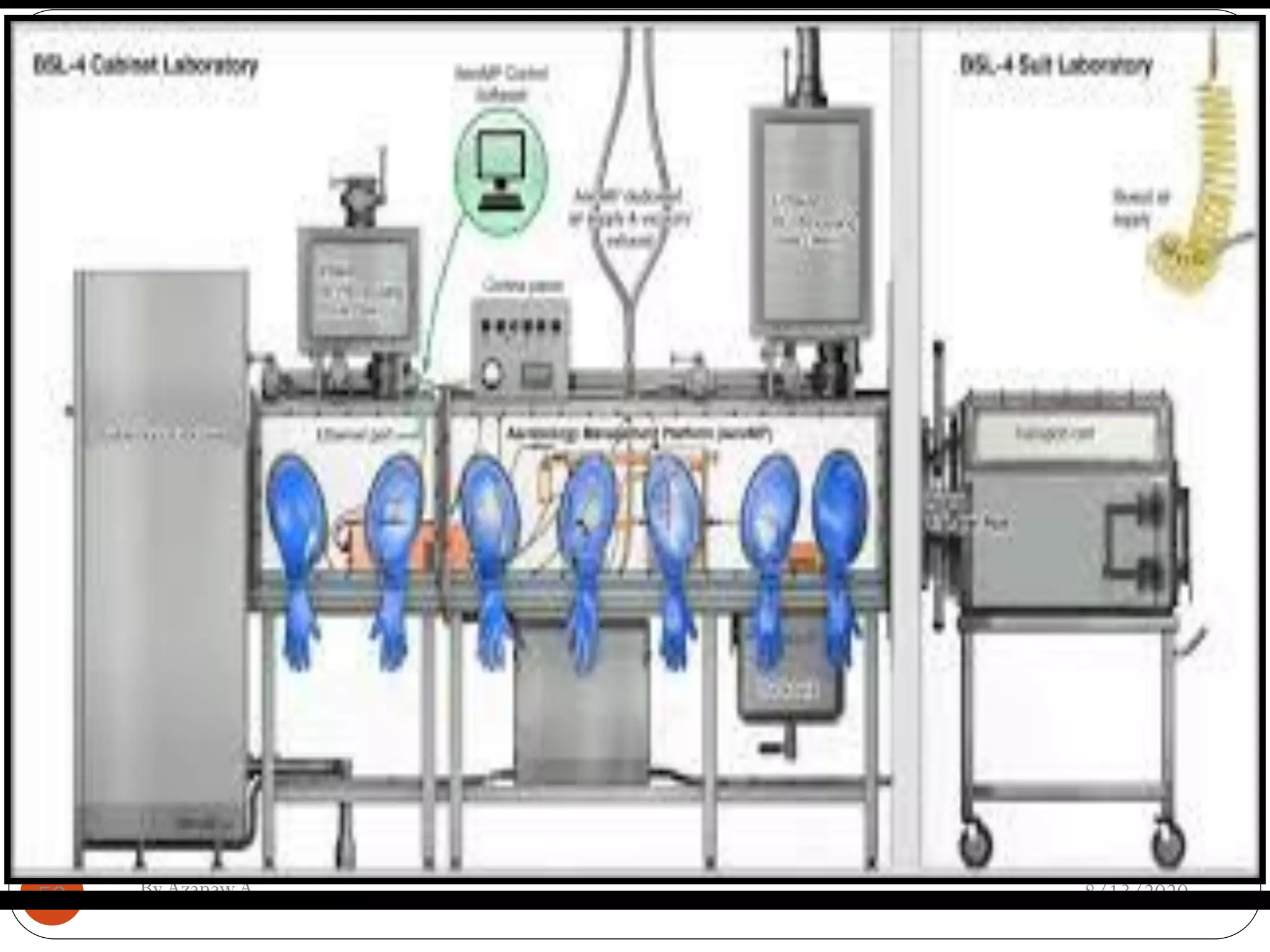
There are two models for BSL-4 laboratories.
A 1. Cabinet Laboratory—Manipulation of agents must be performed in
a Class III BSC; and
A 2. Suit Laboratory—Personnel must wear a positive pressure supplied
air protective suit.
BSL-4 cabinet and suit laboratories have special engineering and design
features to prevent microorganisms from being disseminated into the
environment.
The following standard and special safety practices, equipment, and
facilities apply to BSL-4.
8/13/2020ByAzanawA53
Biosafety Level 4 cont.….
8/13/2020ByAzanawA54
A. Standard Microbiological Practices Similar Biosafety Level 1
B. Special Practices
1. All persons entering the laboratory must be advised of the potential
hazards and meet specific entry requirements in accordance with
institutional policies.
Entry into the facility must be limited by means of
➢Secure,
➢Locked door
➢A logbook, or
➢Other means of documenting the date and
➢ Time of all persons entering and leaving the laboratory must be
maintained.
Biosafety Level 4 cont.….
8/13/2020ByAzanawA55
2. Laboratory personnel and support staff must be provided
appropriate
➢occupational medical surveillance and
➢available immunizations for agents
➢A system must be established for reporting and documenting
laboratory accidents, exposures, employee absenteeism and for the
medical surveillance of potential laboratory-associated illnesses.
3. Each institution should consider the need for collection and
storage of serum samples from at-risk personnel.
4. A laboratory-specific biosafety manual must be prepared. The
biosafety manual must be available, accessible, and followed.
Biosafety Level 4 cont.….
8/13/2020ByAzanawA56
5. The laboratory supervisor is responsible for ensuring to
manage and coordinate all safety activity in laboratory.
➢ 6. Removal of biological materials that are to remain in a
viable or intact state from the laboratory must be transferred to
➢A non-breakable,
➢Sealed primary container and
➢Then enclosed in a non-breakable,
➢Sealed secondary container.
Biosafety Level 4 cont.….
8/13/2020ByAzanawA57
7. Laboratory equipment musts be routinely decontaminated, as
well as after spills, splashes, or other potential contamination.
8. Incidents that may result in exposure to infectious materials
must be immediately evaluated and treated according to
procedures described in the laboratory biosafety manual.
All incidents must be reported to the laboratory supervisor,
institutional management and appropriate laboratory personnel
as defined in the laboratory biosafety manual.
Medical evaluation, surveillance, and treatment should be
provided and appropriate records maintained.
Biosafety Level 4 cont.….
8/13/2020ByAzanawA58
9. Animals and plants not associated with the work being performed
must not be permitted(accepted) in the laboratory.
10. Supplies and materials that are not brought into the BSL-4
laboratory through the change room, must be brought in through a
previously decontaminated double-door autoclave, fumigation
chamber, or airlock.
11. Daily inspections of essential containment and life support systems
must be completed and documented before laboratory work is initiated
to ensure that the laboratory is operating according to established
parameters.
12. Practical and effective protocols for emergency situations must be
established.
Biosafety Level 4 cont.….
8/13/2020ByAzanawA59
C. Safety Equipment (Primary Barriers and PPE)
Cabinet Laboratory
1. All manipulations of infectious materials within the laboratory
must be conducted in the Class III biological safety cabinet.
➢ Double-door,
➢ Pass through autoclaves must be provided for decontaminating
materials passing out of the class III BSC(s).
➢ The autoclave doors must be interlocked so that only one can
be opened at any time and
➢ Be automatically controlled so that the outside door to the
autoclave can only be opened after the decontamination cycle
has been completed.
Cabinet laboratory
8/13/2020ByAzanawA60
Class III cabinet gloves must be inspected for damage prior to use and
changed if necessary.
Gloves should be replaced annually during cabinet re-certification.
The cabinet should be designed to permit maintenance and repairs of
cabinet mechanical systems (refrigeration, incubators, centrifuges,
etc.) to be performed from the exterior of the cabinet whenever
possible.
Manipulation of high concentrations or large volumes of infectious
agents within the Class III cabinet should be performed using physical
containment devices inside the cabinet whenever practical.
Such materials should be centrifuged inside the cabinet using sealed
rotor heads or centrifuge safety cups.
Biosafety Level 4 cont.….
8/13/2020ByAzanawA61
2. Workers in the laboratory must wear protective laboratory
clothing with a solid-front, such as tie-back or wrap-around
gowns, scrub suits, or coveralls. All personnel clothing must
be removed at changing room.
3. Eye, face and respiratory protection should be used in
rooms containing infected animals as determined by the risk
assessment.
4. Disposable gloves must be worn underneath cabinet
gloves to protect the worker from exposure should a break
or tear occur in a cabinet glove.
Biosafety Level 4 cont.….
8/13/2020ByAzanawA62
Suit(outfit) Laboratory
1. All procedures must be conducted by personnel wearing a one-piece positive
pressure supplied air suit. All manipulations of infectious agents must be
performed within a BSC or other primary barrier system.
2. Workers must wear laboratory clothing, such as scrub suits, before entering the
room used for donning positive pressure suits. All laboratory clothing must be
removed in the dirty side change room before entering the personal shower.
3. Inner disposable gloves must be worn to protect against break or tears in the outer
suit gloves.
➢ Disposable gloves must not be worn outside the change area
➢ Alternatives to latex gloves should be available.
➢ Do not wash or reuse disposable gloves.
➢ Inner gloves must be removed and
➢ discarded in the inner change room prior to entering the personal shower.
➢ Dispose of used gloves with other contaminated waste.
4.Decontamination of outer suit gloves is performed during laboratory operations to
remove gross contamination and minimize further contamination of the laboratory.
Biosafety Level 4 cont.….
8/13/2020ByAzanawA63
D. Laboratory Facilities (Secondary Barriers)
Cabinet Laboratory
1. The BSL-4 cabinet laboratories consists of either a separate
building or a clearly demarcated and isolated zone within a
building. Laboratory doors must have locks in accordance with the
institutional policies.
2. A hands-free sink must be provided near the door of the cabinet
room(s) and the inner change room.
➢A sink must be provided in the outer change room.
➢All sinks in the room(s) containing the class III BSC must
be connected to the waste water decontamination system.
➢Air intakes.
Biosafety Level 4 cont.….
8/13/2020ByAzanawA64
3. Walls, floors, and ceilings of the laboratory must be constructed
to form a sealed internal shell to facilitate fumigation and prohibit
animal and insect intrusion.
Openings around doors into the cabinet room and inner change
room must be minimized and capable of being sealed to facilitate
decontamination.
Drains in the laboratory floor (if present) must be connected
directly to the liquid waste decontamination system.
Services and plumbing that penetrate the laboratory walls, floors,
or ceiling must be installed to ensure that no backflow from the
laboratory occurs.
Selection of the appropriate materials and methods used for
decontamination must be based on the risk assessment.
Biosafety Level 4 cont.….
8/13/2020ByAzanawA65
4. Laboratory furniture must be of simple construction, capable of
supporting anticipated loading and uses.
5. Windows must be break-resistant and sealed.
6. If Class II BSCs are needed in the cabinet laboratory, they must be
installed so that fluctuations of the room air supply and exhaust do not
interfere with proper operations.
7. Central vacuum systems are not recommended. If, however, there
is a central vacuum system, it must not serve areas outside the cabinet
room.
Two in-line HEPA filters must be placed near each use point. Filters
must be installed to permit in-place decontamination and replacement.
Biosafety Level 4 cont.….
8/13/2020ByAzanawA66
8. An eyewash station must be readily available in the laboratory.
9. A dedicated non-recirculating ventilation system is provided.
The air exhaust discharge must be located away from occupied
spaces and building.
All HEPA filters should be located as near as practicable to the
cabinet and laboratory in order to minimize the length of
potentially contaminated ductwork.
All HEPA filters must be tested and certified annually.
Biosafety Level 4 cont.….
8/13/2020ByAzanawA67
10. HEPA filtered exhaust air from a Class II BSC can be
safely re-circulated into the laboratory environment if the
cabinet is tested and certified at least annually and operated
according to the manufacturer’s recommendations. .
Class III BSCs must be directly and independently
exhausted through two HEPA filters in series.
Supply air must be provided in such a manner that prevents
positive pressurization of the cabinet.
11. Pass through dunk tanks, fumigation chambers, or
equivalent decontamination methods must be provided.
8/13/2020ByAzanawA68
Biosafety Level 4 cont.….
8/13/2020ByAzanawA69
12. Liquid effluents from cabinet room sinks, floor drains, autoclave
chambers, and other sources within the cabinet room must be
decontaminated by a proven method, preferably heat treatment, before
being discharged to the sanitary sewer.
13 A double-door, pass through autoclave(s) must be provided for
decontaminating materials passing out of the cabinet laboratory.
Autoclaves that open outside of the laboratory must be sealed to the
interior wall.
14. The BSL-4 facility design parameters and operational procedures
must be documented.
15. Appropriate communication systems must be provided between the
laboratory and the outside (e.g., voice, fax, and computer).
Biosafety Level 4 cont.….
8/13/2020ByAzanawA70
Suit Laboratory
1. The BSL-4 suit laboratory consists of either a separate building or a clearly
demarcated and isolated zone within a building. Laboratory doors must have
locks in accordance with the institutional policies.
An automatically activated emergency power source must be provided, at a
minimum, for the laboratory exhaust system, life support systems, alarms, lighting,
entry and exit controls, BSCs, and door gaskets.
Monitoring and control systems for air supply, exhaust, life support, alarms, entry and
exit controls, and security systems should be on a UPS.
A double-door autoclave, dunk tank, or fumigation chamber must be provided at the
containment barrier for the passage of materials, supplies, or equipment in or out of
the laboratory.
2. Sinks inside the suit laboratory should be placed near procedure areas and be
connected to the wastewater decontamination system.
3. Walls, floors, and ceilings of the laboratory must be constructed to form a sealed
internal shell to facilitate fumigation and prohibit animal and insect intrusion.
Biosafety Level 4 cont.….
8/13/2020ByAzanawA71
4. Laboratory furniture must be of simple construction, capable of
supporting anticipated loading and uses. Sharp edges and corners should
be avoided.
5. Windows must be break-resistant and sealed.
6. BSCs and other primary containment barrier systems must be installed
so that fluctuations of the room air supply and exhaust do not interfere
with proper operations.
7. Central vacuum systems are not recommended. Filters must be installed
to permit in-place decontamination and replacement.
8. An eyewash station must be readily available in the laboratory area for
use during maintenance and repair activities.
9. A dedicated, non-recirculating ventilation system is provided.
8/13/2020
ByAzanawA
72
Summary
8/13/2020ByAzanawA73
➢ A fundamental objective of any biosafety program is the containment of
potentially harmful biological agents.
➢ “Laboratory biosafety” refers a field dedicated to the protection of
workers and the environment from exposures to infectious materials
➢ “Laboratory biosecurity” refers to institutional and personal security
measures designed to prevent the loss, theft, misuse, diversion or
intentional release of pathogens and toxins. E.g. smallpox Atlanta lab
➢ There are four biosafety level laboratories and three level of biosafety
cabinets. level 1,2,3 and 4 and class 1,2,3 respectively.
➢ Over the years the basic design of BSCs has undergone several
modifications. A major change was the addition of a high-efficiency
particulate air (HEPA) filter.
➢ All HEPA filters must be tested and certified annually.
➢ The laboratory supervisor is responsible for ensuring to manage and
coordinate all safety activity in laboratory.
References
8/13/2020ByAzanawA74
1. McIntosh IBD, Morgan CB, Dorgan CE. ASHRAE laboratory
design guide. Atlanta: American Society of Heating, Refrigerating
and Air-Conditioning Engineers, Inc; 2001.
6.Centers for Disease Control and Prevention National Institutes of
Health Biosafety in Microbiological and Biomedical Laboratories ,5th
Edition, U.S. Department of Health and Human Services, Public
Health Service, HHS Publication No. (CDC) 21-1112, Revised
December 2009
8/13/2020ByAzanawA75

Biosafety training for hcw converted

  • 1.
    8/13/2020ByAzanawA1 College of Medicineand Health Science School of Biomedical and Laboratory Science Department of Medical Microbiology Diagnosis microbiology Biosafety Practice In Microbiology Laboratory Gondar, Ethiopia
  • 2.
    Outline of presentation 8/13/2020ByAzanawA2 ➢Introduction to principle of biosafety ➢ Biosafety practices and technique in microbiological laboratories ➢ Primary Barriers and PPE ➢ Biosafety cabinet ➢ Secondary Barriers ➢ Biosafety Levels ➢ Animals Facility ➢ Clinical Laboratories ➢ Importation and Interstate Shipment ➢ Laboratory Biosafety level Criteria ➢ Summary ➢ Reference
  • 3.
    8/13/2020ByAzanawA3 Introduction Principles ofBiosafety ❖ A fundamental objective of any biosafety program is the containment of potentially harmful biological agents. ❖ The term “containment” is used in describing safe methods, facilities and equipment for managing infectious materials in the laboratory environment where they are being handled or maintained. ❖ The purpose of containment is to reduce or eliminate exposure of laboratory workers, other persons, and the outside environment to potentially hazardous agents. ❖ The use of vaccines may provide an increased level of personal protection. ❖ The risk assessment of the work to be done with a specific agent will determine the appropriate combination of these elements.
  • 4.
    Biosafety practices andtechnique in microbiological laboratories 8/13/2020ByAzanawA4 ❖The most important element of containment is strict adherence to standard, special microbiological practices and techniques. ❖ Persons working with infectious agents or potentially infected materials must be aware of potential hazards, and must be trained. ❖The director or person in charge of the laboratory is responsible for providing or arranging the appropriate training of personnel.
  • 5.
    Cont.…. 8/13/2020ByAzanawA5 ❖Each laboratory shoulddevelop or adopt a biosafety or operations manual ❖A scientist, trained and knowledgeable in appropriate laboratory techniques, safety procedures, and hazards associated with handling infectious agents must be responsible for the conduct of work with any infectious agents or materials
  • 6.
    Cont.…. 8/13/2020ByAzanawA6 ❖When standard laboratorypractices are not sufficient to control the hazards associated with a particular agent or laboratory procedure, additional measures may be needed. ❖The laboratory director is responsible for selecting additional safety practices. ❖Appropriate facility design and engineering features, safety equipment, and management practices must supplement laboratory personnel, safety practices, and techniques.
  • 7.
    Safety Equipment (PrimaryBarriers and PPE) 8/13/2020ByAzanawA7  Safety equipment includes BSCs, enclosed containers, and other engineering controls.  The BSC is the principal device used to provide containment of infectious droplets or aerosols generated by many microbiological procedures.  Three types of BSCs (Class I, II, III) used in microbiological laboratories.
  • 8.
    Primary barrier cont.… 8/13/2020ByAzanawA8 ❖Others primary barrier is the safety centrifuge cup, an enclosed container designed to prevent aerosols. ❖ PPEs, such as gloves, coats, gowns, shoe covers, boots, respirators, face shields, safety glasses, or goggles. ❖ PPE is often used in combination with BSCs and other devices that contain the agents, animals, or materials being handled. ❖ BSCs impractical in some situation, PPT only used. ❖ Such as animal studies, animal necropsy, agent production activities, and activities relating to maintenance, service, or support of the laboratory facility
  • 9.
  • 10.
    Class I biologicalsafety cabinet 8/13/2020ByAzanawA10 Room air is drawn in through the front opening at a minimum velocity of 0.38 m/s, it passes over the work surface and is discharged from the cabinet through the exhaust duct. The directional flow of air whisks aerosol particles that may be generated on the work surface away from the laboratory worker and into the exhaust duct. The front opening allows the operator’s arms to reach the work surface inside the cabinet while he or she observes the work surface through a glass window. The window can also be fully raised to provide access to the work surface for cleaning or other purposes. The air from the cabinet is exhausted through a HEPA filter: (a) Into the laboratory and then to the outside of the building through the building exhaust; (b) Directly to the outside. Advantage of providing personnel and environmental protection and can also work with radionuclides and volatile toxic chemicals.
  • 11.
    Class II biologicalsafety cabinets 8/13/2020ByAzanawA11 ❑Use of cell and tissue cultures for the propagation of viruses and other purposes. ❑Was designed not only to provide personnel protection but also to protect work surface materials from contaminated room air. ❑There are four types class II BSCS (a1, a2, b1 and b2), differ from class I BSCS by allowing only air from a HEPA-filtered (sterile) supply to flow over the work surface. ❑Used for working with infectious agents in risk groups 2 and 3. ❑Can also be used for working with infectious agents in risk group 4 when positive-pressure suits are used.
  • 12.
    Class III biologicalsafety cabinet 8/13/2020ByAzanawA12 ➢ Highest level of personnel protection and is used for risk group 4 agents. ➢ All penetrations are sealed “gas tight”. ➢ Supply air is HEPA-filtered and exhaust air passes through two HEPA filters. ➢ Airflow is maintained by a dedicated exhaust system exterior to the cabinet, which keeps the cabinet interior under negative pressure (about 124.5 pa).
  • 13.
    Class III biologicalsafety cabinet cont.. 8/13/2020ByAzanawA13 ➢ Heavy duty rubber gloves, which are attached to ports in the cabinet. ➢ Should have an attached pass-through box that can be sterilized and is equipped with a HEPA-filtered exhaust. ➢ May be connected to a double-door autoclave used to decontaminate all materials entering or exiting the cabinet. ➢ Several glove boxes can be joined together to extend the work surface. ➢ Are suitable for work in biosafety level 3 and 4 laboratories
  • 14.
    8/13/2020ByAzanawA14 Type of protectionBSC Selection Personnel protection, microorganisms in Risk Groups 1–3 Class I, Class II, Class III Personnel protection, microorganisms in Risk Group 4, glove-box laboratory Class III Personnel protection, microorganisms in Risk Group 4, suit laboratory Class I, Class II Product protection Class II, Class III only if laminar flow included Volatile radionuclide/chemical protection minute amounts Class IIB1, Class IIA2 vented to the outside Volatile radionuclide/chemical protection Class I, Class IIB2, Class III Table 1. Selection of a biological safety cabinet (BSC), by type of protection needed
  • 15.
  • 16.
  • 17.
  • 18.
    Laminar Flow Hoods ◼Laminar vertical flow hoods  Contains HEPA filter ◼ Removes 99.97% of particles of 0.3μM or higher ◼ Usually used in virological laboratories Figure 5-3: Vertical laminar flow hood. 8/13/2020ByAzanawA18
  • 19.
    Facility Design andConstruction (Secondary Barriers) 8/13/2020ByAzanawA19 ❖The design and construction of the facility contributes to the laboratory workers’ protection, ❖provides a barrier to protect persons outside the laboratory, ❖and protects persons or animals in the community from infectious agents that may be accidentally released from the laboratory. ❖ Laboratory directors are responsible for providing facilities commensurate with the laboratory’s function and the recommended biosafety level for the agents being manipulated.
  • 20.
    Secondary barrier cont.…. 8/13/2020ByAzanawA20 ❖Designfeatures include specialized ventilation systems ❖To ensure directional airflow, ❖ Air treatment systems to decontaminate or ❖Remove agents from exhaust air, ❖Controlled access zones, ❖Airlocks at laboratory entrances, or ❖Separate buildings or ❖Modules to isolate the laboratory ❖specialized ventilation systems based on American Society of Heating, Refrigerating, and Air-Conditioning Engineers (ASHRAE).
  • 21.
    Animal facility 8/13/2020ByAzanawA21  Fourstandard biosafety levels are also described for activities involving infectious disease work with commonly used experimental animals.  These four combinations of practices, safety equipment, and facilities are designated Animal Biosafety Levels 1, 2, 3, and 4, and provide increasing levels of protection to personnel and the environment.  One additional biosafety level, designated BSL-3- Agriculture (or BSL 3-Ag) addresses activities involving large or loose-housed animals and/or studies involving agents designated as High Consequence Pathogens by the USDA.
  • 22.
    Clinical Laboratories 8/13/2020ByAzanawA22  Speciallythose in health care facilities, receive clinical specimens with requests for a variety of diagnostic and clinical support services.  Typically, the infectious nature of clinical material is unknown (e.g., Sputa submitted for “routine,” acid-fast, and fungal cultures).  Except in extraordinary circumstances (e.g., Suspected hemorrhagic fever), the initial processing of clinical specimens and serological identification of isolates can be done safely at BSL-2, the recommended level for work with blood borne pathogens such as HBV and HIV.
  • 23.
    Importation and InterstateShipment of Certain Biomedical Materials 8/13/2020ByAzanawA23  The importation of etiologic agents and vectors of human diseases is subject to the requirements of the Public Health Service Foreign Quarantine regulations. ➢Companion regulations of the public health service, ➢The department of transportation specify packaging, ➢ Labeling, ➢Shipping requirements for etiologic agents and ➢ Diagnostic specimens shipped in interstate commerce. ➢In Ethiopia know a days there is a regulation of triple packaging system through postal transportation of specimen.
  • 24.
    Select Agents 8/13/2020ByAzanawA24  Inrecent years, with the passing of federal legislation regulating the possession, use, and transfer of agents with high adverse public health and/or agricultural consequences, much greater emphasis has been placed in the emerging field of biosecurity.  In contrast with biosafety, a field dedicated to the protection of workers and the environment from exposures to infectious materials,  The field of biosecurity prevents loss of valuable research materials and limits access to infectious materials by individuals who would use them for harmful purposes.  Nevertheless, adequate containment of biological materials is a fundamental program component for both biosafety and biosecurity.
  • 25.
    Universal or StandardPrecautions 8/13/2020ByAzanawA25 Every specimen should be treated as infectious
  • 26.
    Biosafety Levels 8/13/2020ByAzanawA26 ❖There arefour BSLs, which consist of combinations of laboratory practices and techniques, safety equipment, and laboratory facilities as described the WHO Laboratory Biosafety Manual. ❖Risk groups are the result of a classification of microbiological agents based on:- ➢Severity of disease in humans ➢Mode of transmission, ➢Procedural protocols, ➢Experience of staff and ➢Other factors in determining the BSL in which the work will be conducted.
  • 27.
    Biosafety levels cont.--- 8/13/2020ByAzanawA27 ➢The laboratory director is specifically and primarily responsible for assessing the risks and applying the appropriate biosafety levels. ➢ The institution’s Biological Safety Officer (BSO) and Institution’s biosafety Coordinator can be of great assistance in performing and reviewing the required risk assessment. ➢ BSOs were required only when large-scale research or production of organisms containing recombinant DNA molecules was conducted at BSL-3 or above. ➢ IBCs were required only when an institution was performing non- exempt recombinant DNA experiments
  • 28.
    Biosafety Level 1laboratories 8/13/2020ByAzanawA28  Biosafety level 1 practices, safety equipment, and facility design and construction are appropriate for  Undergraduate and secondary educational training and teaching laboratories, and  For other laboratories in which work is done with defined and characterized strains of viable microorganisms not known to consistently cause disease in healthy adult humans.  However, opportunistic pathogens and may cause infection in the young, the aged, and immunodeficient or immunosuppressed individuals.  Vaccine strains that have undergone multiple in vivo passages should not be considered avirulent simply because they are vaccine strains.  BSL-1 represents a basic level of containment that relies on standard microbiological practices with no special primary or secondary barriers recommended, other than a sink for hand washing.
  • 29.
    Biosafety Level 2laboratories 8/13/2020ByAzanawA29  Biosafety level 2 practices, equipment, and facility design and construction are applicable to Clinical, diagnostic, teaching, and  Also broad spectrum of indigenous moderate-risk agents that are present in the community and associated with human disease of varying severity.  Hepatitis B virus, HIV, the salmonella, and toxoplasma are representative of microorganisms assigned to this containment level.  BSL-2 is appropriate when work is done with any human-derived blood, body fluids, tissues, or primary human cell lines where the presence of an infectious agent may be unknown.
  • 30.
    Biosafety Level 2lab. Cont.…. 8/13/2020ByAzanawA30  Primary hazards to personnel working with these agents relate to accidental percutaneous or mucous membrane exposures, or ingestion of infectious materials.  Extreme caution should be taken with contaminated needles or sharp instruments.  Even though organisms routinely manipulated at BSL-2 are not known to be transmissible by the aerosol route, procedures with aerosol or high splash potential that may increase the risk of such personnel exposure must be conducted in primary containment equipment, or in devices such as a BSC or safety centrifuge cups.  PPT should be used as appropriate, such as splash shields, face protection, gowns, and gloves.  Secondary barriers, such as hand washing sinks and waste decontamination facilities, must be available to reduce potential environmental contamination.
  • 31.
    Biosafety Level 3Laboratories 8/13/2020ByAzanawA31  Biosafety Level 3 practices, safety equipment, and facility design and construction are applicable to clinical, diagnostic, teaching, research, or production facilities in which work is done with indigenous or exotic agents with a potential for respiratory transmission, and which may cause serious and potentially lethal infection.  M.TB, St. Louis encephalitis virus, Brucella and Coxiella burnetii are representative of the microorganisms assigned to this level.  Primary hazards to personnel working with these agents relate to autoinoculation, ingestion, and exposure to infectious aerosols.  At BSL-3, more emphasis is placed on primary and secondary barriers to protect personnel in contiguous areas, the community, and the environment from exposure to potentially infectious aerosols.  For example, all laboratory manipulations should be performed in a BSC or other enclosed equipment, such as a gas-tight aerosol generation chamber.  Secondary barriers for this level include controlled access to the laboratory and ventilation requirements that minimize the release of infectious aerosols from the laboratory.
  • 32.
    Biosafety Level 4laboratories 8/13/2020ByAzanawA32  Biosafety Level 4 practices, safety equipment, and facility design and construction are applicable for work with dangerous and exotic agents that pose a high individual risk of life- threatening disease,  transmitted via the aerosol route and for which there is no available vaccine or therapy.  When sufficient data are obtained, work with these agents may continue at this level or at a lower level.  Viruses such as Marburg or Congo-Crimean hemorrhagic fever are manipulated at BSL-4.
  • 33.
    Biosafety Level 4lab cont.…. 8/13/2020ByAzanawA33  The primary hazards to personnel working with BSL-4 agents are respiratory exposure to infectious aerosols, mucous membrane or broken skin exposure to infectious droplets, and autoinoculation.  All manipulations of potentially infectious diagnostic materials, isolates, and naturally or experimentally infected animals, pose a high risk of exposure and infection to ➢Laboratory personnel, ➢The community and ➢The environment.  For those agents working in a class III BSC or in a full-body, air-supplied positive-pressure personnel suit.  The BSL-4 facility is generally ✓ A separate building or completely isolated zone with complex, ✓ Specialized ventilation requirements and ✓ Waste management systems to prevent release of viable agents to the environment.
  • 34.
    Laboratory Biosafety LevelCriteria 8/13/2020ByAzanawA34  The levels are designated in ascending order, by degree of protection provided to • Personnel, • The environment, and • The community.  Standard microbiological practices are common to all biosafety level laboratories.  Special microbiological practices enhance • Worker safety, • Env’t protection, and • Address the risk of handling agents
  • 35.
    Biosafety Level 1laboratories 8/13/2020ByAzanawA35 A. Standard Microbiological Practices 1. The laboratory supervisor must enforce the institutional policies that control access to the laboratory. 2. Persons must wash their hands after working with potentially hazardous materials and before leaving the laboratory. 3. Eating, drinking, smoking, handling contact lenses, applying cosmetics, and storing food for human consumption must not be permitted in laboratory areas. 4. Mouth pipetting is prohibited; mechanical pipetting devices must be used. 5. Policies for the safe handling of sharps, such as needles, scalpels, pipettes, and broken glassware must be developed and implemented.
  • 36.
    Biosafety Level 1Standard Microbiological Practices cont.…. 8/13/2020ByAzanawA36 6. Perform all procedures to minimize the creation of splashes and/or aerosols. 7. Decontaminate work surfaces after completion of work and after any spill or splash of potentially infectious material with appropriate disinfectant. 8. Decontaminate all cultures, stocks, and other potentially infectious materials before disposal using an effective method. a. Materials to be decontaminated outside of the immediate laboratory must be placed in a durable, leak proof container and secured for transport. b. Materials to be removed from the facility for decontamination must be packed in accordance with applicable local, state, and federal regulations.
  • 37.
    37 “Never place needlesor sharps in office waste containers” 2.48/13/2020 By Azanaw A
  • 38.
    Biosafety Level 1Standard Microbiological Practices cont.…. 8/13/2020ByAzanawA38 9. A sign incorporating the universal biohazard symbol must be posted at the entrance to the laboratory when infectious agents are present. 10. An effective integrated pest management program is required. 11. The laboratory supervisor must ensure that laboratory personnel receive appropriate ➢Training regarding their duties, ➢The necessary precautions to prevent exposures, and exposure evaluation procedures. B. Special Practices None required for biosafety level 1 laboratories and all four level laboratories have the same standard microbiological practices Listed on the above in biosafety level 1 laboratory .
  • 39.
    Biosafety level 2laboratories special practices 8/13/2020ByAzanawA39 A. Standard Microbiological Practices Similar Biosafety Level 1 B. Special Practices 1. All persons entering the laboratory must be advised of the potential hazards and meet specific entry/exit requirements. 2. All staffs provided medical surveillance, as appropriate, and offered available immunizations for agents handled or potentially present in the laboratory. 3. Each institution should consider the need for collection and storage of serum samples from at-risk personnel.
  • 40.
    Biosafety level 2laboratories special practices cont.… 8/13/2020ByAzanawA40 4.A laboratory-specific biosafety manual must be prepared and adopted as policy. The biosafety manual must be available and accessible. 5.The laboratory supervisor must ensure that laboratory personnel demonstrate proficiency in standard and special microbiological practices before working with BSL-2 agents. 6.Potentially infectious materials must be placed in a durable, leak proof container during collection, handling, processing, storage, or transport within a facility. 7.Laboratory equipment should be routinely decontaminated, as well as, after spills, splashes, or other potential contamination.
  • 41.
    Biosafety level 2cont.…. 8/13/2020ByAzanawA41 8. Incidents that may result in exposure to infectious materials must be immediately evaluated and treated according to procedures described in the laboratory biosafety manual. 9. Animal and plants not associated with the work being performed must not be permitted in the laboratory. 10. All procedures involving the manipulation of infectious materials that may generate an aerosol should be conducted within a BSC or other physical containment devices.
  • 42.
    Biosafety level 2cont.…. 8/13/2020ByAzanawA42 C. Safety Equipment (Primary Barriers and PPE) 1. Properly maintained BSCs, other appropriate PPE, or other physical containment devices must be used whenever: a. Procedures with a potential for creating infectious aerosols or splashes are conducted. b. High concentrations or large volumes of infectious agents are used.. 2. Protective laboratory coats, gowns, shoes , or uniforms designated for laboratory use must be worn while working with hazardous materials. Remove protective clothing before leaving for non-laboratory areas.
  • 43.
    Biosafety level 2cont.…. 8/13/2020ByAzanawA43 3. Eye and face protection (goggles, mask, face shield or other splatter guard) is used in areas in lab, in or outside the BSCS. 4. Gloves must be worn to protect hands from exposure to hazardous materials. Glove selection should be based on an appropriate risk assessment. a. Change gloves when contaminated, glove integrity is compromised, or when otherwise necessary. b. Remove gloves and wash hands when work with hazardous materials has been completed and before leaving the laboratory. a. Do not wash or reuse disposable gloves. 5. Eye, face and respiratory protection should be used in rooms containing infected animals as determined by the risk assessment.
  • 44.
    Biosafety level 2cont.…. 8/13/2020ByAzanawA44 D. Laboratory Facilities (Secondary Barriers) 1. Laboratory doors should be self-closing and have locks in accordance with the institutional policies 2. Laboratories must have a sink for hand washing. It should be located near the exit door. 3. The laboratory should be designed so that it can be easily cleaned and decontaminated. Carpets and rugs in laboratories are not permitted. 4. Laboratory furniture must be capable of supporting anticipated loads and uses. 5. Bench tops must be impervious to water and resistant to heat, organic solvents, acids, alkalis, and other chemicals.
  • 45.
    Biosafety level 2cont.…. 8/13/2020ByAzanawA45 5. Laboratory windows that open to the exterior are not recommended. However, if a laboratory does have windows that open to the exterior, they must be fitted with screens. 6. BSCs must be installed so that fluctuations of the room air supply and exhaust do not interfere with proper operations. BSCs should be located away ➢From doors, ➢Windows that can be opened, ➢Heavily traveled laboratory areas, and ➢Other possible airflow disruptions. 7. Vacuum lines should be protected with liquid disinfectant traps.
  • 46.
    Biosafety level 2cont.…. 8/13/2020ByAzanawA46 8. An eyewash station must be readily available. 9. There are no specific requirements for ventilation systems. 10. HEPA filtered exhaust air from a Class II BSC can be safely recirculation back into the laboratory environment if the cabinet is tested and certified at least annually and operated according to manufacturer’s recommendations. 11. A method for decontaminating all laboratory wastes should be available in the facility. (e.g., autoclave, chemical disinfection, incineration, or other validated decontamination method).
  • 47.
    Biosafety Level 3Laboratories 8/13/2020ByAzanawA47 A. Standard Microbiological Practices Similar Biosafety Level 1 B. Special Practices All most all special practice are the similar with biosafety level 2
  • 48.
    Biosafety Level 3cont.….. 8/13/2020ByAzanawA48 C. Safety Equipment (Primary Barriers and PPE) 1. All procedures involving the manipulation of infectious materials must be conducted within a BSC (preferably Class II or Class III), or other physical containment devices. 2. Workers in the laboratory where protective laboratory clothing with a solid-front, such as tie-back or wrap-around gowns, scrub suits, or coveralls. 3. Eye and face protection (goggles, mask, face shield or other splash guard) is used. 4. Gloves must be worn to protect hands from exposure to hazardous materials. 5. Eye, face, and respiratory protection must be used in rooms containing infected animals.
  • 49.
    Biosafety Level 3cont.….. 8/13/2020ByAzanawA49 D. Laboratory Facilities (Secondary Barriers) 1. Laboratory doors must be self-closing and have locks in accordance with the institutional policies. 2. Laboratories must have a sink for hand washing. The sink must be hands-free or automatically operated. 3. The laboratory must be designed so that it can be easily cleaned and decontaminated. ➢ Floors must be slip resistant, impervious to liquids, and resistant to chemicals. ➢ Walls should be constructed to produce a sealed smooth finish ➢ Ceilings should be constructed, sealed, and finished in the same general manner as walls.
  • 50.
    Biosafety Level 3cont.….. 8/13/2020ByAzanawA50 4. Laboratory furniture must be capable of supporting anticipated loads and uses. ➢Bench tops must be impervious to water and resistant to heat, organic solvents, acids, alkalis, and other chemicals. ➢Chairs used in laboratory work must be covered with a non- porous material 5. All windows in the laboratory must be sealed. 6. BSCs must be installed so that fluctuations of the room air supply and exhaust do not interfere with proper operations. 7. Vacuum lines must be protected with HEPA filters, or their equivalent. 8. An eyewash station must be readily available in the laboratory. 9. A ducted air ventilation system is required. .
  • 51.
    Biosafety Level 3cont.…. 8/13/2020ByAzanawA51 10. HEPA filtered exhaust air from a Class II BSC can be safely re-circulated into the laboratory environment. Similar to level 2 laboratories. 11. A method for decontaminating all laboratory wastes should be available in the facility, preferably within the laboratory (e.g., autoclave, chemical disinfection, or other validated decontamination method). 12. HEPA filters should be tested and/or replaced at least annually. 13. Facility design consideration should be given to means of decontaminating large pieces of equipment before removal from the laboratory. 14. Enhanced environmental and personal protection may be required by the agent summary statement, risk assessment, or applicable local, state, or federal regulations. These laboratory enhancements may include. 15. The BSL-3 facility design, operational parameters, and procedures must be verified and documented prior to operation. Facilities must be re-verified and documented at least annually.
  • 52.
    Biosafety Level 4laboratories 8/13/2020ByAzanawA52 There are two models for BSL-4 laboratories. A 1. Cabinet Laboratory—Manipulation of agents must be performed in a Class III BSC; and A 2. Suit Laboratory—Personnel must wear a positive pressure supplied air protective suit. BSL-4 cabinet and suit laboratories have special engineering and design features to prevent microorganisms from being disseminated into the environment. The following standard and special safety practices, equipment, and facilities apply to BSL-4.
  • 53.
  • 54.
    Biosafety Level 4cont.…. 8/13/2020ByAzanawA54 A. Standard Microbiological Practices Similar Biosafety Level 1 B. Special Practices 1. All persons entering the laboratory must be advised of the potential hazards and meet specific entry requirements in accordance with institutional policies. Entry into the facility must be limited by means of ➢Secure, ➢Locked door ➢A logbook, or ➢Other means of documenting the date and ➢ Time of all persons entering and leaving the laboratory must be maintained.
  • 55.
    Biosafety Level 4cont.…. 8/13/2020ByAzanawA55 2. Laboratory personnel and support staff must be provided appropriate ➢occupational medical surveillance and ➢available immunizations for agents ➢A system must be established for reporting and documenting laboratory accidents, exposures, employee absenteeism and for the medical surveillance of potential laboratory-associated illnesses. 3. Each institution should consider the need for collection and storage of serum samples from at-risk personnel. 4. A laboratory-specific biosafety manual must be prepared. The biosafety manual must be available, accessible, and followed.
  • 56.
    Biosafety Level 4cont.…. 8/13/2020ByAzanawA56 5. The laboratory supervisor is responsible for ensuring to manage and coordinate all safety activity in laboratory. ➢ 6. Removal of biological materials that are to remain in a viable or intact state from the laboratory must be transferred to ➢A non-breakable, ➢Sealed primary container and ➢Then enclosed in a non-breakable, ➢Sealed secondary container.
  • 57.
    Biosafety Level 4cont.…. 8/13/2020ByAzanawA57 7. Laboratory equipment musts be routinely decontaminated, as well as after spills, splashes, or other potential contamination. 8. Incidents that may result in exposure to infectious materials must be immediately evaluated and treated according to procedures described in the laboratory biosafety manual. All incidents must be reported to the laboratory supervisor, institutional management and appropriate laboratory personnel as defined in the laboratory biosafety manual. Medical evaluation, surveillance, and treatment should be provided and appropriate records maintained.
  • 58.
    Biosafety Level 4cont.…. 8/13/2020ByAzanawA58 9. Animals and plants not associated with the work being performed must not be permitted(accepted) in the laboratory. 10. Supplies and materials that are not brought into the BSL-4 laboratory through the change room, must be brought in through a previously decontaminated double-door autoclave, fumigation chamber, or airlock. 11. Daily inspections of essential containment and life support systems must be completed and documented before laboratory work is initiated to ensure that the laboratory is operating according to established parameters. 12. Practical and effective protocols for emergency situations must be established.
  • 59.
    Biosafety Level 4cont.…. 8/13/2020ByAzanawA59 C. Safety Equipment (Primary Barriers and PPE) Cabinet Laboratory 1. All manipulations of infectious materials within the laboratory must be conducted in the Class III biological safety cabinet. ➢ Double-door, ➢ Pass through autoclaves must be provided for decontaminating materials passing out of the class III BSC(s). ➢ The autoclave doors must be interlocked so that only one can be opened at any time and ➢ Be automatically controlled so that the outside door to the autoclave can only be opened after the decontamination cycle has been completed.
  • 60.
    Cabinet laboratory 8/13/2020ByAzanawA60 Class IIIcabinet gloves must be inspected for damage prior to use and changed if necessary. Gloves should be replaced annually during cabinet re-certification. The cabinet should be designed to permit maintenance and repairs of cabinet mechanical systems (refrigeration, incubators, centrifuges, etc.) to be performed from the exterior of the cabinet whenever possible. Manipulation of high concentrations or large volumes of infectious agents within the Class III cabinet should be performed using physical containment devices inside the cabinet whenever practical. Such materials should be centrifuged inside the cabinet using sealed rotor heads or centrifuge safety cups.
  • 61.
    Biosafety Level 4cont.…. 8/13/2020ByAzanawA61 2. Workers in the laboratory must wear protective laboratory clothing with a solid-front, such as tie-back or wrap-around gowns, scrub suits, or coveralls. All personnel clothing must be removed at changing room. 3. Eye, face and respiratory protection should be used in rooms containing infected animals as determined by the risk assessment. 4. Disposable gloves must be worn underneath cabinet gloves to protect the worker from exposure should a break or tear occur in a cabinet glove.
  • 62.
    Biosafety Level 4cont.…. 8/13/2020ByAzanawA62 Suit(outfit) Laboratory 1. All procedures must be conducted by personnel wearing a one-piece positive pressure supplied air suit. All manipulations of infectious agents must be performed within a BSC or other primary barrier system. 2. Workers must wear laboratory clothing, such as scrub suits, before entering the room used for donning positive pressure suits. All laboratory clothing must be removed in the dirty side change room before entering the personal shower. 3. Inner disposable gloves must be worn to protect against break or tears in the outer suit gloves. ➢ Disposable gloves must not be worn outside the change area ➢ Alternatives to latex gloves should be available. ➢ Do not wash or reuse disposable gloves. ➢ Inner gloves must be removed and ➢ discarded in the inner change room prior to entering the personal shower. ➢ Dispose of used gloves with other contaminated waste. 4.Decontamination of outer suit gloves is performed during laboratory operations to remove gross contamination and minimize further contamination of the laboratory.
  • 63.
    Biosafety Level 4cont.…. 8/13/2020ByAzanawA63 D. Laboratory Facilities (Secondary Barriers) Cabinet Laboratory 1. The BSL-4 cabinet laboratories consists of either a separate building or a clearly demarcated and isolated zone within a building. Laboratory doors must have locks in accordance with the institutional policies. 2. A hands-free sink must be provided near the door of the cabinet room(s) and the inner change room. ➢A sink must be provided in the outer change room. ➢All sinks in the room(s) containing the class III BSC must be connected to the waste water decontamination system. ➢Air intakes.
  • 64.
    Biosafety Level 4cont.…. 8/13/2020ByAzanawA64 3. Walls, floors, and ceilings of the laboratory must be constructed to form a sealed internal shell to facilitate fumigation and prohibit animal and insect intrusion. Openings around doors into the cabinet room and inner change room must be minimized and capable of being sealed to facilitate decontamination. Drains in the laboratory floor (if present) must be connected directly to the liquid waste decontamination system. Services and plumbing that penetrate the laboratory walls, floors, or ceiling must be installed to ensure that no backflow from the laboratory occurs. Selection of the appropriate materials and methods used for decontamination must be based on the risk assessment.
  • 65.
    Biosafety Level 4cont.…. 8/13/2020ByAzanawA65 4. Laboratory furniture must be of simple construction, capable of supporting anticipated loading and uses. 5. Windows must be break-resistant and sealed. 6. If Class II BSCs are needed in the cabinet laboratory, they must be installed so that fluctuations of the room air supply and exhaust do not interfere with proper operations. 7. Central vacuum systems are not recommended. If, however, there is a central vacuum system, it must not serve areas outside the cabinet room. Two in-line HEPA filters must be placed near each use point. Filters must be installed to permit in-place decontamination and replacement.
  • 66.
    Biosafety Level 4cont.…. 8/13/2020ByAzanawA66 8. An eyewash station must be readily available in the laboratory. 9. A dedicated non-recirculating ventilation system is provided. The air exhaust discharge must be located away from occupied spaces and building. All HEPA filters should be located as near as practicable to the cabinet and laboratory in order to minimize the length of potentially contaminated ductwork. All HEPA filters must be tested and certified annually.
  • 67.
    Biosafety Level 4cont.…. 8/13/2020ByAzanawA67 10. HEPA filtered exhaust air from a Class II BSC can be safely re-circulated into the laboratory environment if the cabinet is tested and certified at least annually and operated according to the manufacturer’s recommendations. . Class III BSCs must be directly and independently exhausted through two HEPA filters in series. Supply air must be provided in such a manner that prevents positive pressurization of the cabinet. 11. Pass through dunk tanks, fumigation chambers, or equivalent decontamination methods must be provided.
  • 68.
  • 69.
    Biosafety Level 4cont.…. 8/13/2020ByAzanawA69 12. Liquid effluents from cabinet room sinks, floor drains, autoclave chambers, and other sources within the cabinet room must be decontaminated by a proven method, preferably heat treatment, before being discharged to the sanitary sewer. 13 A double-door, pass through autoclave(s) must be provided for decontaminating materials passing out of the cabinet laboratory. Autoclaves that open outside of the laboratory must be sealed to the interior wall. 14. The BSL-4 facility design parameters and operational procedures must be documented. 15. Appropriate communication systems must be provided between the laboratory and the outside (e.g., voice, fax, and computer).
  • 70.
    Biosafety Level 4cont.…. 8/13/2020ByAzanawA70 Suit Laboratory 1. The BSL-4 suit laboratory consists of either a separate building or a clearly demarcated and isolated zone within a building. Laboratory doors must have locks in accordance with the institutional policies. An automatically activated emergency power source must be provided, at a minimum, for the laboratory exhaust system, life support systems, alarms, lighting, entry and exit controls, BSCs, and door gaskets. Monitoring and control systems for air supply, exhaust, life support, alarms, entry and exit controls, and security systems should be on a UPS. A double-door autoclave, dunk tank, or fumigation chamber must be provided at the containment barrier for the passage of materials, supplies, or equipment in or out of the laboratory. 2. Sinks inside the suit laboratory should be placed near procedure areas and be connected to the wastewater decontamination system. 3. Walls, floors, and ceilings of the laboratory must be constructed to form a sealed internal shell to facilitate fumigation and prohibit animal and insect intrusion.
  • 71.
    Biosafety Level 4cont.…. 8/13/2020ByAzanawA71 4. Laboratory furniture must be of simple construction, capable of supporting anticipated loading and uses. Sharp edges and corners should be avoided. 5. Windows must be break-resistant and sealed. 6. BSCs and other primary containment barrier systems must be installed so that fluctuations of the room air supply and exhaust do not interfere with proper operations. 7. Central vacuum systems are not recommended. Filters must be installed to permit in-place decontamination and replacement. 8. An eyewash station must be readily available in the laboratory area for use during maintenance and repair activities. 9. A dedicated, non-recirculating ventilation system is provided.
  • 72.
  • 73.
    Summary 8/13/2020ByAzanawA73 ➢ A fundamentalobjective of any biosafety program is the containment of potentially harmful biological agents. ➢ “Laboratory biosafety” refers a field dedicated to the protection of workers and the environment from exposures to infectious materials ➢ “Laboratory biosecurity” refers to institutional and personal security measures designed to prevent the loss, theft, misuse, diversion or intentional release of pathogens and toxins. E.g. smallpox Atlanta lab ➢ There are four biosafety level laboratories and three level of biosafety cabinets. level 1,2,3 and 4 and class 1,2,3 respectively. ➢ Over the years the basic design of BSCs has undergone several modifications. A major change was the addition of a high-efficiency particulate air (HEPA) filter. ➢ All HEPA filters must be tested and certified annually. ➢ The laboratory supervisor is responsible for ensuring to manage and coordinate all safety activity in laboratory.
  • 74.
    References 8/13/2020ByAzanawA74 1. McIntosh IBD,Morgan CB, Dorgan CE. ASHRAE laboratory design guide. Atlanta: American Society of Heating, Refrigerating and Air-Conditioning Engineers, Inc; 2001. 6.Centers for Disease Control and Prevention National Institutes of Health Biosafety in Microbiological and Biomedical Laboratories ,5th Edition, U.S. Department of Health and Human Services, Public Health Service, HHS Publication No. (CDC) 21-1112, Revised December 2009
  • 75.