© 2008 Cisco Systems, Inc. All rights reserved. Cisco Confidential
Presentation_ID 1
Instructor Materials
Chapter 5: Windows
Installation
IT Essentials v6.0
© 2008 Cisco Systems, Inc. All rights reserved. Cisco Confidential
Presentation_ID 2
Chapter 5:
Windows Installation
IT Essentials v6.0
Presentation_ID 3
© 2008 Cisco Systems, Inc. All rights reserved. Cisco Confidential
Chapter 5 - Sections & Objectives
 5.1 Modern Operating System
 Explain operating system requirements.
 5.2 Operating System Installation
 Install a Microsoft Windows operating system.
 5.3 Chapter Summary
© 2008 Cisco Systems, Inc. All rights reserved. Cisco Confidential
Presentation_ID 4
5.1 Modern Operating
Systems
Presentation_ID 5
© 2008 Cisco Systems, Inc. All rights reserved. Cisco Confidential
Modern Operating Systems
Operating System Terms and Characteristics
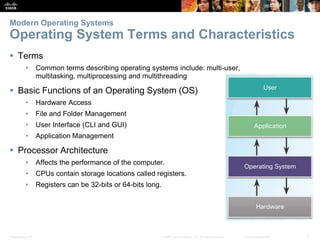
 Terms
• Common terms describing operating systems include: multi-user,
multitasking, multiprocessing and multithreading
 Basic Functions of an Operating System (OS)
• Hardware Access
• File and Folder Management
• User Interface (CLI and GUI)
• Application Management
 Processor Architecture
• Affects the performance of the computer.
• CPUs contain storage locations called registers.
• Registers can be 32-bits or 64-bits long.
Presentation_ID 6
© 2008 Cisco Systems, Inc. All rights reserved. Cisco Confidential
Modern Operating Systems
Types of Operating Systems
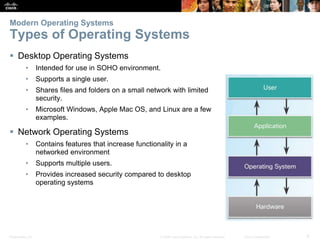
 Desktop Operating Systems
• Intended for use in SOHO environment.
• Supports a single user.
• Shares files and folders on a small network with limited
security.
• Microsoft Windows, Apple Mac OS, and Linux are a few
examples.
 Network Operating Systems
• Contains features that increase functionality in a
networked environment
• Supports multiple users.
• Provides increased security compared to desktop
operating systems
Presentation_ID 7
© 2008 Cisco Systems, Inc. All rights reserved. Cisco Confidential
Modern Operating Systems
Customer Requirements for an Operating System
 OS Compatible Applications and Environments
• Before recommending an OS, the technician must:
• Review budget constraints.
• Learn how the computer will be used.
• Determine which types of applications will be installed.
• Determine if a new computer needs to be purchased?
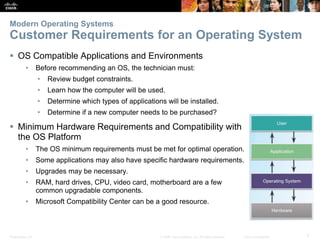
 Minimum Hardware Requirements and Compatibility with
the OS Platform
• The OS minimum requirements must be met for optimal operation.
• Some applications may also have specific hardware requirements.
• Upgrades may be necessary.
• RAM, hard drives, CPU, video card, motherboard are a few
common upgradable components.
• Microsoft Compatibility Center can be a good resource.
Presentation_ID 8
© 2008 Cisco Systems, Inc. All rights reserved. Cisco Confidential
Modern Operating Systems
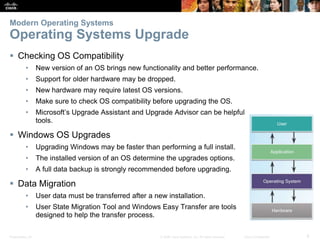
Operating Systems Upgrade
 Checking OS Compatibility
• New version of an OS brings new functionality and better performance.
• Support for older hardware may be dropped.
• New hardware may require latest OS versions.
• Make sure to check OS compatibility before upgrading the OS.
• Microsoft’s Upgrade Assistant and Upgrade Advisor can be helpful
tools.
 Windows OS Upgrades
• Upgrading Windows may be faster than performing a full install.
• The installed version of an OS determine the upgrades options.
• A full data backup is strongly recommended before upgrading.
 Data Migration
• User data must be transferred after a new installation.
• User State Migration Tool and Windows Easy Transfer are tools
designed to help the transfer process.
© 2008 Cisco Systems, Inc. All rights reserved. Cisco Confidential
Presentation_ID 9
5.2 Operating System
Installation
Presentation_ID 10
© 2008 Cisco Systems, Inc. All rights reserved. Cisco Confidential
Operating System Installation
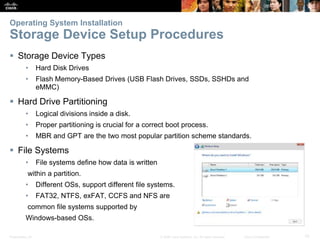
Storage Device Setup Procedures
 Storage Device Types
• Hard Disk Drives
• Flash Memory-Based Drives (USB Flash Drives, SSDs, SSHDs and
eMMC)
 Hard Drive Partitioning
• Logical divisions inside a disk.
• Proper partitioning is crucial for a correct boot process.
• MBR and GPT are the two most popular partition scheme standards.
 File Systems
• File systems define how data is written
within a partition.
• Different OSs, support different file systems.
• FAT32, NTFS, exFAT, CCFS and NFS are
common file systems supported by
Windows-based OSs.
Presentation_ID 11
© 2008 Cisco Systems, Inc. All rights reserved. Cisco Confidential
Operating System Installation
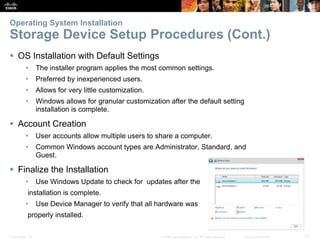
Storage Device Setup Procedures (Cont.)
 OS Installation with Default Settings
• The installer program applies the most common settings.
• Preferred by inexperienced users.
• Allows for very little customization.
• Windows allows for granular customization after the default setting
installation is complete.
 Account Creation
• User accounts allow multiple users to share a computer.
• Common Windows account types are Administrator, Standard, and
Guest.
 Finalize the Installation
• Use Windows Update to check for updates after the
installation is complete.
• Use Device Manager to verify that all hardware was
properly installed.
Presentation_ID 12
© 2008 Cisco Systems, Inc. All rights reserved. Cisco Confidential
Operating System Installation
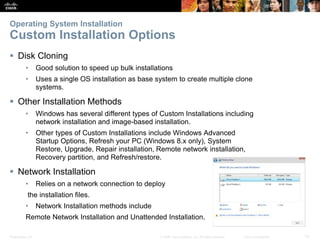
Custom Installation Options
 Disk Cloning
• Good solution to speed up bulk installations
• Uses a single OS installation as base system to create multiple clone
systems.
 Other Installation Methods
• Windows has several different types of Custom Installations including
network installation and image-based installation.
• Other types of Custom Installations include Windows Advanced
Startup Options, Refresh your PC (Windows 8.x only), System
Restore, Upgrade, Repair installation, Remote network installation,
Recovery partition, and Refresh/restore.
 Network Installation
• Relies on a network connection to deploy
the installation files.
• Network Installation methods include
Remote Network Installation and Unattended Installation.
Presentation_ID 13
© 2008 Cisco Systems, Inc. All rights reserved. Cisco Confidential
Operating System Installation
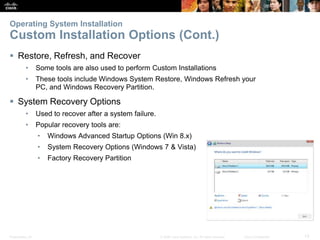
Custom Installation Options (Cont.)
 Restore, Refresh, and Recover
• Some tools are also used to perform Custom Installations
• These tools include Windows System Restore, Windows Refresh your
PC, and Windows Recovery Partition.
 System Recovery Options
• Used to recover after a system failure.
• Popular recovery tools are:
• Windows Advanced Startup Options (Win 8.x)
• System Recovery Options (Windows 7 & Vista)
• Factory Recovery Partition
Presentation_ID 14
© 2008 Cisco Systems, Inc. All rights reserved. Cisco Confidential
Operating System Installation
Boot Sequence and Registry Files
 Windows Boot Process
• Common boot steps are: POST execution, locating and loading CMOS
configurations, locating and loading bootloaders, locating and loading
the OS.
• Windows Boot Loader and Windows Boot Manager are programs used
to manage Windows startup.
 Startup Modes
• Windows Startup Modes allow for troubleshooting when Windows fails
to start.
• Windows Startup Modes include: Safe Mode, Safe Mode with
Networking, Safe Mode with Command Prompt and Last Known Good
Configuration.
 Windows Registry
• All Windows settings are stored as key-values pairs in the Windows
Registry
• Extreme caution must be taken when working with the Registry.
Presentation_ID 15
© 2008 Cisco Systems, Inc. All rights reserved. Cisco Confidential
Operating System Installation
Multiboot
 Multiboot Procedures
• It is possible to install multiple OSs in one computer.
• BOOTMGR manages multiple versions of Windows installed on a single
computer.
 Disk Management Utility
Many tasks can be accomplished through Disk Management Utility, including:
view drive status, extend partitions, split partitions, assign drive letters, add
drives and add arrays.
 Partitions
• Logical divisions created inside a drive to host file systems.
• Partitions can be extended or shrunk using the Disk Management Utility
 Drive Mapping or Drive Letter Assignment
• In Windows, assigning letters to name physical or logical drives is called drive
mapping or drive letter assignment.
• Disk Management Utility can also be used to manage drive letter assignment.
Presentation_ID 16
© 2008 Cisco Systems, Inc. All rights reserved. Cisco Confidential
Operating System Installation
Disk Directories
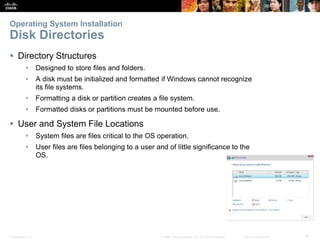
 Directory Structures
• Designed to store files and folders.
• A disk must be initialized and formatted if Windows cannot recognize
its file systems.
• Formatting a disk or partition creates a file system.
• Formatted disks or partitions must be mounted before use.
 User and System File Locations
• System files are files critical to the OS operation.
• User files are files belonging to a user and of little significance to the
OS.
Presentation_ID 17
© 2008 Cisco Systems, Inc. All rights reserved. Cisco Confidential
Operating System Installation
Disk Directories (Cont.)
 Attributes
• File extensions identify file types in Windows and must
adhere to Windows Naming Convention.
• File attributes define how files can be handled.
• Common file attributes are READ, ARCHIVE, SYSTEM
and HIDDEN.
 Application, File, and Folder Properties
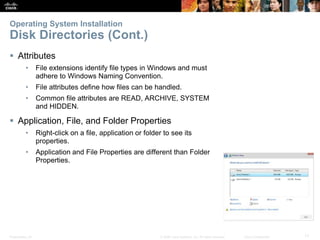
• Right-click on a file, application or folder to see its
properties.
• Application and File Properties are different than Folder
Properties.
© 2008 Cisco Systems, Inc. All rights reserved. Cisco Confidential
Presentation_ID 18
5.3 Chapter Summary
Presentation_ID 19
© 2008 Cisco Systems, Inc. All rights reserved. Cisco Confidential
This chapter introduced computer operating systems. As a technician, you should be skilled
at installing Windows® operating systems. The following concepts from this chapter are
important to remember:
 Several different operating systems are available, and you must consider the customer’s
needs and environment when choosing an OS.
 The main steps in setting up a customer’s computer include preparing the drive, installing
the OS, creating user accounts, and configuring installation options.
Chapter Summary
Summary
Presentation_ID 20
© 2008 Cisco Systems, Inc. All rights reserved. Cisco Confidential
Presentation_ID 21
© 2008 Cisco Systems, Inc. All rights reserved. Cisco Confidential

Windows_Installation.pptx

  • 1.
    © 2008 CiscoSystems, Inc. All rights reserved. Cisco Confidential Presentation_ID 1 Instructor Materials Chapter 5: Windows Installation IT Essentials v6.0
  • 2.
    © 2008 CiscoSystems, Inc. All rights reserved. Cisco Confidential Presentation_ID 2 Chapter 5: Windows Installation IT Essentials v6.0
  • 3.
    Presentation_ID 3 © 2008Cisco Systems, Inc. All rights reserved. Cisco Confidential Chapter 5 - Sections & Objectives  5.1 Modern Operating System  Explain operating system requirements.  5.2 Operating System Installation  Install a Microsoft Windows operating system.  5.3 Chapter Summary
  • 4.
    © 2008 CiscoSystems, Inc. All rights reserved. Cisco Confidential Presentation_ID 4 5.1 Modern Operating Systems
  • 5.
    Presentation_ID 5 © 2008Cisco Systems, Inc. All rights reserved. Cisco Confidential Modern Operating Systems Operating System Terms and Characteristics  Terms • Common terms describing operating systems include: multi-user, multitasking, multiprocessing and multithreading  Basic Functions of an Operating System (OS) • Hardware Access • File and Folder Management • User Interface (CLI and GUI) • Application Management  Processor Architecture • Affects the performance of the computer. • CPUs contain storage locations called registers. • Registers can be 32-bits or 64-bits long.
  • 6.
    Presentation_ID 6 © 2008Cisco Systems, Inc. All rights reserved. Cisco Confidential Modern Operating Systems Types of Operating Systems  Desktop Operating Systems • Intended for use in SOHO environment. • Supports a single user. • Shares files and folders on a small network with limited security. • Microsoft Windows, Apple Mac OS, and Linux are a few examples.  Network Operating Systems • Contains features that increase functionality in a networked environment • Supports multiple users. • Provides increased security compared to desktop operating systems
  • 7.
    Presentation_ID 7 © 2008Cisco Systems, Inc. All rights reserved. Cisco Confidential Modern Operating Systems Customer Requirements for an Operating System  OS Compatible Applications and Environments • Before recommending an OS, the technician must: • Review budget constraints. • Learn how the computer will be used. • Determine which types of applications will be installed. • Determine if a new computer needs to be purchased?  Minimum Hardware Requirements and Compatibility with the OS Platform • The OS minimum requirements must be met for optimal operation. • Some applications may also have specific hardware requirements. • Upgrades may be necessary. • RAM, hard drives, CPU, video card, motherboard are a few common upgradable components. • Microsoft Compatibility Center can be a good resource.
  • 8.
    Presentation_ID 8 © 2008Cisco Systems, Inc. All rights reserved. Cisco Confidential Modern Operating Systems Operating Systems Upgrade  Checking OS Compatibility • New version of an OS brings new functionality and better performance. • Support for older hardware may be dropped. • New hardware may require latest OS versions. • Make sure to check OS compatibility before upgrading the OS. • Microsoft’s Upgrade Assistant and Upgrade Advisor can be helpful tools.  Windows OS Upgrades • Upgrading Windows may be faster than performing a full install. • The installed version of an OS determine the upgrades options. • A full data backup is strongly recommended before upgrading.  Data Migration • User data must be transferred after a new installation. • User State Migration Tool and Windows Easy Transfer are tools designed to help the transfer process.
  • 9.
    © 2008 CiscoSystems, Inc. All rights reserved. Cisco Confidential Presentation_ID 9 5.2 Operating System Installation
  • 10.
    Presentation_ID 10 © 2008Cisco Systems, Inc. All rights reserved. Cisco Confidential Operating System Installation Storage Device Setup Procedures  Storage Device Types • Hard Disk Drives • Flash Memory-Based Drives (USB Flash Drives, SSDs, SSHDs and eMMC)  Hard Drive Partitioning • Logical divisions inside a disk. • Proper partitioning is crucial for a correct boot process. • MBR and GPT are the two most popular partition scheme standards.  File Systems • File systems define how data is written within a partition. • Different OSs, support different file systems. • FAT32, NTFS, exFAT, CCFS and NFS are common file systems supported by Windows-based OSs.
  • 11.
    Presentation_ID 11 © 2008Cisco Systems, Inc. All rights reserved. Cisco Confidential Operating System Installation Storage Device Setup Procedures (Cont.)  OS Installation with Default Settings • The installer program applies the most common settings. • Preferred by inexperienced users. • Allows for very little customization. • Windows allows for granular customization after the default setting installation is complete.  Account Creation • User accounts allow multiple users to share a computer. • Common Windows account types are Administrator, Standard, and Guest.  Finalize the Installation • Use Windows Update to check for updates after the installation is complete. • Use Device Manager to verify that all hardware was properly installed.
  • 12.
    Presentation_ID 12 © 2008Cisco Systems, Inc. All rights reserved. Cisco Confidential Operating System Installation Custom Installation Options  Disk Cloning • Good solution to speed up bulk installations • Uses a single OS installation as base system to create multiple clone systems.  Other Installation Methods • Windows has several different types of Custom Installations including network installation and image-based installation. • Other types of Custom Installations include Windows Advanced Startup Options, Refresh your PC (Windows 8.x only), System Restore, Upgrade, Repair installation, Remote network installation, Recovery partition, and Refresh/restore.  Network Installation • Relies on a network connection to deploy the installation files. • Network Installation methods include Remote Network Installation and Unattended Installation.
  • 13.
    Presentation_ID 13 © 2008Cisco Systems, Inc. All rights reserved. Cisco Confidential Operating System Installation Custom Installation Options (Cont.)  Restore, Refresh, and Recover • Some tools are also used to perform Custom Installations • These tools include Windows System Restore, Windows Refresh your PC, and Windows Recovery Partition.  System Recovery Options • Used to recover after a system failure. • Popular recovery tools are: • Windows Advanced Startup Options (Win 8.x) • System Recovery Options (Windows 7 & Vista) • Factory Recovery Partition
  • 14.
    Presentation_ID 14 © 2008Cisco Systems, Inc. All rights reserved. Cisco Confidential Operating System Installation Boot Sequence and Registry Files  Windows Boot Process • Common boot steps are: POST execution, locating and loading CMOS configurations, locating and loading bootloaders, locating and loading the OS. • Windows Boot Loader and Windows Boot Manager are programs used to manage Windows startup.  Startup Modes • Windows Startup Modes allow for troubleshooting when Windows fails to start. • Windows Startup Modes include: Safe Mode, Safe Mode with Networking, Safe Mode with Command Prompt and Last Known Good Configuration.  Windows Registry • All Windows settings are stored as key-values pairs in the Windows Registry • Extreme caution must be taken when working with the Registry.
  • 15.
    Presentation_ID 15 © 2008Cisco Systems, Inc. All rights reserved. Cisco Confidential Operating System Installation Multiboot  Multiboot Procedures • It is possible to install multiple OSs in one computer. • BOOTMGR manages multiple versions of Windows installed on a single computer.  Disk Management Utility Many tasks can be accomplished through Disk Management Utility, including: view drive status, extend partitions, split partitions, assign drive letters, add drives and add arrays.  Partitions • Logical divisions created inside a drive to host file systems. • Partitions can be extended or shrunk using the Disk Management Utility  Drive Mapping or Drive Letter Assignment • In Windows, assigning letters to name physical or logical drives is called drive mapping or drive letter assignment. • Disk Management Utility can also be used to manage drive letter assignment.
  • 16.
    Presentation_ID 16 © 2008Cisco Systems, Inc. All rights reserved. Cisco Confidential Operating System Installation Disk Directories  Directory Structures • Designed to store files and folders. • A disk must be initialized and formatted if Windows cannot recognize its file systems. • Formatting a disk or partition creates a file system. • Formatted disks or partitions must be mounted before use.  User and System File Locations • System files are files critical to the OS operation. • User files are files belonging to a user and of little significance to the OS.
  • 17.
    Presentation_ID 17 © 2008Cisco Systems, Inc. All rights reserved. Cisco Confidential Operating System Installation Disk Directories (Cont.)  Attributes • File extensions identify file types in Windows and must adhere to Windows Naming Convention. • File attributes define how files can be handled. • Common file attributes are READ, ARCHIVE, SYSTEM and HIDDEN.  Application, File, and Folder Properties • Right-click on a file, application or folder to see its properties. • Application and File Properties are different than Folder Properties.
  • 18.
    © 2008 CiscoSystems, Inc. All rights reserved. Cisco Confidential Presentation_ID 18 5.3 Chapter Summary
  • 19.
    Presentation_ID 19 © 2008Cisco Systems, Inc. All rights reserved. Cisco Confidential This chapter introduced computer operating systems. As a technician, you should be skilled at installing Windows® operating systems. The following concepts from this chapter are important to remember:  Several different operating systems are available, and you must consider the customer’s needs and environment when choosing an OS.  The main steps in setting up a customer’s computer include preparing the drive, installing the OS, creating user accounts, and configuring installation options. Chapter Summary Summary
  • 20.
    Presentation_ID 20 © 2008Cisco Systems, Inc. All rights reserved. Cisco Confidential
  • 21.
    Presentation_ID 21 © 2008Cisco Systems, Inc. All rights reserved. Cisco Confidential