E85
Biorefinery – New Area for Interdisciplinary Research and International Cooperation
Janusz Gołaszewski
University of Warmia and Mazury in Olsztyn, Poland
BSRUN, Olsztyn, May 31, 2013
GREEN UNIVERSITY
Prerequisites:
I. sustainable development needs sustainable energy
↑ increasing share of energy from renewables, incl. biomass
↑ increasing energy efficiency
↓ reduction of greenhouse gas emission
II. sustainable energy needs sustainable biomass production
• Biorefinery bio-industry, bio-economy, sustainability, …
III. sustainable biomass production requires transformational
breakthroughs in bio-based research
BSRUN, Olsztyn, May 31, 2013
Outline:
• General climate and energy context for bio-based industry
• Biomass – photosynthetic efficiency and high productivity
research context
• Biorefinery – feedstock, processes
• Cascading biomass use – biochemicals
• Recapitulation
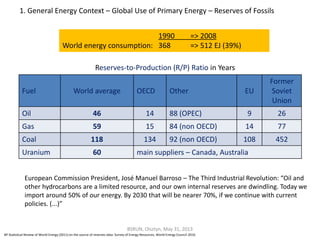
1. General Energy Context – Global Use of Primary Energy – Reserves of Fossils
Fuel World average OECD Other EU
Former
Soviet
Union
Oil 46 14 88 (OPEC) 9 26
Gas 59 15 84 (non OECD) 14 77
Coal 118 134 92 (non OECD) 108 452
Uranium 60 main suppliers – Canada, Australia
BP Statistical Review of World Energy (2011) on the source of reserves data: Survey of Energy Resources, World Energy Council 2010.
Reserves-to-Production (R/P) Ratio in Years
European Commission President, José Manuel Barroso – The Third Industrial Revolution: “Oil and
other hydrocarbons are a limited resource, and our own internal reserves are dwindling. Today we
import around 50% of our energy. By 2030 that will be nearer 70%, if we continue with current
policies. (...)”
1990 => 2008
World energy consumption: 368 => 512 EJ (39%)
BSRUN, Olsztyn, May 31, 2013
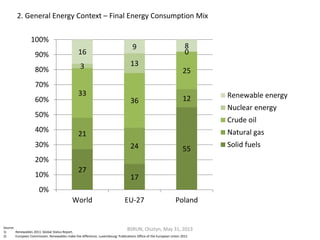
2. General Energy Context – Final Energy Consumption Mix
Source:
1) Renewables 2011. Global Status Report.
2) European Commission. Renewables make the difference. Luxembourg: Publications Office of the European Union 2011
27
17
55
21
24
12
33
36
25
3 13
0
16
9 8
0%
10%
20%
30%
40%
50%
60%
70%
80%
90%
100%
World EU-27 Poland
Renewable energy
Nuclear energy
Crude oil
Natural gas
Solid fuels
BSRUN, Olsztyn, May 31, 2013
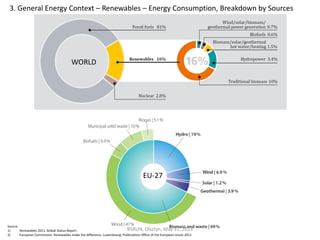
3. General Energy Context – Renewables – Energy Consumption, Breakdown by Sources
Source:
1) Renewables 2011. Global Status Report.
2) European Commission. Renewables make the difference. Luxembourg: Publications Office of the European Union 2011
WORLD
EU-27
BSRUN, Olsztyn, May 31, 2013
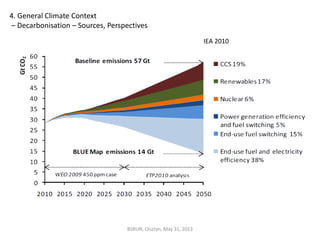
4. General Climate Context
– Decarbonisation – Sources, Perspectives
IEA 2010
BSRUN, Olsztyn, May 31, 2013
World Wide Fund for Nature. The Energy Report. 100% Renewable Energy by 2050. 2011.
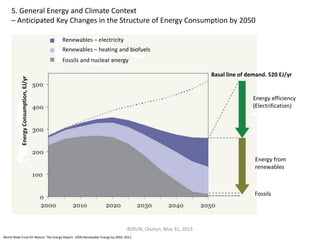
5. General Energy and Climate Context
– Anticipated Key Changes in the Structure of Energy Consumption by 2050
Fossils
Energy from
renewables
Energy efficiency
(Electrification)
Basal line of demand. 520 EJ/yr
Energy
Consumption,
EJ/yr
Renewables – electricity
Renewables – heating and biofuels
Fossils and nuclear energy
BSRUN, Olsztyn, May 31, 2013
Orientation of research on biomass use
Biorefinery
BSRUN, Olsztyn, May 31, 2013
Definition of biorefinery:
BSRUN, Olsztyn, May 31, 2013
… the sustainable processing of biomass into a
spectrum of marketable products (food, feed,
materials, chemicals) and energy (fuels, power, heat)
Acc. to IEA Bioenergy Task 42
… co-products can also be food and/or feed
Acc. to „Biorefineries Roadmapas part of the German Federal Government action plans for the material and energetic utilisation of renewable raw materials”
 development of biorefinery concept for bio-based production is a great
challenge for the present and future research activity
 today the main driver for the development of biorefinery processes is the
transportation sector (biofuels are of the superior interest) - it is built on
agriculture, food and forestry industries
 agro-biotechnology and agro-bio-chemical sciences will play a crucial role
in the progress of research on bio-based products and finally chemical
and process engineering for their implementation
 building the bio-based research portfolio today means to develop bio-
industry (incl. bio-energy industry) tomorrow
 new field of research and new entity on the market
 new market requires a special economic approach that will consider all
and any elements of sustainable development, including environmental
and social aspects – bio-economy
Orientation of biobased research on biorefinery
BSRUN, Olsztyn, May 31, 2013
Biomass – photosynthetic efficiency and high productivity
research context
BSRUN, Olsztyn, May 31, 2013
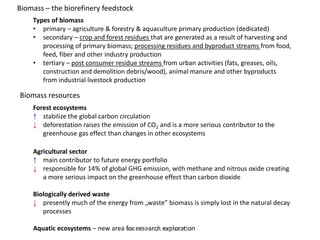
Types of biomass
• primary – agriculture & forestry & aquaculture primary production (dedicated)
• secondary – crop and forest residues that are generated as a result of harvesting and
processing of primary biomass; processing residues and byproduct streams from food,
feed, fiber and other industry production
• tertiary – post consumer residue streams from urban activities (fats, greases, oils,
construction and demolition debris/wood), animal manure and other byproducts
from industrial livestock production
Forest ecosystems
↑ stabilize the global carbon circulation
↓ deforestation raises the emission of CO2 and is a more serious contributor to the
greenhouse gas effect than changes in other ecosystems
Agricultural sector
↑ main contributor to future energy portfolio
↓ responsible for 14% of global GHG emission, with methane and nitrous oxide creating
a more serious impact on the greenhouse effect than carbon dioxide
Biologically derived waste
↓ presently much of the energy from „waste” biomass is simply lost in the natural decay
processes
Aquatic ecosystems – new area for research exploration
Biomass – the biorefinery feedstock
Biomass resources
BSRUN, Olsztyn, May 31, 2013
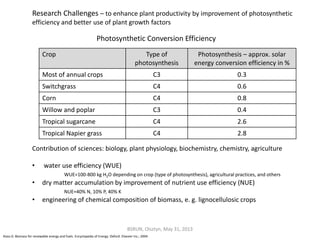
Photosynthetic Conversion Efficiency
Contribution of sciences: biology, plant physiology, biochemistry, chemistry, agriculture
• water use efficiency (WUE)
WUE=100-800 kg H2O depending on crop (type of photosynthesis), agricultural practices, and others
• dry matter accumulation by improvement of nutrient use efficiency (NUE)
NUE=40% N, 10% P, 40% K
• engineering of chemical composition of biomass, e. g. lignocellulosic crops
Research Challenges – to enhance plant productivity by improvement of photosynthetic
efficiency and better use of plant growth factors
BSRUN, Olsztyn, May 31, 2013
Crop Type of
photosynthesis
Photosynthesis – approx. solar
energy conversion efficiency in %
Most of annual crops C3 0.3
Switchgrass C4 0.6
Corn C4 0.8
Willow and poplar C3 0.4
Tropical sugarcane C4 2.6
Tropical Napier grass C4 2.8
Klass D. Biomass for renewable energy and fuels. Encyclopedia of Energy. Oxford: Elsevier Inc.; 2004.
Klass D. Biomass for renewable energy and fuels. Encyclopedia of Energy. Oxford: Elsevier Inc.; 2004
Zhu X-G., Stephen P. Long S.P., Ort D.R. 2010. Improving Photosynthetic Efficiency for Greater Yield Annual Review of Plant Biology Vol. 61: 235-261
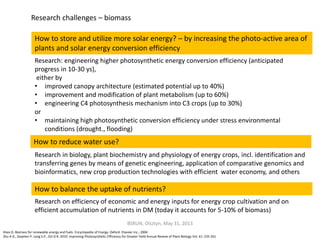
How to store and utilize more solar energy? – by increasing the photo-active area of
plants and solar energy conversion efficiency
Research challenges – biomass
Research: engineering higher photosynthetic energy conversion efficiency (anticipated
progress in 10-30 ys),
either by
• improved canopy architecture (estimated potential up to 40%)
• improvement and modification of plant metabolism (up to 60%)
• engineering C4 photosynthesis mechanism into C3 crops (up to 30%)
or
• maintaining high photosynthetic conversion efficiency under stress environmental
conditions (drought., flooding)
BSRUN, Olsztyn, May 31, 2013
How to reduce water use?
Research in biology, plant biochemistry and physiology of energy crops, incl. identification and
transferring genes by means of genetic engineering, application of comparative genomics and
bioinformatics, new crop production technologies with efficient water economy, and others
How to balance the uptake of nutrients?
Research on efficiency of economic and energy inputs for energy crop cultivation and on
efficient accumulation of nutrients in DM (today it accounts for 5-10% of biomass)
Biorefinery
– a production system of biomass-based products
feedstock
pretreatment
hydrolysis
fermentation
destilation
biofuels
biochemicals
biomaterials
biogas plant
fertilizers
power plant
elctricity
heat
BSRUN, Olsztyn, May 31, 2013
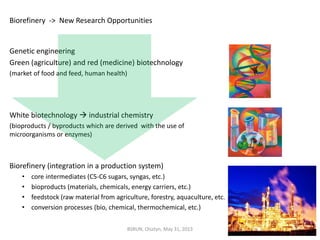
Genetic engineering
Green (agriculture) and red (medicine) biotechnology
(market of food and feed, human health)
White biotechnology  industrial chemistry
(bioproducts / byproducts which are derived with the use of
microorganisms or enzymes)
Biorefinery (integration in a production system)
• core intermediates (C5-C6 sugars, syngas, etc.)
• bioproducts (materials, chemicals, energy carriers, etc.)
• feedstock (raw material from agriculture, forestry, aquaculture, etc.
• conversion processes (bio, chemical, thermochemical, etc.)
Biorefinery -> New Research Opportunities
BSRUN, Olsztyn, May 31, 2013
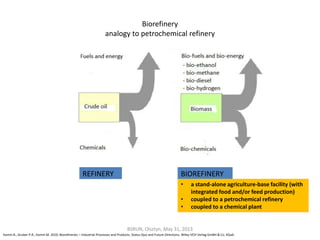
Biorefinery
analogy to petrochemical refinery
REFINERY BIOREFINERY
Kamm B., Gruber P.R., Kamm M. 2010. Biorefineries – Industrial Processes and Products. Status Quo and Future Directions. Wiley-VCH Verlag GmBH & Co. KGaA.
• a stand-alone agriculture-base facility (with
integrated food and/or feed production)
• coupled to a petrochemical refinery
• coupled to a chemical plant
BSRUN, Olsztyn, May 31, 2013
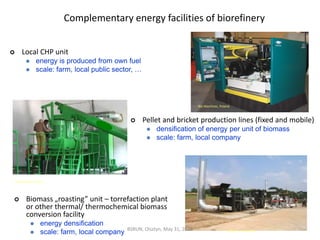
Complementary energy facilities of biorefinery
Dranko-Farm. Spain
Bio Machines, Poland
 Pellet and bricket production lines (fixed and mobile)
 densification of energy per unit of biomass
 scale: farm, local company
 Local CHP unit
 energy is produced from own fuel
 scale: farm, local public sector, …
http://cnr.ncsu.edu
 Biomass „roasting” unit – torrefaction plant
or other thermal/ thermochemical biomass
conversion facility
 energy densification
 scale: farm, local company BSRUN, Olsztyn, May 31, 2013
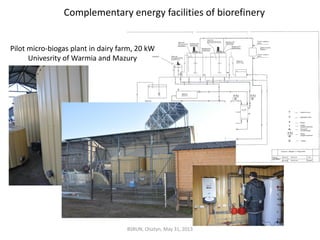
Pilot micro-biogas plant in dairy farm, 20 kW
Univesrity of Warmia and Mazury
BSRUN, Olsztyn, May 31, 2013
Complementary energy facilities of biorefinery
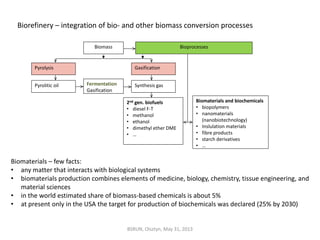
Biorefinery – integration of bio- and other biomass conversion processes
Biomass
Pyrolysis Gasification
Pyrolitic oil Fermentation
Gasification
Synthesis gas
2nd gen. biofuels
• diesel F-T
• methanol
• ethanol
• dimethyl ether DME
• …
Bioprocesses
Biomaterials and biochemicals
• biopolymers
• nanomaterials
(nanobiotechnology)
• Inslulation materials
• fibre products
• starch derivatives
• …
Biomaterials – few facts:
• any matter that interacts with biological systems
• biomaterials production combines elements of medicine, biology, chemistry, tissue engineering, and
material sciences
• in the world estimated share of biomass-based chemicals is about 5%
• at present only in the USA the target for production of biochemicals was declared (25% by 2030)
BSRUN, Olsztyn, May 31, 2013
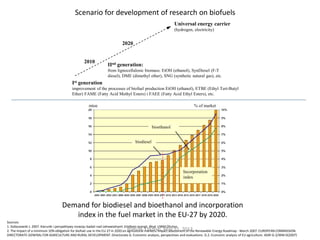
Scenario for development of research on biofuels
2020
2010
Ist generation
improvement of the processes of biofuel production EtOH (ethanol), ETBE (Ethyl Tert-Butyl
Ether) FAME (Fatty Acid Methyl Esters) i FAEE (Fatty Acid Ethyl Esters), etc.
IInd generation:
from lignocellulosic biomass: EtOH (ethanol), SynDiesel (F-T
diesel), DME (dimethyl ether), SNG (synthetic natural gas), etc.
Universal energy carrier
(hydrogen, electricity)
bioethanol
Incorporation
index
mtoe % of market
biodiesel
Demand for biodiesel and bioethanol and incorporation
index in the fuel market in the EU-27 by 2020.
Sources:
1. Gołaszewski J. 2007. Kierunki i perspektywy rozwoju badań nad odnawialnymi źródłami energii. Wyd. UWM Olsztyn.
2. The impact of a minimum 10% obligation for biofuel use in the EU-27 in 2020 on agricultural markets. Impact assessment of the Renewable Energy Roadmap - March 2007. EUROPEAN COMMISSION.
DIRECTORATE-GENERAL FOR AGRICULTURE AND RURAL DEVELOPMENT. Directorate G. Economic analysis, perspectives and evaluations. G.2. Economic analysis of EU agriculture. AGRI G-2/WM D(2007)
BSRUN, Olsztyn, May 31, 2013
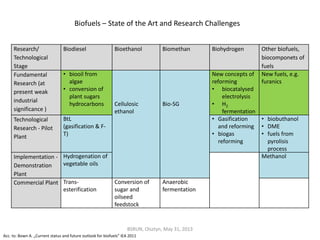
Research/
Technological
Stage
Biodiesel Bioethanol Biomethan Biohydrogen Other biofuels,
biocomponets of
fuels
Fundamental
Research (at
present weak
industrial
significance )
• biooil from
algae
• conversion of
plant sugars
hydrocarbons Cellulosic
ethanol
Bio-SG
New concepts of
reforming
• biocatalysed
electrolysis
• H2
fermentation
New fuels, e.g.
furanics
Technological
Research - Pilot
Plant
BtL
(gasification & F-
T)
• Gasification
and reforming
• biogas
reforming
• biobuthanol
• DME
• fuels from
pyrolisis
process
Implementation -
Demonstration
Plant
Hydrogenation of
vegetable oils
Methanol
Commercial Plant Trans-
esterification
Conversion of
sugar and
oilseed
feedstock
Anaerobic
fermentation
Biofuels – State of the Art and Research Challenges
Acc. to: Bown A. „Current status and future outlook for biofuels” IEA 2011
BSRUN, Olsztyn, May 31, 2013
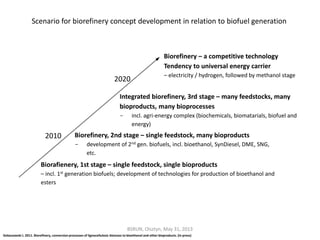
Scenario for biorefinery concept development in relation to biofuel generation
Gołaszewski J. 2011. Biorefinery, conversion processes of lignocellulosic biomass to bioethanol and other bioproducts. (in press)
2020
2010
Biorafienery, 1st stage – single feedstock, single bioproducts
– incl. 1st generation biofuels; development of technologies for production of bioethanol and
esters
Biorefinery, 2nd stage – single feedstock, many bioproducts
- development of 2nd gen. biofuels, incl. bioethanol, SynDiesel, DME, SNG,
etc.
Integrated biorefinery, 3rd stage – many feedstocks, many
bioproducts, many bioprocesses
- incl. agri-energy complex (biochemicals, biomatarials, biofuel and
energy)
Biorefinery – a competitive technology
Tendency to universal energy carrier
– electricity / hydrogen, followed by methanol stage
BSRUN, Olsztyn, May 31, 2013
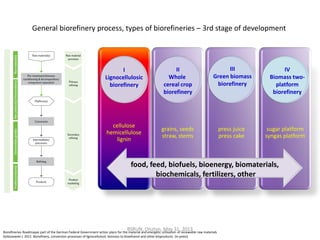
General biorefinery process, types of biorefineries – 3rd stage of development
cellulose
hemicellulose
lignin
grains, seeds
straw, stems
press juice
press cake
sugar platform
syngas platform
I
Lignocellulosic
biorefinery
II
Whole
cereal crop
biorefinery
III
Green biomass
biorefinery
IV
Biomass two-
platform
biorefinery
food, feed, biofuels, bioenergy, biomaterials,
biochemicals, fertilizers, other
Biorefineries Roadmapas part of the German Federal Government action plans for the material and energetic utilisation of renewable raw materials
Gołaszewski J. 2011. Biorefinery, conversion processes of lignocellulosic biomass to bioethanol and other bioproducts. (in press)
BSRUN, Olsztyn, May 31, 2013
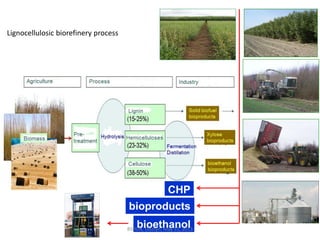
bioethanol
Lignocellulosic biorefinery process
CHP
bioproducts
BSRUN, Olsztyn, May 31, 2013
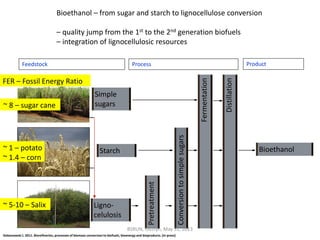
Bioethanol – from sugar and starch to lignocellulose conversion
– quality jump from the 1st to the 2nd generation biofuels
– integration of lignocellulosic resources
Pretreatment
Conversion
to
simple
sugars
Fermentation
Bioethanol
Distillation
Simple
sugars
Ligno-
celulosis
Feedstock Process Product
Starch
FER – Fossil Energy Ratio
~ 8 – sugar cane
~ 1 – potato
~ 1.4 – corn
~ 5-10 – Salix
Gołaszewski J. 2011. Biorefineries, processes of biomass conversion to biofuels, bioenergy and bioproducts. (in press)
BSRUN, Olsztyn, May 31, 2013
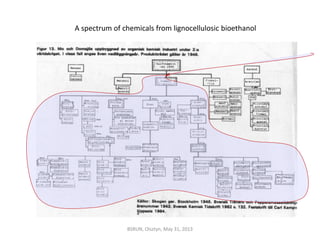
A spectrum of chemicals from lignocellulosic bioethanol
BSRUN, Olsztyn, May 31, 2013
Straw, husk
harvest, supply
logistics
Salix
harvest, supply
logistics
Other ….
harvest, supply
logistics
Biodegradation
• cellulose
• hemicellulose
• lignin
Lignin
gasification
Biomass
gasification
Conversion of
sugars to
bioethanol
Conversion of
bipolimers to
bioproducts
SynGas 
2nd gen. biofuel
SynGas 
hydrogen
Bioproducts
from conversion of
lignin
Biofuels
from conversion of
lignin
Syngas 
products
Syngas  CHP
Poplar
harvest, supply
logistics
Continuous supply
Availability
Flexibility
Mixing
CHP
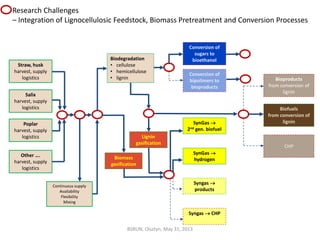
Research Challenges
– Integration of Lignocellulosic Feedstock, Biomass Pretreatment and Conversion Processes
BSRUN, Olsztyn, May 31, 2013
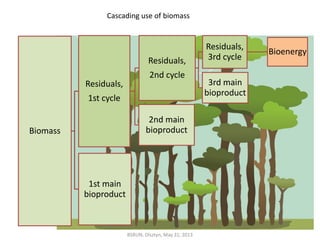
Biomass
Residuals,
1st cycle
Residuals,
2nd cycle
Residuals,
3rd cycle
Bioenergy
3rd main
bioproduct
2nd main
bioproduct
1st main
bioproduct
Cascading use of biomass
BSRUN, Olsztyn, May 31, 2013
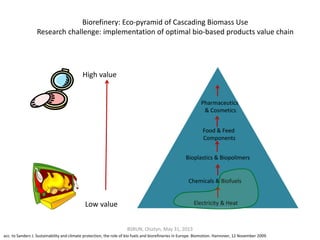
Biorefinery: Eco-pyramid of Cascading Biomass Use
Research challenge: implementation of optimal bio-based products value chain
acc. to Sanders J. Sustainability and climate protection, the role of bio fuels and biorefineries in Europe. Biomotion. Hannover, 12 November 2009.
Electricity & Heat
Chemicals & Biofuels
Bioplastics & Biopolimers
Food & Feed
Components
Pharmaceutics
& Cosmetics
Low value
High value
BSRUN, Olsztyn, May 31, 2013
Biochemicals – two obvious facts
• from a technical point of view almost all industrial materials made from fossils
(today ca. 330 mil. t) could be substituted by their bio-based counterparts (today
ca. 50 mil. t).
• cost of bio-based production in many cases exceeds the cost of petrochemical
production but at the lower environmental impact
Acc. to: Bio-based Chemicals. Value Added Products from Biorefineries. Report of IEA Bioenergy. 2011.
BSRUN, Olsztyn, May 31, 2013
Biorefinery – Platforms of Biochemicals Depending on the Main Bioproduct in Value Chain
- Syngas
(methanol, DME (dimethylether), ethanol, Fischer-Tropsch diesel)
- Biogas
(amino and organic acids (e.g. lactic acid), vitamins, antibiotics, xanthan, and many other promissive
chemicals: succinic acid, itaconic acid, adipic acid, 3-hydroxypropionic acid / aldehyde,
isoprene/farnesene, glutamic acid, aspartic acid)
- Sugars C5 and C5/C6
(sorbitol, levulinic acid, glucaric acid, hydroxymethylfurfural 2,5-furan dicarboxylic acid, p-xylene)
- Vegetable oil
(propylene glycol, epichlorohydrin, 1,3-propanediol, 3-hydroxypropion aldehyde, acrylic acid, propylene,
methanol (via syngas)
- Algae oil
(lipids, pigments, antioxidants, fatty acids, vitamins, sterols)
- Press juice
(carbohydrates, proteins, free amino acids, organic acids, minerals, hormones and enzymes)
- Lignin
(syngas products, hydrocarbons, phenols, oxidised products, amcromolecules)
- Pyrolysis oil
(phenols, organic acids, furfural, HMF and levoglucosan
Acc. to: Bio-based Chemicals. Value Added Products from Biorefineries. Report of IEA Bioenergy. 2011.
BSRUN, Olsztyn, May 31, 2013
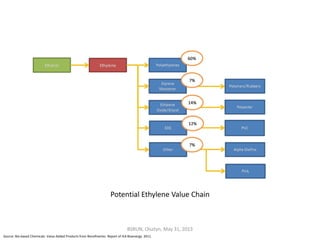
Potential Ethylene Value Chain
Source: Bio-based Chemicals. Value Added Products from Biorefineries. Report of IEA Bioenergy. 2011.
BSRUN, Olsztyn, May 31, 2013
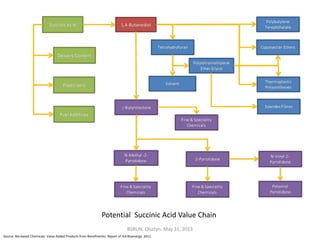
Potential Succinic Acid Value Chain
Source: Bio-based Chemicals. Value Added Products from Biorefineries. Report of IEA Bioenergy. 2011.
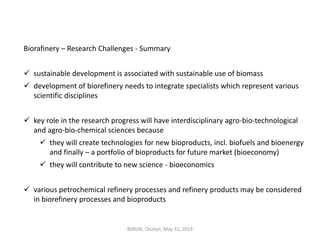
Biorafinery – Research Challenges - Summary
 sustainable development is associated with sustainable use of biomass
 development of biorefinery needs to integrate specialists which represent various
scientific disciplines
 key role in the research progress will have interdisciplinary agro-bio-technological
and agro-bio-chemical sciences because
 they will create technologies for new bioproducts, incl. biofuels and bioenergy
and finally – a portfolio of bioproducts for future market (bioeconomy)
 they will contribute to new science - bioeconomics
 various petrochemical refinery processes and refinery products may be considered
in biorefinery processes and bioproducts
BSRUN, Olsztyn, May 31, 2013
1. Competitive today:
• production of bioethanol from sugar cane (Brasil)
• chosen systems for biowaste utilization,
• effective boilers and CHP units which use fuels from biomass
2. Competitive in the course of 10-20 years:
• low-cost agriculturally derived lipid materials such as tallow, greases, and soapstocks
• lignocellulosic biofuels as a main replacement of fossil fuels
• advanced technologies of electricity production from biomass
• biorefineries optimized for a set of bioproducts
• multi-cycle path for recycling of bio-waste
• models for integrated economic, energy, and environmental assessment in agreement
with energy systems
3. Competitive in the course of 20-30 years:
• integration of biomass conversion with CCS in the context of significant reduction of
GHG emission
4. A biomass potential which is difficult to determine today:
• advanced biomaterials from biomass
• effective utilization of energy potential and bioproducts from water biomass
• economic effectiveness and significant reduction of GHG emission
Biomass-to-Energy Technologies – Research Challenges - Summary
BSRUN, Olsztyn, May 31, 2013
Source: Ed de Jong, 2008
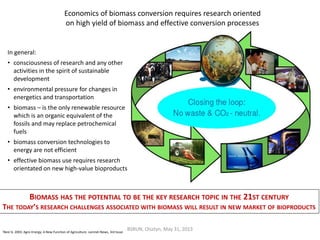
In general:
• consciousness of research and any other
activities in the spirit of sustainable
development
• environmental pressure for changes in
energetics and transportation
• biomass – is the only renewable resource
which is an organic equivalent of the
fossils and may replace petrochemical
fuels
• biomass conversion technologies to
energy are not efficient
• effective biomass use requires research
orientated on new high-value bioproducts
BIOMASS HAS THE POTENTIAL TO BE THE KEY RESEARCH TOPIC IN THE 21ST CENTURY
THE TODAY’S RESEARCH CHALLENGES ASSOCIATED WITH BIOMASS WILL RESULT IN NEW MARKET OF BIOPRODUCTS
Economics of biomass conversion requires research oriented
on high yield of biomass and effective conversion processes
1Best G. 2003. Agro-Energy: A New Function of Agriculture. Lamnet-News, 3rd Issue
BSRUN, Olsztyn, May 31, 2013
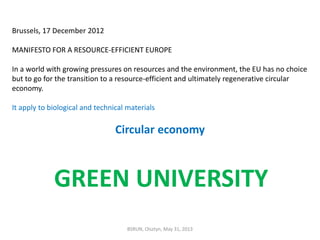
Brussels, 17 December 2012
MANIFESTO FOR A RESOURCE-EFFICIENT EUROPE
In a world with growing pressures on resources and the environment, the EU has no choice
but to go for the transition to a resource-efficient and ultimately regenerative circular
economy.
It apply to biological and technical materials
Circular economy
GREEN UNIVERSITY

biorefinery-2.pdf

  • 1.
    E85 Biorefinery – NewArea for Interdisciplinary Research and International Cooperation Janusz Gołaszewski University of Warmia and Mazury in Olsztyn, Poland BSRUN, Olsztyn, May 31, 2013 GREEN UNIVERSITY
  • 2.
    Prerequisites: I. sustainable developmentneeds sustainable energy ↑ increasing share of energy from renewables, incl. biomass ↑ increasing energy efficiency ↓ reduction of greenhouse gas emission II. sustainable energy needs sustainable biomass production • Biorefinery bio-industry, bio-economy, sustainability, … III. sustainable biomass production requires transformational breakthroughs in bio-based research BSRUN, Olsztyn, May 31, 2013
  • 3.
    BSRUN, Olsztyn, May31, 2013 Outline: • General climate and energy context for bio-based industry • Biomass – photosynthetic efficiency and high productivity research context • Biorefinery – feedstock, processes • Cascading biomass use – biochemicals • Recapitulation
  • 4.
    1. General EnergyContext – Global Use of Primary Energy – Reserves of Fossils Fuel World average OECD Other EU Former Soviet Union Oil 46 14 88 (OPEC) 9 26 Gas 59 15 84 (non OECD) 14 77 Coal 118 134 92 (non OECD) 108 452 Uranium 60 main suppliers – Canada, Australia BP Statistical Review of World Energy (2011) on the source of reserves data: Survey of Energy Resources, World Energy Council 2010. Reserves-to-Production (R/P) Ratio in Years European Commission President, José Manuel Barroso – The Third Industrial Revolution: “Oil and other hydrocarbons are a limited resource, and our own internal reserves are dwindling. Today we import around 50% of our energy. By 2030 that will be nearer 70%, if we continue with current policies. (...)” 1990 => 2008 World energy consumption: 368 => 512 EJ (39%) BSRUN, Olsztyn, May 31, 2013
  • 5.
    2. General EnergyContext – Final Energy Consumption Mix Source: 1) Renewables 2011. Global Status Report. 2) European Commission. Renewables make the difference. Luxembourg: Publications Office of the European Union 2011 27 17 55 21 24 12 33 36 25 3 13 0 16 9 8 0% 10% 20% 30% 40% 50% 60% 70% 80% 90% 100% World EU-27 Poland Renewable energy Nuclear energy Crude oil Natural gas Solid fuels BSRUN, Olsztyn, May 31, 2013
  • 6.
    3. General EnergyContext – Renewables – Energy Consumption, Breakdown by Sources Source: 1) Renewables 2011. Global Status Report. 2) European Commission. Renewables make the difference. Luxembourg: Publications Office of the European Union 2011 WORLD EU-27 BSRUN, Olsztyn, May 31, 2013
  • 7.
    4. General ClimateContext – Decarbonisation – Sources, Perspectives IEA 2010 BSRUN, Olsztyn, May 31, 2013
  • 8.
    World Wide Fundfor Nature. The Energy Report. 100% Renewable Energy by 2050. 2011. 5. General Energy and Climate Context – Anticipated Key Changes in the Structure of Energy Consumption by 2050 Fossils Energy from renewables Energy efficiency (Electrification) Basal line of demand. 520 EJ/yr Energy Consumption, EJ/yr Renewables – electricity Renewables – heating and biofuels Fossils and nuclear energy BSRUN, Olsztyn, May 31, 2013
  • 9.
    Orientation of researchon biomass use Biorefinery BSRUN, Olsztyn, May 31, 2013
  • 10.
    Definition of biorefinery: BSRUN,Olsztyn, May 31, 2013 … the sustainable processing of biomass into a spectrum of marketable products (food, feed, materials, chemicals) and energy (fuels, power, heat) Acc. to IEA Bioenergy Task 42 … co-products can also be food and/or feed Acc. to „Biorefineries Roadmapas part of the German Federal Government action plans for the material and energetic utilisation of renewable raw materials”
  • 11.
     development ofbiorefinery concept for bio-based production is a great challenge for the present and future research activity  today the main driver for the development of biorefinery processes is the transportation sector (biofuels are of the superior interest) - it is built on agriculture, food and forestry industries  agro-biotechnology and agro-bio-chemical sciences will play a crucial role in the progress of research on bio-based products and finally chemical and process engineering for their implementation  building the bio-based research portfolio today means to develop bio- industry (incl. bio-energy industry) tomorrow  new field of research and new entity on the market  new market requires a special economic approach that will consider all and any elements of sustainable development, including environmental and social aspects – bio-economy Orientation of biobased research on biorefinery BSRUN, Olsztyn, May 31, 2013
  • 12.
    Biomass – photosyntheticefficiency and high productivity research context BSRUN, Olsztyn, May 31, 2013
  • 13.
    Types of biomass •primary – agriculture & forestry & aquaculture primary production (dedicated) • secondary – crop and forest residues that are generated as a result of harvesting and processing of primary biomass; processing residues and byproduct streams from food, feed, fiber and other industry production • tertiary – post consumer residue streams from urban activities (fats, greases, oils, construction and demolition debris/wood), animal manure and other byproducts from industrial livestock production Forest ecosystems ↑ stabilize the global carbon circulation ↓ deforestation raises the emission of CO2 and is a more serious contributor to the greenhouse gas effect than changes in other ecosystems Agricultural sector ↑ main contributor to future energy portfolio ↓ responsible for 14% of global GHG emission, with methane and nitrous oxide creating a more serious impact on the greenhouse effect than carbon dioxide Biologically derived waste ↓ presently much of the energy from „waste” biomass is simply lost in the natural decay processes Aquatic ecosystems – new area for research exploration Biomass – the biorefinery feedstock Biomass resources BSRUN, Olsztyn, May 31, 2013
  • 14.
    Photosynthetic Conversion Efficiency Contributionof sciences: biology, plant physiology, biochemistry, chemistry, agriculture • water use efficiency (WUE) WUE=100-800 kg H2O depending on crop (type of photosynthesis), agricultural practices, and others • dry matter accumulation by improvement of nutrient use efficiency (NUE) NUE=40% N, 10% P, 40% K • engineering of chemical composition of biomass, e. g. lignocellulosic crops Research Challenges – to enhance plant productivity by improvement of photosynthetic efficiency and better use of plant growth factors BSRUN, Olsztyn, May 31, 2013 Crop Type of photosynthesis Photosynthesis – approx. solar energy conversion efficiency in % Most of annual crops C3 0.3 Switchgrass C4 0.6 Corn C4 0.8 Willow and poplar C3 0.4 Tropical sugarcane C4 2.6 Tropical Napier grass C4 2.8 Klass D. Biomass for renewable energy and fuels. Encyclopedia of Energy. Oxford: Elsevier Inc.; 2004.
  • 15.
    Klass D. Biomassfor renewable energy and fuels. Encyclopedia of Energy. Oxford: Elsevier Inc.; 2004 Zhu X-G., Stephen P. Long S.P., Ort D.R. 2010. Improving Photosynthetic Efficiency for Greater Yield Annual Review of Plant Biology Vol. 61: 235-261 How to store and utilize more solar energy? – by increasing the photo-active area of plants and solar energy conversion efficiency Research challenges – biomass Research: engineering higher photosynthetic energy conversion efficiency (anticipated progress in 10-30 ys), either by • improved canopy architecture (estimated potential up to 40%) • improvement and modification of plant metabolism (up to 60%) • engineering C4 photosynthesis mechanism into C3 crops (up to 30%) or • maintaining high photosynthetic conversion efficiency under stress environmental conditions (drought., flooding) BSRUN, Olsztyn, May 31, 2013 How to reduce water use? Research in biology, plant biochemistry and physiology of energy crops, incl. identification and transferring genes by means of genetic engineering, application of comparative genomics and bioinformatics, new crop production technologies with efficient water economy, and others How to balance the uptake of nutrients? Research on efficiency of economic and energy inputs for energy crop cultivation and on efficient accumulation of nutrients in DM (today it accounts for 5-10% of biomass)
  • 16.
    Biorefinery – a productionsystem of biomass-based products feedstock pretreatment hydrolysis fermentation destilation biofuels biochemicals biomaterials biogas plant fertilizers power plant elctricity heat BSRUN, Olsztyn, May 31, 2013
  • 17.
    Genetic engineering Green (agriculture)and red (medicine) biotechnology (market of food and feed, human health) White biotechnology  industrial chemistry (bioproducts / byproducts which are derived with the use of microorganisms or enzymes) Biorefinery (integration in a production system) • core intermediates (C5-C6 sugars, syngas, etc.) • bioproducts (materials, chemicals, energy carriers, etc.) • feedstock (raw material from agriculture, forestry, aquaculture, etc. • conversion processes (bio, chemical, thermochemical, etc.) Biorefinery -> New Research Opportunities BSRUN, Olsztyn, May 31, 2013
  • 18.
    Biorefinery analogy to petrochemicalrefinery REFINERY BIOREFINERY Kamm B., Gruber P.R., Kamm M. 2010. Biorefineries – Industrial Processes and Products. Status Quo and Future Directions. Wiley-VCH Verlag GmBH & Co. KGaA. • a stand-alone agriculture-base facility (with integrated food and/or feed production) • coupled to a petrochemical refinery • coupled to a chemical plant BSRUN, Olsztyn, May 31, 2013
  • 19.
    Complementary energy facilitiesof biorefinery Dranko-Farm. Spain Bio Machines, Poland  Pellet and bricket production lines (fixed and mobile)  densification of energy per unit of biomass  scale: farm, local company  Local CHP unit  energy is produced from own fuel  scale: farm, local public sector, … http://cnr.ncsu.edu  Biomass „roasting” unit – torrefaction plant or other thermal/ thermochemical biomass conversion facility  energy densification  scale: farm, local company BSRUN, Olsztyn, May 31, 2013
  • 20.
    Pilot micro-biogas plantin dairy farm, 20 kW Univesrity of Warmia and Mazury BSRUN, Olsztyn, May 31, 2013 Complementary energy facilities of biorefinery
  • 21.
    Biorefinery – integrationof bio- and other biomass conversion processes Biomass Pyrolysis Gasification Pyrolitic oil Fermentation Gasification Synthesis gas 2nd gen. biofuels • diesel F-T • methanol • ethanol • dimethyl ether DME • … Bioprocesses Biomaterials and biochemicals • biopolymers • nanomaterials (nanobiotechnology) • Inslulation materials • fibre products • starch derivatives • … Biomaterials – few facts: • any matter that interacts with biological systems • biomaterials production combines elements of medicine, biology, chemistry, tissue engineering, and material sciences • in the world estimated share of biomass-based chemicals is about 5% • at present only in the USA the target for production of biochemicals was declared (25% by 2030) BSRUN, Olsztyn, May 31, 2013
  • 22.
    Scenario for developmentof research on biofuels 2020 2010 Ist generation improvement of the processes of biofuel production EtOH (ethanol), ETBE (Ethyl Tert-Butyl Ether) FAME (Fatty Acid Methyl Esters) i FAEE (Fatty Acid Ethyl Esters), etc. IInd generation: from lignocellulosic biomass: EtOH (ethanol), SynDiesel (F-T diesel), DME (dimethyl ether), SNG (synthetic natural gas), etc. Universal energy carrier (hydrogen, electricity) bioethanol Incorporation index mtoe % of market biodiesel Demand for biodiesel and bioethanol and incorporation index in the fuel market in the EU-27 by 2020. Sources: 1. Gołaszewski J. 2007. Kierunki i perspektywy rozwoju badań nad odnawialnymi źródłami energii. Wyd. UWM Olsztyn. 2. The impact of a minimum 10% obligation for biofuel use in the EU-27 in 2020 on agricultural markets. Impact assessment of the Renewable Energy Roadmap - March 2007. EUROPEAN COMMISSION. DIRECTORATE-GENERAL FOR AGRICULTURE AND RURAL DEVELOPMENT. Directorate G. Economic analysis, perspectives and evaluations. G.2. Economic analysis of EU agriculture. AGRI G-2/WM D(2007) BSRUN, Olsztyn, May 31, 2013
  • 23.
    Research/ Technological Stage Biodiesel Bioethanol BiomethanBiohydrogen Other biofuels, biocomponets of fuels Fundamental Research (at present weak industrial significance ) • biooil from algae • conversion of plant sugars hydrocarbons Cellulosic ethanol Bio-SG New concepts of reforming • biocatalysed electrolysis • H2 fermentation New fuels, e.g. furanics Technological Research - Pilot Plant BtL (gasification & F- T) • Gasification and reforming • biogas reforming • biobuthanol • DME • fuels from pyrolisis process Implementation - Demonstration Plant Hydrogenation of vegetable oils Methanol Commercial Plant Trans- esterification Conversion of sugar and oilseed feedstock Anaerobic fermentation Biofuels – State of the Art and Research Challenges Acc. to: Bown A. „Current status and future outlook for biofuels” IEA 2011 BSRUN, Olsztyn, May 31, 2013
  • 24.
    Scenario for biorefineryconcept development in relation to biofuel generation Gołaszewski J. 2011. Biorefinery, conversion processes of lignocellulosic biomass to bioethanol and other bioproducts. (in press) 2020 2010 Biorafienery, 1st stage – single feedstock, single bioproducts – incl. 1st generation biofuels; development of technologies for production of bioethanol and esters Biorefinery, 2nd stage – single feedstock, many bioproducts - development of 2nd gen. biofuels, incl. bioethanol, SynDiesel, DME, SNG, etc. Integrated biorefinery, 3rd stage – many feedstocks, many bioproducts, many bioprocesses - incl. agri-energy complex (biochemicals, biomatarials, biofuel and energy) Biorefinery – a competitive technology Tendency to universal energy carrier – electricity / hydrogen, followed by methanol stage BSRUN, Olsztyn, May 31, 2013
  • 25.
    General biorefinery process,types of biorefineries – 3rd stage of development cellulose hemicellulose lignin grains, seeds straw, stems press juice press cake sugar platform syngas platform I Lignocellulosic biorefinery II Whole cereal crop biorefinery III Green biomass biorefinery IV Biomass two- platform biorefinery food, feed, biofuels, bioenergy, biomaterials, biochemicals, fertilizers, other Biorefineries Roadmapas part of the German Federal Government action plans for the material and energetic utilisation of renewable raw materials Gołaszewski J. 2011. Biorefinery, conversion processes of lignocellulosic biomass to bioethanol and other bioproducts. (in press) BSRUN, Olsztyn, May 31, 2013
  • 26.
  • 27.
    Bioethanol – fromsugar and starch to lignocellulose conversion – quality jump from the 1st to the 2nd generation biofuels – integration of lignocellulosic resources Pretreatment Conversion to simple sugars Fermentation Bioethanol Distillation Simple sugars Ligno- celulosis Feedstock Process Product Starch FER – Fossil Energy Ratio ~ 8 – sugar cane ~ 1 – potato ~ 1.4 – corn ~ 5-10 – Salix Gołaszewski J. 2011. Biorefineries, processes of biomass conversion to biofuels, bioenergy and bioproducts. (in press) BSRUN, Olsztyn, May 31, 2013
  • 28.
    A spectrum ofchemicals from lignocellulosic bioethanol BSRUN, Olsztyn, May 31, 2013
  • 29.
    Straw, husk harvest, supply logistics Salix harvest,supply logistics Other …. harvest, supply logistics Biodegradation • cellulose • hemicellulose • lignin Lignin gasification Biomass gasification Conversion of sugars to bioethanol Conversion of bipolimers to bioproducts SynGas  2nd gen. biofuel SynGas  hydrogen Bioproducts from conversion of lignin Biofuels from conversion of lignin Syngas  products Syngas  CHP Poplar harvest, supply logistics Continuous supply Availability Flexibility Mixing CHP Research Challenges – Integration of Lignocellulosic Feedstock, Biomass Pretreatment and Conversion Processes BSRUN, Olsztyn, May 31, 2013
  • 30.
    Biomass Residuals, 1st cycle Residuals, 2nd cycle Residuals, 3rdcycle Bioenergy 3rd main bioproduct 2nd main bioproduct 1st main bioproduct Cascading use of biomass BSRUN, Olsztyn, May 31, 2013
  • 31.
    Biorefinery: Eco-pyramid ofCascading Biomass Use Research challenge: implementation of optimal bio-based products value chain acc. to Sanders J. Sustainability and climate protection, the role of bio fuels and biorefineries in Europe. Biomotion. Hannover, 12 November 2009. Electricity & Heat Chemicals & Biofuels Bioplastics & Biopolimers Food & Feed Components Pharmaceutics & Cosmetics Low value High value BSRUN, Olsztyn, May 31, 2013
  • 32.
    Biochemicals – twoobvious facts • from a technical point of view almost all industrial materials made from fossils (today ca. 330 mil. t) could be substituted by their bio-based counterparts (today ca. 50 mil. t). • cost of bio-based production in many cases exceeds the cost of petrochemical production but at the lower environmental impact Acc. to: Bio-based Chemicals. Value Added Products from Biorefineries. Report of IEA Bioenergy. 2011. BSRUN, Olsztyn, May 31, 2013
  • 33.
    Biorefinery – Platformsof Biochemicals Depending on the Main Bioproduct in Value Chain - Syngas (methanol, DME (dimethylether), ethanol, Fischer-Tropsch diesel) - Biogas (amino and organic acids (e.g. lactic acid), vitamins, antibiotics, xanthan, and many other promissive chemicals: succinic acid, itaconic acid, adipic acid, 3-hydroxypropionic acid / aldehyde, isoprene/farnesene, glutamic acid, aspartic acid) - Sugars C5 and C5/C6 (sorbitol, levulinic acid, glucaric acid, hydroxymethylfurfural 2,5-furan dicarboxylic acid, p-xylene) - Vegetable oil (propylene glycol, epichlorohydrin, 1,3-propanediol, 3-hydroxypropion aldehyde, acrylic acid, propylene, methanol (via syngas) - Algae oil (lipids, pigments, antioxidants, fatty acids, vitamins, sterols) - Press juice (carbohydrates, proteins, free amino acids, organic acids, minerals, hormones and enzymes) - Lignin (syngas products, hydrocarbons, phenols, oxidised products, amcromolecules) - Pyrolysis oil (phenols, organic acids, furfural, HMF and levoglucosan Acc. to: Bio-based Chemicals. Value Added Products from Biorefineries. Report of IEA Bioenergy. 2011. BSRUN, Olsztyn, May 31, 2013
  • 34.
    BSRUN, Olsztyn, May31, 2013 Potential Ethylene Value Chain Source: Bio-based Chemicals. Value Added Products from Biorefineries. Report of IEA Bioenergy. 2011.
  • 35.
    BSRUN, Olsztyn, May31, 2013 Potential Succinic Acid Value Chain Source: Bio-based Chemicals. Value Added Products from Biorefineries. Report of IEA Bioenergy. 2011.
  • 36.
    Biorafinery – ResearchChallenges - Summary  sustainable development is associated with sustainable use of biomass  development of biorefinery needs to integrate specialists which represent various scientific disciplines  key role in the research progress will have interdisciplinary agro-bio-technological and agro-bio-chemical sciences because  they will create technologies for new bioproducts, incl. biofuels and bioenergy and finally – a portfolio of bioproducts for future market (bioeconomy)  they will contribute to new science - bioeconomics  various petrochemical refinery processes and refinery products may be considered in biorefinery processes and bioproducts BSRUN, Olsztyn, May 31, 2013
  • 37.
    1. Competitive today: •production of bioethanol from sugar cane (Brasil) • chosen systems for biowaste utilization, • effective boilers and CHP units which use fuels from biomass 2. Competitive in the course of 10-20 years: • low-cost agriculturally derived lipid materials such as tallow, greases, and soapstocks • lignocellulosic biofuels as a main replacement of fossil fuels • advanced technologies of electricity production from biomass • biorefineries optimized for a set of bioproducts • multi-cycle path for recycling of bio-waste • models for integrated economic, energy, and environmental assessment in agreement with energy systems 3. Competitive in the course of 20-30 years: • integration of biomass conversion with CCS in the context of significant reduction of GHG emission 4. A biomass potential which is difficult to determine today: • advanced biomaterials from biomass • effective utilization of energy potential and bioproducts from water biomass • economic effectiveness and significant reduction of GHG emission Biomass-to-Energy Technologies – Research Challenges - Summary BSRUN, Olsztyn, May 31, 2013
  • 38.
    Source: Ed deJong, 2008 In general: • consciousness of research and any other activities in the spirit of sustainable development • environmental pressure for changes in energetics and transportation • biomass – is the only renewable resource which is an organic equivalent of the fossils and may replace petrochemical fuels • biomass conversion technologies to energy are not efficient • effective biomass use requires research orientated on new high-value bioproducts BIOMASS HAS THE POTENTIAL TO BE THE KEY RESEARCH TOPIC IN THE 21ST CENTURY THE TODAY’S RESEARCH CHALLENGES ASSOCIATED WITH BIOMASS WILL RESULT IN NEW MARKET OF BIOPRODUCTS Economics of biomass conversion requires research oriented on high yield of biomass and effective conversion processes 1Best G. 2003. Agro-Energy: A New Function of Agriculture. Lamnet-News, 3rd Issue BSRUN, Olsztyn, May 31, 2013
  • 39.
    BSRUN, Olsztyn, May31, 2013 Brussels, 17 December 2012 MANIFESTO FOR A RESOURCE-EFFICIENT EUROPE In a world with growing pressures on resources and the environment, the EU has no choice but to go for the transition to a resource-efficient and ultimately regenerative circular economy. It apply to biological and technical materials Circular economy GREEN UNIVERSITY