BIOPHOTONICS & IT’S
APPLICATION IN
PHARMACEUTICAL SCIENCES
Presented by ISHA GHOSH
Roll no: 18901914042
3rd year, 6th semester
Guided by DR. SOUVIK BASAK
Dr. B.C.Roy College of Pharmacy & A.H.S.
BIOPHOTONS – a new tool in
Pharmaceutical Sciences
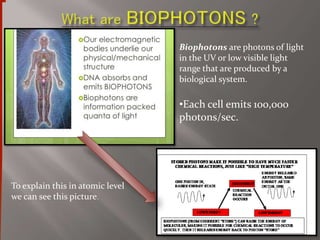
To explain this in atomic level
we can see this picture.
Biophotons are photons of light
in the UV or low visible light
range that are produced by a
biological system.
•Each cell emits 100,000
photons/sec.
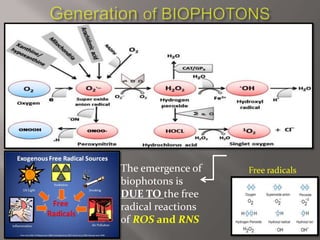
The emergence of
biophotons is
DUE TO the free
radical reactions
of ROS and RNS
Free radicals
FREE RADICALS cause CELL MALFUNCTION/CELL
DAMAGE which is correlated with BIOPHOTON
EMISSION.
Applications in
Pharmaceutical Sciences
Cell
Stress
due to
diseased
condition
Over excited cell
(increased free
radical)
Cell damage
Low energy
state.
Biophoton
emission.
Compound/s under
trial reduces (IF?)
biophoton emission
Probability of new drug molecule
High energy
state.
ROS*ROS
X
(Kantevari S. J
Bioequiv Bioavail
2010; 01 (01))
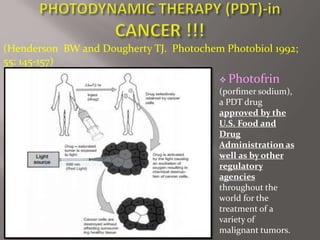
(Henderson BW and Dougherty TJ. Photochem Photobiol 1992;
55: 145-157)
 Photofrin
(porfimer sodium),
a PDT drug
approved by the
U.S. Food and
Drug
Administration as
well as by other
regulatory
agencies
throughout the
world for the
treatment of a
variety of
malignant tumors.
(Salvioli et al . Cytometry 2000; 40: 189-197)
Selectively stained
mitochondria of living cell
with fluorescent probe.
Measured changes of
mitochondrial
potential by imaging
as indication of
apoptosis.
 increase in
fluorescence
means starting of
apoptosis.
USES OF BIOIMAGING
 MRI
 X ray imaging
 CT scan
 Radiotherapy
.
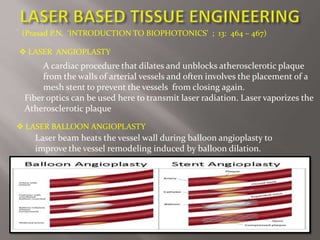
 LASER ANGIOPLASTY
A cardiac procedure that dilates and unblocks atherosclerotic plaque
from the walls of arterial vessels and often involves the placement of a
mesh stent to prevent the vessels from closing again.
Fiber optics can be used here to transmit laser radiation. Laser vaporizes the
Atherosclerotic plaque
 LASER BALLOON ANGIOPLASTY
Laser beam heats the vessel wall during balloon angioplasty to
improve the vessel remodeling induced by balloon dilation.
(Prasad P.N. ‘INTRODUCTION TO BIOPHOTONICS’ ; 13: 464 – 467)
Virus (plant virus)
Native gene removed
Toxic cargo is loaded
Photosensitizer is
loaded.
Introduced into
body (VNP).
Target cells
are killed.
STEPS.
Why Viruses are used ?
The interiors of virus particles can
protect sensitive compounds.
 Exterior can be altered to attach/
display molecules (photosensitizer
probes)
 Highly biocompatible
(Wen et al. Bioconjugate Chem 2015; 26:
51-62)
 Highly sensitive technology
 Depends on free radical generation that is
characteristic of all the diseases
 Photodynamic therapy used for tumour
destruction
 Bioimaging used for cell-cell, cell-drug pathway
tracking
 Targeted nanoparticle used for cell imaging or cell
repair or cell death.
 Used for drug discovery by high throughput
screening
 Used in laser based tissue engineering.
THANK YOU.THANK YOUTHANK YOU

BIOPHOTONICS & ITS APPLICATION

  • 1.
    BIOPHOTONICS & IT’S APPLICATIONIN PHARMACEUTICAL SCIENCES Presented by ISHA GHOSH Roll no: 18901914042 3rd year, 6th semester Guided by DR. SOUVIK BASAK Dr. B.C.Roy College of Pharmacy & A.H.S.
  • 2.
    BIOPHOTONS – anew tool in Pharmaceutical Sciences
  • 3.
    To explain thisin atomic level we can see this picture. Biophotons are photons of light in the UV or low visible light range that are produced by a biological system. •Each cell emits 100,000 photons/sec.
  • 4.
    The emergence of biophotonsis DUE TO the free radical reactions of ROS and RNS Free radicals
  • 5.
    FREE RADICALS causeCELL MALFUNCTION/CELL DAMAGE which is correlated with BIOPHOTON EMISSION.
  • 6.
  • 7.
    Cell Stress due to diseased condition Over excitedcell (increased free radical) Cell damage Low energy state. Biophoton emission. Compound/s under trial reduces (IF?) biophoton emission Probability of new drug molecule High energy state. ROS*ROS X (Kantevari S. J Bioequiv Bioavail 2010; 01 (01))
  • 8.
    (Henderson BW andDougherty TJ. Photochem Photobiol 1992; 55: 145-157)  Photofrin (porfimer sodium), a PDT drug approved by the U.S. Food and Drug Administration as well as by other regulatory agencies throughout the world for the treatment of a variety of malignant tumors.
  • 9.
    (Salvioli et al. Cytometry 2000; 40: 189-197) Selectively stained mitochondria of living cell with fluorescent probe. Measured changes of mitochondrial potential by imaging as indication of apoptosis.  increase in fluorescence means starting of apoptosis. USES OF BIOIMAGING  MRI  X ray imaging  CT scan  Radiotherapy
  • 10.
    .  LASER ANGIOPLASTY Acardiac procedure that dilates and unblocks atherosclerotic plaque from the walls of arterial vessels and often involves the placement of a mesh stent to prevent the vessels from closing again. Fiber optics can be used here to transmit laser radiation. Laser vaporizes the Atherosclerotic plaque  LASER BALLOON ANGIOPLASTY Laser beam heats the vessel wall during balloon angioplasty to improve the vessel remodeling induced by balloon dilation. (Prasad P.N. ‘INTRODUCTION TO BIOPHOTONICS’ ; 13: 464 – 467)
  • 11.
    Virus (plant virus) Nativegene removed Toxic cargo is loaded Photosensitizer is loaded. Introduced into body (VNP). Target cells are killed. STEPS. Why Viruses are used ? The interiors of virus particles can protect sensitive compounds.  Exterior can be altered to attach/ display molecules (photosensitizer probes)  Highly biocompatible (Wen et al. Bioconjugate Chem 2015; 26: 51-62)
  • 12.
     Highly sensitivetechnology  Depends on free radical generation that is characteristic of all the diseases  Photodynamic therapy used for tumour destruction  Bioimaging used for cell-cell, cell-drug pathway tracking  Targeted nanoparticle used for cell imaging or cell repair or cell death.  Used for drug discovery by high throughput screening  Used in laser based tissue engineering.
  • 13.