BIOMES
(COMMUNITIES ON
A GLOBAL SCALE)
Dr. Vividha Raunekar
D
r
.
V
i
v
i
d
h
a
R
a
u
n
e
k
a
r
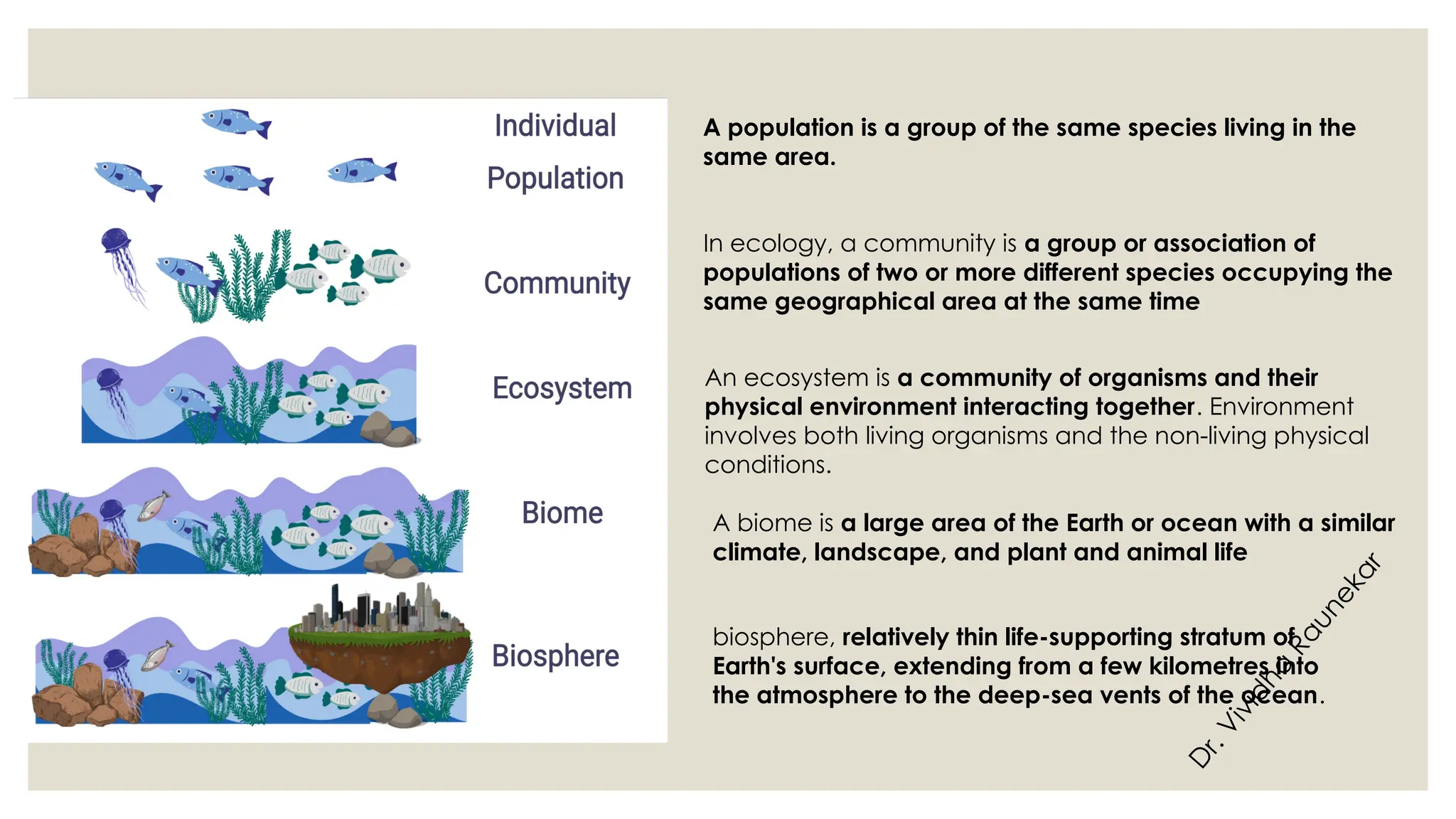
A biome is a large area of the Earth or ocean with a similar
climate, landscape, and plant and animal life
biosphere, relatively thin life-supporting stratum of
Earth's surface, extending from a few kilometres into
the atmosphere to the deep-sea vents of the ocean.
An ecosystem is a community of organisms and their
physical environment interacting together. Environment
involves both living organisms and the non-living physical
conditions.
In ecology, a community is a group or association of
populations of two or more different species occupying the
same geographical area at the same time
A population is a group of the same species living in the
same area.
D
r
.
V
i
v
i
d
h
a
R
a
u
n
e
k
a
r
Introduction to Biomes
•Definition: Biomes as large-scale ecological units defined by
vegetation, climate, and geography.
•Factors influencing biomes: Climate (temperature and precipitation),
latitude, altitude, and soil type.
•Biotic and abiotic components: Interaction between living organisms
and their physical environment.
D
r
.
V
i
v
i
d
h
a
R
a
u
n
e
k
a
r
D
r
.
V
i
v
i
d
h
a
R
a
u
n
e
k
a
r
D
r
.
V
i
v
i
d
h
a
R
a
u
n
e
k
a
r
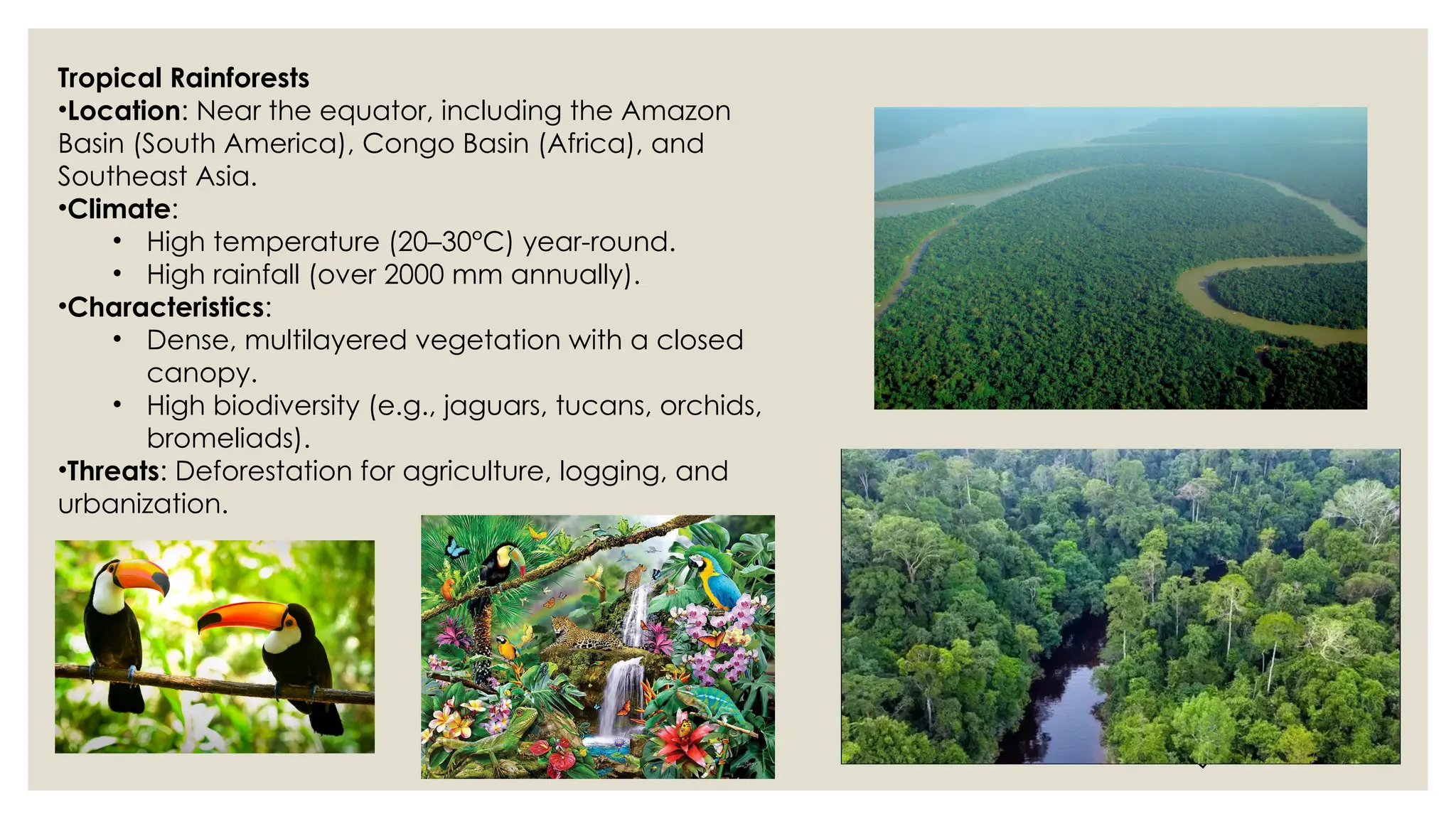
Tropical Rainforests
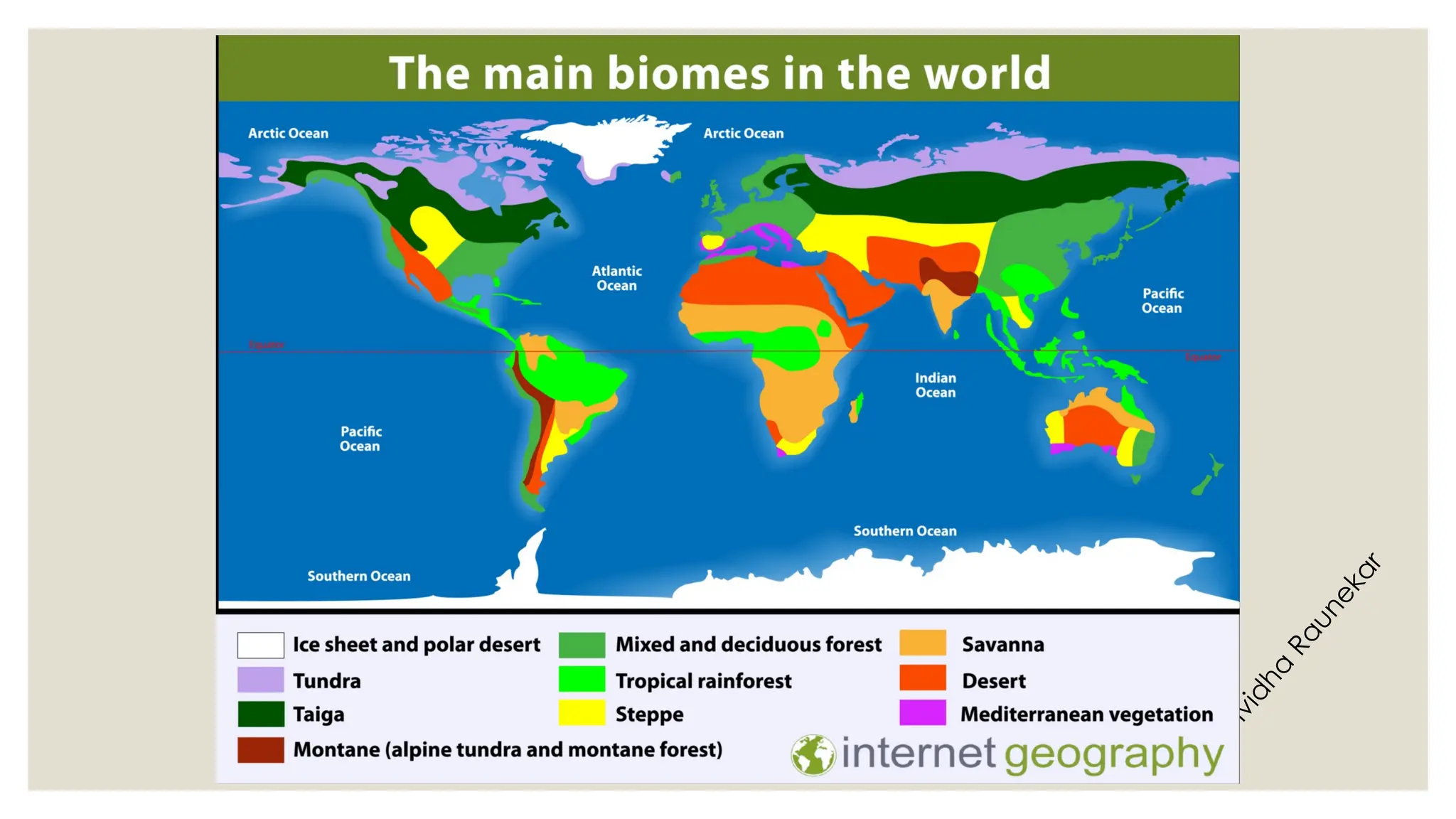
•Location: Near the equator, including the Amazon
Basin (South America), Congo Basin (Africa), and
Southeast Asia.
•Climate:
• High temperature (20–30°C) year-round.
• High rainfall (over 2000 mm annually).
•Characteristics:
• Dense, multilayered vegetation with a closed
canopy.
• High biodiversity (e.g., jaguars, tucans, orchids,
bromeliads).
•Threats: Deforestation for agriculture, logging, and
urbanization.
D
r
.
V
i
v
i
d
h
a
R
a
u
n
e
k
a
r
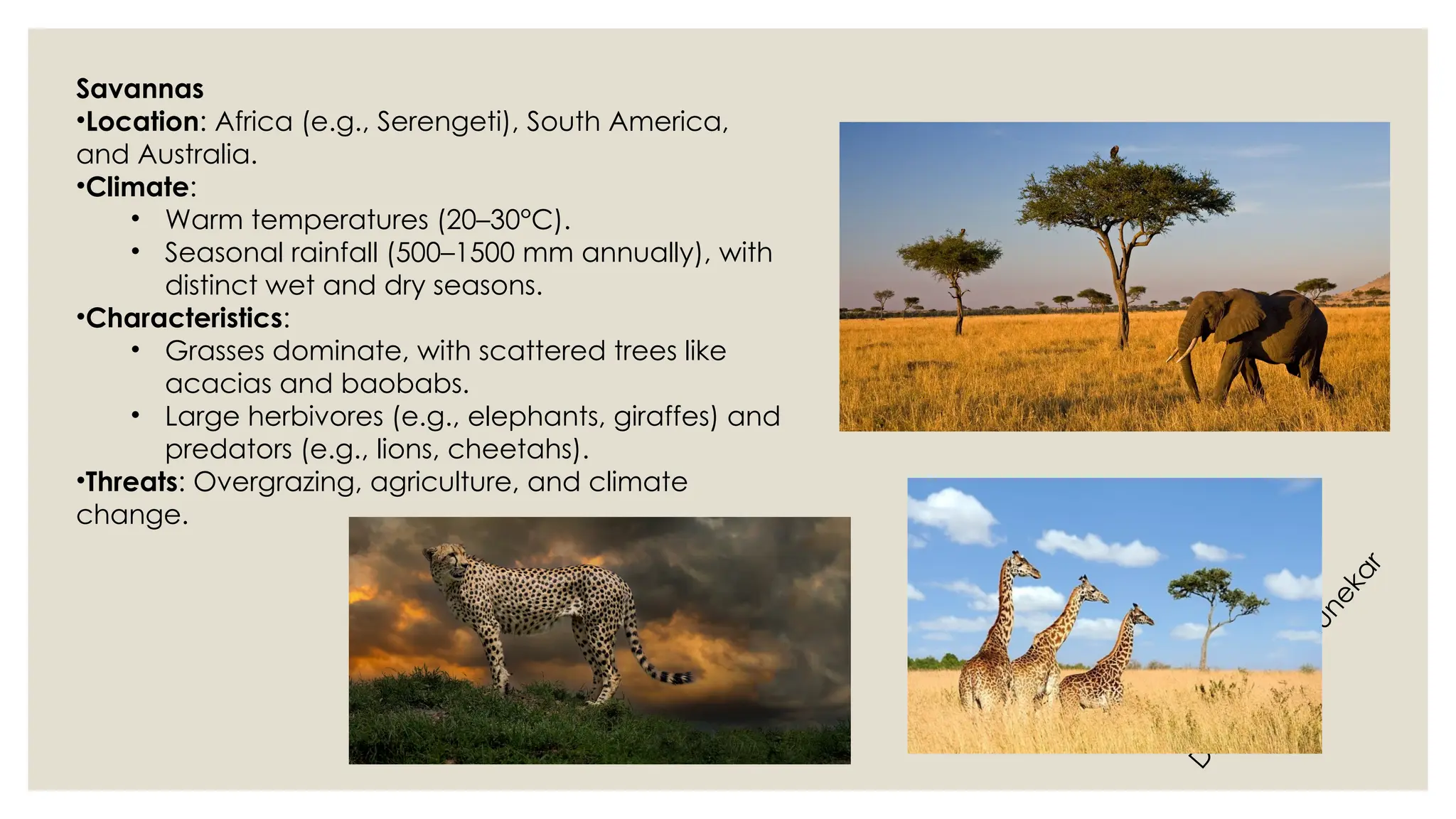
Savannas
•Location: Africa (e.g., Serengeti), South America,
and Australia.
•Climate:
• Warm temperatures (20–30°C).
• Seasonal rainfall (500–1500 mm annually), with
distinct wet and dry seasons.
•Characteristics:
• Grasses dominate, with scattered trees like
acacias and baobabs.
• Large herbivores (e.g., elephants, giraffes) and
predators (e.g., lions, cheetahs).
•Threats: Overgrazing, agriculture, and climate
change.
D
r
.
V
i
v
i
d
h
a
R
a
u
n
e
k
a
r
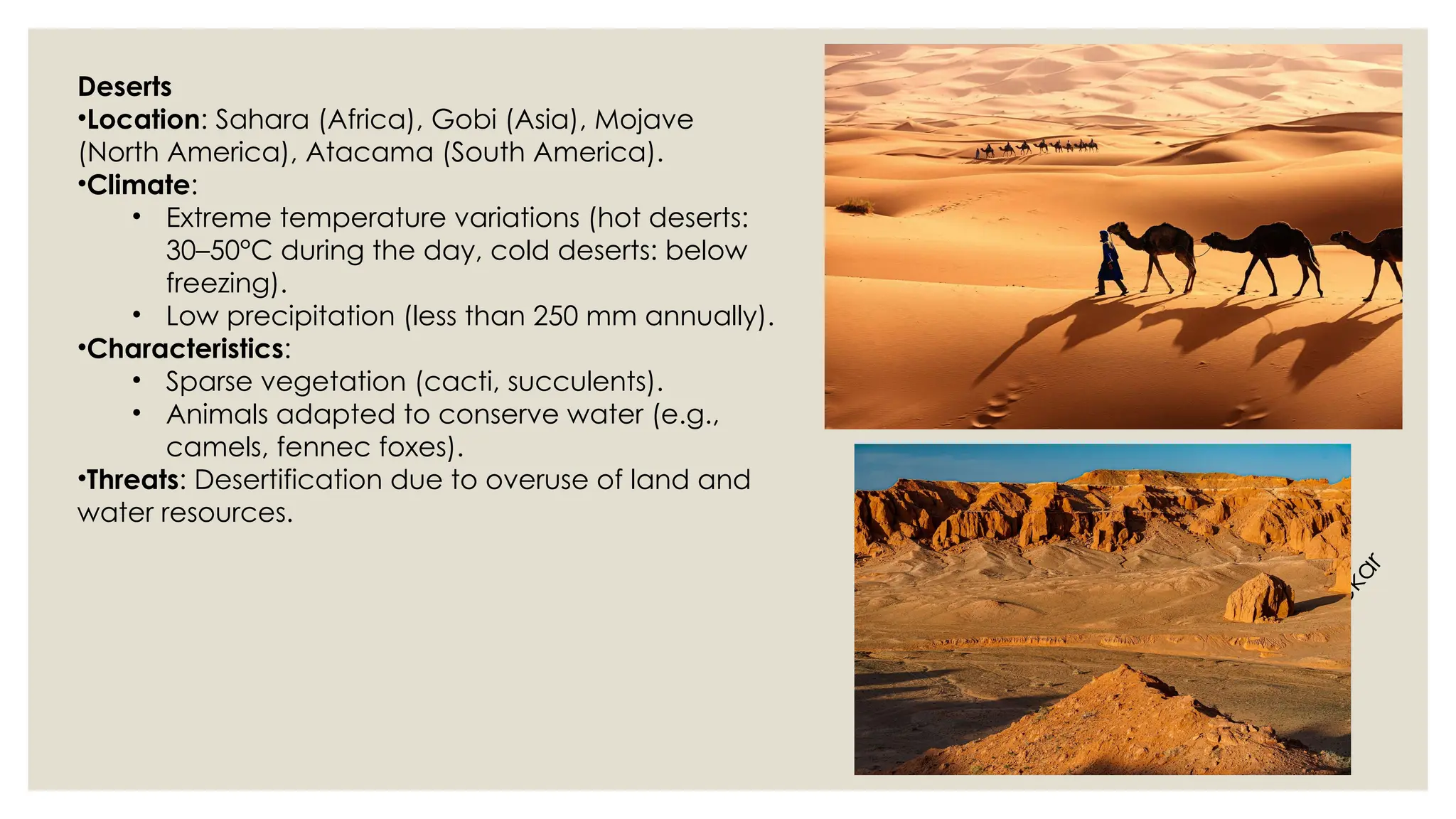
Deserts
•Location: Sahara (Africa), Gobi (Asia), Mojave
(North America), Atacama (South America).
•Climate:
• Extreme temperature variations (hot deserts:
30–50°C during the day, cold deserts: below
freezing).
• Low precipitation (less than 250 mm annually).
•Characteristics:
• Sparse vegetation (cacti, succulents).
• Animals adapted to conserve water (e.g.,
camels, fennec foxes).
•Threats: Desertification due to overuse of land and
water resources.
D
r
.
V
i
v
i
d
h
a
R
a
u
n
e
k
a
r
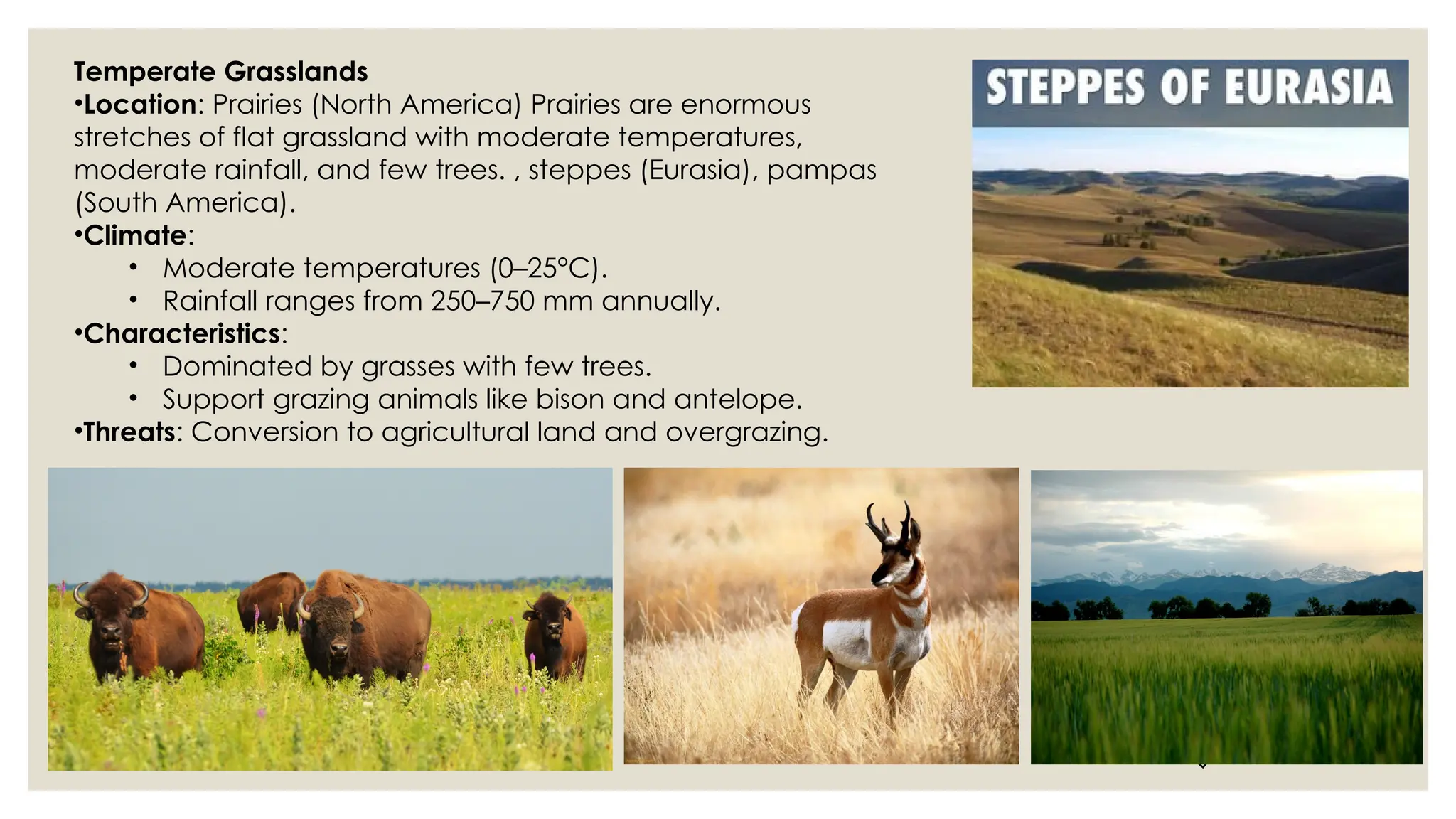
Temperate Grasslands
•Location: Prairies (North America) Prairies are enormous
stretches of flat grassland with moderate temperatures,
moderate rainfall, and few trees. , steppes (Eurasia), pampas
(South America).
•Climate:
• Moderate temperatures (0–25°C).
• Rainfall ranges from 250–750 mm annually.
•Characteristics:
• Dominated by grasses with few trees.
• Support grazing animals like bison and antelope.
•Threats: Conversion to agricultural land and overgrazing.
D
r
.
V
i
v
i
d
h
a
R
a
u
n
e
k
a
r
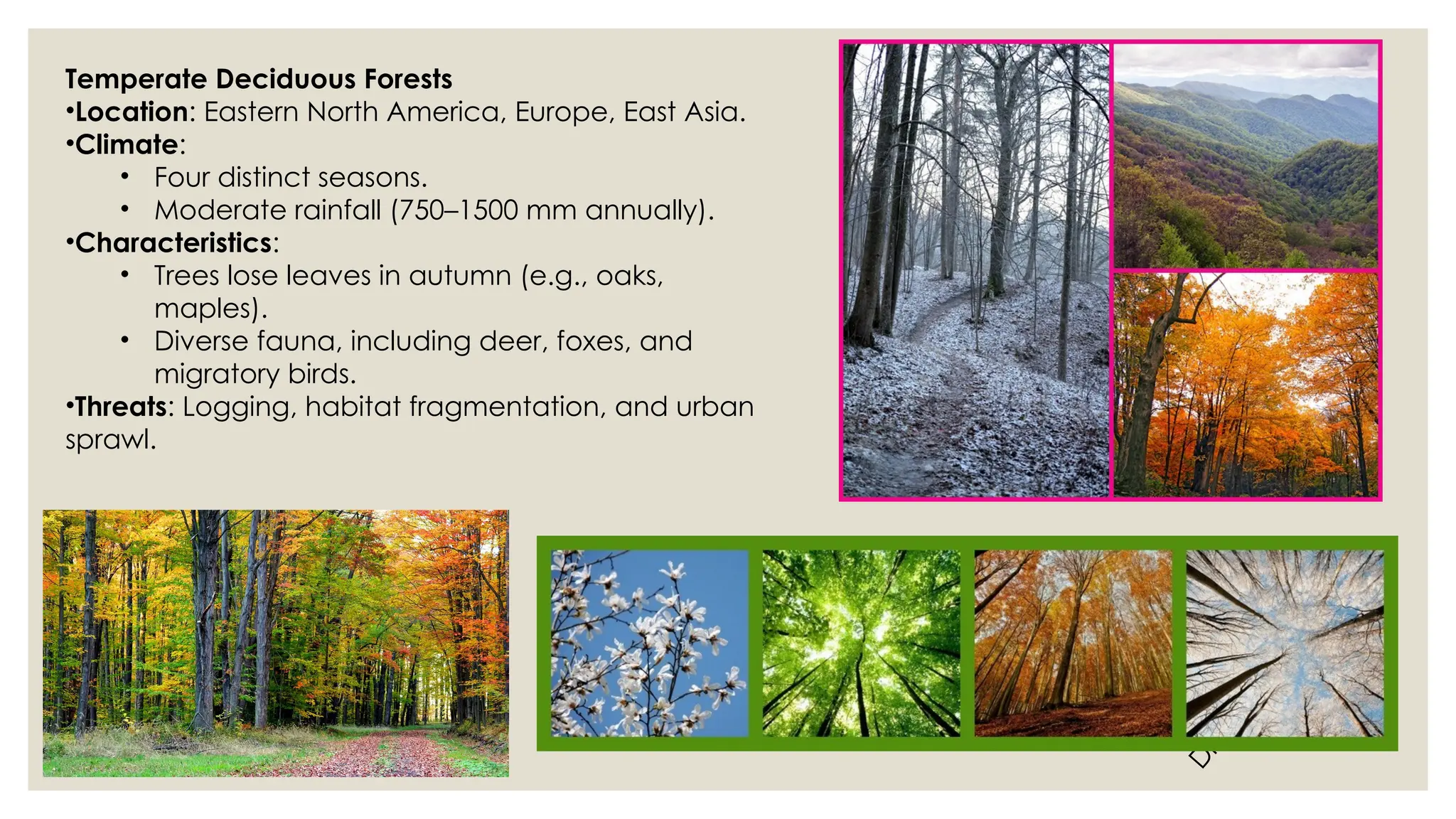
Temperate Deciduous Forests
•Location: Eastern North America, Europe, East Asia.
•Climate:
• Four distinct seasons.
• Moderate rainfall (750–1500 mm annually).
•Characteristics:
• Trees lose leaves in autumn (e.g., oaks,
maples).
• Diverse fauna, including deer, foxes, and
migratory birds.
•Threats: Logging, habitat fragmentation, and urban
sprawl.
D
r
.
V
i
v
i
d
h
a
R
a
u
n
e
k
a
r
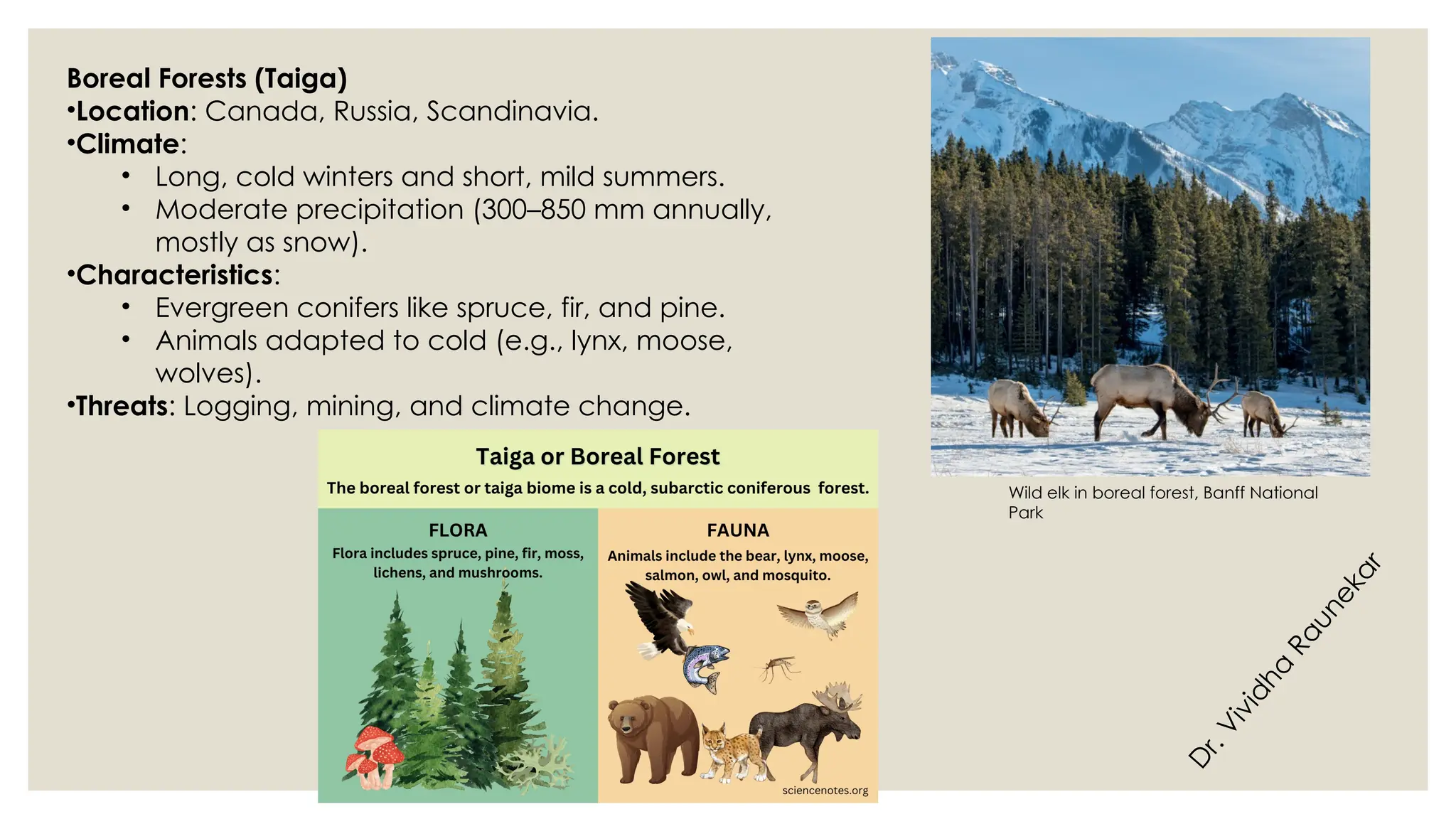
Boreal Forests (Taiga)
•Location: Canada, Russia, Scandinavia.
•Climate:
• Long, cold winters and short, mild summers.
• Moderate precipitation (300–850 mm annually,
mostly as snow).
•Characteristics:
• Evergreen conifers like spruce, fir, and pine.
• Animals adapted to cold (e.g., lynx, moose,
wolves).
•Threats: Logging, mining, and climate change.
Wild elk in boreal forest, Banff National
Park
D
r
.
V
i
v
i
d
h
a
R
a
u
n
e
k
a
r
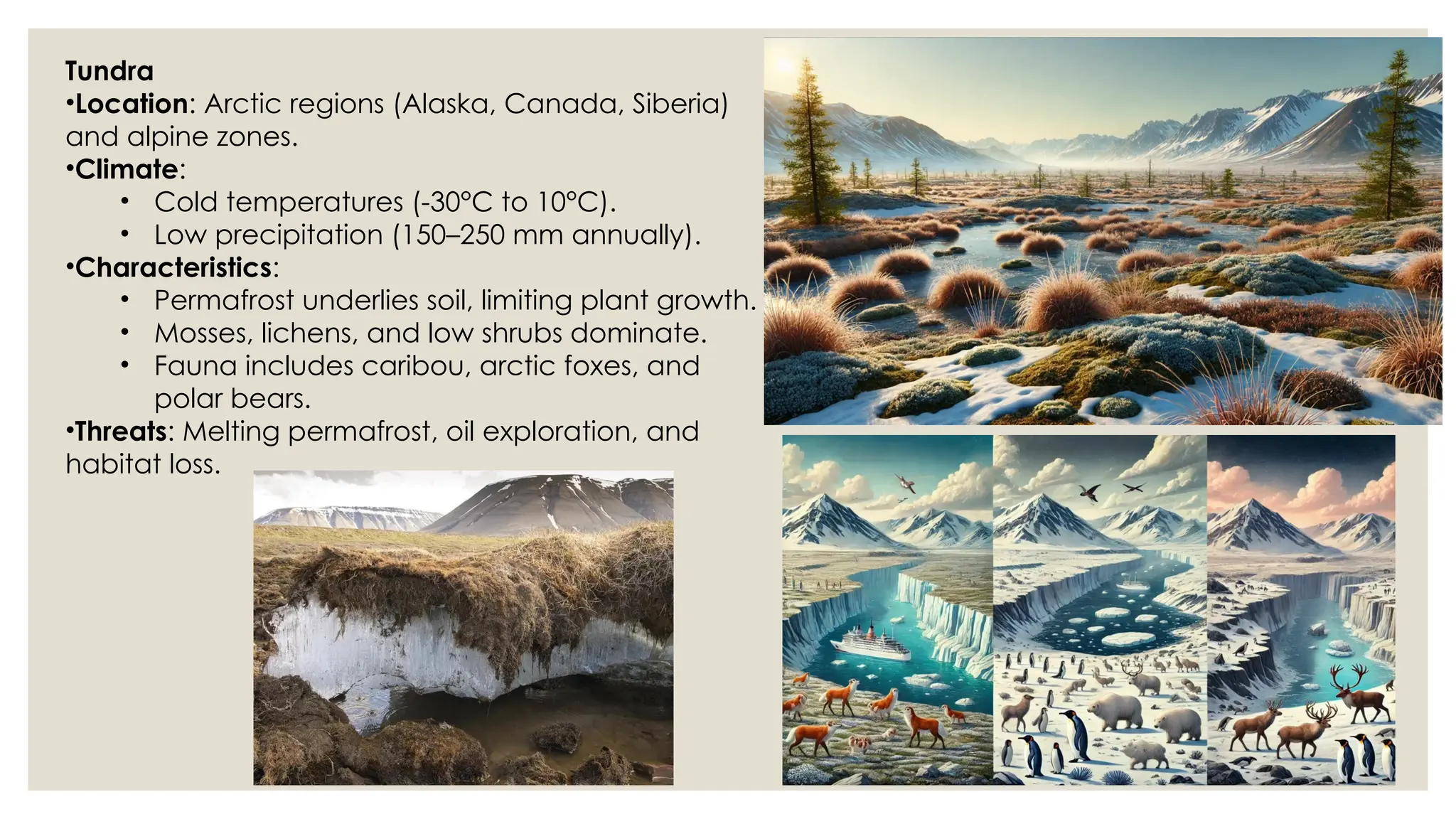
Tundra
•Location: Arctic regions (Alaska, Canada, Siberia)
and alpine zones.
•Climate:
• Cold temperatures (-30°C to 10°C).
• Low precipitation (150–250 mm annually).
•Characteristics:
• Permafrost underlies soil, limiting plant growth.
• Mosses, lichens, and low shrubs dominate.
• Fauna includes caribou, arctic foxes, and
polar bears.
•Threats: Melting permafrost, oil exploration, and
habitat loss.
D
r
.
V
i
v
i
d
h
a
R
a
u
n
e
k
a
r
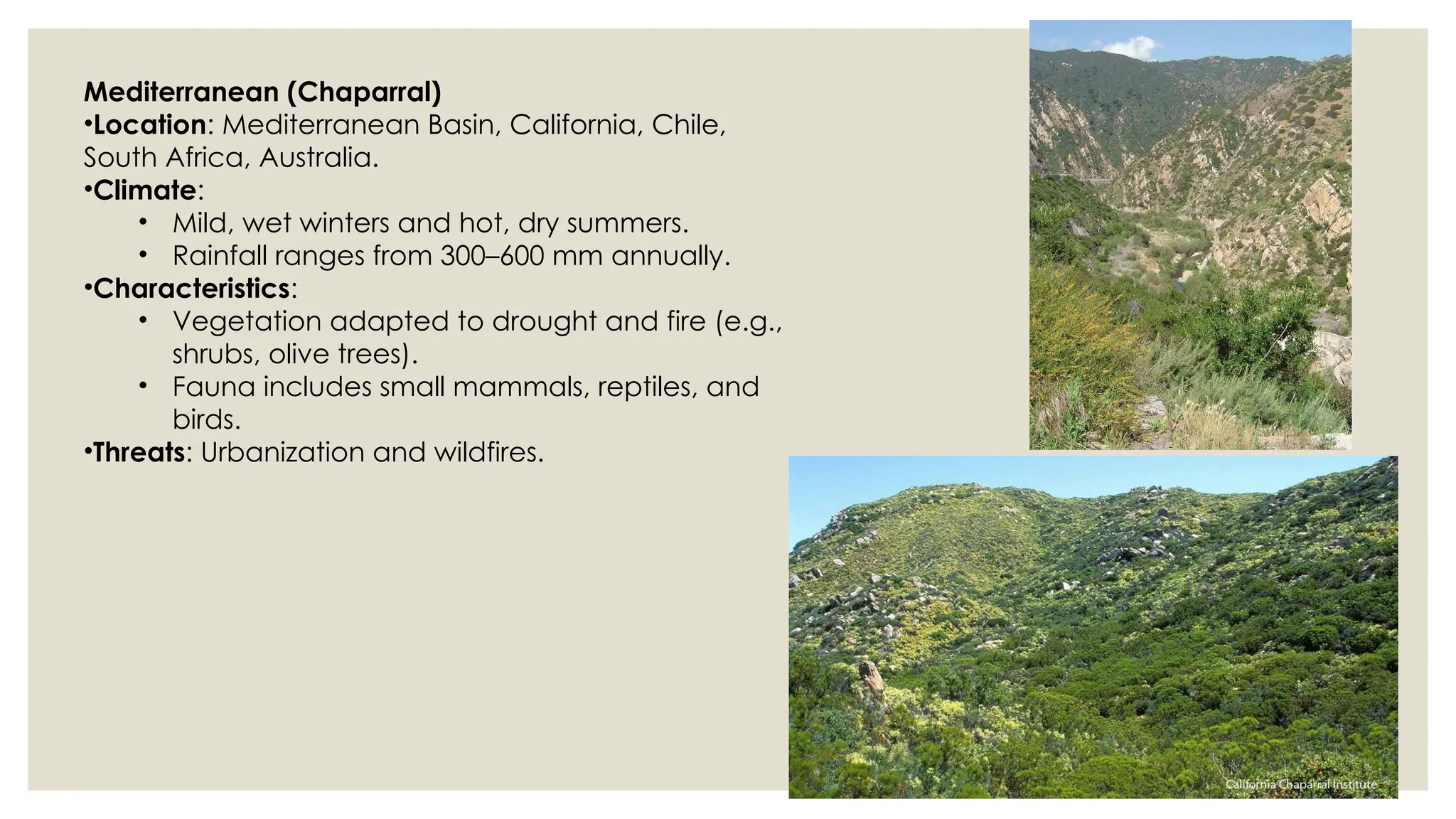
Mediterranean (Chaparral)
•Location: Mediterranean Basin, California, Chile,
South Africa, Australia.
•Climate:
• Mild, wet winters and hot, dry summers.
• Rainfall ranges from 300–600 mm annually.
•Characteristics:
• Vegetation adapted to drought and fire (e.g.,
shrubs, olive trees).
• Fauna includes small mammals, reptiles, and
birds.
•Threats: Urbanization and wildfires.
D
r
.
V
i
v
i
d
h
a
R
a
u
n
e
k
a
r
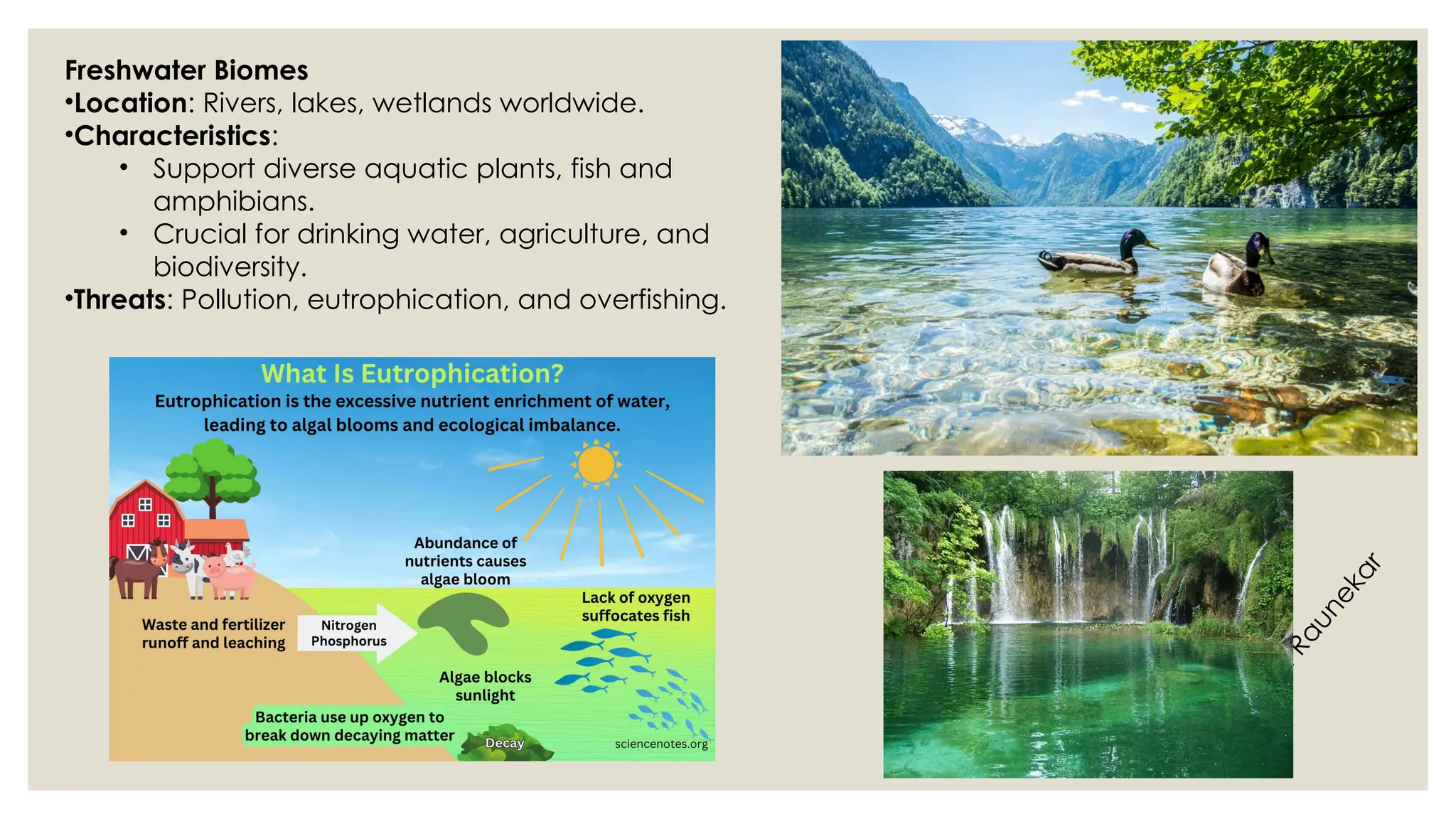
Freshwater Biomes
•Location: Rivers, lakes, wetlands worldwide.
•Characteristics:
• Support diverse aquatic plants, fish and
amphibians.
• Crucial for drinking water, agriculture, and
biodiversity.
•Threats: Pollution, eutrophication, and overfishing.
D
r
.
V
i
v
i
d
h
a
R
a
u
n
e
k
a
r
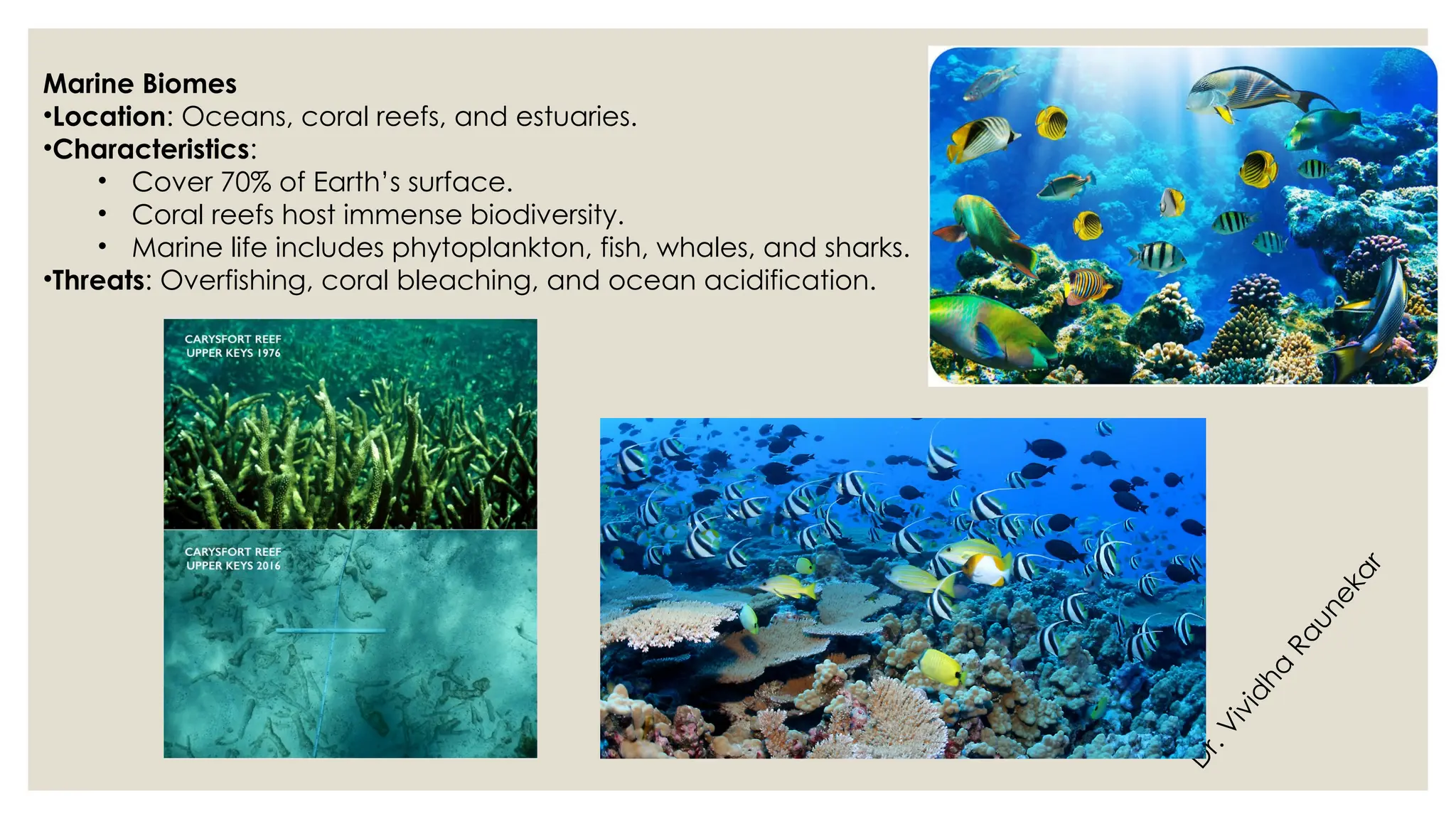
Marine Biomes
•Location: Oceans, coral reefs, and estuaries.
•Characteristics:
• Cover 70% of Earth’s surface.
• Coral reefs host immense biodiversity.
• Marine life includes phytoplankton, fish, whales, and sharks.
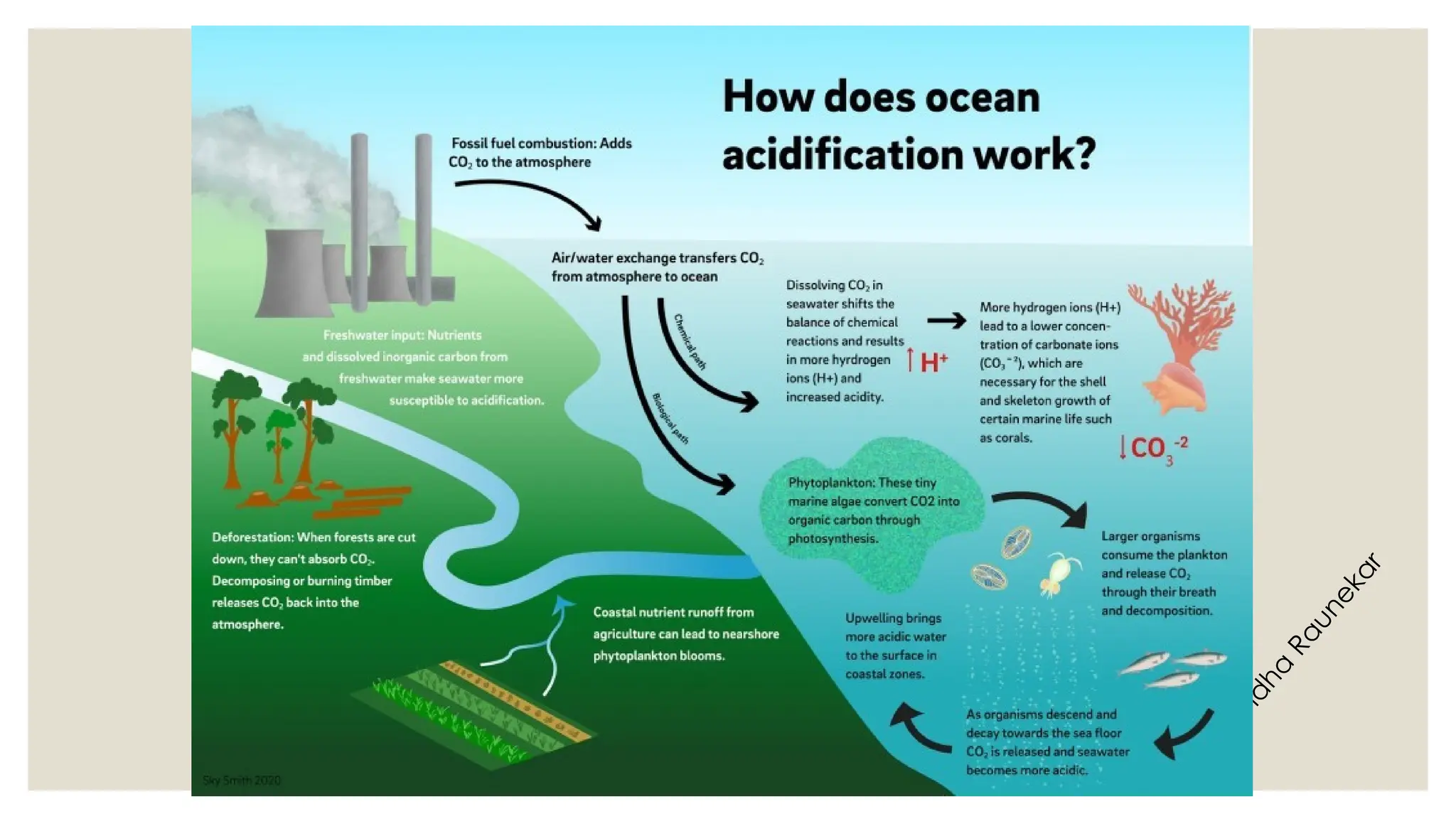
•Threats: Overfishing, coral bleaching, and ocean acidification.
D
r
.
V
i
v
i
d
h
a
R
a
u
n
e
k
a
r
D
r
.
V
i
v
i
d
h
a
R
a
u
n
e
k
a
r
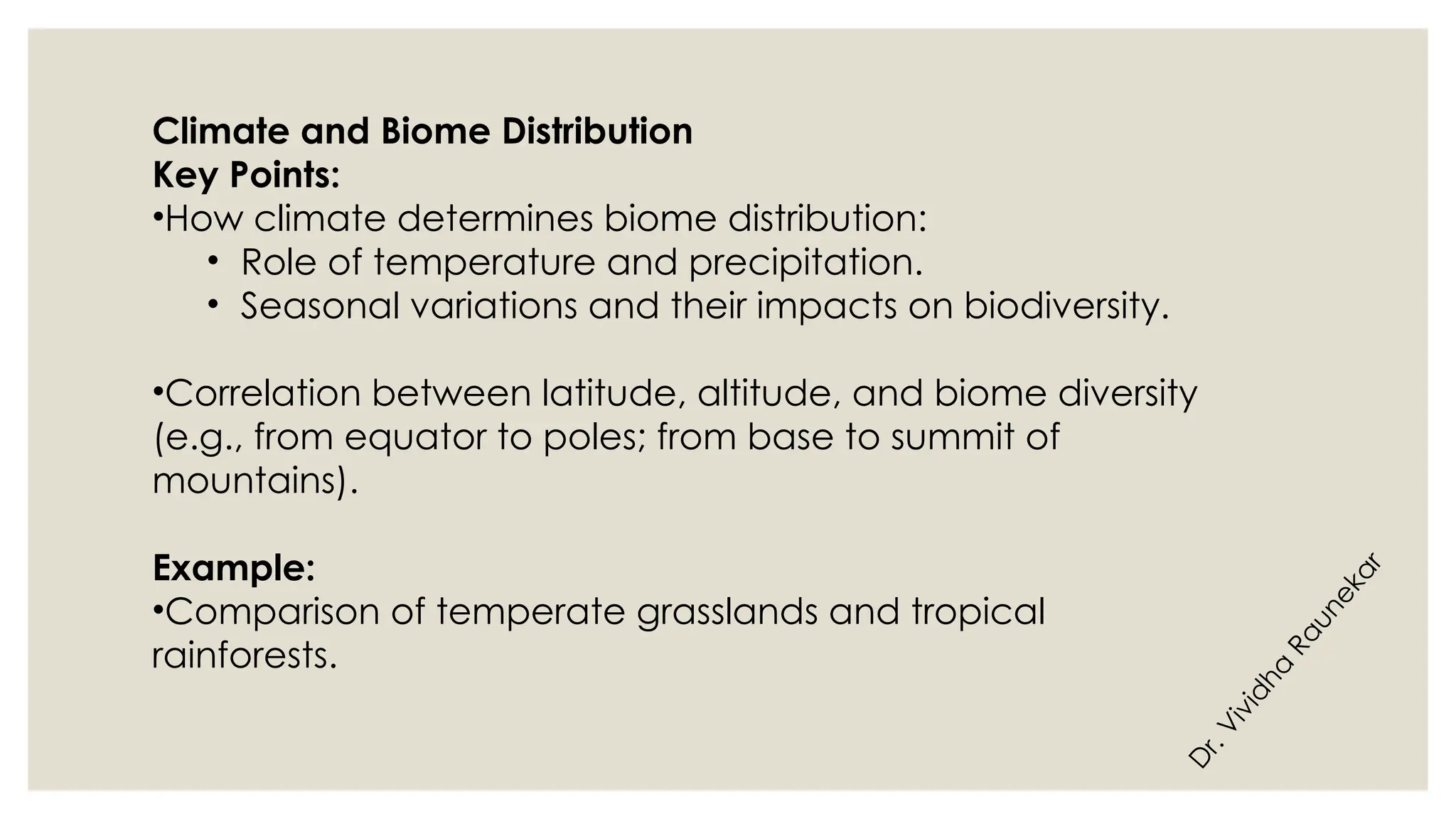
Climate and Biome Distribution
Key Points:
•How climate determines biome distribution:
• Role of temperature and precipitation.
• Seasonal variations and their impacts on biodiversity.
•Correlation between latitude, altitude, and biome diversity
(e.g., from equator to poles; from base to summit of
mountains).
Example:
•Comparison of temperate grasslands and tropical
rainforests.
D
r
.
V
i
v
i
d
h
a
R
a
u
n
e
k
a
r
Human Impacts on Biomes
Key Points:
•Habitat destruction, urbanization, and land-use changes.
•Climate change and its differential impact on biomes
(e.g., coral bleaching in marine systems, tundra thawing).
•Conservation strategies:
• Protected areas (e.g., national parks, marine
reserves).
• Restoration ecology.
Examples:
•Deforestation rates.
•Effects of melting Arctic ice on global sea levels.
D
r
.
V
i
v
i
d
h
a
R
a
u
n
e
k
a
r
Case Study Analysis:
•Group discussion- Wildfire in Los Angeles
THANK YOU

Biomes (communities on a global scale).pptx

  • 1.
    BIOMES (COMMUNITIES ON A GLOBALSCALE) Dr. Vividha Raunekar
  • 2.
    D r . V i v i d h a R a u n e k a r A biome isa large area of the Earth or ocean with a similar climate, landscape, and plant and animal life biosphere, relatively thin life-supporting stratum of Earth's surface, extending from a few kilometres into the atmosphere to the deep-sea vents of the ocean. An ecosystem is a community of organisms and their physical environment interacting together. Environment involves both living organisms and the non-living physical conditions. In ecology, a community is a group or association of populations of two or more different species occupying the same geographical area at the same time A population is a group of the same species living in the same area.
  • 3.
    D r . V i v i d h a R a u n e k a r Introduction to Biomes •Definition:Biomes as large-scale ecological units defined by vegetation, climate, and geography. •Factors influencing biomes: Climate (temperature and precipitation), latitude, altitude, and soil type. •Biotic and abiotic components: Interaction between living organisms and their physical environment.

  • 4.
  • 5.
  • 6.
    D r . V i v i d h a R a u n e k a r Tropical Rainforests •Location: Nearthe equator, including the Amazon Basin (South America), Congo Basin (Africa), and Southeast Asia. •Climate: • High temperature (20–30°C) year-round. • High rainfall (over 2000 mm annually). •Characteristics: • Dense, multilayered vegetation with a closed canopy. • High biodiversity (e.g., jaguars, tucans, orchids, bromeliads). •Threats: Deforestation for agriculture, logging, and urbanization.
  • 7.
    D r . V i v i d h a R a u n e k a r Savannas •Location: Africa (e.g.,Serengeti), South America, and Australia. •Climate: • Warm temperatures (20–30°C). • Seasonal rainfall (500–1500 mm annually), with distinct wet and dry seasons. •Characteristics: • Grasses dominate, with scattered trees like acacias and baobabs. • Large herbivores (e.g., elephants, giraffes) and predators (e.g., lions, cheetahs). •Threats: Overgrazing, agriculture, and climate change.
  • 8.
    D r . V i v i d h a R a u n e k a r Deserts •Location: Sahara (Africa),Gobi (Asia), Mojave (North America), Atacama (South America). •Climate: • Extreme temperature variations (hot deserts: 30–50°C during the day, cold deserts: below freezing). • Low precipitation (less than 250 mm annually). •Characteristics: • Sparse vegetation (cacti, succulents). • Animals adapted to conserve water (e.g., camels, fennec foxes). •Threats: Desertification due to overuse of land and water resources.
  • 9.
    D r . V i v i d h a R a u n e k a r Temperate Grasslands •Location: Prairies(North America) Prairies are enormous stretches of flat grassland with moderate temperatures, moderate rainfall, and few trees. , steppes (Eurasia), pampas (South America). •Climate: • Moderate temperatures (0–25°C). • Rainfall ranges from 250–750 mm annually. •Characteristics: • Dominated by grasses with few trees. • Support grazing animals like bison and antelope. •Threats: Conversion to agricultural land and overgrazing.
  • 10.
    D r . V i v i d h a R a u n e k a r Temperate Deciduous Forests •Location:Eastern North America, Europe, East Asia. •Climate: • Four distinct seasons. • Moderate rainfall (750–1500 mm annually). •Characteristics: • Trees lose leaves in autumn (e.g., oaks, maples). • Diverse fauna, including deer, foxes, and migratory birds. •Threats: Logging, habitat fragmentation, and urban sprawl.
  • 11.
    D r . V i v i d h a R a u n e k a r Boreal Forests (Taiga) •Location:Canada, Russia, Scandinavia. •Climate: • Long, cold winters and short, mild summers. • Moderate precipitation (300–850 mm annually, mostly as snow). •Characteristics: • Evergreen conifers like spruce, fir, and pine. • Animals adapted to cold (e.g., lynx, moose, wolves). •Threats: Logging, mining, and climate change. Wild elk in boreal forest, Banff National Park
  • 12.
    D r . V i v i d h a R a u n e k a r Tundra •Location: Arctic regions(Alaska, Canada, Siberia) and alpine zones. •Climate: • Cold temperatures (-30°C to 10°C). • Low precipitation (150–250 mm annually). •Characteristics: • Permafrost underlies soil, limiting plant growth. • Mosses, lichens, and low shrubs dominate. • Fauna includes caribou, arctic foxes, and polar bears. •Threats: Melting permafrost, oil exploration, and habitat loss.
  • 13.
    D r . V i v i d h a R a u n e k a r Mediterranean (Chaparral) •Location: MediterraneanBasin, California, Chile, South Africa, Australia. •Climate: • Mild, wet winters and hot, dry summers. • Rainfall ranges from 300–600 mm annually. •Characteristics: • Vegetation adapted to drought and fire (e.g., shrubs, olive trees). • Fauna includes small mammals, reptiles, and birds. •Threats: Urbanization and wildfires.
  • 14.
    D r . V i v i d h a R a u n e k a r Freshwater Biomes •Location: Rivers,lakes, wetlands worldwide. •Characteristics: • Support diverse aquatic plants, fish and amphibians. • Crucial for drinking water, agriculture, and biodiversity. •Threats: Pollution, eutrophication, and overfishing.
  • 15.
    D r . V i v i d h a R a u n e k a r Marine Biomes •Location: Oceans,coral reefs, and estuaries. •Characteristics: • Cover 70% of Earth’s surface. • Coral reefs host immense biodiversity. • Marine life includes phytoplankton, fish, whales, and sharks. •Threats: Overfishing, coral bleaching, and ocean acidification.
  • 16.
  • 17.
    D r . V i v i d h a R a u n e k a r Climate and BiomeDistribution Key Points: •How climate determines biome distribution: • Role of temperature and precipitation. • Seasonal variations and their impacts on biodiversity. •Correlation between latitude, altitude, and biome diversity (e.g., from equator to poles; from base to summit of mountains). Example: •Comparison of temperate grasslands and tropical rainforests.
  • 18.
    D r . V i v i d h a R a u n e k a r Human Impacts onBiomes Key Points: •Habitat destruction, urbanization, and land-use changes. •Climate change and its differential impact on biomes (e.g., coral bleaching in marine systems, tundra thawing). •Conservation strategies: • Protected areas (e.g., national parks, marine reserves). • Restoration ecology. Examples: •Deforestation rates. •Effects of melting Arctic ice on global sea levels.
  • 19.
  • 20.

Editor's Notes

  • #12 Just as a puddle of water freezes on a frigid winter night, water that is trapped in sediment, soil, and the cracks, crevices, and pores of rocks turns to ice when ground temperatures drop below 32°F (0°C). When the earth remains frozen for at least two consecutive years, it’s called permafrost. If the ground freezes and thaws every year, it’s considered “seasonally frozen.”