BIOLUMINESCENCE
BIOLUMINESCENCE
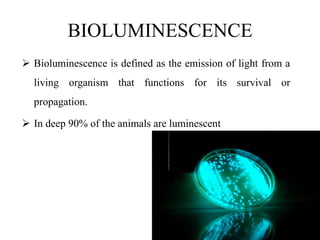
 Bioluminescence is defined as the emission of light from a
living organism that functions for its survival or
propagation.
 In deep 90% of the animals are luminescent
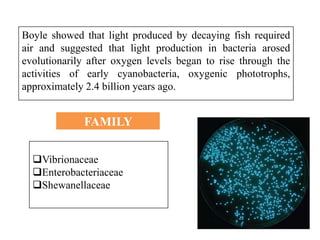
Boyle showed that light produced by decaying fish required
air and suggested that light production in bacteria arosed
evolutionarily after oxygen levels began to rise through the
activities of early cyanobacteria, oxygenic phototrophs,
approximately 2.4 billion years ago.
FAMILY
Vibrionaceae
Enterobacteriaceae
Shewanellaceae
SPECIES SOURCE REFERENCE
Aliivibrio fischeri
Coastal seawater, light organs
of squid
and fish
Budsberg et al., 2013
Aliivibrio logei
Coastal seawater, sediment
salmonicida Tissue lesions of
Atlantic salmon
Ast et al., 2009
Photobacterium aquimaris Coastal seawater Yoshizawa et al., 2009
Shewanella hanedai Seawater and sediment Jensen et al., 1908
Vibrio cholerae
Estuaries, bays, coastal
seawater
Kaeding et al., 2007
Photorhabdus asymbiotica Human skin lesions Engebrech et al., 1983
Distribution Of Bioluminescence
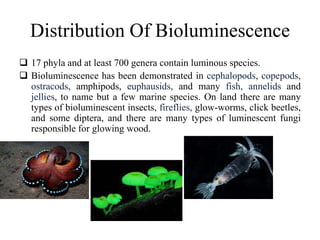
 17 phyla and at least 700 genera contain luminous species.
 Bioluminescence has been demonstrated in cephalopods, copepods,
ostracods, amphipods, euphausids, and many fish, annelids and
jellies, to name but a few marine species. On land there are many
types of bioluminescent insects, fireflies, glow-worms, click beetles,
and some diptera, and there are many types of luminescent fungi
responsible for glowing wood.
ANATOMIC DISTRIBUTION
 Photophore or the light producing organ, quite evidently seen
in many luminous fish and very vividly in cephalopods.
Photophores are normally made up of complex photogenic
(light emitting) cells.
 Bioluminescent reaction components have also been detected
in the stomach, secretory organs and liver of some organisms
GEOGRAPHIC DISTRIBUTION
• Bioluminescent organisms are found world-wide
• A great variety of firefly species are found in the temperate to
tropical regions of the Americas, in China, and S.E. Asia.
• Several types of glow-worm have been identified in North
America, Europe, and Australasia.
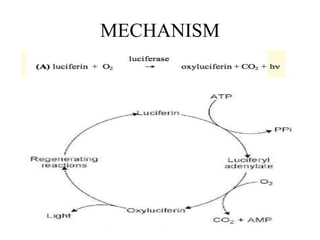
MECHANISM
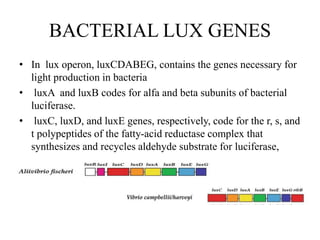
BACTERIAL LUX GENES
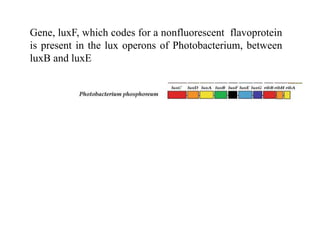
• In lux operon, luxCDABEG, contains the genes necessary for
light production in bacteria
• luxA and luxB codes for alfa and beta subunits of bacterial
luciferase.
• luxC, luxD, and luxE genes, respectively, code for the r, s, and
t polypeptides of the fatty-acid reductase complex that
synthesizes and recycles aldehyde substrate for luciferase,
Gene, luxF, which codes for a nonfluorescent flavoprotein
is present in the lux operons of Photobacterium, between
luxB and luxE
QUORUM SENSING
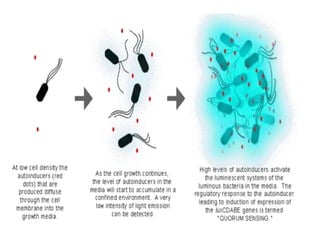
• Quorum sensing is the regulation of gene expression in
response to fluctuations in cell-population density.
• Quorum sensing is a process of cell–cell communication that
allows bacteria to share information about cell density and
adjust gene expression accordingly.
STEPS IN QUORUM SENSING
 Small biochemical signal molecules production by the
bacterial cell
 Release of the signal molecules
 Recognition of the signal molecules by specific receptors
 Changes in gene regulation
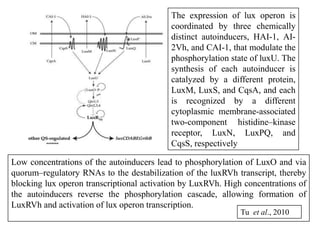
The expression of lux operon is
coordinated by three chemically
distinct autoinducers, HAI-1, AI-
2Vh, and CAI-1, that modulate the
phosphorylation state of luxU. The
synthesis of each autoinducer is
catalyzed by a different protein,
LuxM, LuxS, and CqsA, and each
is recognized by a different
cytoplasmic membrane-associated
two-component histidine–kinase
receptor, LuxN, LuxPQ, and
CqsS, respectively
Low concentrations of the autoinducers lead to phosphorylation of LuxO and via
quorum–regulatory RNAs to the destabilization of the luxRVh transcript, thereby
blocking lux operon transcriptional activation by LuxRVh. High concentrations of
the autoinducers reverse the phosphorylation cascade, allowing formation of
LuxRVh and activation of lux operon transcription.
Tu et al., 2010
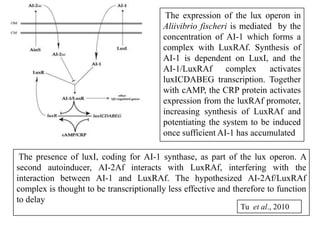
The expression of the lux operon in
Aliivibrio fischeri is mediated by the
concentration of AI-1 which forms a
complex with LuxRAf. Synthesis of
AI-1 is dependent on LuxI, and the
AI-1/LuxRAf complex activates
luxICDABEG transcription. Together
with cAMP, the CRP protein activates
expression from the luxRAf promoter,
increasing synthesis of LuxRAf and
potentiating the system to be induced
once sufficient AI-1 has accumulated
The presence of luxI, coding for AI-1 synthase, as part of the lux operon. A
second autoinducer, AI-2Af interacts with LuxRAf, interfering with the
interaction between AI-1 and LuxRAf. The hypothesized AI-2Af/LuxRAf
complex is thought to be transcriptionally less effective and therefore to function
to delay
Tu et al., 2010
USES OF BIOLUMINISCENCE
 Defense
 Communication
 Mating
 Mimicry
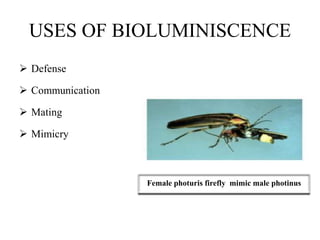
Female photuris firefly mimic male photinus
Impact Of Molecular Biology And
Bioluminescence
 The calcium-dependent photoprotein aequorin from the
jellyfish Aequorea victoria was cloned in 1985. Because the
intensity of its luminescence varies with calcium
concentration, aequorin has been used for advantage in the
monitoring of cell calcium Inouye et al., 1985
. In 1985, firefly luciferase was cloned (10). As an extremely
sensitive method for the assay of ATP, this bioluminescence
system has found wide application, e.g., to detect microbial
contamination in foodstuffs, water systems, etc.
De Wet et al., 1985
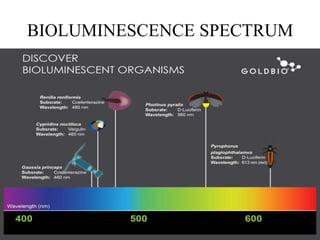
BIOLUMINESCENCE SPECTRUM
THANK YOU

bioluminiscence example for light movement

  • 1.
  • 2.
    BIOLUMINESCENCE  Bioluminescence isdefined as the emission of light from a living organism that functions for its survival or propagation.  In deep 90% of the animals are luminescent
  • 3.
    Boyle showed thatlight produced by decaying fish required air and suggested that light production in bacteria arosed evolutionarily after oxygen levels began to rise through the activities of early cyanobacteria, oxygenic phototrophs, approximately 2.4 billion years ago. FAMILY Vibrionaceae Enterobacteriaceae Shewanellaceae
  • 4.
    SPECIES SOURCE REFERENCE Aliivibriofischeri Coastal seawater, light organs of squid and fish Budsberg et al., 2013 Aliivibrio logei Coastal seawater, sediment salmonicida Tissue lesions of Atlantic salmon Ast et al., 2009 Photobacterium aquimaris Coastal seawater Yoshizawa et al., 2009 Shewanella hanedai Seawater and sediment Jensen et al., 1908 Vibrio cholerae Estuaries, bays, coastal seawater Kaeding et al., 2007 Photorhabdus asymbiotica Human skin lesions Engebrech et al., 1983
  • 5.
    Distribution Of Bioluminescence 17 phyla and at least 700 genera contain luminous species.  Bioluminescence has been demonstrated in cephalopods, copepods, ostracods, amphipods, euphausids, and many fish, annelids and jellies, to name but a few marine species. On land there are many types of bioluminescent insects, fireflies, glow-worms, click beetles, and some diptera, and there are many types of luminescent fungi responsible for glowing wood.
  • 6.
    ANATOMIC DISTRIBUTION  Photophoreor the light producing organ, quite evidently seen in many luminous fish and very vividly in cephalopods. Photophores are normally made up of complex photogenic (light emitting) cells.  Bioluminescent reaction components have also been detected in the stomach, secretory organs and liver of some organisms
  • 7.
    GEOGRAPHIC DISTRIBUTION • Bioluminescentorganisms are found world-wide • A great variety of firefly species are found in the temperate to tropical regions of the Americas, in China, and S.E. Asia. • Several types of glow-worm have been identified in North America, Europe, and Australasia.
  • 8.
  • 9.
    BACTERIAL LUX GENES •In lux operon, luxCDABEG, contains the genes necessary for light production in bacteria • luxA and luxB codes for alfa and beta subunits of bacterial luciferase. • luxC, luxD, and luxE genes, respectively, code for the r, s, and t polypeptides of the fatty-acid reductase complex that synthesizes and recycles aldehyde substrate for luciferase,
  • 10.
    Gene, luxF, whichcodes for a nonfluorescent flavoprotein is present in the lux operons of Photobacterium, between luxB and luxE
  • 11.
    QUORUM SENSING • Quorumsensing is the regulation of gene expression in response to fluctuations in cell-population density. • Quorum sensing is a process of cell–cell communication that allows bacteria to share information about cell density and adjust gene expression accordingly.
  • 12.
    STEPS IN QUORUMSENSING  Small biochemical signal molecules production by the bacterial cell  Release of the signal molecules  Recognition of the signal molecules by specific receptors  Changes in gene regulation
  • 14.
    The expression oflux operon is coordinated by three chemically distinct autoinducers, HAI-1, AI- 2Vh, and CAI-1, that modulate the phosphorylation state of luxU. The synthesis of each autoinducer is catalyzed by a different protein, LuxM, LuxS, and CqsA, and each is recognized by a different cytoplasmic membrane-associated two-component histidine–kinase receptor, LuxN, LuxPQ, and CqsS, respectively Low concentrations of the autoinducers lead to phosphorylation of LuxO and via quorum–regulatory RNAs to the destabilization of the luxRVh transcript, thereby blocking lux operon transcriptional activation by LuxRVh. High concentrations of the autoinducers reverse the phosphorylation cascade, allowing formation of LuxRVh and activation of lux operon transcription. Tu et al., 2010
  • 15.
    The expression ofthe lux operon in Aliivibrio fischeri is mediated by the concentration of AI-1 which forms a complex with LuxRAf. Synthesis of AI-1 is dependent on LuxI, and the AI-1/LuxRAf complex activates luxICDABEG transcription. Together with cAMP, the CRP protein activates expression from the luxRAf promoter, increasing synthesis of LuxRAf and potentiating the system to be induced once sufficient AI-1 has accumulated The presence of luxI, coding for AI-1 synthase, as part of the lux operon. A second autoinducer, AI-2Af interacts with LuxRAf, interfering with the interaction between AI-1 and LuxRAf. The hypothesized AI-2Af/LuxRAf complex is thought to be transcriptionally less effective and therefore to function to delay Tu et al., 2010
  • 16.
    USES OF BIOLUMINISCENCE Defense  Communication  Mating  Mimicry Female photuris firefly mimic male photinus
  • 17.
    Impact Of MolecularBiology And Bioluminescence  The calcium-dependent photoprotein aequorin from the jellyfish Aequorea victoria was cloned in 1985. Because the intensity of its luminescence varies with calcium concentration, aequorin has been used for advantage in the monitoring of cell calcium Inouye et al., 1985 . In 1985, firefly luciferase was cloned (10). As an extremely sensitive method for the assay of ATP, this bioluminescence system has found wide application, e.g., to detect microbial contamination in foodstuffs, water systems, etc. De Wet et al., 1985
  • 18.
  • 19.