
KARAGANDA STATE MEDICAL
UNIVERSITY
TOPIC=AGE RELATED CHANGES OF
ENDOCRINE SYSTEM
NAME =GOVIND KUMAR
SUBMITTED TO= TIMUR SIR
GROUP NO= 3002
KARAGANDA 2017
The aging process can alter
neuroendocrine function at multiple levels
(i.e. through its effects on biogenic
aminergic and peptidergic neurons,
anterior pituitary cells and end organs)
THE HYPOTHALAMIC-PITUITARY
ADRENALAXIS
1. Corticotropin-releasing hormone (CRH or
CRF)
2. Corticotropin (ACTH, adrecorticotropic
hormone) secreted by anterior pituitary
corticotropes into the circulation
3. Adrenal hormone, primarily glucocorticoids,
from the adrenal cortex.
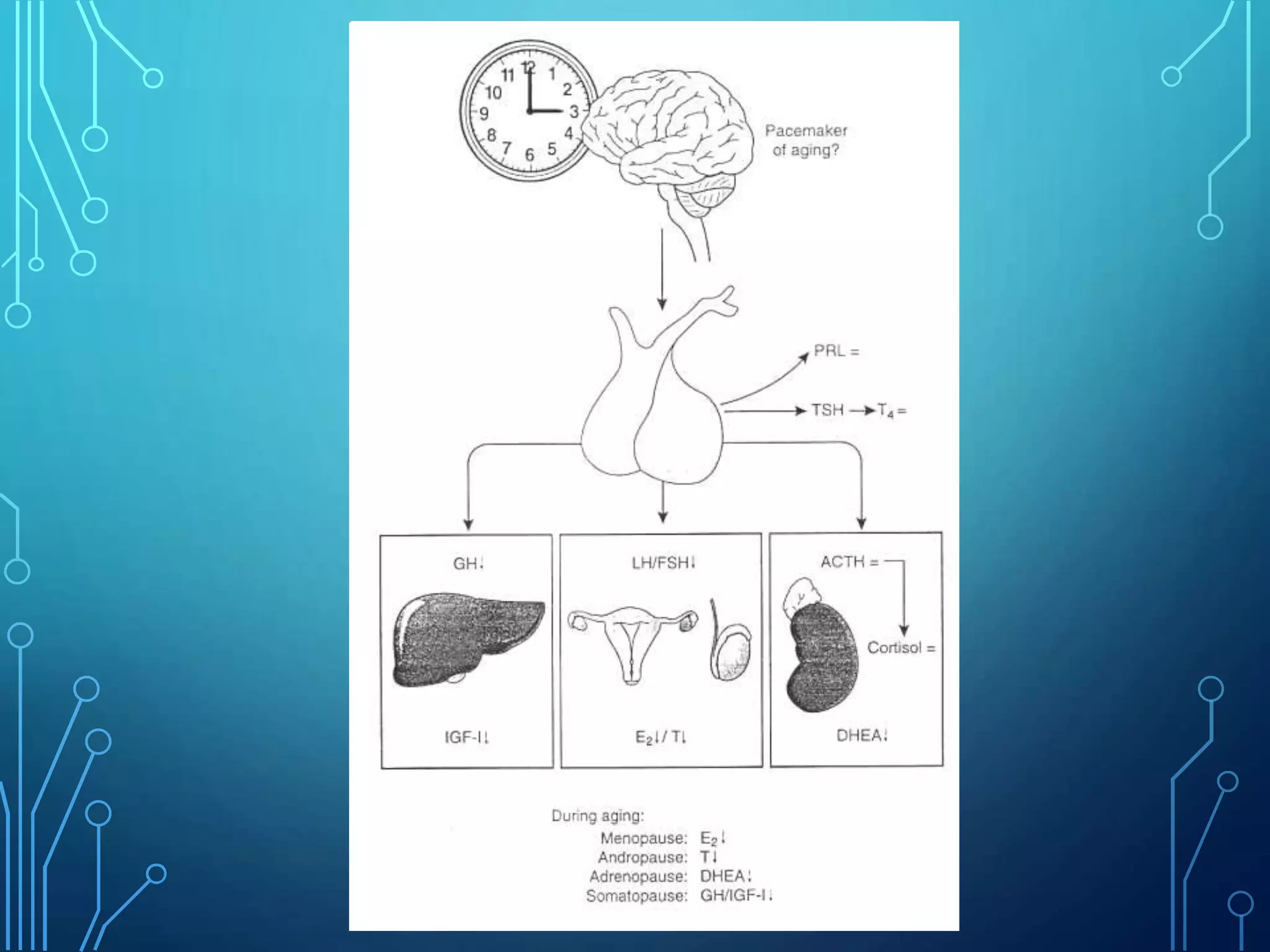
During Aging
 Menopause : E2 
 Andropause : T 
 Andrenopause : DHEA 
 Somatopause : GH/IGF-1 
EFFECT OF AGING ON THE HPA
 ACTH and glucocorticoid secretion
 Pituitary and adrenal involvement
 Stress activation and feedback inhibition
 CRH in Alzheimer’s disease
This bulk of evidence indicates that of the
alterations in the HPA that develop with aging, the
one most clearly demonstrable is a diminution in
feedback inhibition of ACTH and/or CRH systems
by glucocorticoids. Thus, there appears to be a
prolonged response to HPA activation by stressful
stimuli, suggesting an imbalance in the recovery
phase of HPA-mediated homeostasis. The
significance of decrease brain CRH levels in the
pathogenesis and treatment of Alzheimer’s disease
is currently under investigation.
EFFECT OF AGING ON THE
GROWTH HORMONE
 Physiologic secretion
 Sites of involvement
 Feedback inhibition and peripheral effect
Investigation of the age-related decline in episodec
GH secretion point to several sites in the
hypothalamic-pituitary axis where there may be
disruption of regulatory mechanism. At the
extrahypothalamic level, there is evidence for
diminished catecholamine neurotransmission that
could cause decreased stimulation of GHRH or
enhanced suppression of somatostatin release. At the
hypothalamic level, a large number of studies
provides convincing evidence that somatostatin
release is increased in aged animals, and the
proportion of the more potent and longer lasting
form, somatostatin-28 increase with age.
It is not clear if the synthesis and/or release of
GHRH decline with age. At the pituitary level, some
studies suggest that the pituitary responsiveness to
GHRH is decreased, possible due to a loss of
functional GHRH receptors. However, this may be
due to the age-associated decline in pituitary GH
content. Evidence from developmental studies
indicates that the inhibitory influence of
somatostatin on pituitary somatotropes is facilitated
during the aging process. Finally, there is no
evidence to indicate that feedback inhibition,
plasma clearance, or the peripheral actions of GH
are significantly altered in aged animal.
EFFECT OF AGING ON THE HYPOTHALAMIC-
PITUITARY-TESTICULAR AXIS (HPT)
 Testicular function
 Pituitary and feedback regulation
 Hypothalamic factors :
 GnRH
 Opioids
 Prolactin
There is considerable evidence that normal aging is
accompained by primary testicular failure that is modest
in degree in most individuals. This age-related testicular
failure result in diminished availability of testosterone
and inhibin as well as a decrease in sperm production.
While there is a gonadotropin response to this testicular
failure, there is growing evidence for subtle defects in
hypothalamic-pituitary regulation that may contribute to
the age-related decline in testicular function. Because of
the role that the central neurotransmitter norepinephrine
and opioids play in regulation of the hypothalamic
pituitary axis, alterations in these central neurotrnsmitters
with aging may contribute to the hypothalamic-pituitary
alterations observed
DISORDERS OF THE
NEUROENDOCRINE SYSTEM
Disorders of the neuroendocrine system have
clinical features related to hormone excess,
hormone deficiency, or local physical effect
from endocrine tumors. Particularly in the
area of hormone deficiency states. There
may be some challenge to clinical
recognition in an elderly patients population
Symptoms of adrenal, testicular or pituitary
insufficiency tend to be nonspecific and
include weight loss, fatigue, loss of appetite,
muscle wasting, and impaired sexual function.
As any of these findings may be
manifestations of chronic illness in an older
person, it is understandable that an endocrine
cause for such symptoms, which would be
relatively rare, can be overlooked.
The diagnostic challenge is further
compounded by age-related changes in
neuroendocrine function, as detailed
previously, since decreased growth hormone
and testosterone production occur with age
in the absence of neuroendocrine disease.
 Hypothalamic-Pituitary Disorders
a. Hypopituitarism
b. Acromegali
c. Gynecomastia
 Testicular disorders
 Disorder of the adrenal gland
a. Glucocorticoid excess
b. Mineralocorticoid excess
c. Adrenal insufficiency
GENERALAGE-RELATED
CHANGE
Structure Gland
Affected
Change
Most Gland
Target tissues of most
gland
Hypothalamus, pituitary
Some degree of glandular atrophy and fibrosis
Decreased rate of secretion
Decreased rate metabolic destruction of
hormone produced. Circulating hormone
levels remain fairly constant because of this
decrease, or decreased excretion through
the kidneys
Change in sensitivity
Progressive loss of sensitivity to feedback
control
Growth Hormone
 Decline about 50% of level early adulthood by
age 65
 Replacement – favorablr effects : increased
body mass, skin thickness, bone density
 GH decline could be a significant feature in
aging process.
 Consider as therapy : cancer, pancreas problem.
Thyroid
 Infiltration of lymphocytes and decrease in glandular cells.
 Associated in part with autoimmune destruction of the
gland
 Antithyroglobin antibodies
 Nodularity thyroid (postmortem : 27%)
 Hypothyroidism accurs in 3% to 4% elderly
 Hyperthyroidism 1%
 More common in woman
 Difficult to diagnosis (symptoms cause of other factors
 Iodine uptake little change
 Drug interaction  distort thyroid function tests
Adrenal Cortex
 Cortisol decline by 25% in elderly
 Plasma cortisol level are unchanged
 Renal clearance of cortisol are diminished
 Responsiveness to ACTH does not decline
 Pituitary to cortisol feedback : not does
 Progesterone – aldosterone : decrease with age
 Affect attitudes, behavior are related physical
factors
 Renin-aldosterone mechanism also decline with
age
Adrenal Medulla
The adrenal medulla may increase its
catecholamine and norepinephrine
production in elderly subjects, but the
cardiovascular response to norepinephrine
may decline. Nerve ending production of
norepinephrine may decline in some
patients, producing a delayed blood
pressure response to moving to an upright
posture (orthostatic hypotension).
Pancreas
 The islets Langerhans show little age-related
change
 Substantial decline in glucose tolerance
 Caused by decreased islets response to high blood
glucose
 In adequate insulin production
 Decreased cell membrane responsiveness to
insulin
 Increased insulin level in response to oral glucose
(in some affected elderly)
Change of Gastrin and Secretion
Diabetes mellitus and thyroid dysfunction are two
most important general categories of
endocrine/metabolic disorders in the elderly. They
are followed by the consequences of menopause in
women, hypocalcemia and hypercalcemia (either
dietary-absorptive or parathyroid in origin),
electrolyte problems related to adrenal or renal
changes, maglinancy-generated imbalances, and
drug-related endocrine problems. One reseacher has
observed that there is likely to be, on average, at
least one endocrine related problem in each new
elderly patient.
ANDROPAUSE :
 The aging of reproductive system
 Sexual activity among elderly people
 Disease and condition associated with advancing age :
 Impotence
 Gynecomastia
 Adenocarcinoma
 Hypertrophy prostate
 Testicular cancer
Age Related Changes of Endocrine System Histology

Age Related Changes of Endocrine System Histology

  • 1.
    KARAGANDA STATE MEDICAL UNIVERSITY TOPIC=AGERELATED CHANGES OF ENDOCRINE SYSTEM NAME =GOVIND KUMAR SUBMITTED TO= TIMUR SIR GROUP NO= 3002 KARAGANDA 2017
  • 2.
    The aging processcan alter neuroendocrine function at multiple levels (i.e. through its effects on biogenic aminergic and peptidergic neurons, anterior pituitary cells and end organs)
  • 3.
    THE HYPOTHALAMIC-PITUITARY ADRENALAXIS 1. Corticotropin-releasinghormone (CRH or CRF) 2. Corticotropin (ACTH, adrecorticotropic hormone) secreted by anterior pituitary corticotropes into the circulation 3. Adrenal hormone, primarily glucocorticoids, from the adrenal cortex.
  • 5.
    During Aging  Menopause: E2   Andropause : T   Andrenopause : DHEA   Somatopause : GH/IGF-1 
  • 6.
    EFFECT OF AGINGON THE HPA  ACTH and glucocorticoid secretion  Pituitary and adrenal involvement  Stress activation and feedback inhibition  CRH in Alzheimer’s disease
  • 7.
    This bulk ofevidence indicates that of the alterations in the HPA that develop with aging, the one most clearly demonstrable is a diminution in feedback inhibition of ACTH and/or CRH systems by glucocorticoids. Thus, there appears to be a prolonged response to HPA activation by stressful stimuli, suggesting an imbalance in the recovery phase of HPA-mediated homeostasis. The significance of decrease brain CRH levels in the pathogenesis and treatment of Alzheimer’s disease is currently under investigation.
  • 8.
    EFFECT OF AGINGON THE GROWTH HORMONE  Physiologic secretion  Sites of involvement  Feedback inhibition and peripheral effect
  • 9.
    Investigation of theage-related decline in episodec GH secretion point to several sites in the hypothalamic-pituitary axis where there may be disruption of regulatory mechanism. At the extrahypothalamic level, there is evidence for diminished catecholamine neurotransmission that could cause decreased stimulation of GHRH or enhanced suppression of somatostatin release. At the hypothalamic level, a large number of studies provides convincing evidence that somatostatin release is increased in aged animals, and the proportion of the more potent and longer lasting form, somatostatin-28 increase with age.
  • 10.
    It is notclear if the synthesis and/or release of GHRH decline with age. At the pituitary level, some studies suggest that the pituitary responsiveness to GHRH is decreased, possible due to a loss of functional GHRH receptors. However, this may be due to the age-associated decline in pituitary GH content. Evidence from developmental studies indicates that the inhibitory influence of somatostatin on pituitary somatotropes is facilitated during the aging process. Finally, there is no evidence to indicate that feedback inhibition, plasma clearance, or the peripheral actions of GH are significantly altered in aged animal.
  • 11.
    EFFECT OF AGINGON THE HYPOTHALAMIC- PITUITARY-TESTICULAR AXIS (HPT)  Testicular function  Pituitary and feedback regulation  Hypothalamic factors :  GnRH  Opioids  Prolactin
  • 12.
    There is considerableevidence that normal aging is accompained by primary testicular failure that is modest in degree in most individuals. This age-related testicular failure result in diminished availability of testosterone and inhibin as well as a decrease in sperm production. While there is a gonadotropin response to this testicular failure, there is growing evidence for subtle defects in hypothalamic-pituitary regulation that may contribute to the age-related decline in testicular function. Because of the role that the central neurotransmitter norepinephrine and opioids play in regulation of the hypothalamic pituitary axis, alterations in these central neurotrnsmitters with aging may contribute to the hypothalamic-pituitary alterations observed
  • 13.
    DISORDERS OF THE NEUROENDOCRINESYSTEM Disorders of the neuroendocrine system have clinical features related to hormone excess, hormone deficiency, or local physical effect from endocrine tumors. Particularly in the area of hormone deficiency states. There may be some challenge to clinical recognition in an elderly patients population
  • 14.
    Symptoms of adrenal,testicular or pituitary insufficiency tend to be nonspecific and include weight loss, fatigue, loss of appetite, muscle wasting, and impaired sexual function. As any of these findings may be manifestations of chronic illness in an older person, it is understandable that an endocrine cause for such symptoms, which would be relatively rare, can be overlooked.
  • 15.
    The diagnostic challengeis further compounded by age-related changes in neuroendocrine function, as detailed previously, since decreased growth hormone and testosterone production occur with age in the absence of neuroendocrine disease.
  • 16.
     Hypothalamic-Pituitary Disorders a.Hypopituitarism b. Acromegali c. Gynecomastia  Testicular disorders  Disorder of the adrenal gland a. Glucocorticoid excess b. Mineralocorticoid excess c. Adrenal insufficiency
  • 17.
    GENERALAGE-RELATED CHANGE Structure Gland Affected Change Most Gland Targettissues of most gland Hypothalamus, pituitary Some degree of glandular atrophy and fibrosis Decreased rate of secretion Decreased rate metabolic destruction of hormone produced. Circulating hormone levels remain fairly constant because of this decrease, or decreased excretion through the kidneys Change in sensitivity Progressive loss of sensitivity to feedback control
  • 18.
    Growth Hormone  Declineabout 50% of level early adulthood by age 65  Replacement – favorablr effects : increased body mass, skin thickness, bone density  GH decline could be a significant feature in aging process.  Consider as therapy : cancer, pancreas problem.
  • 19.
    Thyroid  Infiltration oflymphocytes and decrease in glandular cells.  Associated in part with autoimmune destruction of the gland  Antithyroglobin antibodies  Nodularity thyroid (postmortem : 27%)  Hypothyroidism accurs in 3% to 4% elderly  Hyperthyroidism 1%  More common in woman  Difficult to diagnosis (symptoms cause of other factors  Iodine uptake little change  Drug interaction  distort thyroid function tests
  • 20.
    Adrenal Cortex  Cortisoldecline by 25% in elderly  Plasma cortisol level are unchanged  Renal clearance of cortisol are diminished  Responsiveness to ACTH does not decline  Pituitary to cortisol feedback : not does  Progesterone – aldosterone : decrease with age  Affect attitudes, behavior are related physical factors  Renin-aldosterone mechanism also decline with age
  • 21.
    Adrenal Medulla The adrenalmedulla may increase its catecholamine and norepinephrine production in elderly subjects, but the cardiovascular response to norepinephrine may decline. Nerve ending production of norepinephrine may decline in some patients, producing a delayed blood pressure response to moving to an upright posture (orthostatic hypotension).
  • 22.
    Pancreas  The isletsLangerhans show little age-related change  Substantial decline in glucose tolerance  Caused by decreased islets response to high blood glucose  In adequate insulin production  Decreased cell membrane responsiveness to insulin  Increased insulin level in response to oral glucose (in some affected elderly)
  • 23.
    Change of Gastrinand Secretion Diabetes mellitus and thyroid dysfunction are two most important general categories of endocrine/metabolic disorders in the elderly. They are followed by the consequences of menopause in women, hypocalcemia and hypercalcemia (either dietary-absorptive or parathyroid in origin), electrolyte problems related to adrenal or renal changes, maglinancy-generated imbalances, and drug-related endocrine problems. One reseacher has observed that there is likely to be, on average, at least one endocrine related problem in each new elderly patient.
  • 24.
    ANDROPAUSE :  Theaging of reproductive system  Sexual activity among elderly people  Disease and condition associated with advancing age :  Impotence  Gynecomastia  Adenocarcinoma  Hypertrophy prostate  Testicular cancer