PRESENTED BY:
SUNDAS NAVEED
 14-ARID-4935
MARIA KHATOON
 14-ARID-4912
BIOLISTICS
A NEW WAY OF INJECTING GENETIC INFORMATION……………
CONTENTS…………….
What is biolistics????????
Gene gun design
Biolistics construct design
Applications
1. Plants
2. Human and other animals
Advantages
limitations
BIOLISTICS……………….??????
• Artificial direct method of DNA transfer
• One of the novel physical method of exogenous DNA transfer
• This physical method uses accelerated micro projectiles to deliver DNA
OR other molecules into intact tissues and cells
• Also known as GENE GUN or particle bombardment
GENE GUN………….?????
• A gene gun is a device that literally fires DNA into target cells
GENE GUN DESIGN……….
• The gun gene was originally a Crosman air pistol modified to fire
dense tungsten particles
• It was invented by John C Sanford, Ed Wolf and Nelson Allen at Cornell
University, and Ted Klein of DuPont, between 1983 and 1986
• expressed the gene.
• The original target was onions (chosen for their large cell size) and it was used to
deliver particles coated with a marker gene. Genetic transformation was then proven
when the onion tissue expressed the gene
PRINCIPLE STEPS………….
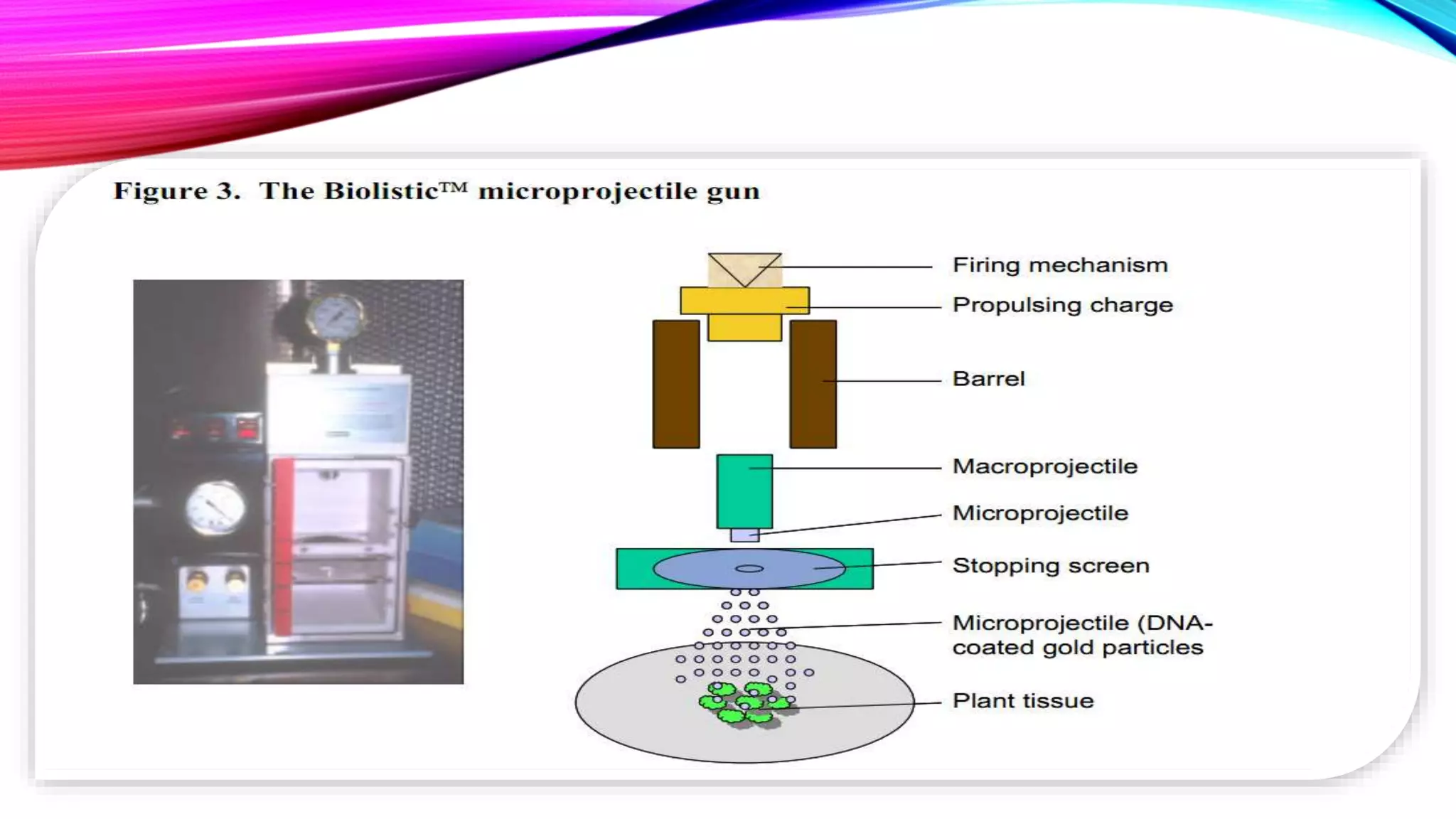
• Step 1: the gene gun apparatus is ready to fire
• Step 2: Helium fills the chamber and pressure builds against the rupture disk.
• Step 3: the pressure eventually reaches the point where the rupture disk breaks, and
the resulting burst of helium propels the DNA/gold-coated macrocarrier ('Plastic
Disk') into the stopping screen.
• Step 4: when the macrocarrier hits the stopping screen, the DNA-coated gold
particles are propelled through the screen and into the target cells.
WORKING……
• The DNA to be transformed into the cells is
coated onto microscopic beads made of
either tungsten or gold
• The coated beads are then attached to the
end of the plastic bullet and loaded into the
firing chamber of the gene gun
• An explosive force fires the bullet down the
barrel of the gun towards the target cells that
lie just beyond the end of the barrel
CONTI……
• When the bullet reaches the end of the barrel it is
caught and stopped, but the DNA coated beads
continue on towards the target cells
• Some of the beads pass through the cell wall into the
cytoplasm of the target cells
• Here the bead and the DNA dissociate and the cells
become transformed
• Once inside the target cells, the DNA is solubilized
and may be expressed
APPLICATIONS……………
IN PLANTS………….
• This technique has been used successfully
to transform soyabean, cotton, spruse,
sugarcane, papaya, sunflower, rice, maize,
wheat and tobacco
• The particle gun has also been used with
pollen, early stage embroyoids, meristems
and somatic embryos
• The use of the gene gun may be
contrasted with the use
of Agrobacterium tumefaciens and its Ti
plasmid to insert DNA into plant cells
HUMAN AND OTHER
ANIMALS…………..
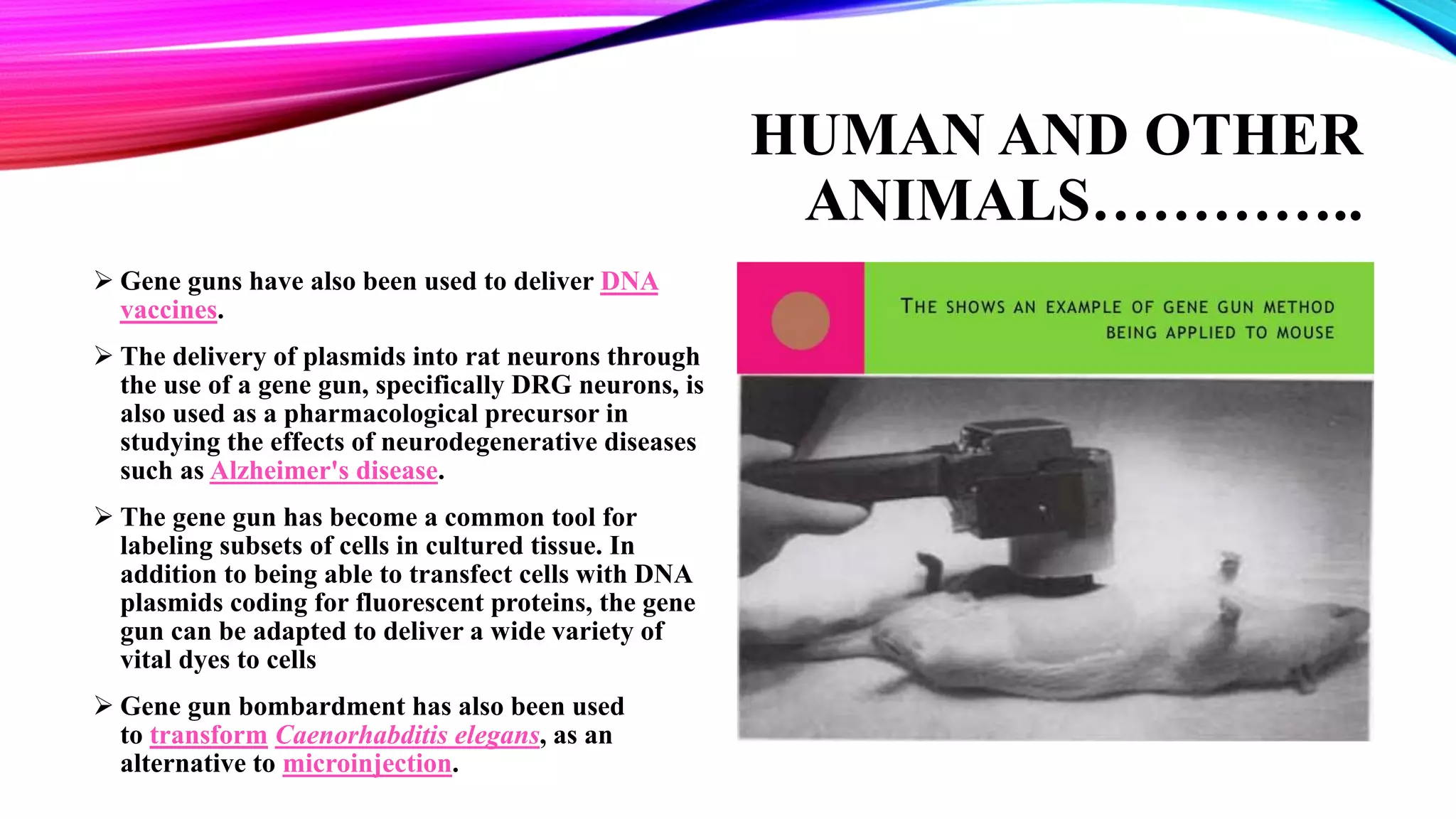
 Gene guns have also been used to deliver DNA
vaccines.
 The delivery of plasmids into rat neurons through
the use of a gene gun, specifically DRG neurons, is
also used as a pharmacological precursor in
studying the effects of neurodegenerative diseases
such as Alzheimer's disease.
 The gene gun has become a common tool for
labeling subsets of cells in cultured tissue. In
addition to being able to transfect cells with DNA
plasmids coding for fluorescent proteins, the gene
gun can be adapted to deliver a wide variety of
vital dyes to cells
 Gene gun bombardment has also been used
to transform Caenorhabditis elegans, as an
alternative to microinjection.
ADVANTAGES……….
• Requirement of protoplast can be avoided
• Walled intact cells can be penetrated
• Manipulation of genome of subcellular organelles can be achieved
• This technology has even allowed for modification of specific tissues in situ,
although this is likely to damage large numbers of cells and transform only some,
rather than all, cells of the tissue
• Relatively high efficiency
• Technical simplicity
LIMITATIONS………..
• Integration is random
• Requirement of equipments
• Shallow penetration of particles
• Associated cell damage
• The tissue to incorporate the DNA must be able to regenerate
• Equipment itself is very expensive
Biolistics

Biolistics

  • 2.
    PRESENTED BY: SUNDAS NAVEED 14-ARID-4935 MARIA KHATOON  14-ARID-4912
  • 3.
    BIOLISTICS A NEW WAYOF INJECTING GENETIC INFORMATION……………
  • 4.
    CONTENTS……………. What is biolistics???????? Genegun design Biolistics construct design Applications 1. Plants 2. Human and other animals Advantages limitations
  • 5.
    BIOLISTICS……………….?????? • Artificial directmethod of DNA transfer • One of the novel physical method of exogenous DNA transfer • This physical method uses accelerated micro projectiles to deliver DNA OR other molecules into intact tissues and cells • Also known as GENE GUN or particle bombardment
  • 6.
    GENE GUN………….????? • Agene gun is a device that literally fires DNA into target cells
  • 7.
    GENE GUN DESIGN………. •The gun gene was originally a Crosman air pistol modified to fire dense tungsten particles • It was invented by John C Sanford, Ed Wolf and Nelson Allen at Cornell University, and Ted Klein of DuPont, between 1983 and 1986 • expressed the gene. • The original target was onions (chosen for their large cell size) and it was used to deliver particles coated with a marker gene. Genetic transformation was then proven when the onion tissue expressed the gene
  • 8.
    PRINCIPLE STEPS…………. • Step1: the gene gun apparatus is ready to fire • Step 2: Helium fills the chamber and pressure builds against the rupture disk. • Step 3: the pressure eventually reaches the point where the rupture disk breaks, and the resulting burst of helium propels the DNA/gold-coated macrocarrier ('Plastic Disk') into the stopping screen. • Step 4: when the macrocarrier hits the stopping screen, the DNA-coated gold particles are propelled through the screen and into the target cells.
  • 10.
    WORKING…… • The DNAto be transformed into the cells is coated onto microscopic beads made of either tungsten or gold • The coated beads are then attached to the end of the plastic bullet and loaded into the firing chamber of the gene gun • An explosive force fires the bullet down the barrel of the gun towards the target cells that lie just beyond the end of the barrel
  • 11.
    CONTI…… • When thebullet reaches the end of the barrel it is caught and stopped, but the DNA coated beads continue on towards the target cells • Some of the beads pass through the cell wall into the cytoplasm of the target cells • Here the bead and the DNA dissociate and the cells become transformed • Once inside the target cells, the DNA is solubilized and may be expressed
  • 12.
  • 13.
    IN PLANTS…………. • Thistechnique has been used successfully to transform soyabean, cotton, spruse, sugarcane, papaya, sunflower, rice, maize, wheat and tobacco • The particle gun has also been used with pollen, early stage embroyoids, meristems and somatic embryos • The use of the gene gun may be contrasted with the use of Agrobacterium tumefaciens and its Ti plasmid to insert DNA into plant cells
  • 14.
    HUMAN AND OTHER ANIMALS………….. Gene guns have also been used to deliver DNA vaccines.  The delivery of plasmids into rat neurons through the use of a gene gun, specifically DRG neurons, is also used as a pharmacological precursor in studying the effects of neurodegenerative diseases such as Alzheimer's disease.  The gene gun has become a common tool for labeling subsets of cells in cultured tissue. In addition to being able to transfect cells with DNA plasmids coding for fluorescent proteins, the gene gun can be adapted to deliver a wide variety of vital dyes to cells  Gene gun bombardment has also been used to transform Caenorhabditis elegans, as an alternative to microinjection.
  • 15.
    ADVANTAGES………. • Requirement ofprotoplast can be avoided • Walled intact cells can be penetrated • Manipulation of genome of subcellular organelles can be achieved • This technology has even allowed for modification of specific tissues in situ, although this is likely to damage large numbers of cells and transform only some, rather than all, cells of the tissue • Relatively high efficiency • Technical simplicity
  • 16.
    LIMITATIONS……….. • Integration israndom • Requirement of equipments • Shallow penetration of particles • Associated cell damage • The tissue to incorporate the DNA must be able to regenerate • Equipment itself is very expensive